Chapter XIII
Reading edition
THE THIRD CIVIL WAR (1568). NEW CATHOLIC LEAGUE. THE BATTLE OF JARNAC
The peace of Longjumeau, more than any treaty of the civil wars, was a tentative settlement, an armistice merely. It was chiefly compelled by the lack of funds of both parties and from its signature was more openly opposed and protested against than any other of the treaties. Suspense over the probability of a third and worse war prevailed from the beginning. For while many on each side returned to their homes, there were many others who had no place to which to retire, for whom vagabond life had attractions and who preferred war to peace and plundering to honest labor.[1212] Both sides were too suspicious and too fearful to lay down their arms. So many of the Huguenot captains kept their troops in the fields that the King wrote to no less than 212 places charging the governors thereof to scatter these bands. Many known to have been in arms hid them in secret places and were, in consequence, not permitted to return to their native places until such arms were given up. The Catholic resentment seems to have been strongest in Paris[1213] and Burgundy, though in the former the provost of the merchants made the singularly sane plea to the King to have an especial regard for justice lest its denial might stir the Protestants to new strife. In general, though, wherever the King’s garrisons were stationed there was trouble.
It was not long before the Guise opposition organized. Failing of their hold upon Charles IX, the Guises directed their efforts upon his brother, Henry, duke of Anjou, whose Catholic sentiments[1214] were less impeachable than those of Charles and who began to “show some tokens of an ambitious heart,” was a sworn Catholic, and showed great offense at his royal brother’s action in “very courteously” entertaining the cardinal Châtillon, the count Rochefoucauld, and Brocarde, the Protestant governor of Orleans.[1215] On the night of March 29 a secret conference was held at the Louvre of the leaders among the Guise party, in which it was proposed that a pacific attitude be pretended until the disarming of the prince of Condé’s forces and the withdrawal of the reiters had taken place, and then suddenly to seize Orleans, Soissons, Auxerre, and La Rochelle—the Huguenot strongholds—for which duty Lansac, Martigues, Chavigny, and Brissac were to be appointed, reinforce the garrison of Paris, and send the ferocious Montluc into Gascony to subjugate the strongest Protestant provinces, seize the sea-ports, and drive a Catholic wedge in between Poitou and the territories of the queen of Navarre, who already had taken the precaution to strengthen her defenses. By some means, perhaps through the marshal Cossé, who was a Politique at heart, the cardinal Châtillon learned of the plot the very next day, and straightway informed the marshal Montmorency, another moderate, of it. At the same time the plan was discovered from another source to the prince of Condé. When Charles IX was taxed with information of it, he swore that the whole thing was done without his knowledge, accused the cardinal of Lorraine of treasonable practice, and calling for pen and ink wrote to Condé promising “good and sincere” observation of all that had been agreed upon at Longjumeau.[1216]
It will be observed how completely this plan of the Guises for the subjugation of Guyenne and Gascony is in alignment with the views of Montluc which he had expressed to Philip II.[1217] Hitherto the King of Spain had been sustaining two separate lines of secret correspondence, one with Montluc direct; the other with the cardinal of Lorraine through the duke of Alva. These two lines now are fused into a larger whole, at least so far as the Spanish king is concerned.[1218] Montluc is the military, the cardinal of Lorraine the diplomatic, agent of Philip’s purposes.
The development of the Holy League has now advanced another stage in its evolution. The old warrior had not discontinued his secret relations with Spain, in spite of his warm denial of the fact to the queen mother, who taxed him with it,[1219] but through Bardaxi still kept in communication with Philip II. We find him writing twice to the King in February 1567 and Philip responding in terms of encouragement in the following month.[1220] Guyenne was peculiarly vulnerable to such an attack as was now contemplated, and Montluc was certainly the best captain to execute it. The army of the Huguenots there was in a bad state.[1221]
The instrument was already forged to Philip II’s hand in the local Catholic leagues in France. His interest in these was one of the silent activities at Bayonne. The instructions to the duke of Alva and to Bardaxi were almost identical. “As the queen mother lacks either fixity of ideas or honesty of purpose”—the words are those of the procès-verbal framed in the Spanish council-chamber, it is necessary to encourage the practices of Montluc and the Catholics.[1222] It must have been a source of delight to the Spanish king to observe the rapid increase of these associations. There are two changes to be noticed in these provincial leagues: their increasingly popular character, and their tendency to fuse together. Hitherto they had been local in their operations. Now a process of federation is to be observed by which the provincial leagues are gradually welded into one whole—in a word the mighty Sainte Ligue of 1576 potentially exists now.[1223] The federative tendency of these associations was a natural result of their increase in number and membership. It was not a haphazard development at all. Design is evident throughout.[1224]
The renewal of civil war in 1567 had given a great impulse to this spirit of association.[1225] Nowhere was it more pronounced than in Burgundy. Tavannes, who was governor of Burgundy, in the year 1567 (July 18), formed a league under the name of the Confrérie du St. Esprit. Churchmen, the nobility of Burgundy, and wealthy bourgeois who wished to preserve the Catholic religion were united together in the service of the King. The version of its origin in the Mémoires de Tavannes is so interesting that I venture to quote it:
Seeing so much discontent and so many threatening enterprises among the Huguenots, the queen, for safety’s sake, in the beginning of the year 1567 caused a levy of 9,000 Swiss [the actual number was 6,000] to be made under pretext that they were to be for the service of the duke of Alva in the Flemish War. The prevailing unrest and the rumors of insurrection gave the sieur de Tavannes, who penetrated the designs of the queen and the purpose of the Huguenots, the thought that a prudent man might also take precautions of his own. He reasoned that the Huguenots did not have more zeal for their cause than the Catholics for the old religion, and that those who would preserve it would give their lives and employ their last sou to succor the King; in a word, oppose league to league. He therefore organized the Confrérie du St. Esprit, which in reality was a league of the ecclesiastics and the nobility of Burgundy, with rich men from the towns, who voluntarily swore to serve in the interest of the Catholic religion against the Huguenots, sacrificing both person and property for the sake of the King. Without using coercion he gave orders for the enrolment of men-at-arms and the collection of money, created warders, spies, and messengers, in imitation of the Huguenots, in order to discover their machinations. The oath subscribed to justified this design. Each parish of Dijon paid its men for three months, and each town contributed 200 horse and 250 footmen. Burgundy could furnish 1,500 horse and 400 men on foot, paid for three months of the year. The sieur de Tavannes summoned an assembly in the Maison du Roi, ... and there caused the oath to be read.
The oath began:
We swear by the most holy and incomprehensible name of God, the Father, Son, and Holy Spirit, in whose name we have been baptized, and we promise on our honor and the peril of our lives that, henceforth, at all times, through the chiefs and those who shall be named by the King under these articles, we will make known any enterprise that may work contrary to our said law and faith of which we have made profession in our baptism, and which we have maintained by the grace of God to the present, and also to make known every enterprise, which may clothe itself in hatred of the maintenance of the said faith, against the said royal Majesty, madame his mother, and messieurs his brothers, who rule over us by divine permission.
And further on in the oath:
We swear and promise in the present writing to render all friendship and fraternity the one to the other, to aid each other reciprocally against all phases of the opposite party, if they shall undertake any enterprise against any one of the signatories to the cause of this party; and for the sake of said aid we promise respectively, the one and the other, to employ all our persons, our credit, and our favors without sparing anything. And we promise to observe all the articles above sworn to without regard to friends, parents, or any relationship which we may have with those who undertake the contrary.[1226]
In the following year, on April 2, 1568, “La Fraternité des Catholiques de Châlons-sur-Saône” emerged.
A l’imitation de la majesté du Roy nostre sire [so runs the instrument], et soubs sa protection et bon plaisir ... nous avons faict entre nous et pour tous autres Catholiques qui adjoindre se vouldront une fraternité qui s’appellera Confrairie et Société des Catholiques.
And it is added—sign of omen—
Et au cas qu’il advint que Dieu ne veuille que les persones de sa majesté et de messieurs ses frères ... fussent oppressés de sorte que ne sceussions avoir advertissement de leurs volontez, promettons rendre toute obeissance au général chef qui sera esleu.[1227]
Six weeks later, on May 18, 1568, through the activity of Tavannes, a similar association was formed in Berry and was confirmed at Bourges by the archbishop, Jacques le Roy.[1228] A month later La Ligue Chrétienne et Royale, “for the defense of the Catholic church in France and for maintaining the royal authority in the House of Valois,” to which was appended the significant proviso, “so long as it shall govern in the Catholic and Apostolic religion” appeared in Champagne under the auspices of Henry of Guise, then eighteen years of age and governor of the province. The nobility, the bishop, and the clergy, in a meeting at Troyes, concluded, signed, and took an oath to this league on June 25.[1229] Exactly a month later, on July 25, the Beauvaisis followed the lead of Burgundy, Berry, and Champagne, and formed an “Association Catholique” for the same purpose.[1230] The movement also spread west of the Seine, into Maine and Anjou, where the clergy, the nobility, and the third estate, on July 11, 1568, established an association whose members swore “de vivre et mourir en la religion catholique et de nous secourir les uns et les autres contre les rebelles et hérétiques sectaires de la nouvelle religion.” Forty persons signed the oath.[1231]
In Toulouse, the former league was revived in September, 1568, with new energy under the patronage of the cardinal of Armagnac and actual leadership of a secular priest who preached war upon the Protestants with a crusader’s zeal. On September 12 the latter gathered those desirous of reviving the association in the cathedral of St. Etienne where a solemn oath was taken by all, who promised to devote life and property to the support of the catholic religion. The league thus formed was officially entitled La Croisade, with the motto: “Eamus nos, moriamur cum Christo.” All its members wore a white cross.[1232] Even some of the smaller towns followed the example of the provinces and large cities. At Anduze in Lower Languedoc at this same time the churches formed a Catholic union.[1233] The movement actually spread into Lower Navarre where in the same month, September, the sieur de Luxe and some others, at the instigation of the cardinal of Lorraine, perhaps, formed a league at St. Palais for the purpose of driving out the Calvinist preachers in St. Palais. They seized La Rive, the pastor at St. Palais, Tarde, pastor at Ostabanès, both of whom were imprisoned in the house of De Luxe. But the prompt conduct of Jeanne d’Albret and the prince of Navarre, who won his spurs in the siege of Garris, speedily crushed this association.[1234]
In view of this spontaneous organization of the Catholics everywhere, it was inevitable that the peace of Longjumeau would be of short duration, even if there had been no special circumstances to bring it to an end.[1235] The Guises, after the discovery of their secret conference of March 29, for the time being sought to dissemble their feelings and purposes, and not to offend the King’s anger. When it was observed in the royal presence that great inconvenience was likely to arise in France for want of obedience to the edict, the cardinal of Lorraine, hearing the remark, replied “Sur ma conscience, il n’y a rien plus necessaire.”
The feud between the Guises and Montmorencys seemed likely to involve the state in war before very long.[1236] The quarrel between the two houses was the more intense at this time owing to the fact that the duke of Anjou’s retention of the lieutenantship, in which office the Guises supported and maintained him for their own purposes, gave offense to the marshals, Montmorency, Damville, and Vieilleville; the more so because they were all moderate Catholics and were dissatisfied with the duke’s bigoted Catholic leanings and affiliation with the Guises; they argued that “it had not been seen heretofore, that the King should have a lieutenant,” that the continuance of such a title, especially in time of peace, was a prejudice to their station,[1237] adding significantly that they “being marshals knew what appertained to their charges.” The strife between the factions soon became so severe as to dismay some, especially the cardinal of Bourbon, who threatened “that in case the King would take no better order than he had done, he would depart the court and give the world to understand how he had at heart the honour of his house and the welfare of his friends.” The chancellor L’Hôpital, having vainly endeavored to soften the strife, asked leave to be discharged of his office—an event which the cardinal of Lorraine would have hailed with delight. As it was, the Guises used Anjou to abuse the position of the chancellor.[1238]
The continued presence of the reiters and the Swiss also added to the anxiety of those who were peaceably inclined, for “there was not a town or a village in the Ile-de-France that was not furnished with soldiers,” the country indeed teeming so much with them that traveling now was more perilous even than during the wars.[1239] The 6,000 Swiss still remained within four leagues of Paris at the last of May. The reiters of the prince stopped in Burgundy and plundered the country; while the prince of Condé vainly demanded that they be paid at once.[1240] At Dijon five of them were slain by the desperate populace and a massacre of thirteen of the inhabitants followed.[1241] Many thought that the war would be renewed the moment the harvest was gathered.[1242]
Late in May the duke of Montmorency left Paris for Chantilly, while his brother Damville stayed in the capital. The action of each was significant. At Chantilly the cardinal Châtillon and other Protestant nobles deliberated, while in Paris Damville’s house was frequented by those hostile to the cardinal of Lorraine’s authority, notably the four marshals, all of whom inveighed against him and were popularly believed to be forming a new opposition to him.[1243] The Huguenot leaders, Condé, Coligny, D’Andelot, all lay in various castles throughout the Ile-de-France, with captains, soldiers, and gentlemen around them, and so distributed that no river separated them one from the other, while one ford between Paris and Rouen was kept open to enable those of the religion in Picardy to keep in touch with the prince.[1244] So skilfully was the distribution made that the leaders could have been able to unite within a day and a half if necessary.[1245]
The strain upon Charles IX soon began to tell. He was heard to say that he would rather lose his crown outright than live in continual fear, and as the feud became intenser, the King yielded and finally showed his hand by displacing the marshal Montmorency as governor of Paris, though he dared not go quite so far as to put Henri d’Anjou in his room, but chose his youngest brother, the duke of Alençon.[1246]
We discover at this time the germ of the Politique party.[1247] If the Guises had been aware of the astonishing diplomatic stroke Montmorency had conceived in his retreat at Chantilly and which he had communicated to the Huguenot leaders, they might not have pressed the case of Anjou so insistently. This scheme was to separate the King’s brother from his attachment to the Guises and at the same time enlist English aid in support of religious toleration in France—the aim of the Politique party—by nothing less than bringing about the marriage of the Valois prince with Queen Elizabeth. At the same time Montmorency, by gaining the favor of the duke, would work the cardinal out of power. To this end the duke approached the English envoy in France.[1248]
Day by day the animosity of the parties grew. In a certain sense the peril of the times was greater than during a state of war. Daily murder by dagger and by drowning, and violation of property took place throughout France, to such an extent that it was said more had been murdered since the publication of the peace than were in the war which it was supposed to have concluded.[1249] But although the animosity of the parties was strong enough to incite them to war, the renewal of hostilities was yet very dependent upon the fluctuation of events in the Netherlands,[1250] and at this moment the balance there was inclined in Spain’s favor.[1251]
William of Orange, while not in alliance with the French, nevertheless sought to avail himself of the services of the 4,000 reiters which John Casimir had raised for the French Protestants, whose use was no longer required by the Huguenots after the peace of Longjumeau. A horror of Spanish cruelty was beginning to pervade Germany and brought him sympathy and support.[1252] Calvinist Europe built high hopes upon this assistance for the Dutch.[1253] But Orange was straitened for money[1254] and it was not until the middle of August that he was ready to return to give Alva battle with an army of 6,000 horsemen and four regiments of foot, besides the Lorrainers and Gascons who were all gunners. According to the plan of the prince, three armies were to enter the Netherlands at once, the French under a Huguenot leader named Cocqueville, through Artois; the Count of Hoogstraeten between the Rhine and the Meuse, and Louis of Nassau through Groningen.
But the whole plan failed. Cocqueville raised seven or eight hundred men with the intention of provoking Artois to revolt.[1255] Failing to take Doulens by surprise, Cocqueville pillaged the abbey-town of Dammartin. The duke of Alva energetically protested to Charles IX against this violation of the Spanish provinces by French subjects, and the marshal Cossé was sent into Picardy. The foreigners in Cocqueville’s band were summarily beheaded at St. Valéry, the leader himself was sent to Abbeville for trial for treason and executed, and the whole expedition came to naught.[1256] The enforced delay of the prince of Orange, united with this repulse, was fatal to the Netherland project. On July 21, 1568, Louis of Nassau was defeated at Jemmingen by Alva, Spanish tyranny was fixed more firmly in the Low Countries, and Egmont and Hoorne were shortly afterward sent to the scaffold.[1257]
Everything was now out of joint. The success of the Dutch would have emboldened their French coreligionists to renew the struggle with some hope of success.[1258] But the Catholic victory in the Low Countries hardened the resolution of the French government. Hitherto chiefly the lesser nobility of France had been successfully coerced by the French crown. Now the cardinal of Lorraine intended to do the like with the higher nobles, compelling them either to abandon their religious and political contentions or to take up arms.[1259] At the same time military preparations began to be made which could not but be viewed with alarm by the Huguenots. The crown was stronger in cavalry, in infantry, in artillery, and in munitions. The country as a whole was with the King, and the chief cities were in his hands. “The great cities,” said Coligny mournfully, “are the tombs of our armies.”[1260]
So carefully were the preparations made that the King remained armed while the Huguenots were scattered and unarmed,[1261] saving large numbers of individual nobles who yet stood upon their guard. In northern and central France, La Rochelle excepted, the government controlled all the towns. In Provence and Languedoc, however, many of the towns were governed by the Protestants.[1262] In order to prevent the communication of intelligence between the various parts of France under Protestant control, Charles IX even had refused to permit Condé to levy money upon the Huguenots for payment of the reiters, notwithstanding the governments’ own poverty, although the prince cunningly suggested such an action.[1263] The outlook was dark indeed. The Huguenots nowhere save in the south seemed strong enough to take the field, and it seemed hopeless for them to expect to join with their coreligionists of the north owing to the vigilance of Montluc in Languedoc and Tavannes in Burgundy and to the fact that the whole course of the Loire was patrolled by forces of the government. Moreover, the general contribution being stopped, both resources and communication were at an end; the gentry too were impoverished by the late war to a very great extent, having “consumed as much in eight months as they had gathered in four years before,”[1264] so that the wisest of the Huguenot leaders were of the opinion that the religion was not in a state to attempt anything by open arms.
While he tried to augment his forces Condé sought to remedy matters by appeal to the King,[1265] complaining of the outrages inflicted on the Huguenots[1266] (Montluc had even hanged seven gentlemen of the entourage of the queen of Navarre, in Languedoc), being careful not to impute these wrongs, however, to the King, but reprobating the malignancy of the cardinal of Lorraine and accusing him of secret intelligence with Spain.[1267] The cardinal, thus assailed, parried through the King, who two days later issued a proclamation, which after reciting the complaints of murder, robberies and other wrongs alleged by those of “the pretended Reformed religion,” declared that the King, having sent his maîtres des requêtes into the provinces where these acts of violence had been perpetrated, was satisfied of the substantial justice of the administration, and asserted that the complaints had either been manufactured by the Huguenot leaders, or else grossly exaggerated. The proclamation closed by commanding all judges and other officers, on pain of deprivation, to search out and punish wrong-doers, so that those of the religion might not have ground for complaining that justice was not done them.[1268]
Such a proclamation was mere verbiage, however, and was intended to lull the anxiety of the Huguenots while the government’s preparations went forward. It deceived none of the Protestant leaders. The signs of the times were too plain to be concealed. Arms were secretly levied and stored in La Rochelle, Saintes, Châtellerault, St. Jean-d’Angély.[1269] To these signs was now added another unmistakable indication. In August, 1568 the concentration of fourteen companies of gendarmes and several bands of infantry in Burgundy, where the two most conspicuous of the leaders of the Huguenots then were—the prince of Condé and Coligny[1270]—ostensibly to prevent the prince from delivering his German reiters to the prince of Orange, precipitated civil war anew.
Protestant historians have contended that the government of Charles IX was wholly to blame for the renewal of war. But it may be fairly said that Charles IX acted not only according to his right, but according to policy in seeking to prevent the union of the Huguenot and Dutch interests. France was not yet prepared to espouse an open anti-Spanish policy, though she was already secretly so inclining,[1271] and the projected alliance of the prince of Condé and the prince of Orange[1272] would have been certain seriously to compromise her with Spain. Finally, it may be added, that there was not a little of self-ambition in Condé’s action.[1273]
This attempted co-operation of the prince of Condé and the prince of Orange drew the French government into close association with the duke of Alva. But the diplomatic relations now established between the courts of Paris and Madrid were of much greater importance and the negotiations were energetically forwarded by the cardinal of Lorraine, who on November 21, sent the cardinal of Guise into Spain charged to treat of marriage between Philip II and Marguerite of Valois,[1274] or if that proved unacceptable, to suggest Philip’s marriage with one of the daughters of the Emperor, while Charles IX was to marry the other. At the same time Alva proposed that the duke of Anjou—the future Henry III—should marry the queen of Portugal.[1275] The far-reaching effect of such a series of alliances is manifest. The two houses of Hapsburg would become dynastically united again in a common family and politico-religious purpose, into which association France would be woven.
The government had secretly prepared for the sudden investment of La Rochelle, intending to “spring” the war suddenly at that point, but had been compelled to alter the plan. This change of plan induced the resolution to attempt to capture the prince and Coligny,[1276] the purpose of the Guises (with whom the King and his mother were not acting) probably being to send them to the scaffold, as Alva had done with Egmont and Hoorne.
But the deception and duplicity which they used to allay the suspicions of the prince and the admiral offended the bluff, soldierly honor of Tavannes, who, though a bigoted Catholic, would not stoop to such a dishonorable course of action.[1277] While feigning to obey the orders to capture the two leaders, he contrived to apprise them of their danger by managing so as to have his letters intercepted by them.[1278] Thanks to this timely warning, escape was made possible. On August 23, 1568 Condé and Coligny, accompanied by the members of their families and D’Andelot’s—the princess of Condé being pregnant—crossed the Loire in sudden flight, guarded on the road by a hundred horsemen. The fugitives were bound for La Rochelle, which was safely reached without mishap, though not without peril.
From the safe retreat of this famous port and stronghold the prince of Condé issued a manifesto protesting that he and his followers intended nothing prejudicial to the King, but only to protect those of the religion from the tyranny and oppression of their enemies. A form of oath was adopted, to be taken by the nobility, officers, and others of the prince’s army, regulations were issued for the maintenance of discipline in the army, for the prevention of desertion, private plundering, and avoidance of excess of baggage, camp-followers, disorders, and quarrels.[1279]
The government at once took up the gage of battle and prepared to push the war. On September 25, 1568, an edict proscribed the Reformed faith, exiled the pastors thereof, and excluded Protestants from public offices and from the universities.[1280] As far back as July the government had begun negotiations with the Pope to secure license to alienate from the lands of the church 200,000 crowns per annum. This had failed when first petitioned,[1281] but the cardinal of Lorraine by the end of August had managed to raise 1,200,000 francs, although half of it had to go to pay old debts to the Parisians.[1282] The holy father, having at last been persuaded of the good of the cause, consented to the alienation of 100,000 crowns annual rent of the clerical lands, upon condition that the money be strictly employed for the compulsion of those who denied the authority of Rome and the revocation of the Edict of Toleration.[1283] The debate upon the measure pertaining to the church lands brought about a clash in the King’s Privy Council between the cardinal of Lorraine and the chancellor L’Hôpital, on September 19. The latter protested against the withdrawal of the Edict of Toleration, on the ground that it would induce the war at once and lead to the overrunning of the country again by the reiters, and refused to affix the royal seal to the proposed ordinance, without which the papal writing was of no force in France. The cardinal retaliated by taunting the chancellor with being a hypocrite and asserted that his wife and daughter were Calvinists. L’Hôpital retorted by sarcastically alluding to the notorious administrative practices of the Guises, at which the cardinal became so angry that he would have seized the venerable chancellor by his great white beard if the marshal Montmorency had not stepped between them. In his rage the cardinal, turning to the queen mother, declared the chancellor’s vicious policy of toleration was at the bottom of the evils of France and that if he were in the hands of the Parlement of Paris his head would not tarry on his shoulders twenty-four hours longer.[1284] The issue of this episode was not long in forthcoming. On September 28 Michel de l’Hôpital was dismissed from office[1285] and the seal given to the archbishop of Sens, Biragues, a pupil of the Guises and a henchman of Philip of Spain.[1286] It was he who rescinded the Edict of January and the other two edicts of pacification and exiled all Huguenot preachers from France within twenty days, forbade all exercise of the Reformed religion on pain of death, and dismissed from office and the universities all those who were Protestants.
The new civil war was represented as a war of religion; indeed as a crusade, the King going to evensong at La Sainte-Chapelle, on Michaelmas Eve, where the heart of St. Louis was interred, and on the morrow marching in procession with the relics of St. Denis, as did the former kings of France before they took the road of the cross. The duke of Anjou, the King’s brother, was appointed lieutenant-general of the realm on September 1, and proclamation made to the companies of gendarmerie and the bands of archers, to assemble at Orleans, now become the Catholic headquarters.[1287]
Charles IX, in October, went in person to Orleans, in order by his presence, to enlarge the enlistments, and also to overcome the suspicion that the whole movement was made at the instigation of the Guises. The government of Paris was left to the King’s youngest brother, the duke of Alençon, assisted by the duke of Montmorency. In the meantime the prince of Condé had remained in the vicinity of La Rochelle during September, while his army was gathering.[1288] When the army was massed, he moved up the Loire with his forces.
The emulation that had characterized the Huguenot nobility in the last war now served Condé well. The provinces were alive with activity during this autumn. The young prince of Navarre, the future Henry IV, was to win eminence in the coming struggle, and at this time was at Bergerac where forces were assembled to assist Condé.[1289] The Catholic and governmental forces were no less alert. The King’s captains were employed in all parts of the realm to levy men. Montluc, discovering a plot in Bordeaux to deliver the town to those of the Reformed religion, executed the greater part of those so accused. At Toulouse, Auxerre, and Lyons all men were constrained to go to mass. In Provence and Languedoc the peasantry even rose against the Protestants. To crown all both sides levied reiters in Germany.[1290]
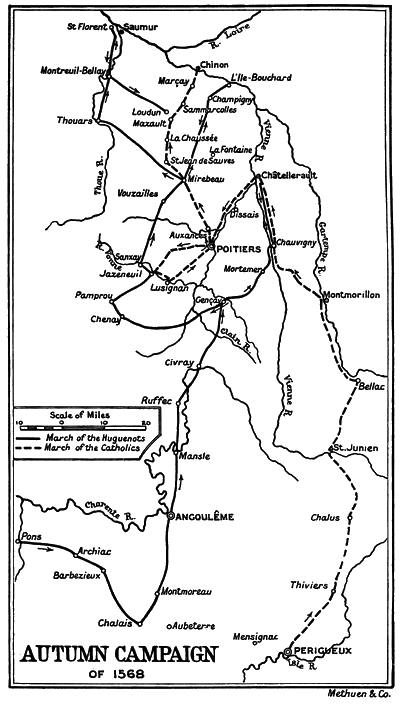
The lower course of the Loire was the fighting-line, for command of which both sides aimed.[1291] The tactics of Anjou were to avoid an engagement, if possible, and to prevent Condé’s forces from crossing, which he succeeded in doing through a stratagem.[1292] The passage of the Loire being stopped, and the river towns being all garrisoned, especially Saumur, the prince of Condé, after taking the castle of Champigny which belonged to the duke de Montpensier, fell back on Loudun. The country was so wet that neither horse nor foot could do much. The prince excelled in cavalry, the Catholic army in infantry.[1293] In the provinces the Catholic preponderance was marked. The duke of Aumale in Champagne had 18 companies of men-at-arms and 25 ensigns of footmen, awaiting the coming of the reiters; Marshal Cossé was in Picardy with 15 companies of men-at-arms and 2,000 footmen. The reason for the presence of so many troops so far from the actual seat of the war is to be found in the fact that the movements of the prince of Orange, who had entered France in December,[1294] gave great anxiety to the government. The prince was now on the borders of Picardy, but his horsemen rode as far as Compiègne and Rheims, to the amazement of the court and the consternation of the Guises, who dispatched the cardinal of Guise to Madrid for the help of Philip II.[1295] If the two princes could have effected a junction in the meantime, Paris would have been between hammer and anvil. As it was, the danger was so great that the King hastily began to raise an additional army in December, calling out ban and arrière-ban, and in order that the capital might be able to withstand a siege, if worst came to worst, drew all the provisions of the country roundabout Paris for a space of ten miles into the city.
The position of the various armies was an interesting one. In east France the reiters of the duke of Deuxponts were endeavoring to join Orange who delayed his movement to await their coming,[1296] while Alva dogged his steps.[1297] In the west Condé was vainly striving to cross the Loire in order to join Orange and the Protestant reiters, while the duke of Anjou was straining every nerve to keep him back. In the midst of all, Paris lay calm but tense[1298]—the undisturbed center of the cyclone of war. Both armies suffered from the terrible weather of December. The soldiers of each side were dying of famine and privation.[1299]
The hope long deferred that Condé had cherished of Orange joining him made him heartsick at last; the latter could not come, for Alva, the duke of Aumale, and the Catholic reiters under a German colonel named Schomberg—a name destined to become illustrious—were too closely watching his movements.[1300] Even had these impediments been removed, the Seine and the Loire would have had to be crossed—an impossible feat.
The winter of 1568-69 was occupied with Huguenot and Catholic negotiations for foreign support and with preparations for a renewal of the war when the spring came. Meanwhile the delay of France to pay its debts in Switzerland had gradually provoked a change of public sentiment in the forest cantons, which pushed them a few years later into espousal of Spain. The loss of its ascendency in Switzerland was a particularly hard blow to France. For the policy of Spain had been to rouse a religious war in the Alpine lands, so that her intervention would find easy entrance. The five cantons of the center were the fulcrum of Spain’s diplomatic efforts. Day by day the tension became greater, the five cantons inclining more to Spain, their neighbors leaning to France, while between the two groups Bern and Zurich continued neutral, refusing to aid the prince of Condé with either men or money.[1301]
Military events were insignificant. Anjou remained with his army in Limousin, and the prince of Condé in Périgord. On December 23, 1568, there was a skirmish near Loudun. In January Condé marched to the relief of Sancerre. The town was of very strong situation and Brocbart, the Huguenot commandant, filled a great number of wine-vats with sand and earth and used them for gabions, and so managed to hold out against five assaults,[1302] although the place was so invested by the Catholic army that the prince could do nothing to relieve it. Failing this, he marched upon Saumur in the vain hope of forcing a crossing of the Loire at some point, on the way putting the garrison of 150 men in the abbey of St. Florens at Pont-de-Cé to the sword. Both armies suffered terribly from the weather and the condition of the country.[1303]
In the King’s council the Politique party still labored for peace, and in the interim made an unsuccessful effort to restore the Edict of Toleration.[1304] The cessation of hostilities, however, was complete enough to alarm the Pope, who feared another truce would be made and used exhortation and promise in order to prevent any compromise with heresy.[1305]
The Dutch and English were attentive observers of the movement in France, the former especially, for they felt that they and the French Protestants were engaged in a common cause. From England came numbers of English gentlemen to La Rochelle, in order to follow Condé in the war, and the Channel and the Bay of Biscay were thronged with English and Dutch privateers.[1306] Elizabeth, as the saying went, wanted “to throw the stone and hide the arm.” Although the English ambassador, Sir Henry Norris, protested the innocence of his government and the queen wrote with her own hand that she would not interfere in France, Englishmen were landed at La Rochelle and in Brittany and English vessels brought over gunpowder, shoes, and arms.[1307]
While Anjou held the line of the Loire, the French government established its military base at Château-Thierry on the Marne in order to prevent communication between the Protestant German princes, especially the elector palatine and the duke of Deuxponts; or between the Dutch and its own revolted subjects. To this end it was planned that the duke of Aumale, with a force of reiters sent by the margrave of Baden and the count of Westelburg, and some troops proferred by Count Mansfeldt[1308] should be sent against the prince of Orange, while the duke of Anjou was to go against the prince of Condé.[1309] But William of Orange effected a junction with the duke of Deuxponts[1310] in spite of D’Aumale’s effort to prevent him.[1311]
The attitude of the Lutheran princes had now become more definite in favor of the Huguenots.[1312]
The international Protestant plan was to drive its blows in on either side of Lorraine and thus sever the chain through central Europe by which Philip II held his dominions together, and to separate the two houses of Hapsburg.[1313] The conduct of the Emperor furthered this project, for when Charles IX sent La Forrest to the Emperor to protest against the action of the Lutheran princes of Germany and to continue the talk of his marriage with the Emperor’s daughter, Ferdinand, while expressing his regret at the troubled state of France, received the marriage proposition coldly and complained of the damage done by the French army under the duke of Aumale within the limits of the empire,[1314] and recommended that Charles try peaceful methods instead of force for the pacification of his kingdom.[1315] Parallel with the project to co-operate with the prince of Orange and the duke of Deuxponts, Coligny planned a revival of Huguenot activity in the south of France so that this diversion would weaken resistance to the other. The aim was, with the aid of the “viscounts” to break a way across the upper Loire, and so open the road to German assistance.[1316]
The combined array against D’Aumale was too great for him to make head.[1317] Nor was the adverse double military situation the sole anxiety of the French government. Montmorency and the duke of Bouillon were so disaffected that there was even expectation of their openly joining the Huguenots. The cost of the two armies amounted to 900,000 livres a month, besides the gendarmerie and artillery, which was about two million each quarter.[1318] There was owing to the gendarmerie 12,000,000 of livres for six quarters; to the 6,000 Swiss with the duke of Anjou 300,000 livres; to those with the duke of Aumale 100,000 livres besides what was owing to the French infantry. Both of the King’s commanders were so short of funds that they were forced to seize church-plate and even reliquaries.[1319]
In these extremities Charles IX viewed the renewal of war on the opening of spring with alarm and began to think of making peace for a term, with no intention of keeping it, but merely in order to avoid a catastrophe and with the hope that some of the Huguenots might be disarmed in the interim. But suddenly the cloud was lifted. The royal army under the nominal command of the duke of Anjou, but really commanded by the veteran Tavannes, who had orders to give battle at all cost before the duke of Deuxponts could arrive, won the decisive victory of Jarnac on March 13, 1569. It was a fierce and bloody battle.
The prince of Condé, after having been dangerously wounded and taken prisoner, suffered a foul death at the hands of some unknown assassin in the royal army, who shot him with a pistol-ball.[1320] In the engagement the Scotchman, Stuart, who had killed the constable at St. Denis, was taken and brought to the duke, who said to him: “So here you are, you traitor, you who have frequently boasted that you wished to kill the queen, my mother. Now you shall receive your deserts.” At that moment the marquis de Villars, the old constable’s brother-in-law, appeared, and with his own hands executed vengeance.[1321]
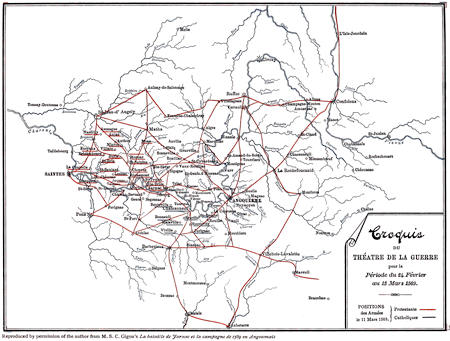
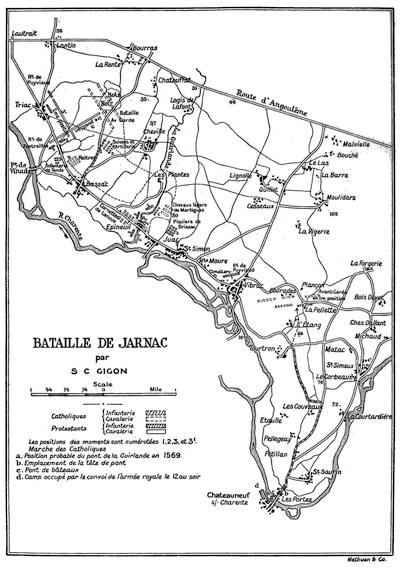
In Paris when news of the battle of Jarnac was brought a grand procession was authorized by the clergy and the Parlement. All the stores and shops were closed as though it were a holiday. The clergy, bearing the relics of the saints, marched first to the convent of the Cordeliers, and then to that of the Jacobins, where a fiery sermon was preached by a Jacobin of Auxerre named Mammerot. After the sermon the Te Deum was celebrated, and then the militia of the city assembled under the command of the four captains, and a grand review was held in the streets. The celebration ended by a great bonfire in front of the Hotel-de-Ville, and the firing of cannon.[1322]
The Pope took the victory of Jarnac as a direct answer to prayer.[1323]