Chapter VIII
Reading edition
THE WAR WITH ENGLAND—THE PEACE OF TROYES[703] (1563-64)
The closure of the civil war was a necessary condition precedent to the war France now planned to wage with her “adversary of England” for the recovery of Havre-de-Grace. Catherine de Medici had paid Coligny’s reiters in order to close the chasm as soon as possible. The keen-witted representatives of Queen Elizabeth in France—Throckmorton and Smith—had done all in their power to diussade the Protestants from making peace.[704] Too late Elizabeth perceived the result of her procrastination. War between England and France over Havre was inevitable,[705] though in March the French government dissembled its real intention, giving the English to understand that the last portion of the fourth article of the peace, which referred to putting strangers out of the realm, applied to the German reiters.[706]
The English declared that if the French would restore Calais to the queen, Elizabeth would surrender Havre-de-Grace and Dieppe, with all that was held by the English in Normandy.[707] But the French contended that the English, having occupied Havre-de-Grace, were deprived of all right to Calais,[708] and declined to entertain such a proffer, hoping to recover Havre-de-Grace by force[709] and also to remain masters of Calais by virtue of the treaty of 1559, which provided that if, during the term of the treaty, which was to endure for the space of eight years, the English acquired other possessions in France, they would immediately lose their right to Calais. To this England replied that France had been the first offender, when French troops were sent into Scotland in aid of Queen Mary; and that thereby the treaty was broken and Calais was due her. Elizabeth refused to see that her own selfish conduct had compelled the Huguenots to make terms, and bitterly upbraided the Huguenot leaders for their “desertion.”[710]
The determination to push the war proceeded entirely from the queen, the chief members of the government having opposed it both because of the strength of the fortress, which they thought difficult to take, and also because of the confusion which still prevailed in the kingdom. On April 7 the prince of Condé was established in the lieutenantship. Marshal Brissac, who was chief military commander, a week later quitted Paris for Normandy in company with the Swiss, and the whole artillery lately used before Orleans was sent forward.[711] Artillery and ammunition were sent by the river, and provisions also were forwarded. The campaign was delayed until this time for two reasons: first, to ascertain whether the internal disturbances could be quelled and the reiters gotten out of the kingdom, as otherwise it would have been perilous to make any movement in the direction of the coast; secondly, all the territory of Normandy had been so devasted by the war that the army could not be maintained except at very great cost and inconvenience. Fortunately for the French government anxiety with reference to the Emperor’s designs regarding Metz was now removed, the cardinal of Lorraine having persuaded Ferdinand that if the Three Bishoprics were restored they would become a refuge for the heretics from Lower Germany and Luxembourg.[712]
The queen mother appealed to Paris to obtain 200,000 crowns, and a royal edict commanded the clergy to contribute 100,000 écus de rentes annual revenue.[713] At the same time a government octroi upon wines was laid for six years, to the dismay of many towns, which opposed the execution of the edict, claiming that the vine and wine were their sole means of livelihood.[714] The King also went to Parlement to obtain pecuniary supplies there against England, saying that the 200,000 crowns from the city was to be used to pay the reiters of the Rhinegrave, who had mutinied for their pay in Champagne, to quit the kingdom.[715] Paris readily responded, “the Parisians caring not what they gave to recover Newhaven;” it had been “a scourge and loss to them of many millions of francs” during that year.[716]
Meanwhile the position of Warwick in Havre had grown so bad that he had expelled all strangers from the town.[717] Anticipating a siege, a new fosse 30 feet wide, 10 feet broad, and 8 feet deep had been constructed outside of the old ditch around the town. The delay of the English government, however, was fatal to the success of Warwick. All his labors went for naught.[718] On May 22 the French assault upon Havre began in earnest.[719] In the midst of the tedium and the anxiety Catherine de Medici dominated all, having no regard for her own convenience, but being in vigorous action at all hours, and under great mental strain most of the time. Yet her patience, her address, and her assiduous attention during the time of the siege to the councils of the government, and to her continual audiences, were remarkable. “Her Majesty,” wrote the Venetian ambassador, “exceeds all that could be expected from her sex, and even from an experienced man of valor, or from a powerful king and military captain.” She insisted on being present at all the assaults, and even in the trenches, where cannon-balls and arquebus-bullets were flying.[720]
The character of Catherine de Medici from this time forth, throughout her long and varied career, continued to fill her subjects with astonishment. Not even the most consummate courtier could have praised her beauty. She had big eyes and thick lips, like Leo X, her great-uncle.[721] She possessed, too, the characteristics of her family. She loved to erect public edifices; to collect books. She made a profession of satisfying everybody, at least in words, of which she was not saving. Her industry in public business was the subject of astonishment. Nothing was too small for her notice. She could neither eat nor drink without talking politics. She followed the army without regard to her health or even her life. Her physical characteristics, if not the admiration, were certainly the wonder of all. She was fond of good-living, eating much and irregularly, and was addicted to physical exercise, especially hunting, which she also followed for the purpose of reducing her weight. With this design, incredible as it may seem, she often rode clad in heavy furs.[722] When fifty years of age she could walk so fast that no one in the court was willing to follow her.
The difficulties of the French in the siege of Havre-de-Grace were very great. The locality was surrounded for the distance of a mile by marsh and by the waters of the sea, which were cut by inaccessible canals. There was a strand of sand on the seaside only about thirty yards distant from the wall at low tide. The besiegers passed along the shore, somewhat concealed by the sand and gravel cast up by the sea, and wedged themselves and their artillery between this strand and the sea, and opened fire. By the end of July the French had approached so near the walls of Havre-de-Grace that they were almost able to batter them point-blank, and the besieged went out to parley and demanded four days’ time to communicate with England.[723]
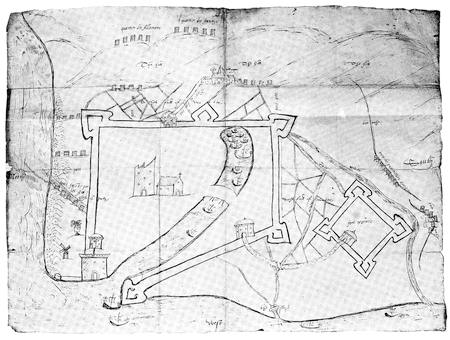
SKETCH MAP OF THE FORTIFICATIONS OF HAVRE-DE-GRACE
Dated July 15, 1563. Original in Public Record Office, State Papers, Foreign, Elizabeth, Vol. XL, No. 919.
The garrison was reduced to a sorry plight, for the French were about to storm the place, as they had already battered effectually and dismantled a bulwark and several towers of the fort and filled up the whole moat, so that with but a little more work they would have opened a road for themselves securely with a spade. They had, moreover, a battery of forty cannon, so that while only twenty or thirty shots each day formed the usual feature of a siege at this time, the French now fired more than a hundred and twenty shots.[724] At last on July 28 Warwick agreed to surrender Havre-de-Grace, and to embark in four days. Two days later the English admiral Clinton appeared in sight, with thirty ships and five galliots. The French artillery was then directed toward the sea, so the admiral set sail the next evening with the fleet, and the French army entered on Sunday, August 1, 1563.[725]
The capture of Havre was of immense immediate advantage to France, especially to Normandy, Havre being the door through which all the traffic and commerce entered, not only to Rouen, but also to Normandy, and to a great part of France. Without this commerce Normandy-of-the-Seine suffered greatly.[726]
But Elizabeth was reluctant to believe that she had been beaten, and the autumn of the year witnessed tedious negotiations.[727] The chief difficulty between the two crowns turned on the restitution of Calais. The French insisted that they were absolved from the terms of Cateau-Cambrésis through the action taken by England in the matter of Havre-de-Grace; that thereby forfeiture of the English right to Calais was made.[728] Elizabeth, on the other hand, would not make peace unless her pretensions were recognized.[729]
In the meanwhile, in the seas of Flanders, France, and England thousands of acts of piracy were committed, and trade in the Channel was quite interrupted.[730] A partial agreement at last was patched up. On April 11, 1564, the treaty of peace was signed at Troyes,[731] the articles yielding Havre-de-Grace to France, in return for 120,000 gold crowns, a sum which the English grudgingly took, though they had demanded a half million, the terms also providing for property indemnifications and freedom of commerce between the two nations.
Nothing was specified as to Calais. After three years of negotiations the question still remained unsettled. In June, 1567, Sir Thomas Smith, Elizabeth’s ambassador, demanded the restitution of Calais. Charles was evasive, saying that the messenger must be content to wait till the King had obtained the consent of his council, before whom the King told Smith openly that he would not restore Calais, but would hold it as the possession of his ancestors, to which the queen of England had no just right. When the ambassador replied, citing the word of the treaty, the chancellor answered that the promise had been given under the express conditions that the English queen should not in any way molest the subjects or territory of France or Scotland, but from what had taken place at Havre-de-Grace it appeared manifest that she had forfeited all claims which she might have had to Calais. The King’s rejoinder was notable in that it is so excellent an example of the French doctrine of “natural frontiers,” Charles IX replying to the effect that the queen ought not to regret the loss of Calais, knowing that of old it was the possession of the crown of France, and that God had willed it to return to its first master, and that the two realms ought to remain content with the frontiers created for them by nature and with a boundary so clearly defined as the sea.[732]