The War (continued 3)
Reading edition
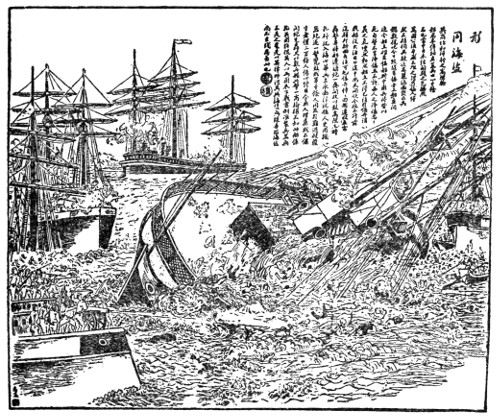
SINKING OF THE KOW-SHING. (Drawn by a Chinese Artist.)
This crisis in affairs was met, as crises usually are in China, by divided counsels; moral cowardice on the part of those who knew, blind rage on the part of those who did not know, and the submission of the judgment of the informed to the arbitrary decrees and even the insidious advice of the uninformed. To speak 547plainly, Li Hang Chang, on whom the burden of the war would in all cases rest, and who knew something, though very little, of the power of discipline and organization, and who from the first was strongly opposed to the intervention in Corea, which was forced on him by pressure applied from Peking, was for withdrawing the garrison from Asan. In answer to his memorials to the throne, he had obtained the imperial authority and had hired transports to bring the troops over into Chinese territory. But other counsels supervened, and Li Hung Chang refrained from giving effect to his own views. As the Japanese were by imperial fiat to be driven out of Corea, it followed that the garrison at Asan must be strengthened, and China committed herself to the conditions of war dictated by the enemy, an offensive war oversea, which was entirely beyond China’s capacity.
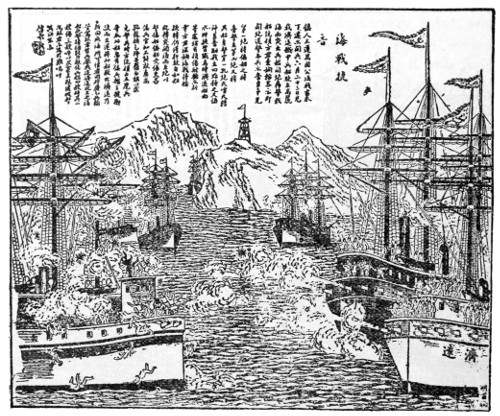
NAVAL SKIRMISH, JULY 25TH. (Drawn by a Chinese Artist.)
There were still discussions and hesitations up to the moment of dispatching troops by sea to Corea. When the expedition of 548troops was seen to be inevitable, the Chinese were advised to take at least the precaution of having the transports escorted by a strong naval squadron. This was decided to be done, and the ill-fated Kow-shing left Taku on the clear understanding that an escort of warships would join her outside Wei-hai-wei, which was two hundred and twenty miles distant, and roughly half way to Asan. But before the transport had got so far on her voyage, the official weathercock had set in another direction. The diplomatic Yuan-si-Kai, former resident in Corea, where he had done so much to irritate the Japanese, now advised that the appearance of warships with the transports might give umbrage to the Japanese, and in deference to this opinion, before the pendulum had time to swing back, the Kow-shing with twelve hundred men on board, was sent unprotected to the Bay of Asan. The Japanese consular establishment, with its wonderfully organized intelligence department, was still in Tien-tsin, perfectly informed 551of everything that was being said and done in the most secret places, and making free use of the telegraph wires.
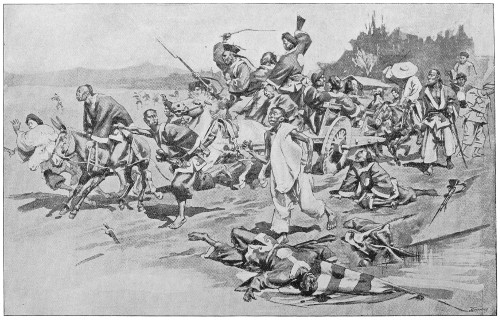
ROUTED CHINESE FLYING BEFORE THE VICTORIOUS ENEMY.
With the tragic destruction of the Kow-shing, the war was begun most disadvantageously to the Chinese. Being by one and the same stroke deprived of the expected re-enforcements and cut off from the sea, the small force at Asan had either to fight to the death, surrender, or make good their retreat by a long and dangerous flank march. This last course was adopted, and after making sufficient stand to cover their retreat, not without inflicting loss on the enemy, they succeeded in joining the Chinese army which had entered Corea from the north-west. The numbers of the retreating force were given as four thousand, but they were certainly less.
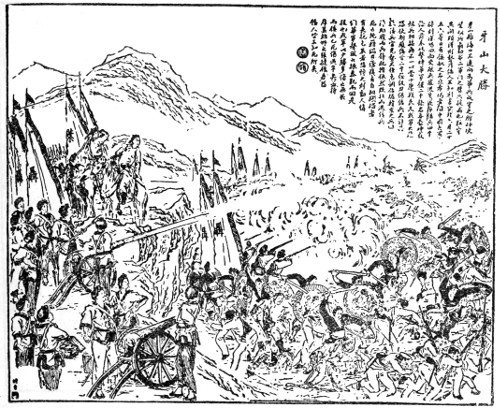
SKIRMISH ON JULY, 27TH. (Drawn by a Chinese Artist.)
The simultaneous engagements by land and sea on the same day, July 25, proved that the Japanese had determined to begin the war in earnest. The naval action in which two Chinese ships 552were waylaid as they were leaving the Corean coast, served to prove that the Chinese ships could both fight and run away, and that the Japanese ships were very ably manœuvred, but the affair had little other significance.
Enraged by the sinking of the transport in time of nominal peace, the emperor of China ordered the fleet, over the head of Li Hung Chang, to pursue the enemy to destruction. In obedience to the imperial mandate, the Pei-yang squadron, in the early days of August, steamed for the Corean coast, but before sighting it steamed back again. The viceroy Li then interested himself to obtain a modification of the decree, and the fleet was commanded to remain on the defensive for the special protection of the Gulf of Pechili, which instruction held good until the middle of September, when the fleet was forced to accept battle off the Yalu river.
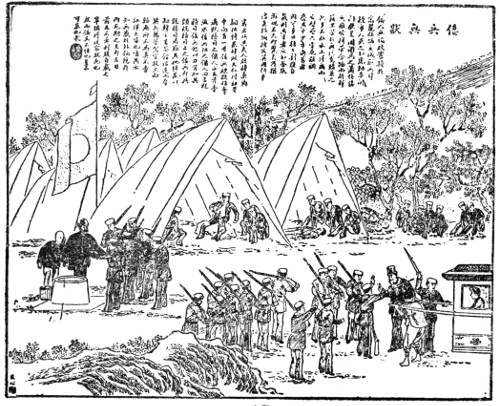
BEFORE THE WALL OF SEOUL. (Drawn by a Chinese Artist.)
August 1st, troops were ordered to enter Corean territory from 553the Manchoorian side, and in the course of the month a considerable force had filtered its way to the city of Ping-Yang, the strongest strategical point in western Corea, and even to a considerable distance beyond. The massing of these troops was conducted in the old rough-and-tumble, half-hearted Chinese fashion. There was no head, but separate and rival commands, each general looking only to the viceroy, Li Hung Chang for orders and supplies, and receiving more of the former than of the latter.
These Chinese generals are an old world curiosity, scarcely conceivable in our age. They might be described as army contractors rather than fighting agents, for like the civil mandarins they buy their posts as an investment. The battalion or camp is farmed, as regards its expenses, by the general, who draws from government a lump sum for the maintenance of the force, and makes his economies according to his conscience, by falsifying his muster roll and defrauding his men. At the battle or rout of Ping-Yang there were soldiers who were three, four, and even five months in arrears of pay, some generals deliberately calculating on the casualties of war to reduce the number of eventual claimants on the pay fund. The most notorious offender, General Wei of Ping-Yang notoriety, who had less than half the troops he drew pay for, and these mostly untrained coollies, hustled into the ranks to take the place of unpaid deserters, and in whose program fighting had no place, had paid certain influential persons liberally for his command. Desertion, it may be observed in passing, is not regarded as a calamity by an avaricious Chinese general.
Chinese officers are however by no means all abandoned to money making. Some are liberal with their funds, just as some are brave and loyal, and are backed by equally brave and loyal soldiers. The efficiencyefficiency of a force depends altogether on the personality of the general, and as in feudal times in Europe, it is to their chief rather than to any government or country that the troops feel the ties of allegiance. As the leader is, therefore, so are the men. General Tso-pao-kwei for example, who bore to his grave the honors of the fight at Ping-Yang, was a man well known to many foreigners of different classes, missionary and others, and the unanimity of good opinion of him is quite remarkable. He was not only brave, but a courteous and kindly gentleman 554who gained the affections of all around. A Mohammedan himself, all his soldiers were of the same faith, andand they stood shoulder to shoulder like heroes in the face of overpowering odds.
During the month of August, while the Japanese forces were advancing upon Ping-Yang in three columns, there were outpost skirmishes in which the Japanese were frequently worsted. These affairs were naturally enough reported by the Chinese commanders concerned, according to their lights, as victories, and when it is remembered how the view of each is bounded by the horizon of his own camp, it is easy to see how they could deceive themselves as to the significance of such apparent success. The truth seems to be that the Chinese commanders in and about Ping-Yang did not realize that they were surrounded, each perhaps thinking it was the other’s business. They had sent out no scouts, nor posted videttes to watch the mountain passes to the north of them. These elementary military precautions had been pressed on Li Hung Chang, who sent repeated orders to the front to have them seen to; but nothing was done, for according to the vicious tradition of the Chinese service, the word is taken for the deed, and orders which are either impracticable or inconvenient are simply ignored or forgotten, without the delinquent being ever called to account. Spacious but wholly fictitious excuses would in any case serve the turn in a system whose fetich is universal sham. Perhaps, as there was no commander-in-chief, but a number of independent commands, duties which concerned the army at large fell within the sphere of no one in particular. But in whatever manner it came about, the result was that the Chinese remained in comatose ignorance of the intentions of the enemy, until the only thing left was precipitate retreat.
The affair of Ping-Yang was observed by one military expert, a Russian, who speaks in high terms of the precision and completeness of the Japanese equipment and organization, but the opposition had been so contemptible throughout the war that the military qualities of the Japanese have not been seriously put to the proof. They remain a theoretical quantity. So far as the campaign had gone, to November 1, the chief obstacles encountered had been bad roads, standing crops, and sickness.
555The second day after the flight from Ping-Yang, September 17, the naval battle off the Yalu River was fought. The collision of the fleets seems to have been somewhat unpremeditated. The Chinese were engaged in disembarking troops for the re-enforcement of the army at Ping-Yang, and it is a characteristically haphazard proceeding that they should have been landing troops one hundred and twenty miles from the front, to strengthen a position already abandoned. The battle which ensued, and which raged for five hours, has been described with as much fullness as the limits of this volume permit, but the ultimate truth about it will perhaps never be fully known except of course to the Japanese government. From the Chinese side it will be impossible to obtain a consistent account, not because of intentional concealment, but because of the simple reason that no one in the Chinese fleet was able to observe accurately what was going on, except near his own vessel. Nevertheless the salient points of the battle stand out clear enough. The sea fight was but a repetition of the land fight, with two important differences. The first of these was that as the nature of the cause rendered it impossible to sail modern ships of war at all by two-thousand-year-old tactics, the mere possession of a fleet required a European organization. But the organization was imperfect, and would have been unable to sustain itself in action, but for the presence of another element in which the Chinese land forces were entirely lacking, competent foreign direction. This factor also was most imperfect. The foreign officers had been extemporized hastily, the leader of them being not even a seaman. They were of various nationalities and were enlisted about the middle of August. Three engineers, two German, one English; two gunnery officers, one English, one German; had been for some years in the fleet, and volunteered for war service. One American engaged for many years in the Chinese naval college also volunteered for active service during the war. Captain Von Hannecken, bearing now the rank of Chinese general, commissioned as Inspector General of Fortifications, was entrusted with the anomalous office of adviser of the admiral, thus giving him the real command of the fleet. An English civilian with naval training also joined.
On entering on their duties, these officers found the fleet honeycombed 556with abuses requiring patient reform, but they set themselves to make the best of things as they were, and to get the ships as quickly as possible into action, as the thing most needful in order to brace up officers and men. Von Hannecken urged unceasingly an offensive policy. He would seek out the Japanese and attack them wherever found, fall on their convoys, and generally assert the supremacy of China in Corean waters, from the Yalu eastward. In particular he urged the occupation of Ping-Yang inlet, so important for the support of the army which held the city of that name, and, if necessary, to fight to the death for the possession of a harbor at once so valuable and so easily defended. His prescience was indicated in the sequel, but to all such suggestions Admiral Ting replied with the imperial edict which forbade him to move out of Chinese waters. The convoying service for which the fleet was eventually told off in the middle of September was a sort of compromise, which, without transgressing too flagrantly the imperial restrictions, yet committed the fleet to an engagement on conditions not of its own choosing.
The handling of the respective fleets showed the great superiority of the Japanese professional training, and critics have commented on the weakness of the Chinese manœuvring, but the first consideration was to get the Chinese to fight at all. The government had satisfied itself that without foreigners to lead them, the Chinese commanders would rather lose their ships in trying to escape than stand up to the enemy. The man, the only man available, who possessed the requisite qualities, personal and professional, including a competent knowledge of Chinese, happened to be a soldier, but he at least made the fleet fight, not as a trained admiral would have done with a trained fleet, but in a manner to inspire the Chinese with some confidence in themselves, in which till then they were greatly lacking. That is perhaps the most important result of the baptism of fire of the Chinese navy.
As regards the technical bearings of the action off the Yalu, the Chinese admiral and captains adopted the formation which they said had been taught them by Captain Lang as the most advantageous for attack. But obviously a plan communicated four 557years ago by an officer whom these same men had intrigued out of their navy, when he had taken it through only half its course of training, could not be considered an infallible weapon with which to meet the thoroughly efficient navy of Japan.
The fight brought out several of the weak points of the Chinese naval organization, and taught the officers many lessons. Most conspicuously was the fatuous economy of ammunition exposed. The most formidable ships for offense and defense were of course the two iron clads Ting-Yuen and Chen-Yuen, with their twelve and one-half inch guns. These guns throw a shell three and one-half calibres long, charged with forty pounds of powder. It is a projectile of low initial velocity, but a most destructive explosive, as the Japanese have testified. There were but four of these shells in the fleet, all being on board the Chen-Yuen. Of a smaller, and of course cheaper shell for the same guns two and one-half calibres long, used for target practice, there were in all fourteen in the two iron clads, and they were fired off in the first hour and a half of the engagement, after which only steel shot was left with which to continue the fight. From the condition of the flag ship and her consort, may be inferred that of the other vessels in the fleet. They were at once however, after the battle, well supplied with shell except of the larger size.
The Chinese fleet was at a disadvantage in manœuvring from inferior speed, but a greater difficulty even than that was the perversity of the personnel. Even on board the flag ship orders were not carried out, but varied or suppressed at the discretion of the officers. In telegraphing from the conning tower to the engine room, the plans of the admiral were frustrated, by the officer who moved the telegraph signalling a low speed when the admiral was ordering a high speed, in order to close with the enemy. This trick was only discovered after the battle, by comparing notes with the German engineer who was below. How many other ways of cheating the commanding officer were resorted to during those critical hours, no one can tell. As for the other ships of the fleet, it is acknowledged that after the first round they kept no formation, each ship fighting her own battle, except the two ironclads with the foreign officers on board, which kept moving in concert till the close. The flagship lost all her signal 558halyards and a number of signal men in the beginning of the action, and thereby lost touch with the rest of the squadron.
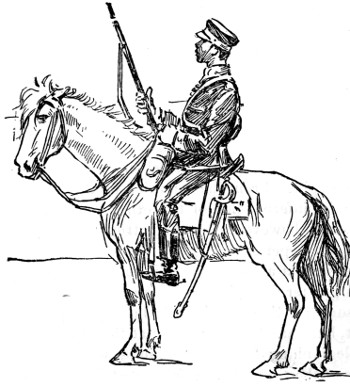
JAPANESE CAVALRYMAN.
From the capture of Ping-Yang, to the first of November, the progress of the war attested the circumspection of the Japanese, who from first to last resolved to risk nothing by land or sea. There was practically no resistance, and the Chinese government was tolerably aware that there would be none, either at the Yalu or at Feng-hwang-tcheng. What the government reckoned on, if they can be said to have made any reckoning at all, was that the forces assembled at Chiu-lien-tcheng would delay the advance of the enemy till something turned up, or till the winter should come to the aid of the invaded. Well, winter came, and lo it was the Chinese and not the Japanese who were its first victims. Poor General Sung, driven out of Kiu-lien-tcheng, and falling back on Feng-hwang-tcheng, was followed up so sharp that, with the remnant of his force, he had to retreat to the mountains, without extra clothing or baggage. The cold set in, and snow was falling on these shivering wretches, while the enemy was enjoying the comparative luxury of the towns and villages.
By this time in the history of the war, it seemed certain that in such a conflict as was to be anticipated, China would not entrust the ultimate defense of the empire to such loose levies as had been in the field. From the time of their organization, these 561troops under arms have constituted a danger to the peace of China, whether in victory or defeat, and perhaps there was a certain cynical calculation in the release by the Japanese of prisoners, that they might swell the ranks of brigands. It was believed by many friends of China that the dispersion of these troops would make room for an army built up on a different system, should the government be at last aroused to a sense of the necessity for military reform.
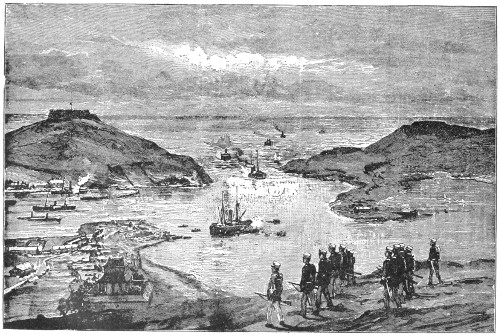
PORT ARTHUR—TRANSPORTS ENTERING THE INNER HARBOR.
Until this time, the government of China properly so called, had not been able to bring its intelligence to bear on the question of imperial defense. That had been left in the hands of the imperial viceroy Li Hung Chang, who has for many years conducted the foreign as well as the naval and military affairs of the empire. But during the fall the Peking government was gradually gathering the reins into its own hands. The return of Prince Kung to the counsels of the emperor was a marked expression of the new resolution. The summoning of Von Hannecken by imperial edict to Peking was another indication of the suspension of Li Hung Chang’s function of general middleman between the empire and the world. Whether this new born energy for affairs was to have staying power sufficient to launch the government on the unknown sea of foreign science, and save the empire from disruption was problematical, but the war still raged on, and out of its immediate issues, it was predicted by many, was to arise a state of thing which would mock the slow progress of mere evolutionary reform, by a cataclysm which might do in one day what a century of deliberation could not accomplish.
562
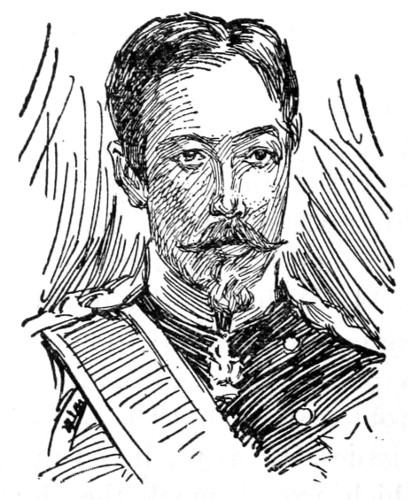
LIEUT. GEN. VISCOUNT NODZU.
563
THE ADVANCE UPON PORT ARTHUR.
Landing of the Second Japanese Army at Kwa-yuen-ken—Capture of Kinchow—Taking of Talien-wan—Flight of the Chinese to Port Arthur—General Nodzu’s Force and its Action—Pekin Authorities Despondent—Prince Kung Asks Foreign Intervention—Propositions for Peace Fail—Contractors Want to Destroy Japanese Fleet—Foreigners in Chinese Service—The Emperor Receives Visitors—Drawing Near to Port Arthur—People of the Peninsula—Skirmishes on the Way—The Night Before the Battle.
The troops of the second Japanese army landed at a place called Kwa-yuen-ken near the mouth of the Pili River, northeast of Talien-wan Bay. From the mouth of the Pili to Kinchow, the principal town in the peninsula, the distance is fifty-four miles. The debarkation was completed without interruption, and the march southwestward began. The capture of Kinchow, at the narrowest point in the Adams Isthmus, was made without difficulty, and the victorious forces continued on their way. November 7 the Japanese occupied Talien-wan. The more the captured Chinese position here was examined, the greater became the astonishment at the poor defense made. The defensive works were excellent in design. Six large and strongly constructed forts commanded Talien-wan bay, mounting all together eighty guns of various sizes and patterns. Many of them were comparatively modern and excellent of their kind. All of these guns, as well as large stores of ammunition, fell into the hands of the Japanese.
Beside the forts on the bay, the Chinese had constructed across the narrow neck of the peninsula, which was here about seven miles wide, a series of earthworks of an elaborate kind. The whole system had evidently been planned by an engineer of high skill. It was completely fitted with telephones and other modern appliances for communication. The works had been designed to facilitate a concentration of troops at any threatened point in the shortest possible time. The batteries were powerfully constructed and well armed. The greatest strength of the forts on the bay was on the side facing the sea. Some successful reconnoitering revealed weakness upon the land side. An intimation was conveyed 564to Count Ito that the seaward forts were of such strength that a bombardment from the Japanese fleet would assuredly result in serious damage to some of the ships. Marshal Oyama informed his colleague that he believed a land attack would be attended with success, and that idea was therefore put into effect.
The Japanese fleet took a station off the bay, and opened a tremendous bombardment of the forts on the 6th of November. For many hours the firing scarcely ceased, and on the following day it was resumed. On the 7th, covered by the bombardment, the land force attacked Talien-wan at daybreak by a general assault, and the success was complete. The Chinese, taken by surprise, fled panic-stricken towards Port Arthur.
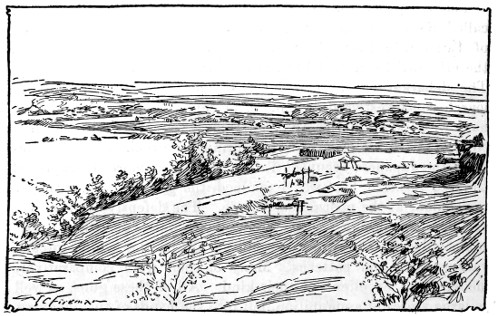
CHINESE EARTHWORKS.
The losses in the capture of these two fortifications, Kinchow and Talien-wan, were not great on either side. The Chinese garrison at the former place consisted of one thousand infantry and one hundred cavalry. They fled to Talien-wan, which was defended by three thousand infantry and one hundred and eighty cavalry, and all together retreated thence towards Port Arthur. On the Japanese side the losses were only ten killed and wounded, and the losses of the Chinese, who offered practically no resistance, 565were not much greater. As in previous retreats, the Chinese threw away their arms in their flight, and reached Port Arthur with nothing but the clothes they wore.
During these days of action by the force under Oyama, General Nodzu’s troops had not been idle. Immediately after the capture of Chiu-lien, the Japanese headquarters’ staff moved there from Wi-ju. Two columns were sent after the fleeing Chinese. Colonel Sato moved upon An-tung, which was taken without fighting. General Tachimi, with the first division, moved upon Feng-hwang on October 27, and on the 31st the town surrendered. No prisoners were taken by the Japanese. The orders were to disarm and scatter the enemy wherever found, and this was done with vigor. By Marshal Yamagata’s orders, the peaceable inhabitants were treated with the utmost consideration. All food purchased was paid for and laborers were paid for any extra help required. As a result the Japanese camp was thronged with Chinese peasants offering produce, and more Chinese laborers asked for work than could be engaged.
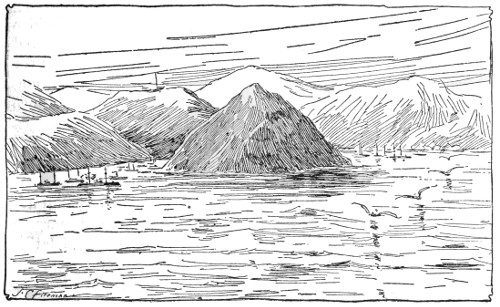
VIEW OF TALIEN-WAN BAY.
The enemy divided in flight from Feng-hwang, some going to Mukden, others to Hai-tcheng, and others to Taku-shan. Most of the generals fled to Mukden. As the last fugitives left Feng-hwang 566it was set on fire, and the flames wrecked the village before the Japanese could extinguish them. Cold had set in among the Manchoorian hills by this time and some snow had fallen. The victorious army therefore took pains to make itself as comfortable as possible, advancing slowly, living off the country, and driving all enemies before it.
In Peking at this time the authorities were busy attempting to devise means of safety for their armies, and to provide for their own escape from threatening danger. Li Hung Chang was deprived of all his decorative honors. Liu Kunyi, viceroy of Nanking, was made viceroy of Tien-tsin. Chang Chi Stung, viceroy of Wu-chang, was appointed viceroy of Nanking. Hu Yuff, a judge of Kwang-hsi, and Captain Von Hannecken were ordered to enlist and equip a force of troops after the German model, as the nucleus of a new grand army of China. Finally Prince Kung was appointed Chief Controller of Military Affairs, with Prince Chung to assist him, thus further centralizing the power.
Another imperial edict gave executive effect to the sentence passed by the military courts upon General Wei. It declared that by his withdrawal from the battle of Ping-Yang he caused the defeat of the entire army. Furthermore, he was adjudged guilty of embezzling public funds entrusted to him for the specific purpose of paying his soldiers, and of gross incompetence and violation of duty in that he permitted the troops with whom he retreated to maltreat and rob the people along the line of route, thereby lowering the national character. For these offenses General Wei was degraded from military rank and deprived of all his honors. It was also announced that Admiral Ting kept from the knowledge of the throne many important matters connected with the naval battle of the Yalu, and that while losing some ships and getting others crippled he inflicted scarcely any damage upon the enemy. The admiral was therefore deprived of all the honors recently bestowed upon him under a misapprehension of the facts.
How despondent was the view of the situation held by the Chinese authorities may be judged by the first action taken by Prince Kung after his promotion. On Sunday, November 4, before the news of the Japanese success at Talien-wan had reached the Chinese, owing to the cutting of the telegraph wires, he invited 567the representatives all the powers to assemble at the Tsung-li Yamen to hear what the Chinese government had to say respecting the critical situation. At this audience Prince Kung calmly avowed the complete impotence of his country to withstand the Japanese attack, and appealed to the powers to intervene. He made an appeal for their assistance in bringing about some agreement for the termination of the war, indicating as a basis of negotiation a willingness of China to abandon her claim to the suzerainty of Corea, and to pay a war indemnity to Japan. This appeal was made formally and officially, and marked for the first time the fact that China recognized her utter defeat.
Having concluded his speech, Prince Kung handed to each minister a note embodying his remarks. The ministers were favorably impressed, and they applauded the frankness of China’s confession. They promised to support her appeal to their respective governments, with a view to the restoration of peace, and in order to avert the dangers threatening all interested. Simultaneously with this action of Prince Kung, the Chinese minister to Great Britain and France endeavored to enlist the assistance of the foreign offices of those countries, but again the effort to secure peace for China by the intervention of western nations met with little encouragement.
A diplomatic complication arose between Japan and France early in November which had an element of comedy in it and is of interest here. Two American citizens, John Brown and George Howie, of British extraction, offered their services to the Chinese government in the capacity of torpedo experts. They claimed to be in possession of an invention capable of most destructive effects in naval warfare, and having succeeded in convincing a Chinese agent of the validity of their claim, they were engaged to employ the invention against the Japanese navy, in consideration of a payment of $100,000 down, $1,000,000 for each naval squadron destroyed, and a proportion of the value of each merchantman sent to the bottom. With their contract in their pocket, they sailed from San Francisco, and at Yokahama transferred themselves to the French steamer Sydney. Meanwhile the Japanese authorities, having obtained intelligence of the two men’s proceedings, telegraphed instructions to Kobe, and in that port 568the alleged inventors were taken off the ship, together with their Chinese companions. The French minister inclined to push the case in their favor, but diplomacy and international law was so clearly on the side of the Japanese that he withdrew his efforts. After their arrest however, the two men signed a stringent guarantee binding themselves not to assist the Chinese during the present war, and this with the representation of the American minister secured their release.
The Japanese forces occupying Talien-wan used their time to advantage in strengthening their positions, completing the telegraph line along the north shore of Corea Bay, to a junction with the line which had already been built across the Yalu River from Corea, and in preparing for their investment of Port Arthur. Admiral Ito’s sailors and marines destroyed all the torpedoes placed by the enemy in the bay and its approaches. They also captured several torpedo boats and apparatus. The fleet and the transports all entered the bay, and there remained to act in harmony with the land forces. A few days after the occupation of Talien-wan, the advance column of the first Japanese army, pursuing from Feng-hwang that portion of the divided fugitive Chinese who were seeking Port Arthur, met the outposts of the second invading army, and communication was thereby established, both by telegraph and by messenger service, through Japanese garrisons, in a chain extending the full length of the Corean peninsula and around Corea Bay to Talien-wan.
Consternation was caused in Peking by the discovery, which one would have supposed not difficult, that the Pei-yang squadron was caught in a trap at Port Arthur. Li Hung Chang had made efforts to bring all the damaged war ships out of that harbor, ordering the squadron to keep within range of the guns of Wei-hai-wei. But on account of somebody’s violation of orders, a dozen Chinese vessels of war were now within the Port Arthur harbor, hemmed in by the neighboring Japanese fleet. The responsible Chinese officials appeared to be callous to the fate of the empire, giving their chief attention to matters of personal interest and gain.
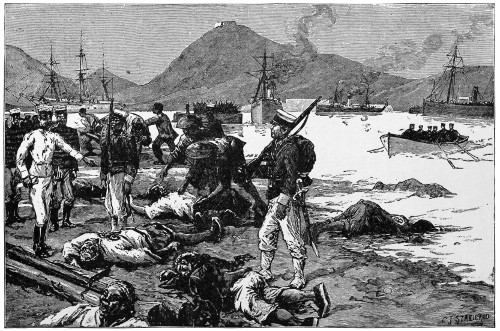
PORT ARTHUR—JAPANESE COOLIES REMOVING CHINESE DEAD.
Port Arthur was now effectively invested and threatened, and to provide for their personal safety, Kung, the taotai of the 571place, together with several military leaders, abandoned Port Arthur as hastily as possible. The effort made by one Englishman, anxious to preserve some Chinese dignity, to save Port Arthur, was received with considerable surprise and not by any means appreciated.
The position of foreigners in the employ of the Chinese government has always been anomalous, but the exigencies of the war have shown up the relationship between Chinese and foreigners in a vivid and highly instructive light. Their rooted aversion to foreigners, which springs from fear, does not withhold the Chinese from flying to seek foreign aid in their extremity. On these occasions they betray a superstitious feeling towards the foreigners, regarding him as a sort of medicine man who can see through a millstone or work any other miracle. Their idea is to hire him by the job, and when the job is done cast him off as any other laborer. When war came upon them, the Chinese fleet was in a quandary, scuttling about from one snug harbor to another, the officers knowing nothing of their enemy, his movements, or his capacities. Though they were told they had the strongest fleet, they would have preferred not to put its presumed superiority to too severe a test, yet they had the imperial order to destroy the enemy unconditionally. In this extremity, the authorities cast about for extemporized foreigners to help them.
A hardy Scandinavian came first to the rescue, offering to scout, pilot, or fight for them, run a torpedo boat, or do anything that youthful daring might legitimately venture. Only he stipulated for a twenty-knot steamer, performing, however, in the meantime, the emergency service in a common tugboat of less than half that speed. The promise of a fast steamer was broken, as every promise of every Chinese official, with few exceptions, from the beginning of time has been broken, and until the end of the war the hardy Norseman had to content himself on the deck of that same wet and lively tugboat. Comical indeed were the adventures he had with his convoys of troops, munitions, and stores, which never would follow the program laid down for them, sometimes bolting from the smoke of their own escort, andand he chasing them back into their own ports whose forts would open fire on him. This was the uniform experience of Europeans 572who served the Chinese. The zeal and loyalty were all on the side of the aliens, whose hearts were broken in hopeless efforts to make the Chinese do their duty to their own country. Every foreigner who served China, no matter in what capacity, unless he belonged to the class which is content to draw pay and say nothing, had the same strenuous battle with his employers to compel them to interest themselves in their own service. The Chinese, on their part, failed to comprehend the folly of the foreigner who was not content to draw his pay and keep quiet.
At Port Arthur there were some half dozen rival generals, but no one in command, each caring only for his own camp, and all at loggerheads with the others. The head of the port, the poor taotai, of the literary graduate order, was a brother of the present minister to England. There was also the admiral of the Pei-yang squadron, the most likely man to assume the responsibility of a general command; but for fear of getting himself disliked by Taotai Kung or the generals, he kept his hands out of mischief. Finally, the English harbor master at Port Arthur went to Tien-tsin, and showed the condition of affairs to the viceroy. The result was that the viceroy sent instructions to Kung, which the latter ignored, flying from Port Arthur at the first chance. The collapse of Chinese resistance was proceeding at a rate which more than astonished the Japanese themselves. With Kinchow and Talien-wan captured almost without a blow, although amply supplied with the means of making a vigorous and protracted defense, and all the soldiers joining in an ignominious rush for Port Arthur, it seemed that the Chinese were exhibiting all that reluctance to make trouble which characterized Crockett’s famous 'coon, demonstrating their willingness to come down to any required extent if Marshal Oyama would only consent not to shoot.
The force under Yamagata, advancing from Feng-hwang in two divisions, one towards Port Arthur and one on the road to Mukden, met no resistance that was strong enough to intercept their advance, although there was some fighting at two or three stands. The right division advanced northwestward and entered the Manchoorian highlands by the Mo-thien-ling pass where a force was gathered to oppose it. The left division marched 573towards Siu-Yen where another Chinese force was encamped. It was the outpost of this division, pursuing the Chinese fugitives through Taku-shan, which made junction with the second army and completed the chain of communication.
On the 9th of November the Japanese advanced and attacked Namquan pass, a strongly fortified neck between Society Bay and Talien-wan. There was no concerted defense, and each Chinese detachment was separately routed. Some thousands of refugees from Kinchow, who were flying towards villages in the vicinity, were mistaken for the enemy and were fired upon from the rear of the defenses, many being killed.
Again the Chinese authorities in Peking decided to seek peace through the influence and intervention of western powers between herself and Japan. On the morning of November 15 the emperor gave an audience to the diplomatic representatives in Peking, and all the ministers were present. His Majesty’s action in thus receiving the diplomatists caused considerable stir in high Chinese circles, such a violation was it of imperial Chinese etiquette. This audience was granted on the occasion of the presentation of letters of congratulation by the ministers, on the sixtieth birthday of the dowager empress. For the first time in Chinese history the audience was held in the imperial palace itself. As an especial mark of courtesy the foreign ministers entered by the central gate, the gate through which the emperor only is usually allowed to pass.
The ministers had audience with the emperor separately, and the reception was of a distinctly formal character, lasting but a few minutes. The audience took place in the hall where His Majesty was accustomed to hear the Confucian classics expounded. He was seated cross-legged on the Dragon Throne, surrounded by a numerous body of princes and officials. In front of His Majesty was placed a small table covered with yellow satin, which concealed the lower half of his person. In the short interviews with each minister, who stood some ten feet from His Majesty, Prince Kung and Prince Ching acted alternately as masters of the ceremonies, and interpreted the speeches. The emperor spoke entirely in the Manchoo tongue. He appeared small and delicate, possessing a fine forehead, with expressive 574brown eyes, and an intellectual countenance. The emperor’s position, surrounded as he was by the dignitaries of his court, gave him an imposing appearance, although to a close observer he looked and spoke like a lad of sixteen or seventeen years. His Majesty did not indulge in any social conversation with the visitors, but spoke formally to all. The interview was granted in the hope that western sympathy would be secured for the threatened orientals.
Now that the approach to Port Arthur has brought the Japanese army almost to the walls, let us take a brief retrospect of the operations of the month. On the 24th of October the debarkation of the second army on the Liao-Tung peninsula began, to the northwest of the Elliot islands, at Kwa-yuen. No opposition of any kind was encountered, but natural difficulties such as shallow beaches and great range of tides impeded the operation, so that all the stores were not landed until the evening of the 30th. The troops however were put in motion at once, and on October 28th the advance guard reached Pitszwo, a place of some importance at the junction of the Niuchwang, Port Arthur, and Taku-shan road. This place was twenty-five miles from the port of debarkation. Forty-five miles farther southwest, the troops came upon Kinchow, at the point where the two post roads of the peninsula met. On November 6 the Japanese captured this town without difficulty, and the next day Field Marshal Oyama’s troops, pressing close on the heels of the flying enemy, reached the formidable isthmus a couple of hours after them, and to the accompaniment of a thunderous bombardment from the fleet, seized the defenses without a struggle. After such a singular display of blundering and cowardice on the part of the Chinese, what followed was not astonishing. The troops passing the isthmus, found themselves on the shore of Talien-wan Bay, one of the best harbors in North China. Ample preparations for defense had indeed been made, but they were not utilized by the cowardly soldiers. The Japanese themselves were taken by surprise. They had not contemplated such a fiasco.
Meanwhile the army had continued its march towards Port Arthur. Their line of communication to the rear, both by land and sea, was perfect. The commissariat was in the best condition 575for service. The hospital corps was active and modern in its manner of work. Nurses of the Red Cross Society, both men and women, accompanied the army and were provided with everything in the power of the commander to grant, being shown every courtesy. On the other hand, efforts made by hospital corps to reach the Chinese wounded from the Chinese side of the lines, met with utter failure. Two Red Cross nurses were turned back by the Chinese authorities at Tien-tsin, they declining to be responsible for the safety of non-combatants. The Taotai Sheng said, “We do not want to save our wounded. A Chinaman cheerfully accepts the fates that befall him.”
More than a fortnight had Marshal Oyama’s army been marching in two divisions, eastern and western, down the peninsula to Port Arthur. The distance was less than fifty miles, but the country was a difficult one, there being practically no roads available except in the cultivated valleys. As the army approached the objective point, there were occasional brushes with the enemy. At Ye-jo-shu on November 18, the army was more than half way from Kinchow to Port Arthur, and almost within sight of the goal. The next day’s march was expected to bring the forces to camp on the safe side of the hills, within an hour’s ride of Port Arthur, unless the Chinese should prevent. The next day was to be devoted to rest and to making sure that everything was properly arranged and ready for the fray; and it was confidently asserted that on the evening of the day after, November 21, the Japanese army would sleep peacefully in Port Arthur with Dragon Flags for bed quilts.
On the morning of the 18th the Chinese made a reconnoissance in force, but retired without discovering much except a Japanese scouting party, which had a narrow escape. The army was moving along steadily with General Nishi leading the vanguard, General Yamaji, his staff, and the war correspondents all with the main body, and General Nogi bringing up the rear. The field marshal and his staff were also behind, and General Hasegawa was on the left wing, with his forces practically covering the country down to the south coast. In front and on the right as far as the not very distant north coast, small bodies of cavalry and infantry were thrown out along the valleys. The country 576was magnificent for defensive purposes, studded with moderately steep hills, ranging from low undulations up to huge crags two thousand feet high, with hundreds of rocky ravines and gulleys; broad fertile valleys never very level, intersected by winding water courses, like a labyrinth, almost dry at this season.
Every two or three miles there were small villages roughly built of stone, nestling in hollows, with a few trees here and there. In and about the villages scores of natives crowded, curious to see the foreigners they feared; on the hilltops were the more timorous ones, watching awhile and then hurrying away perhaps to tell the Chinese army what they had seen, but no attempt was ever made to stop them, except occasionally to ask a question or two. The road was the military road connecting Port Arthur with Kinchow, Niuchwang and Peking. There was not the least sign of anything having been done to keep it in repair since it was first cut a quarter of a century ago, the soft parts were deep rutted, and would be well-nigh impassable after heavy rain, while the rocky parts were jagged and strewn with stones of all sizes and shapes. Over the plains dust drove in black clouds which enveloped the column, suggesting the great dust storms of North China. There was bright sunny weather, but the nights were cold during the march down the peninsula.
The day’s march which had begun at seven in the morning, was to end at Ye-jo-shu, a big village near the sea, about ten miles northeast of Port Arthur. Before entering the village General Yamaji was met by an aid-de-camp with news of fighting ahead, half way to Port Arthur. After a little hesitation the general granted the request of two of the correspondents to permit them to go forward, and they galloped off to the left in a southwesterly direction. Five miles away, among the hilltops, they caught a glimpse of a small, square, stone building, like a fort or watchtower, and all around it could be discerned figures moving amidst clouds of smoke. The road was lined many yards on either side with men and animals, all racing in the same direction, spurting to be first at a ford or a narrow defile, urging and helping each other, and only afraid the enemy might retire too soon.
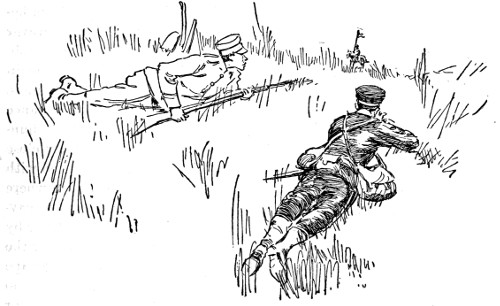
JAPANESE SKIRMISHERS BEFORE PORT ARTHUR.
It was an hour after midday, and Nishi’s force had just begun to pitch camp south of Ye-jo-shu, when a courier arrived and announced 577that the outer pickets were being forced and cut off. Firing had begun at eleven o’clock, but did not become serious until an hour later. Cavalry were rushed to the front, then infantry, then artillery and ammunition trains as they could be mustered and got away. The correspondents galloped hard where the land allowed, past soldiers looking to their rifles and pouches as they ran, past lumbering guns and kicking mules, past panting coolies and Red Cross men, threading their way through the throng, cheering the wounded as they were taken to the rear, smiling bravely in spite of pain. Progress was delayed in the narrow lanes of a picturesque village, in a little wooded hollow where the artillery stuck in a broad, shallow stream. But by eager efforts it was got clear, and went on scrambling up the bank, splashing and stumbling through half dried ditches, plunging in the soft sand, and bumping over boulders, sparing neither man nor beast in the rush up the glen to the top of the hill. There stood Brigadier-General Nishi, watching a “strategic rearward” movement of the Chinese in the plain beyond, and directing operations intended to cut them off if possible. Two strong columns were pushed out right and left, like the horns of a crescent among the hills encircling the valley, towards the sea northwest 578and Port Arthur southwest. The artillery was already on the spot, but was not used yet; there was no need to let the Chinese know how much strength was massing before Port Arthur.
The engagement originated simply in a surprise meeting of opposing scouts. The Chinese had been creeping all over the valley and surrounding hills, along the ravines and behind the ridges; Japanese had been striking out in twos and threes, reconnoitering many miles into the enemy’s country. Suddenly shots were heard, and a general move was made on both sides for the main road in the center. The Japanese seeing no great force in front, and knowing how quickly help could be brought from behind them, stood their ground at first. About noon however three strongstrong columns of Chinese with cavalry and artillery, probably three thousand in all, filed out through the hills from main roads and by-paths leading from Port Arthur. The Japanese were in great danger of being surrounded before the advance guard could arrive. Only a score of cavalry and about two hundred infantry, they had to fight their way back at pretty close quarters, hand to hand at one point. The Chinese advanced with an immense display of banners almost to the foot of the hill where Nishi stood; but the small force of three hundred Japanese cavalry sent out to draw them on, seemed to scare them off, for by half past one they were in full retreat, in good order, over the same paths by which they had come, only just in time to escape the consummation of the Japanese flank movements. It was no use trying to pursue them into the hills about Port Arthur; for as the full force of Nishi’s brigade was collecting about the old stone monument the Chinese army was disappearing through the passes six miles away.
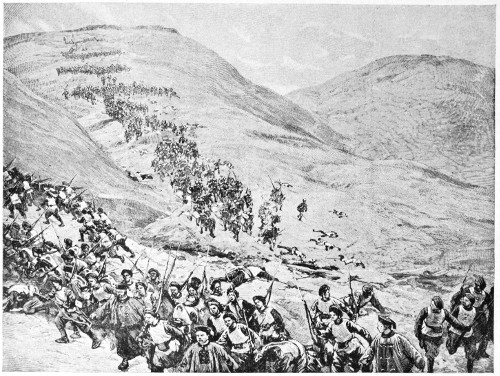
RETREAT OF CHINESE SOLDIERS AFTER THE FALL OF PORT ARTHUR.
A cavalry patrol of seven went forward and followed cautiously along the main road until dusk, turning back at a village just under the hills. They saw the bodies of the seven Japanese who had been left dead on the field, hacked, stripped, beheaded, and in two cases minus the right hand; they saw the cavalryman’s horse lying partly flayed with the skin turned back where two large pieces of flesh had been carved out and carried away. They saw traces of the Chinese every few yards, but no bodies; they must have been removed, for the men of Satsuma had not died 581for nothing. They saw no signs of life except the patrols and men with stretchers for the dead, as they rode back slowly into camp at Ye-jo-shu, over ten miles of wretched roads, the horses nearly dead with the fatigue of a long day’s work, stumbling at every step, and finally having to be left with the coolies while the riders walked most of the way. These coolies were simply wonderful in their endurance; after the helter-skelter race for the monument they came up smiling only a few minutes behind, in spite of their forty pound pack on their shoulders.
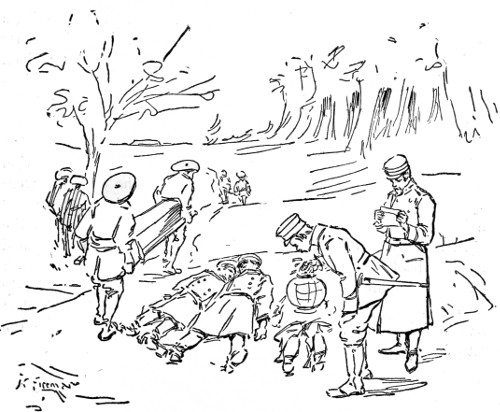
JAPANESE SOLDIERS REMOVING DEAD BODIES.
The advance was slow during the 19th and 20th, the desire being to give the soldiers as much rest as possible before the hard work of the assault. On arriving at Dojoshu, a village at the foot of the hills near Port Arthur, about noon on the 20th, the troops were halted. Oyama had gone around to survey the field, and was expected back every minute, so the time of waiting was passed 582in a hurried midday meal. Suddenly the boom of heavy guns was heard, and the Chinese were seen advancing in two columns, the right one by Suishiyeh, under the eyes of the troops who held the hill where the army had halted, and the left by way of the west side of the valley, out of sight behind the foot hills. They had at last learned that the invading armies had almost surrounded them, and must be dislodged if possible. But it was not possible now. It was too late.
As soon as the advancing left column got within a mile, a portion of the Japanese artillery opened with shrapnel. The forts replied as soon as the positions were revealed. About 3:00 o’clock the Chinese column got within short range of the Japanese batteries, and was struck fairly in the center by the first two shells. The foolish banners dropped at once, and the column lay down. Bravely the line was reformed twice, but the shelling was too hot and too accurate. The Chinese got their field guns into position but could do nothing for practically none of the Japanese were exposed to them or to the forts. There was a little musketry fire on both sides, but of no importance. The artillery settled the affair, and by 5:00 o’clock the whole of the Chinese army had marched back into camp. The forts away on the sea-front got into action before dusk, and dropped a few 12-inch shells uselessly on the hilltops a mile beyond the Japanese; but when the last streak of daylight had disappeared, all was quiet. During the rest of the night there was no sound nor sign on either side.
583
THE CAPTURE OF PORT ARTHUR AND THE MASSACRE.
Description of the Great Chinese Naval Station—Strength of its position—The Defenses—Arrangement of Japanese Troops, and Plan of Attack—The First Assault—Attack and Counter-Attack—Fall of the Chinese Forts—Action of the Fleet—The Japanese in the Streets of Port Arthur—Massacre of Fugitives—Japanese Red Cross Society and Its Previous Good Work—Shocking Details of the Atrocities Committed After the Taking of the Town—Four Days of Violence and Cruelty—Stories of Eyewitnesses—Japanese Explanations and Excuses—Effects of the Capture of Port Arthur on the War.
Port Arthur, or to give it its native name, Lu-shun-kou, was the largest naval station possessed by the Chinese. Situated at the extreme southern end of the Liao-Tung peninsula, Port Arthur in its earlier days afforded convenient shelter for winter-bound junks employed in carrying timber from the Yalu River to the ports westward. At that period it was merely a small village consisting of less than one hundred mud houses, an occasional shop, and three or four inns. The prosperity of the town began with the determination of the authorities in 1881 to establish a naval dockyard at the port. At first the work was entrusted to native contractors, who however proved to be quite incapable of carrying out so extended an undertaking, and in 1887 a French company took up the contract, completing the work in three years. The port then boasted of a large basin with a depth of twenty-five feet at low water. Spacious wharves and quays bordered this basin, and were connected with the workshops by a railroad. Two dry-docks were built ready for repairing ships of all sizes, from iron clads to torpedo vessels. Foundries and workshops were constructed on the most improved models, and containing the best modern machinery. The fact that the harbor was always free from ice, even in the coldest of winter, added to its value. By the time of the beginning of the war, the number of houses had multiplied until they were able to contain a population of about six thousand, exclusive of the garrison. There were also two large temples, two theatres, and several banks, besides the necessary stores and warehouses.
584Such land defenses as this important dockyard possessed when the war broke out, were limited to nine small redoubts, connected by mud walls in some cases, on the north and northeast, and three redoubts on the southwest. On the north side a range of hills from three hundred and fifty to six hundred and fifty feet high, running from the sea to a shallow inlet of the harbor, enclosed the position. The tops of these hills were not more than two thousand five hundred yards from the dockyard and town. The original line of defenses was still closer to the town, and on the northern side was only about one thousand yards in advance of the vital point. The strongest part of the position was a group of three coast batteries surrounded by a continuous mud wall, and crowning a hill on the right of the entrance to the harbor. The works all appeared to be designed for the protection of the narrow harbor mouth, which at the entrance was only a few hundred yards wide.
Upon the outbreak of the war, much additional fortification was carried out. The normal garrison of four thousand was greatly increased, and the troops who were drilled on the European model garrisoned the fortifications, and were to be further assisted in the defense of the port by submarine mines and a fleet of torpedo boats. The forts were armed with heavy Krupp guns, and the artillery men were especially trained by a German officer. Within the defenses there were all of the most recent scientific appliances, electric search lights, torpedo factories, etc., and the forts were connected by telephone.
The Japanese army broke camp at Dojoshu village before Port Arthur at 1:00 A.M. on November 21, and marching by circuitous and very difficult routes over the outlying hills, sometimes quite close to the sea at Pigeon Bay, got into line of battle before daylight. The moon was in the last quarter, and gave very little light; the sky was quite clear, and the weather dry and cool. The positions were as heretofore described.
The key of the position was the northwest triple fort on Table Mountain, and there the whole weight of the opening attack was concentrated. The field marshal and his staff were mostly near the center of the line, and the heavy siege artillery was planted on the best position available near the center, and north to northeast 585of Port Arthur, five or six miles away, with Suishiyeh and the forts right opposite and well in range. The first division under General Yamaji occupied the right wing, and had the roughest and most broken country to traverse. Nine batteries of field and mountain guns were got into fine positions, on lofty ridges, nearly on the same level and almost within rifle shot of the forts; while behind the artillery lay large bodies of infantry ready for a rush. Brigadier-General Nishi had charge of the extreme right, and Brigadier-General Nogi the right center, near the field marshal. On the left, Brigadier-General Hasegawa had his mixed brigade rather wider apart, as the hills were not near enough to aid greatly in an assault on the forts; nor were the hills very good as artillery positions. Hasegawa had only two batteries, but the flying column under Lieutenant-Colonel Masamitsu, that had moved from San-ju-li Ho on the south shore road was with him, and had a mountain battery beside two battalions of infantry and a thousand cavalry.
The first shot was fired within two or three minutes of seven o’clock, from a battery of thirty guns, just as the day was becoming light enough for gun practice. Then for an hour the Japanese guns blazed into the Table-Top forts, which with their guns of all sizes kept up a spirited reply. In the forts, and in the rifle pits on the hillside under the walls, were about one thousand infantry; near the Japanese batteries trenches had been dug in the stony ground during the night, and sheltered ravines had been carefully selected, where practically the whole of the first division, at least ten thousand men, lay in wait. The Chinese shells came close by their ears in dozens, bursting or burying themselves on the other side of the little ravine behind. Many of the boulders about were struck, but strange to say not a man was killed. In the first half hour there must have been three hundred shells over an area of as many yards, but the average elevation was slightly too high, and no damage was done.
Meantime the Japanese were getting to work all along the line. Each battery had a telescope fixed to bear on the desired target, though the dense morning mist and the thick clouds of smoke frequently made it quite impossible to see for a time. It was easy enough to tell that the Japanese had got the reins from the very 586first. The opening shot of the day, which all watched with intense interest, had struck within five yards short of a Krupp gun in the nearest of the three forts. The closeness of this shot, in semi-darkness, at an unknown range estimated to be one thousand yards, was a fair indication of what followed. One by one the Chinese guns ceased fire towards eight o’clock, and suddenly a great shouting came across the valley from the fort. The Japanese infantry were singing a march song as they charged the forts, and in a few minutes a huge cheer ran all along the line over the hilltops and In the valleys where the rest of the Japanese were, and great cries of “Kot-ta—Victory!” The Chinese emptied their guns and small arms as the Japanese swarmed up on three sides, firing every few yards and then rushing forward. The enemy, not numerous enough for hand-to-hand combat, waited no longer but fled over the edge of the hill, down to the fortified camps before the town, and the Table Mountain forts displayed the flag of the Rising Sun.
After this first success, the rest of the battle was practically little more than a question of time, although there was still a great deal of hard fighting to follow. Neither side had yet lost more than fifty or sixty in killed and wounded, and there were still many thousand Chinese soldiers to be considered. Had the forts been fully manned with plenty of picked marksmen, they should have cost the invaders several hundreds if not thousands and should have held out longer. And if the Chinese artillery had been as accurate and steady as the Japanese, the vast difference in position and shelter should have more than compensated for the disparity in numbers. Careful planning, rapidity of attack, and individual bravery were all on the Japanese side. The Chinese did not, indeed, run at the sound of shooting, as has been said. They stood their ground manfully and tried their best to shoot straight up to the last minute; but they never attempted to face the foe hand to hand to “Die in the last ditch.”
Only one definite counter-attack was made; a large force, probably near two thousand of Chinese infantry with a few cavalry, marched out around the hills westward, north of the Port Arthur lagoon, to turn the Japanese right flank. General Yamaji, who never showed fatigue all day but kept near the front calmly 587and resolutely at every move, detected the attempt at once, and dispatched Brigadier-General Nishi with the third regiment and the mountain battery to meet it. The extremely rough, broken country rendered movement slow, and this part of the battle dragged on until the afternoon.
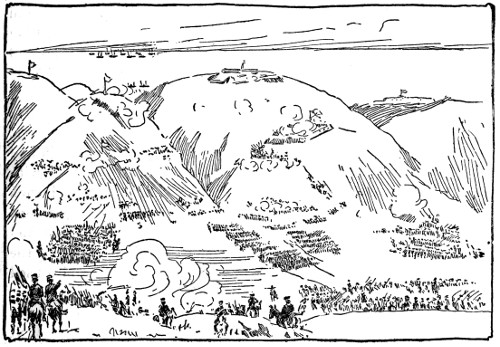
JAPANESE ATTACK ON PORT ARTHUR.
The second regiment had occupied the Isusen forts shortly after eight o’clock, and the artillery was then ordered forward. The guns had come on late from Talien-wan, by forced marches night and day, over a very difficult route, and only arrived at Dojoshu on the night of the 20th, after the enemy’s attempt to dislodge the field and mountain guns. The same night twenty of these large guns had been taken into position for the fight north and west of Suishiyeh, and from one to three kilometers from the nearest forts. They were supported by the whole of the first division, fifteen thousand men less twenty-four hundred men detailed to garrison Kinchow and Talien-wan. Deducting also the regiment of twenty-four hundred sent to head off the flank movement in the west, there were ten thousand left before the Table 588Mountain forts. Not more than a third actually took part in the storming. The rest were waiting ready for use if needed, all along the line from the advance guard under Nishi, near the lagoon, to the center under Nogi, about Peh-ka-shu village, where the skirmish was on the 19th. Here, midway between the camp at Dojoshu and the large village of Suishiyeh, Field Marshal Oyama and his staff remained during the first part of the day, communicating his orders by aides-de-camp, never by flag, or flash signal, or bugle, to Yemaji and Hasegawa on the left.
Peh-ka-shu was about a kilometer north of Suishiyeh, and Suishiyeh about five kilometers north of Port Arthur town, and one kilometer from Table Mountain fort on the east, and Pine Tree fort on the west. About half way between Peh-ka-shu and the sea, southeastward, was So-tai-shu where Hasegawa faced the line of eight forts along a wall of five or six kilometers. Of course this brigade did not cover all the country; he had about five thousand men near the center and two thousand near the sea. The five thousand were about equally divided between Shoju and Niryo, each one regiment of two thousand four hundred with artillery. In attacking, two battalions of eight hundred each formed the front, and one was held behind until within range. Then the whole opened out in skirmishing order and charged, and the Chinese exploded several mines, but without effect, as the fuses were not well timed. Some electric mines were also used but wrongly timed.
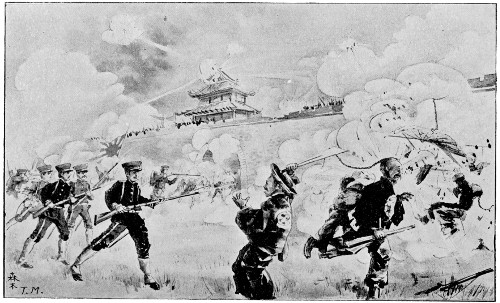
THE ATTACK ON KINCHOW. Japanese Drawing.
While Yamaji was attacking the northwest forts, Hasegawa engaged the attention of the northeast forts, in order to prevent them from concentrating fire on the Japanese right. No serious attack was made by the mixed brigade until the first division had made the winning move. Thus the Chinese right wasted their energy on almost bare country, while the weight of the Japanese attack fell on the almost entirely isolated Chinese left. The strategy succeeded completely, for by the time the Chinese discovered their mistake it was too late. The Shoju, or Pine Tree Hill forts opened a heavy fire across Suishiyeh plain, on the hills occupied by the Japanese; but Isu was already finished and the whole weight of Japanese artillery was centered on the largest Shoju fort. Thus the Japanese right wing, which had been briefly 591threatened by the forts on its left and the Chinese column on its right, was never really in any danger, for while the third regiment under Nishi was storming Isu, the second regiment with its back to the third beat off the enemy’s infantry, and the mountain, field, and siege batteries gave Shoju far more than it could face.
It was surprising how the Chinese stood to their guns; they worked like heroes and aimed their guns well. But what could a fort or a half-dozen of forts do, against fifty guns hidden in the mountains, moving to get better positions when possible, and firing systematically and simultaneously at one point.
A furious fusillade was maintained by both sides for nearly two hours; but the Chinese shots got wilder and wilder as the Japanese improved, until finally the Shoju magazine blew up and set fire to the sheds inside of the forts. Then shortly after eleven o’clock, Hasegawa charged all along the line, and took all the eight forts one by one. The big Shoju fort, which had done such determined work was, of course, evacuated as soon as it caught fire, and for two hours afterward the ruined wood-work burned and the piles of ammunition continued to explode. The second largest fort, Liang Leong, or Double Dragon, held out longest. Twice the Japanese advancing along a ravine tried to break cover and rush up the hill, but were met by bombs from the mortars, and had to get back into shelter and try musketry again. Again they came up magnificently at their officers’ call, and scrambled up the mountain side in the teeth of a galling cross fire. At the ramparts, not a Chinaman remained. They fled from fort to fort along the high wall, firing as they went, and making a stand at every point till too close for rifles. All over the hills they were chased and for many miles around hardly a hundred yards could be passed without sight of a Chinese corpse. Those who escaped got down into the town with the main body of the Chinese army.
Meanwhile there had been heavy firing, chiefly infantry, between Suishiyeh, Isu and Port Arthur. There was a flat tract about three miles square, with low ridges of mud and stones across, behind which the Chines riflemen lay. They had tried to make a stand about the walled camps below Isu, but shells and shrapnel soon cleared them out. The Japanese then mustered in the same place about two thousand men from the right 592wing and right center, increasing in number every minute, and ready to force the town itself. Between these camps and the big drill ground at the entrance to Port Arthur were some three thousand Chinese in skirmishing order, making the most of every bit of cover and firing desperately. Behind them the Chinese field guns, some dozen in number, tried to locate the enemy and occasionally succeeded; one shell shattered the corner of the largest camp, where a dense body of Japanese stood behind the wall waiting for orders, and killed several of them. Still farther back, a big hill which threatened the town swarmed with riflemen, who were sheltered by piles of stones and abundantly supplied with ammunition. Last of all the shore forts were firing a little, but could not aid much in the melee.
Steadily the Japanese crept forward from cover to cover, assisted by artillery from Suishiyeh, until the parade ground and the general’s pavilion overlooking it had been mastered and cleared, and nothing remained but the trenches of Boulder hill, or Hakugoku, the town itself, and the shore forts. Along the south of the parade ground ran a broad, shallow stream that came down the Suishiyeh valley, flowing into a creek west of Hakugoku. Three times the Japanese came out from behind the parade ground wall, to cross the bridge, but were driven back by a withering hail of bullets. At last they forced it and rushed across with a cheer, and spread out over the face of the hill pursuing the Chinese up to the town itself. The Second Regiment fired volleys as it advanced to the town. Not a shot was fired in reply. The battle was over as far as Port Arthur was concerned.
The Japanese fleet was not inactive during the assault by the land forces. At 10:30 A.M. the Japanese vessels, comprising the Matsusima, Chiyoda, Itsukusima, Hasidate, Yoshino, Naniwa, Akitsushima, Takachiho, Fuso, Hiyei, and Kongo steamed past Port Arthur, rounding the promontory. The Chiyoda here began to fire shells over the forts at a very long range. A tugboat from Taku was searched by the Japanese, but was allowed to proceed. At 4:00 o’clock the fleet returned, passing Port Arthur again, at a distance of about six miles, and one of the big forts fired at the Chiyoda but failed to hit her. The admiral did not respond to the fire nor alter his course but steamed slowly on. A 593few minutes later, as the Chinese troops were hurrying down to the harbor, ten torpedo boats dashed from the fleet, separating in pairs and firing three-pounder Hotchkiss guns at the exposed soldiers. The fire was briskly responded to by one fort to the left of the harbor, but not a single shot told. A steamer which had towed a junk out of Port Arthur with Taotai Kung in it, making his escape, was cut off on her return and ran ashore, where the crew deserted her and took to the hills.
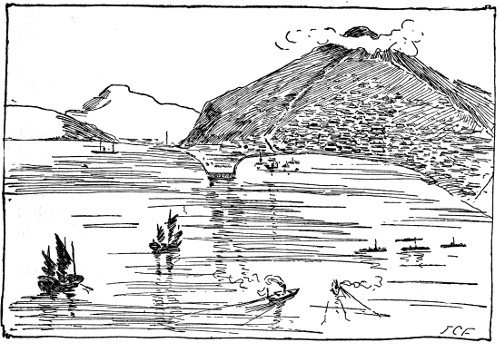
PORT ARTHUR FROM THE BAY.
As the Japanese troops reached the edge of the town, driving the Chinese before them, a halt was called before the army marched in, as the force was not yet assembled in strength. This delay enabled the Chinese to take to boats, and scores of sampans and junks were soon moving off, some over the lagoon to the mountain fastnesses of Lao-tieh-shan promontory in the southwest, and some out to sea, in full view of the Japanese fleet. When the first division was all assembled before the town, with the left wing to the northeast in case the enemy should rally and try to dash out, the order was given to enter the town and storm the 594inner fort, Golden Hill. The Second Regiment led, firing volleys file by file through the streets, past the docks, and the burning army stores, up the hill, and into Ogunsan, which was practically abandoned without an effort at defense.
During the evening Hasegawa’s brigade went over the hills, and occupied the two eastern shore forts called the “Mule’s Jaws.” The following morning Yamaji’s first regiment marched around the lagoon and occupied the peninsula forts, which had been deserted during the night. Where the Chinese all vanished to, appeared rather a mystery to the victors. It was found that most of them got away along the beach past Hasegawa, and the rest westward in small parties under cover of darkness. In such a wide stretch of hilly country, it was easy for them to conceal themselves if they once escaped the vicinity of their foes. Port Arthur was in full possession of Marshal Oyama, with the fleet under Admiral Ito safe in the harbor.
Now comes the most painful recital of the war. It is difficult to reconcile in any one’s mind the pretensions to enlightened civilization which the Japanese had claimed, with the horrible atrocities committed by the victorious army during the days following the capture of Port Arthur. Let us glance at what had been the history of Japanese treatment of the wounded in previous battles.
It will be remembered that in a foregoing chapter of this work, the proclamation of the Japanese minister of war enjoining humanity upon all his soldiers was quoted, and that it was stipulated that the ignorance of the Chinese as to the true meaning of humanity would cause them to commit atrocities no doubt, which must not be imitated in retaliation by Japanese troops. At Hiroshima, the military headquarters of Japan during the war, was the principal military hospital and the establishment of the Red Cross society, which to investigators were a remarkable revelation after all that had been said about Japanese inhumanity and indifference to suffering. As long ago as 1877, when the Satsuma clan raised the standard of rebellion, a benevolent society was founded to aid and care for the sick and wounded, enemies as well as friends, after the manner of the European Red Cross societies. Subscriptions at once began to pour in, the emperor and empress 595helping greatly, and throughout the Satsuma war the young organization distinguished itself admirably. From that time special efforts were made to bring the society up to the high standard of its western models in every way; and when the government of Japan in 1886 declared its adhesion to the Geneva convention, the “Hakuaisha” was reorganized and formally enrolled on the international list of Red Cross societies. Since then it had made rapid progress, its membership reaching nearly thirty thousand in 1893, with funds liberally augmented by the emperor, and an annual income before the war with China of $70,000. Since 1887, a large number of women, including members of the royal family and of the nobility, have become qualified nurses of the order and have taken instruction in the making of articles for use in its work. The objects of the society, as set forth in the rules, are to help the sick and wounded in time of war, and to prepare for the same by organizing a trained staff in time of peace. The last activity of the Red Cross society prior to the war in 1891, was whenwas when the central provinces of Japan were devastated by an earthquake which caused the loss of more than seven thousand lives, besides untold suffering.
With the object of training a staff properly, the society in 1886 established a hospital of its own in Tokio, and three years later, when this one was outgrown, a new one was erected on a splendid site provided by the emperor and empress. The hospital itself covers some two acres, and the grounds about ten. After the war began, the membership funds and operations of the society were all multiplied about three times above normal. All the working staff was under the control of the army medical staff, and operated in conjunction with the army corps. At Hiroshima in the permanent military hospital, Chinese wounded by the scores and hundreds were received and treated with the same care that was given to the Japanese. For order, cleanliness, and convenience these institutions would reflect credit on any country. Just prior to the battle of Port Arthur, the female nurses of the Red Cross societies in Hiroshima numbered eighty-eight and more were soon to come from Tokio. Like the men they had uniforms of European pattern, and all wore the badge of membership. Many had other badges representing special qualifications or services.
596In Corea there were two hospitals managed by the Red Cross society, one near Chemulpo and the other near Ping-Yang. At the seat of war the society had a staff of forty, consisting of a chief manager, a secretary, a treasurer, five doctors, two pharmacists in charge of the drug supplies and thirty male nurses.
To those who love contrasts, it will be startling to note the difference between the spirit of the Japanese Red Cross society, which was doing everything that humanity and science could suggest for wounded Chinamen, and that of the victorious army at Port Arthur in its atrocious butchery of unarmed fugitives.
The execrable deeds which followed the taking of the place pushed into the background the question of how many hundreds on one side or the other fell in the battle. The massacre of the whole remaining population of Port Arthur, between two and three thousand, without distinction of age or sex, and that by the soldiers of Marshal Oyama’s army, for a time passed practically without mention in the newspapers of England and the United States. Three of the famous correspondents who entered the town with the Japanese army were Creelman of the New York World, Villiers of the London Standard, and Cowan of the London Times. The first detailed description of the atrocities witnessed by these correspondents was that made by Creelman, and for a time after his story was published, other leading American journals denounced it as false. One month later it was found that Creelman’s shocking story was true in every essential particular. No words except those from the lips of men who saw the acts of inhuman barbarity can justly describe the scenes. Said Cowan, in a letter dated at Kobe twelve days after the taking of Port Arthur:
“What happened after Port Arthur fell into Japanese hands, it would have been impossible and even dangerous to report while on the spot. At the earliest possible moment, every foreign correspondent escaped from the horrifying scene to a place where freedom of speech would be safe; and as we sailed away from Port Arthur on the Nagoto Maru eight days ago, almost astonished to find ourselves escaping alive from the awful epidemic of incredible brutality, the last sounds we heard were those of shooting, of wanton murder, continued the fifth day after the great 597battle. When the Japanese army entered Port Arthur on the 21st, beginning a little after two o’clock in the afternoon, the Chinese had resisted desperately till the last, retreating slowly from cover to cover, until they got back among the buildings on the outskirts of the town. Then at last all resistance ceased; they were thoroughly defeated, and made a stampede through the streets trying to hide or to escape, east or west as best they might. I was on the brow of a steep hill called “White Boulders,” in Japanese Hakugoku, commanding a close view of the whole town at my feet. When I saw the Japanese march in, firing up the streets and into the houses, chasing and killing every live thing that crossed their path, I looked hard for the cause. I saw practically every shot fired, and I swear positively that not one came from any but Japanese. I saw scores of Chinese hunted out of cover, shot down, and hacked to pieces, and never a man made any attempt to fight. All were in plain clothes, but that meant nothing for the soldiers flying from death got rid of their uniforms how they might. Many went down on their knees, supplicating with heads bent to the ground in kowtow, and in that attitude were butchered mercilessly by the conquering army. Those who fled were pursued and sooner or later were done to death. Never a shot came from a house as far as I could see, and I could hardly believe my eyes, for, as my letters have shown, the indisputable evidence of previous proceedings had filled me with admiration of the gentle Japanese. So I watched intensely for the slightest sign of cause, confident that there must be some, but I saw none whatever. If my eyes deceived me, others were in the same plight; the military attaches of England and America were also on Boulder Hill and were equally amazed and horrified. It was a gratuitous ebullition of barbarism they declared, a revolting repudiation of pretended humanity.
“Gun shots behind us turned our attention to the north creek leading into the broad lagoon. Here swarms of boats were moving away to the west, loaded to twice their normal limit with panic-stricken fugitives, men, women, and children, who had stayed too late in the beleaguered town. A troop of Japanese cavalry with an officer, was at the head of the creek, firing seaward, slaughtering all within range. An old man and two children 598of ten and twelve years had started to wade across the creek; a horseman rode into the water and slashed them a dozen times with his sword. The sight was more than mortal man could stand. Another poor wretch rushed out at the back of a house as the invaders entered the front door, firing promiscuously. He got into a back lane, and a moment later found himself cornered between two fires. We could hear his cry for quarter as he bowed his head in the dust three times; the third time he rose no more, but fell on his side, bent double in the posture of petition for the greatly vaunted mercy of the Japanese, who stood ten paces off and exultantly emptied their guns into him.
“More of these piteous deaths we saw, unable to stay the hands of the murderers; more and more, far more than one can relate, until sick and saddened beyond the power of words to tell, we slowly made our way in the gathering gloom down the hill, picking a path through rifle-pits thick with Chinese cartridge cases, and back to headquarters. There at the Chinese general’s pavilion, facing a spacious parade ground, Field Marshal Oyama and all his officers assembled, amid the strains of strange music from the military band, now a weirdweird, characteristic Japanese march, now a lively French waltz, and ending with the impressive national anthem, “Kaminoga,” and a huge roar from twenty thousand throats, “Banzai Nippon!” All were overflowing with enthusiastic patriotism and the delight of a day’s work done, a splendid triumph after a hard fought fight; none of the Japanese dreamed that their guests from the west were filled with horror, indignation, and disgust. It was a relief to get away from that flood of fiendish exultation, to escape from the effusive glee of our former friends, who would overwhelm us with their attention which we loathed like caresses from the ghouls of hell. To have to remain among men who could do what we had seen was little short of torture.
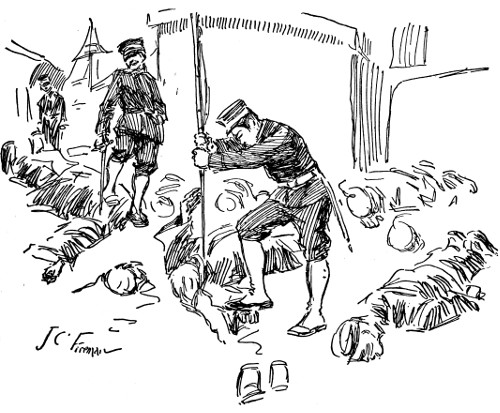
JAPANESE SOLDIERS MUTILATING BODIES.
“Robbed of our sleep on the eve of the battle, and utterly exhausted, we lay long next morning until the sound of shooting roused us. To our surprise and dismay we found that the massacre of Wednesday, which might have been explained though certainly not excused on the ground of excitement in the heat of battle, the flush of victory, and the knowledge of dead comrades 599mutilated, was being continued in cold blood now. Thursday, Friday, Saturday, and Sunday were spent by the soldiery in murder and pillage from dawn to dark, in mutilation, in every conceivable kind of nameless atrocity, until the town became a ghastly Inferno to be remembered with a fearsome shudder until one’s dying day. I saw corpses of women and children, three or four in the streets, more in the water; I stooped to pick some of them out to make sure that there could be no possibility of mistake. Bodies of men strewed the streets in hundreds, perhaps thousands, for we could not count—some with not a limb unsevered, some with heads hacked, cross-cut, and split lengthwise, some ripped open, not by chance but with careful precision, down and across, disemboweled and dismembered, with occasionally a dagger or bayonet thrust in private parts. I saw groups of prisoners tied together in a bunch with their hands behind their backs, riddled with bullets for five minutes, and then hewn in pieces. I saw 600a junk stranded on the beach, filled with fugitives of either sex and of all ages, struck by volley after volley until—I can say no more.
“Meanwhile every building in the town was thoroughly ransacked, every door burst open, every box and closet, every nook and cranny looted. What was worth taking was taken, and the rest destroyed or thrown into the gutter. Even Mr. Hart, Reuter’s war correspondent on the Chinese side, whom we found when we entered Port Arthur, was robbed of everything but the clothes he had on, while his cook and two scully boys in the same house were shot at their kitchen stove, while doing nothing but their regular work. Mr. Hart himself had told the Chinese hotel keeper before the battle not to leave the town, because the Japanese would certainly do no harm to citizens or property. So thoroughly had been the discipline maintained, and so perfect the show of civilized methods in warfare, that the present outburst of cold-blooded brutality was the very last thing to have been thought possible.
“The Japanese alleged that the populace of the town had been armed with guns and express ammunition, and that the army when entering the town had been attacked from the houses. I did afterward find cartridges such as these lying about; but I never saw one fired. I never saw any attack from the houses. I saw the Japanese firing before they entered, and as they entered, without intermission.
“The Japanese who had been wounded and killed or captured in several skirmishes before the day of the battle, had been horribly mutilated by the Chinese. We saw several bodies along the line of march, and it is said others were found in the town, with hands and heads cut off, stomachs opened, etc. And some were burnt at Kinchow, and one said to be burnt in Port Arthur. Moreover, placards have been found offering rewards and stating prices, for heads, hands, or prisoners. So the Japanese soldiers swore revenge, and they carried out their vow thoroughly in barbarous eastern style. All that can be said is that the Chinese committed nameless atrocities which the Japanese repaid a hundred fold.
“It is unavoidable that innocent persons must be killed in war. I do not blame the Japanese for that alone; Chinese soldiers dress as peasants and retain their weapons, and attack when they can 601under cover of disguise. It therefore becomes excusable to some extent to regard all Chinese as enemies, with or without uniform; in that the Japanese are plainly justified. But regarding them as enemies, it is not humanity to kill them; they should be taken alive. I saw hundreds killed after being captured and tied. Perhaps that is not barbarity; at any rate it is the truth. On the day of the battle, soldiers fresh from the excitement of a hard struggle cannot help being somewhat bloodthirsty, perhaps. At any rate their nerves are tense, their blood is up, they are violently excited. Not that it is right to be so, but it is usual. But the battle was on the 21st, and still on the 25th, after four nights’ sleep, the slaughter was continued. Some allowance must be made for the intense indignation of the soldiers whose comrades had been mutilated by the Chinese. Indignation is perfectly justifiable; the Japanese were quite right to feel incensed. But why should they express themselves in the very same barbarous manner? Is it because they are also barbarous at heart like the Chinese? Of course they say ‘No.’ Then they will have to prove it, for the fact remains that a dozen white men saw these Japanese commit these savageries for four clear days after the day of the fight.”
Creelman’s story was as graphic and as shocking in its details, and included many of the same sights which were related by Cowan. He says in part: “The story of the taking of Port Arthur will be one of the blackest pages in history. An easy victory over a Chinese mob, and the possession of one of the most powerful strongholds in the world, was too great a strain upon the Japanese character, which relapsed in a few hours back to the state from which it awakened a generation ago. Almost the entire population found in Port Arthur have been massacred, and the work of butchering unarmed and unresisting inhabitants has continued day after day until the streets are choked with corpses. The march upon helpless Peking or a surrender of China to her foe is a small matter in its vital significance compared with this appalling crime against the nineteenth century, at a moment when Japan asks to be admitted as an equal into the family of civilized nations. The Japanese lost about fifty dead and two hundred and fifty wounded in carrying a fortress that would have cost them ten thousand men had it been occupied by European or American 602troops, and yet the sense of uncontrolled power which let loose the savagery which had been pent up in the Japanese under the external forms of civilization, has proved the utter incapability of the nation to stand the one sure test. Japan stands disgraced before the world. She has violated the Geneva convention, dishonored and profaned the Red Cross, and banished humanity and mercy from her councils. Victory and a new lust for dominion have set her mad.
“All attempts to justify the massacre of the wretched people of Port Arthur and the mutilation of their bodies, are mere afterthoughts. The evidence is clear and overwhelming that it was the sudden breaking down of Japanese civilization under the stress of conscious power. The tremendous facts revealed by the war so far are, that there is practically no Chinese army in existence; that Japan has been arraying herself in the outward garb of civilization, without having gone through the process of moral and intellectual development necessary to grasp the ideas upon which modern civilization is founded; that Japan at heart is a barbarous nation, not yet to be trusted with sovereign power over the lives and property of civilized men. Up to the moment Port Arthur was entered I can bear witness that both of her armies now in the field were chivalrous and generous to the enemy. There was not a stain on her flag. But it was all blind sentiment. The Japanese were playing with the Red Cross as with a new toy and their leaders were never weary of calling the attention of other nations to the spectacle.
“When Port Arthur fell, not even the presence of the horrified British and American military attaches and of foreign newspaper correspondents served to check the carnival of murder. I have again and again tried to save helpless men from slaughter by protest and entreaty, but in vain. The sign of the Red Cross was jeered at, and in the midst of the orgies of blood and rapine, with troops tramping over the bodies of unarmed victims who lost their homes, the fat field marshal and his generals paced smiling, content at the sound of rifle shots mingling with the music of the national hymn and the clink of wine glasses. I am satisfied that not more than one hundred Chinamen were killed in fair battle at Port Arthur and that at least two thousand unarmed men were 603put to death. It may be called the natural result of the fury of troops who have seen the mutilated corpses of their comrades, or it may be called retaliation, but no civilized nation could be capable of the atrocities I have witnessed in Port Arthur. Every scene I have described I have looked upon myself, either in the presence of the American and British military attaches, or in the company of Mr. Cowan or Mr. Villiers. The field marshal and all his generals were aware that the massacre was being continued day after day.
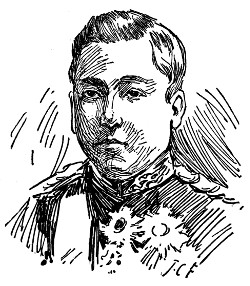
MARSHAL OYAMA.
“We watched the Second regiment as it marched into town, firing volleys as it advanced. Not a shot was fired in reply. The soldiers had made their escape, and the frightened inhabitants were cowering in the streets. As the troops moved on they saw the heads of their slain comrades hanging by cords with the noses and ears gone. There was a rude arch in the main street decorated with bloody Japanese heads. A great slaughter followed. The infuriated soldiers killed every one they saw. I can say as an eyewitness that the wretched people of Port Arthur made no attempt to resist the invaders. Just below me was a hospital flying the Red Cross flag, but the Japanese fired upon the unarmed men who came out of the doorway. A merchant in fur cap knelt down and raised his hands in entreaty. As the soldiers shot him he put his hands over his face. I saw his corpse the next day, slashed beyond recognition. Women and children were hunted and shot at as they fled to the hills with their protectors. All along the streets I could see the bleeding store keepers shot and sabered. A junk was discovered in the harbor crowded with fugitives. A platoon was stretched across the end of a wharf, and fired into the boat until every man, woman and child was killed. The torpedo boats outside had already sunk ten junks filled with terror stricken people.
604“The Japanese had tasted blood, and the work went on the second day. I saw four men walking peaceably along the edge of the town, one man in the street carried a naked infant in his arms. As he ran he dropped the baby. I found it an hour later, dead. The third, the father of the baby tripped and fell. In an instant a soldier had pounced upon his back with a naked bayonet in his hand. I ran forward and made the sign of the Red Cross on the white non-combatant’s bandage around my arm, but the appeal was useless. The bayonet was plunged three or four times into the neck of the prostrate man, and then he was left to gasp his life out on the ground. I hurried back to my quarters and awakened Frederick Villiers, who went with me to the spot where I left the dying man. He was dead, but his wounds were still smoking.
“While we were bending over the corpse we heard shooting a few yards around a road, and went forward to see what it was. We saw an old man standing with his hands tied behind his back. On the ground beside him were the writhing bodies of three other pinioned men who had just been shot. As we advanced a soldier shot the old man down. This was the third day after the battle. Next day I went in company with Mr. Villiers to see a courtyard filled with mutilated corpses. As we entered we surprised two soldiers bending over one of the bodies. They had ripped open the corpse. When they saw us they cowered and tried to hide their faces.”
It is but fair to the Japanese to relate what they had to offer in contravention of these shocking reports so well substantiated. The Japanese minister to Great Britain, Mr. Takaki Kato, while passing through New York some weeks after the taking of Port Arthur, offered these explanations.