China (continued 2)
Reading edition
99
THE CHINESE EMPIRE.
Origin of the Name of China, and What the Chinese Call their Own Country—Dependencies of the Empire—China and the United States in Comparison—Their Many Physical Similarities—Mountains and Plains—The Fertile Soil—Provinces of China—Rivers and Lakes—Climate—Fauna and Flora—Industries of the People—Commerce with Foreign Nations—The Cities of China—Forms of Government and Administration.
Until recent years the word China was unknown in the empire which we call by that name, but of late it has become more familiar to the Chinese, and in certain regions they are in fact adopting it for their own use, owing to the frequency with which they hear it from the foreigners with whom they are doing business. The name was no doubt introduced in Europe and America from the nations of Central Asia who speak of the Chinese by various names derived from that of the powerful Ching family, who held sway many centuries ago. The names which the Chinese use in speaking of themselves are various. The most common one is Chung Kwo, the “Middle Kingdom.” This term grew up in the feudal period as a name for the royal domain in the midst of the other states, or for those states as a whole in the midst of the uncivilized countries around them. The assumption of universal sovereignty, of being the geographical center of the world, and also the center of light and civilization that have been so injurious to the nation, appear in several of the most ancient names. In the oldest classical writings the country is called the Flowery Kingdom, flowery presenting the idea of beautiful, cultivated, and refined. The terms Heavenly Flowery Kingdom, and Heavenly Dynasty are sometimes used, the word heavenly presenting the Chinese idea that the empire is established by the authority of heaven, and that the emperor rules by divine right. This title has given rise to the contemptuous epithet applied to the race by the Europeans, “The Celestials.”
The Chinese empire, consisting of China proper and Manchooria, with its dependencies of Mongolia, I-li and Thibet, embraces a vast territory in eastern and central Asia, only inferior 100in extent to the dominions of Great Britain and Russia. The dependencies are not colonies but subject territories; and China proper itself indeed, has been a subject territory of Manchooria since 1644.
China proper was divided nearly two hundred years ago into eighteen provinces; and since the recent separation of the island of Formosa from Fu-chien, and its constitution into an independent province, we may say that it now consists of nineteen. These form one of the corners of the Asiatic continent, having the Pacific ocean on the south and east. They are somewhat in the shape of an irregular rectangle, and including the island of Hainan lie between 18 and 49 degrees north latitude and 98 and 124 degrees east longitude. Their area is about two million square miles, while the whole empire has an area more than twice that large.
In giving a correct general idea of China one cannot perhaps do better than to institute a comparison between it and the United States, to which it bears a striking resemblance. It occupies the same position in the eastern hemisphere that the United States does in the western. Its line of sea coast on the Pacific resembles that of the United States on the Atlantic, not only in length but also in contour. Being found within almost the same parallels of latitude, it embraces almost the same variety of climate and production. A river as grand as the Mississippi, flowing east, divides the empire into nearly two equal parts, which are often designated as “north of the river” and “south of the river.” It passes through an immense and fertile valley, and is supplied by numerous tributaries having rise in mountain ranges on either side and also in the Himalayas on the west. The area of China proper is about two-thirds that of the states of the American union.
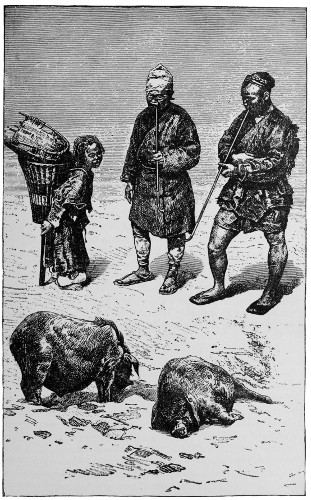
CHINESE MINERS.
The resemblance holds also in the artificial divisions. While our country is divided into more than forty states, China is divided into nineteen provinces. As our states are divided into counties, so each province has divisions called fu and each fu is again divided into about an equal number of hien. These divisions and subdivisions of the provinces are generally spoken of in English as departments or prefectures, and districts, but they are 103much larger than our corresponding counties and townships. And similarly to our own system of government, each of these divisions and subdivisions has its own capital or seat of civil power, in which the officers exercising jurisdiction over it reside. The outer dependencies of the Chinese empire are comparatively sparsely populated, and in this work, when China, without specification, is mentioned, it is intended to refer to the eighteen provinces exclusively, which include the vast proportion of the population, intelligence and wealth of the empire.
As to the physical features of China proper, the whole territory may be described as sloping from the mountainous regions of Thibet and Nepaul towards the shores of the Pacific on the east and south. A far extending spur of the Himalayas called the Nanling, or southern range, is the most extensive mountain system. It commences in Yun-nan, and passing completely through the country enters the sea at Ningpo. Except for a few steep passes, it thus forms a continuous barrier that separates the coast regions of south-eastern China from the rest of the country. Numerous spurs are cast off to the south and east of it, which appear in the sea as a belt of rugged islands. On the borders of Thibet to the north and west of this range, the country is mountainous, while to the east and from the great wall on the north to the Po-yang Lake in the south, there is the great plain comprising an area of more than two hundred thousand square miles and supporting in the five provinces contained in it more than one hundred and seventy-five million people.
In the north-western provinces the soil is a brownish colored earth, extremely porous, crumbling easily between the fingers, and carried far and wide in clouds of dust. It covers the sub-soil to an enormous depth and is apt to split perpendicularly in clefts which render traveling difficult. Nevertheless by this cleavage it affords homes to thousands of the people, who live in caves excavated near the bottom of the cliffs. Sometimes whole villages are so formed in terraces of the earth that rise one above another. The most valuable quality of this peculiar soil is its marvelous fertility, as the fields composed of it require scarcely any other dressing than a sprinkling of its own fresh loam. The farmer in this way obtains an assured harvest two and even three times a 104year. This fertility, provided there be a sufficient rainfall, seems inexhaustible. The province of Shan-hsi has borne the name for thousands of years of the “granary of the nation,” and it is, no doubt, due to the distribution of this earth over its surface, that the great plain owes its fruitfulness.
Geographically speaking the arrangement of the provinces of China is as follows: On the north there are four provinces, Chihli, Shan-hsi, Shen-hsi, and Kan-su; on the west two, Szechwan, the largest of all, and Yun-nan; on the south two, Kwang-hsi and Kwang-tung; on the east four, Fu-chien, Cheh-chiang, Chiang-su, and Shan-tung. The central area enclosed by these twelve provinces is occupied by Honan, An-hui, Hoopih, Hunan, Chiang-hsi, and Kwei-chau. The latter is a poor province, with parts of it largely occupied by clans or tribes supposed to be the aborigines. The island of Formosa, lying off the coast of Fu-chien, ninety miles west of Amoy, is about two hundred and thirty-five miles in length, fertile and rich in coal, petroleum, and camphor wood. The first settlement of a Chinese population took place only in 1683, and the greater part of it is still occupied by aboriginal tribes of a more than ordinary high type. The population of these provinces is immense, but the various estimates and alleged censuses fluctuate and vary so much that it is impossible to give a definite number as the total. It is a safe estimate however to say that the population of the Chinese empire approximates four hundred million, or considerably more than one-fourth the population of the world, and nearly as much as the total of all Europe and America.
One of the most distinguishing features of China is found in the great rivers. These are called for the most part “ho” in the north and “chiang” (kiang) in the south. Two of these are famous and conspicuous among the great rivers of the world, the Ho, Hoang-ho, or Yellow River, and the Chiang, generally misnamed the Yang-tsze. The sources of these two rivers are not far from one another. The Ho rises in the plain of Odontala, which is a region of springs and small lakes, and the Chiang from the mountains of Thibet only a few miles distant. The Ho pursues a tortuous course first to the east and north until it crosses the great wall into Mongolia. After flowing a long distance 105northward of the Mongolian desert, to the northern limit of Shen-hsi, it then turns directly south for a distance of five hundred miles. A right angle turns its course again to the eastward and finally north-eastward, when it flows into the Gulf of Pechili in the province of Shan-tung. The Chiang on the contrary turns south where the Ho turns north, and then after a general course to the eastward and northward, roughly parallelparallel with its fellow, flows into the Eastern Sea, not far from Shanghai.
Both rivers are exceedingly tortuous and their courses are only roughly outlined here. Almost the very opening of Chinese history is an account of one of the inundations of the Ho River, which has often in course of time changed its channel. The terrible calamities caused by it so often have procured for it the name of “China’s sorrow.” As recently as 1887 it burst its southern bank near Chang Chau, and poured its mighty flood with hideous devastation, and the destruction of millions of lives, into the populous province of Honan. Each of these rivers has a course of more than three thousand miles. They are incomparably the greatest in China, but there are many others which would be accounted great elsewhere. In connection with inland navigation must be mentioned the Grand Canal, intended to connect the northern and southern parts of the empire by an easy water communication; and this it did when it was in good order, extending from Peking to Hankow, a distance of more than six hundred miles. Kublai Khan, the first sovereign of the Yuan dynasty, must be credited with the glory of making this canal. Marco Polo described it, and compliments the great ruler for the success of his work. Steam communication all along the eastern seaboard from Canton to Tien-tsin has very much superseded the use of the canal and portions of it are now in bad condition, but as a truly imperial achievement it continues to be a grand memorial of Kublai.
The Great Wall was another vast achievement of human labor, constructed more than two thousand years ago. It has been alleged a myth at some times, but its existence has not been denied since explorations have been made to the north of China Proper. It was not as useful as the canal, and it failed to answer the purpose for which it was intended, a defense against the incursions 106of the northern tribes. In 214 B.C. the Emperor Che Hwang Ti determined to erect a grand barrier all along the northern limit of his vast empire. The wall commences at the Shan-hsi pass on the north coast of the Gulf of Pechili. From this point it is carried westward till it terminates at the Chia-yu barrier gate, the road through which leads to the “western regions.” It is twice interrupted in its course by the Ho River, and has several branch and loop walls to defend certain cities and districts. Its length in a straight line would be one thousand two hundred and fifty-five miles, but if measured along its sinuosities this distance must be increased to one thousand five hundred. It is not built so grandly in its western portions after passing the Ho River, nor should it be supposed that to the east of this point it is all solid masonry. It is formed by two strong retaining walls of brick rising from granite foundations, the space between being filled with stones and earth. The breadth of it at the base is about twenty-five feet, at the top fifteen feet, and the height varies from fifteen to thirty feet. The surface at the top was once covered with bricks but is now overgrown with grass. What travelers go to visit from Peking is merely a loop wall of later formation, enclosing portions of Chihli and Shan-hsi.
China includes many lakes, but they are not so commanding in size as the rivers. There are but three which are essential to mention. These are the Tung-ting Hu, the largest, having a circumference of two hundred and twenty miles, about in the center of the empire; the Po-yang Hu, half way between the former and the sea; and the Tai Hu, not far from Shanghai and the Yang-tsze River. The latter lake is famous for its romantic scenery and numerous islets.
The peculiarities of climate along the Chinese coast are due in great measure to the northern and southern monsoons, the former prevailing with more or less uniformity during the winter, and the latter during the summer months. These winds give a greater degree of heat in summer and of cold in winter than is experienced in the United States in corresponding latitudes. At Ningpo, situated in latitude 30, about that of New Orleans, large quantities of ice are secured in the winter for summer use. It is, however, very thin measured by what we think proper ice for 107preservationpreservation. In this part of China snow not infrequently falls to the depth of six or eight inches, and the hills are sometimes covered with it for weeks in succession. In the northern provinces the winters are very severe. In the vicinity of Peking, not only are the canals and rivers closed during the winter, but all commerce by sea is suspended during two or three months, while in the summer that part of China is very warm. The period of the change of the monsoon, when the two opposite currents are struggling with each other is marked by a great fall of rain and by the cyclones which are so much dreaded by mariners on the Chinese coast. The southern monsoon gradually loses its force in passing northward, and is not very marked above latitude 32, though its influence is decidedly felt in July and August. With the exception of the summer months the climate of the northern coast of China is remarkably dry; that of the southern coast is damp most of the year, especially during the months of May, June, and July.
In different parts of the country almost every variety of climate can be found, hot or cold, moist or dry, salubrious or malarial. The ports which were at first opened as places of residence for foreigners were unfortunately among the most unhealthful of the empire, not so much from the enervating effects of their southerly latitude as from their local miasmatic influences, being situated in the rice-producing districts and surrounded more or less by stagnant water during the summer months. Under the later treaties which opened new ports in the north, as well as interior cities, foreigners have been permitted to live in regions whose climates will compare favorably with most parts of our own country. The Chinese themselves consider Kwang-tung, Kwang-hsi, and Yun-nan to be less healthful than the other provinces; but foreigners using proper precautions may enjoy their lives in every province.
The Chinese are essentially an agricultural people, and from time immemorial they have held agriculture in the highest esteem as being the means by which the soil has been induced to supply the primary wants of the empire, food. Of course the climate and the nature of a district determine the kind of farming appropriate to it. Agriculturally China may be said to be divided 108into two parts by the Chiang. South of that river, speaking generally, the soil and climate point to rice as the appropriate crop, while to the north lie vast plains which as clearly are best designed for growing wheat, barley, oats, Indian corn and other cereals. Culinary or kitchen herbs, mushrooms, and aquatic vegetables, with ginger and a variety of other condiments, are everywhere produced and widely used. From Formosa there comes sugar, and the cane thrives also in the southern provinces. Oranges, pomegranates, peaches, plantains, pineapples, mangoes, grapes, and many other fruits and nuts are supplied in most markets. The cultivation of opium is constantly on the increase.
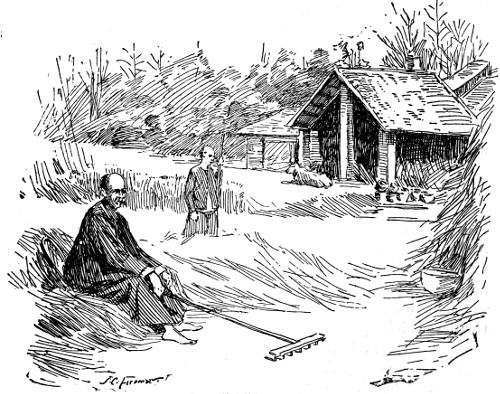
CHINESE FARM SCENE.
Of course the use of tea as a beverage is a national characteristic. The plant does not grow in the north, but is cultivated extensively in the western provinces and in the southern. The infusion of the leaves was little if at all drunk in ancient times, but now its use is universal. Fu-chien, Hoopih, and Hu-nan produce 110the greater part of the black teas; the green comes chiefly from Cheh-chiang and An-hui; both kinds comes from Kwang-tung and Sze-chwan. Next to silk, if not equally with it, tea is China’s most valuable export. From rice and millet the Chinese distill alcoholic liquors, but they are very sparingly used and it is a compliment to the temperate inclinations of the people, that immediately upon the opening of tea houses many years ago, the places for selling liquor found themselves empty of business and were soon compelled to close.
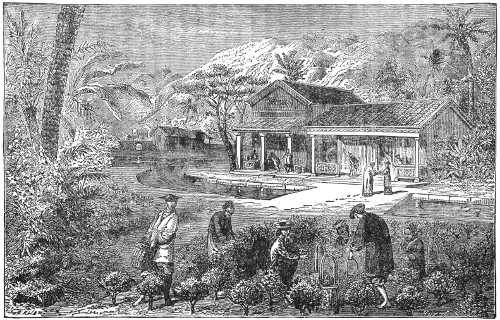
CHINESE TEA FARM.
Birds and animals are found in great variety, though the country is too thickly peopled and well cultivated to harbor many wild and dangerous beasts. One occasionally hears of a tiger that has ventured from the forest and been killed or captured, but the lion was never a denizen of China and is only to be seen rampant in stone in front of temples. The rhinoceros, elephant, and tapir are said still to exist in the forests and swamps of Yun-nan; but the supply of elephants at Peking for the carriage of the emperor when he proceeds to the great sacrificial altars has been decreasing for several reigns. Both the brown and the black bear are found, and several varieties of the deer family, of which the musk deer is highly valued. Among the domestic animals the breed of horses and cattle is dwarfish and no attempts seem to be made to improve them. The ass is a more lively animal in the north than it is in European countries or America, and receives much attention. About Peking one is struck by many beautiful specimens of the mule. Princes are seen riding on mules, or drawn by them in handsome litters, while their attendants accompany them on horseback. The camel is seen only in the north. Many birds of prey abound, including minos, crows, and magpies. The people are fond of songbirds, especially the thrush, the canary, and the lark. The lovely gold and silver pheasants are well known, and also the mandarin duck, the emblem to the Chinese of conjugal fidelity. Many geese too are reared and eaten, while the ducks are artificially hatched. The number of pigs is enormous and fish are a plentiful supply of food.
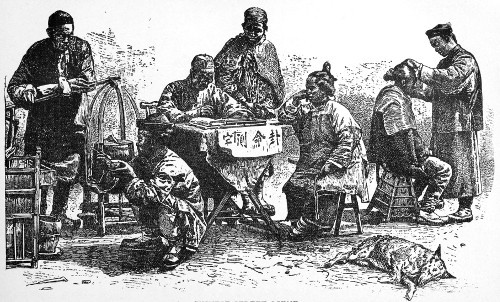
CHINESE STREET SCENE.
The people are very fond of flowers and are excellent gardeners, but their favorites are mostly cultivated in pots instead of in beds.
113Silk, linen, and cotton furnish abundant provision for the clothing of the race. China was no doubt the original home of silk. The mulberry tree grows everywhere and silk worms flourish as widely. In all provinces some silk is produced, but the best is furnished from Kwang-tung, Sze-chwan, and Cheh-chiang. From the twenty-third century B.C. and earlier, the care of the silk worm and the spinning and weaving of its produce have been the special work of women. As it is the duty of the sovereign to turn over a few furrows in the spring to stimulate the people to their agricultural tasks, so his consort should perform an analogous ceremony with her silk worms and mulberry trees. The manufactures of silk are not inferior to or less brilliant than any that are produced in Europe, and nothing can exceed the embroidery of the Chinese. The cotton plant appears to have been introduced some eight hundred years ago from Eastern Turkestan and is now cultivated most extensively in the basin of the Chiang River. The well known nankeen is named for Nanking, a center for its manufacture. Of woolen fabrics the production is not large, but there are felt caps, rugs of camels hair and furs of various kinds.
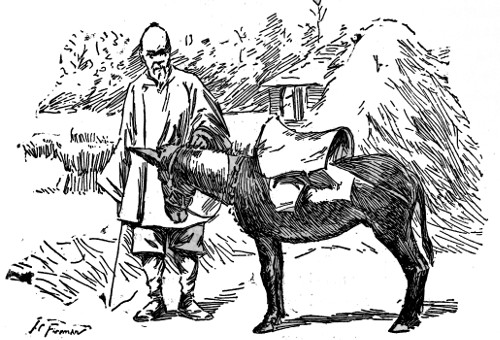
CHINESE FARMER.
114While the Chinese have done justice to most of the natural capabilities of their country, they have greatly failed in developing its mineral resources. The skill which their lapidaries display in cutting the minerals and jewels is well known, but in the development of the utilitarian minerals they have been very negligent. The coal fields of China are enormous, but the majority of them can hardly be said to be more than scratched. Immense deposits of iron ore are still untouched. Copper, lead, tin, silver, and gold are known to exist in many places, but little has been done to make the stores of them available. More attention has been directed to their mines since their government and companies began to have steamers of their own and a scheme has been approved by the government for working the gold mines in the valley of the Amoor River. With the government once conscious of its mineral wealth, there is no limit to the results which it may bring about.
The commerce of China with the western nations has been constantly on the increase for many years. The number of vessels entering and clearing at the various treaty ports is now between thirty thousand and thirty-five thousand annually, and the value of the whole trade, import and export, approximates $300,000,000 annually. Of course the two principal exports are tea and silk. About half of the trade is done by means of vessels under the British flag, and nearly half of the remainder are vessels of foreign type, but owned by Chinese and sailing under the Chinese flag.
The capitals of the different divisions of the empire are all walled cities, and these form a striking feature of the country. There are important distinctions between the cities of the third class, most of which are designated as hien, a few as cheo and others as ting. Though varying considerably in size, these different cities present nearly the uniform appearance. They are surrounded by walls from twenty to thirty-five feet in height, and are entered by large arched gateways which open into the principal streets and are shut and barred at night. These walls are from twenty to twenty-five feet thick at the base and somewhat narrower at the top. The outside is of solid masonry from two to four feet thick, built of hewn stone, or bricks backed with 115earth, broken tiles, etc. There is generally a lighter stone facing on the inside. The outside is surmounted by a parapet with embrasures generally built of brick.
The circumferences of the provincial cities vary from eight to fifteen miles; those of the fu cities from four to ten miles, and those of the hien cities from two or three to five miles. Some of the larger and more important cities contain a smaller one, with its separate walls, enclosed within the larger outside walls. This is the Tartar or military city. It is occupied exclusively by Tartars with their families, forming a colony or garrison, and numbering generally several thousand soldiers. In times of insurrection and rebellion the emperor depends principally upon these Tartar colonies to hold possession of the cities where they are stationed. In such emergencies the inhabitants of these enclosed Tartar cities, knowing that their lives and the lives of their families are at stake, defend themselves with great desperation.
The provincial capitals contain an average population of nearly one million inhabitants; the fu cities from one hundred thousand to six hundred thousand or even more, while the cities of the third class, which are much more numerous, generally contain several tens of thousands. The most of these towns of different classes have outgrown their walls, and frequently one-fourth or even one-third of the inhabitants live in the suburbs, which in some cases extend three or four miles outside the walls in different directions. Property is less valuable in these suburbs, not only because it is removed from the business parts of the city, but also because it is more liable to be destroyed in times of rebellion. All the names to be found on even our largest maps of China, are the names of walled cities, and many of those of the third class are not down for want of space. The total number of these cities is more than one thousand seven hundred. From the number and size of the cities of China it might be inferred that they contain the greater portion of the inhabitants of the empire. This is however by no means the case. The Chinese are mainly an agricultural people and live for the most part in the almost innumerable villages which everywhere dot its fertile plains. A detached or isolated farm house is seldom seen. The country people live in towns or hamlets for the sake of society 116and mutual protection. Most of the cities, even the smaller ones, have thousands of these villages under their jurisdiction. In the more populous parts of China will frequently be found, within a radius of three or four miles, from one hundred and fifty to two hundred of these villages.
The estimate of population made on a previous page gives an average population of about three hundred persons to the square mile, while that of Belgium and some other European countries is greater. Perhaps no country in the world is more fertile and capable of supporting a dense population than China. Every available spot of ground is brought under cultivation, and nearly all the land is made use of to provide food for man, pasture fields being almost unknown. The masses of China eat very little animal food, and what they do eat is mostly pork and fowls, the raising of which requires little or no waste of ground. The comparatively few horses and cattle and sheep which are found in the country are kept in stables, or graze upon the hill tops, or are tethered by the sides of canals. Taking these facts into consideration, that an extended and exceedingly fertile country under the highest state of cultivation, is taxed to its utmost capacity to supply the wants of a frugal and industrious people, the estimate of population need not excite incredulity.
Nearly all of the cities marked on our maps of the coast of China, are now open ports for traffic and residence of foreigners. The most northerly of these is Niuchwang and the most southern Pak-hoi, while between these familiar names are those of Canton, Swatow, Amoy, Foochow, Ningpo, Shanghai, Tien-tsin and several others. Interior cities that have been opened to foreigners include a number on the Chiang River, the one farthest inland being I-chang. Peking is also accessible to foreigners; and several ports on the islands of Hainan and Formosa are opened by treaty. The population of these cities cannot be told with much exactness, as the Chinese census can scarcely claim accuracy. But the largest cities, such as Canton and Peking, are generally credited, in common with several others even smaller, with passing the million mark.
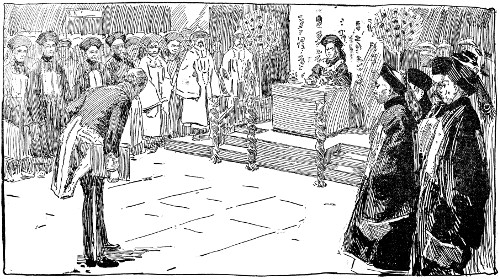
AN IMPERIAL AUDIENCE.
The Chinese government is one of the great wonders of history. It presents to-day the same character which it possessed more 118than three thousand years ago, and which it has retained ever since, during a period which covers the authentic history of the world. The government may be described as being in theory a patriarchal despotism. The emperor is the father of his people, and just as in a family the father’s law is supreme, so the emperor exercises complete control over his subjects, even to the extent of holding, under certain recognized conditions, their lives in his hands. But from time immemorial it has been held by the highest constitutional authorities that the duties existing between the emperor and his people are reciprocal, and that though it is the duty of the people to render a loyal and willing obedience to the emperor, so long as his rule is just and beneficent, it is equally incumbent upon them to resist his authority, to depose him, and even to put him to death, in case he should desert the paths of rectitude and virtue.
As a matter of fact however, it is very difficult to say what extent of power the emperor actually wields. The outside world sees only the imperial bolts, but how they are forged or whose is the hand that shoots them none can tell. The most common titles of the emperor are Hwang-Shang, “The August Lofty One,” and Tien-Tsz, “The Son of Heaven.” He lives in unapproachable grandeur, and is never seen except by members of his own family and high state officers, save once a year when he gives audience to few foreign diplomats. Nothing is omitted which can add to the dignity and sacredness of his person or character. Almost everything used by him or in his service is tabooed from the common people, and distinguished by some peculiar mark or color so as to keep up the impression of awe with which he is regarded, and which is so powerful an auxiliary to his throne. The outward gate of the palace must always be passed on foot, and the paved entrance walk leading up to it can be used only by him. The vacant throne, or even a screen of yellow silk thrown over a chair, is worshipped equally with his actual presence, and an imperial dispatch is received in the provinces with incense and prostration.
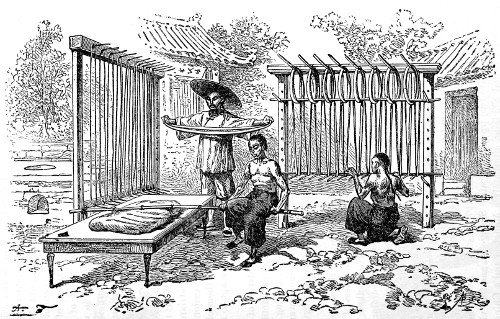
PREPARATION OF VERMICELLI.
The throne is not strictly and necessarily hereditary, though the son of the emperor generally succeeds to it. The emperor appoints his successor, but it is supposed that in doing so he will 120have supreme regard for the best good of his subjects, and will be governed by the will of heaven, indicated by the conferring of regal gifts, and by providential circumstances pointing out the individual whom heaven has chosen. Of course in the case of unusually able men, such as the second and fourth rulers of the present dynasty, their influence is more felt than that of less energetic rulers; but the throne of China is so hedged in with ceremonials and so padded with official etiquette that unless its occupant be a man of supreme ability he cannot fail to fall under the guidance of his ministers and favorites. In governing so large a realm, of course it is necessary for the emperor to delegate his authority to numerous officers who are regarded as his agents and representatives in carrying out the imperial will. What they do the emperor does through them. The recognized patriarchal character of the government is seen in the familiar expressions of the people, particularly at times when they consider themselves injured or aggrieved by their officers, when they are apt to say, “A strange way for parents to treat their children.”
The government of the empire, omitting the regulation of the imperial court and family, or the special Manchoo department, is conducted from the capital, supervising, directing, controlling the different provincial administrations, and exercising the power of removing from his post any official whose conduct may be irregular or dangerous to the state.
There is the Grand Cabinet, the privy council of the emperor, in whose presence it meets daily to transact the business of the state, between the hours of 4:00 and 6:00 A.M. Its members are few and hold other offices. There is also the Grand Secretariat, formerly the supreme council, but under the present dynasty very much superseded by the Cabinet. It consists of four grand and two assistant grand secretaries, half of them Manchoos and half Chinese. The business on which the Cabinet deliberates comes before it from the six boards or Luh-pu. These are departments of long standing in the government, having been modeled on much the same plan during the ancient dynasties. At the head of each board are two presidents, called Shang-shu, and four vice-presidents called Shi-lang, alternately a Manchoo and a Chinese. There are three subordinate grades of officers in each board, 123with a great number of minor clerks, and their appropriate departments for conducting the details of the general and peculiar business coming under the cognizance of the board, the whole being arranged in the most business-like style.
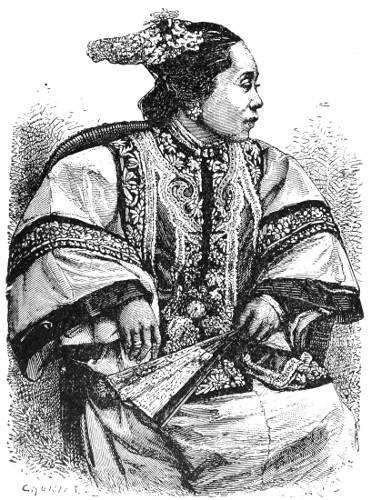
Newly Married.
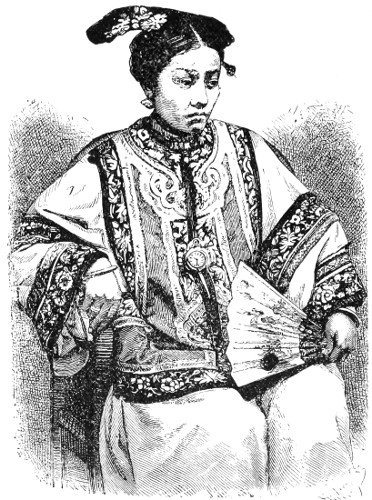
Young Lady of Quality.
CHINESE LADIES.
The six boards are respectively of Civil Office, of Revenue, of Ceremonies, of War, of Punishments, and of Works. In 1861 the changed relations between the empire and foreign nations led to the formation of what may be called a seventh board styled the Tsung-li Yamen, or Court of Foreign Affairs. There is also another important department which must be mentioned, the censorate, members of which exercise a supervision over the board, and are entrusted with the duty of exposing errors and crimes in every department of government. Distributed through the provinces they memorialize the emperor on all subjects connected with the welfare of the people and the conduct of the government. Sometimes they do not shrink even from the dangerous task of criticising the conduct of the emperor himself.
The different boards are all charged with the superintendence of the affairs of the eighteen provinces into which the empire is divided. Fifteen of these provinces are grouped into eight vice-royalties, and the remaining three are administered by a governor. Each province is autonomous, or nearly so, and the supreme authorities, whether viceroys or governors, are practically independent so long as they act in accordance with the very minute regulations laid down for their guidance. The principal function of the Peking government is to see that these regulations are carried out, and in case they should not be to call the offending viceroy or governor to account. Below the governor-general or governor of a province, are the lieutenant-governor, commonly called the treasurer, the provincial judge, the salt-comptroller, and the grain-intendant. The provinces are further divided for the purposes of administration into prefectures, departments, and districts. Each has its officers, magistrates, and a whole host of petty underlings. The rank of the different officials in these provinces is indicated by a knob or button on the top of their caps. In the two highest it is made of red coral; in the third it is clear blue; in the fourth it is lapis lazuli; in the fifth of crystal; in the sixth of an opaque white stone; and in the three 124lowest it is yellow, of gold or gilt. They also wear insignia or badges embroidered on a square patch in the front or back of their robes, representing birds on the civilians and animals on the military officers.
Each viceroy raises his own army and navy, which he pays, or sometimes unfortunately does not pay, out of the revenues of the government. He levies his own taxes, and except in particular cases is the final court of appeal in all judicial matters within the limits of his rule. But in return for this latitude allowed him, he is held personally responsible for the good government of his territory. If by any chance serious disturbances break out and continue unsuppressed, he is called to account, as having by his misconduct contributed to them, and he in his turn looks to his subordinates to maintain order and execute justice within their jurisdiction. Of himself he has no power to remove or punish subordinate officials, but has to refer all complaints against them to Peking. The personal responsibility resting upon him of maintaining order makes him a severe critic on those who serve under him, and very frequently junior officials are impeached and punished at the instigation of their chief. Incapable and unworthy officials, constant opium smokers, those who misappropriate public money, and those who fail to arrest criminals, are those who meet swift punishment. On the whole the conduct of junior officials is carefully watched.
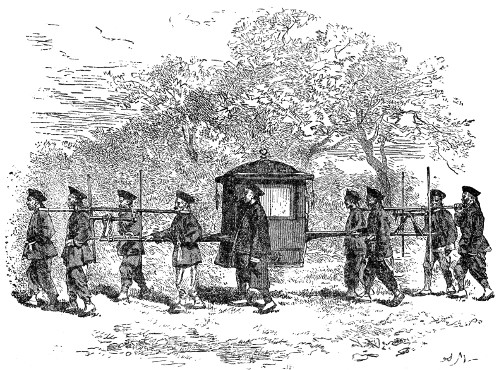
PALANQUIN OF A HIGH OFFICIAL.
As has been already said, the affairs of each province are administered by the viceroy, or governor, and his subordinates, and speaking generally their rule is as enlightened and as just as could be expected in an oriental country where public opinion finds only a very imperfect utterance. Official purity and justice must be treated as comparative terms in China. The constitution of the civil service renders it next to impossible that any office holder can be clean-handed. The salaries awarded are low, out of all proportion to the necessary expenses pertaining to the offices to which they are apportioned, and the consequence is that in some way or other the officials are compelled to make up the deficiency from the pockets of those subject to them. As a rule, mandarins seldom enter office with private fortunes, and the wealth therefore, which soothes the declining years of veteran 126officials, may be fairly assumed to be ill-gotten gain. There are laws against these exactions, and very often some magistrate is degraded or executed for levying illegal assessments. The immunity which some mandarins enjoy from the just consequences of their crimes, and the severity with which the law is vindicated in the cases of others for much lighter offenses, has a sinister aspect. But in a system of which bribery and corruption practically form a part, one need not expect to find purity in any direction. And it is not too much to say that the whole civil service is, judged by an American standard, corrupt to the core. The people however are lightly taxed and they readily submit to limited 129extortion so long as the rule of the mandarin is otherwise just and beneficent.
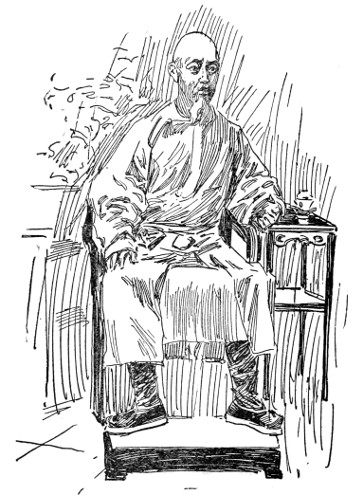
THE GOVERNOR OF A PROVINCE.
How rarely does a mandarin earn the respect and affection of the people is obvious from the great parade which is made on the departure from their posts of the very occasional officials who are fortunate enough to have done so. Archdeacon Gray relates that during his residence of a quarter of a century at Canton he only met one man who had entitled himself to the regret of the people at his departure. When the time came for this man to leave the city, the people rose in multitudes to do him honor and begged for him to return if he could. A somewhat similar scene occurred at Tien-tsin in 1861, on the departure of the most benevolent prefect that the city had ever seen. The people accompanied him beyond the gate on his road to Peking with every token of honor and finally begged from him his boots, which they carried back in triumph and hung up as a memento in the temple of the city god. Going to the opposite extreme, it sometimes happens that the people, goaded into rebellion by a sense of wrong, rise in arms against some particularly obnoxious mandarin and drive him from the district. But the Chinese are essentially unwarlike, and it must be some act of gross oppression to stir their blood to fever heat.
A potent means of protection against oppression is granted to the people by the appointment of imperial censors throughout the empire, whose duty it is to report to the throne all cases of misrule, injustice, or neglect on the part of the mandarins which come to their knowledge. The same tolerance which is shown by the people towards the shortcomings and ill deeds of the officials, is displayed by these men in the discharge of their duties. Only aggravated cases make them take their pens in hand, but when they do, it must be confessed that they show little mercy. Neither are they respectors of persons; their lash falls alike on all from the emperor on his throne to the police-runners in magisterial courts. Nor is their plain speaking more amazing than the candor with which their memorials affecting the characters of great and small alike are published in the Peking Gazette. The gravest charges, such as of peculation, neglect of duty, injustice, or incompetence, are brought against 130mandarins of all ranks and are openly published in the official paper.
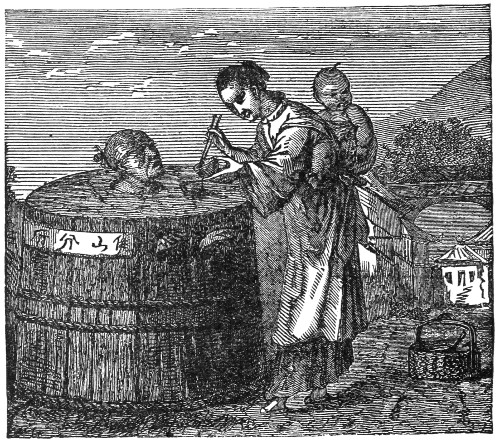
PUNISHMENT BY THE GANGUE.
In the administration of justice the same lax morality as in other branches of government exists, and bribery is largely resorted to by litigants, more especially in civil cases. As a rule money in excess of the legal fees has in the first instance to be paid to clerks and secretaries before a case can be put down for hearing, and a decision of the presiding mandarin is too often influenced by the sums of money which find their way into his purse from the pockets of either suitor. But the greatest blot on Chinese administration is the inhumanity shown to both culprits and witnesses in criminal procedure. Tortures of the most painful and revolting kind are used to extort evidence, and punishments scarcely more severely cruel are inflicted on the guilty parties. Flogging with bamboos, beating the jaws with thick pieces of leather, or the ankles with a stick, are some of the preliminary tortures applied to witnesses or culprits who refuse to give the evidence expected of them. Further refinements of 131cruelty are reserved for hardened offenders by means of which infinite pain and often permanent injury are inflicted.
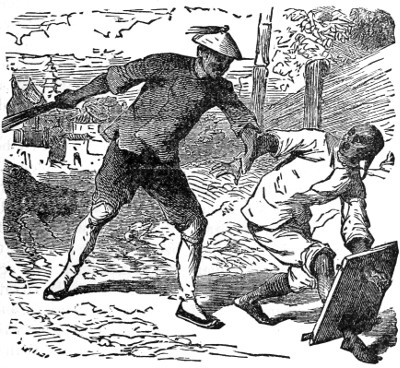
FLOGGING A CULPRIT.
It follows as a natural consequence that in a country where torture is thus resorted to the punishments inflicted on criminals must be proportionately cruel. Death, the final punishment, can unfortunately be inflicted in various ways, and a sliding scale of capital punishments is used by the Chinese to mark their sense of the varying heinousness of murderous crimes. For parricide, matricide and wholesale murders, the usual sentence is that of Ling-che, or “ignominious and slow death.” In the carrying out of this sentence the culprit is fastened to a cross, and cuts varying in number, at the discretion of the judge, from eight to one hundred and twenty are made first on the face and fleshy parts of the body, next the heart is pierced, and finally when death has been thus caused, the limbs are separated from the body and divided. During a recent year ten cases in which this punishment was inflicted were reported in the official Peking Gazette. In ordinary cases of capital punishment execution by beheading is the common 132mode. This is a speedy and merciful death, the skill gained by frequent experience enabling the executioner in almost every case to perform his task with one blow. Another death which is less horrible to Chinamen, who view any mutilation of the body as an extreme disgrace, is by strangulation. The privilege of so passing out of the world is accorded at times to influential criminals, whose crimes are not of so heinous a nature as to demand their decapitation; and occasionally they are even allowed to be their own executioners.
Asiatics are almost invariably careless about the sufferings of others, and the men of China are no exception to the rule. It is almost impossible to exaggerate the horrors of a Chinese prison. The filth and dirt of the rooms, the brutality of the jailers, the miserable diet, and the entire absence of the commonest sanitary arrangements make a picture which is too horrible to draw in detail.
Chinese law-givers have distinguished very markedly between crimes accompanied and unaccompanied with violence. For offenses of the latter description, punishments of a comparatively light nature are inflicted, such as wearing a wooden collar, and piercing the ears with arrows, to the ends of which are attached slips of paper on which are inscribed the crime of which the culprit has been guilty. Frequently the criminals bearing these signs of their disgrace are paraded up and down the street where their offense was committed, and sometimes in more serious cases they are flogged through the leading thoroughfares of the city, preceded by a herald who announces the nature of their misdemeanors. But to give a list of Chinese punishments will be to exhaust the ingenuity of man to torture his fellow creatures. The subject is a horrible one and it is a relief to turn from the dingy prison gates and the halls of so-called justice.
After this review of the impersonal, and the material, and the official character of the Chinese empire as a nation, let us now turn to the more personal consideration of the people themselves, their characteristics, and their manner of life and thought.
134
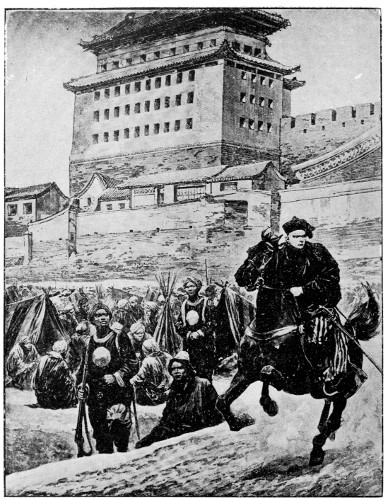
OUTSIDE PEKING. From a Sketch.
135
THE CHINESE PEOPLE.
Severity of the Judgment of Americans and Chinese Against One Another—Each Sees the Worst Side of the Other—Characteristics of the Chinese, Their Physique, Temperament, and Morals—Tests of Intellectuality—Marriage Customs of the Chinese—The Engagement—The Wedding Ceremony—The Position of Women—Concubinage—Divorce—Family Relationships—Dress of Men and Women—Distorted Feet versus Queues—Chinese Houses and Home Life—Children—Education and Schools—National Festivities—Music and Art—Chinese Religions—Language and Literature.
In treating of the personal characteristics and customs of the Chinese people it is the desire of the writer to get away from the hackneyed descriptions of pigtails, shaven heads, thick soled shoes, assumption of dignity and superiority, and great ignorance concerning many subjects with which we are familiar, which usually mark the pages of articles and books concerning this race. The Chinaman is believed by many to be the personification of stupidity, and many writers who wish to make readable matter gladly seize upon and exaggerate anything which can be made to appear grotesque and ridiculous. It would be but a poor answer to these views to say that they correspond remarkably with those which the Chinese entertain of us. They also enjoy a great deal of pleasantry at our expense, finding it almost impossible to regard otherwise than as ludicrous our short cropped hair, tight fitting, ungraceful, and uncomfortable looking clothes, men’s thin soled leather shoes, tall stiff hats, gloves in summer time, the wasp-like appearance of ladies with their small waists, our remarkable ignorance of the general rules of propriety, and the strange custom of a man and his wife walking together in public! These views we can afford to laugh at as relating to comparatively trivial matters, but they think they have the evidence that we are also inferior to them in intellectuality, in refinement, in civilization, and especially morals. It is evident that one party or the other has made a serious mistake, and it would be but a natural and reasonable presumption that both may have erred to some extent. We should look at this matter from an impartial standpoint, and take into view not simply facts which are comparatively 136unimportant and exceptional, but those which are fundamental and of widespread influence, and should construe these facts justly and generously. We should take pains not to form the judgment that because a people or a custom is different from our own it is therefore necessarily worse.
There are many reasons why unfair judgments have been formed by us against the Chinese and by the Chinese against Europeans and Americans. Each nation is apt to see the worst side of the other. It so happens that the Chinese who have come to America are almost all from the southern provinces and from the lower classes of the worst part of the empire. We have formed many of our impressions from our observation of these low class adventurers. They on the other hand have not received the treatment here which would cause them to carry back to China kindly opinions of Americans.
In China the same or similar conditions have existed. In the open ports, where a large foreign commerce has sprung up, an immense number of Chinese congregate from the interior. Many of them are adventurers who come to these places to engage in the general scramble for wealth. The Chinamen of the best class are, as a matter of fact, not the most numerous in the open ports. Moreover foreign ideas and customs prevail to a great extent in these foreign communities, and the natives, whatever they might have been originally, gradually become more or less denationalized, and present a modified type of their race. The Chinese being every day brought into contact with drunken sailors and unscrupulous traders from the west, new lessons are constantly learned from them in the school of duplicity and immorality. The Chinese of this class are no fitting type of the race. It is an accepted fact that the great seaports of the world, where international trade holds sway, are the worst centers of vice, and no estimate of a people formed from these cities can be just.
The Chinese as a race are of a phlegmatic and impassive temperament, and physically less active and energetic than European and American nations. Children are not fond of athletic and vigorous sports, but prefer marbles, kite flying, and quiet games of ball or spinning tops. Men take an easy stroll for recreation, but never a rapid walk for exercise and are seldom in a hurry or 137excited. They are also characteristically timid and docile. But while the Chinese are deficient in active courage and daring, they are not in passive resistance. They are comparatively apathetic as regards pain and death, and have great powers of physical endurance as well as great persistency and obstinacy. Physical development and strength and longevity vary in different parts of the empire. In and about Canton, as well as in most parts of the south, from which we have derived most of our impressions of China, the people are small in stature; but in the province of Shan-tung in the north, men varying in height from five feet eight inches to six feet are very common, while some of them are considerably taller. In this part of China too, one frequently finds laborers more than seventy years of age working daily at their trades, and it is not unusual to hear of persons who have reached the age of ninety or more.
The intellectuality of the Chinese is made evident by so many obvious and weighty facts, that it seems strange that persons of ordinary intelligence and information should ever have questioned it. We have before us a system of government and code of laws which will bear favorable comparison with those of European nations, and have elicited a generous tribute of admiration and praise from the most competent students. The practical wisdom and foresight of those who constructed this system are evidenced by the fact that it has stood the test of time, enduring longer than any other which man has devised during the world’s history; that it has bound together under one common rule, a population to which the world affords no parallel, and given a degree of prosperity and wealth which may well challenge our wonder. It is intelligent thought which has given China such a prominence in the east and also in the eyes of Christendom. She may well point with pride to her authentic history reaching back through more than thirty centuries; to her extensive literature, containing many works of sterling and permanent value; to her thoroughly elaborated language possessed of a remarkable power of expression; to her list of scholars, and her proficiency in belles-lettres. If these do not constitute evidences of intellectuality, it would be difficult to say where such evidences could be found, or 138on what basis we ourselves will rest our claim of intellectual superiority.
China has been so arrogant and extravagant in her assumptions of pre-eminence, that we have perhaps for this very reason been indisposed to accord to her the position to which she is fairly entitled. It should be remembered, that ignorant until recently of western nations, as they have been of her, she has compared herself simply with the nations around her, and a partial excuse for her overweening self conceit may be found in the fact that she only regarded herself as the nations with which she is acquainted have regarded her. She has been for ages the great center of light and civilization in eastern Asia. She has given literature and religion to Japan, to Corea, and to Manchooria, and has been looked up to by these and other smaller nations as their acknowledged teacher. The Japanese have produced no great teachers or sages which they would presume to compare with those of China; and it is clearest evidence of their acknowledgment of the literary superiority of the Chinese that they use Chinese classics as text books in their schools much as we do those of Greece and Rome. It is true that the Chinese know hardly anything of the modern arts and sciences and that there is no word in their language to designate some of them; but how much did our ancestors know two hundred years ago of chemistry, geology, philosophy, anatomy, and other kindred sciences. What did we know fifty years ago of the steamboat, the railroad, and the telegraph? And is our comparative want of knowledge a few years ago and that of our ancestors to be taken as evidence of inferiority of race and intellect? Furthermore, if we go back a few hundred years we are apt to find many things to establish the claims of the Chinese as a superior rather than inferior race. There are excellent grounds to credit the Chinese with the invention or discovery of printing, the use of the magnetic needle, the manufacture and use of gunpowder, of silk fabrics, and of chinaware and porcelain, and there seems no doubt that the Chinese discovered America from the westward, long before the discoveries of Europeans.
Intellectual power manifests itself in a variety of ways, and glaring defects are often found associated in the same individual with remarkable powers and capabilities, as particular faculties 139both of mind and body are often cultivated and developed at the expense of others. Chinese education has very little regard to the improvement of the reasoning powers, and Chinese scholars are deficient in logical acumen and very inferior to the Hindoos in this respect; but in developing and storing the memory they are without a rival. Again their system of training effectually discourages and precludes freedom and originality of thought, while it has the compensating advantages of creating a love of method and order, habitual subjection to authority, and a remarkable uniformity in character and ideas. Perhaps the results which they have realized in fusing such a vast mass of beings into one homogeneous body, could have been reached in no other way.
The morality of the Chinese presents another subject about which there is a wide difference of opinion. It may be a matter of interest and profit to turn for a moment to the views which the Chinese generally entertain of our morality, and their reasons for these views. They are all familiar with the fact that foreigners introduced opium into China, in opposition to the earnest and persistent remonstrances of the Chinese government; that out of the opium trade grew the first war with China; and that when the representatives of Christian England urged the Chinese government to legalize the trade and make it a source of revenue, the Chinese emperor replied that he would not use as a means of revenue that which brought suffering and misery upon his people.
The Chinese form their opinions of western morality to a great extent from the sailors on shore-leave at the open ports, and these men are proverbially vicious under such circumstances. For years foreigners of this class have commanded many of the piratical fleets on the coasts of China, and foreign thieves and robbers have infested many of the inland canals and rivers. In business dealings with strangers from western lands the natives find that duplicity and dishonesty are not confined to their own people. Replying to our criticism of the system of concubinage, the Chinese point to the numerous class of native women in the foreign communities, fostered and patronized by foreigners alone, who appear in the streets with an effrontery which would be regarded as utterly indecent and intolerable in most Chinese cities. 140The large importation from Europe of obscene pictures which are offered at every hand, is another fact which the educated Chinese cites in answer to criticisms of his people’s morality.
On the general subject of morality and Chinese moral teaching, two quotations from the writings of eminent Englishmen who lived in China for many years are pertinent. Sir John Davis says: “The most commendable feature of the Chinese system is the general diffusion of elementary moral education among the lower orders. It is in the preference of moral to physical instruction that even we might perhaps wisely take a leaf out of the Chinese book, and do something to reform this most mechanical age of ours.” The opinion of Thomas Taylor Meadows is thus expressed: “No people whether of ancient or modern times has possessed a sacred literature so completely exempt as the Chinese from licentious descriptions and from every offensive expression. There is not a single sentence in the whole of their sacred books and their annotations that may not when translated word for word be read aloud in any family in England.”
It must be acknowledged that the Chinese give many evidences, not only in their literature, but also in their paintings and sculpture, of a scrupulous care to avoid all indecent and immoral associations and suggestions. In referring to the above peculiarity of Chinese views and customs, these remarks are not, of course, concerning the private lives and practices of the people, but of their standard of propriety and of what the public taste requires, in objects which are openly represented to be seen and admired by the young and old of both sexes.
The government of the empire is modeled on the government of a household, and at the root of all family ties, says one of the Chinese classics, is the relation of husband and wife, which is as the relation of heaven and earth. Chinese historians record that the rite of marriage was first instituted by the Emperor Fuh-he, who reigned in the twenty-eighth century B.C. But before this period there is abundant evidence to show that as amongst all other peoples the first form of marriage was by capture. At the present day marriage is probably more universal in China than in any other civilized country in the world, for it is regarded 141as something indispensable and few men pass the age of twenty without taking to themselves a wife. To die without leaving behind a son to perform the burial rites and to offer up the fixed periodical sacrifices at the tomb, is one of the most direful fates that can overtake a Chinaman, and he seeks to avoid it by an early marriage.
Like every other rite in China that of marriage is fenced in with a host of ceremonies. In a vast majority of cases the bridegroom never sees his bride until the wedding night, it being considered a grave breach of etiquette for young men and maidens to associate together or even to see one another. Of course it does occasionally happen that either by stealth or chance a pair become acquainted; but whether they have thus associated, or whether they are perfect strangers, the first formal overture must of necessity be made by a professional go-between, who having received a commission from the parents of a young man, proceeds to the house of the young woman and makes a formal proposal on behalf of the would-be bridegroom’s parents. If the young lady’s father approves the proposed alliance, the suitor sends the lady some presents as an earnest of his intentions.
The parents next exchange documents which set forth the hour, day, month, and year when the young people were born, and the maiden names of their mothers. Astrologers are then called in to cast the horoscopes, and should these be favorable the engagement is formally entered into, but not so irrevocably that there are not several orthodox ways of breaking it off. But should things go smoothly, the bridegroom’s father writes a formal letter of agreement to the lady’s father, accompanied by presents, consisting in some cases of sweetmeats and a live pig, and in others of a goose and gander, which are regarded as emblems of conjugal fidelity. Two large cards are also prepared by the bridegroom, and on these are written the particulars of the engagement. One is sent to the lady and the other he keeps. She in return now makes a present to the suitor according to his rank and fortune. Recourse is then again had to astrologers to fix a fortunate day for the final ceremony, on the evening of which the bridegroom’s best man proceeds to the house of the lady and conducts her to her future home in a red sedan chair, 142accompanied by musicians who enliven the procession by wedding airs. At the door of the house the bride alights from her sedan, and is lifted over a pan of burning charcoal laid on the threshold by two “women of luck,” whose husbands and children must be living.
In the reception room the bridegroom awaits his bride on a raised dais, at the foot of which she humbly prostrates herself. He then descends to her level, and removing her veil gazes on her face for the first time. Without exchanging a word they seat themselves side by side, and each tries to sit on a part of the dress of the other, it being considered that the one who succeeds in so doing will hold rule in the household. This trial of skill over, the pair proceed to the hall, and there before the family altar worship heaven and earth and their ancestors. They then go to dinner in their apartment, through the open door of which the guests scrutinize and make their remarks on the appearance and demeanor of the bride. This ordeal is the more trying to her, since etiquette forbids her to eat anything, a prohibition which is not shared by the bridegroom, who enjoys the dainties provided as his appetite may suggest. The attendants next hand to each in turn a cup of wine, and having exchanged pledges, the wedding ceremonies come to an end. In some parts of the country it is customary for the bride to sit up late into the night answering riddles which are propounded to her by the guests; in other parts it is usual for her to show herself for a time in the hall, whither her husband does not accompany her, as it is contrary to etiquette for a husband and wife ever to appear together in public. For the same reason she goes to pay the customary visit to her parents on the third day after the wedding alone, and for the rest of her wedded life she enjoys the society of her husband only in the privacy of her apartments.
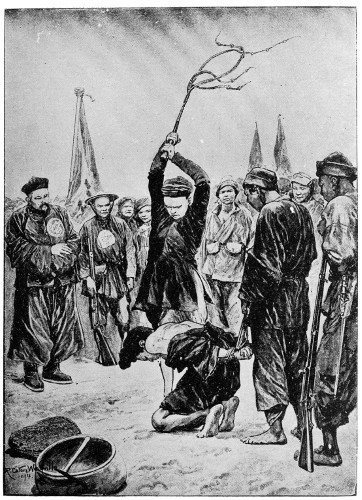
DISCIPLINE ON THE MARCH, IN THE CHINESE ARMY.
The lives of women in China, and especially of married women, are such as to justify the wish often expressed by them that in their next state of existence they may be born men. Even if in their baby days they escape the infanticidal tendencies of their parents, they are regarded as secondary considerations compared with their brothers. The philosophers from Confucius downward have all agreed in assigning them an inferior place to men. 145When the time comes for them to marry, custom requires them in nine cases out of ten, as we have seen, to take a leap in the dark, and that wife is fortunate who finds in her husband a congenial and faithful companion.
There is but one proper wife in the family, but there is no law against a man’s having secondary wives or concubines; and such connections are common enough wherever the means of a family are sufficient for their support. The concubine occupies in the family an inferior position to the wife, and her children, if she has any, belong by law to the wife.
There are seven legal grounds for divorcing a wife: disobedience to her husband’s parents; not giving birth to a son; Dissolute conduct; jealousy; talkativeness; thieving, and leprosy. These grounds however may be nullified by “the three considerations:” If her parents be dead; if she has passed with her husband through the years of mourning for his parents; and if he has become rich from being poor.
So many are the disabilities of married women, that many girls prefer going into nunneries or even committing suicide to trusting their future to men of whom they can know nothing but from the interested reports of the go-between.
The re-marriage of widows is regarded as an impropriety, and in wealthy families is seldom practiced. But among the poorer classes necessity often compels a widow to seek another bread winner. Some, however, having been unfortunate in their first matrimonial venture, refuse to listen to any proposal for a re-marriage, and like the young girls mentioned above seek escape by death from the importunities of relatives who desire to get them off their hands. A reverse view of matrimonial experiences is suggested by the practice of wives refusing to survive their husbands, and putting a voluntary end to their existence rather than live to mourn their loss. Such devotion is regarded by the people with great approbation and a deed of suicide is generally performed in public and with great punctiliousness.
The picture here given of married life in China has been necessarily darkly shaded, since it is, as a rule, only in its unfortunate phases, that it affords opportunity for remark. Without doubt there are many hundreds of thousands of families in China 146which are entirely happy. Happiness is after all a relative term, and Chinese women, knowing no higher status, are as a rule content to run the risk of wrongs which would be unendurable to an American woman, and to find happiness under conditions which are fortunately unknown in western countries.
The family tie in China is strong and the people are clannish. They seldom change their place of residence and most of them live where their ancestors have lived for many generations. One will frequently find the larger portion of a small village bearing the same name, in which case the village often takes its name from the family. Books on filial piety and the domestic relations recommend sons not to leave their parents when married, but to live together lovingly and harmoniously as one family. This theory is carried out in practice to some extent, in most instances. In the division of property some regard is had to primogeniture, but different sons share nearly equally. The eldest simply has a somewhat larger portion and certain household relics and valuables.
The position of woman is intermediate between that which she occupies in Christian and in other non-Christian countries. The manner in which they regard their lot may be inferred from the fact related on a previous page, that the most earnest desire and prayer in worshipping in Buddhist temples is, generally, that they may be men in the next state of existence. In many families girls have no individual names, but are simply called No. One, Two, Three, Four, etc. When married they are Mr. So-and-so’s wife, and when they have sons they are such-and-such a boy’s mother. They live in a great measure secluded, take no part in general society, and are expected to retire when a stranger or an acquaintance of the opposite sex enters the house. The claim of one’s parents and brothers upon his affections is considered to be paramount to that of his wife. A reason given for this doctrine in a celebrated Chinese work is that the loss of a brother is irreparable but that of a wife is not. Women are treated with more respect and consideration as they advance in years; mothers are regarded with great affection and tenderness, and grandmothers are sometimes almost worshipped. It must be further said that the Chinese have found the theory of inferiority of women a very 147difficult one to carry out in practice. There are many families in which the superiority of her will and authority is sufficiently manifest, even though not cheerfully acknowledged.
The rules and conventionalities which regulate social life are exceedingly minute and formal. Politeness is a science, and gracefulness of manners a study and discipline. The people are hospitable and generous to a fault, their desire to appear well in these respects often leading them to expenditures entirely disproportionate to their means.
When under the influence of passion, quarrels arise, the women resort to abuse in violent language, extreme in proportion to the length of time during which the feelings which prompted them have been restrained. Men bluster and threaten in a manner quite frightful to those unaccustomed to it, but seldom come to blows. In cases of deep resentment the injured party often adopts a mode of revenge which is very characteristic. Instead of killing the object of his hate, he kills himself on the doorstep of his enemy, thereby casting obloquy and the stigma of murder on the adversary.
In matters of dress, with one or two exceptions, the Chinese must be acknowledged to have used a wise discretion. They wear nothing that is tight fitting, and make a greater difference between their summer and winter clothing than is customary among ourselves. The usual dress of a coolie in summer is a loose fitting pair of cotton trousers and an equally loose jacket; but the same man in winter will be seen wearing quilted cotton clothes, or if he should be an inhabitant of the northern provinces a sheepskin robe, superadded to an abundance of warm clothing intermediate between it and his shirt. By the wealthier classes silk, satin, and gauze are much worn in the summer, and woolen or handsome fur clothes in the winter. Among such people it is customary except in the seclusion of their homes, to wear both in summer and winter long tunics coming down to the ankles.
In summer non-official Chinamen leave their heads uncovered, but do not seem to suffer any inconvenience from the great heat. On the approach of summer an edict is issued fixing the day upon which the summer costume is to be adopted throughout the empire, and again as winter draws near, the time for putting on 148winter dress is announced in the same formal manner. Fine straw or bamboo forms the material of the summer hat, the outside of which is covered with fine silk. At this season also the thick silk robes and the heavy padded jackets worn in winter are exchanged for light silk or satin tunics. The winter cap has a turned-up brim and is covered with satin with a black cloth lining, and as in the case of the summer cap a tassel of red silk covers the entire crown.
The wives of mandarins wear the same embroidered insignia on their dresses as their husbands, and their style of dress as well as that of Chinese women generally bears a resemblance to that of the men. They wear a loose fitting tunic which reaches below the knee, and trousers which are drawn in at the ankle after the bloomer fashion. On state occasions they wear a richly embroidered petticoat coming down to the feet, which hangs square both before and behind and is pleated at the sides like a Highlander’s kilt. The mode of doing the hair varies in almost every province. At Canton the women plaster their back hair into the shape of a teapot handle, and adorn the sides with pins and ornaments, while the young girls proclaim their unmarried state by suttingsutting their hair in fringe across their foreheads after a fashion not unknown among ourselves. In most parts of the country, flowers, natural when obtainable and artificial when not so, are largely used to deck out the head dresses, and considerable taste is shown in the choice of colors and the manner in which they are arranged.
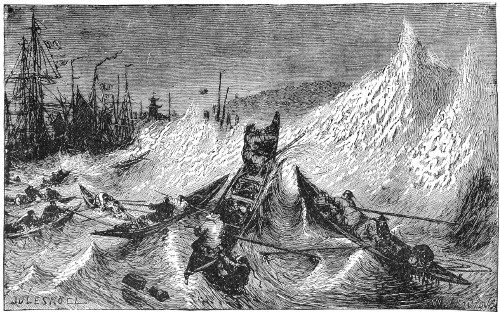
A TYPHOON.
Thus far there is nothing to find fault with in female fashions in China, but the same cannot be said of the way in which they treat their faces and feet. In many countries the secret art of removing traces of the ravages of time with the appliances of the toilet table has been and is practised; but by an extravagant and hideous use of pigments and cosmetics, the Chinese girl not only conceals the fresh complexion of youth, but produces those very disfigurements which furnish the only possible excuse for artificial complexions. Their poets also have declared that a woman’s eyebrows should be arched like a rainbow or shaped like a willow leaf, and the consequence is that wishing to act up to the idea thus pictured, China women with the aid of tweezers 151remove all the hairs of their eyebrows which straggle the least out of the required line, and when the task becomes impossible even with the help of these instruments, the paint brush or a stick of charcoal is brought into requisition. A comparison of one such painted lily with the natural healthy complexion, bright eyes, laughing lips, and dimpled cheeks of a Canton boat girl, for example, is enough to vindicate nature’s claim to superiority over art a thousand fold.
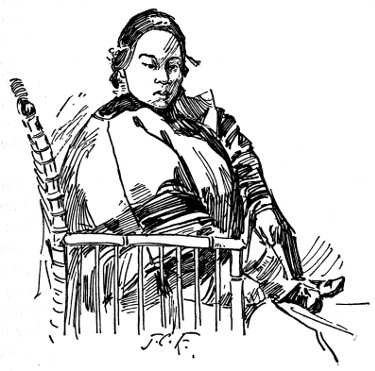
BANDAGING THE FEET.
But the chief offense of Chinese women is in their treatment of their feet. Various explanations are current as to the origin of the custom of deforming the women’s feet. Some say that it is an attempt to imitate the peculiarly shaped foot of a certain beautiful empress; others that it is a device intended to restrain the gadding-about tendencies of women; but however that may be, the practice is universal except among the Manchoos and the Hakka population at Canton, who have natural feet. The feet are first bound when the child is about five years old and the muscles of locomotion have consequently had time to develop. 152A cotton bandage two or three inches wide is wound tightly about the foot in different directions. The four smaller toes are bent under the foot, and the instep is forced upward and backward. The foot therefore assumes the shape of an acute triangle, the big toe forming the acute angle and the other toes, being bent under the foot, becoming almost lost or absorbed. At the same time, the shoes worn having high heels, the foot becomes nothing but a club and loses all elasticity. The consequence is that the women walk as on pegs, and the calf of the leg having no exercise shrivels up. Though the effect of this custom is to produce real deformity and a miserable tottering gait, even foreigners naturally come to associate it with gentility and good breeding, and to estimate the character and position of women much as the Chinese do, by the size of their feet. The degree of severity with which the feet are bound differs widely in the various ranks of society. Country women and the poorer classes have feet about half the natural size, while those of the genteel or fashionable class are only about three inches long.
Women in the humbler walks of life are therefore often able to move about with ease. Most ladies on the other hand are practically debarred from walking at all and are dependent on their sedan chairs for all locomotion beyond they own doors. But even in this case habit becomes a second nature and fashion triumphs over sense. No mother, however keen may be her recollection of her sufferings as a child, or however conscious she may be of the inconveniences and ills arising from her deformed feet, would ever dream of saving her own child from like immediate torture and permanent evil. Further there is probably less excuse for such a practice in China than in any other country, for the hands and feet of both men and women are naturally both small and finely shaped. The Chinese insist upon it that the custom of compressing women’s feet is neither in as bad taste nor so injurious to the health as that of foreign women in compressing the waist.
The male analogue of the women’s compressed feet in the shaven forepart of the head and the braided queue. The custom of thus treating the hair was imposed on the people by the first emperor of the present dynasty, in 1644. Up to that time the Chinese 153had allowed the hair to grow long, and were in the habit of drawing it up into a tuft on the top of the head. The introduction of the queue at the bidding of the Manchoorian conqueror was intended as a badge of conquest, and as such was at first unwillingly adopted by the people. For nearly a century the natives of outlying parts of the empire refused to submit their heads to the razor and in many districts the authorities rewarded converts to the new way by presents of money. As the custom spread these bribes were discontinued, and the converse action of treating those who refused to conform with severity, completed the conversion of the empire. At the present day every Chinaman who is not in open rebellion to the throne, shaves his head with the exception of the crown where the hair is allowed to grow to its full length. This hair is carefully braided, and falls down the back forming what is commonly known as the “pig tail.” Great pride is taken, especially in the south, in having as long and as thick a queue as possible, and when nature has been niggardly in her supply of natural growth, the deficiency is supplemented by the insertion of silk in the plait.
The staff of life in China is rice. It is eaten and always eaten, from north to south and from east to west, on the tables of the rich and poor, morning, noon, and night, except among the very poor people in some of the northern non-rice producing provinces where millet takes its place. In all other parts the big bowl of boiled rice forms the staple of the meal eaten by the people, and it is accompanied by vegetables, fish and meat, according to the circumstances of the household. Among many people, however, there is a disinclination to eat meat, owing to the influence of Buddhism. The difference in the quality and expense of the food of the rich from that of the poor, consists principally in the concomitants eaten with the rice or millet. The poor have simply a dish of salt vegetables or fish, which costs comparatively little. The rich have pork, fowls, eggs, fish and game prepared in various ways.
Before each chair is placed an empty bowl and two chop-sticks, while in the middle of the table stands the dishes of food. Each person fills his basin from the large dishes, or is supplied by the servants, and holding it up to his chin with his left hand he 154transfers its contents into his mouth with his chop-sticks with the utmost ease. The chop-sticks are held between the first and second, and the second and third fingers, and constant practice enables a Chinaman to lift up and hold the minutest atoms of food, oily and slippery as they often are, with the greatest ease. To most foreigners their skillful use is well nigh impossible. To the view of the Chinese the use of chop-sticks is an evidence of superior culture; and the use of such barbarous instruments as knives and forks, and cutting or tearing the meat from the bones on the table instead of having the food properly prepared and severed into edible morsels in the kitchen, evidences a lower type of civilization.
The meats most commonly eaten are pork, mutton, and goat’s flesh, beside ducks, chickens, and pheasants, and in the north deer and hares. Beef is never exposed for sale in the Chinese markets. The meat of the few cattle which are killed is disposed of almost clandestinely. There is a strong and almost universal prejudice against eating beef, and the practice of doing so is declaimed against in some of the moral tracts. Milk is hardly used at all in the eighteen provinces, and in many places our practice of drinking it is regarded with the utmost disgust.
It must be confessed that in some parts of the country less savory viands find their place on the dinner table. In Canton, for example, dried rats have a recognized place in the poulterers’ shops and find a ready market. Horse flesh is also exposed for sale, and there are even to be found dog and cat restaurants. The flesh of black dogs and cats, and especially the former is preferred as being more nutritive. Frogs form a common dish among the poor people and are, it is needless to say, very good eating. In some parts of the country locusts and grasshoppers are eaten. At Tien-tsin men may commonly be seen standing at the corners of the streets frying locusts over portable fires, just as among ourselves chestnuts are cooked. Ground-grubs, silkworms and water-snakes are also occasionally treated as food. The sea, lakes, and rivers abound in fish, and as fish forms a staple food of the people the fisherman’s art has been brought to a great degree of perfection. The same care as in the production of fish is extended to that of ducks and poultry. Eggs are artificially 157hatched in immense numbers, and the poultry markets and boats along the river at Canton are most amazing in their extent.
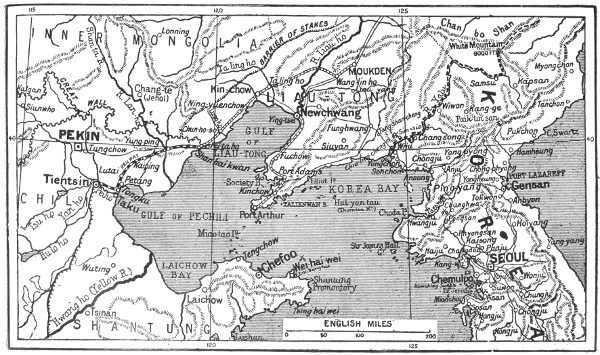
THE SEAT OF THE WAR.
The funerals of grown persons, and especially of parents, are as remarkable for burdensome ceremonies, extravagant manifestations of grief and lavish expense, as those of children are for their coldness and neglect. Candles, incense and offerings of food are placed before the corpse, and a company of priests is engaged to chant prayers for the departed spirit. An abundance of clothing is deposited with the body in the coffin and various ceremonies are performed during several days immediately after that, and on every subsequent seventh day, closing with the seventh seven. When the coffin is carried out for burial, men and women follow in the procession clothed in coarse white garments, white being used for mourning.
Inasmuch as the coffin must remain in the hall for forty-nine days, naturally they are prepared with a great deal of care. Very thick planks are used in its construction, cut from the hardest trees, caulked on the outside and cemented on the inside, and finally varnished or lacquered. Sometimes a coffin containing a body is kept in the house for a considerable length of time after the forty-nine days have expired, while arrangements are being made for a burying place and other preliminaries are attended to. The lids being nailed down in cement they are perfectly air-tight.
The notions which Chinamen entertain concerning the future life rob death of half its terrors and lead them to regard their funeral ceremonies and the due performance of the proper rites by their descendants as the chief factors of their future well being. Among other things the importance of securing a coffin according to the approved fashion is duly recognized, and as men approach old age they not infrequently buy their own coffins, which they keep carefully by them. The present of a coffin is considered a dutiful attention from a son to an aged father.
The choice of a site for the grave is determined by a professor of the “Fung Shuy” superstition, who, compass in hand, explores the entire district to find a spot which combines all the qualities necessary for the quiet repose of the dead. When such 158a favored spot has been discovered a priest is called in to determine a lucky day for the burial. This is by no means an easy matter and it often happens that the dead remain unburied for months or even years on account of the difficulties in the way of choosing either fortunate graves or lucky days. The ceremonies of the interment itself and of mourning that follows are most elaborate in character, and too much involved for detailed description here.
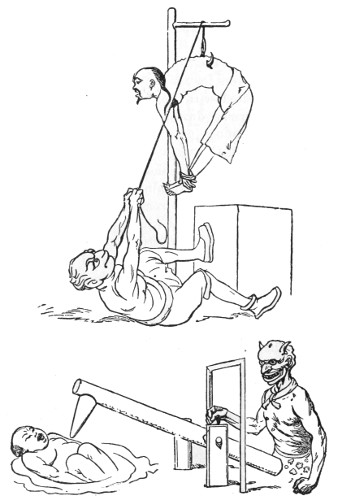
THE PUNISHMENTS OF HELL.—From Chinese Drawings.
159But universal as the practice of burying may be said to be in China there are exceptions to it. The Buddhist priests as a rule prefer cremation, and this custom, which came with the religion they profess from India, has at times found imitators among the laity. In Formosa the dead are exposed and dried in the air; and some of the Meaou-tsze tribes of central and southern China bury their dead, it is true, but after an interval of a year or more, having chosen a lucky day, they disinter them. On such occasions they go accompanied by their friends to the grave, and having opened the tomb they take out the bones and having brushed and washed them clean they put them back wrapped in cloth.
The necessity in the Chinese mind that their bones must rest in the soil of their native land with their ancestors, has made to exist some peculiar practices among the colonizing Chinese in the United States and other countries. The bones of those who die thus far away from home are carefully preserved by their countrymen and shipped back, sometimes after many years, to find a resting place in the Middle Kingdom.
It is a curious circumstance that in China where there exists such a profound veneration for everything old, there should not be found any ancient buildings or old ruins. That there is an abundant supply of durable materials for building is certain, and for many centuries the Chinese have been acquainted with the art of brick making, yet they have reared no building possessing enduring stability. Not only does the ephemeral nature of the tent, which would indicate their original nomadic origin and recollection of old tent homes, appear in the slender construction of Chinese houses, but even in shape they assume a tent-like form. Etiquette provides that in houses of the better class a high wall shall surround the building, and that no window shall look outward. Consequently streets in the fashionable parts of cities have a dreary aspect. The only breaks in the long line of dismal wall are the front doors, which are generally closed, or if not, movable screens bar the sight of all beyond the door. Passing around one such screen one finds himself in a court-yard which is laid out as a garden or paved with stone. From this court-yard one reaches, on either side, rooms occupied by servants, or 160directly in front, another building. Through this latter another court-yard is reached, in the rooms surrounding which the family live, and behind this again are the women’s apartments, which not infrequently give exit to a garden at the back.
Wooden pillars support the roofs of the buildings, and the intervals between these are filled up with brick work. The window-frames are wooden, over which is pasted either paper or calico, or sometimes pieces of talc to transmit the light. The doors are almost invariably folding doors; the floors either stone or cement; and ceilings are not often used, the roof being the only covering to the rooms. Carpets are seldom used, more especially in southern China, where also stoves for warming purposes are known. In the north, where in the winter the cold is very great, portable charcoal stoves are employed and small chafing dishes are carried about from room to room. Delicate little hand-stoves, which gentlemen and ladies carry in their sleeves, are very much in vogue. In the colder latitudes a raised platform or dais is built in the room, of brick and stone, under which a fire is kindled with a chimney to carry off the smoke. The whole substance of this dais becomes heated and retains its warmth for several hours. This is the almost universal bed of the north of China. But the main dependence of the Chinese for personal warmth is on clothes. As the winter approaches garment is added to garment and furs to quilted vestments, until the wearer assumes an unwieldy and exaggerated shape. Well-to-do Chinamen seldom take strong exercise, and they are therefore able to bear clothes which to a European would be unendurable.
Of the personal comfort obtainable in a house, Chinamen are strangely ignorant. Their furniture is of the hardest and most uncompromising nature. Chairs made of a hard black wood, angular in shape, and equally unyielding divans, are the only seats known to them. Their beds are scarcely more comfortable, and their pillows are oblong cubes of bamboo or other hard material. For the maintenance of the existing fashions of female head dressing, this kind of pillow is essential to women at least, as their hair, which is only dressed at intervals of days, and which is kept in its shape by the abundant use of bandoline, would be crushed and disfigured if lain upon for a moment. Women, 161therefore, who make any pretension of following the fashion, are obliged to sleep at night on their backs, resting the nape of the neck on the pillow and thus keeping the head and hair free from contact with anything.
The ornaments in the houses of the well-to-do are frequently elaborate and beautiful. Their wood carvings, cabinets, and ornamental pieces of furniture, and the rare beauty of their bronzes and porcelain, are of late years well known and much sought for in our own country. Tables are nearly uniform in size, furnishing a seat for one person on each of the four sides, and tables are multiplied sufficiently to accommodate whatever number requires to be served. When guests are entertained, the two sexes eat separately in different rooms, but in ordinary meals the members of the family of both sexes sit down together with much less formality.
The streets in the towns differ widely in construction in the northern and southern portions of the empire. In the south they are narrow and paved, in the north they are wide and unpaved, both constructions being suited to the local wants of the people. The absence of wheel traffic in the southern provinces makes wide streets unnecessary, while by contracting their width the sun’s rays have less chance of beating down on the heads of passers and it is possible to stretch awnings from roof to roof. It is true that this is done at the expense of fresh air, but even to do this is a gain. Shops are all open in front, the counters forming the only barrier. The streets are crowded in the extreme, and passage is necessarily slow.
This inconvenience is avoided in the wide streets of the cities of the north, but these streets are so ill kept that in wet weather they are mud and in dry they are covered inches deep in dust. Of the large cities of the north and south Peking and Canton may be taken as typical examples and certainly, with the exception of the palace, the walls, and certain imperial temples, the streets of Peking compare very unfavorably with those of Canton. The walls surrounding Peking are probably the finest and best kept in the empire. In height they are about forty feet and the same in width. The top, which is defended by massive battlements, is well paved and is kept in excellent order. Over each 162gate is built a fortified tower between eighty and ninety feet high.
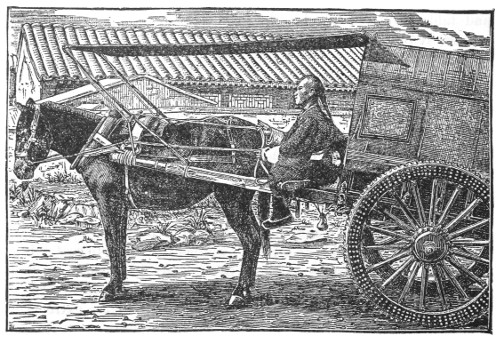
CHINESE CART.
The power of a Chinese father over his children is complete except that it stops short with life. The practice of selling children is common, and though the law makes it a punishable offense, should the sale be effected against the will of the children, the prohibition is practically ignored. In the same way a law exists making infanticide a crime, but as a matter of fact it is never acted upon; and in some parts of the country, more especially in the provinces of Chiang-hsi and Fu-chien, this most unnatural offense prevails among the poorer classes to an alarming extent. Not only do the people acknowledge the existence of the practice, but they even go the length of defending it. It is only however abject poverty which drives parents to this dreadful expedient, and in the more prosperous and wealthy districts the crime is almost unknown. Periodically the mandarins inveigh against the inhumanity of the offense and appeal to the better instincts of the people to put a stop to it; but a stone which stands near a 163pool outside the city of Foochow bearing the inscription, “Girls may not be drowned here,” testifies with terrible emphasis to the futility of their endeavors.
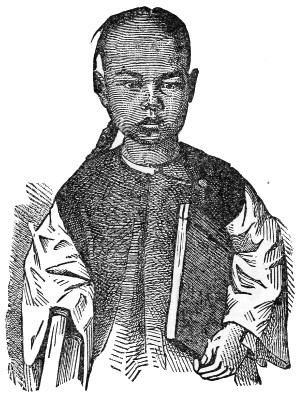
SCHOOL BOY.
The large number of cast-a-way bodies of dead infants seen in many parts of China is often regarded, though unjustly, as evidence of the prevalence of this crime. In most instances, however, it really indicates only the denial of burial to infants. This is due, at least in many places, to the following superstition: When they die it is supposed that their bodies have been inhabited by the spirit of a deceased creditor of a previous state of existence. The child during its sickness may be cared for with the greatest tenderness, but if it dies parental love is turned to hate and resentment. It is regarded as an enemy and intruder in the family who has been exacting satisfaction for the old unpaid debt; and having occasioned a great deal of anxiety, trouble, and expense, has left nothing to show for it but disappointment. The uncared for and uncoffined little body is cast away anywhere; and as it is carried out of the door the house is swept, crackers are fired, and gongs beaten to frighten the spirit so that it may never dare enter the house again. Thus do superstitions dry up the fountains of natural affection.
The complete subjection of children to their parents is so firmly imbued in the minds of every Chinese youth, that resistance to the infliction of cruel and even unmerited punishment is seldom if ever offered, and full-grown men submit meekly to be flogged without raising their hands. The law steps in on every occasion in support of parental authority. Filial piety is the leading principle in Chinese ethics.