Japan (continued 2)
Reading edition
253Dr. William Elliot Griffis, in his exhaustive and interesting work, “The Mikado’s Empire,” discusses at length the change of Japan from feudalism to its present condition, the abolition of the shogunate, and the rebellions that followed that event. He declares that popular impression to be wrong which suggests that the immediate cause of the fall of the shogun’s government, the restoration of the mikado to supreme power, and the abolition of the dual and feudal systems, was the presence of foreigners on the soil of Japan. The foreigners and their ideas were the occasion, not the cause, of the destruction of the dual system of government. Their presence served merely to hasten what was already inevitable.
The history of Japan from the abolition of feudalism in 1871 up to the present time, is a record of advance in all the arts of western civilization. The mikado, Mutsuhito, has shown himself to be much more than a petty divinity, a real man. He has taken a firm stand in advocacy of the introduction of western customs, wherever they were improvements. The imperial navy, dockyards, and machine shops have been a pride to him. He has withdrawn himself from mediæval seclusion and assumed divinity, and has made himself accessible and visible to his subjects. He has placed the empress in a position like to that occupied by the consorts of European monarchs, and with her he has adopted European attire. In the latter part of June, 1872, the mikado left Tokio in the flagship of Admiral Akamatsu, and made a tour throughout the south and west of his empire. For the first time in twelve centuries the emperor of Japan moved freely and unveiled among his subjects.
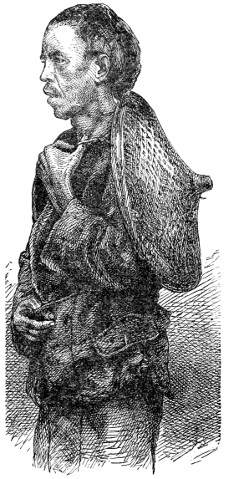
CHINESE COOLIE.
Again in the same year Japan challenged the admiration of Christendom. The coolie trade, carried on by Portuguese at Macao, in China, between the local kidnappers and Peru and Cuba, had long existed in defiance of the Chinese government. Thousands of ignorant Chinese were yearly decoyed from Macao and shipped in sweltering shipholds, under the name of “passengers.” In Cuba and Peru their contracts were often broken, they were cruelly treated, and only a small portion of them returned alive to tell their wrongs. The Japanese government had with a fierce jealousy watched the beginning of such a 254traffic on their own shores. In the last days of the shogunate, coolie traders came to Japan to ship irresponsible hordes of Japanese coolies and women to the United States. To their everlasting shame, be it said some were Americans. Among the first things done by the mikado’s government after the restoration, was the sending of an official who effected the joyful delivery of these people and their return to their homes.
So the Japanese set to work to destroy this nefarious traffic. The Peruvian ship Maria Luz, loaded with Chinese, entered the port of Yokohama. Two fugitive coolies in succession swam to the English war ship Iron Duke. Hearing the piteous story of their wrongs, Mr. Watson, the British chargé d’affaires, called the attention of the Japanese authorities to these illegal acts in their waters. A protracted enquiry was instituted and the coolies landed. The Japanese refused to force them on board against their will, and later shipped them to China, a favor which was gratefully acknowledged by the Chinese government. This act of a pagan nation achieved a grand moral victory for the world and humanity. Within four years the coolie traffic, which was but another name for the slave trade, was abolished from the face of the earth, and the coolie prisons of Macao were in ruins. Yet the act of freeing the Chinese coolies in 1872 was done in the face of clamor and opposition, and a rain of protests from 257the foreign consuls, ministers, and a part of the press. Abuse and threats and diplomatic pressure were in vain. The Japanese never wavered, but marched straight to the duty before them, the liberation of the slaves. The British chargé and the American consul, Colonel Charles O. Shepherd, alone gave hearty support and unwavering sympathy to the right side.
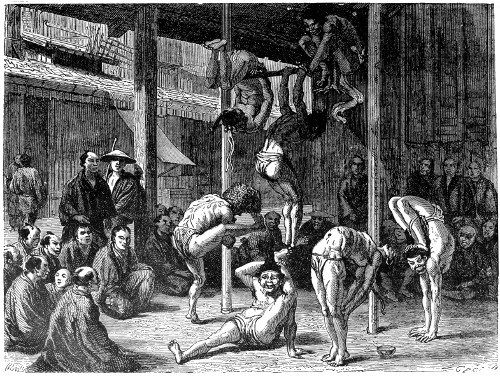
JAPANESE GYMNASTS—KIOTO.
During the same year, 1872, two legations and three consulates were established abroad, and from that time forward the number has been increasing until the representatives of Japan’s government are found all over the world. Scores of daily newspapers and hundreds of weeklies have been furnishing the country with information and awakening thought. The editors are often men of culture or students returned from abroad.
The Corean war project had, in 1872, become popular in the cabinet and was the absorbing theme of the army and navy. During the Tokugawa period Corea had regularly sent embassies of homage and congratulation to Japan; but not relishing the change of affairs in 1868, disgusted at the foreignizing tendencies of the mikado’s government, incensed at Japan’s departure from Turanian ideals, and emboldened by the failure of the French and American expeditions, Corea sent insulting letters taunting Japan with slavish truckling to the foreign barbarians, declared herself an enemy, and challenged Japan to fight. About this time a Liu Kiu junk was wrecked on eastern Formosa. The crew was killed by the savages, and, it is said, eaten. The Liu Kiuans appealed to their tributary lords at Satsuma, who referred the matter to Tokio. English, Dutch, American, German, and Chinese ships have from time to time been wrecked on this cannibal coast, the terror of the commerce of Christendom. Their war ships vainly attempted to chastise the savages. Soyejima, with others, conceived the idea of occupying the coast, to rule the wild tribes, and of erecting light houses in the interests of commerce. China laid no claim to eastern Formosa, all trace of which was omitted from the maps of the “Middle Kingdom.” In the spring of 1873, Soyejima went to Peking and there, among other things granted him, was an audience with the Chinese emperor. He thus reaped the results of the diplomatic labors of half a century. The Japanese ambassador stood upright before 258the “Dragon Face” and the “Dragon Throne,” robed in the tight black dress-coat, trousers, and linen of western civilization, bearing the congratulations of the young mikado of the “Sunrise Kingdom” to the youthful emperor of the “Middle Kingdom.” In the Tsung-li Yamen, Chinese responsibility over eastern Formosa was disavowed, and the right of Japan to chastise the savages granted. A Japanese junk was wrecked on Formosa, and its crew stripped and plundered while Soyejima was absent in China. This event piled fresh fuel on the flames of the war feeling now popular even among the unarmed classes.
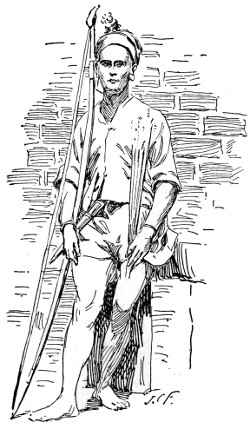
FORMOSAN TYPE.
Japan at this time had to struggle with opposition within and without, to every move in the direction of advancement in civilization. Says Griffis, “At home were the stolidly conservative peasantry backed by ignorance, superstition, priestcraft, and political hostility. On their own soil they were fronted by aggressive foreigners who studied all Japanese questions through the spectacles of dollars and cents and trade, and whose diplomatists too often made the principles of Shylock their system. Outside the Asiatic nations beheld with contempt, jealousy and alarm the departure of one of their number from Turanian ideas, principles, and civilization. China with ill-concealed anger, Corea with open defiance taunted Japan with servile submission to the ‘foreign devils.’
“For the first time the nation was represented to the world by 259an embassy at once august and plenipotentiary. It was not a squad of petty officials or local nobles going forth to kiss a toe, to play the part of figure-heads, or stool-pigeons, to beg the aliens to get out of Japan, to keep the scales on foreign eyes, to buy gun-boats, or to hire employees. A noble of highest rank, and blood of immemorial antiquity, with four cabinet ministers, set out to visit the courts of the fifteen nations having treaties with Dai Nippon. They were accompanied by commissioners representing every government department, sent to study and report upon the methods and resources of foreign civilizations. They arrived in Washington February 29, 1872, and for the first time in history a letter signed by the mikado was seen outside of Asia. It was presented by the ambassadors, robed in their ancient Yamato costume, to the President of the United States on the 4th of March, Mr. Arinori Mori acting as interpreter. The first president of the free republic, and the men who had elevated the eta to citizenship stood face to face in fraternal accord. The one hundred and twenty-third sovereign of an empire in its twenty-sixth centennial saluted the citizen ruler of a nation whose century aloe had not yet bloomed. On the 6th of March they were welcomed on the floor of Congress. This day marked the formal entrance of Japan upon the theater of universal history.”
In its subordinate objects the embassy was a signal success. Much was learned of Christendom. The results at home were the splendid series of reforms which mark the year 1872 as epochal. But in its prime object the embassy was an entire failure. One constant and supreme object was ever present, beyond amusement or thirst for knowledge. It was to ask that in the revision of the treaties the extra-territoriality clause be stricken out, that foreigners be made subject to the laws of Japan. The failure of the mission was predicted by all who knew the facts. From Washington to St. Petersburg point-blank refusal was made. No Christian governments would for a moment trust their people to pagan edicts and prisons. While Japan slandered Christianity by proclamations, imprisoned men for their beliefs, knew nothing of trial by jury, of the habeas corpus writ, or of modern jurisprudence; in short while Japan 260maintained the institutions of barbarism, they refused to recognize her as a peer among nations.
At home the watchword was progress. Public persecution for conscience' sake vanished. All the Christians torn from their homes and exiled and imprisoned in 1868 were set free and restored to their native villages. Education advanced rapidly, public decency was improved, and the standards of Christendom attempted.
While in Europe Iwakura and his companions in the embassy kept cognizant of home affairs. With eyes opened by all that they had seen abroad, mighty results, but of slow growth, they saw their country going too fast. Behind the war project lay an abyss of ruin. On their return the war scheme brought up in a cabinet meeting was rejected. The disappointment of the army was keen and that of expectant foreign contractors pitiable. The advocates of war among the cabinet ministers resigned and retired to private life. Assassins attacked Iwakura, but his injuries did not result fatally. The spirit of feudalism was against him.
On the 17th of January, the ministers who had resigned sent in a memorial praying for the establishment of a representative assembly in which the popular wish might be discussed. Their request was declined. It was officially declared that Japan was not ready for such institutions. Hizen, the home of one of the great clans of the coalition of 1868, was the chief seat of disaffection. With perhaps no evil intent, Eto, who had been the head of the department of justice, had returned to his home there and was followed by many of his clansmen. Scores of officials and men assembled with traitorous intent, and raised the cry of “On to Corea.” The rebellion was annihilated in ten days. A dozen ringleaders were sent to kneel before the blood pit. The national government was vindicated and sectionalism crushed.
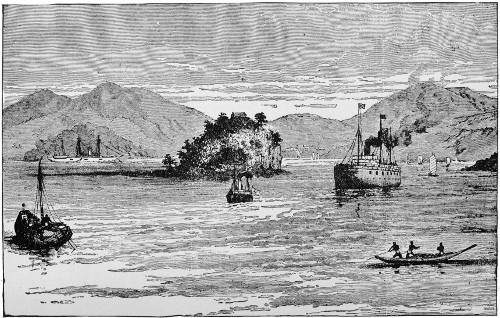
ENTRANCE TO NAGASAKI HARBOR.
The Formosan affair was also brought to a conclusion. Thirteen hundred Japanese soldiers occupied the island for six months, conquering the savages wherever they met, building roads and fortifications. At last the Chinese government in shame began to urge their claims on Formosa and to declare the Japanese intruders. For a time war seemed inevitable. The 263man for the crisis was Okubo, a leader in the cabinet, the master spirit in crushing the rebellion, and now an ambassador at Peking. The result was that the Chinese paid in solid silver an indemnity of $700,000 and the Japanese disembarked. Japan single-handed, with no foreign sympathy, but with positive opposition, had in the interests of humanity rescued a coast from terror and placed it in a condition of safety. In the face of threatened war a nation having but one-tenth the population, area, or resources of China, had abated not a jot of its just demands nor flinched from battle. The righteousness of her cause was vindicated.
The Corean affair ended happily. In 1875 Kuroda Kiyotaka with men of war entered Corean waters. Patience, skill, and tact were crowned with success. On behalf of Japan a treaty of peace, friendship, and commerce was made between the two countries February 27, 1876. Japan thus peacefully opened this last of the hermit nations to the world.
The rebellions which we have mentioned were of a mild type compared with that which in 1877 shook the government to its foundations. In the limits of our space it is impossible to enter deeply into the causes of the Satsuma rebellion. Its leader, Saigo Takamori, was one of the most powerful members of the reformed government until 1873 when he resigned as some of his predecessors had done, indignant at the peace policy which was pursued. A veritable Cincinnatus, he seems to have won the hearts of all classes around him by the Spartan simplicity of his life and the affability of his manner, and there was none more able or more willing to come to the front when duty to his country called him. It is a thousand pities that such a genuine patriot should have sacrificed himself through a mistaken notion of duty. Ambition to maintain and extend the military fame of his country seems to have blinded him to all other more practical considerations. The policy of Okubo and the rest of the majority in the cabinet, with its regard for peace and material prosperity, was in his eyes unworthy of the warlike traditions of old Japan. But we cannot follow out the story of this famous rebellion—how Saigo established a private school in his native city of Kagoshima for the training of young Shizoku in military tactics, how the reports of the policy of the government more and more dissatisfied 264him, until a rumor that Okubo had sent policemen to Kagoshima to assassinate him precipitated the storm that had been brewing. This report was not supported by satisfactory evidence, although the Kagoshima authorities extorted a so-called confession from a policeman. Okubo was too noble to be guilty of such an act. It was only after eight months of hard fighting, during which victory swayed from one side to another, and the death of Saigo and his leading generals when surrounded at last like rats in a trap, and the expenditure of over forty million yen, that the much tried government could freely draw breath again. The people of Satsuma believe that Saigo’s spirit has taken up its abode in the planet Mars, and that his figure may be seen there when that star is in the ascendant.
By this time railways, telegraphs, lighthouse service, and a navy were well under construction in native works. Two national exhibitions were held, one in 1877 and the second in 1881; the latter particularly was a pretentious one and a great success. In 1879 Japan annexed the Liu Kiu islands, bringing their king to Tokio, there to live as a vassal, and reducing the islands to the position of a prefecture in spite of the warlike threats of China. In the same year occurred the visit to Japan of General Grant while he was on his tour around the world. The famous American was entertained most enthusiastically by the citizens of Tokio for some two weeks in July. The enthusiasm awakened by his visit among the citizens was remarkable. Arches and illuminations were on every hand for miles. The entertainment provided by the Japanese for their distinguished guests at any time is so unique when seen by western eyes that it is always impressive and delightful.
265
LIMITS AND POSSESSIONS OF THE JAPANESE EMPIRE.
The Islands and their Situation—The Famous Mountain Fuji-yama—Rivers and Canals—Ocean Currents and Their Effect on the Japanese Climate—Japan not a Tropical Country—Flora and Fauna—The Important Cities—Strange History of Yokohama—Commerce—Mining—Agricultural Products—Ceramic Art—Government of the Realm.
The empire of Japan is a collection of islands of various dimensions, numbering nearly four thousand, and situated to the east of the Asiatic continent. Only four of these however, are of size sufficient to entitle them to considerable fame, and around these a sort of belt of defense is formed by the thousands of islets. Dai Nippon is the name given by the natives to their beautiful land, and from this expression, which means Great Japan, our own name for the empire has been taken. Foreign writers have very often blundered in calling the largest island Nippon or Niphon. This more properly applies to the entire empire, while the main island is named in the military geography of Japan, Hondo. This word itself means main land. The other three important islands are Kiushiu, the most southeasterly of all; Shikoku, which lies between the latter and Hondo; and Yesso, which is the most northerly of the chain.
Japan occupies an important position on the surface of the globe, measured by political and commercial possibilities. Its position is such that its people may not unreasonably hope to form a natural link between the Occident and the Orient. Lying in the Pacific Ocean, in the temperate zone and not in the torrid, as many have the thought, it bends like a crescent off the continent of Asia. In the extreme north, near the island of Saghalien, the distance from the main land of Asia is so short that it is little more than a day’s sail in a junk. At the southern extremity, where Kiushiu draws nearest to the Corean peninsula, the distance to the main land is even less. Between this crescent of islands and the Asiatic main land is enclosed the Sea of Japan. For more than four thousand miles eastward stretches the Pacific Ocean, with no stopping point for steamers voyaging to San 266Francisco unless they diverge far from their course for a call at Honolulu.
The island connections of Japan are numerous. To the south are the Liu Kiu islands, which have been annexed to Japan, and still farther the great island of Formosa. To the north are the Kurile islands, which extend far above Yesso and were ceded to Japan by Russia in return for Saghalien, over which rule was formerly disputed. The chain is almost continuous, although broken and irregular, to Kamtchatka, and thence prolonged by the Aleutian islands in an enormous semicircle to Alaska and our own continent.
The configuration of the land is that resulting from the combined effects of volcanic action and wave erosion. The area of the Japanese islands is about one hundred and fifty thousand square miles, or nearly as great as the New England and Middle States. But of this surface nearly two-thirds consists of mountain land, much of it still lying waste and uncultivated though apparently capable of tillage. On the main island a solid backbone of mountainous elevations runs through a great portion of its length, with subordinate chains extending at right angles and rising again in the other islands. The mountains decrease in height towards the south and there are few highlands along the sea coast. The range is reached by a gradual rise from the sea, until the backbone of the great island chain is reached. Japan rises abruptly from the sea, and deep water begins very close to the shore, indicating that the entire range of islands may be properly characterized as an immense mountain chain thrown up from the bottom of the ocean. The highest peak is Fuji-yama, which rises to a height of more than twelve thousand feet above the sea. It is a wonderfully beautiful mountain, and is the first glimpse that one has of land in approaching Yokohama from the Pacific Ocean. Of the position which this mountain occupies in the affections and traditions of the Japanese, mention will be made in a later chapter.
The islands forming the empire of Japan are comprehended in these limits; between twenty-four degrees and fifty-one degrees north latitude, and one hundred and twenty-four degrees and one hundred and fifty-seven degrees east longitude. That is, speaking 267roughly, it lies diagonally in and north of the subtropical belt, and has northern points corresponding with Paris and Newfoundland, and southern ones corresponding with Cairo and the Bermuda islands; or coming nearer home, it corresponds pretty nearly in latitude with the eastern coast line of the United States, added to Nova Scotia and Newfoundland, and the contrasts of climate in the latter island and in Florida are probably not more remarkable than those which are observed in the extreme northern and southern regions of Japan.
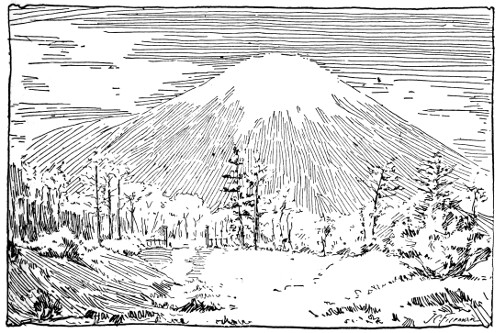
FUJI-YAMA.
The most striking geographical feature of Japan is the Inland Sea, which is one of the beauties of the world. It is a long, irregularly shaped arm of the sea, with tides and rapid currents, of variable width and no great depth, studded with innumerable thickly wooded islands. It is the water area which separates Hondo from Shikoku and Kiushiu, and is often spoken of as the Japanese Mediterranean.
One or two of the rivers of Japan, such as the Sumida, on the banks of which Tokio, the capital, lies, and which is about as broad as the East River between New York and Brooklyn, are 268worthy of note. Here at the present time are situated several ship yards, and many modern craft built in the American fashion may be seen along the shore. Here it may be mentioned that any particular appellation given to a river in Japan holds good only for a limited part of its course, so that it changes its name perhaps four or five times in flowing a few hundred miles. Indeed the river which passes through the city of Ozaka changes its name four times within the city limits. Most of the larger rivers in the main land run a course tending almost north and south. The general contour of the land is such that they must be short, but this direction gives them the greatest length possible. There are brief periods of excessively heavy rain, and they are often then in fierce flood, carrying everything before them and leaving great plains of water-worn stones and gravel around their mouths. There are many picturesque waterfalls which attract travelers and command the admiration of native artists and poets. The rivers at a short distance from their outlets are rendered navigable chiefly by the courage and expertness of the boatmen,—who are among the most daring and skillful in the world.
Till recently little has been done to deepen river channels or protect their banks, except in the interest of agriculture. In the lower courses, where broad alluvial plains of great fertility have been formed, they are frequently intersected by numerous shallow canals, for the most part of comparatively recent excavation, but some of them are many centuries old and these have been of immense service in keeping up communication throughout the country. In spite of their shallowness and rapid silting, some of the rivers of Japan are capable of being improved so as to admit of the passage of steam vessels of the largest size, and there are fine natural inlets and spacious bays which form harbors of great excellence.
The Japanese coast is usually steep and even precipitous. Its chief natural features, such as sunken rocks, capes, straits, entrances to bays and harbors and the mouths of rivers are now well marked with beacons or lighthouses of modern construction. The tides are not great, and in Yeddo bay the rise is only about four feet on an average. In spring tides it rarely exceeds six feet, and in general the height of the flood tide is never very 269great. Navigation in summer is somewhat dangerous and difficult, owing to the mists and fogs which are deemed by its sailors to be the great scourge of Japan. Indeed these malarious cloud banks are probably as dangerous to the health of the landsmen as they are to the safety of the mariner. While a large area of land lying under shallow water, during rice cultivation, may have some share in the formation of these dangerous mists, there is the more general cause which is readily to be found in the ocean currents.
Japan occupies a striking position in these currents which flow northward from the Indian ocean and the Malay peninsula. That branch of the great Pacific equatorial current called the Kuro Shiwo, or dark tide or current, on account of its color, flows in a westerly direction past Formosa and the Liu Kiu islands, striking the south point of Kiushiu and sometimes in summer sending a branch up the Sea of Japan. With great velocity it scours the east coast of Kiushiu and the south of Shikoku; thence with diminished rapidity it envelopes the group of islands south of the Bay of Yeddo; and at a point a little north of Tokio it leaves the coast of Japan and flows northeast towards the shores of America, ultimately giving to our own Pacific coast states a far milder climate than the corresponding latitudes on the Atlantic coast.
The yearly evaporation at the tropics, of fully fourteen or fifteen feet of ocean water, causes the great equatorial current of the Pacific to begin its flow. When the warm water reaches the colder waters to the northward, condensation of the water-laden air takes place, with the resulting formation of great cloud banks. The water appears to be of a deep, almost indigo-blue color, whence the name given to the current by the Japanese. Fish occur in great numbers where the Arctic current of fresher, lighter, and cooler water meets the warm salt stream from the south, amidst great commotion. The analogy of this great current to the Gulf stream of the Atlantic is apparent, and there can be no doubt as to its great influence on the climate of Japan. A difference of from twelve to sixteen degrees may be observed in passing from its waters to the cold currents from the north, and the effect of this on the atmosphere is very marked. The sudden 270and severe changes of temperature are often noticed on the southern coast of Japan and even in Yeddo bay. They are evidently due to eddies or branch currents from the great streams of cold and warm water which interweave themselves in the neighborhood.
In the island of Yesso, the most northerly of the large ones, the extremes of temperature are nearly as great as in New England. In the vicinity of Tokio the winter is usually clear and mild, with occasional sharp frosts and heavy falls of snow. In summer the heat is oppressive for nearly three months. Even at night the heat remains so high that sleep becomes almost impossible, the air being oppressive and no breeze stirring. The greatest heat is usually from the middle of June to early in September. The cold in winter is much more severe on the northwestern coast, and the roads across the main island are often blocked with snow for many months. In Yokohama the snow fall is light, not often exceeding two or three inches. The ice seldom exceeds an inch in thickness. Earthquake shocks are frequent, averaging more than one a month, but of late years there have been none of great severity.
The winds of Japan are at all seasons exceedingly irregular, frequently violent, and subject to sudden changes. The northeast and easterly winds are generally accompanied by rain, and are not violent. The southwest and westerly winds are generally high, often violent, and accompanied with a low barometer. It is from the southwest that the cyclones or typhoons almost invariably come. On clear and pleasant days, which in the neighborhood of Yokohama prevail in excess of foggy ones, there is a regular land and sea breeze at all seasons. The rainfall is above the average of most countries, and about two-thirds of the rainfalls during the six months from April to October.
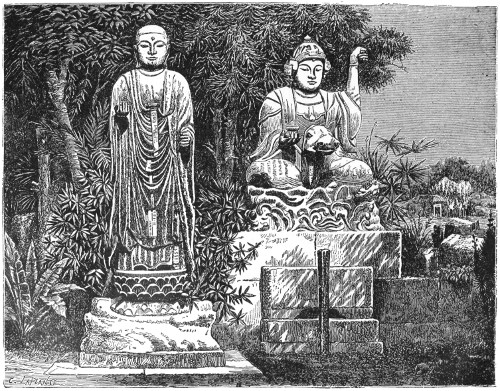
JAPANESE IDOLS.
The flora of Japan is exceedingly interesting, not only to botanists and specialists, but to casual travelers and readers. The useful bamboo flourishes in all parts of the land; sugar cane and the cotton plant grow in the southern part; tea is grown almost everywhere. The tobacco plant, hemp, corn, mulberry for silkworm food, rice, wheat, barley, millet, buckwheat, potatoes, and yams are all cultivated. The beech, the oak, maples, and pine 273trees in rich variety; azaleas, camelias, etc., grow in the forests. Some of the more characteristic plants are wisteria, cryptomeria, calceolaria and chrysanthemums. Various varieties of evergreens are grown, and the Japanese gardeners are peculiarly expert in cultivating these trees in dwarf forms of great beauty. Many familiar wild flowers can be gathered, such as violets, blue-bells, forget-me-nots, thyme, dandelions, and others. The woods are rich in ferns, among which the royal fern is conspicuous, and in orchids, ivies, lichens, mosses and fungi. The beautiful locusts, though imported, may now fairly be considered as naturalized. There are many water lilies, reeds and rushes, some of which are of great beauty and others of utility.
The mammalia of Japan are not numerous. In ancient times, before the dawn of history, two species of dwarf elephants existed in the plains around Tokio. There are many monkeys in some parts, even in the extreme northern latitudes. Foxes abound and are regarded with reverence. Wolves and bears are destructive in the north. There are wild antelopes, red deer, wild boars, dogs, raccoons, badgers, otters, ferrets, bats, moles, and rats; while the sea is specially rich in seals, sea-otters, and whales. The country has been found quite unsuitable for sheep, but goats thrive well, although they are not much favored by the people. Oxen are used for draught purposes. Horses are small but are fair quality, and the breed is being improved. The cats are nearly tailless. The dogs are of a low, half-wolfish breed. There are some three hundred varieties of birds known in Japan. Few of them are what we call song-birds, but the lark is one brilliant exception. Game birds are plentiful, but are now protected.
Insects are very numerous, as no traveler will dispute, and Japan is a great field for investigation by entomologists. Locusts are often destructive, and mosquitoes are a great pest. Bees, the silk worm and the wax-insect are highly appreciated.
There are several kinds of lizards, a great variety of frogs, seven or eight snakes, including one deadly species, and two or three kinds of tortoise. The crustaceans are numerous and interesting, and of fish there is extraordinary variety, especially those found in salt water. Oysters and clams are excellent and plentiful.
274Let us now turn to the temporal affairs of the people who dwell in this island empire, their cities, their industries, and to their government.
Japan like its oriental companion, China, is a country of great cities, although the smaller empire has not so many famous for their size as has China. With scarcely an exception these greater cities are situated at the heads of bays, most of them good harbors and accessible for commerce. The largest of these cities, of course, is the capital Tokio, which doubtless passes a million inhabitants, although it is impossible that it should justify the American tradition of not many years ago, that its numbers were twice a million. Tokio, or the old city of Yeddo, is situated near the head of Yeddo Bay, but a few miles from Yokohama, and but little farther from Uraga where the first reception to Commodore Perry was given. Among the other more important cities on the sea coast are Nagasaki, Yokohama, Hakodate, Hiogo, Ozaka, Hiroshima, and Kanagawa.
Nagasaki is situated on the southwest coast of the island of Kiushiu, and is built in the form of an amphitheater. The European quarter in the east, stands upon land reclaimed from the sea at considerable labor and expense. Desima, the ancient Dutch factory, lies at the foot, and behind it is the native part of the town. The whole is sheltered by high wooden mountains. The city of Nagasaki was almost the first which attracted the attention of foreigners, partly from its being already known by name from the Dutch colony established there; partly because it was the nearest point to China and a port of great beauty; and also because before the political revolution which overthrew the power of the shogunate, the daimios of the south were there enabled, owing to its distance from Yeddo, to transact foreign affairs in their own way unmolested. This comparative importance did not last long, for affairs soon began to be concentrated in Yokohama, and the opening of the ports of Hiogo and Ozaka further reduced it to a secondary rank among commercial towns. It is still, however, a busy place and a great portion of the navigation of the Japanese seas passes by its beautiful port. But it is not a town of the future, and will be supplanted in prosperity to considerable extent by the more northern cities.
275Yokohama, situated on the Gulf of Yeddo, owes its rise and importance to the merchants who came to seek their fortunes in the empire of the rising sun immediately after the signature of the treaties which threw open the coasts of Japan to adventurous foreigners. When Perry, with his augmented fleet, returned to Japan in February, 1854, the Japanese found him as inflexibly firm as ever. Instead of making the treaty at Uraga he must take it nearer Yeddo. Yokohama was the chosen spot, and there on the 8th of March, 1854, were exchanged the formal articles of convention between the United States and Japan.
By the treaty of Yokohama, Shimoda was one of the ports opened to Americans. Before it began to be of much service the place was visited by an earthquake and tidal wave, which overwhelmed the town and ruined the harbor. The ruin of Shimoda was the rise of Yokohama. By a new treaty Kanagawa, three miles across the bay from Yokohama, was substituted for Shimoda. The Japanese government decided to make Yokohama the future port. Their reasons for this were many. Kanagawa was on the line of the great highway of the empire, along which the proud Daimios and their trains of retainers were continually passing. With the antipathy to foreigners that existed, had Kanagawa been made a foreign settlement, its history would doubtless have had many more pages of assassination and incendiarism than did Yokohama. Foreseeing this, even though considered by the foreign ministers a violation of treaty agreements, the Japanese government immediately set to work to render Yokohama as convenient as possible for trade, residence and espionage.
They built a causeway nearly two miles long across the lagoons and marshes to make it of easy access. They built granite piers, custom house and officers’ quarters, and dwellings and store houses for the foreign merchants. After a long quarrel over which should be the city, the straggling colony of diplomats, missionaries, and merchants of Kanagawa finally pulled up their stakes and joined the settlement of Yokohama. Yokohama was settled in a squatter-like and irregular manner, and the ill effects of it are seen to this day. When compared with Shanghai, the foreign metropolis of China, it is vastly inferior.
The town grew slowly at first. Murders and assassinations of 276foreigners were frequent during the first few years. Diplomatic quarrels were constant, and threats of bombardment from some foreign vessel in the harbor of frequent occurrence. A fire which destroyed nearly the whole foreign town seemed to purify the place municipally, commercially, and morally. The settlement was rebuilt in a more substantial and regular manner. As the foreign population grew, banks, newspaper offices, hospitals, post-offices, and consulate buildings reappeared in a new dignity. Fire and police protection were organized. Steamers began to come from European ports and from San Francisco. Social life began as ladies and children came, and houses became homes. Then came the rapid growth of society and the finer things. Churches, theaters, clubs, schools were organized in rapid succession. Telegraph connection with Tokio, and thence around the globe, was accomplished, and the railway system increased rapidly. Within the thirty-five years of the life of Yokohama, it has grown from a fishing village of a few hundred to a city of fifty thousand people. Its streets are lighted with gas and electricity; its stores are piled full of rare silks, bronzes and curios. At present the foreign population of Yokohama numbers about two thousand residents. In addition to these the foreign transient population, made up of tourists and officers and sailors of the navy, and the merchant marine, numbers between three thousand and six thousand. Several daily newspapers, beside weeklies and monthlies, printed in English, furnish mediums of communication and news. Yokohama has become and will remain the great mercantile center of American and European trade in Japan.
Hiogo, or rather Kobe, as the foreign part has been called since the concession, is near Ozaka, both towns being situated on the inland Sea of Japan, near the south end of the Island of Niphon. Kobe is a considerable foreign settlement, with many fine houses and spacious warehouses. Ozaka, which contains more than half a million inhabitants, is one of the chief trading cities of Japan, and an immense proportion of the merchandise imported into the empire passes through it.
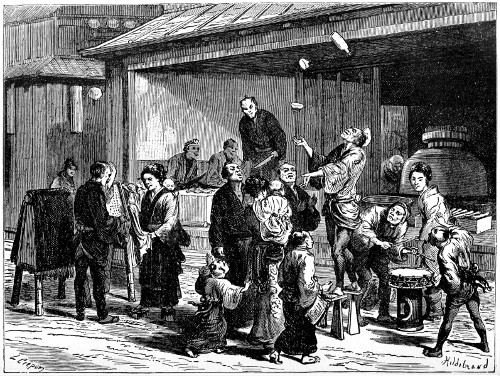
JAPANESE JUGGLERS.
The commerce between Japan and western nations, European and American, increases year by year. England enjoys the profits from more than half of the total interchange, the United 279States is second, with a large portion of the remainder, and the rest of the commerce is divided among Germany, France, Holland, Norway, and Sweden. It is impossible to obtain figures recent enough to be a satisfactory index of the total volume of commerce annually, but it is now very many millions of dollars a year. Japan exports tobacco, rice, wax, tea, silks, and manufactured goods, such as curios, bronzes, lacquer ware, etc. The principal imports of Japan are cotton goods, manufactures of iron, machinery of all sorts, woolen fabrics, flour, etc.
Mining in Japan is seldom carried on by modern methods, and the mineral wealth has not been developed as it will be within a few years. In almost every portion of Japan are found ores of some kind and there is scarcely a district in which there are not traces of mines having been worked. No mines can be worked without special license of the government, and foreigners are excluded from ownership in any mining industry. Japan seems to be fairly well, though not richly, provided with mineral wealth. The mines include those for gold, silver, copper, lead, iron, tin, plumbago, antimony, arsenic, marble, sulphur, alum, salt, coal, petroleum, and other minerals.
The annual export of tea amounts to nearly thirty million pounds, of which considerably more than half is shipped from Yokohama. All Japanese tea is green and the United States is the chief customer for it.
The exact area of Japan is not known, though it is computed at nearly one hundred and fifty thousand square miles, with a population of more than two hundred persons to a square mile. The number of acres under cultivation is about nine million, or one-tenth of the entire area. Not one-fourth of the fertile portion of Japan is yet under cultivation. Immense portions of good land await the farmers’ plow and seed to return rich harvests. For centuries the agricultural art has been at a standstill. Population and acreage have increased, but the crop in bulk and quantity remains the same. The true wealth of Japan consists in her agricultural and not in her mineral and manufacturing resources. The government and intelligent classes seem to be awakening to this fact. The islands are capable of yielding good crops and adapted to support the finest breeds of cattle. With 280these branches of industry increased to the extent that they deserve, the prosperity of the empire will show constant increase.
The ceramic art of Japan and the art of the lacquer worker are two that have helped to make Japanese wares famous in the western world. The various wares of porcelain and faience are made in Japan in quality and art inferior to none in the world.
Since the restoration to power of the mikado in 1868, the government of Japan has been growing nearer and nearer into the forms of western monarchical governments. In a prior chapter the promise of the young mikado to advance the freedom of his people, and ultimately to adopt constitutional forms of rule, has been quoted. In the later years he has been aiming for the fulfillment of this promise. Supporting him, the party of progressionists, largely influenced by contact with European and American civilization, urge on every reform. The present government is simply the modernized form of the system established more than a thousand years ago, when centralized monarchy succeeded simple feudalism. After the emperor comes the Dai Jo Kuan, which is practically a supreme cabinet, and following this, three other cabinets of varying powers and duties. The council of ministers is made up of the heads of departments, the foreign office, home office, treasury, army, navy, education, religion, public works, judiciary, imperial household, and colonization. The Dai Jo Kuan directs the three imperial cities and the sixty-eight ken or prefectures. The provinces are now merely geographical divisions.
In the course of the efforts to bring the Japanese forms of government more into harmony with those of Europe and America, many important changes have been made. A system of nobility was devised, and titles were granted to those who were considered to be entitled to them, whether by birth or achievement. The four or five ranks included in this system closely follow the English models.
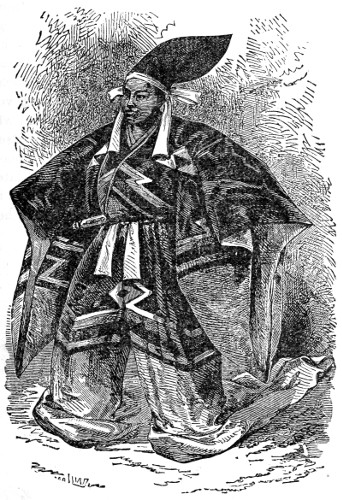
JAPANESE COURT DRESS, OLD STYLE.
The judiciary, too, has been remodeled in many details to make it approach the western system. The methods of procedure are gradually conforming nearer and nearer to our own, as well as the names and jurisdiction of the courts. The Japanese people have been exceedingly anxious of late years to expunge the extraterritoriality 281clause which appears in the treaties with all western nations. It provides, in effect, that offenses by a foreigner against a Japanese shall be judged in a consular court presided over by the consul of that country whence the foreigner comes. In other words, Japanese courts have no jurisdiction over the doings of foreigners having consuls in that country. This provision has become very obnoxious to the Japanese people, placing them on a level, as it does, with barbaric and semi-barbaric countries, where like provisions hold. This has been one of the potent factors in influencing Japan to adopt western legal methods. Recent 282treaties which have been drawn with the United States and with England provide that this clause shall be expunged, and if they are finally agreed upon we may soon see Japan more absolutely independent than she has yet been.
In 1890 a constitution was granted to Japan by the emperor, and a few months later legislative bodies for the first time began deliberation in Tokio. The powers of this parliament are constantly increasing. The war between China and Japan has been a strong influence to weld the people of opposing political faiths into harmony, and in parliament conservatives and radicals alike have risen in patriotism, and have been glad to cast votes for every measure that would hold up the hands of those who were bearing the battles. With a government drawing for itself lines parallel with those of enlightened western nations, increasing the freedom of its people, the power of the people’s legislators, and the honesty of the people’s courts, Japan has every right to name herself as worthy of a place in full brotherhood with the family of civilized nations.
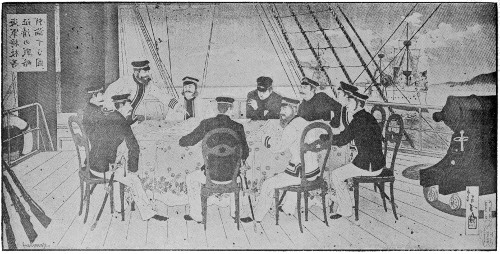
COUNCIL OF WAR ON A JAPANESE BATTLE SHIP. (From a Drawing by a Japanese Artist.)]
285
PERSONAL CHARACTERISTICS OF THE JAPANESE PEOPLE.
Difference of Opinion as to the True Significance of Their Rapid Adoption of Western Civilization—Physique of Man and Woman—Two Great Classes of the Population—The Samurai—The Agricultural Laborer—Wedding Ceremonies—Elopements—Japanese Babies—Sports of Childhood and of Age—Dress of Man and Woman—Food—Homes of the People—Family Life—Art, Science, Medicine, Music—Language and Literature—Religion.
In such a state of transition are the Japanese people themselves, as truly as the government, that it is difficult to describe their personal characteristics. Different observers reach different conclusions as to their personality. One affirms that great quickness of imitation and judgment in discovering what is worth imitating, seem to be the prominent characteristics of the Japanese. They want originality and independence of thought, and character which accompanies it. The Japanese are not slow in adopting the inventions of modern civilization, and even in modifying them to suit their own convenience, but, says another observer, that they will ever add anything of importance to them may be doubted. The same is true in a political point of view. The more enlightened of the Japanese are already beginning to recognize the superiority of the European forms of government. The upper classes are all sedulously imitating Paris and London fashions of dress. In our own country we have seen the prevalence of an offensive Anglomania among certain classes of society in the larger cities, but in Japan a corresponding mania for the forms of western civilization has become almost universal, and is reaching the real bulk of the nation. Such extraordinary capacity for change may mark a versatile but unreliable race; for it seems hard to believe that a people who are parting with their ancestral notions with such a total absence of any pangs of sorrow, will be likely to adhere with much steadfastness to a new order of things. On the other hand, other students of this movement take it to be only a most gratifying indication that Japan was a nation which had outgrown its narrow limits of thought and learning, ready to adopt whatever was good, and yearning for it when the opportunity 286came, with a strength that made rapid assimilation of ideas entirely proper, and no sign of instability. It is to be hoped that the latter interpretation is the right one.
In moral character the average Japanese is frank, honest, faithful, kind, gentle, courteous, confiding, affectionate, filial, and loyal. Love of truth for its own sake, chastity, and temperance are not characteristic virtues. A high sense of honor is cultivated by the Samurai. In spirit the average artisan and farmer is lamblike. In intellectual capacity the actual merchant is mean, and his moral character low. He is beneath the Chinaman in this respect. The male Japanese is far less overbearing and more chivalrous to woman than any other Asiatic. In political knowledge, or gregarious ability, the countryman is a baby and the city artisan a boy. The peasant is a pronounced pagan, with superstition ingrained into his inmost nature. In reverence to elders and to antiquity, obedience to parents, gentle manners, universal courtesy, and generous impulses the Japanese are the peers of any and superior to many peoples of Christendom. The idea of filial obedience has been developed into fanaticism and is the main blot of paganism and superstition.
The Japanese in physique are much of the same type as the Spaniards, and inhabitants of the south of France. They are of middle or low stature. The men are about five feet six inches in height or a trifle less on an average, while the women rarely exceed five feet. When dressed the Japanese look strong, well proportioned men, but when in the exceedingly slight costumes which they very often are pleased to adopt, it is then apparent that though their bodies are robust their legs are short and slight. Their heads are somewhat out of proportion to their bodies, being generally large and sunk a little between the shoulders, but they have small feet and delicate hands. The resemblance the Japanese bear to the Chinese is not nearly as marked as popular opinion would have it. The faces of the former are longer and more regular, their noses more prominent, and their eyes less sloped. The men are naturally very hirsute, but they never wear beards. Their hair is glossy, thick, and always black. Their eyes are black, their teeth white and slightly prominent. The shade of their skin is totally unlike the yellow complexions of the 287Chinese; in some cases it is very swarthy or copper colored, but the most usual tint is an olive brown. Children and young people have usually quite pink complexions.
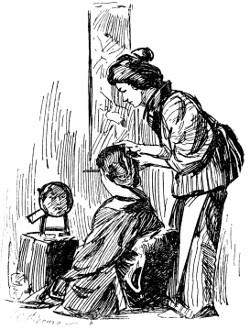
DRESSING THE HAIR.
The women follow the Chinese type a little closer. The eyes are narrower and sloped upward, and the head is small. Like the men their hair is glossy and very black, but it never reaches the length of American women’s hair. They have clear, sometimes even perfectly white skin, especially among the aristocracy, oval faces, and slender, graceful forms. Their manners are peculiarly artless and simple. But the harmony of the whole is spoiled in many instances by an ugly depression of the chest, which is sometimes observed in those who are otherwise handsomest and best formed.
About the end of the eighth century a reform was instituted in the military system of the empire, which had become unsatisfactory and defective. The court decided that all those among the rich peasants who had capacity and were skilled in archery and horsemanship, should compose the military class, and that the remainder, the weak and feeble, should continue to till the soil and apply themselves to agriculture. This was one of the most significant of all the changes in the history of Japan. Its fruits are seen to-day in the social constitution of the Japanese people. Though there are many classes, there are but two great divisions of the Japanese, the military and the agricultural.
This change wrought a complete severance of the soldier and the farmer. It lifted up one part of the people to a plane of life on which travel, adventure, the profession and pursuit of arms, letters, and the cultivation of honor and chivalry were possible, 288and by which that brightest type of Japanese men, the Samurai was produced. This is the class which for centuries has monopolized arms, polite learning, patriotism, and intellect of Japan. They are the men whose minds have been open to learn, from whom sprung the ideas that once made and later overthrew the feudal system, which wrought the mighty reforms that swept away the shogunate in 1868, and restored the mikado to ancient power, who introduced those ideas that now rule Japan, and sent their sons abroad to study the civilization of the west. To the Samurai Japan looks to-day for safety in war and progress in peace. The Samurai is the soul of the nation. In other lands the priestly and the military castes were formed, in Japan one and the same class held the sword and the pen; the other class, the agricultural, remained unchanged.
Left to the soil to till it, to live and die upon it, the Japanese farmer has remained the same to-day that he was then. Like the wheat, that for successive ages is planted as wheat, sprouts, beards and fills as wheat, the peasant with his horizon bounded by his rice fields and water courses or the timbered hills, his intellect laid away for safe keeping in the priest’s hands, is the son of the soil. He cares little who rules him unless he is taxed beyond the power of flesh and blood to bear, or an overmeddlesome official policy touches his land to transfer, sell or divide it. Then he rises to rebel. In time of war he is a disinterested and a passive spectator and he does not fight. He changes masters with apparent unconcern. Amidst all the ferment of ideas induced by the contact of western civilization with Asiatic within the last four decades, the farmer stolidly remains conservative. He knows not nor cares to hear of it and hates it because of the heavier taxes it imposes upon him.
The domestic solemnities of the Japanese, marriage especially, are made the subjects of deep and careful meditation. In the upper classes marriage is arranged between two young people when the bridegroom has reached his twentieth and the bride her sixteenth year. The will of the parents is almost without exception the dominating power in the matrimonial arrangements, which are carried out according to agreement among the relatives, but love affairs of a spontaneous kind form a large element in the 289romantic literature of Japan. The wedding is preceded by a betrothal, which ceremony offers an occasion for the members of both families to meet one another; and it not unfrequently happens that the future couple then learn for the first time the wishes of their parents respecting their union. If perchance the bridegroom elect is not satisfied with the choice, the young woman returns home again. With the introduction of other western ideas, this inconvenient custom is little by little falling into disuse. Nowadays, if a young man wishes to marry into a family of good position or one which it would be advantageous to his prospects to enter, he endeavors first to see the young lady, and then if she pleases him he sends a mediator, chosen usually from amongst his married friends, and the betrothal is arranged without any further obstacle. Even more American-like than this, however, there are many instances, and the number is constantly increasing, in which the match is the result of mutual affection, and sometimes elopements are known to occur among the best families.
When things are carried through conventionally, the betrothal and wedding are usually solemnized on the same day and without the assistance of any minister of worship. The customary ceremonies are all of a homely nature, but at the same time are extremely complicated and numerous. Upon the day fixed, the trousseau of the young bride and all the presents she has received, are brought to the home of the bridegroom, where the ceremony is to be performed, and arranged in the apartments set apart for the affair. The bride arrives soon afterward, dressed in white and escorted by her parents. The groom, arrayed in gala costume, receives her at the entrance of the house, and conducts her into the hall where the betrothal takes place. Here grand preparations have been made. The altar of the domestic gods has been decorated with images of the patron saints of the family and with different plants, each having its symbolical meaning.
When all have taken their places according to the recognized form of precedence, the ceremony is begun by two young girls, who hand around unlimited quantities of saki to the guests. These two damsels are surnamed the male and female butterfly, the emblems of conjugal felicity, because according to popular notion butterflies always fly about in couples. The decisive ceremony 290is tinged with a symbolism which has a considerable touch of poetry in it. The two butterflies, holding between them a two-necked bottle, approach and offer it to the engaged couple to drink together from the two mouths of the bottle till it is emptied, which signifies that husband and wife must drain together the cup of life whether it contain nectar or gall; they must share equally the joys and sorrows of existence.
The Japanese is the husband of one wife only, but he is at liberty to introduce several concubines under the family roof. This is done in all classes of society, especially amongst the daimios. It is asserted that in many of the noble families the legitimate wife not only evinces no jealousy, but has even a certain pleasure in seeing the number of her household thus augmented, as it supplies her with so many additional servants. In the middle classes, however, the custom is often the cause of bitter family dissentions.
The heavy expenses of the marriage ceremonies often occasion considerable domestic strife and misery, at least if they are celebrated according to all the established conventionalities. Debts are then incurred which perhaps the young couple are unable to meet, so that when other expenses grow, and trouble or misfortune overtake them, they are speedily plunged into the deepest distress and indigence. The natural consequence of these arbitrary customs is the increase of runaway matches. The elopement, however, is usually wisely winked at by the parents, who feign great lamentation and anger, then finally assemble their neighbors, pardon their recreant children, and circulate the inevitable saki, and the marriage is considered as satisfactory as if performed with all the requisite formalities.
The birth of a child is another occasion for the meeting of the whole circle of relations, and the consumption of a great many more bumpers of saki. The baptism of the young Japanese citizen takes place thirty days later, when the infant is taken to the temple of the family divinity to receive its first name. The father has previously written three different names upon three separate slips of paper, which are handed over to the officiating bonze or priest. The latter throws them into the air, and the piece of paper which in falling first touches the ground contains 291the name which is to be given to the child. There are no godparents, but several friends of the family declare themselves the infant’s protectors and make it several presents, among which is a fan if it be a boy, or a pot of rouge if a girl.
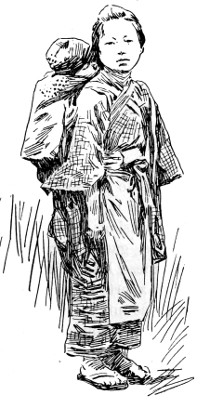
CHILD CARRYING BABY.
The Japanese child is early taught to endure hardships, and is subjected from its infancy to all the small miseries of life, so far as may be thought wise for its training. The mother nurses it till it is two years of age, and carries it continually about with her attached to her back for convenience. The children are daintily pretty, chubby, rosy, sparkling-eyed. The children’s heads are shaved in all curious fashions, some with little topknots, and others with bald spots. The way the babies are carried is an improvement upon the Indian fashion. He is lugged on the back of his mother or his sister, maybe scarcely older than himself, either strapped loosely but safely, with his head just peering above the shoulder of the bearer, or else enclosed in a fold of the garment she wears. It is a popular belief among travelers that Japanese babies are the best in the world and never cry, but the Japanese themselves claim no such distinction for the little ones, very proud of them though they are, and affirm that they have their fits of temper as well as American babies.
Education is not forced too early upon the children, but nature is allowed its own way during the first years of childhood. Toys, pleasures, fetes of all kinds, are liberally indulged in. One writer has said that Japan is the paradise of babies; not only is this true but it is also a very delightful abode for all who love play. The contrast between the Japanese and Chinese character in this respect is radical. The whole character, manners, and even the dress of the sedate and dignified Chinaman, seems to be in keeping 292with that aversion to rational amusement and athletic exercises which characterize that adult population. In Japan, on the contrary, one sees that children of the larger growth enjoy with equal zest, games which are the same or nearly the same as those of the little ones. Certain it is that the adults do all in their power to provide for the children their full quota of play and harmless sports.
A very noticeable change has passed over the Japanese people since the recent influx of foreigners, in respect of their love of amusements. Their sports are by no means as numerous or elaborate as formerly, and they do not enter into them with the enthusiasm that formerly characterized them. The children’s festivals and sports are rapidly losing their importance, and some are rarely seen. There is no country in the world in which there are so many toy shops for the sale of the things which delight children. Street theatrical shows are common. Sweet meats of a dozen strange sorts are carried by men who do tricks in gymnastics to please the little ones. In every Japanese city there are scores if not hundreds of men and women who obtain a livelihood by amusing the children. There are indoor games and outdoor games, games for the day time and games for the evening. Japanese kite flying and top spinning are famous the world over, and experts in these sports come to exhibit their adeptness in our own country. In the northern provinces, where the winters are severe, Japanese boys have the same sports with snow and ice, coasting, sliding, fighting mimic battles with snowballs, that are known to our own American boys. Dinners, tea parties, and weddings, keeping store, and playing doctor, are imitated in Japanese children’s games.
On the third day of the third month is held the wonderful “Feast of Dolls” which is the day especially devoted to the girls, and to them it is the greatest day in the year. The greatest day in the year for the boys is on the fifth day of the fifth month, when they celebrate what is known as the “Feast of Flags.”
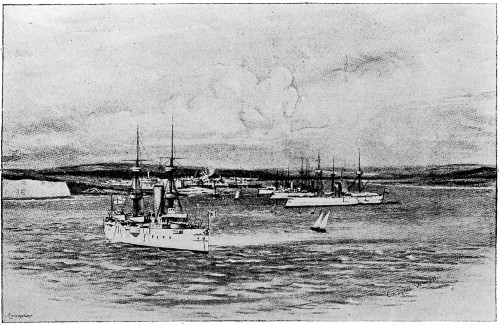
THE CHINESE FLEET AT WEI-HAI-WEI.
A Japanese attains his majority at fifteen years of age. As soon as this time has arrived he takes a new name, and quietly discards the pleasures of infancy for the duties of a practical life. His first care, if he belong to the middle classes, is the choice of 295a trade or profession. The opportunities for this choice are much greater than in China, just as the scope of Japanese learning and life has increased in the last quarter century. Practically all of the businesses and trades that we know in our own country are to-day known in Japan, those which were not there before, having crept in with the advent of the foreigners. The Japanese young man, if he is to be a merchant or to learn a trade, serves an apprenticeship for a period sufficient to fit him for the mastery of his work, and then it is he provides himself with a wife.
The dress of the Japanese is changing in harmony with the introduction of other foreign habits. Custom has always obliged married women to shave their eyebrows and blacken their teeth, but of late years the practice has been decreasing and now it does not prevail among the better classes and in the larger cities. They have also made a most immoderate use of paint, covering their brow, cheeks, and neck with thick coats of rouge and white. Some have even gone so far as to gild their lips, but the more modest have been content to color them with carmine, and the excessive use of paints is diminishing.
The kirimon, a kind of long, open dressing gown, is worn by every one, men and women alike. It is a little longer and of better quality for the women, who cross it in front and confine it by a long wide piece of silk, or other material tied in a quaint fashion at the back. The men keep theirs in its place by tying a long straight scarf around them. The Japanese use no linen, the women alone wearing a chemise of silk crepe, but it must be remembered that they bathe daily or even oftener, and that simplicity of dress is affected by all.
The middle classes wear in addition to the kirimon, a doublet and pantaloons. These are also worn in winter by men of the lower orders, the pantaloons fitting tightly, and made of checked cotton. The peasants and porters usually wear a loose overall in summer, made of some light paper material, and in winter not unfrequently consisting of coarse straw. The women also envelop themselves in one or several thickly wadded mantles. Linen gloves with one division for the thumb are very generally worn. Sandals are made of plaited straw, and in bad weather are discarded for wooden clogs, raised from the ground by means of two 296bits of wood under the toetoe and heel. As might naturally be expected, locomotion under such circumstances is performed with difficulty, and the hobbling gate which these props necessitate has often been commented on. This peculiarity is most noticeable among the women, whose naturally easy gait is almost as much diverted from its normal movement by these small stilts as that of their sisters in the west by their high heeled shoes. The costume of the country is exactly alike for both the lower and higher classes, with the difference that the latter always wear silk material. The costumes worn by officials, and those of the nobility, are distinguished by the amplitude of the folds and the richness of the texture. Wide flowing pantaloons are often substituted for the kirimon, which trail on the ground, completely concealing the feet, and give the wearer the appearance of walking on his knees, which indeed is the delusion it is intended to produce. A kind of overcoat with wide sleeves reaching to the hips completes the costume.
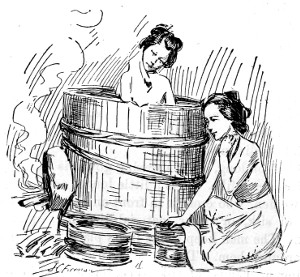
JAPANESE BATH.
The dwelling houses of the Japanese are well adapted to their manners of life, except that they are not always sufficient protection against severe cold. Rich and poor live side by side, although in Tokio there are still traces of the castes of the feudal age, and there are also growing tendencies in the rising mercantile and moneyed classes to separate themselves from the common mass. There are now great portions of the capital densely populated 297by the working classes only, and quite destitute of any open spaces of practical value for health and recreation.
The proverb “Every man’s house is his castle,” might very readily be appropriated by the Japanese, whose home, however humble it may be in all other respects, is always guarded by a moat. In a feudal mansion the moat was usually deep enough to prove a genuine obstacle. While it is still almost universally retained, the muddy water is hidden in summer time by the leaves of the lotus, and the bridges are not drawn. The smaller gentry imitate the grandeur of those above them, and when at last we come down to the lowest level we still find a miniature moat which is often dry, of a foot or so in breadth, and at most about two inches deep.
In houses of some pretensions there is an enbankment behind the moat, with a hedge growing above it. Behind this there is either a wall or fence of bamboo, tiles, or plaster. As the name of the street is not to be found at the street corner as with us, it is repeated on every doorway. The towns are divided into wards and blocks, and the numbers of the houses are often confused and misleading. A slip of white wood is nailed on one of the posts of the gate, and is inscribed with the name of the street or block, the number, name of house holder, numbers and sexes of household. The gates of the larger houses are heavy, adorned with copper or brass mountings, and often studded with large nails.
When one enters by the gate there is generally found a court, from the sides of which the open verandas of the building may be reached. The verandas are high and there is a special entrance by heavy wooden stairs. The court is sometimes paved with large stones, and sometimes it is left bare or covered with turf. The gardens even of somewhat humble mansions are graced with carved stone lanterns. The well placed near the kitchen often has a rim of stone around it, and the bucket is raised by a beam or a long bamboo.
In front of the doorway there is a small space unfloored called the doma, where one takes off his shoes after announcing himself by calling, or by striking a gong suspended by the door post. There is often only one story in Japanese houses, and very rarely more than two. Almost all of them are built of wood; the ground 298floor is raised about four feet above the ground, the walls are made of planks covered with coarse mats; and the roof is supported by four pillars. In a two-storied house the second story is generally built more solidly than the first; experience having shown that the edifice can thus better resist the shock of an earthquake. Sometimes the walls are plastered with a coating of soft clay or varnish, and are decorated with gildings and paintings. The stair to the second story is very steep. The ceilings are composed of very thin, broad planks, and are lower than we are accustomed to, but it must be remembered that the people do not sit on chairs and have no high beds or tables. Doorways, or rather the grooved lintels in which the screen doors slide, are very low and the Japanese, who are always bowing, seem to enjoy having an unusual number of them to pass through in extensive houses. No room is completely walled in, but each one opens on one or more sides completely into the garden, the street, or the adjoining room. Sliding shutters, with tissue paper windows, the carpentry of which is careful and exact, move in wooden grooves almost on a level with the floor, which is covered with padded woven mats of rushes. As a protection against the severities of the weather rain shutters are also used.
All Japanese dwellings have a cheerful, well-cared-for appearance, which in a great measure is the result of two causes; first, that every one is bound constantly to renew the paper coverings of the outside panels, and next that the frequent fires which each time make immense ravages often render it necessary to reconstruct an entire district. In the interior the houses are generally divided into two suites of apartments, the one side being apportioned to the women as private rooms, and the other side being used for the reception rooms. These apartments are all separated from one another by partitions made of slight wooden frames, upon which small square bits of white paper are pasted, or else a kind of screen is used which can be moved at pleasure and the room enlarged or contracted according as the occasion requires. Towards nightfall these screens are usually folded up so as to allow a free passage of air throughout the house.
The mats of rushes or rice straw which carpet the floors are about three inches thick, and are soft to the touch. They are of 299uniform size, about six feet by three, and this fact dominates all architecture in Japan. Estimates for building houses and the cutting of wood rest upon this traditional custom. The inhabitants never soil them with their boots but always walk barefooted about the house. The mat in Japan answers the purpose of all ordinary furniture, and takes the place of our chairs, tables, and beds. For writing purposes only do they use a low round table about a foot high, which is kept in a cupboard and only brought out when a letter has to be written. This they do kneeling before the table, which they carefully put away again when the letter is finished. The meals are laid upon square tables of very slender dimensions, around which the whole family gather, sitting on their heels.
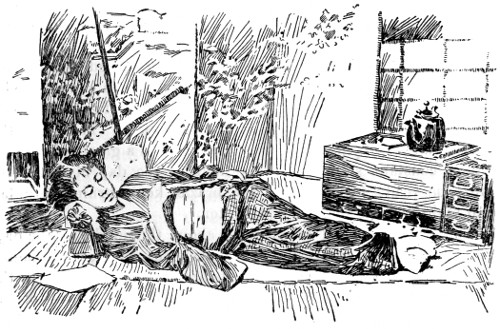
JAPANESE COUCH.
In the walls are recesses with sliding doors into which the bedding is thrust in the daytime. At bedtime out of these recesses are taken the soft cotton stuffed mattresses and the thick coverlets of silk or cotton which have been rolled up all day, and these are spread upon the mats. The Japanese pillows are of wood, with the upper portions stuffed or padded, and in form something like a large flat iron. Sometimes each one contains a little 300drawer in which the ladies put their hairpins. When a Japanese has taken off his day garments he rests his head on this wooden pillow and composes himself to sleep. Everything is put away in the morning, all the partitions are opened to give air, the mats are carefully swept, and the now completely empty chamber is transformed during the day into an office, sitting room, or dining room, to become again the sleeping apartment the following night.
Clothes are kept in plaited bamboo boxes usually covered with black or dark green waterproof paper. The furniture is very simple, and there are often in the best houses no chairs, no tables, no bedsteads. There may be some low, short-legged side tables of characteristic Japanese pattern and one or two costly vases or other ornaments, a few pictures which are changed in deference to guests and seasons, some flowers or dwarf trees in vases and a lamp or two. There are, however, two pieces of furniture which are to be found in the houses of every class. These are the brazier and the pipe box, for the Japanese is a great tea drinker and a constant smoker. Every hour in the day his hot water must be ready for him, and the brazier kept burning both day and night both in summer and winter.
The principal meal takes place about the middle of the day, and after it the family indulge themselves with several hours’ sleep, so that at this time the streets are almost deserted. In the evening they have another meal, and then devote the rest of the time till bedtime to all kinds of amusements. In the highest Japanese circles the dinner hour is sometimes enlivened by music from an orchestra stationed in an adjoining room.
In summer a well-planned Japanese house is the very ideal of coolness, grace and comfort. In winter it is the extreme of misery. There are no fire-places and there is unmitigated ventilation. People keep themselves warm by holding themselves close over some morsels of red hot charcoal in a brazier, and frost bite is very common. At night, when cold winds blow, a heating apparatus is put beneath the heavy cotton coverlets. It often gets overturned; a watchman from his ladder-like tower sees afar off a dull red glow, bells begin to clang, and soon the city is in an uproar of excitement over another conflagration. In a few 301hours a great fan-shaped gap has appeared in the city. One goes at day-break to find the scene of destruction, but it has already almost disappeared. Crowds of carpenters have rushed in, and have already done much to erect on the hot and smoking ruins wooden houses nearly as good as those swept away by the fire of the night before.
The yashikis or palaces in which the people of rank reside, are nothing more than ordinary houses grouped together and surrounded by whitewashed outhouses, with latticed windows of black wood. These outhouses serve a two-fold purpose, as habitations for the domestics, and as a wall of the enclosure. Always low, and usually rectangular, they look very much like warehouses or barracks. The palace of the sovereign has, however, a certain character of its own. It is a perfect labyrinth of courts and streets formed by the many separate houses, pavilions, and corridors or simple wooden partitions. The roofs are supported by horizontal beams varnished white, or gilded at the extremities, and decorated with small pieces of sculpture, many of which are very beautiful works of art. The ancient palace of the Tycoons is remarkable for boldness and richness of outline. Everything breathes a spirit of the times when the power and prosperity of the shogunate was at its height. Upon the ceilings of gold, sculptured beams cross each other in squares, the angles where they meet being marked by a plate of gilt bronze of very elegant design.
The greatest novelties in the eyes of foreigners are the gardens attached to every house. The smallest tradesman has his own little plot of ground where he may enjoy the delights of solitude, take his siesta, or devote himself to copious potations of tea and saki. These gardens are often of exceedingly small size. They consist of a quaint collection of dwarf shrubs, miniature lakes full of gold fish, lilliputian walks in the middle of diminutive flower beds, tiny streams over which are little green arches to imitate bridges, and finally arbors or bowers beneath which a rabbit might scarcely find room to nestle.
The Japanese are as strict in the observance of etiquette at a funeral as at their marriage ceremonies. The rites take place both at the time of the actual interment, and afterwards at the 302festivals celebrated in honor of the gods on these occasions. There are two kinds of funerals, interment and cremation. Most of the Japanese make known during life either to the heir or to some intimate friend their wishes respecting the mode of the disposal of their remains. When the father or mother in a family is seized with a mortal illness and all hope of recovery is past and the end approaching, the soiled garments worn by the dying person are removed and exchanged for perfectly clean ones. The last wishes of the dying one are then recorded on paper. As soon as life has departed all the relations give way to lamentations; the body is carried into another room, covered with a curtain and surrounded by screens. In the higher classes the body is watched for two days, but in the lower it is buried a day after death.
Contrary to the customs at marriage ceremonies, the bonzes or priests preside over all the funeral rites. It is they who watch beside the dead until the time for interment. This is usually carried out by men who make it their profession. The corpse is placed in a coffin, somewhat of the shape of a round tub, in a squatting position, with the head bowed, the legs bent under, and the arms crossed; the lid of the coffin is then fastened down by wooden pegs. The funeral procession proceeds to the temple, the bonzes marching first, some carrying flags, others different symbols, such as little white boxes full of flowers, others wringing small hand-bells. Then follows the corpse, preceded by a long tablet upon which is inscribed the new name given to the deceased. The eldest son follows, and then the family, intimate friends, and domestics. The nearest relations are dressed in white which is the color worn for mourning.
When the procession arrives at the temple the coffin is placed before the image of the god and then various ceremonies commence, the length of which is regulated by the rank of the deceased, as with us. After that all the friends and acquaintances return home, whilst the relations turn to the place where the body is to be laid. If the deceased has expressed the desire that his body should be burned, the coffin is carried from the temple to a small crematory a short distance away. It is there placed upon a kind of stone scaffold, at the base of which a fire is kept burning until the body is consumed. The men employed in this 305work draw out the bones from the ashes by means of sticks, the remaining ashes are placed in an urn, and carried to the tomb by the relations. The burials of the poor outcasts from society are very simple. The body is interred at once without entering in the temple, or else it is burnt in some waste spot.
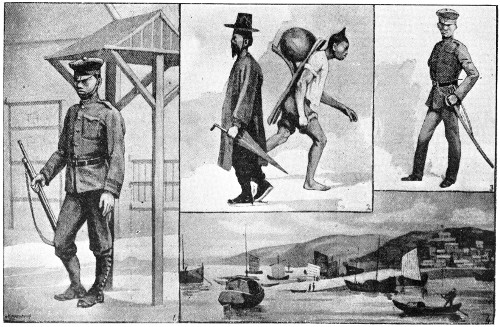
SKETCHES IN JAPAN AND COREA.
1. JAPANESE PRIVATE ON GUARD OVER STORES.
2. COREAN FARMER AND COOLIE.
3. JAPANESE OFFICER.
4. LANDING PLACE AT CHEMULPO.
Japanese cemeteries are most carefully cherished spots, and are always bright with verdureverdure and flowers. Each family has its own little enclosure, where several simple commemorative stones stand. Once a year a festival for the dead is held. It is celebrated at night. The cemetery is illuminated by thousands of colored fires, and the whole population resort there, and eat, drink, and enjoy themselves in honor of their dead ancestors.
Their incapacity for conceiving sorrow is one of the most characteristic features of the Japanese. Perhaps this psychological phenomenon is due to the influences amidst which this happy people have the privilege of living. It is an indisputable fact that where nature is bright and beautiful the inhabitants themselves of that particular spot, like the scenery, seem to expand under its sweet influence and to become bright and happy. Such is the case with the Japanese, who while yielding almost unconsciously to these influences, deepen them by their eager pursuit of all things gay and beautiful.
Japan is progressive enough that it has a compulsory system of education, which is sure to be ultimately fatal to idolatrous religions. There are more than three million children in the elementary schools, not to mention those in the higher institutions. The ability to read and write is almost universal among the people. Steady improvement is observed from year to year, in the attendance and quality of the government schools. The various schools in connection with the protestant and Roman missions, which are numerous and influential are also well attended and constantly growing. A large number also of the wealthier classes have their children taught privately at home. The average attendance of the Japanese children at the schools is nearly one-half the total number of school age. Education is very highly esteemed by every class, and all are willing to make genuine sacrifices to obtain it for their children.
Penmanship is laid great stress upon, and there are many 306different styles in use. The blackboard is used in all schools now, and the artistic tendencies of the people are often well displayed on it. The Arabic numerals are fast displacing the old Chinese system. A great many of the methods of European and American teaching have been introduced into Japan, and their use is constantly on the increase.
Universities and academies supported by the government have been chiefly under the direction of American and European professors, and the western languages are taught everywhere. In addition to this educational element introduced into the country, there is that brought in by the large number of Japanese young men who have been sent to the universities of the United States, Germany, France, and England to complete their education. In our own colleges these young men have ranked with the highest as linguists, scientists, and orators. The influence that they have exerted in Japan, where they have invariably taken a high position, either officially or educationally, has been most beneficial to the advance of learning in the island empire.
The excessive cleanliness of the Japanese, the simplicity of their apparel, which allows their bodies to be so much exposed to the open air, added to the salubrity of their country, might reasonably lead one to imagine that they enjoy excellent health. Such however is not the case. Diseases of the skin, and chronic and incurable complaints are very prevalent. The hot baths are the great remedies for everything, but in certain cases the aid of the physicians is enlisted. These form a class of society which has existed from a very early date, and enjoy certain privileges. They are divided into three classes, the court physicians, who are not permitted to practice elsewhere, the army physicians, and lastly the common physicians, not employed by the government, who attend all classes of the community. As no formalities used to be required for the practice of medicine, each member entered on the career at his pleasure and practiced according to his own theories on the subject. It is a profession often handed down from father to son, but it is not a lucrative one, and is looked upon as an office of little importance or consideration.
Medical men nevertheless abound in Japan, and in addition to recognized practitioners, there is a class of quacks exactly answering 307to those of our own country. Their science principally partakes of the nature of sorcery. Where hot baths fail to produce the desired effect, they have recourse to acupuncture and cauterisation. Acupuncture consists in pricking with a needle the part affected, a mode of healing which has been practiced from time immemorial in the east. After the skin has been stretched sufficiently tight, the needle is thrust in perpendicularly either by rolling between the fingers or by a direct gentle pressure, or else by striking it lightly with a small hammer made for the purpose.
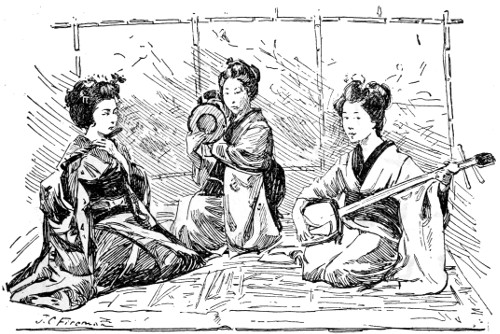
GÉISHA GIRLS PLAYING JAPANESE MUSICAL INSTRUMENTS.
Cauterisation is performed with little cones called moxas, formed of dried wormwood leaves, and prepared in such a manner as to consume slowly. One or more of these is applied to the diseased part and set alight. The mode of cauterising wounds has frequently the effect of strongly exciting the nervous system, but does not seem to improve the general health of the patient materially. The national university of Tokio has a medical department in connection with it, which teaches medical science according to our own western methods. Hospitals exist in the large cities of Japan which are similarly equipped to those of our own 308country, and are under the direction of physicians and surgeons, most of whom are either Europeans and Americans, or Japanese who have been educated in medical colleges abroad. Many young women of Japan have come to America to take courses in nursing in our great hospitals and training schools, and on their return to Japan are spreading the knowledge they have thus gained.
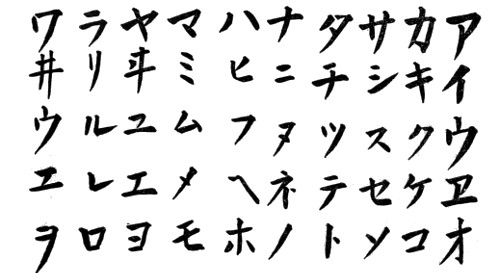
JAPANESE ALPHABET, NEW.
Music is one of the most cultivated of the fine arts of Japan, and Japanese tradition accords it a divine origin. The Japanese have many stringed, wind, and percussion instruments, but the general favorite is the sam-sin or guitar with three strings. There are also the lutes, several kinds of drums and tambourines, fifes, clarionets, and flageolets. The Japanese have no idea of harmony. A number of them will often perform together, but they are never in tune. They are not more advanced in melody; their airs recall neither the savage strains of the forest nor the scientific music of the west. In spite of this their music has the power of charming them for hours together, and it is only among the utterly uneducated classes that a young girl is to be found unable to accompany herself in a song on the sam-sin.
In the department of jurisprudence great progress has been made. Scarcely any nation on earth can show a more revolting list of horrible methods of punishment and torture in the past, and none can show greater improvement in so short a time. The cruel and 309blood-thirsty code was mostly borrowed from China. Since the restoration, revised statutes and regulations have greatly decreased the list of capital punishments, reformed the condition of prisons, and made legal processes more in harmony with mercy and justice. The use of torture to obtain testimony is now entirely abolished. Law schools have also been established and lawyers are allowed to plead, thus giving the accused the assistance of counsel for his defense.
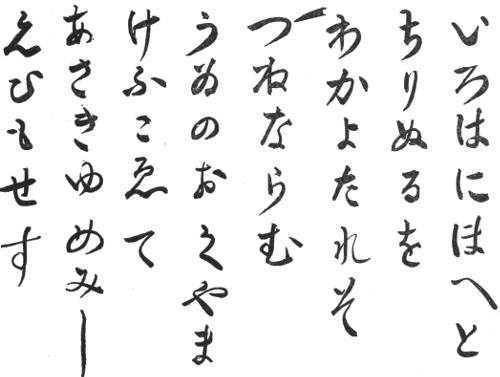
JAPANESE ALPHABET, OLD.
The Japanese tongue has for a long time been regarded merely as an offshoot of the Chinese language, or at any rate as being very nearly connected with it. Study however, and the comparison of the two languages has rectified this error. Japanese understand Chinese writing because the Chinese characters form part of the numerous kinds in use in Japan. This is easily understood when it is remembered that Chinese characters represent neither letters nor meaningless sounds, which are only the constituent parts of a word, but are words themselves, or rather the ideas that these words express; consequently the same ideas 310can be communicated although expressed by different words to any one who is acquainted with the signification of the characters. The Japanese language is very soft and agreeable to the ear, but travelers declare that no one born out of the country could possibly pronounce some of the words. They have a system of forty-eight syllabic signs, which can be doubled by means of signs added to the consonants, which modify the sound, and render it harder or softer. This system, it is said, dates from the eighth century and can be written in four different series of characters.
Japanese literature comprises books on science, biography, geography, travels, philosophy, and natural history, as well as poetry, dramatic works, romances, and encyclopedias. The latter seem to be little more than picture books, with explanatory notes, arranged like other Japanese dictionaries, sometimes alphabetically, but more often quite fancifully and without any attempt at scientific classification. The poets of Japan strive to express the most comprehensive ideas in the fewest possible words, and to employ words with double meanings for the sake of typical allusions. They also delight in descriptions or similes furnished by the scenery, or the rich variety of natural productions with which they are surrounded.
Of their older books on science none are of any value but those which treat of astronomy. The proof of their progress in this science is afforded by the fact that almanacs, which were at first brought from China, have now become very general and are composed in Japan. The Japanese, until western education began to have its influence over them, had only a slight knowledge of mathematics, trigonometry, mechanics, or engineering. History and geography are very fairly cultivated. Reading is the favorite recreation of both sexes in Japan. The women confine themselves to the perusal of romances, and those works on etiquette and kindred subjects prepared for them. Every young girl who can afford it has her subscription to a library, which for the sum of a few copper coins per month furnishes her with as many books, ancient and modern, as she can devour. Except for their titles, these productions seem all formed on one pattern. In the choice of their characters and their subjects the authors seem by 311no means desirous of breaking through the narrow limits within which prejudice and custom have confined them.
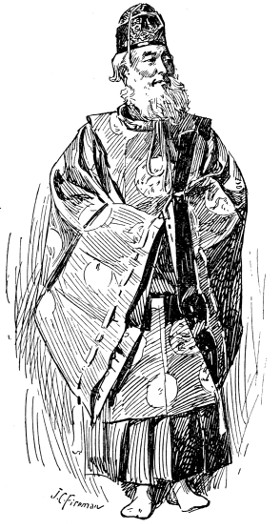
SHINTO PRIEST.
The ancient religion of the Japanese is called “Kami no michi,” way, or doctrine of the gods. The Chinese form of the same is Shinto, and from this foreigners have called it Shintoism. In its purity the chief characteristic of this religion is the worship of ancestors and the deification of emperors, heroes, and scholars. The adoration of the personified forces of nature enters largely into it. It employs no idols, images, or effigies in its worship, and teaches no doctrine of the immortality of the soul. Shinto has no moral code, and no accurately defined system of ethics or belief. The leading principle of its adherents is imitation of the illustrious deeds of their ancestors, and they are to prove themselves worthy of their descent by the purity of their lives. The priests of Shinto are designated according to their rank. Sometimes they receive titles from the emperor, and the higher ranks of the priesthood are court nobles. Ordinarily they dress like other people, but are robed in white when officiating, or in court dress when in court. They marry, rear families, and do not shave their heads. The office is usually hereditary.
After all the research of foreign scholars, many hesitate to decide 312whether Shinto is a native Japanese product or whether it is not closely allied with the ancient religion of China which existed before the period of Confucius. The weight of opinion inclines to the latter belief. The Kojiki is the Bible of Shintoism. It is full of narrations, but it lays down no precepts, teaches no morals or doctrines, prescribes no ritual. Shinto has very few of the characteristics of a religion as understood by us. The most learned native commentators and exponents of the faith expressly maintain the view that Shinto has no moral code. Motoori, the great modern revivalist of Shinto, teaches with emphasis that morals were invented by the Chinese because they were an immoral people, but in Japan there was no necessity for any system of morals, as every Japanese acted aright if he only consulted his own heart. The duty of a good Japanese, he says, consists in obeying the commands of the mikado without questioning whether these commands are right or wrong. It was only immoral people like the Chinese who presumed to discuss the character of their sovereign. The opinion of most scholars from America and Europe, studying Shinto on its own soil, has been that the faith was little more than an influence for reducing the people to a condition of mental slavery. Its influence is weakening every year.
The outlines of Buddhism in its Chinese forms have been indicated in a foregoing chapter. It is well, however, to take another glance at it here in connection with its Japanese significance. This religion reached the Japanese empire about the middle of the sixth century after Christ, twelve centuries after its establishment. Buddhism originated as a pure atheistic humanitarianism, with a lofty philosophy and a code of morals higher perhaps than any heathen religion had reached before or has since attained. First preached in India, a land accursed by secular and spiritual oppression, it acknowledged no caste and declared all men equally sinful and miserable, and all equally capable of being freed from sin and misery through knowledge. It taught that the souls of all men had lived in a previous state of existence and that all the sorrows of this life are punishments for sins committed in a previous state. After death the soul must migrate for ages through stages of life inferior or superior, 315until perchance it arrived at last in Nirvana or absorption in Buddha. The true estate of the human soul, according to the Buddhist, was blissful annihilation.
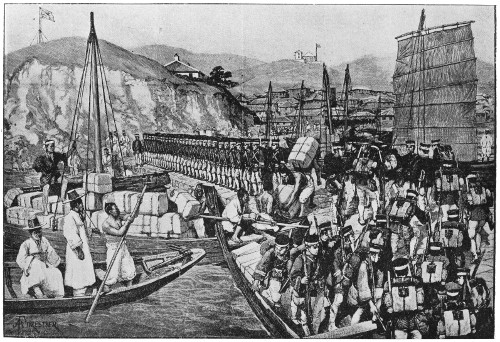
JAPANESE TROOPS LANDING AT CHEMULPO. September 9th.
The morals of Buddhism are superior to its metaphysics. Its commandments are the dictates of the most refined morality. Such was Buddhism in its early purity. Beside its moral code and philosophical doctrines it had almost nothing. But in the twelve centuries which passed while it swept through India, Birmah, Siam, China, Thibet, Manchooria, Corea, and Siberia, it acquired the apparel with which Asiatic imagination and priestly necessity had clothed and adorned the original doctrines of Buddha. The ideas of Buddha had been expanded into a complete theological system, with all the appurtenances of a stock religion. Japan was ready for the introduction of any religion as attractive as Buddhism, for prior to that time nothing existed except Shinto, of which there was little but the dogma of the divinity of the mikado, the duty of all Japanese to obey him implicitly, and some Confucian morals.
Buddhism came to touch the heart, to fire the imagination, to feed the intellect, to offer a code of lofty morals, to point out a pure life through self-denial, to awe the ignorant, and to terrify the doubting. With this explanation of the field which Buddhism found and what it offered, it is sufficient to say that the faith spread with marvelous rapidity until the Japanese empire was a Buddhist land. This did not necessarily exclude Shinto from the minds of the same people, and the two faiths have existed side by side in harmony. Of late years, however, the Japanese have not only been losing faith in their own religions but in all others, and to-day they are said by many to form a nation of atheists. This does not apply to the common people so truly as to the educated ones, and of course is not nearly as general a truth as has been often assumed. In no country of Asia has Christianity made such rapid and permanent advance as in Japan. It is the only oriental country having a government of its own in which there is absolute freedom in religious belief and practice, and in which there is no state religion and no state support.