Japan
Reading edition
184
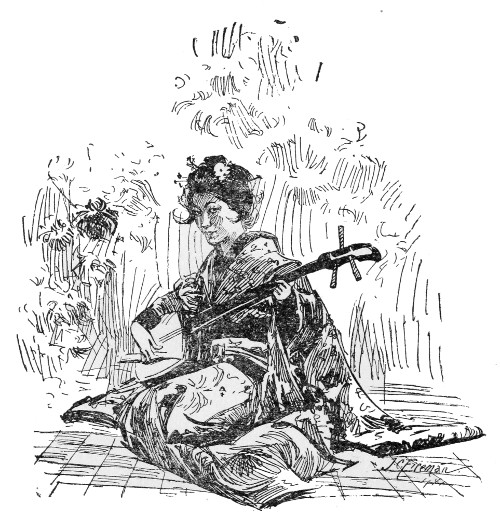
JAPANESE MUSICIAN.
186
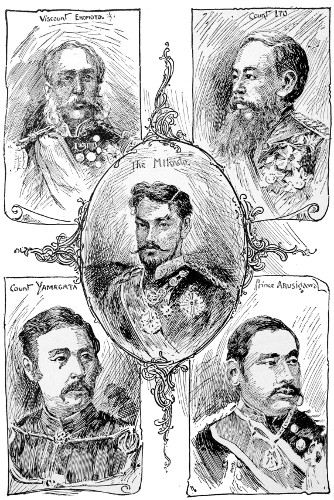
THE MIKADO AND HIS PRINCIPAL OFFICERS.
187
HISTORICAL SKETCH OF JAPAN FROM THE EARLIEST TIMES TO FIRST CONTACT WITH EUROPEAN CIVILIZATION.
The Oldest Dynasty in the World and its Records—The First Emperor of Japan—Some of the Famous Early Rulers—Invasion and Conquest of Corea by the Empress Jingo—How Civilization Came from Corea to Japan—The Rise of the Dual System of Government—Mikado and Shogun—Expulsion of the Hojo Dynasty of Shoguns—The Invasion of the Mongol Tartars—Annihilation of the Armada—Corruption of the Shogun Rule—Growth of the Feudal System—Another Conquest of Corea—Founding of the Last Dynasty of Shoguns—Advance of Japan in the Age of Hideyoshi.
In a historical sketch of the life of a nation which counts twenty-five centuries of recorded history, but the briefest outline can be given. The scope of such a work as this does not admit of minute historical details. When it is said that traditions exist carrying back the history for a number of years which requires several hundred ciphers to measure, the effort to relate even an outline becomes almost appalling. Until the twelfth century of our era, Europe did not know even of the existence of Japan; and the reports which were then brought by Marco Polo, who had learned of the island empire of Zipangu from the Chinese were as vague as they were enticing. The successes of the Jesuit missionaries led by Xavier, and the commercial intercourse established by the Portuguese in the latter part of the 16th century, and by the Dutch somewhat later, promised to disclose the mysteries of the far Pacific empire; but within a few generations these were more hopelessly than ever sealed against foreign intrusion. Only forty years ago the United States of America knocked at the door of Japan, met a welcome under protest, and the country began to open to western civilization. Even yet the great mass of the people of our own country have far from a right conception of the ancient civilization which has for ages prevailed in these islands of the Pacific.
The Japanese imperial dynasty is the oldest in the world. Two thousand five hundred and fifty-four years ago in 660 B.C., 188the sacred histories relate that Jimmu Tenno commenced to reign as the first Mikado, or Emperor of Japan. The sources of Japanese history are rich and solid, historical writings forming the largest and most important divisions of their voluminous literature. The period from about the ninth century until the present time is treated very fully, while the real history of the period prior to the eighth century of the Christian era is very meagre. It is nearly certain that the Japanese possessed no writing until the sixth century A.D. Their oldest extant composition is the “Kojiki,” or “Book of Ancient Traditions.” It may be called the Bible of the Japanese. It comprises three volumes, composed A.D. 711-712, and is said to have been preceded by two similar works about one hundred years earlier, but neither of these have been preserved. The first volume treats of the creation of the heavens and earth, the gods and goddesses, and the events of the holy age or mythological period. The second and third give the history of the mikados from the year I (660 B.C.) to the year 1280 of the Japanese era. It was first printed in the years A.D. 1624-1642. The “Nihongi” completed A.D. 720 also contains a Japanese record of the mythological period, and brings down the annals of the mikados to A.D. 699. These are the oldest books in the language. They contain so much that is fabulous, mythical or exaggerated, that their statements especially in respect of dates cannot be accepted as true history. A succession of historical works of apparent reliability illustrate the period between the eighth and the eleventh centuries, and still better ones treat of the mediæval period from the eleventh to the sixteenth century. The period from 1600 to 1853 is less known than others in earlier times, because of mandates that existed forbidding the production of contemporary histories.
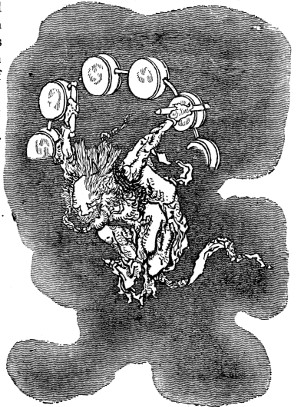
JAPANESE GOD OF THUNDER.
Whatever may be the actual fact, Jimmu Tenno is popularly believed to have been a real person and the first emperor of Japan. He is deified in the Shinto religion, and in thousands of shrines dedicated to him the people worship his spirit. In one official list of mikados he is named as the first. The reigning Emperor refers to him as his ancestor, from whom he claims unbroken descent as the 123rd member of this dynasty. The 189seventh day of April is fixed as the anniversary of his ascension to the throne and that day is a national holiday on which the birth, the accession and death of this national hero are still annually celebrated. Then one may see flags flying from both public and private buildings, and hear the reverberations of a royal salute fired by the ironclad navy of modern Japan from Krupp guns, and by the military in French uniforms from Remington rifles. The era of Jimmu is the starting point of Japanese chronology, and the year 1 of the Japanese era is that upon which he ascended the throne at Kashiwavara.
In the beginning there existed, according to one interpretation of the somewhat perplexing Shinto mythology, chaos, which contained the germs of all things. From this was evolved a race of heavenly beings and celestial “Kami” of whom Izanagi, a male, and Izanami, a female, were the last individuals. Other authorities on Shinto maintain that infinite space and not chaos existed in the beginning; others again that in the beginning there was one god. However, all agree as to the appearance on the scene of Izanagi and Izanami, and it is with these we are here concerned; for by their union were produced the islands of Japan, 190and among their children were Amaterasu, the sun goddess, and her younger brother, Susanoo, afterward appointed god of the sea. On account of her bright beauty the former was made queen of the sun, and had given to her a share on the government of the earth. To Ninigi-no-mikoto, her grandson, she afterward consigned absolute rule over the earth, sending him down by the floating bridge of heaven upon the summit of the mountain Kirishima-yama. He took with him the three Japanese regalia, the sacred mirror, now in one of the Shinto shrines of Ise; the sword, now treasured in the temple of Atsuta, near Nagoya; and the ball of rock crystal in possession of the emperor. On the accomplishment of the descent, the sun and the earth receded from one another, and communication by means of the floating bridge ceased. Jimmu Tenno, the first historic emperor of Japan, was the great grandson of Ninigi-no-mikoto.
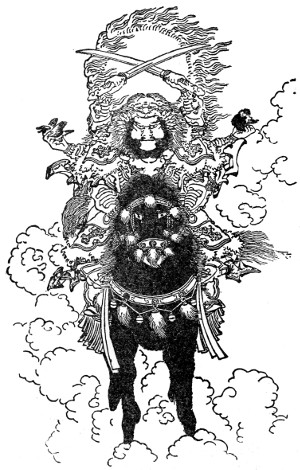
JAPANESE GOD OF RIDING.
According to the indigenous religion of Japan, therefore, a religion which even since the adoption of western civilization has 193been patronized by the state, the mikados are directly descended from the sun goddess, the principal Shinto divinity. Having received from her the three sacred treasures, they are invested with authority to rule over Japan as long as the sun and moon shall endure. Their minds are in perfect harmony with hers; therefore they cannot err and must receive implicit obedience. Such is the traditional theory as to the position of the Japanese emperors, a theory which was advanced in its most elaborate form, as recently as the last century, by Motoori, a writer on Shinto, which of late years has no doubt been much modified or even utterly discarded by many of the more enlightened among the people. Even yet, however, it is far from having been abandoned by the masses.
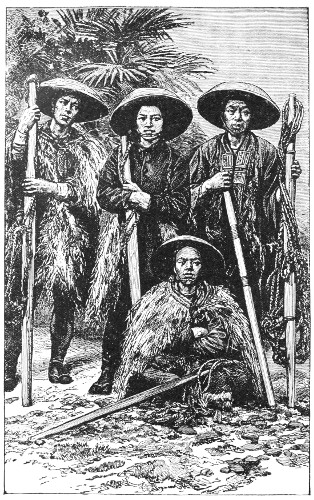
JAPANESE PEASANTRY.
The mikados being thus regarded as semi-divinities, it is not surprising that the very excess of veneration showed them tended more and more to weaken their actual power. They were too sacred to be brought much into contact with ordinary mortals, too sacred even to have their divine countenances looked upon by any but a select few. Latterly it was only the nobles immediately around him that ever saw the mikado’s face; others might be admitted to the imperial presence, but it was only to get a glimpse from behind a curtain of a portion of the imperial form, less or more according to their rank. When the mikado went out into the grounds of his palace in Kioto, matting was spread for him to walk upon; when he left the palace precincts he was borne in a sedan chair, the blinds of which were carefully drawn down. The populace prostrated themselves as the procession passed, but none of them ever saw the imperial form. In short, the mikados ultimately became virtual prisoners. Theoretically gifted with all political knowledge and power, they were less the masters of their own actions than many of the humblest of their subjects. Although nominally the repositories of all authority, they had practically no share in the management of the national affairs. The isolation in which it was deemed proper that they should be kept, prevented them from acquiring the knowledge requisite for governing, and even had that knowledge been obtained, gave no opportunity for its manifestation.
From the death of Jimmu Tenno to that of Kimmei, in whose 194reign Buddhism was introduced, A.D. 571, there were thirty mikados. During this period of one thousand three hundred and thirty-six years, believed to be historic by most Japanese, the most interesting subjects are the reforms of Sujin Tenno, the military expeditions to eastern Japan by Yamato-Dake, the invasion of Corea by the Empress Jingo Kogo, and the introduction of Chinese civilization and Buddhism.
Sujin—or Shujin, B.C. 97-30, was a man of intense earnestness and piety. His prayers to the gods for the abatement of a plague were answered, and a revival of religious feeling and worship ensued. He introduced many forms in the practices of religion and the manners of life. He appointed his own daughter priestess of the shrine and custodian of the symbols of the three holy regalia, which had hitherto been kept in the palace of the mikado. This custom has continued to the present time, and the shrines of Uji in Ise, which now hold the sacred mirror, are always in charge of a virgin princess of imperial blood.
The whole life of Sujin was one long effort to civilize his half savage subjects. He regulated taxes, established a periodical census, and encouraged the building of boats. He may also be called the father of Japanese agriculture, since he encouraged it by edict and example, ordering canals to be dug, water courses provided, and irrigation to be extensively carried on.
The energies of this pious mikado were further exerted in devising a national military system whereby his peaceablypeaceably disposed subjects could be protected, and the extremities of his realm extended. The eastern and northern frontiers were exposed to the assaults of the wild tribes of Ainos, who were yet unsubdued. Between the peaceful agricultural inhabitants and the untamed savages a continual border war existed. A military division of the empire into four departments was made, and a shogun or general appointed over each. The half subdued inhabitants in the extremes of the realm needed constant watching, and seem to have been as restless and treacherous as the indians on our own frontiers. The whole history of the extension and development of the mikado’s empire is one of war and blood, rivalling that of our own country in its early struggles with the Indians. This constant military action and life in a camp resulted, in the course 195of time, in the creation of a powerful and numerous military class, who made war professional and hereditary. It developed that military genius and character which so distinguish the modern Japanese and mark them in such strong contrast with other nations of eastern Asia.
Towards the end of the first century A.D., Yamato-Dake, son of the emperor Keiko, reduced most of the Ainos of the north to submission. These savages fought much after the manner of the North American Indian, using their knowledge of woodcraft most effectually, but the young prince with a well equipped army embarked on a fleet of ships and reaching their portion of the island, fought them until they were glad to surrender.
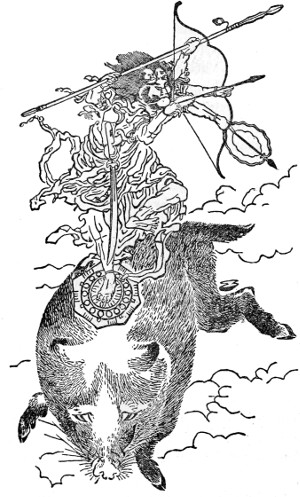
JAPANESE GOD OF WAR.
It was in the third century that the Empress Jingo invaded and conquered Corea. In all Japanese tradition or history, there is no greater female character than this empress. She was equally renowned for her beauty, piety, intelligence, energy and martial valor. To this woman belongs the glory of the conquest of Corea, whence came letters, religion and civilization to Japan. Tradition is that it was directly commanded her by the gods to cross the water and attack Corea. Her husband, the emperor, doubting the veracity of this message from the gods, was forbidden by them any share in the enterprise.
Jingo ordered her generals and captains to collect troops, build ships, and be ready to embark. She disguised herself as a man, proceeded with the recruiting of soldiers and the building of ships, and in the year 201 A.D. was ready to start. Before starting, Jingo issued these orders for her soldiers: “No loot. Neither despise a few enemies nor fear many. Give mercy to those who yield but no quarter to the stubborn. Rewards shall be apportioned to the victors, punishments shall be meted to the deserters.”
It was not very clear in the minds of these ancient filibusters where Corea was, or for what particular point of their horizon they were to steer. They had no chart or compass. The sun, stars and the flight of birds were their guide. None of them before had ever known of the existence of such a country as Corea, but the same gods that had commanded the invasion protected the invaders, and in due time they landed in southern Corea. 196The king of this part of the country had heard from his messengers of the coming of a strange fleet from the east, and terrified exclaimed, “We never knew there was any country outside of us. Have our gods forsaken us?”
It was a bloodless invasion, for there was no fighting to do. The Coreans came holding white flags and surrendered, offering to give up their treasures. They took an oath to become hostages and be tributary to Japan. Eighty ships well laden with gold and silver, articles of wealth, silks and precious goods of all kinds, and eighty hostages, men of high families, were given to the conquerors. The stay of the Japanese army in Corea was very brief, and the troops returned in two months. Jingo was, on her arrival, delivered of a son, who in the popular estimation of gods and mortals holds even a higher place of honor than his mother, who is believed to have conquered southern Corea through the power of her yet unborn illustrious offspring. The motive which induced the invasion into Corea seems to have been mere love of war and conquest, and the Japanese still refer with great pride to this, their initial exploit on foreign soil.
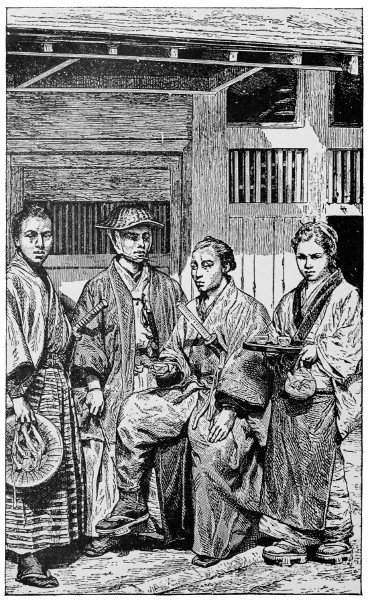
TOKIO—TYPES AND COSTUMES.
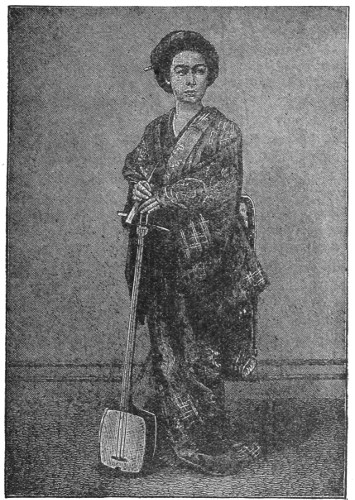
JAPANESE MUSICIAN.
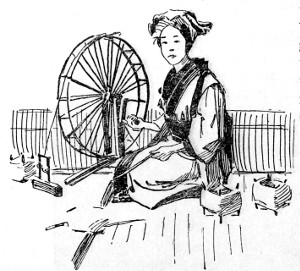
JAPANESE SILK SPINNER.
The son Ojin, who became the emperor, was, after his death, 199deified and worshipped as the god of war, Hachiman, and down through the centuries he has been worshiped by all classes of people, especially by soldiers, who offer their prayers and pay their vows to him. Ojin was also a man of literary tastes, and it was during his reign that Japan began to profit from the learning of the Coreans, who introduced the study of the Chinese language, and indeed the art of writing itself. During the immediately succeeding centuries various emperors and empresses were 200eminent for their zeal in encouraging the arts of peace. Architects, painters, physicians, musicians, dancers, chronologists, artisans and fortune tellers were brought over from Corea to instruct the people, but not all of these came at once. Immigration was gradual, but the coming of so many immigrants brought new blood, ideas, methods and improvements. Japan received from China, through Corea, what she has been receiving from America and Europe for the last forty years—a new civilization. The records report the arrival of tailors in 283 and horses in 284 from Corea to Japan. In 285 a Corean scholar came to Japan, and residing at the court, instructed the mikado’s son in writing. In 462 mulberry trees were planted, together with the silk worm, for whose sustenance they were implanted, from China or Corea. And this marks the beginning of silk culture in Japan. When in 552 the company of doctors, astronomers and mathematicians came from Corea to live at the Japanese court, they brought with them Buddhist missionaries, and this may be called the introduction of continental civilization. Beginning with Jingo, there seems to have poured into the island empire a stream of immigrants, skilled artisans, scholars and teachers, bringing arts, literature and religion. This was the first of three great waves of foreign civilization in Japan. The first was from China, through Corea, in the sixth; the second from western Europe in the fifteenth century; the third was from America, Europe and the world, in the decade following the advent of Commodore Perry.
In the eighth century, during the greater part of which the capital of the country was the city of Nara, about thirty miles 201from Kioto, Japan had largely under the government of empresses reached a most creditable stage of progress in the arts of peace. Near the close of the eighth century the emperor Kuwammu took up his residence at Kioto, which until 1868 remained the capital of the country, and is even now dignified with the name of Saikiyo, or “Western Capital.” Here he built a palace very unlike the simple dwelling in which his predecessors had been content to live. It had a dozen gates, and around it was reared a city with twelve hundred streets. The palace, he named “the Castle of Peace,” but for years it proved the very centre of the feuds which soon began to distract the country. This did not happen however until some centuries after the death of Kuwammu. But even after his time there were not wanting indications that the control of affairs was destined to slip into the hands of certain powerful families at the imperial court.
The first family to rise into eminence was that of Fujiwara, a member of which it was that got Kuwammu placed upon the throne. For centuries the Fujiwaras controlled the civil affairs of the empire, but a more important factor in bringing about the reduction of the mikado’s power and the establishment of that strange system of government which was destined to be so characteristic of Japan, was the rise into power of the rival houses of Taira and Minamoto, otherwise called respectfully Hei and Gen. This system of government has almost always been misunderstood in America and Europe. Two rulers in two capitals gave to foreigners the impression that there were two emperors in Japan, an idea that has been incorporated into most of the text books, and encyclopedias of Christendom. Let it be clearly understood however that there never was but one emperor in Japan, the mikado, who is and always was the only sovereign, though his measure of power has been very different at different times. Until the rise and domination of the military classes, he was in fact, as well as by law, supreme.
With the feuds of Hei and Gen commences an entirely new era in the history of the country, an era replete with tales alike of bloodshed, intrigue and chivalry. We see the growth of a feudal system at least as elaborate as that of Europe, and strangely 202enough, assuming almost identical forms, and that during the same period.
The respective founders of the Taira and Minamoto families were Taira Takamochi and Minamoto Tsunemoto, two warriors of the tenth century. Their descendants were for generations military vassals of the mikado, and were distinguished by red and white flags, colors which suggest the red and white roses of the rival English houses of Lancaster and York. For years the two houses served the emperor faithfully; but even before any quarrel had arisen between them, the popularity of the head of the Minamoto clan, with the soldiers with whom he had been placed, so alarmed the emperor Toba (1108-1124, A.D.) that he issued an edict forbidding the Samurai, the military class, of any of the provinces, from constituting themselves the retainers of either of these two families.
It was in the year 1156 that the feuds between the two houses broke out, and it arose in this way. At the accession of Go-Shirakawa to the throne in that year, there were living two ex-emperors who would seem to have voluntarily abdicated; one of them, however, Shutoku, was averse to the accession of the heir, being himself anxious to resume the imperial power. His cause was espoused by Tameyoshi, the head of the Minamoto house, while among the supporters of Go-Shirakawa was Kiyomori, of the house of Taira. In the conflict which followed, Go-Shirakawa was successful, and immediately thereafter we find Taira Kiyomori appointed Daijo-Daijin, or prime minister, with practically all political power in his hands. On the abdication within a few years of the mikado, the prime minister was able to put whatever member of the imperial house he willed upon the throne; and being himself allied by marriage to the imperial family, he at length saw the accession of his own grandson, a mere babe. Thus, to use the term connected with European feudalism of the same period, the mayor of the palace virtually, though not nominally, usurped the imperial functions. The emperor had the name of power but Kiyomori had the reality.
But this state of matters was not destined to last long. The Minamotos were far from being finally quieted. The story of the revival of their power is a romantic one, but we cannot dwell 203upon it. It was in the battle of Atiji that Kiyomori seemed at length to have quelled his rivals. Yoshitomo, the head of the Minamoto clan was slain in the fight, but his beautiful wife Tokiwa succeeded in escaping with her three little sons. Tokiwa’s mother, however, was arrested. This roused the daughter to make an appeal to Kiyomori for pardon. She did so, presenting herself and children to the conqueror, upon whom her beauty so wrought that he granted her petition. He made her his concubine, and not withstanding the remonstrances of his retainers, also spared the children who were sent to a monastery, there to be trained for the priesthood. Two of these children became famous in the history of Japan. The eldest was Yoritomo the founder of the Kamakura dynasty of shoguns, and the babe at the mother’s breast was Yoshitsune, one of the flowers of Japanese chivalry, a hero whose name even yet awakens the enthusiasm of the youth of Japan and who so impressed the Ainos of the north whom he had been sent to subdue, that to this day he is worshiped as their chief god. A Japanese has even lately written a book in which he seeks to identify Yoshitsune with Genghis Khan.
It is unnecessary to dwell on the circumstances which brought Yoritomo and Yoshitsune into note; how the two brothers raised the men of the eastern provinces, and after a temporary check at the pass of Hakone, succeeded in utterly routing the Taira forces in a dreadful battle, half by land and half by sea, at the straits of Shimonoseki. Suffice it to say, that Yoshitsune having been slain soon after a famous victory, through the treachery of his brother Yoritomo, who was jealous of his fame and popularity, that warrior was left without a rival. Yoritomo received from the emperor the highest title which could be conferred upon him, that of Sei-i-tai-shogun, literally “Barbarian-subjugating great general.” This title is generally contracted to shogun, which means simply general. Thus appointed generalissimo of all the imperial forces, he looked about for a city which he might make the center of his power. This he found in Kamakura about fifteen miles westward of the site of the modern Yokohama.
Thus before the close of the twelfth century was founded that system of dual government which lasted with little change until 204the year 1868. The Mikado reigned in Kioto with the authority of his sacred person undisputed; but the shogun in his eastern city had really all the public business of the country in his own hands. It was he who appointed governors over the different provinces and was the real master of the country; but every act was done in the name of the emperor whose nominal power thus remained intact.
Yoritomo virtually founded an independent dynasty at Kamakura, but it was not destined to be a lasting one. His son Yoriye succeeded him in 1199, but was shortly afterwards deposed and assassinated; and the power though not the title of shogun passed to the family of Yoritomo’s wife, that of Hojo, different members of which swayed the state for more than a century.
After a checkered career of various shoguns of the Hojo family, their tyranny became supreme. None of the family ever seized the office of shogun, but in reality they wielded all and more of the power attaching to the office. The political history of these years is but that of a monotonous recurrence of the exaltation of boys and babies of noble blood to whom was given the semblance of power, who were sprinkled with titles and deposed as soon as they were old enough to be troublesome. In an effort made by the ex-emperor Gotoba to drive the usurping Hojo from power the chains were riveted tighter than ever. The imperial troops were massacred by the conquering Hojo. The estates of all who fought on the emperor’s side were confiscated and distributed among the minions of the usurpers. The exiled emperor died of a broken heart. The nominal Mikado of Kioto and the nominal shogun at Kamakura were set up, but the Hojo were the keepers of both. The oppression, the neglect of public business and the carousals of the usurpers became intolerable. Armies were raised spontaneously to support the emperor and the Ashikaga leader in their revolt against the existing evils. All over the empire the people rose against their oppressors and massacred them. The Hojo domination which had been paramount for nearly one hundred and fifty years was utterly broken.
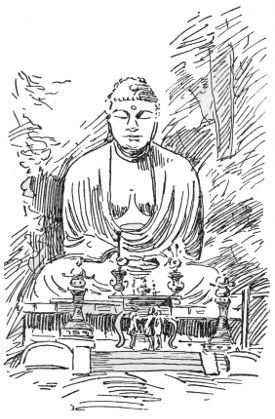
COLOSSAL JAPANESE IMAGE FIFTY FEET HIGH.
The Hojo have never been forgiven for their arbitrary treatment 205of the Mikados. Every obloquy is cast upon them by Japanese historians, dramatists, poets and novelists, and yet there is another side to the story. It must be conceded that the Hojos were able rulers and kept order and peace in the empire for more than a century. They encouraged literature and the cultivation of the arts and sciences. During their period the resources of the country were developed, and some branches of useful handicraft and fine arts were brought to a perfection never since surpassed. To this time belongs the famous image carver, sculptor and architect, Unkei, and the lacquer artists who are the “old masters” in this branch of art. The military spirit of the people was kept alive, tactics were improved, and the methods of governmental administration simplified. During this period of splendid temples, monasteries, pagodas, colossal images and other monuments of holy zeal, Hojo Sadatoki erected a monument over the grave of Kiyomori at Hiogo. Hojo Tokimune raised and kept in readiness a permanent war fund so that the military expenses might not interfere with the revenue reserved for ordinary government expenses. To his invincible courage, patriotic pride, and indomitable energy are due the vindication of the national honor and the repulse of the Tartar invasion.
During the early centuries of the Christian era, Japan and China kept up friendly intercourse, exchanging embassies on various missions, but chiefly with the mutual object of bearing congratulations to an emperor upon his accession to the throne. The civil disorders in both countries interrupted these friendly relations 206in the twelfth century, and communication ceased. When the acquaintance was renewed in the time of the Hojo it was not on so friendly a footing.
In China the Mongol Tartars had overthrown the Sung dynasty and had conquered the adjacent country. Through the Coreans the Mongol emperor, Kublai Khan, at whose court Marco Polo and his uncles were then visiting, sent letters demanding tribute and homage from Japan. Chinese envoys came to Kamakura, but Hojo Tokimune, enraged at the insolent demands, dismissed them in disgrace. Six embassies were sent, and six times rejected. An expedition from China consisting of ten thousand men was then sent against Japan. They landed, were attacked, their commander was slain, and they returned, having accomplished nothing. The Chinese emperor now sent nine envoys to announce their purpose to remain until a definite answer was returned to their master. They were called to Kamakura, and the Japanese reply was given by cutting off their heads. The Japanese now began to prepare for war on land and sea. Once more Chinese envoys came to demand tribute. These were decapitated. Meanwhile the armada was preparing. Great China was coming to crush the little strip of land that refused homage to the invincible conqueror. The army numbered one hundred thousand Chinese and Tartars, and seven thousand Coreans in ships that whitened the sea. They numbered three thousand five hundred in all. It was in July, 1281, that the sight of the Chinese junks greeted the watchers on the hills of Daizaifu. Many of the junks were of immense proportion, larger than the natives of Japan had ever seen, and armed with the engines of European warfare which their Venetian guests had taught the Mongols to construct and work. The naval battle that ensued was a terrible one. The Japanese had small chance of success in the water, owing to the smallness of their boats, but in personal valor they were much superior, and some of their deeds of bravery are inspiringly interesting. Nevertheless the Chinese were unable to effect a landing, owing to the heavy fortifications along the shore.
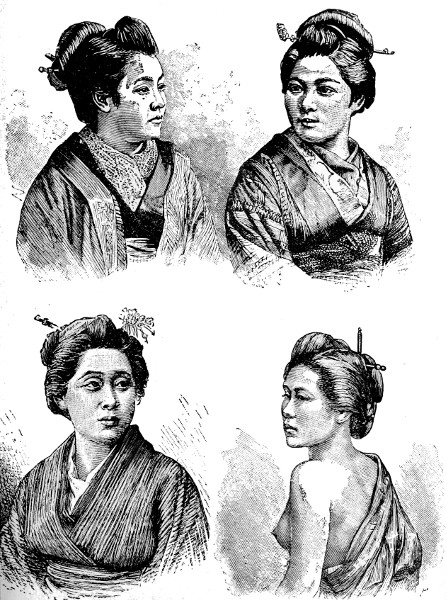
JAPANESE FEMALE TYPES.
The whole nation was now roused. Re-enforcements poured in from all quarters to swell the hosts of defenders. From the monasteries and temples all over the country went up unceasing 209prayer to the gods to ruin their enemies and save the land of Japan. The emperor and ex-emperor went in solemn state to the chief priest of Shinto, and writing out their petitions to the gods sent him as a messenger to the shrines of Ise. It is recorded as a 210miraculous fact that at the hour of noon as the sacred envoy arrived at the shrine and offered a prayer, the day being perfectly clear, a streak of cloud appeared in the sky that soon overspread the heavens, until the dense masses portended a storm of awful violence. One of those cyclones called by the Japanese tai-fu, of appalling velocity and resistless force, such as whirl along the coast of Japan and China during late summer and early fall of every year, burst upon the Chinese fleet. Nothing can withstand these maelstorms of the air. We call them typhoons. Iron steamships of thousands of horse power are almost unmanageable in them. The helpless Chinese junks were crushed together, impaled on the rocks, dashed against the cliffs or tossed on land like corks on the spray. Hundreds of the vessels sank. The corpses were piled on the shore or floating on the water so thickly that it seemed almost possible to walk thereon. The vessels of the survivors in large numbers drifted or were wrecked upon Taka island, where they established themselves and cutting down trees began building boats to reach Corea. Here they were attacked by the Japanese, and after a bloody struggle, all the fiercer for the despair on the one side and the exultation on the other, were all slain or driven to the sea to be drowned except three, who were sent back to tell their emperor how the gods of Japan had destroyed their armada.
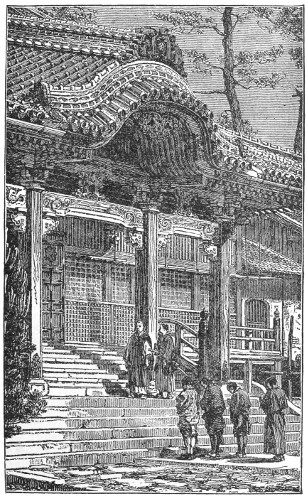
SHINTO TEMPLE.
This was the last time that China ever attempted to conquer Japan, whose people boast that their land has never been defiled by an invading army. They have ever ascribed the glory of the destruction of the Tartar fleet to the interposition of the gods of Ise, who thereafter received special and grateful adoration as the guardian of the seas and the winds. Great credit and praise were given to the Lord of Kamakura, Hojo Tokimune, for his energy, ability and valor. The author of one native history says, “The repulse of the Tartar barbarians by Tokimune and his preserving the dominions of our Son of Heaven were sufficient to atone for the crimes of his ancestors.”
Nearly six centuries afterward when “the barbarian” Perry anchored his fleet in the bay of Yeddo, in the words of the native annalist, “Orders were sent by the imperial court to the Shinto priest at Ise to offer up prayers for the sweeping away of the barbarians.” 211Millions of earnest hearts put up the same prayers their fathers had offered fully expecting the same result.
To this day the Japanese mother hushes her fretful infant by the question, “Do you think the Mongols are coming?” This is the only serious attempt at invasion ever made by any nation upon the shores of Japan.
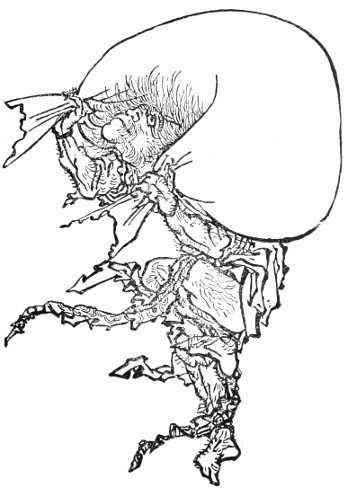
JAPANESE GOD OF THE WIND.
The internal history of Japan during the period of time covered by the actual or nominal rule of the Ashikaga family, from 1336 until 1573, except the very last years of it, is not very attractive to a foreign reader. It is a confused picture of intestinal war. It was by foul means that Ashikaga Takugi, one of the generals who overthrew the Hojos, attained the dignity of shogun, and a period of more than two centuries, during which his descendants held sway at Kamakura, was characterized by treachery, bloodshed and almost perpetual warfare. The founder of this line secured the favor of the mikado Go-Daigo, after he was recalled from exile, upon the overthrow of the military usurpation. Ashikaga soon seized the reins in his own hands. The mikado fled in terror, and a new mikado was declared in the person of 212another of the royal family. Of course this man was willing to confer upon Ashikaga, his supporter the title of shogun. Kamakura again became a military capital. The duarchy was restored, and the war of the northern and southern dynasties began, to last fifty-six years.
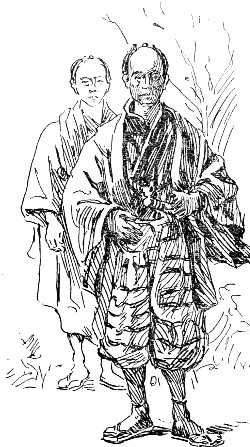
DAIMIOS OF JAPAN.
The act by which more than any other the Ashikagas earned the curses of posterity, was the sending of an embassy to China in 1401, bearing presents, acknowledging in a measure the authority of China, and accepting in return the title of Nippon O, or king of Japan. This which was done by Ashikaga Yoshimitsu, the third of the line, was an insult to the national dignity for which he has never been forgiven. It was a needless humiliation of Japan to her arrogant neighbor and done only to exalt the vanity and glory of the usurper, who, not content with adopting the style and equipage of the mikado, wished to be called a king and yet dared not usurp the imperial throne.
Japan of all the Asiatic nations seems to have brought the feudal system to the highest state of perfection. While in Europe the nations were engaged in throwing off the feudal yoke and inaugurating modern government, Japan was riveting the fetters which stood intact until 1871. The daimios were practically independent chieftains, who ruled their own provinces as they willed; and the more ambitious and powerful did not hesitate to make war upon the neighboring clans. There were on all sides struggles for pre-eminence in which the fittest survived, annexing to their own territories those of the weaker class which they had subdued. Nor was it merely rival clans that were disturbing the country. The Buddhist clergy 215had acquired immense political influence, which they were far from scrupulous in using. Their monasteries were in many cases castles, from which themselves living amid every kind of luxury, they tyrannized over the surrounding country. The history of these often reads strikingly like that of the corresponding institutions in Europe during the middle ages; indeed the hierarchical 216as well as the feudal development of Europe and Japan have been wonderfully alike.
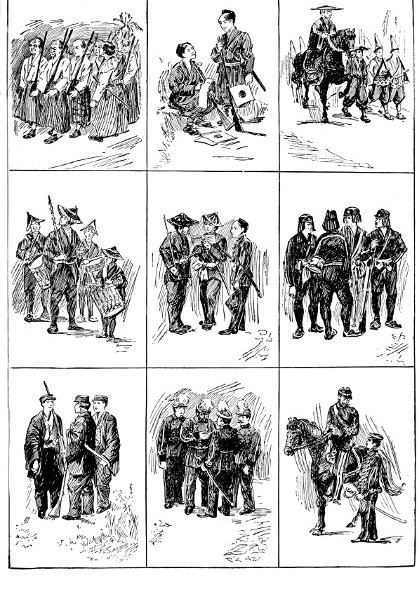
SKETCH SHOWING DEVELOPMENT OF THE JAPANESE ARMY FROM 1867 TO THE PRESENT.
Probably the three names most renowned in Japan are Nobunaga, Hideyoshi and Iyeyasu. The second and third of these were generals subordinate to the first, who deposed the Ashikaga shoguns, persecuted the Buddhists, encouraged the Jesuits, and restored to a great extent the supremacy of the mikado. The Buddhists look on this leader as an incarnate demon sent to destroy their faith. He was a Shintoist, with bitter hatred for the Buddhists, and never lost an opportunity to burn property of his enemies or butcher priests, women, and children of that faith. These who have just been named, by their prowess and the strength of their armies, rose to highest positions among the daimios.
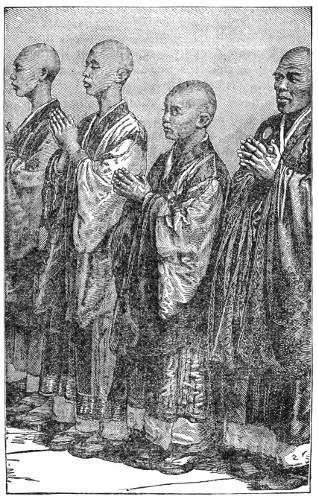
BUDDHIST PRIESTS.
When these three great men appeared, the country was in a most critical state. The later Ashikaga shoguns had become as powerless as the mikado himself in the management of affairs. Nobunaga first rose into note. By successive victories, he became ruler of additional provinces, and his fame became so great that the emperor committed to him the task of tranquilizing the country. He deposed first one usurping shogun and then another, and thus came an end to the domination of the Ashikagas. Nobunaga was now the most powerful man in the country, and was virtually discharging the duties of shogun though he never obtained the title. Hideyoshi became virtual lord of the empire, after the assassination of Nobunaga. He rose from the ranks of the peasants to the highest position in Japan under the emperor. Having in connection with Nobunaga and Iyeyasu reduced all the Japanese clans into subjection, he looked abroad for some foreign power to subdue.
The immoderate ambition of Hideyoshi’s life was to conquer Corea, and even China. Under the declining power of Ashikaga, all tribute from Corea had ceased and the pirates who ranged the coasts scarcely allowed any trade to exist. We have seen how it was from Corea that Japan received Chinese learning and the arts of civilization, and Coreans swelled the number of Mongol Tartars who invaded Japan with the armada. On the other hand Corea was more than once overrun by Japanese armies, even 217partly governed by Japanese officials, and on different occasions had to pay tribute to Japan in token of submission. Japanese pirates too were for six hundred years as much the terror of the Chinese and Corean coastscoasts as were the Danes and Norsemen of the shores of the North Sea. The discontinuance of the embassies and tribute from Corea, thus afforded the ambitious general a pretext for disturbing the friendly relations with Corea, by the dispatch of an embassador to complain of this neglect. The behavior of this embassador only too clearly reflected the swagger of his overbearing lord, and the consequence was an invasion of Corea.
Hideyoshi promised to march his generals and army to Peking, and divide the soil of China among them. He also scorned the suggestion that scholars versed in Chinese should accompany the expedition. Said he, “This expedition will make the Chinese use our literature.” Corea was completely overrun by Hideyoshi’s forces, although the commander himself was unable to accompany the expedition, owing to his age and the grief of his mother. Further details of this invasion will be found later in the historical sketch of Corea. It may be said here however, that the conquest terminated ingloriously, and reflects no honor on Japan. The responsibility of the outrage upon a peaceful nation rests wholly upon Hideyoshi. The Coreans were a mild and peaceable people, wholly unprepared for war. There was scarcely a shadow of provocation for the invasion, which was nothing less than a huge filibustering scheme. It was not popular with the people or the rulers, and was only carried through by the will of the military leader. The sacrifice of life on either side must have been great, and all for the ambition of one man. Nevertheless, a party in Japan has long held that Corea was by the conquests of the third and sixteenth centuries a part of the Japanese empire, and the reader will see how 1772 and again in 1775 the cry of “On to Corea” shook the nation like an earthquake.
After the deaths of Nobunaga and Hideyoshi, Tokugawa Iyeyasu was left the virtual ruler of Japan. At first he governed the country as regent, but his increasing popularity awoke the jealousy of the partisans of Hideyori, the son of Hideyoshi, who was nominated as his successor, as well as of Nobunaga’s family. 218These combined to overthrow him, and the consequence was the great battle of Sekigahara, fought in 1600, in which Iyeyasu came off completely victorious. Three years later, he was appointed by the emperor shogun. Like Yorotomo he resolved to select a city as the center of his power, and that which seemed to him most suitable was not Kamakura, which ere this had lost much of its glory, but the little castle town of Yeddo, about thirty-five miles farther north. Here he and his successors, and the dynasty he founded, swayed the destinies of Japan from 1603 until the restoration in 1868.
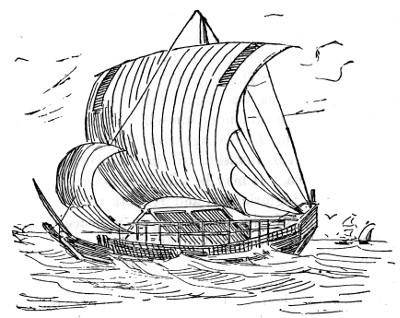
JAPANESE JUNK.
It is not difficult to account for the tone of admiration and pride with which a modern Japanese speaks of “The age of Taiko.” There are many who hold that Hideyoshi, or Taiko, was the real unifier of the empire. Certain it is that he originated many of the most striking forms of national administration. In his time the arts and sciences were not only in a very flourishing condition, but gave promise of rich development. The spirit of military enterprise and internal national improvement was at its height. Contact with the foreigners of many nations awoke a spirit of inquiry and intellectual activity; but it was on 221the seas that genius and restless activity found their most congenial field.
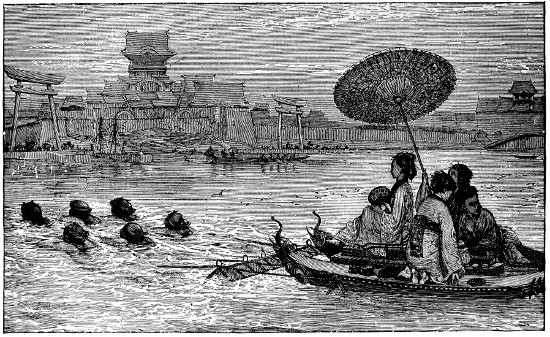
OLD TIME JAPANESE FERRY.
This era is marked by the highest production in marine architecture, and the extent and variety of commercial enterprise. The ships built in this century were twice the size and vastly the superior in model of the junks that now hug the Japanese shores or ply between China and Japan. The pictures of them preserved to the present day, show that they were superior in size to the vessels of Columbus, and nearly equal in sailing qualities to the contemporary Dutch and Portuguese galleons. They were provided with ordnance, and a model of a Japanese breech-loading cannon is still preserved in Kioto. Ever a brave and adventurous people, the Japanese then roamed the seas with a freedom 222that one who knows only of the modern bound people would scarcely credit. Voyages of trade discovery or piracy have been made to India, Siam, Birmah, the Philippine Islands, Southern China, the Malay Archipelago and the Kuriles, even in the fifteenth century, but was more numerous in the sixteenth. The Japanese literature contains many references to these adventurous sailors, and when the records of the far east are thoroughly investigated, and this subject fully studied, very interesting results are apt to be obtained showing the widespread influence of Japan at a time when she was scarcely known by the European world to have existence.
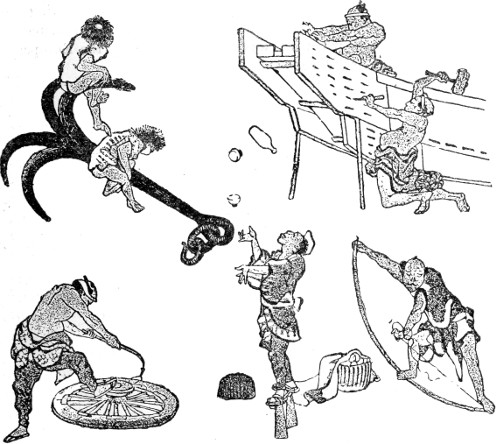
SCENES OF INDUSTRIAL LIFE. (From a Japanese Album.)
223
HISTORICAL SKETCH FROM THE COMING OF THE FIRST EUROPEAN TRAVELERS TO THE PRESENT TIME.
A New Dynasty of Shoguns—Mendez Pinto’s Visit—Arrival of the Jesuit Missionaries—Kind Reception of Christianity—Quarrels Between the Sects—Beginning of Christian Persecution—Expulsion of the Missionaries—Torture and Martyrdom—The Massacre of Shimabara—Expulsion of all Foreigners—Closing the Door of Japan—History of the Last Shogunate—Arrival of Commodore Perry’s Fleet—The Knock at the Door of Japan—An Era of Treaty Making—Rapid Advance of Western Manners and Ideas in Japan—Attacks on Foreigners—The Abolition of the Shogunate—Japan’s Last Quarter Century.
Hitherto we have seen two readily distinguishable periods in the history of Japan, the period during which the mikados were the actual as well as the nominal rulers of the empire; and the period during which the imperial power more and more passed into the hands of usurping mayors of the palace, and the country was kept in an almost constant ferment with the feuds of rival noble families which coveted this honor. Successively the power, although not always the title, of shogun, had been held by members of the Minamoto, Hojo, Ashikaga, Ota and Toyotomi families. With Iyeyasu we pass into a third period, like the second in that the dual system of feudal government still prevailed, but unlike it in that it was a period of peace. Much strife had accompanied the erection of the fabric of feudalism, but it now stood complete. The mikado in Kioto and the daimios in their different provinces, alike ceased to protest against the dual administration. Within certain limits they had the regulation of their own affairs; the mikado was ever recognized as the source of all authority, and the daimios in their own provinces were petty kings; but it was the shogun in Yeddo who, undisputed, at least in practice, whatever some of the more powerful daimios may have said, swayed the destinies of the empire.
Let us now note the policy which the Shoguns adopted towards the foreigners who as missionaries or merchants had found their 224way to Japan, and the course of settlement and trade of foreigners.
It seems now certain that when Columbus set sail from Spain to discover a new continent, it was not America he was seeking, but the land of Japan. Marco Polo, the Venetian traveler, had spent seventeen years, 1275-1292, at the court of the Tartar emperor Kublai Khan, and while in Peking had heard of a land lying to the eastward, called in the language of the Chinese, Zipangu, from which our modern name Japan has been corrupted. Columbus was an ardent student of Polo’s book, which had been published in 1298. He sailed westward across the Atlantic to find this kingdom. He discovered not Japan, but an archipelago in America on whose shores he eagerly inquired concerning Zipangu. Following this voyage, Vasco de Gama and a host of other brave Portuguese navigators sailed into the Orient and came back to tell of densely populated empires enriched with the wealth that makes civilization possible, and of which Europe had scarcely heard. Their accounts fired the hearts of the zealous who longed to convert the heathen, aroused the cupidity of traders who thirsted for gold, and kindled the desire of monarchs to found empires in Asia.
Mendez Pinto, a Portuguese adventurer, seems to have been the first European who landed on Japanese soil. On his return to Europe he told so many wonderful stories that by a pun on his Christian name he was dubbed “the mendacious.” His narrative was, however, as we now know, substantially correct. Pinto while in China had got on board a Chinese junk, commanded by a pirate. They were attacked by another corsair, their pilot was killed, and the vessel was driven off the coast by a storm. They made for the Liu Kiu Islands, but unable to find a harbor, put to sea again. After twenty-three days’ beating about, they sighted the islands of Tanegashima and landed. The name of the island, “island of the seed,” was significant. The arrival of these foreigners was a seed of troubles innumerable. The crop was priestcraft of the worst type, political intrigue, religious persecution, the inquisition, the slave trade, the propagation of Christianity by the sword, sedition, rebellion, and civil war. Its harvest was garnered in the blood of sixty-thousand Japanese.
225The native histories recount the first arrival of Europeans in 1542, and note that year as the one in which fire-arms were first introduced. The pirate trader who brought Pinto to Japan cleared twelve hundred per cent. on his cargo, and the three Portuguese returned to China loaded with presents. The new market attracted hundreds of Portuguese adventurers to Japan, who found a ready welcome. The missionary followed the merchant. Already the Portuguese priests and Franciscan friars were numerous in India. Two Jesuits and two Japanese who had been converted at Goa, headed by Xavier, landed at Kagoshima in 1549. Xavier did not have great success, and in a short time left Japan disheartened. He had, however, inspired others who followed him, and their success was amazingly great.
The success of the Jesuit missionaries soon attracted the attention of the authorities. Organtin, a Jesuit missionary in Kioto, writing of his experiences, says that he was asked his name and why he had come to Japan. He replied that he was the Padre Organtin and had come to spread religion. He was told that he could not be allowed at once to spread his religion, but would be informed later on. Nobunaga accordingly took counsel with his retainers as to whether he would allow Christianity to be preached or not. One of these strongly advised not to do so, on the ground that there were already enough religions in the country, but Nobunaga replied that Buddhism had been introduced from abroad and had done good in the country, and he therefore did not see why Christianity should not be granted a trial. Organtin was consequently allowed to erect a church and to send for others of his order, who, when they came, were found to be like him in appearance. Their plan of action was to care for the sick, and so prepare the way for the reception of Christianity, and then to convert every one and make the thirty-six provinces of Japan subject to Portugal. In this last clause we have an explanation of the policy which the Japanese government ultimately adopted towards Christianity and all foreign innovations. Within five years after Xavier visited Kioto, seven churches were established in the vicinity of the city itself, while scores of Christian communities had sprung up in the south-west. 226In 1581 there were two hundred churches and one hundred and fifty thousand native Christians.
In 1583 an embassy of four young noblemen was dispatched by the Christian daimios to the pope to declare themselves vassals of the Holy See. They returned after eight years, having had audience of Phillip II. of Spain, and kissed the feet of the pope at Rome. They brought with them seventeen Jesuit missionaries, an important addition to the list of religious instructors. Spanish mendicant friars from the Philippine Islands, with Dominicans and Augustinians, also flocked into the country, teaching and zealously proselyting. The number of “Christians” at the time of the highest success of the missionaries in Japan was, according to their own figures six hundred thousand, a number that seems to be no exaggeration if quantity and not quality are considered. The Japanese less accurately set down a total of two million nominal adherents to the Christian sects. Among the converts were several princes, large numbers of lords, and gentlemen in high official positions, and beside generals of the army and admirals of the navy. Churches and chapels were numbered by the thousand, and in some provinces crosses and Christian shrines were as numerous as the kindred evidences of Buddhism had been before. The methods of the Jesuits appealed to the Japanese, as did the forms and symbols of the faith, but the Jesuits began to attack most violently the character of the native priests, and to incite their converts to insult their gods, burn the idols and desecrate the old shrines.
As the different orders, Jesuits, Franciscans and Augustinians increased, they began to clash. Political and religious war was almost universal in Europe at the same time, and the quarrels of the various nationalities followed the buccaneers, pirates, traders and missionaries to the distant seas of Japan. All the foreigners, but especially Portuguese, then were slave traders, and thousands of Japanese were bought and sold and shipped to China and the Philippines. The sea ports of Hirado and Nagasaki were the resorts of the lowest class of adventurers of all European nations, and the result was a continuous series of uproars, broils and murders among the foreigners. Such a picture of foreign influence and of Christianity as the Japanese saw it was not calculated 227to make a permanently favorable impression on the Japanese mind.
Latterly Nobunaga had somewhat repented of the favor he had shown to the new religion, though his death occurred before his dissatisfaction had manifested itself in any active repression. Hideyoshi had never been well disposed to Christianity, but other matters prevented him from at once meddling with the policy of his predecessors. In 1588 he ventured to issue an edict commanding the missionaries to assemble at Hirado, an island off the west coast of Kiushiu and prepared to leave Japan, and the missionaries obeyed, but as the edict was not enforced they again returned to the work of evangelization in private as vigorously as ever, averaging ten thousand converts a year. The Spanish mendicant friars pouring in from the Philippines, openly defied Japanese laws. This aroused Hideyoshi’s attention and his decree of expulsion was renewed. Some of the churches were burned. In 1596 six Franciscan and three Jesuit priests with seventeen Japanese converts were taken to Nagasaki and there burned.
When Hideyoshi died, affairs seemed to take a more favorable turn, but only for a few years. Iyeyasu was as much opposed to Christianity as Hideyoshi, and his hatred of the new religion was intensified by his partiality for Buddhism. The new daimios, carrying the policy of their predecessors as taught them by the Jesuits, but reversing its direction, began to persecute their Christian subjects, and to compel them to renounce their faith. The native converts resisted, even to blood and the taking up of arms. The idea of armed rebellion among the farmers was something so wholly new that Iyeyasu suspected foreign instigation. He became more vigilant as his suspicions increased, and resolving to crush this spirit of independence and intimidate the foreign emissaries, met every outbreak with bloody reprisals.
Iyeyasu issued a decree of expulsion against the missionaries in 1600, but the decree was not at once carried into effect. The date of the first arrival in Japan of Dutch merchants was also 1600. They settled in the island of Hirado. In 1606 an edict from Yeddo forbade the exercise of the Christian religion, but an outward show of obedience warded off active persecution. Four years later the Spanish friars again aroused the wrath of the 228government by defying its commands and exhorting the native converts to do likewise. In 1611 Iyeyasu obtained documentary proof of what he had long suspected, the existence of a plot on the part of the native converts and the foreign emissaries to reduce Japan to the position of a subject state. Fresh edicts were issued, and in 1614 twenty-two Franciscan, Dominican and Augustinian friars, one hundred and seventeen Jesuits and hundreds of native priests were embarked by force on board junks and sent out of the country. The next year the shogun pushed matters to an extreme with Hideyori, who was entertaining some Jesuit priests, and laid siege to the castle of Ozaka. A battle of unusual ferocity and bloody slaughter raged, ending in the burning of the citadel and the total defeat and death of Hideyori and thousands of his followers. The Jesuit fathers say that one hundred thousand men perished in this brief war.
The exiled foreign friars kept secretly returning, and the shogun pronounced sentence of death against any foreign priest found in the country. Iyemitsu, the next shogun, restricted all foreign commerce in Nagasaki and Hirado; all Japanese were forbidden to leave the country on pain of death. Any European vessel approaching the coast was at once to be referred to Nagasaki, whence it was to be sent home; the whole crew of any junk in which a missionary should reach Japanese shores were to be put to death; and the better to remove all temptation to go abroad, it was decreed that no ships should be constructed above a certain size and with other than the open sterns of coasting vessels.
Fire and sword were used to extirpate Christianity and to paganize the same people who in their youth were Christianized by the same means. Thousands of the native converts fled to China, Formosa and the Philippines. The Christians suffered all sorts of persecutions and tortures that savage ingenuity could devise. Yet few of the natives quailed or renounced their faith. They calmly let the fire of wood, cleft from the crosses before which they once prayed, consumeprayed, consume them. Mothers carried their babes to the fire or the edge of the precipice rather than leave them behind to be educated in pagan faith. If any one doubt the sincerity and fervor of the Christian converts of to-day, or the ability of the Japanese to accept a higher form of faith, or their willingness 231to suffer for what they believe, he has but to read the accounts of various witnesses to the fortitude of the Japanese Christians of the seventeenth century.
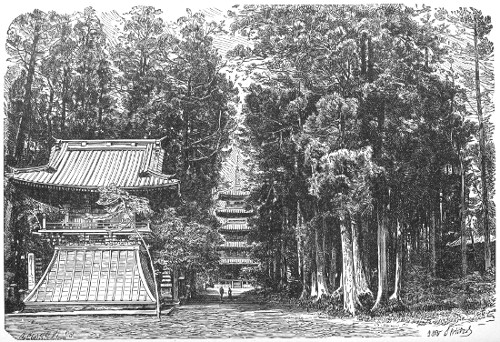
JAPANESE BELL TOWERS.
The persecution reached its climax in the tragedy of Shimabara in 1637. The Christians arose in arms by tens of thousands, seized an old castle, repaired it and fortified it, and raised the flag of rebellion. The armies of veterans sent to besiege it expected an easy victory, and sneered at the idea of having any difficulty in subduing these farmers and peasants. It took two months by land and water, however, of constant attack before the fort was reduced, and the victory was finally gained only with the aid of Dutch cannon furnished under compulsion by the traders of Deshima. After great slaughter the intrepid garrison surrendered, and then began the massacre of thirty-seven thousand Christians. Many of them were hurled into the sea from the top of the island rock of Takaboko-shima, by the Dutch named Pappenberg, in the harbor of Nagasaki.
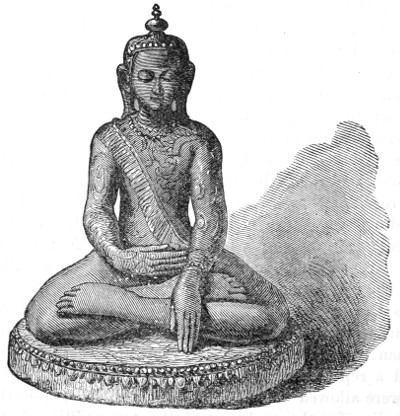
IMAGE OF BUDDHA.
The result of this series of events was that the favorable policy adopted by Iyeyasu in regard to foreign trade was completely reversed. No foreigners were allowed to set foot on the soil of Japan, except Chinese and a few Dutch merchants. The Dutch gained the privilege of residing in confinement on the little island of Deshima, a piece of made land in the harbor of Nagasaki. Here under degrading restrictions and constant surveillance lived less than a score of Hollanders, who were required every year to send a representative to Yeddo to do homage to the shogun. They were allowed one ship per annum to come from the Dutch East Indies for the exchange of the commodities of Japan for those of Holland.
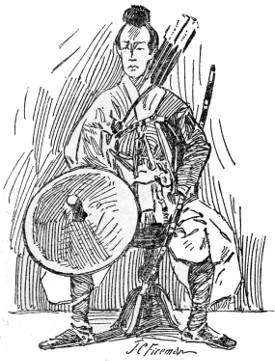
JAPANESE SAMURAI OR WARRIOR OF THE OLD TIME.
Says Doctor Griffis in his study of this era of Japanese history, “After nearly a hundred years of Christianity and foreign intercourse, the only apparent results of this contact with another religion and civilization were the adoption of gunpowder and fire-arms as weapons, the use of tobacco and the habit of smoking, the making of sponge cake, the naturalization into the language of a few foreign words, the introduction of new and strange forms of disease, among which the Japanese count the scourge of the venereal virus, and the permanent addition to 232that catalogue of terrors which priest and magistrate in Asiatic countries ever hold as welcome, to overawe the herd. For centuries the mention of that name would bate the breath, blanch the cheek and smite with fear as with an earthquake shock. It was the synonymsynonym of sorcery, sedition, and all that was hostile to the purity of the home and the peace of society. All over the empire, in every city, town, village and hamlet; by the roadside, ferry or mountain pass; at every entrance to the capitol, stood the public notice boards on which with prohibitions against the great crimes that disturbed the relations of society’s government was one tablet written with a deeper brand of guilt, with a more hideous memory of blood, with a more awful terror of torture, than when the like superscription was affixed at the top of a cross that stood between two thieves on a little hill outside Jerusalem. Its daily and familiar sight startled ever and anon the peasants who clasped hands and uttered a fresh prayer; the Bonze, or Buddhist priest, to add new venom to his maledictions; the magistrate to 233shake his head; and to the mother a ready word to hush the crying of her fretful babe. That name was Christ. So thoroughly was Christianity or the “corrupt sect” supposedsupposed to be eradicated before the end of the seventeenth century, that its existence was historical, remembered only as an awful scar on the national memory. No vestiges were supposed to be left of it, and no knowledge of its tenets was held save by a very few scholars in Yeddo, trained experts who were kept as a sort of spiritual blood hounds to scent out the adherents of the accursed creed. It was left to our day since the recent opening of Japan, for them to discover that a mighty fire had been smoldering for over two centuries beneath the ashes of persecutions. As late as 1829 seven persons, six men and an old woman, were crucified in Ozaka on suspicion of being Christians and communicating with foreigners. When the French brethren of the Mission Apostolique of Paris came to Nagasaki in 1860, they found in the villages around them over ten thousand people who held the faith of their fathers of the seventeenth century.”century.”
The Portuguese were not the only race to attempt to open a permanent trade with Japan. Captain John Saris, with three ships, left England in April, 1611, with letters from King James I. to the “Emperor” (shogun) of Japan. Landing at Hirado he was well received, and established a factory in charge of Richard Cocks. The captain and a number of the party visited Yeddo and other cities and obtained from the shogun a treaty defining the privileges of trade, and signed Minamoto Iyeyasu. After a tour of three months Saris arrived at Hirado again, having 234visited Kioto, where he saw the splendid Christian churches and Jesuit palaces. After discouraging attempts to open a trade with Siam, Corea and China, and hostilities having broken out between them and the Dutch, the English abandoned the project of permanent trade with Japan, and all subsequent attempts to reopen it failed.
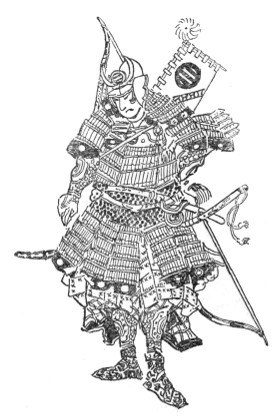
JAPANESE GENERAL OF THE OLD TIME. (From a Native Drawing.)
Will Adams, who was an English pilot, and the first of his nation in Japan, arrived in 1607 and lived in Yeddo till he died thirteen years later. He rose into favor with the shoguns and the people by the sheer force of a manly, honest character. His knowledge of shipbuilding, mathematics, and foreign affairs made him a very useful man. Although treated with kindness and honor, he was not allowed to leave Japan. He had a wife and daughter in England. Adams had a son and daughter born to him in Japan, and there are still living Japanese who claim descent from him. One of the streets of Yeddo was named after him, and the people of that street still hold an annual celebration on the fifteenth of June in his honor.
The history of the two centuries and a half that followed the triumphs of Iyeyasu is that of profound peace and stern isolation. We must pass rapidly in review of them. This great shogun took pains to arrange the empire after the appointment to the office, in such a way that the shoguns of the Tokugawa family, the dynasty which he founded, should have strictest power and most certain descent. His sons and daughters were married where they would be most powerful in influence with the great families of daimios. It must not be forgotten that Iyeyasu and 235his successor were both in theory and in reality vassals of the emperor, though they assumed protection of the imperial person. Neither the shogun nor the daimios were acknowledged at Kioto as nobles of the empire. The lowest kuge, or noble, was above the shogun in rank. The shogun could obtain his appointment only from the mikado. He was simply the most powerful among the daimios, who had won that pre-eminence by the sword, and who by wealth and power and a skillfully wrought plan of division of land among the other daimios was able to rule.
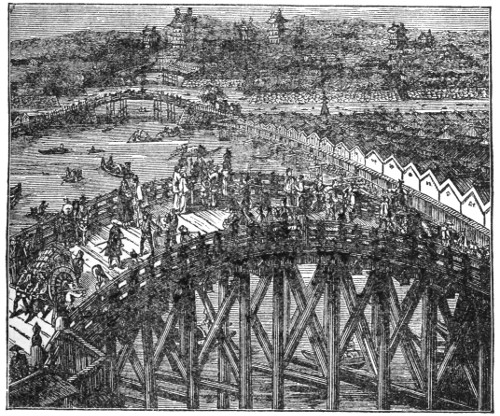
JAPANESE BRIDGE.
In 1600 and the years following, Iyeyasu employed an army of three hundred thousand laborers in Yeddo improving and building the city. Before the end of the century, Yeddo had a population of more than half a million, but it never did have, as the Hollanders guessed and the old text books told us, two million five hundred 236thousand souls. Outside of Yeddo the strength of the great unifier was spent on public roads and highways, post stations, bridges, castles and mines. He spent the last years of his life engaged in erasing the scars of war by his policy of conciliation, securing the triumphs of peace, perfecting his plans for fixing in stability a system of government, and in collecting books and manuscripts. He bequeathed his code of laws to his chief retainers, and advised his sons to govern in the spirit of kindness. He died on the eighth of March, 1616.
The grandson of Iyeyasu, Iyemitsu, was another great shogun, and it was he who established the rule that all the daimios should visit and reside in Yeddo during half the year. Gradually these rules became more and more restrictive, until the guests became mere vassals. Their wives and children were kept as hostages in Yeddo. During his rule the Christian insurrection and massacre at Shimabara took place. Yeddo was vastly improved, with aqueducts, fire watch towers, the establishment of mints, weights and measures. A general survey of the empire was executed; maps of various provinces and plans of the daimios’ castles were made; the councils called Hiojo-sho (discussion and decision), and Wakadoshiyori (assembly of elders), were established and Corean envoys received. The height of pride and ambition which this shogun had already reached, is seen in the fact that in a letter of reply to Corea he is referred to as Tai Kun, (“Tycoon”), a title never conferred by the mikado on any one, nor had Iyemitsu any legal right to it. It was assumed in a sense honorary or meaningless to any Japanese, unless highly jealous of the mikado’s sovereignty, and was intended to overawe the Coreans. The approximate interpretation of it is “great ruler.”
Under the strong rule of the Tokugawa shoguns, therefore, the long distracted Japanese empire at length enjoyed two-and-a-half centuries of peace and prosperity. The innate love of art, literature, and education, which almost constant warfare had prevented from duly developing among the people, had now an opportunity of producing fruit. And as it had shown itself in former intervals of rest, so was it now. Under the patronage of Iyeyasu was composed the Dai Nihon Shi, the first detailed history of Japan. Tsunayoshi, his successor, 1681 to 1709, founded at Seido a Confucian 237university, and was such an enthusiast for literature that he used to assemble the princes and high officials about him and expound to them passages from the Chinese classics. Yoshimune, another shogun, was much interested in astronomy and other branches of science, beside doing much to improve agriculture. Legal matters also engaged his attention; he altered Iyeyasu’s policy so far as to publish a revised criminal code, and improved the administration of the law, forbidding the use of torture except in cases where there was flagrant proof of guilt. He built an astronomical observatory at Kanda and established at his court a professorship of Chinese literature.
Iyenori, shogun from 1787 to 1838, threw the classes of the Confucian university open to the public. Every body from the nobility down to the masses of the people began to appreciate literary studies. Maritime commerce within the limits of the four seas was encouraged by the shogun’s government, regular service of junks being established between the principal ports. Nor must it be forgotten that to the Tokugawas is due the foundation of the great modern city of Yeddo with its vast fortifications and its triumphs of art in the shrines of Shiba and Uyeno. It was at this period too that the matchless shrines of Nikko were reared in memory of the greatness of Iyeyasu and Iyemitsu. The successors of the former, the shoguns of the Tokugawa dynasty, fourteen in all, were with one exception buried alternately in the cemeteries of Zozoji and Toyeizan, in the city districts of Shiba and Uyeno.
But throughout all this period of peace and progress the light of the outer world was excluded. The people made the best use of the light they had, but after all it was but dim. The learning by rote of thousands of Chinese characters, and the acquisition of skill in the composition of Chinese and Japanese verse, were little worthy to be the highest literary attainments possible to the most aspiring of the youth of Japan. In the domain of art there was more that was inviting, but scientific knowledge was tantalizingly meagre and that little was overlaid with Chinese absurdities. When we consider that the isolation of the country was due to no spirit of exclusiveness in the national character, that indeed it was the result of a policy that actually went against the grain of 238the people, how many restless spirits must there have been during these long years, who kept longing for more light. Fortunately there was one little chink at Deshima, in the harbor at Nagasaki, and of this some of the more earnest were able to take advantage. Many instances are recorded and there must be many more of which we can know nothing, of Japanese students displaying the truest heroism in surmounting the difficulties that lay in the way of their acquiring foreign knowledge. Let us now see how there came at length an unsettled dawn, and after the clouds of this had cleared, a dazzling inpouring of the light.
It was the American Union which opened the door of Japan to western civilization. It had been desired by all of the European nations, as well as by the United States, to obtain access to Japanese ports. Supplies were frequently needed, particularly water and coal, but no distress was ever considered a sufficient excuse for the Japanese to permit the landing of a foreign vessel’s crew. Shipwrecked sailors frequently passed through seasons of great trial and danger, before they were restored to their own people. Even Japanese sailors who were shipwrecked on other shores, or carried out to sea, were refused re-admission to their own country when rescued by foreigners.
Commodore Matthew Calbraith Perry of the American navy, urged upon President Millard Fillmore the necessity and possibility of making some sort of a treaty with the exclusive empire. It was decided that the most effective way to advance this desire was to sail into the bay of Yeddo with a squadron sufficient to command respect. A fleet was assigned to the undertaking, under the command of Perry, and the American vessels sailed away to the Orient to rendezvous at the chief city of the Liu Kiu islands, Napha. From Napha the fleet sailed for Japan, the Susquehanna, the flagship, the advance of the line of the ships of seventeen nations.
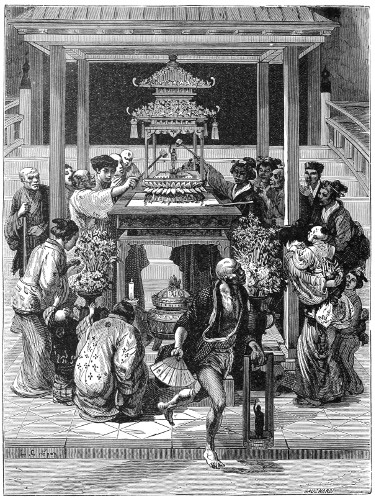
BAPTISM OF BUDDHA.
It was on the seventh day of July, 1853, under a sky and over a sea of perfect calm, that the four American warships appeared off Uraga in the Bay of Yeddo. Without delay the officials of Uraga emphatically notified the “barbarian” envoy that he must go to Nagasaki, where all business with foreigners had to be done. The barbarian refused to go. He informed the messengers 241that he was the bearer of a letter from the President of the United States to the Emperor of Japan; that he had sailed as near as possible to the destination of the letter and would now deliver it and continue it on its way by land, but he would not retrace his path until the letter was delivered. The shogun Iyeyoshi on receiving information of such decision, was exceedingly troubled and called his officials to a council. Alarm was wide spread, and it was ordered that strict watch should be kept along the shore to prevent the barbarian vessels from committing acts of violence. During the eight days while Commodore Perry’s fleet was waiting in the Bay of Yeddo, the boats of his ships were busily engaged in taking soundings and surveying the shores and the anchorage. No sailors were permitted to land, and no natives were molested. Every effort was made to indicate to the Japanese the desire for a peaceful friendship.
A learned Chinese scholar was sent by the shogun to Uraga, who acted as an official and eminent interpreter in an interview with the American envoy. Continued councils were called by the shogun, not only of his chief officers but of the daimios, the nobles, and the retired nobles of Yeddo. The citizens of Yeddo and the surrounding villages were in great tumult, fearing that there would be a war, for which the country was totally unprepared. Meanwhile the envoy was impatiently demanding an answer. At last, after eight days, the patience and the impatience, combined with the demonstrations made by the vessels of the fleet, which were highly impressive to the Japanese who had never seen a steamboat, won success for Commodore Perry’s message. A high Japanese commissioner came to Uraga, prepared a magnificent pavilion for the ceremonies, and announced himself ready to receive the letter to the emperor. With great pomp and ceremony the Americans landed and in this pavilion with proper formalities, delivered the letter and presents from the president. Then having, for the first time in history, gained several important points of etiquette in a country where etiquette was more than law or morals, the splendid diplomat and warrior Perry sailed away with his fleet July 17, 1853.
It was in response to a temporizing policy on the part of Japan, and to the good judgment and careful decision of Commodore 242Perry, that the fleet sailed away without demanding an immediate reply to his letter. The American envoy was informed that in a matter of so much importance a decision could not be at once reached, and that if he now left, he would on his return get a definite answer. No wonder there was commotion. The nineteenth century had come suddenly into contact with the fourteenth. The spirit of commerce and the spirit of feudalism, two great but conflicting forces, met in their full development, and the result was necessarily a convulsion. We are hardly surprised to hear that the shogun died before Commodore Perry’s return, or that during the next few years the land was harassed by earthquakes and pestilences.
Perry’s second appearance was in February, 1854, this time with a much larger fleet. A hot debate took place in the shogun’s council as to the answer that should be given. The old daimio of Mito, the head of one of the three families, which, forming the Tokugawa clan, furnished the occupants of the shogunate, wanted to fight and settle the question once for all. “At first,” he said, “they will give us philosophical instruments, machinery and other curiosities; will take ignorant people in; and trade being their chief object they will manage to impoverish the country, after which they will treat us just as they like, perhaps behave with the greatest rudeness and insult us, and end by swallowing up Japan. If we do not drive them away now we shall never have another opportunity.”
Others gave contrary advice, saying, “If we try to drive them away they will immediately commence hostilities, and then we shall be obliged to fight. If we once get into a dispute we shall have an enemy to fight who will not be easily disposed of. He does not care how long he will have to spend over it, but he will come with myriads of men-of-war and surround our shores completely; however large a number of ships we might destroy, he is so accustomed to that sort of thing that he would not care in the least. In time the country would be put to an immense expense and the people plunged into misery. Rather than allow this, as we are not the equals of foreigners in the mechanical arts, let us have intercourse with foreign countries, learn their drill and tactics, and when we have made the nation as united as one 243family, we shall be able to go abroad and give lands in foreign countries to those who have distinguished themselves in battle.”
The latter view carried and a treaty with the United States was signed on the thirty-first of March, 1854. Now be it observed that the shogun did this without the sanction of the mikado, whom indeed he had never yet consulted on the matter, and that he subscribed himself Tai Kun, (“Tycoon,”) or great ruler, a title to which he had no right and which if it meant anything at all involved an assumption of the authority of supreme ruler in the empire. This was the view naturally taken by Perry and by the ambassadors from European countries who a few years later obtained treaties with Japan. They were under the impression that they were dealing with the emperor; and hearing of the existence of another potentate living in an inland city, surrounded with a halo of national veneration, they conceived the plausible but erroneous theory that the tycoon was the temporal sovereign, and this mysterious mikado the spiritual sovereign of the country. They little dreamed that the so-called tycoon was no sovereign at all, and that consequently the treaties which he signed had no legal validity.
The shogun could ill afford thus to lay himself open to the charge of treason. From the first there had been a certain class of daimios who had never heartily submitted to the Tokugawa administration. The principal clans which thus submitted to the regime under protest against what they considered a usurpation, an encroachment on the authority of the mikado, whom alone they recognized as the divinely appointed ruler of Japan, were those of Satsuma, Choshiu, and Tosa. As the years of peace cast their spell over the nation, making the people forgetful of war and transforming the descendants of Iyeyasu into luxurious idlers, much more like impotent mikados than successors of the energetic soldier and law-giver, their hopes more and more arose that an opportunity would be given them to overthrow the shogunate and bring about the unification of the empire at the hands of the mikado. Their time had now come. The shogun was enervated and he had so far forgotten himself as to open the country to foreign trade, without the sanction of the “Son of Heaven.” It was this illegal act of the shogun that precipitated 244the confusion, violence and disaster of the next few years, reaching ultimately in 1868 to the complete overthrow of his own power and the restoration of the mikado to his rightful position as actual as well as nominal ruler of the empire.
Fearing the consequences of the illegal act into which he had been driven, the shogun lost no time in sending messengers to Kioto to inform the mikado of what had happened and seek his sanction to the policy adopted. It was plead in excuse for the course of conduct, that affairs had reached such a condition that the shogun was driven to sign the treaty. The emperor in great agitation summoned a council. The decision was unanimous against the shogun’s action, and the messengers were informed that no sanction could be given to the treaty. The next important step was not taken until July, 1858, when Lord Elgin arrived with propositions on the part of Great Britain for a treaty of amity and commerce. He was unaccompanied by any armed force, and brought a steam yacht as a present from Queen Victoria to the tycoon of Japan.
A few months later treaties were entered into with all the leading powers of Europe, but if there was a political lull between 1854 and 1858, the poor Japanese had distractions of a very different kind. From a violent earthquake and consequent conflagration, one hundred and four thousand of the inhabitants of Yeddo lost their lives. A terrific storm swept away one hundred thousand more, and in a visitation of cholera thirty thousand persons perished in Yeddo alone. Moreover, just when the treaties were being signed, the shogun Iyesada died, “as if,” says Sir R. Alcock, “a further victim was required for immolation on the altar of the outraged gods of Japan.”
The political tempest that had been gathering now swept over the nation. For the next ten years there was so much disorder, intrigue, and bloodshed, that Japan became among the western nations a byword for treachery and assassination. Defenseless foreigners were cut down in the streets of Yeddo and Yokohama and even in the legations. Twice was the British legation attacked, on one of the occasions being taken by storm and held for a time by a band of free-lances. No foreigner’s life was safe. Even when out on the most trivial errand, every foreign resident 245was accompanied by an armed escort furnished by the shogun’s government. It is needless to give an account of all the different assassinations, successful or attempted, which darkened the period. The secretary to the American legation was cut down near Shiba, Yeddo, when returning from the Prussian legation with an armed escort; a Japanese interpreter attached to the British legation was fatally stabbed in broad daylight while standing at the legation flagstaff; one of the guard at the same legation murdered two Englishmen in the garden and then committed suicide; an Englishman was cut down on the highway between Yokohama and Yeddo by certain retainers of the daimio of Satsuma, whose procession he had unwittingly crossed on horseback; and these were not all.
It is not a satisfactory answer to say that hatred of foreigners was the leading motive that inspired all these acts of violence. This was no doubt more or less involved, but the true explanation is to be found in the hostility of the mikado’s partisans to the shogun’s government. All possible means were taken to thwart the shogun and bring him into complications with the ambassadors at his court. Every attack on a foreigner brought fresh trouble upon the Yeddo government and hastened its collapse. Long before foreigners arrived, the seeds of revolution had sprouted and their growth was showing above the soil. It is to the state of political parties and of feudalism at this epoch in Japanese history, and not to mere ill will against foreigners, that this policy of intrigue and assassination must be ascribed.
It would take too long to discuss all the complications of this period and to inquire, for instance, how far when the Japanese government failed to arrest and execute the murderer of Mr. Richardson, the British were justified in demanding an indemnity of $500,000 from the shogun and $125,000 from the daimio of Satsuma, or in enforcing their demands with a threatened bombardment of Yeddo and an actual bombardment of Kagoshima. It is out of our scope here to inquire into the shelling of the batteries of the daimio of Choshiu, at Shimonoseki, in turn by the Americans, British, French and Dutch, the men of Choshiu having fired upon some Dutch, American, and French vessels that had entered the straits against the prohibition of the Japanese. 246An indemnity of $3,000,000 was also exacted and distributed among these nations.
Such stern measures doubtless appeared to the foreign ambassadors necessary to prevent the expulsion or even the utter extermination of foreigners. Whether their policy was mistaken or not, certain it is that they can have had no adequate conception of the difficulties with which the shogun had to contend. The position of that ruler was one of such distraction as might well evoke for him the pity of every disinterested onlooker. Do as he would, he could not escape trouble; on the one side were the mikado’s partisans ever growing in power and in determination to crush him, and on the other were the equally irresistible foreigners with their impatient demands and their alarming threats. He was as helpless as a man between a wall of rock and an advancing tide.
The internal difficulties of the country were increased by dissensions which broke out in the imperial court. The clans of Satsuma and Choshiu had been summoned to Kioto to preserve order. For some reason the former were relieved of this duty, or rather privilege, and it therefore devolved exclusively upon the Choshiu men. Taking advantage of their position, the Choshiu men persuaded the mikado to undertake a progress to the province of Yamato, there to proclaim his intention of taking the field against foreigners; but this proposal roused the jealousy of the other clans at the imperial court, as they feared that the men of Choshiu were planning to obtain possession of the mikado’s person and thus acquire pre-eminence. The intended expedition was abandoned, and the men of Choshiu, accompanied by Sanjo, afterward prime minister of the reformed government, and six other nobles who had supported them, were banished from Kioto.
The ill feeling thus occasioned between Choshiu and Satsuma, was fomented by an unfortunate incident which occurred at Shimonoseki early in 1864. The former clan recklessly fired upon a vessel, which being of European build they mistook for a foreign one, but which really belonged to Satsuma. Thus Choshiu was in disfavor both with the shogun and with the mikado, and in this year we have the strange spectacle of these two rulers leaguing their forces together for its punishment. 247August 20, 1864, the Choshiu men advanced upon Kioto, but were repulsed with much slaughter, only however after the greater part of the city had been destroyed by fire. The rebellion was not at once quelled; indeed the Choshiu samurai were proving themselves more than a match for the troops which the shogun had sent against them, when at length the imperial court ordered the fighting to be abandoned. Simultaneously with the Choshiu rebellion the shogun had to meet an insurrection by the daimio of Mito, in the east. His troubles no doubt hastened his death, which took place at Osaka in September, 1866, shortly before the war against Choshiu terminated. Then there succeeded Keiki, the last of the shoguns.
It should be noted, however, that before this the mikado’s sanction had been obtained to the foreign treaties. In November, 1865, British, French, and Dutch squadrons came to anchor off Hiogo, of which the foreign settlement of Kobe is now a suburb, and sent letters to Kioto demanding the imperial consent. The nearness of such an armed force was too great an argument to be withstood, and the demand was granted. Little more than a year after his accession to the shogunate Keiki resigned. In doing so he proved himself capable of duly appreciating the national situation. Now that foreigners had been admitted, it was more necessary than ever that the government should be strong, and this, it was seen, was impossible without the abolition of the old dual system. He had secured the mikado’s consent to the treaties, on the condition that they should be revised, and that Hiogo should never be opened as a port of foreign commerce.
But the end had not yet come. On the same day when the shogunate was abolished, January 3, 1868, the forces friendly to the Tokagawas were dismissed from Kioto, and the guardianship of the imperial palace was committed to the clans of Satsuma, Tosa, and Geishiu. This measure gave Keiki great offense, and availing himself of a former order of the court which directed him to continue the conduct of affairs, he marched with his retainers and friends to Ozaka and sent a request to the mikado that all Satsuma men who had any share in the government should be dismissed. To this the court would not consent, and 248Keiki marched against Kioto with a force of thirty thousand men, his declared object being to remove from the mikado his bad counselors. A desperate engagement took place at Fushimi, in which the victory was with the loyalists. But this was only the beginning of a short but sharp civil war, of which the principal fighting was in the regions between Yeddo and Nikko.
The restoration was at last complete. Proclamation was made “to sovereigns of all foreign nations and their subjects, that permission had been granted to the shogun Yoshinobu, or Keiki, to return the governing power in accordance with his own request;” and the manifesto continued: “henceforward we shall exercise supreme authority both in the internal and external affairs of the country. Consequently the title of emperor should be substituted for that of tycoon which had been hitherto employed in the treaties.” Appended were the seal of Dai Nippon, and the signature of Mutsuhito, this being the first occasion in Japanese history on which the name of an emperor had appeared during his lifetime.
With the triumph of the imperial party one might have expected a return to the old policy of isolation. There can be no doubt that when the Satsuma, Choshiu, and other southern clans commenced their agitation for the abolition of the shogunate, their ideas with regard to foreign intercourse were decidedly retrogressive. But after all, the leading motive which inspired them was dissatisfaction with the semi-imperial position occupied by the upstart Tokugawas; to this their opposition to foreigners was quite secondary. It so happened that the Tokugawa shoguns got involved with foreigners, and it was so much the worse for the foreigners. To go deeper, what was at the bottom of this desire was the overthrow of the shogunate. Doubtless their patriotism, what they had at heart, was the highest welfare of their country, and this they believed impossible without its unification. Their primary motive then, being patriotism, we need not be surprised that they were willing to entertain the notion that perhaps after all the prosperity of their country might best be insured by the adoption of a policy of free foreign intercourse. This idea more and more commended itself, until it became a conviction; and when they got into power they astonished the 251world by the thoroughness with which they broke loose from the old traditions and entered upon a policy of enlightened reformation. To the political and social revolution which accompanied the restoration of the mikado in 1868, there has been no parallel in the history of mankind.
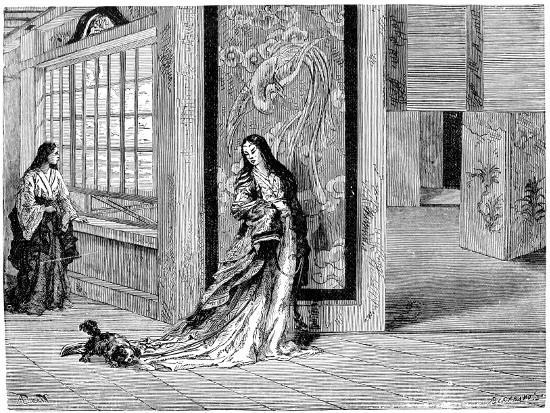
WOMAN OF COURT OF KIOTO.
One of the first acts of the mikado after the restoration, was to assemble the kuges and daimios and make oath before them “that a deliberative assembly should be formed, and all measures be decided upon by public opinion; that impartiality and justice should form the basis of his action; and that intellect and learning should be sought for throughout the world in order to establish the foundations of the empire.” In the mid-summer of 1868, the mikado, recognizing Yeddo as really the center of the nation’s life, made it the capitalcapital of the empire and transferred his court thither; but the name Yeddo, being distasteful on account of its associations with the shogunate, was abolished, and the city renamed Tokio, or “Eastern Capital.” At the same time the ancient capital Kioto, received the new name of Saikio or “Western Capital.” For the creation of a central administration, however, more was necessary than the abolition of the shogunate and the establishment of the mikado’s authority. The great fabric of feudalism still remained intact. Within his own territory each daimio was practically an independent sovereign, taxing his subjects as he saw fit, often issuing his own currency, and sometimes even granting passports so as to control intercourse with neighboring provinces. Here was a formidable barrier to the consolidation of the empire. But the reformers had the courage and the tact necessary to remove it.
The first step towards the above revolution was taken in 1869, when the daimios of Satsuma, Choshiu, Hizen, and Tosa addressed a memorial to the mikado requesting his authorization for the resignation of their fiefs into his hands. Other nobles followed their example, and the consequence was the acceptance by the mikado of control over the land and revenues of the different provinces, the names of the clans however being still preserved, and the daimios allowed to remain over them as governors, each with one-tenth of the former assessment of his territory as rental. By this arrangement the evil of too suddenly terminating 252the relation between the clans and their lords was sought to be avoided, but it was only temporary; in 1871 the clan system was totally abolished, and the country redivided for administrative purposes, with officers chosen irrespectively of hereditary rank or clan connection.
But the payment of hereditary pensions and allowances of the ex-daimios and ex-samurai proved such a drain upon the national resources that in 1876 the reformed government found it necessary to compulsorily convert them into capital sums. The rate of commutation varied from five years’ purchase in the case of the largest pensions, to fourteen years’ in that of the smallest. The number of the pensioners with whom they had thus to deal was three hundred and eighteen thousand four hundred and twenty-eight. The act of the daimios in thus suppressing themselves looks at first sight like a grand act of self-sacrifice, as we are not accustomed to see landed proprietors manifesting such disinterestedness for the patriotic object of advancing their country’s good. But the vast majority of daimios had come to be mere idlers, as the greater mikado had been. Their territories were governed by the more able and energetic of their retainers, and it was a number of these men that had most influence in bringing about the restoration of the mikado’s authority. Intense patriots, they saw that the advancement of their country could not be realized without its unification, and at the same time they cannot but have preferred a larger scope for their talents, which service immediately under the mikado would give them. From being ministers of their provincial governments, they aspired to be ministers of the imperial government. They were successful; and their lords, who had all along been accustomed to yield to their advice quite cheerfully, acquiesced when asked for the good of the empire to give up their fiefs to the mikado. One result of this is that while most of the ex-daimios have retired into private life, the country is now governed almost exclusively by ex-samurai. Such sweeping changes were not to be accomplished without rousing opposition and even rebellion. The government incurred much risk in interfering with the ancient privileges of the samurai. It is not surprising that several rebellions had to be put down during the years immediately succeeding 1868.