Chapter I · VORARLBERG.
Reading edition
. . . . . Everywhere
Fable and Truth have shed, in rivalry,
Each her peculiar influence. Fable came,
And laughed and sang, arraying Truth in flowers,
Like a young child her grandam. Fable came,
Earth, sea, and sky reflecting, as she flew,
A thousand, thousand colours not their own.—Rogers.
‘Traditions, myths, legends! what is the use of recording and propagating the follies and superstitions of a bygone period, which it is the boast of our modern enlightenment to have cast to the winds?’
Such is the hasty exclamation which allusion to these fantastic matters very frequently elicits. With many they find no favour because they seem to yield no profit; nay, rather to set up a hindrance in the way of progress and culture.
All who love poetry and art, as well as all who are interested in the study of languages or races, all who have any care concerning the stirrings of the human mind in its search after the supernatural and the infinite, must confess to standing largely in debt, in the absence of more positive records of the earliest phases of thought, to these various mythologies.
Ladybird, ladybird, fly away home!
Thy house is on fire!
Thy children at home!
can be proved to refer to a belief of our forefathers in the coming downfall of the universe by a great conflagration. The ladybird has its name from having been sacred to our Lady Freia. The words addressed to the insect were once an incantation—an appeal to the goddess for the protection of the soul of the unborn, over whom in her heavenly abode she was supposed to keep watch and ward, and whom she is asked to shield from the fire that consumes the world.... If we ever wean men from the crude notions that haunt them, and yet promote the enjoyment of fancies which serve as embellishing garlands for the rude realities of life, we cannot do better than promote a fuller scientific knowledge of that circle of ideas in which those moved who moulded our very speech. We feel delight in the conceptions of the Greek Olympus. Painters and poets still go back to that old fountain of fancy. Why should we not seek for similar delight in studying the figures of the Germanic Pantheon, and the rich folk-lore connected with them? Why should that powerful Bible of the Norse religion, which contains such a wealth of striking ideas and descriptions in language the most picturesque, not be as much perused as the Iliad, the Odyssey, or the Æneid? Is it too much to say that many even of those who know of the Koran, of the precepts of Kou-fu-tsi and of Buddha, of the Zendavesta and the Vedas, have but the dimmest notion of that grand Germanic Scripture?...
‘Can it be said that there is a lack of poetical conception in the figure of Wodan or Odin, the hoary ruler of the winds and the clouds, who, clad in a flowing mantle, careers through the sky on a milk-white horse, from whose nostrils fire issues, and who is followed at night by a retinue of heroic warriors whom he leads into the golden shield-adorned Walhalla? Is there a want of artistic delineation in Freia—an Aphrodite and Venus combined, who changes darkness into light wherever she appears—the goddess with the streaming golden locks and siren voice, who hovers in her sun-white robe between heaven and earth, making flowers sprout along her path and planting irresistible longings in the hearts of men? Do we not see in bold and well-marked outline the figure of the red-bearded, steel-handed Thor, who rolls along the sky in his goat-drawn car, and who smites the mountain giants with his magic hammer? Are these mere spectres without distinct contour?... are they not, even in their uncouth passions, the representatives of a primitive race, in which the pulse throbs with youthful freshness? Or need I allude to that fantastic theory of minor deities, of fairies and wood-women, and elfin and pixies and cobolds, that have been evolved out of all the forces of Nature by the Teutonic mind, and before whose bustling crowd even Hellenic imagination pales?
‘Then what a dramatic power has the Germanic mythology! The gods of classic antiquity have been compared to so many statues ranged along a stately edifice ... in the Germanic view all is active struggle, dramatic contest, with a deep dark background of inevitable fate that controls alike gods and men.’
Such are the Beings whom we meet wandering all over Tirol; transformed often into new personalities, invested with new attributes and supplemented with many a mysterious companion, the offspring of an imagination informed by another order of thought, but all of them more living, and more readily to be met with, than in any part of wonder-loving Germany itself.
‘If we would investigate the cause of their multiplication, and of the favour with which they were received from the earliest times, we shall find it to consist chiefly in the need and love of the marvellous which governed the new society, notwithstanding the severity of its dogmas. Neophytes snatched from the superstitions of paganism would not have been able all at once to suppress every inclination for poetical fables. They needed another food according to their fancy. And indeed were they not great marvels (though of another order from those to which they were accustomed) which were narrated to them? The aggregate mass was, however, increased by the way in which they lived and the scarcity of communication; every uncertain rumour was thus readily dressed up in the form of a wonderful fact.
‘Again, dogmatic and historical teaching continued long to be oral; so that when an apostle, or the apostle of an apostle, arrived in any city and chained the interest of the faithful with a narration of the acts of Jesus he had himself witnessed or received from the personal narrative of witnesses, his words ran along from mouth to mouth, and each repeater added something, suggested by his faith or by his heart. In this way his teaching constituted itself into a legend, which in the end was no longer the narrative of one, but the expression of the faith of all.
‘Thus whoever looks at legends only as isolated productions of a period most worthy of study, without attending to the influence they exercised on later epochs, must even so hold them in account as literary monuments of great moment.’
Nor is this the case only with the earliest legends. The popular mind in all ages has evinced a necessity for filling up all blanks in the histories of its heroes. The probable, and even the merely possible, is idealized; what might have been is reckoned to have happened; the logical deductions as to what a favourite saint or cobbold ought to have done, according to certain fixed principles of action previously ascribed to his nature, are taken to be the very acts he did perform; and thus, even those traditions which are the most transparently human in their origin, have served to show reflected in action the virtues and perfections which it is the boast of religion to inculcate.
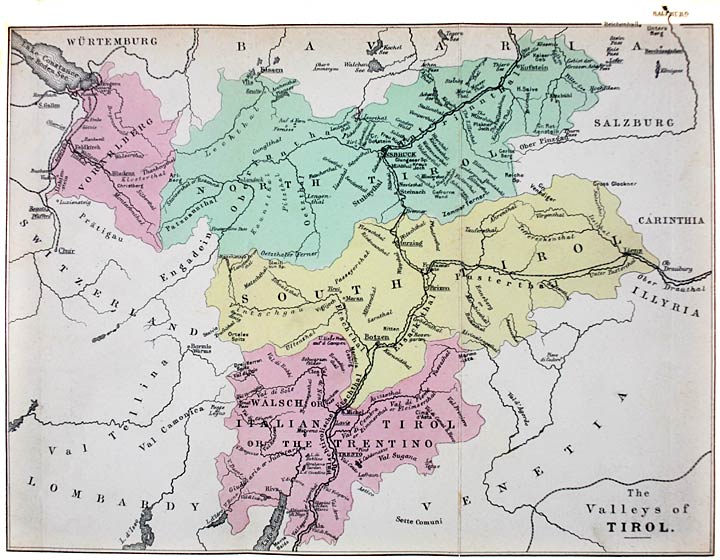
The Valleys of Tirol.
Europe possesses in Tirol one little country at least in whose mountain fastnesses a store of these treasures not only lies enshrined, but where we may yet see it in request. Primitive and unsophisticated tillers of the soil, accustomed to watch as a yearly miracle the welling up of its fruits, and to depend for their hopes of subsistence on the sun and rain in the hand of their Creator, its children have not yet acquired the independence of thought and the habit of referring all events to natural causes, which is generated by those industries of production to which the human agent appears to be all in all. Among them we have the opportunity of seeing these expositions of the supernatural, at home as it were in their contemporary life, supplying a representation of what has gone before, only to be compared to the revelations of deep-cut strata to the geologist, and the unearthing of buried cities to the student of history. It is further satisfactory to find that, in spite of our repugnance to superstition, this unreasoning realization of the supernatural has in no way deteriorated the people. Their public virtues, seen in their indomitable devotion to their country, have been conspicuous in all ages, no less than their heroic labours in grappling with the obstacles of soil and climate; while all who have visited them concur in bearing testimony to their possession of sterling homely qualities, frugality, morality, hospitality; and, for that which is of most importance to the tourist, all who have been among them will bear witness to the justice of the remark in the latest Guide-book, that, except just in the more cultivated centres of Innsbruck, Brixen, and Botzen, you need take no thought among the Tiroleans concerning the calls on your purse.
My first acquaintance with Tirol was made at Feldkirch, where I had to pay somewhat dearly for my love of the legendary and the primitive. Our plan for the autumn was to join a party of friends from Italy at Innsbruck, spend some months of long-promised enjoyment in exploring Tirol, and return together to winter in Rome. The arrangements of the journey had been left to me; and as I delight in getting beyond railways and travelling in a conveyance whose pace and hours are more under one’s own control, I traced our road through France to Bâle, and then by way of Zurich and Rorschach and Oberriet to Feldkirch (which I knew to be a post-station) as a base of operations, for leisurely threading our mountain way through Bludenz and Landeck and the intervening valleys to Innsbruck.
The reason given why this hill is called Our Lady’s Mound is, that on it once stood a fortress called Schönberg. Schönberg having been burnt down, its owner, the knight of Hörnlingen, set about rebuilding it; but whatever work his workmen did in the day-time, was destroyed by invisible hands during the night. A pious old workman, too, used to hear a mysterious voice saying that instead of a fortress they should build a sanctuary in honour of the mother of God. The knight yielded to the commands of the voice, and the church was built out of the ruins of his castle. In this church, too, is preserved a singular antique cross, studded with coloured glass gems, which the people venerate because it was brought down to them by the mountain stream. It is obviously of very ancient workmanship, and an inscription records that it was repaired in 1347.
Another way to be recommended for entering Vorarlberg is by crossing Lake Constance from Rorschach to Lindau, a very pleasant trajet of about two hours in the tolerably well-appointed, but not very swift lake-steamers. Lindau itself is a charming old place, formed out of three islands on the edge of the lake; but as it is outside the border of Tirol, I will only note in favour of the honesty of its inhabitants, that I saw a tree laden with remarkably fine ripe pears overhanging a wall in the principal street, and no street-boy raised a hand to them.
The first town in Tirol by this route is Bregenz, which reckons as the capital of Vorarlberg. It may be reached by boat in less than half an hour. It is well situated at the foot of the Gebhartsberg, which affords a most delightful, and in Tirol widely celebrated, view over Lake Constance and the Appenzel mountains and the rapid Rhine between; and here, at either the Post Hotel or the Black Eagle, there is no lack of carriages for reaching Feldkirch. Bregenz deserves to be remembered as the birth-place of one of the best modern painters of the Munich-Roman school, Flatz, who I believe, spends much of his time there.
Pursuing the journey southwards towards Feldkirch, every step is full of natural beauty and legendary interest. At first leaving Bregenz you have to part company with Lake Constance, and leave in the right hand distance the ruins of Castle Fussach. On the left is Riedenberg, which, if not great architecturally, is interesting as a highly useful institution, under the fostering care of the present Empress of Austria, for the education of girls belonging to families of a superior class with restricted means. From Fussach the road runs parallel to the Rhine; there is a shorter road by Dornbirn, but less interesting, which joins it again at Götzis, near Hohenembs. The two roads separate before Fussach at Wolfurth, where there is an interesting chapel, the bourne of a pilgrimage worth making if only for the view over the lake. The country between S. John Höchst and Lustenau is much frequented in autumn for the sake of the shooting afforded by the wild birds which haunt its secluded recesses on the banks of the Rhine at that season. At Lustenau there is a ferry over the Rhine.
The favourite saints of this part of the country are Merboth, Diedo, and Ilga—two brothers and a sister of a noble family, hermit-apostles and martyrs of the eleventh century. Ilga established her hermit-cell in the Schwarzenberg, just over Dornbirn, where not only all dainty food, but even water, was wanting. The people of Dornbirn also wanted water; and though she had not asked the boon for herself, she asked it for her people, and obtained from the hard rock, a miraculous spring of sparkling water which even the winter cold could not freeze. Ilga used to fetch this water for her own use, and carry it up the mountain paths in her apron. One day she spilt some of it on the rock near her cell on her arrival, and see! as it touched the rock, the rock responded to the appeal, and from out there flowed a corresponding stream, which has never ceased to flow to this day.
The most important and interesting spot between Bregenz and Feldkirch, is Embs or Hohenembs, with its grand situation, its picturesque buildings and its two ruined castles, which though distinguished as Alt and Neu Hohenembs, do not display at first sight any very great disparity of age; both repay a visit, but the view from Alt Hohenembs is the finer. The virtues and bravery of the lords of Hohenembs have been duly chronicled. James Von Embs served by the side of the chevalier Bayard in the battle of Ravenna, and having at the first onset received his death wound, raised himself up again to pour out his last breath in crying to his men, ‘The King of France has been our fair ally, let us serve him bravely this day!’ His grandson, who was curiously enough christened James Hannibal, was the first Count of Embs, and his descendants often figure in records of the wars of the Austrian Empire, particularly in those connected with the famous Schmalkaldischer Krieg, and are now merged in the family of Count Harrach.
The ‘Swiss embroidery’ industry here crosses the Rhine, and, in the female gatherings which it occasions, as in the ‘Filo’ of the south, many local chronicles and legends are, or at least have been, perpetuated.
In the parish church, I have been told by a traveller, that the cardinal’s hat of S. Charles Borromeo is preserved, though why it should be so I cannot tell; and I think I have myself had it shown me both at Milan and, if I mistake not, also at the church in Rome whence he had his ‘title.’
The ascent to Neu Hohenembs has sufficient difficulty and danger for the unpractised pedestrian to give it special interest, which the roaring of the waterfall tends to excite. A little way beyond it the water was formerly turned to the purpose of an Italian pescheria (or fish-preserve for the use of the castle), which is not now very well preserved. Further up still are the ruins of Alt Hohenembs. There are also prettily situated sulphur baths a little way out of the town, much frequented from June to September by the country people. It is curious that the Jews, who have never hitherto settled in large numbers in any part of Tirol, have here a synagogue; and I am told that it serves for nearly a hundred families scattered over the surrounding country, though there are not a dozen even at Innsbruck.
All I have met with of interest between this and Feldkirch, I have mentioned under the head of excursions from Feldkirch.
The valley of Montafon is further celebrated for its production of kirschwasser.
After Dalaas the road assumes a character of real grandeur, both as an engineering work and as a study of nature. The size of the telegraph poles alone (something like fourteen inches in diameter) gives an idea of the sort of storms the road is built to resist; so do the veritable fortifications, erected here and there, to protect it from avalanches.
The summit (6,218 ft.) of the Arlberg, whence the province has its name—and which in turn is named from Schloss Arlen, the ruins of which are to be observed from the road—is marked by a gigantic crucifix, overhanging the road. An inscription cut in the rock records that it was opened for traffic (after three hard years of labour) on St. James’s day, 1787; but a considerable stretch of the road now used was made along a safer and more sheltered pass in 1822–4, when a remarkable viaduct called the Franzensbrücke was built. Two posts, striped with the local colours, near the crucifix above-named, mark the boundary of Vorarlberg and Oberinnthal. As we pass them we should take leave of Vorarlberg; but it may be convenient to mention in this place some few of the more salient of the many points of interest on the onward road to Innsbruck.
The opening of the Stanzerthal, indeed, on which the road is carried, seems to belong of right to Vorarlberg, for its first post-halt of S. Christof came into existence through the agency of a poor foundling boy of that province, who was so moved by the sufferings of travellers at his date (1386), that he devoted his life to their service, and by begging collected money to found the nucleus of the hospice and brotherhood of S. Christof, which lasted till the time of Joseph II. The pass at its highest part is free from snow only from the beginning of July to September, and in the depth of winter it accumulates to a height of twenty feet. The church contains considerable remains of the date of its founder, Heinrich das Findelkind; of this date, or not much later, must be the gigantic statue of S. Christopher, patron of wayfarers.
The Stanzerthal, without being less grand, presents a much more smiling prospect than that traversed during the later part of the journey through Vorarlberg. The waters of the Rosanna and the Trisanna flow by the way; the mountains stretch away in the distance, in every hue of brilliant colouring; the whole landscape is studded with villages clustering round their church steeples, while Indian-corn-fields, fruit-gardens in which the barberry holds no insignificant place, and vast patches of a deep-tinted wild flora, fill up the picture.
At Schloss Wiesburg is the opening into the Patznaunthal, the chief village of which is Ischgl, where the custom I have heard of in other parts of Tirol, and also in Brittany, prevails, of preserving the skulls of the dead in an open vault in the churchyard, with their names painted on them. Nearly opposite it, off the left side of the road lies Grüns or Grins, so called because it affords a bright green patch amid the grey of the rocks. It was a more important place in mediæval times, for the road then ran beside it; the bridge with its pointed arches dates from the year 1639. Margareta Maultasch, with whose place in Tirolese history we must make acquaintance further on, had a house here which still contains some curious mural paintings.
Imst was formerly celebrated for its breed of canary-birds, which its townsmen used to carry all over Europe. The church contains a votive tablet, put up by some of them on occasion of being saved from shipwreck in the Mediterranean. It has a good old inn, once a knightly palace. From Imst the Pitzthal branches southwards; but concerning it I have not space to enlarge, as the more interesting excursion to Füssen, on the Bavarian frontier, must not be passed over. The pleasantest way of making this excursion is to engage a carriage for the whole distance at Imst, but a diligence or ‘Eilwagen,’ running daily between Innsbruck and Füssen, may be met at Nassereit, some three miles along the Gunglthal. At Nassereit I will pause a moment to mention a circumstance, bearing on the question of the formation of legends, which seemed to take considerable hold on the people, and was narrated to me with a manifest impression of belief in the supernatural. There was a pilgrimage from a place called Biberwier to a shrine of the Virgin, at Dormiz, on August 10, 1869. It was to gain the indulgence of the Vatican Council, and the priest of Biberwier in exhorting his people to treat it entirely as a matter of penance, and not as a party of pleasure, had made use of a figure of speech bidding them not to trust themselves to the bark of worldly pleasure, for, he assured them, it had many holes in it, and would swamp them instead of bearing them on to the joys of heaven. Four of the men, however, persisted in disregarding his warning, and in combining a trip to the Fernsee, one of two romantically situated mountain lakes overlooked by the ancient castle of Sigmundsburg, on a promontory running into it and with its Wirthshaus ‘auf dem Fern’ forming a favourite though difficult pleasure-excursion. The weather was treacherous; the boat was swamped in the squall which ensued, and all four men were drowned. From Nassereit also is generally made the ascent of the Tschirgants, the peak which has constantly formed a remarkable feature in the landscape all the way from Arlberg.
The road to Füssen passes by Sigmundsburg, Fernsee and Biberwier mentioned in the preceding narrative also the beautiful Blendsee and Mittersee (accessible only to the pedestrian) or rather the by-paths leading to them. Leermoos is the next place passed,—a straggling, inconsiderable hamlet, but affording a pleasing incident in the landscape, when, after passing it, the steep road winds back upon it and reveals it again far far below you. It is, however, quite possible to put up for a night with the accommodation afforded by the Post inn, and by this means one of the most justly celebrated natural beauties may be enjoyed, in the sunset effects produced by the lighting up of the Zugspitzwand.
Next is Lähn, whose situation disposes one to believe the tradition that it has its name from the avalanches (Lawinen, locally contracted into Lähne) by which the valley is frequently visited, and chiefly from a terrible one, in the fifteenth century, which destroyed the village, till then called Mitterwald. A carrier who had been wont to pass that way, struck with compassion at the desolation of the place, aided in providing the surviving inhabitants to rebuild their chapel, and tradition fables of him that they were aided by an angel. The road opens out once more as we approach Heiterwang; there is also a post-road hence to Ammergau; here, a small party may put up at the Rossl, for the sake of visiting the Plansee, the second largest lake of Tirol, on the right (east) of the road; on the left is the opening of the Lechthal, a difficult excursion even to the most practised pedestrian. For those who study convenience the Plansee may be better visited from Reutte.
After Heiterwang the rocks close in again on the road as we pass through the Ehrenberger Klause, celebrated again and again through the pages of Tirolese history, from the very earliest times, for heroic defences; its castle is an important and beautiful ruin; and so the road proceeds to Reutte, Füssen, and the much visited Lustschloss of Schwangau; but as these are in Bavaria I must not occupy my Tirolese pages with them, but mention only the Mangtritt, the boundary pass, where a cross stands out boldly against the sky, in memory of S. Magnus, the apostle of these valleys. The devil, furious at the success of the saint with his conversion of the heathen inhabitants, sent a tribe of wild and evil men, says one version of the legend, a formidable dragon according to another, to exterminate him; he was thus driven to the narrow glen where the fine post-road now runs between the rocks beside the roaring Lech. Nothing daunted, the saint sprang across to the opposite rock whither his adversaries, who had no guardian angels’ wings to ‘bear them up’, durst not pursue him; it is a curious fact for the comparative mythologist that the same pass bears also the name of Jusulte (Saltus Julii) and the tradition that Julius Cæsar performed a similar feat here on horseback. Near it is a poor little inn, called ‘the White House,’ where local vintages may be tasted.
Reutte has two inns; the Post and Krone, and from it more excursions may be made than I have space to chronicle. That to Breitenwang is an easy one; a house here is pointed out as having been built on the spot where stood a poor hut which gave shelter in his last moments to Lothair II. ‘the Saxon’ overtaken by death on his return journey from the war in Italy, 1137; what remained of the old materials having been conscientiously worked into the building, down to the most insignificant spar; a tablet records the event. The church, a Benedictine foundation of the twelfth century, was rebuilt in the seventeenth, and contains many specimens of what Tirolese artists can do in sculpture, wood-carving, and painting. A quaint chapel in the churchyard has a representation in stucco of the ‘Dance of Death.’
The country between this and the Plansee is called the Achenthal, fortunately distinguished by local mispronounciation as the Archenthal from the better known (though not deservingly so) Achenthal, which we shall visit later. The Ache or Arche affords several water-falls, the most important of them, the Stuibfall, is nearly a hundred feet in height, and on a bright evening a beautiful ‘iris’ may be seen enthroned in its foam.
I must bestow, too, another line of record on the charming village of Rorschach, the little colony of Catholics in the midst of a Protestant canton. Its delicious situation on the Boden-see; our row over the lake by moonlight, where we are nearly run down by one of the steamers perpetually crossing it in all directions, while our old boatman pours out and loses himself in the mazes of his legendary lore; the strange effect of interlacing moonbeams, interspersed by golden rays from the sanct lamps with Turner-like effect, seen through the open grated door of the church; the grotesque draped skeletons supporting the roof of one of the chapels, Caryatid fashion and the rustic procession on the early morning of the Assumption.
So far all had gone passing well; my first misgiving arose when I saw the factotum of the Oberriet station eye our luggage, the provision of four English winterers in Rome, and a look of embarrassed astonishment dilate his stolid German countenance. It was evident that when he engaged himself as ticket-clerk, porter, ‘and everyting,’ he never contemplated such a pile of boxes being ever deposited at his station. We left him wrapt in his earnest gaze, and walked on to see what help we could get in the village. It was a collection of a half-dozen cottages, picturesque in their utter uncivilization, clustered round an inn of some pretensions. The host had apparently heard of the depth of English purses, and was delighted to make his premières armes in testing their capacity. Of course there was ‘no arguing with the master of’ the only horses to whose assistance we had to look for carrying us beyond the mountains, which now somehow struck us as much more plainly marked on the map than we had noticed before. His price had to be ours, and his statement of the distance, about double the reality, had to be accepted also. His stud was soon displayed before us. Three rather tired greys were brought in from the field, and made fast (or rather loose) with ropes to a waggon, on which our formidable Gepäck was piled, and took their start with funeral solemnity. An hour later a parcel of boys had succeeded in capturing a wild colt destined to assist his venerable parent in transporting ourselves in a ‘shay,’ of the Gilpin type, and to which we managed to hang on with some difficulty, the wild-looking driver good-naturedly volunteering to run by the side.
Off we started with the inevitable thunder of German whip-cracking and German imprecations on the cattle, sufficient for the first twenty paces to astonish the colt into propriety. No sooner had we reached the village boundary, however, than he seemed to guess for the first time that he had been entrapped into bondage. With refreshing juvenile buoyancy he instantly determined to show us his indomitable spirit. Resisting all efforts of his companion in harness to proceed, he suddenly made such desperate assault and battery with his hind legs, that one or two of the ropes were quickly snapped, the Jehu sent sprawling in the ditch on one side, and the travelling bags on the other; so that, but for the staid demeanour of the old mare, we should probably in two minutes more have been ‘nowhere.’ Hans was on his feet again in an instant, like the balanced mannikins of a bull-fight, and to knot the ropes and make a fresh start required only a minute more; but another and another exhibition of the colt’s pranks decided us to trust to our own powers of locomotion.
A bare-footed, short-petticoated wench, who astonished us by proving that her rough hands could earn her livelihood at delicate ‘Swiss’ embroidery, and still more by details of the small remuneration that contented her, volunteered to pilot us through the woods where we had quite lost our way; and finding our luggage van waiting on the banks of the Rhine for the return of the ferry, we crossed with it and walked by its side for the rest of the distance.
Our road lay right across the Ardetzen, a basin of pasture enclosed by a magnificent circuit of mountains,—behind us the distant eminences of Appenzell, before us the great Rhætian Alps, and at their base a number of smiling villages each with its green spire scarcely detaching from the verdant slopes behind. The undertaking, pleasant and bright at first, grew weary and anxious as the sun descended, and the mountains of Appenzell began to throw their long shadow over the lowland we were traversing, and yet the end was not reached. At last the strains of an organ burst upon our ears, lights from latticed windows diapered our path, and a train of worshippers poured past us to join in the melodies of the Church, sufficiently large to argue that our stopping-place was attained. We cast about to find the Gasthof zur Post to which we were bound, but all in vain, there was no rest for us.
Here indeed, Feldkirch fuit, but here it was no more. In the year 909, the Counts of Montfort built themselves a castle on the neighbouring height of Schattenburg, (so called because the higher eminences around shade it from the sun till late in the morning,) and lured away the people from this pristine Feldkirch to settle themselves round the foot of their fortress. Some of the original inhabitants still clung to the old place, and its old Church of St. Peter, that very church whose earlier foundations, some say, were laid by monks from Britain, S. Columban and St. Gall, who, when the people were oppressed by their Frankish masters, came and lived among them, and by their preaching and their prayers rekindled the light of religion, working out at the same time their political relief; the former subsequently made his way, shedding blessings as he went, on to Italy, where he died at the age of ninety, in 615; the latter founded, and ended his days at the age of ninety-five, in the famous monastery which has given his name to the neighbouring Swiss Canton.
The descendants of this remnant have kept up the original settlement to this day with the name of Altenstadt, while the first built street of the present thriving town of Feldkirch still retains its appellation of the Neustadt.
It seemed a long stretch ere we again came upon an inhabited spot, but this time there was no mistake. All around were the signs of a prosperous centre, the causeways correctly laid out, new buildings rising on every side, and—I am fain to add—the church dark and closed; in place of the train of worshippers of unsophisticated Altenstadt, one solitary figure in mourning weeds was kneeling in the moonlight at a desk such as we often see placed under a cross against the outer wall of churches in Germany.
Our first care of the day was to engage our carriage for Innsbruck. We were at the Post hotel, and had the best chance there; for besides its own conveyances, there were those of the post-office, which generally in Germany afford great convenience. Not one was there, however, that would undertake our luggage over the mountain roads. The post-master and his men all declared that at every winding of the passes there would be too great risk of overturning the vehicle. It was in vain we argued that the same amount had often accompanied us over higher mountains in Italy; it was clear they were not prepared for it. There was a service for heavy goods by which it could be sent; there was no other way, and they did not advise that. They could not ensure any due care being taken of it, or that it should reach within three or four weeks. Four or five hours spent in weighing, measuring, arranging, and arguing, advanced our cause not a whit; there was no plan to be adopted but to return by Oberriet to Rorschach, cross lake Constance to Lindau, and make our way round by Augsburg, Munich, and Rosenheim!
It was with great reluctance we relinquished the cherished project. Our now hated luggage deposited in a waggon, as the day before, we mounted our rather more presentable, and certainly better horsed vehicle, in no cheerful mood, for, besides the disappointment, there was the mortification which always attaches to a failed project and retraced steps.
‘The Herrschaften are not in such bright spirits as the sun to-day!’ exclaimed our driver, when, finally tired of cracking his whip and shouting to his horses, he found we still sat silent and crest-fallen. He wore the jauntiest costume to be found in Europe, after that of his Hungarian confrère, a short postilion jacket, bound and trimmed with yellow lace, a horn slung across his breast by a bright yellow cord, and a hat shining like looking-glass cocked on one side of his head, while his face expressed everything that is pleasant and jovial.
‘How can one be anything but out of spirits when one is crossed by such a stupid set as the people of your town? Why, there is no part of Europe in which they will even believe it possible!’
‘Well, you see they don’t understand much, about here,’ he replied, with an air of superiority, for he was a travelled postilion, as he took care to let us know. ‘In Italy they manage better; they tie the luggage on behind, or underneath, where it is safe enough. Here they have only one idea—to stick it on the top, and in that way a carriage may be easily upset at a sharp turn. You cannot drive any new idea into these fellows; it is like an echo between their own mountains, whatever is once there, goes on and on and on.’ I showed him the map, and traced before him the difference in the length of the route we should have taken and that we had now to pursue. I don’t think he had ever understood a map before, for he seemed vastly pleased at the compliment paid to his intelligence. ‘Ah!’ he exclaimed, ‘if we could always go as the crow flies, how quickly we should get to our journey’s end; or if we had the Stase-Sattel, as they used to have—wasn’t that fine!’
‘The Stase-Sattel,’ I replied, ‘what is that?’
‘What! don’t you know about the Stase-Sattel—at that place, Bludenz, there,’ and he pointed to it on the map, ‘where you were telling me you wanted to have gone, there used to live an old woman named Stase, and folk said she was a witch. She had a wonderful saddle, on to which she used to set herself when she wanted anything, and it used to fly with her ever so high, and quicker than a bird. One day the reapers were in a field cooking their mess, and they had forgotten to bring any salt—and hupf! quick! before the pot had begun to boil she had flown off on her saddle to the salt-mines at Hall, beyond Innsbruck, and back with salt enough to pickle an ox. Another time there was a farmer who had been kind to her, whose crops were failing for the drought. She no sooner heard of his distress than up she flew in her saddle and swept all the clouds together with her broom till there was enough to make a good rainfall. Another time, a boy who had been sent with a message by his master to the next village had wasted all the day in playing and drinking with her; towards dusk he bethought himself that the gates would be shut and the dogs let loose, so that it was a chance if he reached the house alive. But she told him not to mind, and taking him up on her saddle, she carried him up through the air and set him down at home before the sun was an inch lower.’
‘And what became of her?’ I inquired.
‘You have had many such folk about here,’ I observed seriously, with the view of drawing him out.
‘The peasant went home more alarmed than rejoiced, and full of fear above all that his wife should inquire the meaning of all the hammering and blustering and running hither and thither which was to be heard going on in the homestead, for she was a pious God-fearing woman.
‘He remained dumb to all her inquiries, hour after hour through the night; but at last, towards morning, his courage failed him, and he told her all. She, like a good wife, gave back no word of reproach, but cast about to find a remedy. First she considered that he had done the thing thoughtlessly and rashly, and then she ascertained that at last he had given no actual consent. Finally, deciding matters were not as bad as might be, she got up, and bid him leave the issue to her.
‘The house belonged to the peasant by every right, but no stone could ever be made to stay on the vacant space. This inconvenience was the penance he had to endure for the desperate game he had played, and he took it cheerfully, and when the rain came in he used to kiss his good wife in gratitude for the more terrible chastisement from which she had saved him.’
The jaunty postilion whipped the horses on as he thus brought his story to a close, or rather cracked his whip in the air till the mountains resounded with it, for he had slackened speed while telling his tale, and the day was wearing on.
‘We must take care and not be late for the train,’ he observed. ‘The Herrschaften have had enough of the inn of Oberriet, and don’t want to have to spend a night there, and we have no Vorarlberger-geist to speed us now-a-days.’
‘Who was he?’ I inquired eagerly.
‘I suppose you know that all this country round about here is called the Vorarlberg, and in olden time there was a spirit that used to wander about helping travellers all along its roads. When they were benighted, it used to go before them with a light; when they were in difficulties, it used to procure them aid; if one lost his way, it used to direct him aright; till one day a poor priest came by who had been to administer a distant parishioner. His way had lain now over bog, now over torrent-beds. In the roughness of the way the priest’s horse had cast a shoe. A long stretch of road lay yet before him, but no forge was near. Suddenly the Vorarlberger-geist came out of a cleft in the rock, silently set to work and shod the horse, and passed on its way as usual with a sigh.
‘“God be praised!” exclaimed the spirit. “Now am I at last set free. These hundred years have I served mankind thus, and till now no man has performed this act of gratitude, the condition of my release.” And since this time it has never been seen again.’
We had now once more reached the banks of the Rhine. The driver of the luggage van held the ferry in expectation of us, and with its team it was already stowed on board. Our horses were next embarked, and then ourselves, as we sat, perched on the carriage. A couple of rough donkeys, a patriarchal goat, and half-a-dozen wild-looking half-clothed peasants, made up a freight which seemed to tax the powers of the crazy barge to the utmost; and as the three brawny ferrymen pulled it dexterously along the guide rope, the waters of the here broad and rapid river rose some inches through the chinks. All went well, however, and in another half-hour we were again astonishing the factotum of the Oberriet station with a vision of the ‘Gepäck’ which had puzzled him so immensely the day before.