Chapter XI · WÄLSCH-TIROL. THE WÄLSCH-TIROLISCHE ETSCHTHAL AND ITS TRIBUTARY VALLEYS.
Reading edition
It is not some Peter or James who has written these stories for a little circle of flattering contemporaries; it is a whole nation that has framed them for all times to come, and stamped them with the impress of its own mighty character.—Aksharounioff, Use of Fairy Tales.
Wälsch, or Italian-Tirol sometimes, especially of late, denominated the Trentino, comprises the sunniest, and some at least, of the most beautiful valleys of Tirol. The Etschthal, or valley of the Adige, which takes its source from the little lake Reschen, also called der Grüne, from the colour of its waters, near Nauders, traverses both South and Wälsch-Tirol. That part of the Etschthal belonging to the latter Kreis takes a direct north to south direction down its centre. There branch out from it two main lines of valleys on the west, and two on the east. The northernmost line on the west side is formed of the Val di Non and the Val di Sole; on the east, of the Avisio valley under its various changes of name which will be noted in their place. The Southern line on the west is called Giudicaria, and on the east, Val Sugana, or valley of the Euganieren.
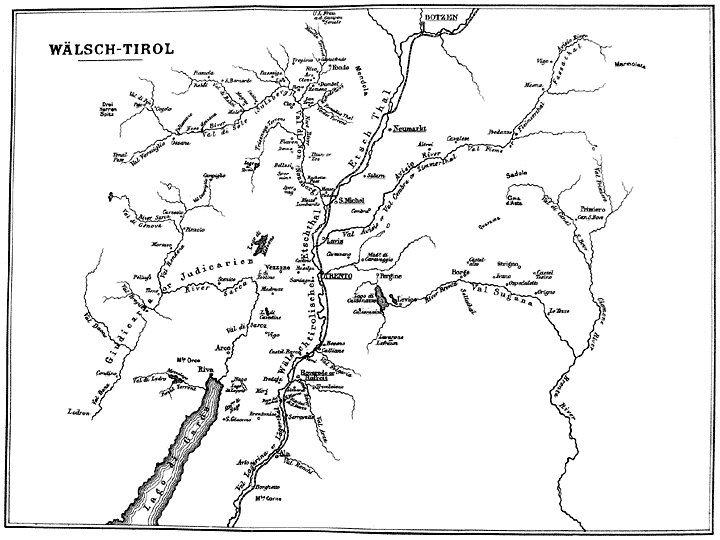
Wälsch-Tirol.
The traveller’s first acquaintance with the Wälschtirolische-Etschthal will probably, as in my own case, be made in the Val Lagarina, through which the railway of Upper Italy passes insensibly on to Tirolese soil, for you are allowed to get as far as Ala before the custom-house visitation reminds you that you have passed inside another government. It is a wild gorge along which you run, only less formidable than that which you saw so grimly close round you as you left Verona. If you could but lift that stony veil on your left, you would see the beautiful Garda-See sparkling beside you; but how vexatious soever the denial, the envious mountains interpose their stern steeps to conceal it. Their recesses conceal too, but to our less regret, the famous field of Rivoli.
Roveredo itself is crowned by a fort—Schloss Junk, or Castel nuovo—which has stood many a siege, originally built by the Venetians; but it is more distinguished by its villas and manufactories. The silk trade was introduced here in 1580, and has continuously added to the prosperity of the place. Gaetano Tacchi established relations with England at the end of the last century, and the four brothers of the same name, who now represent her house, are the richest family in Roveredo. They have a very pretty family vault near the Madonna del Monte, a pilgrimage reached by a road which starts behind the Pfarrkirche of Sta. Maria. Another pilgrimage church newly established is the Madonna de Saletto. While the silk factories occupy the Italian hands, the Germans resident in Roveredo find employment at a newly-established tobacco factory. Much tobacco is grown in the Trentino.
A great deal of activity is seen in Roveredo. The Corso nuovo is a broad handsome street with fine trees. A new and handsome road, between the town and railway station, was laid out in the autumn of 1869. Outside the town is the so-called Lenoschlucht, reached by the Strada nuova, which crosses it by a daring high arched bridge. The cliff rises sheer on the right hand, and overlooking the dangerous precipice is the little chapel of S. Columban, seemingly perched there by enchantment. It is built over the spot where a hermit, who was held in veneration by the neighbourhood, had his retreat.
There are seven churches, but not much to remark in any of them. That of S. Rocchus was built in consequence of a vow made by the townspeople during the plague of 1630, to invite a settlement of Franciscans if it was stayed. The altar-piece is ascribed to Giovanni da Udine. There are several educational establishments, and a club which is devoted to propagandism of Italian tendencies.
That their city was the see of S. Vigilius, and the seat of the great council of the Church, are reckoned by its people their greatest glories; and they delight to trace a parallel between their city and ‘great Rome.’ They reckon that it was founded in the time of Tarquinius Priscus by a colony of Etruscans, under a leader named Rhætius, who established there the worship of Neptune, whence the name of Tridentum or Trent. That they occupied and fortified the country, and subsequently became a power formidable to the Empire; but some twenty-five years before the Christian era, Rhætia, as the country round was called, was conquered by Drusus, son-in-law of Augustus, and colonized. An ancient inscription preserved in the Schloss Buon Consiglio shows that Trent was the centre of the local government, which was exactly modelled on that of Rome. S. Vigilius, who spread the light of the faith here, was a born Roman, and suffered martyrdom in a persecution emulating those of Rome in the year 400. The city endured sieges and over-running from many of the barbarous nations which over-ran and sacked Rome, and researches into the ancient foundations show that the accumulation of ruins has raised the soil, as in Rome, some feet above the original ground plan—Ranzi says more than four metres. The traces of three distinct lines of walls, showing just as in Rome the progressive enlargement of the city, have been found, as also remains of a considerable amphitheatre, and many of inlaid pavements, &c., showing that it was handsomely built and provided. To complete the parallel, it was under the régime of an ecclesiastical ruler that, after years of distress and turmoil, its peace and prosperity were restored. The Bishop of Trent still retains his title of Prince, but the deprivation of his territorial rule was one of the measures of secularization of Joseph II.
My limits forbid my speaking in much detail of the secular buildings and institutions which are, however, not unworthy of attention. There are clubs and reading-rooms—in some of which aspirations after union with Italy are steadily propagated. The spirit of loyalty to Austria, though still strong in many breasts, has nothing like the same influence as in 1848–9, or in 1866, when the attacks and blandishments of the revolutionists of Italy were alike powerless to shake the allegiance of the Trentiners. No one will overlook the vast Schloss buon Consiglio in the Piazza d’Armi, said to be an Etruscan foundation. The public museum is a very creditable institution, enriched in 1846 by the legacy of Count Giovanelli’s collection, chiefly of coins and medals; and paintings, not to be despised, are to be seen in the collections of the best families of the place—Palazzi Wolkenstein and Sizzo, Case Salvetti and Gaudenti. Two great ornaments of the city are the Palazzi Tabarelli, and Zambelli or Teufelspalast; and with the legend of the latter I must wind up my notice of Trent.
Georg Fugger, a scion of the wealthy Anthony Fugger, of Augsburg, the entertainer of Charles Quint, was deeply enamoured of the spirited Claudia Porticelli, the acknowledged beauty of Trent. Claudia did not appear at all averse from the match, but she was too proud to yield herself all too readily; and besides, was genuinely possessed with the spirit of patriotism, to which mountain folk are never wanting. Accordingly, when the reply long pressed for from her lips came at last, it informed him that never would Claudia Porticelli of Tirolean Trent give her hand to one whose dwelling was afar from her native city; she wondered, indeed, that one who did not own so much as a little house to call a home in Trent, should imagine he possessed her sympathies. To another this answer would have amounted to a refusal, for it only wanted a day of the time already fixed, of long date beforehand, for the announcement of her final choice. But Georg Fugger, whose vast riches had long nursed him in the belief that ‘money maketh man,’ and that nothing was denied to him, would not yield up a hope so dearly cherished as that of making Claudia Porticelli his wife. To his determined mind there was a way of doing everything a man was resolved to do. To build a house, however, in one night, and that a house worthy of being the home of his Claudia, when men should call her Claudia Fugger, was a serious matter indeed. No human hands could do the work, that was clear; he must have recourse to help from which a good Christian should shrink; but the case was desperate; he had no choice. Nevertheless, Georg Fugger had no mind to endanger his soul either. The game he had to play was to get the Evil One to build the house, but also to guard from letting him gain any spiritual advantage against him; and his indomitable energy devised the means of securing the one and preventing the other. Without loss of time the devil was summoned, and the task of building the desired palace propounded. The tempter willingly accepted the undertaking, on his usual condition of the surrender of the soul of him in whose favour it was performed. Georg Fugger cheerfully signed the bond with his blood, only stipulating first for the insertion of one slight condition on his side—namely, that the devil should do one little other thing for him before he claimed his terrible guerdon. ‘Whatever you like! it won’t be too hard for me!’ boasted the Evil One; and they separated, each well satisfied with the compact.
‘The Devil’s Palace has a splendid design, worthy the genius of Palladio,’ writes a modern traveller, who has only seen it in its decadence. On the night in which it was built, it was resplendent with marbles and gilding and tasteful decoration; furnished it was too, to satisfy the most fastidious taste, and the requirements of the most luxurious. With pride the devil called Georg Fugger to come and survey the lordly edifice, and name his ‘final condition.’ Georg Fugger was prepared for him; he had taken a bushel of corn, and strewn it over all the floors of the vast building. ‘Look here, Meister,’ he said. ‘If you can gather this corn up grain by grain, and deliver me back the whole number correctly, then indeed my soul will be yours; but if otherwise, my soul remains my own and the palace too. That is my final condition.’
The devil accepted the task readily, and with no misgiving of his success. True, it took all the time that remained before sunrise to collect all the scattered grain; still he had performed harder feats before that day. But the hours ran by, and still there were five grains wanting to complete the count; where could those five grains be! With a flaring torch, lighted at his fiercest fire, he searched every corner through and through, but the five grains were nowhere to be seen, and daylight began to appear! ‘Ah! the measure is well-heaped up, the Fugger won’t discover they are missing,’ so the fiend flattered himself. But Georg Fugger was keener than he seemed. Before his eyes he counted out the corn, and asked for the five missing grains. ‘Stuff! the measure is piled up full enough, I can’t be so particular as all that. The number must be there.’ ‘But it is not!’ urged Fugger. ‘Oh, you’ve miscounted,’ rejoined the Evil One; ‘I’m not going to be put off in that way. I’ve built your house, and I’ve collected your measure of corn, and your soul is mine; you can’t prove that there were five more grains.’ ‘Yes, I can,’ replied Fugger; ‘reach out me your paw;’ and the Devil, not guessing how he could convict him by that means, held out his great paw, with insolent confidence of manner. ‘There!’ cried Fugger, pointing to it as he spoke; ‘there, under your own claws, lie the five grains! That corn had been offered before the Holy Rood, and by the power of the five Sacred Wounds it was kept from fulfilling your fell purpose. You had not collected the full number of grains into the measure by the morning light, so our bargain is at an end. Begone!’ The Devil, self-convicted, had no refuge but to strive to alarm his victor by a show of fury, and with burning claw he began tearing down the wall so lately raised. But Fugger remained imperturbable, for he had fairly won the palace, and the Devil himself had no more power over it. He could only succeed in making a hole big enough for himself to escape by, which hole was for many and many years pointed out.
But Fugger had also hereby established his claim to Claudia’s hand, who rejoiced at the gentle violence thus done her; and many happy days they spent together in the Teufelspalast. In later years it passed from their family into the hands of Field-Marshal Gallas, who lived here in peaceful retirement after his renowned exploits in the Thirty Years’ War, whence it was long called Palazzo Gallas or Golassi; but it has lately again changed hands, and thus acquired the name of Palazzo Zambelli.
The only remaining towns of any note in the line of the Wälschtirolische Etschthal, are Lavis and S. Michel. Lavis is a pretty little well-built town (situated at the point where the torrents of the Cembra, Fleims, and Fassa valleys, under the name of the Avisio, are poured into the Etsch), remarkable for a red stone viaduct, nearly 3,000 feet long, near the railway station, over the Avisio. Lavis fell into possession of the French in 1796, when the church was burnt and the houses plundered. In 1841—forty-five years after—a French soldier sent a sum of one hundred gulden to the church, in reparation for having carried off a silver sanct-lamp for his share of the booty.
San Michel, or Wälsch Michel, is the boundary town against the circle of South Tirol, once the last town on Venetian territory. There are imposing remains here of a fine Augustinian priory, which originated in a castle given up to this object by Ulrich Count of Eppan in 1143; the building has of late years been sadly neglected; it is now a school of agriculture. A little way before Wälsch Michel, the railway crosses, for the first time since leaving Verona, to the left bank of the Adige, by a handsome bridge called by the people ‘the sechsmillionen Brücke.’ Here we leave the Etschthal for a time, but we shall renew acquaintance with it in its northern stretch when we come to visit South Tirol.
Cles, situated nearly at the northernmost reach of the valley, is a centre of the silk trade, and the factory-girls are remarkable for their tastefully adorned hair, though they all go barefooted. The site of a temple of Saturn, of considerable dimensions, has been found, coinciding with traditions of his worship having been popular here; and remains of an ancient civilization are continually dug up. There is a wild-looking plain outside the town, still called the Schwarzen Felder, or black fields, because tradition declares it to be the place where the Roman inhabitants burnt their dead. Here SS. Sisinius, Martyrius, and Alexander, are believed to have suffered death by fire on May 29, 397, because these zealous supporters and missionaries of St. Vigilius refused to take part in a heathen festival. St. Vigilius no sooner heard of their steadfast witnessing to the truth, than he repaired to the spot, and after zealously collecting and venerating their remains, preached so powerfully on their holy example, that great numbers were converted by his word. A church was shortly after built here, and being the first in the neighbourhood, was called Eccelesia, whence the name of Cles. The devout spirit of these saintly guides does not seem wanting to the present inhabitants; when the jubilee was held on occasion of the Vatican Council, more than two thousand persons went to Communion. At the not far distant village of Livo, on the same occasion, it was found necessary to erect a temporary building to supplement the large parish church, for the numbers who flocked in from the outlying parishes. The same thing occurred when the faithful were invited to join in prayers for the Pope after the Piedmontese invasion of Rome, September 20, 1870.
On these ‘Campi neri’ was found, in the spring of 1869, a tablet since known as the ‘Tavola Clesiana.’ It is a thickish bronze tablet, about 18 in. by 13 in., with holes showing where it was attached to a wall by the corners. It bears an inscription in Roman character, the graving of which is quite distinct and unworn, as if newly executed. It is as follows, and has given rise to a great deal of controversy among archæologists, and between Professors Vallaury and Mommsen, concerning its bearing on the early history of Annaunia:—
Miunio . sIlano . q . sulpicio . camerino . CoS idibus . martIs . baIs . in . praetorio . edictum . ti . claudi . caesaris . augusti . germanici . propositum . fuit . id . quod . infra . scriptum . est . ti . claudius . caesar . augustus . germanicus . pont . maxim . trib . potest . VI . imp . XI . P . P . cos . designatus . IIII . dicit . cum . ex . veteribus . controversIs . petentibus . aliquamdiu . etiam . temporibus . ti . caesaris . patrui . meI . ad . quas . ordinandas . pinarium . apollinarem . miserat . quae . tantum . modo . inter . comenses . essent . quantum . memoria . refero . et . bergaleos . is que . primum . apsentia . pertinaci . patrui . meI . deinde . etiam . gaI . principatu . quod . ab . eo . non . exigebatur . referre . non . stulte . quidem . neglexerit . et . posteac . detulerit . camurius . statutus . ad . me . agros . plerosque . et . saltus . meI . iuris . esse . in . rem . praesentem . mIsi . plantam . iulium . amicum . et . comitem . meum . qui . cum . adhibitis . procuratoribus . meis . quisque . in . alia . regione . quique . in . vicinia . erant . summa . cura . inquisierit . et . cognoverit . cetera . quidem . ut . michi . demonstrata . commentario . facto . ab . ipso . sunt . statuat . pronuntietque . ipsi . permitto . Quod . ad . condicionem . anaunorum . et . tulliassium . et . sindunorum . pertinet . quorum . partem . delator . adtributam . tridentinis . partem . neadtributam . quidem . arguisse . dicitur . tam . et . si . animaduerto . nonnimium . firmam . id . genus . hominum . habere . civitatis . romanae . originem . tamen . cum . longa . usurpatione . in . possessionem . eius . fuisse . dicatur . et . ita . permixtum . cum . tridentinis . ut . diduci . ab . Is . sine . gravi . splendi . municipI . iniuria . non . possit . patior . eos . in . eo . iure in . quo . esse . existimaverunt . permanere . beneficio . meo . eo . quidem . libentius . quod . plerisque . ex . eo . genere . hominum . etiam . militare . in . praetorio . meo . dicuntur . quidam . vero . ordines . quoque . duxisse . nonnulli . collecti . in . decurias . romae . res . iudicare . Quod . beneficium . Is . ita . tribuo . ut . quaecumque . tanquam . cives . romani . gesserunt . egeruntque . aut . inter . se . aut . cum . tridentinis . alIsve . ratam . esse . iubeat . nominaque . ea . que . habuerunt . antea . tanquam . cives . romani . ita . habere . Is . permittam .
A fragment of an altar was found at the same time, with the following words on it:—
SATURNO SACR L. PAPIRIUS L OPUS
Livo is the first village of the Val di Sole, which runs in a south-westerly direction, forming nearly a right-angle with the Val di Non, than which it is wilder, and colder, and less inhabited. At Magras the Val di Rabbi strikes off to the north. Its baths are much frequented, and S. Bernardo is hence provided with four or five capacious hotels. A new church has just been built there, circular in form, with three altars, one of which is dedicated in honour of St. Charles Borromeo, who visited the place in 1583, and preached with so much fervour as effectually to arrest the Zuinglian teaching, which had lately been imported.
Male is the chief place of Val di Sole, and contains about 1,500 inhabitants. At a retreat held here last Christmas by the Dean of Cles, so many of them as well as of the circumjacent hamlets were attracted, that not less than 3,000 went to communion. Further along the valley is Mezzana, the birthplace of Antonio Maturi, who, after serving in the campaigns of Prince Eugene, entered a Franciscan convent at Trent, whence he was sent as a missionary to Constantinople, and was made Bishop of Syra, and afterwards was employed as nuncio by Benedict XIV. It was almost entirely destroyed by fire a few years ago, but is being rapidly rebuilt. After this place the country becomes more smiling, and cheerful cottages are seen by the wayside, with an occasional edifice, whose solid stone-built walls suggest that it is the residence of some substantial proprietor. The valley widens out to a plain at Pellizano, round which lofty mountains rise on every side. The church here has a most singular fresco on the exterior wall, which is intended to record the circumstance that Charles Quint passed through in 1515. Some restoration or addition was made to the church at his expense, and a quaint inscription hints that he did it somewhat grudgingly.
The spot has never ceased to be honoured since the death of the saint, somewhere about 398. It is strange to stand between the walls of the living mountain and realize the fact. There are few shrines in all Europe which can boast of such antiquity, such unbroken tradition, and such exemption from desecration. The building is as singular and characteristic as the locality. The chapel, where the saint’s remains rest, and where he himself raised the first sanctuary of the Nonsthal, is reached by one hundred and twenty-two steps, necessarily very steep; and on attaining the last, it must be a very steady head that can turn to survey the rise without giddiness. The interior is quite in keeping with the surroundings. Its light is dim and subdued, sufficient only to reveal the countless trophies of answered prayer which cover the dark red marble columns and enrichments. There are two other chapels at lower levels, one of the Blessed Sacrament, called del Santissimo, and one over the hermitage in the rock. Flanking this curious pile of chapels on chapels are, on one side, the priory or residence of the chaplain of the place, and on the other the Hospice for pilgrims and visitors, the whole forming a considerable corps de bâtiment, and enclosed by a wall which seems to have grown out of the rock. Another little crag, jutting up as if in emulation of that so gloriously crowned, was made into a Gottesacker, by a late prior, and its churchyard cross affords it a striking termination too; though not many monuments of the dead bristle from its sides as yet. This singularly interesting excursion may be made direct from S. Michel by those who have not time for visiting the whole valley. They will pass several striking old castles, particularly that of Thun, nearly opposite Castle Bellasi, the Stammschloss of one of the oldest and noblest German families, founded by one of the dearest companions and patrons of St. Vigilius. No other has given so many distinguished scions to the service of the Church; Sigmund von Thun was the representative of the Emperor at the Council of Trent. There is a strong attachment between it and the people of the valley, who delight in celebrating every domestic event by what they call a Nonesade, or poem in the dialect of the Val di Non. The castle is well kept up; the interior is characteristically decorated and arranged, and many curiosities are preserved in the library; its grounds also are charmingly laid out. It is supplied with water by a noble aqueduct, raised in 1548, right across the valley from Berg St. Peter; crowned also by an ancient castle, but in ruins. Few will have a prettier page in their sketch-book than they can supply it with here.
Half way between Sanzeno and Fondo, by a path which forms a loop with that already mentioned, by Cloz and Arz, and just where the opening into the Romediusthal strikes off, is a village named Dambel or Dambl, where a very curious relic of antiquity, and an important one for throwing light on the history of the earlier inhabitants of the valley, was unearthed a couple of years ago. It is a stout, handsome bronze key, 14½ in. long, the bow ornamented with scroll-work, which at first sight suggested the idea that it had formed part of a comparatively modern casting of the Pontifical arms. Closer inspection showed that on an octagonal ornament of the upper part of the stem was an inscription, not merely engraved, but deeply cut (it is thought with a chisel), and in perfect preservation, in characters described by a local antiquary as ‘parte Runiche, parte Gotiche, del Greco e Latino del 388 dell’ era volgare, descritte da Ufila; ma molte somigliano a quelle del Latino dell’ Ionio 741 B. C.’
It would be curious to know how Mr. Isaac Taylor would read the inscription by his different method, for Padre Tarquini found a curious coincidence of circumstances to afford an interpretation to his translation. It would seem that it was only after translating it as above that his attention was called to the Christian local tradition, and then he was struck with several points of contact between it and them. 1. The date which he had already assigned to the key is that given by the Bollandists to the martyrdom of St. Alexander and his two brothers. 2. It was found within the very precincts where he was said to have been burnt, and (his translation of) the inscription commemorates a human burnt sacrifice (il vivicomburio). 3. The inscription (by his translation) seems to allude to Christians, to their suffering expressly for propagating their religion. 4. The inscription points to the sacrifice having taken place in an elevated situation, as it uses the verb ‘to ascend,’ and the contemporary narrative of St. Vigilius to St. Chrysostom of the event, as it had happened before his eyes, says ‘Itum est post hæc in religiosa fastigia, hoc est altum Dei templum ... in conspectu Saturni.’ He further goes on to approve a conjecture of the local antiquary that the key was a votive offering made on occasion of the martyrdom of St. Alexander with SS. Zeno and Martyrius, in thanksgiving for the triumph over their teaching, and inscribed with the above lines as a perpetual warning to their followers.
The Avisiothal—the northernmost eastern tributary of the Etschthal—consists of three valleys running into each other; the Val di Cembra, or Zimmerthal; the Val Fieme, or Fleimserthal; and the Val di Fassa, or Evasthal. The Val di Cembra is throughout impracticable for all wheeled traffic. Nature has made various rents and ledges in its porphyry sides, of which hardy settlers have taken advantage for planting their villages, and for climbing from one to another; but even their laborious energy has not sufficed to make roads over such a surface. This difficulty of access has not been without its effect in tending to keep up the honesty, hospitality, and piety of the people; but as few will be able to penetrate their recesses, their characteristics will be better sacrificed to the exigencies of space than those of others. I will only mention, therefore, the Church of Cembra, the Hauptort (about four hours’ rugged walk from Lavis), which is an ancient Gothic structure well kept up, and adorned with paintings; and a peculiar festival which was celebrated on the Assumption-day, 1870, at Altrei, namely, the presentation of new colours to the Schiess-stand, by Karl von Hofer, on behalf of the Empress of Austria. One bears a Madonna, designed by Jele of Innsbruck, on a banner of green and white (the national colours); the other the names of the Empress (‘Karolina Augusta’) and the word ‘All-treu,’ the original name of the village, conferred on it by Henry Duke of Bohemia, when he permitted ten faithful soldiers to make a settlement here free of all taxes and customs. And yet the Italians, regardless of derivations, have made of it Anterivo.
The Fassathal begins just after Moena. One of its wildest legends is that of the feuriger Verräther. It dates from the time of the Roman invasion. The mountain-dwellers appear to have been as zealous defenders of their native fastnesses then as in later times, and it is said the conquering legions were long wandering round the confines without finding any who would lead them into the interior of the country. It was at last an inhabitant of the Fassathal who betrayed the narrow pass which was the key to their defences, and which cost the liberty of the nation—all for the sake of the proffered blood-money. But he was never suffered to enjoy it; for a flash like lightning, though under a clear sky, struck him to the earth, and ever since, the traitor has been to be met by night wrapt in flames, and howling piteously.
The Avisio was once the boundary against Venetian territory; and St. Ulrich dying on its banks, on his return from Rome, exacted of his disciples a promise that they would carry his body across, so that he might find his final rest on German soil.