Front matter
Reading edition
Cambridge University Press Fetter Lane, London
Bombay, Calcutta, Madras Toronto Macmillan
Tokyo Maruzen Company, Ltd
Copyrighted in the United States of America by the Macmillan Company
All rights reserved
Lowell Observatory
The Discovery of Pluto
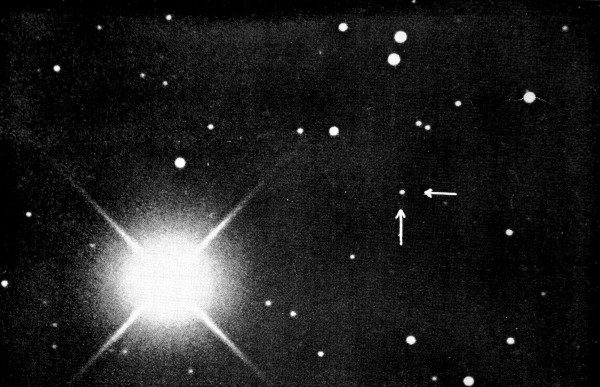
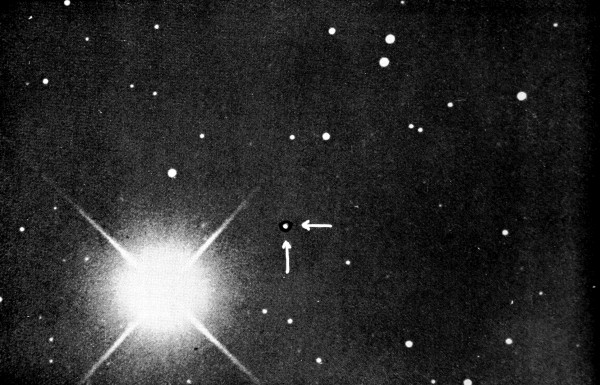
The two photographs were taken at the Lowell Observatory on the nights of March 2 and 5, 1930. The object indicated by arrows was seen to have moved considerably in the interval, and this proved that it was of planetary character.
The bright object in the bottom left-hand corner is the star δ Geminorum (see p. 260).
THE UNIVERSE AROUND US
By SIR JAMES JEANS M.A., D.Sc., Sc.D. LL.D., F.R.S.

CAMBRIDGE AT THE UNIVERSITY PRESS
1930
First Edition, September 1929 Reprinted November 1929 ” January 1930 Second Edition, October 1930
PRINTED IN GREAT BRITAIN
PREFACE
The present book contains a brief account, written in simple language, of the methods and results of modern astronomical research, both observational and theoretical. Special attention has been given to problems of cosmogony and evolution, and to the general structure of the universe. My ideal, perhaps never wholly attainable, has been that of making the entire book intelligible to readers with no special scientific knowledge.
Parts of the book cover the same ground as various lectures I have recently delivered to University and other audiences, including a course of wireless talks I gave last autumn. It has been found necessary to re-write these almost in their entirety, so that very few sentences remain in their original form, but those who have asked me to publish my lectures and wireless talks will find the substance of them in the present book.
J. H. JEANS
DORKING 1 May 1929
PREFACE TO SECOND EDITION
In preparing a second edition, I have taken advantage of a great number of suggestions made by correspondents and reviewers, to whom I offer my sincerest thanks. I have also inserted discussions of the new planet Pluto, the rotation of the galaxy, the apparent expansion of the universe, and other subjects which have become important since the first edition was published, and in general have tried to bring the book up to date.
J. H. JEANS
DORKING 2 August 1930
CONTENTS
PAGE
Introduction—The Study of Astronomy 1
Chapter I Exploring the Sky 16
II Exploring the Atom 92
III Exploring in Time 150
IV Carving out the Universe 194
V Stars 253
VI Beginnings and Endings 325
Index 355
PLATES
The Discovery of Pluto FRONTISPIECE
PLATE FACING PAGE
I The Milky Way in the neighbourhood
of the Southern Cross 23
II Planetary Nebulae:
1. N.G.C. 2022
2. N.G.C. 6720 (The Ring Nebula)
3. N.G.C. 1501
4. N.G.C. 7662 28
III The Nebula in Cygnus 29
IV The Great Nebula M 31 in Andromeda 30
V The Nebula N.G.C. 891 in Andromeda
seen edge-on 31
VI The “Horse’s Head” in the Great Nebula
in Orion 37
VII The Trifid Nebula M 20 in Sagittarius 44
VIII Stellar Spectra 51
IX The Globular Cluster M 13 in Hercules 63
X The Region of ρ Ophiuchi 65
XI Magnification of part of the outer regions
of the Great Nebula M 31 in Andromeda 70
XII Magnification of the central region of the
Great Nebula M 31 in Andromeda 71
XIII The tracks of α- and β-particles 113
XIV Collisions of α-particles with Atoms 117
XV The Nebula N.G.C. 4594 in Virgo
The Nebula N.G.C. 7217 204
XVI A sequence of Nebular Configurations:
1. N.G.C. 3379
2. N.G.C. 4621
3. N.G.C. 3115
4. N.G.C. 4594 in Virgo
5. N.G.C. 4565 in Berenice’s hair 207
XVII The “Whirlpool” Nebula M 51 in
Canes Venatici 210
XVIII The Nebula M 81 in Ursa Major 211
XIX The Nebula M 101 in Ursa Major 212
XX The Nebula M 33 in Triangulum 213
XXI The Lesser and Greater Magellanic Clouds 214
XXII Two Nebulae (N.G.C. 4395, 4401)
suggestive of Tidal Action 236
XXIII The twin Nebulae N.G.C. 4567-8
The Nebula N.G.C. 7479 237
XXIV Saturn and its System of Rings 250