Chapter IV · Carving out the Universe (continued 2)
Reading edition
In 1850 Roche gave a mathematical investigation of this process of tidal break-up. His discussion dealt only with solid or liquid bodies, but the underlying mechanism is the same whether the bodies are solid, liquid or gaseous. We have seen that the smaller of the two bodies involved in a tidal encounter suffers the most. Roche dealt only with the case in which one body was very small in comparison with the other; in such a case the small body was completely broken up, while the larger one remained unscathed. Roche imagined the small body to describe an orbit of gradually decreasing size around the big body. If the two bodies were of equal density, he calculated that the small body would be broken up as soon as the radius of its orbit fell to 2·45 times the radius of the large body. If the bodies are of different density the matter is slightly more complicated. We must imagine the larger body to expand or contract until it has the same average density as the smaller body; the critical distance is then 2·45 radii of the larger body in its imaginary expanded or contracted state.
This distance is generally known as Roche’s limit. A satellite can with safety describe a circular orbit about its primary so long as this orbit lies beyond Roche’s limit, but it is broken into fragments as soon as it trespasses within the limit. The following figures confirm Roche’s mathematical analysis:
Radius of Saturn’s outermost ring 2·30 radii of Saturn
Roche’s limit 2·45 radii of primary
Radius of orbit of Saturn’s 3·11 radii of Saturn
innermost satellite
Radius of orbit of Jupiter’s 2·54 radii of Jupiter
innermost satellite
Radius of orbit of Mars’ 2·79 radii of Mars
innermost satellite
At the same time they suggest very forcibly that Saturn’s rings are the broken-up fragments of a former satellite which ventured into the danger-zone marked out by Roche’s limit. We have seen how our own moon is destined in time to contract its orbit, until it is finally drawn within the Roche’s limit surrounding the earth and broken into fragments. After this the earth will have no moon, but will be surrounded by rings like Saturn.
We speak of Saturn’s rings in the plural, because two distinct circular gaps cause an appearance of three detached rings. There is a tendency to jump to the hasty inference that the rings are the shattered remains of three distinct satellites, but it is not so. Goldsbrough has shewn how certain orbits around Saturn are rendered unstable by the motions of the larger satellites of Saturn, so that no particle could permanently remain in such an orbit. He has calculated positions for these unstable orbits, and these are found to agree exactly with the positions of the observed divisions between the rings. Thus Saturn’s rings were in all probability produced by the breakage of a single satellite. The ring of small satellites which our moon will ultimately form round the earth will contain no divisions, because the earth has no other moons to render certain orbits unstable.
PLATE XXIV
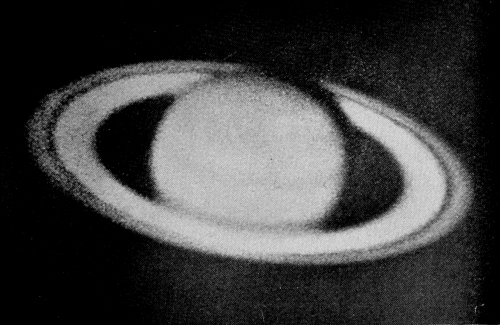
Saturn in 1916
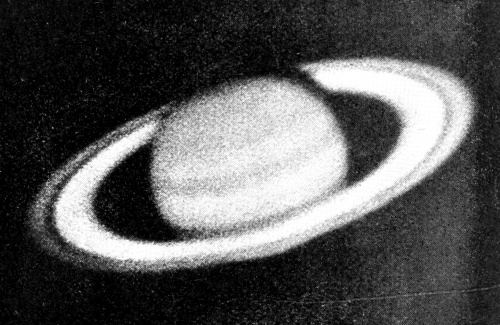
Saturn in 1917
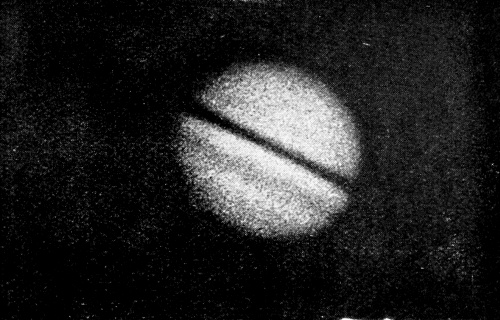
Lowell Observatory
Saturn in 1921
Saturn and its System of Rings
Roche’s fundamental idea can be extended in many directions and admits of varied applications. There must, for instance, be a danger-zone, marked off by a Roche’s limit, surrounding the sun. The distance of this danger-zone from the sun depends on the density of the body for which it is dangerous (p. 249). For a body having the low density of a comet the distance will be very great indeed. Whatever the distances of their danger-zones, comets must occasionally pass through them and become broken up in so doing. Two comets, Biela’s comet (1846) and Taylor’s comet (1916), were observed actually to break in two while at about the earth’s distance from the sun, and in 1882 a comet was seen to divide into four parts. Biela’s comet returned in due course (1852) in the form of two distinct comets a million and a half miles apart, since which time neither part of the original comet has been seen again. The orbit of this comet was identical with that of the Andromedid meteors, which make a display of shooting-stars in the earth’s atmosphere on favourable 27ths of November, so that it is likely that these shooting-stars are the broken remains of Biela’s comet. Other conspicuous swarms of shooting-stars also move in the tracks of comets—the Leonids which used to make a magnificent show every 33 years move in the track of Comet 1866 I, the Perseids in the track of another Comet (1862 II), and the Aquarids in the track of Halley’s famous comet. In each case, there can be little doubt that the shooting-stars are scattered fragments of the comets. Besides this there are several families of comets whose members follow one another round and round in the same orbit, as though they had originally formed a single mass.
In the same way a Roche’s limit must surround the planet Jupiter, so that comets and other bodies may be broken up through getting inside the danger-zone marked off by this limit. Jupiter’s innermost satellite is already perilously near it. But the greatest interest of this particular danger-zone is that it probably accounts for the existence of the asteroids. In the early days of the solar system, when the orbits of the planets were less nearly circular than they now are, a primaeval planet between Mars and Jupiter may well have described an orbit so elongated as to take it repeatedly within the danger-zone of Jupiter. If so, we need look no further for the origin of the asteroids. It is significant that the average orbit of all the asteroids agrees almost exactly with that of the planet which Bode’s law (p. 19) would require to exist between Mars and Jupiter.