VI THE TREATY WITH TURKEY (continued 2)
Reading edition
As we had entered into a parley with Mustafa Kemal openly and officially and signed an armistice with him, it seemed likely we meant to pursue a policy that might bring about a local and provisional agreement with the Nationalists, and perhaps a definite agreement later on. If such an armistice was not concluded, a rupture was to be feared on either side later on, in which case the condition of things would remain as intricate as before, or military operations would be resumed in worse conditions than before for both parties. In short, after treating with Mustafa Kemal it was difficult to ignore him in the general settlement that was to ensue.
But no broad view had ever dominated the Allies’ policy since they had signed the armistice with Turkey in October, 1918. Eastern affairs had never been carefully sifted or clearly understood; so the Allies’ action had been badly started. Conflicting ambitions had led them in a confused way. The policy of England especially, which had proved harsh and grasping, and also highly dangerous, was at the bottom of the difficulties the Allies had experienced in the East. So France, where public opinion and popular feeling were opposed to any Eastern adventure or any action against Turkey, could not be called upon to maintain troops in the East or to fight there alone for the benefit of others. The operations that were being contemplated in the East would have necessarily required an important army, and if adequate credits had been asked for them, a loud protest would have been raised—though later on the French Chamber granted large sums of money for Syria, after a superficial debate, not fully realising what would be the consequence of the vote.
M. d’Estournelles de Constant, a member of the Senate, wrote to the French Prime Minister on May 25 that, “after asking the Government most guardedly—for months in the Foreign Affairs Committee and the day before in the Senate—to give information about the mysterious military operations that had been carried on for a year and a half in Asia Minor and towards Mesopotamia,” he found it necessary to start a debate in the Senate upon the following question: “What are our armies doing in Cilicia?”29
Meanwhile the Supreme Council urged the Turkish delegation to sign the treaty that had been submitted for its approval, and the Allies were going to negotiate with the representatives of a Government which, on the whole, was no longer acknowledged by the country. Of what value might be the signature wrested by the Allies from these representatives, and how could the stipulations of that treaty be carried out by the Turks? Most of its clauses raised internal difficulties in Turkey, and such a confusion ensued that the members of the delegation did not seem to agree any longer with the members of the Ottoman Cabinet, and at a certain time even the latter seemed unable to accept the treaty, in spite of the pressure brought to bear on the Ottoman Government by the English troops of occupation.
Mustafa Kemal’s Nationalist forces conquered not only the whole of Asia Minor, but also all the Asiatic coast and the islands of the Marmora, except Ismid, which was still held by British posts. The Turkish Nationalists soon after captured Marmora Island, which commanded the sea route between Gallipoli and Constantinople.
On June 16 the British forces engaged the Kemalist troops in the Ismid area. About thirty Indian soldiers were wounded and an officer of the Intelligence Department was taken prisoner by the Turks. The civilians evacuated Ismid, and it was hinted that the garrison would do the same. Mustafa Kemal’s aeroplanes dropped bombs on the town, and the railway line between Ismid and Hereke was cut by the Nationalists. The British forces on the southern coast of the Dardanelles withdrew towards Shanak, whose fortifications were being hurriedly repaired.
Mustafa Kemal’s plan seemed to be to dispose his forces so as not to be outflanked, and be able to threaten Smyrna later on. To this end, the Nationalist forces advanced along the English sector toward the heights of Shamlija, on the Asiatic coast of the Bosphorus, from which point they could bombard Constantinople.
After a long interview with the Sultan, which lasted two hours, on June 11, the Grand Vizier Damad Ferid Pasha, owing to the difficulty of communicating between Paris and Constantinople, and the necessity of co-ordinating the draft of the answer worked out by the Ottoman Government and the reports drawn up by the various commissions with the answer recommended by the delegation, set off to Paris the next day. So it seemed likely that Turkey would ask for further time before giving her answer.
It could already be foreseen that in her answer Turkey would protest against the clauses of the treaty concerning Thrace and Smyrna, against the blow struck at the sovereignty of the Sultan by the internationalisation of the Bosphorus and the Dardanelles, as thus the Sultan could no longer leave his capital and go freely to Asia Minor, and, lastly, against the clauses restoring the privileges of the Capitulations to the States that enjoyed them before the war.
Turkey also intended to ask that the Sultan should keep his religious rights as Caliph over the Mussulmans detached from the Empire, and that a clause should be embodied in the treaty maintaining the guarantee in regard to the interior loan raised during the war, for otherwise a great many subscribers would be ruined and the organisation of the property of the orphans would be jeopardised.
At the beginning of the second week of June it was rumoured that the treaty might be substantially amended in favour of Turkey.30 Perhaps Great Britain, seeing how things stood in the East, and that her policy in Asia Minor raised serious difficulties, felt it necessary to alter her attitude with regard to Turkish Nationalism which, supported by the Bolshevists, was getting more and more dangerous in Persia. For Mr. Lloyd George, who has always allowed himself to be led by the trend of events, and whose policy had lately been strongly influenced by the Bolshevists, had now altered his mind, as he often does, and seemed now inclined, owing to the failure of his advances to the Soviet Government, to modify his attitude towards Constantinople—after having exasperated Turkish Nationalism. The debate that was to take place on June 15 in the House of Lords as to what charges and responsibilities England had assumed in Mesopotamia, was postponed—which meant much; and the difficulties just met with by the British in the Upper Valley of the Tigris and the Euphrates in their struggle with the Arabs convinced them of the advisability of a revision of the British policy towards both the Arabs and the Turks.
On the other hand, it did not seem unlikely that M. Venizelos, who was being expected in London, might have seen the mistake the Supreme Council had made when it had granted the Greek claims so fully, and that the apprehension he was entitled to feel about the reality of the huge advantages obtained by Greece might have a salutary influence on him. Yet nothing of the kind happened, and in a long letter to the Daily Telegraph (June 18) he asserted not only the rights of Greece to Smyrna, but his determination to have them respected and to prevent the revision of the treaty.
M. Venizelos, “the great victor of the war in the East,” as he was called in London, even supported his claims by drawing public attention to the intrigues carried on by Constantine’s supporters to restore him to the throne. He maintained that the revision of the treaty would second the efforts which were then being made in Athens by the old party of the Crown, which, he said, was bound to triumph if Greece was deprived of the fruits of her victory and if the Allies did not redeem their pledges towards her. But then it became obvious that the Greeks did not despise Constantine so much after all, and their present attitude could not in any way be looked upon as disinterested.
It might have been expected, on the other hand, that Count Sforza, who had been High Commissioner in Constantinople, where he had won warm sympathies, would maintain the friendly policy pursued by Italy since the armistice towards Turkey—that is to say, he would urge that the time had come to revise the treaty of peace with Turkey which, since it had been drawn up at San Remo, had constantly been opposed by the Italian Press. All the parties shared this view, even the clerical party, and one of its members in the Chamber, M. Vassalo, who had just come back from Turkey, energetically maintained it was impossible to suppress the Ottoman Empire without setting on fire the whole of Asia. The Congress of the Popular Party in Naples held the same opinion. Recent events also induced Italy to preserve the cautious attitude she had assumed in Eastern affairs since the armistice, and she naturally aimed at counterbalancing the supremacy that England, if she once ruled over Constantinople and controlled Greater Greece, would enjoy over not only the western part, but the whole, of the Mediterranean Sea.
Henceforth it was obvious that the chief stipulations of the treaty that was to be enforced on Turkey were doomed to failure, and it was asked with no little anxiety whether the Powers would be wise enough to take facts into account and reconsider their decisions accordingly, or maintain them and thus pave the way to numerous conflicts and fresh difficulties. Indeed, the outcome of the arrangements they had laboriously elaborated was that things in the East had become more intricate and critical than before. No State wished to assume the task of organising the Armenian State: the American Senate flatly refused; Mr. Bonar Law formally declared in the House of Commons that England had already too many responsibilities; France did not see why she should take charge of it; Italy accepted no mandate in Asia Minor. Syria, on the other hand, protested against its dismemberment. Mesopotamia was rising against the English at the very time when the Ottoman Nationalists entered an indignant protest against the cession of Smyrna and Thrace to Greece.
It was to be wished, therefore, from every point of view that not only some articles of the treaty presented to the Turks, but the whole document, should be remodelled, and more regard should be paid to the lawful rights of the Ottoman Empire, a change which could only serve French interests.
But though reason and her interest urged France to maintain the Ottoman Empire—which she attempted to do to some extent—she allowed herself to be driven in a contrary direction by England, who thought she could take advantage of the perturbation caused by the war within the Turkish Empire to dismember it—not realising that this undertaking went against her own Asiatic interests, which were already seriously endangered. Such a submission to the English policy was all the more to be regretted as Mr. Lloyd George had but grudgingly supported the French policy with regard to Germany, and after the San Remo conversations it seemed that France would have to consent to heavy sacrifices in the East in return for the semi-approbation he had finally granted her. This policy of England well might surprise the French—who have always reverenced the British parliamentary system; for the so-styled imperialist policy of Queen Victoria or King Edward, though it has been violently criticised, had really kept up the old traditions of British Liberalism, and had nothing in common with the greed and cool selfishness of such demagogues and would-be advanced minds as Mr. Lloyd George, who stands forth before the masses as the enemy of every imperialism and the champion of the freedom of peoples. But the former leaders of English foreign policy were not constantly influenced by their own political interests; they knew something of men and countries; and they had long been thoroughly acquainted with the ways of diplomacy. Both in England and France, everyone should now acknowledge their fair-mindedness, and pay homage alike to their wisdom and perspicacity.
Many people in France now wondered with some reason what the 80,000 French soldiers round Beyrut were doing—whether it was to carry out the expedition that had long been contemplated against Damascus, or to launch into an adventure in Cilicia.
M. d’Estournelles de Constant, who had first wished to start a debate in the French Chamber on the military operations in Syria and Cilicia, addressed the following letter, after the information given by M. Millerand before the Commission of Foreign Affairs, to M. de Selves, chairman of this Commission:
“I feel bound to let the Commission know for what reasons I have determined not to give up, but merely postpone the debate I wanted to start in the Chamber concerning our military operations in Syria and Cilicia.
“The Premier has given as much consideration as he could to the anxieties we had expressed before him. He has inherited a situation he is not responsible for, and seems to do his best to prevent France from falling into the dreadful chasm we had pointed out to him. We must help him in his most intricate endeavours, for France is not the only nation that has to grapple with the perilous Eastern problem. She must work hand in hand with her allies to avert this peril. The whole world is threatened by it. Our Allies should understand that the interest of France is closely connected with their interests. France guards the Rhine; she is practically responsible for the execution of the treaty with Germany.
“How can she perform such a task, together with the administration of Alsace and Lorraine and the restoration of her provinces laid waste by the Germans, if she is to scatter her effort and her reduced resources both in Europe and all her large colonial empire and in Asia Minor among peoples who have long welcomed her friendship, but abhor any domination?
“France would do the world an immense service by openly reverting to the war aims proclaimed by herself and her allies. Far from endangering, she would thus strengthen her traditional influence in the East; she would thus do more than by risky military operations to smother the ambitions and rebellions that might set on fire again the Balkan States, Anatolia, and even Mesopotamia.
“After five years of sacrifices that have brought us victory, to start on a would-be crusade against the Arabs and Turks in a remote country, in the middle of summer, would imply for France as well as for England, Italy, Greece, and Serbia, the beginning of a new war that might last for ever, to the benefit of anarchy.
“At any rate I ask that the intended treaty of peace with Turkey, which has not been signed yet, should not be presented to the French Parliament as an irremediable fact.”
After a long debate on Eastern affairs and on the questions raised by M. Millerand’s communications, the Commission for Foreign Affairs, seeing things were taking a bad turn, and the situation of France in Syria, Cilicia, and Constantinople was getting alarming, decided on June 15 to send a delegation to the East to make an inquiry on the spot.
At the first sitting of the French Chamber on June 25, 1920, M. Briand, who three months before had made a speech in favour of the 1916 agreements which were being threatened by English ambition, though he considered the Turkish bands “went too far,” and our policy “played too much into their hands,” felt it incumbent on him to say:
“When we leave a nation like Turkey, after a long war, for over a year, under what might be called a Scotch douche, telling her now ‘Thou shalt live,’ now ‘Thou shalt not live,’ we strain its nerves to the extreme, we create within it a patriotic excitement, a patriotic exasperation, which now becomes manifest in the shape of armed bands. We call them bands of robbers; in our own country we should call them ‘bands of patriots.’”
In the course of the general discussion of the Budget, during a debate which took place on July 28 in the Senate, an amendment was brought in by M. Victor Bérard and some of his colleagues calling for a reduction of 30 million francs on the sums asked for by the Government, which already amounted, as a beginning, to 185 million francs.
M. d’Estournelles de Constant then expressed his fear that this Eastern expedition might cause France to make sacrifices out of proportion to her resources in men and money, and asked how the Government expected to recuperate the expenditure incurred in Syria.
M. Victor Bérard, in his turn, sharply criticised our Eastern policy.
M. Bompard, too, expressed his fears concerning our Syrian policy, and M. Doumergue asked the Government to consent to a reduction of the credits “to show it intended to act cautiously in Syria.”
But after M. Millerand’s energetic answer, and after M. Doumer, chairman of the Commission, had called upon the Senate to accept the figures proposed by the Government and the Commission, these figures were adopted by 205 votes against 84.
M. Romanos, interviewed by the Matin,31 and soon after M. Venizelos, at the Lympne Conference, maintained that the treaty could be fully carried out, and the Greeks felt quite able to enforce it themselves.
As the Allied troops were not sufficient to take decisive action, and as a large part of the Ottoman Empire had been assigned to Greece, England herself soon asked why the latter should not be called upon to pay for the operation if she insisted upon carrying it out.
About June 20 the situation of the British troops became rather serious, as General Milne did not seem to have foreseen the events and was certainly unable to control them.
The Nationalist troops, which met with but little resistance, continued to gain ground, and after marching past Ismid occupied Guebze. The Government forces were retreating towards Alemdagh.
By this time the Nationalists occupied the whole of Anatolia, and the English held but a few square miles near the Dardanelles. The Nationalists, who had easy access to both coasts of the Gulf of Ismid, attempted to blow up the bridges on the Haïdar-Pasha-Ismid railway line. Though the English were on the lookout, four Turkish aeroplanes started from the park of Maltepe, bound for Anatolia. One of them was piloted by the famous Fazil Bey, who had attacked English aeroplanes during their last flight over Constantinople a few days before the armistice in October, 1918.
Indeed, the Government forces only consisted of 15,000 specialised soldiers, artillerymen or engineers, with 6 light batteries of 77 guns and 2 Skoda batteries; in addition to which 20,000 rifles had been given to local recruits. The Nationalists, on the contrary, opposed them with 35,000 well-equipped men commanded by trained officers. Besides, there was but little unity of command among the Government forces. Anzavour Pasha, who had been sent with some cavalry, had refused to submit to headquarters, and at the last moment, when ordered to outflank the enemy and thus protect the retreat of the Government forces, he had flatly refused to do so, declaring he was not going to be ordered about by anybody.
So, considering how critical the situation of the British troops was in the zone of the Straits, England immediately made preparations to remedy it and dispatched reinforcements. The 2nd battalion of the Essex Regiment was held in readiness at Malta, and the light cruiser Carlisle kept ready to set off at a few minutes’ notice. All available destroyers had already left Malta for the Eastern Mediterranean, where the first and fourth squadrons had already repaired. Besides, the cruiser Ceres, which had left Marseilles for Malta, received orders on the way to steam straight on to the Ægean Sea. All the Mediterranean fleet was concentrated in the East, while in the Gulf of Ismid the English warships, which were already there, carefully watched the movements of the Turkish Nationalist forces.
Such a state of things naturally brought about some anxiety in London, which somewhat influenced Mr. Lloyd George’s decisions.
During the Hythe Conference, after some conversations on the previous days with Mr. Lloyd George, Lord Curzon, and Mr. Philip Kerr, in which he had offered to put the Greek Army at the disposal of the Allies, M. Venizelos, accompanied by Sir John Stavridi, a rich Greek merchant of London, who had been his intimate adviser for several years, went on Saturday evening, June 18, to the Imperial Hotel at Hythe, where were met all the representatives and experts whom Sir Philip Sassoon had not been able to accommodate at his mansion at Belcair, to plead the cause of Greek intervention with them.
M. Venizelos, on the other hand, in order to win over the British Government to his views, had secured the most valuable help of Sir Basil Zaharoff, who owns most of the shares in the shipbuilding yards of Vickers and Co. and who, thanks to the huge fortune he made in business, subsidises several organs of the British Press. He, too, has been a confidential adviser of M. Venizelos, and has a great influence over Mr. Lloyd George, owing to services rendered to him in election time. So it has been said with reason that M. Venizelos’ eloquence and Sir Basil Zaharoff’s wealth have done Turkey the greatest harm, for they have influenced Mr. Lloyd George and English public opinion against her.
According to M. Venizelos’ scheme, which he meant to expound before the Conference, the Turkish Nationalist army, concentrated in the Smyrna area, could be routed by a quick advance of the Greek forces, numbering 90,000 fully equipped and well-trained men, who would capture the railway station of Afium-Karahissar. This station, being at the junction of the railway line from Smyrna and the Adana-Ismid line, via Konia, the only line of lateral communication Mustafa Kemal disposed of, would thus be cut off, and the Nationalist leader would have to withdraw towards the interior. His resistance would thus break down, and the British forces on the southern coast of the Sea of Marmora that M. Venizelos offered to reinforce by sending a Greek division would be at once freed from the pressure brought to bear on them, which, at the present moment, they could hardly resist.
The next day the Allies decided to accept M. Venizelos’ offer, as the Greek troops were on the spot and no other force could arrive soon enough to relieve the British forces, which were seriously threatened.
Mr. Lloyd George declared that the British Government was sending to the spot all the ships it had at its disposal, but that this naval intervention could not affect the situation much without the help of the Greek Army.
“Without the Greek help,” he said, “we may be driven to an ignominious evacuation of that region of Asia Minor before Kemal’s forces, which would certainly have a terrible repercussion throughout the East and would pave the way to endless possibilities.”
This was also the view held by Sir Henry Wilson, Chief of the Imperial General Staff.
Marshal Foch, too, was asked his advice about the Greek co-operation. He had already declared at San Remo, in agreement with Marshal Wilson, that an army of 300,000 or 400,000 well-equipped men would be needed to conquer Asia Minor. Now, after making full reserves in regard to the political side of the question, he merely remarked that from a strictly military point of view, Greek co-operation might be a decisive element of success; moreover, in a report he had drawn up a few months before, he had pointed out the advantage that an active co-operation of the Greek Army was sure to bring, from a military point of view.
M. Millerand, while admitting these advantages, is said to have raised some serious objections to the scheme.
Finally, as the question could not be solved definitely without Italy’s consent, it was adjourned till the Boulogne Conference met.
Mr. Lloyd George accepted this solution the more readily as he only seemed to look upon M. Venizelos’ scheme as an experiment; and he wanted to gain time, in order to know whether he was to pursue it, till facts had proved that M. Venizelos was right and the Turkish Nationalists’ resistance could be overcome in a short time. If after some time things did not turn out as he expected, he would merely resort to another policy, as is usual with him. But England, meanwhile, was in an awkward situation, since, while accepting the help of an ally, she hinted at the same time that she would not stand by the latter if things turned out wrong. On the other hand, it was surprising that the Supreme Council should take such decisions before receiving Turkey’s answer and knowing whether she would sign the treaty.
When the decisions taken at Hythe in regard to the part to be entrusted to Greece were made known on June 21 at the Boulogne Conference, they brought forth some remarks on the part of Count Sforza, who refused to engage Italy’s responsibility in the policy that was being recommended. He thought it his duty to make reservations in regard to the timeliness of these decisions and the consequences that might ensue, referring to the technical advice given at San Remo by Marshal Foch and Marshal Wilson as to the huge forces they thought would be needed to enforce the treaty against the Nationalists’ wish.
Soon after—on July 13—M. Scialoja, in the long speech he delivered before the Senate to defend the attitude of Italy in the Peace Congress, declared that Italy could not be held responsible for the serious condition of things now prevailing in Asia Minor and the East, for she had attempted, but in vain, to secure a more lenient treatment for Turkey. Finally, in spite of all the objections raised against the treaty, and the difficulties that would probably ensue, it was decided at the few sittings of the Boulogne Conference that the Ottoman delegation should be refused any further delay in giving their answer, which averted any possibility of revision of the treaty. The Powers represented in the Conference gave a free hand to Greece in Asia Minor, because they had not enough soldiers there themselves—let us add that none of them, not even England probably, cared to rush into a new Eastern adventure. The Greeks had none but themselves to blame; their landing at Smyrna had started the Nationalist movement, and now they bore the brunt of the fight.
This new decision implied the giving up of the policy of conciliation which might have been expected after the three weeks’ armistice concluded on May 30 between the French Staff and the Nationalists, which seemed to imply that the French military authorities intended to evacuate the whole of Cilicia, left by the treaty to Turkey. Owing to the serious consequences and infinite repercussions it might have through the Moslem world, the new decision heralded a period of endless difficulties.
Even the Catholic Press did not much appreciate the treaty, and had been badly impressed by recent events. The Vatican, which has always sought to prevent Constantinople from falling into the hands of an Orthodox Power, might well dread the treaty would give the Phanar a paramount influence in the East, if Greece became the ruling Power both at Stambul and Jerusalem. In the first days of the war, when at the time of the Gallipoli expedition Constantinople seemed doomed to fall, the Holy See saw with some anxiety that the Allies intended to assign Constantinople to Russia, and it then asked that at least Saint Sophia, turned into a mosque by the Turks, should be given back to the Catholic creed. This fear may even have been one of the reasons which then induced the Holy See to favour the Central States. M. René Johannet, who was carrying on a campaign in the newspaper La Croix32 for the revision of the treaty, wrote as follows:
“But then, if Asia Minor is deprived of Smyrna and thus loses at least half her resources, we ask with anxiety where France, the chief creditor of Turkey, will find adequate financial guarantees? To give Smyrna to Greece is to rob France. If the Turks are stripped of everything, they will give us nothing.
“Lastly, the fate of our innumerable religious missions, of which Smyrna is the nucleus, is to us a cause of great anxiety. After the precedents of Salonika and Uskub, we have everything to fear. The Orthodox Governments hate Catholicism. Our religious schools—that is to say, the best, the soundest part of our national influence—will soon come to nothing if they are constantly worried by the new lords of the land. How can we allow this?”
According to the account given by the Anatolian newspapers of the sittings of the Parliament summoned by Mustafa Kemal to discuss the conditions of peace, very bitter speeches had been delivered. The Assembly had passed motions denouncing the whole of the treaty, and declaring the Nationalists were determined to oppose its being carried out, supposing it were signed by Damad Ferid Pasha, or any venal slave of the foreigner, and to fight to the bitter end.
Mustafa Kemal was said to have declared, in a conversation, that he had not enough soldiers to make war, but he would manage to prevent any European Power establishing dominion in Asia Minor. And he is reported to have added: “I don’t care much if the Supreme Council ejects the Turks from Europe, but in this case the Asiatic territories must remain Turkish.”
The Greek Army, which, according to the decisions of the Conference, had started an offensive on the Smyrna front, after driving back the Nationalists concentrated at Akhissar, occupied the offices of the captainship of the port of Smyrna and the Ottoman post-office.
On June 20, at Chekmeje, west of Constantinople on the European coast of the Marmora, a steamer had landed a detachment of Kemalist troops, which the British warships had immediately bombarded at a range of eight miles.
On June 21 and 22 two battalions, one English and the other Indian, landed on the Asiatic coast and blew up the eighty guns scattered all along the Straits, on the Asiatic shore of the Dardanelles.
On June 23 the 13th Greek division attacked Salikili and occupied it. A column of cavalry advanced towards Kula.
On June 24 the Greek troops carried on their advance in four directions and the Nationalists withdrew, fighting stoutly all the time.
On June 25 the Greeks overcame their resistance and captured Alashehr, formerly called Philadelphia, an important town on the Smyrna-Konia line, about 100 miles from Smyrna, took some prisoners and captured material.
On July 1 the Greeks occupied Balikesri, an important station on the Smyrna-Panderma line, nearly fifty miles to the north of Soma, in spite of the Nationalists’ energetic resistance.
On July 3 a landing of Greek troops hastened the fall of Panderma. Some detachments which had landed under the protection of the fleet marched southwards, and met the enemy outposts at Omerkeui, fifteen miles to the north-west of Balikesri.
Then on July 7 M. Venizelos stated at the Spa Conference that the Greek offensive against Mustafa Kemal’s forces which had begun on June 22 and whose chief objective was the capture of the Magnesia-Akhissar-Soma-Balikesri-Panderma line, had ended victoriously on July 2, when the forces coming from the south and those landed at Panderma had effected a junction, and that the scheme of military operations drawn up at Boulogne, which was to be carried out in two weeks, according to General Paraskevopoulos’ forecast, had been brought to a successful end in eleven days.
On July 8 Brusa was occupied by the Greek army, and Mudania and Geumlek by British naval forces. Before the Greek advance began every wealthy Turk had fled to the interior with what remained of the 56th Turkish division, which had evacuated Brusa on July 2. Brusa had been occupied by the Greeks without any bloodshed. A good number of railway carriages and a few steam-engines belonging to a French company had been left undamaged by the Turks on the Mudania line. The British naval authorities, under the pretext that some shots had been fired from the railway station, had had it shelled, together with the French manager’s house, and all that was in these two buildings had been looted by British sailors and the Greek population of Mudania.
Some misleading articles in the Greek and English Press, which were clearly unreliable, extolled the correct attitude of the Greek troops towards the inhabitants during their advance in Asia Minor. According to the Greek communiqué of July 17, “the Nationalists, now deprived of any prestige, were being disarmed by the Moslem population which earnestly asked to be protected by the Greek posts,” and “the Turks, tired of the vexatious measures and the crushing taxes enforced by the Kemalists, everywhere expressed their confidence and gratitude towards the Greek soldiers, whom they welcomed as friends and protectors.”
At the same time political circles in Athens openly declared that the Greek operations in Asia Minor had now come to an end, and that Adrianople and Eastern Thrace would soon be occupied—this occupation being quite urgent as the Turks already evinced signs of resistance, and the Bulgarians were assuming a threatening attitude. Moreover, as might have been foreseen, the Greeks already began to speak of territorial compensations after their operations in Asia Minor and of setting up a new State.
General Milne, whose forces had been reinforced by Greek elements, also undertook to clear all the area lying between Constantinople and Ismid from the irregular Turkish troops that had made their way into it.
On July 7 it was officially notified by the British Headquarters that “military movements were going to take place in the direction of Ismid, and so the Asiatic shore of the Bosphorus was considered as a war zone.” Accordingly troops quartered in that district, and soldiers employed in the various services, were to be recalled to the European shore at once, and the next day any Turkish soldier found within that zone would be treated as an enemy.
The great Selimie barracks, at Skutari, were therefore evacuated by the Turks, who thus had no troops left on the Asiatic shore of the Straits.
At Pasha Bagtche Chiboukli, on the Asiatic shore of the Bosphorus, Greek soldiers helped to disarm the population, and searched everybody who landed at that village.
At Stambul, on the great bridge of Karakeui, British agents halted all officers and soldiers wearing the Turkish uniform, and directed them to the buildings of the English gendarmerie to be examined.
The Alemdagh district was occupied, and General Milne had all the Government troops disarmed, on the pretext of their questionable attitude and the weakness of the Turkish Government. Yet the latter had, of its own accord, broken up the Constantinople army corps, and replaced it by one division that was to be dissolved, in its turn, after the signature of the Peace Treaty, as according to the terms of peace only 700 Turkish soldiers had a right to reside in Constantinople as the Sultan’s guard.
In an article of Le Matin, July 7, 1920, under the title, “A New Phase of the Eclipse of French Influence in the East,” M. André Fribourg pointed out the encroachment of the British Commander in Constantinople.
The decision taken by the Allies at Boulogne not to grant any further delay had placed the Turks in a difficult situation. The Grand Vizier, who had come to Paris in the hope of negotiating, handed his answer on the 25th, in order to keep within the appointed time.
The Supreme Council examined this answer on Wednesday, July 7, at Spa. After hearing the English experts, who advised that any modification should be rejected, the Council refused to make any concessions on all the chief points mentioned in the Turkish answer, and only admitted a few subsidiary requests as open to discussion. It deputed a Commission of political experts to draw up an answer in collaboration with the military experts.
Meanwhile the Minister of the Interior, Reshid Bey, chairman of the Ottoman delegation, who had left Constantinople on the 25th, and had arrived in Paris with Jemil Pasha only at the beginning of July, sent a note to the Secretary of the Peace Conference to be forwarded to M. Millerand at Spa. This note, which came to hand on July 11, completed the first answer. It included the decisions taken in Constantinople during Damad Ferid’s stay at Versailles.
The remarks offered by the Ottoman delegation about the peace conditions presented by the Allies made up a little book of forty pages with some appendices, which was handed to the Conference on the 25th. The answer, which had been revised in Constantinople, and consisted of forty-seven pages, was delivered a few days after; it differed but little from the first.
This document began with the following protest against the conditions enforced on Turkey:
“It was only fair—and it was also a right recognised by all nations nowadays—that Turkey should be set on an equal footing with her former allies. The flagrant inequality proffered by the draft of the treaty will be bitterly resented not only by 12 million Turks, but throughout the Moslem world.
“Nothing, indeed, can equal the rigour of the draft of the Turkish treaty. As a matter of fact, it is a dismemberment.
“Not only do the Allies, in the name of the principle of nationalities, detach important provinces from the Ottoman Empire which they erect to the rank of free, independent States (Armenia and the Hejaz), or independent States under the protection of a mandatory Power (Mesopotamia, Palestine, and Syria); not only do they wrench from it Egypt, Suez, and Cyprus, which are to be ceded to Great Britain; not only do they require Turkey to give up all her rights and titles to Libya and the States of the Ægean Sea: they even mean to strip her, notwithstanding the said principle of nationalities, of Eastern Thrace and the zone of Smyrna, which countries, in a most iniquitous way, would be handed over to Greece, who wants to be set on an equal footing with the victors, though she has not even been at war with Turkey.
“Further, they are preparing to take Kurdistan and in an indirect way to slice the rest of the country into zones of influence.
“In this way more than two-thirds of the extent of the Ottoman Empire would already be taken from it. With regard to the number of inhabitants, it would be at least two-thirds. If we consider the economic wealth and natural resources of the country, the proportion would be greater still.
“But that is not all. To this spoliation, the draft of the treaty adds a notorious infringement on the sovereignty of the Ottoman State. Even at Constantinople Turkey would not be her own mistress. Side by side with His Imperial Majesty the Sultan and the Turkish Government—or even above them in some cases—a ‘Commission of the Straits’ would rule over the Bosphorus, the Sea of Marmora, and the Dardanelles. Turkey would not even be represented in this Commission, whereas Bulgaria would send a representative to it.
“In addition to these two powers, there would be a third one—the military power exercised by the troops of occupation of three States, whose headquarters would have the upper hand even of the Ottoman gendarmerie.
“Any possibility of mere defence against an attack would thus be taken away from Turkey, whose capital would henceforth be within the range of her enemies’ guns.
“The sovereignty of the State would also be deeply infringed upon in all matters relating to legislation, international treaties, finance, administration, jurisdiction, trade, etc., so that finally the crippled Ottoman Empire would be stripped of every attribute of sovereignty both at home and abroad, but would be held responsible all the same for the execution of the Peace Treaty and the international obligations pertaining to every State.
“Such a situation, which would be an utter denial of justice, would constitute both a logical impossibility and a judicial anomaly. For, on the one hand, it is impossible to maintain a State and at the same time divest it of all that is an essential judicial condition of its existence; and, on the other hand, there cannot be any responsibility where there is no liberty.
“Either the Allied Powers are of opinion that Turkey should continue to exist, in which case they should make it possible for her to live and fulfil her engagements by paying due regard to her rights as a free, responsible State.
“Or the Allied Powers want Turkey to die. They should then execute their own sentence themselves, without asking the culprit—to whom they did not even give a hearing—to append his signature to it and bring them his co-operation.”
After these general considerations and some remarks as to the responsibility of Turkey, the fundamental rights of the State, and the right of free disposal of peoples, the Ottoman Government made counter-proposals which were quite legitimate, and at the same time bore witness to its goodwill.
This document, to which we refer the reader for further particulars, may be summed up as follows: The Turkish Government recognises the new States of Poland, Serbia-Croatia-Slovenia, and Czecho-Slovakia. It confirms the recognition made by Turkey in 1918 of Armenia as a free, independent State. It also recognises the Hejaz as a free, independent State. It recognises the French protectorate over Tunis. It accepts all economic, commercial, and other consequences of the French protectorate over Morocco, which was not a Turkish province. It renounces all rights and privileges over Libya and the isles and islets of the Ægean Sea. It recognises Syria, Mesopotamia, Palestine, as independent States. It recognises the British protectorate over Egypt, the free passage of the Suez Canal, the Anglo-Egyptian administration of the Soudan, the annexation of Cyprus by Great Britain.
In regard to Constantinople and the régime of the zone of the Straits, the Ottoman delegation remarked that according to the terms of the treaty there would be together in that town—
“First, His Imperial Majesty the Sultan and the Turkish Government, whose rights and titles shall be maintained.
“Secondly, the Commission of the Straits.
“Thirdly, the military powers of occupation.
“Fourthly, the diplomatic representatives of France, Britain, and Italy, deliberating in a kind of council with the military and naval commanders of the Franco-Anglo-Italian forces.”
With them would be—
“Fifthly, the Inter-Allied Commissioners of Control and Military Organisation.
“Sixthly, the Commission of Finance.
“Seventhly, the Council of the Ottoman Public Debt.
“Eighthly, the consuls’ jurisdictions.”
After going over all the objections raised by the coexistence of these various bodies, whose powers would encroach upon each other or would be exactly similar, and the impossibility that foreign agents accredited to the Sultan should hold such functions, the memorandum opposed the following reasons to the decisions of the Conference:
“First, the draft of the treaty does not in any way institute an international judicial and political organisation of the Straits.
“Secondly, it institutes a political and military power on behalf of some States, attended with all the international risks pertaining to it.
“Thirdly, with regard to Turkey it would constitute a direct and deep infringement on her rights of sovereignty, preservation, and security, which infringements are not necessary to safeguard the freedom of passage of the Straits.
“Fourthly, from an international point of view the intended régime would create a kind of international moral person by the side of the States, which would not represent the League of Nations.
“Fifthly, the new international condition of Turkey would in some respects be inferior to that of the new States consisting of territories detached from Turkey, for these new States would be placed under the mandate of a Power appointed by the League of Nations mainly in accordance with the wishes of the populations concerned, and bound to give a periodical account to the League of Nations of the exercise of its mandate.
“Sixthly, far from ensuring the internationalisation of the Straits, which was aimed at by the Powers, the régime instituted by the draft of the treaty would favour their nationalisation by another State.
“The internationalisation of the Straits could only be realised by means of an international organisation—viz., a judicial organisation representing all the Powers.”
Therefore, the Government allows the free passage of the Straits, but asks that they should be controlled only by the League of Nations, and that the Straits zones mentioned in the scheme of internationalisation “should be reduced territorially to what is necessary to guarantee the free passage of the Straits.” Turkey declares herself ready to accept “this scheme, if restricted to the Straits zone, whose frontiers were fixed as follows”:
“(a) In Europe the Sharkeui-Karachali line, thus including all the Gallipoli Peninsula.
“(b) In Asia a line passing through Kara-Bigha (on the Sea of Marmora), Bigha, Ezine, and Behramkeui.”
She thus agrees to “all restrictions to her sovereignty over the Straits that are necessary to control the navigation and ensure their opening to all flags on a footing of complete equality between the States.”
Further,
“As regards all matters concerning the region of the Straits and the Sea of Marmora, the Ottoman Government is willing to discuss a convention instituting for these waters a régime of the same kind as the one established for the Suez Canal by the Constantinople treaty of October 29, 1888, the very régime advocated by Great Britain (Art. 109).”
The Ottoman Government—this article, together with the one concerning the Hejaz that will be mentioned later on, was the most important addition in the revised answer drawn up at Constantinople—wishes the islands of Lemnos, Imbros, Tenedos, lying before the entrance to the Dardanelles, to be included in the zone of the Straits—that is to say, to remain Ottoman territories under inter-Allied occupation. The Allies intended to give these islands to Greece, and it was feared in Constantinople the latter might hand them over to another Power—England, for instance—that would cede her Cyprus in exchange.
Among a great many measures intended for ensuring the security of Constantinople, the Ottoman Government chiefly asks for the limitation of the number of foreign warships allowed to stay in Turkish waters.
It wants to maintain, under Ottoman sovereignty, Eastern Thrace within its pre-war boundaries, and Smyrna with the surrounding area, which shall be evacuated by Hellenic troops, and may be occupied for three years at the utmost by troops of the chief Allied Powers.
The Ottoman Government asks for an international inquiry to fix the frontiers of Kurdistan according to the principle of nationalities, in case the Kurds—who, it firmly believes, are “indissolubly attached to His Majesty the Sultan,” and who “have never wished, and will never have the least desire, to be completely independent or even to relax the bonds that link them with the Turkish people”—should express the wish to enjoy local autonomy. The intended frontier between Syria and Mesopotamia should also be altered, for otherwise it would cut off from the Ottoman Empire a predominantly Turkish population; “an international commission should make a thorough inquiry with a view to ascertain facts from an ethnic point of view.”
It also wants the King of the Hejaz to pledge himself to respect the titles and prerogatives of the Sultan as Caliph over the holy cities and places of Mecca and Medina.
Lastly, it declares itself ready to accept, without asking for reciprocity, the clauses concerning the protection of minorities.
Meanwhile the Greeks seemed eager to carry on their campaign in Asia Minor, without even waiting for the definite settlement of the treaty. According to information sent from Greece,33 the Hellenic army, having reached all its objectives, was waiting for the decisions of the Spa Conference, and if the latter wished her to carry on her operations in Asia Minor, her fourth objective would probably be Eskishehr, the nucleus of the Anatolian railways, which commands all the traffic and revictualling of Asia Minor, and whose fall would perhaps bring the war to an end.
The Allied answer to the Turkish request for further delays and to the Turkish remarks was handed to the Ottoman delegation on July 17.
In this answer, the main lines or perhaps even the very words of which had been settled at Spa, the Allies only repeated their previous arguments—some of which were ineffective and others unfounded; and both the letter and the spirit of the answer were most unconciliatory.
The assertion that “Turkey entered into the war without the shadow of an excuse or provocation,” recurred again in it and was fully enlarged upon. The events that had taken place lately and the character they had assumed since the end of hostilities did not seem to have taught the writers or instigators of the answer anything at all. We do not wish here to mitigate in any way the responsibilities of Turkey or her wrongs to the Allies; yet we should not overlook the most legitimate reasons that drove her to act thus, and we must own she had a right to mistrust the promises made to her. For the policy that the Allies pursued at that time and that they have not wholly repudiated obviously proved that they would give a free hand to Russia to carry out her ambitious schemes on Constantinople and Turkey-in-Asia, as a reward for her energetic share in the war.
Besides, a fact helps us to understand how Turkey was driven to enter into the war and accounts for her apprehension of England and the Anglo-Hellenic policy pursued by England in relation with her later on, both in the working out of the Sèvres treaty and after the signature of this treaty; it is the proposition made by England to Greece to attack Turkey. According to the letter that M. Venizelos addressed to King Constantine on September 7, 1914, sending in his resignation, which was not accepted by the King, Admiral Kerr, the very man whom later on, in 1920, the British Government was to entrust with a mission to the Hellenic King while he was at Lucerne, formally waited upon the latter to urge him to attack Turkey. The King is said to have laid down as a necessary condition to his consent that Britain should guarantee the neutrality of Bulgaria and should contrive to bring Turkey to afford him a pretext for opening hostilities. Admiral Kerr, speaking on behalf of the British Government, is reported to have given him full guarantee on the first point; but with reference to the second point he hinted that he thought it unnecessary to seek for a pretext or wait for a provocation as the Hellenic policy constantly evinced a feeling of hostility towards Turkey.34
In this answer the Allies again reproached the Turks with their atrocities—without mentioning the atrocities committed by the Armenians against the Turks; and yet at that time Mr. Lloyd George seemed to have wholly forgotten the German atrocities, for he did not say a word about the punishment of the war criminals, and seemed ready to make concessions as to the reparations stipulated in the treaty with Germany. Why should the Turks be chastised—as was said at the time—if the other criminals were not punished? Was it merely because they were weaker and less guilty than the Germans?
Though it was a palpable falsehood, it was asserted again in this document that in Thrace the Moslems were not in a majority.
The Powers also gravely affirmed they contemplated for Smyrna “about the same régime as for Dantzig,” which could not greatly please either the Greeks or the Turks, judging from the condition of the Poles in the Baltic port; but they did not add that perhaps in this case too England would finally control the port.
“With regard to the control of the Straits,” said the document, “the Powers must unhesitatingly take adequate measures to prevent the Turkish Government from treacherously trampling upon the cause of civilisation.” It seemed to be forgotten that Turkey insisted upon keeping them in order to prevent Russia from seizing them; and at the very time when the note was drawn up some newspapers declared—which might have sufficed to justify the Turkish claim—that the passage of the Straits must be free in order to allow the Allies to send munitions to Wrangel’s army.
The Allies, however, decided to grant to “Turkey, as a riparian Power and in the same manner and on the same conditions as to Bulgaria, the right to appoint a delegate to the Commission and the suppression of the clause through which Turkey was to surrender to the Allied Governments all steamers of 1,600 tons upwards.” These were the only two concessions made to Turkey.
The Allies’ answer laid great stress upon the advantages offered by the organisation of a financial control of Turkey, which, to quote the document itself, “was introduced for no other purpose than to protect Turkey against the corruption and speculation which had ruined her in the past.” As a matter of fact, that corruption and speculation had been let loose in Turkey by the Great Powers themselves, under cover of the privileges given by the Capitulations.
Judging from the very words of the clause which left Constantinople in the hands of the Turks, the Allies seemed to allow this merely out of condescension, and even alleged that the territory left to Turkey as a sovereign State was “a large and productive territory.”
Finally, the note concluded with the following threat:
“If the Turkish Government refuses to sign the peace, still more if it finds itself unable to re-establish its sovereignty in Anatolia or to give effect to the treaty, the Allies, in accordance with the terms of the treaty, may be driven to reconsider the arrangement by ejecting the Turks from Europe once and for all.”
These lines plainly show that some Powers had not given up the idea of ejecting the Turks from Europe, and were only awaiting an opportunity that might warrant another European intervention to carry out their plans and satisfy their ambition; and yet this policy, as will be seen later on, went against their own interests and those of Old Europe.
The idea that the British Premier entertained of the important strategic and commercial consequences that would ensue if the Near East were taken away from Turkish sovereignty was obviously contradictory to the historical part played by Turkey; and by disregarding the influence of Turkey in European affairs in the past and the present, he made a grievous political mistake. If one day Germany, having become a strong nation again, should offer her support to Turkey, cut to pieces by England, all the Turks in Asia might remember Mr. Lloyd George’s policy, especially as M. Venizelos might then have been replaced by Constantine or the like.
Turkey was granted a period of ten days, expiring on July 27 at 12 midnight, to let the Allies definitely know whether she accepted the clauses of the treaty and intended to sign it.
This comminatory answer did not come as a surprise. Mr. Lloyd George openly said he was convinced the Greeks would be as successful in Thrace as they had been in Asia Minor, which was easy to foresee but did not mean much for the future; and he thought he was justified in declaring with some self-satisfaction before the Commons on July 21, 1920—
“The Great Powers had kept the Turk together not because of any particular confidence they had in him, but because they were afraid of what might happen if he disappeared.
“The late war has completely put an end to that state of things. Turkey is broken beyond repair, and from our point of view we have no reason to regret it.”
The Greek troops, supported by an Anglo-Hellenic naval group, including two British dreadnoughts, effected a landing in the ports of Erekli, Sultan Keui (where they met with no resistance), and Rodosto, which was occupied in the afternoon.
The Hellenic forces landed on the coasts of the Marmora reached the Chorlu-Muradli line on the railway, and their immediate objective was the occupation of the Adrianople-Constantinople railway in order to cut off all communications between Jafer Tayar’s troops and the Nationalist elements of the capital, and capture Lule Burgas. From this position they would be able to threaten Jafer Tayar and Huhi ed Din on their flanks and rear in order to compel them to withdraw their troops from the Maritza, or run the risk of being encircled if they did not cross the Bulgarian frontier.
The Greek operations against Adrianople began on July 20. The Turkish Nationalists had dug a network of trenches on the right bank of the Tunja, which flows by Adrianople; they offered some resistance, and bombarded the bridgeheads of Kuleli Burgas and of the suburbs of Karagatch, three miles from Adrianople, where the Greeks had taken their stand for over a month. But on Saturday, July 24, the confident spirit of the Turkish civilians and officers suddenly broke down when it was known that the Greeks had landed on the shores of the Marmora, had reached Lule Burgas, and threatened to encircle the troops that defended Adrianople. In the absence of Jafer Tayar, who had repaired to the front, the officers suddenly left the town without letting it be known whether they were going to Northern Thrace or withdrawing to Bulgaria, and the soldiers, leaving the trenches in their turn, scattered all over Adrianople. The white flag was hoisted during the night, and the next day at daybreak a delegation, including Shevket Bey, mayor of the town, the mufti, the heads of the Orthodox and Jewish religious communities, repaired to the Hellenic outposts, at Karagatch, to ask the Greeks to occupy the town at once. At 10 o’clock the troops marched into the town, and by 12 they occupied the Konak, the prefect’s mansion, where the Turks had left everything—archives, furniture, carpets, and so on.
Meanwhile, it was reported that 12,000 Turks who had refused to surrender and accept Greek domination crossed the Bulgarian frontier.
As soon as the Grand Vizier came back to Constantinople a conflict arose between the latter, who maintained Turkey was compelled to sign the treaty, and some members of the Cabinet. As the Grand Vizier, who was in favour of the ratification, hesitated to summon the Crown Council, the Minister of Public Works, Fakhr ed Din, Minister of Public Education, Reshid, Minister of Finance and provisional Minister of the Interior, and the Sheik-ul-Islam, who all wanted the Council to be summoned, are said to have offered their resignation, which was not accepted by the Sultan—or at any rate was no more heard of.
On July 20 the Sultan summoned a Council of the Imperial Family, including the Sultanas, and on July 22 the Crown Council, consisting of fifty-five of the most prominent men in Turkey, among whom were five generals, a few senators, the members of the Cabinet, and some members of the former Government. The Grand Vizier spoke first, and declared Turkey could not do otherwise than sign the treaty. All the members of the Council supported the Government’s decision, with the exception of Marshal Fuad, who had already used his influence with the Sultan in favour of the Nationalists and who said the Turks should die rather than sign such a peace, and of Riza Pasha, who had commanded the artillery before the war, who said Turkey did not deserve such a grievous punishment and refused to vote. Turkey had been at war for ten years, which partly accounts for the decision taken. Therefore the order to sign the treaty of peace was officially given, and, as had already been announced, General Hadi Pasha, of Arabian descent, Dr. Riza Tewfik Bey, and Reshad Halis Bey, ambassador at Berne, were appointed Turkish plenipotentiaries.
The Grand Vizier in an appeal to Jafer Tayar, the Nationalist leader in Thrace, begged of him “to surrender at once and leave Thrace to the Greek army.” He concluded with these words: “We fully recognise your patriotism, but protracting the war would be detrimental to the interests of the nation. You must submit.”
Then the question arose how the treaty—which now admitted of no discussion—after being enforced and carried out by arms, before the delay for acceptance granted to the Ottoman Government had come to an end, against all rules of international law and diplomatic precedents, could solve the Eastern question.
Of course it was alleged that the Greek offensive in Anatolia had nothing to do with the treaty of peace presented to Turkey, that it only constituted a preventive measure in support of the treaty and it was not directed against the Stambul Government, but against Mustafa Kemal’s troops, which had broken the armistice by attacking the British troops on the Ismid line. Yet this was but a poor reason, and how was it possible to justify the Greek attack in Thrace, which took place immediately after? The fact was that England and Greece, being afraid of losing their prey, were in a hurry to take hold of it, and neither Mr. Lloyd George nor M. Venizelos shrank from shedding more blood to enforce a treaty which could not bring about peace.
Now that the Allies had driven a Government which no longer represented Turkey to accept the treaty, and the latter had been signed, under English compulsion, by some aged politicians, while the Greeks and the British partitioned the Ottoman Empire between themselves, was it possible to say that all the difficulties were settled? The signature of the treaty could but weaken the tottering power of the Sultan. Moreover, England, eager to derive the utmost benefit from the weakness of Turkey, raised the question of the Caliphate; it was learned from an English source that the title of Caliph had been offered to the Emir of Afghanistan, but the latter had declined the offer. On the other hand, how could Mustafa Kemal be expected to adhere to the decisions taken in Constantinople? It was to be feared, therefore, the agitation would be protracted, for an Anatolian campaign would offer far greater difficulties than those the Greek army had had to overcome on the low plains along the sea; and at Balikesri, standing at an altitude of 400 feet, begin the first slopes of the Anatolian uplands. As a matter of fact, Turkey was not dead, as Mr. Lloyd George believed, but the policy of the British Premier was doomed to failure—the same policy which the Soviets were trifling with, which was paving the way to the secession of Ireland, and may one day cost Great Britain the loss of India and Egypt.
It has even been said the Bolshevists themselves advised Turkey to sign the treaty in order to gain time, and thus organise a campaign in which the Bolshevist forces and the Nationalist forces in Turkey and Asia Minor would fight side by side.
The Ottoman delegation, consisting of General Hadi Pasha, Riza Tewfik Bey, a senator, and the Turkish ambassador at Berne, Reshad Halis Bey, arrived in Paris on Friday, July 30. The signature of the treaty, which was first to take place on July 27 and had been put off till the next Thursday or Saturday because the delegates could not arrive in time, was at the last moment postponed indefinitely.
Some difficulties had arisen between Italy and Greece concerning the “Twelve Islands,” or Dodecanese, and this Italo-Greek incident prevented the signature of the treaty. For it was stipulated in Article 122 of the treaty:
“Turkey cedes to Italy all her rights and titles to the islands of the Ægean Sea—viz., Stampalia, Rhodes, Calki, Scarpanto, Casos, Piscopis, Nisyros, Calimnos, Leros, Patmos, Lipsos, Symi, and Cos, now occupied by Italy, and the islets pertaining thereunto, together with the Island of Castellorizzo.”
The thirteen islands mentioned here constitute what is called the Dodecanese, and Italy had taken possession of them in 1912, during the war with the Ottoman Empire. But in July, 1919, an agreement, which has already been mentioned, had been concluded between the Italian Government, represented by M. Tittoni, and the Greek Government, represented by M. Venizelos, according to which Italy ceded to Greece the Dodecanese, except Rhodes, which was to share the fate of Cyprus, and pledged herself not to object to Greece setting foot in Southern Albania. Of course, Italy in return was to have advantages in Asia Minor and the Adriatic Sea.
At the meeting of the Supreme Council held in London before the San Remo Conference to draw up the Turkish treaty, M. Venizelos had stated that Greece could not accept Article 122, if the Italo-Greek agreement did not compel Italy to cede the Dodecanese to Greece. M. Scialoja, the Italian delegate, had answered that on the day of the signature of the Turkish treaty an agreement would be signed between Italy and Greece, through which Italy transferred to Greece the sovereignty of the aforesaid islands.
Now Italy, in 1920, considered that the agreement which was binding on both parties had become null and void, as she had not obtained any of the compensations stipulated in it, and so she thought she had a right now not to cede the islands—Castellorizzo, though inhabited by 12,000 Greeks, not being included in the agreement. As to Rhodes, that was to share the fate of Cyprus: England did not seem willing now to cede it to Greece; so that was out of the question for the moment. Moreover, the Italian Government insisted upon keeping the Island of Halki, or Karki, lying near Rhodes. Lastly, as Italy, after the solemn proclamation of the autonomy and independence of Albania, had been obliged to evacuate nearly the whole of Albania, the cession to Greece of part of Southern Albania could not be tolerated by Italian public opinion and had now become an utter impossibility.
Under such circumstances the Greek Government had stated it was no longer willing to sign the Turkish treaty, which, if the previous agreement alone is taken into account, assigns the Dodecanese to Italy. This incident at the last moment prevented the signature of the treaty which had been so laboriously drawn up, and put the Powers in an awkward situation since the regions occupied by the Greek armies in Asia Minor were five times as large as the Smyrna area assigned to Greece, and obviously could not be evacuated by the Greeks before a state of peace was restored between them and Turkey.
The signature of the treaty, which had been put off at first, as has just been mentioned, till the end of July, was, after various delays, arranged for Thursday, August 5, then postponed till the next Saturday, and finally took place only three days later.
Meanwhile, the Armenian delegation raised another objection, and informed the Allies that as their president, Nubar Pasha, had been admitted by the Allied Governments to the signature of the Peace Treaty, as representing the Armenians of Turkey and the Armenian colonies, they thought it unfair not to let him sign the Turkish treaty too, merely because he represented the Turkish Armenians. The Allies advised the Armenians for their own sake not to insist, in order to avoid an official protest of Turkey against the treaty after its signature, under the pretext that it had not been signed regularly.
In the House of Lords the treaty was sharply criticised by Lord Wemyss, especially in regard to the condition of Smyrna and the cession of Eastern Thrace to Greece.
In the speech he delivered on Friday, August 6, at Montecitorio, Count Sforza, coming to the question of the Dodecanese, summed up the Tittoni-Venizelos agreement of July 29, 1919, as follows:
“Italy pledged herself to support at the Conference the Greek claims on Eastern and Western Thrace; she even pledged herself to support the Greek demand of annexing Southern Albania. Greece, in return for this, pledged herself to give Italy a free zone in the port of Santi Quaranta, and to give Italian industry a right of preference for the eventual building of a railway line beginning at this port.
“Greece pledged herself to support at the Conference the Italian mandate over Albania, to recognise Italian sovereignty over Valona, and confirm the neutralisation of the Corfu Canal already prescribed by the London Conference in 1913-14, when Greece had promised not to build any military works on the coast between Cape Stilo and Aspriruga.
“Greece pledged herself, in case she should have satisfaction in Thrace and Southern Albania, to give up, in favour of Italy, all her territorial claims in Asia Minor which hindered Italian interests.
“The Italian and Greek Governments promised to support each other at the Conference concerning their claims in Asia Minor.
“Italy had already pledged herself to cede to Greece the sovereignty of the isles of the Ægean Sea, except Rhodes, to which the Italian Government promised to grant a liberal administrative autonomy.
“Italy also pledged herself to respect the religious liberty of the Greeks who were going to be more under her rule in Asia Minor, and Greece took a similar engagement with respect to the Italians.
“Article 7 dealt with what would happen if the two countries wished to resume their full liberty of action.
“Italy pledged herself to insert a clause in the treaty, in which she promised to let the people of Rhodes freely decide their own fate, on condition that the plebiscite should not be taken before five years after the signature of the Peace Treaty.”
Count Sforza proceeded to say that on July 22, after coming back from Spa, he had addressed M. Venizelos a note to let him know that the Allies’ decisions concerning Asia Minor and the aspirations of the Albanian people compelled the Italian Government to alter their policy in order to safeguard the Italian interests in those regions:
“Under the circumstances, the situation based on the agreement of July 29, 1919, as to the line of conduct to be followed at the Conference was substantially modified.
“Therefore Italy, in conformity with Article 7 of the agreement, now resumes her full liberty of action. Yet the Italian Government, urged by a conciliatory spirit, intends to consider the situation afresh, as it earnestly wishes to arrive at a satisfactory and complete understanding.
“The desire to maintain friendly relations with Greece is most deeply felt in Italy. Greece is a vital force to the East. When I tried to get better conditions of peace for Turkey, I felt convinced I was safeguarding the independence and the territorial integrity which the Turkish people is entitled to, and at the same time I was serving the true interests of Hellenism.”
In an interview published by the Stampa, M. Tittoni on his side declared, concerning the Dodecanese and the arrangement he had negotiated with M. Venizelos, that, as circumstances had changed, the clauses of the agreement had become null and void.
Alluding to the note handed by him on coming to Paris to M. Clémenceau and Mr. Lloyd George and recently read to the Senate by M. Scialoja, he complained that the Allies supported the Greek claims in Asia Minor, and overlooked the Italian interests in the same region. As Greece had got all she wanted and Italy’s hopes in Asia Minor had been frustrated, the agreement with M. Venizelos was no longer valid, according to him, and he concluded thus: “The agreement became null and void on the day when at San Remo the draft of the Turkish treaty was definitely drawn up.” Finally, on August 9 Greece and Italy came to an agreement, and a protocol was signed. The Dodecanese, according to the Tittoni-Venizelos agreement, were given up to Greece, with the exception of Rhodes, which, for the present, remained in the hands of Italy. In case England should cede Cyprus to Greece, a plebiscite was to be taken at Rhodes within fifteen years, instead of five years as had been settled before. There was no reason why Italy should give up Rhodes if England, which had ruled over Cyprus since 1878, did not hand it over to Greece. The League of Nations was to decide in what manner this plebiscite was to be taken; meanwhile Italy would grant Rhodes a wide autonomy. According to the account given of the Italo-Greek agreement, it includes some stipulations concerning Smyrna, and at the request of the Italian Government the Italian schools, museums, and subjects enjoy a special treatment. Italy keeps her privilege for the archæological excavations at Kos.
Not a word was said of Albania, though there had been some clauses about it in the 1919 agreement. Italy and Greece were to make separate arrangements with the Albanians.
Yugo-Slavia in its turn protested in regard to the share of the Turkish debt that was assigned to her and complained that the charges inherent in the Turkish territories she had received in 1913 were too heavy.
King Hussein too was dissatisfied with the Syrian events and the attitude of France. So he refused to adhere to the treaty, though it indirectly acknowledged the independence of his States and his own sovereignty. He thus showed he really aimed at setting up a huge Arabian Kingdom where his sons would have only been his lieutenants in Syria and Mesopotamia. Besides, King Hussein earnestly begged that the Kingdom of Mesopotamia, which had hitherto been promised to his son Abdullah, should be given to the Emir Feisal as a compensation for Syria, and a hint was given that England would not object to this.
Then the Turkish delegates, seeing the Allies at variance, raised objections to the treaty, and on the morning of August 10 Hadi Pasha informed the Conference he could not sign the treaty if the Allies could not agree together. However, at the earnest request of a high official of the Foreign Office and after he had been repeatedly urged to do so, he consented to sign the treaty in the afternoon at Sèvres.
Together with the Turkish treaty seven treaties or agreements were also signed—namely:
“A treaty in regard to Thrace; sanctioning the cession to Greece of some territories given up by Bulgaria in accordance with the Versailles treaty, and giving Bulgaria a free outlet to the sea at the port of Dedeagatch.
“A tripartite convention between England, France, and Italy, settling the zones of economic influence of France and Italy in the Ottoman territory of Asia Minor.
“A Greco-Italian convention assigning the ‘Twelve Islands’ to Greece—a plebiscite was to be taken in regard to the sovereignty over Rhodes.
“A treaty between Armenia and the Great Powers, settling the question of the minorities in the future Armenian State.
“A treaty in regard to the Greek minorities, ensuring them protection in the territories that had newly been occupied by Greece.
“A treaty concerning the New States, settling administrative questions between Italy and the States which occupied territories formerly belonging to Austria-Hungary.
“A treaty fixing various frontiers in Central Europe at some places where they had not yet been definitely laid down.”
According to the terms of the agreement concerning the protection of minorities, Greece pledged herself to grant to Greek subjects belonging to minorities in language, race, or religion the same civil and political rights, the same consideration and protection as to the other Greek subjects, on the strength of which France and Great Britain gave up their rights of control over Greece, established by the London treaty of 1832, their right of control over the Ionian Islands established by the London treaty of 1864, and their right of protection of religious freedom conferred by the London Conference of 1830.
Greece pledged herself also to present for the approval of the League of Nations within a year a scheme of organisation of Adrianople, including a municipal council in which the various races should be represented. All the clauses of the treaty for the protection of minorities were under the guarantee of the League of Nations. Greece also pledged herself to give the Allies the benefit of the “most favoured nation” clause till a general commercial agreement had been concluded, within five years, under the patronage of the League of Nations.
All these delays and incidents bore witness to the difficulty of arriving at a solution of the Eastern question in the way the Allies had set to work, and to the frailty of the stipulations inserted in the treaty.
They also testified to the lack of skill and political acuteness of Mr. Lloyd George. Of course, the British Premier, owing to the large concessions he had made to Greece, had managed to ensure the preponderance of British influence in Constantinople and the zone of the Straits, and by seeking to set up a large Arabian Empire he had secured to his country the chief trunk of the Baghdad Railway.
But the laborious negotiations which had painfully arrived at the settlement proposed by the Conference did not seem likely to solve the Eastern question definitely. It still remained a burning question, and the treaty signed by the Ottoman delegates was still most precarious. Accordingly Count Sforza, in the Chamber of Deputies in Rome, made the following statement with regard to Anatolia:
“Everybody asserts the war has created a new world; but practically everybody thinks and feels as if nothing had occurred. The Moslem East wants to live and develop. It, too, wants to have an influence of its own in to-morrow’s world. To the Anatolian Turks it has been our wish to offer a hearty and earnest collaboration on economic and moral grounds by respecting the independence and sovereignty of Turkey.”
The signatures of plenipotentiaries sent by a Government which remained in office merely because its head, Damad Ferid, was a tool in the hands of England, were no guarantee for the future, and the failure of the revolutionary movement indefinitely postponed the settlement of the Eastern question which for half a century has been disturbing European policy.
Islam remains, notwithstanding, a spiritual force that will survive all measures taken against the Sublime Porte, and the dismemberment of the Ottoman Empire does not solve any of the numerous questions raised by the intercourse of the various races that were formerly under the Sultan’s rule. Russia has not given up her ambitious designs on the Straits, and one day or another she will try to carry them out; and it is to be feared that German influence may benefit by the resentment of the Turkish people. These are some of the numerous sources of future conflicts.
On the day that followed the signature of the treaty all the Turkish newspapers in Constantinople were in mourning and announced it as a day of mourning for the Turkish nation.
At Stambul all public entertainments were prohibited, all shops and public buildings were closed. Many Turks went to the mosques to pray for the welfare of the country, the people who seek nothing but peace and quietude looked weary and downcast.
A few organs of the Turkish Press violently attacked the delegates who had signed “the death-warrant of Turkey and laid the foundations of a necessary policy of revenge.”
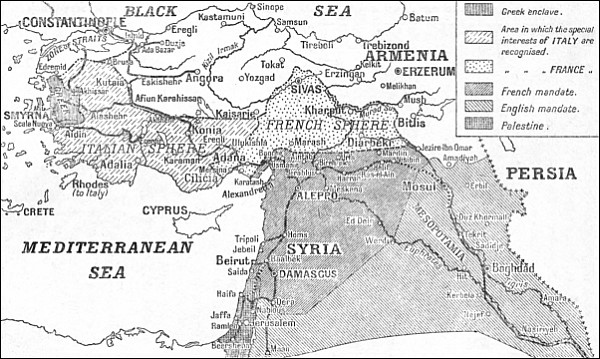
Turkey under the Treaty of Sèvres.
Larger image (201 kB)
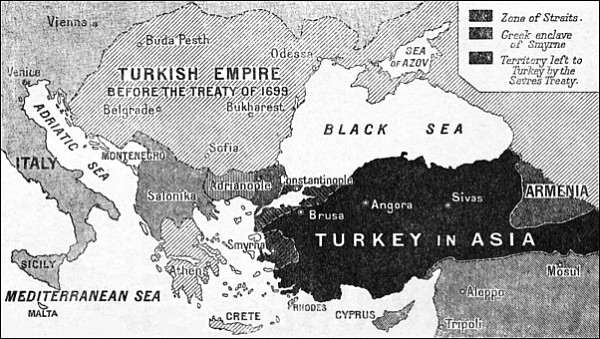
Schematic Map of the Territories lost by Turkey since 1699, and of the Territories left to Turkey by the Sèvres Treaty.
Larger image (204 kB)
Others hoped the Great Powers would take into account the goodwill of Turkey, and would gradually give up some of their intolerable demands.
Others, finally, bewailing the direful downfall of the Turkish Empire and insisting upon the lesson taught by this historical event for the future, hoped that the future would forcibly bring on a revision of that “iniquitous and impracticable” treaty of peace.
In France, M. Pierre Loti devoted one of his last articles to the treaty, which he called “the silliest of all the silly blunders of our Eastern policy.”35
The map on p. 269 shows the area left to the Turks in Europe and in Asia Minor by the Treaty of Sèvres. There will be seen the territories of Mesopotamia under English mandate, those of Syria under French mandate, and those which have been added to Palestine and are practically under English control. There will also be seen the regions on which France and Italy, in virtue of the tripartite agreement signed on August 10, 1920, enjoy preferential claims to supply the staff required for the assistance of the Porte in organising the local administration and the police. The contracting Powers in that agreement have undertaken not to apply, nor to make or support applications, on behalf of their nationals, for industrial concessions in areas allotted to another Power.
The map on p. 270 is a scheme of the territories lost by Turkey from 1699 down to the Sèvres Treaty; it shows that, by completing the dismemberment of Turkey, the treaty aimed at her annihilation.
Footnotes: