IV TURKEY AND THE CONFERENCE
Reading edition
As early as 1916 the Allies seem to have come to an agreement over the principle of the partition of the Ottoman Empire. In their answer to President Wilson they mentioned among their war aims “to enfranchise the populations enslaved to the sanguinary Turks,” and “to drive out of Europe the Ottoman Empire, which is decidedly alien to Western civilisation.”
According to the conventions about the impending partition of Turkey concluded between the Allies in April and May, 1916, and August, 1917, Russia was to take possession of the whole of Armenia and Eastern Anatolia, Constantinople, and the Straits. In virtue of the treaty signed in London on May 16, 1916, fixing the boundaries of two zones of British influence and two zones of French influence, France and England were to share Mesopotamia and Syria, France getting the northern part with Alexandretta and Mosul, and England the southern part with Haïfa and Baghdad. According to the treaty of August 21, 1917, Italy was to have Western Asia Minor with Smyrna and Adalia. Palestine was to be internationalised and Arabia raised to the rank of an independent kingdom.
But, following the breakdown of Russia and the entrance of America into the war, the conventions of 1916 and 1917 were no longer held valid. President Wilson declared in the fourteenth of his world-famous points that: “The Turkish parts of the present Ottoman Empire should be assured of secure sovereignty, but the other nations now under Turkish rule should be assured security of life and autonomous development.”
It follows that the partition of Turkish territories such as Mesopotamia or Syria between Powers that had no right to them, as was foreshadowed in the conventions of 1916, was no longer admitted; and the Conference in February, 1919, decided, at Mr. Wilson’s suggestion, that all territories that belonged to the Ottoman Empire before should be put under the control of the League of Nations, which was to assign mandates to certain Great Powers.
According to the decisions taken at that time, and at the special request of M. Venizelos, the Greeks obtained all the western coast of Asia Minor between Aivali and the Gulf of Kos, with Pergamus, Smyrna, Phocœa, Magnesia, Ephesus, and Halicarnassus, and a hinterland including all the vilayet of Aidin, except the sanjak of Denizli and part of that of Mentesha (Mughla).
The Italian delegation thought fit to make reservations about the assignment of Smyrna to Greece.
It seems that in the course of the conversations at St-Jean-de-Maurienne—Greece being still neutral at the time—M. Ribot asked Baron Sonnino whether Italy, to facilitate the conclusion of a separate peace with Austria-Hungary, would eventually consent to give up Trieste in exchange for Smyrna. The Italian delegation had merely noted down the offer, without giving an answer. The Italian diplomats now recalled that offer as an argument, not so much to lay a claim to Smyrna—as their subsequent attitude showed—as to prevent a change to Italy’s disadvantage in the balance of power in the Eastern Mediterranean, and an infringement of the London treaty that guaranteed her definite possession of the Dodecanese.
Moreover, according to Article 9 of the London treaty, in case of a partition of Asia Minor, or merely in case zones of influence should be marked out in it, Italy was to have the same share as the other Powers and receive, together with the province of Adalia, where she had acquired a paramount influence and obtained a recognition of her rights from Turkey in 1912, the neighbouring regions. In accordance with this article, the Conference seemed inclined to give Italy an international mandate for all the part of Asia Minor that was to be left to the Turks—namely, all the Anatolian plateau, including the vilayets of Kastamuni, Brusa, Angora, Konia, and Sivas. It is obvious that the difficulties raised by the assignment of Smyrna to Greece could not but be aggravated by the new political situation in case this mandate should be given to the Italians.
Consequently, when the Italians saw Smyrna assigned to Greece, they were all the more anxious to give to their new zone of influence in Asia Minor an outlet to the sea that should not depend on the great port of Western Asia Minor. After considering Adalia, Makri, and Marmaris, which are good harbours but do not communicate with the interior and are not connected with the chief commercial routes of the continent, their attention was drawn to Kush-Adassi, called by the Greeks New Ephesus and by themselves Scala Nuova, a port that numbered about 6,000 souls before the war, lying opposite to Samos, in the Gulf of Ephesus, about ten miles from the ruin of the old town of the same name and the Smyrna-Aidin railway.
This port, which is situated on the mouth of the Meander, might easily be connected by a few miles of railroad with the main railway line to the south of Ayasaluk which brings towards the Ægean Sea all the produce of Asia Minor; then it would divert from Smyrna much of the trade of Aidin, Denizli, and the lake region. To the merchants of Asia Minor—who deal with Syria, Egypt, Greece, Italy, and all Western Europe, excepting those who trade with the Black Sea—the Kush-Adassi line would be both faster and cheaper, if this port was as well equipped as Smyrna.
But, as Kush-Adassi happened to be in the zone which at first had been assigned to Greece and whose frontier goes down to the south as far as Hieronda Bay, Italy endeavoured in every way to carry farther to the north the boundaries of the Italian zone, in order to include this port in it. For this purpose, Italy took advantage of the troubled condition of the area round Aidin, Sokia, and Cape Mycale to send a police force up the Meander and the railway line along it, in order to carry her control up to the Gulf of Ephesus. Of course the territory lying between Hieronda and Kush-Adassi still remained part of the Greek zone of occupation, but, all the same, Italy set foot in it. Her diplomats soon turned this fact into a right of possession.
M. Tittoni soon after agreed to play the part of arbiter in the question of the southern frontier of Bulgaria; and in July, 1919, it was announced that after some conversations between M. Venizelos and M. Tittoni an understanding had been reached about Thrace and Northern Epirus, whereby Greece agreed to enlarge the northern part of the Italian zone of occupation in Asia Minor, and gave up to Italy the valley of the Meander. So, though on the whole M. Tittoni’s arbitration was in favour of Greece, Italy obtained the territorial triangle included between Hieronda, Nazili, and Kush-Adassi, the control over the Meander, and to a certain extent over the railway. In return for this, Italy promised to cede to Greece the Dodecanese except one, captured by Italy in 1912 during her war with Turkey, together with the Isle of Rhodes, though she had a right to keep the latter for at least five years. In case England should grant the inhabitants of Cyprus the right to pass under Greek sovereignty, Italy was to hold a plebiscite in Rhodes and let the native population become Greeks if they wished. By supporting the Greek claims in Thrace, Italy won the sympathies of Greece at a time when the latter both consolidated the rights of Italy on the continent and strengthened her own situation in the Dodecanese.
The control over the eastern part of Asia Minor which was to fall to the lot of the Armenians and included the vilayets of Erzerum, Van, Bitlis, Kharput, Diarbekir, and probably Trebizond—the population of the latter vilayet consisting chiefly of Moslems with a Greek minority—was to be assumed, so the Great Powers thought, by the United States.
It should be remembered that the question of the eastern vilayets was raised for the first time by the Tsars of Russia, and gave them a pretext for intervening in the domestic affairs of Turkey and thus carrying out their plans of expansion in Asia Minor. As a matter of fact, those vilayets were not really Armenian. The Armenians were in a minority there, except in two or three districts where, as throughout the Ottoman Empire, they were mixed up with Turks. They had lived peaceably together till the Powers thought fit to support the claims of the Armenians and incite them to rebel, in order to further their own aims in Turkey, by a misuse of the privileges granted them by the Capitulations.
Constantinople and the Straits seemed likely to be internationalised.
Lastly, the Arabian part of the Turkish Empire was to be cut off from it, though nobody could tell expressly in what manner, but in a way which it was easy to foresee.
We shall deal later on with the negotiations that took place during the war between the British Government and Hussein, Grand Sherif of Mecca, the Emir Feisal’s father, and we have already mentioned the help given to the British army by the Emir Feisal’s troops, after the aforesaid negotiations. These facts throw a light on the policy pursued by England later on; and besides, immediately after the hostilities, in a speech made in London on Friday, November 1, 1918, Mr. Barnes, a Labour member of the British Cabinet, while speaking on the armistice with Turkey, acknowledged:
“We could have signed it before, for we held the Turks at our discretion. For the last fortnight the Turks had been suing for peace, but we were on the way to Aleppo, which is to be the capital of the future independent Arab State, established in an Arab country and governed by Arabs. So we did not want to have done with the Turks till we had taken Aleppo.”
Such was the condition of the Turkish problem when the Peace Conference took it in hand for the first time.
Rivalries naturally soon arose.
The Emir Feisal, supported by England, laid claim not only to the whole of Arabia, but also to Palestine, Syria, and Mesopotamia to make up a huge Arab Empire, under his father’s rule. France, who opposed that plan, convened a Syrian Congress in Marseilles, to raise a protest against the partition of Syria as had been laid down by the Franco-English agreement of 1916.
Soon after the landing of Greek troops in Smyrna on the morning of May 15, 1919, brought about a serious conflict.
It is noteworthy that after General Allenby’s victories in Palestine and the resignation and flight of Talaat, Enver, and Jemal, General Izzet Pasha, who had been appointed Grand Vizier, had signed, on October 31, 1918, a convention of armistice, which put Turkish ports and railways under the Allies’ provisional control and allowed them “in case things should become alarming for them” to occupy “all strategic points.” This armistice had been concluded on the basis of Mr. Wilson’s principle that “to the Turkish regions of the Ottoman Empire an unqualified sovereignty should be ensured.” In no respect had the Turks broken the agreement when the Allies infringed it by allowing the Greeks to occupy Smyrna. This occupation, carried on in spite of France, who was not energetic enough, and one might almost say in spite of Italy, created a very serious situation.
Indeed, no good reason could be given in support of this decision. By the help of misleading or false information cleverly worded and widely distributed by a propaganda which overwhelmed the Press—and was only equalled by the propaganda carried on by Poland—political manœuvres induced the Allies to allow Greece, who wished to become “Greater Greece” and wanted Epirus, Thrace, Constantinople, Smyrna, Trebizond, and Adana, to occupy a region belonging to Anatolia, where the Turkish element predominates more than in all the rest of the Ottoman Empire, for there are only 300,000 Greeks against about 1,300,000 Turks. This permission granted to Greece was the more surprising as it seems to have been obtained because the Greek Government had informed the Supreme Council that the disorder prevailing in the vilayet of Smyrna was a danger to the non-Turkish populations.
Now the report of the Inter-allied Commission about the Greek occupation of Smyrna and the neighbouring territories which was sent later on and was dated from Constantinople, October 12, 1919, began as follows:
“The inquiry has proved that since the armistice the general condition of the Christians of the vilayet of Aidin has been satisfactory, and their security has not been threatened.
“If the occupation of Smyrna was ordered by the Peace Conference owing to inaccurate information, the primary responsibility lies with the individuals or governments that gave or transmitted inconsiderately such information as is mentioned in No. 1 of the established facts.
“It is obvious, therefore, that this occupation was not at all justifiable, and violated the terms of the armistice concluded between the Powers and Turkey.”
Moreover, to quote the very words of that report, the Greek occupation, “far from appearing as carrying out a civilising mission, has immediately put on the aspect of a conquest and a crusade.”
This inquiry, on the one hand, acknowledged that the responsibility for the events that took place at Smyrna on May 15 and 16 and in the immediate neighbourhood during the first days following the landing, lay with the Greek headquarters and some officers who did not perform their duty. On the other hand it stated that part of the responsibility rested with the Turkish authorities at Smyrna, who took no step to prevent the escape and arming of common law prisoners before the coming of the Greeks. Then it went on as follows:
“In the person of the high civil authority that represents it at Smyrna, the Greek Government is responsible for the serious disturbances that ended in bloodshed in the interior of the country during the advance of the Greek troops.... The Greeks alone are responsible for the bloodshed at Menemen.... The Greek officers who were at Menemen quite neglected their duty.”
And the Commission wound up its report with this:
“In the occupied region, putting aside the towns of Smyrna—where the number of Christians is high, but the number of Greek Christians much inferior to that of the Turks—and Aivali, the predominance of the Turkish element over the Greek element is undeniable.”
So we easily understand the violent and justifiable indignation felt by the Turks when the Greek troops landed, for they could not forget that now there were no Turks in Thessaly, where they numbered 150,000 in 1878, or in the Morea, where there had once been 300,000, and that in Greece only about 20,000 were left of the 100,000 that had once lived there.
M. Venizelos, in a letter addressed on May 29 to the President of the Conference, thought it his duty to give particulars about the way the occupation had been effected. After setting right what he styled “the wrong and misleading information given by newspapers,” he stated that the Greeks had “arrived at Aidin, on the southern side, east of Nymphaton and north of the River Ermos.” The Great Powers having asked the Greek Government, as he said expressly in his letter, “to occupy Smyrna and its environs” without stating exactly how far the environs of Smyrna reached, he thought he had a right to look upon this operation—which had been attended with a few incidents and had not been received everywhere with unmixed joy—as the outcome of a settled policy. After this occupation public meetings of protest took place in Constantinople.
An important Crown Council was held in the afternoon of May 26 at Yildiz-Kiosk, in order to enable the various political groups to express their opinion concerning the recent events.
The Sultan, attended by the princes of the Imperial Family, opened the meeting, and stated it had been thought necessary to call together the most eminent men of Turkey that they might express their opinion about the critical condition of the country.
The Grand Vizier, after recalling the events that had taken place in Turkey since the beginning of the war, asked the audience to let him have their opinions.
The Unionist group said they were dissatisfied with the composition of the Ministry, and demanded a Coalition Government, in which all parties should be represented.
Another political group asked the Crown Council to form itself into a National Assembly.
Somebody else showed the inanity of such suggestions and proposed to entrust the mandate of the administration of Turkey to a Great Power—without mentioning which Power. He added: “Otherwise Turkey will be dismembered, which would be her ruin.”
As the assembly had merely consultative powers, no decision was reached.
At the beginning of June, 1919, the Ottoman League sent from Geneva to Mr. Montagu, British Secretary for India, the following note:
“The Ottoman League has examined the statements which your Excellency was so kind as to make at the Peace Conference, regarding the subsequent fate of the Ottoman Empire.
“We have always been convinced that His Britannic Majesty’s Government in its relations with our country would resume its traditional policy, which was started and advocated by the most famous English statesmen, and that, after obtaining the guarantees required for the safety of its huge dominions, it would refuse to countenance any measure aiming at the oppression and persecution of Moslems.
“The British Government can realise better than any other Power the disastrous consequences that would necessarily follow throughout Islam on the downfall of the Ottoman Empire and any blow struck at its vital parts, especially at its capital, the universally revered seat of the Khilafat, where the best works of Moslem civilisation have been gathered for centuries.
“We feel certain that your Excellency will also realise better than anybody else of what importance would be to Great Britain the loyalty, not only of the Ottoman Moslems without any distinction of race, but of all the Mohammedans whose destiny is presided over by His Britannic Majesty.”
At last, about the end of the month, the treaty with Turkey was drafted by the Conference, and on June 11 the Turkish representatives were brought to France on board the French ironclad Démocratie.
The delegation included Tewfik Pasha, Riza Tewfik Bey, with Reshid Bey, former Minister of the Interior, as adviser. At its head was Damad Ferid Pasha, the Sultan’s brother-in-law, who, after the resignation of the Tewfik Pasha Cabinet at the beginning of March, 1919, had formed a new Ministry.
As was stated in the Allies’ answer to the Porte in the letter addressed to the Turkish Premier, Damad Ferid Pasha, Turkey had not attempted in the memorandum handed to the Conference to excuse the Germano-Turkish intrigues which had paved the way for her to take part in the war on the side of the Germans; neither had she attempted to clear herself of all the crimes she was charged with. Damad Ferid Pasha had simply pleaded that only the “Young Turks” of the Committee of Union and Progress were responsible for the Ottoman policy during the last five years, and that, if they had governed the Empire, as it were, in the name of the Germans, the whole Turkish nation could not be held responsible for this.
The Allies pointed out in their reply that they could not accept the distinction which cast all the blame on the Government and alleged the misdeeds were not imputable to the Turkish people merely because these misdeeds were abhorrent to Turkish ideas, as shown in the course of centuries. So the Allies informed the delegation they could not grant their request to restore Ottoman sovereignty over territories that had been taken away from them before.
Yet the Council, though they declared they could not accept such views or enter upon such a controversy, launched into considerations on Turkish ideas and Turkish influence in the world which, to say the least, were most questionable, as will be seen later on.
They stated, for instance, that no section of the Turkish people had ever been able to build up a lasting political organisation, the huge Empires of the Hioung-nous, the Ouigours, and the Kiptchaks having been of short duration. The Supreme Council also asserted that the lack of stability of the Ottoman Empire—which was represented as unable to develop—was due to the various origins of its elements. But other influences were laid aside, which have been at work, especially during the modern period, since the beginning of the decline. It should be borne in mind that three centuries ago the civilisation and prosperity of the Ottoman Empire were not inferior to those of the Western nations, and its inferiority appeared only nowadays, when Germany and Italy founded their unity, while the European States did not do anything in Turkey to improve—or even did much to aggravate—a condition of things that left to Turkey no possibility of recovery. If Moslem civilisation is quite different from Western civilisation, it does not follow necessarily that it is inferior to it. For several centuries its religious and social ideals safeguarded and ruled, to their satisfaction, the lives of numerous populations in the Levant, whereas more modern ideals in the West have not yet succeeded in bringing about conditions of life that can meet the requirements of man’s mind and physical nature. As to the so-called combativeness of the Turks and their supposed fanaticism—which may be only due, considering they were nomads at first, to their quick and headstrong nature—they both were certainly lessened by their intercourse and especially intermarriages with the Mongols, a quiet and peaceful people largely influenced by Buddhism and Lamaism, which they all profess, except a few Bouriate tribes that are still Shamanist. Moreover, even if such suppositions were true, their mixing with Western people could only have a good influence in soothing their original nature, whereas their eviction to Asia, by depriving them of any direct and close contact with Europe, would have the effect of reviving their former propensities.
Finally, the aforesaid document, though it was really superficial and rather vague on this point, purposed to give a crushing answer to the arguments of the Ottoman memorandum about the religious rivalries; yet these arguments were well grounded and most important, as appeared when the Protestant campaign broke out and Anglo-American opinion demanded the ejection of the Turks.
On June 27, 1919, the President of the Peace Conference in Paris addressed a second letter to Damad Ferid Pasha to inform him that the solution of the Turkish problem was postponed.
After stating that the declarations made before the Peace Conference by the Ottoman delegation “have been, and will continue to be, examined most attentively, as they deserve to be,” the letter went on to say that “they involve other interests than those of Turkey, and raise international questions, the immediate solution of which is unfortunately impossible; and it ended thus:
“Therefore, though the members of the Supreme Council are eager to restore peace definitely and fully realise it is a dangerous thing to protract the present period of uncertainty, yet a sound study of the situation has convinced them that some delay is unavoidable.
“They are of opinion, therefore, that a longer stay in Paris of the Ottoman delegation, which the Ottoman Government had asked to be allowed to send to France, would not be conducive to any good.
“Yet a time will come when an exchange of views will be profitable again; then the Allied and Associated Powers will not fail to communicate with the Ottoman Government as to the best means to settle the question easily and rapidly.”
One of the reasons given for this adjournment was the protest handed to Mr. Montagu, Secretary of State for India, by the Maharaja of Bikanir in the name of the Moslems of India, a protest which is supposed to have shaken the decisions already taken by the British Government.
At any rate, instead of maintaining the negotiations on a sound basis, and dealing squarely with the difficulties of the Turkish question, which would have made it possible to reach a better and more permanent solution, the Allies seemed to wish to break off the debates, or at least to postpone the discussion, in order to manœuvre and gain time. Perhaps they did it on purpose, or the negotiations came to an untimely end because, among the men who had assumed the charge of European affairs, some meant to intervene in them all the more eagerly because they did not know anything about them. They were not aware or had forgotten that in dealing with Eastern affairs or in pursuing negotiations with people of ancient civilisation, a great deal of delicacy, discretion, and shrewdness is required at the same time, and that generally diplomatists must expect plenty of haggling and procrastination, must avoid clashing with the adversary, and be able repeatedly to drop and resume a discussion smoothly, sometimes after long delays.
Somebody then quoted the words of the well-known French traveller Chardin in regard to Chevalier Quirini who, about 1671, carried on negotiations in Constantinople with the Vizier Ahmed Küprüli on behalf of the Republic of Venice:
“I heard M. Quirini say, when I had the honour of calling upon him, that the policy of the Turks far excelled that of the Europeans; that it was not restrained by maxims and regulations, but was wholly founded on, and regulated by, discernment. This policy, depending on no art or principles, was almost beyond anybody’s reach. So he candidly confessed that the vizier’s conduct was an utter mystery to him, and he was unable to fathom its discrimination, depth, secrecy, shrewdness, and artfulness.”
It is noteworthy that the same vizier was also able to cope successively with three ambassadors of Louis XIV.
The direction taken from the outset by the deliberations of the Conference, and the standpoint it took to settle the Turkish question, showed it was about to give up the traditional policy of the French kings in the East, which had been started by Francis I, and the last representatives of which had been the Marquis de Villeneuve, Louis XV’s ambassador, and the Comte de Bonneval.
As early as the end of the eighteenth century Voltaire, though he extolled Turkish tolerance throughout his “Essai sur la tolérance,” and wrote that “two hundred thousand Greeks lived in security in Constantinople,” advocated quite a different policy in his “Correspondance,” and took sides with the Russians against the Turks. After confessing that “he had no turn for politics,” and stating in “Candide” that he only cared for the happiness of peoples, he wrote to Frederick II:
“I devoutly hope the barbarous Turks will be driven out of the land of Xenophon, Socrates, Plato, Sophocles, and Euripides. If Europe really cared, that would soon be done. But seven crusades of superstition were once undertaken, and no crusade of honour will ever be undertaken; all the burden will be left to Catherine.”
He did not conceal how highly pleased he was with the events of 1769-71, and he wrote to the “Northern Semiramis,” as he styled her:
“It is not sufficient to carry on a fortunate war against such barbarians; it is not enough to humble their pride; they ought to be driven away to Asia for ever. Your Imperial Majesty restores me to life by killing the Turks. It has always been my opinion that if their empire is ever destroyed, it will be by yours.”
Indeed, some people maliciously hinted at the time that Voltaire’s opinion of the Turks was due to his disappointment at the failure of his play “Mahomet, ou le fanatisme,” and that it was for the same reason he wrote in his “Essai sur les mœurs et l’esprit des nations” while he was Madame du Chatelet’s guest:
“Force and rapine built up the Ottoman Empire, and the quarrels between Christians have kept it up. Hardly any town has ever been built by the Turks. They have allowed the finest works of antiquity to fall to decay; they rule over ruins.”
It seems that the members of the Supreme Council, in their answer to the Turkish delegation, only harped upon this old theme, and amplified it, and that in their settlement of the question they were inspired by similar considerations, evincing the same misunderstanding of Turkey and the same political error. The Supreme Council might have remembered J. J. Rousseau’s prophecy in his “Contrat Social,” which might very well be fulfilled now: “The Russian Empire will endeavour to subjugate Europe, but will be subjugated. The Tatars, its subjects and neighbours, will become its masters and ours too.”15
The negotiations which had just been broken off could only have been usefully carried on if the Allies had quite altered their policy and had realised the true condition of the Ottoman Empire and the interests of the Western nations, especially those of France.
The condition of the Ottoman Empire, as will be seen later on, when we shall dwell upon the slow and deep disintegration which had taken place among the Turkish and Arabian populations, was on the whole as follows: The Young Turk revolution, on which great hopes were built, had ended lamentably: the Austrians had wrested Bosnia-Herzegovina from Turkey; the Turco-Italian war had taken from her another slice of her territory; then the coalition of the Balkan States had arisen, which seems to have been prepared and supported by England and by the other nations which followed her policy. Finally, the treaty of Bukharest confirmed the failure of the principle—once solemnly proclaimed by France and England—of the territorial integrity of Turkey. So the Turks no longer had any confidence in Europe, and, being sacrificed once more in the Balkan war, and as they could no longer trust England, they were necessarily thrown into the arms of Germany.
After Abdul Hamid, Mehmed V, with his weak, religious mind, allowed himself to be led by Enver, and his reign, disturbed by three wars, cost Turkey huge territorial losses. Mehmed VI, being more energetic and straightforward, tried to restore order in the State, and to put an end to the doings of the Committee of Union and Progress.
Then, too, the Crown Prince, Abdul Mejid, a man about fifty, who speaks French very well, evinces the same turn of mind. After seeing what Germany could do with the Turkish Empire, such men, who had not kept aloof from modern ideas, and to whom European methods were not unfamiliar, had made up their mind that the Turks should not be driven out of Europe. But Mejid Effendi was soon deprived of influence through intrigues, and henceforth engaged in his favourite hobby, painting, in his palace on Skutari Hill, and kept away from politics.
Mustafa Kemal, who had been sent to Amasia as Inspector-General of the Eastern army, had secretly raised an army on his own account, with the help of Reouf Bey, once Minister of Marine in the Izzet Cabinet. When recalled to Constantinople by the Turkish Government in July, 1919, he had refused to obey, and had proclaimed himself his own master. Though he had once gone to Berlin with the Sultan, who was only Crown Prince at the time, the latter degraded him and deprived him of the right of wearing his decorations—which could only have been a political measure intended to show that the throne and the Government could not openly countenance the movement that was taking place in Anatolia.
Mustafa Kemal, brought up at Salonika, had only become well known in Constantinople during the Revolution of 1908. During the war in the Balkan Peninsula he had distinguished himself at Chatalja, and after being promoted colonel he was sent as military attaché to Sofia, and then charged with a mission in Paris. He came back to Constantinople in 1914, a short time before war broke out.
Of course, when he had started his career a long time previously, Mustafa Kemal had been connected indirectly with the Union and Progress party, as he was at the head of the revolutionary group in which this association originated, but he was never a member of the Merkez-i-Oumimi, the central seat of the Committee of Union and Progress. He was a good officer, very fond of his profession, and, as he loathed politics, he had soon kept away from them, and consequently never played any part in them, and was hardly ever influenced by them. Yet the supporters of the Committee of Union and Progress, who have made great mistakes, but have always been patriots, have necessarily been compelled lately to co-operate with him, though they did not like to do so at the outset.
Mustafa Kemal was undoubtedly the real leader of the movement which had already spread over the whole of Anatolian Turkey. As his influence was enormous and he had an undeniable ascendancy over the Turkish troops he had recruited, his power was soon acknowledged from Cartal, close to Constantinople to the Persian frontier. He had compelled Liman von Sanders to give him command of a sector at a moment when the Turks seemed to be in a critical situation during the attack of the Anglo-French fleet in the Dardanelles, and by not complying with his orders he had saved the Turkish army by the victory of Anafarta, and perhaps prevented the capture of Constantinople, for two hours after the Allies, whose casualties had been heavy, retired.
But he had soon come into conflict with Enver Pasha. Their disagreement had begun during the war of Tripoli; it had increased during the Balkan war, and had now reached an acute state. The chief reason seems to be that they held quite different opinions about the organisation of the army and the conduct of the war operations. Mustafa Kemal having always refused to take part in politics after the Young Turk revolution of 1908, it seems difficult to believe this hostility could be accounted for by political reasons, though the situation had now completely changed. As to Mustafa Kemal’s bickerings and petty quarrels with several German generals during the war, they seem to have had no other cause than a divergence of views on technical points.
In consequence of this disagreement Mustafa Kemal was sent to Mesopotamia in disgrace. He came back to Constantinople a few weeks before the armistice. After the occupation of Smyrna he was appointed Inspector-General of Anatolia, where he organised the national movement.
By Mustafa Kemal’s side there stood Reouf Bey, once Minister of Marine, who, during the Balkan war, as commander of the cruiser Hamidié, had made several raids in Greek waters, had then been one of the signatories of the Moudros armistice, and now was able to bring over to the Anatolian movement many naval officers and sailors, and General Ali Fuad Pasha, the defender of Fort Pisani at Janina during the Balkan war, who had a great prestige among the troops.
Bekir Sami Bey, once Governor-General, and Ahmed Rustem Bey, formerly ambassador at Washington, were the first political men of note who joined the nationalist movement. On Mustafa Kemal’s arrival at Erzerum, Kiazim Karabekir, together with the other commanders, acknowledged him as their chief, and pledged themselves to support him against Constantinople.
Mustafa Kemal openly charged the Government with betraying Turkey to the Allies, and asked all those who wanted to defend their country and their religion to join him. At that time he only had at his disposal two divisions of regular troops; he sent an appeal to the populations of Sivas and Ushak, and many volunteers joined his colours. Colonel Bekir Sami, who commanded the Panderma-Smyrna line and all the district, also rebelled against the Constantinople Government, and soon his 10,000 soldiers joined the troops of Mustafa Kemal, who assumed the general command of all the insurgent troops. On the other hand, Kiazim Bey threatened to resume hostilities, in case too heavy conditions should be forced on Turkey. Mustafa Kemal, as he refused to make any concessions to the victors of Turkey, and opposed any separatist idea or the cession of any Ottoman territories, of course had with him a large section of public opinion, which was roused by the Allies’ threat to take from Turkey half her possessions, Thrace, Smyrna, and Kurdistan, and to drive the Sultan into Asia.
On July 23, a Congress of the committees which had been established in various parts of the Empire for the defence of the national rights was held at Erzerum.
The proceedings were secret, but at the end of the congress an official report was sent to the High Commissioners of the Allies in Constantinople.
An “Anatolian and Rumelian League for the Defence of the National Rights” was formed, which later on was called the “National Organisation.” According to what has become known about the sittings of the Congress, the principles that were to control the action of the National Organisation and to constitute its programme were the following: (1) Grouping of the various Moslem nationalities of the Empire into a whole politically and geographically indivisible and administered so as to ensure the respect of their ethnic and social differences. (2) Equality of rights for non-Moslem communities so far as consistent with the principle of the political unity of the State. (3) Integrity of the Empire within the boundaries of Turkish sovereignty as they were in September, 1918, when the armistice was concluded—which are almost the same as the ethnic boundaries of Turkey. (4) No infringement whatever on the sovereignty of the Turkish Empire. A special article expressed the sincere wish on the part of the Turkish nation, with a view to the general restoration of Turkey, to accept the support of any Western country, providing the latter did not aim at an economic or political subjection of any kind.
This programme was sanctioned in the course of a second Congress which was held at Sivas at the beginning of September, 1919, to allow the local committees which had not been able to send delegates to Erzerum to give their approbation to it and to adhere to the national movement.
The executive functions of the Congress were entrusted to a representative committee presided over by Mustafa Kemal, and consisting of members chosen by the Congress, who were: Reouf Bey, Bekir Sami Bey, Hoja Raif Effendi, Mazhar Bey, once vali of Bitlis, and later on Ahmed Rustem Bey, once Turkish ambassador at Washington, Haidar Bey, once vali of Kharput, and Hakki Behij Bey.
The local militias which had been raised took the name of national forces; and when they had been linked with the regular army, they were put by Mustafa Kemal under the command of Kara Bekir Kiazim Pasha, who became commander-in-chief in Eastern Anatolia, and Ali Fuad Pasha, who had the command of the forces of Western Anatolia.
Two delegates of the “Liberal Entente,” some leaders of which group seemed open to foreign influence, were sent to Constantinople to ask the Central Committee what attitude was to be taken, and were prudently ordered to enjoin the supporters of the Liberal Entente to be most careful.
But though part of the Constantinople Press seemed to deny any importance to the Anatolian movement, the Stambul Government deemed it proper to send missions to Trebizond, Angora, and Eskishehr, headed by influential men, in order to restore order in those regions. It also directed two of its members to go to the rebellious provinces to see how things stood, and come to terms with Mustafa Kemal. Some of these missions never reached the end of their journey; most of them had to retrace their steps, some did not even set out. In September, 1919, Marshal Abdullah Pasha, who had instructions to reach Mustafa Kemal at Trebizond, and enjoin him to give up his self-assumed command, did not stir from Constantinople. The Government also sent General Kemal Pasha, commander of the gendarmerie, to scatter the nationalist irregular troops, but nothing was heard of him after a while, and he was supposed to have been taken prisoner by, or gone over to, the rebels. The Anatolian valis and commanders who had been summoned to Constantinople did not come, protesting they could not do so or were ill.
On the other hand, Mustafa Kemal sent back to Constantinople Jemal Bey, vali of Konia, and a few functionaries, who had remained loyal to the Stambul Government. Ismaïl Bey, vali of Brusa, one of the most important leaders of the Liberal Entente, was driven out of office by both Governments.
In addition, the cleavages already existing in the Ottoman Empire, which since 1913 only included the prominently Moslem provinces, had widened, and endangered the unity of the Empire. In the provinces where the Arabic-speaking Moslems were in a majority the authority of the Turkish Government dwindled every day; they meant to shake off the Ottoman yoke, and at the same time to keep off any Western influence; they also wished more and more eagerly to part from the provinces where the Turks and Ottoman Kurds—who aim at uniting together—are in a majority.
For the last four centuries France had enjoyed an exceptional situation in Turkey. Her intellectual influence was paramount; French was not only known among the upper classes, but it was also in current use in politics and business, and even a good many clerks in post-offices and booking-offices at Constantinople understood it.
French schools, owing to their very tolerant spirit, were very popular among nearly all classes of the Turkish population, and the sympathies we had thus acquired and the intellectual prestige we enjoyed were still more important than our material interests. Nearly 25,000 children attended the French elementary schools, most of them religious schools, which bears witness both to the confidence the Mahommedans had in us, and the tolerance they showed. The Grammar School of Galata-Serai, established in 1868 by Sultan Abdul Aziz with the co-operation of Duruy, French Minister of Public Education, and several other secondary schools which are now closed, diffused French culture and maintained sympathy between the two peoples. The Jesuits’ school of medicine at Beyrut also spread our influence.
The material interests of France in Turkey were also of great importance; and it was, therefore, a great mistake for France to follow a policy that was bound to ruin the paramount influence she had acquired. The other Western States had as important interests as France; and it was necessary to take all these facts into account if an equitable settlement of the Turkish question was to be reached.
France, England, and Germany were, before the war, the three Powers that owned the most important financial concerns in Turkey, France easily holding the premier position, owing to the amount of French capital invested in Turkish securities, Government stocks, and private companies.
From 1854 to 1875 thirteen loans—almost one every year—were issued by the Ottoman Government, ten being entrusted to the care of French banks or financial establishments controlled by French capital.
These thirteen loans have only an historical interest now, except the three loans issued in 1854, 1855, and 1871, secured on the Egyptian tribute, which still exist with some modifications, but may be looked upon as Egyptian or rather English securities, and were not included in the settlement effected in 1881 which converted them into new bonds, and the 1870-71 loan, styled “Lots Turcs,” the whole of which at the time was subscribed by Baron Hirsch in return for the concession of railways in Europe. To them let us add another financial operation effected about 1865, consisting in the unification of the various bonds of the interior debt and their conversion into bonds representing a foreign debt.
Most of these operations were controlled by the Imperial Ottoman Bank, founded by the most influential English and French financial groups, to which the Ottoman Government by its firmans of 1863 and 1875 granted the privilege of being the State bank. It thus has the exclusive right of issuing banknotes, and has the privilege of being the general paymaster of the Empire and the financial agent of the Government, both at home and abroad.
The financial activity of the French companies was only interrupted by the 1870 war. The only competition met with was that of a few English banks, which no doubt intended to second the views of the British Government in Egypt, and of an Austrian syndicate for the building of the Balkan railways which, later on, furthered the penetration of Austria-Hungary in Eastern Europe.
In 1875 the nominal capital of the Ottoman debt rose to 5,297,676,500 francs. The Ottoman Government, finding it impossible to pay the interest on the Government stocks, announced its decision on October 6, 1875, to give only one-half in cash in the future. The Imperial Ottoman Bank, which was practically under French control owing to the importance of the French capital invested in it, raised a protest on behalf of the bondholders.
The Porte then agreed to make arrangements with the French, the Italians, the Austrians, the Germans, and the Belgians. The claims of the bondholders were laid before the plenipotentiaries who had met at Berlin to revise the preliminaries of San Stefano, and were sanctioned by the Berlin treaty signed on July 13, 1878. They had three chief objects: First, to secure the right of first mortgage which the creditors of the Empire held from the loans secured on the Russian war indemnity; secondly, to appoint the contributive share of the Ottoman debt incumbent on the provinces detached from the Empire; thirdly, to decide what was to be done to restore Turkish finance.
After the conversations with the plenipotentiaries assembled at Berlin, and chiefly owing to the intervention of the French representative, M. Waddington, the Congress embodied the following clauses in the treaty in order to protect the interests of the bond-holders: Bulgaria was to pay the Sultan a tribute; part of the revenue of Eastern Rumelia was to be assigned to the payment of the Ottoman Public Debt; Bulgaria, Serbia, and Montenegro were to assume a part of the Ottoman debt proportionately to the Turkish territories annexed by each of them; all the rights and duties of the Porte relating to the railways of Eastern Rumelia were to be wholly maintained; finally, the Powers advised the Sublime Porte to establish an international financial commission in Constantinople.
In this way the Berlin treaty laid down the principles on which every financial reorganisation was to be based whenever a province should be detached from the Ottoman Empire.
Then the mandatories of the bondholders began to negotiate directly with the Ottoman Empire, but as the various schemes that were proferred failed, the Imperial Ottoman Bank, supported by the Galata bankers, proposed an arrangement that was sanctioned by the Convention of November 10 to 22, 1879. In this way the administration of the Six Contributions was created, to which were farmed out for a period of ten years the revenues derived from stamp duties, spirits in some provinces, the fisheries of Constantinople and the suburbs, and the silk tax within the same area and in the suburbs of Adrianople, Brusa, and Samsun; it was also entrusted with the collection and administration of the revenues proceeding from the monopolies in salt and tobacco.
At the request of the Imperial Ottoman Bank the revenues of this administration, first allocated to the Priority Bonds, of which she owned the greater part, were divided later on between all the bondholders.
In this way the important agreement known as the decree of Muharrem, in which the French played a paramount part, was made possible (December 8 to 20, 1881), according to which the original capital of the foreign Turkish loans was brought down to the average price of issue, plus 10 per cent. of this new capital as a compensation for the interest that had not been paid since 1876. The old bonds were stamped, converted, and exchanged for new bonds called Bonds of the Unified Converted Debt, except the “Lots Turcs,” which, being premium bonds, were treated separately.
The interest of the Converted Debt was fixed at from 1 to 4 per cent. of the new capital.
As to the amortisation, the decree divided the various foreign loans into several series according to the value of the mortgage; this classification stated in what order they would be subject to amortisation.
The outcome of these negotiations, the decree of Muharrem, also established a set of concessions which could not be revoked before the extinction of the debt, and organised the administration of the Ottoman Public Debt, which was to collect and administer, on behalf of the Ottoman bondholders, the revenues conceded as guarantee of the debt.
The Ottoman Government pledged itself to allocate to the payment of the interest and to the amortisation of the reduced debt till its extinction the following revenues: the monopolies in salt and tobacco; the Six Contributions (tobacco, salt, spirits, stamps, fisheries, silk); any increase in the customs duties resulting from the modification of the commercial treaties; any increase of the revenues resulting from new regulations affecting patents and licences (temettu); the tribute of the principality of Bulgaria; any surplus of the Cyprus revenues; the tribute of Eastern Rumelia; the produce of the tax on pipe tobacco (tumbeki); any sums which might be fixed as contributions due from Greece, Serbia, Bulgaria, and Montenegro for the service of the debt.
The administration of the Ottoman Public Debt was entrusted to “the Council for the Administration of the Ottoman Public Debt,” commonly known as “the Public Debt,” consisting of delegates of Ottoman bondholders of all nations. The French owned by far the greater part of the debt. The English represented the Belgians in the Council, the shares of these two countries in the debt being about equal.
This international council, who attended to the strict execution of the provisions of the decree, deducted all the sums required for the interest and the sinking fund, and made over the balance to the Imperial treasury.
The decree of Muharrem also entrusted to the Public Debt the control of the cultivation and the monopoly of the sale of tobacco throughout the Turkish Empire. Later on, in 1883, the Public Debt farmed out its rights to an Ottoman limited company, the “Régie Co-intéressée des Tabacs de l’Empire,” formed by a financial consortium including three groups: the Imperial Ottoman Bank, which was a Franco-English concern; the German group of the B. Bleichröder Bank; and the Austrian group of the Kredit Anstalt with a capital of 100 million francs. Only one-half of this capital was paid up—i.e., 50 million francs—which was cut down to 40 million francs on November 28, 1899, to make up for the losses of the first three years. It is thought in French financial circles that half this capital—viz., 20 million francs—is French, and the rest chiefly Austrian.
The “Régie,” whose activities extend throughout the Empire, may be looked upon as one of the most important financial concerns of the Ottoman Empire. It has branches in all the chief centres, controls the cultivation of tobacco, records the production, buys native and foreign tobaccos, issues licences for the sale of tobacco, and advances money to the growers; its chief factories are at Samsun, Aleppo, Adana, Smyrna, etc. In return for the monopoly it enjoys, it owes the Public Debt a fixed yearly payment, and has to divide a fixed proportion of its net profits between the Public Debt and the Ottoman Government.
The share of France in the Council of the Public Debt, in which French was the official language, gave her a paramount influence and prestige in the Ottoman Empire. Owing to the importance and extent of the part played by the Council of the Debt, in which the influence of France was paramount, the latter country indirectly acquired an influence in the administration of the Malié—i.e., in the administration of the Turkish treasury—and in this way Turkey was obliged on several occasions to call for the advice of French specialists for her financial reorganisation.
But the Ottoman Government, in order to consolidate its floating debt, which had not been included in the previous liquidation, was soon compelled to borrow money abroad. Besides, it wanted to construct a system of railways at that time.
The loan guaranteed by the customs duties in 1886, the Osmanie loan in 1890, the 4 per cent. Tombac preferential loan in 1893, the Eastern Railway loan in 1894, the 5 per cent. 1896 loan, and the 4 per cent. 1901 loan, were all floated in France, and the English had no share in the financial operations between 1881 and 1904.
During the same period Germany, through the Deutsche Bank, took up the Fishery loan in 1888 and the 4 per cent. Baghdad Railway loan in 1903. Later on the German financial companies, together with the Deutsche Bank, gave Turkey as much support as the French banks, in order to promote Pan-Germanism in the East and oust French influence. The chief financial operations carried on by these companies were the Baghdad Railway loan, the Tejhizat loan for the payment of military supplies, and the 1911 loan, which were both a guarantee and an encouragement for the German policy of penetration in Turkey, and paved the way to a Germano-Ottoman understanding.
France continued to subscribe all the same, from 1903 to 1914, to six of the twelve Turkish loans raised by the Ottoman Government; four others were taken up by Germany, another by England, and the sixth—the 4 per cent. 1908 loan—was issued one-half in France, one-fourth in Germany, and one-fourth in England. In 1914, as a reward for issuing a loan of 800 million francs in Paris—the first slice being 500 million—France obtained the settlement of several litigious cases and new concessions of railways and ports.
At the outbreak of the war, the external debt of Turkey, including the Unified Debt and other loans, amounted to 3½ milliards of francs, whereas the Turkish revenue hardly exceeded 500 million francs. One-third of this sum went to the sinking fund of the external debt, of which, roughly speaking, France alone owned nearly 60 per cent., Germany nearly 26 per cent., and England a little more than 14 per cent.
In addition to this, in the sums lent to Turkey by private companies, the share of France was about 50 per cent.—i.e., over 830 million francs; that of Germany rose to 35 per cent.; and that of England a little more than 14 per cent.
Foreign participation in the great works and the various economic or financial concerns in Turkey may be summed up as follows:
France. England. Germany.
Banks 37·7 33·3 28·0
Railways 46·9 10·4 46·6
Ports and wharves 67·9 12·2 19·7
Water 88·6 — 11·3
Mines 100·0 — —
Various concerns 62·8 24·1 13·0
Total per cent. 50·5 14·3 35·0
Capital (million Francs) 830 235 575
Not only had France an important share in the organisation of Turkish finances, but had opened three banks while the English established but one, the National Bank of Turkey, which holds no privilege from the State, and is merely a local bank for business men. Two German banks—the Deutsche Orient Bank and the Deutsche Palästina Bank, founded almost as soon as Germany began to show her policy regarding Turkish Asia—had turned their activity towards Turkey, as we have just seen.
France incurred an outlay of 550 million francs—not including the sums invested in companies which were not predominantly French, such as the Baghdad Railway—for the building of 1,500 miles of railway lines, while the Germans built almost as many, and the English only 450 miles; and France spent 58 million francs for the ports, whereas the English only spent 10 million francs.
The railway concessions worked by French capital included the Damascus-Hama line, which afterwards reached Jaffa and Jerusalem; the tramways of Lebanon; the Mudania-Brusa line; the Smyrna-Kassaba railway; the Black Sea railways which, according to the 1914 agreement, were to extend from Kastamuni to Erzerum, and from Trebizond to Kharput, and be connected with the Rayak-Ramleh line—viz., 1,600 miles of railway altogether in Syria; the Salonika-Constantinople line.
Before the London treaty, the Eastern railways in European Turkey, representing 600 miles, were worked by Austro-German capital, and the Salonika-Monastir line, 136 miles in length, had a German capital of 70 million francs.
The concessions with German capital in Asia Minor formed a complete system of railways, including the Anatolian railways, with a length of 360 miles and a capital of 344,500,000 francs; the Mersina-Tarsus-Adana line, 42 miles, capital 9,200,000 francs; the Baghdad Railway, whose concession was first given to the Anatolian railways but was ceded in 1903 to the Baghdad Railway Company, and which before the war was about 190 miles in length.
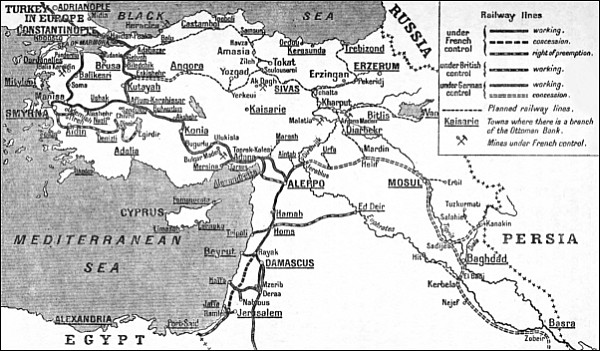
Map of the Railways of the Ottoman Empire and the Chief Mining Concerns under Foreign Control before the War.
Larger image (191 kB)
As the building of this system of railways closely concerned the French companies of the Smyrna-Kassaba and Beyrut-Damascus railways and the English company of the Smyrna-Aidin railway, the French companies and the Ottoman Imperial Bank concluded arrangements with the holders of the concessions to safeguard French interests as much as possible. Thus a French financial group took up a good many of the Baghdad bonds (22,500 and 21,155 bonds) and numerous shares of the “Société de construction du chemin de fer” established in 1909. On the whole, the share of the French consortium before the war amounted to 4,000,000 francs on the one hand, and 1,950,000 francs on the other; the share of the German consortium was 11,000,000 and 8,050,000 francs.
The concessions controlled by English capital were the Smyrna-Aidin line, 380 miles long, with a capital of 114,693,675 francs, and the Smyrna-Kassaba line, which was ceded later on to the company controlled by French capital which has already been mentioned. They were the first two railway concessions given in Turkey (1856 and 1863).
In Constantinople the port, the lighthouses, the gasworks, the waterworks, and the tramways were planned and built by French capital and labour.
The port of Smyrna, whose concession was given in 1867 to an English company and two years after passed into the hands of some Marseilles contractors, was completed by the “Société des quais de Smyrne,” a French limited company. The diversion of the Ghedis into the Gulf of Phocea in order to prevent the port being blocked up with sand was the work of a French engineer, Rivet.
The Bay of Beyrut has also been equipped by a French company founded in 1888 under the patronage of the Ottoman Bank by a group of the chief French shareholders of the Beyrut-Damascus road and other French financial companies.
Moreover, according to the 1914 agreements, the ports of Ineboli and Heraclea on the Black Sea, and the ports of Tripoli, Jaffa, and Haïfa in Syria, were to be built exclusively by French capital. So it was with the intended concessions of the ports of Samsun and Trebizond.
At Beyrut a French group in 1909 bought up the English concession for the building of the waterworks and pipelines, and formed a new company. French capital, together with Belgian capital, also control the Gas Company, Tramway Company, and Electric Company of Beyrut. Only at Smyrna, where the gasworks are in the hands of an English company and the waterworks are owned by a Belgian company has France not taken part in the organisation of the municipal services.
Only the port of Haïdar-Pasha, the terminus of the Anatolian Railway, has been ceded by this company to a financial company whose shares are in German hands.
To these public establishments should be added such purely private industrial or commercial concerns as the Orosdi-Back establishments; the Oriental Tobacco Company; the Tombac Company; the “Société nationale pour le commerce, l’industrie et l’agriculture dans l’Empire ottoman”; the concession of Shukur-ova, the only French concession of landed property situated in the Gulf of Alexandretta on the intended track of the Baghdad Railway, including about 150,000 acres of Imperial land, which represent an entirely French capital of 64 million francs; the Oriental Carpet Company, which is a Franco-British concern; the Joint Stock Imperial Company of the Docks, Dockyards, and Shipbuilding Yard, which is entirely under British control, etc.
During the war, the share of France and that of England were increased, as far as the Public Debt is concerned, by the amount of the coupons which were not cashed by the stockholders of the Allied countries, while the holders of Ottoman securities belonging to the Central Powers cashed theirs.
Beyond this, Turkey borrowed of Germany about 3½ milliards of francs. An internal loan of 400 million francs had also been raised. To these sums should be added 2 milliards of francs for buying war supplies and war material, and the treasury bonds issued by Turkey for her requisitions, which cannot be cashed but may amount to about 700 million francs. As the requisitions already made during the Balkan wars, which amounted to 300 or 400 million francs, have not yet been liquidated, the whole Turkish debt may be valued at over 10 billion francs.
Finally, in the settlement of the Turkish question, the war damages borne by the French in Turkey should also be taken into account, which means an additional sum of about 2 milliards of francs.
The French owned in Turkey great industrial or agricultural establishments, which were wholly or partly destroyed. At Constantinople and on the shores of the Marmora alone they had about fifty religious or undenominational schools, which were half destroyed, together with everything they contained, perhaps in compliance with the wishes of Germany, who wanted to ruin French influence for ever in that country.
In order to keep up French influence in the East, the High Commissioner of the Republic had, in the early days of the armistice, warned his Government it was necessary to provide a fund at once to defray the expenses of the schools and other institutions established by the French in Turkey in pre-war time—which sums of money were to be advanced on the outstanding indemnity. For want of any existing law, this request could not be complied with; but, as will be seen later on, the Peace Treaty, though it says nothing about this urgent question, states that the indemnities due to the subjects of the Allied Powers for damages suffered by them in their persons or in their property shall be allotted by an inter-Allied financial commission, which alone shall have a right to dispose of Turkish revenue and to sanction the payment of war damages. But all this postpones the solution of the question indefinitely.
In the settlement of the Turkish question, the chief point is how Turkey will be able to carry out her engagements, and so, in her present condition, the policy which England and America, followed by Italy and France, seem to advocate, is a most questionable one.
Javid Bey has even published an account of the condition of Turkey, in which he finds arguments to justify the adhesion of his country to the policy of Germany.
Nevertheless it seems that Turkey, where the average taxation is now from 23 to 25 francs per head, can raise fresh taxes. The revenue of the State will also necessarily increase owing to the increase of production, as a tithe of 10 to 12 per cent. is levied on all agricultural produce. Finally, the building of new railway lines and the establishment of new manufactures—to which, it must be said, some competing States have always objected for their own benefit but to the prejudice of Turkey—would enable her to make herself the manufactured goods she bought at a very high price before, instead of sending abroad her raw materials: silk, wool, cotton, hemp, opium, etc.
The soil of Turkey, on the other hand, contains a good deal of mineral and other wealth, most of which has not been exploited yet. There is a good deal of iron in Asia Minor, though there exists but one iron-mine, at Ayasmat, opposite to Mitylene, the yearly output of which is only 30,000 tons. The most important beds now known are those of the Berut Hills, north of the town of Zeitun, about fifty miles from the Gulf of Alexandretta, which may produce 300,000 tons a year. Chrome, manganese, and antimony are also found there.
There is copper everywhere in the north, in thin but rich layers, containing 20 per cent. of metal. The chief mine, which is at Argana, in the centre of Anatolia, is a State property. A French company, the Syndicate of Argana, founded for the prospecting and exploitation of the copper concessions at Argana and Malatia, and the concessions of argentiferous lead at Bulgar-Maden, had begun prospecting before the war.
Lead, zinc, and silver are found, too, in the Karahissar area, where is the argentiferous lead mine of Bukar-Dagh, once a State property. Before the war a French company of the same type as the one above mentioned, the Syndicate of Ak-Dagh, had obtained the right to explore the layers of zinc and argentiferous lead in the vilayet of Angora. The mines of Balia-Karaidin (argentiferous lead and lignite) lying north-east of the Gulf of Adramyti in the sanjak of Karassi, are controlled by French capital. The English syndicate Borax Consolidated has the concession of the boracite mines in the same sandjak.
The range of Gumich-Dagh, or “Silver Mountain,” contains much emery. At Eskishehr there are mines of meerschaum, and in the Brusa vilayet quarries of white, pink, and old-blue marble, lapis-lazuli, etc.
A few years ago gold layers were being exploited at Mender-Aidin, near Smyrna, and others have been found at Chanak-Kale, near the Dardanelles. Some gold-mines had been worked in Arabia in remote ages.
There are oil-fields throughout the peninsula, lying in four parallel lines from the north-west to the south-east. The best-known fields are in the provinces of Mosul and Baghdad, where nearly two hundred have been identified; others have also been found near the Lake of Van, and at Pulk, west of Erzerum, which are not inferior to those of Mesopotamia; and others fifty miles to the south of Sinope.
There are almost inexhaustible layers of excellent asphalt at Latakieh, on the slopes of the Libanus, and others, quite as good, at Kerkuk, Hit, and in several parts of Mesopotamia.
Finally, some coal-mines are being worked at Heraclea which are controlled by French capital, and coal outcrops have been found lately in the Mosul area near the Persian frontier, between Bashkala and Rowanduz and Zahku, close to the Baghdad Railway. But the treaty, as will be shown later on, is to deprive Turkey of most of these sources of wealth.
Among the other products of Turkey may be mentioned carpets, furs (fox, weasel, marten, and otter), and, particularly, silks. The silks of Brusa are more valuable than those of Syria—the latter being difficult to wind; their output has decreased because many mulberry-trees were cut down during the war, but the industry will soon resume its importance.
Turkey also produces a great quantity of leather and hides, and various materials used for tanning: valonia, nut-gall, acacia. It is well known that for centuries the leather trade has been most important in the East, numerous little tanyards are scattered about the country, and there are large leather factories in many important towns. The Young Turks, realising the bright prospects of that trade, had attempted to prohibit the exportation of leathers and hides, and to develop the leather manufacture. During the summer of 1917 the National Ottoman Bank of Credit opened a leather factory at Smyrna, and appointed an Austrian tanner as its director. Owing to recent events, it has been impossible to establish other leather factories, but this scheme is likely to be resumed with the protection of the Government, for the leather industry may become one of the chief national industries.
The Peace Conference, by postponing the solution of the Turkish problem indefinitely, endangered not only French interests in Turkey, but the condition of Eastern Europe.
The consequences of such a policy soon became obvious, and at the beginning of August it was reported that a strong Unionist agitation had started. The Cabinet of Damad Ferid Pasha, after the answer given by the Entente to the delegation he presided over, was discredited, as it could not even give the main features of the forthcoming peace, or state an approximate date for its conclusion. He could have remained in office only if the Allies had supported him by quickly solving the Turkish problem. Besides, he soon lost all control over the events that hurried on.
In the first days of summer, the former groups of Young Turks were reorganised in Asia Minor; some congresses of supporters of the Union and Progress Committee, who made no secret of their determination not to submit to the decisions that the Versailles Congress was likely to take later on, were held at Erzerum, Sivas, and Amasia, and openly supported motions of rebellion against the Government. At the same time the Turkish Army was being quickly reorganised, outside the Government’s control, under the leadership of Mustafa Kemal and Reouf Bey. An openly nationalist, or rather national, movement asserted itself, which publicly protested both against the restoration of the old régime and the dismemberment of Turkey.
Even in Constantinople the Unionist Committee carried on an unrestrained propaganda and plotted to overthrow Damad Ferid Pasha and put in his place Izzet Pasha, a shrewd man, who had signed the armistice with the Allies, and favoured a policy of compromise.
This movement had started after the resignation of the Izzet Pasha Cabinet, when the prominent men of the Unionist party had to leave Constantinople. First, it had been chiefly a Unionist party, but had soon become decidedly national in character. Everywhere, but chiefly in Constantinople, it had found many supporters, and the majority of the cultured classes sympathised with the leaders of the Anatolian Government.
Moreover, the Allies, by allowing the Greeks to land in Smyrna without any valid reason, had started a current of opinion which strengthened the nationalist movement, and raised the whole of Turkey against them.
At the beginning of October, 1919, the Sultan replaced Damad Ferid Pasha by Ali Riza Pasha as Prime Minister. Reshid Pasha, formerly Minister of Public Works and ambassador at Vienna, who had been ambassador at Rome till the revolution of 1908, and had been first Turkish delegate in the Balkan Conference in London in 1912-13, became Minister of Foreign Affairs.
The Grand Vizier General Ali Riza had been Minister of War, and Reshid Pasha Foreign Minister in the Tewfik Cabinet, which had come into office in December, 1918, at a time when the Porte was anxious to conciliate the Allies. Ali Riza had led the operations on the Balkan front in 1912 and 1913, but had refused to assume any command during the Great War, as he had always opposed the participation of Turkey in this war. As he was rather a soldier than a diplomat, his policy seemed likely to be led by his Minister of Foreign Affairs, Reshid Pasha, who was said to be a friend of France.
General Jemal Pasha Kushuk, who became War Minister, was quite a Nationalist. He was called Jemal Junior, to distinguish him from the other Jemal who had been Commander-in-Chief of the Fourth Turkish Army during the war. He, too, had commanded in Palestine. He was popular in the army and among the Unionists. Rightly or wrongly, he was supposed to be in correspondence with Kemal, the leader of the Nationalist movement in Asia Minor, and his appointment intimated that Ali Riza did not want to break off with Kemal, whose rebellion had brought about Damad Ferid’s resignation.
Said Mollah, Under-Secretary of Justice, a friend of England, edited the newspaper Turkje Stambul, in which he carried on a strong pro-English propaganda. It was said he was paid by Abdul Hamid to spy upon a former Sheik-ul-Islam, Jemal ed Din Effendi, his uncle and benefactor. It seems that by appointing him the Sultan wished to create a link within the new Government between the supporters of England and those of France, in order to show that in his opinion Turkey’s interest was, not to put these two nations in opposition to each other, but, on the contrary, to collaborate closely with them both for the solution of Eastern affairs.
Sultan Mehemet VI, by doing so, endeavoured to restore calm and order in Turkey, and also to enhance his prestige and authority over the Nationalist rebels in Anatolia who, at the Congress of Sivas, had plainly stated they refused to make any compromise either with the Porte or the Allies. The choice of the new Ministers marked a concession to the Nationalist and revolutionary spirit.
About the end of 1919 there were serious indications that the Nationalist movement was gaining ground in Cilicia, and in January, 1920, disturbances broke out in the Marash area.
In September, 1919, some armed bands, wearing the khaki uniform of the regular Turkish Army, had been recruited at Mustafa Kemal’s instigation. A French officer had been sent to Marash for the first time to watch over the Jebel Bereket district, which commands all the tunnels of the Baghdad Railway between Mamurah and Islahie. In December one of those armed bands, numbering about 200 men, occupied the road leading from Islahie to Marash, and intercepted the mail.
As the conditions that were likely to be enforced upon Turkey were becoming known, discontent increased. General Dutieux, commanding the French troops of Cilicia, determined to send a battalion as reinforcement. The battalion set off at the beginning of January and arrived at Marash on the 10th, after some pretty sharp fighting on the way at El Oglo. As the attacks were getting more numerous and the Nationalist forces increased in number, a new French detachment, more important than the first, and provided with artillery, was dispatched to Islahie, which it reached on the 14th. This column met with no serious incident on the way from Islahie to Marash; it reached Marash on the 17th, at which date it was stated that all the district of Urfa, Aintab, Antioch, Marash, and Islahie was pacified.
That was a mistake, for it soon became known that the chiefs of Bazarjik, a place lying halfway between Marash and Aintab, had gone over to the Kemalists, and had just sent an ultimatum to the French commander demanding the evacuation of the country.
On February 3 the French troops at Marash were attacked by Turkish and Arabian troops coming from the East, who intended to drive them away, and join the main body of the Arabian army.
A French column under the command of Colonel Normand reached Marash, and after a good deal of hard fighting with the Nationalists, who were well armed, relieved the French. But Armenian legionaries had most imprudently been sent; and after some squabbles, which might have been foreseen, between Moslems and Armenians, the French commander had bombarded the town, and then had been compelled to evacuate it. These events, later on, led to the recall of Colonel Brémond, whose policy, after the organisation of the Armenian legions, had displeased the Moslem population.
Two months after the Marash affair on February 10 the tribes in the neighbourhood of Urfa, which the French, according to the Anglo-French agreement of 1916, had occupied at the end of 1919 after about a year of British occupation, attacked the stations of the Baghdad Railway lying to the south, and cut off the town from the neighbouring posts. The French detachment was first blocked up in the Armenian quarter, was then attacked, and after two months’ fighting, being on the verge of starvation, had to enter into a parley with the Turkish authorities and evacuate the town on April 10. But while the French column retreated southwards, it was assailed by forces far superior in number, and had to surrender; some men were slaughtered, others marched back to Urfa or reached the French posts lying farther south of Arab Punar or Tel-Abiad.
On April 1—that is to say, nearly at the same time—the Turks attacked the American mission at Aintab. French troops were sent to their help as soon as the American consul-general at Beyrut asked for help. They arrived on April 17, and, after resisting for eighteen days, the few members of the American mission were able to withdraw to Aleppo, where they met with American refugees from Urfa, with the French column sent to relieve them.
In a speech made in the Ottoman Chamber of Deputies about the validation of the mandate of the members for Adana, Mersina, and other districts of Asia Minor, Reouf Bey, a deputy and former Minister of Marine, maintained that the occupation of Cilicia had not been allowed in the armistice, and so the occupation of this province by the French was a violation of the treaty.
In the middle of February the Grand Vizier and the Minister of Foreign Affairs handed the Allied representatives a memorandum drawn up by the Government to expound the situation brought about by the postponement of the conclusion of the Peace Treaty, and chiefly requested:
(1) That the Turkish inhabitants, in the districts where they were in a majority, should be left under Turkish sovereignty, and that their rights should be guaranteed.
(2) That the position of the regions occupied by the Allies should be altered.
(3) That the Turkish delegation should be heard before irrevocable decisions were taken.
The Allies, too, felt it was necessary to come to a settlement; and as they had waited too long since they had dismissed the Turkish delegation in July of the previous year, the situation was getting critical now. As the United States, which took less and less interest in European affairs, did not seem anxious to intervene in the solution of the Eastern problem, Mr. Lloyd George, on Thursday, December 18, 1919, in an important speech in which he gave some information about the diplomatic conversations that were taking place in London, came to the Turkish question and stated that the terms of the treaty would soon be submitted to Turkey.
“My noble friend said: Why could you not make peace with Turkey, cutting out all the non-Turkish territories, and then leaving Constantinople and Anatolia to be dealt with?’ I think on consideration he will see that is not possible. What is to be done with Constantinople? What is to be done with the Straits?... If those doors had been open, and if our fleet and our merchant ships had been free to go through ... the war would have been shortened by two or three years. They were shut treacherously in our faces. We cannot trust the same porter. As to what will remain much depended on whether America came in.... Would America take a share, and, if so, what share? France has great burdens, Britain has great burdens, Italy has great burdens. Much depended on whether America, which has no great extraneous burdens, and which has gigantic resources, was prepared to take her share.... But until America declared what she would do, any attempt to precipitate the position might have led to misunderstandings with America and would have caused a good deal of suspicion, and we regard a good understanding with America as something vital. That is the reason why we could not make peace with Turkey....
“We are entitled to say now: ‘We have waited up to the very limits we promised, and we have waited beyond that.’ The decision of America does not look promising.... Therefore we consider now, without any disrespect to our colleagues at the Peace Conference, and without in the least wishing to deprive the United States of America of sharing the honour of guardianship over these Christian communities, that we are entitled to proceed to make peace with Turkey, and we propose to do so at the earliest possible moment. We have had some preliminary discussions on the subject. As far as they went they were very promising. They will be renewed, partly in this country, partly probably in France, in the course of the next few days, and I hope that it will be possible to submit to Turkey the terms of peace at an early date.”
But as the Allies, instead of dictating terms of peace to Turkey at the end of 1918, had postponed the settlement of the Turkish question for fourteen months, as they had dismissed the Ottoman delegation after summoning it themselves, and as the question was now about to be resumed under widely different circumstances and in quite another frame of mind, the Paris Conference found itself in an awkward situation.
About the end of the first half of February, 1920, the Peace Conference at last resumed the discussion of the Turkish question.
The task of working out a first draft of the treaty of peace with Turkey had been entrusted by the Supreme Council to three commissions. The first was to draw up a report on the frontiers of the new Republic of Armenia; the second was to hold an inquiry into the Ottoman debt and the financial situation of Turkey; and the third was to examine the claims of Greece to Smyrna.
It had been definitely settled that the Dardanelles should be placed under international control, and the Conference was to decide what kind of control it would be, what forces would be necessary to enforce it, and what nationalities would provide these forces. There remained for settlement what the boundaries of the Constantinople area would be, and what rights the Turks would have over Adrianople.
The discussion of the Turkish question was resumed in an untoward way, which at first brought about a misunderstanding. The English wanted the debate to be held in London, and the French insisted upon Paris. Finally it was decided that the principles should be discussed in London, and the treaty itself should be drawn up in Paris.
At the first meetings of the Allies concerning Constantinople, the English strongly urged that the Turks should be turned out of Europe, and the French held the contrary opinion. Later on a change seems to have taken place in the respective opinions of the two Allies. The English, who were far from being unanimous in demanding the eviction of the Turks, gradually drew nearer to the opinion of the French, who now, however, did not plead for the Turks quite so earnestly as before.
This change in the English point of view requires an explanation.
The English, who are prone to believe only what affects them, did not seem to dread the Bolshevist peril for Europe, perhaps because they fancied England was quite secure from it; on the contrary, they thought this peril was more to be dreaded for the populations of Asia, no doubt because it could have an easier access to the English possessions. The success of Bolshevism with the Emir of Bokhara, close to the frontiers of India, seemed to justify their fears. Bolshevism, however, is something quite special to the Russian mind; other nations may be led astray or perverted by it for a time, but on the whole they cannot fully adhere to it permanently. Besides, it appears that Bolshevism has been wrongly looked upon as something Asiatic. Of course, it has been welcomed by the Slavs on the confines of Europe, and seems to agree with their mentality; but in fact it does not come from Asia, but from Europe. Lenin and Trotsky, who were sent by Germany from Berlin to St. Petersburg in a sealed railway-carriage and had lived before in Western Europe, imported no Asiatic ideas into Russia. They brought with them a mixture of Marxist socialism and Tolstoist catholicism, dressed up in Russian style to make it palatable to the moujik, and presented to the intellectual class, to flatter Slav conceit, as about to renovate the face of Europe.
The English did not realise that their own policy, as well as that of their Allies, had run counter to their own aims, that they had actually succeeded in strengthening the position of the Soviets, and that if they kept on encroaching upon the independence and territorial integrity of the heterogeneous Eastern populations of Russia and the peoples of Asia Minor, they would definitely bring them over to Bolshevism. Of course, these peoples were playing a dangerous game, and ran the risk of losing their liberty in another way, but they clung to any force that might uphold them. Mustafa Kemal was thus induced not to reject the offers the Moscow Government soon made him, but it did not seem likely he would be so foolish as to keep in the wake of the Soviets, for the latter are doomed to disappear sooner or later, unless they consent to evolution, supposing they have time to change. The Allies, on the other hand, especially the English, forgot that their policy risked giving Constantinople indirectly to Russia, where Tsarist imperialism had been replaced by Bolshevist imperialism, both of which are actuated by the same covetous spirit.
The fear of Bolshevism, however, had a fortunate consequence later on, as it brought about in 1920 a complete change in British ideas concerning Turkey and Constantinople. The London Cabinet realised that the Turks were the first nation that the Bolshevist propaganda could reach, and to which the Moscow Government could most easily and effectually give its support against British policy in Asia Minor, which would make the situation in the East still more complicated. So, in order not to drive the Ottoman Government into open resistance, England first showed an inclination to share the view, held by France from the outset, that the Turks should be allowed to remain in Constantinople.
So the British Government instructed Admiral de Robeck, British High Commissioner in Constantinople, to bring to the knowledge of the Turks that the Allies had decided not to take Constantinople from them, but also warn them that, should the Armenian persecutions continue, the treaty of peace with Turkey might be remodelled.
The Turkish Press did not conceal its satisfaction at seeing that Constantinople was likely to remain the capital of the Empire, and was thankful to France for proposing and supporting this solution. Meanwhile a new party, “the Party of Defence and Deliverance of the Country,” to which a certain number of deputies adhered, and which was supposed to be accepted and supported by the whole nation, had solemnly declared that no sacrifice could be made concerning the independence of the Ottoman Empire, and the integrity of Constantinople and the coast of the Marmora, merely recognising the freedom of passage of the Straits for all nations. This party now held great demonstrations.
At the end of February the Minister of the Interior at Constantinople addressed to all the public authorities in the provinces the following circular:
“I have great pleasure in informing you that Constantinople, the capital of the Khilafat and Sultanate, will remain ours, by decision of the Peace Conference.
“God be praised for this! This decision implies that, as we earnestly hope, our rights will be safeguarded and maintained.
“You should do the utmost in your power and take all proper measures to prevent at all times and especially at the present delicate juncture untoward incidents against the non-Moslem population. Such incidents might lead to complaints, and affect the good dispositions of the Allies towards us.”
In the comments of the Ottoman Press on the deliberations of the Peace Conference regarding the peace with Turkey, the more moderate newspapers held the Nationalists responsible for the stern decisions contemplated by the Powers, and asked the Government to resist them earnestly.
Great was the surprise, therefore, and deep the emotion among the Turks, when, after the aforesaid declarations, on February 29, the English fleet arrived and a large number of sailors and soldiers marched along the main streets of Pera, with fixed bayonets, bands playing, and colours flying.
A similar demonstration took place at Stambul on the same day, and another on the following Wednesday at Skutari.
A sudden wave of discussion spread over Great Britain at the news that the Turks were going to keep Constantinople, and made an impression on the Conference, in which there were still some advocates of the eviction of the Turks.
A memorandum signed by Lord Robert Cecil and Mr. J. H. Thomas, requiring that the Turks should be driven out of Europe, raised some discussion in the House of Commons. In answer to this memorandum some members sent a circular to their colleagues, to ask them to avoid, during the sittings of the Peace Conference, all manifestations that might influence its decisions concerning foreign affairs. Another group, in an appeal to Mr. Lloyd George, reminded him that in his declaration of January 5, 1918, he had stated that the English did not fight to wrest her capital from Turkey, and that any departure from this policy would be deeply resented in India.
Lord Robert Cecil and Lord Bryce proved the most determined adversaries of the retention of the Turks in Europe.
According to the Daily Mail, even within the British Cabinet widely different views were held about Constantinople. One section of the Cabinet, led by Lord Curzon, asked that the Turks should be evicted from Europe; and another, led by Mr. Montagu, Indian Secretary, favoured the retention of the Turks in Constantinople, provided they should give up their internal struggles and submit to the decisions of the Allies.
The Times severely blamed the Government for leaving the Turks in Constantinople; it maintained it was not too late to reconsider their decision; and it asked that Constantinople should in some way be placed under international control.
The Daily Chronicle also stated that it would have been better if the Turks had been evicted from Constantinople, and expressed the hope that at any rate public opinion would not forget the Armenian question. At the same time—i.e., at the end of February, 1920—American leaders also asked that the Turks should be compelled to leave Constantinople, and a strong Protestant campaign started a powerful current of opinion.
On Sunday evening, February 29, a meeting of so-called “non-sectarians” was held in New York, with the support of the dignitaries of St. John’s Cathedral.
The Bishop of Western Pennsylvania, after holding France responsible for the present situation because it owned millions of dollars of Turkish securities, declared: “Though I love England and France, we must let these two countries know that we will not shake hands with them so long as they hold out their hands to the sanguinary Turk.”
Messages from Senator Lodge, the presidents of Harvard and Princeton Universities, M. Myron, T. Herrick, and other Americans of mark were read; asking President Wilson and the Supreme Council that the Ottoman rule in Constantinople should come to an end. Motions were also carried requesting that the Turks should be expelled from Europe, that the Christians should no longer be kept under Moslem sway, and that the Allies should carry out their engagements with regard to Armenia.
Another movement, similar in character to the American one, was started in England at the same time.
The Archbishop of Canterbury, with the other Anglican bishops and some influential men, addressed a similar appeal to the British Government.
Twelve bishops belonging to the Holy Synod of Constantinople sent a telegram to the Archbishop of Canterbury, entreating his support that no Turk might be left in Constantinople. In his answer, the Archbishop assured the Holy Synod that the Anglican Church would continue to do everything conducive to that end.
The Bishop of New York also telegraphed to the Archbishop of Canterbury on behalf of about a hundred American bishops, to thank him for taking the lead in the crusade against the retention of the Turks in Constantinople. The Archbishop replied that he hoped America would assume a share in the protection of the oppressed nationalities in the East.
The personality of the promoters plainly showed that religious interests were the leading factors in this opposition, and played a paramount part in it, for the instigators of the movement availed themselves of the wrongs Turkey had committed in order to fight against Islam and further their own interests under pretence of upholding the cause of Christendom.
So, in February, after the formidable campaign started in Great Britain and the United States, at the very time when the treaty of peace with Turkey was going to be discussed again, and definitely settled, the retention of the Turkish Government in Constantinople was still an open question.
On February 12 the Anglo-Ottoman Society addressed to Mr. Lloyd George an appeal signed by Lord Mowbray, Lord Lamington, General Sir Bryan Mahon, Professor Browne, Mr. Marmaduke Pickthall, and several other well-known men, referring to the pledge he had made on January 5, 1918, to leave Constantinople to the Turks. The appeal ran as follows:
“We, the undersigned, being in touch with Oriental opinion, view with shame the occupation of the vilayet of Aidin, a province ‘of which the population is predominantly Turkish,’ by Hellenic troops; and have noticed with alarm the further rumours in the Press to the effect that part of Thrace—and even Constantinople itself—may be severed from the Turkish Empire at the peace settlement, in spite of the solemn pledge or declaration aforesaid, on the one hand, and, on the other, the undeniable growth of anti-British feeling throughout the length and breadth of Asia, and in Egypt, owing to such facts and rumours.
“We beg you, in the interests not only of England or of India but of the peace of the world, to make good that solemn declaration not to deprive Turkey of Thrace and Asia Minor, with Constantinople as her capital.”
The next week a memorandum was handed to Mr. Lloyd George and printed in the issue of The Times of February 23. It was signed by, among others, the Archbishops of Canterbury and York, the Bishop of London, Lord Robert Cecil, Mr. A. G. Gardiner (late editor of the Daily News), the socialist leader Hyndman, Lord Bryce (formerly ambassador to the United States), the well-known writer Seton-Watson, Dr. Burrows, Principal of King’s College, Professor Oman, and many professors of universities. In it the same desires lurked behind the same religious arguments, under cover of the same social and humanitarian considerations—viz., that the Turks should no longer be allowed to slaughter the Armenians, and that they should be expelled from Constantinople.
“As to Constantinople itself, it will be a misfortune and indeed a scandal if this city is left in Turkish hands. It has been for centuries a focus of intrigue and corruption; and it will so continue as long as the Turkish Government has power there. If Constantinople were transferred to the control of the League of Nations, there would be no offence to genuine Moslem sentiment. For the Khilafat is not, and never has been, attached to Constantinople. The Sultan, if he retains the Khilafat, will be just as much a Khalifa, in the eyes of Moslems all over the world, at Brusa or Konia, as at Stambul.”
Now the absurdity of such arguments is patent to all those who know that “the focus of intrigue and corruption” denounced in this document is the outcome of the political intrigues carried on by foreigners in Constantinople, and kept up by international rivalries. As to the exile of the Sultan to Brusa or Konia, it could only have raised a feeling of discontent and resentment among Moslems and roused their religious zeal.
Such a movement was resented by the Turks all the more deeply as, it must be remembered, they have great reverence for any religious feeling. For instance, they still look upon the Crusades with respect, because they had a noble aim, a legitimate one for Catholics—viz., the conquest of the Holy Places; though later on behind the Crusaders, as behind all armies, there came all sorts of people eager to derive personal profit from those migrations of men. But they cannot entertain the least consideration or regard for a spurious religious movement, essentially Protestant, behind which Anglo-Saxon covetousness is lurking, and the real aim of which is to start huge commercial undertakings.