The Story of Cleopatra's Needle. FROM SYRENE TO LONDON.
Reading edition
By Susie Esplen.
n London, on the embankment of the Thames, standing majestic in its great height and solidity, is that wonderful column of red granite known to all as Cleopatra's Needle. What a history is attached to the obelisk, a history which is as wonderful and strange as the Needle itself is antique, for its age dates back as far as 1,500 years before the Christian Era. We are told that "the child Moses may have played around the foot of this pillar; the Israelites looking citywards from the brickfields saw the sunlight glittering on its tapering point; the plague of darkness clothed it as with a garment; the plague of frogs croaked and squatted on its pediment; the plague of locusts dashed themselves in flights against it, and unto its likeness the heart of Pharaoh was hardened. The sight of it takes us back to a time when the Pisgah—sight of Canaan—was but a promise with a desert and forty years between." Connecting the history of the pillar with such ancient Biblical facts as these, we realize how really aged the Needle is; but we have still to remember that it had been witness to events which took place many hundreds of years even before the days of Moses.
When Thothmes III., called Egypt's greatest King, was in power he gave command for another pair of obelisks to be cut out of the quarries at Syrene and erected by the side of those already standing, which Rameses had set up before one of the many temples of the Sun which were in Heliopolis.
Gazing thoughtlessly at the column one is prone to overlook the fact that this tremendous pillar is unlike other equally high columns in our land, as this one was not built up to its present height by stone being laid upon stone or block being placed upon block, until the desired height and form were attained, but from the first this was hewn out of its place in the quarry in one enormous mass. We can, therefore, understand the difficult undertaking it would be to remove such a weight of granite from one place to the other in the days when steam was not in use. The quarries of Syrene were seven hundred miles from Heliopolis. In an interesting book on this subject written by the Rev. James King (and to him I am indebted for much of this information), we have an account of how in those early times the task of cutting out and removing this column was effected.
He tells us that in an old quarry at Syrene there is to be seen an obelisk upon which the workmen were busy, when for some reason they were obliged to leave it only partially cut out. From this it appears that when the quarrymen wished to abstract a huge mass, such as the Needle would be, they marked out the form by cutting a deep groove, in which, at intervals, they made oblong holes. Into these holes they firmly wedged blocks of timber, and then, filling the grooves with water, the wood in time swelled and thus the granite cracked along the outline from wedge to wedge. Next came the difficulty of taking the Needle on its first journey, seven hundred miles up the river to the City of Heliopolis. When it lay ready for removal in the quarry, rollers made of palm trees were laid so that the column could be placed on them, and by this means it could be pushed down to the edge of the river, and there a raft was built round it. When the Nile overflowed its banks, this raft and its burden floated, and the stone was conveyed to the nearest and most suitable point from which it could again be conveyed on rollers as before to the pedestal which was prepared for it to stand upon, and by the help of ropes and levers made from the date palm it was placed in position. So faultless was the work done by those men of old that, when the column was erected on the pedestal, both had been so accurately levelled, where the one fitted on the other, that the Needle when standing was perfectly true in the perpendicular.
Mr. King continues to inform us that in a grotto at El-Bershch is a representation showing the removal of a gigantic figure. The statue is placed on a sledge, and men are represented going before it pouring oil in grooves, along which the sledge slides, and by means of ropes four rows of men drag the figure along. And from this we learn the method of the column's first removal. Once erected in Heliopolis before one of the many temples of the Sun, the Needle was allowed to remain there with its companion one for fourteen centuries.
Twenty-three years before Christ, Augustus Cæsar ordered the removal of them from Heliopolis to Alexandria, and so the Needle came to be taken on its second journey. In Alexandria was a gorgeous palace of the Cæsars, and before the palace the columns were set up. They are called Cleopatra's Needles, but in reality Cleopatra had no connection with their history. She may have helped to design the magnificent building the front of which these obelisks adorned, and her devoted subjects wishing to give honour to the memory of their much-loved Queen gave the pillars her name.
For fifteen centuries they were left to stand in this last-named position, which was close to the Port of Alexandria; and many years after the grand building of the Cæsars had fallen in ruins, these two columns still stood. With years the sea had advanced to the base of the one in which we are more especially interested, and with the ever-advancing and receding waters the foundation of the Needle became so worn that three hundred years ago it fell to the ground unbroken and unharmed.
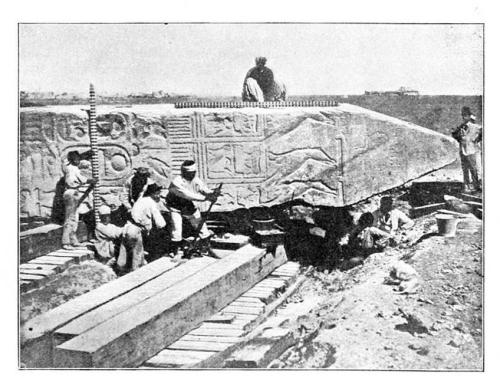
From a] [Photo. PRISING UP THE NEEDLE, IN ORDER TO BUILD THE FRAMEWORK UNDER IT.
In 1801 the French and English fought, and the latter, under Sir Ralph Abercrombie, were victorious. The battle having taken place within sight of the Needle, the English soldiers conceived the desire to possess and take to England the fallen obelisk as a trophy of their success. So anxious were they to have this idea carried out, that they willingly gave up some of their payment, and collected £7,000 towards the expense of its removal.
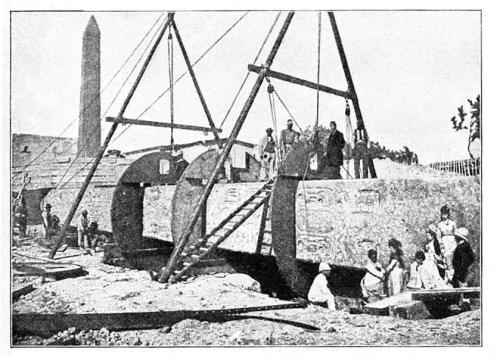
From a] [Photo. BEGINNING THE FRAMEWORK.
The plan they adopted for its conveyance to England on this occasion was to build a pier seaward, and then, taking the Needle to the end of it, proposed putting it through the stern of an old French frigate which had been raised for the purpose. When the pier was partially built a great storm washed it away, and very soon after that the soldiers were ordered to leave Egypt, and the idea could not be carried out. However, the Needle was removed a few feet, and a brass tablet was inserted bearing a record of the British victory. From this time the mind of the people appeared to be in a state of unrest concerning the Needle—an unrest which was not quieted until the column was brought to England and erected where it now stands.
When George IV. was reigning in England, Mehemet Ali was ruling in Egypt, and he offered as a gift to the King this obelisk. George IV. for some reason did not accept the gift. When William IV. came to the throne it was again offered, with an additional favour, for he also promised to pay the cost for its transportation. King William, like his predecessor, King George, thought it best to excuse himself from accepting the obelisk, so he also refused it.
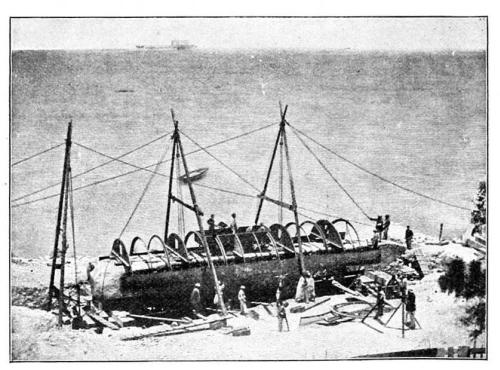
From a] [Photo. PUTTING ON THE CASING.
In 1849 the question was brought before the House of Commons, that the offer made by Mehemet Ali should be re-considered and the obelisk brought to England, but an opposition party opposed the suggestion, considering that the Needle would have become so defaced as to be not worth the risk and expense of removing it.
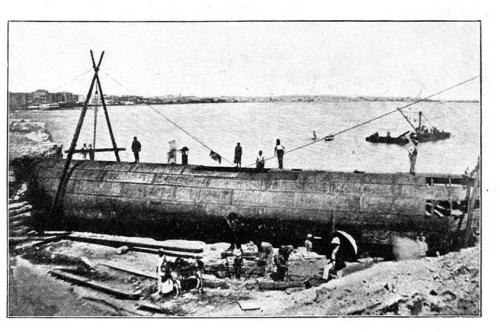
From a] [Photo. COMPLETING THE CASING.
Many years after, when the great Hyde Park Demonstration was being held, it was again suggested that the obelisk should be transported, in honour of the Prince Consort, for his anxiety in trying to make the exhibition a success, but the idea again fell through. When the Sydenham Palace Company were planning their great pavilion they wished to have the Needle to place in the Egyptian department of the building, of course intending to pay for its transit. But it was against order to give a private company any gift which really belonged to the nation.
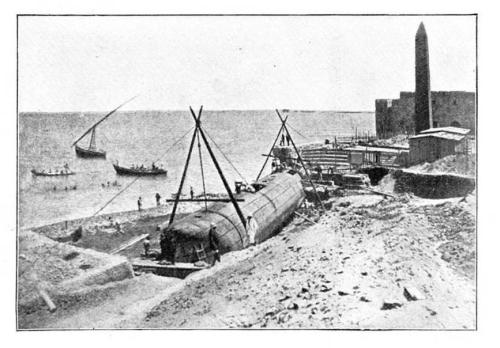
From a] [Photo. THE CASING FINISHED.
The Needle all these years was still lying where the British Army left it, on the shore of the Bay of Alexandria. The ground on which it lay was sold, and a Greek merchant who had bought the land was anxious to have the column taken away. The Khedive advised the English to remove it if they really valued its possession, otherwise they ran the risk of losing it altogether. In 1867 Sir James E. Alexander was attracted by the beauty of the column which was also presented by Mehemet Ali to the French, and stands now in La Place de la Concorde. Remembering that the one belonging to the English was lying unheeded on the shores of Alexandria, he desired to have it brought over to England, and accordingly went to Egypt, gained an interview with the Khedive, and with him discussed its possession and removal. For ten years he was unwearying in his watch over the monument, arranging from time to time with the owner of the land to allow it to remain where it was, hoping meanwhile to be able to make some arrangements concerning it so that it might be preserved for the English.
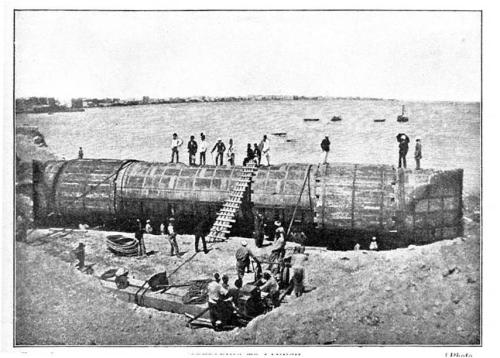
From a] [Photo. PREPARING TO LAUNCH.
He came to the opinion that if ever the obelisk was to be brought to England it would not be at the expense of the nation's purse, but would need to be paid for by private donations. With one or two friends, anxious like himself for the protection of the Needle, he intended to try and raise funds in the City. However, first meeting his friend, Professor Erasmus Wilson, and explaining all to him, the Professor generously offered to pay the sum of £10,000, which was deemed sufficient for the purpose.
In July of 1877 workmen were once more busy in connection with this column which already had experienced such a history. The sand was removed from about it, and to the delight of those most interested it was found to be in an excellent state of preservation. Next came the anxious task of removing it, something more being necessary than the raft, as of old, for the long sea voyage which lay before it.
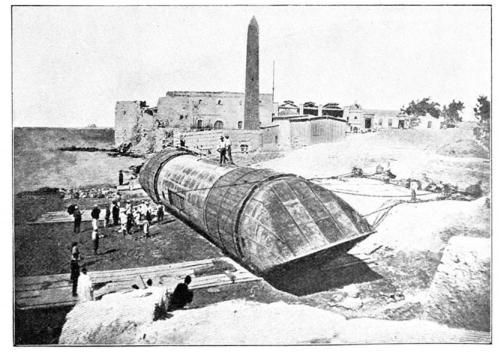
From a] [Photo. THE FIRST ATTEMPT AT LAUNCHING.
A paper might be written on the different methods and numerous plans invented and suggested for the transportation of the Needle. Sir James Alexander had made the acquaintance of Mr. John Dixon, a civil engineer, and he, too, was interested in the monolith. Professor Erasmus Wilson and Mr. Dixon were introduced and discussed the subject together, with the result that Mr. Dixon undertook the responsibility of the conveyance of the column to England, Professor Wilson arranging to pay the £10,000 on its erection in London. A construction was therefore carefully designed in England for encasing the Needle, so that it would be a sea craft of itself, and this was sent out to Egypt in pieces.
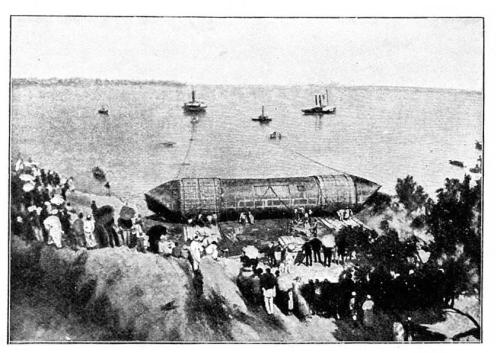
From a] [Photo. THE TUGS IN ACTION.
One of the principal considerations when making their designs was that the Needle when encased required to be launched by being rolled into the water, instead of being sent off in the usual way. Another of the chief difficulties to contend with in the removal of the obelisk was that the bay near which it was lying was unsafe for ships to anchor in, as it was exposed to severe gales and the ground was covered with shoals. The Needle was raised some feet above the ground, the smaller end swung round to be parallel with the sea, and when in this position the work of encasing it was done.
When in this act of turning it, the ground appeared to be giving way under it, and, on examination being made, it was found to be resting on a small vault, which was 6ft. long by 3ft. wide and 4ft. high. It was evidently an ancient tomb, for two human skeletons and some small jars were found in the cavity. The skulls were preserved and put on board the pontoon, when ready for sea, but after the storm in the bay they were never seen again, and the sailors, being foreign, are supposed to have thrown them overboard, through superstition.
The Needle whilst raised and ready for encasing had the plates riveted in place round it, the inside was packed with elastic timber cushions to preserve the stone when being rolled into the water, or in case of any deflection in the vessel's length, which might occur through the waves. The casing was made water-tight, and the greatest care had to be taken to have the column quite in the centre of the cylinder, where it was fastened in position.
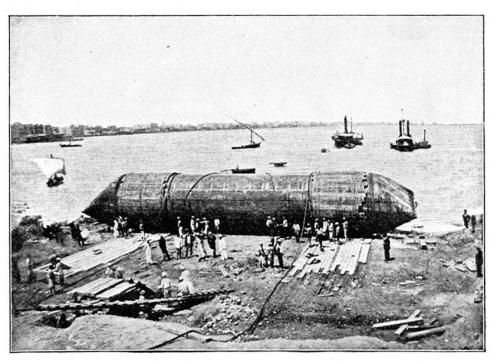
From a] [Photo. AT THE BRINK.
For the purpose of getting it into the water, large wooden wheels, 16-1/2ft. in diameter, were put on either end, and planks were laid for it to roll down. From heavy lighters lying in the bay, wire ropes were taken and wrapped many times round the cylinder. Also from the land side ropes were secured to it, in case, when set in motion, it went off at too great a speed, and thus the ropes could check that fault. On August 28th, 1877, all was ready for the launch. Unfortunately, the morning commenced with a thick fog, which only cleared away as the day wore on.
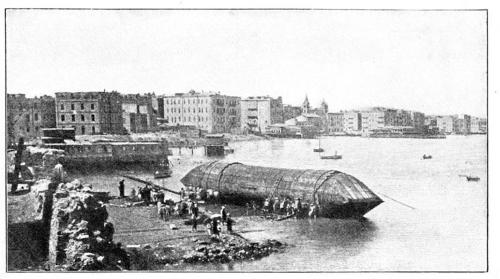
From a] [Photo. REPAIRING THE HOLE MADE BY THE ROCK.
A great crowd of people gathered to witness the interesting event. All being in readiness, the winches on board the lighters worked the ropes connected with the encased Needle, and it commenced to gradually move towards the water, but the movement was so slow that it could scarcely be detected. After some hours it had only made one complete turn on its wheels. It was then proved that the vessels from which the wire ropes were worked were not able to hold their ground against the strain, but were dragging their anchors. Two tugs which had been standing by in readiness to give help if required were called into service, and being connected with the cylinder towed it until she moved a little farther into the water, but although the tugs steamed at full power they could not move the heavy weight at any great speed. The planking ended by an incline into the water, and divers had been previously employed in removing shoals from the intended course to prevent any mishap. When the cylinder was brought to the edge of the railway, so to call it, the idea was that it would roll down the incline and slip off easily into the water.
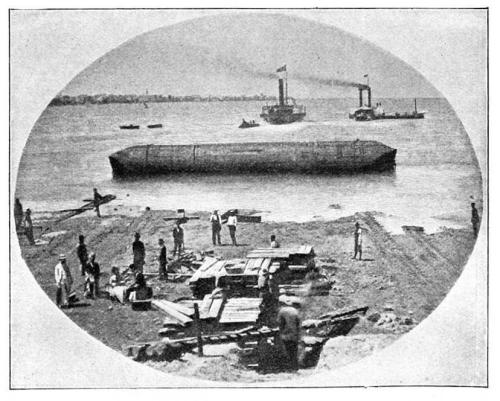
From a] [Photo. LAUNCHED.
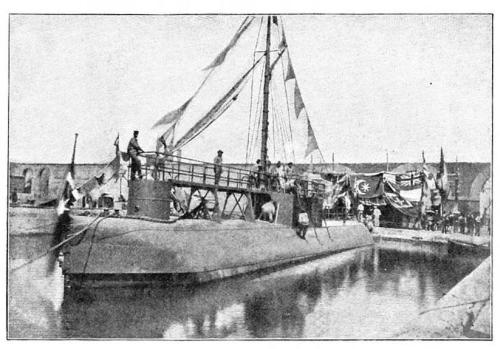
From a] [Photo. PUTTING ON THE TOP-FITTINGS IN DOCK.
All the first day was employed in bringing it to the foot of the incline, and at night it was left in no greater depth of water than 3ft. Next morning the tugs again were at work trying to move it into deep water, but after making one full revolution it stuck, and although the tugs continued to tow all day it remained immovable.
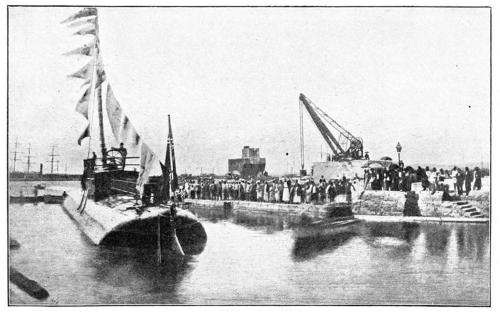
From a] [Photo. FAREWELL TO ALEXANDRIA.
On the third day divers discovered that a hidden stone weighing half a ton had pierced the plates, and making a hole had allowed the water to rush in and fill the cylinder. It took some days to repair the damage made by the rock, but after that was done it was successfully floated and towed round to the harbour, where final arrangements were made for the sea voyage. A cabin house and rail were fixed on top, two bilge keels 40ft. long were riveted one on either side, a mast and rudder placed, and twenty tons of iron ballast were put in her. It was manned by a crew of five Maltese and an English captain. The time occupied from beginning to encase it until the completion was about three and a half months.
A suitable steamer of sufficient size and power was found in the ss. Olga, belonging to Messrs. Wm. Johnson and Co., of Liverpool. The craft, which was named the Cleopatra, was now ready for sea. It was designed not to travel faster than five or six knots an hour, as greater speed might be disastrous. The Olga, towing the Cleopatra, set sail from Alexandria on the 21st September, 1877.
For the first twenty days all was prosperous and uneventful, but on the morning of Sunday, the 14th October, when in the Bay of Biscay, a squall arose, which towards noon developed into a gale. The Cleopatra, however, stood the gale well, not shipping enough water to do any serious harm until about six o'clock on the evening of the same day, when a big sea caught her, turning her completely on her beam ends and carrying away her mast.
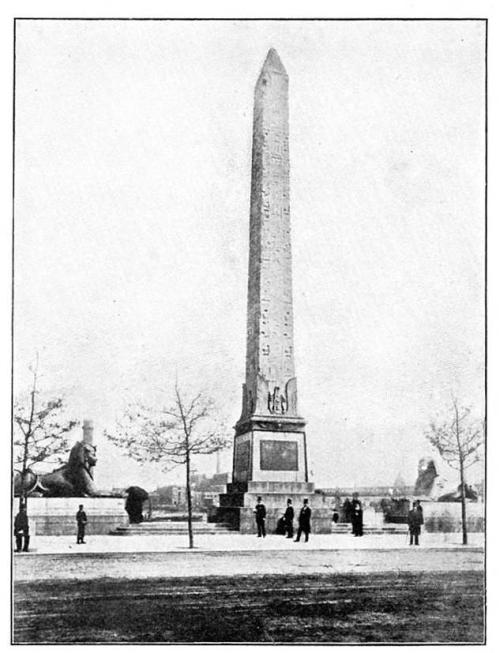
ON THE THAMES EMBANKMENT. From a Photo. kindly lent by C. H. Mabey, Esq., Sculptor of Sphinxes and Pedestal.
A desperate effort was made to right her, but without success; a small boat was lowered, but to no purpose, and the captain of the Olga at this point, seeing the danger all were in, thought it wisest to disconnect the two vessels, and so the cylinder was cut adrift. A little later, the wind having fallen, the Cleopatra signalled for assistance, and the crew of the Olga, pitying the distress of their fellow-sailors, volunteered to put off in a boat and go to their rescue. The captain, thinking it would be a fruitless effort, advised them against it, saying: "A boat could not live in such a sea." The second officer, who had all along taken a keen interest in the welfare of the Cleopatra, replied: "We can't leave the poor fellows to drown; and now, lads, who will go with me?" He found five fine able-bodied men, in the prime of life, were willing to share the risk, and a boat was launched and put off; but before they could render any assistance a great wave washed them away, and they were thus drowned in endeavouring to save others.
After a time a line was thrown from the Olga over the Cleopatra, and by means of it a boat was hauled from the one vessel to the other, and the sailors on the Needle were saved. After spending some hours in searching for signs of the lost boat and the Cleopatra, the captain of the Olga set sail for Falmouth, with the sad news of the enforced abandonment in the Bay and the supposed loss of the Needle and men.
When the news was heard in England, Mr. Dixon was of opinion that the Needle would not sink when cast off, but would float, the only danger being that she might be destroyed on rocks. His surmising was correct in reference to it floating, for a telegram was received sixty days after the news of its loss saying that the ss. Fitzmaurice, bound for Valencia from Middlesbrough, had found and captured it ninety miles north of Ferrol, and had towed it into Vigo in Spain, and it remained in that harbour about three months.
Sir James Ashbury, M.P., kindly offered the loan of his yacht, the Eothen, to tow it home, but arrangements were finally made for the Anglia to do the work, and she arrived in England with the obelisk in tow on the 20th January, 1878.