From Behind the Speaker's Chair. XLVIII.
Reading edition
(VIEWED BY HENRY W. LUCY.)
THE SEARCH FOR GUY FAWKES.
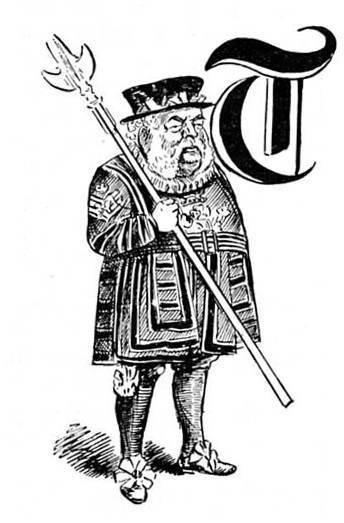
A BEEF-EATER TEMP. HENRY VIII.
he proceedings at the opening of the forthcoming Session, the fifth in the fourteenth Parliament of Queen Victoria, will be fully reported in the morning papers. There is a proceeding preliminary to the Speaker's taking the Chair which, from its history and character, is of necessity conducted in secret. It is the search through the underground chambers and passages of the House with design to frustrate any schemes in the direction of a dissolution of Parliament that descendants or disciples of Guy Fawkes may have in hand. The present generation has seen, more especially when a Conservative Government have been in power, some revolutionary changes in Parliamentary procedure. The solemn search underneath the Houses of Parliament, preceding the opening of the revolving Sessions ever since Gunpowder Plot, is still observed with all the pomp and circumstance attached to it three hundred years ago.
The investigation is conducted under the personal direction of the Lord Great Chamberlain, who is answerable with his head for any miscarriage. When a peer comes newly to the office he makes a point of personally accompanying the expedition. But, though picturesque, and essential to the working of the British Constitution, it palls in time, and the Lord Great Chamberlain, relying upon the discretion, presence of mind, and resource of his Secretary, usually leaves it to him. Oddly enough, the House of Commons is not officially represented at the performance, the avowed object of which is not, primarily, to secure the safety of the Lords and Commons, but to avert the conclusion aimed at by Guy Fawkes—namely, to blow up the Sovereign. It is as the personal representative of the Queen that the Lord Great Chamberlain takes the business in hand.
To this day the result of the inquiry is directly communicated to Her Majesty. Up to a period dating back less than fifty years, as soon as the search was over, the Lord Great Chamberlain dispatched a messenger on horseback to the Sovereign, informing him (or her) that all was well, and that Majesty might safely repair to Westminster to open the new Session. To-day the telegraph wires carry the assurance to the Queen wherever she may chance to be in residence on the day before the opening of Parliament.
THE SEARCH PARTY.
Whilst the Commons take no official part in the performance, the peers are represented either by Black Rod or by his deputy, the Yeoman Usher, who is accompanied by half-a-dozen stalwart doorkeepers and messengers, handy in case of a fray. The Board of Works are represented by the Chief Surveyor of the London District, accompanied by the Clerk of Works to the Houses of Parliament. The Chief Engineer of the House of Commons, who is responsible for all the underground workings of the building, leads the party, the Chief Inspector of Police boldly marching on his left hand.
These are details prosaic enough. The nineteenth century has engrafted them on the sixteenth. The picturesqueness of the scene comes in with the appearance of the armed contingent. This is made up of some fourteen or sixteen of the Yeomen of the Guard, who arrive at the place of rendezvous armed with halberds and swords. The halberds look well, but this search is, above all, a business undertaking. It is recognised that for close combat in the vaults and narrow passages of the building halberds would be a little unwieldy. They are accordingly stacked in the Prince's Chamber, the Yeomen fearlessly marching on armed with nothing but their swords. Clad in their fifteenth century costume, they are commanded by an officer who wears a scarlet swallow-tailed coat, cocked hat, and feathers, gilt spurs shining at his martial heel. The spurs are not likely to be needed. But the British officer knows how to prepare for any emergency.
Following the Yeomen of the Guard stride half-a-dozen martial men in costumes dating from the early part of the present century. They wear swallow-tail coats, truncated cone caps, with the base of the cone uppermost. They are armed with short, serviceable cutlasses and bâtons, such as undertakers' men carry, suggesting that they have come to bury Guy Fawkes, not to catch him.
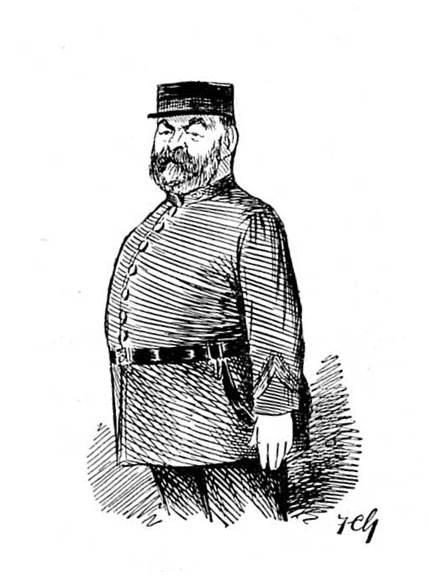
INSPECTOR HORSLEY.
Most of the underground chambers and passages of the Houses of Parliament are lit by electricity. Failing that, they are flooded with gas. When search for Guy Fawkes was first ordered, the uses of gas had not been discovered, much less the possibilities of electricity. Lanterns were the only thing, so lanterns are still used. As the dauntless company of men-at-arms tramp along the subterranean passages, it is pretty to see the tallow dips in the swinging lanterns shamed by the wanton light that beats from the electric lamps.
PARLIAMENTARY CAVES.
Her Majesty's Ministers meeting Parliament at the opening of their fifth Session remain happy in the reflection that their position is not endangered by any mines dug within the limits of their own escarpment. It is different in the opposite camp. The first thing good Liberals do as soon as their own party comes into power is to commence a series of manœuvres designed to thrust it forth. Sometimes they are called "caves," occasionally "tearoom cabals." But, as Mr. Gladstone learned in the 1868-74 Parliament, in that of 1880-85, and, with tragic force, in the Parliament which made an end of what Mr. Chamberlain called "The Stop-Gap Government," they all mean the same thing. Lord Rosebery when he came to the Premiership found the habit was not eradicated.
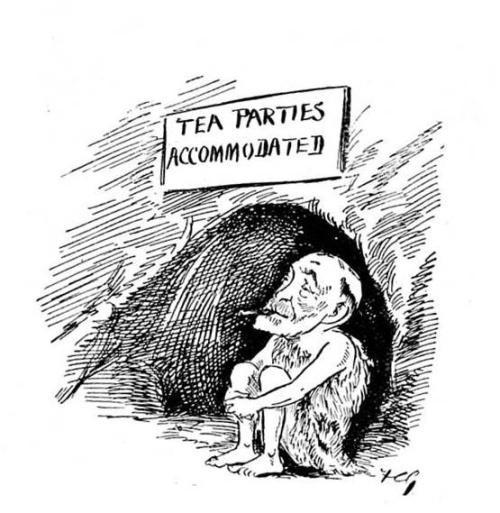
A CAVE-MAN.
The condition of men and things in the House of Commons when Parliament met after the General Election in July, 1895, was rarely favourable to the formation of "caves" on the Ministerial side. To begin with, the Government had such an overwhelming majority that the game of playing at being independent was so safe that its enjoyment was not forbidden to the most loyal Unionist. Given that condition, there were existent personal circumstances that supplied abundant material for cave-making. The necessity imposed on Lord Salisbury of finding place in his Ministry for gentlemen outside the Conservative camp made it impossible not only to satisfy reasonable aspirations on the part of new men of his own party, but even to reinstate some ex-Ministers. Some, like Baron de Worms, were shelved with a peerage. Others, overlooked, were left to find places on back benches above or below the gangway. Of men who held office in Lord Salisbury's former Administration, Mr. Jackson, Sir James Fergusson, Sir W. Hart-Dyke, and Sir E. Ashmead-Bartlett were left out in the cold. Whilst most of the leading members of the Liberal Unionist wing, including Mr. Jesse Collings and Mr. Powell Williams, were provided with office, Mr. Courtney's claims were ignored, and Sir John Lubbock's were probably never considered.
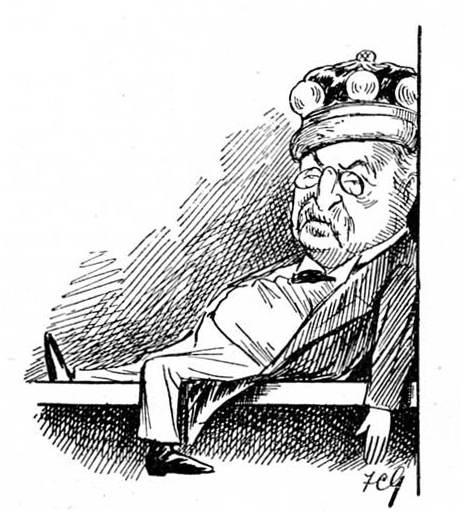
SHELVED WITH A PEERAGE. (BARON DE WORMS.)
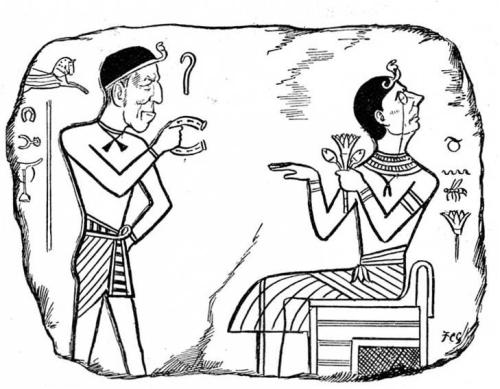
"WHO KNEW NOT JEMMY."
AN OLD PARLIAMENTARY HAND.
Amongst Conservative members who had not been in office but were not alone in their belief that they were well fitted for it were Mr. Gibson Bowles and Mr. George Wyndham—the latter since deservedly provided for. Moreover, to a corner seat below the gangway returned Mr. James Lowther, thought good enough in Disraeli's time to be Under-Secretary for the Colonies and Chief Secretary for Ireland. Since the death of Lord Beaconsfield kings had arisen in Egypt who knew not "Jemmy," or, at least, forgot his existence at a time when Ministerial offices were dispensed. The member for East Thanet, first returned for York in the summer of 1865, is not only personally popular in the House, but has high standing as an old Parliamentary hand. If he had liked to turn rusty, he might have done the Conservative Party at least as much harm as Mr. Horsman when in the same mood wrought to the party with which, to the last, he ranked himself. From time to time Mr. Lowther has vindicated his independence of Ministerial discipline by dividing the House on the question of the futility of reading, at the commencement of recurring Sessions, the standing order forbidding peers to interfere with elections. He has not gone beyond that, and whenever attempt has been made from the Opposition side to inflict damage on the best of all Governments, he has ranged himself on the side of Ministers.
OVERLOOKED.
Sir W. Hart-Dyke, Sir James Fergusson, and the late Sir W. Forwood, instead of openly resenting neglect, on more than one occasion went out of their way to defend the colleagues of the Prime Minister who slighted them. Mr. Wyndham was last Session not less generously loyal. Mr. Tommy Bowles, it is true, has been on occasion fractious. As for Sir E. Ashmead-Bartlett, when he recovered from the shock of realization that Lord Salisbury had not only formed a Ministry without including him in its membership, but looked as if he would be able to carry it on, he showed signs of resentment. Through successive Sessions he has sedulously endeavoured to embarrass an unappreciative Premier by cunningly devised questions addressed to the Colonial Secretary or to the Under-Secretary for Foreign Affairs. Mr. Chamberlain and Mr. Curzon alike proved able to hold their own, and the Sheffield Knight coming out to kick has found himself fulfilling the humble function of the football.
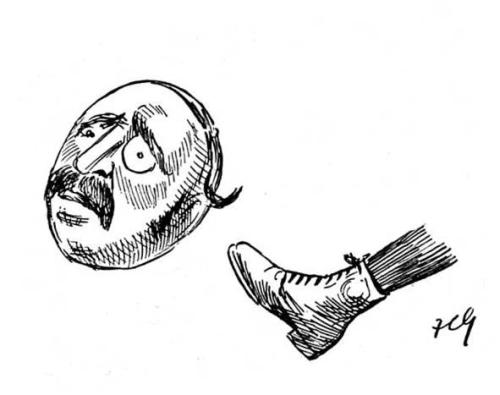
THE HUMBLE FUNCTION OF THE FOOTBALL.
MR. YERBURGH.
A more serious defection was threatened last Session as the result of the distrust and discontent in Ministerial circles of Lord Salisbury's foreign policy. Mr. Yerburgh, moved by apprehension that the interests of the British Empire in the Far East were at stake, instituted a series of weekly dinners at the Junior Carlton, where matters were talked over. The dinners were excellent, the wines choice, and Mr. Yerburgh has a delicate taste in cigars. This meeting at dinner instead of at tea, as was the fashion in the Liberal camp at the time of Mr. Gladstone's trouble over the Irish University Bill in 1873, seemed to indicate manlier purpose. But nothing came of it, except a distinct advancement of Mr. Yerburgh's position in the House of Commons. He, as spokesman of the malcontents, found opportunity to display a complete mastery of an intricate geographical and political position, combined with capacity for forcibly and clearly stating his case.
Thus Lord Salisbury remained master of himself though China fell. Had Mr. Gladstone been in his position, under precisely similar circumstances, it would have been Her Majesty's Ministry that would have fallen to pieces.
JOINED THE MAJORITY.
As usual the recess has seen the final going over to the majority of old members of the House of Commons. Two who have died since the prorogation were distinct types of utterly divergent classes. There was nothing in common between the Earl of Winchilsea and Mr. T. B. Potter, except that they both sat in the 1880 Parliament, saw the rise of the Fourth Party, and the crumbling away of Mr. Gladstone's magnificent majority. Mr. Potter was by far the older member, having taken his seat for Rochdale on the death of Mr. Cobden in 1865. Except physically, he did not fill a large place in the House, but was much esteemed on both sides for his honest purpose and his genial good temper.
This last was imperturbable. It was not to be disturbed even by a double misfortune that accompanied one of the Cobden Club's annual dining expeditions to Greenwich. On the voyage out, passing Temple Pier, one of the guests fell overboard. At the start on the return journey, another guest, a distinguished Frenchman, stepping aboard as he thought, fell into the gurgling river, and was fished out with a boat-hook. Yet Mr. Potter, President of the Club, largely responsible for the success of the outing, did not on either occasion intermit his beaming smile.
A BUFFER STATE.
He was always ready to be of service in whatsoever unobtrusive manner. The House cherishes tender memories of a scene in 1890. The fight in Committee Room No. 15 had recently closed. Its memories still seared the breasts of the Irish members. Members were never certain that at any moment active hostilities might not commence even under the eye of the Speaker. One night a motion by Mr. John Morley raising the Irish question brought a large muster of the contending forces. Mr. Parnell, who had temporarily withdrawn from the scene, put in an appearance with the rest. He happened to seat himself on the same bench as Mr. Justin McCarthy, whom the majority of the Irish members had elected to succeed him in the leadership. Only a narrow space divided the twain. The most apprehensive did not anticipate militant action on the part of Mr. McCarthy. But, looking at Mr. Parnell's pale, stern face, knowing from report of proceedings in Committee Room No. 15 what passion smouldered beneath that mild exterior, timid members thought of what might happen, supposing the two rose together diversely claiming the ear of the House as Leader of the Irish Party.
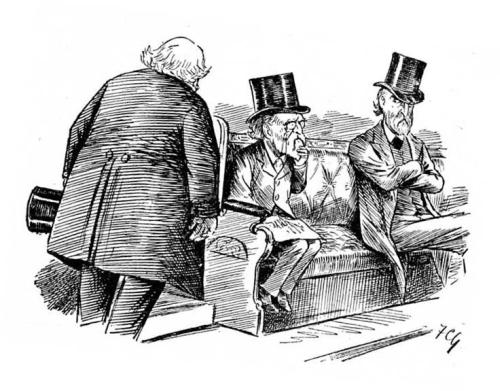
THE BUFFER STATE.
At this moment Mr. T. B. Potter entered and moved slowly up the House like a Thames barge slipping down the river with the tide. He made his way to the bench where the severed Irish Leaders sat, and planted himself out between them, they perforce moving to right and left to make room. Seeing him there, his white waistcoat shimmering in the evening light like the mainsail of an East Indiaman, the House felt that all was well. Mr. Parnell was a long-armed man; but, under whatsoever stress of passion, he could not get at Mr. McCarthy across the broad space of the member for Rochdale.
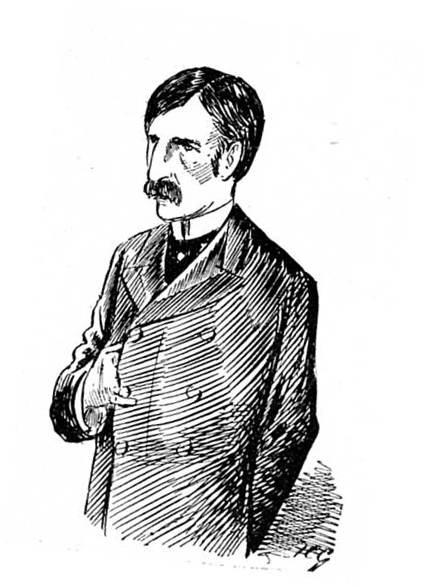
THE LATE LORD WINCHILSEA.
A PROMISING START.
Lord Winchilsea sat in this same Parliament as Mr. Finch-Hatton. He early made his mark by a maiden speech delivered on one of the interminable debates on Egypt. He was content to leave it there, never, as far as I remember, again taking part in set debate. His appearance was striking. Many years after, when he had succeeded to the earldom, I happened to be present when he rose from the luncheon-table at Haverholme Priory to acknowledge the toast of his health. By accident or design he stood under a contemporary portrait of his great ancestor, Christopher Hatton, Queen Elizabeth's Lord Chancellor. The likeness between the founder of the family and a scion separated by the space of more than three hundred years was almost startling.
Lord Winchilsea aged rapidly. When he made his maiden speech in the House of Commons he had not advanced beyond the stage of the young dandy. His face was a shade of ivory, the pallor made more striking by the coal-black hair. His attitude, like his dress and everything about him, was carefully studied. His left hand, rigidly extended, lightly rested behind his back. His right hand, when not in action, hid his finger-tips in the breast of a closely-buttoned frock-coat. Occasionally, he withdrew his hand and made stiff gestures in the air as if he were writing hieroglyphs. Occasionally, he emphasized a point by slightly bowing to the amused audience.
The matter of his speech was excellent, its form, occasionally, as extravagant as his getup. The House roared with laughter when Mr. Finch-Hatton, pointing stiff finger-tips at Mr. Gladstone smiling on the Treasury Bench, invited members to visit the Premier on his uneasy couch and watch him moaning and tossing as the long procession of his pallid victims passed before him. This reminiscence of a scene from "Richard III." was a great success, though not quite in the manner Mr. Hatton, working it out in his study, had forecast.
A man of great natural capacity, wide culture, and, as was shown in his later connection with agriculture, of indomitable industry, he would, having lived down his extravagancies, have made a career in the Commons. Called thence by early doom he went to the Lords, and was promptly and finally extinguished.
MUSTERED AT J. J. COLMAN'S.
Another old member of the House who died in the recess is Mr. Colman. The great mustard manufacturer, whose name was carried on tin boxes to the uttermost ends of the earth, never made his mark in the House of Commons. I doubt whether he ever got so far as to work off his maiden speech. A quiet, kindly, shrewd man of business, he was content to look on whilst others fought and talked. He came too late to the House to be ever thoroughly at one with it, and took an early opportunity of retiring.
Mr. Gladstone had a high respect for him, and occasionally visited his beautiful home in Norfolk. One of these occasions became historic by reason of Mr. Gladstone unwittingly making a little joke. Coming down to breakfast one morning, and finding the house-party already gathered in the room, Mr. Gladstone cheerily remarked, "What, are we all mustered?"
He never knew why this innocent observation had such remarkable success with Mr. J. J. Colman's guests.
MR. GLADSTONE'S TABLE-TALK.
A few more recollections of Mr. Gladstone whilst still in harness. I remember meeting him at a well-known house during the Midlothian campaign of 1885. He came in to luncheon half an hour late, and was rallied by the host upon his unpunctuality. "You know," he said, "only the other day you lectured us upon the grace of punctuality at luncheon-time."
Mr. Gladstone took up this charge with energy familiar at the time in the House of Commons when repelling one of Lord Randolph Churchill's random attacks. Finally, he drew from the host humble confession that he had been in error, that so far from recommending punctuality at luncheon-time he had urged the desirability of absence of formality at the meal. "Anyone," he said, "should drop in at luncheon when they please and sit where they please."
Through the meal he was in the liveliest humour, talking in his rich, musical voice. After luncheon we adjourned to the library, a room full of old furniture and precious memorials, chiefly belonging to the Stuart times. On the shelves were a multitude of rare books. Mr. Gladstone picked up one, and sitting on a broad window seat, began reading and discoursing about it. Setting out for a walk, he was got up in a most extraordinary style. He wore a narrow-skirted square-cut tail-coat, made, I should say, in the same year as the Reform Bill. Over his shoulders hung an inadequate cape, of rough hairy cloth, once in vogue but now little seen. On his head was a white soft felt hat. The back view as he trudged off at four-mile-an-hour pace was irresistible.
Mrs. Gladstone watched over him like a hen with its first chicken. She was always pulling up his collar, fastening a button, or putting him to sit in some particular chair out of a draught. These little attentions Mr. Gladstone accepted without remark, with much the placid air a small and good-tempered babe wears when it is being tucked in its cot.
AN OLD LONDON HOUSE.
In the Session of 1890, Mr. Gladstone rented a house in St. James's Square, a big, roomy, gloomy mansion, built when George I. was King. On the pillars of the porch stand in admirable preservation two of the wrought iron extinguishers, in which in those days the link-boys used to thrust their torches when they had brought master or mistress home, or convoyed a dinner guest. Inside hideous light-absorbing flock wall-papers prevailed. One gained an idea, opportunity rare in these days, of the murkiness amid which our grandfathers dwelt.
Dining there one night, I found the host made up for all household shortcomings. He talked with unbroken flow of spirits, always having more to say on any subject that turned up, and saying it better, than any expert present. His memory was as amazing as his opportunities of acquiring knowledge had been unique.
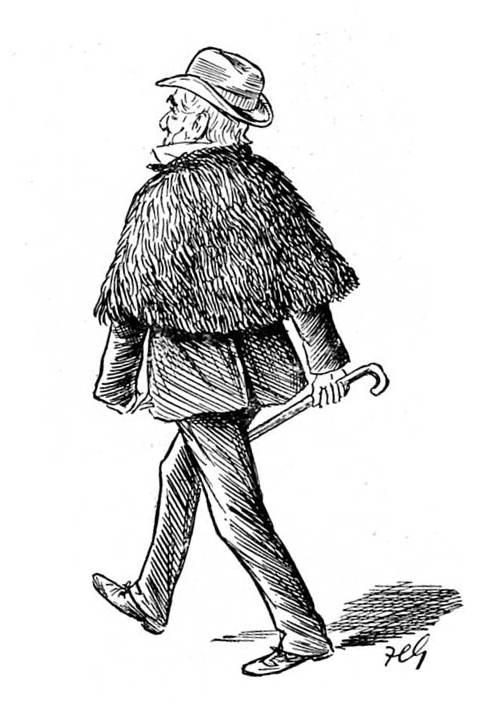
AT A FOUR-MILE-AN-HOUR PACE.
MEMORIES OF CHILDHOOD.
As we sat at table he, in his eighty-first year, recalled, as if it had happened the day before, an incident that befell when he was eighteen months old. Prowling about the nursery on all-fours, there suddenly flashed upon him consciousness of the existence of his nurse, as she towered above him. He remembered her voice and the very pattern of the frock she wore. This was his earliest recollection, his first clear consciousness of existence. His memory of Canning when he stood for Liverpool in 1812 was perfectly clear; indeed, he was then nearly three years old, and took an intelligent interest in public affairs.
Of later date was his recollection of Parliamentary Elections, and the strange processes by which in the good old days they were accomplished. The poll at Liverpool was kept open sometimes for weeks, and the custom was for voters to be shut up in pens ten at a time. At the proper moment they were led out of these inclosures and conducted to the polling-booths, where they recorded their votes. These musters were called "tallies," and the reckoning up of them was a matter watched with breathless interest in the constituency.
DOCTORING A TALLY.
It was a point of keen competition which side should first land a "tally" at the polling-booth. Mr. Gladstone told with great gusto of an accident that befell one in the first quarter of the century. The poll opened at eight o'clock in the morning. The Liberals, determined to make a favourable start, marshalled ten voters, and as early as four in the morning filled the pen by the polling-booth. To all appearances the Conservatives were beaten in this first move. But their defeat was only apparent. Shortly after seven o'clock a barrel of beer, conveniently tapped, with mugs handy, was rolled up within hand-reach of the pen, where time hung heavy on the hands of the expectant voters. They naturally regarded this as a delicate attention on the part of their friends, and did full justice to their hospitable forethought. After a while, consternation fell upon them. Man after man hastily withdrew till the pen was empty, and ten Conservatives, waiting in reserve, rushed in and took possession of the place.
"The beer," said Mr. Gladstone, laughing till the tears came into his eyes, "had been heavily jalaped."