Part 2 — A Town in the Tree-Tops.
Reading edition
By Ellsworth Douglass.
verybody at the pension had heard it, but Bayly has a circumstantial and picturesque manner of narration, which gives old stories a new interest.
"Wasn't it your American millionaire, Mr. Waldorf Astor," he said, addressing me, "who made a wager that he would comfortably seat thirty-two guests around the stump of a California big tree? And didn't he do it? Brought a slice off the tree-stump more than 6,000 miles, and had a grand dinner on it in London?"
"I must say I like your big tree stories better than your big tree wines," put in Gaillet, a dashing young Frenchman, who spoke English fluently; "but I don't think all that is so wonderful. I can show you a place, within less than an hour of Paris, where more than thirty-two persons can dine around comfortable tables high up in the branches of a single tree!"
"That sounds interesting, Gaillet; to me it smells like 'good copy.' Eating up in trees might make some novel photographs; what do you say, Bayly?"
I purposely touched the young Englishman on his hobby. He was an amateur photographer of the virulent and persistent type, and had recently infected me with the contagion.
"If the sun looks promising we will ride down there on our wheels to-morrow and have a look at them," he replied. "Can you go with us and show us the way, Gaillet?"
And so, early the next morning, we went. It was a delightful two hours on the wheel in early October. Just as the country began to grow more broken and interesting, and chestnut trees began to strew the paths with prickly burrs, we wheeled up a slight hill into a quaint village, and dismounting, Gaillet exclaimed:—
"Here we are at home with Robinson Crusoe!"
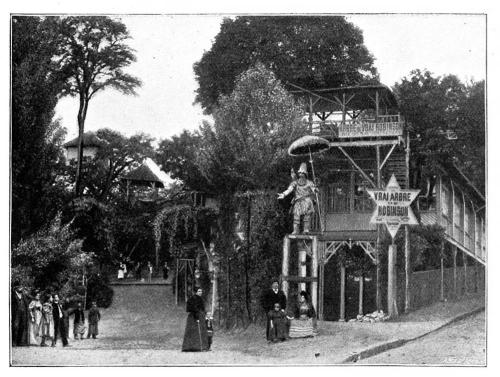
From a Photo. by] [L. Bayly. THE VILLAGE OF ROBINSON.
Had he told me that Robinson Crusoe really lived in the flesh and, after returning from his lonely adventures, founded this little village, and here attempted to bring into fashion his old habit of eating in the trees, I would have believed it. For here is the village bearing his name to this day; here also, as seen in our first photograph, is his effigy in the principal street, under his rough, thatched umbrella, and with his parrot seated upon his shoulder, as every schoolboy knows him. Here, likewise, are a number of great trees, with two or three rustic dining-huts built far up on the limbs of each; and, as Gaillet assured us, here, for the last fifty years, men and their families have eaten in the trees like squirrels.
As Bayly prepared to take the first photograph, he noticed that the highest dining-stage in the tip-top of the biggest tree had curtains drawn around it, which he asked to have pulled back. A waiter informed him that this rustic hut was engaged by a party.
"Yes, I telephoned down yesterday afternoon, and reserved it for us," put in Gaillet. "I also ordered the déjeuner. I hope you will like it: sole au gratin and chateaubriand aux champignons."
At that moment the wind left the leaves and boughs at rest, and Bayly snapped the shutter, regardless of the curtains. I made reply to Gaillet:—
"I never heard of Crusoe's fare being quite so pretentious as all that. He must have learned cookery since he came to France."
"It is M. Gueusquin aîné who claims the credit for applying the tree idea to modern dining. Doubtless he does it better than Crusoe could have done. At any rate, he has made a large fortune out of the idea—far more than Defoe made out of his story. It was just fifty years ago," continued Gaillet, "that the father of the present proprietor here was struck with the clever idea, bought this picturesque plot of ground with large trees on it, and built rustic dining-rooms on the strongest branches. He called his lonely little country place Robinson, after the Swiss family which figures in the French version of the romance, and invited the patronage of the fun-loving Parisians who delight in fanciful ideas of ibis sort. At that time it was a long coach ride from the city, but it soon became the popular rendezvous for a day's outing. Since then Kings have dined here; thousands of wedding parties have seen life rosy from the tree-tops, and nearly every Parisian boy who reads the story of Robinson's adventures is taken to this quaint little village as a realistic sequel. M. Gueusquin's success tempted others into similar ventures here, so that now nearly every large tree is utilized, and Robinson has grown into quite a respectable village, whose name will always be associated in the French mind with breezy dinners, family picnics, donkey-riding, bracing country air, and charming scenery. The Ligne de Sceaux long ago built a branch line terminating here, and a journey of forty minutes by train brings one down from the Luxembourg Station in Paris."
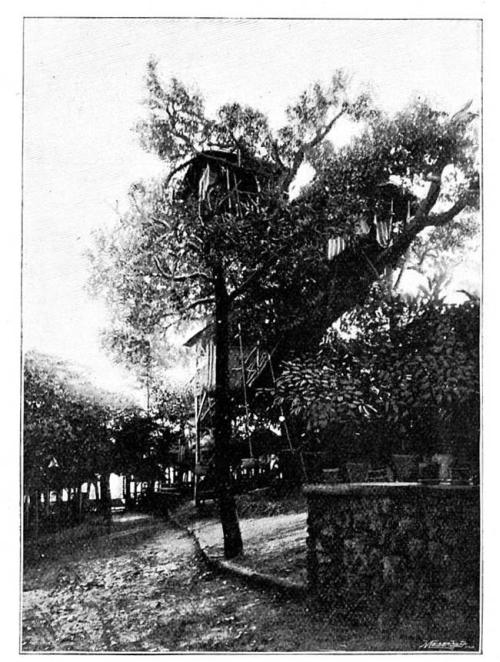
From a Photo. by] [L. Bayly. THE LARGEST ROBINSON TREE.
Bayly evidently cared little for these facts, for he had busied himself getting a focus on the largest tree, which M. Gueusquin proudly advertises as "Le Vrai Arbre de Robinson." You may see the result in the accompanying photograph. Its massive trunk has not much increased in size since the stairway was built around it half a century ago. There is one thatched hut built at the first branch of the tree; another well out on a higher limb on the other side of the trunk; and the third and most desirable in the very tip-top, from which one sees an enchanting view of all the pretty country lying towards Paris. A stairway connects all these rustic huts with each other, and in the busy season a waiter is stationed at each dining stage, and the wines and cooked foods are hauled up to him from the ground by means of a rope and basket running to each stage, as will be seen in most of the photographs. At wedding parties these same baskets have more than once served to lower away some bibulous guest whose frequent toasts to the bride have ended in a decided disinclination to attempt the giddy and precipitous stairway.
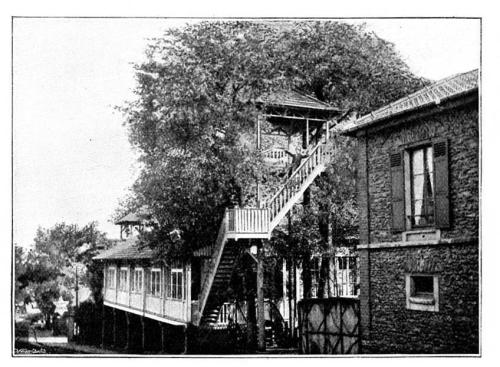
From a Photo. by] [Ellsworth Douglass. LARGE DINING-ROOM BETWEEN TWO TREES.
Bayly went next to inspect a larger and more modern dining-room built between two young trees, and I have caught him on the stairway in the photograph above. But I was anxious to climb to some height and get a good view of the nest in the tree-top where we were to breakfast. I heard someone laughing at my first futile attempts at climbing, but at last I gained a point of vantage which gave a view over the tops of the trees to the indefinite stretch of pretty valley beyond.
While breakfast was preparing we visited the neighbouring inns to photograph the trees. Just across the road we found one which claims the distinction of being the tallest in Robinson. As will be seen in the photograph, it has three dining stages one directly above another, so that the same basket may serve them all. A waiter can be seen in the top stage of this thrifty, sturdy chestnut, in which many generations may yet dine.
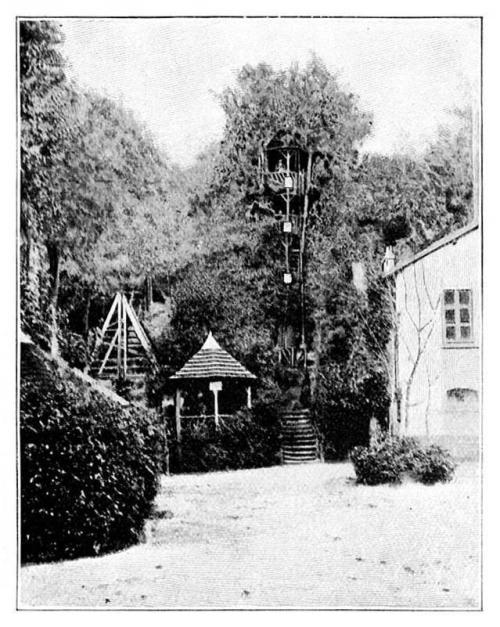
From a Photo. by] [L. Bayly. A THREE-STORY TREE.
Farther down the road is a place called the Maison Robin, possibly in the hope that the kind public will believe that the "true Robinson" was this Robin's son. Here is the "Great Chestnut," which truly looks as if it might antedate Robinson Crusoe by centuries. Yet it still showers its plenteous fruit upon the ground, and as we kicked about its bushels of bursting burrs we wondered how "marron glacé" could be so expensive in Paris. The next photograph shows how the walks were sprinkled with ripe nuts; and also some pretty samples of the vine or ivy-covered bosquets for those who prefer to dine on terra firma. These are numerous, and charmingly pretty in the gardens of most of the inns here.
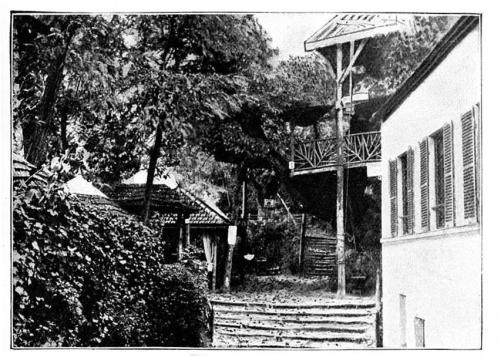
From a Photo. by] [Ellsworth Douglass. THE GREAT CHESTNUT.
Another great feature of Robinson is the family picnic, but the French love ease and comfort too much to dine on the grass under the trees. They prefer to sit properly at a table, and many of the inns recognise the right of visitors to bring their own provisions, and are content with serving them wines, coffee, and the like. When you go to Robinson, you are sure to recognise this place at the turning of the road before reaching the great trees.
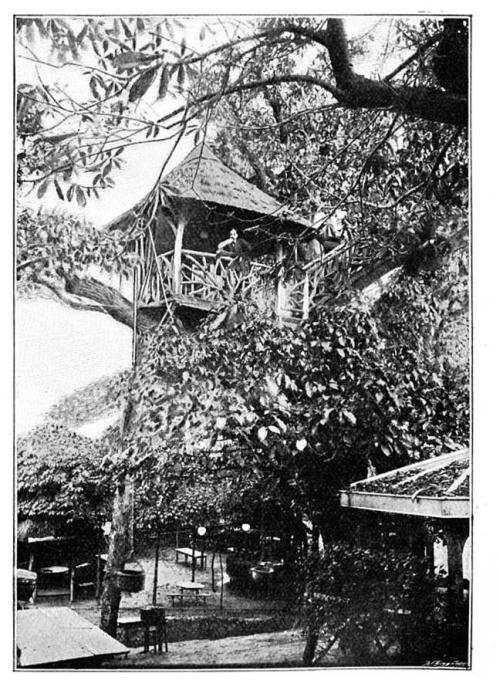
From a Photo. by] [L. Bayly. NEAR VIEW OF A HUT ON A BRANCH.
I returned to our second stage with Gaillet, and found the table laid, but not a scrap of food to be seen. The waiter was trotting up the stairs with a heavily-loaded tray, on which was an enormous plate of sole au gratin. Gaillet remarked that it looked as if the people in the top hut had not only captured our place, but our breakfast as well. He begged the waiter to hurry our order, and then asked me what I thought might be going on up there behind the curtains. It was very near us, and perhaps for this reason the young ladies refrained from audible conversation. They only whispered among themselves and laughed at intervals, but Gaillet thought he surprised one or two attempts to peep around the curtain at us. I was ravenously hungry, and when the waiter next went past up to the top story I seized a yard of bread from his tray. Looking down at Bayly, who was focusing below, I cried out: "Lancelot, if you are hungry, get a photograph of the only morsel of food I have been able to secure before I devour it!" And our last illustration bears witness that he did so. This detailed view of a thatched, rustic hut perched upon a big limb finished his work.