Part 2 — A Record of 1811. OR, A SHEEP'S COAT AT SUNRISE, A MAN'S COAT AT SUNSET.
Reading edition
By J. R. Wade.
t is no new thing for us to see records established one day and beaten the next, the top place nowadays being no sooner reached by one individual than challenged by another. The record in the manufacture of cloth, however, with which this article deals, though of eighty-eight years' standing, has never yet been eclipsed.
The scene of this remarkable achievement in the sartorial art is the village of Newbury, Berkshire, and it came about in this way. Mr. John Coxeter, a then well-known cloth manufacturer, the owner of Greenham Mills, at the above-named village, remarked in the course of conversation one day in the year 1811, to Sir John Throckmorton, Bart., of Newbury, "So great are the improvements in machinery which I have lately introduced into my mill, that I believe that in twenty-four hours I could take the coat off your back, reduce it to wool, and turn it back into a coat again."
The proverb says, "There's many a true word spoken in jest." So great an impression did Mr. Coxeter's boast make upon the Baronet, that shortly afterwards he inquired of Mr. Coxeter if it would really be possible to make a coat from sheep's wool between the sunrise and sunset of a summer's day. That gentleman, after carefully calculating the time required for the various processes, replied that in his opinion it could be done.
Not long after the above conversation, which took place at a dinner party, Sir John Throckmorton laid a wager of a thousand guineas that at eight o'clock in the evening of June the 25th, 1811, he would sit down to dinner in a well-woven, properly-made coat, the wool of which formed the fleeces of sheep's backs at five o'clock that same morning. Such an achievement appearing practically impossible to his listeners, his bet was eagerly accepted.
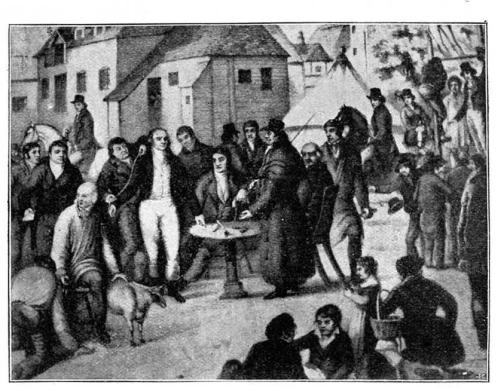
From an] [Old Print. SHEARING THE SHEEP.
Sir John intrusted the accomplishment of the feat to Mr. Coxeter, and shortly before five o'clock on the morning stated, the early-rising villagers of Newbury were astonished to see their worthy squire, accompanied by his shepherd and two sheep, journeying towards Greenham Mills. Promptly at five o'clock operations commenced, and no time was lost in getting the sheep shorn. Our first illustration, which is from an old print executed at the time, shows the sheep being shorn by the shepherd, and is worthy of a little attention. Sir John stands in the middle of the picture, having his measurements taken by the tailor, and it is an interesting fact that, except that all implements to be used were placed in readiness on the field of action, the smallest actual operations in the making of the coat were performed between the hours mentioned.
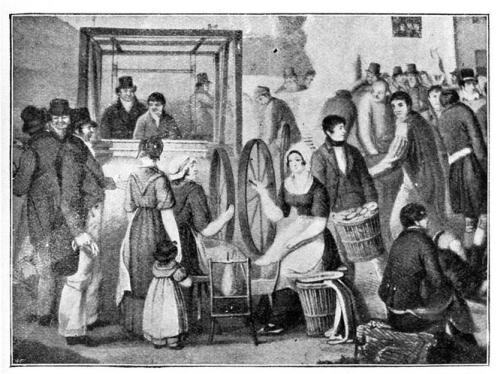
From an] [Old Print. MAKING THE CLOTH.
Mr. Coxeter stands just behind the sheep-shearer, watching with an anxious eye, whilst to the right may be seen a tent, which was erected presumably for refreshments, and schoolboys climbing a greasy-pole and generally making the best of the holiday which had been accorded them in order that they might witness this singular spectacle.
The sheep being shorn, the wool was washed, stubbed, roved, spun, and woven, and our next illustration, also from an old print, shows the weaving, which was performed by Mr. Coxeter, junior, who had been found by previous competition to be the most expert workman. In the background of this picture may be seen the carcass of one of the sheep; of which more later. The curious-looking objects in the basket, held, by the way, by another of Mr. Coxeter's sons, are wool spools, while in the extreme background, looking out of the window of a quaint old cottage, may be seen "the gods in the gallery."
When we compare the primitive-looking loom seen in this picture with the powerful machinery of to-day, the record then established certainly becomes all the more wonderful.
The cloth thus manufactured was next scoured, fulled, tented, raised, sheared, dyed, and dressed, being completed by four o'clock in the afternoon, just eleven hours after the arrival of the two sheep in the mill-yard.
In the meantime, the news of the wager had spread abroad among the neighbouring villages, bringing crowds of people eager to witness the conclusion of this extraordinary undertaking.
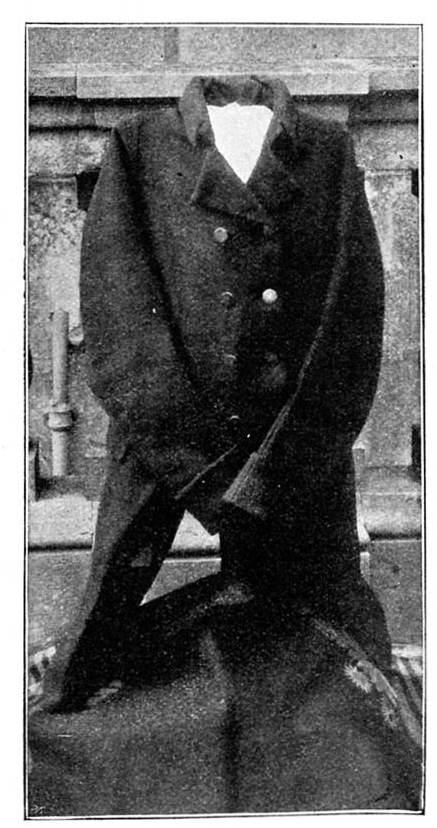
THE FINISHED COAT. From a Photo. by C. J. Coxeter, Abingdon.
The cloth was now put into the hands of the tailor, Mr. James White, who had already got all measurements ready during the operations, so that not a moment should be lost; and he, together with nine of his men, with needles all threaded, at once started on it. For the next two hours and a quarter the tailors were busy cutting out, stitching, pressing, and sewing on buttons, in fact, generally converting the cloth into a "well woven, properly made coat," and at twenty minutes past six Mr. Coxeter presented the coat to Sir John Throckmorton, who put the garment on before an assemblage of over five thousand people, and sat down to dinner with it on, together with forty gentlemen, at eight o'clock in the evening.
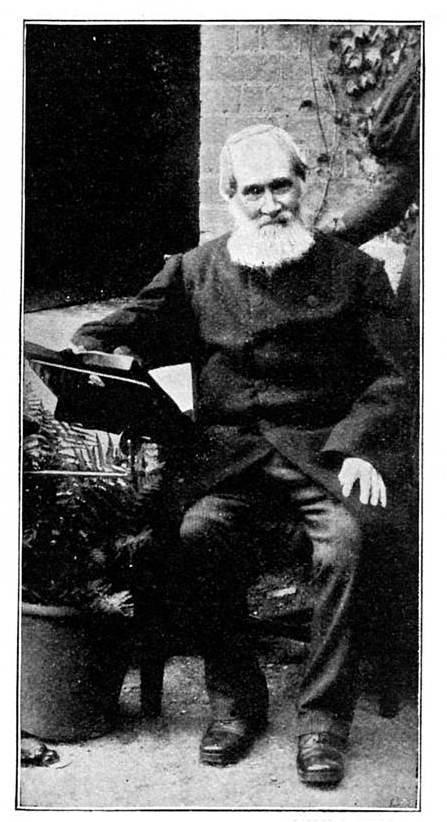
MR. CHARLES COXETER, THE ONLY LIVING EYE-WITNESS. From a Photo. by C. J. Coxeter, Abingdon.
Through the kindness of Sir William Throckmorton, its present owner, we are able to give our readers, in the illustration shown at the bottom of the previous page, a photograph of this wonderful coat. The garment was a large hunting-coat of the then admired dark Wellington colour, a sort of a damson tint. It had been completed in the space of thirteen hours and ten minutes, the wager thus being won with an hour and three-quarters to spare.
To commemorate the event, the two sheep who were the victims of Mr. Coxeter's energy were killed and roasted whole in a meadow near by, and distributed to the public, together with 120 gallons of strong beer, this latter being the gift of Mr. Coxeter.
Our next illustration is a photograph of Mr. Charles Coxeter, of Abingdon, Berks, the only living eye-witness to this feat. He is the younger brother to the weaver of the cloth, long since dead, who is shown in our second illustration. His present age is ninety-three. When approached on the subject he said he well remembered the event, and recalls with pleasure seeing the workmen dine off portions of the sheep, in a barge on the river near the mill. The original mill unfortunately no longer stands, having long since been destroyed, a more modern mill now occupying the site.
We now give an illustration of the silver medal which was struck in honour of the occasion. It is worded as follows:—
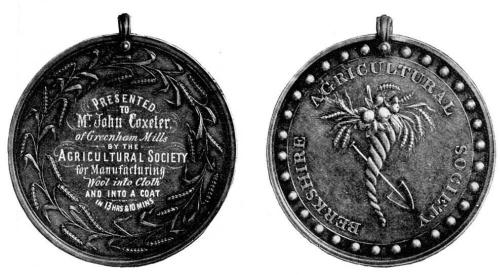
"Presented to Mr. John Coxeter, of Greenham Mills, by the Agricultural Society, for manufacturing wool into cloth and into a coat in thirteen hours and ten minutes."
Mr. Coxeter was a very enterprising individual, for seemingly not content with this wonderful achievement, not many years after, in connection with the public rejoicings for peace after the Battle of Waterloo, he had a gigantic plum-pudding made, which was cooked under the supervision of twelve ladies. This monster pudding measured over 20ft. in length, and was conveyed to his house on a large timber waggon, drawn by two oxen, which were highly decorated with blue ribbons. The driver was similarly ornamented, and bore aloft an old family sword of state, presumably to give éclat to the occasion. Arrived at its destination, the pudding was cut up in the celebrated old mill-yard at Greenham, and distributed to all and sundry, those who had the good fortune to partake of it pronouncing the pudding to be "as nice as mother makes 'em."
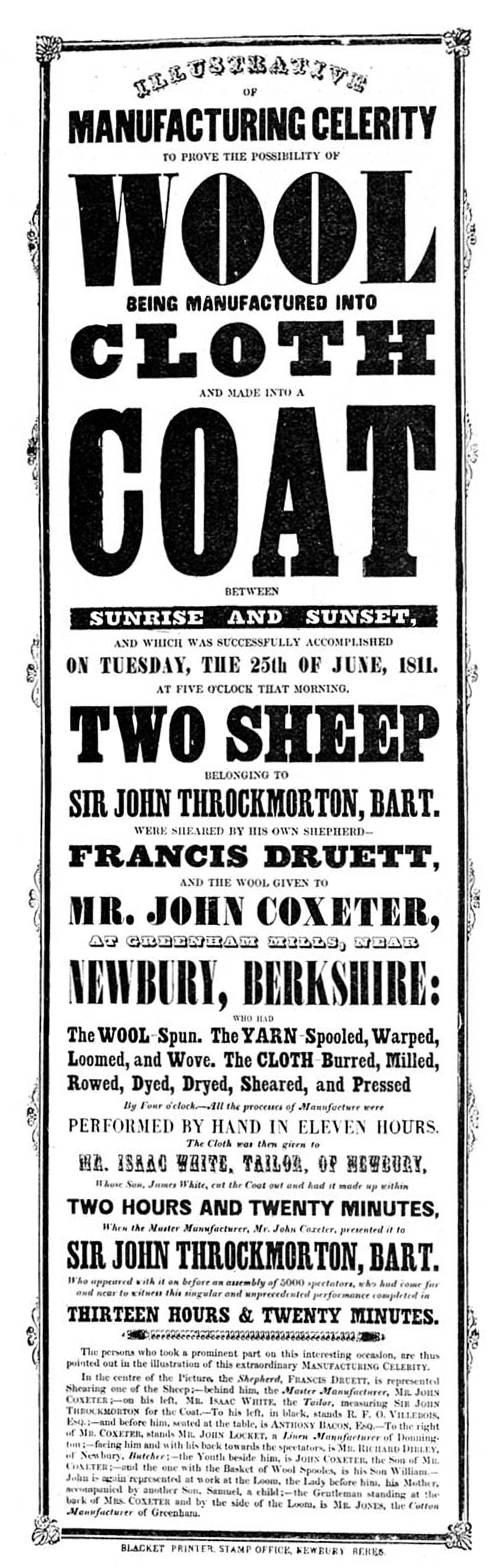
BILL PRINTED FOR THE GREAT EXHIBITION OF 1851.
The famous coat, which has found a resting-place in a glass case in Sir William Throckmorton's hall, was exhibited at the great International Exhibition of 1851, where it attracted a great deal of attention, a few copies of the old engravings from which our first two illustrations are reproduced being eagerly bought up. Our last photograph shows the bill which was printed for that exhibition.
Over thirty years afterwards the coat was again brought before public notice, this time at the Newbury Art and Industrial Exhibition of 1884. It was photographed for the first time, by Sir William's permission, for this article. Though to us it may seem rather a curious cut for a hunting-coat, it was the approved style for those times, the long coat-tails flying to the wind during a chase. Needless to say, however, this coat has never been used for that purpose.
These are certainly days of speed, and though probably with the vastly superior machinery of to-day this wonderful performance could be eclipsed, it is interesting to notice that up to the present it has never been equalled.