ZIG-ZAGS AT THE ZOO
Reading edition
By Arthur Morrison and J A Shepherd
XX.—ZIG-ZAG DASYPIDIAN.
The Dasypidæ are not such fearful wild-fowl as their name may seem to indicate; for the name Dasypus is nothing but the scientific naturalist's innocent little Greek way of saying "hairy-foot." The Sloth, the Scaly Manis, the Armadillo, the Platypus, the Aard-Vark, the Ant-eater, and one or two more comprise the family, presenting the appearance of a job-lot of odds and ends at the tail of an auctioneer's catalogue. Not only is the family of a job-lot nature, but each individual seems a sort of haphazard assemblage of odd parts made up together to save wasting the pieces; for some have tremendous tails, and some have almost none; some have armour and some have hair; one has an odd beak, apparently discarded by a duck as awkwardly shaped; some have two toes only on a foot, some three, some four, and some five—just as luck might have it in the scramble, so to speak; they only agree in being all very hard up for teeth.
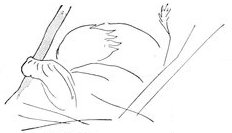
A MERE MOP—
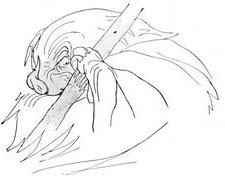
WHICH—
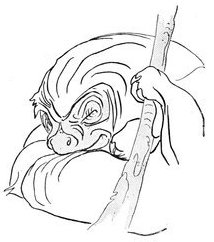
REVEALS—
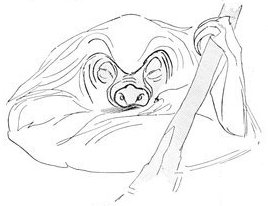
ITSELF—
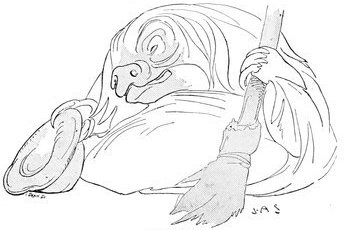
GRADUALLY.
The sloth is an admirable creature in many respects. Chiefly, he has a glorious gift of inaction—a thing too little esteemed and insufficiently cultivated in these times. If it is sweet to do nothing, as we have it on the unimpeachable authority of a proverb, therefore it must be actually noble to do nothing on scientific principles, as does the sloth. The objectionably moral and energetic class of philosopher is always ready to enlist the ant, the bee, and similarly absurdly busy creatures as practical sermons on his side; and that the indolent philosopher has never retaliated with the sloth is due merely to the fact that he is indolent, practically as well as theoretically. Yet the sloth has well-esteemed relations. Consider other proverbs. "Sloth," says one, "is the mother of necessity." Then another. "Necessity," says this second, "is the mother of invention." Whence it plainly follows that sloth is invention's grandmother—although nobody would think it to look at the sloth here, in house number forty-seven.
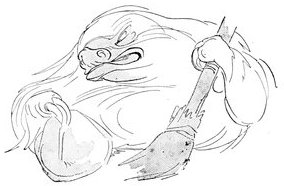
"WOT? NOT A COPPER?"
Now there are persons who attempt to deprive the sloth of the credit due to his laziness by explaining that his limbs are not adapted for use on the ground. This is a fact, although it is mean to use it to discredit so fine a reputation. The sloth is indeed a deal more active when he is hanging upside down by his toes—but then that is all a part of his system, since it is plain that his greatest state of activity is merely one of suspended animation. It is only when he is in a state of suspense that the sloth is really happy, and this is only one aspect of the topsy-turviness of his entire nature. Hanging horizontally, head and tail downward, is his normal position in society, and this is apt to lead to a belief among the unthinking that he must have lived long in Australia and there become thoroughly used to holding on to the world in his usual attitude; but his actual home is Central and South America—not altogether "down under" but merely on the slope.
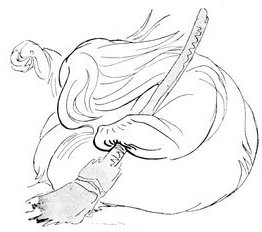
"GURN! I'LL—"
The sloth in this place is, in the eyes of most visitors, a mere mop in a heap of straw. Let but the keeper stir him up and he reveals himself gradually, the picture of a ragged, rascally mendicant—a dirty ruffian whose vocation can be nothing more laborious than extorting coppers on pretence of sweeping a crossing. A little more stirring, and he will reach for his perch and invert himself, to think things over. To him the floor is inconvenient, for it is his ceiling; anybody's ceiling is inconvenient to crawl about on.
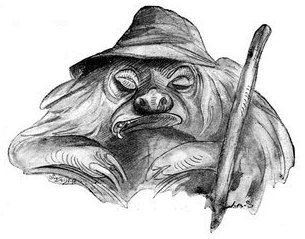
A DIRTY RUFFIAN.
When one knows that the sloth never drinks, one is prepared to believe that he persistently refuses to stand; but then nobody can stand anything, even drinks, on a ceiling. If by any chance he finds himself on the ceiling (which, as I have said, is his word for floor), he can only hook his claws wherever he sees a hole, and drag himself. He is the poorest of all the Dasypidæ in the matter of tail, and was also unfortunate in the allotment of toes, only wearing two on each fore-foot. Which disposes of the sloth.
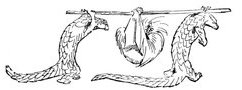
DISPOSED OF.
Of the Dasypidæ there are only, beside the sloth, various armadillos and an ant-eater in this place. The armadillo is a placid creature, with none of the warlike disposition that its armour might lead some to expect. Mild and placable, as well as rather bashful, it has somewhat the character of a beplated and armed theatrical super, who plays the flute and teaches in a Sunday-school when off duty. It is susceptible to cold, too, and regardless of any heroism of appearance in face of a chill in the air. Withal the armadillo is indifferent alike to flattery and abuse: you can no more hurt his feelings than his back.
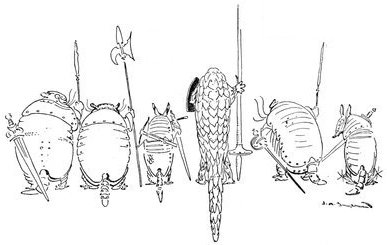
MILD SUPERS.
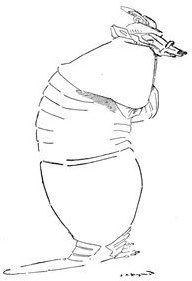
A CHILLY PERSON.
There are several sorts of armadillo here, but all are equally indifferent to criticism. Nothing is more impervious to criticism (or anything else, if you come to that) than an armadillo. He should have been born a minor poet. An oyster appears to care very little for what is said of him, but a good deal of his indifference is assumed; you often catch him opening his shell to listen. The armadillo won't open his shell for anything—figuratively as well as literally speaking. If a raging mad jaguar prances up to an armadillo, the armadillo curls up quietly with an expression that says: "Really, you excite yourself overmuch; I suppose you want to gnaw me. If you expect to eat me, after your length of experience, you must be—well, rather a fool, if I may say so. I shall go to sleep," which he does, while the jaguar ruins his teeth. Naturalists have marvelled at the fact that native Paraguayans find whether an armadillo is at home by poking a stick into his burrow, when (if he is) out comes a swarm of mosquitoes. "What," they ask, wonderingly, "can mosquitoes want with an armadillo, when other things not quite so hopeless are near at hand for biting?" But it is probably a mosquito championship meeting.
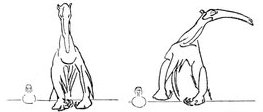
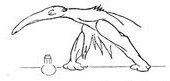
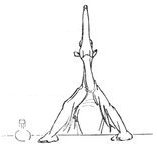
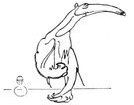
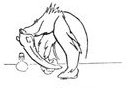
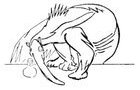
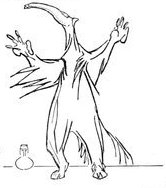
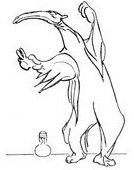
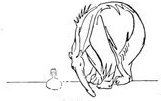
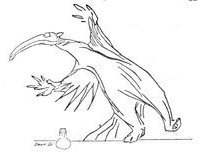
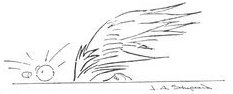
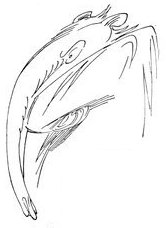
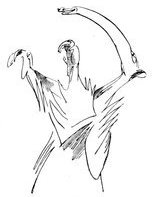
The sloth, sluggard as he is, has not gone to the ant, but to the ant-eater; that is to say, his cage is not far from Sukey's here. Sukey is not a wise person. Nobody anxious to be an orator with so little talent for it can be wise. When first you enter the room you observe that Sukey is anxious to address a large meeting. She has a ledge before her, on which she rests her fore-knuckles in a manner so extremely suggestive of a lecture that you instinctively look for the customary carafe and glass, and feel perplexed at their absence. Regardless of this disadvantage, Sukey will turn this way and that, and thump alternately with one fist and the other, and even, in the excitement of her eloquence, bounce bodily upon the ledge before her, as one has heard of a gymnastic American divine doing in his pulpit. This will the voiceless Sukey do till public indifference disgusts her, and she flops heavily back on her knuckles into hinder retirement. But no failure can stifle her ambition, whether it be actually for oratorical distinction, as appearances indicate, or only for such cockroaches as you may choose to offer, as the keeper believes.
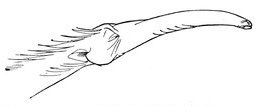
A SNEER.
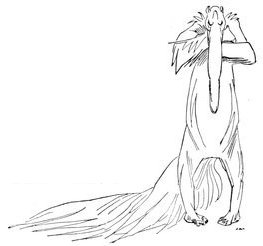
AN IMPOSING PRESENCE.
DIGNITY.
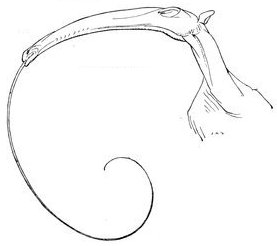
Sukey is not an impressive person—her features are against it. She is not equal to assuming a presence. With all her wealth of nose, she can't turn it up at anybody. Her sneer is a wretched failure. Any attempt at an imposing attitude is worse; a large nose of a sort is often a noble feature of itself; but a nose like this!... Sukey's extravagance in nose is paid for by a scarcity of mouth. Her small mouth may be a loveliness in itself, but it will never allow Sukey a sneer or a smile—let alone a laugh; it condemns her to perpetual prunes and prism. So that Sukey may neither impress you by a haughty presence, nor sneer at you, nor laugh at you; one thing only remains—and it a low expedient—she can put out her tongue at you—by the yard.
A LOW EXPEDIENT.
A LAUGH.
I have often speculated as to how much of this tongue Sukey really has stowed away inside her, and what would happen if she let it all out at once. It would probably get entangled with everything and with itself, like a ball of string cast loose, and Mansbridge (who is Sukey's keeper) would spend an afternoon unfastening all the knots. One has to see Sukey many times before the lineal possibilities of her tongue begin to dawn on one. See her once or twice only, and she may only exhibit a mere foot or so of it—possibly only eight or ten inches. Another time she will let out a foot or eighteen inches more, and you are rather surprised; still, your belief is unshaken that there is another end to that tongue somewhere. But when, some time later, she casually releases another yard or two, beyond the few feet wherewith you are familiar, with an aspect of keeping miles more in reserve, you abandon the doctrine of the finiteness of things earthly as mere scientific superstition. Plainly, I don't believe there is any other end to Sukey's tongue. It has the redeeming feature, however, of possessing one end, which anybody may see; and as there is an end to Sukey's tongue we won't be too hard on her, remembering that there have been Sukeys—well, differently provided for.
PERSEVERANCE.
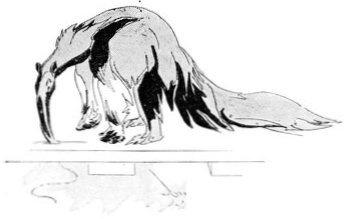
Sukey's tongue is a sticky thing, and she waves it about with a view of eating any unfortunate insect that may adhere to it, on the catch-'em-alive-oh principle. Her chiefest tit-bit is a cockroach, and, as you will perceive from her manner as you make her acquaintance, it is a firm article of Sukey's belief that visitors carry these interesting insects about with them, in large quantities. When one remembers how comparatively unfashionable this practice is, one can understand that Sukey largely lives the life of a disappointed creature. By way of a great feast, she will sometimes be given a mouse; and she fishes perseveringly through such odd cracks and holes as she may find, in hopes of providing such a feast for herself. I respectfully suggest baiting the end of her tongue with a piece of cheese. As it is, I fear her catch of mice is scarcely sufficient to warrant the importation of the ant-eater as a substitute for the harmless necessary (but usually more harmful than necessary) Tom-cat of the garden-wall.
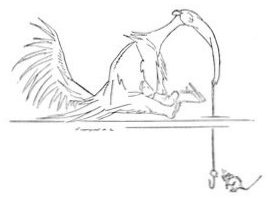
A SUGGESTION.
The ant-eater is not a prepossessing being. Anybody who had never before seen or heard of him would readily believe him to be an inhabitant of the moon. He looks the sort of animal one would invent in a nightmare; his comparatively sober colours and his bushy tail save him from being an absolute unearthly horror. Conceive, if you can, a pink ant-eater with blue spots and a forked tail!
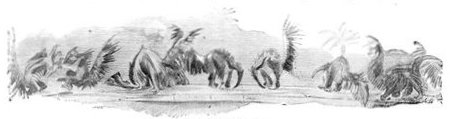
ON THE GARDEN WALL.
Neither is the ant-eater very wise; nothing with so much tongue is very wise; and the ant-eater uses up so much of its head-stuff on its nose that nothing is left for the brain. The ant-eater never cuts his wisdom teeth, because he never has any teeth at all. Really the ant-eater scarcely seems a respectable character considered altogether. An animal with more than a foot of slender nose, expressly used for poking into other people's concerns (the ants'), an immeasurable tongue, no use for a tooth-brush, and an irregular longing for cockroaches for lunch—well, is such an animal quite respectable? Would you, for instance, tolerate him in your club?
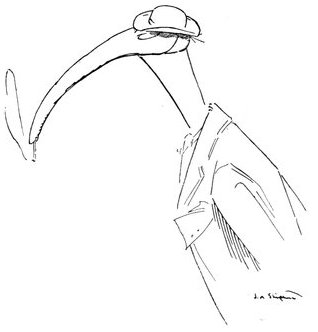
NOT VERY WISE.
The only fairly respectable member of the Dasypidæ is the armadillo—unless you count the sloth's scientific indolence a claim to respectability; I rather think it is. But none of the Dasypidæ are clever—not one. They are all in the lowest form of the mammalian school, and whenever one is not at the bottom of the form it is because another already occupies the place. You will commonly find them placed last of the mammalia in the first book of natural history you look at.
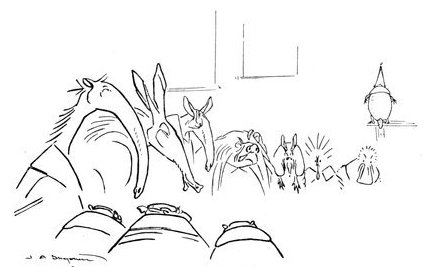
THE LOWEST FORM.