How Composers Work.
Reading edition
By Francis Arthur Jones.
One of my correspondents, writing to me on the subject of this article, says that he thinks I have undertaken a "tough job," and I fancy he is partly right. I trust, however, that my efforts have not been altogether futile, and that I have, in a measure, overcome most of the "toughness."
It has always appeared to me a curious fact that whereas one so often sees facsimile reproductions of the MSS. of famous authors and others, it is a comparatively rare occurrence to come across the compositions of musical composers treated in the same way, and I therefore determined to undertake the work of placing before the readers of this magazine portions of the MSS. of some of the foremost composers of the day, together with their opinions relative to that art of which they are the masters.
It may interest my readers still further to learn that the MSS. were, in most instances, re-written for me by the composers, with the object of their being produced in The Strand Magazine. They are given here as specimens of their compositions when ready for publication, for the first jottings of a composer are, as a rule, intelligible only to himself.
Joseph Barnby.
Sir J. Barnby, the late Precentor of Eton College, and newly elected Principal of the Guildhall School of Music, writes:—
"As a rule I do not work at the piano except to test what has already been written down. I have found ideas come most readily in the railway carriage or during a drive, and the time I prefer for composition is the morning."
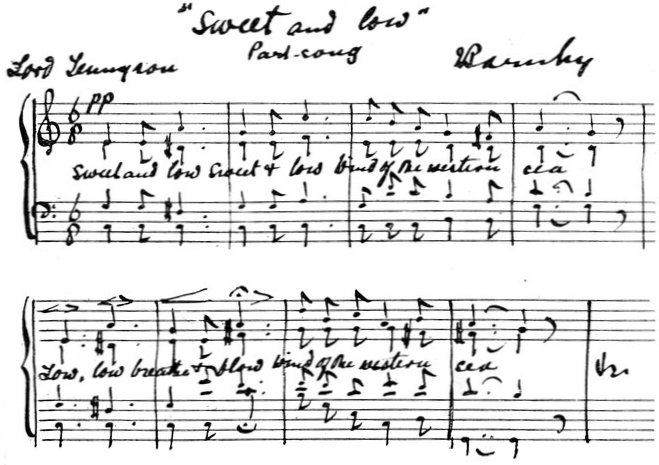
"Sweet and low"
Part-song
Lord Tennyson Barnby
As to writing on commission he says:—
"I see no objection to a composer writing 'to order,' as long as he sends out nothing of which he does not approve. Handel's 'Dettingen Te Deum,' Mozart's 'Requiem,' Mendelssohn's 'Elijah,' and a hundred other works furnish us with successful examples of this class of composition.
"I do not," he continues, "consider the art of composing one which can be acquired (the science may), but such an art is all but useless without serious cultivation."
In his modesty, Sir Joseph will give no opinion as to which he considers his best work, but sends, for publication here, a few bars of one of his part-songs which has had the widest acceptance—"Sweet and Low."
John Francis Barnett.
Mr. Barnett's method of composing I give in his own words:—
"Sometimes," he says, "an idea will come to me spontaneously, but when this is not the case I try for something, generally at the piano. If I succeed, I dot it down on music paper, but do not feel satisfied that it will be of any worth until I try it again the following day, because I have not infrequently found that an idea, which I considered good at the time, after the lapse of a day or more will appear to me insipid and not worth working out. I prefer the evening for composition, but not too late. For working out my ideas, putting them on paper, and for orchestration, I like the morning. Of my own compositions I consider 'The Building of the Ship,' written for the Leeds Festival, the best work I have yet done."
As many of Mr. Barnett's compositions have been written "to order," he not unnaturally believes in this method of composition. In fact, he feels all the better for having some strong reason for commencing a composition, but can easily understand that it would act detrimentally, especially if it involved the hurrying of the work.
"To a great extent," he continues, "I believe that composition can be acquired and cultivated providing there is some groundwork of talent to go upon. Without cultivation it would be impossible to work out ideas satisfactorily; at the same time, I do not believe that any amount of cultivation will give original ideas unless they belong to the composer by nature."
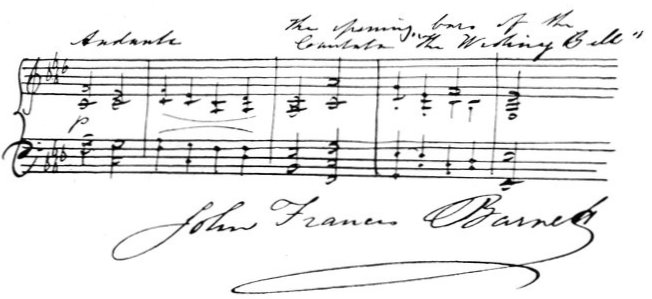
I here give my readers a few remarks of Mr. Barnett's, on whether or no we are a musical nation. At the close of this article I hope to give his opinion on this somewhat oft-repeated question at greater length. For the present, then, he says: "I think that the English are generally fond of music, but the quality of music they are fond of is, in many cases, bordering on the commonplace. That there are a multitude of admirers of the classical in music amongst the English is, fortunately, quite true, but I am inclined to believe that there are too many who are quite content with perhaps dance music, and who would rather not hear such a thing as a Beethoven Sonata. The reason for the want of good taste amongst a certain portion of our people may be traced to the class of music given by some teachers to their young pupils." The portion of music is taken from Mr. Barnett's last cantata, "The Wishing Bell," produced at the Gloucester Festival.
Jacques Blumenthal.
"Sometimes," says Jacques Blumenthal, "I compose at the piano, at other times away from it. I am in the habit of reading a good deal of poetry, and when any poem strikes my fancy and seems adapted to musical treatment, I copy it into one of my MS. books, of which I always keep several, in English, French, German, and Italian. These verses all lie patiently there till their time comes to be set to music. Some have to wait for years, some are composed almost at once; it all depends on the mood in which I happen to be, for according to my mood I look out for some verses corresponding to it, and then the song comes forth with ease; in fact, it takes much less time to compose the music than to write it down, but I invariably try to improve upon it, and file down or add almost up to the time of going into print. Sometimes I feel more attracted towards one language than towards another, and then I am apt to compose for some time nothing but songs in that language. This is the origin of my French and German albums, and as you ask me which I consider my best work, I must say in my estimation it is the album of twenty German songs with English version by Gwendoline Gore."
As to whether the art of composition can be acquired or learned and cultivated, Mr. Blumenthal says:—
"There is no doubt that the rules, or what we may call the grammar of composition, can be acquired by clear heads just as the rules of any other grammar can be. But just as little as knowing the rules of language can make you write one phrase worth remembering, so will the life work of a mere musical scholar be cast into the shade by a few bars from the pen of a man of genius."
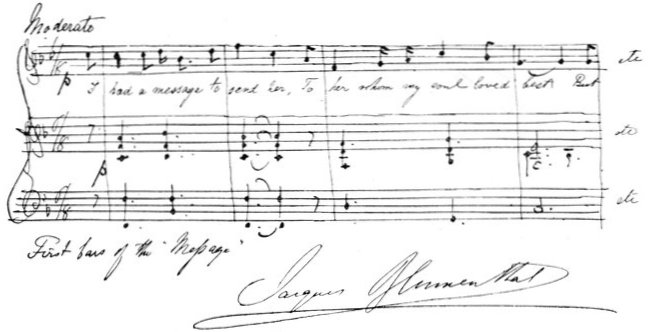
The two or three bars of music in the composer's autograph are taken from his well-known song "The Message."
F. H. Cowen.
Mr. Cowen says, with reference to his mode of composing: "I usually work by fits and starts, or rather, I should say, that I work sometimes for months continuously, almost all day and evening with little rest, especially when I am engaged upon a large work, for then I can think of nothing else: it weighs upon my mind until completed. At other times, perhaps, I do little or nothing (except a few songs, etc.) for a month or two, lying quite fallow. This may be a greater strain than working systematically all the year round, but I cannot bear when engaged on anything important to lose the thread of it for a single moment."
As to composing to a piano, Mr. Cowen believes in it when writing for voices and singing every note and word oneself, but otherwise his opinion is that the music is very apt to be unvocal. In the case of choral works, he often makes the vocal score first, having made up his mind thoroughly beforehand what the orchestration is to be.
"I never work now very late into the night," continues the composer, "though I used to; usually beginning about 10 or 10.30 a.m., and leaving off about 11 or 12 p.m., with intervals for meals and a constitutional (this is, of course, when working hard). Every composer should have a notebook of some sort to jot down ideas in when necessary. I may say, however, that I have carried about with me (mentally only) whole songs or movements perfected, sometimes for three or four years without writing down a note, and have afterwards used them in almost the exact state in which they were photographed in my brain! I do not think it possible for composition to be taught or acquired, that is, real composition. I daresay that anyone with a certain musical taste can be taught to string a melody and accompaniment together; but the genuine thing must be born in one, though, of course, the gift is useless, or at least crude, without serious cultivation."
Mr. Cowen considers his best work up to the present the "Symphony in F, No. 8," and his new opera "Sigrid" (not yet performed).
In conclusion he says: "I do not believe in composers writing 'to order,' as a general rule, but I think they may often do their best work under pressure, and when they know it must be completed by a certain time. Of course, this means that the time allowed them is sufficiently long to prevent their unduly hurrying or 'scamping' their work."
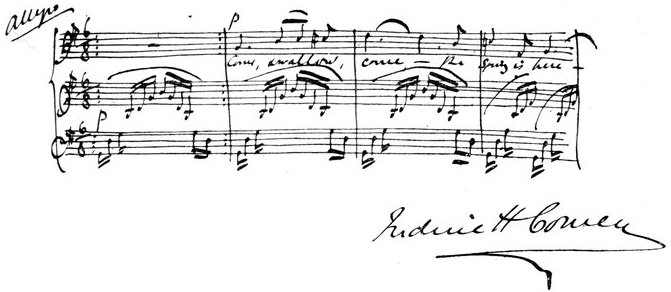
The few bars of music are the beginning of a song published in an album of twelve by various composers, the words of which are by H. Boulton.
Alfred R. Gaul.
Alfred Gaul when composing always thinks of the necessary construction for best bringing out the meaning of the words.
"This I do in the first place," he says, "without associating a musical idea with the words. Having, as far as possible, arrived at a conclusion on this point, I next think of the music, both as to melody and harmony. All these points being settled to my satisfaction, the work then proceeds with ease."
Mr. Gaul sets no particular part of the day aside for composing, working sometimes early and sometimes late.
Of all his cantatas and other compositions his favourite is "The Ten Virgins," Op. 42, a sacred cantata for four solo voices and chorus, and this he considers his best work.
As to the English being a musical nation, Mr. Gaul gives it as his opinion that the greatly improved esteem entertained by foreigners for English compositions and English performers may be taken as evidence of our country being a decidedly musical one.
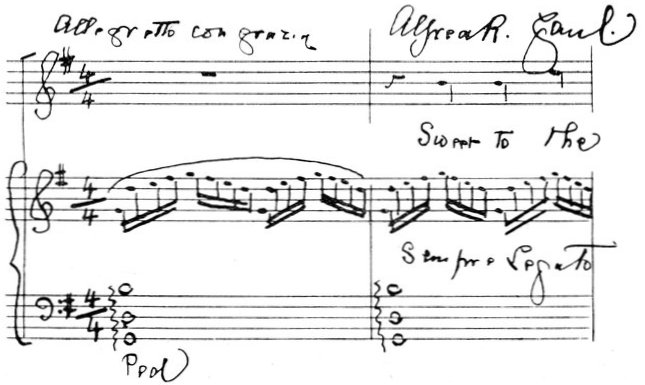
With regard to writing on commission, he adds: "I do not think one is so likely to be as successful as under other conditions, although many of the best works of recent years have been written to order, i.e., in consequence of commissions given by festival committees." The music is taken from Mr. Gaul's last work, "Israel in the Wilderness," performed at the Crystal Palace, July 9, 1892.
Charles Gounod.
The famous French composer, Charles François Gounod, briefly gives as his opinion: "Composer c'est exprimer ce que l'on sent dans une langue que l'on sait."
He adds that though the art of composition cannot be acquired, it may undoubtedly be cultivated; in fact, must be trained, like any other talent.
Mons. Gounod lays down no strict rules for composition, as he follows none himself, only composing when inclined to do so. As to his best work, he says: "I consider it is that which is still to be done"; and again: "Every nation is a musical nation."
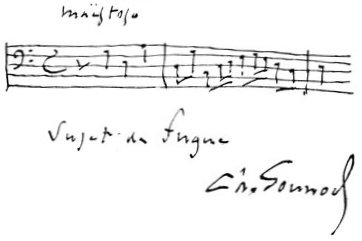
Finally, the few bars of music given here are surrounded by more than the usual amount of interest, for Mons. Gounod, in presenting them, wrote: "The portion of music I send you is from no work of mine, but 'instantaneous' for you, of an autograph."
Edvard Grieg.
The Norwegian composer, Edvard Grieg, sends his opinion over the sea, from his home at Bergen, where, by the way, he has just celebrated his silver wedding.
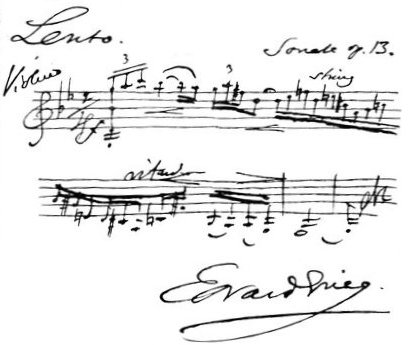
He says: "I have no particular rule when composing. In my opinion the art of composition is not at all to be learned, and yet must be learned; for it is impossible for a composer to write melodies correctly without a complete mastery of his art. Just as hopeless as for an illiterate person lacking the necessary knowledge of language to sit down to write a standard work."
He adds that as he has no favourite composer, all good composers are his favourites.
Of his many compositions, Grieg gives his preference to his famous sonata for the violin, "Op. 13," a few bars of which are here given.
Ch. H. Lloyd.
Professor Ch. H. Lloyd, when composing, generally proceeds on the following lines:—
"If I am setting words to music," he writes, "I generally read them over several times till they suggest appropriate music, and then jot down my ideas on paper. If it is an abstract composition, it is difficult to say what starts the machine. Ideas often come to me when I am in the train, or at less convenient times. Whenever possible, I write down a few bars before I forget them; but the main work is done sitting at a table with some music paper before me. I seldom go to the piano till I am well on with a composition, and I never seek for ideas at it. I have no regular or fixed time for composing—more often in the morning than at any other time; but sometimes I have not time to put a note on paper for months together."
Unlike some other composers, Professor Lloyd believes most decidedly in composers writing under compulsion "to a certain extent."
"For," he says, "if a composer knows that he has to finish a particular work by a certain time and for a certain purpose, why, I am of opinion that he will accomplish it far better under pressure than if he was working with no fixed object; at the same time, of course, such pressure in excess is not a good thing, and if carried to a great extent, actually detrimental to the production of good work."
Of his own works, Mr. Lloyd prefers his "Song of Balder," and this composition in his opinion is the best written.
In conclusion the Professor says: "If there is no aptitude for composition it can never be acquired; if, on the other hand, the aptitude exists, but the energy to cultivate it with hard and serious study be absent, it can never be brought to a successful issue."
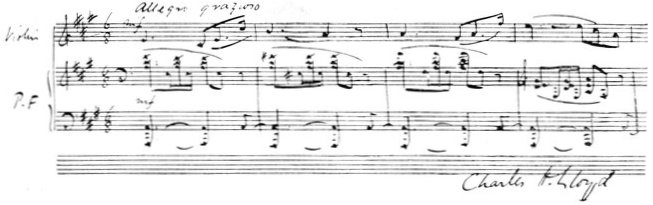
The portion of particularly neat MS. is taken from his "Sonata for Violin and Pianoforte."
(To be Continued.)