From Behind the Speaker's Chair.
Reading edition
XII.
(VIEWED BY HENRY W. LUCY.)
MR. G. AND MR. D.
There is a general impression from observation of Mr. Gladstone's manner in the House of Commons and its precincts that his head is kept so high in the empyrean of State affairs that he takes no note of men and things on a lower level. His ordinary habits in connection with persons on and off the Treasury Bench are certainly diametrically opposed to those of Lord Beaconsfield when he was still in the House of Commons. On the Treasury Bench Mr. Disraeli was wont to sit impassive, with arms folded and head bent forward, not without suspicion in the minds of those at a distance that he slept. Nearer observation would show that he was particularly wide awake. His eyes (with the exception of his hands, the last feature in his personal appearance to grow old) were ever alert and watchful, more particularly of right hon. gentlemen on the bench opposite. He rarely spoke to colleagues on either side of him, making an exception in favour of the late Lord Barrington. But it was only in dull times, in the dinner-hour or after, that he thus thawed. Even at such times he was rather a listener than a converser. Lord Barrington lived much in society and at the clubs. It was probably gossip from these quarters which he retailed for the edification of his chief, whose wrinkled face was often softened by a smile as Lord Barrington whispered in his ear.
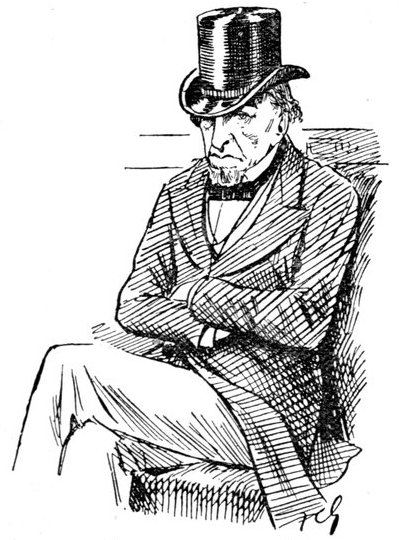
"ASLEEP OR AWAKE?"
Mr. Gladstone, on the Treasury Bench, is constantly in a state of irrepressible energy. He converses eagerly with the colleague sitting on his right or left, driving home with emphatic gestures his arguments or assertions. In quieter mood he makes a running commentary on the speech that is going forward, his observations, I have been told, being refreshingly pungent and often droll. His deep, rich voice carries far. Occasionally it crosses the table, and the right honourable gentleman on his legs at the moment is embarrassed or encouraged by what he cannot help overhearing.
A WARY JUDGE.
Occasionally the Premier seems to be asleep, but it is not safe to assume as a matter of course that, because his eyes are closed and his head resting on the back of the bench, he is lapped in slumber. There is an eminent judge on the Bench whose lapses into somnolency are part of the ordered proceedings of every case that comes before him. For many terms he baffled the observation of the smartest junior, as of the most keen sighted leader. He had his sleep, but instead of awaking with a more or less guilty start, and ostentatiously perusing his notes as others used, he, when he woke, scrupulously preserved exactly the same position and attitude as when he truly slept. Closely following for a few moments the argument of the learned gentleman who had lulled him to sleep, he, softly opening his eyes, and not otherwise moving, interposed a remark pertinent to the argument. For a long time this device baffled the Bar. But it was discovered at last, and is to-day of no avail.
Mr. Gladstone has no occasion for the exercise of this ingenuity. He may, without reproach, snatch his forty winks when he will, none daring to make him afraid. He admits that, "at my time of life," he finds a long and prosy speech irresistible, often enriching him between questions and the dinner-hour with the dower of a quiet nap.
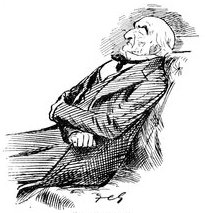
"FORTY WINKS."
IN THE DIVISION LOBBY.
This contrast of demeanour on the Treasury Bench as between Mr. Disraeli and Mr. Gladstone was equally marked in the division lobby. The passage through the division lobby, which sometimes occupies a quarter of an hour, is for Mr. Gladstone an opportunity for continuing his work.
It was one of the most dramatic incidents on the historic night in June, 1885, when his Ministry fell that, engaged in writing a letter when the House was cleared for the particular division, he carried his letter-pad with him, sat down at a table in one of the recesses of the lobby, and went on writing as, at another tragic time of waiting, Madame Defarge went on knitting. It was his letter to the Queen recording the incidents of the night. Returning to the Treasury Bench, Mr. Gladstone, still Premier, placed the pad on his knee and quietly continued the writing, looking up with a glance of interested inquiry when the shout of exultation, led by Lord Randolph Churchill, following on the announcement of the figures, told him that he might incidentally mention to Her Majesty that the Government had been defeated by a majority of twelve.
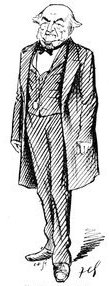
"SEEING NOBODY."
A LOST VOTE.
On the very few occasions when Mr. Gladstone visits the inner lobby on his way to and from the Whips' room, he strides through the groups of members with stiffened back and head erect, apparently seeing nobody. This is a habit, certainly not discourteously meant, which cost him a valuable friend, and made for the Liberal party one of its bitterest and most effective enemies. Twenty years ago there entered the House of Commons in the prime of life a man who early proved the potentiality of his becoming one of its brightest ornaments. A Radical by conviction, instinct, and habits dating from boyhood, he had raised in an important district the drooping flag of Liberalism, and amid the disaster that attended it at the General Election of 1874, had carried nearly every seat in his own county.
There were other reasons why he might have looked for warm welcome from the Liberal chief on entering the House of Commons. Mr. Gladstone had a few years earlier, at another crisis in the fortunes of the party, been a guest at his father's house, and was indebted to him for substantial assistance in carrying the General Election of 1868. A singularly sensitive, retiring man, the new member felt disposed to shrink from the effusive reception that would naturally await him when he settled in London within the circuit of personal communication with Mr. Gladstone. He was in his place below the gangway on the Opposition side for weeks through the Session of 1874. Mr. Gladstone, it is true, was not then in constant attendance, but he not infrequently looked in, and was at least within morning-call distance of the new member. They met for the first time in the quiet corridor skirting the Library, and Mr. Gladstone, his head in the air, passed his young friend, son of an old friend, without sign of recognition.
It was, of course, a mere accident, an undesigned oversight, certainly not enough to shape a man's political career. I do not say that alone it did it, but I have personal knowledge of the fact that it rankled deeply, and was the beginning of the end that wrecked a great career and has cost the Liberal party dearly.
MR. DISRAELI AND DR. O'LEARY.
There is a well-known story of close upon this date which illustrates Mr. Disraeli's manner in analogous circumstances. In the Parliament of 1874 there was a gentleman named Dr. O'Leary—William Haggarty O'Leary, member for Drogheda. The Doctor was a very small man, with gestures many sizes too big for him, and a voice that on occasion could emulate the volume of Major O'Gorman's. He was fierce withal, as one of his colleagues will remember. One night in the Session of 1875, when the Coercion Bill was under discussion, Dr. O'Leary was put up to move the adjournment. In those halcyon days it was possible for a member to recommend such a motion in a speech of any length to which he felt equal. Dr. O'Leary was proceeding apace when, his eye alighting on the immobile face of the noble lord who was then Mr. Dodson, he alluded to him as "the right hon. gentleman the Financial Secretary to the Treasury." A compatriot touched Dr. O'Leary's arm and reminded him that Mr. Dodson was no longer in office. "The late right hon. gentleman, then," retorted Dr. O'Leary, turning a blazing countenance on his interrupter.
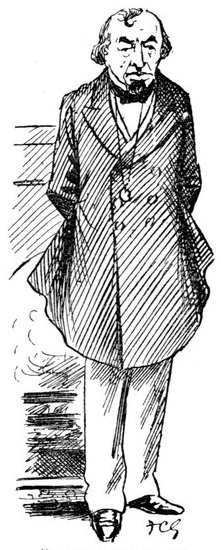
"BEFORE THE FIRE."
It was pending the division on the third reading of the Empress of India Bill that Mr. Disraeli won over this irate Irishman. The Premier was anxious to have the third reading carried by a rattling majority, and spared no pains to gain doubtful votes. One night in a division on another Bill he came upon Dr. O'Leary in the Ministerial lobby, a place the then budding Parnellite party fitfully resorted to. Dizzy walked a few paces behind the member for Drogheda. Quickening his pace, he laid a hand on his shoulder and said: "My dear Doctor, you gave me quite a start. When I saw you I thought for a moment it was my old friend Tom Moore."
From that day the delighted Doctor's vote was unreservedly at the disposal of his eminent and discriminating friend.
A WORD IN SEASON.
Mr. Disraeli, while Leader of the House of Commons, turned the necessary idle moments of the division lobby to better account than finishing up his correspondence. In the winter months he used to station himself at a fire in one of the recesses, standing with coat-tails uplifted, in an attitude which showed that, though of Oriental lineage, he had a British substratum. As the throng of members trooped towards the wicket, Dizzy, keenly watching them, would signal one out and genially converse with him for a few moments. Those thus favoured were generally members who had recently made a speech, and were gratified for the rest of their lives by a timely compliment. Others—those in the Conservative ranks much rarer—were men reported by the Whips to be showing a tendency towards restiveness, whom a few genial words brought back to the fold.
MR. GLADSTONE'S HAT AND STICK.
In a recent number, talking of hat customs in the House of Commons, I observed that there are not many members of the present Parliament who have seen Mr. Gladstone seated on either Front Bench with his hat on. An exception was mentioned with respect to the Session of 1875, when, having retired from the leadership and looking in occasionally to see how things were getting on under Lord Hartington, he was accustomed to sit at the remote end of the Treasury Bench wearing his hat and carrying stick and gloves.
An esteemed correspondent, whose knowledge of Parliament is extensive and peculiar, writes: "There was a time when Mr. Gladstone most ostentatiously and designedly wore his hat after the year you mention. It was when, during the Bradlaugh scenes, he left the leadership, with the responsibility of persecuting Bradlaugh, to Stafford Northcote. He brought stick and hat into the House, and put the latter on during Northcote's proceedings, as much as to say, 'Well, as you have the House with you, carry your tyrannical procedure through yourself. I am not in it.' I think all this must be in your Parliament books."
I do not think it is; but I remember the episode very well, and the embarrassment into which the unexpected attitude plunged good Sir Stafford Northcote. The situation was remarkable, and, I believe, unparalleled. Mr. Gladstone had just been returned to power by a majority that exceeded a hundred. The Conservative forces were shattered. Even with a Liberal majority, which at its birth always contains within itself the seeds of disintegration, it appeared probable that at least the first Session of the new Parliament would run its course before revolt manifested itself. It turned out otherwise. A resolution, moved by Mr. Labouchere, and supported from the Treasury Bench, giving Mr. Bradlaugh permission to make affirmation and so take his seat, was thrown out by a majority of 275 against 230.
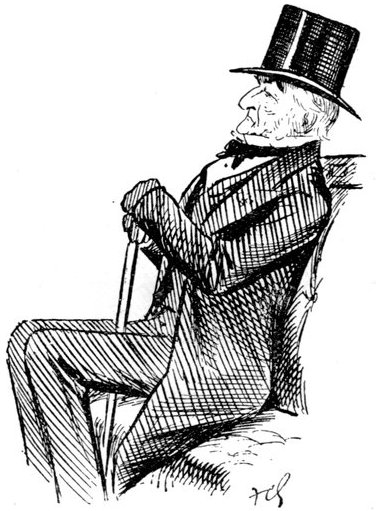
"WITH HAT AND STICK."
It was after this Mr. Gladstone temporarily abrogated his position as Leader of the House, bringing in hat and stick in token thereof. When, on the next day, Mr. Bradlaugh presented himself, made straight for the table, and was subsequently heard at the bar, the Premier came in, not only with hat and stick in hand, but wearing his gloves. All eyes were turned upon him, when Mr. Bradlaugh, having finished his speech, withdrew at the Speaker's bidding. But he did not move, and then and thereafter, during the Session, Sir Stafford Northcote took the lead in whatever proceedings ensued on the lively action of Mr. Bradlaugh.
SIR STAFFORD NORTHCOTE AND MR. BRADLAUGH.
What Sir Stafford thought of the duty thrust upon him by the action of keener spirits below the gangway was suspected at the time. Years afterwards, disclosure was made in a letter written by his second son, Sir Stafford Northcote, and published by the Daily News in December last. When in 1886 the Conservatives returned to power, Mr. Bradlaugh, who had been furiously fought all through the life of the former Parliament, was permitted quietly to take his seat. Later, a motion was made by Dr. Hunter to expunge from the journals of the House the resolution declaring him incompetent to sit. This was an awkward position for a Government which included within its ranks men who had been most active in resistance to Mr. Bradlaugh's attempts to take his seat. After the debate had gone forward for an hour or two, the present Sir Stafford Northcote rose from the bench immediately behind Ministers, and urged that with slight amendment the resolution should be accepted.
I remember well the scene, above all the startled manner in which Mr. W. H. Smith, then Leader of the House, turned round to regard this interposition from so unexpected a quarter. The House instinctively felt that it settled the matter. If a member habitually so unobtrusive as Sir Stafford Northcote felt compelled to interpose and support an amendment, which, however regarded, was a vote of censure on the conduct of the Conservative party through the Parliament of 1880, feeling in the Conservative ranks must be strong indeed. A Government who showed a disinclination to accept the resolution would find themselves in a tight place if they persisted. What course would Mr. W. H. Smith take?
Looking at his honest, ingenuous face, it was easy to read his thoughts. Startled at first by the appearance on the scene of the member for Exeter, he sat with head half turned watching and listening intently. Gradually conviction dawned upon him. It was Sir Stafford Northcote's revered father who had officially led the opposition to Mr. Bradlaugh. Now, whilst the son spoke, there seemed to come a voice from the grave pleading that enough had been done to vindicate Christianity and Constitutionalism, urging that the House of Commons would do well to perform a gracious and generous act and sooth Mr. Bradlaugh's last moments (he was that very night lying on his death-bed) with news that the obnoxious resolution had been erased. All this was glowingly written on Mr. Smith's face as Sir Stafford Northcote spoke, and when he followed everyone was prepared for the statement of acquiescence made on these lines. There was nothing more to be said, and without a division it was agreed to strike out the resolution from the journals of the House.
THE ARTFULNESS OF OLD MORALITY.
Sir Stafford Northcote's letter, dated from the House of Commons, 13th November, 1893, throws a flood of light on this historic episode and, incidentally, upon the methods of management of the homely, innocent-looking gentleman who led the House of Commons from 1886 to his lamented death in the autumn of 1891. "Shortly after the debate on Dr. Hunter's motion began," Sir Stafford writes, "Mr. Smith asked me to come into his private room, and asked me what I thought of the motion. I replied that I did not see how the Government could accept it as it stood, as it conveyed a censure on the Conservative party for their action in the past; but that if this part of the motion were dropped, I thought that the rest of the resolution might be agreed to. I added that I would willingly make such an appeal to Mr. Smith publicly in the House. Mr. Smith quite approved my suggestion. I made the appeal from my place in the House, and Dr. Hunter consented to amend his motion."
Whence it will appear that the whole scene which entirely took in a trusting House of Commons was what in another walk of industry is called a put-up job.
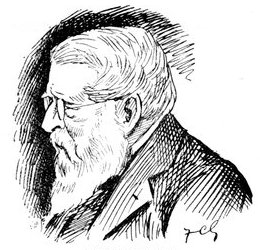
LORD IDDESLEIGH.
On the late Lord Iddesleigh's feelings during the Bradlaugh campaign, his son's letter sheds a gentle light. "My suggestion to Mr. Smith." Sir Stafford writes, "was partly based on the recollection that my father had often said to me that, while he had had no hesitation in discharging what he believed to be his duty in the various painful scenes with which Mr. Bradlaugh's name is associated, he had always felt much pain at having to take a course personally painful to a fellow-member of the House."
THE BIRTH OF THE FOURTH PARTY.
It is a mistake deeply rooted in the public mind that it was Lord Randolph Churchill who gave the first impulse to the creation of the Fourth Party. This is an error due to his fascinating personality, and the prominent part he later took in directing what for its size and voting power is the most remarkable engine known in Parliamentary warfare. The real creator of the Fourth Party was Sir Henry Wolff, now Her Majesty's Minister at the Court of Madrid. It was he who first saw the opportunity presented by the return of Mr. Bradlaugh for Northampton of harassing the apparently impregnable Government. It so happened that Lord Randolph Churchill was not present in the House at the time the first movement commenced.
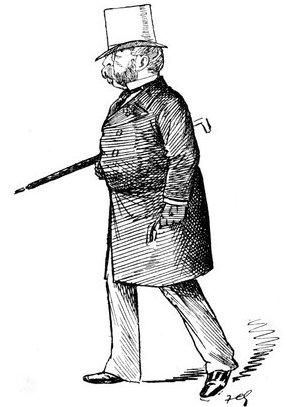
SIR HENRY WOLFF.
In later stages of the struggle Mr. Bradlaugh, so far from showing indisposition to take the oath, insisted upon his right to do so, and even administered it to himself. There was nothing in the world to prevent his falling in with the throng that took the oath on the opening of the new Parliament on the 30th of April, 1880. Had he done so and quietly taken his seat, the course of events in that Parliament would have been greatly altered. But Mr. Bradlaugh was not disposed to miss his opportunity, and having allowed two or three days to elapse, during which prominence was given to his position and curiosity aroused as to his intention, he presented himself at the table and claimed the right to make affirmation.
Even then, had Mr. Gladstone been in his place on the Treasury Bench, the danger might have been averted. But the Premier and his principal colleagues were at the time, pending re-election on acceptance of office, not members of the House. Lord Frederick Cavendish, then Financial Secretary to the Treasury, and all unconscious of the tragedy that would close his blameless life, moved for a Select Committee to inquire into the circumstances. The attitude of the Conservative party at this moment was shown by the fact that Sir Stafford Northcote seconded the motion. It was agreed to as a matter of course.
It was on the nomination of this Committee eight days later that there were indications of trouble ahead. Sir Henry Wolff moved the previous question, and took a division on it. Here again the feeling of official Conservatives was shown by gentlemen on the Front Bench, led by Sir Stafford Northcote, leaving the House without voting. On the 21st of May, Mr. Bradlaugh brought matters to a crisis by advancing to the table claiming to take the oath. It was now that Sir Henry Wolff brought things to a crisis. Having strategically placed himself at the corner seat below the gangway, he threw himself bodily across Mr. Bradlaugh's passage towards the table, crying "I object!" This objection he sustained in an animated speech, concluding by moving a resolution that Mr. Bradlaugh be not permitted to take the oath. It was in support of this resolution that Lord Randolph Churchill appeared upon the scene, interposing in the adjourned debate.
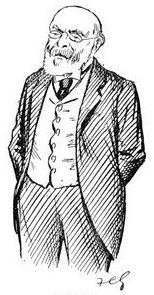
MR. GORST.
He was not present during any earlier movement on the part of Sir Henry Wolff. But his keen eye saw the opening to which Sir Stafford Northcote was yet persistently blind. He joined hands with Sir Henry Wolff. To them entered a gentleman then known as Mr. Gorst, and much later Mr. Arthur Balfour. Thus was formed and welded a personal and political association which has given an Ambassador to Madrid, has bestowed upon the astonished Conservative party two leaders in succession, and has endowed Mr. Gorst, in some respect not exceeded in ability by any of his colleagues, with a modest knighthood and soothing recollections of a too brief colleagueship with Lord Cross at the India Office.
NEW MEN AND OLD PLACES.
Mr. Gladstone has been singularly fortunate in the selection of new blood for his Ministry. Mr. Disraeli, by some happy hits—not the least effective the bringing of Mr. W. H. Smith within the ring fence of office—justly earned a high reputation for insight to character. Till this Parliament, one never heard of "Mr. Gladstone's young men," the innate conservatism of his mind and character leading him to repose on level heights represented by personages like Lord Ripon and Lord Kimberley. Growing more audacious with the advance of years, Mr. Gladstone introduced new men to his last Ministry with success distinctly marked in each particular instance. Mr. Asquith, as Home Secretary; Mr. Acland, as Vice-President of the Council; Mr. Herbert Gardner, as Minister for Agriculture; Sir Edward Grey, as Parliamentary Secretary to the Foreign Office; Mr. Sydney Buxton, in a corresponding position at the Colonial Office; Mr. Burt, at the Board of Trade; Sir Walter Foster, at the Local Government Board, were all new to office when they received their appointments, and each has satisfied the expectation of the most critical Assembly in the world.
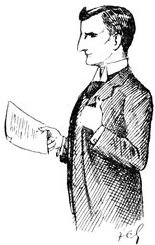
SIR EDWARD GREY.
The Junior Lords of the Treasury who act as Whips were also new to office, whilst Mr. Marjoribanks, though he had gone through a Parliament as Junior Whip, for the first time found in his hands the direction of one of the most important posts in a Ministry based upon a Parliamentary majority. The remarkable and unvaried success of the Liberal Whips—the team comprising Mr. Thomas Ellis, Mr. Causton, and Mr. McArthur—was recognised in these pages very early in the Session, and has since become a truism of political comment.
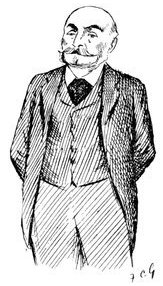
MR. SEALE-HAYNE.
Mr. Seale-Hayne is another Minister new to the work who realizes for his chief the comfort of a department that has no annals. The office of Paymaster-General is not quite what it was in the days of Charles James Fox. A certain mystery broods over its functions and its ramifications. Mr. Seale-Hayne is, personally, of so retiring a disposition that he is apt to efface both his office and himself. But the fact remains that affairs in the office of the Paymaster-General have not cost Mr. Seale-Hayne's illustrious chief a single hour's rest. No Irish member, shut off by the Home Rule compact from foraging in familiar fields, has been tempted to put to the Paymaster-General an embarrassing question relating to the affairs of his office. Mr. Hanbury has left him undisturbed, and Cap'en Tommy Bowles has given him a clear berth. Whom Mr. Seale-Hayne pays, or where he gets the money from to meet his engagements, are mysteries locked in the bosom of the Master. It suffices for the country to know that Mr. Seale-Hayne is an ideal Paymaster-General.
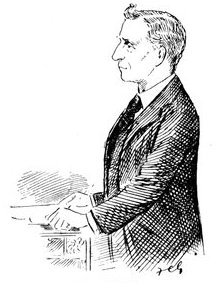
MR. ASQUITH.
MR. ASQUITH.
Whilst all the new Ministers have been successes, the Home Secretary, by reason of the importance of his office and force of character, has done supremely well. This must be peculiarly grateful to Mr. Gladstone, since the member for Fife was his own especial find. That when a Liberal Ministry was formed some office would be allotted to Mr. Asquith was a conclusion commonly come to by those familiar with his career in the last Parliament. But I will undertake to say that his appointment at a single bound to the Home Secretaryship, with a seat in the Cabinet, was a surprise to everyone, not excepting Mr. Asquith, who is accustomed to form a very just estimation of his own capacity. The Solicitor-Generalship appeared to most people who gave thought to the subject the natural start on his official career of a young lawyer who had shown the aptitude for Parliamentary life displayed by Mr. Asquith. Mr. Gladstone knew better, and his prescience has been abundantly confirmed.
Next to the post of Chief Secretary to the Lord Lieutenant, that of Home Secretary is by far the most difficult successfully to fill. Proof of this will appear upon review of the measure of success obtained by incumbents of the office since the time of Mr. Walpole. The reason for the pre-eminence and predicament is not far to seek. The Colonial Secretary has distant communities to deal with, and so has the Secretary of State for India. The Minister for War and the First Lord of the Admiralty each has his labour and responsibility confined within clearly marked limits. So it is with the Postmaster-General, the First Commissioner of Works, and, in less degree, with the President of the Board of Trade and the President of the Local Government Board. The Home Secretary has all England for his domain, with occasional erratic excursions into Scotland.
There is hardly any point of the daily life of an Englishman which is not linked with the Home Office, and does not open some conduit of complaint. Before he had been twelve months in office Mr. Asquith was hung in effigy in Trafalgar Square. That, it is true, was a momentary exuberance on the part of the Anarchists. The incident leaves unchallenged the assertion that there has been no serious or well-sustained protest against Mr. Asquith's administration at the Home Office since he succeeded Mr. Matthews. Comparisons are undesirable. But the mere mention of the name of Mr. Asquith's predecessor reminds us that the case was not always thus.
In his Parliamentary career Mr. Asquith's success has been equally un-chequered. It was a common saying among people indisposed to hamper novices by unwieldy weight of encouragement, that when Mr. Asquith was placed in a position where he would have to bear the brunt of debate, he would certainly break down. This cheerful prognostication was based upon the assertion that the speeches that had established his fame in the House of Commons were carefully prepared, written out, and, if not learned off by rote, the speaker was sustained in their delivery by the assistance of copious notes. This assertion was so confidently made, and appeared to be so far supported by a certain precision of epigram in the young member's Parliamentary style, that the theory obtained wide acceptance.
Everyone now admits that the Home Secretary, occasionally drawn into debate for which he has had no opportunity for preparation at his desk, has spoken much more effectively than Mr. Asquith was wont to do. He has the great gifts of simplicity of style, lucidity of arrangement, and a fearless way of selecting a word that conveys his meaning, even though it may sound a little harsh. To this is added a determined, not to say belligerent, manner, which implies that he is not in any circumstances to be drawn a hair's-breadth beyond the line which duty, conscience, and conviction have laid down for him and that if anyone tries to force him aside he will probably get hurt. This is an excellent foundation on which a Home Secretary may stand to combat all the influences of passion and prejudice that are daily and hourly brought to bear upon him.
Of its general effect a striking and amusing illustration was forthcoming in the closing days of the winter Session. During Mr. Morley's temporary withdrawal on account of illness, Mr. Asquith undertook to take his place at question time in the House of Commons. For a night or two he read the answers to questions put by Irish members, and then Mr. Morley's absence promising to be more protracted than was at first thought probable, the Chancellor of the Duchy, a Minister with fuller leisure, relieved the Home Secretary of the task. Thereupon a story was put abroad that Mr. Asquith had been superseded upon the demand of the Irish members, who had privily conveyed to Mr. Gladstone a peremptory intimation that they could not stand the kind of answers Mr. Asquith chucked at them across the floor of the House. It was added that the appearance on the scene of Mr. Bryce averted an awkward crisis, the Irish members making haste to declare their perfect satisfaction with his replies, and their rejoicing at deliverance from Mr. Asquith's hectoring.
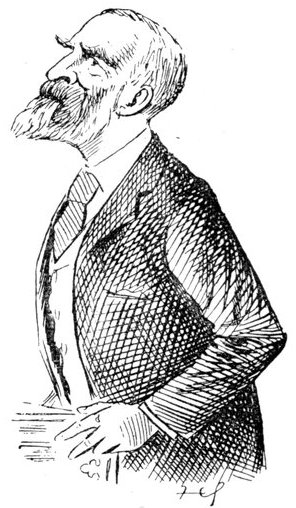
PROFESSOR BRYCE.
Then it turned out that the answers given through the course of the week in question had been neither Mr. Asquith's nor Mr. Bryce's. Each one had been written out by Mr. John Morley. Only, on two nights Mr. Asquith had read the manuscript, and on two others the task had been discharged by Mr. Bryce. Thus do manners make the man.