The Queer Side of Things.
Reading edition
The Thinner-Out
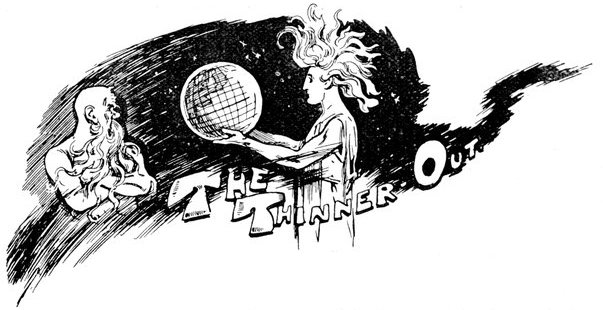
Reader, can you, by a violent effort of memory, recall the two spirits, William and James, who engaged in these pages in several arguments concerning the possibility of your, and my, existence? I know you have had other things to think about lately—the possibility of obtaining, either by exorbitant payment, diplomacy, or any means underhand or otherwise, a supply of coals for the winter—the fate of Lobengula—the chances of the Employers' Liability Bill—the state of our Navy. But if you will for one moment compare the weight of these trivialities with that of the question: "Is it, or is it not, possible for this Universe to have ever existed?"—you will find the former group of subjects vanish like an idle dream; while the Vast Query will instantly absorb your whole attention.
Then you will recollect that the more thoughtful, more logical, less visionary spirit William conclusively proved the impossibility of our existence.
Yet he was wrong. Very slight inquiries into evidence have since convinced me that our Universe does exist. It is difficult to credit, in the face of William's logic: but I fear we must believe it.
Very well—waiving the possibility of our all being hypnotized through all the ages (say by Adam, Rameses the Great, Mr. Stead, or some other power having sway over human minds) into a belief of the existence of the non-existent—we will, please, take it as carried that we do exist, and that even William is forced to admit it. Very good: now let's get on.
"What do you think now?" asked James, a weak-minded scintillation of triumph in his eye.
William was evidently seriously offended; facts which contradict carefully-weighed logic, flawless in all other respects, are always irritating to the thoughtful. Men of science will indorse this.
"Hurrm!" he said at last; "your Universe does exist—in a way; and the globe you call 'Terra' does exist—in a way. But the highly objectionable creatures on it don't seem too comfortable; in fact, a more ridiculous, calamitous, disastrous, pitiful, gruesome, repulsive muddle than they make of it I could not possibly conceive!"
"But they have some reasonable qualities?" argued James.
"A few," said William. "Those taught them by the conduct of what you call the lower animals. I know what's principally wrong with them—they think, and do things, too much."
"Well, they are, perhaps, too much given to thinking and doing things. I admit that they make many mistakes, but I do protest that they mean well—that their theories are, as a whole, in the right direction—that they have a solid, genuine admiration for good aims and great deeds, and reward such merits when conspicuously shown by any among them."
"Hum!" said William.
"Oh, come," said James; "you must admit that humanity's rewards are, as a rule, conferred on those who do the greatest services to humanity."
"From my point of view, yes!" said William. "Let's have a game!" he said, suddenly.
"A game?" said James, taken aback by such a proposition from the cynical and severe William.
"Yes," said the latter. "Let us put this point of yours to the test. Let you and me select, each, a specimen of humanity from among this herd, each of us choosing the specimen which he deems most likely to obtain the highest praises and rewards of humanity; let us choose our specimens as babies, and watch them through their subsequent careers—eh?"
"Very good," said James, confidently.
"Let's have a bet on it, like your humans do with insurance companies about the length of their lives," said William. "I will bet you—let's see—I'll bet you that comet against that little star over there in the constellation like a saucepan. The comet's more showy, and apparently better value; so that will please you best: and you won't notice its flimsiness as compared with the greater solidity of the little star."
"But what nonsense!" said James. "What in space would be the use of a comet or a star to one of us? What could we do with it?"
"You could give yours," said William, in that nasty tone of his, "to one of your humans. He would be delighted. It's exactly the kind of thing they are always longing for."
Then they looked about among humanity.
"I've chosen my baby," said James. "Something has gone wrong with another baby's feeding-bottle, and my baby is trying to put it right."
"Very curious!" said William. "The baby I had chosen is the very baby whose feeding-bottle—(anachronism is nothing to us, James—we deal with all dates)—your baby is attempting to put right. While your baby is so engaged, my baby is damaging the tube of your baby's bottle, to the end that your baby may fail to get any nourishment through it. That's the baby for me!"
James laughed in derision. "Well, if you think your choice will merit the praise of humanity——!" he began.
"Stop!" said William. "The words in our agreement were 'obtain the praises of humanity.' We said nothing about meriting them. I say my choice will obtain them."
"Well, well," said James, "you needn't split hairs!"
"I'm not splitting hairs," replied William; "I am pointing out the chasm between two mountains."
"But—confound it!" said James, impatient at his companion's want of reason. "You don't mean to seriously tell me that you seriously believe that humanity would seriously choose to reward those who injure rather than those who benefit——?"
"Never mind what I believe. You'll see," said William. "See, our babies are growing; they are little boys now. What's yours doing?"
"Mine," said James, triumphantly, "has found a dead bird, and is trying to bring it to life."
"That is the bird which my little boy has killed," said William.
James sniggered again. "You had better make another choice," he said.
"Will you kindly mind your own business," said William, "and look after your chance of that comet? You'd better be ordering a handsome casket to present it to your baby in when he has obtained the praises of humanity. What's your baby up to now?"
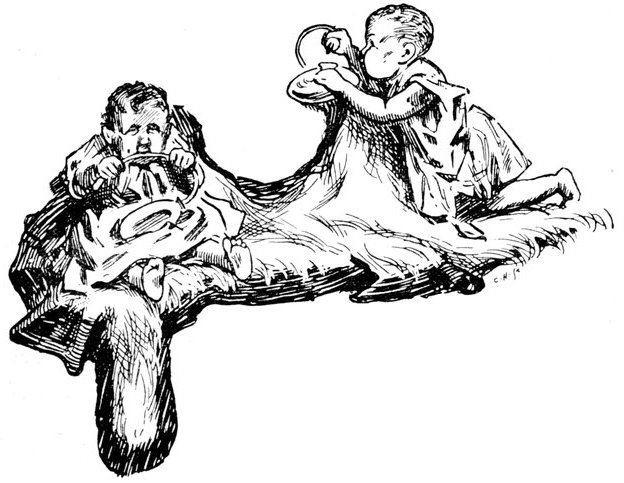
"THAT'S THE BABY FOR ME!"
"He has grown," replied James, gazing earthwards. "He is at school. Another boy has been knocked down in the playground by a third boy ——"
"Yes—by my boy," put in William.
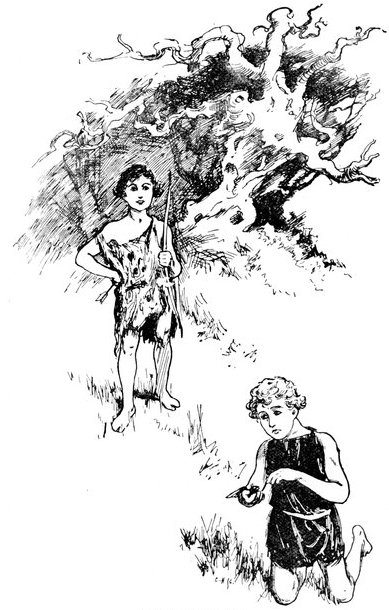
"FOUND A DEAD BIRD."
"And my boy is attending to his bruises and trying to ease the pain of them."
"Just so," said William. "A most mistaken young person! I knew he would—just the sort of thing he would be up to!"
"At any rate, he is earning the gratitude of the victim," protested James.
"The gratitude of victims," said the objectionable William, "is not legal tender; it is not even a marketable article. Did you ever see the gratitude of victims quoted in the share-lists of the newspapers published by your precious humans? Have you ever seen it advertised for in the columns of that periodical of theirs called Exchange and Mart? You may have seen it advertised for sale there; but there were no answers. Now look at my boy, James—look at him! That's promise, if you like! He's knocking down all the other boys like ninepins."
"Your boy is a Bully," said James.
"Ah! you've discovered it, then? It has at last dawned upon you that I am bound to win. My boy is a Bully. You may as well just hand over that little star out of the saucepan at once, and save further trouble."
"What! Do you mean to tell me," screamed James, rising on the tips of his toes with indignation, "to tell me that a Bully is the sort of person to obtain the highest praises and rewards of his fellow-creatures?"
"I do," said William. "The sort, and the only sort. I'll grant that your beneficent person who does a lot of good to your humans may come in for a good large amount of praises, and also even get a small amount of solid rewards: but the fellow they really love is your Bully."
"How can they love him? Impossible!" said James.
"Then why do the confounded creatures act as though they did? You can only judge of their sanity by their acts—and those disprove it. Let's go on. What's my boy doing now?"
"He is playing with a lot of little toy soldiers," said James. "He is knocking them over with toy cannon. Now he is constructing little toy towns, and setting fire to them."
"And your boy?"
"Is picking up the little soldiers, and trying to bend them straight and set them on their legs again."
"Ah! Always throwing away your chances of winning that comet by wasting his time earning the gratitude of victims!" said the horrid William. "And now they have both left school, and are studying. My boy is practising sword-cuts, and reading about words of command, and linked battalions and machine-guns."
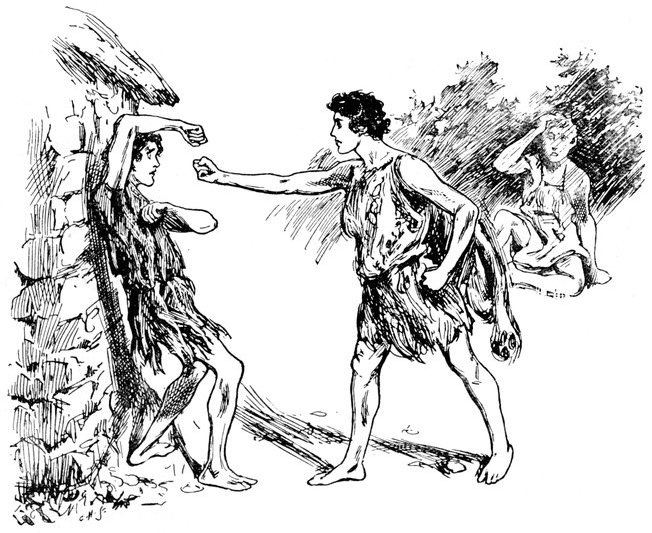
"HE'S KNOCKING DOWN ALL THE OTHER BOYS LIKE NINEPINS."
"And my boy is practising tying bandages, and reading about arteries, and nerves, and compound fractures, and epidemics. My boy is fitting himself as a Healer."
"And my boy," said William, "is fitting himself for a Slayer."
"You are either mad," said James, "or are indulging in a pastime which is not your forte—a jest. You cannot seriously imagine that these humans will actually prefer one who slays them!"
"I know they will—it just tallies with their queer ways. They profess to hold human life at the highest value! That's not humbug on their parts, mind you—they are under the delusion that they do so hold it. Life is to them an object of joy, and the absence of it one of regret; as I told you once before, they delight in the filling up of the waste places of their ball with human life. They don't consider animal life as life.
"If an island is full of intelligent elephants, who hardly ever make mistakes, and quiet, domesticated kangaroos, and contented rabbits, these humans of yours say: 'What a pity it isn't inhabited—we ought to people that desert!' They don't recognise the fact that it is inhabited and isn't a desert! They are delighted at the growing crowds in their towns; and if they look down a lane and don't see anyone in it, they drop a tear and think: 'It's very sad there should be no human life in that lane.'
"And here comes in one of the queerest phases in the exceeding queerness of these people of yours—all the while they are under the impression that they consider the increase of humanity as of the highest advantage, they have an unrecognised instinct which tells them that things will be mightily uncomfortable for them when their ball gets a little overfilled: and from this unrecognised instinct springs their partiality to anyone who thins them out. The Thinner-Out is the object of their very highest rewards——
"Ha! Look—look there, on that Terra of yours. There's a great ship about to be wrecked—yes, there it goes, crashing on the rocks. There will be a wholesale bit of thinning-out there—no; see, one of your humans, by the exercise of superhuman energy, and at infinite risk to himself, is saving the whole lot of them. Every one of them is safe on land now. They are crowding round their preserver——"
"Ha!" cried James. "Where are your precious cynical arguments now? Look at their gratitude—look how they grasp his hand, and kiss it, and——"
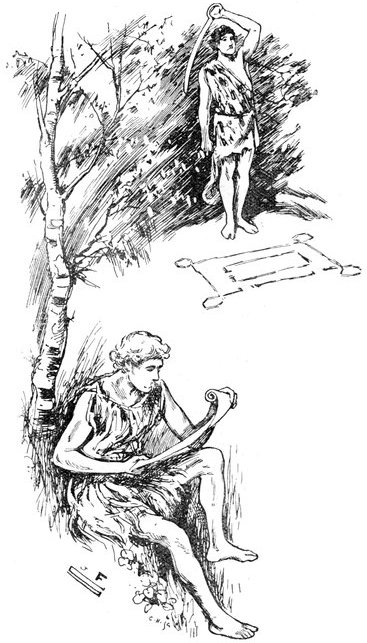
SLAYER AND HEALER.
"Collect for him a sum amounting to nearly fifty pounds, and send him a medal, and mention him in the principal newspapers—nearly half a column in some!—and drop him," said William.
"Of course," he continued, "there are several kinds of Thinners-Out—there's the one who spreads epidemics by travelling in public conveyances when suffering from communicable ailments: they don't reward him, because no particular effort is required for his kind of work—a child could do it: but he is protected by the laws. Who ever heard of anyone being visited by any heavier punishment than the fine of a few coins for wilfully thinning-out humans in this way? Nobody. Then there are two kinds of the class who go in for the most lucrative method of thinning-out—War. There's the warrior who thins out his fellow-creatures to gratify his own personal inclinations and ambitions; and there's the warrior who is forced to thin them out by the duty of defending his country against the former kind of warrior."
"Ah! and the latter's the kind of warrior his fellow humans will heap the highest rewards upon," said James.
"Oh, is he?" said William. "All right; for the sake of curiosity let us just follow the career of a third boy—the little one that was knocked down by my boy, and tended by yours. What is he at now?"
"Why, he is practising with a sword like your Bully; only he is practising parries instead of cuts; and he is also reading about words of command, and linked battalions, and machine-guns, and fortifications. And I recollect, by the way, that he was lately playing with a little toy town and trying to defend it."
"Just so," said William. "He'll do very well, mind you; but the other kind of warrior—my Bully—will distance him in rewards by leagues. Halloa!—there's a booming of cannon, and a noise of screaming. What's doing?"
"It's your Bully. He's an adult human now; and he's besieging a town; now he has taken it and set it on fire, and put the inhabitants to the sword."
"That's the way to begin, James! If you want to win the love and respect of those humans of yours, strike terror into them at the start. You see, those you spare feel so proud of their own cleverness in being spared, and so relieved about it, that they are in the best of humours; and, looking about for somebody on whom to expend their good humour, they naturally fix on the figure that catches their eye first; and that, of course, is the figure of the Thinner-Out. See?"
"Your beastly baby is taking more towns, and kindly accepting ransoms for abstaining from destroying what never was his."
"Yes; and from a corner of the earth comes out the other boy who studied war; and he stands in front of the one-half of the earth where he lives, to prevent the Bully attacking it; and now there's a great battle—another—another—and another, and my baby is beaten back from one-half of that globe of yours, and the other baby stands in the middle of that half and crows; and my baby, the Bully, has to confine his attention to the half he has overrun and conquered, while a wild, delirious, long-pent-up shout of heartfelt relief comes up from the humans on the defended half. Where's that baby of yours—the doctor?"
"There he is," said James; "there he is—picking up the damaged soldiers and trying to bend them straight and set them on their legs again; checking epidemics and diseases arising from the privations and calamities of war, assuaging suffering, and curing and comforting thousands. You'll lose your comet, William—come, confess it!"
"Bah!" said William. "You don't know much of the ways of this pet fancy of yours, the inhabitants of that globule. See—they are about to show their gratitude to our three babies by conferring rewards——"
"They're looking towards my baby, the Healer!" shouted James, excitedly.
Even William was interested out of his wonted calm by the situation.
"They're handing him something done up in paper. What is it?" he shouted.
"A baronetcy—there!" shouted James. "And now they're turning to the Thinner-Out who defended one-half of the world! See—what's that they hand to him?"
"A dukedom!" shouted William. "Wait a bit—wait a bit—don't crowd on to my toes—you can see where you are. Now—they're turning towards——"
"Your Bully, the Champion Thinner-Out. They're handing him—don't shove——"
"Well—what?" screamed William.
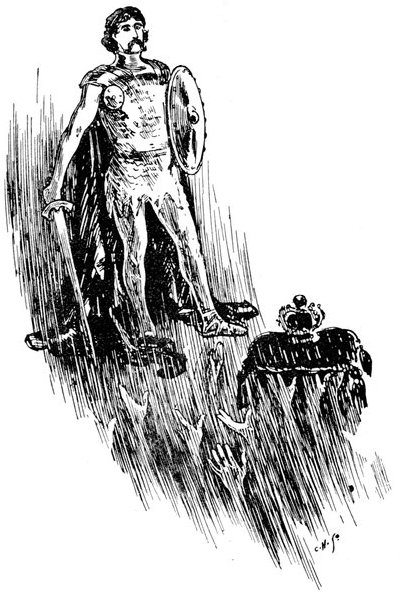
"An Imperial Crown!" gasped James.
Reader, if you do not believe in William's theory, search your "Burke" for a physician qualified to sit in the House of Lords.
J. F. Sullivan.