Part 2 — Part II: The City
Reading edition
SECTION I
If the traveller will place himself on the Pont Royal, or on the Pont du Carrousel, and look towards the Cité when the tall buildings, the spire of the Sainte Chapelle and the massive grey towers of Notre Dame are ruddy with the setting sun, he will enjoy a scene of beauty not easily surpassed in Europe. Across the picture, somewhat marred by the unlovely Pont des Arts, stride the arches of the Pont Neuf with their graceful curves; below is the little green patch of garden and the cascade of the weir; in the centre of the bridge the bronze horse with Henry IV., its royal rider, almost hidden by the trees, stands facing the site of the old garden of the Palais, where St. Louis sat on a carpet judging his people, and whence Philip the Fair watched the flames that were consuming the Grand Master and his companion of the Knights Templars. To the left are the picturesque mediæval towers of the Conciergerie and the tall roof of the belfry of the Palais. Around all are the embracing waters of the Seine breaking the light with their thousand facets. The island, when seen from the east as one sails down the river, is not less imposing, for the great mother church of Notre Dame, with the graceful buttresses of the apse like folded pinions, seems to brood over the whole Cité.
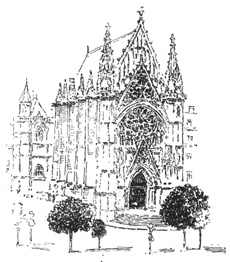
Chapel of Château at Vincennes. View larger image
From the time when Julius Cæsar addressed his legions on the little island of Lutetia Civitas Parisiorum to the present day, two millenniums of history have been enacted there, and few spots are to be found in Europe where so many associations are crowded together. In Gallo-Roman times the island was, as we have seen, even smaller, five islets having been incorporated with it since the thirteenth century. Some notion of the changes that have swept over its soil may be conceived on scanning Félibien's 1725 map, where no less than eighteen churches are marked, scarce a wrack of which now remains on the island. We must imagine the old mediæval Cité as a labyrinth of crooked and narrow streets, with the present broad Parvis of Notre Dame of much smaller extent, at a higher level, enclosed by a low wall and approached by steps. Against the north tower leaned the Baptistery (St. Jean le Rond) and St. Denis of the Ferry against the apse. St. Pierre aux Bœufs, whose façade has been transferred to St. Sévérin's on the south bank, stood at the east corner, St. Christopher at the west corner of the present Hôtel Dieu which covers the site of eleven streets and three churches. The old twelfth-century hospital, demolished in 1878, occupied the whole space south of the Parvis between the present Petit Pont and the Pont au Double. It possessed its own bridge, the Pont St. Charles, over which the buildings stretched, and joined the annexe (1606), which, until 1909, existed on the opposite side of the river.
Notre Dame.
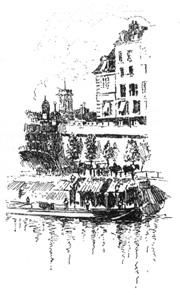
Near the Pont Neuf. View larger image
The traveller who stands on the Parvis before the Church of Our Lady at Paris beholds the embodiment and most perfect expression of early Gothic architecture, the central type and model of the new style created by the genius of the masters of the Isle de France in the late twelfth and early thirteenth centuries. On the west front the builders have lavished all their artistic powers in a synthetic exposition of their outlook on life and eternity. As the worshipper approaches the central portal his eye is arrested by a representation of the ultimate and most solemn fact of human destiny, the Last Judgment. On the lintel the dead are seen rising from their graves at the last trump; prelate, noble and serf in one equality of doom. Above, the fine figure of St. Michael is seen weighing souls in the balance. At his left the damned are hauled in chains by grinning demons to Hell: at his right the elect raise joyful eyes toward Heaven. Crowning the tympanum is Christ the Judge, flanked by angels, and by the Virgin and the Baptist kneeling in intercession while He shows His wounded hands. On the archivolts are, to the right of the spectator, demons and damned souls and quaint personifications of death: to his left the heavenly host, choirs of angels, seated prophets and doctors and the army of martyrs. On the jambs are the five wise and five foolish virgins; apostles and saints on the embrasures of the door; below them reliefs of the virtues, each symbolised above its opposite vice. On the central pillar stands Christ in act of blessing; below Him, bas-reliefs typifying the seven liberal arts.[180]
We turn to the lovely portal of the Virgin under the north tower. In the lower compartment of the tympanum is figured the ark of the Covenant attended by prophets and kings; above, is the burial of the Virgin, and crowning all, Our Lady in glory. On the archivolts are angels, patriarchs, prophets, and kings. The jambs and casements are decorated with thirty-seven marvellously vivid reliefs of the signs of the Zodiac, the seasons and labours of the year, a kind of almanac of stone of rare invention and execution. On the embrasures of the door are, among others, the favourite Parisian saints: Denis, Genevieve and Stephen. On the central pier, below the Virgin and Child, are the Creation, Temptation and Fall. The whole of this portal will repay careful inspection.
St. Anne's portal, under the south tower, is more archaic, and indeed some of its sculptures are believed to have come from an earlier Romanesque building. Along the lintel are seen episodes in the life of St. Anne and in the life of Mary: in the central band, to the left, are the Presentation, the Annunciation, the Visitation; in the middle the Nativity in various scenes; to the right Herod, and the Adoration of the Magi. The whole of these reliefs are twelfth-century work, with the exception of the Presentation, which is thirteenth century. In the hemicycle above are the Virgin and Child under a Byzantine canopy with angels and founders on either side. On the central pier stands St. Marcel, Bishop of Paris, banning the horrible serpent that made his lair in a tomb: the retreating serpent's tail is seen on the pier. Both on this and on the north portal traces of painting still remain.
Before leaving, we note the beautiful mediæval wrought hinges (restored) which came from the old church of St. Stephen and which have been copied for the central portal. The three portals were completed in 1208.
Above them and across the whole façade runs a gallery of kings, twenty-eight in number—a perennial source of controversy. Authorities are divided between the kings of France and the kings of Israel and Judah, the royal ancestry of the Virgin. From the analogy of other cathedrals we incline to the latter view. The gallery dates not later than 1220, but the statues are modern reproductions. Yet higher, on the pierced balustrade, is a group of the Virgin between two angels and on either side, over the N. and S. portals, Adam and Eve. A gallery of graceful columns knits the towers together (which were intended to be crowned by spires) before they soar from the façade. Between the towers, in olden times, as we know from an illumination in a Froissart MS., stood a great statue of the Virgin. The whole of this glorious fretwork of stone, including the tracery of the rose window, was once refulgent with gold and azure and crimson, and the finished front in its mediæval glory has been compared to a colossal carved and painted triptych.
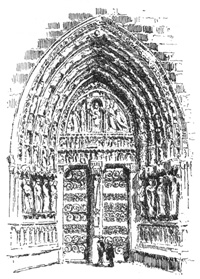
Notre Dame—Portal of St. Anne. View larger image
Notre Dame—South side—from the Seine. View larger image
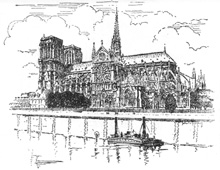
Notre Dame—South side. View larger image
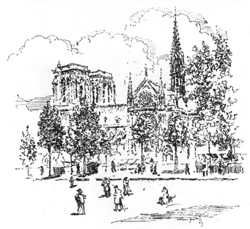
On the central pier of the greater portal of the N. transept, called of the Cloister, we note a fine ancient statue of the Virgin, famed for its grace of expression. The smaller Porte Rouge, further eastward, is remarkable for some well-preserved antique sculpture: a Coronation of the Virgin in the tympanum and six scenes in the life of St. Marcel in the archivolt: some old gargoyles and reliefs may be seen on either side of the door.
We pursue our way by the east end of the cathedral, where in mediæval times was an open waste, the Motte aux Papelards, the playground of the cathedral servants, the graceful outlines of the apse and the bold sweep of the flying buttresses ever varying in beauty as we pace around. The south portal (ill seen through the iron railings) called of St. Stephen or of the Martyrs is decorated with statues of the saint and of other martyrs, with scenes of their martyrdom. The inscription (p. 88) may be seen at the base to the R.
We may now enter the noble and harmonious interior, unhappily bared of its rich old decorations, its tombs and statues cleared away, its fine Gothic altar destroyed by clerical and royal vandals to give place to renaissance and pseudo-classic pomposities (p. 252). We approach the choir from the right aisle, noting a fourteenth-century statue of the Virgin and Child on the left as we reach the entrance, perhaps the very statue before which povre Gilles did his penance (p. 142) and proceed to examine all that remains of the "histories" in stone on the choir wall round the ambulatory, twenty-three in number, begun in 1319 by Master Jean Ravy, mason of Notre Dame, and finished (parfaites) by Master Jean le Bouteiller in 1351, all dorez et bien peints . Those on the choir screen were destroyed by the Cardinal Archbishop de Noailles in 1725. On the north side are twelve reliefs drawn from earlier New Testament history: on the south are nine from later episodes in the life of Christ. These naïve mediæval sculptures of varying merit will repay careful examination. The gilding and colouring are modern. Of the jewelled splendour of the western rose and of the two great rose windows of the transepts the eye will never tire. With every changing light new beauties and new combinations of colour reveal themselves. Those who care to read the subjects will discern in the north transept rose, incidents depicted in the life of the Virgin, and eighteen founders and benefactors: in the south are apostles and bishops crowned by angels.
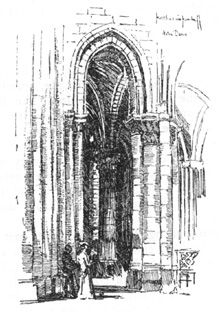
Interior of Notre Dame. View larger image
We return to the Porte Rouge in the Rue du Cloître opposite which is the Rue Massillon, where at Nos. 4 and 6 we may note some remains of the cloisters and canons' dwellings, once a veritable city within a city, fifty-one houses with gardens sequestered within a wall having four gates. We continue to the Rue Chanoinesse, where, No. 10, is the site of Canon Fulbert's house: at No. 18, by the courtesy of Messieurs Allez Frères, we may visit the curious old fifteenth-century tower of Dagobert[181] which marks the site of the old port of St. Landry and affords a fine view of the north side of Notre Dame. We return to No. 10 and descend the Rue des Chantres to the Quai aux Fleurs: at No. 9, the site of the house of Abelard and Héloïse, an inscription recalls the names of the unhappy lovers,
"... for ever sad, for ever dear, Still breathed in sighs, still ushered with a tear."
We turn westward along the Quai and ascend on our L., the narrow Rue de la Colombe, across which a double line of stones traces the position of the Gallo-Roman wall, that enclosed the Cité. We continue to ascend, and on our L., No. 26 Rue Chanoinesse, we enter a small court where we find a portion of the old pavement of St. Aignan's church, with the almost effaced lineaments on the tombstones of those, now forgotten, who were doubtless famous churchmen in their time, and where St. Bernard wept a whole day, fearing that God had withdrawn from him the power of converting souls. This faint trace of the past wealth of churches remains, but where are the sanctuaries of Ste. Geneviève des Ardents, St. Pierre des Arces, St. Denis of the Prison, St. Germain le Vieux, Ste. Croix, St. Symphorien, St. Martial, St. Bartholomew, and the church of the Barnabites, which replaced that of St. Anne, which replaced the old Abbey church of St. Eloy, all clustering around their parent church of Our Lady like nuns under their patroness' mantle? Until comparatively recent times the church of St. Marine was used as a joiner's workshop, and one of the chapels of Ste. Madeleine, parish church of the water-sellers, served as a wine merchant's store! All that survives of the ancient splendour of the Cité are Notre Dame and some portions of the Palais, including the Ste. Chapelle.
We turn R. to the Rue d'Arcole that has swept away the old church of St. Landry, near which, until the reign of Louis XIII., a market was held for the sale of foundling children at thirty sous. The scandal was abolished by the efforts of the gentle St. Vincent de Paul, Anne of Austria's confessor. Turning L. along this street we emerge on the Parvis, which we skirt to the R. along the façade of the new Hôtel Dieu, and reach the Rue de la Cité. We turn R., cross to the L. and follow the broad Rue de Lutèce to the Palais de Justice.
The Sainte Chapelle and the Palais de Justice.
Entering the Cour du Mai by the great iron grille which has replaced the old stone portal, flanked by two towers, a passage on the left leads us to the Cour de la Ste. Chapelle (p. 86). We enter by the west porch of the lower chapel. On the central pier is a restored figure of the Virgin whose original is said to have bowed her head to the famous Scotch theologian Duns Scotus, in recognition of his championship of the dogma of the Immaculate Conception, in 1304: in the decoration of the base of the column and of the embrasures of the door, the Fleur-de-Lys of St. Louis is seen alternating with the Castilian Tower of his mother, Blanche of Castile, a decorative motive repeated in the painting of the chapel.
Beautiful as are the vaultings and proportions of the lower chapel, and the decoration, copied, as in the upper chapel, from traces of the original colouring found under the whitewash, the visitor will doubtless prefer to ascend, after a cursory inspection, the narrow, winding stairway to the resplendent upper sanctuary, whose dazzling brilliancy moved an ancient writer to declare that "in the contest between light and darkness in architecture, the creator of the Ste. Chapelle in the pride of his victory built with light itself." In the apse, flooded by streams of colour falling from the windows, is the platform or tribune where, in a rich reliquary of gold, glittering with precious stones, and under a baldachin, the holy relics from Constantinople were exposed in days of old. Part of the tribune is preserved and one of the staircases by which it is ascended, that to the N., is said to date from the founder's time, and may often have been trodden by the very feet of St. Louis himself. Little else of the interior furniture has escaped destruction. The beautiful high altar, the rood loft, the choir stalls, have long disappeared. Four only of the statues of the apostles bearing the crosses of consecration are said to be originals—the fourth and fifth on each side of the nave counting from the west door; the relics, or all that escaped the political storms of the année terrible, are now at Notre Dame, and the reliquary that contained them went to feed the hungry war-chest of the revolutionary armies. But the thirteenth-century jewelled windows, as left to us by the admirable restorers of 1855, are of paramount interest. The wealth of design and amplitude of the series are truly amazing. The panels, numbering about eleven hundred, are a compendium of sacred history and a revelation of the world to come: the whole scene from the Creation to the Apocalypse is unrolled before our eyes, pictured in a transparent symphony of colour. Seven windows of the nave and four of the apse deal with Old Testament history: three at the end of the apse with the New. The eighth window of the nave (the first to the R. of entrance), dealing with the story of the Translation of the relics from Constantinople, although the most restored—nineteen only of the sixty-seven subjects are original—is perhaps the most interesting, for among the nineteen may be seen St. Louis figured by the contemporary artist: receiving the relics at Sens; assisting to carry the relics, barefoot; taking part at the exposition of the relics with his queen and his mother; receiving an embassy from the Emperor Baldwin; carrying the Byzantine cross which holds a portion of the true cross. Another of the original panels contains a representation of the Cité with the enveloping arms of the Seine. The rose window at the west end is obviously later, and dates from the fifteenth century.
In olden times the lower part of the central window of the apse was made of white glass that the people massed in the courtyard below might behold the relics as St. Louis and his successors, after exhibiting them to the privileged congregation in the chapel, turned round to show them. Against the south wall of the nave is a little oratory with a squint through which it is said Louis XI. used to venerate the relics unobserved.
We step out from the west door of the upper chapel to examine the more richly decorated upper portal. The carvings are all modern and, except such as were suggested by traces of the old work, are copied from the west front of Notre Dame and other churches. Many a solemn and many a strange scene have been enacted in this royal oratory; the strangest of all perhaps when Charles V. of France, the Holy Roman Emperor Charles IV., and his son Wenceslaus, king of the Romans, in the rôle of the three Holy Kings, came to venerate the relics and laid oblations before the shrine.
Before we turn away from the building we should observe on the west façade above the rose window wherein the architect has literally sported with the difficulties of construction in stone a charming design of fleurs-de-lys framed by quatrefoils along the balustrade; the central design is an R. (rex), crowned by two angels. The present spire is a fourth erection. The second, which replaced the original spire in 1383, was one of the wonders of Paris, and fell a victim to fire in 1630. A third, erected by Louis XIII., was demolished in 1791, and in 1853 Lassus, Viollet le Duc's principal colleague in the restoration of the chapel, designed the graceful flèche we see to-day.
We return to the Cour du Mai: on the R., before we ascend the great stairway, we look down on the nine steps leading from the Vestibule (now a Café Restaurant) of the Conciergerie, up which those doomed to the guillotine ascended to the fatal tumbrils awaiting them in the courtyard. We ascend to the Galerie Marchande: the stairway, rebuilt after the fire of 1776, replaced the old flight of stairs at whose feet heralds proclaimed treaties of peace and tournaments, criminals were branded, and books condemned by the Parlement, burned. Here Pantagruel loved to stand and cut the stirrup-straps of the fat councillors' mules, and see the gros suflé de conseiller fall flat when he tried to mount; and here the clercs of the Basoche planted the annual May-tree, brought from the forest of Bondy, with much playing of drums and trumpets and elaborate ceremony.
The Galerie Marchande, formerly known as the Galerie Mercière, was once a busy and fashionable bazaar, where lines of shops displayed fans, shoes, slippers and other dainty articles of feminine artillery. The further galleries were also invaded by the traders, who were only finally evicted in 1842. We turn R. and enter the Grande Salle or, as it is now known, the Salle des Pas Perdus. It, too, was once a busy mart, booksellers especially predominating, most of whom had stations there, much as we see them to-day, round the Odéon Theatre. Vérard's address was—"At the image of St. John the Evangelist, before Notre Dame de Paris, and at the first pillar in the Grande Salle of the Palais de Justice, before the chapelle where they sing the mass for Messieurs of the Parlement." Gilles Couteau's address was at "The Two Archers in the Rue de la Juiverie and at the third pillar at the Palais." Every pillar had its bookseller's shop. In 1618 the great chamber, the finest of its kind in Europe, with its rich stained glass, its double vaultings resplendent with blue and gold, was gutted by fire, and its long line of statues of the kings of France, from Pharamond to Henry IV.—the rois fainéants with pendent arms and lowered eyes, the valiant warrior kings with heads and arms erect—disappeared for ever. This was the hall where the clercs of the Basoche performed their farces, sottises and moralités, and where Victor Hugo has placed the scene of the famous performance of the moralité, composed by Pierre Gringoire,[182] so vividly described in the opening chapters of Notre Dame.
Debrosse, who built the new Salle in 1622, left a noble and harmonious Renaissance chamber, which, again restored after the fire of 1776, endured until its destruction by fire during the Commune. The present rather frigid hall was completed in 1878 by J.L. Duc, who respected the traditional form and amplitude of the older structures. Nearly opposite the monument to Malesherbes (R.) was the position of the old Pilier des Consultations, where the lawyers were wont to give gratuitous legal help to the poor. The best time to visit the Hall is in the afternoon, when the courts are sitting and when the footsteps of the lawyers and their clients are indeed lost amid the buzz of conversation as they pace up and down.
The Première Chambre to the L., in the north-west corner of the Hall, is one of the most profoundly interesting in the agglomerated mass of buildings known as the Palais de Justice. This, now somewhat reduced in size, was the old Grande Chambre, rebuilt by Louis XII. on the occasion of his marriage with Princess Mary of England, which replaced the earlier bed-chamber of St. Louis.
Fra Gioconda's sumptuous decorations of 1502, which won for it the name of the Chambre dorée, the gold used being, it is said, equal in purity to the famous Dutch golden florin, have been partially restored. Here the kings of France held their Beds of Justice; here the Fronde held its sittings, and here on 15th April, 1654, the young king Louis XIV. strode in, booted and spurred, and is said to have uttered the famous words l'État c'est moi. Here too, renamed the Salle Égalité, the dread Revolutionary Tribunal held its sittings and condemned 2742 victims; here on 14th October 1793, at half-past four in the morning, appeared Marie Antoinette, "widow of Louis Capet," before her implacable judges and heard her doom; hence the twenty-one Girondins trooped forth to their common fate; here Robespierre, St. Just, and, at length, the unwearied minister of death, Fouquier-Tinville himself, the revolutionary public prosecutor, heard their condemnation. We leave by the Cour du Mai and note, to our L., the restored clock tower, replacing the most ancient and famous clock of Paris. It was renewed by Germain Pilon in 1588 and restored in 1685. Demolished during the Revolution, the face and decoration were again renewed in 1852. The silvery-toned bell that hung here, called the tocsin, cast in 1371 and known as the cloche d'argent, was accused, together with the bell of St. Germain l'Auxerrois, before the Commune on 21st August 1792, of having given the signal for the massacre of St. Bartholomew, and its immediate destruction was ordered. We turn along the picturesque river façade, and between its two mediæval towers, de César and d'Argent, enter the Conciergerie.[183] The condemned cell of Marie Antoinette (transformed into a chapel) and the cell of Robespierre are shown, together with the chapel where the Girondins passed their last night and where their legendary banquet is famed to have taken place. The so-called Cuisine de St. Louis, a remain of the old Gothic palace of Philip le Bel, is no longer shown. The third tower on the river façade, which we pass on our way westward, has been wholly rebuilt. In the original tower was the judicial torture-chamber (an adjunct of every court of justice in olden times), used to wrest confessions from prisoners and evidence from unwilling witnesses, hence its name of Tour Bon Bec or Bavarde. The fine western façade and the Salle des Pas Perdus of the Cour d'Assises, looking on the Place Dauphine, were completed in 1868.
Few Law Courts in Europe have so venerable a history as the Palais de Justice. From the times when the Roman prætor set up his court, more than two thousand years ago, to the present day, a temple of Law and Justice has ever stood on this spot.
SECTION II
St. Julien le Pauvre—St. Sévérin—The Quartier Latin
As we fare S. from the W. end of the Parvis of Notre Dame and cross the Petit Pont, we behold the old Roman Road, now Rue St. Jacques, rising straight before us and on the annexe of the Hôtel Dieu,[184] to the L. of the Place du Petit Pont find inscribed their names (p. 46), who nearly twelve centuries ago dared: —
"For that sweet motherland which gave them birth, Nobly to do, nobly to die."
St. Sévérin. View larger image
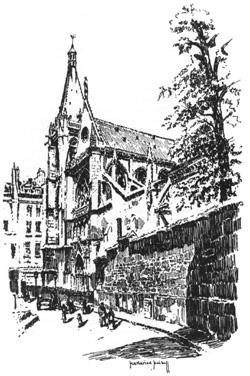
On the site of the Place stood the Petit Châtelet, demolished in 1782, a gloomy prison where many a rowdy student was incarcerated. To the L. of the Rue du Petit Pont we turn by the Rue de la Bûcherie and on our R. find the Rue St. Julien le Pauvre. Here on the L., hidden behind a pair of shabby wooden gates, stands the modest little twelfth-century church, now used for the Uniat Greek services, where St. Gregory of Tours found the drunken impostor (pp. 32, 33), where the University of Paris first held its sittings, and where twice a year the royal provost attended to swear to preserve the privileges of the rector, masters and scholars. Near by stood the house of Buridan (note [49]. At the end of the street we turn R. by the old Rues Galande and St. Sévérin: at No. 4 of the latter, we see a trace of the original naming of the streets by Turgot, the marks of the erasure of the word "Saint" during the Revolution being clearly visible. Parallel with this street to the N. is the Rue de la Huchette, from which opens the curious old Rue du Chat qui Pêche and the Rue Zacharie, in mediæval times called Sac à Lie, which communicates with the Rue St. Sévérin. To our L. is the fine Gothic church of St. Sévérin, one of the most beautiful and interesting in Paris, on the site of the oratory of Childebert I., where St. Cloud was shorn and took his vows. On the thirteenth-century N. portal of the tower have been replaced the two small lions in relief between which, in olden times, the curés are said to have exercised justice. We note the thirteenth-century W. portal, transferred from the old church of St. Pierre aux Bœufs, and enter for the sake of the beautiful Gothic interior, mainly fifteenth century, with its double aisles and ambulatory and fine stained-glass in the nave. We turn L., on leaving, along the Rue des Prêtres St. Sévérin (No. 5 is the site of the old Collège de Lisieux) which is continued by the Rue Boutebrie, in former times the Rue des Enlumineurs, famous for those who practised the art, "che alluminare chiamata è in Parisi."[185] At the end of the Rue des Prêtres we turn L. along the picturesque Rue de la Parcheminerie, where we may recall the old poet Corneille sitting at a cobbler's stall while his gaping shoe was patched, and where still remain, among other curious old houses, Nos. 6 and 7, which in the thirteenth century were owned by the canons of Norwich Cathedral, who maintained a number of scholars there. We are now on the very foyer of the University quarter, in mediæval times swarming with poor scholars, the busy hive of knowledge, and so notorious for its misery and rowdy depravity, that Charles V. during his regency had the Rue du Fouarre closed at curfew by strong iron grilles. We pass on to the Rue St. Jacques, then R. to the Boulevard St. Germain, again sharply to the L. and descend the new Rue Dante, R. of which, in the Rue Domat, are some quaint old houses: at 12 bis is the site of the old Collège de Cournouailles (Brittany). The Rue Dante is continued by the Rue du Fouarre (Straw Street) where Siger taught (p. 103) and in one of whose colleges the author of the Divina Commedia probably sat as a scholar. The houses are all modernised and the name alone remains. We turn R. along the Rue Galande, noting R. the Rue des Anglais which reminds us that there the English scholars congregated. We pass on by the Rue Lagrange and reach the place Maubert of dread memories, for here were burnt many a Protestant martyr and the famous printer philosopher, Étienne Dolet, friend of Erasmus, of Marot and of Melancthon, whose statue in bronze stands on the Place. Dolet's martyrdom is still yearly celebrated there by democratic Parisians, and the Place has always been famous for its barricades during the Fronde and later Revolutionary times. We cross the Boulevard to the Rue des Carmes, whose name recalls the Carmelite monastery founded by St. Louis, and at No. 15 find the site of the old Italian College (Collège des Lombards). Much of this "hostel of the poor Italian scholars of the charity of Our Lady," as rebuilt by two Irish priests, Michael Kelly and Patrick Moggin, still exists, including the chapel, and is partly occupied by a Catholic Workmen's Club It gave shelter to forty missionary priests and an equal number of poor Irish scholars, and the earliest disciples of Loyola found temporary shelter there. Some idea of the vast extent of the ancient foundation may be gained by walking round to 34 Rue de la Montagne Ste. Geneviève on the other side of the Marché where the principal portal may be seen. We return to the Place Maubert, which we recross, and descend direct before us to the Rue de la Bûcherie on our L. This street was the centre of the medical students, and from 1369 to the times of Louis XIV. the Faculty of Medicine held its lectures and demonstrations there. At No. 13 still remains the old anatomical and surgical theatre of the Faculty erected in 1617, which has been acquired by the Municipality, but had a neglected, almost ruined aspect when we last passed (Feb. 1906).[186] We continue along this street and return to the Place du Petit Pont.
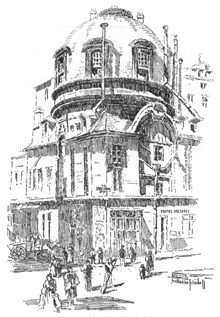
Old Academy of Medicine. View larger image
SECTION III
École des Beaux Arts[187]—St. Germain des Prés—Cour du Dragon—St. Sulpice—The Luxembourg—The Odéon—The Cordeliers—The Surgeons' Guild—The Musée Cluny[188]— The Sorbonne[189]—The Panthéon[190]—St. Étienne du Mont—Tour Clovis—Wall of Philip Augustus—Roman Amphitheatre
We cross to the S. bank of the Seine by the Pont du Carrousel (or des Saints Pères). Opposite on the Quai Malaquais stands the École des Beaux Arts (on the site of the old Convent of the Petits Augustins where Lenoir organised his museum), founded by the Convention and now one of the most important art-teaching centres in Europe. We turn S. by the Rue Bonaparte, and soon find the entrance, on the R., to the first courtyard, in which we note, on our R., the fine Portal of the Château of Anet, built for Diana of Poitiers by Delorme and Goujon (1548): opposite the entrance, giving access to the second courtyard, is placed a façade, transitional in style, from the Château of Gaillon. An hour may profitably be spent on Sundays strolling through the rooms viewing the interesting collection of casts and reproductions of masterpieces of painting by the pupils of the school. Delaroche's famous Hemicycle, representing the great artists of every age, seventy-five figures larger than life, will be found in the theatre of the Musée des Antiquités entered from the second courtyard.
We continue along the Rue Bonaparte past the new Académie de Médecine and on our L. soon sight the grey pile of the old Abbey Church of St. Germain des Prés, once refulgent in colour and gold. A part of the great tower is said to have resisted the Norman conflagrations, but the church as we now behold it, is that rebuilt 1000-1163; enlarged in 1237 and restored at various periods in the first half of the nineteenth century. Of the great fortress-monastery, with its immense domains of land; its cloisters, walls and towers; its prison and pillory, over which the puissant abbots once held sway, only a memory remains. The fortifications were razed in the seventeenth century and gave place to artizans' houses. The famous Fair of St. Germain has long been suppressed, where Henry IV. on the royal entry of Marie de' Medici, after promising the merchants that they should grow rich, since his queen had de l'argent frais, disappointed them all by chaffering much and buying nothing. Over the entrance of the church within the W. porch is a well-preserved Romanesque relief of the Last Supper. Some bases and capitals of the triforium date from the twelfth century, but the heavy Romanesque capitals of the eleventh century nave are restorations, and the beautiful early Gothic choir has also been much modified at various epochs. The interest of the interior is enhanced to the lover of French art by Flandrin's admirable frescoes (p. 391), illustrating scenes from the Old and New Testaments. Unhappily, they are seen with difficulty, and a bright, sunny day is necessary to appreciate the masterly art, the noble and reverent spirit that animates them. One of the most successful and best seen is the Entry into Jerusalem, L. of the choir.
If we turn by the Rue de l'Abbaye, N. of the church, we shall find part of the sixteenth-century Abbot's Palace yet standing, and a walk round the apse and the S. side of the church will afford a view of its massive bulk, its flying buttresses and steep-pitched roof. Crossing the Place St. Germain obliquely to the S.W. we reach the Rue de Rennes: at No. 50 is the entrance of the picturesque Cour du Dragon with an eighteenth-century figure of a Dragon carved over it. At the end of this curious courtyard, paved, as old Paris was paved, with the gutter down the middle, will be seen two old towers enclosing stairways. We return to the Rue Bonaparte and faring still S. reach the huge fabric of St. Sulpice with its massive, gloomy towers and pretentious façade of cumbrous splendour. We enter for the sake of Delacroix' fine paintings in the side chapel R. of entrance: Jacob wrestling with the Angel; Heliodorus driven from the Temple; and St. Michael and the Dragon. In this and in many of the numerous chapels are other decorative paintings by modern artists, few of which will probably appeal to the visitor. It was in this church that Camille Desmoulins was wedded to Lucille, Robespierre acting as best man. On the S. side of the ample Place St. Sulpice is the great Catholic Seminary,[191] and the whole neighbourhood has an essentially ecclesiastical character. Shops and emporiums displaying objets de piété; all kinds of church furniture and art (most of it bad art) abound. We continue our southward way by the Rue Férou, opposite the end of which is the Musée du Luxembourg containing a collection of such contemporary sculpture and paintings as has been deemed worthy of acquisition by the State. The rooms are crowded with statuary and pictures which evince much talent and technical skill, but the visitor will be impressed by few works of great distinction. The English traveller, perchance, will leave with kindlier feelings towards those responsible for the Chantrey pictures, though envious of a collection whose catholicity embraces works by two great modern masters, Londoners by option—Legros and Whistler. But any impression that may be left on the traveller's mind by the inspection of the examples of contemporary French art exhibited in this museum should be supplemented and corrected by an examination of decorative works of greater range in the chief public edifices, such as the Hôtel de Ville, the Sorbonne, the Panthéon and the École de Médecine. We enter the Luxembourg Gardens by the gate R. of the museum, turn L., pass the façade of the palace and opposite its E. wing discover the charming old Medici Fountain. After strolling about the delightful gardens, unhappily by the erection of the Observatory in 1672 reduced by more than one-third of their former extent, we leave by the gate N. of the Medici Fountain which gives on the Rue Vaugirard opposite the Odéon Theatre, formerly the Théâtre de la Nation, where the Comédie Française performed for a few years after 1781. The Paris booksellers still have their stalls inside the colonnade even as they used to do in the great Salle of the Palais de Justice.
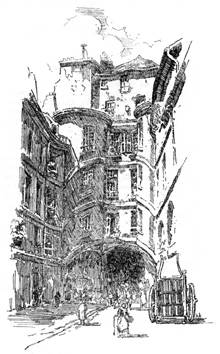
Cour du Dragon View larger image
Descending (R. of the Odéon) the Rues Corneille, Casimir Delavigne and Antoine Dubois, we strike the Rue de l'École de Médecine where (No. 15 to R.) will be seen the Refectory, all that remains of the great Franciscan monastery, and now used as a pathological museum (Musée Dupuytren), for medical students. In this hall was laid the body of Marat after his assassination by Charlotte Corday, and the famous club of the Cordeliers, where the gentler rhetoric of Camille Desmoulins vied with the thunderous declamation of Danton to stir republican fervour, met in the Hall of Theology. We pass to No. 5, where are some remains of the old School of Surgery or Guild of SS. Cosmas and Damian, founded by St. Louis; adjacent stood the church of St. Cosmas, famous for the fiery zeal of its curé during the times of the League. The surgeons of the Guild being compelled by their charter to give professional aid to the poor every Monday, the churchwardens obtained a papal Bull authorising them to erect in their church a suitable consulting-room for the use of the patients. In 1694 the surgeons built an anatomical theatre which, enlarged in 1710, is now used as an art school. We continue our pilgrimage and, crossing the Boulevard St. Michel to the Rue des Écoles, descend on our L. the Rue de la Sorbonne and find the entrance to the beautiful late Gothic palace built for the abbots of Cluny in 1490.
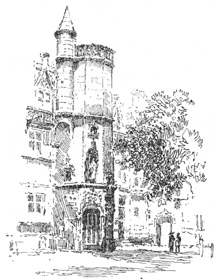
Tower and Courtyard of Hôtel Cluny. View larger image
The delightful old mansion, (p. 159) now the Musée de Cluny, is crowded with a selection of mediæval and renaissance objects unparalleled in Europe for variety and excellence and beauty. The rooms themselves, with their fine carved chimney-pieces, where on winter days wood-fires, fragrant and genial, burn, are not the least charming part of the museum. Many of the exhibits (about 12,000) are uncatalogued, and the old catalogue, long out of date, may well be classed among the antiquities. The traveller will doubtless return again and again to this rich and fascinating museum. The present installation is provisional, and we do but indicate the chief classes of objects exhibited, most of which are clearly labelled. L. of vestibule, Rooms I. and II. contain a miscellaneous collection of wood carving, statuary, ivories, etc. Room III. has some important examples of carved and painted altar-pieces: 709 is late fifteenth-century work; 712, Flemish of the sixteenth century; 710, a German domestic altar-piece, near which stands a fine Flemish altar-piece (no number), carved with scenes from the Passion. On a screen in the centre are some important paintings, carvings and other objects of ecclesiastical art from the Rothschild Collection. Room IV. shows some beautiful renaissance furniture, cabinets, medals, etc. To the R. is the smaller Room V. The chief exhibits here are an eighteenth-century Neapolitan Crèche, with more than fifty doll-like figures; a rich tabernacle of plateresque Spanish work, and some furniture of interest. We return and descend to Room VI. (on the R), a large hall, where many important mediæval sculptures will be seen. At the four corners are thirteenth-century statues from the Ste. Chapelle. We may also mention: 429 (under a glass case), some lovely fourteenth-century statuettes, mourners from the tomb of Philip the Bold, by the Burgundian artist, Claus Sluter; a painted statue of the Baptist, Sienese work; statuette in wood of the Virgin, French art of the fourteenth century; 725, statuette in wood of St. Louis from the Ste. Chapelle. Other noteworthy examples of mediæval plastic art by French, Italian and Netherland craftsmen will be found in this room, and around the walls are specimens of tapestries, carvings, paintings and mosaics, among the last being some from St. Denis and one, 4763, by David Ghirlandaio from St. Merri. We cross a passage to the parallel Hall VII., where hang three grand pieces of early sixteenth century Flemish tapestry, illustrating the story of David and Bathsheba. Among the statuary are: 251, Virgin and Child, French work of early sixteenth century; 448, The Three Fates, attributed to Germain Pilon, and said to be portraits of Diana of Poitiers and her daughters. 449, The Forsaken Ariadne; 456, Sleep; 450, Venus and Cupid; 479, a small and beautiful entombment, are French work of the sixteenth century. Hall VIII. Here are exhibited the sumptuously decorated robes of the Order of the Holy Ghost (p. 187); other examples of fine tapestry; a Venetian Galley Lamp; and some statuary of the sixteenth and seventeenth centuries.
We return to the passage and ascend the stairs to the first floor. Here are three galleries devoted to Faiences and other specimens of the potter's art of French, Italian, Flemish, German, Spanish, Persian and Moorish provenance. All are of admirable craftsmanship, the Italian (including some from Faenza itself, the home of Faience ware) being of especial beauty and excellence. Among the Della Robbia ware is an exquisite Child-Baptist by Andrea. We now ascend three steps to the room which contains, among other objects, a matchless collection of Limoges enamels; some Venetian glass; and the marvellous fifteenth-century tapestries from Boussac, probably the finest of that fine period which have survived to us. The upper portion illustrates the Life and Martyrdom of St. Stephen; the lower, the story of the Lady and the Unicorn, or the Triumph of Chastity.
We descend to the Gallery of Hispano-Moorish and Persian pottery, and cross to a suite of small rooms where specimens of Jewish sanctuary art, old musical instruments, wedding cassoni and Flemish cabinets are displayed. We then turn R. to the Hall of Francis I., with a stately bed of the period; carved cabinets and cupboards, and proceed direct to the room devoted to the ivories. These are of extraordinary variety and beauty, and range from the sixth century downwards. The next room is crowded with an equally varied collection of bronze and iron work, among which we note a fifteenth-century statuette in bronze of Joan of Arc. The examples of the locksmith's art shown are of great beauty and excellence. The elaboration of French keys has a peculiar origin. Henry III., as a mark of royal favour, permitted his minions to possess a key of his private apartment: as a piece of swagger the royal favourite was wont to wear the key ostentatiously on his breast, whereby French smiths were spurred in emulation to produce keys of exquisite craftsmanship and design. Another kind of interest attaches to the key (No. 5962 in the case on the L. as we enter) which was made by Louis XVI. The following room contains specimens of the goldsmith's art. 5104 is a curious sixteenth-century model of a ship in gilded bronze, with figures of Charles V. and his court on the deck: it has an ingenious mechanism for discharging toy cannon. 5299, is a set of chessmen in rock crystal; 4988, the face of an altar, rich gold repoussé work, was given by the Emperor, Henry II., to Bale Cathedral. The glass case in the centre holds nine golden Visigothic crowns found near Toledo in 1860, the largest is that of King Reccesvinthus who reigned in the latter half of the seventh century; 5044 is a fourteenth-century Italian processional cross of great beauty. We retrace our steps to the Hall of Francis I., turn R. and enter the private chapel. Opposite the charming little apse are placed some admirably preserved fourteenth-century reliefs in stone from the Abbey of St. Denis. On leaving, we turn R. along the passage, hung with armour and weapons, to the stairway, descend to Room VI., ground floor, open a door at its W. end, and in the twinkling of an eye are swept back nigh two thousand years along the stream of the ages, for the frigidarium of the Baths of the Palace of the Cæsars is before us, a fabric of imperial architecture, spoiled of its decorations but yet massive and strong, as of elemental strength, defiant of time, the imperishable mark of Rome. We descend and find in the centre the altar (p. 17), bearing the inscription of the Nautæ. A statue of the Emperor Julian; some thirteenth and fourteenth-century statues are also exhibited. We may enter and rest in the garden where a twelfth-century cloister portal from the Benedictine Abbey of Argenteuil, a fourteenth-century portal from the Abbey of St. Denis, and other fragments of architecture are placed.
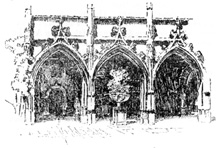
Arches in the Courtyard of the Hôtel Cluny. View larger image
We return to the Rue des Écoles which we cross to the imposing new University buildings. The vestibule, grand staircase and amphitheatre are of noble and stately proportions and adorned with mural paintings, among which Puvis de Chavannes' great composition, The Sacred Grove, in the amphitheatre, is of chief interest.[192] We continue along the Rue de la Sorbonne and soon reach the old chapel, all that remains of Richelieu's Sorbonne, containing his tomb, a masterpiece of monumental art of the late seventeenth century, designed by Lebrun and executed by Girardon. The church of St. Benoist and its cloister, where François Villon assassinated his rival Chermoyé, has also been swept away. We proceed by the Rue Victor Cousin, a continuation of the Rue de la Sorbonne, and debouch on the broad Rue Soufflot. Turning L., an inscription on No. 14 marks the site of the Dominican monastery where the great schoolmen, Albertus Magnus and St. Thomas Aquinas taught. Opposite (No. 9), at the corner of the Rue St. Jacques is the site, marked by a plan, of the old Porte St. Jacques of the Philip Augustus wall. We are now on the Mount of St. Genevieve, crowned by the majestic and eminent Panthéon, whose pediment is adorned by David d'Angers' sculptures, representing La Patrie, between Liberty and History, distributing crowns to her children. Among the figures are Malesherbes, Voltaire, Rousseau, Mirabeau, Carnot, Bonaparte, behind whom stand an old grenadier and the famous drummer-boy of Arcole.
The Panthéon has the most magnificent situation and, except the new church of the Sacré Cœur, is the most dominant building in Paris. Its dome is seen from nearly every eminence commanding the city, and has a certain stately, almost noble, aspect. But the spacious interior, despite the efforts of the artists of the third Republic, is chilling to the spectator. Swept and garnished, it has no warmth of historical or religious associations; it is devoid of human sentiment. The choice of painters to decorate the interior was an amazing act of official insensibility. The most discordant artistic temperaments were let loose on the devoted building. Puvis de Chavannes, the only painter among them who has grasped the limitation of mural art, has painted with restraint and noble simplicity incidents in the story of St. Genevieve. Jean Paul Laurens is responsible for a splendid but incongruous representation of the death of St. Genevieve. A St. Denis, scenes in the lives of Clovis, Charlemagne, St. Louis, and Jeanne d'Arc, by Bonnat, Blanc, Levy, Cabanel and Lenepveu, are all excellent work of the kind so familiar to visitors to the Salon at Paris, but lacking in harmony and in inspiration. The angel appearing to Jeanne d'Arc seems to have been modelled from a figurante at the opera. The visitor who has perused the opening chapters of this book will have no difficulty in following the subjects depicted on the walls. A more ambitious scheme of decoration was abruptly closed by the Coup d'État of Napoleon III.: Chenavard, who had been commissioned, in 1848, to decorate the interior by a series of forty cartoons, illustrating the "History of Man from his first sorrows to the French Revolution," found his gigantic project made abortive by the Prince President's treachery.
Interior of St. Étienne du Mont. View larger image
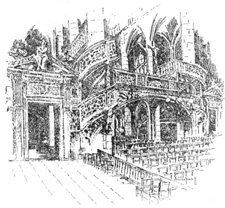
To the L. of the Panthéon, the library of St. Genevieve stands on the site of the Collège Montaigu and behind, in the Rue Clotilde, will be seen the steep-pitched roof of the old dormitory and refectory of the monastery of St. Genevieve: to our L. stands the picturesque church of St. Étienne du Mont (p. 85), whose interior is architecturally of much interest. The triforium, supported by round pillars and arches, in its turn supports a tournée, with another row of arches and pillars; some fine sixteenth-century coloured glass still remains. Biard's florid choir screen (p. 344) or jubé will at once attract the visitor, and the ever-present worshippers around the rich shrine R. of the choir will tell him that there such relics of the holy patroness of Paris as survived the Revolution are preserved. Two inscriptions near by recall the historical associations of the site. Leaving by the door this side of the choir, we issue into the Rue Clovis: opposite we sight the so-called Tower of Clovis, now enclosed in the buildings of the Lycée Henri IV., and once the tower of the fine old abbey church of St. Genevieve. A closer examination from the courtyard proves it to be partly Romanesque, partly Gothic. We descend the Rue Clovis and at No. 7 find one of the best-preserved remains of the Philip Augustus wall. Proceeding to the end of the Rue Clovis, we turn R., ascend the Rue Cardinal Lemoine, and cross to the Rue Rollin, which we descend to its intersection with the Rue Monge: in the Rue de Navarre opposite will be found the ruins of the old Roman Arena (p. 13). To return, we descend the Rue Monge, which terminates at the Place Maubert, where we find ourselves on familiar ground; or we may re-ascend the Rue Rollin, retracing our steps to the Rue Cardinal Lemoine, cross L. to the Place Contrescarpe and on our L. find the interesting Rue Mouffetard with curious old houses: 99, the site of the Palace of the Patriarchs of Alexandria and Jerusalem, is now the Marché des Patriarchs. The street terminates at the church of St. Médard, whose notorious cemetery (p. 245) is now a Square. We retrace our steps, noting L. the old fountain at the corner of the Rue Pot de Fer, continue to the end of the Rue Mouffetard, and descend by the Rue Descartes, where at No. 50 is an inscription marking the site of the Porte St. Marcel called Porte Bordet. We pass the École Polytechnique, on the site of the old College of Navarre, and continue down the Rue de la Montagne Ste. Geneviève to the Place Maubert.
SECTION IV
The Louvre [193]—Sculpture: Ground Floor.
No other edifice in Europe contains so vast a treasure of things beautiful and rare as the great royal palace of the Louvre, whose growth we have traced in our story. From periods so remote that works of art sometimes termed ancient are in comparison but of yesterday to the productions of the generation of artists who have just passed away, we may study the varying phases of the manifestation through the ages of the artistic sense in man. From Egypt, Chaldea and Assyria, from Persia, Phœnicia and Greece, rich and marvellous collections afford a unique opportunity for the study of comparative æsthetics. We may safely assume, however, that the traveller will be chiefly interested in the manifold examples of the plastic and pictorial arts, here exhibited, from Greece downwards. In the limited space at our disposal we can do no more than indicate the principal and choicest objects in the various rooms, praying those whose leisure and interest impel them to more thorough examination of any one department, to possess themselves of the admirable and exhaustive special catalogues issued by the Directors of the Museum.
The nucleus of the gallery of sculpture and painting was formed by Francis I. and the Renaissance princes at the palace of Fontainebleau, where the canvases at the beginning of the seventeenth century had reached nearly 200. Colbert, during the reign of Louis XIV. by the purchase of the Mazarin and other Collections, added 647 paintings and nearly 6000 drawings in ten years. In 1681 the Cabinet du Roi, for so the collection of royal pictures was called, was transferred to the Louvre. They soon, however, followed their owner to Versailles, but some hundred were subsequently returned to Paris, where they might be inspected at the Luxembourg Palace by the public on Wednesdays and Saturdays. In 1709 Bailly, the keeper of the king's cabinet, took an inventory of the paintings and they were found to number 2376. In 1757 all were again returned to Versailles, and it was not until 1793, when the National Convention, on Barrère's motion, took the matter in hand, that they were restored to the Parisians and, together with the works of art removed from the suppressed churches and monasteries preserved by Lenoir, formed the famous gallery of the Louvre, which was formally opened to the public on the first anniversary of the memorable 10th of August. The arrival of the artistic spoils from Italy was stage-managed by Napoleon with consummate skill and imposing spectacular effect. Amid the applauding multitudes of Parisians a long procession of triumphal cars slowly wended its way, loaded with famous pictures, securely packed, but each bearing its title in monumental inscription. The Transfiguration, by Raphael: The Christ, by Titian, etc. Then followed the heavy rumbling of massive cars groaning under the weight of sculptures, these too inscribed: The Apollo Belvedere: The Laocoon, etc. Other chariots loaded with trunks containing famous books, precious manuscripts, captured flags, trophies of arms, gave the scene all the pomp and circumstance of a veritable Roman triumph. These spoils, which almost choked the Louvre during Napoleon's reign, were reduced by the return, in 1815, of 5233 works of art to their original owners under British supervision, and during the removal of the statues and pictures, ostentatiously effected to the bitter humiliation of the Parisians, British sentinels were stationed along the galleries and British soldiers stood under arms in the quadrangle and the Place du Carrousel to protect the workmen.
Before beginning our artistic pilgrimage let us pay grateful tribute to the memory of Alexandre Lenoir, to whose tact and love for the arts we owe the preservation of so many priceless objects here, at St. Denis, and other museums of Paris. Appointed by the National Assembly, Director of a Commission pour les Monuments formed to collect all objects of art worthy of preservation during the search for lead coffins to be cast into bullets, he induced the authorities to grant him the use of the monastery of the Petits Augustins (now part of the École des Beaux Arts) for their storage. There the admirable official succeeded in rescuing some 500 historical and royal monuments from Paris and St. Denis and some 2,600 pictures from the confiscated monasteries and ecclesiastical establishments, although existing receipts for about 600 pictures reclaimed from Lenoir by the Revolutionary Tribunal and burned, prove that he was only partially successful. In 1793 the National Convention assigned the Petits Augustins to Lenoir as a Museum of French Monuments, and the collection was pieced together, somewhat unskilfully it is true, and arranged in six rooms: many of the objects were in due time destined to find their way back to St. Denis, others to enrich the Louvre.
(a) Ancient Sculpture.
Entering the quadrangle of the Louvre and making our way to the S.W. angle we shall see, traced on the granite paving by a line of smaller stones, the outline of the E. and N. walls and towers of the old fortress of Philip Augustus, the position of the E. gateway, the Porte de Bourbon, being marked by its two flanking towers. Enclosed within these lines, the site of the massive old keep is shown by two circular strings of stones on the asphalt. Lescot's and Goujon's beautiful façade (p. 173) is now before us. Although the whole of the decorative sculpture was designed by Goujon, only three groups of figures can be safely attributed to his hand; those that adorn the three œil de bœuf windows of the ground floor: Fame and Victory; Peace, and War disarmed; History and Glory. Concerning the two first-named figures—Fame blowing a trumpet, and a winged Victory offering a crown of laurel—on either side of the window in the S.W. angle, it is related that one day as King Henry II. sat at table with his architect, he asked him what he had in mind when he made the design. "Sire," answered Lescot, "by the first figure I meant Ronsard, and by the trumpet, the power of his verse, which carried his name to the four quarters of the earth." Ronsard, who was present, returned the compliment by a flattering poetic epistle which he sent to Lescot. Goujon's figures, destined for the pediment of the attic, were placed by Napoleon I. most awkwardly over the entrances to the Egyptian and Assyrian collections in the E. wing, and utterly spoiled of their effect. The monograms on either side of the windows: two D's interlaced with the bar of an H, or two C's with the whole of the letter H, are variously interpreted as the initials of Diana of Poitiers and Henry II. or Catherine de' Medici and Henry II.
We enter the palace by the Pavilion de l'Horloge (the clock pavilion) and, turning L. find on our L. a door which opens to the Salle des Caryatides (p. 173). Here, in the old Salle Basse, memories crowd upon us—the dangling bodies of the four terrorist chiefs of the Sections hanged by the Duke of Mayenne from the beams of the old ceiling; the Red Nuptials of fair Queen Margot and Henri Quatre; the chivalrous and handsome, but ill-fated young hero of Lepanto, Don John of Austria, on his way, in 1576, to the Netherlands, his brain seething with romantic dreams of rescuing Mary Queen of Scots and seating her beside himself on the throne of England, taking part in a royal ball, disguised as a Moor, and leaving, smitten by the charms of Queen Margot; the lying in state of the murdered Henri; the dying Mazarin wheeled in his chair to witness the royal performances by Molière. Beneath our feet in the caves are part of the foundations of the old feudal château, and pillars and fragments of old sculpture discovered in 1882-1884.
We note Goujon's Caryatides (p. 174), traverse the hall, filled with Roman sculpture and, turning R. along the Corridor de Pan, enter the Salle Grecque, which contains a small but precious collection of Greek sculptures. In the centre are three archaic works: a draped Juno, and in glass cases, a Head of Apollo, and a Head of a Man, the latter still bearing traces of the original colouring. Also in cases are: Head of a Lapith from the Parthenon; and Head of a woman attributed to the sculptor Calamis, acquired in 1908 from the Humphrey Ward collection. Three bas-reliefs from a temple of Apollo at Thasos show a marked advance in artistic expression, which reaches its ultimate perfection in the lovely fragment of the Parthenon frieze, and in a mutilated metope from the same temple. An interesting comparison is afforded by the metopes (The Labours of Hercules) from the Temple of Jupiter at Olympia, earlier and transitional in style but admirable in craftsmanship. On the walls and in the embrasures of the S. windows are a number of stele, or sepulchral reliefs,[194] executed by ordinary funeral masons, which will demonstrate the remarkable general excellence of Attic sculpture in the finest period: 766, to Philis, daughter of Cleomedes, is especially noteworthy. Even the inferior reliefs are characterised by an atmosphere of dignified and restrained melancholy.
We return to the Corridor de Pan and continue past the Salle des Caryatides through halls filled with Græco-Roman work of secondary importance, to the sanctuary of the serenely beautiful Venus of Melos, the best-known and most admired of Greek statues in Europe. Much has been written by eminent critics as to the attitude of the complete statue. Three conflicting theories may be briefly summarised: (1) That the left hand held an apple, the right supporting the drapery; (2) that the figure was a Victory holding a shield and a winged figure on an orb; (3) the latest conjecture, by Solomon Reinach, that the figure is the sea-goddess Amphitrite, who held a trident in the extended left arm. It was to this exquisite creation[195] of idealised womanhood that the poet Heine dragged himself in May 1848 to bid adieu to the lovely idols of his youth, before he lay, never again to rise, on his mattress-grave in the Rue d'Amsterdam. "As I entered the hall," he writes, "where the most blessed goddess of beauty, our dear lady of Melos, stands on her pedestal, I well-nigh broke down, and fell at her feet sobbing piteously, so that even a heart of stone must be softened. And the goddess gazed at me compassionately, yet withal so comfortless, as who should say: 'Seest thou not that I have no arms and cannot help thee?'"
To the R. of the Salle de la Venus de Milo is the Salle Melpomene, with a fine colossal figure of the Tragic Muse, and, No. 419[196] (163), an excellent Head of a Woman. We enter the Salle de la Pallas de Velletri, and ranged along its centre find: 436, a fine bust of Alexander the Great; the Venus of Arles, 439, said to be a copy of an early work by Praxiteles; a magnificent Head of Homer, 440; and 441, Apollo, the Lizard-slayer, after a bronze by Praxiteles. The colossal Pallas, in a recess to the R., was found at Velletri in 1797: it is another Roman reproduction of a Greek bronze. Near the entrance to the next room stands a pleasing Venus, 525, and in the centre the famous "Borghese Gladiator" or Héros Combattant, actually, a warrior attacking a mounted Amazon. An inscription states that it is the work of Agasias of Ephesus. To the R. is a fine Marsyas, doomed to be flayed alive by order of Apollo; to L. 562, the Borghese Centaur, and near the exit, 529, the charming Diana of Gabii, a Greek girl fastening her mantle. We pass to the Salle du Tibre, in the centre of which stands the famous Diana and the Stag, acquired for Francis I., much admired and over-rated by the sculptors of the renaissance: at the end is a colossal group, symbolising the Tiber and Rome. We turn R. and again enter the Corridor de Pan, pass through the Salle Grecque and reach the Rotonde with the Borghese Mars in its centre. We turn L., continue direct through Rooms XIV. to XVIII. the old Petite Galerie[197] and the apartments of the queen mothers of France still retaining their ceiling decorations by Romanelli. We then turn R. to the spacious Salle d'Auguste, (XIX), at the end of which, in a recess, stands a majestic draped statue of Augustus. In the centre are a bust, 1204, said to be the head of Antiochus III., king of Syria 223-187 B.C., and 1207 the stately Roman Orator as Mercury, which an inscription on the tortoise states to be the work of Cleomanes, an Athenian. In this and the subsequent halls are placed many imperial busts[198] of much historical and some artistic interest.
We return to Room XVIII. where we find, 1205, the colossal bust of Antinous, the beautiful young favourite of Hadrian, who in a fit of melancholy flung himself into the Nile and (deified) became the most popular of the gods in the Panthéon of the later Empire: the eyes were originally formed of jewels. This is the bust referred to by J.A. Symonds, in his Sketches and Studies in S. Europe, as by far the finest of the simple busts of the imperial favourite. In Room XV. is a statue, 1121, of the Emperor Julian, found at Paris, some curious Mithraic reliefs, and, in Room XIV. are interesting Roman altars and sacrificial reliefs. We again enter the Rotonde, turn L. and proceed across the Vestibule Daru to the Escalier Daru, ascending which, we are confronted by the majestic Victory of Samothrace, one of the noblest examples of Greek art, wrought immediately before it had spent its creative force and began to direct a subtle and technical mastery to serve private luxury and pomp. We descend and return to the Quadrangle.
(b) Mediæval and Renaissance Sculpture.
We cross the quadrangle to the S.E. and enter[199] the Musée des Sculptures du Moyen Age et de la Renaissance, where the sense of beauty inherent in the Gallic race is seen expressed in a medium which has always appealed to its peculiar objective and lucid temperament. We proceed to Room I., which contains some typical early Madonnas and other figures in wood and stone; a fifteenth-century statuette in marble (No. 211), in the embrasure of the second window, is worthy of special attention. The fine sepulchral monument of Phil. Bot, Seneschal of Burgundy, an effigy on a grave-stone borne by eight mourners, illustrates a favourite design of the Burgundian sculptors. The recumbent figure, 224, of Philippe VI. of France (1350), attributed to Andrieu Beaunepveu, the art-loving Charles V's. cher ymagier, is one of the earliest attempts at portraiture. Centre of hall, 887 and 888, recumbent statues of Charles IV. and Jeanne d'Évreux, fourteenth-century, by Jean de Liège. The tomb of Philippe de Morvillier, 420, in the recess of a window, is an example of early fifteenth-century acrolithic monumental sculpture; the head and hands of the figure being of marble according to a common custom dating from Greek times. On either side of the entrance are fine busts of Charles VIII. and Marie of Anjou.
Rooms II., IX. and X. should next be visited. In IX. stands the oldest fragment of mediæval sculpture in the Louvre, a capital from the old abbey of St. Genevieve, whereon an eleventh-century artist has carved a quaint relief of Daniel in the Lions' Den. The Virgin and Child in the same room, 37, is late twelfth-century; the painted statue of Childebert, 48, from the abbey of St. Germain, is an example of the more mature art of the thirteenth century, as are also in Room II., 78, a scene in the Inferno from Notre Dame, and two lovely angels from the tomb of St. Louis' brother, in the embrasures of the window.
The fourteenth-century Madonnas in these mediæval rooms possess a peculiar, intimate character and mark the change of feeling which came over French artists of the time. The impersonal, unemotional and regal bearing of the thirteenth-century figures give way to a more naturalistic treatment. The Virgin's impassive features soften; they become more human; she turns to her child with a maternal smile (which later becomes conventionalised into a simper), or permits a caress. In Room X. are: 889, 890, two fifteenth-century statues, admirable and living portraitures of Charles V. and his queen, from the church of the Célestins, whose preservation is due to the excellent Lenoir—statues famous in their day, and mentioned by the contemporary Christine de Pisan as moult proprement faits; 892, a fifteenth-century statue in wood of St. John; 943, Eve, a fine example of the German school of the sixteenth century, painted and gilded; other works are temporarily placed in this room. We return to Room III., noting in passing (Room IX.) 875, a small thirteenth-century relief of St. Matthew writing his Gospel at the dictation of an angel.
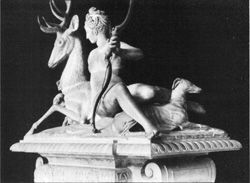
Diana and the Stag. Jean Goujon. View larger image
The stubborn individuality of French sculptors who long resisted the encroaching advance of the Italian renaissance is well seen in Room III. by the works of Michel Colombe (? 1430-1570), after whom this hall is named. The exquisite relief on the L. wall, St. George and the Dragon, displays an art touched indeed by the new Italian life, but impressed with an intimate charm and spirit which are eminently French. The Virgin and Child, 143, and the tombs of Roberte Legendre and her husband have also been ascribed to this truly great master. The fine effigies of Philippe de Comines the annalist, and his wife, 126, are wrought in the traditional French manner, the decorations on the tomb being obviously by another and Italianised artist; the shells on the shields denote that the knight had made the pilgrimage to St. James of Compostella in Galicia. Beneath is the tomb of their daughter, Jeanne. The sixteenth-century Virgin of Ecouen, 144, is typically French in treatment; the large relief on the L. wall from the old church of St. Jacques de la Boucherie, 199, is an excellent example of transitional Franco-Italian sculpture; and the half-reclining bronze effigy of Prince Carpi from the great Franciscan church (the Cordeliers) of Paris, is wholly Italian in style. The gruesome figure, La Mort, in the embrasure of a window, from the old cemetery of Les Innocents, and a fine bust, 173, of John of Alesso, will also be noted. We pass to Room IV., dominated by the most eminent sculptor of the French renaissance, Jean Goujon (? 1520-1567), whose famous Diana and the Stag, from a fountain at Diana of Poitiers' château of Anet, marks the increasing influence of the Italians, and especially of Cellini, who were attracted to Fontainebleau by the patronage of Francis I. A more intimate example, however, of Goujon's genius will be seen in the beautiful bas-reliefs on the L. wall, Tritons and Nereids, from the Fontaine des Innocents, executed 1548-49, and those (R. wall) from the old choir screen of St. Germain l'Auxerrois in 1544, happily rescued from clerical vandals.[200] For sheer loveliness of form and poetry of outline, those reliefs are unsurpassed by any contemporary artist. His younger contemporary, Germain Pilon (1535-1590), is well represented in this room. The Three Graces (trois grâces décentes), which Catherine de' Medici commissioned him to execute, to sustain an urn containing the heart of her royal husband at the Célestins, is an early work; the admirable kneeling bronze effigy, 257, of René of Birague, a maturer production. The four cardinal virtues in oak were executed for the abbey church of St. Genevieve: they were originally covered with stucco and held on high the saint's reliquary. The too lachrymose Madonna in terra-cotta, 256, already ushers in the decadence. Portrait busts of Henry II., 227, the vicious Henry III., 253, and of the feeble Charles IX., 252, are also to be noted. Pilon's pupil, Bart. Prieur (†1611), is responsible for the monument to the Constable Anne of Montmorency and Madeleine of Savoy, in the recess of a window, and the three bronze statues placed by the opposite wall. With Pierre Biard the elder, who about 1600 executed the elaborate choir-screen of St. Étienne du Mont, the French renaissance sinks to a not inglorious end. His Fame (224, bis), in Room III. and a copy of Giov. da Bologna's Mercury, made for the Duke of Epernon's tomb, hints at the impending pomposity and extravagance of the later French pseudo-classic school. Room V. affords an instructive comparison with some productions of the Italian renaissance. 332, Florentine school, is a charming bust of Beatrice d'Este, the girl bride of Lodovico il Moro, autocrat of Milan. The fine bas-relief, 386, Julius Cæsar, was formerly ascribed to Donatello; 389, Virgin and Child, is also a school work; 403, the Child-Baptist, is a good example of Mino da Fiesole's sweet and tender style, as are some Madonna bas-reliefs in the embrasure of the first window. Here, too, and in the next window, are some well-wrought early renaissance reliefs in bronze (scenes in the life of a physician), by a Paduan artist, from the tomb of a celebrated professor of Verona, Marc'antonio della Torre. In the lunette of the R. wall is embedded Cellini's Nymph of Fontainebleau, and on either side of the noble portal from the Palazzo Stanza at Cremona, which forms the entrance to Room VI., stand the divine Michael Angelo's so-called Two Slaves, actually fettered Virtues intended for the unfortunate tomb of Pope Julius II. These priceless statues, given to Francis I. by Robert Strozzi, subsequently found their way to Richelieu's garden, and during the later years of the monarchy lay neglected in a stable in the Faubourg du Roule: when put up to auction in 1793 the vigilant and admirable Lenoir seized them for his Musée National at the Augustins. Among other objects we note, 396, a fine bust of Filippo Strozzi by Benedetto da Maiano. We enter Room VI. The excellent bust of the Baptist, 383, by Desiderio da Settignano is officially assigned to Donatello, and the coloured Virgin and Child in wood to the Sienese Jacopo della Quercia. Room VII. contains many beautiful specimens of della Robbia ware, and among the statues and busts we note Louis XII. by Lorenzo da Mugiano, of which the head has been restored. Provisionally placed in this room is a recently acquired relief in marble of the Madonna by Agostino di Duccio.
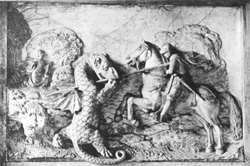
St. George and the Dragon. Michel Colombe. View larger image
(c) Modern Sculpture.
We cross the quadrangle to the N.W. and find the entrance to the Musée des Sculptures Modernes, where we may trace the rapid decline and utter degradation of French sculpture during the seventeenth and eighteenth centuries, and some signs of its recovery during the revolutionary period. Many causes contributed to the decay; the essentially bourgeois and commonplace taste of Colbert and the influence of his artistic henchman, Lebrun; the slavish worship of Græco-Roman and Roman models, fostered by the creation of the École de Rome; and the teachings of critics like Lessing and Winkelmann, who drew their inspiration not from pure Greek models, but from the decadent and sterile art of the Empire, stored in the Vatican. Among the artists whose individuality stands forth from the mass of sculptures in these rooms is Charles Antoine Coysevox (1640-1720), who gives his name to Room I. to the L. of the vestibule. His chief works are in the "royal pandemonium," at Versailles, but in the vestibule will be found excellent examples of his art, 555, Nymph with a shell, and 560, Shepherd playing a flute. In Room I., 561, Marie Adelaide of Savoy as Diana; 557, a fine bronze bust of the great Condé and a bust of Ant. Coypel acquired in 1910, are worth attention, as is also 552, the grand monument to Mazarin in Room II. Pierre Puget (1622-1694), who gives his name to this hall, began his career as a carver of figure-heads at the arsenals of Toulouse and Marseilles. He was the chief exponent of the bombastic and exuberant art of the century, and the inventor of the peculiar gusty draperies in statuary known as the coup de vent dans la statuaire. 794, Milo (the famous athlete of Crotona), attacked by a Lion, his most popular work, and 796, a relief, Diogenes and Alexander, esteemed by Gonse one of the most éclatante creations of modern sculpture, will be found in this room. Some bronzes, 702-704, Louis XIII., Anne of Austria, and the child Louis XIV., from an old monument on the Pont au Change by Simon Guillain (1581-1658) are of interest. The Coustous, Nicholas (1658-1733) and Guillaume (1677-1746), nephews and pupils of Coysevox are represented in Room III. 547, Apollo presenting the Image of Louis XIV. to France (embrasure of window); 548, Adonis (centre of room); 549, Julius Cæsar; and 550, Louis XV., are due to the former: the statue of Louis' queen Maria Leczinska, 543, to the latter, whose masterpiece, the Horse-tamers of Marly, stands at the entrance of the Champs Élysées opposite Coysevox', Mercury and Fame on winged horses, at the entrance to the Tuileries Gardens. J.B. Pigalle (1714-1785) is but poorly represented by: 785, a bronze bust of Guérin; and 781, a Mercury in lead, which has much suffered from exposure to the atmosphere in the Luxembourg Gardens. A most talented portraitist in marble was J.J. Caffieri (1725-1792), whose seven masterly busts in the foyer of the Théâtre Français, paid for by free passes, which the artist promptly sold, will be familiar to playgoers. His diploma work, The River, 518 (L. of entrance), and a bust of the poet Nivelle de la Chaussée, 519 (embrasure of window), will be found in this room. J.A. Houdon (1741-1828), whose admirable bust of Molière, and marvellously vivid statue of the seated Voltaire—the greatest production of eighteenth-century French sculpture—will be also known to playgoers at the Français, gives his name to Room IV. Few artists maintained so high and consistent a standard of excellence.[201] 716 is a replica in bronze of a statue of Diana, executed for the Empress Catherine II. of Russia; 708, Diderot; 711, Rousseau; 712 Voltaire; 713, Franklin; 715, Washington; 717, Mirabeau, are busts of revolutionary heroes of which many replicas exist, executed at seventy-two francs each (if with shoulders ninety-six francs), to save himself from starvation during the revolutionary period. Two exquisitely charming terra-cotta busts in glass cases of the children, Louise and Alexandre Brogniart, and 1034, 1035, the original busts in plaster of Mme. Houdon and Sabine Houdon, will also be noted. Like Caffieri, Houdon was an habitué of the Français, and in his old age would totter to the theatre supported by his servant, to calmly sleep the performance out. A favourite exponent of the suave and languishing style that appealed to the decadent tastes of the age was Antoine Pajou (1730-1809) here represented by 775, a Bacchante, and 772, Maria Leczinska as Charity. Other two works by Pigalle, 782, Love and Friendship, and 783, bust of Marshal Saxe, may be noticed before quitting this room. Room V. is dedicated to A.D. Chaudet (1763-1810), whose diploma work, Phorbas and Œdipus, 533, is here shown; 537, a Bacchante, is a rather poor example of the art of Claude Michel (1738-1814), known as Clodion whose popularity rivalled that of his master Pajou, and whose prodigious output of marble and terra-cotta sculpture failed to keep pace with the demands of his clients. 777 is Pajou's, The Forsaken Psyche. By the seductive and sentimental Canova are 523 and 524, variants of a favourite theme, Love and Psyche.[202] With some sense of relief we enter the more invigorating atmosphere of Room VI., named after the sturdy François Rude (1784-1855), who flung off the yoke of the Roman classicists, and from whose simple, austere atelier issued works instinct with a new life, such as the dramatic group, The Departure of the Volunteers of 1792, on the E. base of the Triumphal Arch of the Etoile. Rude, who rescued the art from the fetid atmosphere of a corrupt society and emancipated it from a hide-bound pedagogy, is here represented by his Jeanne d'Arc, 813; Maurice de Saxe, 811; and 815, Napoleon awakening to Immortality, a model for a monument to the Emperor. In the centre are 810, Mercury in bronze, and the Neapolitan fisher lad (no number). Rude's contemporary and fellow-liberator, David d'Angers (1789-1856), chiefly renowned for his pediment sculpture on the Panthéon (p. 330) is here represented by 566, Philopœman, the famous general of the Achaen League; busts of Arago and of Béranger; 567 bis, Child and Grapes, and a series of medals in the embrasures of the windows. Of Antoine Barye (1796-1875), pupil of père Rude and another victorious assailant of the "Bastille of Classicism," this room exhibits three masterly works in bronze; 494, Centaur and Lapith; 495, Jaguar and Hare; and (no number), Tiger and Crocodile. A later contemporary and excellent master was Jean Baptiste Carpeaux (1827-1875), after whom Room VII. is named. Here stand his models for the famous group, Dancing, which adorns the Opera façade; and for The Four Quarters of the World, at the Fountain of the Observatoire. Among others of his productions may be cited a bronze group, Ugolino and his Children. In a new room (Salle Moderne) are some more recent works transferred from the Luxembourg, among which is Chapu's Joan of Arc.
SECTION V
The Louvre (continued)—Pictures: First Floor.
(a) Foreign Schools.
We enter by the Pavilion Denon, in the middle of the S. wing, opposite the Squares du Louvre which are bounded on the W. by the Place du Carrousel and the monument to Gambetta. Turning L. along the Galerie Denon we mount the Escalier Daru to the first landing below the Winged Victory (p. 341), turn R., ascend to a second landing, and on either side find two charming frescoes from the Villa Lemmi, which was decorated by Botticelli to celebrate the Nuptials of Lorenzo Tornabuoni and Giovanna Albizzi.[203] To the L., 1297, The Three Graces are presented to the bride; R., 1298, The Seven Liberal Arts to the bridegroom. The latter fresco is generally believed to have been the work of a pupil. On the wall that forms an angle with this is a fresco, The Crucifixion, 1294, by Fra Angelico from the Dominican monastery at Fiesole. A door L. of 1297 leads to
Room VII.
containing a small but choice collection of early Italian paintings, all of which will repay careful study. We note on the entrance wall, 1260, a Virgin and Child by Cimabue—if indeed we may now assign any work to that elusive personality.[204] L. of this is a genuine Giotto, 1312, described by Vasari: St. Francis receiving the Stigmata. In the predella, Vision of Pope Innocent III.; Papal Confirmation of the Rule; The Saint preaching to the Birds—each scene portrayed with all the sweet simplicity of a chapter in the Fioretti. Below 1260 is a predella, 1302, by Taddeo Gaddi: Death of the Baptist; the Crucifixion; Martyrdom of the Saint. On the R. wall is 1301, a conventional early Florentine Annunciation by Agnolo Gaddi, his pupil. Among the early Sienese on the L. wall is 1383, a charming little Simone Martini: Christ bearing the Cross. The gem of the collection and one of the most precious pictures in Europe is 1290, on this wall, Fra Angelico's Coronation of the Virgin, which Vasari declared might have been painted by one of the blessed spirits or angels represented in the picture, so unspeakably delightful were their forms; so gentle and delicate their mien, so glorious their coloration. "Even so," he adds, "must they be in heaven and I never gaze on this picture without discovering fresh beauties, nor withdraw my eyes from it, satisfied with seeing." The scenes in the predella are from the life of St. Dominic and form an interesting parallel with those of the Giotto. Other works by the angelic master are (L. of this) 1293, Martyrdom of SS. Cosmas and Damian, and 1294A, The Resurrection: R. is 1291, The Dance of Herodias. R. of 1383 is 1278 by Gentile da Fabriano: The Presentation, a portion of a predella. To the same is also attributed by Crowe and Cavalcaselle, 1279, Virgin and Child and Donor, Pandolfo Malatesta. 1422 bis, is by Pisanello: Portrait of a Princess of the House of Este, identified by Mr G.F. Hill, from the sprig of juniper in her dress, as Ginevra d'Este, married to Sigismondo Malatesta in 1435. R. of 1291 is 1319, the Apotheosis of St. Thomas Aquinas by Benozzo Gozzoli, described by Vasari. On opposite wall, 1272, formerly assigned to Masaccio: portraits of Giotto, the artist himself Paolo Uccelo, Donatello, Manetti and Brunelleschi; painted, says Vasari, "that posterity might keep them in memory." R. of this is 1273, a battle scene by the same, similar to that in our National Gallery. Both had been badly restored even in Vasari's time. L. of 1272 are 1343 and 1344: a Nativity, and a Virgin and Child with Angels and Saints adoring, by Fra Filippo Lippi. The former, according to gossiping Vasari, was executed at the Convent of S. Margherita at Prato where having been smitten by the bellissima grazia ed aria of one of the novices, Lucrezia Buti, Fra Lippo painted her portrait in this picture, fell madly in love, and eloped[205] with her: the latter exquisite painting Vasari extols as a most rare work which was held in the greatest esteem by the masters of his day. Opposite on L. wall is 1525, a predella: Birth of the Virgin, considered by Crowe and Cavalcaselle an excellent example of Luca Signorelli's art. R. wall, 1321, the Visitation, and 1322, an intimate domestic scene, painted with much tenderness, a bibulous old Florentine magistrate bending to embrace his little grandson, are masterly works by Domenico Ghirlandaio. 1296, Virgin and Child and St. John, is a beautiful early work by Botticelli, and 1367 is a like subject by Mainardi, in a tondo, a popular form of composition invented by Botticelli. R. of exit is 1295, a copy of the master's famous Madonna of the Magnificat at Florence. L. wall, 1263, Virgin and Child, SS. Julian and Nicholas by Lorenzo di Credi, highly eulogised by Vasari as the artist's most careful work in oil wherein he surpassed himself. 1566 (L. of exit), is an indifferent late painting by Perugino. In the lunette over the door is a Raphael school fresco formerly attributed to the master and bought for the sum of 207,000 francs in 1875! We now enter the long
Grande Galerie, Room VI.
and begin with Section A. On the R. is 1565, Holy Family, by Perugino. 1567, Combat of Love and Chastity, by the same, was painted in 1505 to the elaborate specification of the enthusiastic and acquisitive patron of the renaissance, Isabella d'Este, Marchioness of Mantua, for her famous "Grotta." The artist's slovenly execution of the work brought him a well-deserved rebuke from the Marchioness. 1261, by Lorenzo Costa, a flattering symbolic representation of the Court at Mantua was also painted for her. Isabella, to whom a Cupid hands a laurel crown, is seen standing near a grove of trees, surrounded by poets and philosophers.
Among the Francias we distinguish, 1436, a Crucifixion; 1556 is a Pietà by Cosimo Tura in the characteristic hard manner of the Ferrarese master, being the upper portion of the central altar-piece, Virgin and Child Enthroned, in the National Gallery; 1417, Virgin and Child with two Saints, is a doubtful Pinturicchio; 1114, Virgin and Child between SS. Jerome and Zanobi is a good example of Albertinelli's pleasing but somewhat characterless style; 1516 and 1516A are two Andrea del Sartos; 1264 is another Lorenzo di Credi: Christ and the Magdalen. Last of all we note 1418, a rather inky Nativity, in the grand and broad-manner of the later Roman School by Giulio Romano, much admired by Vasari.
We return to the L. wall and note 1526, Signorelli's Adoration of the Magi; further on are 1154, an excellent Fra Bartolomeo, The Holy Family, and 1153, The Annunciation, a graceful and suave composition, original in treatment, by the same master. We pass to some more Andrea del Sartos: 1515, according to Vasari, a Nostra Donna bellissima, was painted in quick time for Francis I., and 1514, Charity, was executed in Paris for the gran re and highly esteemed by him. This picture has much suffered by transference from the worm-eaten original panel to canvas, in 1750, and by a later restoration in 1799. We are soon arrested by some masterpieces of the Milanese school, and first by the Da Vincis: 1599 is the famous Virgin of the Rocks, whose genuineness is warmly championed by French critics as against the similar picture in the National Gallery stoutly defended as the original by English authorities. Professor Legros with impartial judgment assures us that both are copies of a lost original; 1597, a doubtful attribution, is a rather effeminate John the Baptist, by some critics believed to be a second Gioconda portrait; 1600, the supposed portrait of Lucrezia Crivelli, mistress of Ludovico il Moro, is also ascribed by the official catalogue to Da Vinci. It would, however, be hard to persuade us that Leonardo had any hand in this portrait, excellent though it be, which seems rather by Beltraffio, Solario, or another of the Milanese masters; 1602, Bacchus, is another doubtful Leonardo. 1488, L. of 1597, is an admirable work by Sacchi: Four Doctors of the Church with symbols of the Evangelists. By Solario, a younger contemporary of Da Vinci, are 1532, a Crucifixion; 1530, a masterpiece, the much admired Virgin of the Green Cushion; and 1533, Head of the Baptist.
The sweet and tender Luini is seen almost at his best in 1355, Salome with the Baptist's head: other works by him are 1362, Silence, and 1353, a Holy Family. At the end of this section hangs 1169, Beltraffio's, Virgin of the Casio Family, esteemed by Vasari the painter's best production. We proceed to Section B, same wall, where hang two grand Mantegnas, painted for Isabella d'Este's "Grotta," towards the end of the artist's career. 1375, Parnassus, executed in 1497, represents the Triumph of Venus over Mars, celebrated by Apollo and the Muses—a delightful group of partially draped female figures dancing to Apollo's lyre; 1376, Triumph of Virtue (virtù, mental and moral excellence) over the Vices of Sensuality and Sloth, a less successful composition, executed in 1502. Another masterpiece is 1374, Our Lady of Victory, a noble and virile work, painted in 1496 to commemorate the defeat of the French at Taro in 1495 by Isabella's consort, Francesco Gonzaga, the donor, who is seen kneeling in full armour; 1373, is an earlier work, the central and most important of the three sections of the predella of the Triptych at S. Zeno in Verona—a powerful, reverent, though somewhat hard, conception of the cardinal tragedy of Christianity. From Mantegna to his brothers-in-law, Gentile and Giovanni Bellini and other Venetian masters the transition is easy. The school is here represented by a most valuable collection from Bartolomeo Vivarini, No. 1607, to Guardi. 1158, Giovanni Bellini, Virgin and Saints; and 1158A, a Man's Portrait, are however dubious attributions. 1156, Two Portraits; and 1157, a Venetian Envoy at Cairo, are Gentile school works. 1134, by Antonello da Messina, A Condottiere, is an amazingly vivid and powerful portrait. Carpaccio's St. Stephen preaching at Jerusalem, 1211, is part of the Historia of the Protomartyr, painted for St. Stephen's Guild at Venice. The naïve attempts at local colour—Turkish women sitting on the ground in groups as they may still be seen in Turkey to-day, and quaint architectural details—are noteworthy. Cima is well represented by 1259, Virgin and Child, with the Baptist and the Magdalen. 1351, A Holy Family, by Lotto, was formerly assigned to Dosso Dossi. 1350 is an early and charming little work, St. Jerome, by the same master. We return to Palma Vecchio's grand composition, 1399, The Adoration of the Shepherds, which under a false signature, once passed for a Titian. 1135, Holy Family, with SS. Sebastian and Catherine, is a form of composition known as a Santa Conversazione, which Palma brought to its ultimate perfection. The official catalogue of 1903 persists in ascribing it to Giorgione. The claims of Palma himself, Pellegrino da San Daniele, Cariani and Sebastiano del Piombo, have all found protagonists among modern critics. How excellent a standard of craftsmanship was maintained by the Venetian school is well exemplified by 1673, a portrait by an unknown artist. 1352, The Visitation, by Sebastiano del Piombo, although much injured by restorers, is a fair example of that master's grandiose style in his Roman period. We now reach the Titians. 1577 and 1580, are good average Sante Conversazioni, the latter is, however, assigned by Mr. Berenson to a pupil. 1581, The Supper at Emmaus, a mature and genuine work; and 1578, the much-admired Virgin and Child with the Rabbit, painted in 1530, next claim our attention. 1593 and 1591 are unknown portraits, the former attributed by Crowe and Cavalcaselle to Pordenone. On the R. wall opposite the Carpaccio is hung, 1587, a magnificent work of the painter's[206] old age, Jupiter and Antiope, unhappily much injured by fire and by more than one restoration. Two characteristic Sante Conversazioni from Bonifazio's atelier may next be noted, 1172, over a doorway; and 1171, skied[ii] on the L. wall. The later interpreters of the pomp and grandeur of the Venetian state, Veronese and Tintoret, are represented to L. and R. by several typical canvases. Among these we note, 1196 (L. wall), an excellent Veronese, The Supper at Emmaus; and 1465, a sketch by Tintoret for the great Paradiso in the Ducal Palace. The eighteenth-century masters (following after the Jupiter and Antiope) are well exemplified in a fine Canaletto, 1203, View of the Salute Church and the Grand Canal; and several good examples of the more romantic Guardi. A Last Supper, 1547, and other works by Tiepolo, the last of the Venetian masters of the grand style; and some Bassanos—1429, by Jacopo, Giov. da Bologna is an admirable portrait—conclude the collection of Venetians. We pass to the Italian Eclectics, the once admired but now depreciated Carracci, Guido Reni and Domenichino. 1613, St. Cecilia, is a famous picture by the last named. R. of the next section (C), are two Peruginos; 1564, a beautiful tondo, Virgin and Child, Saints and Angels; and 1566A, St. Sebastian, a careful and pleasing study of the nude. We cross to the L. wall, rich with examples of Raphael, and of his school; and turn first to a lovely little panel, 1509, Apollo and Marsyas, of most enigmatical authorship,[207] bought in 1883 from Mr. Morris Moore for 200,000 francs. Sold, in 1850, as a Mantegna, it has since been variously assigned to Raphael, Perugino, Timoteo Viti, and Francia. Perugino's influence, however, if not his hand, is sufficiently obvious. 1506, unknown Portrait, is another doubtful Raphael, confidently attributed by Morelli to Perugino's pupil, Bacchiacca. We are on more certain ground with 1497, the popular Virgin of the Diadem, undoubtedly designed by the master during his Roman period, and probably executed by his pupil, Giulio Romano. 1501, St. Margaret, painted during the same period for Francis I., was also, according to Vasari, almost wholly executed by Giulio. This unhappy picture was, however, racommodé (mended) in 1685, and since has been severely mauled by restorers. 1507, Joan of Aragon: the head alone, says Vasari, was painted by the master who left the portrait to be completed by his famous pupil. 1499, the charming little Holy Family, was probably executed by a pupil. 1508, two unknown portraits, has small claim to be classed as a Raphael. The exquisite little panels, 1502 and 1503, of St. Michael and St. George, are, however, precious and genuine works painted in 1504 at Urbino. They symbolise the overthrow of the hated tyrant Cæsar Borgia, and the return of the exiled Duke Guidobaldo to his loving subjects. On the R. wall of Section D. are hung some works by the Italian Naturalists (a seceding school from the Eclectics), to whose chief representative Caravaggio (called the anti-Christ of painting), is due 1121, Death of the Virgin. This realistic representation of a sacred subject so shocked the pious at Rome that it was removed from the church for which it was painted. 1124, Portrait of Alof, Grand Master of the Knights of Malta, brought the artist a chain of gold, two Turkish prisoners and a knighthood. Salvator Rosa's Landscape, 1480; and a characteristic and much-appreciated Battle Scene, 1479, hang on this wall.