Part 2 — Part II: The City (continued 2)
Reading edition
We cross to the L. wall, devoted to the Spanish school. The recently acquired El Greco (no number), King Ferdinand, is one of that master's best works outside Spain. By Ribera, who was obviously much influenced by the Italian Naturalists are: 1723, St. Paul the Hermit; 1722, The Entombment; and 1721, Adoration of the Shepherds, the last a masterpiece, wrought in the sombre manner of this powerful artist. From the magnificent show of Murillos stands forth, 1709, The Immaculate Conception, a favourite Spanish theme, by the most popular of Spanish masters. This grandiose representation of the Woman of the Apocalypse, clothed with the sun, the moon under her feet, was acquired at the Soult sale in 1852 for 615,000 francs. From the same collection came the superb composition 1710, The Birth of the Virgin, of which a small sketch in oil is possessed by the National Gallery. We cross to the R. wall where hangs 1716, The Miracle of S. Diego; at the prayer of the saint, angels descend from heaven and prepare a miraculous repast for his needy Franciscan friars, to the great amazement of brother cook. Other Murillos, including a characteristic Beggar Boy, 1717 (L. wall) will be seen on either side. By Velasquez, the supreme master of the school are: (L. wall) 1734, Meeting of Thirteen Spanish Gentlemen, Velasquez and Murillo standing left of the group; and 1732, one of the many portraits scattered about Europe of Philip IV. The sombre Zurbaran is represented by 1739 and 1738, A Bishop's Funeral, and St. Pierre Nolasque and St. Raymond de Peñafort. Four portraits, 1704-1705B, by the facile and popular Madrid artist Goya, should by no means be passed without notice. There follows next a small collection of English paintings, rather indifferent in quality, but historically of much interest, by reason of the inspiration drawn from Constable and Bonington by the Barbizon school. Bonington, whose untimely death was a grievous loss to modern art, passed much of his time in Paris and was the link between the Valley of the Stour and the Forest of Fontainebleau.
We pass to some productions of the German school. On the R. wall hang 2738 and 2738C, Episodes in the Life of St. Ursula by the Master of St. Sévérin.[208] Opposite is 2737, an earlier specimen of the Cologne school, Descent from the Cross, by the Master of St. Bartholomew. 2709 and 2709A, Head of an Old Man, and Head of a Child, are ascribed to Albert Dürer. But the chief glory of this collection are the Holbein portraits on the L. wall, four of which are of supreme excellence; 2715, Erasmus; 2714, William Wareham, Archbishop of Canterbury; 2713, Nicholas Kratzer, Astrologer to Henry VIII.; and 2718, Anne of Cleves. 2719, Richard Southwell is a doubtful Holbein.
Section E is filled with Flemish paintings. R. hangs, among other of his works, Phil. de Champaigne's masterpiece, 1934, portraits of Mother Catherine Agnes Arnaud and of his own daughter, Sister Catherine, painted for the Convent of Port Royal. The intimate association of this grave and virile artist, who settled at Paris when nineteen years of age, with the austere and pious Jansenists of Port Royal, is also traceable in 1928, The Last Supper. On the L. are some excellent works by Rubens: 2075, Flight of Lot; 2077, Adoration of the Magi; 2113, Portrait of Helen Fourment, the artist's second wife, and their two children; 2144, Lady's Portrait, said to be that of Suzanne Fourment. The ignoble Kermess, 2115, will be familiar to readers of Zola.
Section F on the L. is occupied by a rich collection of Rembrandt's works: 2548, the oft-reproduced Flayed Ox, is a masterly rendering of an unattractive subject; no number, Old Man Reading; in 2547 the artist has immortalised his faithful servant, Hendrickje Stoffels; 2536, Tobit and the Angel; 2549 and 2550, Bathsheba, and Susannah and the Elders are two studies of the nude; 2542, The Joiner's Family, formerly known as the Holy Family; 2540, Philosopher in Meditation. 2537, The Good Samaritan; and 2539, The Supper at Emmaus, are painted with profound and reverent piety. Opposite the Rembrandts are Gerard Dow's masterpiece; 2348, The Sick Woman, and other works by the same artist. We now enter at the end of the Grande Galerie, the new
Salle Vandyck, Room XVII.
Here, among other portraits, by the first of portrait painters (according to Reynolds) hangs the superb rendering of Charles I., 1967, bought by Louis XV. for Madame du Barry's boudoir on the fiction that it was a family picture, since the page holding the horse was named Barry. Michelet says that he never visited the Louvre without pausing to muse before this historic canvas.[209] Before we descend to the new Rubens room we note by this master three large canvases, 2086, 2087, 2096: Birth of Marie de' Medici at Florence; her education; the widowed Queen as Regent of France, which properly belong to the suite of paintings exposed in the
Salle de Rubens, Room XVIII.
to which we now descend. In this sumptuous hall, specially erected for the purpose, are exhibited, with the three exceptions noted, the famous paintings completed in 1625 by the artist and his pupils for the Luxembourg Palace to the order of the Regent Marie. These spacious and grandiose compositions illustrate in pompous and pagan symbolism the chief events in her career: all the principal figures are due to Reubens' own hand. Reynolds was wont to say of Reubens' colouring that his figures looked as if they fed on roses: these, however, would seem to have fed upon less ethereal diet. L. of entrance, 2085, The Three Fates spinning Marie's destiny; L. wall, 2088, Reception of her Portrait; R. wall, 2089, Her Marriage by Procuration to Henry—the Grand Duke Ferdinand of Tuscany, her uncle, places the ring on her finger; L., 2090, Disembarkation at Marseilles; R., 2091, The Marriage at Lyons; L., 2092, Birth of Louis XIII. at Fontainebleau; R., 2093, Departure of Henry for Germany, who hands to his consort the symbols of the Regency; L., 2094, Coronation of Marie at St. Denis: the dogs are said to have been painted by Snyders; R., 2095, Apotheosis of Henry. Like the ascending Faust in Henry's portly form, —
"Bleibt ein Erdenrest Zu tragen peinlich."
L., 2097, Marie's journey to Anjou; R., 2098, Exchange at Hendaye of the Princess Elizabeth of France affianced to Philip IV., and of Anne of Austria, affianced to Louis XIII.; L., 2099, Felicity of the Regency—this picture was hastily improvised at Paris; R., 2100, The Majority of Louis XIII.; L., 2101, Escape of Marie from the Château of Blois; R., 2102, Reconciliation with her son, Louis XIII., at Angers; End wall, L., 2103, Conclusion of Peace; R., 2104, Meeting between Marie and Louis in Olympia. R. of entrance, 2105, The Triumph of Truth.
Enclosing this hall are a series of Cabinets XX.-XXXVI., containing a large and important collection of works by the Netherland painters. We ascend, turn R., and enter Room XX., which is devoted to Franz Hals and contains 2386 and 2387, superb portraits of Nicholas van Beresteyn and his wife; and 2388 the same, with their Family; 2383, Descartes. Room XXI., Cuyp, after whom the room is named, is seen in four typical works, 2341-2344; 2415 and 2414 are excellent Dutch Interiors by Peter de Hoogh. In Room XXII. reigns the jovial Van Steen: two characteristic paintings are here shown; 2578, Feast in an Inn, and 2580, Evil Company. 2587 is a masterly Terburg, The Amorous Soldier, and 2459 a similar subject treated by Gabriel Metsu. Room XXIII. is assigned to Van Goyen, and Room XXIV. to Adrian van Ostade, Hals' pupil. In the latter room, 2495, the so-called Family of the Painter, and 2496, The Schoolmaster, stand forth pre-eminent. 2509 and 2510, Travellers Halting and a Winter Scene, are by Adrian's brother, Isaac. Room XXV. is rich in landscapes by Ruysdael, of which 2557, The Forest, and 2558, Tempest near the Dykes of Holland, are masterpieces: 2588, The Music Lesson, is a fine Terburg. Room XXVI., dedicated to Hobbema, contains his fine landscapes: 2403, A Forest Scene, and 2404, The Mill, and another exquisite Terburg, 2589, The Concert. Some typical Paul Potters also hang here. We proceed round to Room XXIX., which holds a precious collection of Van Eycks and Memlings. 1986 is an exquisite little masterpiece painted by Jean with infinite patience and care, Virgin and Child and Donor. Fine Memlings are:—2024, The Baptist; 2025, The Magdalen; 2027, Marriage of St. Catherine; 2028, a Triptych—the Resurrection, St. Sebastian and the Ascension Here too are hung, 1957, Gerard Dow's Wedding at Cana; 2196, Van der Weyden's Descent from the Cross, and some excellent Flemish school paintings. Room XXX. is the Quentin Matsys Room: 2029 is the well-known Banker and his Wife, of which many replicas exist; 2030, by the same artist, Virgin and Child. The fine example of the fifteenth-century painter, known as the Master of the Death of Mary, 2738, hangs in this room. This profoundly reverent and sincere work consists of: a central panel, Descent from the Cross, below which is The Last Supper, and above, in the lunette, St. Francis receiving the Stigmata; Friar Leo is seen asleep against a rock. A remarkable work by Peter Brueghel, The Blind leading the Blind, will also arrest attention. Room XXXI., named after Anthony More, contains a miscellaneous collection, among which the artist's portraits (2481A) of Edward VI. of England, and of (2479) a Spanish Dwarf, and Peter Brueghel's Village, 1918, and a Country Dance, 1918B, are of chief interest. The Teniers Room, XXXII., shows some excellent works by the younger master: 2155, St. Peter denies his Lord; 2156, The Prodigal Son; 2157, Works of Charity; 2158, Temptation of St. Anthony. We next pass to three rooms in which are hung works by Netherland artists, formerly in the La Caze collection, among which, in Room XXXIII., are 2579, Van Steen's, Family Repast; and 2454, Nicholas Maes', Grace before Meat. In XXXIV. are two well-known works: 1916, Adrian Brouwer's, The Smoker; and 2384, The Gipsy, a masterpiece by Franz Hals. A fine Vandyck, 1979, Head of an Old Man; Rubens' portrait of Marie de' Medici, 2109; and a sketch in oils, 2122, Elevation of the Cross, are in Room XXXV. We return to the Salle Vandyck and the Grande Galerie, along which we retrace our steps and enter, at its further end, the
Salon Carré, Room IV.
where an assortment of masterpieces is hung from the various schools we have visited. We begin with the Raphaels: On the L. (W. wall), 1496, La Belle Jardinière, painted in 1507, is the most delightful of the Florentine Madonnas for which it is said a flower-girl of Florence sat; Vasari relates that the unfinished mantle was left to Ridolfo Ghirlandaio to complete; 1498, The Holy Family, styled of Francis I. and designed at Rome (1518) in the zenith of the artist's power, was presented by Pope Leo X. to Francis' queen; the inky hand of Giulio had no small part in the work. In the same year was painted 1504, (diagonally opposite) the dramatic St. Michael, a picture which evoked much interest at Rome, and whose coloration was adversely criticised by Sebastiano del Piombo; here also the hand of Giulio is all too apparent, and the picture, moreover, has suffered much in its transference from wood to canvas. 1505, N. wall, the masterly and authentic portrait of Baltazar Castiglione, was executed in 1506. On the same wall among the Venetians we find the much-disputed Al Fresco Concert, 1136, here ascribed to Giorgione, an ascription which has the support of Morelli and Berenson. The magnificent Titian, 1590, variously known as Titian and his Mistress, and the Lady with the Mirror, is supposed to be the portraits of Duke Alfonso of Ferrara and his mistress, Laura Diante, later his wife, the daughter of a poor artizan who more than once sat to Titian as a model. The portrait on the S. wall, 1592, The Man with the Glove, extolled by Vasari as an opera stupenda, and 1584, The Entombment, on the E. wall, are the two greatest Titians in the Louvre, where the artist's majesty and power are displayed in their highest degree. 1583, The Crown of Thorns, E. wall, is a work of the painter's old age.[210] The sensual features of Francis I., 1588, S. wall, were painted from a medal.
By Tintoret is 1464, Susannah; and by Veronese, the grand composition that expatiates over the S. wall, 1192, known as The Marriage at Cana, executed in his most pompous and stately manner for the refectory of the Benedictine monastery of St. Giorgio Maggiore at Venice. The artist is seen in the foreground playing a viol: Titian a bass viol. Many other historical figures are more or less convincingly identified by critics. On the opposite wall is another large refectory composition, 1193, The Supper in the House of Simon the Pharisee. A characteristic ceiling decoration, Rebellion and Treason, from the Hall of the Council of the Ten at Venice; and 1190, N. wall, Holy Family, are by the same artist. The Portrait, 1601, N. wall, by Da Vinci of his friend Monna Lisa, wife of Fr. del Giocondo, known as La Gioconda, is the most fascinating picture in Europe. A whole symphony of praise has been lavished on this miraculously beautiful creation in which psychical and physical perfection have been blended with potent and subtle genius. 1598, S. wall, Virgin and Child and St. Anne, attributed to the same, though of somewhat doubtful authenticity, is worth careful study. By another Milanese master is 1354, S. wall, Luini's Virgin and Sleeping Child. Of the two fine Correggios, 1117 and 1118, N. wall, The Marriage of St. Catherine, and Jupiter and Antiope, the former is referred to by Vasari, in his life of Girolamo da Carpi, as a divine thing, wherein the figures are so superlatively beautiful that they seem to have been painted in Paradise; the latter formed part of Isabella d'Este's collection, to which we have so often referred. 1731, N. wall, is the marvellous portrait by Velasquez of the Infanta Margarita Maria, Philip IV.'s fair-haired darling child by his second wife. This is one of the most characteristic of the master's work out of Spain, and profoundly influenced Manet and the Modern Impressionist School. The great French master Poussin's typical classical subject, 741, together with Jouvenet's masterpiece, 437, Descent from the Cross, have also their place of honour in this Hall. In the
Salle Duchâtel, Room V.
entered from the N.E. angle of this room, we find, R., some Luini frescoes: 1359, 1360, the Nativity, and The Adoration of the Magi, and 1361, Christ Blessing, full of this master's tenderness and charm. Some excellent portraits by Antonio Moro, 2480, 2481 and, a most beautiful Memling, 2026, Virgin and Child with Donors, will also be noted. As we pursue our way to the Escalier Daru at the end of the room, we pass L. and R., one of the earliest and one of the latest works of Ingres (p. 390), 421, Œdipus and the Sphinx, painted in 1808; and the most popular nude in the French school, 422, La Source, painted in 1856.
(b) The French School.
The great schools of Christian painting in Western Europe which we have reviewed, were born, grew and flourished in the free cities of the Netherlands and of Italy. French masters working in Paris, Tours, Dijon, Moulins, Aix, and Avignon, were inevitably subdued by the dominant and powerful masters of the north and south, and how far they succeeded in impressing a local and racial individuality on their works is, and long will be, a fruitful theme for criticism. The collection of French Primitifs of the fourteenth and fifteenth centuries, exhibited in Paris in 1904, and the publication of Dimier's[211] uncompromising and powerful defence of those critics who, like himself, deny the existence of any indigenous French School of painting whatsoever, have recently concentrated the attention of the artistic world on a passionately debated controversy. Undoubtedly most of the examples of the so-called Franco-Flemish school which formerly hung unquestioned among collections of Flemish paintings, did when massed together, as they were in 1904 in the Pavilion de Marsan, display more or less well-defined extra-Flemish characteristics—a modern feeling for Nature and an intimate realism in the treatment of landscapes, a freer, more supple and more vivacious drawing of the human figure—reasonably explained by the theory of a school of painters expressing independent local feeling and genius. But even if all the paintings which the patriotic bias of French critics now attributes to French or Franco-Flemish masters[212] be accepted, the continuity is broken by many gaps which can only be filled by assuming, after the fashion of biologists, the existence of missing links.
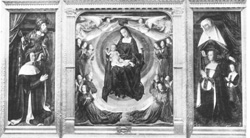
The Triptych of Moulins. Maître de Moulins. View larger image
We make our way to the small but increasing collection of French Primitifs possessed by the Louvre, along the Grande Galerie as far as Section D. and, turning R., enter Rooms IX.-XIII. Beginning with Room X., devoted to fifteenth-century masters, on the L. wall is 995, Martyrdom of St. Denis, ascribed to the Burgundian Jean Malouet, court painter of Jean sans Peur, and owing its completion to Henri Bellechose, after the former's death in 1415. To L. of the main subject, the saint is seen in prison, receiving the sacred Host from the hands of Christ; 996, a Pietà on the L. wall has also been attributed to Malouet. 999, L. wall, a portrait group of Jean Jouvénal des Ursins and his family, by an unknown fifteenth-century artist, is admirable in execution and important for contemporary costumes. Below (1005A) is the fine picture so admired in the exhibition of the Primitifs in 1904 by the Maître de Moulins,[213] St Mary Magdalen and Donatrix, eminently French in feeling. 1004 and 1005, portraits of the Duke and Duchess of Bourbon, are now catalogued under this master's name. The realistic Pietà (1001B) on the L. wall is assigned to the school of Nicholas Froment of the papal city of Avignon. 288 and 289 at either end of the R. wall, portraits of Guillaume Jouvénal des Ursins and of Charles VII., are by the well-known Jehan Fouquet of Tours, who unites the gentleness of the Tuscan school with the vivacity of the Gallic temperament. 998D, Virgin and Donors, is now tentatively ascribed to the Master of the Legend of St. Ursula. We next note a Crucifixion, the famous altar-piece (998A) of the Parlement of Paris recently transferred from the Palais de Justice. To the L. are St. Louis and the Baptist, R., St. Denis and Charlemagne; in the background are seen the old Louvre and the abbey of St. Germain. 998C is a similar altar-piece from St. Germain des Prés, painted about 1490, Descent of the Cross; in the background are other representations of the old Louvre, St. Germain and Montmartre. 304A, portraits of good King René and his second wife Jeanne de Laval, by Nicholas Froment of Avignon. (1001D) St. Helena and the Miracle of the Cross, by an unknown artist, about 1480. R. of entrance, Christ, St. Agricola and Donor, school of Avignon; below this hangs 997A, portrait of the sinister Jean sans Peur, and 997B, portrait of Philip le Bon of Burgundy, artist unknown. We pass to
Room XI.
which contains a series of most interesting historical portraits. Among the sixteenth-century painters cited by Félibien,[214] the Vasari of French painting, most of whom are but names to us, we may distinguish the Clouet family of four generations. The senior Jehan, born in Flanders in 1420, came to France in 1460 as painter to the Duke of Burgundy. His son, also, named Jehan, figures in the Royal accounts in 1528 as valet and court painter to Francis I., and was known as Maître Jehan or Jehanet. To him, an artist of great simplicity and charm, are attributed 126 and 127, R. wall, portraits of his royal master. Sons of the junior Jehan were François (1500-1572), the best-known and most talented of the Clouets, who was naturalised in 1541, and Jehan the younger, known as Clouet de Navarre (1515-1589), court painter to Margaret of Valois. By the former, who assisted his father during the last ten years of his life and succeeded him as court painter, are two admirable portraits, 128 and 129, of Charles IX. and his queen, Elizabeth of Austria; 130, Henry II., and (on the end wall) 131, the Duke of Guise, are also attributed to him. To the latter artist is ascribed 134, Louis of St. Gelais. Each of these elusive personalities, whose Flemish ancestry is evident, was known as Maître Jehanet, and much confusion has thus arisen. We now turn to some portraits by unknown artists of the period, among which may be noted: 1033, Henry III.; 132, Charles IX.; 1024, Diana of France, legitimised daughter of Henry II.; 1030, Catherine de' Medici; 1035, Ball given by Henry III. in celebration of the marriage of his favourite minion, Anne, Duke of Joyeuse, with Margaret of Lorraine in 1581; the king is seen seated with his mother, Catherine de' Medici, and his wife, Louise of Lorraine; the Duke of Guise (le Balafré) leans against his chair. On the same wall are 1015, François, Duke of Guise; and 1007, King Francis I. On the end wall, 1032, Henry III.; by the window opposite, 1022, the young Duke of Alençon (p. 178), by no means ill-favoured; and 1023, Louise of Lorraine, queen of Henry III. By a contemporary of the later Clouets, Jean Cousin (1501-1589), is 155 on the L. wall, The Last Judgment. Cousin was a versatile craftsman, and some stained glass by him still exists at S. Gervais and in the chapel at Vincennes. Among other artists mentioned by Félibien is Martin Fréminet (1567-1616), whose Mercury commanding Æneas to forsake Dido, 304, hangs on the end wall.
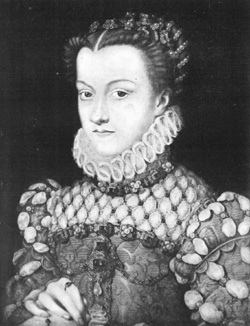
Portrait of Elizabeth of Austria, Wife of Charles IX. François Clouet. View larger image
The two years' sojourn of Solario in France at the invitation of the Cardinal of Amboise, of Da Vinci at the solicitation of Louis XII., and the foundation of the school of Fontainebleau in 1530 by Rosso (1496-1540), Primaticcio (1504-1570), and Nicolo dell' Abbate (1512-1571), mark the eclipse of whatever schools of French painting were then existing; for the grand manner and dramatic power of the Italians, fostered by royal patronage, carried all before them. This room possesses by Rosso, known as Maître Roux, 1485, a Pietà, and 1486, The Challenge of the Pierides, and Primaticcio is represented by some admirable drawings exhibited in cases in the centre of the room. Readers of Vasari will remember numerous references in his pages to Italian artists who went to serve, and agents employed to buy Italian works for, the gran re Francesco nel suo luogo di Fontainebleo. But the sterility of the Fontainebleau school may be inferred from the fact that when Marie de' Medici desired to have the walls of the Luxembourg royally decorated, she was compelled to have recourse to a foreigner, Rubens. Neglecting for a moment Room XII. and turning to
Room XIII.
we come upon some charming works by the brothers Lenain, whom Félibien dismisses in a few lines, while giving scores of pages to artists whose names and works have long been forgotten. So little is known of the brothers Antoine and Louis, who died in 1648, and Matthieu, who survived them nearly thirty years, that critics have only partially succeeded in differentiating their works, which are usually exhibited under their united names. Obviously dominated by the Netherland masters, their manner is yet pervaded by essentially French qualities—a love of Nature and a certain atmosphere of poetry and gentleness alien to the Flemish and Dutch schools. Nine of their works are here seen. A Smithy, 540; Peasants playing at Cards, 546; and Return from Haymaking, 542, are good examples. Skied in this room is 976, portrait of Louis XIII. by Simon Vouet (1590-1649), leader of the new academic French school of the seventeenth century, an artist of prodigious activity and master of the army of court painters who served Louis XIV. Vouet, who had worked in Italy, acquired there the grand and spacious manner of the later Venetians, which was admirably adapted to the decorative requirements of his royal patrons. To his pupil, Eustache Lesueur (1617-1655), is due 586, St. Bruno and his Companions bestowing Alms, one of the famous series illustrating the life of St. Bruno, of which the greater number are in
Room XII.
whither we now return. This eminently religious and tender artist is well represented in the Louvre, and the sympathetic student will appreciate the austere and sincere devotion expressed in these pictures, painted for the brethren of the Charterhouse in the Rue d'Enfer. The finest, a masterpiece, both in beauty of composition and depth of feeling, is 584, The Death of St. Bruno. The artist's careful application to his monumental task may be estimated by the fact that 146 preliminary drawings for this series are preserved in the Louvre. Lesueur's modesty and high purpose went almost unheeded amid the exultant prosperity of the fashionable courtier-artists of his day. We retrace our steps, pass through Room XIII., turn R., and enter the spacious
Room XIV.
also devoted to seventeenth-century artists. Lesueur is here seen in another masterpiece; 560, R. wall, St. Paul at Ephesus, a mai[215] picture; and 556, same wall, Christ bearing His Cross. The influence of Raphael in the former is very apparent. The hierophant of the school, Vouet, is represented in this room by some dozen examples, among which hangs his masterpiece 971, L. wall, Presentation at the Temple. A work, 25, Charity, by his short-lived rival, Jacques Blanchard, (1600-1638), known in his day as the French Titian, may be seen towards the end of this long gallery on the R. wall. A talented artist too was Jean de Bologne, an Italian by birth and known as Le Valentin (1591-1634). A good example of his style will be seen in 56 (same wall), Susannah. We now turn to Nicholas Poussin (1594-1665), the greatest master of his age, whose exalted and lucid conceptions, ripe scholarship, admirable art and fertility of invention, may be adequately appreciated at the Louvre alone, which holds a matchless collection of nearly fifty of his works. The visitor, fresh from the rich and glowing colour, the grandeur and breadth of the later Italians, will perchance experience a certain chill before the sobriety, the cold intellectuality and severe classic reserve of this powerful artist. Let us however remember his aim and ideal: to produce a picture in which correct drawing and science of linear and aerial perspective should subserve harmony of composition, lucid expression and classic grace. To approach Poussin and his younger contemporary Claude rightly, the traveller will do well to free his mind from Ruskin's partial and prejudiced depreciation of these two supreme masters, in order to effect an equally partial appreciation of Turner.[216] The story of Poussin's single-minded and stubborn application to his art cannot here be told. After a life of poverty at Paris and two unsuccessful attempts to work his way to Rome, he at length reached that Mecca of French artists, where a commission to paint two pictures, now at Vienna, for Cardinal Barbarini, established his reputation. Two of his works executed about 1630 during this first Roman period hang here; 709 and 710, R. wall, The Rain of Manna, and, The Philistines smitten by Plague. In 1640, after two years' negotiations and the personal intervention of Louis XIII., he was persuaded to return to Paris to take part in the decoration of the Louvre; but in spite of his generous pay and of the fine palazzetto and charming garden allotted to him for residence, the petty jealousies, chicanery and low standard of his rivals, revolted his artistic conscience: he obtained leave to return to Rome "to fetch his wife," and never left the eternal city again. Two of his works painted during this second and last Roman period are 717 (L. of entrance), Institution of the Eucharist, and 735 (L. wall), a ceiling composition executed for Richelieu, Time rescuing Truth from the assaults of Envy and Discord, whose subjective interest is obvious; 704, L. of entrance, Rebecca at the Well, is described at great length by Félibien, who saw it in progress. It was painted (1648) for a rich patron who desired a composition treated like Guido's Virgin, and filled with several young girls of differing types of beauty. The finished picture so delighted amateurs at Paris that large sums were offered in vain to divert it from the fortunate possessor; 711, L. wall, is the famous Judgment of Solomon (1649). On the same wall are 731, Echo and Narcissus; 734, his masterpiece, Shepherds of Arcady—a group of shepherds of the Vale of Tempe in the heyday of health and beauty, are arrested in their enjoyment of life by the warning inscription on a tomb: Et in arcadia ego (I, too, once lived in Arcady); 736-739, The Four Seasons were painted (1660-1664) for Richelieu. These beautiful compositions, more especially the last, The Deluge, typifying winter, will repay careful study. On the R. wall are, 724, the well-known Rape of the Sabine Women; 740, a most perfect work of his maturity, Orpheus and Eurydice (1659); and 742, Apollo and Daphne, his last work, left unfinished. Such are some of the more striking manifestations of this remarkable genius who alone, says Hazlitt, has the right to be considered as the painter of classical antiquity. His integrity was so rigid that he once returned part of the price paid for one of his works which he deemed excessive. To the modern, Poussin is somewhat antipathetic by reason of his scholarly aloofness and insensibility to the passions and actualities of life. As Reynolds remarked: he lived and conversed with ancient statues so long, that he was better acquainted with them than with the people around him, and had studied the ancients so much, that he had acquired a habit of thinking in their way. He saw Nature through the glass of Time, says Hazlitt, and his friend Dom Bonaventura tells how he often met the solitary artist sketching in the Forum or returning from the Campagna with specimens of moss, pebbles, flowers, etc., to be used as models. When asked the secret of his artistic perfection, he would modestly answer: "Je n'ai rien négligé."
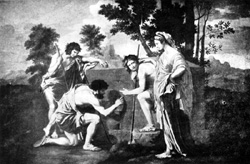
Shepherds of Arcady. Poussin. View larger image
Claude Gelée (1600-1682) known as Claude, and one of the greatest names in the history of modern painting, also spent most of his artistic career at Rome. He was the first to bring the glory of the sun and the sun-steeped atmosphere on to canvas. He touches a new chord in the symphony of colour and by his poetic charm and romantic feeling stirs a deeper emotion. He, too, was a strenuous, implacable worker, a loving student of Nature, passing days in silent abstraction before her varying moods.
Landing of Cleopatra at Tarsus. Lorrain. View larger image
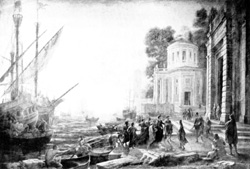
The Louvre possesses sixteen Claudes, among which we may emphasise on the L. wall, 310, View of a Port; 311, a poetic and glowing representation of the Roman Forum, before the old Campo Vaccino, with its romantic and picturesque aspect, had been excavated by modern archæologists. 314 and 316, Landing of Cleopatra at Tarsis, and Ulysses restoring Chryseis to her father, are typical imaginary classic compositions and variations on the artist's favourite theme—the effects of sunlight on an atmosphere of varying luminosity and on the limpid, rippling waves of the sea. We now come to the grand monarque of the arts at Paris during the century, Charles Lebrun (1619-1690), founder of the Royal Academy of Painting and Sculpture that finally eclipsed the old Painters' Guild which, from the thirteenth century, had monopolised the exercise of the art at Paris. So tyrannous had the Guild become that, in 1646, it ordered the number of court painters to be reduced to four each for the king and queen. An attempt to apply this regulation to the painters lodged at the Louvre roused Lebrun's hostility, who induced the regent, Anne of Austria, to found a rival Académie Royale on the model of the famous Academy of St. Luke at Florence. Twelve anciens were chosen by lot and the new Academy, Lebrun at its head, was inaugurated on 1st February 1648. The angry Guild swooped down on the Academy on 19th March, armed with a police warrant, to seize all its pictures and effects, a blow which Lebrun parried by a royal decree annulling the warrant. Hereupon the Guild organised their own Academy of St. Luke under the leadership of Vouet and Mignard, and after some temporary reconciliations and as many bickerings and hostilities, Lebrun won Mazarin's favour by a judicious gift of two paintings, and the Académie Royale obtained in 1658 a new constitution, an increase of members to forty, free quarters, and pensions, which, under Colbert, were raised to 4,000 livres. The Guild fought hard and won some concessions, but the Académie Royale remained supreme, and both were finally overwhelmed in the revolutionary storm.
In 1661 Lebrun was commanded by Louis XIV. to paint cartoons for tapestry illustrating the life of Alexander the Great. Five of these huge canvases hang in this room, R. and L., 509-513; 511, R. wall, The Family of Darius at Alexander's Feet, so charmed the king that he appointed Lebrun first royal painter, and granted him a patent of nobility. For thirty years the royal favourite was sole arbiter of taste and ruled supreme over the arts, until his star paled before the rising luminary, his rival Mignard. Lebrun's best work is to be seen at Versailles, but 510, R. wall, The Battle of Arbela, is an excellent example of his facile and adroit style. In 1686 the old favourite was commanded by Louis to paint a rival picture to Mignard's, Christ bearing His Cross, which was incensed with extravagant adulation by the courtiers. Lebrun set to work and in three months completed his Christ on the Cross, which the king loudly appreciated. Both pictures, 630 and 500, now hang on the L. wall a few paces from each other. Pierre Mignard (1612-1695) was a fellow-pupil with Lebrun under Vouet, and like him in early years a sojourner in Rome: his popular Madonnas, modelled from his Italian wife, added a new word (mignardes) to the French language. One such, 628, hangs a little further along this wall. In 1657 he won royal favour by a portrait of the young Louis, a branch of art in which he excelled. Mignard was a supple flatterer, and Louis sat to him many times. Once, later in the monarch's life, his royal sitter asked if he observed any change. "Sire," answered the courtly painter, "I only perceive a few more victories on your brow." A portrait of Madame de Maintenon, 639, is seen (L. wall) in this room. Mignard's greatest work, however, great in range if not in art, is the painting of the cupola of the church at the Val de Grâce, which is not only an indifferent painting, but was the occasion of a bad poem by his friend Molière.[217] Two other eminent portraitists, Nicholas Largillière (1656-1746), and Hyacinth Rigaud (1659-1743), may now fitly be considered.
By Rigaud, who was regarded as the first painter of Europe for truth of resemblance united with magnificence of presentment, are: a masterly portrait of Bossuet, 783; and a superb rendering of the roi-soleil, 781, both on the L. wall. Further along, on the same wall, are 784, portrait of his mother in two aspects painted for the sculptor Coysevox; and his last work, 780, Presentation at the Temple. Rigaud was especially successful with the rich bourgeoisie of Paris, and later became court painter, supreme in expressing the grandiose and inflated pomposities of the age. He, says Reynolds, in the tumour of his presumptuous loftiness, was the perfect example of Du Pile's rules, that bid painters so to draw their portraits that they seem to speak and say to us: "Stop, look at me! I am that invincible king: majesty surrounds me. Look! I am that valiant soldier: I struck terror everywhere. I am that great minister, etc." By Largillière, who lacks the psychological insight of his contemporary, is, L. wall, 483, Portrait of the Comte de la Chartre. He was a master of the accessories and upholstery of portraiture and painted some 1500 sitters during his long career, part of which was passed in England as court painter to Charles II. and James II. A third successful portraitist was Jean Marc Nattier (1685-1766), whose ingenious and compliant art aimed at endowing a commonplace sitter with distinction and grace, and who generally was able to strike a happy medium between flattery and truth. Better represented at Versailles, he is but poorly seen here in 657, R. wall, A Magdalen, and 661A, L. wall, Unknown Portrait. 441 is an interesting portrait of Fagon, Louis XIV.'s favourite physician, by Jean Jouvenet (1644-1717), known as Le Grand, a talented and docile pupil of Lebrun, whose four large compositions executed for the church of St. Martin des Champs, 432-435, are hung in this room. 434, R. wall, Resurrection of Lazarus, is perhaps the best. His works are a connecting link between the pompous spread-eagle manner of the Siècle de Louis XIV. and the gay abandonment and heartless frivolity of the reign of Louis XV. We pass from this room to the Collection of Portraits in
Room XV.
of which some few possess artistic importance and many historical interest. We bestow what attention we may desire and pass direct to
Room XVI.
Embarkation for the Island of Cythera. Watteau. View larger image
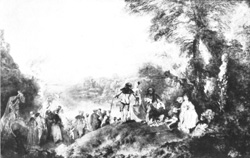
devoted to seventeenth-century art. Chief among the painters who interpreted the refined sensuality and more pleasant vices of the age, yet not of them, was Antoine Watteau (1684-1721), the melancholy youth from French Flanders, who began by painting St. Nicholases at three francs a week and his board, but who soon invented a new manner and became famous as the Peintre des Scènes Galantes. These scenes of coquetry, frivolity and amorous dalliance, with their patched, powdered and scented ladies and gallants, toying with life in a land where, like that of the Lotus Eaters, it seems always afternoon, he clothes with a refined and delicate vesture of grace and fascination. He has a poetic touch for landscape and a tender, pathetic sense of the tears in mortal things which make him akin to Virgil in literature, for over the languorous and swooning air and sun-steeped glades the coming tempest lours. His success, as Walter Pater suggests, in painting these vain and perishable graces of the drawing-room and garden-comedy of life, with the delicate odour of decay which rises from the soil, was probably due to the fact that he despised them. The whole age of the Revolution lies between these irresponsible and gay courtiers in the scènes galantes of Watteau and the virile peasant scenes in the "epic of toil" painted by Millet. In this room hangs his Academy picture, the Embarkation for Cythera, 982, L. wall, its colour unhappily almost worn away by over cleaning. His pupils, Pater (1696-1736), and Lancret (1690-1743), imitated his style, but were unable to soar to the higher plane of their master's genius. The former is represented by a Fête Champêtre, 689, R. wall: the latter by the Four Seasons, 462-465, R. wall; on the L. wall, 468, The Music Lesson, and 469, Innocence, both from the Palace of Fontainebleau. The Fête Galante dies with these artists whom we shall meet again better represented in the Salle La Caze. A famous contemporary of Pater and Lancret and first painter to the king was Charles Antoine Coypel (1694-1752), grandson of Noël Coypel (1629-1707), and son of Antoine (1661-1722), both of whom are represented in the Louvre (Rooms XIV.-XVI., 157-166, and 167-175), His Perseus and Andromeda, 180, hangs R. of the entrance of this room. Charles André Vanloo (1705-1765), known as Carle Vanloo, (whose grandfather, Jacob Vanloo, is represented by two pictures, 2451, 2452, hung among the Dutch artists in Rooms XXIV. and XXVI.), enjoyed a great vogue in his day. His facile drawing and riotous colour temporarily enriched the language with a new verb—to vanlooter. 899, on the L. wall, A Hunting Picnic, is an admirable specimen of his supple talent. The flaunting sensuality of François Boucher (1703-1770), and of Jean Honoré Fragonnard (1732-1806), who lavished undoubted genius and ignoble industry in the service of the depraved boudoir tastes of the Pompadours and Du Barrys that ruled at Versailles, are seen here and in the Salle la Caze in all their eloquent vulgarity. That Boucher had in him the elements of a great painter may be inferred from the charming little sketch, 30, R. wall, Diana, and from the excellent interior, 50A, L. wall, Breakfast. His popular pastoral scenes, executed with amazing facility, with their beribboned shepherds and dainty shepherdesses, are exemplified in 32 and 33, R. wall, and 34 and 35, L. wall. Other works by this fluent servant of La Pompadour are 31, R. wall, Venus commanding Vulcan to forge arms for Æneas, and 36, L. wall, Vulcan presenting them to Venus. Boucher with all his faults was a grand decorative artist of extraordinary versatility, but the loose habits and careless methods of his later days are reflected in slovenly drawing and waning powers of invention. Reynolds, who visited him in Paris, noted the change, and describes how he found the artist at work on a large picture without studies or models of any kind, and on expressing his surprise, was told by Boucher that he did in earlier days use them, but had dispensed with them for many years. Fragonnard, who on his return from Rome, had set about some canvases in the grand traditional style of the earlier masters, of which an example may be seen in 290, R. wall, Coresus[218] and Callirrhoe, soon perceived that fame lay not in that direction, and devoted himself with exuberant talent and unconscionable facility to satisfy the frivolous tastes and refined animality of royal and courtly patrons. For it was a time when life was envisaged as a perpetual feast of enjoyment; a vision of roguish eyes and rouged and patched faces of sprightly beribboned and perfumed gallants, playing at shepherds and shepherdesses, of luxurious sensuality untrammelled by a Christianity minus the Ten Commandments, soon to be hustled away by the robust and democratic ideals of David. Another early work of Fragonnard in this room is 291, R. wall, The Music Lesson: some of his more characteristic productions we shall meet with in the Salle La Caze. A somewhat feeble protest against the prevailing vulgarity and debasement of contemporary art was made by Jean Baptiste Siméon Chardin (1699-1779) and Jean Baptiste Greuze (1725-1805) in their rendering of scenes of domesticity and of the pathos of simple lives. Chardin is well seen in this room in his laborious studies of still life, 89 and 90, L. wall, diploma works, and in 91 and 92, same wall, The Industrious Mother, and Grace before Meat. The last, a delightful work, won for the artist Diderot's powerful advocacy, and made him the popular interpreter of bourgeois intimacies. Other patient studies of still life are: 95, 96, 101, and 102; and R. wall 94. On the same wall hang, 97, The Ape as Antiquary, and 99, The Housewife. If Chardin touches the border-line between sentiment and sentimentality, Greuze (end wall) in 369, Return of the Prodigal; 370, A Father's Crime; and 371, The Undutiful Son, certainly oversteps it. Each of these became the theme of extravagant eulogy and didactic preachments by Diderot, his literary protagonist, who hailed him as a French Hogarth making Virtue amiable and Vice odious. An even more equivocal note is struck (L. wall) in 372A, The Milkmaid; and 372, The Broken Pitcher, where as Gautier acutely remarks, the artist contrives to make Virtue exhale the same sensual delight as Vice had done, and to suggest that Innocence will fall an easy victim to temptation. Madame Du Barry was much attracted by the latter picture and possessed a replica of it. Other works and studies, R. wall, by the artist are in this room. 368, end wall, Severus Reproaching Caracalla, was painted as a diploma picture. But Greuze essayed here a flight beyond his powers: to his profound disgust the Academy refused to admit him as an historical, and classed him as a genre painter. No survey of eighteenth century French painting would be complete without some reference to Claude Joseph Vernet (1714-1789), the famous marine and landscape artist, whose paintings of the principal ports of France are hung in the Musée de la Marine on the second floor. Here we may distinguish among some score of his works: 921, The Bathers; 923, A Landscape; and 932, A Seascape: The Setting Sun, all on the L. wall.
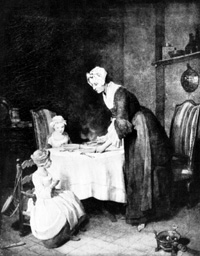
Grace before Meat. Chardin. View larger image
It will now be opportune to make our way to the La Caze collection. We pass out from the end of this room and descend the Escalier Daru to the first landing; then ascend L. of the Victory of Samothrace to the Rotonde, pass direct through the Salle des Bijoux, and turn L. through Room II. to
Room I.
The La Caze collection. We note on the R. wall, an excellent Lenain, 548, A Peasant Meal, and some admirable portraits by Largillière, 484-491, of which the last, Portrait of the Artist, his Wife and Daughter, is a masterly work. Among the fine portraits by Rigaud, 791-795, that of the Young Duke of Lesdiguières, stands pre-eminent. We cross to the L. wall, where the rich collection of works by Watteau and his followers is placed: 983, Gilles, a scene from a Comedy, is one of Watteau's most precious pictures. Near it are: 984, The Disdainful; 986, Gathering in a Park. 985, Sly-Puss, a charming little picture, is followed by 988, 989, 990 and 992, four other studies. 991 is a carefully finished classical subject, Jupiter and Antiope. Near these are grouped: 470-473, four small works by Lancret, and 690-693, a like number of typical variations of the scène galante by Pater. We next note 659, a fine portrait group by Nattier: Mlle. de Lambec as Minerva, arming her brother the young Count of Brienne. To the same skilful portraitist are due: 660, a Knight of Malta; and 661, A Daughter of Louis XV. as a Vestal Virgin. By Boucher are: 48, R. of entrance, The Painter in his Studio, and R. wall, 47, The Three Graces; 46 and 49, L. wall, Venus and Vulcan, and Vulcan's Forge. Fragonnard is represented by some of his characteristic works executed with wonderful sleight of hand, 292-301. The prevailing taste of his patrons may be judged by 295, L. wall, a sketch of one of his most successful and oftenest repeated subjects. On this same wall are a varied series of Chardin's studies of still life; a poor replica, 93, of his Grace before Meat; 104, The Ape as Painter, and other similar homely subjects.
Here also are two historical revolutionary portraits by Greuze: 378, The Girondin, Gensonné, and 379, the Poet-Deputy, Fabre d'Eglantine. Among the later Venetians are some Tintorets, R. wall: 1468, Susannah; 1469, Virgin and Child, Saints and Donor; 1470, Portrait of Pietro Mocenigo. Spanish art is represented by a fine but unpleasing Ribera, 1725, Boy with a Club-foot, and to Velasquez are ascribed: 1735, The Infanta Maria Teresa, Queen of Louis XIV.; 1736, Unknown Portrait; 1733, L. of entrance, Philip IV. 1945 and 1946, R. wall, the Provost and Sheriffs, and Jean de Mesme, President of the Parlement of Paris, are excellent examples of Philippe de Champaigne's austere and honest art.
From the studios of Boucher and of Comte Joseph Marie Vien (1716-1809) there came towards the end of the eighteenth century the virile, revolutionary figure of Jacques Louis David (1748-1825), who burst like a thunderstorm on the corrupt artistic atmosphere of the age, sweetening and bracing French art for half a century. Shocked by the slovenly drawing and vulgarity of the fashionable masters, and nursed on Plutarch, he applied himself to the study of the antique with a determination to rejuvenate the painter's art and establish a school, drawing its inspiration from heroic Greece and Rome. The successive phases of this potent but rather theatrical genius may be well followed in the Louvre. Neglecting for the present his earlier and pre-revolutionary works, we retrace our steps through Room II. noting in passing, 143, The Funeral at Ornans (a remarkable, realistic painting by a later revolutionary, to whom we shall return) and enter
Room III.
on the L. wall of which hangs 188, David's famous canvas: The Sabine Women, over which he brooded during his imprisonment in the Luxembourg after the Thermidorian reaction. David regarded this composition as the most successful expression of his theory of art. He studied whole libraries of antiquities and vainly imagined it to be the most "Greek" of all his works. Nothing, however, could be farther removed from the tranquil self-restraint and noble simplicity of Greek art than these self-conscious, histrionic groups of figures, without one touch of naturalness. The old preoccupation with classic models inherited from Poussin and the Roman school, still dominates even this revolutionary artist, who best displays his great genius when he forgets his theories and paints direct from life, as in 199, Mme. Récamier; and 198 (opposite wall), Pius VII. David's fierce Jacobinism (he had been a member of the terrible Committee of Public Safety) did not prevent him from worshipping the rising star of the First Consul, who, on assuming the Imperial crown, appointed him court painter and commissioned him to execute, 202A, Consecration of Napoleon I. at Notre Dame. In this grandiose historic scene, containing at least 150 portraits, the eye is at once drawn to the central actor who, having crowned himself, is placing a diadem on the kneeling Josephine's brow. The story runs, that David had originally drawn Pope Pius VII. with hands on knees. Bonaparte entering the studio, at once ordered the artist to represent the pontiff in the act of blessing, exclaiming: "I didn't bring him all this way to do nothing." For this picture and for the Distribution of the Eagles 180,000 francs were paid.
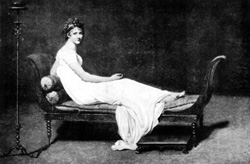
Madame Récamier. David. View larger image
Among the painters of the new school was Pierre Prud'hon (1758-1823), whose fame was made by two pictures, 747 and 756, on opposite walls, first exhibited in 1808: Justice and Divine Wrath pursuing Crime; and the graceful but somewhat invertebrate, Rape of Psyche. 746, an Assumption, was executed for the Tuileries Chapel in 1819. Other works by this master, whose Correggiosity is evident, hang in the room. Two famous pupils of David were François Pascal Simon Gérard (1770-1837) and Antoine Jean Gros (1771-1835). By the former, known as the King of Painters and Painter of Kings, are: 328, Love and Psyche; and 332, a charming portrait of the painter Isabey and his daughter. By the latter, who owed the Imperial favour to the good graces of Josephine, are: 391, Bonaparte at Arcole; 392A, Lieut. Sarlovèze, a typical Beau-Sabreur portrait; and 388, Bonaparte visiting victims of the Plague at Jaffa, a striking composition, which advanced the artist to the front rank of his profession. Gros was the parent of the grand battle-pictures of the future; the painter of the Napoleonic epos. Young artists were wont to attach a sprig of laurel to this work in which the first signs of the coming storm of Romanticism are discerned.
The real champion of the movement was, however, Jean Louis André Théodore Géricault (1791-1824), whose epoch-making picture, 338, The Raft of the Medusa, we now observe. This daring and passionate revolt from frigid classicism and preoccupation with a conventional antiquity was received but coldly by the professional critics on its appearance in 1819, though with enthusiasm by the people. Failing to find a buyer at Paris, its exhibition in England by a speculator, proved a financial success. 339-343, are military subjects of lesser range by this young innovator: 348, Epsom Races, was painted in England in 1821, three years before his premature death. To follow on with the French school we retrace our steps by the Rotonde and the Escalier Daru through Room XVI. to Room XV., L. of which, is the entrance to
Room VIII.
We revert to David whose Oath of the Horatii, 189, exhibited in 1785; and The Lictors bearing to Brutus the Bodies of his Sons, 191, exhibited in the fateful year 1789, hang skied on the R. wall. These paintings, hailed with prodigious enthusiasm, revolutionised the fashions and tastes of the day and gave artistic expression to the coming political and social changes. 200A on the same wall, The Three Ladies of Ghent, was painted during the artist's exile in Belgium, for the old Terrorist was naturally not a persona grata to the restored Bourbons. Jean Auguste Dominique Ingres (1780-1857), the most famous of David's pupils, two of whose works we have seen in Room V., was the bitterest opponent of the new Romantic school and steadfast champion of his master's artistic ideal. To him more than to any other teacher is due the tradition of clean, correct and comely drawing that characterises the French school. It is somewhat difficult perhaps for a foreigner, observing the paintings by Ingres in this room, fully to comprehend[219] the reverence in which he is held by his countrymen. More than once Professor Legros has described to the present writer the thrill of emotion that passed through him and his fellow-students when they saw the aged master enter the École des Beaux Arts at Paris. If, however, the visitor will inspect the marvellous Ingres drawings in the Salle des Desseins (p. 394), he will appreciate his genius more adequately. The master's chief work in the present room is 417, R. wall, Apotheosis of Homer, a ceiling composition in which the arch-poet, laurel-crowned, has at his footstool seated figures symbolising the Iliad and the Odyssey, while the most famous poets and philosophers of the ages are grouped below him. The Odalisque, 422B, L. wall, is a characteristic nude, and a few other subject pictures will be noted. Among his portraits, 418, Cherubini; 428B, Bertier de Vaux, are generally regarded as masterpieces. Ingres despised colour, he never appealed to the emotions; his type of beauty is external and soulless, and he leaves the spectator cold.
Meanwhile the new Romantic school of brilliant colourists grew and flourished. Ary Scheffer, Delaroche, Delacroix, cradled in the storms of the revolutionary period, are all represented around us. The sentimental Ary Scheffer (1795-1858) is seen, L. wall, in 841, St. Augustine and St. Monica, an immensely popular but affected and feeble composition. Some portraits by this artist may be also found on the walls. Greater than he in breadth of composition, opulence of colour and artistic virtuosity, was Paul Delaroche, whose Death of Queen Elizabeth, 216, end wall, now asserts itself. His greatest work, however, and one which won him much fame, is his well-known Hemicycle in the Beaux Arts (p. 319). A twin spirit with Géricault was the impetuous Ferdinand Victor Eugène Delacroix (1798-1863), who is more fully hung in this collection. Of the brilliant compositions which with indefatigable industry he poured forth in the heyday of the movement, we may note some excellent examples: 212, L. wall, The Wreck of Don Juan; 211, L. wall, Jewish Wedding at Morocco; and, 213, Capture of Constantinople by the Venetians and Franks. Earlier works are, 207, R. of entrance, Virgil and Dante nearing the City of Dis, executed with feverish energy in a few weeks for the Salon of 1822; and 208, L. of entrance, The Massacre of Scio, a glowing canvas painted in 1834. Jean Hippolyte Flandrin (1809-1864), the Lesueur of the century, and like him uniting artistic genius and wide erudition with profound religious faith and true modesty, is represented most poorly of all; 284, Portrait of a Young Girl being the only example of this master's work here. Flandrin can only be truly appreciated in the church of St. Germain des Prés (p. 320). Before we turn to the Barbizon painters, we note Gros' fine composition, 389, L. wall, Napoleon at Eylau; and 390, R. wall, Francis I. and Charles V. visiting the Tombs at St. Denis.
With Théodore Rousseau (1812-1867), the all-father of the modern French landscape school, and chief of the little band of enthusiasts who grouped themselves about him at Barbizon, we touch the greatest artistic movement of the age. Jean Baptiste Camille Corot (1796-1875), the ever-young and gentle spirit, the tenderest emanation of the century; Jean François Millet (1814-1875), the inspired and cultured peasant, mightiest of them all, grand and solemn interpreter of the fundamental and tragic pathos of human toil, ever discerning God's image in the most bent and ill-shapen of his creatures; Constant Troyon (1810-1865), the grandest animal painter of his day; Narcisse Diaz de la Peña (1809-1876), once a poor errand lad with a maimed leg, painter of forest depths and of the rich hues of summer foliage; Charles François Daubigny (1817-1878), latest of the little band, faithful and tender student of nature, painter of the countryside, of the murmuring waters of the Seine and the Oise—these once despised and rejected of men have long won fame and appreciation. No princely patronage shone on them in their early struggles nor smoothed their path; they wrought out the beauty of their souls under the hard discipline of poverty in loving and awful communion with Nature. They have revealed to us new tones of colour in the air, in the forest and the plain, and a new sense of the pathos and beauty in simple lives and common things.
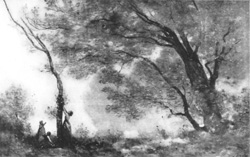
827, L. wall, is Rousseau's Forest at Fontainebleau, a fine effect of setting sun and loving representation of his favourite tree, the oak; 829 and 830, R. wall, are also by this master. On the same wall 643, Millet's Spring, whose coloration at first sight may seem forced and strange, is absolutely faithful to Nature, as the writer who once observed similar colour effects in the forest can testify. 644, The Gleaners, "the three fates of poverty," is, next to the Angelus, the most popular of Millet's works. Corot, the Theocritus of modern painting, is represented by 138, the lovely and poetical Morning, 141, Souvenir de Mortefontaine and 141 bis, Castelgandolfo. R. and L. are, 889 and 890, two grand and massive compositions by Troyon: Oxen going to the Plough; and, The Return to the Farm: landscapes that smell of the very earth, and rendered with a marvellous breadth of style and penetrating sympathy; 184, end wall, and 185, R. of entrance, Grape Harvest in Burgundy, and Spring, are by Daubigny.
One of the most aggressive, ebullient and individual of painters was Gustave Courbet (1819-1877), whose harshly realistic Funeral at Ornans we have seen in Room II. In 1855 Courbet, finding his works badly hung in the International Exhibition at Paris, erected a wooden shed near the entrance, where he exhibited thirty-eight of his large pictures, and defiantly painted outside in big letters—REALISM: G. COURBET. Strong of body and coarse in habit, this peintre-animal, as he was called, delighted to épater le bourgeois, and painted his studies of the nude with a brutal reality that stripped the female form of all the beauty and grace with which the superior ideality of man has invested it. This swashbuckler of realism, who despised the old masters, denounced imagination as humbug, and would have great men, railway stations, factories and mines painted as the vérités vraies, the saints and miracles of the age, was, however, often better than his artistic creed, and is here represented by some pleasing Fontainebleau pictures: L. wall, 147, Deer in Covert; R. wall, 66, Source of the Puits Noir, and L., 147 bis, The Waves, a most powerful and original interpretation of the sombre majesty of the sea. For in truth the creed of Realism, whether in literature or in art, involves a fallacy, and the creations of the imaginative and idealistic faculty in man are as real as those which result from the faculty of seeing mean things meanly and coarse things coarsely. Courbet's violent revolutionary nature nearly cost him his life in 1848 and involved him in the Commune in 1871, during which he presided over the destruction of the Vendôme Column (though he saved the Luxembourg and the Thiers' collection from the violence of the people). Poor Courbet, mulcted in enormous damages for his share in the overthrow of the Column, was ruined and died in exile. A more potent revolutionist, the arch-Impressionist Manet and founder of the school, has at length forced the portals of the Louvre and is represented by the celebrated Olympia, 204, around which so many fierce battles were waged in 1865.
We proceed to supplement this small collection of Barbizon pictures by a visit to the recently acquired (1903) Thomy-Thiéry and Chauchard collections. Returning to the Salle La Caze by Room XVI., and the Escalier Daru, we issue from it, pass direct before us and continue through the rooms devoted to exhibits of furniture (in Hall II. is a superb specimen of cabinet-work—Louis XV.'s writing-table). Turning R., we then enter a series of Cabinets, containing an admirable and most important collection of drawings, beginning with the early Italian masters and following on chronologically to the later Italians and to the German, Netherland and French masters. If the visitor have leisure he will be repaid by returning at some convenient time to study these carefully. But even the most hurried traveller should not omit to glance through them, and more especially at the lovely Da Vincis in the second cabinet and the Ingres drawings further along. Arrived at the end, we shall find on our L. a wooden staircase, which we mount and reach
Room XXXVII.
the Salle Française de 1830. Here are exhibited Delaroche's Princes in the Tower; Flandrin's Portrait of Mme. Vinet and some early works of the Barbizon school; Corot, 139, the Forum at Rome; 140, the Colosseum; 141F, The Belfry at Douai and others. Millet's sketch of the Church at Gréville, 641, was found in his studio after his death; another study is 642, The Bathers; 644A, The Seamstress, 642A is a portrait of the artist's sister-in-law. By Rousseau are two small landscapes, 831 and 832; and The Landes, 830, a masterpiece. Diaz and Dupré are seen in a number of studies and paintings.
Room XXXVIII.
The Binders. Millet. View larger image
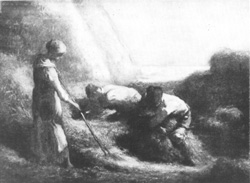
contains the Thomy-Thiéry pictures, excellently hung and forming one of the most rich and precious collections in the Louvre. On the R. wall as we enter are a numerous series of genre paintings, happily conceived and wrought by Alexandre Gabriel Decamps (1803-1860). This room holds many excellent Rousseaus, among which are: 2896, Banks of the Loire; 2900, an excellent study of his favourite Oak Trees; 2901, The Pyrenees; 2903, Springtide. Millet is well represented by a priceless little collection: 2892, The Binders;2890, The Rubbish-burners; 2893, The Winnower; 2894, A Motherly Precaution; 2895, The Wood Chopper. By Corot are shown no less than twelve examples: 2801-2812. All are most exquisitely poetical and delicate, but we may specially note: 2804, Shepherds' Dance at Sorrento; 2805, The Pollard Willows; 2806, Souvenir of Italy; 2807, The Pond; 2808, Entrance to a Village; 2810, View of Sin-le-Noble; 2811, Evening. A magnificent set of Troyons next claims our admiration, eleven in all, 2906-2916, of which: 2913, Girl with Turkeys; 2909, Morning; 2914, The Barrier; 2916, The Heights of Suresnes, are superlative. The ten Diaz pictures, 2854-2863, are of perhaps lesser interest, although they will all repay careful attention. Of Daubigny's intimate landscapes thirteen are offered to our appreciation, 2813-2825, among which: 2821, The Thames at Erith; 2822, The Mill at Gyliers; and 2824, Morning, are notable. By the melancholy and poetical Jules Dupré (1812-1889), whose landscapes oft breathe the tragic pathos of storm and desolation, and who is said to have broken into a passionate outburst of tears and sobs as he watched the magnificent spectacle of a nocturnal tempest, are twelve compositions, 2864-2875; and let us not omit some half-score Delacroix, 2843-2853, among which is a rare religious subject, 2849, Christ on the Cross. The glass cases in the centre of the room exhibit a numerous collection of bronzes by Barye, whom we have seen among the modern sculptors in Room VI.
Landscape. Corot. View larger image
Room XXXIX.
is the Salle Française du Second Empire and contains Horace Vernet's well known, The Barrière de Clichy, Defence of Paris in 1814; and Ary Scheffer's, Death of Géricault. 2938 is the great caricaturist Daumier's portrait of Théodore Rousseau. Numerous examples of the myopic art of Jean Louis Ernest Meissonier (1815-1891) will attract attention in this Room. To reach the Chauchard collection, provisionally exhibited in the old Colonial office, we descend to the first floor, traverse the Grande Galerie and the new Rubens Room. This, prodigieux accroissement de richesses, as it is termed by the official catalogue, contains a large number of masterpieces by the Barbizon painters and raises the Louvre collections of that school to supreme importance. No less than eight Millet's are included, the most famous of which, if not the greatest, The Angelus, 102, is much faded, but always attracts a crowd of admirers. 103, Woman at the Well, is a scene at the artist's birthplace; 104, is one of the most inspired of the master's creations, The Shepherdess watching her Flock. 99, The Winnower; 105, Girl with a Distaff, and 106, The Sheep Fold—a lovely pastoral scene by night. Among the twenty-six Corots are many of his finest works; 6, Goatherd playing the Flute; 8, The Dance of the Nymphs; 15, Rest beneath the Willows; 16, The Ford; 20, Forest Glade: Souvenir of Ville Avray; 24, Dance of Shepherdesses; 27, The Mill of St. Nicholas-les-Arras. Some noble Rousseaus are included: 107, Avenue in the Forest of d'Isle-Adam; 108, Pond by the Wayside; 112, Road in the Forest of Fontainebleau. Troyon's score of canvases make a brave show: 127, The White Cow, painted in 1856, was a favourite of the artist who kept it by him until his death and bequeathed it to his mother. By Charles Jacque, the painter of sheep, three works are shown including 72, The Great Sheepfold. Daubigny, Descamps, Diaz and others of the school are well represented in the collection. Admirers of "the little master of little pictures" will find among the twenty-six Meissonier's, which the Chauchard bequest brings to the Louvre, two of the most famous of his works: 87, The Napoleonic picture, Campaign of France, 1814; and 80, Amateurs of Painting. All these examples of the most successful but least inspired of modern artists exemplify his patient, concentrated, meticulous style. By an ingenious fiction that the installation is only provisional, six characteristic Venetian pictures by the veteran, Ziem, have been retained in the collection.[220] 136, is, however, wrongly named, and should read Scene from the Giudecca.
We have completed our rapid survey of the chief paintings in the Louvre, for the more recent developments of French art must be sought in the Luxembourg, where they are all too inadequately represented. The self-imposed limitations of this work will not carry us thither, but the most cursory visit to the Louvre would be incomplete without some notice of the collections of Persian and Egyptian art which we may conveniently glance at on our way as we leave. Descending to the first floor by the staircase up which we mounted, we turn obliquely to the R. and enter the E. gallery containing the Persian terra-cotta reliefs and other objects from the royal palace of Darius, and Artaxerxes,[221] his son, at Susa, including the marvellous coloured Frieze of the Archers; one of the colossal capitals (restored), that supported the roof of the Throne Room; a model of the same; and some fine terra-cotta reliefs of Lions and of winged Bulls.
We pass on through the Mediæval and Renaissance collections, turn an angle R., and enter the South Gallery, where some remarkable specimens of ancient art will be found among the Egyptian Antiquities. The painted statue (Hall III.) of the Seated Scribe is one of the most precious examples the world possesses of an art admirable in its naturalism and power of vivid portraiture, and the charming figure of a priestess, known as Dame Toui, exquisitely wrought in wood, is equally noteworthy. A superb example of a royal papyrus of the Book of the Dead will also invite attention. We pass on through a suite of beautifully decorated rooms filled with a choice collection of Etruscan and Greek Ceramic art, each of which offers a rich feast of beauty and historic interest.
At length we reach again the collection of paintings, Room III., whence we may pass through the Salle des Bijoux with a small exhibit of ancient jewellery, to the Rotonde, and turning L., enter the magnificent Galerie d'Apollon (the old Petite Galerie of Henry IV.), and examine the wealth of enamels; the exquisite productions of the goldsmith's art as applied to the sacred vessels of the church; precious stones; cameos; and such as remain of the old crown jewels. We may leave the palace by returning to the Rotonde; pass through the Salle La Caze and descend the Escalier Henry II. to the L., noting the caissons of its ceiling, decorated by Jean Goujon, and reach the Quadrangle under the Pavilion de l'Horloge, where we began our visit; or we pass from the Rotonde down the Escalier Daru to the exit in the Pavilion Denon, which gives on the Squares du Louvre. In the latter case it will be of some interest before leaving to pass for a moment by the exit and along the Galerie Mollien, where on the R. among the models of Roman masterpieces executed for Francis I., under Primaticcio's supervision, will be found one of the Laocoon, which shows its condition before Bernini's bungling restoration had deformed the group. To the unsated sightseer there yet remain the rich and comprehensive collections of Egyptian and Asiatic antiquities on the ground floor of the E. wing entered on either side of the E. portal.
SECTION VI
The Ville (S. of the Rue St. Antoine)—The Hôtel de Ville[222]—St. Gervais—Hôtel Beauvais—Hôtel of the Provost of Paris—SS. Paul and Louis—Hôtel de Mayenne—Site of the Bastille—Bibliothèque de l'Arsenal[223]—Hôtel Fieubert—Hôtel de Sens—Isle St. Louis.
We take the Métropolitain to the Hôtel de Ville station and make our way to the Place de l'Hôtel de Ville, formerly Place de Grève, a little W. of the station.
In 1141 a sloping bank of sand (grève), to the E. of the Rue St. Martin and facing the old port of the Nautæ at St. Landry on the island of the Cité, was ceded by royal charter, to the burgesses of Paris for a payment of seventy livres. "It is void of houses," says the charter, "and is called the gravia, and is situated where the old market-place (vetus forum) existed." This was the origin of the famous Place de Grève,[224] where throbbed the very heart of civic, commercial and industrial Paris. On its eastern side stood the old Maison aux Piliers, a long, low building, whose upper floor was supported by columns. Here every revolutionary and democratic movement has been organised, from the days of Marcel to those of the Communes of 1789—when the last Provost of the Merchants met his death—and of 1871, when the fine old Renaissance Hôtel de Ville was destroyed by fire. The place of sand was much smaller in olden times, and from 1310, when Philip the Fair burned three heretics, to September, 1822, when the last political offenders, the four serjeants of Rochelle, were executed, and to July 1830, when the last murderer was hung there, has soaked up the blood of many a famous enemy of State and Church and of innumerable notorious and obscure criminals, including the infamous Marquise de Brinvilliers, who was burned alive, and Cartouche, broken on the wheel. A permanent gibbet stood there and a market cross, and there during the English wars the infuriated Parisians tied the hands and feet of hundreds of English prisoners taken at Pontoise and flung them into the Seine. Every St. John's eve—the church and cloister of St. Jean stood behind the Hôtel de Ville—a great bonfire was lighted in the Place de Grève, fireworks were let off, and a salvo of artillery celebrated the festival. When the relations between Crown and Commune were felicitous the king himself would take part in the fête and fire the pile with a torch of white wax decorated with crimson velvet. A royal supper and ball in the Grande Salle concluded the revels. Not infrequently the ashes at the stake where a poor wretch had met his doom had scarcely cooled before the joyous flames and fireworks of the Feu de St. Jean burst forth, and the very day after the execution of the Count of Bouteville the people were dancing round the fires of St. John. The present Hôtel de Ville, by Ballu and Deperthes, completed in 1882,[225] is one of the finest modern edifices in Europe, and contains some of the most important productions of contemporary French painters and sculptors: Puvis de Chavannes, Carolus Duran, Benjamin Constant, Jean Paul Laurens, Carrière Dalou, Chapu and others.
We pass to the E. of the Hôtel, where stands the church of St. Gervais and St. Protais, whose façade by Solomon Debrosse (1617) "is regarded," says Félibien (1725), "as a masterpiece of art by the best architectural authorities" ("les plus intelligens en architecture"). The church, which has been several times rebuilt, occupies the site of the old sixth-century building, near which stood the elm tree where suitors waited for justice to be done by the early kings. "Attendre sous l'orme" ("To wait under the elm") is still a proverbial expression for waiting till Doomsday.
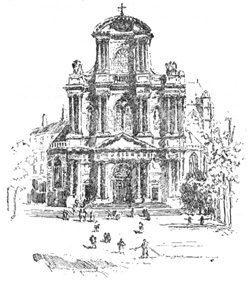
St. Gervais. View larger image
Hôtel of the Provost of Paris. View larger image
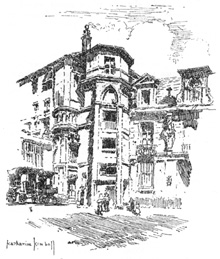
The lofty Gothic interior, dating from the late fifteenth century, is lighted by some sixteenth and seventeenth-century stained glass, and among the pictures that have escaped transportation to the Louvre may be noted a lunette over the clergy stalls R. of the nave, God the Father, by Perugino; and a remarkable tempera painting, The Passion, attributed to Dürer's pupil, Aldegräver, in the fifth chapel, L. aisle. The curious old panelled and painted little Chapelle Scarron (fourth to the L.) and the sixteenth-century carved choir stalls from the abbey church of Port Royal are of interest: the beautiful vaulting of the Lady Chapel is also noteworthy. Some good modern paintings may be seen (with difficulty) in the side chapels. The Rue François Miron leading E. from the Place St. Gervais was part of the Rue St. Antoine, before the cutting of the Rue de Rivoli, and the chief artery from the E. to the centre of Paris. On the R. of this street, No. 26, Rue Geoffrey l'Asnier, is the fine portal of the seventeenth-century Hôtel de Châlons, where the whilom ambassador to England, Antoine de la Borderie, lived (1608). Yet further on in the Rue François Miron is the Rue de Jouy: at No. 7, is the charming Hôtel d'Aumont by Hardouin Mansard. We continue our eastward way along the Rue François Miron and among other interesting houses note No. 68, the princely Hôtel de Beauvais, erected 1660, for Anne of Austria's favourite femme de chambre, Catherine Henriette Belier, wife of Pierre Beauvais. The street façade has been much disfigured and the magnificent wrought-iron balcony, whence Anne, Mazarin and Turenne, together with the Queen of England, watched the solemn entry of Louis XIV. and his consort Maria Thérèse, has been destroyed: but the beautiful circular porch with its Doric columns and metopes and the stately courtyard where the architect, Jean Lepautre, has triumphed over the irregularity of the site and created a marvellous symmetry of form—all this still remains, together with the noble stairway on the L., decorated by the Flemish sculptor, Desjardins. In the house at the sign of the Falcon which formerly stood on this spot, Tasso in the splendour of his early years was lodged by his patron, the Cardinal d'Este, and composed the greater part of the Gerusalemme Liberata. The Rue François Miron is continued by the Rue St. Antoine: at No. 119, we enter the Passage Charlemagne and pass to the second courtyard where remains a goodly portion of the old Hôtel of the Royal Provost of Paris, [226] given to Aubriot by Charles V. At No. 101 is the site of one of the gates of the Philip Augustus wall and at No. 99 stands the Jesuit Church of St. Paul and St. Louis, in the typical baroque style so familiar to visitors to Rome. The once lavishly decorated interior has suffered much from the Revolutionists. Germain Pilon's Virgin still remains in the chapel L. of the high altar, but the four angels in silver that sustained the hearts of Louis XIII. and XIV., and the noble bronze statues from the mausoleum of the Princes of Condé, admired by Bernini, are only a memory. At No. 65, a malodorous court leads to the old vaulted entrance to the charnel-houses of St. Paul, where Rabelais and the Man with the Iron Mask were buried;[227] and to the R. of this vault a narrow street leads to the Marché Ste. Catherine on the site of the canons' houses of the monastery of Ste. Catherine du Val des Écoliers (p. 124). At the corner of the Rue du Petit Musc is the magnificent Hôtel de Mayenne, begun by Du Cerceau for Diana of Poitiers and completed for the Duke of Mayenne, leader of the forces of the League: this too has a fine courtyard. The chamber in which the leaders of the League met and decided to assassinate Henry III. still exists. An inscription over No. 5 marks the site of the forecourt of the Bastille where the revolutionists penetrated on 14th July: on the pavement in front of No. 1 and across the end of the street and in front of No. 5 Place de la Bastille, round the opposite corner, lines of white stones mark part of the huge space on which the gloomy and sinister old fortress stood. We turn S.W. by the Boulevard Henry IV., past the imposing new barracks of the Garde Républicaine, and then L. by the Rue de Sully. At No. 3 we enter the Bibliothèque de l'Arsenal, one of the most important libraries of Paris, where an attendant will show Sully's private cabinet and antechamber, with the rich decorations as they were left by his successor, including a ceiling painted by Vouet. Many an intimate outpouring of the Victor of Ivry's domestic woes did Sully endure here—complaints of his ill-tempered Marie's scoldings, the contrast between his lawful wife's sour greetings and the endearing graces and merry, roguish charms of his mistresses; their quarrels and exactions. All of which the great minister would listen to reprovingly, and exhort his dejected royal master not to permit himself, who had vanquished the hosts of his enemies in battle, to be overcome by a woman's petulancy. To the S. of the library the Boulevard Morland marks the channel which separated the Isle de Louviers from the N. bank of the river. We return to the Boulevard Henry IV. and cross to the Quai des Célestins, where on our L. stands part of a tower of the Bastille, discovered in 1899 during the construction of the Metropolitan Railway and transferred here. At the corner of the Rue du Petit Musc opposite, is the fine Hôtel Fieubert, erected by Hardouin Mansard (1671) on part of the site of the Royal Hôtel St. Paul. The principal façade, 2 bis Quai des Célestins, has unhappily been irretrievably spoilt by subsequent additions. Continuing westward, we note No. 32, the site of the Tour Barbeau of the Philip Augustus wall. An inscription bids us remember that there stood the old Tennis Court of the Croix Noire, where Molière's troupe of the Illustre Théâtre performed in 1645. Turning R. up the Rue Falconnier, we come upon (L.) the grand old fifteenth-century palace of the archbishops of Sens (p. 114), now a glass merchant's warehouse. We regain the Place de l'Hôtel de Ville by the Quai of the same name, or cross the Pont Marie, and stroll about the quiet streets of the Isle St. Louis (p. 214), and return by the Pont Louis Philippe at its western extremity.
SECTION VII
The Ville (N. of the Rue St. Antoine)—Tour St. Jacques—Rue St. Martin—St. Merri—Rue de Venise—Les Billettes—Hôtels du Soubise,[228] de Hollande, de Rohan [229]—Musée Carnavalet[230]—Place Royale—Musée Victor Hugo—Hôtel de Sully.
Two parallel historic roads named of St. Martin and of St. Denis cut northwards through the mass of houses that now crowd the Marais: the latter, the Grande Chaussée de Monseigneur St. Denis, to the shrine of the martyred saint of Lutetia, the former, the great Roman Street which led to the provinces of the north.
West door of St. Merri. View larger image
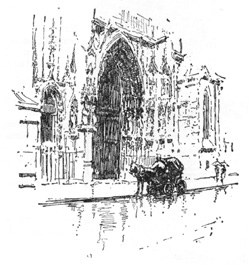
We set forth northwards from the Place du Châtelet, at the foot of the Pont au Change, where stood the massive pile of the Grande Châtelet, originally built to defend the bridge from the Norman pirates as the Petit Châtelet was to defend the Petit Pont. It subsequently became the official seat and prison of the Provost of Paris, where he held his criminal court and organised the City Watch, and was demolished in 1802. Below this festered an irregular maze of slums, the aggregation of seven centuries, the most fetid, insanitary and criminal quarter of Paris, known as the Vallée de Misère, which only disappeared in 1855. On our R. soars the beautiful flamboyant Gothic tower, all that remains of the great church of St. Jacques de la Boucherie. This fine monument was saved by the good sense of the architect Giraud who, when the church was sold to the housebreakers during the Revolution, inserted a clause in the warrant exempting the tower from demolition. It was afterwards used as a lead foundry and twice narrowly escaped destruction by fire. Purchased by the Ville, it seemed safe at last, but again it was threatened in 1853 by the prolongation of the Rue de Rivoli: luckily, however, the new street just passed by on the north. The statue of Pascal under the vaulting reminds the traveller that the great thinker conducted some barometrical experiments on the summit, and the statues of the patron saints of craftsmen in the niches, that under its shadow the industrial arts were practised. We ascend the Rue St. Martin from the N.E. corner of the Square, and on our R. find the late Gothic church of St. Merri, built on the site of the seventh-century Chapel of St. Pierre, where Odo Falconarius, one of the defenders of Paris in the siege of 886, is known to have been buried. We enter for the sake of the beautiful sixteenth-century glass in the choir and a curious old painting of the same epoch in the first chapel beyond the entrance to the sacristy, Ste. Geneviève and her Flock, with a view of Paris in the background. We continue to ascend the street, noting No. 122, an old fountain and some reliefs, and soon reach, R. and L., the quaint and narrow mediæval Rue de Venise, formerly the Ruelle des Usuriers, home of the Law speculators (p. 242). At No. 27, L. of the Rue St. Martin and corner of the Rue Quincampoix, is the old inn of the Epée de Bois (now à l'Arrivée de Venise), where Prince de Hoorn and two other nobles assassinated and robbed a banker in open day and were broken alive on the wheel in the Place de Grève. Mirabeau and L. Racine, with other wits are said to have met there and Mazarin granted letters patent to a company of dancing masters who taught there, under the direction of the Roi des Violins: from these modest beginnings grew the National Academy of Dancing. We return E. along the Rue de Venise and pass to its end; then cross obliquely to the R. and continue E., along the Rue Simon le Franc, traversing the Rue du Temple, to the Rue des Blancs Manteaux. This we follow still eastward to its intersection with Rue des Archives. Turning down this street to the R. we cross, and at Nos. 24 or 26 enter the fifteenth-century cloister (restored) of the monastery of the Billettes, founded at the end of the thirteenth century to commemorate the miracle of the Sacred Host, which had defied the efforts of Jonathan, the Jew to destroy it by steel, fire and boiling water. The chapel, built on the site of the Jew's house in 1294, was rebuilt in 1754, and is now a Protestant church. The miraculous Host was preserved as late as the early eighteenth century in St. Jean en Grève, and carried annually in procession on the octave of Corpus Christi. We return northwards along the Rue des Archives, and reach at the corner of the Rue des Francs Bourgeois the fine pseudo-classic Hôtel de Soubise, now the National Archives, erected in 1704 for the Princesse de Soubise on the site of the old Hôtel of the Constable of France, Olivier de Clisson, where Charles VI., after his terrible vengeance on the revolted burgesses, agreed to remit further punishment, and where the Duke of Clarence established himself at the time of the English occupation. It became later (1553) the fortress of the Guises and rivalled the Louvre in strength and splendour. The picturesque Gothic portal (restored) of the old Hôtel de Clisson still exists higher up the Rue des Archives. The lavishly decorated Hôtel de Soubise, entered from the Rue des Francs Bourgeois, in which are exhibited historical documents and other objects of profound interest, though bereft of much of its former splendour is well worth a visit. The sumptuous chambers contain much characteristic and well-preserved decorative work by Boucher, Natoire, Carle Vanloo and others.[231] Opposite the hôtel and between Nos. 59 and 57 may be seen a portion of a tower, repaired in brick, of the old Philip Augustus wall, and in the courtyard of the Mont de Piété (No. 55) the line of the wall is traced: a nearer view of the tower may be obtained from the courtyard to the R.
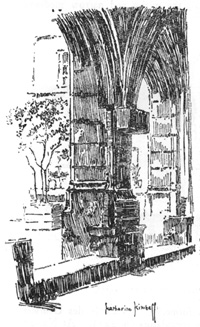
Cloister of the Billettes, Fifteenth Century. View larger image
Archives Nationales, Hôtel Soubise, showing towers of Hôtel de Clisson. View larger image
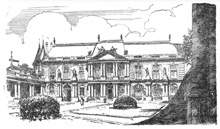
We proceed eastward past the rebuilt church of the Blancs Manteaux and at the corner of the Rue Vieille du Temple find a charming Gothic tourelle (restored), all that remains of the mansion built in 1528 by Jean de la Balue. Descending the Rue Vieille du Temple to the R., we may examine (No. 47) the old Hôtel de Hollande, erected in 1638, where the Dutch ambassadors resided; and ascending, at No. 87, we find the Hôtel de Rohan (1712), home of the Cardinal de Rohan of diamond-necklace fame, now the Imprimerie Nationale. The Salon des Singes, charmingly decorated by Huet, and other interesting rooms are shown. The fine relief by Le Lorrain of the Horses of Apollo in a passage to the R. of the courtyard should by no means be missed. We return to the Rue des Francs Bourgeois, and at No. 38 find an inscription[232] over the entrance to a picturesque court which marks the place where the Duke of Orleans was assassinated by Jean Sans Peur (p. 132). Still proceeding E. we pass yet more interesting domestic architecture—No. 31, Hôtel d'Albret, where goody Scarron used to visit Madame de Montespan and where she was appointed governess to the royal bastards; 25, Hôtel de Lamoignon, once occupied by Diana of France, daughter of Henry II., and where Malesherbes was born.
Tower at the corner of the Rue Vielle du Temple. View larger image
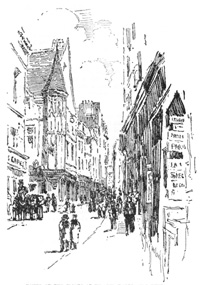
Nos. 14 and 16, corner of the Rue de Sévigné, is the Hôtel de Carnavalet, a magnificent renaissance mansion, in raising which no less than four famous architects had part—Lescot, Bullant, Du Cerceau and the elder Mansard. For twenty years (1677-1697) it was the home of Madame Sévigné, queen of letter-writers. Her Carnavalette, as she delighted to call it, is now the civic museum of Paris. The beautiful reliefs over the entrance, including the two superb lions against a background of trophies, are by Goujon, as are also the satyrs' heads on the keystones of the arcades of the courtyard. The Four Seasons and some of the lateral figures that decorate the courtyard were designed by him. In the centre stands a bronze statue of Louis XIV as a Roman conqueror, by Coysevox, which once stood on the Place de Grève before the old Hôtel de Ville. The museum, which contains a collection,[233] historic and prehistoric, relating to the city of Paris, is especially rich in objects, all carefully labelled, illustrating the great Revolution, and is of profound interest to students of that period: the second floor is devoted to the last siege of Paris. From the museum we fare yet further E. along the Rue des Francs Bourgeois to the Place Royale (now des Vosges), the site of the Palace of the Tournelles, once a favourite pleasure-house with a fair garden, of the kings of France, and where the Duke of Bedford lived during the English occupation, projecting to transform it into an English park for his exclusive use. There the ill-fated Henry II. lay eleven days in excruciating agony (p. 172), calling for his seule princesse, the beloved Diana, while Catherine, like a she-dragon, watched lest her rival entered. After his death the palace becoming hateful to Catherine, she had it demolished. It was subsequently used as a horse-market, and there the three minions of Henry III. began their bloody duel with the three bullies of the Duke of Guise at five in the morning of 27th April 1578, and fought on until every one was either slain or severely wounded.
How different is the present aspect of this once courtly square! Here noble gentlemen in dazzling armour jousted, while from the windows of each of the thirty-five pavilions, gentle dames and demoiselles smiled gracious guerdon to their cavaliers. Around the bronze statue of Louis XIII., proudly erect on the noble horse cast by Daniello da Volterra, in the midst of the gardens, fine ladies were carried in their sedan-chairs and angry gallants fought out their quarrels. And now on this royal Place, the Perle du Marais, the scene of these brilliant revels, peaceful inhabitants of the east of Paris sun themselves and children play. Bronze horse and royal rider went to the melting pot of the Revolution to be forged into cannon that defeated and humbled the allied kings of Europe, and a feeble marble equestrian statue, erected under the Restoration, occupies its place.
We cross the Square obliquely and at No. 6, Victor Hugo's old house, find a delightful little museum of portraits, busts, casts, illustrations of his works in various mediums, and personal and intimate objects belonging to the poet. It was at this house that in 1847 the two greatest novelists of their age met. Dickens has described how he was welcomed with infinite courtesy and grace by Hugo, a noble, compact, closely-buttoned figure, with ample dark hair falling loosely over his clean-shaven face and with features never so keenly intellectual, and softened by a sweet gentility. We leave the Place by the S. exit, and entering the Rue St. Antoine turn R. to No. 62, where stands the Hôtel de Sully, built by Du Cerceau in 1634. The stately but now rather grimy inner courtyard is little altered, but the fine façade has been disfigured by the erection of a mean building between the wings. We return from the Métropolitain station at the end of the Rue François Miron.
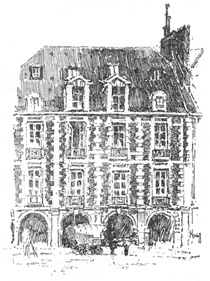
Place des Vosges, Maison de Victor Hugo. View larger image
SECTION VIII
Rue St. Denis—Fontaine des Innocents—Tower of Jean sans Peur—Cour des Miracles—St. Eustache—The Halles—St. Germain l'Auxerrois.
From the Châtelet Station of the Métropolitain we strike northwards along the Rue St. Denis, passing R. and L. the Rue des Lombards, the Italian business quarter of old Paris, where Boccaccio, son of Boccassin, the money-changer, was born. We continue past the ill-omened Rue de la Ferronnerie and soon reach the Square and Fontaine des Innocents. This charming renaissance fountain was transferred here in 1786 from the corner of the old Rues aux Fers (now the widened Rue Berger) and St. Denis, where it had been designed and decorated by Lescot and Goujon to celebrate the solemn entry of Henry II. in 1549. The beautiful old fountain has been considerably modified and somewhat debased. The longer side has been divided to make a third, and a new fourth side has been added by Pajou. The whole has been elevated much too high by the addition of the terrace steps, and an unsightly dome has been added. Five of the exquisite reliefs of the Naiads by Goujon still remain, and three have been added by Pajou. These latter may be distinguished by their higher relief and lack of refinement.
The site of the immense Necropolis of Les Innocents,[234] which for six centuries swallowed up half the dead of Paris, roughly corresponds to the parallelogram formed by the modern Rues Berger, St. Denis, Ferronnerie and de la Lingerie, and one of the old vaulted charnel-houses may still be seen at the ground floor of No. 7 Rue des Innocents. The huge piles of human remains and skulls that grinned from under the gable roof of the gallery painted with the Dance of Death were, in 1786, carted away to the catacombs under Paris, formed by the old Gallo-Roman quarrymen as they quarried the stone used to rebuild Lutetia. For centuries this enclosure was the refuge of vagabonds and scamps of all kinds, a receptacle for garbage, the haunt of stray cats and dogs, whose howlings by night made sleep impossible to nervous folk; and the lugubrious clocheteur, or crier of the dead, with lantern and bell, his tunic figured with skull and cross-bones, bleating forth: —
"Reveillez-vous gens qui dormez, Priez Dieu pour les trépassez."
was no soothing lullaby.
A curious early fifteenth-century rhyme is associated with this charnel-house. One morning, two bourgeoises of Paris, the wife of Adam de la Gonesse and her niece, went abroad to have a little flutter and eat two sous' worth of tripe in a new inn. On their way they met Dame Tifaigne, the milliner, who recommended the tavern of the "Maillez," where the wine was excellent. Thither they went and fared not wisely but too well. When fifteen sous had already been spent, they determined to make a day of it, and ordered roast goose with hot cakes. After further drinking, gauffres, cheese, peeled almonds, pears, spices and walnuts were called for, and the feast ended in songs. When the bad quarter of an hour came, their sum of sous proving inadequate, they parted with some of their finery to meet the score, and at midnight left the inn dancing and singing —