Front matter
Reading edition
Transcriber's note: Minor spelling inconsistencies, mainly hyphenated words, have been harmonised. Obvious printer errors have been repaired.
Accents: In French sentences, most of them italicized, accents have been added, when necessary, according to the French spelling rules of the time.
In an English context, French words have no accents if there are no accents in the original text. In case of an inconsistent use of accents, the French spelling has been favoured.
The Latin numbers (i and ii) in the text refers to transcriber's notes at the end of this e-book.
The advertisement for other books in the series have been removed from page 3 to the end of this e-book.
Cover. View larger image
The Story of Paris
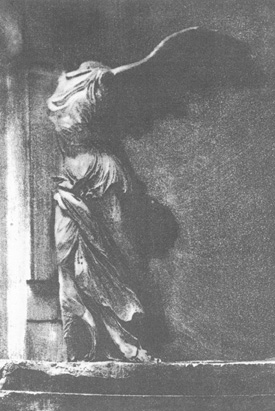
Winged Victory of Samothrace. View larger image
The Story of Paris
by Thomas Okey
With Illustrations by
Katherine Kimball

London: J.M. Dent & Sons Ltd.
Aldine House, 10-13 Bedford Street
Covent Garden, W.C. * * *
New York: E.P. Dutton & Co.—1919
First Edition, 1906
Reprinted, 1911; July, 1919
"I will not forget this, that I can never mutinie so much against France but I must needes looke on Paris with a favourable eye: it hath my hart from my infancy; whereof it hath befalne me, as of excellent things, the more other faire and stately cities I have seene since, the more hir beauty hath power and doth still usurpingly gaine upon my affections. I love that citie for hir own sake, and more in hir only subsisting and owne being, than when it is fall fraught and embellished with forraine pompe and borrowed garish ornaments. I love hir so tenderly that hir spottes, her blemishes and hir warts are deare unto me. I am no perfect French man but by this great citie, great in people, great in regard of the felicitie of hir situation, but above all great and incomparable in varietie and diversitie of commodities; the glory of France and one of the noblest and chiefe ornaments of the world. God of his mercy free hir and chase away all our divisions from hir. So long as she shall continue, so long shall I never want a home or a retreat to retire and shrowd myselfe at all times."
—Montaigne.
"Quand Dieu eslut nonante et dix royaumes Tot le meillor torna en douce France."
Couronnement Loys.
PREFACE
In recasting Paris and its Story for issue in the "Mediæval Towns Series," opportunity has been taken of revising the whole and of adding a Second Part, wherein we have essayed the office of cicerone.
Obviously in so vast a range of study as that afforded by the city of Paris, compression and selection have been imperative: we have therefore limited our guidance to such routes and edifices as seemed to offer the more important objects of historic and artistic interest, excluding from our purview, with much regret, the works of contemporary artists. On the Louvre, as the richest Thesaurus of beautiful things in Europe, we have dwelt at some length and even so it has been possible only to deal broadly with its contents. A book has, however, this advantage over a corporeal guide; it can be curtly dismissed without fear of offence, when antipathy may impel the traveller to pass by, or sympathy invite him to linger over, the various objects indicated to his gaze. In a city where change is so constant and the housebreaker's pick so active, any work dealing with monuments of the past must needs soon become imperfect. Since the publication of Paris and its Story in the autumn of 1904, a picturesque group of old houses in the Rue de l'Arbre Sec, including the Hôtel des Mousquetaires, the traditional lodging of Dumas' d'Artagnan, has been swept away and a monstrous mass of engineering is now reared on its site: even as we write other demolitions of historic buildings are in progress. Care has, however, been taken to bring this little work up to date and our constant desire has been to render it useful to the inexperienced visitor to Paris. Success in so complicated and difficult a task can be but partial, and in this as in so many of life's aims "our wills," as good Sir Thomas Browne says, "must be our performances, and our intents make out our actions; otherwise our pious labours shall find anxiety in our graves and our best endeavours not hope, but fear, a resurrection."
It now remains to acknowledge our indebtedness to the following, among other authorities, which are here set down to obviate the necessity for repeated footnotes, and to indicate to readers who may desire to pursue the study of the history and art of Paris in more detail, some works among the enormous mass of literature on the subject that will repay perusal.
For the general history of France, the monumental Histoire de France now in course of publication, edited by E. Lavisse; Michelet's Histoire de France, Recits de l'Histoire de France, and Procès des Templiers; Victor Duruy, Histoire de France; the cheap and admirable selection of authorities in the seventeen volumes of the Histoire de France racontée par les Contemporains, edited by B. Zeller; Carl Faulmann, Illustrirte Geschichte der Buchdruckerkunst; the Chronicles of Gregory of Tours, Richer, Abbo, Joinville, Villani, Froissart, De Comines; Géographie Historique, by A. Guerard; Froude's essay on the Templars; Jeanne d'Arc, Maid of Orleans, by T. Douglas Murray; Paris sous Philip le Bel, edited by H. Geraud.
For the later Monarchy, the Revolutionary and Napoleonic periods, the Histories of Carlyle, Mignet, Michelet and Louis Blanc; the Origines de la France Contemporaine, by Taine; the Cambridge Modern History, Vol. VIII.; the Memoirs of the Duc de St. Simon, of Madame Campan, Madame Vigée-Lebrun, Camille Desmoulins, Madame Roland and Paul Louis Courier; the Journal de Perlet; Histoire de la Société Française pendant la Révolution, by J. de Goncourt; Goethe's Die Campagne in Frankreich, 1792; Légendes et Archives de la Bastille, by F. Funck Brentano; Life of Napoleon I., by J. Holland Rose; L'Europe et la Révolution Française, by Albert Sorel; the periodical, La Révolution Française; Contemporary American Opinion of the French Revolution, by C.D. Hazen.
For the particular history of Paris, the exhaustive and comprehensive Histoire de la Ville de Paris, by Michel Félibien and Guy Alexis Lobineau; the so-called Journal d'un Bourgeois de Paris, edited by L. Lalanne; Paris Pendant la Domination Anglaise, by A. Longnon; the more modern Paris à Travers les Ages, by M.F. Hoffbauer, E. Fournier and others; the Topographie Historique du Vieux Paris, by A. Berty and H. Legrand, and other works now issued or in course of publication by the Ville de Paris. Howell's Familiar Letters, Coryat's Crudities, Evelyn's Diary, and Sir Samuel Romilly's Letters, contain useful matter. For the chapters on Historical Paris, E. Fournier's Promenade Historique dans Paris, Chronique des Rues de Paris, Énigmes des Rues de Paris; the Marquis de Rochegude's Guide Pratique à Travers le Vieux Paris; the Dictionnaire Historique de Paris, by G. Pessard, and the excellent Nouvel Itinéraire Guide Artistique et Archéologique de Paris, by C. Normand, published by the Société des Amis des Monuments Parisiens.
For French art, Félibien's Entretiens; the writings of Lady Dilke; French Painting in the Sixteenth Century, by L. Dimier; Histoire de l'Art, Peinture, École Française, by Cazes d'Aix and J. Bérard; the compendious History of Modern Painting, by R. Muther; The Great French Painters, by C. Mauclair; La Sculpture Française, by L. Gonse; Mediæval Art, by W.R. Lethaby; the Catalogue of the Exposition des Primitifs Français (1904); Le Peinture en Europe, Le Louvre, by Lafenestre and Richtenberger, and the official catalogues of the Louvre collections. All these have been largely drawn upon and supplemented by affectionate memories of an acquaintance with Paris and many of its citizens dating back for more than thirty years.
May we add a last word of practical counsel. Distances in Paris are great, and the traveller who would economise time and reduce fatigue will do well to bargain with his host to be free to take the mid-day meal wherever his journeyings may lead him.
April, 1906.
PREFACE TO THE SECOND EDITION
The demolition of Old Paris has proceeded apace since the publication of the Story of Paris in 1906. The Tower of Dagobert; the old Academy of Medicine; the Annexe of the Hôtel Dieu and a whole street, the Rue du Petit Pont; the Hôtel of the Provost of Paris—all have fallen under the housebreakers' picks. As we write the curious vaulted entrance to the old charnel houses of St Paul is being swept away and the revision of this little book has been a melancholy task to a lover of historic Paris. Part II. of the work has been brought up to date and the changes in the Louvre noted: it is much to be regretted that the new edition of the official Catalogue of the Foreign Schools of Painting promised by the authorities in 1909 has not yet seen the light.
May, 1911.
CONTENTS
Introduction