Part 2 — Part II: The City (continued 3)
Reading edition
"Amours au vireli m'en vois."
The streets of Paris, however, at midnight were unsafe even for sober ladies, and these soon fell among thieves, were stripped of the rest of their clothing, then taken up for dead by the watch and flung into the mortuary in the cemetery of the Innocents; but, to the terror of the gravedigger, were found lying outside the next morning, singing —
"Druin, Druin, ou es allez? Apporte trois harens salez Et un pot de vin du plus fort."
Pursuing our way N. by the Rue St. Denis we pass (R.) the restored fourteenth-century church of St. Leu and St. Gilles, and on our L. two old reliefs of St. Peter and St. Andrew embedded in the corner of a modern house at the corner of the Rue St. Denis and the Rue Étienne Marcel. Near by stood the Painters' Gate of the Philip Augustus wall. We turn L. by the latter street and soon sight on our R. the massive machicolated Tower of Jean sans Peur (p. 133). It was at the Hôtel de Bourgogne that the Confrères de la Passion de Jésus Christ were performing in the sixteenth century, and where in 1548 they were forbidden by royal decree to play the mystery of the Passion any longer, and limited to profane, decent and lawful plays. From 1566-1576 the comédiens of the Hôtel de Bourgogne continued their performances, which at length became so gross that complaints were made of the blasphèmes et impudicités enacted there, and that not a farce was played that was not orde, sale et vilaine. Repeated ordinances were levelled at the actors, aiming at the purification of the stage and preventing words of double entente. It was here, too, that the most exalted and noble masterpieces of Corneille and Racine—Le Cid, Andromaque and Phèdre—were first enacted. We turn R. by the Rue Française, again R. by the Rue Tiquetonne, then L. by the curious Rue Dussoubs to the new Rue Réamur, where on the opposite side, to the L., is the narrow passage between Nos. 100 and 102 that leads to the once notorious Cour des Miracles, so vividly portrayed in Victor Hugo's Notre Dame. It was here that Jean Du Barry and his mistress, Jeanne Vaubernier, kept a gambling-hell. Jeanne, subsequently married to Jean's brother, was the daughter of a monk and formerly known as Mademoiselle Lange. She it was who became the famous Du Barry, mistress of Louis XV. Here also dwelt Hébert, editor of the foul Père Duchesne. Both perished on the scaffold. We cross the Cour and leave by the Rue Damiette (L.), turn again L. and descend the Rue du Nil to the Rue des Petits Carreaux. This we follow to the L., and continue down it and the busy and picturesque Rue Montorgeuil, noting (L.) No. 78, the curious house at the sign of the Rocher de Cancale. 72-64 were part of the roomy sixteenth-century posting house of the Golden Compasses, and have quaint reliefs carved on their façades. We may enter at 64, the spacious old coaching yard, still used by market carts and waggons. The courtyard on the opposite side, No. 47, was the office of the old sedan-chair porters. We continue to descend, and at length sight the tall apse of the majestic church of St. Eustache, which towers over the Halles. Begun in 1532 by Pierre Lemercier, it was not completed until more than a century later by Jacques Lemercier, architect of the extended Louvre. We enter, by the side portal, the spacious, lofty and beautiful interior with its not unpleasing mingling of Gothic and Renaissance architecture. It was here that in 1587 a friar reciting the story of the execution of Mary Queen of Scots roused his hearers to such a tempest of passion that the whole congregation melted into a common paroxysm of tears. Here, too, on 4th April 1791 was celebrated, amid the gloom and sorrow of a whole people, the funeral of their "Sovereign-Man," Mirabeau. Not till five o'clock did the league-long procession reach the church in solemn silence, interrupted only by the sound of muffled drums and wailing music, "new clangour of trombones and metallic dirge-voice, amid the infinite hum of men." After the funeral oration a discharge of arms brought down some of the plaster from the vaultings of the church, and the body went—the first tenant—to the Panthéon of the heroes of the Fatherland. We leave by the west portal—a monstrous pseudo-classic pile, added 1775-1778. To our L. is the vast area once covered by a congeries of picturesque Halles and streets:—the Halle aux Draps; the Marché des Herborists, with their mysterious stores of simples and healing herbs and leeches; the potato and onion markets; the butter and cheese markets; the fish market; the queer old Rue de la Tonnellerie, under whose shabby porticoes, sellers of rags, old clothes, iron and furniture, crowded against the bread market; the Marché des Prouvaires, beloved of thrifty housewives—all swallowed up by the vast modern structure of iron and glass, known as Les Halles. The Halle au Blé, or corn market, last to disappear, was built on the site of the Hôtel de la Reine which Catherine de' Medici had erected when frightened from the Tuileries by her astrologer Ruggieri. The site is now occupied by the Bourse de Commerce, but one curious decorated and channelled column, which conceals a stairway used by Catherine and her Italian familiar when they ascended to the roof to consult the stars, has been preserved.
The Rue Pirouette N. of the Halles reminds us that there, until the reign of Louis XVI., stood the royal pillory, a tall octagonal tower of two floors. The unhappy wretches condemned to exposure there were placed with head and hands protruding through holes in a revolving wheel, and were left for three hours on three market days, to the gibes and missiles of the populace. There, too, was a place of execution for state offenders, the Constable of Clisson in 1344 and le pauvre Jacques (p. 147) in 1477 having perished on this spot.
From the Place St. Eustache we cross (L.) to the Rue Vauvilliers, formerly the Rue du Four St. Honoré, the west side of which still retains much of its old aspect, and many of the shops, their old signs: Au Chou Vert; Le Panier Fleuri, etc. Descending this street southwards, a turn (R.) up the Rue de Vannes will bring us to the Ruggieri column, transformed (1812) into a fountain, as the inscription tells. Resuming our way down the Rue Vauvilliers we turn R. by the Rue St. Honoré and opposite, at the corner of the Rue de l'Arbre Sec, find the old fountain of the Croix du Trahoir, erected in the reign of François I. and rebuilt by Soufflot in 1775. Here tradition places the cruel death of Queen Brunehaut (p. 29). Descending this street to the Rue de Rivoli, we note, No. 144, to the L. an inscription marking the site of the Hôtel de Montbazon where Coligny was assassinated. We cross to the Rue Perrault and soon reach the church of St. Germain l'Auxerrois from whose tower rang the signal for the St. Bartholomew butchery. The porch was added in 1431 for the convenience of distinguished worshippers; for it was the parish church of the Château of the Louvre and consequently the royal chapel. The saints and martyrs on the portail and porch are therefore closely associated with the history of Paris: opposite to us extends Perrault's famous E. façade of the Louvre.
SECTION IX
Palais Royal—Théâtre Français—Gardens and Cafés of the Palais Royal—Palais Mazarin (Bibliothèque Nationale)[235]—St. Roch—Vendôme Column—Tuileries Gardens—Place de la Concorde—Champs Élysées.
From the Palais Royal Station of the Métropolitain we issue before the great palace begun by Richelieu (p. 212). To our L. stands the Théâtre Français, occupied by the Comédie Française since 1799, on the site of the old Variétés Amusantes or Palais Variétés built in 1787, a little to the W. of Richelieu's Theatre of the Palais Cardinal. This latter was the scene of Molière's triumphs and of his piteous death, and the original home of the French Opera whose position is indicated by an inscription at the corner of the Rues de Valois and St. Honoré. It was at the Théâtre des Variétés, when the staid old Comédie Française was rent by rival factions that Chenier's patriotic tragedy, Charles IX., was performed on 4th November 1789, and the pit acclaimed Talma with frantic applause as he created the rôle of Charles IX., and the days of St. Bartholomew were acted on the stage. The bishops tried to stop the performances, and priests refused absolution to those of their penitents who went to see them. The Royalists among the Comedians replied at the Nation (the Odéon) by playing a royalist repertory, Cinna and Athalie, amid shouts from the pit for William Tell and the Death of Cæsar, and the stage became an arena where political factions strove for mastery. Men went to the theatre armed as to a battle. Every couplet fired the passions of the audience, the boxes crying, "Vive le Roi!" to be answered by the hoarse voices of the pit, "Vive la nation!" Shouts were raised for the busts of Voltaire and of Brutus: they were brought from the foyer and placed on the stage. The very kings of shreds and patches on the boards came to blows and the Roman toga concealed a poignard. For a time "idolatry" triumphed at the Nation, but Talma and the patriots at length won. A reconciliation was effected, and at a performance of the Taking of the Bastille, on 8th January 1791, Talma addressed the audience, saying that they had composed their differences. Naudet, the Royalist champion, was recalcitrant, and amid furious shouts from the pit, "On your knees, citizen!" at length gave way, embraced Talma with ill-grace, and on the ensuing nights the Revolutionary repertory, The Conquest of Liberty, Rome Saved, and Brutus, held the boards.
In the stormy year of 1830, when the July Revolution made an end for ever of the Bourbon cause in Paris, the Comédie Française again became a scene of fierce strife. Hernani, a drama in verse, had been accepted from the pen of Victor Hugo, the brilliant and exuberant master of the new Romantic school of poets who had determined to emancipate themselves from the traditions, long since hardened into dogmas, of the great dramatists of the siècle de Louis Quatorze. On the night of the first performance each side—Romanticists and Classicists—had packed the theatre with partisans. The air was charged with feeling; the curtain rose, but less than two lines were uttered before the pent-up passions of the audience burst forth: —
Doña Josefa—"Serait-ce déjà lui? C'est bien à l'escalier Dérobé—"
The last word had not passed the actress' lips when a howl of execration rose from the devotees of Racine, outraged by the author's heresy in permitting an adjective to stray into the second line of verse. The Romanticists, led by Théophile Gautier, answered in withering blasphemies; the Classicists began to
"... prove their doctrine orthodox By apostolic blows and knocks,"
and the pit became a pandemonium of warring factions. Night after night the literary sects renewed their fights, and the representations, as Hugo said, resembled battles rather than performances. The year 1830 was the '93 of the classic drama, but the passions it evoked have long since been calmed and Hernani and Le Roi s'Amuse, the latter suppressed by Louis Philippe after its first appearance, have taken their places in the classic repertory of the Français beside the tragedies of Corneille and Racine.
At No. 161 Rue St. Honoré, now Café de la Régence, beloved of chess players, is the site of the Porte St. Honoré of the Charles V. wall before which Joan of Arc was wounded at the Siege of Paris in 1429. The old chess-players' temple where Diderot loved to watch the matches; where the author of Gil Blas beheld in a vast and brilliantly lighted salon, a score of silent and grave pousseurs de bois (wood-shovers) surrounded by crowds of spectators amid a silence so profound that the movement of the pieces alone could be heard; where Voltaire and D' Alembert were often seen; where Jean Jacques Rousseau, dressed as an Armenian, drew such crowds that the proprietor was forced to seek police protection; where Robespierre loved to play a cautious game and the young and impecunious Napoleon Bonaparte, an impatient player and bad loser, waited on fortune; where strangers from all corners of the earth congregated as in an arena where victory was esteemed final and complete; where Poles, Turks, Moors and Hindoos in their picturesque garbs made a scene unparalleled even at the Rialto of Venice; where on Sunday afternoons a seat was worth a monarch's ransom—this classic Café de la Régence which, until 1852, stood on the Place du Palais Royal, no longer exists.
We enter the gardens of the Palais by the colonnade to the R. of the Théâtre Français and pass N. along the W. colonnade. On this side was situated the famous Café de Foy (p. 261), founded in 1700, whose proprietor was in early days alone permitted to place chairs and tables on the terrace. There, in the afternoon, would sit the finely apparelled sons of Mars, and other gay dogs of the period, with their scented perukes, amber vinaigrettes, silver-hilted swords and gold-headed canes quizzing the passers-by. In summer evenings, after the conclusion of the opera at 8-30, the bonne compagnie in full dress would stroll under the great overarching trees of the grande allée, or sit at the cafés listening to open-air performers, sometimes revelling in the moonlight as late as the small hours of the morning.
It was from one of the tables of the Café Foy that Camille Desmoulins sounded the war-cry of the Revolution. Every day a special courier from Versailles brought the bulletins of the National Assembly, which were read publicly amid clamorous interjections. Spies found their office a perilous one, for, if discovered, they were ducked in the basins of the fountains, and when feeling grew more bitter, risked meeting a violent death. Later the Café Foy made a complete volte-face, raised its ices to twenty sous and grew Royalist in tone. Its frequenters came armed with sword-sticks and loaded canes, raised their hats when the king's name was uttered, and one evil day planted a gallows outside the café, painted with the national colours. The excited patriots stormed the house, expelled the Royalists and disinfected the salon with gin. Next day the Royalists returned in force and cleansed the air with incense: after many fatalities the café was closed for some days and the triumph of the Jacobins at length made any suspicion of Royalism too perilous. During the occupation of Paris by the allies many a fatal duel between the foreign officers and the Imperialists was initiated there.
The extremer section of the Revolutionists frequented the Café Corazza, still extant on this side of the garden, which soon became a minor Jacobin's, where, after the club was closed, the excited orators continued their discussions: Chabot, Collot d'Herbois and other Terrorists met there. The Café Valois was patronised by the Feuillants, and so excited the ire of the Fédérés, who met at the Caveau, that one day they issued forth, assailed their opponents' stronghold and burned the copies of the Journal de Paris found there.
In the earlier days of the Revolution when its leaders looked for sympathy to England, "a brave and generous nation, whose name alone like that of Rome evokes ideas of Liberty," the people during an exhibition of anti-monarchical feeling went about destroying the insignia of royalty. On coming in the Palais Royal to the sign of the English king's head over a restaurant, an orator mounted a chair in the gardens, and informed them that it was the head of a good king, ruling over a free nation: it was spared, amid shouts of "Vive la Liberté." Later, at the Café des Milles Colonnes, the handsome Madame Romain, La Belle Limonadière, sat majestically on a real throne used by a king whom Napoleon had overthrown.
We leave the gardens by the issue in the middle of the N. colonnade, mount the steps and at the corner of the Rue Vivienne and the Rue des Petits Champs opposite, come upon the Palais Mazarin (p. 222), now the Bibliothèque Nationale, with a fine façade on each street. In the Rue Vivienne stood also the princely Hôtel Colbert, of which only the name remains—the Passage Colbert. We turn W. along the Rue des Petits Champs and skirt the W. walls of the modernised palace northwards along the Rue de Richelieu to the main Cour d'Honneur, opposite the Square Louvois. Hence we may enter some rooms, which contain a magnificent and matchless collection of printed books, bindings and illuminated MSS. The second of the two halls where these treasures are exposed, the Galerie Mazarin, is a part of the old palace and retains its fine frescoed ceiling. As we retrace our steps down the Rue Richelieu we may enter, on our L. the equally rich and sumptuous museum of coins, medals, antiques, intaglios, gems, etc. Having regained the Rue des Petits Champs, we resume our westward way, noting at No. 45, corner of the Rue St. Anne, the fine double façade of the Hôtel erected by Lulli and bearing the great musician's coat-of-arms, a design of trumpets, lyres and cymbals, and soon cross the Avenue de l'Opéra to the Rue St. Roch on our L. This we descend to the church of the same name, with old houses still nestling against it, famous for Bonaparte's whiffs of grape-shot that scattered the Royalist insurrectionary forces stationed there on 5th October 1795. We descend to the Rue de Rivoli. To our L., at the Place des Pyramids, a statue of Joan of Arc recalls her ill-advised attack on Paris, and to our R., on the railings of the Tuileries Garden opposite No. 230, Rue de Rivoli, is the inscription marking the site of the Salle du Manége (p. 271). Northward hence extend Napoleon's Rues de Castiglione and de la Paix, the Regent Street of Paris, divided by the Place Vendôme, which was intended by its creator, Louvois, to be the most spacious in the city. A monumental parallelogram of public offices was designed to enclose the Place, but Versailles engulfed the king's resources and the ambitious scheme was whittled down, the area much reduced, and the site and foundations of the new buildings were handed over to the Ville. What the Allies failed to do in 1814 the Commune succeeded in doing in 1871, and the boastful Column of Vendôme, a pitiful plagiarism of Trajan's Column at Rome, was laid in the dust, only however to be raised again by the Third Republic in 1875. We enter the Tuileries Gardens crossing the Terrace of the Feuillants, all that is left of the famous monastery and grounds where Lafayette's club of constitutional reformers met. The beautiful gardens remain much as Le Notre designed them for Louis XIV: every spring the orange trees, some of them dating back it is said to the time of Francis I., are brought forth from the orangery to adorn the central avenue, and the gardens become vocal with many voices of children at their games—French children with their gentle humour and sweet refined play. R. and L. of the central avenue we find the two marble exhedræ, erected in 1793 for the elders who presided over the floral celebrations of the month of Germinal by the children of the Republic.
Of the gorgeous palace of the Tuileries at the E. end of the gardens, with its inharmonious but picturesque façade stretching across the western limit of the Louvre from the Pavilion de Flore to the Pavilion de Marsan, not one stone is left on another. We remember it after its fiery purgation by the Commune in 1871, a gaunt shell blackened and ruined, fitting emblem of the wreck which the enthroned wantonness and corruption of the Second Empire had made of France.
We fare again westward along the gardens and emerge into the Place de la Concorde by the gate adorned with Coysevox' statues, Fame and Mercury on Winged Horses, facing, on the opposite side of the vast area, Guillaume Coustou's Horse Tamers from Marly.
The Place, formerly of Louis XV., with its setting of pavilions adorned with groups of statuary representing the chief cities of France, was created by Gabriel in 1763-1772 on the site of a dreary, marshy waste used as a depot for marble. It was adorned in 1763 with an equestrian statue of Louis XV., by Pigalle, elevated on a pedestal which was decorated at the corners by statues of the cardinal virtues. Mordant couplets, two of which we transcribe, affixed on the base, soon expressed the judgment of the Parisians: —
"Grotesque monument! Infâme piédestal! Les vertus sont à pied, le vice est à cheval."
"Il est ici comme à Versailles, Toujours sans cœur et sans entrailles."
After the fall of the monarchy the Place was known as the Place de la Révolution, and in 1792, Louis XV. with the other royal simulacra in bronze having been forged into the cannon that thundered against the allied kings of Europe, a plaster statue of Liberty was erected, at whose side the guillotine mowed down king and queen, revolutionist and aristocrat in one bloody harvest of death, ensanguining the very figure of the goddess herself, who looked on with cold and impassive mien. She too fell, and in her place stood a fascis of eighty-three spears, symbolising the unity of the eighty-three departments of France. In 1795 the Directory changed the name to Place de la Concorde, and again in 1799 a seated statue of Liberty holding a globe was set up. In the hollow sphere a pair of wild doves built their nest—a futile augury, for in 1801 Liberty II. was broken in pieces, and the model for a tall granite column erected in its place by Napoleon I. One year passed and this too disappeared. After the Restoration, among the other inanities came, in 1816, a second statue of Louis XV., and the Place resumed its original name. Ten years later an expiatory monument to Louis XVI. was begun, only to be swept away with other Bourbon lumber by the July Revolution of 1830. At length the famous obelisk from Luxor, after many vicissitudes, was elevated in 1836 where it now stands.
The Place as we behold it dates from 1854, when the deep fosses which surrounded it in Louis XV.'s time, and which were responsible for the terrible disaster that attended the wedding festivities of Louis XVI. and Marie Antoinette, were filled up, and other improvements and embellishments effected. The vast space and magnificent vistas enjoyed from this square are among the finest urban spectacles in Europe. To the north, on either side of the broad Rue Royale which opens to the Madeleine, stand Gabriel's fine edifices (now the Ministry of Marine and the Cercle de la Rue Royale), designed to accommodate foreign ambassadors. To the south is the Palais Bourbon, now the Chamber of Deputies; to the east are the gardens of the Tuileries, and to the west is the stately Grande Avenue of the Champs Élysées rising to the colossal Arch of Triumph crowning the eminence of the Place de l'Étoile. As our eyes travel along the famous avenue, memories of the military glories and of the threefold humiliation of Imperial France crowd upon us. For down its ample way there marched in 1814 and 1815 two hostile and conquering armies to occupy Paris, and in 1871 the immense vault of the Arc de Triomphe, an arch of greater magnitude than any raised to Roman Cæsars, echoed to the shouts of another exultant foreign host, mocking as they strode beneath it at the names of German defeats inscribed on its stones. And on the very Place de la Concorde, German hussars waltzed in pairs to the brazen music of a Uhlan band, while a line of French sentries across the entrance to the Tuileries gardens gazed sullenly on. To this day the mourning statue of Strassbourg with her sable drapery and immortelles, still keeps alive the bitter memory of her loss.
To the south of the Champs Élysées is the Cours de la Reine, planted by Catherine de' Medici, for two years the most fashionable carriage drive in Paris. This we follow and at No. 16 find the charming Maison François I. brought from Moret, stone by stone, in 1826. To the north, in the Cours de Gabriel, a fine gilded grille, surmounted with the arms of the Republic, gives access to the Élysée, the official residence of the President. It was once Madame Pompadour's favourite house in Paris, and the piece of land she appropriated from the public to round off her gardens is still retained in its grounds. In the Avenue Montaigne, leading S.W. from the Rond Point (once the Allée des Veuves, a retired walk used by widows during their term of seclusion) Nos. 51 and 53 stand on the site of the notorious Bal Mabille,[236] the temple of the bacchanalia of the gay world of the Second Empire. In 1764 the Champs Élysées ended at Chaillot, a little to the W. of the Rond Point, an old feudal property which Louis XI. gave to Philippe de Comines in 1450, and which in 1651 sheltered the unhappy widow of Charles I. Here Catherine de' Medici built a château, but château and nunnery of the Filles de Sainte Marie, founded by the English queen, disappeared in 1790. S. of the Champs Élysées on the opposite bank of the Seine rises the gilded dome of the Invalides, and to the S.W. stretches the vast field of Mars, the scene of the Feast of Pikes, and now encumbered with the relics of four World-Fairs.
The Paris we have rapidly surveyed is, mainly, enclosed by the inner boulevards, which correspond to the ramparts of Louis XIII. on the north, demolished by his successor between 1676 and 1707, and the line of the Philip Augustus wall and the Boulevard St. Germain on the south. Beyond this historic area are the outer boulevards which mark the octroi wall of Louis XVI.; further yet are the Thiers wall and fortifications of 1841. Within these wider boundaries is the greater Paris of the nineteenth and twentieth centuries, of profound concern to the economical and social student, but of minor interest to the ordinary traveller. The vogue of the brilliant and gay inner boulevards of the north bank so familiar to the foreigner in Paris is of comparatively recent growth. In the early nineteenth century the boulevard from the Place de la Madeleine to the Rue Cambon was almost deserted by day and dangerous by night—a vast waste, the proceeds of the confiscated lands of the Filles de la Conception. From the Boulevard Montmartre to the Boulevard St. Martin followed lines of private hôtels, villas, gardens and convent walls. A great mound which separated the Boulevard St. Martin from the Boulevard du Temple was not cleared away until 1853. From 1760 to 1862 the Boulevard du Temple was a centre of pleasure and amusement, where charming suburban houses and pretty gardens alternated with cheap restaurants, hotels, theatres, cafés, marionette shows, circuses, tight-rope dancers, waxworks, and cafés-chantants. In 1835, so lurid were the dramas played there, that the boulevard was popularly known as the Boulevard du Crime.
In the early nineteenth century the favourite promenade of Parisian flaneurs was displaced from the Palais Royal to the Boulevard des Italiens, whither the proprietors of cafés and restaurants followed. A group of young fellows entered one evening a small cabaret near the Comédie Italienne (now Opéra Comique), found the wine to their taste and the cuisine excellent, praised host and fare to their friends, and the modest cabaret developed into the Café Anglais, most famous of epicurean temples, frequented during the Second Empire by kings and princes, to whom alone the haughty proprietor would devote personal care. The sumptuous cafés Tortoni, founded in 1798, and De Paris, opened 1822, have long since passed away. So has the Café Hardy, whose proprietor invented déjeuners à la fourchette, although its rival and neighbour, the Café Riche, stills exists. Many others of the celebrated cafés of the Boulevards have disappeared or suffered a transformation into the more popular Brasseries and Tavernes of which so many, alternating with the theatres, restaurants and dazzling shops that line the most-frequented evening promenade of Paris, invite the thirsty or leisurely pleasure-seeker of to-day.
Nowhere may the traveller gain a better impression of the essential gaiety and sociability of the Parisian temperament than by sitting outside a café on the boulevards on a public festival and observing his neighbours and the passers-by: their imperturbable good humour; their easy manners; their simple enjoyments; their quick intelligence, alert gait and expressive gestures; the wonderful skill of the women in dress. The glittering halls of pleasure that appeal to so many visitors, the Bohemian cafés of the outer boulevards, the Folies Bergères, the Moulins Rouges, the Bals Bulliers, with their meretricious and vulgar attractions, frequented by the more facile daughters of Gaul, "whose havoc of virtue is measured by the length of their laundresses' bills," as a genial satirist of their sex has phrased it—all these manifestations of la vie, so unutterably dull and sordid, are of small concern to the cultured traveller. The intimate charm and spirit of Paris will be heard and felt by him not amid the whirlwind of these saturnalia largely maintained by the patronage of English-speaking visitors, but rather in the smaller voices that speak from the inmost Paris which we have essayed to describe. Nor can we bid more fitting adieu to Lutetia than by translating Goethe's words to Eckermann: "Think of the city of Paris where all the best of the realms of nature and art in the whole earth are open to daily contemplation, a world-city where the crossing of every bridge or every square recalls a great past, and where at every street corner a piece of history has been unfolded."
SECTION X
The Basilica of St. Denis and the Monuments of the Kings, Queens and Princes of France.
No historical pilgrimage to Paris would be complete without a visit to the Sanctuary of its protomartyr and the burial-place of its kings. Taking train from the Gare du Nord, either main line or local train-tramway and being arrived at the railway station of the grimy industrial suburb of St. Denis, we cross the canal and continue along the Rue du Chemin de Fer and the Rue de la République, to the Cathedral, architecturally the most important relic of the great age of the early ecclesiastical builders. The west façade before us, completed about 1140 by Abbot Suger, is of profound interest, for here we may behold the round Romanesque arch side by side with the Pointed, and the very first grip of the new Gothic on the heavy Norman architecture it was about to overthrow. The sculptures on the W. portals, however, almost wholly and clumsily renewed, need not detain us long. We enter and descend from the sombre vestibule. As we wait for the verger we revel in the airy and graceful symmetry of the nave and aisles; the beautiful raised choir and lovely apse with its chevets and round of chapels, where structural science and beauty of form are so admirably blended. The choir was so far advanced in 1143 that mass was sung at the high altar during a heavy storm while the incomplete ribs of the new Gothic vaulting swayed over head. In 1219, however, Suger's structure was nearly destroyed by fire and the upper part of the choir, the nave and transepts were afterwards rebuilt in the pure Gothic of the times, the more active reconstruction being effected between 1231 and 1281. A visit to the monuments is unhappily a somewhat mingled experience. Owing to the inscrutable official regulations in force, the best of the mediæval tombs are only seen with difficulty and from a distance that renders any appreciation of their beauty impossible.[237] The monuments are mainly those claimed by Lenoir for his Museum at Paris when the decree of 1792 was promulgated, ordering the "effacement of the proud epitaphs and the destruction of the Mausoleums, that recalled the dread memories of kings": they were restored to their original places so far as possible by Viollet le Duc. The head of St. Denis is said to have been found when his shrine was desecrated and appropriated by the revolutionists, and in the cant of the time was brought back to Paris by "a miracle greater and more authentic than that which conveyed it from Montmartre to St. Denis, a miracle of the regeneration of opinion, registered not in the martyrology but in the annals of reason."
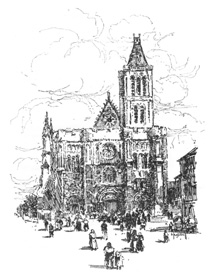
Cathedral of St. Denis. View larger image
We are first led past some mediæval tombs in the N. transept, then by those of the family of St. Louis, which include that of his eldest son, one of the most beautiful creations of thirteenth-century sculpture. Our own Henry III. who attended the funeral is figured among the mourners around the base which are only partially seen from afar. The monument to Louis XII. and his beloved and chère Bretonne, Anne, is next shown. It is in Italian style and was wrought by the Justes, a family of Tourraine sculptors. The Royal effigies are twice rendered: once naked in death under a tabernacle and again kneeling in prayer. Before we ascend the steps leading to the raised ambulatory, we are shown across the choir, and R. of the high altar, the fine thirteenth-century tomb of Dagobert, with some quaint reliefs, impossible to see in detail, illustrating his legend (p. 34) and a statue of Queen Nantilde also of the thirteenth century. Nor should we omit to note the two rare and beautiful twelfth-century statues, in the style of the Chartres sculpture, of a king and queen on either side of the portal of the N. transept brought from the church of Notre Dame de Corbeil. To our L. is a masterpiece of the French renaissance, the tomb by Lescot and Pilon of Henry II. and Catherine de' Medici, who are represented twice, as in the monument to Louis XII. We ascend the steps to the ambulatory and below, to our L., are summarily shown some important Valois tombs: Philippe de Valois, John II., Charles V. and others, by contemporary sculptors, such as Andrieu Beaunepveu and Pierre de Chelles—all of great interest to the traveller but utterly impossible of appreciation under the cursory glance permitted by the vergers. A second monument to Henry II. and Catherine, with recumbent and draped figures, is next indicated; Catherine is portrayed in her old age and rigid devotion. As we pace round the ambulatory we are shown some remains of twelfth-century stained glass in the choir chapels (that in the Lady Chapel including the figure of Abbot Suger,) and a modern representation of the Oriflamme to the L. of the high altar. Opposite the sacristy is a curious twelfth-century tomb from St. Germain des Prés, with the effigy of Queen Fredegonde outlined in mosaic and copper. We descend to the gloomy old crypt, with the curious Romanesque capitals of its columns, where now lie the remains of the later Bourbons. On returning to the church the tombs of Philip the Bold and Philip the Fair are shown, and to the L. the grandiose monument to Francis I., designed by Delorme, with five kneeling effigies: the king, Claude his queen, and their three children. The fine base reliefs represent the battles of Marignano and Cerisole. Then follows the beautiful urn executed by Pierre Bontemps, to contain the heart of the gran re Francesco. In conclusion, we are permitted to see the tombs of Louis of Orleans and of Valentine of Milan, early fifteenth-century, by a Milanese artist; and Charles of Etampes, an excellent work of the middle of the fourteenth-century. Before returning to Paris we should not omit to walk round the basilica and examine the sculptures of the portal of the N. transept, which have suffered less from iconoclasts and restorers.
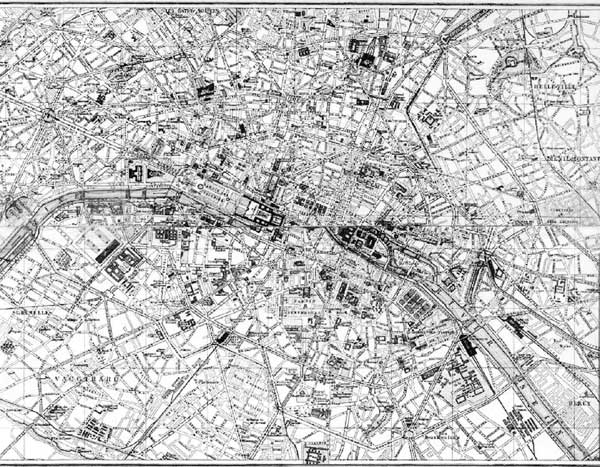
Map of Paris.
FOOTNOTES:
INDEX
A
Abbeys, their foundation and growth 30
Abbo, his story of the siege of Paris, 43-49
Abbots, their power and wealth, 39, 52
Abelard and Héloïse, 91-93; their tomb,93; and house, 305
Académie Française, 213
Acephali, the, 47, 49
Adam du Petit Pont, 94
Agincourt, 134
Aignan's, St., remains of, 305
Alcuin, 40
Alençon, Duke of, 177, 187
Amphitheatre, Roman, 13, 14, 332
Ancien Régime, the, 275, 280, 286
Anselm, story of, 58
Antheric, Bishop, 47, 48
Antoine, St., Abbey of, 79
Antoinette, Marie, note, [55], 249, 257, 265, 268, 311, 312
Aqueduct, Roman, 13, 208
Aquinas, 103, 104
Aristotle, study of, at Paris, 103
Armagnac, Count of, 134
Armagnacs, the, 134; massacre of, 136
Augustins, the Grands, 75
Austria, Anne of, 207, 212, 215, 217, 237
B
Bacon, Roger, 104
Bailly, 282
Balafré, le, 187
Bal des Ardents, 131
Barrère, 282
Barry, Mme. du, 248, 421
Bartholomew, St., massacre of, 175, 179-185
Basoche, the, 309
Bastille, the, 128, 146, 218, 261-264; column of, 291; site of, 406
Baths, Roman, 13, 17; public, note, [63]
Bazoches, Guy of, his impression of Paris, 69
Beauharnais, Mme. de, 282
Beaux Arts, École des, 318
Bedford, Duke of, note, [87];
Regent at Paris, 137; his death there, 140
Béguines, the, 79
Bellay, du, 169
Benvenuto da Imola, 104
Bernard, St., 58, 59, 61, 63, 89, 92
Bernini, 234, 235, 398
Bibliothèque Nationale, 222, 429; de l'Arsenal, 406
Billettes, cloister of, 410
Bishops, their power and patriotism, 30
Blancs Manteaux, church of, 133
Blancs Manteaux, the, 76, 142
Boccaccio, 417
Bonaventure, St., 78
Boniface VIII., Pope, 107-109,111
Boulevards, the, 238, 434-436
Bourbon, Hôtel de, 204, 233
Bretigny, treaty of, 125
Brunehaut, her career and death, 27-29
Brunswick, Duke of, his proclamation, 269
Bullant, Jean, 198
Burgundy, Duke of, 132; defeat of, 146
Buridan, note, [49], 313
Bursaries, foundation of, 97
Bussy, Island of, note , [78]
C
Cæsar, Julius, 11,13, 297
Café Corazza, 428
Café de Foy, 261, 427
Café de la Régence, 426, 427
Café Milles Colonnes, 428
Ça ira, origin of, 266
Calvin, 98, 164
Campan, Madame, Memoirs of, 248, 267
Capet, Hugh, 51
Capetians, rise of, 51
Cards, playing, renamed, 203
Carlovingians, their rise, 35
Carlyle, his history, 260, 268
Carmelites, the, 75, 316
Carrousel, the, 225; arch of, 291
Casaubon, Isaac, 202
Castile, Blanche of, 70, 96
Catholic Faith, restoration of, 286
Cellini, at Paris, 160, 163
Champ de Mars, 22, 261, 264, 433
Champeaux, William of, 63, 90, 94; market of, 63
Champs Élysées, 432
Chapelle, Sainte, the, 72, 86, 306-309
Charlemagne at St. Denis, 37; his love of learning, 40
Charles, the Bold, 41; the Fat, 47, 48; the Simple, 49
Charles V., completes Marcel's wall, 125; his success against English, 125; a great builder, 126
Charles VI., minority of, 128; narrow escape of, 131; his vengeance on the Parisians, 130; his madness, 131
Charles VII., 138; his wretched death, 144
Charles VIII, 151
Charles IX., 176; his pitiful death, 185
Charles X., 267
Charonne, 219
Charterhouse, the monks of, 75
Châtelet, the Grand, 44, 154, 408
Châtelet, the Petit, 152, 192, 408
Chaumette, note, [180]
Chelles, Jean de, 87
Chenier, Marie Joseph, 282
Childebert, 26
Chilperic III., 35
Choiseul, Duke of, 248
Cité, the, 11, note, [28], 37, 295
Clarence, Duke of, 138
Claude Lorrain, 224, 377
Clement V., Pope, 111
Clément, Jacques, 189, 190
Clergy, their wealth, 256
Clisson, Constable of, 129
Clootz, 282
Clotilde, 24, 26
Cloud, St., 27
Clovis, captures Paris, 21; stories of, 21, 24; conversion of, 24; makes Paris his capital, 26; Tower of, 331
Cluny, Hôtel de, 159; Museum of, 324-329
Colbert, 223, 234, 235, 237
Coligny, Admiral, 176; attempted assassination of, 178; his assassination, 181
Collège, de Cluny, 98; de France, 163, 329; des Jesuits, 105; des Lombards, 316; de Montaigu, 97; de Navarre, 97; de la Sorbonne, 96
Colleges, foundation of, 95-98
Comédie Française, 424-426"
Comines, De, 145, 148, 163
Commune, origin of, 17
Conciergerie, the, 120, 312
Concini, assassination of, 205
Condé, Prince of, 175, 176, 178, 183, 204, 209, 210
Condorcet, 282
Constance of Aquitaine, 54
Contrat, Social, the, 279, 280
Convention, the National, its constructive work, 275
Cordeliers, the, 76; club of, 324
Corneille, 224, 314
Cortona, Dom. da, 155, 159
Coryat, his impressions of Paris, 200-203
Cour du Dragon, 321; des Miracles, 421; de Rouen, 67
Crecy, 121,134
D
Dagobert the Great, 33, 34, 305
Damiens, 247
Dante, 59, 89, 103, 109, 159, 278
Danton, 273, 324
Dark Ages, the so-called, 88, 89
Da Vinci, 158, 354, 372
Debrosse, Solomon, 208
Deffand, Mme. du, 282
Denis, St., legends of, 15; Abbey of, 33; body of, exposed, 56; church of, 23, 84, 193; head of, 203; tombs at, 436-440
Desmoulins, Camille, 98, 213, 261, 324
Diamond necklace, the, 78
Dickens, at Paris, 416
Dionysius, 13, 15
Dolet, Étienne, 316
Dominic, St., at Paris, 76
Dominicans, the, 76
Dubois, Abbé, 242
Durham, Bishop of, his praise of Paris, 104
E
Ebles, Abbot, 44, 47
Edward IV., of England, 146
Egalité, Philip, 213, 272
Elizabeth, Queen, her crooked policy, 177
Eloy, St., 33; abbey of, 37, 60
Élysée, the, 433
Emigrés, the, 267, 268
Empire, the second, its fall, 287; changes under, at Paris, 292
Encyclopedists, the, 279, 281, 282
English Barons at Paris, 125
English, occupy Paris, 138; expelled from Paris, 143
Erasmus, 98, 163
Estampes, Mme. d', 162
Estiennes, the, 148-150
Estrées, Gabrielle d', 193, 195, 196, 216
Étienne du Mont, St., note, [58], 159, 331
Etoile, Arch of, l', 291
Eudes, Count, 44, 47, 48, 49
Eugene III., Pope, at Paris, 61
Eustache, St., church of, 159, 421
Evelyn, at Paris, 210, 275
F
Feudalism, rise of, 50, 52
Fioretti, the, note, [54]
Fontainebleau, school of, 160, 372
Francis I., 149, 156, 157; fixes hotel charges, note, [106]; his morbid piety, 166; and death, 169; Maison de, 433
Francis II., 175
Francis, St., 102
Franciscan Refectory, 322
Franciscans, the, 76
Franklin, Benjamin, 266, 282
Fredegonde, her career and death, 27-29
French art, its stubborn individuality, 159
French language, the, its universality, 102
Froissart, 300
Fronde, the, 218, 219
Fulbert, Canon, 91
Fulrad, Abbot, 38
G
Galerie, Grande, 198, 353
Galerie, Petite, 198, 250, 399
Galilée, Island of, 14
Gauls, their permanent traits, 3, 4
Genevieve, St., 22, 23, 47; church and abbey of, 23, 36, 61, 112, 254, 331
Germain, St., of Paris, 28, 30
Germain, St., des Prés, church and abbey of, 32, 36, 85, 89, 152, 319-321; abbot's palace of, 321
Germain, St., l'Auxerrois, 22, 30; church of, 32, 44, 423
Gervais, St., church of, 36, 402
Gibbon, 255, note, [173]
Giocondo, Fra, 155
Girondins, the, 311, 312
Goethe, 259, 269, 275, 436
Goldoni, 275
Gothic architecture, rise of, 53, 84-88; its development to Flamboyant style, 151
Goujon, Jean, 174, 337, 343, 399, 415; his death, note, [111]
Gozlin, Bishop, 43, 45, 46, 47
Greek first taught at Paris, 151
Gregory, St., 21, 28, 30, 31, 32
Greuze, 282, 384, 386
Guillaume de Nogaret, 113
Guillemites, the, 76
Guise, Cardinal of, 171
Guise, Duke of, 178, 180, 187 assassination of, 188
Guises, the, 171, 175, 176
H
Halle Aux Vins, the, 63
Halles, the, 69, 129, 146, 154, 422
Heine, his appreciation of Paris, 5; at the Louvre, 339
Helvetius, 282
Henry I., 56
Henry II., 171; his tragic death, 172
Henry III., 178, 186, 188; his assassination, 189
Henry V. of England, 136, 137
Henry VI. of England, 137, 141
Heretics, first execution of, 69
Holy Ghost, order of, 187, 326
Hôtel, d'Aumont, 403; de Beauvais, 403; de Bourbon, 154; Burgundy, 133; Carnavalet, 415; de Clisson, 412; Dieu, 37, 80, 81, 200, 297; Fieubert, 406; de Hollande, 414; de Lulli, 429; de Mayenne, 405; de Nesle, 68; Provost of Paris, 403; de Rohan, 414; St. Paul, 127, 133, 152; de Soubise, 412; de Sully, 416; des Tournelles, 146, 154; de Ville, 159, 199, 292, 400
Hugo, Victor, 7, 155, 255, 287, 310; house of, 416
Huguenots, the, 175, 176, 177, 179, 206, 228
I
Infanta, the, 244; garden of, 244, 250
Innocents, cemetery of the, 69, 155, 182, 417-420; fountain of, 417
Institut, the, 222
Invalides, the, 237
Iron Mask, Man of, 261, 405
Isabella of Bavaria, her welcome, 130; joins Jean sans Peur, 136
Italian art at Paris, 155, 159
J
Jacobins, the, 76; club of, 208
Jacquerie, the, 122
Jacques, St., de la Boucherie, 63, 154, 408
Jansenists, the, 231, 245, 247
Jean sans Peur, 131-136, 414, 420
Jeanne d'Arc wounded at siege of Paris, 139; her trial and rehabilitation, 140
Jefferson, Thomas, 265
Jesuits, the, 164, 198, 231, 245, 247, 248
John the Good, 118, 121, 125
Joinville, 81, note, [57]
Julian, the Emperor, 17; statue of, 18, 341; his love of Paris, 18
Julien le Pauvre, St., church of, 32, 37, 85, 99, 313
Justice, bed of, 216
L
Latin Quarter, the, 93, 99
Latini, Brunetto, note, [61]
Lavoisier, 282
Law, John, 242, 243
League, the, 187, 188, 191, 193
Lebrun, 215, 224, 235, 378, 379
Leczinska, Marie, 244, 249
Lemercier, Jacques, 210, 421
Lenoir, Alexandre, 335
Lescot, his work on the Louvre, 165, 173, 174
Lesueur, 75, 215, 373, 374
Levau, 215, 234
Lombard, Peter, 94
Londonne, Jocius de, 96
Lorraine, Cardinal of, assassinated, 189
Louis VI., the Lusty, 58, 62, 63
Louis, St., his youth, 70; affection for his mother, 70; conception of kingship, 71; popular justice, 71; piety, 72; love of stories, 72; the Jews and, 73, 74; founds library of Sainte Chapelle, 75; his rigid justice, 79, 81; death, 81; personal appearance and prowess, 83
Louis, St., island of, 214, 407; church of, 215
Louis XI. at Paris, 145, 146; his death, 148
Louis XII. returns taxes, 156
Louis XIII., 204, 205, 208
Louis XIV., 212, 215, 220; his court, 224, 225; hatred of Paris, 225; his "three queens" at the wars, 230; his death, 233
Louis XV., his majority, 243; popularity, 244, 246; death, 249
Louis XVI., 256, 257; trial and execution of, 271-273
Louis XVIII., 255
Louis Philippe, 287
Louviers, island of, 14, 240, 406
Louvois, 224
Louvre, the, 68, 126, 164, 173, 198, 210, 233-237, 250-252, 289-290, 333-336; Sculpture, ancient, 336-341; mediæval and renaissance, 341-346; modern, 346-350; Pictures, foreign schools, 350-368; French schools, 368-398; Persian and Egyptian art, 398-399
Loyola, Ignatius, 164
Lutetia, 11, 14, 18, 19
Luther, appeals to Paris, 104
Lutherans at Paris, 167, 169
Luxembourg, palace of, 208; museum of, 322; palace and gardens of, 322
Luxor, column of, 291
Luynes, Albert de, 205
M
Madeleine, Church of, 291
Maillart, Jean, 123
Maillotins, the, 129
Maintenon, Mme. de, 227, 228, 229, 231, 233
Maison aux Piliers, 122, 123, 130
Manége, Salle du, 271, 429
Mansard, François, 212, 237
Mansard, J.H., 226, 237
Marais, the, 15, 407
Marat, 255, 289, 324
Marcel, Étienne, 122-124
Marchands d'Eau, Provost of, 122
Margaret of Angoulême, 149
Marguerite of Valois, 176, 177, 181, 194, 195
Marly, 227, 230, 232
Marseillaises, the, 275
Martel, Charles, 35
Martin, St., legend of, 16
Martin, St., des Champs, 57, 86, 155, note, [231]
Maur des Fossés, St., note, [30], 60
Mayenne, Duke of, 192, 204
Mazarin, 213, 216, 219, 222; palais, 222, 429
Mazzini, 279
Médard, St., church of, 333
Medici, Catherine de', 173, 176, 180; her death, 189
Medici, Marie de', 195, 196, 204, 206, 207
Medici fountain, 322
Medicine, faculty of, 318
Merovingian dynasty, 26
Merri, St., church of, 159, 408
Mirabeau, 255, 267; funeral of, 422; the elder, 258
Mississippi bubble, the, 243
Molay, Jacques de, 111, 112, 113, 116
Molière, 224, 233
Monarchy, growing power of, 174; absolutism of, 220, 223
Monasteries, reform of, 60; suppression of, 284
Montereau, Pierre de, 57, 88
Montfaucon, 48; gallows of, 201
Montgomery, Count of, 172
Montjoie, St. Denis, war cry of, note, [82]
Montmartre, 15; abbey of, 65
Morris, Governor, 265
Morris, William, 88
N
Nantes, Edict of, revocation of, 228
Napoleon I., 276, 277, 278, 279, 281, 289, 290, 291, 426
Napoleon, Louis, 255, 287
Navarre, Charles of, 123
Navarre, Henry of, 178, 183, 189; his conversion and kingship, 193, 194; divorce, 193; assassination, 197; statue of, 208, 210
Navarre, Jeanne of, 176, 177
Nautæ, altar of, 17, 328
Necker, Mme., 282
Nemours, Duke of, execution of, 147
Nicholas, St., chapel of, 39, 72; church of, 251
Noces vermeilles, the, 177
Normans, the, 41, 49
Norwich, Canons of, 314
Notre Dame, church of, 32, 37, 72, 85, 107, 108, 116, 141, 142, 252, 298-305; de Lorette, 291; des Victoires, 206; island of, 14; Parvis of, 297
O
Odéon, theatre of the, 322
Opera, Italian, the, 233
Opera, the new, 293
Orders, the religious, 59
Oriflamme, the, 62, 440
Orleans, Duke of, 133; assassinated, 136;
Philip of, 212, 242
Orme, Philibert de l', 198
Ovens, public, 57
P
Paine, Thomas, 272
Palace of Archbishop of Sens, 407
Palais de Justice, 53, 118, 137, 152, 309-313
Palais Royal, 15, 212, 213, 217, 234; gardens of, 261, 427
Palissy, 199
Panthéon, the, 254, 330
Paris, her essential unity, 2; apprehension of coming changes, 4; intellectual culture, 5, 21; conquest by Romans, 12; origin of, 9-12; geographical position, 10-13; device of, 17; sacked by the Northmen, 41; siege of, by Northmen, 43; growth under Capets, 53; expansion under Louis VI., 63; evil smells at, 65; first paving of, 65; capital of intellectual world, 101; faubourgs wasted by English, 121, 124, 125; first library at, 126; occupied by English, 138, 143; life at, under English, 141-143; bridges of, 152; sieges of, by Henry of Navarre, 189, 191; sections of, their insurrection, 191, 192; its dirt, 202; misery at, 231, 241, 247, 256; a vast camp, 273, 274
Parisian democracy, its enlightenment, 7
Parisians, their responsive nature and love of order, 6; loss of liberties, 130; their loyalty and tolerance, 286
Parisii, the, 10, 11
Parlement, the, 118, 216-218, 220
Parloir aux Bourgeois, 122
Pascal, 231
Passion, Confrères de la, 420
Paul, St., charnel-houses, 405
Paul and Louis, SS., church of, 405
Peasantry, their condition, 260
Pepin the Short, 35
Père la Chaise, 220
Peronne, peace of, 146
Perrault, Charles, 235; Claude, 224, 235-236, 250
Petit, Nesle, the, 160
Philip I., 57
Philip Augustus, birth of, 64; his entry into Paris, 65; wall of, 65-68, 405, 407
Philip le Bel, 78, 100, 107, 117
Philip VI., 121
Pierre, St., church of, 15
Pierre aux Bœufs, St., church of, 63, 297
Pillory, the, 423
Place, Châtelet, 407; de la Concorde, 430-433; de Grève, 116, 146, 154, 168, 197, 400; Maubert, 169, 316; Royale, 186, 200, 207, 415, 416; Vendôme, 429
Plantes, Jardin des, 214
Poitiers, 121, 134; Diana of, 150, 173
Pol, St., Count of, 146
Pompadour, Mme., 215, 247
Pont, au Change, note, [11], 154, 200; de la Concorde, 264; Grand, 15, 70; Marie, 214; aux Meuniers, 200; Neuf, 210; Notre Dame, 155; aux Oiseaux, 200; Petit, 14, 70, 152, 155; Royal, 240
Ponzardus de Gysiaco, 113
Pope Paul III., his humane protest, 169
Port Royal, suppression of, 232
Porte, St. Antoine, 124; St. Denis, 123, 238; St. Jacques, 143; St. Martin, 238
Poussin, 234, 375-377
Prés aux Clercs, the, 100;
students at, 101
Printing, art of, at Paris, 148-150
Provost, of Marchands d'Eau, 17; suppressed, 130; royal, note, [14]
Puget, 224, 347
Punishments, cruelty of, during Renaissance, 168
Q
Quai, Des Augustins, 283; de la Mégisserie, 154
Quinze-Vingts, the, 78
R
Rabelais, note, [30], 98, 405
Racine, 224
Radegonde, St., note, [25]
Ravaillac, 197
Reason, temples of, 285, 286
Reformation, the, 174
Renaissance, architecture at Paris, 156
Republic, the second, 287
Republic, the third, 287, 292
Retz, de, Cardinal, 216, 219
Revolution, the great, its beneficent results, 288
Reynolds, 236, 361, 362, 377, 380
Richelieu, 205, 206, 208, 214
Robert the Pious, 53, 54, 55
Robespierre, 106, 260, 267, 426
Roch, St., church of, 429
Rohan, Cardinal of, 78
Rollo, 42, 49
Romilly, Sir S., his letters, 265
Ronsard, 337
Rousseau, J.J., 240, 255, 257, 281, 426
Royalty abolished, 270
Rue, des Anglais, 316; de l'Arbre Sec, 29, 423; des Archives, 410, 412; du Bac, 240; des Blancs Manteaux, 410; du Dante, 316; Étienne Marcel, 133, 420; de la Ferronnerie, 238, 417; du Fouarre, 103, 316; François Miron, 403; des Francs Bourgeois, 412; Guénégaud, 68; des Lombards, 154, 417; Montorgeuil, 421; Mouffetard, 333; des Petits Champs, 429; Quincampoix, 243; de Rivoli, 154; St. Antoine, 405; St. Denis, 407; St. Jacques, 13, 149, 283, 313; St. Martin, 15, 408; de Venise, 409; Vieille du Temple, 136, 414
Ruggieri column, 422, 423
Ruskin, 86, 375
S
Sacré Cœur, church of the, 293
Salisbury, John of, 94
Salons, the, 281
Samaritaine, la, 210
Sans-culottes, the, 274
Savoy, Adelaide of, 232
Saxony, Henry of, 47
Scholars, poor, at Paris, 94
Schools, rise of, at Paris, 90; elementary, 106
Scotus Duns, 78, 306
Sculpture, French, 87
Seigneurs, their lawlessness, 58
Sens, archbishop of, 61, 114, 116
September, massacres of, 270
Serfs, at Paris, 54
Sévérin, St., church of, 297, 314
Sévigné, Mme. de, 415
Sick, the care of in Middle Ages, 80
Siéyès, 281, 282
Siger, 103, 316
Signs, old, 283, 423
Simon, St., Duke of, 224, 232, 242
Sorbon, Robert of, 72, 96
Sorbonne, the, 292; chapel of, 329
Soufflot, 237, 252, 254
Staël, Mme. de, 282
States-General, the, 107, 122, 192, 204
Stephen, St., church of, 32, 85
Streets, renaming of, 283
Stuart, Marie, 175
Suger, Abbot, 62, 84
Sully, Duke of, 193, 196, 406
Sully, Maurice de, 85, 94
Sulpice, St., church of, 255, 321
T
Talleyrand, 265, 282
Talma, Julie, 282
Tasso, 405
Tellier, le, 231
Templars, destruction of, 109-118; fortress of, 117, 155
Terror, the, 260, 275; the White, 261
Thermidorians, the, 260
Thomas, St., of Canterbury, 94; church of, 95
Thorns, Crown of, redeemed by St. Louis, 71
Tiers État, the, 107
Tolbiac, battle of, 24
Torture, late use of in England, note, [75]
Tour de Nesle, 68
Trellises, island of, 117
Tribunal, revolutionary, 311
Trocadero, the, 292, note, [237]
Truce of God, the, 101
Tuileries, the, 154, 273; gardens of, 179, 430; palace of, 198; attack on, 269
Turenne, 219, 260
Twelve, the, 46, 47, 313
U
University, origin of the, 98 decadence of, 104; the modern, 329
Ursins, Mme. des, 229
V
Vaches, Isle des, 14
Val de Grâce, 237
Vallière, Mme. de la, 212, 226
Valois, House of, 121
Varennes, flight to, 267
Vauban, 224
Vendôme, Duke of, 230; column of, 291, 430; place, 240
Venetian merchants at Paris, 40
Vergniaud, 272, 282
Versailles, 226, 230
Victoires, Place des, 240
Victor, St., abbey of, 61
Villon, François, note, [49], 94, 330
Vincennes, chapel of, 128
Vincent, St., 36; de Paul, church of, 291
Viollet le Duc, 80, 292
Volney, 282
Voltaire, 215, 223, 244, 255, 258, 281, 426
W
Wall, Gallo-Roman, 16, 36; of Philip-Augustus, 66, 68, 233, 330; of Marcel, 123; of Charles V., 128
Wars, religious, 175
Watch, the royal, 81
Willoughby, Lord, 143
Workmen, compensation of; by Charles V., 127
PRINTED IN GREAT BRITAIN BY RICHARD CLAY & SONS, LIMITED, BRUNSWICK ST., STAMFORD ST., S.E. 1, AND BUNGAY, SUFFOLK.
The Mediæval Town Series
ASSISI.* By Lina Duff Gordon. [4th Edition.
BRUGES.† By Ernest Gilliat-Smith. [3rd Edition.
BRUSSELS.† By Ernest Gilliat-Smith.
CAIRO.† By Stanley Lane-Poole. [2nd Edition.
CAMBRIDGE.† By Charles W. Stubbs, D.D.
CHARTRES.† By Cecil Headlam.
CONSTANTINOPLE.* By William H. Hutton. [2nd Edition.
EDINBURGH.† By Oliphant Smeaton.
FERRARA.† By Ella Noyes.
FLORENCE.† By Edmund G. Gardner. [8th Edition.
LONDON.† By Henry B. Wheatley. [2nd Edition.
MOSCOW.* By Wirt Gerrare. [2nd Edition.
NUREMBERG.* By Cecil Headlam. [4th Edition.
PARIS.† By Thomas Okey.
PERUGIA.* By Margaret Symonds and Lina Duff Gordon. [5th Edition.
PRAGUE.* By Count Lutzow.
ROME.† By Norwood Young. [4th Edition.
ROUEN.† By Theodore A. Cook. [3rd Edition.
SEVILLE.† By Walter M. Gallichan.
SIENA.† By Edmund G. Gardner. [2nd Edition.
TOLEDO.* By Hannah Lynch. [2nd Edition.
VERONA.† By Alethea Wiel. [2nd Edition.
VENICE.† By Thomas Okey.
The prices of these(*) are 3s. 6d. net in cloth, 4s. 6d. net in leather; these(†) 4s. 6d. net in cloth, 5s. 6d. net in leather.