Chapter XXXV
Reading edition
THE BEGINNING OF THE VOYAGE
AT FIRST the three fugitives—the young lady and Jack and Dred—sailed away in silence. The wind blew swiftly, and the dark, silent shores seemed to slide away strangely and mysteriously behind them. As they ran out into the broad, misty waters of the greater river, the distorted half-moon was just rising from a bank of clouds in the east, and a sort of obscure light lit up everything indistinctly. The wind was blowing fresh and cool, and as the boat came further and further out into the wider waters it began to pitch and dance. “About!” called Dred, and, as he put down the tiller and drew in the sheet, hand over hand, the sail flapping and fluttering, Jack and the young lady crouched, and the boom came swinging over. The boat heeled over upon the other course, and then drove forward swiftly with a white splash of loud water at the bow, and a long misty wake trailing behind, flashing every now and then with a sudden dull sparkle of pallid phosphorescence.
Neither Jack nor Dred had spoken anything to the young lady since they had left the wharf behind, and she sat silent and motionless in the stern where they had placed her. Jack had gone forward to raise the peak a little higher. As he came back, stepping over the thwarts, he looked at her; her face shone faint and pallid in the moonlight, and he saw her shudder. “Why, mistress,” he said, “you are shivering—are you cold?”
f272
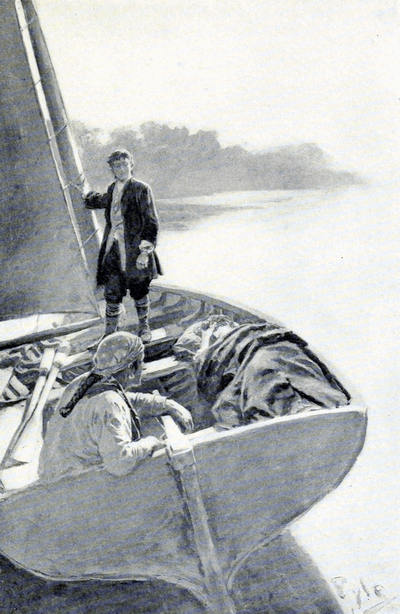
JACK AND DRED RESCUE ELEANOR—THE START.
“No, I’m not cold,” said she, in a hoarse, dry voice. And then, for the first time, Jack noticed the sparkle of tears upon her cheeks. Dred was looking at her, and perhaps saw the tears at the same time.
“Here,” said he, suddenly, “put on this overcoat; ‘twill make you more comfortable.” She protested feebly, but Dred and Jack persisted, and Jack held the coat for her as she slipped her arms into it.
“There’s a scarf in the traveling-bag yonder,” she said. “If you’ll let me have it I’ll put it on.”
Jack reached the bag to her, and she placed it upon the seat beside her and opened it, turning over the clothes until she found what she wanted. Then she wrapped the scarf around her head, tying it in beneath her chin. She felt in her pocket for her handkerchief and wiped her eyes. “How long will it take us to get back to Virginia?” she asked.
Jack looked at Dred. “Why, I don’t know,” said Dred. “Maybe not more’n a week.”
“A week!” she repeated.
“Why, yes. Perhaps not that long, though,” he added, “if the weather holds good, and we’re not stopped any place.” No one said anything for a while, and the boat plunged swiftly on, the waves, every now and then clapping against the bow, sending a dash of spray astern, and the water gurgling away noisily behind. Suddenly Dred turned toward the young lady again. “You must be tired,” he said. “I know very well you must be tired.”
“No, I’m not very tired,” said she, faintly.
“Why, mistress, I know you must be tired from the sound of your voice. Here, lad”—to Jack—“you take the tiller while I see if I can make her comfortable. Now, then,” he said, as he turned to her, “you lie down there with your head on this here bundle, and I’ll cover you over.”
She obeyed him silently, and he covered her over with the second overcoat, tucking it in under her feet. “I’ll never forget what you are doing for me, as long as I live,” she said. “I—” her lips moved, but she could not say anything more.
“That’s all very well, mistress,” said Dred, gruffly. “Never you mind that, just now.”
Jack looked long and fixedly at the young lady’s face, pallid in the growing moonlight which sparkled in her dark eyes; she looked singularly beautiful in the white light. “Where be ye going?” called out Dred, suddenly. “Keep to your course!” And then he came back to himself and the things about him with a start, to find the yawl falling off to the wind. Then once more Dred settled himself in his place, relieving Jack of the tiller. Presently he took out his tobacco-pipe and filled it. He struck the fire with the flint and steel, holding the tiller under his arm as he did so. Then he lit his pipe, puffing hard at it for a while. The wind blew the young lady’s hair across her face and she raised her hand to put it back. Jack half lay upon the bench opposite, resting upon his elbow, his cheek upon his hand.
“D’ye see,” said Dred, beginning abruptly with the thoughts in his mind, and without any preface, “according to what I calculate they won’t be able to folly us afore late to-morrow morning. ‘Twill take ‘em some time to get a crew together to man the sloop, and it may be ten o’clock afore they gets away. In course, arter they do have her manned they’ll overhaul us fast enough; but if we have so much start as we’re like to have, why, ’tis like we’ll keep our lead till we get up into the Sound.” Jack listened, saying nothing. In spite of himself he was dozing off every now and then, and awakening with a start. As Dred talked to him, the words came distantly to his ears. “D’ye see,” said Dred, after puffing away at his pipe for a while in silence—and once more Jack aroused from the doze with a start at the sound of his voice—“D’ye see, what we’ll have to do’ll be to sail up into Albemarle Sound, past Roanoke Island and so into Currituck Sound. The waters there be shoal, and even if the sloop should folly us we can keep out of her way, maybe, over the shallows. Old Currituck Inlet—if’t is anything like I used to know it three year ago—is so as we can get over it at high tide in the north channel; that is, we may if the bar ain’t closed it yet. The sloop can’t folly through the inlet; she draws too much water for that, and if we once get there, d’ye see, we’re safe enough from all chase. Contrarywise, if they run down to Ocracock, thinking we took that way—what with running so far down into the Sound and we having the gain on ‘em of so much start, they’d have as poor chance as ever you saw in your life to overhaul us afore we gets inside of Cape Henry. D’ye understand?”
Again Jack had dropped off into a dim sleep; at the last question he awoke with a start. “What did you say, Dred?” he asked; “I didn’t hear the last part.”
Dred looked keenly at him for a moment or two; then he took the pipe out of his mouth and puffed out a cloud of smoke. “Well,” he said, “it don’t matter no way. You lay down and go to sleep.”
“No, I won’t,” said Jack. “I’ll just rest this way.” He was lying upon the thwart, his head propped upon his arm. He tried to stay awake, but presently he began again dozing off, waking every now and then to find Dred steadily at the helm, and the young lady lying motionlessly opposite to him. At last he fell fairly asleep and began dreaming.
When he awoke again he found the day had broken, although the sun had not yet risen. They were running down about a quarter of a mile from the shore. A dark, dense fringe of pine forest grew close to the water’s edge. The breeze was falling away with the coming of the day, and the boat was sailing slowly, hardly careening at all to the wind.
Jack sat up, looking about him, and then at the young lady, and there his gaze rested. She looked very white and wan, but she was sleeping deeply and peacefully, her eyelids closed, and the long, dark lashes resting softly on her cheek. Dred followed Jack’s look, and there his eyes rested also. As Jack moved, stretching his stiffened arms, Dred put his finger to his lips and Jack nodded.
About a half a league over the bow of the boat Jack could see the wide mouth of a tributary inlet to the Sound. He slid along the seat toward Dred. “What water is that over there?” he whispered.
“That’s the mouth of the Pungo,” said Dred. “I’m a-going to run ashore at the p’int, and I hope the wind’ll hold to reach it. There’s a lookout tree there, and I want to take a sight to see if there’s any sign of a chase. I don’t know as we’ll get there without oars, though,” he said, “for the wind’s dying down. I tell you what ’tis, lad, you’d better whistle your best for a breeze; for just now ’tis worth gold and silver to us, for the furder we reaches now, the safer we’ll be. By and by, about this time, they’ll be stirring at home to find we’ve gone. If we’d have to lay at the p’int yonder all day, ‘twill give ‘em a chance to man the sloop and be down on us. As like as not they’ll be getting a slant o’ wind afore we do, if it comes out from the west, as ’tis like to do.”
Jack looked over the edge of the boat and down into the brackish water, clear but brown with juniper stain. It seemed to him that the yawl barely crept along. “At this rate,” said Dred, “we’re not making two knot an hour.”
The sun rose round and red over the tops of the trees of the distant further shore, and the breeze grew lighter and lighter. Every now and then the sail, which lay almost flat, began to flutter. Presently the boom swayed inward a little, and as it did so a level shaft of light fell across the young lady’s face. She moved her hand feebly over her face; then she opened her eyes. Jack and Dred were gazing at her as she did so. First there was a blank look of newly awakened life in her face, then bewilderment, then a light of dawning consciousness. Then she sat up suddenly. “Where am I?” she said, looking about her, dazed and bewildered.
“You’re safe enough so far, Mistress,” said Dred; “and I’m glad you’re awake, for’t is high time we was taking to the oars. An ash breeze is all we’ll be like to have for a while now.” He gave the tiller a quick jerk or two. “Come, Jack,” said he; “I’ll make out well enough to do the sailing, but’t is you’ll have to take to the oars.”
“Very well,” said Jack; “that suits me well enough.”
He drew out the oars, clattering, and dropped them into the rowlocks. Then he shot a quick glance over the bow, spat on his hands, and gripped the oars. As he began rowing, the sail swung in over the boat, and Dred steadied it with one hand, holding the tiller with the other. He laid the bow of the boat for a little cypress-tree that stood out beyond the tip of the point in the water. Jack rowed and rowed, and the shore drew foot by foot nearer and nearer; and presently they went slowly around the point into a little inlet or bay sheltered by the woods that stretched out like arms on either side. Then the bow of the boat grated upon the sand, and Dred arose from where he sat. “Here we be,” he said, stretching himself.
Fronting upon the beach was a little sandy bluff three or four feet high, and beyond that stretched away the pine forest, the trees—their giant trunks silver-gray with resin—opening long, level vistas into the woods carpeted with a soft mat of brown needles. “We’ll go ashore here a bit,” said Dred; “you come along o’ me, Jack, and we’ll go down to the p’int to the lookout tree. Don’t you be afraid if we leave you a little while, mistress; we’ll be back afore long.”
“I would like to get out of the boat for a little while too,” she said, “for I’m mightily tired.”
“To be sure you be,” said Dred. “Come, Jack, lend a hand to help her young ladyship ashore.”
They spread out one of the overcoats upon the sand, and made her as comfortable as they could. The sun, which had now risen above the tops of the trees, shone warm and strong across the broad, level stretch of smooth water. The young lady sat gazing away into the distance. “We’ll be back again soon,” said Dred. “Come along, Jack.” She looked toward them and smiled, but made no other reply.
“Methinks she appears better already,” said Jack, as he and Dred walked away together.
“Ay,” said Dred, briefly.
They walked down along the sandy shore for some little distance, and then cut across a little narrow neck of land to the river shore upon the other side. A great, single pine-tree stood towering above the lower growth, and there were cleats nailed to the trunk, leading from the earth to the high branches above. “Here we be,” said Dred; “and now for a sight astern.” He laid aside his coat, and then began ascending the tree by means of the cleats. Jack watched him as he climbed higher and higher until he reached the roof-like spread of branches far overhead. There he flung one leg over the topmost cleat, and, holding fast to the limb, sat looking steadily out toward the westward, his shirt gleaming white among the branches against the sky of the zenith. He remained there for a long time, and then Jack saw him climbing down again. He brushed his hands smartly together as he leaped to the ground, and then put on his coat.
“Well,” said Jack, “did you see anything?”
“No,” said Dred, “I didn’t. ’Tis a trifle thick and hazy-like—d’ye see? But so far as I could make out, there ain’t no chase in sight yet awhile.”
The young girl, when they returned, was walking up and down the beach. She hesitated when she saw them, then came a lingering step or two to meet them, and then stood waiting.
“I see naught so far, mistress,” said Dred, when they had come up to her; “so far as I see we’re safe from chase.”
“You are very good to me,” she said. “I was just thinking how kind you are to me.” She looked from one to the other as she spoke, and her eyes filled with tears. Jack looked sheepish at the sight of her emotion, and Dred touched his forehead with his thumb, with rather an abashed salute. They stood for a moment as though not knowing what to say.
“Well, lad,” said Dred, in a loud, almost boisterous voice, making a pretended feint as though to strike at Jack as he spoke, “’tis time to be off again with an ash breeze, seeing as no other don’t come up for to help us. Every mile we make now, d’ye see, is worth ten furder on. As for a bite to eat, why, we’ll just have to take that as we goes along. Come, mistress, get aboard, and we’ll push off.” He helped the young lady into the boat, and then he and Jack pushed it off, Jack running through the water and jumping aboard with a soaking splash of his wet feet.