Chapter XXIII
Reading edition
A MEETING
BULLOCK’S LANDING, the settlement of which Jack had spoken, was a little cluster of poor frame houses on the other side of the wide river from the Roost. You could see it easily enough from the high bluff bank, but not what sort or condition of houses they were. But there were people living there, for now and then boats stopped at the little straggling landing. Jack’s first plan was to cross the river to this place. From there he thought he might be able to find some road through the woods to North Carolina. Or if he were not pursued he might find a chance to work a passage down to Norfolk, and thence, perhaps, to England. Anyhow, the first thing was to get away from the Roost, and Bullock’s Landing was the nearest habitable place. He remembered now that a sloop had been lying there for two days. If it had not left, maybe he could work a passage in it down to Norfolk.
He rowed steadily away into the river, and in a little while the shore he had left behind him disappeared into the darkness of night. All around him was the lapping, splashing water of the river. He guided his course by the stars, still pulling away steadily. His mind drifted aimlessly as he rowed, touching a dozen different points of thought that had nothing to do with his present trouble. Now and then he wondered what he would do when he reached the further shore; but generally he let his thoughts drift as they chose. He planned indefinitely to himself that, when he got to the further shore, where, no doubt, he would find somebody awake, he would, in the morning, go aboard of the sloop and ask the master or captain to let him work his passage to Norfolk. Or, if the captain of the sloop should seem to show any signs of dealing dishonestly with him, and if there appeared to be any danger of his being kidnapped again, he would try to get away into the interior of the country. He could very easily beg his way from house to house until he reached North Carolina. There was a splash in the water, very loud in the stillness—it sounded like a fish. It startled Jack for a moment, and he lay on his oars, listening breathlessly. Presently he began rowing again. He did not doubt that he could easily escape, if need be, into North Carolina. Plenty of people had escaped thus from the plantations, and he was sure he could do the same.
So his scattered thoughts drifted as he continued rowing with almost instinctive regularity. Every now and then he stopped to rest himself for a little while, and then the breathless silence would brood over him, broken only by the ceaseless lap and gurgle and splash of the water all around him.
It was an hour or more before he came to the further shore of the river. At the point which he reached there was nothing to be seen but the black pine forest coming down close to the water’s edge, and two stunted cypress trees that stood out in the stream. In the darkness of the night he could not tell whether the settlement to which he was directing his course lay above or below the point he had reached. The woods brooded dark and still. Millions of fireflies spangled its blackness with quick pulsing sparkles of light, and a multitudinous whisper and murmur of woodland life breathed out from the dark, mysterious depths. He unshipped his oars, rattling loudly in the dark stillness, and stood up in the boat, looking first up the stream and then down, then up again. He thought he saw a dim outline that looked like a group of houses and the sloop far away up the river, and then he sat down, replaced the oars, and began rowing up the shore.
It was the sloop he had seen. Gradually it came out more and more defined from the obscurity. Then he could see the outline of the long, narrow landing. There were signs of life about the sloop, and up on the shore. The door of one of the houses stood open, and there was a light within. By and by he could hear the noise of laughing and singing and of boisterous voices coming from it. As he came nearer and nearer to the landing some one suddenly hailed him through the night. “Ahoy! Who’s that? Who be ye?” He did not reply, but rowed up under the wharf and lashed the dug-out to one of the piles. Three or four men came over across the wharf from the sloop, one of them carrying a lantern. They stood looking down at him as he made the boat fast. Then he climbed up to the wharf. The man with the lantern thrust it close to his face, and almost instantly a voice, very familiar to his ears, called out: “Why, Jack, is that you? What are you doing here?”
Jack looked up and, in the dim light of the lantern, saw who it was. It was Christian Dred. “Why, Dred,” he cried out, “is that you? What are you doing here?”
“That’s what I axed you,” said Dred. “What be you doing here at this time of night.”
“I’ll tell you,” said Jack. “I’ve been treated badly, and I’m running away from my master, Dred. He used me mightily ill, and I had either to run away or to be whipped to-morrow. But, O Dred, I’m glad to find you here, for I didn’t know what I was to do without a friend to help me.” For suddenly the joy and relief of having thus unexpectedly found his friend began to grow so big in Jack’s soul that he could hardly save himself from breaking down before them all. Every instant the wonder of it grew bigger and bigger within him—the wonder that he should so have met Dred face to face in the boundless spaces of the new world—thus at midnight in the wild depths of the Virginias. Then he heard Dred asking, “Who was your master?”
“My master?—His name was Richard Parker,” Jack answered.
“But, O Dred; how is it you were to be here? ’Tis the wonderfullest thing I ever heard tell of.”
Dred burst out laughing, “I’ll tell ye that by and by,” he said. A little crowd had gathered about him by this time, and more were coming over from the sloop, aboard of which there seemed to be a great many men. They crowded closely about, listening curiously to what was said. “But Richard Parker!” said Dred. “Was then Mr. Richard Parker your master? Why, he was here this very arternoon. He and the captain are great friends. Why, the captain came up here just to see Mr. Richard Parker, and that’s why I be here, too.”
Jack, as he looked about him at the faces dim in the lantern-light, wondered dumbly who the captain was, but he was too bewildered and confused to think with any sharpness or keenness of intelligence.
“What are you going to do now?” asked Dred.
“I don’t know,” said Jack. “I thought maybe I might work a passage to Norfolk in this sloop, for I’d seen it yesterday from t’other side of the river and remembered it when I ran away. If I couldn’t do that I was going to try to get down into North Carolina, afoot. What is this sloop, Dred?”
Dred took Jack by the arm. “Never mind that, now,” he said, “you come along with me. I’ll be back again in a trifle or so, Miller,” he said to the man who carried the lantern. Then he pushed his way through the group that had surrounded them, and led Jack along the landing toward the shore. Suddenly as they walked along together he spoke. “Look ‘ee,” he said, “did you ever hear of Blackbeard the Pirate?”
“Yes,” said Jack, “I have, and that not a few times.”
“Well, then,” said Dred, “I’m going to take you to him now. He’s the captain, and if ye wants to get away from your master, the only thing I can do for to help you is to get the captain to take ye along of us. Arter you left the Arundel I disarted and ran away to North Caroliny ag’in, and so here I be now. You’ll have to join with us if you want to get away, and that’s all I can do for you. Will you do that?”
“Indeed I will,” cried Jack. “I’m glad enough to get away to be willing to go anywhere. And then, do you see, you’ll be along, Dred.”
Dred was still holding him by the arm, and he gave it a squeeze. “Well then, we’ll just go up to Bullock’s and have a talk with the captain about it,” he said.
They had left the landing by now and were ascending a little rise of ground to the house, the door of which stood open, and from which was coming the sound of loud voices, and now and then a burst of laughter. Dred, still holding Jack by the arm, led him up to the door of the house and into it. It seemed to be a sort of store, or drinking-house—a wide, barrack, shed-like place. There was a kind of bench or counter, some shelves seemingly empty, and two or three barrels, apparently of spirits. It was reeking hot, and full of men who were drinking and talking with loud voices. Some of the men had the appearance of being planters or settlers; others looked like sailors.
Dred, still holding Jack by the arm, looked around for a brief moment, then he elbowed his way through the crowd toward the other end of the room, almost dragging Jack with him. “Who have you got there, Dred?”—“Who’s that, Dred?” was asked by a dozen voices as Dred pushed his way up the length of the room. Dred did not reply; he led Jack up to a man who sat upon a barrel, swinging one leg and holding a glass of spirits in the hand that rested upon his knee.
Jack knew the man as soon as he saw him. It was the stranger who had twice come to the Roost. He was still dressed in the sort of sailor dress in which Jack had last seen him, and his beard was plaited into three plaits that hung down and over his breast. Jack saw that he had been drinking, perhaps a great deal. He did not move, except to raise his eyes sullenly as Dred led Jack up to him. “Captain,” said Dred, “this young man’s just come ashore down at the wharf. I know him very well, seeing as how he came over from England with me and that we was, so to say, messmates. He’s run away from his master, and says he’d like to ‘list with us. He’s a good, able-bodied lad, and very willing too.”
“Don’t you come from Mr. Parker’s?” said the captain, in his hoarse, husky voice.
“Yes, I do,” said Jack. “He was going to have me whipped, and I ran away from him.”
“I thought I knew your face,” said the pirate. “And so you’re running away, are you? And he was going to beat you, was he? Well, I dare say you deserved it. What were you doing to have him beat you?”
The strange, shaggy crowd pressed up close around them, and Jack gazed about him at the half-drunken faces. “I was doing naught to be whipped for,” he said. “I went away with the overseer, and while I was gone Mr. Parker came back. He tried to whip me with a riding-whip, and while I was keeping him off he fell down. He was going to have me beaten for that to-morrow, and so I ran away.”
The pirate captain stared at him for a little while of gloomy silence, shaking his head slowly from side to side the while. “Well, then,” he said, “Mr. Parker and I are very good friends, and I don’t choose to help his servants to run away from him. So I’ll just make across to his place to-morrow, and drop you on our way up the river.”
Jack saw that the pirate was not sober, and he turned to look to Dred. Dred had let go his hold upon Jack’s arm; now he leaned over toward the pirate captain, and began whispering in his ear, the other listening gloomily and sullenly, and Jack watching them both with an anxious intentness. “Well, I can’t help that,” the pirate said aloud to something that Dred urged; and he raised his elbow and tried to push the other away. Dred leaned forward to whisper some last words as the other thrust him off. “I wish you wouldn’t come here troubling me this way, Chris Dred,” he said. “I don’t care anything about the fellow, he won’t be any use to me. Well, then, take him aboard if you choose, and I’ll think about it to-morrow morning. Now you go back to the sloop. You shouldn’t ha’ left it, as ’tis.”
Again Dred took Jack by the arm. “Come along, Jack,” he said, “’tis all right now.”
“But he said he was going to send me back,” said Jack, as they made their way back through the room, and toward the open air.
“Oh, that’s all very well; he won’t send you back; you just set your mind at rest on that. I know him as well as I know my own hand. He’s give in so far now, he won’t send you back.” Then, as they came out of doors once more—“Lord!” drawing a deep breath, “but it do feel good to get a breath of fresh air.”
“Tell me,” said Jack, as they walked down to the wharf together, “was that Blackbeard?”
f174
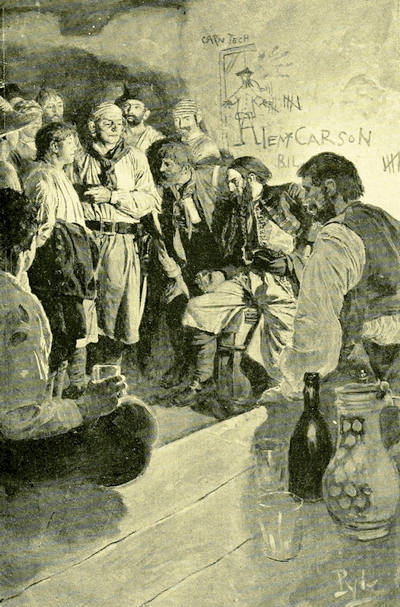
“HE LED JACK UP TO THE MAN WHO SAT UPON A BARREL.”
“Ay,” said Dred, “that’s what they call him hereabouts.”
“Why, then,” said Jack, “I’ve seen him before. He was over to the Roost twice in the last two weeks, but I never thought ’twas Blackbeard.”
When, after a deep and profound sleep, Jack awoke almost at the dawn of the following day, he looked about him, at first not knowing just where he was. The hold of the sloop was full of the forms of sleeping men huddled into groups and clusters. The air was heavy and oppressive. He sat for a while staring about him, then suddenly he remembered everything—his surroundings, and how he had fallen asleep there the night before. He roused himself and, stepping cautiously over the sleeping forms without disturbing them, climbed up the ladder to the deck above.
A thick fog had arisen during the night, and everything was shrouded in an impenetrable mist that drifted in great clouds across the deck. The ropes and sheets were wet and fuzzy with the moisture that had settled upon them, and the sails looked heavy and sodden with dampness, the decks and the two boats hanging from the davits wet and shining with moisture. Two or three of the crew were upon watch in the early morning. One of them, his hair and woolen cap white with particles of the drifting mist, lay stretched upon the top of the galley deck-house, a carbine lying beside him. He was smoking his pipe, a faint, blue thread of smoke rising into the mist-laden air. He raised himself upon his elbow and stared at Jack as he came up on deck. The cook, who was also awake, was busy in the galley, and every now and then the clatter of pans sounded loud in the damp silence. A cloud of smoke from the newly-lighted galley fire rolled in great volume out of the stovepipe and drifted slowly across the deck and through the ratlines. In the brightening light Jack could see more of his surroundings. There was a large cannon in the bow of the sloop, partly covered with a tarpaulin, and there were two carronades amidships. The sloop still lay lashed to the end of the wharf. The shore was hidden in the fog, which opened now and then, just showing a dim, fleeting, misty outline which, the next moment, would be again lost in the drifting cloud.
A figure, dim and white in the distance, stood looking over the stern down into the water. It was very familiar to Jack, and then presently it turned toward him and he saw it was Christian Dred. As soon as Dred saw Jack he came directly forward to where he was. “Well,” he said, catching him by the arm and shaking it, “here we be together again, hey?”
Jack laughed, and then he asked, “Are you sure he—Captain Teach—won’t send me back to Mr. Parker again?”
“Why, no,” said Dred, “in course he won’t. That was only his talk last night while he was in his drink. He don’t care nothing for Mr. Parker, and he won’t bother to send you back again. Just you rest your mind easy on that, Jack. If I’d thought there was any chance of his sending you back there, I wouldn’t ‘a’ kept you aboard here, last night, and you may be sure of that. But ’tis mightily queer, Jack, to think that Mr. Parker was only with us yesterday art’noon, and here you comes and finds your way aboard in the night. What did you come over here for, anyhow?”
As Jack stood, giving Dred a brief account of his adventures and of his plans of escape, the signs of awakening life began gradually to show aboard the sloop. The men were coming up from below, and after a while the captain himself came up on deck, from the cabin aft. He stood for a while, his head just showing above the companion-way, looking about him with eyes heavy and bleared with sleep. Then he came slowly up on deck. He beckoned to one of the men—a negro—who ran in his bare feet and hauled up a pail of water from alongside. Jack, from a distance, watched the pirate captain as he washed his face in the water, puffing and splashing and spluttering, rubbing it into his shaggy hair. Then he fished out a yellow and greasy comb from his pocket, and, with a great deal of care, parted his hair in the middle and smoothed it down on either side. Then he began plaiting the two locks at his temples, looking about him all the while with his heavy lowering gaze. Presently his eyes fell upon Jack. “Come here,” he said, without stopping his toilet, and Jack came forward and stood before him. “What’s your name?” he asked. He had finished plaiting the first long, thin lock, and was winding a bit of string around it.
“Jack Ballister.”
“You waited on Mr. Dick Parker, didn’t you?”
“Yes, sir,” said Jack.
“Well, d’ye think you could wait on a gentlewoman?”
“I don’t know,” said Jack; “I believe I could.”
“Well, I expect a lady aboard here, maybe to-night, and it may be I’ll call on you to wait upon her now and then. D’ye think ye could?”
“I believe I could,” said Jack.
“Very well, that will do now. You can go.”
The sound of hissing and sizzling was coming from the galley, and as Jack went forward again, the air was full of the smell of cooking pork.
During the early part of the morning a rude cart drawn by two oxen came out along the wharf. It was driven by a negro, and two men with carbines over their shoulders marched beside it. There were two barrels full of fresh water in the cart, and a half dozen of the crew presently rolled them aboard the sloop.
A breeze had come up as the sun rose higher, and in an hour or more—it was about the middle of the morning—the fog began to drift away in bright yellow clouds, through which the disk of the sun shone thin and watery. Now and then the outline of the houses on the shore stood out faint and dim; they looked very different to Jack in the wide light of day. Then the sun burst out in a sudden bright, hot gleam. The pirate captain had gone below, but Dred and the sailing-master, Hands, were on deck. The boatswain’s whistle trilled shrilly, and the great patched, dingy mainsail, flapping and bellying sluggishly, rose slowly with the yo-hoing of the sailors and the creaking of block and tackle. The lines were cast loose, Dred standing directing the men as they pushed the sloop off with the sweeps. Some of the settlers had come down to the shore, and stood watching. “All away!” called Dred, and Hands spun the wheel around. The sloop fell slowly off, the sail filling out smooth and round. The men on the wharf shouted an adieu, and two or three of the men aboard the sloop replied, and then they were out in the wide expanse of the river.