Chapter XVI
Reading edition
JACK’S MASTER IN THE TOILS
JACK had been living nearly a month at the Roost before he saw anything of those money troubles that so beset and harassed his master. He was afterward to learn how fierce and truculent Mr. Parker could become at those times when he was more than usually tormented by his creditors.
It was about noon, and Jack was busy getting ready the clothes that his master was to wear for the morning. There had been company at the Roost the night before, and Mr. Parker, who had sat up till past midnight, and who had only just risen, sat at the open window in his nightcap and dressing-gown, with his half-eaten breakfast beside him, smoking a long pipe of tobacco out into the warm, soft air.
Suddenly there came the sound of horses’ hoofs approaching from the distance, and then the opening of the gate. Mr. Parker craned his neck and peeped out of the window cautiously. Immediately he laid down his pipe of tobacco, and turning to Jack,—“Harkee,” said he, in a voice instinctively lowered, “yonder is a man coming whom I don’t choose to see, so you just go down and tell him I’m not at home, and that I won’t be back till next Thursday; d’ ye understand?” Jack nodded his head. “Well, then, do as I tell you, and don’t you let him guess I’m at home.”
Even as the master spoke there came a loud knocking at the door. Jack ran down-stairs and through the hall, and opened it before any of the slower negroes could reach it. There were two men outside, one of them held a pair of horses, and the other had just knocked. The man with the horses had the look of a servant. The other was a lean, wizened fellow with smoothly brushed hair tied behind with a bit of string, a flapped hat, and a long-skirted gray coat—he looked like an attorney or a money-lender. “Well, master,” said Jack, “and what’ll you have?”
“I want to see your master,” said the man shortly.
“Who?” said Jack.
“Your master.”
“My master?”
“Yes; what’s the matter with the oaf? Where’s your master? Why don’t ye answer me and tell me whether Mr. Parker is at home.”
“Oh, Mr. Parker! So ’tis him you wish to see, to be sure.”
But, after all, Jack did not have to tell the lie Mr. Parker had bidden him to tell. A voice suddenly sounded from overhead—a keen, shrill voice. “What d’ye want, Master Binderly? Who d’ye come to see?”
The man at the door stepped back a pace or two and looked up, and Jack craned forward and looked up also. Mrs. Pitcher was leaning out of the window just above their heads. She wore a morning wrapper, and a cap very much the worse for wear, which gave her a singularly frowsy, tousled appearance.
“Why, you know what I want, Mistress Pitcher, just as well as I do,” said the man. “I want to see Mr. Richard Parker, and by zounds! I will see him, too! Here have I been running after him and looking for him up and down the Province these two weeks past. Here are obligations of his which have come into my hands for over a thousand pounds, and he won’t pay any attention to me, and he won’t renew his notes, and he won’t do anything.”
Jack stood in the doorway listening with very great interest, and two or three grinning negroes had gathered at the end of the house, looking on with a vague and childish curiosity. “Well, Master Money-Shark,” said the woman, “I don’t know what you are talking about; all I know is that you won’t find Mr. Richard Parker here, and so you may as well go about your business.”
“Why, what are you talking about?” bawled the money-lender. “If this is not my business, what is my business?” and Jack could not help laughing at his loud voice.
“Well, that I don’t know anything about, or don’t care anything about,” Mrs. Pitcher answered shrilly. “All I know is this here—Mr. Parker ain’t about, and won’t be about till next Thursday.”
“I don’t believe what you tell me,” answered the man roughly; “anyhow, I’ll come in and wait—and I’ll wait till next Thursday, if I have to. Either I’m going to have my money, or I’m going to have satisfaction for it.”
“No, you won’t come into the house, neither,” cried Mrs. Pitcher; and then, as the money-lender made as though to enter, she called, “Shut the door, there, Jack!” and Jack at her bidding banged the door in the man’s face, shooting the bolt and locking it.
The man kicked and pounded upon the door, and Jack could hear the housekeeper pouring vituperation down upon him from above. He himself, now having nothing more to do, went up stairs and leaned out of another window to see what the outcome of it all would be.
The housekeeper was just saying: “If you don’t go away from there, now, I’ll pour a kittle of hot water on ye.” Whereupon Mr. Binderly seemed to think it best to quit his knocking. He went out into the roadway in front, and stood there for a while talking in low tones to his servant.
“Very well, then, Mistress Pitcher,” said he at last. “You’ve got the power on me here; but you tell your master this for me, that he may hide himself from me as he pleases, but for all that there is law to be had in the Province of Virginia. And that ain’t all, neither, Mrs. Pitcher; you tell your master that I ain’t going to law till I try other things first. I’m going to his brother, Colonel Birchall Parker, first, and see what he’ll have to say to this here. He’s the richest man in Virginia, and he ain’t got the right to let his brother ruin a poor man like me.”
Peggy Pitcher made no answer to the money-lender, but snapped her fingers at him. Then she leaned on the window-sill watching him as he clambered on his horse and rode away again as he had come, with his serving-man at his heels.
There were several other occasions when creditors came pressing Mr. Parker for money, but never any that had such a smack of comedy about it.
It was somewhat more than a month later when another sort of visitor than poor Mr. Binderly appeared at the Roost. Again the master was at home, and alone, but upon this occasion it was after nightfall when the visitor arrived. Jack was reading aloud the jokes from an old almanac to Mrs. Pitcher, who sat idly listening to him. Mr. Parker was in the room beyond, and every now and then in the intervals of his muttered reading, Jack would turn and glance toward the half-opened door. The master was very quiet, and very intent upon what he was doing. He sat by the light of a candle, smoking a pipe of tobacco, and shuffling and dealing to himself and an imaginary opponent a hand of cards which he turned face up upon the table. Then, leaning with his elbows upon the board, he would study and calculate the combinations of the two hands until he was satisfied, and then again would shuffle and deal the cards. A bottle and a glass of rum and water stood at his elbow, and every now and then he would take a sip of it.
Then a loud, sudden knock upon the door startled the stillness of the house. Jack pushed back his chair, grating noisily upon the bare floor, and hurried to open to the visitor. It was a tall, brown-faced man with a great, heavy, black beard hanging down over his breast. His figure stood out dimly in the light of the candle from the darkness of the starlit night behind. The brass buttons of his coat shone bright in the dull yellow light. “Is Mr. Richard Parker at home, boy?” he asked in a hoarse, husky voice.
“I—I believe he is, sir,” said Jack, hesitatingly.
“Hath he any visitors?”
“Why, no,” said Jack. “I believe not to-night.”
Then the stranger pushed by into the house. “I want to see him,” said he, roughly; “where is he?”
Mrs. Pitcher had arisen and had managed to quietly close the door of the room in which Mr. Parker sat. “And what might be your business with his honor, master?” she said.
“Well, mistress,” said the man, “that’s my affair and not yours. Where is Mr. Parker?”
At that moment the door that Mrs. Pitcher had closed was opened again and Mr. Parker appeared. He wore a silk nightcap upon his head, and carried his pipe in his hand. “’Tis you, is it, captain?” said he. “Well, I hadn’t looked to see you so far up the river as this; but come in here.”
He held the door open as the other entered, and then closed it again. “Sit down,” said Mr. Parker, pointing toward the table with the stem of his pipe. “Sit down, and help yourself.”
As the stranger obeyed the invitation, Mr. Parker stood with his back to the great empty fireplace, looking with his usual cold reserve, though perhaps a little curiously, at his visitor. The other tossed off the glass of rum and water he had mixed for himself, and then wiped his mouth with the palm of his hand. Then, thrusting his hand into an inside pocket of his coat he brought out a big, greasy leather pocket-book, untied the thongs, opened it, and took from it a paper. “Here’s that note of hand of yours, Mr. Parker,” said he, “that you gave me down at Parrott’s. ’Tis due now some twenty days and more, and yet I have received nothing upon it. When may I look for you to settle it?”
“Let me see it,” said Mr. Parker calmly, reaching out his hand for it.
The other looked at him quizzically for a moment, and then without a word replaced the paper in his pocket-book, retied the thongs, and thrust the wallet back into his pocket again. “Why,” said he, “methinks I’d rather not let it go out of my own hands and into yours, if it’s all the same to you.”
Mr. Parker’s expression did not change a shade, but he shrugged his shoulders ever so slightly. “Why, Mr. Captain Pirate,” said he, dryly, “methinks then you’re mightily careful of small things and not so careful of great things. If I were of a mind to do you some ill turn, what do you think is to prevent me from opening this window and calling my men to knock you on the head, tie you up hand and foot, and turn you over to the authorities? Governor Spotteswood and my brother would be only too glad to lay hands on you, now you’ve gone back to your piracies and broken your pardon and fallen under the law again, as I hear you have done. What’s to prevent me from handing you over to my brother, who would rather than ten thousand pounds have the chance of hanging you?”
The other grinned. “Why,” said he, “I’ve taken my chances of that. I dare say you could do me an ill enough turn if you chose—but you won’t choose.”
“Why, Mr. Pirate?” said Mr. Parker, looking down at his visitor coldly.
“Because, Mr. Tobacco-planter, I’ve made my calculations before I came here! I know very well how you depend upon your honorable brother for your living, and that he’d cut you off to a farthing if he knew that you’d been so free and easy with me as to sit down quietly at table with me and lose four or five hundred pounds at play. You can afford to give your note to anyone but me, Mr. Gambler-Parker, but you can’t afford to give it to me and then lord it over me! Come! come! Don’t try any of your airs with me,”—this with a sudden truculence—“but tell me, when will you settle with me in whole or part?”
Mr. Parker stood for a while looking steadily at his visitor, who showed by every motion and shade of expression that he did not stand in the least awe or fear of the other. “I don’t know,” said Mr. Parker at last. “Suppose I never pay you, what then?”
“Why, in that case I’ll just send the paper to your brother for collection.”
Another long space of silence followed. “Lookee, sirrah,” said Mr. Parker at last, “I’ll be plain with you. I can’t settle that note just now. I have fifty times more out against me than I can arrange for. But if you’ll come—let me see—three days hence, I’ll see what I can do.”
The other looked suspiciously and cunningly at him for a moment or two. “Come! come! Mr. Tobacco-planter,” said he, “you’re not up to any tricks, are you?”
f122
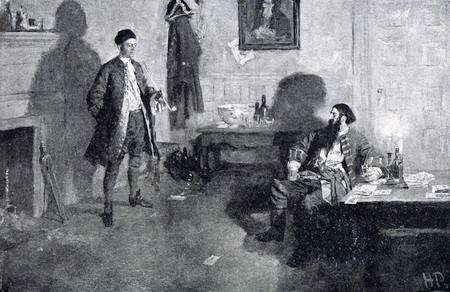
“MR. PARKER STOOD LOOKING STEADILY AT HIS VISITOR.”
“No; upon my honor.”
The other burst out laughing. “Upon my honor,” he mimicked. “Well, then, I’ll be here three days from now.”
Jack and Mrs. Pitcher, as they sat in the next room, heard nothing but the grumbling mutter of the two voices and now and then the sound of the stranger’s laugh. “What d’ ye suppose he’s come for, Mrs. Pitcher?” asked Jack.
“Like enough for money,” said Mrs. Pitcher, briefly.