Chapter XVIII
Reading edition
MISS ELEANOR PARKER
IT was nearly noon the next day when Jack rode up to the front of Marlborough. A group of negroes came gathering about the horse, and Jack asked of them whether Colonel Parker was at home.
“Iss, he be at home,” was the grinning answer; but no one made any offer to help him in any way. Just then Mr. Simms came to the door of his office in one of the wings of the house, and then, though bareheaded, walked directly across in the sun to where Jack stood holding his horse.
“What d’ ye want?” said the factor, and Jack answered that he brought a letter from Mr. Richard Parker to his honor.
“Humph!” said Mr. Simms, and his face fell somewhat. “You don’t know what your master wants, do you?”
Jack looked at the factor somewhat cunningly. “How should I know?” said he.
“Well, then, give me the letter,” said Mr. Simms, “and I’ll take it to Colonel Parker. You came just in time to find him at home, for he’s going to Williamsburg this afternoon. You may go into the hall and wait for your answer there, if you choose. Here, Blackie”—to one of the negroes—“take this horse over to the stable. Come in, young man, come in!”
The great empty, shady hallway, open from one end to the other, felt and looked very dark and cool after the glare of the morning sun outside. The great doors stood open from the rear to the front, and from where he sat Jack, through the vista of trees, could catch a glimpse of the wide river stretching away in the sunlight, sparkling and glittering in the warm breeze. The strong wind swept through the space, and it was very cool and sweet. Jack sat there waiting and waiting. Somewhere a mocking-bird in a cage was singing its mimic notes, and now and then he could hear the noise of voices echoing loudly through the summer stillness of the great house. There was the sound of an occasional banging of a door, a distant snatch of a high-pitched, monotonous negro song. Through all these he could hear the ceaseless tinkling and jingling of a spinet played in one of the more distant rooms. As Jack sat listening, holding his hat in his hand, he knew that it must be Miss Eleanor Parker who was playing the spinet; and thinking of her he recalled that first day of his servitude, in which he had come out across the lawn and had seen her standing behind her father, looking at him. It seemed as though all that had happened not two or three months ago but two or three years ago, in some far-away time of the past. Suddenly the music ceased—a door opened, and the young lady came into the hall fanning herself. As she came forward Jack rose and stood waiting for her to pass by. She glanced toward him and was about to do so, when she suddenly recognized him and stopped. “Why,” said she, “are you not the young man that papa gave to Uncle Richard for a servant some while ago?”
“Yes, lady,” said Jack, and he blushed hotly.
“Methought I remembered your face,” she said; “and tell me, how do you like to be with my uncle?”
“I like it—that is, I like well enough to be with him,” said Jack, “if I have to be with any body. I wouldn’t be anybody’s servant, if I could help it.”
“But sure,” said she, “you must be somebody’s servant. Why else did you come from England except to be a servant?”
“I could not help coming,” said Jack. “I was knocked in the head and kidnapped.”
“Why, then,” said she, “it was a very great pity, indeed, for you to have been treated so. What is your name?”
“Jack—that is, John Ballister.”
Just then Mr. Simms came down-stairs to where Jack and the young lady stood. “Colonel Parker wants to see you up-stairs in his closet, young man,” said the factor; and then to the young lady, “By your leave, Mistress Nelly,” said he, “I’ll have to take him up-stairs with me, his honor wishes to speak with him.”
“He tells me, Mr. Simms, that he hath been kidnapped and fetched here to Virginia against his will,” she said.
“Like enough, Miss Nelly. ’Tis the only way we can supply enough servants nowadays. If they did but know it, they are a thousand times better off here living at ease than they are at home living in poverty.”
“I wasn’t living in poverty,” Jack said, indignantly.
“There, Mr. Simms, you hear what he says?” said the young lady.
“Well, Miss Nelly, you can talk about this some other time, maybe, for now by your leave I must take the young man away. His honor wants to see him.”
When Jack was ushered into Colonel Parker’s presence he found him seated in a large, double-nailed armchair at an open window. Some books and a lot of letters and papers lay upon the writing-desk near at hand. His head was covered by a silk nightcap, and he wore a silk dressing-gown. A sealed letter lay upon the window-sill beside him. “Come hither, young man,” he said to Jack. “Haven’t I seen you before?”
f132
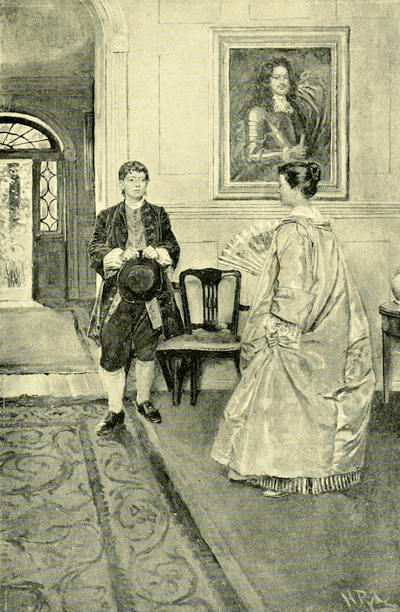
“I DON’T WANT TO BE ANYBODY’S SERVANT, LADY, AND WOULDN’T IF I COULD HELP IT.”
“Why, yes, your honor,” said Jack. “You gave me as a servant to Mr. Richard Parker.”
“He was one of the servants I fetched over from Yorktown when the Arundel came in,” said Mr. Simms.
“Oh, yes, I remember now,” said Colonel Parker. “How long have you been with your master?”
“Between two and three months, sir.”
“Two or three months, hey? Well, tell me now, how does your master live—what does he do?”
“I don’t know what you mean, sir,” said Jack hesitatingly, and then he looked in the direction of Mr. Simms.
“You need not mind my agent,” said Colonel Parker, “and I want you to speak plainly. Tell me, does your master play much at cards or dice?”
“Yes—yes, sir,” hesitated Jack, “he does play sometimes.”
“You see, Simms,” said Colonel Parker. “I knew ’twas so. That is where the money all goes.” Mr. Simms did not reply, and Colonel Parker turned to Jack again. “Tell me,” he said, “is my brother often away from home?”
“Methinks, sir,” said Mr. Simms, very respectfully but firmly, “you do your brother an injustice in thus questioning his servant behind his back.”
“I mean to do him no injustice, Simms,” said Colonel Parker, impatiently, “but I mean to do myself justice. Tell me, boy,” he continued, turning to Jack, “do men come pushing your master for money?”
“Sometimes, sir,” said Jack. “There was a man came once saying that Mr. Parker owed him a thousand pounds, and last night—”
“A thousand pounds!” interrupted Colonel Parker. “’Tis enough. I will not ruin myself, Simms, for him or for any other man. Take this letter, sirrah, and give it to your master,” and he handed Jack the sealed letter that lay in the window place beside him. “And now get you gone.”
It was the middle of the afternoon of the following day when Jack finally reached the Roost. Mr. Parker himself came to the door as he galloped up and leaped to the ground, and the housekeeper looked down from an upper window. Jack’s master snatched Colonel Parker’s note from his fingers and tore it open violently. He hesitated for a moment, and then he began reading it, running his glance rapidly down the letter. As he did so, his face gathered into a heavier and heavier frown, and his strong, white teeth bit deep into the end of the cigarro. At last he crushed the letter in his hand. Jack, for fear he should appear to notice anything, had turned and had begun to stroke and rub the neck of the sweating horse. When he looked again, he saw that Mr. Parker had reopened the crumpled letter and was reading it through once more, this time very carefully. Then, having finished it the second time, he tore it sharply across, and then across again and again and into little pieces that fell at last in a white fluttering shower.