TROUT AND OTHER FLY FISHING.
Reading edition
This subject far from being treated exhaustively, or even with any attempt at fulness, will, on the contrary, only be written of, so as to give a few hints to those who love to wield the rod. Bottom fishing, with the paraphernalia necessary to that branch of the sport, has objections at least from a woman's point of view, but to fishing with the fly there is no drawback, unless indeed you happen to be one of those who hold that you should never pit your skill against one of the lower animals in a struggle for life. Of all sports indeed there is none more entirely suited to the powers of woman than fly-fishing. The nicety, the quickness, the light-handedness, and care as to details, and I think I may add thoroughness in any pursuit they really take to, in which women generally excel are all points in her favour the moment she takes a rod in hand. Great strength is not needed, unless indeed she choose to go after one of the leviathans of the deep, but only constant and exhaustless patience. Yet it is the mention of the last that will make many who know only of the sport by hearsay, look scornful and say they see no fun in standing watching and waiting for the bite that often never comes, and that they prefer something more active. As it is no use arguing with people who are persuaded they view the subject from a vastly superior standpoint, the only answer to this is, "If you do not change your opinion after a week's—or even a day's—experience—well, fly-fishing is not for you."
What I am anxious to impress upon all is, that fly-fishing is not necessarily an expensive sport. For the best of salmon-fishing and the right to try for trout in their choicest waters you must indeed pay, but for the right to fish for their less thought of brethren there need be but small demands on your purse.
My own experience one summer may be of some use to those who would fain do likewise. My lot was cast in a part of Sussex where under the Downs flowed a tiny but most beautiful little river. "No trout," had been the answer given when I enquired as to the prospect of sport from its banks, so sadly I made up my mind that beyond an occasional visit to a trout stream, owned by some friends in the same county, my rod would be idle that summer.
"If only it was stocked with trout," was my frequent reflection as I wandered along its banks and noted the swift flowing current and the tempting stickles that looked a perfect paradise from a trouting point of view. One evening as I stood watching the clear waters as they rushed round and over some opposing rocks into a large pool, I caught sight of a silvery, most graceful fish dart through the water at the side of the eddy. Then when my eye became accustomed to the curious light, as the rays of the setting sun fell slantways over the pool, through the branches of a mighty oak tree that rose from the banks, I saw another, and another. "Dace," was my verdict, and forthwith dismissed them from my mind. But I had not reached home before the thought of trying for those dace with fly came to me, and the next day, trout rod in hand, and with a Black Palmer and Alder on the cast, I made my first venture in what was to me quite a new branch of sport.
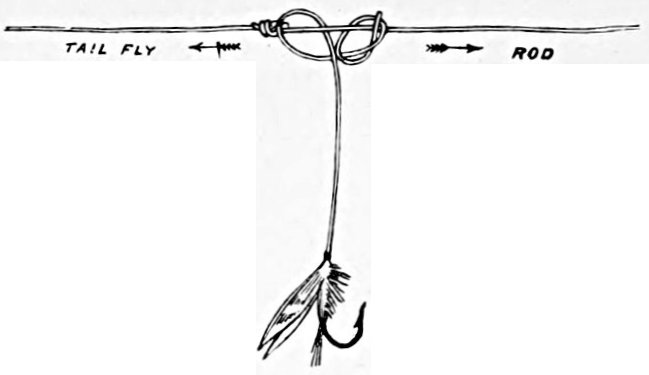
Method of fastening Dropper to Cast.
As the line flew out for the second time and the flies fell gently and lightly on the water, I had but to wait a second before a faint thrill ran through my hand and told me something had touched the fly. Could it be a bite? So different was it to the sudden onslaught of a trout, that I hesitated whether or not to strike, and contrary to the usual fate of the waverer, it was the momentary pause which gave me the fish. A slight movement of the wrist and I had him fast, and then a delicious few minutes followed while I played as game a dace as I ever wish to measure skill with. Indeed I should not have been surprised when at last my prize was safely caught in the landing net, to see the spotted scales of a trout. But no, the slender, silvery, beautiful-headed fish could be no other than a dace, and his captor at least was content with the gallant bid he had made for his life.
If dace would take the fly, why not also roach and chub, and soon, faute de mieux it is true, but none the less with very considerable enjoyment, I was fishing the little stream for all three kinds in turn. On the gravelly bottom of a certain portion of the water, I found a red Palmer very attractive to the roach which were there in considerable numbers. Some of them were of fair size, the largest I took turning the scales at 1-lb., but I am bound to confess that I found these fish such very shy biters that I generally preferred to try either for dace or chub. One roach, however, gave rather a novel experience by hanging itself in a tree, and causing the greatest excitement among our party, the members of which quickly came from their chosen spots to see and admire. I was fishing from the shelter of a bush on the top of a high steep bank, and with some trees close at the rear and a decidedly fresh breeze blowing, it was not an easy matter to get the line safely out at all. The water, however, was but little disturbed by the wind, from which just there it was protected by the high ground, and the fish were clearly visible in the water below. As there was nothing for it in such a position but to swing the fish out if I caught one, I did not for that once wish to make a big capture. Scarcely had the tail fly—this was a red Palmer—touched the water than one of the usual shy bites was made, and fortunately my strike secured the prize so far. But he seemed heavy and was, besides, the gamest of his kind I have ever played. Quietly we could not manage things, and it was very soon clear that if I did not then secure him, I need not struggle with the difficulties of casting again in that part of the stream, for every other finny inhabitant would have taken the alarm. All my faculties were therefore intent on the capture. When I saw him at last tired of struggling and almost beneath me, I tried to swing him up, wondering, as I did so, if it were possible my light tackle could stand the strain. A flash of silver through the air, then a puff of wind, and a red-finned, black-backed roach of about 8-oz. in weight, was dangling over the topmost bough of a tree which grew up from the lower part of the bank a little to my left. The poor fish struggled and the line swayed ominously among the branches, till at last a nimble climber released them both, and to my delight restored them to me.
For chub I found a larger fly effective, and a Coachman and a Red Palmer, both tied large, were what I generally used. In my experience, chub is the most determined biter of any of those I am now discussing, and he is very game up to a certain point, his dashes and struggles as he tries to free himself from the hook, being as fierce as those of many a good trout. The battle, however, will be over much sooner than with one of the latter species, and when you see the inert form in the water, you will realise with sorrow that after all he does not belong to the kind known as "game fish." In fishing for chub you must be as careful about showing yourself as you would be in trying for a trout, for he is very quick in spotting anything unusual, and once he has done this, you may offer him the most tempting flies unavailingly. By the time you have landed a 2-lb. chub, you will, in my opinion, have exercised to the full as much, if not more skill, than you would have done in the capture of a trout, and though the sport of playing him will be sooner over, it will have been good indeed while it lasted.
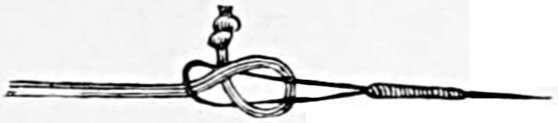
Method of fastening Reel-line to Cast.
The chub I found to rise earlier in the day in this little Sussex stream than either dace or roach, the two last on the warm August evenings often rising freely as long as we could see to cast for them.
The great difference between fishing with the fly for game and coarse fish lies in this, that while with the latter you require even more lightness of hand and skill in casting than on any ordinary trout stream, the intense excitement of the moments when you play a good trout or salmon will not be experienced to the same extent. But that sport and good sport may be enjoyed with any of the three varieties I have named, I have proved to my own satisfaction, and I hope that what I have said may induce others to try for themselves.
At the same time that nothing can equal the joy of playing and landing your first trout, I would be the last to deny, for the day on which the first fell to my rod is still marked as a red letter day in my life. This also was in Sussex, in a well-stocked merry little stream which babbled and chattered over its white stones, giving the last touch of beauty to the peaceful valley through which it flowed. After the preliminary walk along the banks of that part of the water I was to fish, so as to get the knowledge of the position of the pools and eddies and overhanging banks without which one's labour is likely to be thrown away, I sallied forth, rod in hand, to the neighbourhood of a bridge from which I had noted several trout lying with their heads up stream. A few hundred yards from this, where the banks it is true did not seem to offer much facility for casting, there was an eddy at one side of the stream and a mass of rushes on the other, all under the shadow of trees which rose between them and the bridge. When it is remembered that I was trying for my first trout—the experience now lies back in the dim distance of the past—it will not perhaps cause surprise if I say that my whole being thrilled with the excitement of the moment. My cast had a red Palmer for the tail fly, and black Alder as dropper, for at dinner the night before I had been advised to try these by a local fisherman. I should probably make a mess of it, and catch my line in one or other of the traps that literally bristled on all sides of me, was the thought that was uppermost, as after scrambling down cautiously and keeping well out of view, I craned my neck to see how I could possibly get my cast to alight on the spot I had chosen. As I had my hand up for the venture a swift rise just where my eyes were fixed on the water, told me of the presence of a trout. My line flew out, and the tail-fly falling within the widening circle was instantly seized, and a sharp turn of the wrist gave me a trout with a bewildering suddenness. Up went the point of the rod, and the good cane bent to the weight beneath. A maddened dash across stream to the reeds, was the first attempt of the prey, then a trial to get to the shelter of a rock conveniently near, but slowly and surely he gave in to the steady pull brought to bear on him, and soon I looked with unspeakable delight on a ½-lb. trout, in the prime of condition, safe within the folds of the landing net. That no fish ever comes up to the one you first capture, has since this moment been an article of faith with me. Others larger, gamer, better in every sense may, and will if you have ordinary skill and perseverance, fall to your rod, but nothing will give you the same thrill of rapture you felt when you saw your "first trout" on the bank at your feet.
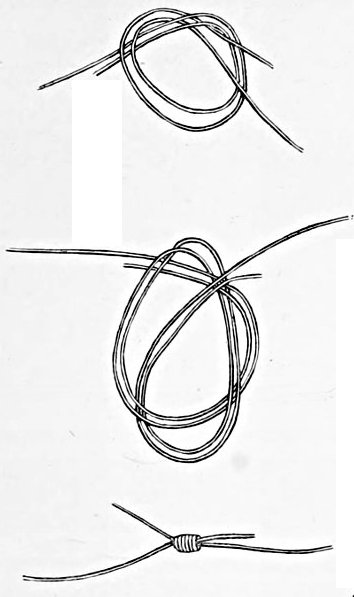
A good Gut Knot.
To make a good trout fisher there are of course many things to learn, and one of the greatest charms of the sport lies in this, that you never come to the end of what there is to know of it. But pre-eminently is it true that an ounce of practice is worth a ton of precepts. You must to a very great extent buy your own experience, and though you will always do well to profit by other people's advice, you must yourself build up the theories which will show you how, when, and where to cast so that fish may rise to your fly, when they are proof against the blandishments of the less skillfully-thrown lure. That you should always study the lie of the water over which you mean to fish is a truism, and yet it is a fundamental rule to the neglect of which many both men and women owe the fact, that they never rise above a very mediocre degree of skill. Unless you know something of the habits of the fish and the spots in which he is likely to be found, how can you hope to succeed in making him acquainted with your fly? To prevent him catching a glimpse of you, and for this end to be dressed so as scarcely to be distinguished from the ground upon which you will be standing, to make no noise or disturbance, to throw with the utmost delicacy of hand, to strike instantaneously or the reverse according to the particular class of fish you are angling for, to cast up stream or partly up and across, and never to allow the gut to make a ripple as you draw your cast through the water, all these constitute the ABC of an angler's stock of learning.
I believe that most people carry about with them a quite unnecessary stock of flies, and that as much success will fall to you if you only provide yourself with different kinds of Palmers, Black and Red Gnats, the Black Alder, Red Spinner, March Brown, Blue Upright, Yellow Dun, Stone Fly, Wickham's Fancy, Greenwell's Glory, and on some streams the Green Drake, having these in several shades and tied on different sized hooks, never forgetting to supplement them by any others recommended by local fishermen, whose knowledge remember has probably been bought by careful study and long and varied experience.
For coarse fish I have found the Palmers, Black Gnat, Artificial Grub, and Bumble Bee the most successful. The Chub always liking their fly tied large, the Dace and Roach preferring theirs small.
A rod well-chosen and well-balanced is of course of the first necessity to your success. To speak again from my own experience, I found an inexpensive light Greenheart made by Hancock, a delightful rod in every respect and with this my first ventures both with trout and coarse fish were made. It only measured 10-ft. 6-in., but was beautifully balanced, and you could make very fairly long casts with it. As a beginner you should always get some experienced friend to choose your rod for you, though like everything else of the kind, you will naturally prefer to make the choice yourself as soon as you know how to test the balance on which all else depends.
In the matter of outfit, you will need a creel which should contain an upper tray for luncheon, a landing net, and one or two casts ready made for use. The last may be fastened round your hat, and of course if you have any idea of being independent and going out by yourself, your creel and net should be chosen with a view to lightness, or they will naturally add materially to the fatigue of a day on the river bank.
Lastly, I would say, that if you should have the opportunity of going out with a good fisherman on a river or lake, there to learn the elements of fly-fishing, by all means avail yourself of it. In no other way can you master the rudimentary practice so easily as from a boat, for there will be no bushes or banks, or the hundred and one difficulties you may have to consider on land, and you will therefore be able to concentrate your efforts on getting your line out in a fairly workmanlike manner.
That you should not be easily discouraged it is scarcely necessary to add, for who that has landed her first trout has not straightway felt the fever of the rod take possession of her?
Frances E. Slaughter.
Lafayette. Dublin.
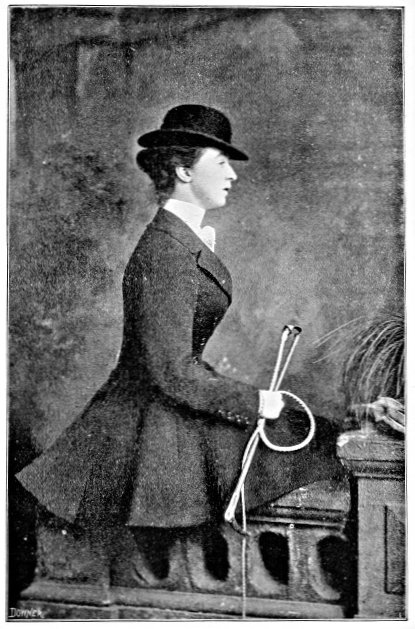
MISS MASSEY-MAINWARING.