SALMON FISHING, WITH NOTES ON TROUT AND COARSE FISHING.
Reading edition
Autrefois, Carpillon fretin Eut beau prêcher, il eut beau dire, On le mit dans la poële à frire. In olden days the little fish In spite of all they could say or wish Were fried in a pan and served on a dish!
La Fontaine's lines, to which I have appended a somewhat free translation, could certainly not be applied to the modern representative of the species, whose extensive educational privileges on the subject of bait and flies have formed his mind, brought his acquirements thoroughly up to date, and elevated him from an innocent unresisting victim into an adversary whose cunning not unfrequently out-matches our own, but of whom the true fisherman should scorn to take an unfair advantage.
This being a sport in which delicacy of hand is more necessary than mere brute strength, it is especially adapted to women who love fresh air and beautiful scenery, and who are willing to bide the good time at which the fish feel disposed to rise.
I should perhaps say here that my remarks are intended to apply to salmon and trout fishing in rivers and lakes, taking incidentally such "coarse fish," pike, perch, etc., as are to be found by the way.
Of all fish the salmon stands pre-eminent for his sporting qualities, and next to him in order come trout of all kinds.
Salmon are a curious and interesting race, whose habits have been an object of study to the naturalist for many years past. They are born in the shallow reaches of rivers, the eggs taking from eighty to over a hundred days to hatch, the exact length of incubation being determined by the temperature of the water, and they sometimes remain in or near their original quarters till they are from one to three years old, when they migrate to the sea. By far the greater number, however, descend to the sea within twelve to fifteen months after they are hatched out from the ova. Up to this crisis in their history they are called parr, and seldom exceed some three ounces in weight. As the period of migration approaches—usually in the spring, though autumn migrations also occur—the samlets increase in size; silvery scales replace their barred markings, and they are known as smolts. Both parr and smolts feed greedily in the rivers, but it is a curious fact that subsequent to their first visit to the sea none of the salmon tribe appear to feed in fresh water, the stomach almost invariably being empty when examined. They remain in the sea for an uncertain period which may vary from three or four months to as much as two years, and during this time must certainly feed with voracity, as they increase many pounds in weight. On their first return to fresh water as grilse they weigh from two to eight pounds.
I have myself seen, in the Killery Bay, a shoal of salmon making for the mouth of the Erriff river. They were apparently led by a large fish, which from time to time sprang out of the water, I suppose to reconnoitre the neighbourhood. The fisherman used to look out for this leading fish, and run a net round the shoal. Salmon certainly do not live in company in the rivers, whatever they may do in the sea. They start on the journey up stream in shoals, but soon separate to take up their quarters in the different pools through which they pass. They are now promoted to the name of grilse, and attain the rank of salmon on their second and all subsequent migrations. Their arrival in fresh water is partly determined by conditions of weather and water; also by the special circumstances of the river to which they belong, i.e., whether it be early or late. The fish come up in prime condition, for the purpose of spawning, and return eventually emaciated and most unattractive-looking, after this has been accomplished. In the first state they are called "clean" or "fresh-run" fish, and are a bright silvery colour; in the second they are termed "kelts," become reddish or dark in colour, and from being thick and cobby in shape appear long and eel-like, the males having developed strange crooked snouts which vanish in quite a miraculous way when they return to the sea. There is no sign of this odd proboscis when they first enter the river, so that it comes and goes, leaving no token of its presence behind.[4]
Salmon are now unfit for the table, and must be returned to the water uninjured, when they are caught. I might here say, as I am regarding the salmon from a culinary point of view, that it greatly enhances the flavour and firmness of a clean fish, if he is "crimped" at once on being landed. He should first be killed by a blow on the head, and then cut into slices about an inch thick; taking out the joints of the backbone and running a stout piece of cord through the hole thus made. These slices may then be put into the river where the current is not too strong, the string being secured to the bank by a stout peg, and they should remain in the water for several hours until the flesh "rises," as it is called, to the "crimp."
My appetite for crimped salmon received, however, on one occasion a severe shock. I caught a beautiful fish weighing about eight or ten pounds, in the Hampshire Stour. The keeper proceeded first to kill him, and then began the crimping process. He advanced as far as the shoulder, at which moment I told him to stop, saying he might have the rest for himself. Thanking me, he laid his portion on the ground and we went further down the river. In half-an-hour we returned, and a friend who was with me and who had studied medicine, took up the head and shoulders of the fish and showed it me. To my horror, the heart, which was plainly visible and untouched by the cut of the knife, was still beating strongly. My companion assured me it was merely muscular action, but it was a ghastly sight, and for a long time I could not face crimped salmon again.
The instinct of the fish urges them to run up the river as high as possible, sometimes at a tremendous pace, and to make violent efforts to leap all obstacles in their way.
When in this state of mind they very frequently turn into small tributary streams, which, being flooded, allow them to pass up, but where they are sometimes found almost high and dry and unable to return, like a stranded whale of small proportions.
Sea trout also belong to the migratory species, and of them it may be said, shortly, that they are, in appearance much like miniature salmon, and have game and fighting qualities of very high order.
I may perhaps be allowed to say here that I have found mackerel, caught in the sea with a light trolling rod and trout tackle, give a great deal of sport. They are particularly muscular little fish, and the curl of their lithe tapering bodies, and forked tails, seems to give them a hold on the water which is out of all proportion to their actual size. When caught, after they have been killed, the large vein in the throat or gills should be torn. They bleed to quite an extraordinary extent, but are much better eating and less oily when they have been treated thus.
Bull-trout are something between the salmon and the sea-trout, and are also migratory fish of much the same habits and characteristics. They are very common in some rivers, less so in others, but I remember seeing one caught in Dhulough, County Mayo. There were also in this same place numbers of sea-trout which rose to the fly or came at a minnow, but as far as we could learn there was no egress from the lake by which these fish could get into the sea. They must, however, have had some means of descent.
The Salmo Ferox, or Great Lake Trout grows to an enormous size, weighing as much as thirty pounds. They give quite as good sport as a salmon, and many of them were caught some years ago in Loch Arkaig. The method of fishing was to troll for them in a boat, either with a fly or with a small gudgeon or minnow, but always with pretty fine tackle, heavily shotted so as to sink to a considerable depth. I hear that none have been taken in this way for a very long time in that water.
There only remains to be mentioned the ordinary brown trout of our streams and rivers, so common and so delicious when in good condition, but by far the most wary and difficult to catch of all his tribe.
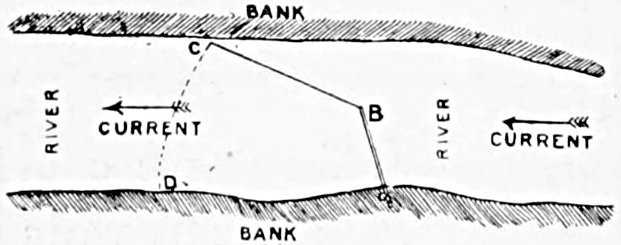
The Cast for Salmon.
One of the greatest initial mistakes made by the novice in salmon-fishing is to continue flogging the water for hours together, without intermission, and regardless of the state of the sky or water. It is very difficult to give general directions as to the latter, for circumstances vary in different rivers, and experience only can enable the angler to judge when the right moment has come, but in floods or in rising water no fish will, as a rule, pay the slightest attention to the fly. As to the weather, a fresh breeze which ripples the current of the river or the surface of the lake is always a point in the angler's favour, and the sky should be overcast. A bright sun is generally fatal to any chance of sport, but there are of course exceptions to this rule. The largest salmon I ever caught, and which weighed thirty-two pounds, rose to a fly just before sunset, after a cloudless day, during which he had remained at rest close under the bank, holding a levée of numerous visitors who came to admire his fair proportions as he lay motionless and, apparently, without fear, within a foot of the surface of the water.
I have seen fish rise as if they were mad, in a gale, with pelting rain and flashes of lightning. In weather like this, my father caught in one day some years ago, thirteen salmon and one hundred-and-seventy sea trout to his own rod in the Erriff. It was a sort of convulsion of nature and the fish seemed to look upon it as an opportunity for a Saturnalia.
In all rivers and lakes with which I am acquainted I have found that the Salmon rise at certain fixed hours morning and evening, and sometimes also in the middle of the day. As salmon do not rise from hunger, as far as we know, it is difficult to understand why this should be. I leave the explanation to others and merely state the fact as I have found it. In that part of the Hampshire Stour with which I am best acquainted, the hours for rising were five in the morning, one p.m., and sunset. At one p.m. the fish were so regular in their habits that the servants' dinner-bell, which rang at that hour and was audible for some miles round, came to be called the Salmon bell.
In Dhulough, Delphi, and Glendalough lakes, in County Mayo, the fish were lotus-eaters, and preferred the afternoon for intercourse with the human race.
In Pool Persyn, on the Usk, near Brecon, they never rose, as far as we could find out, before twelve o'clock, or between two and four, when I presume they had their siesta. No doubt a great deal depends on the time of year and the amount of daylight. These peculiarities in a river can only be ascertained by experience, or by consultation with someone who knows the water, and should never be disregarded, as for all we know to the contrary, fish may get used to the sight of a fly which is constantly being dangled before their nose, and end by paying no attention to it.
Another very important matter is to make oneself acquainted with the haunts of the fish, the spots where they lie and rest on their way up the river—I do not say "down" as well, because they must not then be caught at all, owing to their condition.
In fine weather, therefore, when the sun is bright and the water low, the wise fisherwoman will leave her rod at home and walk along the bank, slowly and carefully examining the bed of the river and ascertaining, as far as she can, where the fish are lying and where the rocks and roots of trees, or "snags," as they are called, are situated. This knowledge will assist her to cast her fly in the right and not in the wrong place, and may avoid the loss of a fish which would otherwise either accidentally or of malice prepense entangle the line and snap it by means of a resistance which he cannot get from a lissom rod and a running line.
This is such a favourite trick with pike that it amounts to a recognised dodge, and would almost seem to be the result of some form of reasoning, however dim.
To flog the river for hours at a stretch, without having first ascertained these simple facts, at a wrong time of day, or when, for instance, the water is rising, is worse than useless, for it disgusts the angler, and renders her incapable, from sheer fatigue, of throwing a light fly when at last there is really a chance of a prize. Casting, let us say, from forty to sixty feet of line with a heavy rod is hard work for any woman; indeed, most men return from their first day's sport with a stiffness in the muscles of the back and shoulders which it takes a vast amount of "Elliman" to alleviate.
It is most important for a woman, in fishing for salmon, to husband her strength, otherwise, if she hooks a heavy fish and is already tired out, she may find it a difficult matter to play it safely, and to land it eventually, after perhaps following and keeping strain on him for some distance over unequal ground.
Thick waterproof boots, made high in the legs, gaiters if required, a short skirt, a blouse or tennis flannel, strong belt of leather or webbing and loose jacket, with a small hat well fixed on head, is the most suitable costume to go out fishing in. I take for granted that most women will not care to wade, a practice which is dangerous to health and sometimes to life itself, even when waders are used, as few women so hampered could regain their footing in a strong current once they had lost it, or if they accidentally stepped into a hole.
Quiet colours, heather mixture and the like, should be worn, as fish, and more especially trout, have a quick eye for a bright patch. White objects are to be avoided. It is a well-known trick with poachers to send a large piece of white paper floating down stream. Not a fish will rise for hours afterwards. It seems to affect them as flying a kite does partridges—they lie close and can be netted afterwards with ease.
Salmon are distinctly less clever than trout, and the same precautions against being seen are not so necessary, although always advisable even in the case of the former, which will also be attracted by a much coarser form of lure. No doubt the reason is partly that we fish for salmon and its varieties—the sea and bull-trout—in deeper water of which the surface, being broken by the current, is roughened and intercepts their view of the upper world. In trout streams this is not nearly so much the case, as a rule, and where the banks rise high above the water, trout require the greatest care, coaxing and delicacy in handling to induce them to exchange a comfortable home for the angler's creel.
When salmon are rising, they will take almost anything, and in thick or heavy water I have caught them myself with the identical spoon-bait which I used for mackerel in the sea.
It is difficult to fathom what is in the salmon's mind when he takes either a spoon or a boiled prawn, objects which he can never have met with in the sea in his natural state, but many fish will come at the fly merely to drown it by striking at it with their tail, and are ingloriously "foul-hooked" in consequence. When this happens they are far more difficult to kill, and often lead their captor a pretty dance before being finally gaffed or netted, the tail fin not being so sensitive as the mouth, which the fish can therefore close, thus swallowing no water when the strain begins to be severe.[5]
Before starting for a day's fishing it is necessary thoroughly to examine the rod and tackle which are to be used. I recommend from personal experience, for a woman, a light, well-balanced rod about sixteen or seventeen feet in length. Greenheart is a very good wood,[6] and mine, which is made of this, has lasted for years and is, apparently, none the worse. All depends on the care which is taken of it during the time it is not being used. I have always kept my rod in a moderately warm place, where neither the damp could get at, to warp and swell the wood, nor too great dryness make it brittle, and before beginning the season I varnish it carefully to preserve it from wet. Spare tops should be always kept ready in case of an emergency, but the accomplished sportswoman will of course learn how to splice a broken joint, as accidents do not always occur within reach of assistance. Each joint, unless made with screw fastenings, is provided with brass eyes; a piece of waxed thread should be fixed to these so that, being wound round an eye in each joint, the whole rod can be securely put together.
Having omitted this precaution on one occasion when I was fishing for pike, I cast into the river, with my bait, the top joint of my trolling rod, which floated in the water, but did not, strange to say, prevent my hooking and landing a fish of seven or eight pounds.
Examine the reel carefully; take it to pieces, oil it, if necessary, and work the handle to see that it runs smoothly without a hitch before winding on the line. Large heavy reels and coarse tackle are, to my mind, very inartistic and unsuitable for women, as they naturally lessen the chance of hooking a fish, although, once hooked, all the angler has to do is to hold on, "show the butt" persistently, keep the point of the rod well up and tire out the fish by main force.
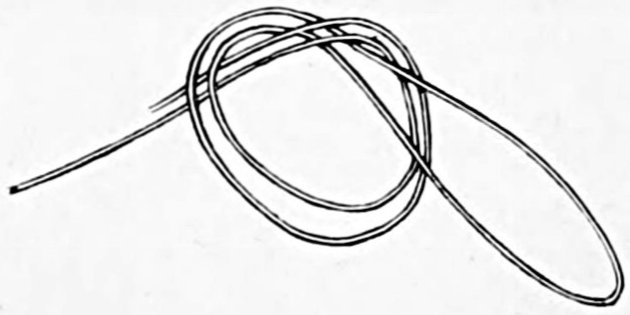
Knot for Gut Loop.
This manner of proceeding has always seemed to me to be taking an unfair advantage of a salmon or trout. With a pike, of course, the question is a different one, as he cuts the line with his teeth, if you give him the chance and nothing but gimp is of any service. The rings through which the line runs should also be examined to see that they are secure and that the line itself, which is best of hemp for salmon-fishing is free from kinks and not chafed anywhere, also that it is wound evenly on the reel, from which it must run lightly and easily.
A check in the running of the line, when a large fish makes a sudden dash, would almost certainly enable him to break away. Many people waterproof or varnish the line to keep it from rotting, and its usual length is from sixty to seventy yards, the gut cast at the end being generally about three more and stained (according to the colour of the water in which it is to be used) either with tea or coffee, or else ink and water.
One very important point is to wet both line and cast thoroughly before using; the former should be run through the rings in the rod, and casts made on a lawn or other open space for practice and to remove kinks if any. Lines must be thoroughly dried after use.

Ordinary method of tying Gut.
Most women buy their tackle ready made, or are accompanied by an expert fisherman, but, if breakage in the cast takes place and no help be at hand, they should know how to make a single and double slip-knot, and how to put on fresh flies in case of need. It should always be remembered that the two ends of gut about to be joined should be thoroughly moistened before they are manipulated. Otherwise the knots will not bind and the gut will break.
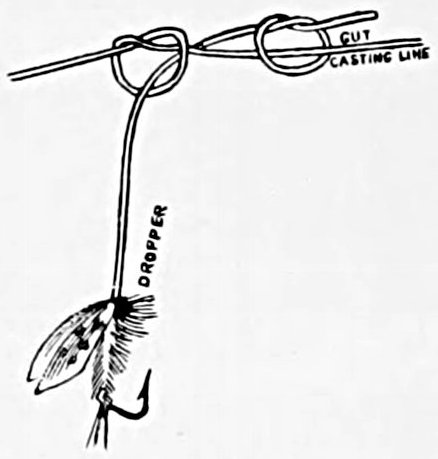
Method of fastening Dropper to Cast.
It is better for a woman, if not an expert, to keep to one fly, that at the end of the cast, called the tail fly, unless she is fishing for sea-trout in which case a smaller one, called the dropper, may be employed a little higher up the cast, or it may be advisable to use two different kinds of salmon flies, but they are apt to get entangled and give a great deal of trouble, without any conspicuous advantage. This is particularly the case where casting is interfered with by high rocks, or trees and branches just behind the fisherman.
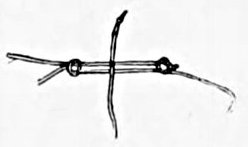
Dropper and Cast.
The length of my own favourite salmon and trout rods are seventeen and eleven feet respectively, but many people recommend a length of not over fourteen for the former, as a woman's strength is so much less than a man's.
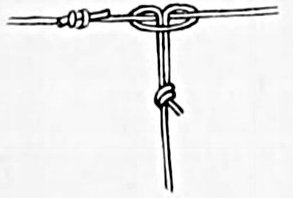
Dropper and Cast.
My own experience is, that in casting against a strong wind, a stiffish rod of eighteen feet is quite within my powers, so much depending on the balance of the whole apparatus, the size of the reel and weight of the butt. In quiet weather my "Castle Connell," a foot less in length and much more supple was very satisfactory.
Marvellous tales are told of long casts, but personally I have found sixty feet or thereabouts to be the length of my tether, at least so far as a satisfactory performance is concerned. This distance is usually quite enough for all practical purposes, and it will be some time before the angler can be certain of dropping his fly lightly and surely on a given spot, even at forty feet.
Women should practise casting on lawns without a cast at the end of their lines, as, when the fly is on, a novice has been known to hook swallows and even inquisitive puppy-dogs. The "Spey" cast should be studied as well as the ordinary method, the former being most useful where there are high branches or rocks just behind the place where the angler must stand.
The "Spey" cast consists in so switching the line that it shoots out direct to the required spot without ever passing behind the angler's head, while in the more ordinary method, the great secret is to send the line right out at the back, and then with a dexterous turn of the wrist to bring it forward. By raising the tip of the rod slightly just before the fly touches the water, it will fall into its position in a light and natural manner. Casting requires great care and patience in practising, and many a time the beginner may find her flies firmly embedded in her own back hair, instead of speeding swiftly through the air to where the fish lies.
In casting a line either for salmon or trout it should be noted that fish always lie with their heads up-stream, and that it is therefore necessary to stand some distance above where they are supposed to be, and cast across the water so that the fly may fall delicately and gently, without the least splash, a little above their noses. It cannot be too often repeated that, in fishing for trout, the great art is not to be seen. The angler must therefore stand well back from the bank, hide behind trees and bushes and crouch in hollows. Above all, it is absolutely essential that the figure should never be seen against the sky. She must keep her face to the sun, that her shadow may not fall on the water, throwing her fly first of all under the near bank and then by successive casts across the stream.
The salmon cast is naturally a longer and slower movement than that which is used for trout, but in both instances it is often well to allow the fly to sink a little before beginning to play it. For salmon the line should be drawn gently and with successive movements of the wrist up-stream and across the space which intervenes between the spot where the fly has fallen and that at which the angler stands. The trout cast is much more rapid, and the playing should be across and down stream as well as up, the movements of the wrist being much lighter and more varied. In both cases, when a fish is felt, a "strike" should be made, at least, authorities, to whom I am bound to bow, insist on this ceremony. Personally I believe that the fish, by this sharp turn of the wrist, is as often lost as hooked, unless care be taken to chose the actual moment when he has closed his jaws upon it. I have seen a fly pulled right out of a salmon's mouth, and have been told by those looking on and instructing me that I had done that same thing myself, when I merely intended to strike. My impression is, therefore, that the novice had better let her salmon hook themselves, which they will certainly do if they come well at the fly.
The cast itself requires careful examination before it is used; it should be stained to the required colour and tested with a steelyard up to sixteen or seventeen pounds for finer tackle, and eighteen for that which is coarser. Trout-casts, will not, of course, require or bear so severe a strain, but should be tried to see whether there is any defect either in the gut or in the knots which unite the several lengths of which they consist.
Few women, I imagine, will care to make their own casts, although some do, and for those I may mention that the best and cheapest gut is to be had in the South of Spain, where it is about one-third of the price which it fetches in England. Fly-making is very pretty work for delicate fingers but tedious and, on the whole, not very remunerative, as flies can be bought very cheap now-a-days. They may not be quite so carefully finished as those of home manufacture, but they are, I must admit, equally killing, although for years I placed implicit faith in the latter.
There was one fly for which I had a special fancy; it is a combination of orange-coloured silks and tinsel for the body with pheasant and jay for the wings, peacock for the head and golden pheasant for the tail. On one occasion, this "Orange Body" of private manufacture was presented to a friend, who admired it greatly and sallied forth, on slaughter bent.
He hooked a salmon almost with the first cast, struck with decision, and behold, all the dressing of the hook including of course the eye, came away and he lost his fish.
What had happened? The secret was this: that the cobbler's wax used for fly-making had been mislaid, and an ordinary piece of wax-candle used instead, the result being that the fish went away with the hook in his mouth while the rest of the fly remained to adorn the cast.
Test your flies, therefore, see that they are thoroughly sound and that the eye and piece of gut by which they are fastened to the cast are not frayed. It is a good thing to try a new fly in a basin of water or shallow pond to see whether it floats, as it should, horizontally, and whether the wings have a life-like motion, as by repeated short movements you play it with your hand.
Attention to all these little matters may seem very irksome at first, but it is by these means that one angler will succeed when another who precedes him on the same ground, will obtain no sport.
To give an accurate description of the different kinds of flies used in salmon and trout fishing, would be quite impossible in so short an article as the present one, but it should be said that, as a general rule, the deeper and larger the river the larger and brighter will be the flies required.
In thick or heavy water, after a flood, large bright coloured flies are indicated, and the clearer the stream the smaller must be the size, and the more neutral the colours tend to become. Most authorities seem to agree that the size of flies is a much more important factor in their killing qualities than the special materials of which they are made, or the finish and delicacy of their manufacture. When fish do not seem to be rising it is well to try them with another colour or make, and this will often enable the angler to fill his basket, when otherwise the day's sport must have been marked with a "duck's egg."
The same general rules also apply to trout fishing, but it should be remembered that in the latter case, except when fishing in lakes or rivers for the larger species which may fairly be angled for as salmon, the shallow water, enabling the lure to be plainly seen, requires less gaudy colours, and, of course, an immense reduction in size.
I must not omit to mention the gaff and the landing-net, most important parts of the angler's outfit. The former is best for large fish, under which it is much more difficult to get a net.
There is always a great controversy raging as to whether it is best to gaff "over" or "under," and the right place to accomplish the former is said by some authorities to be the back just at the shoulder. Personally I belong to those who gaff "under," and have always found it much easier than the other.
When a fish is brought close to the bank, sometimes only half or three-parts killed, he will generally make a dash for his life when he sees a murderous-looking steel instrument close to him, so it must be concealed from his view, and it is a good plan to have the gaff pretty deep in the water before he is brought up to it then striking under and drawing the gaff sharply forwards and upwards. I have landed some very heavy fish in this way, and scarcely ever missed one.
Once I gaffed a beautiful salmon of at least eighteen pounds, on the Usk, landed him triumphantly, and stood admiring him while the fly was taken out of his mouth. He seemed quite dead, but just as we turned away to what we hoped would be fresh conquests, with a vigorous flap of his tail, he managed to slide over into the river and was lost to view. I am afraid he was mortally wounded by the gaff, and must have died before long. This was a lesson to me to remove my fish to some distance from the water's edge and to make sure that they were really dead before leaving them. The net should be used for "red" or "black" fish, which must be returned to the river on account of their condition, with as little injury as possible.
Grayling are not usually considered as interesting to catch as salmon and trout, for, although they will sometimes make a desperate fight for life, they will only too often sink down to the bottom of the stream and remain there. They must be fished for with the same precautions against being seen which are used for trout, and with several flies on the cast, as they often move in shoals. They usually lie in the middle of the river, in its lower reaches towards the sea, and when these are broad, the angler is often compelled to wade to get the best chance at them. They are caught with the fly as well as worms and other bait. The cast should be made up-stream.
I must not forget to mention dry-fly fishing, which is particularly suitable for women. This form of angling is usually necessary in chalk streams, where trout will often refuse to be tempted by any other. The cast must be made up-stream so that the fly drops on the nose of the fish in a natural manner, and floats on the top of the water. The moment the fly gets wet it is useless, and must be dried by making two or three false casts in the air before returning to a real one on the stream. The fly must be worked with the greatest delicacy of touch, and allowed to float down with the current on the surface of the water.
COARSE FISH.

Lead for Spinning. Double Swivel.
The above title includes pike, perch, roach, dace, chub, bream, barbel, and tench, the last of which is very good eating, its fat being almost like that of the turtle. When the nobler varieties are not to be obtained, coarse fish are by no means to be despised, either for the table or for sporting purposes, and many a happy day may be spent on rivers and lakes at a time of year when perhaps neither salmon nor trout are available.
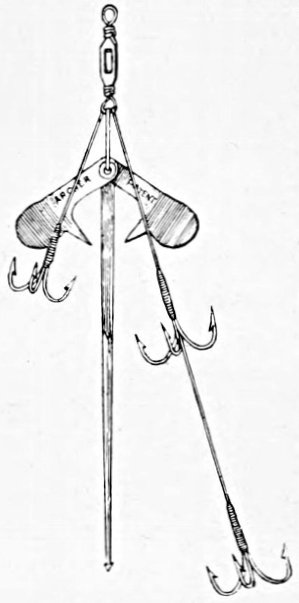
Archer Spinner.
My experience of pike fishing has been chiefly in the Hampshire Stour, which has a gravelly bottom, so that those fish, which are apt to be muddy in flavour, were superior to any I have tasted caught elsewhere. They are to be taken either with a float and live bait, or else with a trolling-rod and spinning tackle, baited with a dace or other small fish. After the care and tact which must be displayed in salmon, and especially in trout fishing, pike seem to be of a very inferior order of intellect. No concealment of one's person at the river-side is absolutely necessary, though it may be advisable sometimes, and the splash made by the bait in the water when spinning and which is enough to frighten all the trout in the pool, does not seem to affect the appetite of the fish we are now dealing with.
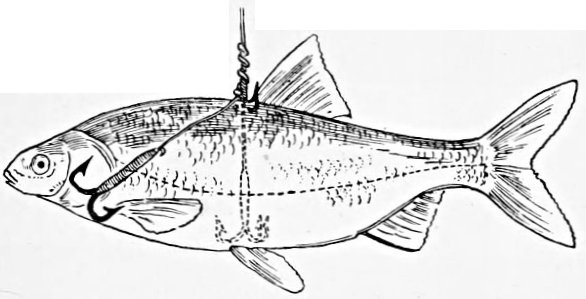
Bickerayke's Snap Tackle.
As far as my experience goes, I should say that gimp is the only thing that will hold a large pike, whose tactics are to cut the line with his teeth, or to wind it round a rock or root in the bed of the river and so defeat his human enemy. Even when safely landed he is still dangerous for he has jaws like a tiger, fitted with large, sharp teeth, which must be approached with caution. The trolling-rod is short and stiff, with large rings so that the line can run freely; the latter cannot of course be wound on the reel when fishing, unless in casting from the reel, but must be drawn in by hand. Great care is required to prevent entanglement, and the angler must beware of treading on his line as he moves along.
I found, inside a pike of twenty-five pounds, caught in the Hampshire Stour, a perch of three pounds, which had been swallowed whole. The pike had, apparently, only regarded this as a Hors d'œuvre and not as a square meal, since he came to my dace with the greatest voracity.
Perch fishing has always had great attractions for me, and I have caught many beautiful baskets of them, also in the Hampshire Stour. They are curious fish in some ways, and are to be found in large companies in pools and lakes, at the time of year when they are in season. When they are on the shallows they are not fit to eat, and will not usually take the bait. We fished for them with a live minnow and float, sometimes from the bank and sometimes from a punt. They do not seem shy, and I have caught them with my hand in the water holding the gut and minnow, but if once a perch is lost, no more will rise in that pool.
They must have some means of communication with each other, for after such an event the only thing to do is to move to another hole. When, by the disappearance of the float under water, the angler becomes aware that a fish has taken the bait, a short time should be allowed before striking as it must be remembered that the perch has to swallow part of the minnow before arriving at the hook. If left too long, the perch will gorge the bait (and this applies also to pike), the result being very unpleasant for all parties concerned. I have also caught perch with a worm, in which case the bait should be almost on the bottom of the river. The great attraction in this sport is that you can fish on a brilliantly fine summer's day, and see the objects of your attentions swimming about and playing regardless of you in the deep clear water.
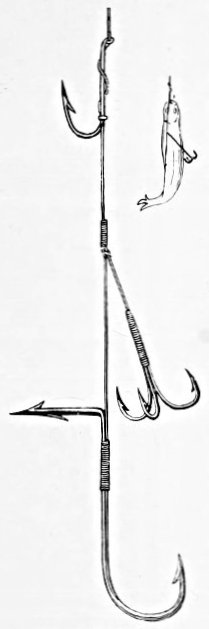
Pennell Flight for Small Baits.
It is said that certain kinds of trout croak, but that roach do, I myself can testify, and so distressing is the noise they emit that when I have caught them by accident, I always returned them to the water with great despatch.
Carp and tench are exceedingly shy fish and both prefer muddy and weedy ponds to a clear running stream. In the former they may be caught with paste and other forms of bait, but, to my mind, are hardly worth the trouble and, if wanted for the table may just as well be circumvented with a net, for all the sport they afford.
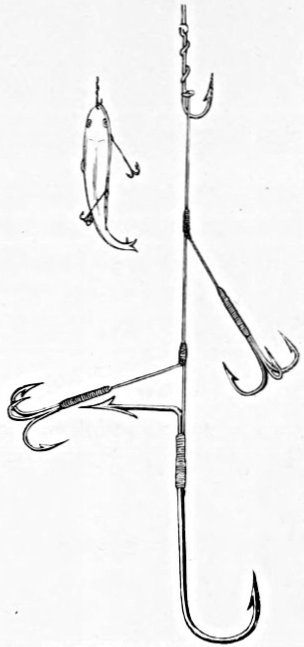
Pennell Flight for Large Baits.
Barbel and bream are very dull fish to catch with a rod and line; the former especially dive at once and burrow sulking in the mud, opposing merely dead weight to the angler's efforts. Dace and chub only remain to be noticed. The former will take a fly very readily, and give very good sport for their size, while chub are as shy as trout and as difficult to catch, if once they obtain a sight of their antagonist on the bank.
It has only been possible to give a very short account of the various kinds of fresh-water fish, and numerous questions will occur to the novice in angling, which must be elucidated partly by study of the many excellent volumes already published on the subject, but chiefly by experience and consultation with men who possess special knowledge of their own locality.
Still, I hope I have said enough to encourage women to look into the science of angling for themselves, and not to be entirely dependent on the services and advice of anyone who may chance to accompany them.
S. H. Malmesbury.
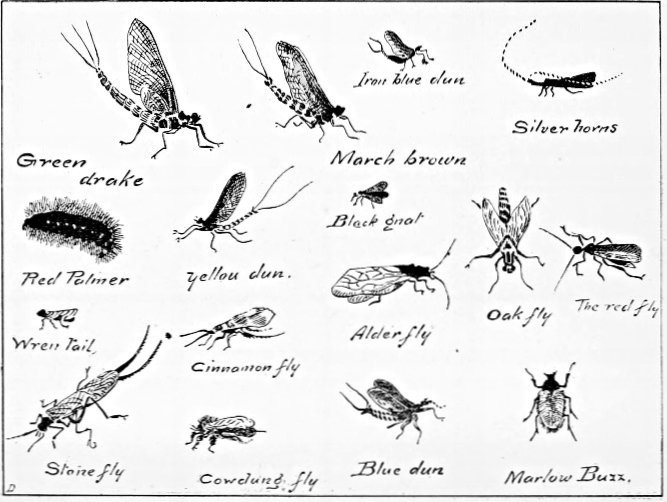
NATURAL FORMS OF FAVOURITE TROUT FLIES.