FANCY FIGURES AND MUSICAL RIDES.
Reading edition
The branch of Cycling familiarly known as "figure riding" is open to all, and there is no doubt that the short turns and rapid curves required are not only fascinating, but at the same time excellent practice. The control over the machine given by them will enable the rider to pick his or her way very exactly through the most difficult pathway. Some may laugh at the idea of "riding to music," but having once tried it you will find they are generally glad to do it again. The figures, varied as they are, and presenting almost endless possibilities, are intricate enough to give a beginner in this branch of the art, absorbing work, and even afterwards, when perfection has been attained, there will be found a charm in winding in and out in the execution of the figures, so long as everyone engaged in the ride keeps time. For it must not be forgotten that it is in the neatness and precision with which they are done that the fascination exists.
It was while staying at an hotel in the country that a rainy day drove me to the nearest Gymnasium to try Cycling for the first time. As it happened, the instructors were accustomed to put up clubs and teach their pupils to circle round them so as to ensure balance and absolute control over their machines. I believe it was by accident that they first tried riding to music, but once tried it was never abandoned, as it was found an enormous help in keeping a regular pace, and in enabling the leader to guide the ride more accurately. Nothing but a waltz, however, will be found suitable. In the summer, shortly after this, I first turned figure riding to account, as a means of amusing my guests, and I found it so popular that eventually I procured the services of an instructor, and we used to ride every afternoon.
It is surprising how many miles one goes, simply turning and twisting, and going over the same ground. With tea spread near by, and comfortably seated in easy chairs, placed so as to command a view of the riding, even the onlookers, I found, were well amused, and for those who wish to spend a delightful summer's afternoon in an exercise, combining sociability and amusement, I know of no better pastime than this.
There are a few simple rules to be attended to, which it may not be amiss for me to state, and then by the aid of some diagrams I hope to give the key to what may look difficult, though, in reality, it is easy enough.
1. In the first place either a Gymnasium or smooth lawn must be selected to ride on. In the latter case it will not hurt the grass, no matter what your gardener may say to the contrary, and if he will only water it and roll it daily, or even twice a day, you will have a delightful ground, and in the following year an even better grass crop than if it had not been so treated.
2. The lawn should be the size that is usually allotted to a full size Croquet lawn. However, there is no rule as to size, though with a greater number of riders, you will have to go over a larger space. I, therefore, recommend a fairly large ground, especially as after rain the grass is apt to become slippery, and even in those rides which are done by only four riders you will have to make larger circles to avoid accidents.
3. Never attempt to do the rides too quickly. Sacrifice speed to exactitude when necessary, and pay great attention to making all your turns simultaneously.
4. If a mistake is made in a figure, dismount and begin again. In some of the rides if one person makes an error, she can ride to the side and dismount, while the others continue, but in most cases this will put the ride out, and it is better for all to stop. In any case no one should ever try to cut in and resume her original place or join in a ride after it has begun.
When possible, it is best to have someone on foot who will give the word of command, for this is a great help, not only to the leaders but to all who are riding.
Before mounting or dismounting, have the order given to do so very distinctly, and make it a never-failing rule never to let the riders be taken by surprise. I think too, at a garden party, it is always a good plan to let all who are going to take part in the ride join in the first figure, as it will make them feel more interest in the proceedings, and give everyone time to become at ease on their bicycles. For this purpose I would suggest the "double snake" through clubs. (See Fig. 1.)
For this you will begin with "single snake," by riding once round the lawn. Be sure that everybody is in line when the word to mount is given; it creates confusion and leads to unnecessary collisions when several mount in a group. Of course the pace must be regulated by the leader. Starting at the corner below clubs C, this rider will go round outside the clubs, and having reached the point marked (*) will turn in and ride straight between clubs A, then going to the right between those marked B, and afterwards through C. At the same place the turn was made the first time it should be repeated, and having passed between A turn to the left through E and D. After repeating some four or five times begin the "double snake."
Up to this point all have followed one leader, now two will be required. Continue as before, but when leader No. 1, after passing through clubs A turns to the right to clubs C, leader No. 2 will turn to the left between E and D. The third rider will then follow No. 1 and the fourth No. 2, each keeping her original distance, for when leader No. 1, having passed clubs C turns through A again, No. 2 will fall in behind, and the same with all the others, each resuming her original place. The next time No. 1 will turn to the left, No. 2 to the right, each leader being followed by half the riders, dividing alternately. To finish the ride all will follow leader No. 1, and having again been the round of the lawn should dismount together. To add to the effect it is most important that this should be done in line and simultaneously. Although exceedingly easy, when done with care and in time with the music, this is a very pretty ride.
The next ride is commonly called "Centre Circles." This cannot be done by more than four. Each rider will start from her own corner, and while riding separately should remember that No. 1 always regulates the pace, and the others must keep in time with her. The proper distances should be kept in the ride round the ground, and then No. 1 having come abreast of club E, No. 2 abreast of club D, No. 3 with club C, and No. 4 with club B, at the word "circle" all will circle to the left, making a semi-circle, and when abreast of club A circling that fully, and branching off when No. 1 is again beside club C, which she encircles. Thus: As No. 1 goes round her club (E) the others will circle theirs, and as all are doing the same figure at the same time the four will meet in the centre circle (A), and when No. 1 turns off to circle club C, No. 4, who began by circling club B, will go to club D, and circle that, and No. 3 who began at Club C will go to club E (for her second circle), etc. This can be continued as long as desired, the riders No. 1 and No. 3 alternating between clubs C and E, and the other two taking clubs B and D. Each one, from her own starting point, does exactly the figure as drawn in Figure 2.
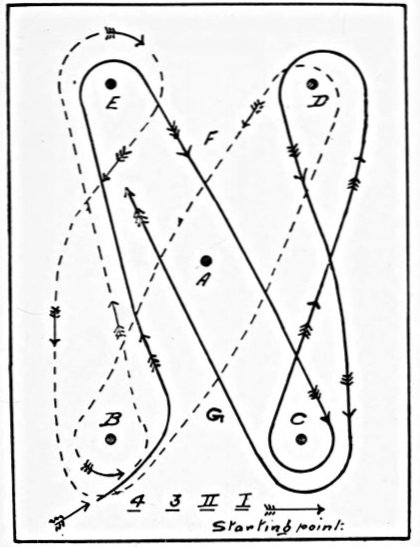
Fig. III
Cross bows.
Another ride, but requiring more accuracy in time-keeping, is that known as "cross bows," and this is one of the prettiest of all, for the whole of the lawn is occupied, and when done by practised riders and rather quickly, it is charming to watch and most fascinating to do. Again four riders are required, and they mount in line. The five clubs are in the same position as for Centre Circles. In this ride, however, there are two leaders, No. 1 being followed by rider No. 3, and No. 2 by rider No. 4. As in Figure 3, leader No. 1 will follow the dotted lines, while leader No. 2 will go over the heavy lines indicated; rider No. 3 following leader No. 1, and rider No. 4 following leader No. 2. It is imperative that the original distances be kept exactly, or in crossing at points F and G there will surely be a collision otherwise. This being a complicated ride to do well, it will require practice, but I think that by following the lines of the diagram there will be no difficulty in learning it. Leader No. 1 (having led the ride all round the lawn) on reaching club B will ride straight across to club D, keeping to the right of centre club A, and turning round club D will then ride straight back to club B again, followed by rider 3. At the same time leader 2, in starting the ride, will turn short to her left, going outside club E, where she begins the "cross bow," by riding straight across the lawn to club C. Leaders 1 and 2 should reach clubs D and E simultaneously and turn them together, and leader No. 1 making her curve closer to the club than No. 2, should pass the point F on the diagram just as No. 2 reaches it on her way to club C. In this way rider 3 will pass point F immediately after No. 2, and rider 4, following No. 2 will pass F a second after No. 3. Reaching B, leader 1 will now make the double curve round clubs B and E, as shown, and leader 2 will do the same between C and D, and on reaching B and C again, they will do once more the "cross bow" as described, only this time leader 1 will pass over point G first, and leader 2 will follow, as was done before in passing F. The greatest exactitude should be kept in crossing each other, for not only does safety demand it, but when done with indecision and over zig-zag lines, the figure loses its beauty, and like all the other rides, becomes difficult to follow. It is fatal to any ride to do it in a wavering way, which will impress people with the idea that you are not sure of it yourself. The best riders I have ever seen doing these figures, have always emphasized the straight lines, thus making their curves seem more sweeping by contrast, and adding greatly to the effect.
Another thing figure riders invariably advocate, is to ride very high, and certainly once any one has ridden with both handle-bars and seat well up, they never can go back to the lower saddle. Some people indeed say it is more difficult to ride high, but I do not think when you have become used to it, that you will find it so. Of all things to be avoided I would mention the mistake of putting up the handle bars, without heightening the saddle. I heard this position once described as that of "begging," and it has always seemed to me irresistibly ludicrous ever since. If you will watch the ankle play of two riders, one with the saddle high and the other with it low, you will not hesitate an instant as to which position is preferable.
There is no limit to the number of rides you can do. Almost any book of army drills, especially for cavalry, will give you ideas for a hundred new figures, and you can vary these, not the least amusing part being in creating, adapting and arranging figures to add to the old repertoire.
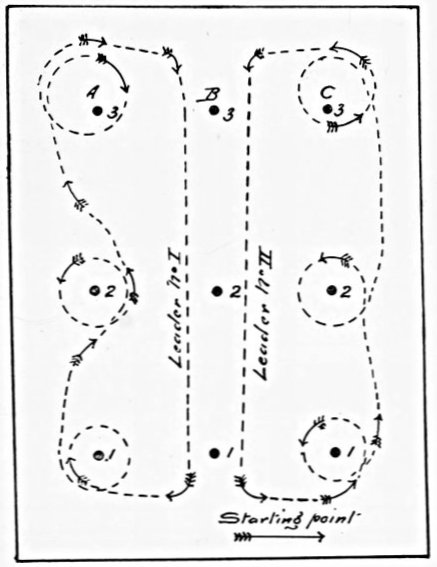
Fig. IV
American Circle ride.
But to go back to the well-known figures, with which one is never tired, and which always hold their own as to prettiness.
Let us continue with the "American Circle Ride." This can be ridden by any number and is a great favourite when introduced at garden-parties. With eight riders, three rows of three clubs each are needed, and these rows should be about three bicycle lengths from each other, while two bicycle lengths should separate the clubs in the rows. All the riders start in a line. On reaching line B, leader 1 goes to the left of Club 3, and No. 2 will keep to its right so that they ride side by side, divided by the clubs. The others divide in the same way and at the bottom they will turn to their respective sides, leader No. 1 following line A, and leader No. 2 line C. To begin with, they will both do the circles to the left as drawn down line C, and meeting at the top they again come down the centre on either side of Clubs B, side by side. The second time they both do the ride as shewn through line A, doing the middle club the reverse way to the first and last, and for the third round, reverting to the ride as shown through Clubs C, only of course, where those following leader 2 turn to the left, those following No. 1 will turn and circle to the right. In coming down the centre the leaders can join hands, and the others naturally will do the same, but this is generally called by another name, and is often worked as another figure.
Speaking of circling to left and right brings up another very pretty figure for a number of riders. Set your Clubs as for "Centre Circles" and begin (all following one leader) by circling Club B, going right round it as shown in Figure 2, and going on to E, then D, and finally to C, then describe the double curve as shown in 'cross bows' (between Clubs B and E of Figure 3) only ride straight round Club D—Figure 2. The Club marked E in the former, is D in Figure 2. Having gone round Club D, go on to Club E, and circle that to the right, and then on to B, and so circle every club as you come to it. Having circled D again, to finish the ride, go to Club C passing outside it, and then straight round the lawn. This can be done by two parties at the same time, one starting from Club B, the other from Club D, and each doing the same thing at opposite corner Clubs throughout the ride. I have seen as many as twenty riding in this figure together.
The "Maypole" is of course very pretty and when care is taken to ensure the riders having ribbons to match the colour they wear, or in which they have decked their bicycles, it is lovely. It is simple to execute, too, and can be done by almost any number, though I think eight or ten quite enough. Half the riders will go to the left, the other half to the right. Supposing the pole to be in the centre of the lawn, the four who are going to the right will mount at the four points of the compass, holding their ribbons high above them, in their right hands. The other four will mount, a little farther from the pole, as they will make a larger circle to begin with, and hold their ribbons in their left hands as they go to the left. In order to weave a regular pattern, those going to the left and right must pass each other in and out, as they meet. It is easier to learn the ride if Clubs are put up, where the riders should meet and pass each other, as they go in and out. There should be an even number of riders and a club for each. If eight were riding, four would pass the first club on the left and the next on their right, and so on, while the other half would pass their first Club on the right and the second club to the left. It will be found easier to keep your balance if you hold your arm high, and there is no doubt that it looks better.
The idea of passing clubs first on the right and then on the left alternately has been the foundation of a number of rides. A pretty sight is to have a circle of clubs, with a rider to each. One rider will begin by going outside the circle, from inside, and passing between the clubs at the same time that the next rider will pass from outside into the circle, and so picking their way to the left of one club and the right of the next, all the way round the ring. However, all depends on the riders passing the clubs at the same moment on their several ways, and as this requires no little practice to do well, one rarely sees this figure to advantage.
Fancy Figure Riding may sound tame to those who have never tried it, but I venture to think that those who once take to it will very quickly become fascinated, and my own belief is, that as figures become better known, and more hostesses introduce them at their gatherings, this branch of cycling will increase in popularity.
Evelyn Van Wart.
J. Weston and Son Folkestone.
MISS MAUD MARSHALL.
(Figure B. Overhand Service.)