THE CHASE OF THE CARTED DEER.
Reading edition
NOTE.—This article has been kindly read and approved by Mrs. Culpeper Clarke, who was unfortunately prevented from undertaking the task of writing it herself. In several cases the valuable suggestions she has made will be found embodied in the paper, marked by the initials C.F.C.C. At the special request of the writer of the paper, Mrs. Culpeper Clarke has consented to allow her photograph to appear.
Of all forms of the chase, that of the carted deer, has the unenviable distinction of having been followed, discussed and written about, by a greater number of people ignorant of the first elements of sport, than any other. It has too the disadvantage of being scorned by some of the boldest followers of the fox and the red deer, and thus while "crabbed" by those incompetent to judge, it is a "thing of naught" in the hunting calendar of some of the best sportsmen and women of the day. In spite of this, however, the hunt of the carted deer is the source of pleasure and health to many who otherwise would seldom or never be seen in the hunting-field, and as such it deserves to be chronicled.
That certain objections have always been urged with more or less weight against this particular form of sport, I am well aware, but I will leave its defence to abler hands than mine, and while ready to give help, if it may be, to any sister-sportswoman who would take it up, I must say boldly that a day with fox or hare is in my opinion, worth more than a dozen brilliant gallops after an enlarged deer. On the score of humanity, however, there is undoubtedly nothing to be said in its disfavour. The deer is well fed and cared for, and rarely comes to harm when before the hounds, and though there are nervous deer as nervous people, who will in the one case "funk" a possible fence, and in the other show signs of extreme fear at the pursuit of hounds, I do not believe in the agonies of terror of which the so-called humanitarians are pleased to make so much. On this point, however, let those who like Lord Ribblesdale, can wield the pen with as skilful a hand as they can steer a horse across country, speak with the authority which is theirs by right of profound knowledge, and long and unusual experience. And if we should find that other forms of sport are for whatever reason out of our reach, we may well be content to ride after the carted deer with such sisters of the chase as Lady Julia Follett, Lady Georgiana Curzon, Lady Downshire, and the brilliant horsewomen who week after week are among the followers of the Wards over the stiffest part of the Meath country. Can we go far wrong either in following such sportsmen as Lord Coventry and Lord Ribblesdale, with the spirit of Whyte-Melville inspiring us?
Let us then turn for a few words about the quarry of the Stag-hunt. The animal pursued, whether it be Stag, Havier, or Hind, has been carefully selected and most heedfully cared for, so that when it comes out for a gallop it is in the very height of condition. It is not often that it is asked to exert itself, for it comes out only in its proper turn, and this in the larger hunting establishments would not be more than three or four times in the course of the season. A Stag, fed on the choicest oats and the best old hay is not easily fatigued, and probably at the close of the day's proceedings, will not be nearly so "done" as the horses that have ridden in its pursuit, or the men and women to whom it has been giving pleasure. We all know the old history of Mr. Henry Nevill's deer, which lived on terms of perfect amity with the hounds kept for their chase, and I have myself seen a stag deliberately trot down a road and look over the hedge at the pack, which had considerately been stopped till his Lordship should get his second wind. The exploits of a celebrated old hind too, which was on the best of terms with all connected with her hunt, are still remembered in the country in which she afforded sport. As soon as she was released she would speed away, often for twenty miles or so, and when weary would take refuge in a wood. Recognising the sign that the hunt was at an end, the huntsman then stopped his hounds, leaving the hind in peace till the deer-cart came up. When this had been backed to the boundary fence of the covert where the deer was waiting, and the old driver had given a low peculiar whistle, the keen ears and soft eyes of the hind would appear through the bushes. If no enemy was in sight, she would then jump lightly in the cart and be driven home. Let us hope she would have a more comfortable journey than many a sportswoman, with weary limbs and a weary horse to carry her, and many long miles stretching between her and her abode.
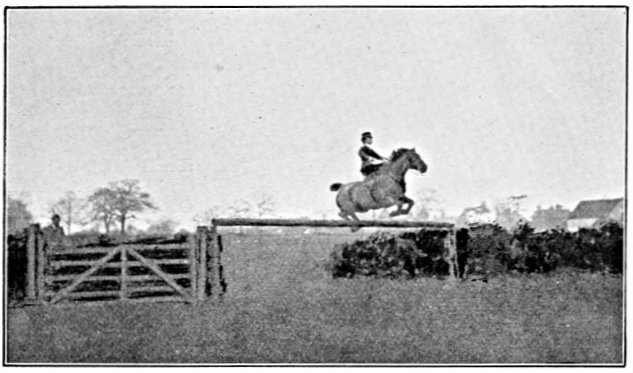
IN THE AIR. NO. 1.
There are certain women who ride hard, for whom this form of the chase has special advantages. For example there is the woman who from whatever cause, whether from the care of a large household, or the pressure of the duties that her literary or artistic, or it may be her political tastes, have involved her in, finds it extremely difficult to take a whole long day for her pleasure in the field, and to such an one the short day with staghounds will be an inestimable boon. Again there are women, whose social or domestic duties keep them in town during the winter months, and to them a run with the staghounds will be a much-prized form of recreation.
On the other hand it should be remembered that to some women who are more or less of invalids, and who would yet rather not go out at all than leave off before the run is over, the possible long day, and the almost certain fast pace with staghounds, will be against this form of sport. This, like most other matters connected with sport, will depend very much whether the chase of the deer is the sport of the neighbourhood, when hounds will often make long days, or whether, as in some good foxhunting countries, it is more or less subservient to the chase of the fox.
There are others again whose lot is cast in a good stag-hunting country, who honestly find a satisfying enjoyment in riding after the hounds. These will like to make long days, and if they follow the chase to the end, will be not less weary than their foxhunting sisters, by the time they turn their steps homewards.
Let us see how such will fare.
Suppose that a run with Lord Rothschild's splendid pack is in prospect, and that the meet is fixed for twelve o'clock. If time is of moment to you, you may reckon that if you arrive at the rendezvous three quarters of an hour later, you will find you still have a margin before hounds are laid on. This will give you a comfortable morning's work, before the cart is at the door. For remember, that a pony cart or dog cart, or the more luxurious brougham, is very necessary to the comfort of the hunter of the carted deer. In the first place the long distances covered and the fast pace, make large demands on a woman's powers and those of her horse, and she should, therefore, husband both till the moment of the chase arrives. Equally for both horse and rider too, she should, if possible, make the return journey also in the cart.
That this often will not be practicable, and for the same reason that it is generally useless to have a second horse out stagging, does not in any way detract from the comfort of having the cart at hand if it can be managed. If, however, the deer should run too fast and too far, for his cart to come up to him for many hours after the "take," then—and this will be the most frequent experience of the followers of the chase—the rail may prove the best hack home for both woman and horse.
The former will thus be saved a weary jog home, and her horse will also be spared what, even if he is a good hack, will be the most difficult part of the day's work to him. And though, of course, an ideal woman's hunter should also be a perfect hack, how few even good horses answer the description. What hunting woman cannot recall some animal, and many it may be, which have served their turn, for which she would not have taken centuries, if offered when he was sailing with magnificent action over a grass country, but which on the journey home at night, she would have been almost inclined to give away to the first comer? But even with a good hack, it is a doubtful pleasure to ride him after he has tired himself in the chase, and you will find it a relief unspeakable to exchange the saddle for the cushions, and to drive or train home, instead of striving to keep your weary hunter on his legs.
T. Bennett and Sons. Worcester and Malvern
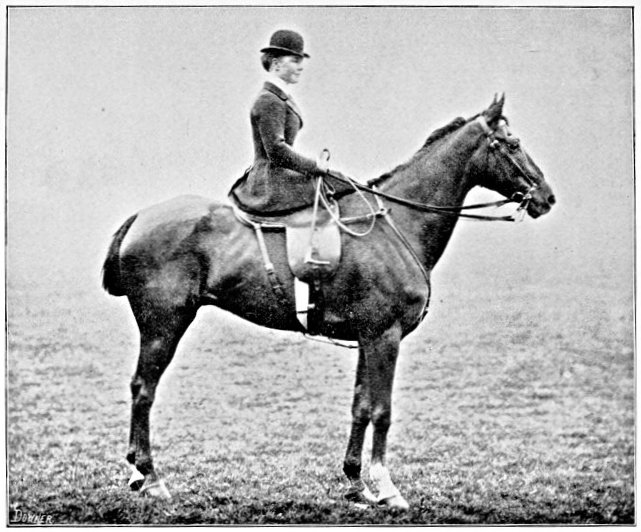
LADY DOROTHY COVENTRY ON SIXPENNY.
But to return to the meet. When you get to the place of meeting there will be three courses open to you as a rule. You can either see the stag un-carted and the hounds laid on, or you can omit the first ceremony and come on the scene with the hounds, which in well regulated establishments will not have been allowed to catch a view of the cart, or you can adopt another course, and wait till the stag has completed his first circle, which he is almost sure to run before leaving. If you incline to the last, and there is much to be said in its favour, you will look out for some point, such as the crossing of a road by the stag, and trotting quietly down to it, you will wait for the hounds to come up. By the time they reach you, they will have got over the first flurry with which staghounds always make for the line, and will come chiming down as prettily as a pack of harriers.
[I think the best plan is to come into the field with the hounds, if possible, pick your own place at the first fence—of course riding wide of the hounds—and do your level best to get a good start. If staghounds really run, a good start is every bit as important with them as in the Shires, and that is one reason I think they are such good training for judgment, decision and nerve. She who hesitates is sure to be lost sooner or later, and when you have been out of a good thing two or three times, because you did not push along at first, it does make you keen.—C.F.C.C.]
Then you should ride to the hounds and watch them working. You will observe that they string more than foxhounds—though they are foxhounds in everything but the use to which they are put—but such packs as Lord Rothschild's or the Queen's, will drive forward on a hot scent and work out a cold one, in a way that will delight any lover of hound work. Now you may, nay you must, ride somewhat closer to the pack than would be quite orthodox with foxhounds, and if there should be anything like a scent you will find that in spite of being a light weight, it may be, and riding one of the best, it will take you all your time to live with them. Nor will you be in any danger of overriding hounds. With a good deer you will find you need all your judgment, horsemanship, coolness and pluck to live to the end.
After you have been going some twenty or twenty-five minutes, perhaps, hounds will run up to their deer. But the sport will not be over. If possible at this point you should notice whether the deer has his mouth open or shut, for this will tell you whether you may still look for a long gallop or not. A deer, be it remembered, closes his mouth when he is beaten, but as long as he has it open, you may be sure he has not the smallest intention of being captured. You will find that with the consideration for the feelings of the quarry which marks all the proceedings, hounds will not be allowed to go on till ample time has been given for the deer to get a good start. He may not unlikely be encouraged by the friendly crack of a hunting crop by one of the field, but otherwise his Lordship will be left to himself, and the hounds meanwhile will stand with their sterns waving in eager impatience to be off, and their eyes fixed on the face of the huntsman. It was a grand sight to see poor Mark Howcutt at such a moment, in the vale of Aylesbury. The loose thong of his whip, as he sat motionless in front of hounds was enough to keep them in check, and when he quietly gathered the thong up, they knew the moment had come, and casting themselves on the line, they would break into a chorus of rejoicing, and race eagerly away.
It is not till you see the stag soil, that you may begin to take things easily, for this is generally a sign of the beginning of the end. It is, however (and here I recall the words of Whyte Melville), an act of courtesy to those who supply our sport, to stay and see the deer taken before we leave. If you are up at the end of a good gallop over the Vale, you may be pretty sure you will be able to hold your own wherever fortune may lead you, even if the Quorn hounds should be running their best from the Ashby Pastures, over the Twyford Vale to Burrough Hill, or the Cottesmore lady-pack be racing in front of you from Ranksboro' Gorse to Woodwell Head.
As stag-hunting begins later in the day than the pursuit of the fox, so does it leave off earlier, and the sportswoman who shares in it will generally find herself at home in time to get into a comfortable tea-gown, and give what our neighbours call "five o'clock" to her friends. There will then be the chance of a rest before dinner, and to those who are not over-strong, or who have heavy social duties before them, I would recommend the plan of a well-known rider to hounds in Leicestershire, who goes quietly to bed and gets perhaps a couple of hours sleep before her maid rouses her to dress for dinner. As many women undoubtedly suffer from the strain entailed by the great demands on their strength during the hunting season, the plan may help them to keep both good looks and health, and will thus give them a keener enjoyment in their favourite sport.
And now a word as to equipment, though this will be brief indeed, as what applies to the follower of the fox applies in almost every particular to her who rides after the stag. I would only suggest in the latter case that the habit worn should be plain, and that the distinctive collar of any Foxhunt of which you may be a member, is not quite in place when you are following another form of sport. As to the vexed question of the tall and the round hat, in the hunting-field, some will declare in favour of comfort as represented by the latter, while others will prefer the undeniable smartness of the ugliest product of modern civilization.
[My advice to everyone is to take a change in a Gladstone, and leave it either at the Inn where the meet is, or better still with the clothing and horse-box, for it is a serious matter to get ducked in a brook and then perhaps have a long train journey home, without the possibility of dry clothes. I say this feelingly, as this year after the Stag in Kent, I fell at a brook about 2.15—my watch stopped, so I know the hour—and after finishing the run, I had to ride seven miles to Paddock Wood, before training home. Of course I ought to have died of pneumonia after this, but happily was none the worse.—C.F.C.C.]
The above note reminds me that if at any time you should get a wetting, such as that described above, and have no welcome change at hand, you will in nine cases out of ten experience no harm, if in train or cart you cover your wet clothing with coat or rug, or even horse-cloth should nothing else be available. Some may think even a probable chill preferable to the last suggestion, but verbum sap.
The canteen for a day with staghounds will not require much thought, for between the late breakfast and early tea, which generally are possible, the demands of appetite will not be great. However, as there will be no second horseman to rely on, the sportswoman will do well to carry with her a few biscuits and a little cold essence of beef, or a slice of plum pudding, and some port wine should she prefer it. (A medical friend says there is nothing like Kola Wine.)
But now, last, though of more importance than all that has gone before, we come to the question of the hunter. To leave out of count for the moment, the points we should insist on for all women's hunters, the first great requisite for a horse that is to follow staghounds, is speed. For remember that the fastest possible form of the chase, is when a pack of large-sized foxhounds, is in pursuit of a red deer hind, over a grass country. A well-bred horse is essential, and other things being equal, if clean thoroughbred, so much the better.
[From my eleven years' experience of Stag-hunting, I have come to the conclusion that the most essential thing is that a hunter should be well-seasoned. If you ride a young horse with the stag, which would go perfectly well with foxhounds, he will go off his feed and fall all to pieces, even if you are lucky enough not to strain or over-reach him. A horse ought in my opinion to be quite seven years old, to take his turn regularly once a week stagging.
I quite agree with what you say about breeding, but for a woman the ideal horse for staghounds must not only be temperate, but in every way good-mannered. I suppose it is the rush at starting, which of course suggests racing, that excites them, but I know by experience that a horse which is a comfortable mount for a woman with Foxhounds or Harriers, may prove quite unmanageable if taken with Staghounds. A hot horse, too, even if you can ride it, takes so much out of itself, that it cannot stand the long days, and is sure to knock up. With the packs I know in Surrey and Kent, a good timber jumper is essential, and in Kent you also want a water jumper—a rare combination.—C.F.C.C.]
A good fencer will be the best to carry you in the Vale of Aylesbury or the Ashford Vale; while if you go out with the Queen's, you will need a stouter animal for their Beaconsfield country, and indeed for most of the country of the Royal Hunt. With the Wards in Ireland, you will need the very best class of horse you will ride with the Meath, and in all countries where the chase of the carted deer is pursued, you will, in my opinion, find size and scope important, as a large horse will be going well within himself while a smaller one is at a stretch. As however to every rule there is an exception, so an undoubted authority tells me, that an Arab pony standing only 14·2, was well to the front in a good run after stag one day this season (1897-8), and pounded some gallant Dragoons over a six-barred gate.
Although the fences in most stag-hunting countries are generally of a manageable size, yet as you have to gallop at them, you should have a bold free horse under you. One too which has his wits about him is perhaps, if that be possible, even more valuable after stag than after fox or hare, the pace necessitating the promptest decision and the greatest possible judgment in making the best of the unexpected, which is sure to happen, even when you think you know every inch of the country.
Stag-hunting then, we have seen, has its advantages, and I am not sure that if your lot is cast in a provincial country where the interest of watching hounds track their fox over flinty hills, from the depths of one thick covert to the recesses of another, is seldom varied by a gallop, you will not do well to take your place, at least occasionally, with the followers of the local staghounds. Of course, I am taking for granted that you are, more or less, interested in the working of hounds; but if you should be one of the hard-riding brigade, who frankly acknowledge they hunt to ride, then I should say that your best place will always be with staghounds, for with them you may reckon on the gallop which with other hounds is, and always must be, a matter of doubt. In most parts of the country you will find some staghounds within reach, at least of the "iron covert hack," and in Ireland the Wards and the Rosscommon are unrivalled for speed and incident in any land. It is only, though, the youngest, and pluckiest, and best mounted of us who can hope to live over the stiff Irish banks at the pace at which the latter hounds go. A saddening thought, but true, as many a good woman has found to her cost.
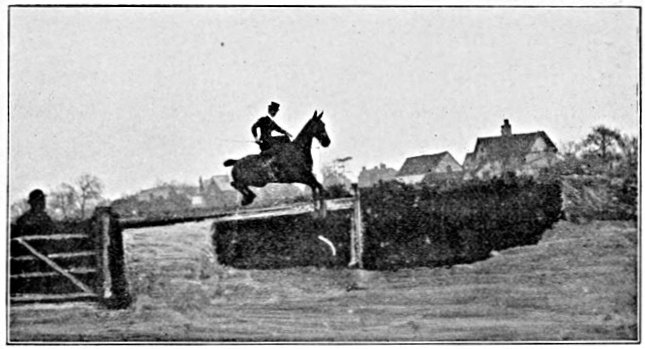
IN THE AIR. NO. 2.
If your hunting lot should be cast within distance of a stag-hound kennel, I would strongly advise you to learn something about the hounds. Your pleasure in the chase will be greater if you can distinguish between the notes of a trusted hound and those of a youngster which has not proved his right to your confidence. My own reception by kindly Fred Cox, when I made my first visit to Lord Rothschild's celebrated kennels, I have always felt to be a reproach to my fellow-sportswomen on this point. It was during a frost in the early days of 1895, that I determined to ask Cox to show me his beauties on the flags. A telegram brought back a satisfactory reply, and I duly presented myself at Cox's door. Mrs. Cox, however, was doubtful about admitting me, and told me her husband was engaged to show the hounds to a visitor at twelve o'clock.
"But I made an appointment for that hour," was my remark, and the astonishment with which the old lady regarded me I shall never forget.
With uplifted hands she exclaimed, "Well, to be sure ma'am, we thought you was a man!" and it was some little time, I could see, before the old huntsman himself decided that though I had the misfortune to be a woman, I was not altogether ignorant of what a good hound should be.
It will be a good thing when more women who ride to hounds know sufficient of hound work to be able to take an intelligent interest in the performance of the pack in the field, for those who can only enjoy a mad gallop know but little of the inner joys of the hunting field.
Frances E. Slaughter.
THE LADY THEODORA GUEST ON PEMBROKE.
(With the Blackmore Vale Hounds.)