Front matter
Reading edition
Cover art
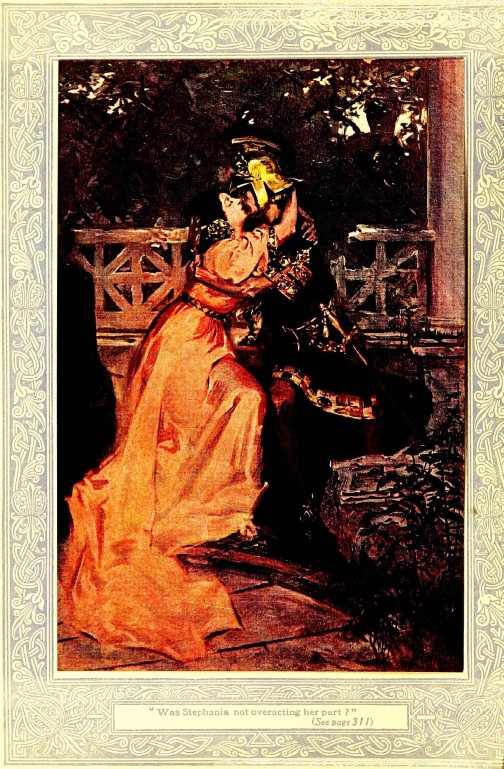
Was Stephania not overacting her part? (See page 311)

Title page
THE SORCERESS OF ROME
BY
NATHAN GALLIZIER
AUTHOR OF CASTEL DEL MONTE
PICTURES BY THE KINNEYS
DECORATIONS BY P. VERBURG
THE PAGE COMPANY BOSTON PUBLISHERS
Copyright, 1907 BY L. C. PAGE & COMPANY (INCORPORATED)
Entered at Stationers' Hall, London
All rights reserved
First Impression, October, 1907 Second Impression, February, 1920
THE COLONIAL PRESS C. H. SIMONDS CO., BOSTON, U.S.A.
Somewhere, in desolate wind-swept space,
In Twilight-land, in no-man's land,
Two hurrying shapes met face to face
And bade each other stand.
"And who are you?" cried one agape
Shuddering in the gloaming light.
"I know not," said the second shape,
"I only died last night."
THOMAS BAILEY ALDRICH.
decoration
music fragment
INTRODUCTION
The darkness of the tenth century is dissipated by no contemporary historian. Monkish chronicles alone shed a faint light over the discordant chaos of the Italian world. Rome was no longer the capital of the earth. The seat of empire had shifted from the banks of the Tiber to the shores of the Bosporus, and the seven hilled city of Constantine had assumed the imperial purple of the ancient capital of the Cæsars.
Centuries of struggles with the hosts of foreign invaders had in time lowered the state of civilization to such a degree, that in point of literature and art the Rome of the tenth century could not boast of a single name worthy of being transmitted to posterity. Even the memory of the men whose achievements in the days of its glory constituted the pride and boast of the Roman world, had become almost extinct. A great lethargy benumbed the Italian mind, engendered by the reaction from the incessant feuds and broils among the petty tyrants and oppressors of the country.
Together with the rest of the disintegrated states of Italy, united by no common bond, Rome had become the prey of the most terrible disorders. Papacy had fallen into all manner of corruption. Its former halo and prestige had departed. The chair of St. Peter was sought for by bribery and controlling influence, often by violence and assassination, and the city was oppressed by factions and awed into submission by foreign adventurers in command of bands collected from the outcasts of all nations.
From the day of Christmas in the year 800, when at the hands of Pope Leo III, Charlemagne received the imperial crown of the West, the German Kings dated their right as rulers of Rome and the Roman world, a right, feebly and ineffectually contested by the emperors of the East. It was the dream of every German King immediately upon his election to cross the Alps to receive at the hand of the Pope the crown of a country which resisted and resented and never formally recognized a superiority forced upon it. Thus from time to time we find Rome alternately in revolt against German rule, punished, subdued and again imploring the aid of the detested foreigners against the misrule of her own princes, to settle the disputes arising from pontifical elections, or as protection against foreign invaders and the violence of contending factions.
Plunged in an abyss from which she saw no other means of extricating herself, harassed by the Hungarians in Lombardy and the Saracens in Calabria, Italy had, in the year 961, called on Otto the Great, King of Germany, for assistance. Little opposition was made to this powerful monarch. Berengar II, the reigning sovereign of Italy, submitted and agreed to hold his kingdom of him as a fief. Otto thereupon returned to Germany, but new disturbances arising, he crossed the Alps a second time, deposed Berengar and received at the hands of Pope John XII the imperial dignity nearly suspended for forty years.
Every ancient prejudice, every recollection whether of Augustus or Charlemagne, had led the Romans to annex the notion of sovereignty to the name of Roman emperor, nor were Otto and his two immediate descendants inclined to waive these supposed prerogatives, which they were well able to enforce. But no sooner had they returned to Germany than the old habit of revolt seized the Italians, and especially the Romans who were ill disposed to resume habits of obedience even to the sovereign whose aid they had implored and received. The flames of rebellion swept again over the seven hilled city during the rule of Otto II, whose aid the Romans had invoked against the invading hordes of Islam, and the same republican spirit broke out during the brief, but fantastic reign of his son, the third Otto, directing itself in the latter instance chiefly against the person of the youthful pontiff, Bruno of Carinthia, the friend of the King, whose purity stands out in marked contrast against the depravity of the monsters, who, to the number of ten, had during the past five decades defiled the throne of the Apostle. Gregory V is said to have been assassinated during Otto's absence from Rome.
The third rebellion of Johannes Crescentius, Senator of Rome, enacted after the death of the pontiff and the election of Sylvester II, forms but the prelude to the great drama whose final curtain was to fall upon the doom of the third Otto, of whose love for Stephania, the beautiful wife of Crescentius, innumerable legends are told in the old monkish chronicles and whose tragic death caused a lament to go throughout the world of the Millennium.

decoration
CONTENTS

decoration
BOOK THE FIRST
Chapter
The Grand Chamberlain
The Pageant in the Navona
On the Palatine
The Wanton Court of Theodora
The Wager
John of the Catacombs
The Vision of San Pancrazio
Castel San Angelo
The Sermon in the Ghetto
The Sicilian Dancer
Nilus of Gaëta
Red Falernian
Dead Leaves
The Phantom at the Shrine
The Death Watch
The Conclave
BOOK THE SECOND
The Meeting
The Queen of Night
The Elixir of Love
The Secret of the Tomb
The Grottos of Egeria
Beyond the Grave
Ara Coeli
The Gothic Tower
The Snare of the Fowler
The Temple of Neptune
The Incantation
The Hermitage of Nilus
The Lion of Basalt
The Last Tryst
The Storm of Castel San Angelo
The Forfeit
Nemesis
Vale Roma
BOOK THE THIRD
Paterno
Memories
The Consummation
The Angel of the Agony
Return
decoration
decoration
LIST OF ILLUSTRATIONS
"Was Stephania not overacting her part?" (See page 311) Frontispiece
"Looking up from the task he was engaged in"
"Persisting in his endeavour to remove her mask"
"The haunting memories of Stephania"
decoration
Book the First
The Truce of God
"As I came through the desert, thus it was
As I came through the desert: All was black,
In heaven no single star, on earth no track;
A brooding hush without a stir or note,
The air so thick it clotted in my throat.
And thus for hours; then some enormous things
Swooped past with savage cries and clanking wings;
But I strode on austere;
No hope could have no fear."
—James Thomson.
BOOK THE FIRST
CHAPTER I
THE GRAND CHAMBERLAIN
t was the hour of high noon on a sultry October day in Rome, in the year of our Lord nine hundred and ninety-nine. In the porphyry cabinet of the imperial palace on Mount Aventine, before a table covered with parchments and scrolls, there sat an individual, who even in the most brilliant assembly would have attracted general and immediate attention.
Judging from his appearance he had scarcely passed his thirtieth year. His bearing combined a marked grace and intellectuality. The finely shaped head poised on splendid shoulders denoted power and intellect. The pale, olive tints of the face seemed to intensify the brilliancy of the black eyes whose penetrating gaze revealed a singular compound of mockery and cynicism. The mouth, small but firm, was not devoid of disdain, and even cruelty, and the smile of the thin, compressed lips held something more subtle than any passion that can be named. His ears, hands and feet were of that delicacy and smallness, which is held to denote aristocracy of birth. And there was in his manner that indescribable combination of unobtrusive dignity and affected elegance which, in all ages and countries, through all changes of manners and customs has rendered the demeanour of its few chosen possessors the instantaneous interpreter of their social rank. He was dressed in a crimson tunic, fastened with a clasp of mother-of-pearl. Tight fitting hose of black and crimson terminating in saffron-coloured shoes covered his legs, and a red cap, pointed at the top and rolled up behind brought the head into harmony with the rest of the costume.
Now and then, Benilo, the Grand Chamberlain, cast quick glances at the sand-clock on the table before him; at last with a gesture of mingled impatience and annoyance, he pushed back the scrolls he had been examining, glanced again at the clock, arose and strode to a window looking out upon the western slopes of Mount Aventine.
The sun was slowly setting, and the light green silken curtains hung motionless, in the almost level rays. The stone houses of the city and her colossal ruins glowed with a brightness almost overpowering. Not a ripple stirred the surface of the Tiber, whose golden coils circled the base of Aventine; not a breath of wind filled the sails of the deserted fishing boats, which swung lazily at their moorings. Over the distant Campagna hung a hot, quivering mist and in the vineyards climbing the Janiculan Mount not a leaf stirred upon its slender stem. The ramparts of Castel San Angelo dreamed deserted in the glow of the westering sun, and beyond the horizon of ancient Portus, torpid, waveless and suffused in a flood of dazzling brightness, the Tyrrhene Sea stretched toward the cloudless horizon which closed the sun-bright view.
How long the Grand Chamberlain had thus abstractedly gazed out upon the seven-hilled city gradually sinking into the repose of evening, he was scarcely conscious, when a slight knock, which seemed to come from the wall, caused him to start. After a brief interval it was repeated. Benilo drew the curtains closer, gave another glance at the sand-clock, nodded to himself, then, approaching the opposite wall, decorated with scenes from the Metamorphoses of Ovid, touched a hidden spring. Noiselessly a panel receded and, from the chasm thus revealed, something like a shadow passed swiftly into the cabinet, the panel closing noiselessly behind it.
Benilo had reseated himself at the table, and beckoned his strange visitor to a chair, which he declined. He was tall and lean and wore the gray habit of the Penitent friars, the cowl drawn over his face, concealing his features.
For some minutes neither the Grand Chamberlain nor his visitor spoke. At last Benilo broke the silence.
"You are the bearer of a message?"
The monk nodded.
"Tell me the worst! Bad news is like decaying fruit. It becomes the more rotten with the keeping."
"The worst may be told quickly enough," said the monk with a voice which caused the Chamberlain to start.
"The Saxon dynasty is resting on two eyes."
Benilo nodded.
"On two eyes," he repeated, straining his gaze towards the monk.
"They will soon be closed for ever!"
The Chamberlain started from his seat.
"I do not understand."
"The fever does not temporize."
"'Tis the nature of the raven to croak. Let thine improvising damn thyself."
"Fate and the grave are relentless. I am the messenger of both!"
"King Otto dying?" the Chamberlain muttered to himself. "Away from Rome,—the Fata Morgana of his dreams?"
A gesture of the monk interrupted the speaker.
"When a knight makes a vow to a lady, he does not thereby become her betrothed. She oftener marries another."
"Yet the Saint may work a miracle. The Holy Father is praying so earnestly for his deliverance, that Saint Michael may fear for his prestige, did he not succour him."
"Your heart is tenderer than I had guessed."
"And joined by the prayers of such as you—"
The monk raised his hand.
"Nay,—I am not holy enough."
"I thought they were all saints at San Zeno."
"That is for Rome to say."
There was a brief pause during which Benilo gazed into space. The monk heard him mutter the word "Dying—dying" as if therein lay condensed the essence of all his life.
Reseating himself the Chamberlain seemed at last to remember the presence of his visitor, who scrutinized him stealthily from under his cowl. Pointing to a parchment on the table before him, he said dismissing the subject:
"You are reported as one in whom I may place full trust, in whom I may implicitly confide. I hate the black cassocks. A monk and misfortune are seldom apart. You see I dissemble not."
The Grand Chamberlain's visitor nodded.
"A viper's friend must needs be a viper,—like to like!"
"'Tis not the devil's policy to show the cloven hoof."
"Yet an eavesdropper is best equipped for a prophet."
Again the Chamberlain started.
Straining his gaze towards the monk, who stood immobile as a phantom, he said:
"It is reported that you are about to render a great service to Rome."
The monk nodded.
"A country without a king is bad! But to carry the matter just a trifle farther,—to dream of Christendom without a Pope—"
"You would not dare!" exclaimed Benilo with real or feigned surprise, "you would not dare! In the presence of the whole Christian world? Rome can do nothing without the Sun,—nothing without the Pope. Take away his benediction: 'Urbi et Orbi'—What would prosper?"
"You are a poet and a Roman. I am a monk and a native of Aragon."
Benilo shrugged his shoulders.
"'Tis but the old question: Cui bono? How many pontiffs have, within the memory of man, defiled the chair of Saint Peter? Who are your reformers? Libertines and gossipers in the taverns of the Suburra, among fried fish, painted women, and garlic; in prosperity proud, in adversity cowards, but infamous ever! The fifth Gregory alone soars so high above the earth, he sees not the vermin, the mire beneath."
"Perhaps they wished to let the mire accumulate, to furnish work for the iron broom of your tramontane saint! Are not his shoulders bent in holy contemplation, like the moon in the first quarter? Is he not shocked at the sight of misery and of dishevelled despair? His sensitive nerves would see them with the hair dressed and bound like that of an antique statue."
"Ay! And the feudal barons stick in his palate like the hook in the mouth of the dog fish."
"We want no more martyrs! The light of the glow-worm continues to shine after the death of the insect."
"It was a conclave, that disposed of the usurper, John XVI."
"Ay! And the bravo, when he discovered his error, paid for three candles for the pontiff's soul, and the monk who officiated at the last rites praised the departed so loudly, that the corpse sat up and laughed. And now he is immortal and possesses the secret of eternal life," the monk concluded with downcast eyes.
"Yet there is one I fear,—one who seems to enlist a special providence in his cause."
"Gerbert of Cluny—"
"The monk of Aurillac!"
"They say that he is leagued with the devil; that in his closet he has a brazen head, which answers all questions, and through which the devil has assured him that he shall not die, till he has said mass in Jerusalem."
"He is competent to convert a brimstone lake."
"Yet a true soldier seeks for weak spots in the armour."
"I am answered. But the time and the place?"
"In the Ghetto at sunset."
"And the reward?"
"The halo of a Saint."
"What of your conscience's peace?"
"May not a man and his conscience, like ill-mated consorts, be on something less than speaking terms?"
"They kill by the decalogue at San Zeno."
"Exitus acta probat!" returned the monk solemnly.
Benilo raised his hand warningly.
"Let him disappear quietly—ecclesiastically."
"What is gained by caution when one stands on an earthquake?" asked the monk.
"You deem not, then, that Heaven might take so strong an interest in Gerbert's affairs, as to send some of the blessed to his deliverance?" queried Benilo suavely.
The Chamberlain's visitor betrayed impatience.
"If Heaven troubled itself much about what is done on earth, the world's business would be well-nigh bankrupt."
"Ay! And even the just may fall by his own justice!" nodded Benilo. "He should have made his indulgences dearer, and harder to win. Why takes he not the lesson from women?"
There was a brief pause, during which Benilo had arisen and paced up and down the chamber. His visitor remained immobile, though his eyes followed Benilo's every step.
At last the Grand Chamberlain paused directly before him.
"How fares his Eminence of Orvieto? He was ailing at last reports," he asked.
"He died on his way to Rome, of a disease, sudden as the plague. He loved honey,—they will accuse the bees."
With a nod of satisfaction Benilo continued his perambulation.
"Tell me better news of our dearly beloved friend, Monsignor Agnello, Archbishop of Cosenza, Clerk of the Chamber and Vice-Legate of Viterbo."
"He was found dead in his bed, after eating a most hearty supper," the monk spoke dolefully.
"Alas, poor man! That was sudden. But such holy men are always ready for their call," replied the Grand Chamberlain with downcast eyes. "And what part has his Holiness assigned me in his relics?"
"Some flax of his hair shirt, to coil a rope therewith," replied the monk.
"A princely benefaction! But your commission for the Father of Christendom? For indeed I fear the vast treasures he has heaped up, will hang like a leaden mountain on his ascending soul."
"The Holy Father himself has summoned me to Rome!" The words seemed to sound from nowhere. Yet they hovered on the air like the knell of Fate.
The Grand-Chamberlain paused, stared and shuddered.
"And who knows," continued the monk after a pause, "but that by some divine dispensation all the refractory cardinals of the Sacred College may contract some incurable disease? Have you secured the names,—just to ascertain if their households are well ordered?"
"The name of every cardinal and bishop in Rome at the present hour."
"Give it to me."
A hand white as that of a corpse came from the monk's ample parting sleeves in which Benilo placed a scroll, which he had taken from the table.
The monk unrolled it. After glancing down the list of names, he said:
"The Cardinal of Gregorio."
The Chamberlain betokened his understanding with a nod.
"He claims kinship with the stars."
"The Cardinal of San Pietro in Montorio."
An evil smile curved Benilo's thin, white lips.
"An impostor, proved, confessed,—his conscience pawned to a saint—"
"The Cardinal of San Onofrio,—he, who held you over the baptismal fount," said the monk with a quick glance at the Chamberlain.
"I had no hand in my own christening."
The monk nodded.
"The Cardinal of San Silvestro."
"He vowed he would join the barefoot friars, if he recovered."
"He would have made a stalwart mendicant. All the women would have confessed to him."
"It is impossible to escape immortality," sighed Benilo.
"Obedience is holiness," replied the other.
After carefully reviewing the not inconsiderable list of names, and placing a cross against some of them, the monk returned the scroll to its owner.
When the Chamberlain spoke again, his voice trembled strangely.
"What of the Golden Chalice?"
"Offerimus tibi Domine, Calicem Salutaris," the monk quoted from the mass. "What differentiates Sacramental Wine from Malvasia?"
The Chamberlain pondered.
"Perhaps a degree or two of headiness?"
"Is it not rather a degree or two of holiness?" replied the monk with a strange gleam in his eyes.
"The Season claims its mercies."
"Can one quench a furnace with a parable?"
"The Holy Host may work a miracle."
"It is the concern of angels to see their sentences enforced."
"Sic itur ad astra," said the Chamberlain devoutly.
And like an echo it came from his visitor's lips:
"Sic itur ad astra!"
"We understand each other," Benilo spoke after a pause, arising from his chair. "But remember," he added with a look, which seemed to pierce his interlocutor through and through. "What thou dost, monk, thou dost. If thy hand fail, I know thee not!"
Stepping to the panel, Benilo was about to touch the secret spring, when a thought arrested his hand.
"Thou hast seen my face," he turned to the monk. "It is but meet, that I see thine."
Without a word the monk removed his cowl. As he did so, Benilo stood rooted to the spot, as if a ghost had arisen from the stone floor before him.
"Madman!" he gasped. "You dare to show yourself in Rome?"
A strange light gleamed in the monk's eyes.
"I came in quest of the End of Time. Do you doubt the sincerity of my intent?"
For a moment they faced each other in silence, then the monk turned and vanished without another word through the panel which closed noiselessly behind him.
When Benilo found himself once more alone, all the elasticity of temper and mind seemed to have deserted him. All the colour had faded from his face, all the light seemed to have gone from his eyes. Thus he remained for a space, neither heeding his surroundings, nor the flight of time. At last he arose and, traversing the cabinet, made for a remote door and passed out. Whatever were his thoughts, no outward sign betrayed them, as with the suave and impenetrable mien of the born courtier, he entered the vast hall of audience.
A motley crowd of courtiers, officers, monks and foreign envoys, whose variegated costumes formed a dazzling kaleidoscope almost bewildering to the unaccustomed eye, met the Chamberlain's gaze.
The greater number of those present were recruited from the ranks of the Roman nobility, men whose spare, elegant figures formed a striking contrast to the huge giants of the German imperial guard. The mongrel and craven descendants of African, Syrian and Slavonian slaves, a strange jumble of races and types, with all the visible signs of their heterogeneous origin, stared with insolent wonder at the fair-haired sons of the North, who took their orders from no man, save the grandson of the mighty emperor Otto the Great, the vanquisher of the Magyars on the tremendous field of the Lech.
A strange medley of palace officials, appointed after the ruling code of the Eastern Empire, chamberlains, pages and grooms, masters of the outer court, masters of the inner court, masters of the robe, masters of the horse, seneschals, high stewards and eunuchs, in their sweeping citron and orange coloured gowns, lent a glowing enchantment to the scene.
No glaring lights marred the pervading softness of the atmosphere; all objects animate and inanimate seemed in complete harmony with each other. The entrance to the great hall of audience was flanked with two great pillars of Numidian marble, toned by time to hues of richest orange. The hall itself was surrounded by a colonnade of the Corinthian order, whereon had been lavished exquisite carvings; in niches behind the columns stood statues in basalt, thrice the size of life. Enormous pillars of rose-coloured marble supported the roof, decorated in the fantastic Byzantine style; the floor, composed of serpentine, porphyry and Numidian marble, was a superb work of art. In the centre a fountain threw up sprays of perfumed water, its basin bordered with glistening shells from India and the Archipelago.
Passing slowly down the hall, Benilo paused here and there to exchange greetings with some individual among the numerous groups, who were conversing in hushed whispers on the event at this hour closest to their heart, the illness of King Otto III, in the cloisters of Monte Gargano in Apulia whither he had journeyed on a pilgrimage to the grottoes of the Archangel. Conflicting rumours were rife as to the course of the illness, and each seemed fearful of venturing a surmise, which might precipitate a crisis, fraught with direst consequences. The times and the Roman temper were uncertain.
The countenance of Archbishop Heribert of Cologne, Chancellor of the Empire, reflected grave apprehension, which was amply shared by his companions, Archbishop Willigis of Mentz, and Luitprand, Archbishop of Cremona, the Patriarch of Christendom, whose snow-white hair formed a striking contrast to the dark and bronzed countenance of Count Benedict of Palestrina, and Pandulph of Capua, Lord of Spoleto and Beneventum, the lay-members of the group. The conversation, though held in whispered tones and inaudible to those moving on the edge of their circle, was yet animated and it would seem, that hope had but a small share in the surmises they ventured on what the days to come held in store for the Saxon dynasty.
Without paying further heed to the motley throng, which surged up and down the hall of audience, seemingly indifferent to the whispered comments upon himself as a mere man of pleasure, Benilo seated himself upon a couch at the western extremity of the hall. With the elaborate deliberation of a man who disdains being hurried by anything whatsoever, he took a piece of vellum from his doublet, on which from time to time he traced a few words. Assuming a reclining position, he appeared absorbed in deep study, seemingly unheedful of his surroundings. Yet a close observer might have remarked that the Chamberlain's gaze roamed unsteadily from one group to another, until some chance passer-by deflected its course and Benilo applied himself to his ostentatious task more studiously than before.
"What does the courtier in the parrot-frock?" Duke Bernhardt of Saxony, stout, burly, asthmatic, addressed a tall, sallow individual, in a rose-coloured frock, who strutted by his side with the air of an inflated peacock.
John of Calabria gave a sigh.
"Alas! He writes poetry and swears by the ancient Gods!"
"By the ancient Gods!" puffed the duke, "a commendable habit! As for his poetry,—the bees sometimes deposit their honey in the mouth of a dead beast."
"And yet the Philistines solved not Samson's riddle," sighed the Greek.
"Ay! And the devil never ceases to cut wood for him, who wishes to keep the kettle boiling," spouted the duke with an irate look at his companion as they lost themselves among the throngs. Suddenly a marked hush, the abrupt cessation of the former all-pervading hum, caused Benilo to glance toward the entrance of the audience hall. As he did so, the vellum rolled from his nerveless hand upon the marble floor.
CHAPTER II
THE PAGEANT IN THE NAVONA
he man, who had entered the hall of audience with the air of one to whom every nook and corner was familiar, looked what he was, a war-worn veteran, bronzed and hardened by the effect of many campaigns in many climes. Yet his robust frame and his physique betrayed but slight evidence of those fatigues and hardships which had been the habits of his life. Only a tinge of gray through the close-cropped hair, and now and then the listless look of one who has grown weary with campaigning, gave token that the prime had passed. In repose his look was stern and pensive, softening at moments into an expression of intense melancholy and gloom. A long black mantle, revealing traces of prolonged and hasty travel, covered his tall and stately form. Beneath it gleamed a dark suit of armour with the dull sheen of dust covered steel. His helmet, fashioned after a dragon with scales, wings, and fins of wrought brass, resembled the headgear of the fabled Vikings.
This personage was Margrave Eckhardt of Meissen, commander-in-chief of the German hosts, Great Warden of the Eastern March, and chief adviser of the imperial youth, who had been entrusted to his care by his mother, the glorious Empress Theophano, the deeply lamented consort of Emperor Otto II of Saracenic renown.
The door through which he entered revealed a company of the imperial body-guard, stationed without, in gilt-mail tunics, armlets and greaves, their weapon the formidable mace, surmounted by a sickle-shaped halberd.
The deep hush, which had fallen upon the assembly on Eckhardt's entrance into the hall, had its significance. If the Romans were inclined to look with favour upon the youthful son of the Greek princess, in whose veins flowed the warm blood of the South, and whose sunny disposition boded little danger to their jealously guarded liberties, their sentiments toward the Saxon general had little in common with their evanescent enthusiasm over the "Wonder-child of the World." But if the Romans loved Eckhardt little, Eckhardt loved the Romans less, and he made no effort to conceal his contempt for the mongrel rabble, who, unable to govern themselves, chafed at every form of government and restraint.
Perhaps in the countenance of none of those assembled in the hall of audience was there reflected such intensity of surprise on beholding the great leader as there was in the face of the Grand Chamberlain, the olive tints of whose cheeks had faded to ashen hues. His trembling hands gripped the carved back of the nearest chair, while from behind the powerful frame of the Patricius Ziazo he gazed upon the countenance of the Margrave.
The latter had approached the group of ecclesiastics, who formed the nucleus round the venerable Archbishop of Cremona.
"What tidings from the king?" queried the patriarch of Christendom.
Eckhardt knelt and kissed Luitprand's proffered hand.
"The Saint has worked a miracle. Within a fortnight Rome will once more greet the King of the Germans."
Sighs of relief and mutterings of gladness drowned the reply of the archbishop. He was seen to raise his hands in silent prayer, and the deep hush returned anew. Other groups pushed eagerly forward to learn the import of the tidings.
The voice of Eckhardt now sounded curt and distinct, as he addressed Archbishop Heribert of Cologne, Chancellor of the Holy Roman Empire.
"If the God to whom you pray or your patron-saint, has endowed you with the divine gift of persuasion,—use it now to prompt your king to leave this accursed land and to return beyond the Alps. Roman wiles and Roman fever had well-nigh claimed another victim. My resignation lies in the hands of the King. My mission here is ended. I place your sovereign in your hands. Keep him safe. I return to the Eastern March."
Exclamations of surprise, chiefly from the German element, the Romans listening in sullen silence, rose round the commander, like a sullen squall.
Eckhardt waved them back with uplifted arm.
"The king requires my services no longer. He refuses to listen to my counsel! He despises his own country. His sun rises and sets in Rome. I no longer have his ear. His counsellors are Romans! The war is ended. My sword has grown rusty. Let another bear the burden!—I return to the Eastern March!"
During Eckhardt's speech, whose curtness barely cloaked the grief of the commander over a step, which he deemed irrevocable, the pallor in the features of the Grand Chamberlain had deepened and a strange light shone in his eyes, as, remote from the general's scrutiny, he watched and listened.
The German contingent, however, was not to be so easily reconciled to Eckhardt's declaration. Bernhardt, the Saxon duke, Duke Burkhardt of Suabia, Count Tassilo of Bavaria and Count Ludeger of the Palatinate united their protests against a step so fatal in its remotest consequences, with the result that the Margrave turned abruptly upon his heels, strode from the hall of audience, and, passing through the rank and file of the imperial guard, found himself on the crest of Mount Aventine.
Evening was falling. A solemn hush held enthralled the pulses of the universe. A dazzling glow of gold swept the western heavens, and the chimes of the Angelus rang out from untold cloisters and convents. To southward, the towering summits of Soracté glowed in sunset gold. The dazzling sheen reflected from the marble city on the Palatine proved almost too blinding for Eckhardt's gaze, and with quick, determined step, he began his descent towards the city.
At the base of the hill his progress suffered a sudden check.
A procession, weird, strange and terrible, hymning dirge-like the words of some solemn chant, with the eternal refrain "Miserere! Miserere!" wound round the shores of the Tiber. Four files of masked, black spectres, their heads engulfed in black hoods, wooden crucifixes dangling from their necks, carrying torches of resin, from which escaped floods of reddish light, at times obscured by thick black smoke, marched solemnly behind a monk, whose features could but vaguely be discerned in the tawny glare of the funereal light. No phantom procession at midnight could have inspired the popular mind with a terror so great as did this brotherhood of Death, more terrifying than the later monks and ascetics of Zurbaran, who so paraded the frightfulness of nocturnal visions in the pure, unobscured light of the sun. In numbers there were approximately four hundred. Their superior, a tall, gaunt and terrible monk, escorted by his acolytes, held aloft a large black crucifix. A fanatic of the iron type, whose austerity had won him a wide ascendency, the monk Cyprianus, his cowl drawn deeply over his face, strode before the brotherhood. The dense smoke of their torches, hanging motionless in the still air of high noon, soon obscured the monks from view, even before the last echoes of their sombre chant had died away.
Without a fixed purpose in his mind, save that of observing the temper of the populace, Eckhardt permitted himself to be swept along with the crowds. Idlers mostly and inquisitive gapers, they constituted the characteristic Roman mob, always swarming wherever there was anything to be seen, however trifling the cause and insignificant the attraction. They were those who, not choosing to work, lived by brawls and sedition, the descendants of that uproarious mob, which in the latter days of the empire filled the upper rows in theatre and circus, the descendants of the rabble, whose suffrage no Cæsar was too proud to court in the struggle against the free and freedom-loving remnants of the aristocracy.
But there were foreign elements which lent life and contrast to the picture, elements which in equal number and profusion no other city of the time, save Constantinople, could offer to the bewildered gaze of the spectator.
Moors from the Western Caliphate of Cordova, Saracens from the Sicilian conquest, mingled with white-robed Bedouins from the desert; Greeks from the Morea, Byzantines, Epirotes, Albanians, Jews, Danes, Poles, Slavs and Magyars, Lombards, Burgundians and Franks, Sicilians, Neapolitans and Venetians, heightened by the contrast of speech, manner and garb the dazzling kaleidoscopic effect of the scene, while the powerful Northern veterans of the German king thrust their way with brutal contempt through the dregs of Romulus.
After having extricated himself from the motley throngs, Eckhardt, continuing his course to southward and following the Leonine wall, soon found himself in the barren solitudes of Trastevere. Here he slackened his pace, and, entering a cypress avenue, seated himself on a marble bench, a relic of antiquity, offering at once shade and repose.
Here he fell into meditation.
Three years had elapsed since the death of a young and beloved wife, who had gone from him after a brief but mysterious illness, baffling the skill of the physicians. In the ensuing solitude he had acquired grave habits of reflection. This day he was in a more thoughtful mood than common. This day more than ever, he felt the void which nothing on earth could fill. What availed his toils, his love of country, his endurance of hardships? What was he the better now, in that he had marched and watched and bled and twice conquered Rome for the empire? What was this ambition, leading him up the steepest paths, by the brinks of fatal precipices? He scarcely knew now, it was so long ago. Had Ginevra lived, he would indeed have prized honour and renown and a name, that was on all men's lips. And Eckhardt fell to thinking of the bright days, when the very skies seemed fairer for her presence. Time, who heals all sorrows, had not alleviated his grief. At his urgent request he had been relieved of his Roman command. The very name of the city was odious to him since her death. Appointed to the office of Great Warden of the East and entrusted with the defence of the Eastern border lands against the ever-recurring invasions of Bulgarians and Magyars, the formidable name of the conqueror of Rome had in time faded to a mere memory.
Not so in the camp. Men said he bore a charmed existence, and indeed his counsels showed the forethought and caution of the skilled leader, while his personal conduct was remarkable for a reckless disregard of danger. It was observed, though, that a deep and abiding melancholy had taken possession of the once free and easy commander. Only under the pressure of imminent danger did he seem to brighten into his former self. At other times he was silent, preoccupied. But the Germans loved their leader. They discussed him by their watch-fires; they marvelled how one so ready on the field was so sparing with the wine cup, how the general who could stop to fill his helmet from the running stream under a storm of arrows and javelins and drink composedly with a jest and a smile could be so backward at the revels.
In the year 996, Crescentius, the Senator of Rome raised the standards of revolt, expelled Gregory the Fifth and nominated a rival pontiff in the infamous John the Sixteenth. Otto, then a mere youth of sixteen summers, had summoned his hosts to the rescue of his friend, the rightful pontiff. Reluctantly, and only moved by the tears of the Empress Theophano, who placed the child king in his care and charge, Eckhardt had resumed the command of the invading army. Twice had he put down the rebellion of the Romans, reducing Crescentius to the state of a vassal, and meting out terrible punishment to the hapless usurper of the tiara. After recrossing the Alps, he had once more turned his attention to the bleak, sombre forests of the North, when the imperial youth was seized with an unconquerable desire to make Rome the capital of the empire. Neither prayers nor persuasions, neither the threats of the Saxon dukes nor the protests of the electors could shake Otto's indomitable will. Eckhardt was again recalled from the wilds of Poland to lead the German host across the Alps.
Meanwhile increasing rumours of the impending End of Time began to upheave and disturb the minds. A mystical trend of thought pervaded the world, and as the Millennium drew nearer and nearer pilgrims of all ages and all stages began to journey Rome-ward, to obtain forgiveness for their sins, and to die within the pale of the Church. At first he resisted the strange malady of the age, which slowly but irresistibly attacked every order of society. But its morbid influences, seconded by the memory of his past happiness, revived during his last journey to Rome, at last threw Eckhardt headlong into the dark waves of monasticism.
During the present, to his mind, utterly purposeless expedition, it had seemed to Eckhardt that there was no other salvation for the loneliness in his heart, save that which beamed from the dismal gloom of the cloister. At other times a mighty terror of the great lonesomeness of monastic life seized him. The pulses of life began to throb strangely, surging as a great wave to his heart and threatening to precipitate him anew into the shifting scenes of the world. Yet neither mood endured.
Ginevra's image had engraved itself upon his heart in lines deep as those which the sculptors trace on ivory with tools reddened with fire. Vainly had he endeavoured to cloud its memory by occupying his mind with matters of state, for the love he felt for her, dead in her grave, inspired him with secret terror. Blindly he was groping through the labyrinth for a clue—It is hard to say: "Thy will be done."
Passing over the sharp, sudden stroke, so numbing to his senses at the time, that a long interval had to elapse, ere he woke to its full agony; passing over the subsequent days of yearning, the nights of vain regret, the desolation which had laid waste his life,—Eckhardt pondered over the future. There was something ever wanting even to complete the dull torpor of that resignation, which philosophy inculcates and common sense enjoins. In vain he looked about for something on which to lean, for something which would lighten his existence. The future was cold and gray, and with spectral fingers the memories of the past seemed to point down the dull and cheerless way. He had lost himself in the labyrinth of life, since her guiding hand had left him, and now his soul was racked by conflicting emotions; the desire for the peace of a recluse, and the longing for such a life of action, as should temporarily drown the voices of anguish in his heart.
When he arose Rome was bathed in the crimson after glow of departing day. The Tiber presented an aspect of peculiar tranquillity. Hundreds of boats with many-coloured sails and fantastically decorated prows stretched along the banks. Barges decorated with streamers and flags were drawn up along the quays and wharfs. The massive gray ramparts of Castel San Angelo glowed in the rich colours of sunset, and high in the azure hung motionless the great standard, with the marble horses and the flaming torch.
Retracing his steps, Eckhardt soon found himself in the heart of Rome. An almost endless stream of people, recruiting themselves from all clans and classes, flowed steadily through the ancient Via Sacra. Equally dense crowds enlivened the Appian Way and the adjoining thoroughfares, leading to the Forum. In the Navona, then enjoying the distinction of the fashionable promenade of the Roman nobility, the throngs were densest and a vast array of vehicles from the two-wheeled chariot to the Byzantine lectica thronged the aristocratic thoroughfare. Seemingly interminable processions divided the multitudes, and the sombre and funereal chants of pilgrims and penitents resounded on every side.
Pressing onward step for step, Eckhardt reached the arch of Titus; thence, leaving the fountain of Meta Sudans, and the vast ruins of the Flavian Amphitheatre to the right, he turned into the street leading to the Caelimontana Gate, known at this date by the name of Via di San Giovanni in Laterano. Here the human congestion was somewhat relieved. Some patrician chariots dashed up and down the broad causeway; graceful riders galloped along the gravelled road, while a motley crowd of pedestrians loitered leisurely along the sidewalks. Here a group of young nobles thronged round the chariot of some woman of rank; there, a grave, morose-looking scribe, an advocate or notary in the cloister-like habit of his profession, pushed his way through the crowd.
While slowly and aimlessly Eckhardt pursued his way through the shifting crowds, a sudden shout arose in the Navona. After a brief interval it was repeated, and soon a strange procession came into sight, which, as the German leader perceived, had caused the acclamation on the part of the people. In order to avoid the unwelcome stare of the Roman rabble, Eckhardt lowered his vizor, choosing his point of observation upon some crumbled fragment of antiquity, whence he might not only view the approaching pageant, but at the same time survey his surroundings. On one side were the thronged and thickly built piles of the ancient city. On the opposite towered the Janiculan hill with its solitary palaces and immense gardens. The westering sun illumined the distant magnificence of the Vatican and suffered the gaze to expand even to the remote swell of the Apennines.
The procession, which slowly wound its way towards the point where Eckhardt had taken his station, consisted of some twelve chariots, drawn by snow-white steeds, which chafed at the bit, reared on their haunches, and otherwise betrayed their reluctance to obey the hands which gripped the rein—the hands of giant Africans in gaudy, fantastic livery. The inmates of these chariots consisted of groups of young women in the flower of beauty and youth, whose scant airy garments gave them the appearance of wood-nymphs, playing on quaintly shaped lyres. While renewed shouts of applause greeted the procession of the New Vestals, as they styled themselves in defiance of the trade they plied, and the gaze of the thousands was riveted upon them,—a new commotion arose in the Navona. A shout of terror went up, the crowds swayed backward, spread out and then were seen to scatter on both sides, revealing a chariot, harnessed to a couple of fiery Berber steeds, which, having taken fright, refused to obey the driver's grip and dashed down the populous thoroughfare. With every moment the speed of the frightened animals increased, and no hand was stretched forth from all those thousands to check their mad career. The driver, a Nubian in fantastic livery, had in the frantic effort to stop their onward rush, been thrown from his seat, striking his head against a curb-stone, where he lay dazed. Here some were fleeing, others stood gaping on the steps of houses. Still others, with a cry of warning followed in the wake of the fleeting steeds. Adding to the dismay of the lonely occupant of the chariot, a woman, magnificently arrayed in a transparent garb of black gossamer-web, embroidered with silver stars, the reins were dragging on the ground. Certain death seemed to stare her in the face. Though apprehensive of immediate destruction she disdained to appeal for assistance, courting death rather than owe her life to the despised mongrel-rabble of Rome. Despite the terrific speed of the animals she managed to retain over her face the veil of black gauze, which completely enshrouded her, though it revealed rather than concealed the magnificent lines of her body. Eckhardt fixed his straining gaze upon the chariot, as it approached, but the sun, whose flaming disk just then touched the horizon, blinded him to a degree which made it impossible for him to discern the features of a face supremely fair.
For a moment it seemed as if the frightened steeds were about to dash into an adjoining thoroughfare.
Breathless and spellbound the thousands stared, yet there was none to risk his life in the hazardous effort of stopping the blind onrush of the maddened steeds. Suddenly they changed their course towards the point where, hemmed in by the densely congested throngs, Eckhardt stood. Snatching the cloak from his shoulders, the Margrave dashed through the living wall of humanity and leaped fearlessly in the very path of the snorting, onrushing steeds. With a dexterous movement he flung the dark cover over their heads, escaping instantaneous death only by leaping quickly to one side. Then dashing at the bits he succeeded, alone and unaided, in stopping the terrified animals, though dragged along for a considerable space. A great shout of applause went up from the throats of those who had not moved a hand to prevent the impending disaster. Unmindful of this popular outburst, Eckhardt held the frightened steeds, which trembled in every muscle and gave forth ominous snorts, until the driver staggered along. Half dazed from his fall and bleeding profusely from a gash in the forehead, the Nubian, almost frightened out of his wits, seized the lines and resumed his seat. The steeds, knowing the accustomed hand, gradually quieted down.
At the moment, when Eckhardt turned, to gain a glimpse of the occupant of the chariot, a shriek close by caused him to turn his head. The procession of the New Vestals had come to a sudden stand-still, owing to the blocking of the thoroughfare, through which the runaway steeds had dashed, the clearing behind them having been quickly filled up with a human wall. During this brief pause some individual, the heraldry of whose armour denoted him a Roman baron, had pounced upon one of the chariots and seized one of its scantily clad occupants. The girl had uttered a shriek of dismay and was struggling to free herself from the ruffian's clutches, while her companions vainly remonstrated with her assailant. To hear the shriek, to turn, to recognize the cause, and to pounce upon the Roman, were acts almost of the same moment to Eckhardt. Clutching the girl's assailant by the throat, without knowing in whose defence he was entering the contest, he thundered in accents of such unmistakable authority, as to give him little doubt of the alternative: "Let her go!"
With a terrible oath, Gian Vitelozzo released his victim, who quickly remounted her chariot, and turned upon his assailant.
"Who in the name of the foul fiend are you, to interfere with my pleasure?" he roared, almost beside himself with rage as he perceived his prey escaping his grasp.
Through his closed visor, Eckhardt regarded the noblemen with a contempt which the latter instinctively felt, for he paled even ere his antagonist spoke. Then approaching the baron, Eckhardt whispered one word into his ear. Vitelozzo's cheeks turned to leaden hues and, trembling like a whipped cur, he slunk away. The crowds, upon witnessing the noble's dismay, broke into loud cheers, some even went so far as to kiss the hem of Eckhardt's mantle.
Shaking himself free of the despised rabble whose numbers had been a hundred times sufficient to snatch his prey from Vitelozzo and his entire clan, Eckhardt continued upon his way, wondering whom he had saved from certain death, and whom, as he thought, from dishonour. The procession of the New Vestals had disappeared in the haze of the distance. Of the chariot and its mysterious inmate not a trace was to be seen. Without heeding the comments upon his bravery, unconscious that two eyes had followed his every step, since he left the imperial palace, Eckhardt slowly proceeded upon his way, until he found himself at the base of the Palatine.
CHAPTER III
ON THE PALATINE
he moon was rising over the distant Alban hills, when Eckhardt began his ascent. Now and then, he paused on a spot, which offered a particularly striking view of the city, reposing in the fading light of day. No sound broke the solemn stillness, save the tolling of convent-bells on remote Aventine, or the sombre chant of pilgrims before some secluded shrine.
Like the ghost of her former self, Rome seemed to stretch interminably into the ever deepening purple haze.
Colossal watch-towers, four-cornered, massive, with twin-like steeples and crenelated ramparts, dominated the view on all sides. Their shadows fell afar from one to another. Here and there, conspicuous among the houses, loomed up the wondrous structures of old Rome, sometimes singly, sometimes in thickly set groups. Beyond the walls the aqueducts pursued their long and sinuous path-ways through the Campagna. The distant Alban hills began to shroud their undulating summits in the slowly rising mists of evening.
What a stupendous desolation time had wrought!
As he slowly proceeded up the hill, Eckhardt beheld the Palatine's enormous structures crumbled to ruin. The high-spanned vaulted arches and partitions still rested on their firm foundations of Tophus stone, their ruined roofs supported by massive pillars, broken, pierced and creviced. Resplendent in the last glow of departing day towered high the imperial palaces of Augustus, Tiberius and Domitian. The Septizonium of Alexander Severus, still well preserved in its seven stories, had been converted into a feudal stronghold by Alberic, chief of the Optimates, while Caligula's great piles of stone rose high and dominating in the evening air. The Jovian temples were still standing close to the famous tomb of Romulus, but the old triumphal course was obstructed with filth. In crescent shape here and there a portico was visible, shadeless and long deprived of roofing. High towered the Coliseum's stately ruins; Circus and Stadium were overgrown with bushes; of the baths of Diocletian and Caracalla, once magnificent and imposing, only ruins remained. Crumbling, weatherbeaten masonry confronted the eye on every turn. Endless seemed the tangled maze of crooked lanes, among which loomed a temple-gable green with moss or a solitary column; an architrave resting on marble columns, looked down upon the huts of poverty. Nero's golden palace and the Basilica of Maxentius lay in ruins; but in the ancient Forum temples were still standing, their slender columns pointing to the skies with their ornate Corinthian capitals.
The Rome of the Millennium was indeed but the phantom of her own past. On all sides the eye was struck with inexorable decay. Where once triumphal arches, proud, erect, witnessed pomp and power, crumbling piles alone recorded the memory of a glorious past. Great fragments strewed the virgin-soil of the Via Sacra from the splendid arch of Constantine to the Capitol. The Roman barons had turned the old Roman buildings into castles. The Palatine and the adjoining Coelian hill were now lorded over by the powerful house of the Pierleoni. Crescentius, the Senator of Rome, claimed Pompey's theatre and the Mausoleum of the Emperor Hadrian, Castel San Angelo; in the waste fields of Campo Marzio the Cavalli had seized the Mausoleum of Augustus; the Aventine was claimed by the Romani and Stefaneschi; the Stadium of Domitian by the Massimi. In the Fora of Trajan and Nerva the Conti had ensconced themselves; the theatre of Marcellus was held by the Caetani and the Guidi ruled in the tomb of Metellus.
There was an inexpressible charm in the sadness of this desolation which chimed strangely with Eckhardt's own life, now but a memory of its former self.
It was a wonderful night. Scarce a breath of air stirred the dying leaves. The vault of the sky was unobscured, arching deep-blue over the higher rising moon. To southward the beacon fires from the Tor di Vergera blazed like a red star low down in the horizon. Wrapt in deep thought, Eckhardt followed the narrow road, winding his way through a wilderness of broken arches and fallen porticoes, through a region studded with convents, cloisters and the ruins of antiquity. Gray mists began to rise over housetops and vineyards, through which at intervals the Tiber gleamed like a yellow serpent in the moonlight. Near the Ripetta long spirals of dark smoke curled up to the azure night-sky and the moon cast a glory on the colossal statue of the Archangel Michael, where it stood on the gloomy keep of Castel San Angelo. The rising night-wind rustled in organ-tones among the cypress trees; the fountains murmured, and in a silvery haze the moon hung over the slumbering city.
Slowly Eckhardt continued the ascent of the Palatine and he had scarcely reached the summit, when out of the ruins there rose a shadow, and he found himself face to face with Benilo, the Grand Chamberlain.
"By St. Peter and St. Paul and all the saints I can remember!" exclaimed the latter, "is it Eckhardt, the Margrave, or his ghost? But no matter which,—no man more welcome!"
"I am but myself," replied Eckhardt, as he grasped the proffered hand.
"Little did I hope to meet you here," Benilo continued, regarding Eckhardt intently. "I thought you far away among the heathen Poles."
"I hate the Romans so heartily, that now and then I love to remind them of my presence."
"Ay! Like Timon of Athens, you would bequeath to them your last fig-tree, that they may hang themselves from its branches," Benilo replied with a smile.
"I should require a large orchard. Is Rome at peace?"
"The burghers wrangle about goats' wool, the monks gamble for a human soul, and the devil stands by and watches the game," replied Benilo.
"Have you surprised any strange rumours during my absence?" questioned Eckhardt guardedly.
"They say much or little, as you will," came the enigmatic reply. "I have heard your name from the lips of one, who seldom speaks, save to ill purpose."
Eckhardt nodded with a grim smile, while he fixed his eyes on his companion. Slowly they lost themselves in the wilderness of crumbling arches and porticoes.
At last Eckhardt spoke, a strange mixture of mirth and irony in his tones.
"But your own presence among these ruins? Has Benilo, the Grand Chamberlain become a recluse, dwelling among flitter mice and jack-daws?"
"I have not sipped from the fount of the mystics," Benilo replied. "But often at the hour of dusk I seek the solitudes of the Palatine, which chime so strangely with my weird fancies. Here I may roam at will and without restraint,—here I may revel in the desolation, enlivened only now and then by the shrill tones of a shepherd's pipe; here I may ramble undisturbed among the ruins of antiquity, pondering over the ancient greatness of Rome, pondering over the mighty that have fallen.—I have just completed an Ode—all but the final stanzas. It is to greet Otto upon his return. The Archbishop of Cologne announced the welcome tidings of the king's convalescence—truly, a miracle of the saint!"
Eckhardt had listened attentively, then he remarked drily:
"Let each man take his own wisdom and see whither it will lead him. Otto is still pursuing a mocking phantom under the ruins of crumbled empires, but to find the bleached bones of some long-forgotten Cæsar! Truly, a worthy cause, in which to brave the danger of Alpine snows and avalanches—and the fever of the Maremmas."
"We both try to serve the King—each in his way," Benilo replied, contritely.
Eckhardt extended his hand.
"You are a poet and a philosopher. I am a soldier and a German.—I have wronged you in thought—forgive and forget!"
Benilo readily placed his hand in that of his companion. After a pause Eckhardt continued:
"My business in Rome touches neither emperor nor pope. Once, I too, wooed the fair Siren Rome. But the Siren proved a Vampire.—Rome is a enamel house.—Her caress is Death."
There was a brief silence.
"'Tis three years since last we strode these walks," Eckhardt spoke again. "What changes time has wrought!"
"Have the dead brought you too back to Rome?" queried Benilo with averted gaze.
"Even so," Eckhardt replied, as he strode by Benilo's side. "The dead! Soon I too shall exchange the garb of the world for that of the cloister."
The Chamberlain stared aghast at his companion.
"You are not serious?" he stammered, with well-feigned surprise.
Eckhardt nodded.
"The past is known to you!" he replied with a heavy sigh. "Since she has gone from me to the dark beyond, I have striven for peace and oblivion in every form,—in the turmoil of battle, before the shrines of the Saints.—In vain! I have striven to tame this wild passion for one dead and in her grave. But this love cannot be strangled as a lion is strangled, and the skill of the mightiest athlete avails nothing in such a struggle. The point of the arrow has remained in the wound. Madness, to wander for ever about a grave, to think eternally, fatefully of one who cannot see you, cannot hear you, one who has left earth in all the beauty and splendour of youth."
A pause ensued, during which neither spoke.
They walked for some time in silence among the gigantic ruins of the Palatine. Like an alabaster lamp the moon hung in the luminous vault of heaven. How peacefully fair beneath the star-sprinkled violet sky was this deserted region, bordered afar by tall, spectral cypress-trees whose dark outlines were clearly defined against the mellow luminance of the ether. At last Eckhardt and his companion seated themselves on the ruins of a shattered portico, which had once formed the entrance to a temple of Saturnus.
Each seemed to be occupied with his own thoughts, when Eckhardt raised his head and gazed inquiringly at his companion, who had likewise assumed a listening attitude. Through the limpid air of the autumnal night, like faint echoes from dream-land, there came softly vibrating harp-tones, mingled with the clash of tinkling cymbals, borne aloft from distant groves. Faint ringing chimes, as of silver bells, succeeded these broken harmonies, followed by another clash of cymbals, stormily persistent, then dying away on the evanescent breezes.
A strange, stifling sensation oppressed Eckhardt's heart, as he listened to these bells. They seemed to remind him of things which had long passed out of his life, the peaceful village-chimes in his far-away Saxon land, the brief dream of the happy days now for ever gone. But hark! had he not heard these sounds before? Had they not caressed his ears on the night, when accompanying the king from Aix-la-Chapelle to Merséburg, they passed the fateful Hoerselberg in Thuringia?
Eckhardt made the sign of the cross, but the question rising to his lips was anticipated by Benilo, who pointed towards a remote region of the Aventine, just as the peals of the chiming bells, softened by distance into indistinct tremulous harmonies, and the clarion clearness of the cymbals again smote the stillness with their strangely luring clangour.
"Yonder lies the palace of Theodora," Benilo remarked indifferently.
Eckhardt listened with a strange sensation.
He remembered the pageant he had witnessed in the Navona, the pageant, from whose more minute contemplation he had been drawn by the incident with Gian Vitelozzo.
"Who is the woman?" he questioned with some show of interest.
"Regarding that matter there is considerable speculation," replied Benilo.
"Have you any theory of your own?"
The Chamberlain shrugged his shoulders.
"Heard you ever of a remote descendant of Marozia, still living in Italy?"
"I thought they had all been strangled long ago."
"But if there were one, deem you, that the harlot-blood which flowed in the veins of her mother and all the women of her house would be sanctified by time, a damp convent-cell, and a rosary?"
"I know nothing of a surviving limb of that lightning-blasted trunk."
"Did not the direct line of Marozia end with John XI, whom she succeeded in placing in the chair of St. Peter, ere she herself was banished to a convent, where she died?" questioned Benilo.
"So it is reported! And this woman's name is?"
"Theodora!"
"You know her?"
Benilo met Eckhardt's gaze unflinchingly.
"I have visited her circle," he replied indifferently.
Eckhardt nodded. He understood.
Dexterously changing the subject Benilo continued after a pause.
"If you had but some heart-felt passion, to relieve your melancholy; if you could but love somebody or something," he spoke sympathetically. "Truly, it was never destined for the glorious career of Eckhardt to end behind the bleak walls of a cloister."
Eckhardt bowed his head.
"Philosophy is useless. Strange ailments require strange cures."
For some time they gazed in silence into the moonlit night. Around them towered colossal relics of ancient grandeur, shattered walls, naked porticoes. Wildernesses of broken arches stretched interminably into the bluish haze, amidst woods and wild vegetation, which had arisen as if to reassert their ancient possessions of the deserted site.
At last Eckhardt spoke, hesitatingly at first, as one testing his ground, gradually with firmer purpose, which seemed to go straight to the heart of his companion.
"There is much about Ginevra's sudden death that puzzles me, a mystery which I have in vain endeavoured to fathom. The facts are known to you, I can pass them over, dark as everything seems to me at this very moment. So quickly, so mysteriously did she pass out of my life, that I could not, would not trust the testimony of my senses. I left the house on the Caelian hill on that fateful night, and though I felt as if my eyes were bursting from my head, they did not shed a single tear. Where I went, or what I did, I could not tell. I walked about, as one benumbed, dazed, as it sometimes happens, when the cleaving stroke of an iron mace falls upon one's helmet, deafening and blinding. This I remember—I passed the bridge near the tower of Nona and, ascending the Borgo, made for the gate of San Sebastian. The monks of Della Regola soon appeared, walking two by two, accompanied by a train of acolytes, chanting the Miserere, and bearing the coffin covered with a large pall of black velvet."
Eckhardt paused, drawing a deep breath. Then he continued, slowly:
"All this did not rouse me from the lethargy which had benumbed my senses. Only the one thought possessed me: Since we had been severed in life, in death at least we could be united. We were both journeying to the same far-off land, and the same tomb would give us repose together. I followed the monks with a triumphant but gloomy joy, feeling myself already transported beyond the barriers of life. Ponte Sisto and Trastevere passed, we entered San Pancrazio."
There was another pause, Benilo listening intently.
"The body placed in the chapel, prior to the performance of the last rites," Eckhardt continued, "I hurried away from the place and wandered all night round the streets like a madman, ready to seek my own destruction. But the hand of Providence withheld me from the crime. I cannot describe what I suffered; the agony, the despair, that wrung my inmost heart. I could no longer support a life that seemed blighted with the curse of heaven, and I formed the wildest plans, the maddest resolutions in my whirling brain. For a strange, terrible thought had suddenly come over me. I could not believe that Ginevra was dead. And the longer I pondered, the greater became my anxiety and fear. Late in the night I returned to the chapel. I knelt in the shadow of the vaulted arches, leaning against the wall, while the monks chanted the Requiem. I heard the 'Requiescat in Pace,' I saw them leave the chapel, but I remained alone in the darkness, for there was no lamp save the lamp of the Virgin. At this moment a bell tolled. The sacristan who was making the rounds through the church, preparatory to closing, passed by me. He saw me, without recognizing who I was, and said: 'I close the doors.' 'I shall remain,' I answered. He regarded me fixedly, then said: 'You are bold! I will leave the door ajar—stay, if you will!' And without speaking another word he was out. I paid little heed to him, though his words had strangely stirred me. What did he mean? After a few moments my reasoning subsided, but my determination grew with my fear. Everything being still as the grave, I approached the coffin, cold sweat upon my brow. Removing the pall which covered it, I drew my dagger which was strong and sharp, intending to force open the lid, when suddenly I felt a stinging, benumbing pain on my head, as from the blow of a cudgel. How long I lay unconscious, I know not. When after some days I woke from the swoon, the monks had raised a heavy stone over Ginevra's grave, during the night of my delirium. I left Rome, as I thought, for ever. But strange misgivings began to haunt my sleep and my waking hours. Why had they not permitted me to see once more the face I had so dearly loved, ere they fastened down for ever the lid of the coffin? 'Tis true, they contended that the ravages of the fever to which she had succumbed had precipitated the decomposition of her body. Still—the more I ponder over her death, the more restless grows my soul. Thus I returned to Rome, even against my own wish and will. I will not tarry long. Perchance some light may beam on the mystery which has terrified my dreams, from a source, least expected, though so far I have in vain sought for the monk who conducted the last rites, and whose eyes saw what was denied to mine."
There was a dead silence, which lasted for a space, until it grew almost painful in its intensity. At last Benilo spoke.
"To return to the night of her interment. Was there no one near you, to dispel those dread phantoms which maddened your brain?"
"I had suffered no one to remain. I wished to be alone with my grief."
"But whence the blow?"
"The masons had wrenched away an iron bar, in walling up the old entrance. Had the height been greater, I would not be here to tell the tale."
Benilo drew a deep breath. He was ghastly pale.
"But your purpose in Rome?"
"I will find the monk who conducted the last rites—I will have speech with Nilus, the hermit. If all else fails, the cloister still remains."
"Let me entreat you not to hasten the irrevocable step. Neither your king nor your country can spare their illustrious leader."
"Otto has made his peace with Rome. He has no further need of me," Eckhardt replied with bitterness. "But this I promise. I shall do nothing, until I have had speech with the holy hermit of Gaëta. Whatever he shall enjoin, thereby will I abide. I shall do nothing hastily, or ill-advised."
They continued for a time in silence, each wrapt in his own thoughts. Without one ray of light beaming on his course, Eckhardt beheld a thousand vague and shadowy images passing before his eyes. That subterranean love, so long crouched at his soul's stairway, had climbed a few steps higher, guided by some errant gleam of hope. The weight of the impossible pressed no longer so heavily upon him, since he had lightened his burden by the long withheld confession. The vertigo of fatality had seized him. By a succession of irregular and terrible events he believed himself hurried towards the end of his goal. A mighty wave had lifted him up and bore him onward.
"Whither?"
From the distance, borne aloft on the wings of the night-wind, came faintly the chant of pilgrims from secluded shrines on the roadway. Eckhardt's mind was made up. He would seek Nilus, the hermit. Perchance he would point out to him the road to peace and set at rest the dread misgivings, which tortured him beyond endurance. This boon obtained, what mattered all else? The End of Time was nigh. It would solve all mysteries which the heart yearned to know.
And while Benilo seemed to muse in silence over the strange tale which his companion had poured into his ear, the latter weighed a resolve which he dared not even breathe, much less confide to human ear. Truly, the task required of Nilus was great.
At last Eckhardt and Benilo parted for the night. Eckhardt went his way, pondering, and wondering what the morrow would bring, and Benilo returned among the ruins of the Palatine, where he remained seated for a time, staring up at the starry night-sky, as if it contained the solution of all that was dark and inscrutable in man's existence.
CHAPTER IV
THE WANTON COURT OF THEODORA
strange restlessness had seized the Chamberlain, after his meeting with the German commander. The moon illumined the desolate region with her white beams, dividing the silent avenues into double edged lines of silvery white, and bluish shadows. The nocturnal day with its subdued tints disguised and mantled the desolation. The mutilated columns, the roofs, crumbled beneath the torrents and thunders of centuries, were less conspicuous than when seen in the clear, merciless light of the sun. The lost parts were completed by the half tints of shadows; only here and there a brusque beam of light marked the spot, where a whole edifice had crumbled away. The silent genii of Night seemed to have repaired the ancient city to some representation of fantastic life.
As he hurried along the slopes of the hill, Benilo fancied at times that he beheld vague forms, lurking in the shadows; but they seemed to vanish the moment he approached. Low whisperings, an undefined hum, floated through the silence. First he attributed the noises to a fluttering in his ears, to the sighing of the night-wind or to the flight of some snake or lizard through the nettles. In nature all things live, even death; all things make themselves heard, even silence. Never before had Benilo felt such an involuntary terror. Once or twice he precipitately changed his course, hurrying down some narrow lane, between desolate looking rows of houses, low and ill-favoured, whose inmates recruited themselves from the lowest types of the mongrel population of Rome.
At the Agrippina below the bridge of Nero he paused and gave a sigh of relief. The phantoms seemed to have vanished. No breath of life broke the stillness. As on a second Olympus the marble palaces of the Cæsars towered on the summit of the Capitoline hill, glistening white in the ghostly moonlight. Below, the Tiber sent his sluggish waves down toward Ostia, rocking the fleet of numberless boats and barges which swung lazily at their moorings.
Benilo found himself in a quarter of Rome which had been abandoned for centuries. Ruins of temples and porticoes were strewn in the waste which he traversed. Here at least he could breathe more freely. No one was likely to surprise his presence in these solitudes. The superstition of the age prevented the Romans from frequenting the vale between Mounts Aventine and Testaccio after dark, for it was believed to be the abode of evil spirits.
As the Chamberlain made his way through the wilderness of fallen columns, shattered porticoes, and tangles of myrrh and acanthus, the faint clash of cymbals, like the echo of some distant bacchanalia, fell upon his ear. A strange fitful melody, rising and falling with weird thrilling cadence, was borne upon the perfumed breezes.
He had not advanced very far, when through an avenue of tall spectral cypress trees he emerged upon a smooth and level lawn, shut in by black groups of cedar, through the entwined branches of which peeped the silver moon.
Traversing a broad marble terrace, garlanded with a golden wealth of orange trees and odorous oleanders, Benilo approached a lofty building, surrounded at some distance by a wall of the height of half-grown palms. A great gate stood ajar, which appeared to be closely guarded. Leaning against one of the massive pillars which supported it, stood an African of giant stature, in scarlet tunic and white turban, who, turning his gleaming eyeballs on Benilo, nodded by way of salutation. Entering the forbidden grounds, the Chamberlain found himself in a spacious garden which he traversed with quick, elastic step, as one familiar with the locality.
As Benilo advanced under the leafy branches, swaying in melancholy relief against the blue-green sky, the sight of thousands of coloured lamps hanging in long festoons from tree to tree first caused him to start and to look about. A few moments later he was walking between quaintly clipped laurel and yew-bushes, which bordered the great avenue starred with semi-circular lights, where bronze and marble statues held torches and braziers of flame.
Sounds of joy and merry-making fell upon his ear, causing a frown, like a black shadow, to flit over his face, deepening by stages into ill-repressed rage. In whichever manner the dark prophecies concerning the Millennium may have affected the Romans and the world at large, it was quite evident they disturbed not the merry circle assembled in the great hall beyond.
At last Benilo found himself at the entrance of a vast circular hall. The picture which unfolded itself to his gaze was like a fairy fantasy. Gilded doors led in every direction into vast corridors, ending in a peri-style supported by pillars. These magnificent oval halls admitted neither the light of day nor the season of the year. The large central hall, at the threshold of which Benilo stood, reviewing the spectacle before him, had no windows. Silver candelabra, perpetually burning behind transparent curtains of sea-green gauze diffused a jewel-like radiance.
And here, in the drowsy warmth, lounging on divans of velvet, their feet sunk in costly Indian and Persian carpets, drinking, gossiping, and occasionally bursting into fitful snatches of song, revelled a company of distinguished men, richly clad, representatives of the most exclusive Roman society of the time. They seemed bent upon no other purpose save to enjoy the pleasure of the immediate hour. Africans in fantastic attire carried aloft flagons and goblets, whose crystalline sheen reflected the crimson glow of the spicy Cyprian.
Benilo's arrival had not been noticed. In the shadow of the entrance he viewed the brilliant picture with its changing tints, its flash of colour, its glint of gold, the enchanting women, who laughingly gossipped and chatted with their guests, freed from the least restraint in dress or manner, thus adding the last spark to the fire of the purple Chianti. But as he gazed round the circle, the shade of displeasure deepened in Benilo's countenance.'
Bembo, the most renowned wit in the seven-hilled city, had just recited one of his newest and most poignant epigrams, sparing neither emperor nor pope, and had been rewarded by the loud applause of his not too critical audience and a smile from the Siren, who, in the absence of the hostess, seemed to preside over that merry circle. With her neck and shoulders half veiled in transparent gauze, revealing rather than concealing the soft, undulating lines of her supple body and arms, her magnificent black hair knotted up at the back of her head and wreathed with ivy, Roxané smiled radiantly from the seat of honour, which she had usurped, the object of mad desire of many a one present, of eager admiration to all. A number of attendants moved quickly and noiselessly about the spacious hall, decorated with palms and other tropical plants, while among the revellers the conversation grew more lively every moment.
In the shadow of the great door Benilo paused and listened.
"Where is the Queen of the Groves?" Roffredo, a dissolute youth, questioned his neighbour, who divided his attention between the fair nymph by his side and the goblet which trembled in his hands.
"Silence!" replied the personage to whom the young noble had addressed himself, with a meaning glance.
Roffredo and the girl by his side glanced in the direction indicated by the speaker.
"Benilo," replied the Patrician. "Is he responsible for Theodora's absence?"
Oliverotto uttered a coarse laugh.
Then he added with a meaning glance:
"I will enlighten you at some other time. But is it true that you have rescued some errant damsel from Vitelozzo's clutches? Why do you not gladden our eyes with so chaste a morsel?"
Roffredo shrugged his shoulders.
"Who knows, whether it was the vulture's first visit to the dove's nest?" he replied with a disgusting smile. "'Tis not a matter of much consequence."
Benilo heard the lie and the empty boast. He hated the prating youth for reasons of his own, but cared not to interfere at this stage, unconscious that his presence had been remarked.
"Is she fair?" questioned the girl by Roffredo's side.
"Some might call her so," replied the latter.
The girl pouted and raised the goblet to her lips.
"Reveal her name to us!" croaked Bembo, who, though at some distance, had heard every word of the discourse. "And I will forthwith dedicate to her five and twenty stanzas on her virtue!"
"Who spoke the fatal word?" laughed Roxané, who presided over the circle. "What is amusing you so much, you ancient wine-cask?" She then turned to the poet, whose rather prosaic circumference well justified the epithet.
"The old theme—women!" croaked Bembo good-humouredly.
"Forget it!" shouted Roffredo, draining his goblet. "Rather than listen to your tirades, they would grasp the red hot hand of the devil."
"Ah! We live in a sorry age and it behooves us to think of the end," Roxané sighed with a mock air of contrition, which called forth a general outburst of mirth.
"You are the very one to ponder over the most convenient mode of exit into the beyond," sneered the Lord of Gravina.
"What have we here?" rasped Bembo. "Who dares to speak of death in this assembly?"
"Nay, we would rather postpone the option till it finds us face to face with that villainous concoction you served us, to make us forget your more villainous poetry," shouted Oliverotto, hobbling across the hall and slapping the poet on the back. "I knew not that Roman soil produced so vile vintage!"
"'Twas Lacrymae Christi," remonstrated Bembo. "Would you have Ambrosia with every epigram on your vileness?"
"Nay, it was Satan's own brew," shrieked the baron, his voice strident as that of a cat, which has swallowed a fish bone.
And Oliverotto clinked his goblet and cast amorous glances right and left out of small watery eyes.
Bembo regarded him contemptuously.
"By the Cross! You are touched up and painted like a wench! Everything about you is false, even to your wit! Beware, fair Roxané,—he is ogling you as a bullfrog does the stars!"
At this stage an intermezzo interrupted the light, bantering tone of conversation. A curtain in the background parted. A bevy of black haired girls entered the hall, dressed in airy gowns, which revealed every line, every motion of their bodies. They encircled the guests in a mad whirl, inclining themselves first to one, then to the other. They were led by one, garbed as Diana, with the crescent moon upon her forehead, her black hair streaming about the whiteness of her statuesque body like dark sea-waves caressing marble cliffs. Taking advantage of this stage of the entertainment Benilo crossed the vast hall unnoticed and sat apart from the revellers in gloomy silence, listening with ill-concealed annoyance to the shouts of laughter and the clatter of irritating tongues. The characteristic wantonness of his features had at this moment given place to a look of weariness and suffering, a seemingly unaccustomed expression; it was a look of longing, the craving of a passion unsatisfied, a hope beyond his hope. Many envied him for his fame and profligacy, others read in his face the stamp of sullen cruelty, which vented itself wherever resistance seemed useless; but there was none to sound his present mood.
Benilo had not been at his chosen spot very long, when some one touched him on the shoulder. Looking up, he found himself face to face with an individual, wrapt in a long mantle, the colour of which was a curious mixture of purple and brown. His face was shaded by a conical hat, a quaint combination of Byzantine helmet and Norse head-gear, being provided with a straight, sloping brim, which made it impossible to scrutinize his features. This personage was Hezilo, a wandering minstrel seemingly hailing from nowhere. At least no one had penetrated the mystery which enshrouded him.
"Are you alone insensible to the charms of these?" And Benilo's interlocutor pointed to the whirling groups.
"I was thinking of one who is absent," Benilo replied, relapsing into his former listless attitude.
"Why not pluck the flowers that grow in your path, waiting but your will and pleasure?"
Benilo clenched his hands till the nails were buried in the flesh.
"Have you ever heard of an Eastern drug, which mirrors Paradise before your senses?"
Hezilo shook his head. "What of it?"
"He who becomes its victim is doomed irretrievably. While under its baleful spell, he is happy. Deprive him of it and the horrors of hell are upon him. No rest! No peace! And like the fiend addicted to the drug is the thrice accursed wretch who loves Theodora."
Hezilo regarded the Chamberlain strangely.
"Benilo deploring the inconstancy of woman," he said with noiseless laugh. Then, beckoning to one of the attendants, he took from the salver thus offered to him a goblet, which he filled with the dark crimson wine.
"Drink and forget," he cried. "You will find it even better than your Eastern drug."
Benilo shook his head and pushed away the proffered wine.
"Your advice comes too late!"
For a moment neither spoke. Benilo, busied with his own thoughts, sat listening to the boisterous clamour of the revellers, while the harper's gaze rested unseen upon him.
After a pause he broke the silence.
"How chanced it," he said, placing his hand affectionately on the other's shoulder, "that Benilo, who has broken all ten commandments and, withal, hearts untold, Benilo, who could have at his feet every woman in Rome, became woman's prey, her abject slave? That he is grovelling in the dust, where he might be lord and master? That he whines and whimpers, where he should command?"
Benilo turned fiercely upon his interlocutor.
"Who dares say that I whine and whimper and grovel at her feet? Fools all! On a mountain pass the trip is easier down than up! Know you what it means to love a woman with mad consuming passion, but to be cast aside for some blatant ass, to catch a few crumbs of favour tossed in one's face? Men like that rhyming zebra Bembo, who sings of love, which he has never felt."
"Still you have not answered my question," said the harper with quiet persistence. "Why are you the slave where you should be the master? Theodora is whimsical, heartless, cruel; still she is a woman."
"She is a devil, a heartless beautiful devil who grinds the hearts of men beneath her feet and laughs. Sometimes she taunts me till I could strangle her—ah! But I placed myself in the demon's power and having myself broken the compact which bound me to her, body and soul—from the lord I was, I have sunk to the slave I am,—you see, I speak free from the heart, what little she has left of it."
The harper nodded.
"Why not leave Rome for a time?" he said. "Your absence might soften Theodora's heart. Your sins, whatever they were, will appear less glaring in the haze of the distance."
Benilo looked up like an infuriated tiger.
"Has she appointed you my guardian?" he laughed harshly.
"I have had no words with her," replied the harper. "But one with eyes to see, cannot help but sound your ailment."
The Chamberlain relaxed.
"The drug is in the blood," he replied wearily.
"Then win her back, if you can," said the harper.
Benilo clenched his hands while he glared up at the other. "It is a game between the devil and despair, and the devil has the deal."
"A losing game for you, should either win."
Benilo nodded.
"I know it! Yet one single word would make me master where I am the slave."
"And you waver?"
"Silence!" growled Benilo. "Tempt me no more!"
Their discourse at this point was rudely interrupted by the clamour of the guests, bent upon silencing Bembo's exuberance, whose tongue, like a ribbon in the wind, fluttered incessantly. He bore himself with the airs of some orator of antiquity, rolling his eyes until they showed the whites beneath, and beating the air with his short, chubby arms.
"If Bembo is to be believed there is not in all Rome one faithful wife nor one innocent girl," roared the lord of Bracciano, a burly noble who was balancing a dainty dancer on his knee, while she held his faun-like head encircled with her arms.
"Pah!" cried Guido da Fermo, a baron whose chief merit consisted in infesting the roads in the Patrimony of St. Peter. "There are some, but they are scarce, remarkably scarce!"
"Make your wants known at the street corners," exclaimed Roffredo, taking the cue. "And I wager our fair Queen would be the first to claim the prize."
And the young Patrician whose face revealed traces of grossest debauchery gazed defiantly round the hall, as if challenging some one to take up the gauntlet, if he dared.
"Be careful!" whispered the girl Nelida, his companion. "Benilo is looking at you!"
Roffredo laughed boisterously.
"Theodora's discarded lover? Why should I muffle my speech to please his ear?"
The girl laughed nervously.
"Because the tongue of a fool, when long enough, is a rope to hang him by,—and he loves her still!"
"He loves her still," drawled the half-intoxicated Patrician, turning his head toward the spot where Benilo sat listening with flaming eyes. "The impudence!"
And he staggered to his feet, holding aloft the goblet with one hand, while the other encircled the body of the dancing girl, who tried in vain to silence him.
"Fill your goblets," he shouted,—"fill your goblets full—to the brim."
He glanced round the hall with insolent bravado, while Benilo, who had not lost a word the other had spoken, leaned forward, his thin lips straightening in a hard white line, while his narrowing eyelids and his trembling hands attested his pent up ire louder than words.
"A toast to the absent," shrieked Roffredo. "A toast to the most beautiful and the most virtuous woman in Rome, a toast to—"
He paused for an instant, for a white-cheeked face close to his, whispered:
"Stop! On your life be silent!"
But Roffredo paid no heed.
He whirled the crystal goblet round his head, spilling some of the contents over the girl, who shrank from it, as from an evil omen. The purple Chianti looked like blood on her white skin.
"To Theodora!" shouted the drunken youth, as all except Benilo raised their goblets to join in the toast. "To Theodora, the Wanton Queen, whose eyes are aglow with hell's hot fire, whose scarlet lips would kiss the fiend, whose splendid arms would embrace the devil, were he passing fair to look upon!"
He came no further.
"May lightning strike you in your tracks!" Benilo howled, insane with long suppressed rage, as he hurled a heavy decanter he had snatched from the board, at the head of the offender.
A shrill outcry, dying away into a moan, then into silence, the crash of broken flagons, a lifeless form gliding from his paralyzed arms to the floor, roused Roffredo to the reality of what had happened. The heavy decanter having missed its aim, had struck the girl Nelida squarely in the forehead, and the dark stream of blood which flowed over her eyes, her face, her neck, down her arms, her airy gown, mingled with the purple wine from the Patrician's spilled goblet.
It was a ghastly sight. In an instant pandemonium reigned in the hall. The painted women shrieked and rushed for safety behind columns and divans, leaving the men to care for the dying girl, whom Bembo and Oliverotto tenderly lifted to a divan, where the former bandaged the terribly gashed head.
While he did so the poor dancing girl breathed her last.
The awful sight had effectually sobered Benilo. For a moment the drunken noble stared as one petrified on the deed he had wrought, then the sharp blade of his poniard hissed from its scabbard and with a half smothered outcry of fury he flew at Roffredo's throat.
"This is your deed, you lying cur!" he snarled into the trembling youth's face, whom the catastrophe had completely unnerved and changed into a blanched coward. "Retract your lying boast or I'll send you to hell ere you can utter a Pater-Noster!"
With the unbounded fury of a maniac who has broken his chains and against whose rage no mortal strength may cope, Benilo brought Roffredo down on the floor, where he knelt on his breast, holding his throat in a vice-like grip, which choked any words the prostrate youth might endeavour to speak.
The terror of the deed, which had cast its pall over the merry revellers, and the suddenness of the attack on Roffredo had so completely paralyzed those present, that none came to the rescue of the prostrate man, who vainly struggled to extricate himself from his opponent's clutches. His eyes ablaze with rage, Benilo had set the point of his dagger against the chest of his victim, whom now no power on earth seemed able to save, as his cowardly associates made no effort to stay the Chamberlain's hand.
He who had seen Benilo, in the palace on the Aventine, composing an ode in the hall of audience, would have been staggered at the complete transformation from a diplomatic courtier to a fiend incarnate, his usually sedate features distorted with mad passion and rage. A half-choked outcry of brute fear and despair failed to bring any one to the prostrate boaster's aid, most of those present, including the women, thronging round the dead girl Nelida, and Roffredo's fate seemed sealed. But at that moment, something happened to stay Benilo's uplifted hand.
CHAPTER V
THE WAGER
t the moment when Benilo had raised his poniard, to drive it through his opponent's heart, the diaphanous curtains dividing the great hall from the rest of the buildings were flung aside and in the entrance there appeared a woman like some fierce and majestic fury, who at a moment's glance took in the whole scene and its import. Her manner was that of a queen, of a queen who was wont to bend all men to her slightest caprice. Every eye in the large hall was bent upon her and every soul felt a thrill of wonder and admiration. The ivory pallor of her face was enhanced by the dark gloss of her raven hair. The slumbrous starry eyes were meant to hold the memories of a thousand love-thoughts. A dim suffused radiance seemed to hover like an aureole above her dazzling white brow, crowning the perfect oval of her face, adorned with a clustering wealth of raven-black tresses. She was arrayed in a black, silk-embroidered diaphanous robe, the most sumptuous the art of the Orient could supply. Of softest texture, it revealed the matchless contours of her form and arms, of her regal throat, heightening by the contrast the ivory sheen of her satin-skin.
But those eyes which, when kindled with the fires of love, might have set marble aflame, were blazing with the torches of wrath, as looking round the hall, she darted a swift inquiring glance at the chief offenders, one of whom could not have spoken had he wished to, for Benilo was fairly strangling him.
The rest of the company had instinctively turned their faces towards the Queen of the Groves, endeavouring at the same time to hide the sight of the dead girl from her eyes by closely surrounding the couch, with their backs to the victim. But their consternation as well as the very act betrayed them. From the struggling men on the floor, Theodora's gaze turned to the affrighted company and she half guessed the truth. Advancing towards her guests, she pushed their unresisting forms aside, raised the cover from the dead girl with the bloody bandage over the still white face, bent over it quickly to kiss the dark, silken hair, then she demanded an account of the deed. One of the women reported in brief and concise terms what had happened before she arrived. At the sight of this flower, broken and destroyed, Theodora's anger seemed for a moment to subside, like a trampled spark, before a great pity that rose in her heart. In an instant the whole company rushed upon her with excited gestures and before the Babel of jabbering tongues, each striving to tell his or her story in a voice above the rest, the Fury returned.
Theodora stamped her foot and commanded silence. At the sight of the woman, Benilo's arms had fallen powerlessly by his side and Roffredo, taking advantage of an unwatched moment, had pushed the Chamberlain off and staggered to his feet.