Front matter (continued 3)
Reading edition
"But this power, this weakness as you call it—what is it?" Stephania interposed, raising her head questioningly. "I know you have not scrutinized the armour, which encases that fantastic soul, without an effort to discover a flaw."
"And I have discovered it," Crescentius replied, his heart beating strangely. Stephania herself was leading up to the fatal subject of his visit; but in the depths of his soul he trembled for fear of himself, and wished he had not come.
"And what have you discovered?" Stephania persisted curiously.
"The weak spot in the armour," he replied, avoiding her gaze.
"Is there a remedy?"
"We lack but the skilful physician."
Stephania raised herself from her recumbent position. With pale and colourless face she stared at the speaker.
"Surely—you would not resort to—"
She paused, her lips refusing to utter the words.
Crescentius shook his head.
"If such were my desire, the steel of John of the Catacombs were swifter. No,—it is not like that," he continued musingly, as if testing the ground inch by inch, as he advanced. "A woman's hand must lead the youth to the fateful brink. A woman must enwrap him and entrap him; a woman must cull the hidden secrets from his heart;—a woman must make him forget time and eternity, forget the volcano, on whose crater he stands,—until the great bell of the Capitol shall toll the hour of doom for German dominion in Rome."
He paused, trembling, lest she might read and anticipate the thoughts of his heart.
But she seemed not to guess them, for with a smile she said:
"They say the boy has never loved."
"Thereon have I built my plans. Some Circe must be found to administer to him the fatal lotus,—to estrange him from his country, from his leaders, from his hosts."
"But where is one to be trusted so supremely?" she questioned.
Crescentius had anticipated the question.
"There is but one in all Rome—but one."
"And she?" the question came almost in a whisper. "Do you know her?"
Crescentius breathed hard. For a moment he closed his eyes, praying inwardly for courage. At last he replied with seeming indifference:
"I have known her long. She is loyal to Rome and true to herself."
"Her name?" she insisted.
"Stephania."
A wild laugh resounded in the chamber. Its echoes seemed to mock those two, who faced each other, trembling, colourless.
"That was Benilo's advice."
Like a knife-thrust the words from Stephania's lips pierced the heart of the Senator of Rome.
Stephania stared at him in such bewilderment, as if she thought him mad. But when he remained silent, when she read in his downcast eyes the mute confirmation of his speech, she sprang from her couch, facing him in the whole splendour of her beauty.
"Surely you are jesting, my lord, or else you rave, you are mad?" she cried. "Or can it be, that my ears tinkle with some mockery of the fiend? Speak! You have not said it! You did not! You dared not."
She removed a stray lock of hair from her snow white brow, while her eyes burnt into those of Crescentius, like two orbs of living fire.
"Your ears did not belie you, Stephania," the Senator said at last. "I said you are the one—the only one."
With these words he took her hands in his and attempted to draw her down beside him, but she tore them from his grasp, while her face alternately paled and flushed.
"Nay," she spoke with cutting irony, "the Senator of Rome is a model husband. He disdains the dagger and poison phial, instead he barters his wife. You have an admirable code of morality, my lord! 'Tis a pity I do not share your views, else the fiend might teach me how to profit by your suggestion."
Crescentius did not interrupt the flow of her indignation, but his face betrayed a keenness of anguish which did not escape Stephania's penetrating gaze. She approached him and laying her hands on his shoulders bade him look her in the eye.
"How could you say this to me?" she spoke in softer, yet reproachful tones. "How could you? Has it come to the pass where Rome can but be saved by the arts of a wanton? If so, then let Rome perish,—and we ourselves be buried under her ruins."
Her eyes reflected her noble, undaunted spirit and never had Stephania appeared more beautiful to the Senator, her husband.
"Your words are the seal of loyalty upon your soul, Stephania," Crescentius replied. "Think you, I would cast away my jewel, cast it before these barbarians? But you do not understand. I will be more plain. It was not that part you were to assume."
Stephania resumed her seat by his side. Her bosom heaved and her eyes peered dimly through a mist of tears.
"Of all the hosts who crossed the Alps with him," Crescentius spoke with a voice, unsteady at first, but gradually gaining the strength of his own convictions, "none shares the emperor's dreams, none his hopes of reconstruction. An embassy from the Palatinate is even now on the way, to demand his return.—Not he! But there is one, the twin of his mind and soul—Gregory the Pontiff, who will soon have his hands full with a refractory Conclave, and will not be able to succour his friend in the realization of his fantastic dreams. He must be encouraged,—his watchfulness beguiled until we are strong enough to strike the final blow. Only an intellect equal to his own dares assail the task. He must be led by a firm hand, by a hand which he trusts—but by a hand never forgetful of its purpose, a hand closed to bribery of chattel or soul. He must be ruled by a mind that grasps all the strange excrescences of his own diseased brain. Let him build up his fantastic dream-empire, while Rome rallies her forces for a final reckoning, then let the mirage dissolve. This is the part I had assigned to you. I can entrust it to none else. Our hopes hang upon the fulfilment. Thus, his hosts dissatisfied, the electors muttering beyond the Alps, the Romans awakening to their own disgrace, the king at odds with his leaders and himself, the pontiff menaced by the hostile Cardinals, there is one hope left to us, to crush the invaders—our last. If it miscarries,—there will not be gibbets enough in the Campagna for the heads that will swing."
Stephania had gradually regained her composure. Raising her eyes to those of Crescentius, she said with hesitation:
"There is truth in your words, but I like not the task. I hate Otto with all my Roman heart; with all my soul do I hate that boy whose lofty aims shame our depravity. 'Tis an ill time for masks and mummeries. Why not entrust the task to the one so eminently fitted for it,—Benilo, the glittering snake?"
"There will be work enough for all of us," Crescentius replied evasively. Somehow he hated to admit even to his wife, that he mistrusted the Chamberlain's serpent wisdom. He had gone too far. He dared not recede without betraying his own misgivings.
Stephania heaved a deep sigh.
"What would you have me do?"
"You have so far studiously avoided the king. You have not even permitted him to feast his eyes on the most beautiful woman in all Rome. Be gracious to him, enter into his vagaries, point out to him old temples and forgotten tombs, newly dug-up friezes and musty crypts! Tell him of our legends and lead him back into the past, from whose labyrinth no Ariadne will guide him back to the present hour,—It is for Rome I ask."
"Truly, were I a man, I would not trap my foe by woman's wiles, as long as I could grip mace or lance. Is there no man among all these Romans of yours treacherous enough for the task?"
"It is even their treachery I dread," replied Crescentius. "Ambition or the lust of gain may at the last moment carry victory from the field. My maxim, you know: Trust none—Fear none! These festivities are to dazzle the aim of suspicion, to attach the people once more to our cause and to give you the desired opportunity to spread your nets. Then lead him step for step away from life, until he shall himself become but a spectre of the past."
"It is a game unworthy of you and me," Stephania replied after a long pause. "To beguile a trusting foe—but the end? What is it to be?"
"Once in the councils of the king, you will lull his suspicions to slumber! You will counteract the pressure of his flaxen-haired leaders! You will make him a puppet in your hands, that has no will save yours. Then sound the watchword: Rome and Crescentius!"
"I too love glory," Stephania spoke almost inaudibly. "Glory achieved by valour, not intrigue. Give me time, my lord. As yet I hardly know if I am fitted for the high mission you have laid out for me. Give me but time."
"There shall be no further mention of this matter between us," Crescentius replied. "You will be worthy of your self and of Rome, whose fates I have laid into your hands. The task is grave, but great will be the reward. Where will the present state lead to? Is there to be no limit to humiliation? Is every rebellion unlawful? Has Fate stamped on our brow, Suffer and be silent?"
"For whom then is this comedy to be enacted?"
Crescentius shrugged his shoulders.
"Say for ourselves if you will. Deem you, Stephania, I would put my head in the sling for that howling mob down yonder in their hovels? For the rabble which would stone him, who gives them bread? Or for the barons of Rome, who have encroached upon our sovereignty? If Fate will but grant me victory, their robber dens shall crumble into dust, as if an earthquake had levelled them. For this I have planned this Comedy of Love—for this alone."
Stephania slowly rose from her seat beside the Senator. Every vestige of colour had faded from her face.
"Surely I have not heard aright," she said. "Did you say 'Comedy of Love'?"
Crescentius laughed, a low but nervous laugh.
"Why stare you so, Stephania, as if I bade you in all truth to betray me? Is it so hard to feign a little affection for this wingless cherub whom you are to mould to your fancies? The choice is his,—until—"
"Until it is his no longer," Stephania muttered under her breath, which quickly came and went.
There was a pause of some duration, during which the Senator of Rome restlessly paced the apartment. Stephania had resumed her former station and seemed lost in deep rumination. From without no sounds were audible. The city slept. The evening star burnt low down in the horizon. The moon sickle slept on the crests of the mountains of Albano.
At last Stephania rose and laid her white arm on the shoulder of the Senator of Rome.
"I will do your bidding," she said slowly, looking straight into his eyes, "for the glory of Rome and your own!"
"For our glory," Crescentius replied with a deep sigh of relief. "I knew you would not fail me in this hour of need."
Stephania raised her hand, as if deprecating the reward.
"For your glory alone, my lord,—it will suffice for both of us," she replied hurriedly, as her arms sank down by her side.
"Be it so, since you so wish it," Crescentius replied. "I thank you, Stephania! And now farewell. It waxes late and grave matters of state require my instant attention. Await not my return to-night."
And kissing her brow, Crescentius hurriedly left his wife's apartment and ascended a spiral stairway, leading to the chamber of his astrologer. Suddenly he staggered, as if he had seen his own ghost and turned sick at heart.
"What have I done!" he gasped, grasping his forehead with both hands. "What have I done!"
Was it a presentiment that suddenly rushed over Him, prompting him to retrace his steps, prompting him to take back his request? For a moment he wavered. His pride and his love struggled for supremacy,—but pride conquered. He would not have Stephania think that he feared a rival on earth. He would not have her believe that he questioned her love.
After Crescentius had departed from the chamber, Stephania gazed long and wistfully into the starlit night without, so calm and so serene.
Then a laugh, wild and shrill, broke from her lips, and sinking back among her cushions, a shower of tears came to her relief.
CHAPTER IX
THE SERMON IN THE GHETTO
he Contubernium Hebræorum, as it is loftily styled in the pontifical edicts of the time, the Roman Ghetto, was a district of considerable extent, reclaimed originally from the swamps of the Tiber at the foot of the Capitoline Hill, and surrounded either by lofty walls, or houses which were not permitted to have even a loop-hole to the exterior. Five massive gates, guarded by the halberdiers of the Roman magistrate were opened at sun-rise and closed at sun-set to emit and to receive back their jealously guarded inmates, objects of unutterable contempt and loathing with the populace, into whose heart the Catholic Church of the Middle Ages had infused a veneration and love for the person of the Redeemer rather than for his attributes, and whose passions and devotions were as yet unalloyed by the skepticism and indifference which began to pervade the higher ranks of society in the century of the Renaissance.
Three or four times a year, a grand attempt at conversion was made, the Pope appointing the most renowned ecclesiastics to deliver the sermons.
On the occasion about to be described towards the end of the year 999, the Jews had good reason to expect a more than commonly devout throng in the train of the pontifical delegate. They had prepared accordingly. Upon entering the gates of the Ghetto the beholder was struck with the dreary and melancholy aspect of the houses and the emptiness of the little shops which appeared like holes in the walls. Such precious wares as they possessed had been as carefully concealed as those they had abstracted on the eve of their departure from Egypt. The exceeding narrowness of the streets, which were in some parts scarcely wide enough to allow two persons to walk abreast, and seemed in a manner arched, in-as-much as one story extended above the others, increased the disagreeable effect. Noisome smells greeted the nostrils on every turn and the flutter of rags from numerous dark lattices seemed to testify to the poverty within.
Such the Roman Ghetto appeared on the eve of the great harangue for which the reigning Pontiff, Gregory V, had, in accordance with the tradition of the Holy See, delegated the most renowned light of the church. Not a Jew was to be seen, much less a Jewess, throughout the whole line of march from the gates of the Ghetto to the large open square where they held their markets, and where they had been summoned to assemble in mass. The long narrow and intricate windings misled many who did not keep pace with the Pope's delegate and his attendants, but the greater part of the rabble rushed into the square like a mountain stream, leaping over opposing boulders, shouting, laughing, yelling and crushing one another, as if they were taking possession of a conquered city.
The square itself was paved with volcanic tufa, very unevenly laid. In the center was a great fountain of granite without the least ornament, intended exclusively for the use of the inmates of this dreary quarter. Into this square radiated numberless streets and alleys giving its disordered architecture the appearance of being reft and split into chasms, some of the houses being doubtfully propped with timbers.
Round the fountain stone benches had been arranged with tables of similar crude material, at which usually sat the Elders, who decided all disputes, regulated the market and governed this inner empire partly by the maxims of common sense and justice, partly by the laws prescribed by their sacred books, severe indeed and executed with rigour, without provoking a thought of appeal to the milder and often opposing Christian judicature.
But now this Sanhedrim was installed in its place of honour for a different purpose; to hear with outward complacency and inner abhorrence their ancient law denounced and its abolition or reform advocated. For this purpose a movable pulpit, which resembled a bronze caldron on a tripod, carried by four Jewish converts, was duly planted under the supreme direction of the companion friar of the pontifical delegate, who ordered its position reversed several times, ere it seemed to suit his fancy.
The delegate of the Pope himself, surrounded by the pontifical guards, was still kneeling in silent prayer, when a stranger, who had followed the procession from afar, entered the Ghetto, unremarked in the general tumult and ensconced himself out of observation in a dark doorway. From his point of vantage, Eckhardt had leisure to survey the whole pandemonium. On his left there rose an irregular pile of wood-work, built not without some pretentions to architecture, with quaint carvings and devices of birds and beasts on the exposed joints and window-frames, but in a state of ruinous decay. About midheight sloped a pent-house with a narrow balcony, supported like many of the other buildings by props of timber, set against it from the ground. The lower part of the house was closed and barred and had the appearance of having been forsaken for decades.
While, himself unseen Eckhardt surveyed every detail of his surroundings; the preparations for the sermon continued. Beyond the seats of the Elders was assembled the great mass of those who were to profit by the exhortation, remarkable for their long unkempt beards, their glittering eyes and their peculiar physiognomies.
Beyond the circle of these compelled neophytes a tumultuous mob struggled for the possession of every point, whence a view of the proceedings could be obtained, quarrelling, scoffing and buffeting the unresisting Jews, whose policy it was not to offer the least pretext for pillage and general massacre, which on these occasions hovered over their heads by a finer thread than that to which hung the sword of Damocles. Without expostulations they submitted to the rude swaying of the mob, to their blows and revilings, opposing to their tormentors a seemingly inexhaustible endurance. But the horror, anxiety, and rage which glowed in their bosoms were strongly reflected in their faces, peering through the smoky glare of innumerable torches, which they were compelled to exhibit at all the windows of their houses. Engaged in this office only now and then a woman appeared for a brief instant, for the most part withered and old, or veiled and muffled with more than Turkish scrupulousness.
At last the pulpit was duly hoisted and placed to the satisfaction of the attending friar. The Pope's delegate having concluded his prayer arose and two of the Elders advanced, to present him with a copy of the Old Testament, for from their own laws were they to be refuted. They offered it with a deep Oriental bend and the humble request, that the representative of his Holiness, their sovereign, would be pleased to deliver his message. The monk replied briefly that it was not the message of any earthly power which he was there to deliver and then mounted the pulpit by a ladder, which his humbler associate held for him. The attendant friar then sprinkled a lustration round the pulpit with a bunch of hyssop, which he had dipped in an urn of holy water. This he showered liberally upon the Elders who dared not resent it, and ground their teeth in impotent rage.
Strangely interested, as Eckhardt found himself in the scene about to be enacted, watching the rolling human sea under the dark blue night-sky, he found his own curiosity shared by a second personage, who had taken his position immediately below the door-way, in which he stood concealed. This worthy wore a large hat, slouched over his face, which gave him the appearance of a peasant from the marshes; but his dirty gray mantle and crooked staff denoted him a pilgrim. Of his features very little was to be seen, save his glittering minx-eyes. These he kept fixed on the balcony of the ruined house, which had also attracted Eckhardt's attention. At other times that worthy's gaze searched the shadows beneath the gloomy structure with something of mingled scrutiny and scorn.
"Surely this boasted steel-hearted knave of yours means to play us false? Where is the rogue? He keeps us waiting long."
These words, as Eckhardt perceived, were addressed to an individual, who, to judge from the mask he wore, did not wish to be recognized.
"Were it against the fiend, I would warrant him," answered a hushed voice. "But folks here have a great reverence for this holy man, who goes to comfort a plague-stricken patient more cheerfully than another visits his lady-love. And, if he needs must die, were it not wiser to venture the deed in some of the lonely places he haunts, than here in the midst of thousands?"
"Nay," replied his companion in an undertone, every word of which was understood by his unseen listener. "Here alone can a tumult be raised without much danger, and as easily quelled. I do not set forests on fire, to warm my feet. Here they will lay the mischief to the Jews—elsewhere, suspicion would be quickly aroused, for what bravo would deem it worth his while to slay a wretched monk?"
Again the pseudo-pilgrim's associate peered into the shadows. Then he plucked his companion by the sleeve of his mantle.
"Yonder he comes—and by all my sins—streaming like a water-dog! Raise your staff, but no—he sees us," concluded the masked individual, shrinking back into the shadows.
Presently a third individual joined the pilgrim and his friend.
"Don Giovan! Thou dog! How long hast kept me gaping for thee!" the principal speaker hissed into the bravo's face as he limping approached. "But, by the mass,—who baptized thee so late in life?"
There was something demoniacal in the sunken, cadaverous countenance of John of the Catacombs, as he peered into the speaker's eyes. His ashen-pale face with the low brow and inflamed eyelids, never more fittingly illustrated a living sepulchre. He growled some inarticulate response, half stifled by impotent rage and therefore lost upon his listener. For at this moment the voice of the preacher was heard above all the confused noise and din in the large square, reading a Hebrew text, which he subsequently translated into Latin. It was the powerful voice of the speaker, which prevented Eckhardt from distinctly hearing the account which the bravo gave of his forced immersion. But towards the conclusion of his talk, the pilgrim drew the bravo deeper into the shadows of the overhanging balcony and now their conversation became more distinct.
"Dog of a villain!" he addressed John of the Catacombs. "How dare you say that you will fail me in this? Have you forgotten our compact?"
"That I have not, my lord," replied the bravo, shuddering with fear and the cold of his dripping garments. "But an angel was sent for the prevention of the deed! No man would have braved John of the Catacombs and lived."
"Thou needest not proclaim my rank before all this rabble," growled the pseudo-pilgrim. "Have I not warned thee, idiot? Deemest thou an angel would have touched thee, without blasting thee? What had thine assailant to do to stir up the muddy waves? An angel! Coward? Is the bribe not large enough? Name thine own hire then!"
"A pyramid of gold shall not bribe me to it," replied the bravo doggedly. "But I am a true man and will keep no hire which I have not earned. So come with me to the catacombs, and I will restore all I have received of your gold. But the saints protect that holy man—I will not touch him!"
The pilgrim regarded the speaker with ill-repressed rage.
"Holy—maybe—," he sneered, "holy, according to thy country's proverb: 'La Cruz en los pechos, el diablo en los hechos.' Thou superstitious slave! What has one like thou to fear from either angel or devil?"
"May my soul never see paradise, if I lift steel against that holy man!" persisted the bravo.
"Fool! Coward! Beast!" snarled the pilgrim, gnashing his teeth like a baffled tiger. "You refuse, when this monk's destruction will set the mob in such roaring mutiny as will give your noble associates, whom I see swarming from afar, a chance to commence a work that will enrich you for ever?"
"For ever?" repeated the bravo, somewhat dubiously. "But—it is impossible. See you not he is surrounded by the naked swords of the guards? I thought he would have come darkling through some narrow lane, according to his wont, else I should never—moreover I have taken an oath, my lord, and a man would not willingly damn himself!"
"Will you ever and ever forget my injunction and how much depends upon its observance?" snarled the disguised pilgrim, looking cautiously around. "I warn you again, not to proclaim my rank before all your cut-throats! You swore," he then continued more sedately, "not to lift steel against him! But have I not seen you bring down an eagle's flight with your cross-bow? Where is it?"
"I have sold it to some foreign lord, from beyond the Alps, where they love such distant fowling," the bravo replied guardedly. "I for my part prefer to steal my game with a club, or a dagger."
"You have no choice! Wait! I think I can yet provide you with a weapon such as you require! I have for some time observed yonder worthy, whoever he may be, staring at that old bower, as if it contained some enchanted princess," said the pilgrim, emerging slightly from under the shadows of the doorway and beckoning John of the Catacombs to his side. This movement brought the two—for the third seemed to be engaged in a look-out for probable danger—closer to Eckhardt, but luckily without coming in contact with him, for it may be conjectured that he had no desire to expose himself to a conflict in the dark, with three such opponents.
The personage indicated by the disguised pilgrim had indeed for some time been engaged in scrutinizing the form of a young girl, who, seemingly attracted by the novelty of the scene below had appeared behind a window of the apparently deserted house, vainly soliciting her attentions with gestures and smiles. He was of middling height, but very stout and burly of frame, a kind of brutal good humour and joviality being not entirely unmingled with his harsher traits.
"By the mass!" the disguised pilgrim turned to the object of his scrutiny, in whom we recognize no lesser a personage than Gian Vitelozzo, as he cautiously approached and saluted him. "I see your eyes are caught too!"
He winked at the window which seemed to hold the fascination for the other, then nodded approval.
"Saw you ever a prettier piece of flesh and blood?"
"Yet she looks more like a waxen image than a woman of the stuff you mention, Sir Pilgrim," returned the nobleman in a barbarous jargon of tenth century Latin.
"She is poisoned by the stench amid which she lives, and it were charity to take her out of it," replied the pilgrim, with a swift glance at the cross-bow slung over the other's shoulders.
"Ay, by the mass! You speak truth!" affirmed Vitelozzo, while a fourth personage, whom he had not heretofore observed, had during their discourse emerged from the shadows and had silently joined the survey.
"Would the whole Ghetto were put to plunder!" sighed the baron, turning to the pilgrim, "but I am under severe penance now by order of the Vicar of the Church."
"You must indeed have wrought some special deed of grace, to need his intercession," the pilgrim sneered with disgusting familiarity.
Vitelozzo peered into the face of his interlocutor, doubtful whether to resent the pleasantry or to feel flattered. Then he shrugged his shoulders.
"'Twas but for relieving an old man of some few evil days of pains and aches," he then replied carelessly. "But since we are at questioning,—what merit is yours to travel so far with the cockle-shells? Surely 'twas not just to witness the crumbling of this planet into its primeval dust?"
"They say—I killed my brother," replied the disguised pilgrim coldly.
"Mine was but my uncle," said Vitelozzo eagerly, as if rejoicing in the comparative inferiority of his crime. "'Tis true he had pampered me, when a child, but who can wait for ever for an inheritance?"
"Ay—and old men never die," replied the pseudo-pilgrim gloomily. "You are a bold fellow and no doubt a soldier too," he continued, simulating ignorance of the other's rank, in order to gain his point. "I have been a good part of mine a silly monk. As you see, I am still in the weeds. Yet I will wager, that I dare do the very thing, which you are even now but daring to think."
"What am I thinking then? I pray your worship enlighten my poor understanding," replied the nobleman sarcastically.
"You are marking how conveniently those timbers are set to the balcony of yonder crow's nest, for a man to climb up unobserved, and that you would be glad if you could summon the courage to scale it to the scorn of this circumcized mob," said the pilgrim.
Vitelozzo laughed scornfully.
"For the fear of it? I have clambered up many a strong wall with only my dagger's aid, when boiling lead poured down among us like melting snow and the devil himself would have kept his foot from the ladder. But," he concluded as if remembering that it behooved not his own dignity to continue parley with the pilgrim, "who are you, that you dare bandy words with me?"
The pilgrim considered it neither opportune nor discreet to introduce himself.
"My staff against your cross-bow," he replied boastfully instead. "You dare not attempt it and I will succeed in it!"
"By the foul fiend! Not until I have failed," replied Vitelozzo, colouring. "Hold my cross-bow while I climb. But if you mean mischief or deceit, know better than to practise it, for I am not what I seem, but a great lord, who would as soon crack your empty pate as an egg!"
The pseudo-pilgrim replied apparently with some warmth, but as the preacher's tone now rose above the surrounding buzz only the conclusion of his speech was audible, wherein he declared that he would restore the noble's cross-bow or rouse his friends to his assistance in the event of danger. This compact concluded Eckhardt noted that the Roman baron gave his helmet, cross-bow and other accoutrements, which were likely to prove an impediment, into the care of the pilgrim, and prepared to accomplish his insolent purpose.
The disguised pilgrim, whose identity Eckhardt had vainly endeavoured to establish, now retired instantly and rejoined his companions, who had been eagerly listening in their concealment under the doorway. The newcomer, who had for a time swelled their number, had retreated unobserved after having concluded his observations, as it seemed, to his satisfaction, for Eckhardt saw him nod to himself ere he vanished from sight.
"Here then is a weapon, Don Giovan, if you would not rather have the point in your own skull," the pilgrim said, handing the bravo a small bow of peculiar construction which Vitelozzo was wont to carry on his fowling expeditions, as he styled his nightly excursions.
"Moreover," the pilgrim continued encouragingly, noting the manifest reluctance on the part of the bravo, "I have caused you a pretty diversion. When the tumult, which this villain will raise, shall begin, you have but to adjust the arrow and watch the monk's associate. When he raises his hand—let fly!"
John of the Catacombs shivered, but did not reply, while Eckhardt scrutinized the monk indicated by the pilgrim, as well as the glare of the torches and their delusive light would permit. But his face being averted, he again turned his attention to the trio in the shadows below.
The pontifical delegate meanwhile continued his sermon as unconcerned as if his deadliest enemy did not stand close beside him ready to imprint on his brow the pernicious kiss of Judas.
"Fear you aught for your foul carcass and the thing you call your soul?" the pilgrim snarled, seemingly exasperated by the reluctance of the instrument to obey the master's behest. "Fear you for your salvation, when so black a wretch as Vitelozzo—for I know the ruffian, who slew his benefactor,—hazards both for a fool's frolic? The monk is a fair mark! Look but at him perched in the pulpit yonder, with his arms spread out as if he would fly straightway to heaven!"
"He looks like a black crucifixion," muttered the bravo with a shudder.
"Tush, fool! You can easily conceal yourself in these shadows, for the blame will fall on the Jews and the uproar which I will raise at different extremities of the crowd will divert all attention from the perpetrator of the deed!"
John of the Catacombs seemed to yield gradually to the force of the other's arguments. The deed accomplished, it had been agreed that they would dive into the very midst of the congested throngs and urge the inflamed minds to the extermination of the hated race of the Ghetto.
Eckhardt's consternation upon listening to this devilish plot was so great, that for a time he lost sight of the would-be assailant of the young girl, whom he was unable to see from his concealment almost directly beneath the balcony. Again he was staggered by the dilemma confronting him, how best to direct his energies for the prevention of the double crime. To rush forth and, giving a signal to the pontifical guards, to proclaim the intended treachery, would perhaps in any other country, age or place have been sufficient to counteract the plot. But in this case it was most likely to secure the triumph of the offenders. It was far from improbable, that the projectors of this deed of darkness, upon finding their sinister designs baffled, would fall combined upon whosoever dared to cross their path, and silence him for ever ere he had time to reveal their real purpose. In the rancorous irritation and mutually suspicious state of men's minds the least spark might kindle a universal blaze. The fears and hatred of both parties would probably interpret the first flash of steel into a signal for preconcerted massacre and the very consequences sought to be averted would inevitably follow.
A further circumstance which baffled Eckhardt was the cause of the implacable hatred, which the moving spirit of the trio seemed to bear the pontifical delegate. But the sagacious intellect of the man into whose hands fate had so opportunely placed a lever for preventing a crime, whose consequences it was difficult to even surmise, suggested these dangers and their remedies almost simultaneously. Thus he patiently awaited the separation of the colleagues on their several enterprises, regarding the monk with renewed interest in this new and appalling light.
His tall and commanding form was to be seen from every point. The austerity and gloom of the speaker's countenance only seemed to aid in displaying more brilliantly the irradiations of the mind which illumined it. His harangue seemed imbued with something of supernatural inspiration and dark as had appeared to Eckhardt the motive for the contemplated crime, the probable reason suddenly flashed through his mind. For in the pulpit stood Gerbert of Aurillac, Archbishop of Rheims, Bishop of Ravenna, the teacher of the Emperor, the friend of the Pontiff, he who was so soon as Sylvester II to be crowned with the Triple Tiara of St. Peter.
But there was no time for musing if the double crime was to be prevented. For John of the Catacombs, who had now turned his back on the crowds, had possessed himself of Vitelozzo's cross-bow and was tightening the bow-strings. With equal caution, to avoid betraying his presence, Eckhardt unsheathed his sword. But the jar of the blade against the scabbard, though ever so slight, startled the outlaw's attention. He paused for a moment, listening and glancing furtively about. Then he muttered to himself: "A rat," and resumed his occupation, while Eckhardt slowly stepped from his concealment, taking his station directly behind the kneeling bravo, unseen by the pilgrim and the latter's silent companion.
A brilliant glow, emanating from some mysterious source near the monk and which many afterwards contended as having proceeded directly from his person, suddenly illumined not only the square, the pontifical delegate, and the monk, who held his arms aloft as if imploring a benediction, but likewise the towering form of Eckhardt, leaning on his bare and glittering brand.
With a yell as if he had seen a wild beast crouching for its deadly spring, John of the Catacombs sprang up, only to be instantly struck down by a mighty blow from the commander's gauntleted hand. He lay senseless on the ground, covered with blood. The bow had fallen from his grasp. Setting his foot on the outlaw's breast, Eckhardt hesitated for a moment whether to rid Rome of so monstrous a villain, or spare him, in order to learn the real instigators of the crime, when a piercing shriek from above convinced him that while the bravo had failed, the high-born ruffian had been more successful.
There was no time for parley.
Trampling with his crushing weight over the bravo's breast Eckhardt turned towards the spot whence the cry of distress had come. An intense hush fraught with doubts and fears had fallen upon the monk's audience at the ominous outcry,—a cry which might have been but the signal for some preconcerted outrage, and the hush deepened when the tall powerful form of the German leader was seen stalking toward the deserted house and entering it through a door, which Gian Vitelozzo had forced, the obstacle which had luckily prevented him from reaching before his unsuspecting victim. The ruffian could be seen from below, holding in his arms on the balcony the shrieking and struggling girl, disregarding in his brutal eagerness all that passed below. Suddenly his shoulder was grasped as in the teeth of a lion, and so powerful was the pressure that the noble's arms were benumbed and dropped powerlessly by his side. Before he recovered from his surprise and could make one single effort at resistance, Eckhardt had seized him round the waist and hurled him down on the square amidst a roaring thunder of applause mingled with howls of derision and rage. Those immediately beneath the balcony, consisting chiefly of the scum and rabble, who cared little for the monk's arguments, rejoiced at the prompt retribution meted out to one of their oppressors, though the discomfiture of the hapless victim had left them utterly indifferent. Why should they carry their skin to market to right another's wrong?
Thus they offered neither obstacle nor assistance when the Roman baron, in no wise hurt by his fall, as the balcony was at no great height from the ground, rose in a towering rage and challenged his assailant to descend and to meet him in mortal combat. But by this time the disturbance had reached the monk's ears, and at once perceiving the cause from his lofty point of vantage, Gerbert shouted to his audience to secure the brawler in the name of God and the Church. The mob obeyed, though swayed by reluctance and doubts, while the pontifical guards closed round the offending noble to cut off his escape. But Gian Vitelozzo seemed to possess sovereign reasons for dreading to find himself in the custody of the Vicar of the Church and promptly took to flight.
Overthrowing the first who opposed him, the rest offering no serious resistance, he forced his way to one of the narrow passages of the Ghetto, fled through it, relinquishing his accoutrements and vanished in the shadows, which haunted this dismal region by day and by night. But Gerbert of Aurillac was not to be so easily baffled. He had recognized the Roman baron despite his demeaning attire. With a voice of thunder he ordered his entire following to the ruffian's pursuit, and noting the direction in which Vitelozzo had disappeared, he leaped, despite his advanced years, from his pulpit and waving a cross high in the air, led the pursuit in person, which inaugurated a general stampede of nobles, Jews, pilgrims, monks and the ever-present rabble of Rome.
This unforeseen incident having drawn off the crowd, which had invaded the Ghetto, in the preacher's wake, the great square was quickly deserted and the torches in the high windows were extinguished as if a sudden wind-storm had snuffed out their glowing radiance.
CHAPTER X
THE SICILIAN DANCER
fter a fruitless search for the hapless victim of the Roman baron's licentiousness, in order to restore her in safety to her kindred or friends, Eckhardt concluded at last that she had found a haven of security and turned his back upon the Ghetto and its panic-stricken inmates without bestowing another thought upon an incident, in itself not uncommon and but an evidence of the deep-rooted social disorder of the times. His thoughts reverted rather to the attempt upon the life of the pontifical delegate, which some happy chance had permitted him to frustrate, but in vain did he try to fathom the reasons prompting a deed, the accomplishment of which seemed to hold out such meagre promise of reward to its perpetrators, whose persons were enshrouded in a veil of mystery. Eckhardt could only assign personal reasons to an attempt, which, if successful, could not enrich the moving spirits of the plot, a consideration always uppermost in men's minds, and pondering thus over the strange events, the commander aimlessly pursued his way in a direction opposite to the one the monk and his following had chosen for the pursuit of the baron. How long he had thus strolled onward, he knew not, when he found himself in the space before the Capitol. The moon gleamed pale as an alabaster lamp in the dark azure of the heavens, trembling luminously on the waters of a fountain which flowed from beneath the Capitoline rock.
Here some scattered groups of the populace sat or lolled on the ground, discussing the events of the day, jesting, laughing or love-making. Others paraded up and down, engaged in conversation and enjoying the balmy night air, tinged with the breath of departing summer.
Wearied with thought, Eckhardt made his way to the fountain, and, seated on the margin regardless of the chattering groups which continually clustered round it and dispersed, he felt his spirits grow calm in the monotony of the gurgling flow of the water, which was streaming down the rock and spurting from several grotesque mouths of lions and dolphins. The stars sparkled over the dark, towering cypresses, which crowned the surrounding eminences, and the palaces and ruins upon them stood forth in distinctness of splendour or desolation against the luminous brightness of the moonlit sky.
Eckhardt's ruminations were interrupted by the sound of a tambourine, and looking up from his reverie, he perceived that the populace were gathering in a wide circle before the fountain, attracted by the sound of the instrument. In the background, kept thus remote by the vigilance of an old woman and two half-savage Calabrians, who seemed to be the proprietors of the show, stood a young woman in the garb of a Sicilian, apparently just preparing to dance. She seemed to belong to a class of damsels who were ordained under severe penalties to go masked during all religious festivals, to protect the pilgrims from the influence of their baleful charms. Else there could be no reason why an itinerant female juggler or minstrel who employed the talents, which the harmonious climate of Italy lavishes on its poorest children, to enable them to earn a scant living from the rude populace, should affect the modesty or precaution of a mask. But her tall, voluptuous form as she stood collecting her audience with the ringing chimes of her tambourine, garbed as she was in that graceful Sicilian costume, which still retains the elegance of its Greek original, proved allurement enough despite her mask. While thus unconsciously diverting his disturbed fancies, Eckhardt became aware, that he had himself attracted the notice of the dancer, for he encountered her gaze beaming on him from the depths of her green-speckled mask, which its ordainer had intended to represent the corruption of disease, but which the humour of the populace had transmuted into a more pleasant association, by calling them, "Cardinal melons."
The dancer started from her somewhat listless attitude into one of gayety and animation, when she saw how earnestly the dark stranger scrutinized her, and tripping across the intervening space, she paused before him and said in a voice whose music flowed to his heart in its mingled humility and tenderness:
"Sainted Stranger! Will you disdain dancing the Tarantella with a poor Sicilian sinner for the love of Santa Rosalia?"
"Thou art like to make many for the love of thyself," replied Eckhardt. "But it were little seemly to behold a sinner in my weeds join in the dance with one in thine."
As he spoke, he peered so intently into the masked visage of the Sicilian dancer, that she precipitately retreated.
"Nay—then I must use my spells," she replied after a moment's thought, and glancing round the circle, which was constantly increasing, she added slowly, "my spells to raise the dead, since love and passion are dead in your consecrated breast! Mother—my mandolin!"
The smile of her lips seemed to gleam even through her mask as she threw her tambourine by its silver chain over her shoulders, taking instead the instrument, which one of the Calabrians handed to her. Tuning her mandolin she again turned to Eckhardt.
"But first you must fairly answer a question, else I shall not know which of my spells to use: for with some memory alone avails,—with others hope."
And without waiting his reply, she began to sing in a voice of indescribable sweetness. After the second stanza she paused, apparently to await the reply to her question, while a murmur of delight ran through the ranks of her listeners. The first sound of her voice had fixed Eckhardt's attention, not alone for its exquisite purity and sweetness, but the strange, mysterious air which hovered round her, despite her demeaning attire.
Yet his reply partook of the asperity of his Northern forests.
"Deem you such gossamer subtleties were likely to find anchorage in this restless breast, which, you hear, I strike and it answers with the sound of steel?"
"Nay, then so much the worse for you," replied the dancer. "For where the pure spirit comes not,—the dark one will," and she continued her song in a voice of still more mellow and alluring sweetness.
Suddenly she approached him again, her air more mysterious than ever.
"Ah!" she whispered. "And I could teach you even a sweeter lesson,—but you men will never learn it, as long as women have been trying to teach it on earth."
"Wherefore then wear you this mask?" questioned Eckhardt with a severity in his tone, which seemed to stagger the girl.
"To please one greater than myself," the dancer replied with a mock bow, which produced a general outburst of laughter.
"Well then,—what do you want with me? Why do you shrink away?"
"Nay,—if you will not dance with me, I must look for another partner, for my mother grows impatient, as you may see by the twirling of her girdle," replied the girl pettishly. "I never cared who it was before,—and now simply because I like you, you hate me."
"You know it is the bite of the poison spider, for which the Tarantella is the antidote," spoke Eckhardt sternly.
Without replying the girl began her dance anew, flitting before her indifferent spectator in a maze of serpentine movements, at once alluring and bewildering to the eye. And to complete her mockery of his apathy, she continued to sing even during all the vagaries of her dance.
The crowd looked on with constantly increasing delight testifying its enthusiasm with occasional outbursts of joyful acclamation. Showers of silver, even gold, which fell in the circle, showed that the motley audience had not exhausted its resources in pious contributions, and the coins were greedily gathered in by the old woman and her comrades, while several nobles who had joined the concourse whispered to the hag, gave her rings and other rich pledges, all of which she accepted, repaying the donors with the less substantial coin of promise.
Suddenly the relentless fair one concluded her mazy circles by forming one with her nude arms over Eckhardt's head and inclining herself towards him, she whispered a few words into his ear. A lightning change seemed to come over the commander's countenance, intensifying its pallor, and struck with the impression she had produced, the Sicilian continued her importunities, nodding towards the old hag in the background, until Eckhardt half reluctantly, half wrathfully permitted himself to be drawn towards the group, of which the old woman formed the center. Pausing before her and whispering a few words into her ear, which caused the hag to glance up with a scowling leer, the girl took a small bronze mirror of oval shape from beneath her tunic and after breathing upon the surface, requested the old woman to proceed with the spell. The two Calabrians hurriedly gathered some dried leaves, which they stuffed under a tripod, that seemed to constitute the entire stock-in-trade of the group. After placing thereon a copper brazier, on which the old woman scattered some spices, the latter commanded the girl to hold the mirror over the fumes, which began to rise, after the two Calabrians had set the leaves on fire. The flames, which greedily licked them up, cast a strange illumination over the scene. The crowds attracted by the uncommon spectacle pushed nearer and nearer, while Eckhardt watched the process with an air of ill-disguised impatience and annoyance leaning upon his huge brand.
The old woman was mumbling some words in a strange unintelligible jargon and the Calabrians were replenishing the consumed leaves with a new supply they had gathered up, when Eckhardt's strange companion drawing closer, whispered to him:
"Now your wish! Think it—but do not speak!"
Eckhardt nodded, half indifferently, half irritated, when the girl suddenly held the bronze mirror before his eyes and bade him look. But no sooner had he obeyed her behest, than with an outcry of amazement he darted forward and fairly captured his unsuspecting tormentor.
"Who are you?" he questioned breathlessly, "to read men's thoughts and the silent wish of their heart?"
But in his eagerness he probably hurt the girl against the iron scales, of whose jangling he had boasted, for she uttered a cry and called in great terror: "Rescue—Rescue!"
Before the words were well uttered the two Calabrians rushed towards them with drawn daggers. The mob also raised a shout and seemed to meditate interference. This uproar changed the nature of the dancer's alarm.
"In our Holy Mother's name—forbear—" she addressed the two Calabrians, and the mob, and turning to her captor, she muttered in a tone of almost abject entreaty:
"Release me—noble stranger! Indeed I am not what I seem, and to be recognized here would be my ruin. Nay—look not so incredulous! I have but played this trick on you, to learn if you indeed hated all woman-kind. You think me beautiful,—ah! Could you but see my mistress! You would surely forget these poor charms of mine."
"And who is your mistress?" questioned Eckhardt persisting in his endeavour to remove her mask, and still under the spell of the strange and to him inexplicable vision in the bronze mirror.
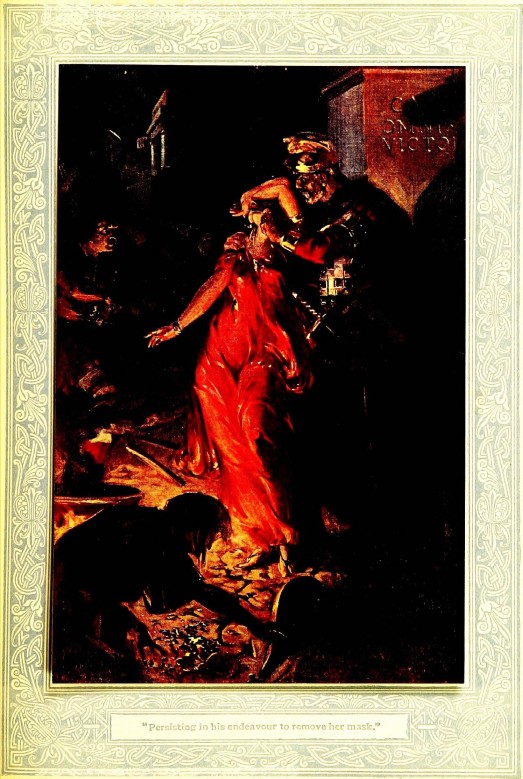
Persisting in his endeavour to remove her mask.
"Mercy—mercy! You know it is a grievous offence to be seen without my Cardinal melon," pleaded the girl with a return of the wiling witchery in her tones and attempting, but in vain, to release herself from Eckhardt's determined grasp.
"Who is your mistress?" insisted the Margrave. "And who are you?"
"Release the wanton! How dare you, a soldier of the church, break the commands of the Apostolic lieutenant?" exclaimed a husky voice and a strong arm grasped Eckhardt's shoulder. Turning round, the latter saw himself confronted by the towering form of the monk Nilus, who seemed ignorant of the person and rank of him he was addressing and whose countenance flamed with fanatic wrath.
"Ay! And it hath come to my turn to rescue damsels, and moreover to serve the church," added another speaker in a bantering tone and Eckhardt instantly recognized the Lord Vitelozzo, who having eluded the pursuit of the monk of Cluny, held a mace he had secured in lieu of his cross-bow high and menacingly in the air.
"Friar, look to your ally, if such he be, lest I do what I should have done before and make a very harmless rogue of him," said Eckhardt, holding the girl with one hand while with the other he unsheathed his sword.
"Peace, fool!" the monk addressed his would-be ally, drawing him back forcibly. "The church needs not the aid of one rogue to subdue another. Let the girl go, my son!" he then turned to the Margrave.
"Nay, father—by these bruises, which still ache, I will retrieve my wrong and rescue the wench," insisted the Roman, again raising his massive weapon, but the monk and some bystanders wedged themselves between Eckhardt and his opponent.
"Nay, then, now we are like to have good sport," exclaimed a fourth. "A monk, a woman and a soldier,—it requires not more to set the world ablaze."
"Stranger,—I implore you, release me," whispered Eckhardt's captive with frantic entreaty amidst the ever increasing tumult of the bystanders, who appeared to be divided, some favouring the monk, while others sided with the girl's captor, whose intentions they sorely misconstrued. "I would not stand revealed to yonder monk for all the world!" concluded the girl in fear-struck tones.
At this moment a cry among the bystanders warned Eckhardt that Vitelozzo's wrath had at length mastered every effort to restrain him, and, whirling round, to defend himself he was compelled to release the girl. But instead of making the use she might have been expected to do of her liberty, she called to the monk, to part the combatants in the name of the saints.
But it required no expostulation on the part of the friar, for when Eckhardt turned fully upon him, Vitelozzo, for the first time recognizing his antagonist, beat a precipitate retreat, but at some distance he turned, shouting derisively:
"An olive for a fig! Your dove has flown!" and when Eckhardt, recovering from his surprise, wheeled about, he found, much to his chagrin, the Roman's words confirmed by the absence of the girl as well as of her associates, who managed to make their escape at the moment when the impending encounter had momentarily drawn off the attention of the crowd.
"The devil can speak truth, they say, though I believed it not till now," muttered Eckhardt to himself as, vexed and mystified beyond measure, he strode through the scattering crowds.
Had it been some jeer of the fiend? Had he been made the victim of some monstrous deceit?
Who was the Sicilian dancer, whose manners and golden language belied her demeaning attire, whose strange eyes had penetrated into the darkness of his soul, whose voice had thrilled him with the echoes of one long silent and forever?
The magic mirror in which, as in a haze, he had seen the one face he most longed to see,—the strange and sudden fulfillment of the unspoken wish of his heart,—the dancer's marked persistence in the face of his declared abhorrence,—her mask and her incongruous companions,—her fear of the monk and concern for himself,—all these incidents, which one by one floated on the mirror of his memory, rose ever and anon before his inner gaze—each time more mystifying and bewildering.
In deep rumination Eckhardt pursued his way, gazing absently upon the roofless columns and shattered walls, everywhere visible, over which the star-light shone—ghostly and transparent, backed by the frowning and embattled fortresses of the Cavalli, half hidden by the dark foliage that sprang up amidst the very fanes and palaces of old. Now and then he paused with a deep and heavy sigh, as he pondered over the dark and desolate path upon which he was about to enter, over the lack of a guiding hand in which he might trust, over the uncertainty of the step, which, once taken was beyond recall.
Suddenly a light caught the solitary rambler's eye, a light almost like a star, scarcely larger indeed, but more red and intense in its ray. Of itself it was nothing uncommon and might have shone from either convent or cottage. But it streamed from a part of the Aventine, which contained no habitations of the living, only deserted ruins and shattered porticoes of which even the names and memories of their former inhabitants had been long forgotten. Aware of this, Eckhardt felt a slight awe, as the light threw its unsteady beam over the dreary landscape; for he was by no means free from the superstition of the age and it was near the hour consecrated to witches and ghosts.
But fear, whether of this world or the next, could not long daunt the mind of the Margrave; and after a brief hesitation he resolved to make a digression from his way, to discover the cause of the phenomenon. Unconsciously Eckhardt's tread passed over the site of the ill-famed temple of Isis which had at one time witnessed those wildest of orgies commemorated by the pen of Juvenal. At last he came to a dense and dark copse from an opening in the center of which gleamed the mysterious light. Penetrating the gloomy foliage Eckhardt found himself before a large ruin, grey and roofless. Through a rift in the wall, forming a kind of casement and about ten feet from the ground, the light gleamed over the matted and rank soil, embedded, as it were, in vast masses of shade. Without knowing it, Eckhardt stood on the very spot once consecrated to the cult of the Egyptian goddess, and now shunned as an abode of evil spirits. The walls of the ruin were covered with a dense growth of creepers, which entwined even the crumbled portico to an extent that made it almost impossible to penetrate into its intricate labyrinth of corridors.
While indulging in a thousand speculations, occasioned by the hour and the spot, Eckhardt suddenly perceived a shadow in the portico. Only the head was visible in the moonlight, which bathed the ruin, and it disappeared almost as quickly as it had been revealed. While meditating upon the expediency of exploring the mystery which confronted him, Eckhardt was startled by the sound of footsteps. Straining his gaze through the haze of the moonlight he beheld emerging from the portico of the temple the tall form of a man, wrapt in a long black cloak. He wore a conical hat with sloping brim which entirely shadowed his face and on his right arm he carried the apparently lifeless body of a girl. With the object of preventing a probable crime Eckhardt stepped from his place of concealment just as the stranger was about to pass him with his mysterious burden and placed his hands arrestingly on the other's shoulder.
"Who are you? And what is your business here?" he questioned curtly, attempting to remove the stranger's vizor.
"The one matters little to your business,—the other little to mine," the tall individual replied enigmatically while he dexterously resisted his questioner's effort to gain a glimpse at his face. "But," he added in a strange oracular tone, which moved Eckhardt despite himself, "if you value my aid in your hour of trial—assist me now in my hour of need!"
"Your aid?" echoed Eckhardt, staring amazed at his companion. "Do you know me? In what can you assist me?"
"You are Eckhardt the Margrave," replied the stranger; then inclining his head slightly towards him he whispered a word, the effect of which seemed to paralyze his listener, for his arresting hand fell and he retreated a step or two, surveying him in speechless wonder.
"Who are you?" he stammered at last.
The stranger raised the long visor of his conical hat. An exclamation of surprise came from Eckhardt's lips.
"Hezilo, the harper!"
The other replied with a silent nod.
"And we have never met!"
"I seldom go out!" said the harper.
"What know you of Ginevra?" begged the Margrave.
The harper shook his head.
"This is neither the time, nor the place. I must be gone—to shelter my burden! We shall meet again! If you follow me," he concluded, noting Eckhardt's persistence, "you will learn nothing and only endanger my safety and that of this child!"
"Is she dead?" Eckhardt questioned with a shudder.
"Would she were!" replied the stranger mournfully.
"Can I assist you?"
"I thank you! The burden is light. We will meet again."
There was something in the harper's tone which arrested Eckhardt's desire to ignore his injunction. How long he remained on the site of the ill-famed ruin, the Margrave hardly knew. When the fresh breeze of night, blowing from the Campagna, roused him at last from his reverie the mysterious stranger and his equally mysterious burden had disappeared in the haze of the moonlit night. Like one walking in a dream Eckhardt slowly retraced his steps to his palace on the Caelian Mount, where an imperial order sanctioning his purpose and relieving him of his command awaited him.
CHAPTER XI
NILUS OF GAËTA
grand high mass in honour of the pilgrims was on the following eve to be celebrated in the ancient Basilica of St. Peter's. But vast as was its extent, only a part of the pilgrims could be contained and the bronze gates were thrown open to allow the great multitude which filled the square to share the benefits and some of the glories of the ceremony.
The Vatican Basilica of the tenth century, far from possessing its present splendour, was as yet but the old consecrated palace, hallowed by memories of the olden time, in which Charlemagne enjoyed the hospitality of Leo III, when at his hands he received the imperial crown of the West. Similar to the restored church of St. Paul fuori le Mure, as we now see it, it was some twenty feet longer and considerably wider, having five naves divided off by four rows of vast monolith columns. There were ninety-six columns in all, of various marbles, differing in size and style, for they had been the first hasty spoils of antique palaces and temples. The walls above the order of columns were decorated with mosaics such as no Roman hand could then produce or even restore. A grand arch, such as we see at the older Basilicas to-day, inlaid with silver and adorned with mosaic, separated the nave from the chancel, below which was the tribune, an inheritance from the prætor's court of old. It now contained the high altar and the sedile of the Vicar of Christ. Before the altar stood the Confession, the vault wherein lay the bones of St. Peter, with a screen of silver crowned with images of saints and virgins. And the whole was illumined by a gigantic candelabrum holding more than a thousand lighted tapers.
The chief attraction, however, was yet wanting, for the pontiff and his court still tarried in the Vatican receiving the homage of the foreign pilgrims. While listlessly noting the preparations from his chosen point of vantage, Eckhardt discovered himself the object of scrutiny on the part of a monk, who had been listlessly wandering about and who disappeared no sooner than he had caught the eye of the great leader.
Unwilling to continue the target of observation on the part of those who recognized him despite his closed visor, Eckhardt entered the Basilica and took up his station near a remote shrine, whence he could witness the entrance of the pontifical procession, without attracting undue attention to his person. When the pontifical train did appear, it seemed one mass of glitter and sumptuous colour, as it filed down the aisles of the Basilica. The rich copes of the ecclesiastics, stiff with gold and gorgeous brocade, the jewelled mantles of the nobles, the polished breast plates and tasselled spears of the guards passed before his eyes in a bewildering confusion of splendour. In his gilded chair, under a superb canopy, Gregory, the youthful pontiff, was borne along, surrounded by a crowd of bishops, extending his hands in benediction as he passed the kneeling worshippers.
An infinite array of officials followed. Then came pilgrims of the highest rank, each order marching in separate divisions, in the fantastic costumes of their respective countries. In their wake marched different orders of monks and nuns, the former carrying torches, the latter lighted tapers, although the westering sun still flamed down the aisles in cataracts of light. After these fraternities and sisterhoods, Crescentius, the Senator, was seen to enter with his suite, conspicuous for the pomp of their attire, the taste of Crescentius being to sombre colours.
Descending from his elevated station, Gregory proceeded to officiate as High Priest in the august solemnity. Come with what prejudices one might, it was not in humanity to resist the impressions of overwhelming awe, produced by the magnificence of the spectacle and the sublime recollections with which the solemnity itself in every stage is associated. Despite his extreme youth, Gregory supported all the venerableness and dignity of the High Priest of Christendom and when at the conclusion of the high mass he bestowed his benediction on all Christendom, Eckhardt was kneeling with the immense multitude, perhaps more convinced than the most enthusiastic pilgrim, that he was receiving benediction direct from heaven.
The paroxysm only subsided, when raising his head, he beheld a gaunt monk in the funereal garb of the brotherhood of Penitent Friars ascend the chancel. He was tall, lean as a skeleton and from his shrivelled face two eyes, sunken deep in their sockets, burnt with the fire of the fanatic. This was the celebrated hermit, Nilus of Gaëta, of whose life and manners the most wonderful tales were current. He was believed to be of Greek extraction, perhaps owing to his lengthy residence in Southern Italy, near the shrines of Monte Gargano in Apulia. In the pursuit of recondite mysteries of the Moorish and Cabalistical schools, he had attained such proficiency, that he was seized with a profound disgust for the world and became a monk. Several years he spent in remote and pagan lands, spreading the tidings of salvation, until, as it was whispered, he received an extraordinary call to the effect, as was more mysteriously hinted, to turn the church from diverse great errors, into which she had fallen, and which threatened her downfall. Last, not least, he was to prepare the minds of mortal men for the great catastrophe of the Millennium,—the End of Time, the end of all earthly vanity. Special visions had been vouchsafed him, and there was that in his age, in his appearance and his speech which at once precluded the imposter. Nilus of Gaëta himself believed what he preached.
There was a brief silence, during which the Romans acquainted their foreign guests in hurried whispers with the name and renown of the reputed hermit. The latter stood motionless in the chancel and seemed to offer up a silent prayer, ere he pronounced his harangue.
His sermon was delivered in Latin, still the common language of Italy, even in its corrupt state, and its quality was such as to impress at once the most skeptical with the extraordinary gifts of the preacher.
The monk began with a truly terrific picture of the state of society and religion throughout the Christian world, which he delineated with such gloom and horror, that but for his arabesque entanglement and his gorgeousness of imagery one might have believed him a spirit of hell, returned to paint the orb of the living with colours borrowed from its murkiest depths. But with all the fantastic convolutions of his reasoning the fervour of a real eloquence soon began to overflow the twisted fountains, in which the scholastic rhetoric of the time usually confined its displays. These qualities Nilus especially exhibited when describing the pure dawn of Christianity, in which the pagan gods had vanished like phantoms of night. He declared that they were once more deified upon earth and the clear light all but extinguished. And treating the antique divinities as impersonations of human passions and lusts, the monk's eloquence suddenly took the most terrible tints, and considering the nature of some of the crimes which he thus delineated and anathematized, his audience began to suspect personal allusions of the most hideous nature.
After this singular exordium, the monk proceeded in his harangue and it seemed as if his words, like the lava overflow from a volcano, withered all that was green and flowery in their path. The Universe in his desponding eloquence seemed but a vast desolation. All the beautiful illusions which the magic of passion conjures into the human soul died beneath his touch, changing into the phantoms, which perhaps they are. The vanity of hope, the shallowness of success, the bitterness which mingles with the greatest glory, the ecstasy of love,—all these the monk painted in the most powerful colours, to contrast them with the marble calm of that drooping form crucified upon the hill of Calvary.
Spellbound, the immense multitude listened to the almost superhuman eloquence of the friar. As yet his attacks had dealt only in generalities. The Senator of Rome seemed to listen to his words with a degree of satisfaction. A singularity remarked in his character by all his historians, which, by some, has been considered as proof of a nature not originally evil, was his love of virtue in the abstract. Frequent resolutions and recommendations to reform were perhaps only overcome by his violent passions, his ambition and the exigencies of his ambiguous state between church and empire. But as the monk detailed the crimes and monstrosities of the age, the calm on the Senator's face changed to a livid, satirical smile, and occasionally he pointed the invectives of the friar by nodding to those of his followers who were supposed to be guilty of the crimes alleged, as if to call upon them to notice that they were assailed, and many a noble shrank behind his neighbour whose conscience smote him of one or all the crimes enumerated by Nilus.
In one of his most daring flights the monk suddenly checked himself and announcing his vision of impending judgment, he bid his listeners prepare their souls in a prophetic and oracular tone, which was distinctly audible, amid all the muttering which pervaded the Basilica.
A few moments of devout silence followed. The monk was expected to kneel, to offer up a prayer for divine mercy. But he stood motionless in the chancel, and after waiting a short time, Gregory turned to an attendant:
"Go and see what ails the disciple of Benedict,—we will ourselves say the Gratias."
After rising, he stepped to the altar with the accustomed retinue of cardinals and prelates and chanted the benediction. At the conclusion Crescentius approached the altar alone, demanded permission to make a duteous offering and emptied a purse of gold on the salver.
"A most princely and regal benefaction," muttered the Pontifical Datary—"a most illustrious example."
"Charlemagne gave more, but so will I, when like him I come to receive the crown of the West," muttered the Senator of Rome. His example was immediately followed, and in a few moments the altar was heaped round with presents of extraordinary magnificence and bounty. Sacks of gold and silver were emptied out, jewels, crucifixes, relics, amber, gold-dust, ivories, pearls and rare spices were heaped up in promiscuous profusion, and in return each donor received a branch of consecrated palm from the hand of the Datary, whose keen eyes reflected the brightness of the treasures whose receipts he thus acknowledged.
The chant from various chapels now poured down the aisles its torrents of melody, the vast multitudes joining in the Gloria in Excelsis. Eckhardt's remote station had not permitted him to witness all that had happened. His gaze was still riveted on the friar, who was now staggering from the pulpit, when a terrific event turned and absorbed his attention.
The great bell of the Basilica was tolling and the vibration produced by so many sounds shook the vast and ancient pile so violently that a prodigious mass of iron, which formed one of the clappers of the bell, fell from the belfry in the airy spire and dashing with irresistible force through every obstruction, reached the floor at the very feet of the Pontiff, crushing a deep hole in the pavement and throwing a million pieces of shattered marble over him and his retinue.
The vast assembly was for a moment motionless with terror and surprise, expecting little less than universal destruction in the downfall of the whole edifice on their heads, with all its ponderous mass of iron and stone. A cry arose that the Pontiff had been killed, which was echoed in a thousand varying voices, according as men's fears or hopes prevailed. But in the first moment of panic, when it was doubtful whether or not the entire center of the Basilica would crumble upon the assembly, Eckhardt had rushed from the comparative safety of his own station to the side of the Pontiff as if to shield him, when with the majesty of a prophet interposing between offended heaven and the object of its wrath, Gerbert of Aurillac uttered with deep fervour and amid profound silence a De Profundis. The multitudes were stilled from their panic, which might have been attended with far more serious consequences than the accident itself. There was a solemn pause, broken only by a sea-like response of "Amen"—and a universal sigh of relief, which sounded like the soughing of the wind in a great forest.
All distinctions of rank seemed blotted out in that supreme moment. Then the voice of Nilus was heard thundering above the breathless calm, while he held aloft an ebony crucifix, in which he always carried the host:
"The summits of St. Peter still stand! When they too fall, pilgrims of the world—even so shall Christendom fall with them."
At a sign from the Pontiff his attendants raised aloft the canopy, under which he had entered. But he refused to mount the chair and heading the bishops and cardinals, he left the church on foot. The Datary gave one look of hopeless despair, as the masses crowded out of the Basilica, and abandoned all hope of restoring order. In an incredibly short time the vast area was emptied, Crescentius being one of the last to remain in its deepening shadows. With a degree of vacancy he gazed after the vanishing crowds, more gorgeous in their broken and mingled pomp, as they passed out of the high portals, than when marshalled in due rank and order.
He too was about to leave, when he discerned a monk who stood gazing, as it were, incredulously at the shattered altar-pavement and the mass of iron deeply embedded in it. Hastily he advanced towards him, but as he approached he was struck by observing the monk raise his eyes, sparkling with mad fury, to the lighted dome above and clench his hands as if in defiance of its glory.
"Thou seemest to hold thy life rather as a burden than a blessing, monk, since thus thou repayest thy salvation," Crescentius addressed the friar, somewhat staggered by his attitude.
"Ay! If I have done Heaven a temporal injury,—be comforted, ye saints—for ye have wrought me an eternal one!" growled the monk between clenched teeth.
"Heaven?" questioned Crescentius, almost tempted to the conclusion that the monk, whoever he was, was out of his senses.
"Even Heaven," replied the monk. "One cubit nearer the altar,—I thought the struggle over in my soul between the dark angel and the bright—I had strung my soul to its mighty task,—yet I shrank from it, a second, and more cowardly Judas."
Crescentius gazed at the friar without grasping his meaning.
"Take thy superior out of the church, he is mad and blasphemes," he turned to the monk's companion who listened stolidly to his raving.
"Ay!" spoke the strange monk, gnashing his teeth and shaking his fist towards heaven, "even the church shall anon be rent in twain and form a chasm, down which countless generations shall tumble into the abyss—'twere just retribution!"
"Tell me but this, monk, how could Heaven itself throw obstacles in the way of thine intent?" questioned Crescentius, perceiving that the monk had turned to depart and more convinced than ever that he was speaking to a madman.
"How? How? Oh, thou slow of understanding,—how?"
And the monk pointed downward, to the crushed and shattered marble of the pavement, in which the iron clapper of the bell lay embedded.
Crescentius receded involuntarily before the fierce, insane gleam in the monk's eyes, while the terrible import of his speech suddenly flashed upon his understanding. Crossing himself, he left the strange friar to himself and passed swiftly through the motley crowds which were waiting their turn of admission to the subterranean chapel of the Grand Penitentiarius.
Another had remained in the dense gloom of the Basilica, though he had not witnessed the scene which had just come to a close. After the Pontiff's departure, Eckhardt had retired to the shrine of Saint Michael, where he knelt in silent prayer. His mind was filled with fantastic imaginings, inspired chiefly by his recent pilgrimage to the shrines of Monte Gargano. The deep void within him made itself doubly felt in this hour and more than ever he felt the need of divine interposition in order to retain that consciousness of purpose which was to guide his future course.
At last he arose. A remote chant fell upon his ears, and he saw a procession moving slowly from the refectory into the nave of the Basilica. By the dusky glare of the torches, which they carried, Eckhardt distinguished a number of penitent friars, bearing aloft the banner, destined in after-generations to become the standard of the Holy Inquisition, a Red Cross in a black field with the motto: "In Hoc Signo Vinces." Among them and seemingly the chief personage, strode the strange friar. With down-cast head and eyes he walked, eyes which, while they seemed fixed on the ground in self-abasement, stealthily scanned the features of those he passed.
"I marvel the holy saints think it worth while to trouble themselves about the soul of every putrid, garlic-chewing knave," said an old beggar on the steps of the Cathedral to an individual with whose brief review Eckhardt was much struck. He was a man past the middle-age, with the sallow complexion peculiar to the peasants of the marshes. His broad hat, garnished with many coloured ribbons, was drawn over his visage, though not sufficiently so, to conceal the ghastly scars, with which it was disfigured. His lurking, suspicious eye and the peculiar manner with which, from habit, he carried his short cloak drawn over his breast, as if to conceal the naked stiletto, convinced Eckhardt that, whatsoever that worthy might assume to be, he was one of those blackest of the scourges of Italy, which the license of the times had rendered fearfully numerous, the banditti and bravi.
"Whether the saints care or no," that individual returned, "the monk is competent to convert the fiend himself. What an honour for the brotherhood to have produced such a saint."
Scarcely bestowing more than a thought upon so usual an evidence of social disorder, which neither pontifical nor imperial edicts had been able to correct, Eckhardt passed out, without noticing that he had himself attracted at least equal attention from the worthy described, who after having satisfied his curiosity, slunk back among the crowds and was lost to sight.
CHAPTER XII
RED FALERNIAN
he palace of Theodora resounded with merriment, though it was long past midnight.
Round a long oval table in the great hall sat a score or more of belated revellers, their Patrician garbs in disorder, and soiled with wine, their faces inflamed, their eyes red and fiery, their tongues heavy and beyond the bounds of control. Here and there a vacant or overturned chair showed where a guest had fallen in the debauch, and had been permitted to remain on his self-chosen bed of repose. A band of players hidden in a remote gallery still continued to fill up the pauses in the riotous clamour with their barbaric strains.
At the head of the table, first in place as in rank sat Benilo, the Chamberlain. He seemed to take little interest in the conversation, for, resting his head on his hands, he stared into his untouched goblet, as if he endeavoured to cast some augury from the rising and vanishing bubbles of the wine.
Next to him sat Pandulph, Lord of Spoleto and Beneventum. His low, though well-set figure, dark hair, keen, black eyes and swarthy features bespoke his semi-barbaric extraction. His countenance was far from comely, when in repose, even ugly and repulsive, but in his eyes lay the force of a powerful will and a depth and subtlety of intellect, that made men fear, when they could not love him. On the right of the Count sat the Lord of Civitella, a large, sensual man, with twinkling grey eyes, thick nose and full red lips. His broad face, flushed with wine, glowed like the harvest moon rising above the horizon. Opposite him sat the Patricius Ziazo, crafty and unscrupulous, a parasite who flattered whosoever ministered to his pleasure. The Patricius was conversing with an individual who outshone Pandulph in rapine, the Lord of Civitella in coarseness and himself in sycophancy, Guido of Vanossa, an arrogant libertine, whose pinched features and cunning leer formed the true index to his character. The Lords of Sinigaglia, Torre del Grecco, Bracciano, Cavallo and Caetano swelled the roll of infamy on the boards of Theodora,—worthy predecessors of the Orsini and Savelli, who were to oppress the city in after time.
Among those who had marked the beginning of the evening by more than ordinary gaiety, Benilo had by his splendid dissipation excited the general envy and admiration among his fellow revellers. His face was inflamed, his dark eyes were glittering with the adder tongues of the serpent wine, and his countenance showed traces of unlimited debauchery. It seemed to those present, as if the ghost of the girl Nelida, whom he had killed in this very hall, was haunting him, so madly did he respond to the challenges from all around, to drink. But as the wine began to flood every brain, as the hall presented a scene of riotous debauch, his former reckless mood seemed for the nonce to have changed to its very opposite. Through the fumes of wine the dead girl seemed to regard him with sad, mournful eyes.
"Fill the goblets," cried Pandulph, with a loud and still clear voice. "The lying clock says it is day. But neither cock-crows nor clock change the purple night to dawn in the Groves of Theodora, save at the will of the Goddess herself. Fill up, companions! The lamp-light in the wine cup is brighter than the clearest sun that ever shone."
"Well spoken, Pandulph! Name the toast and we will pledge it, till the seven stars count fourteen and the seven hills but one," said the Cavallo looking up. "I see four hour glasses even now and every one of them lies, if it says it is dawn."
"You shall have my toast," said Pandulph, raising his goblet. "We have drunk it twenty times already, but we will drink it twenty times more:—the best prologue to wine ever devised by wit of man—Woman."
A shadow moved in the dusky background and peered unseen into the hall.
"And the best epilogue," replied the Lord of Civitella, visibly drunk. "But the toast—my cup is waiting."
"To the health—wealth—and love by stealth of Theodora!" yelled Pandulph, gulping down the contents of his goblet.
Benilo's face turned ashen pale, but he smiled.
"To Theodora!"
Every tongue repeated the name, the goblets were drained.
"My Lord, it is your turn now," said Pandulph, turning to the Lord of Civitella. "The good folks of Urbino have not yet rung the fire-bells against you, but some say they soon will. Who shall it be?"
The Lord of Civitella filled up his cup with unsteady hand, until it was running over and propping his body against the table as he stood up, he said:
"A toast to Roxané! And as for my foragers—they sweep clean."
The toast was drunk with rapturous applause.
"Right you are," bellowed the Cavallo. "Better brooms were never made on the Posilippo,—not a straw lies in your way."
"Did you accomplish it without fight?" sneered the Lord of Bracciano.
"Fight? Why fight? The burghers never resist a noble! We conjure the devil down with that. When we skin our eels, we don't begin at the tail."
"Better to steal the honey, than to kill the bees that make it."
"But what became of the women and children after this swoop of your foragers?" asked the Lord of Bracciano, who appeared to entertain some few isolated ideas of honour floating on the top of the wine he had gulped down.
"The women and children?" replied the Lord of Civitella with a mocking air, crossing his thumbs, like the peasants of Lugano, when they wish to inspire belief in their words. "They can breakfast by gaping! They can eat wind, like the Tarentines,—it will make them spit clear."
The Lord of Bracciano, irritated at the mocking sign and proverbial allusion to the gaping propensities of the people round the Lago, started up in wrath and struck his clenched fist on the table.
"My Lord of Civitella," he cried, "do not cross your damned thumbs at me, else I will cut them off! The people of Bracciano have still corn in plenty, until your thieving bands scorch their fingers in the attempt to steal it."
Andrea Cavallo interposed to stop the rising quarrel.
"Do not mind the Lord of Civitella," he whispered to Bracciano. "He is drunk!"
"The rake! The ingrate!" growled Bracciano, "after my men opened the traps, in which the Vicar of the Church had caught him."
"Nay! If you gape at man's ingratitude, your mouth will be wide enough, ere you die, my lord," spoke Pandulph with a sardonic laugh. "And men in our day stand no more on precedence in plots than in love affairs,—do they, my lord Benilo?"
"Nay, I'll dispute no man's right to be hanged or quartered before me—least of all yours, my Lord Pandulph," the Chamberlain replied venomously.
"My lord Benilo," replied Pandulph, "you are, when drunk, the greatest ruffian in Christendom, and the biggest knave when sober. Bring in more tankards, and we will not look for day till midnight booms again on the old tower of San Sebastian! I call for full brimmers, varlets,—bring your largest cups! We will drink another toast five fathoms deep in wine, strong enough to melt Cleopatra's pearls, and to a jollier dame than Egypt's queen."
The servitors flew out and in. In a few moments the table was replenished with huge drinking cups, silver flagons and all the heavy impediments of the army of Bacchus.
"We drink to the Fair Lady of the Groves,—and in her presence, too!" shouted the Lord of Spoleto, raising his goblet anew. "Why is she not among us? They say," he turned to Benilo with a sneer, "that you are so jealous of the charms of your bird of paradise, that you have forbidden her to appear before your friends."
Roaring peals of laughter crowned Pandulph's speech.
Benilo saw the absurdity of anger, but he felt it nevertheless.
"She chooses not to leave her bower even to look on you, my Lord Pandulph. I warrant you, she has not slept all night, listening to your infernal din."
A renewed outburst of mirth was the response.
"Then you will permit us to betake ourselves forthwith to her gilded chamber to implore pardon on our knees for disturbing her rest."
"Well spoken—by the boot of St. Benedict!" roared Guido of Vanossa.
"You may measure my foot and satisfy yourself that I am able to wear it," shouted the Lord of Civitella. "On our knees we will crawl to the Sanctuary of our Goddess,—on our knees!"
"But before we start on our pilgrimage, we will drain a draught long as the bell-rope of the Capitol," bellowed the Lord of Bracciano.
"Fill up the tankards!" exclaimed the Lord of Spoleto. "My goblet is as empty as an honest man's purse,—and one of my eyes is sober yet."
"Do not take it to heart!" spoke Guido of Vanossa, whose eyes were full of tears and wine. "You will not die in the jolly fellow's faith!" And with unsteady voice he began to sing a stanza in dog-Latin:
"Dum Vinum potamus
Fratelli cantiamo
A Bacco sia Onore!
Te Deum laudamus!"
"Would your grace had a better voice, you have a good will!" stammered the lord of Sinigaglia. "'Tis ample time to repent when you can do no better. Besides—if you are damned, it is in rare good company!"
"Ay! Saint and Sinner come to the same end!" gurgled the Lord Pandulph, ogling the purple Falernian.
"Fill up your goblets! Though it be a merry life to lead, I doubt if it will end in so cheery a death!" said Benilo, his eye wandering slowly from one to the other.
"Fill up the goblets!" shouted the Lord of Spoleto, rising and supporting his bulky carcass on the heavy oaken table.
With a sleepy leer he blinked at the guests.
"Down on your knees," he roared suddenly, his former intent reverting to him. "To the Sanctuary of the Goddess! On our knees we will implore her to receive us into her favour."
A strange spirit of recklessness had seized Benilo. Instead of resenting or resisting the proposition, he was the first to get down on all fours. His example had an electrifying effect. Although they swayed to and fro like sail-boats on angry sea-waves, all those still sober enough imitated the Chamberlain amid cheers and grunts, and slowly the singular procession, led by Benilo, set in motion with the expressed purpose of invading Theodora's apartments, which were situated beyond the great hall. The Lord Pandulph resembled some huge bear as on all fours he hobbled across the mosaic floor beside the Lord of Bracciano, who panted, grunted and swore and called on the saints, to witness his self-abasement. Being gouty and stout, he was at one time seized with a cramp in his leg and struck out vigorously with the result of striking the Lord of Civitella squarely in the jaw, whereupon the latter, toppling over, literally flooded the hall with profanity and surplus wine. The other ten hobbled behind the leaders, cursing their own folly, but enjoying to a degree the novelty of the pageant.
Thus they had traversed the great hall at a speed as great as their singular mode of locomotion and their intoxicated condition would permit. The background of the hall was but dimly lighted; the great curtain strung between the two massive pillars, which guarded the entrance into Theodora's apartments, excluded the glow of the multi-coloured lamps, strung in regular intervals in the corridor beyond.
Benilo was the first to reach the curtain. Resting one hand on the floor, he raised the other, after the manner of a dog, trying to push its folds aside, when they suddenly and noiselessly parted. Something hissed through the air, striking the object of its aim a stinging blow in the face—a cry of pain and rage, and Benilo, who had sprung to his feet, stood face to face with Theodora. At the same moment the lights in the great hall were turned on to a full blaze, revealing in its entire repelling atrocity the spectacle of the drunken revellers, who, upon experiencing a sudden check to their further progress, had come to a sluggish halt, some of them unable to retain their balance and toppling over in their tracks.
"Beasts! Swine!" hissed the woman, her eyes ablaze with wrath, the whip which had struck Benilo in the face, still quivering in her infuriated grasp. "Out with you—out!"
The sound of a silver whistle, which she placed between her lips, brought some five or six giant Africans to the spot. They were eunuchs, whose tongues had been torn out, and who, possessing no human weakness, were ferocious as the wild beasts of their native desert. Theodora gave them a brief command in their own tongue and ere the amazed revellers knew what was happening to them, they found themselves picked up by dusky, muscular arms and unceremoniously ejected from the hall, those lying in a semi-conscious stupor under the tables sharing the same fate.
CHAPTER XIII
DEAD LEAVES
hile the Nubians set about in cleaning the hall and removing the last vestiges of the night's debauch, Theodora faced Benilo with such contempt in her dark eyes, that for a moment the Chamberlain's boasted insolence almost deserted him, and though seething with rage at the chastisement inflicted upon him he awaited her speech in silence. She faced him, leaning against a marble statue, her hands playing nervously with the whip.

"For once I have discovered you in your true station, the station of the foul, crouching beast, to which you were born, had not some accident played into the devil's hands by giving you the glittering semblance of the snake," she said slowly and with a disdain ringing from her words, which cut even his debased nature to the core. "I have whipped you, as one whips a cur: do you still desire me for your wife?"
With lips tightly compressed he looked down, not daring to meet her fierce gaze of hatred, which was burning into his very brain.
"I see little reason for changing my mind," he replied after a brief pause, while as he spoke his cheek seemed to burn with shame, where the whip had struck it, and her evil, terrible beauty, exposed in her airy night-robe, roused all the wild demoniacal passions in his soul.
The whip trembled in her hands.
"And you call yourself a man!" she said with a withering look of contempt, under which he winced.
Then she continued in a hard and cheerless voice, wherein spoke more than simple aversion, a voice that seemed as it were petrified with grief, with remorse and hatred of the man who had been the cause of her fall.