Front matter (continued 2)
Reading edition
"Whose deed is this?" Theodora demanded, holding aloft the covering of the couch.
"It was my accursed luck! The decanter was intended for this lying cur, whose black heart I will wrench out of his body!"
And Benilo pointed to the shrinking form of Roffredo.
"What had he done?"
"He had insulted you!"
"That proves his courage!" she replied with a withering glance of contempt.
Then she beckoned to the attendants.
"Have the girl removed and summon the Greek—though I fear it is too late."
There was a ring of regret in her tones. It vanished as quickly as it had come.
The body of Nelida, the dancing girl, was carried away and the guests resumed their seats. Roxané had reluctantly abandoned her usurped place of honour. A quick flash, a silent challenge passed between the two women, as Theodora took her accustomed seat.
"A glass of wine!" she commanded imperiously, and Roffredo, reassured, rushed to the nearest attendant, took a goblet from the salver and presented it to the Queen of the Groves.
"Ah! Thanks, Roffredo! So it was you who insulted me in my absence?" she said with an undertone of irony in her voice, which had the rich sound of a deep-toned bell.
"I said you would embrace the devil, did he but appear in presentable countenance!" Roffredo replied contritely, but with a vicious side glance at Benilo.
An ominous smile curved Theodora's crimson lips.
"The risk would be slight, since I have kept company with each of you," she replied. "And our virtuous Benilo took up the gauntlet?"
Her low voice was soft and purring, yet laden with the poison sting of irony, as through half-closed lids she glanced towards the Chamberlain, who sat apart in moody silence like a spectre at the feast.
Benilo scented danger in her tone and answered cautiously:
"Only a coward will hear the woman he loves reviled with impunity."
Theodora bowed with mock courtesy.
"If you wish to honour me with this confession, I care as little for the one as the other. From your temper I judge some innocent dove had escaped your vulture's talons."
Benilo met the challenge in her smouldering look and answered with assumed indifference:
"Your spies have misinformed you! But I am in no mood to constitute the target of your jests!"
"There is but one will which rules these halls," Theodora flashed out. "If obedience to its mandates is distasteful to you, the gates are open—spread your pinions and fly away!"
She flung back her head and their eyes met.
Benilo turned away, uttering a terrible curse between his clenched teeth.
There was a deep hush in the hall, as if the spirit of the dead girl was haunting the guests. The harps played a plaintive melody, which might indeed have stolen from some hearth of ashes, when stirred by the breath of its smouldering spark, like phantom-memories from another world, that seemed to call to Theodora's inner consciousness, each note a foot-step, leading her away beyond the glint and glitter of the world that surrounded her, to a garden of purity and peace in the dim, long-forgotten past. Theodora sat in a reverie, her strange eyes fixed on nothingness, her red lips parted, disclosing two rows of teeth, small, even, pearly, while her full, white bosom rose and fell with quickened respiration.
"The Queen of the Groves is in a pensive mood to-night," sneered the Lord of Bracciano, who had been engaged in mentally weighing her charms against those of Roxané.
Theodora sighed.
"I may well be pensive, for I have seen to-day, what I had despaired of ever again beholding in Rome—can you guess what it is?"
Shouts of laughter broke, a jarring discord, harshly upon her speech.
"We are perishing with curiosity," shouted, as with one voice, the debauched nobles and their feminine companions.
"In the name of pity, save our lives!" begged a girl nearest to Theodora's seat.
"Can you guess?" the Queen of the Groves repeated simply, as she gazed round the assembly.
All sorts of strange answers were hurled at the throne of the Queen of the Groves. She heeded them not. Perhaps she did not even hear them.
At last she raised her head.
Without commenting on the guesses of her guests, she said:
"I have seen in Rome to-day—a man!"
Benilo squirmed. The rest of the guests laughed harshly and Bembo, the Poet asked with a vapid grin:
"And is the sight so wondrous that the Queen of Love sits dreaming among her admirers like a Sphinx in the African desert?"
"Had he horns?" shouted the Lord of Bracciano.
"Or a cloven hoof?" cried Oliverotto.
"What was he like?" sneered a third.
Theodora turned upon her questioners, a dash of scorn in her barbed reply.
"I speak of a man, not reptiles like you—you all!"
"Mercy, oh queen, mercy!" begged the apoplectic poet, amid the noisy clamour of his jeering companions. But heedless of their jabbering tongues Theodora continued earnestly:
"Not such men as the barons of Rome are pleased to call themselves, cowardly, vicious,—beasts, who believe not in God nor the devil, and whose aim in life is but to clothe their filthy carcass in gaudy apparel and appease the cravings of their lust and their greed! I speak of a man, something the meaning of which is as dark to you as the riddle of the Sphinx."
The company gazed at each other in mute bewilderment.
Theodora was indeed in a most singular mood.
"Are we not at the Court of Theodora?" shouted the Lord of Bracciano, who was experiencing some inconvenience in the feat of embracing with his short arms the two women between whom he was seated. "Or has some sudden magic transported us to the hermitage of the mad monk, who predicts the End of Time?"
"Nay," Benilo spoke up for the first time since Theodora's rebuke had silenced him, "perhaps our beautiful Queen of Love has in store for her guests just such a riddle as the one the Sphinx proposed to the son of Iokasté—with but a slight variation."
The illiterate high-born rabble of Rome did not catch the drift of the Patrician's speech, but the pallor on Theodora's cheeks deepened.
Roxané alone turned to the speaker.
"And the simile?" she asked in her sweet siren-voice, tremulous with the desire to clash with her more beautiful rival.
Benilo shrugged his shoulders, but he winced under Theodora's deadly gaze.
"The simile?" he replied with a jarring laugh. "It is this, that incest and adultery are as old as the Athenian asses, that never died, and that the Sphinx eventually drowned herself in the Aegean Sea."
Theodora made no reply, but relapsed into her former state of thoughtfulness. As she turned from Benilo, her eyes met those of Roxané, and again the two women flashed defiance at each other.
Again the laughter of the revellers rose, louder than before.
"By the Cross," shouted the poet, "the Queen of Love will take the veil."
"Has she chosen the convent, whose nuns she will cause to be canonized by her exemplary life and glorious example," jeered Roxané.
"We shall sing a thousand Aves and buy tapers as large as her unimpeached virtue!" cried another of the women.
"I fear one nunnery is damned from chapel to refectory," growled Benilo, keeping his eyes on the floor, as if fearful of meeting those he instinctively felt burning upon him.
"Silence!" cried Theodora at last, stamping her foot on the floor, while a glow of hot resentment flushed her cheeks. "Your merriment and clamour only draws the sharper line between you and that other, of whom I spoke."
Roffredo looked up with a smile of indolence.
"And who is the demi-god?" he drawled lazily.
She measured him with undisguised scorn and contempt.
"The name! The story!" bellowed several individuals, raising their goblets and half spilling their contents in their besotten mood.
In a strange voice, melodious as the sound of Æolian harps when the night wind passes over their strings, amid profound silence Theodora related to her assembled guests the incident of the runaway steeds in which she had so prominently figured, the chariot having been her own,—the occupant herself. She omitted not a detail of the stranger's heroic deed, passing from her own thrilling experience to Vitelozzo's assault upon one of the New Vestals, and his discomfiture at the hand of him who had saved her life.
"And while your Roman scum hissed and hooted and raised not a finger in the girl's defence, her rescuer alone braved Vitelozzo's fury—I saw him whisper something into the ruffian's ear and the mighty lord skulked away like a frightened cur. By heaven, I have seen a man!" the Queen of the Groves concluded ecstatically, disdaining to dwell on her own rescue.
For a lingering moment there hovered silence on the assembly. Gradually it gave way to a flutter of questions.
"Who is he?" queried one.
"What is he like?" shouted another.
Theodora did not heed the questions. Only her lovely face, framed by hair dark as the darkest midnight, had grown a shade more pale and pensive.
Suddenly she turned to the last questioner, a woman.
"What was he like?" she replied. "Tall, and in the prime of manhood; his face concealed by his vizor."
The woman sighed amorously. The men nodded to each other with meaning glances. The danger of the convent seemed passed.
Benilo, who during Theodora's narrative had proven an ideal listener, of a sudden clenched his fist and gazed round for the harper, who sat in a remote corner of the hall.
Another moment's musing, then the Chamberlain ground his teeth together with the fierce determination to carry out at all hazards, what he had resolved in his mind. Theodora herself was playing into his hands.
"Do you know this incomparable hero, this modern Theseus?" he drawled out slowly and with deliberate impudence, addressing the Queen of the Groves.
Theodora's gaze was sharp as steel.
"What is it to you?" she hissed.
Benilo shrugged his shoulders disdainfully.
"Nothing whatever! I also know him!"
There was something in his tone, which struck the ever-watchful ear of Theodora like a danger-knell.
"You know him?" echoed a chorus of voices from every part of the great hall.
He waved back the eager questioners.
"I know him!" he declared emphatically, then he was silent.
Theodora seemed to have grown nervous.
"Are you serious?"
"Never more so!" Benilo replied, with a slight peculiar hardening of the lips.
"Is he a Roman?" cried a voice.
"All Romans according to our fair Queen's judgment, are curs and degenerates," Benilo drawled insultingly.
Theodora nodded.
"Even so," she replied coldly.
"This demi-god, however, is also slightly known to you," the Chamberlain continued, now fairly facing the Queen of Love, "even though he has not yet found his way to your bowers."
Theodora winced.
"Why do you taunt me?" she flashed back angrily.
Benilo heeded her not. Instead of replying, he addressed himself to the company, speaking in a dry, half-bantering tone, while Theodora watched him like a tigress.
"Once upon a time, the Queen of Love boasted that mortal man did not breathe who would resist her charms. Now there is at this hour one man here in Rome, whom even the matchless Theodora dare not summon to her circle, one man before whose 'No' her vain-glorious boast would break like a bubble, one man whose soul she may not sap and send to hell! And this one man is even the hero of her dreams, her rescuer,—the rescuer of a maiden of spotless virtue, the vanquisher of a giant! Do I speak truth, divine Theodora?"
Those who watched the expression on the face of the Queen of the Groves marvelled alike at Benilo's audacity and the startling absence of a passionate outburst on the part of the woman. And though the blood seethed through Theodora's veins, the sudden change of front on Benilo's part seemed to stagger her for a moment. It was a novel sensation to see the man who had heretofore been like clay in the moulder's hands now daring to flout her openly and to hold up her wounded pride as a target for the jests of those present. It was a novel sensation, to find herself publicly berated, but the shaft sank deep. Theodora's eyes flashed scorn and there was something cruel in her glances. Benilo felt its sting like a whiplash. His nerves quivered and he breathed hard. But he had gone too far to recede. His spirit had risen in arms against the disdain of the woman he loved,—loved with a passion that seemed to have slept in a tomb for ages and suddenly gathered new strength, like a fire kindled anew over dead ashes.
Acting on a sudden impulse, he raised his head and looked at her with a fearlessness which for the moment appeared to startle her self-possession, for a deep flush coloured the fairness of her face and, fading, left it pale as marble. Still Theodora did not speak and the breathless silence which had succeeded Benilo's last taunt resembled the ominous hush of the heated atmosphere before a thunder-clap. No one dared speak and the Chamberlain, apparently struck by the sudden stillness, looked round from the tumbled cushions where he reclined.
"You do not answer my question, fair Theodora," he spoke at last, an undertone of mockery ringing through his speech. "I grant you power over some weak fools," and Benilo glanced round the assembly, little caring for the mutter which his words raised, "but you will at least admit that there is one man in Rome at this very hour, on whom all your charms and blandishments would be wasted as a caress on cold marble."
Another deep and death-like pause ensued; then Theodora's silvery cold tones smote the profound silence with sharp retort, as goaded at last beyond forbearance by his scoffing tone she sprang to her feet.
"There is not a man in Rome," she hissed into Benilo's face, "not in Italy, not in all the world, whom I could not bend to the force of my will. Where I choose, I conquer!"
A sardonic laugh broke from Benilo's lips.
"And by what means?"
"Benilo," she flashed forth in withering contempt, "I know not what your object is in taunting me—and I care not—but by Lucifer, you go too far! Name to me a man in Rome, name whom you will, and if I fail to win him in one month—"
"What then?"
For a moment she hesitated.
"Name the wager yourself!"
An ominous smile curved Benilo's lips.
"All the wealth I possess against you—as my wife!"
She laughed scornfully and shuddered, but did not reply.
"Are you afraid?" he cried, tauntingly.
"What a fate!" she replied with trepidation in her tone. "But I accept it, even it!"
She turned her back on him after a look of such withering contempt as one might cast on some reptile, and took her former seat, when again she was startled by his voice. Its mock caressing tones caused her to clench her firm white hands and bend forward as if tempted to strangle the viper, that had dared to place its glittering coils in her path.
"It now remains but to name the champion, just to prevent the wrong bird from fluttering into the nest," said Benilo, addressing the company.
"The champion! The champion!" they shouted, breathing more freely, since the expected lightning did not strike.
"Fill the goblets!" Benilo exclaimed, and in a moment the wine was poured, the guests arose and gathered round the central figures.
Benilo raised his goblet and turned to Theodora, wincing under her look of contempt.
"The champion is to be my choice and to be accepted unconditionally?" he questioned.
"Not so!" she flashed forth, half rising from her seat, her eyes flaming with wrath. "I would not have my words distorted by so foul a thing as you! It is to be the rescuer of the girl, he before whom the lord Vitelozzo slunk away like a whipped cur! You have taunted me with my lack of power face to face with that one—and that one alone, the only man among a crowd of curs!"
Benilo paused, then he said with a hard, cold smile:
"Agreed!" And he placed the goblet to his lips. The guests did likewise and drank the singular toast, as if it had not implied a glaring insult to each present, including the one who reëchoed it.
"And now for his name!" Benilo continued. "Just to prevent a mischance."
The irony of his words and the implied insult cut Theodora to the quick. With hands tightly clenched as If she would strangle her tormentor, she sprang to her feet.
"I object!" she gasped, almost choked with rage, while her startled listeners seemed to lack even voice to vent their curiosity before this new and unexpected outburst.
"I appeal to the company assembled, who has witnessed the wager between the Queen of Love and her faithful and obedient lover," Benilo sneered, looking round among the guests. "How know we, what is concealed under a vizor, beneath a rusty suit of armour? Security lies but in the name of the unconscious victim of Theodora's magic, is it not so?"
The smile on the Chamberlain's countenance caused him to appear more repulsive than his former expression of wildest rage. But, prompted by an invincible curiosity, the guests unanimously assented.
"Be it so!" gasped Theodora, sinking back in her seat. "I care not."
Benilo watched her closely, and as he did so he almost repented of his hasty wager. Just at that moment his gaze met that of the harper, who stood like some dark phantom behind the throne of the Queen of the Groves, and the Chamberlain stifled the misgivings, which had risen within him. And though smiling in anticipation of the blow he was about to deliver, a blow which should prove the sweetest balm for the misery she had caused him by her disdain, he still wavered, as if to torment her to the extremest limits. Then, with a voice audible in the remotest parts of the great hall, he spoke, his eye in that of Theodora, slowly emphasizing each title and name:
"Margrave Eckhardt of Meissen, Commander-in-chief of the German hosts!"
There was the silence of death in the hall.
For a moment Theodora stared fixed and immobile as a marble statue, her face pale as death, while a thin stream of purple wine, spilled from her trembling goblet, trickled down her white, uplifted arm. Then she rushed upon him, and knocking the goblet out of his hand, causing it to fall with a splintering crash at Benilo's feet, she shrieked till the very walls re-echoed the words:
"You lie! You lie!"
Benilo crossed his arms over his chest, and, looking squarely into the woman's eyes, he repeated in the same accents of defiance:
"Margrave Eckhardt of Meissen, Commander-in-chief of the German hosts."
"Again I tell you you lie! You lie!" shrieked the woman, now almost beside herself. "Is there no one among all this scum here assembled, to chastise this viper? Hear me!" she cried as, affrighted, the guests shrank back from her blazing eyes and panting breath, while with all the superhuman beauty of a second Medusa she stood among them, and if her gaze could have killed, none would have survived the hour. "Hear me! Benilo has lied to you, as time and again he has lied to me! He, of whom he speaks, is dead,—has died—long ago!"
Benilo breathed hard. "Then he has arisen from the dead and returned to earth,—to Rome—" he spoke with biting irony in his tones. "A strange hereditary disease affecting the members of his house."
When he saw the deadly pallor which covered the woman's face, and the terror reflected in her eyes, Benilo continued:
"And deem you in all truth, O sagacious Theodora, that a word from the lips of any other man would have caused Vitelozzo to release his prey? Deem you not in your undoubted wisdom that it required a reason, even weightier than the blow of a gauntleted hand, to accomplish this marvellous feat? And,—since you are dumb in the face of these arguments,—will you not enlighten us all why Theodora, the beautiful, the chaste, would deprive him of the plume, to whom it rightfully belongs,—the German commander, Margrave Eckhardt of Meissen, who risked his life to save that of our beautiful queen?"
Theodora turned upon her tormenter like an animal at bay.
"I have heard enough! I will not! The wager is off!"
And rising she prepared to leave the hall without another word.
It would have been difficult for the most profound physiognomist to analyze Benilo's feelings, when he saw his purpose, his revenge, foiled. Looking up he met the enigmatic gaze of the harper resting upon him with a strange mixture of derision and disdain.
"Stay!" Benilo cried to Theodora as she grasped the curtain in the act of pushing it aside. He knew if she passed beyond it, he had lost beyond retrieve. But she paused and turned, mute inquiry and defiance in her look.
"The Queen of the Groves has made a wager before you all," the Chamberlain shouted, lashing himself into the rage needful to make him carry out his design unflinchingly. "After being informed of the person of the champion she has repudiated it! The reasons are plain,—the champion is beyond her reach! The Queen of the Groves is too politic to play a losing game, especially when she knows that she is sure to lose! The charms of our Goddess are great, but alas! There is one man in Rome whom she dare not challenge!"
He paused to study the effect of his words upon her.
She regarded him with her icy stare.
"It is not a question of power—but of my will!"
"So be it!" retorted Benilo. "But since the Queen of Love has refused my wager for reasons no doubt good and efficient, perhaps there is in this company one less pure, one less scrupulous, one of beauty as great, who might win, where Theodora shuns the risk! Will you take up the gauntlet, fair Roxané, and lure to the Groves, Eckhardt, the general?"
"Benilo—beware!"
Shrill, sharp like breaking glass, like the cry of a wounded animal maddened with rage and agony, the outcry seemed wrenched from Theodora's white, drawn lips. Her large, splendid eyes flashed unutterable scorn upon the Chamberlain and her lithe form swayed and crouched as that of a tigress about to spring.
"Will Roxané take the wager?" Benilo repeated defiantly.
The anticipation of the on-coming contest caused Roxané's cheek to blanch. But not to be thought deficient in courage, to meet her rival, she replied:
"Since the Queen of the Groves shuns the test, perhaps I might succeed, where—"
She did not finish the sentence.
Like a lightning flash Theodora turned from the man, who had roused her ire, to the woman who had stung her pride with ill-veiled mockery, and while she slowly crept towards her opponent, her low voice, tremulous with scorn, stung as a needle would the naked flesh.
"And do you dream that Eckhardt of Meissen has aught to fear from you, fair Roxané? Deem you, that the proud Roxané with all her charms, could cause the general of the German host to make one step against his will?"
For a moment the two women stood face to face, measuring each other with deadly looks.
"And what if I would?" flashed Roxané.
Two white hands slowly but firmly encircled her throat.
"I would strangle you!" hissed Theodora, her face deadly pale.
Roxané's cheeks too had lost their colour. She knew her opponent and she instinctively felt she had reached the limit. She gave a little nervous laugh as she drew Theodora's reluctant hands from the marble whiteness of her throat, where their touch had left a rosy imprint.
"I do not wish your Saxon bear," she said. "If you can tame him, we come to his skin!"
"By Lucifer!" replied the Queen of the Groves, "did I but choose to, I would make him forget heaven and hell and bring him to my feet!"
"How dramatic!" sneered Benilo. "Words are air! We want proofs!"
She whirled upon him.
"And what will become of the snake, when the hunter appears?"
Benilo paled. For a moment his arrogance deserted him. Then he said with an ominous scowl:
"Let the hunter beware!"
She regarded him with icy contempt. Then she turned to the revellers.
"Since Benilo has dared to cross swords with me," she cried, "though I despise him and all of you, I accept the challenge, if there is one in this company who will confirm that it was Eckhardt who discomfited Vitelozzo."
From the background of the hall, where he had sat a silent listener, there came forward an individual in the gaudy attire of a Roman nobleman. He was robust and above the middle height, and the lineaments of his coarse face betrayed predominance of brute instincts over every nobler sentiment.
"Vitelozzo! Vitelozzo!" the guests shouted half amazed, half amused.
The robber-baron nodded as he faced Theodora on the edge of the circle.
"I have listened to your discourse," he snarled curtly. "For your opinions I care not. And as for the skullion to whom I gave in,—out of sheer good will,—ha, ha!—may the devil pull the boots from his legs!—'twas no meaner a person than he, at whose cradle the fiend stood sponsor, Eckhardt—the general—but I will yet have the girl, I'll have her yet!"
And with a vigorous nod Vitelozzo took up a brimming decanter and transported himself into the background whence he had arisen.
His word had decided the question.
For a moment there was an intense hush. Then Theodora spoke:
"Eckhardt of Meissen, the commander of the German hosts, shall come to my court! He shall be as one of yourselves, a whimpering slave to my evil beauty! I will it,—and so it shall be!"
For a moment she glanced at Benilo and the blood froze in his veins. Heaven and earth would he have given now to have recalled the fateful challenge. But it was too late. For a time he trembled like an aspen. No one knew what he had read in Theodora's Medusa-like face.
Some of the revellers, believing the great tension relieved, now pushed eagerly forward, surrounding the Queen of the Groves and plying her with questions. They were all eager to witness a triumph so difficult to achieve, as they imagined, that even Theodora, though conscious of her invincible charms, had winced at the task.
But the Queen of Love seemed to have exchanged the attributes of her trade for those of a Fury, for she turned upon them like an animal wounded to death, that sees the hounds upon its track and cannot escape.
"Back! All of you!" she hissed, raising her arms and sweeping them aside. "What is it after all? Is he not a man, like—no! Not like you, not like you!—Why should I care for him?—Perhaps he has wife and child at home:—the devils will laugh the louder!"
She paused a moment, drawing a deep breath. Then she slowly turned towards the cringing Chamberlain. Her voice was slow and distinct and every word struck him as the blow from a whip.
"I accept your wager," she said, "and I warn you that I will win! Win, with all the world, with all your villainy, with the Devil himself against me. Eckhardt shall come to the Groves! But," she continued with terrible distinctness, "if aught befall him, ere we have stood face to face, I shall know the hand that struck the blow, were it covered by the deepest midnight that ever blushed at your foulness, and by the devil,—I will avenge it!"
After these words Theodora faced those assembled with her splendid height in all the glory of her beauty. Another moment she was gone.
For a time deep silence succeeded.
Never had such a scene been witnessed in the Groves. Never had the Queen of Love shown herself in so terrible a mood. Never had mortal dared to brave her anger, to challenge her wrath. Truly, the end of time must be nigh when her worshippers would dare defy the Goddess of the Shrine.
But after Theodora had disappeared, the strain gradually relaxed and soon wore away entirely. With all, save Benilo. His calm outward demeanour concealed only with an effort his terrible apprehensions, as he mixed freely, to divert suspicion, with the revellers. These thought the moments too precious to waste with idle speculations and soon the orgy roared anew through the great hall.
Benilo alone had retreated to its extreme end, where he allowed himself to drop into a divan, which had just been deserted by a couple, who had been swept away by the whirling Bacchanale. Here he sat for some time, his face buried in his hands, when looking up suddenly he found himself face to face with Hezilo.
"I have done it," he muttered, "and I fear I have gone too far!"
He paused, scanning the harper's face for approval. Its expression he could not see, but there was no shade of reproof in the voice which answered:
"At best you have but erred in the means."
"I wished to break her pride, to humble her, and now the tables are turned; it is I, who am grovelling in the dust."
"No woman was by such means ever wooed or won," the harper replied after a brief pause. "Theodora will win the wager. But whether she win or lose, she will despise you for ever more!"
Benilo pressed his hands against his burning temples.
"My heart is on fire! The woman maddens me with her devilish charms, until I am on the verge of delirium."
"You have been too pliant! You have become her slave! Her foot is on your neck! You have lost yourself! Better a monstrous villain, than a simpering idiot, who whines love-ditties under his lady's bower and bellows his shame to the enduring stars! Dare to be a man,—despite yourself!"
So absorbed was Benilo in his own thoughts, that the biting irony of the other's speech was lost upon him.
He extended his hand to his strange counsellor.
"It shall be as you say: The Rubicon is passed. I have no choice."
The stranger nodded, but he did not touch the proffered hand.
At last the Chamberlain rose to leave the hall.
The sounds of lutes and harps quivered through the Groves of Theodora; flutes and cymbals, sistrum and tympani mingled their harmonies with the tempest of sound that hovered over the great orgy, which was now at its height. The banquet-hall whirled round him like a vast architectural nightmare. Through the dizzy glare he beheld perspectives and seemingly endless colonnades. Everything sparkled, glittered, and beamed in the light of prismatic irises, that crossed and shattered each other in the air. Viewed through that burning haze even the inanimate objects seemed to have waked to some fantastic representation of life.—But through it all he saw one face, supremely fair in its marble cold disdain,—and unable to endure the sight longer Benilo the Chamberlain rushed out into the open.
In the distance resounded the chant of pilgrims traversing the city and imploring the mercy and clemency of heaven.
CHAPTER VI
JOHN OF THE CATACOMBS
nce outside of the pavillion, Benilo uttered a sigh of relief. He had resolved to act without delay. Ere dawn he would be assured that he held in his grasp the threads of the web. There was no time to be lost. Onward he hurried, the phantom of the murdered girl floating before his eyes in a purple haze.
While bearing himself ostensibly in the character of a mere man of pleasure, Benilo the Chamberlain lost no opportunity of ingratiating himself with the many desperate spirits who were to be found in the city ready and willing to assist at any enterprise, which should tend to complicate the machine of government. While he rushed into every extravagance and pleasure, surpassing the companions of his own rank in his orgies, he suffered no symptoms of a deeper feeling to escape him, than that of excellence in trifling, the wine cup, the pageant, the passing show. It may have been a strain of mongrel blood, filtering through his veins, which tempered his endurance with the pliancy essential to intrigue, a strain that was apparent in the sculptured regularity of his features. His movements had the pliant ease, the stealthy freedom of the tiger. Had he been caught like Milo, he would have writhed himself out of the trap with the sinuous persistency of the snake. There was something snake-like in the small, glittering eyes, the clear smoothness of the skin. With all its brightness no woman worthy of the name but would have winced with womanly instincts of aversion and repugnance from his glances. With all its beauty, none, save Otto alone, had ever looked confidingly into his face. Men turned indeed to scan him approvingly as he passed, but they owned no sympathy with the smooth, set brow, the ever present smile in the lips of Benilo the Chamberlain.
After deliberating upon the course he was about to pursue Benilo approached the shores of the Tiber. Under the cypress avenues it was dark, and the air came up chill and damp from the stream. A sombre blue over-arched the labyrinth of pillars and ruins, of friezes and statues, of groves and glades which lay dreaming in the pale light of the moon. No other light, save the moist glimmer of the stars whose mist-veiled brightness heralded the approach of a tempest, fell on the chaos of undefined forms. Utter solitude, utter silence prevailed. More and more Benilo lost himself in the wilderness of this ill-favoured region.
The shortest way to the haunts of John of the Catacombs, of whom he was in immediate search, lay across the ancient Alta Semita, where now the Via di Porta Pia winds round the Quirinal hill. But for reasons of his own the Chamberlain chose to make a detour, preferring streets whose deserted character would not be likely to bring him into contact with some unwelcome, nocturnal rambler. Wrapping himself more closely in his cloak and looking cautiously about, he hastened along the North Western declivity of the Quirinal hill, until he reached the remains of a wall built, so tradition has it, by Servius Tullius. This quarter had ever since the time of the emperors enjoyed the worst reputation in all Rome. The streets were tortuous, the houses, squalid, the whole surroundings evil. Benilo moved cautiously along the wall, for a few drinking shops were still open and frequented by a motley throng, with whom it was not safe to mingle, for to provoke a brawl, might engender grave consequences. Wretched women plied their shameful trade by the light of flickering clay-lamps; and watery-eyed hags, the outcasts of all nations, mingled with sailors, bandits and bravi. Drunken men lay snoring under tables and coarse songs were shouted from hoarse throats, half drowned by the uproarious clamour of two fellows who were playing at dice. Suddenly there was a commotion followed by piercing shrieks. The gamblers had fallen out over their pretty stakes. After a short squabble one had drawn his knife on the other and stabbed him in the side. The wounded man fell howling on the ground and the assassin took to his heels. The dancers of the establishment, heedless of the catastrophe, began at once to rattle their castagnettes and sway and whirl in disgraceful pantomime.
After Benilo had passed the shameful den and reached the end of the alley he found himself once more in one of the waste regions of the city. Truly many an emperor was more easily discovered than John of the Catacombs. The region had the appearance as if an earthquake had shattered into dust the splendid temples and porticoes of antiquity, so great was the destruction, which confronted him on every turn. High in the air could be heard the hoarse cry of the vulture, wheeling home from some feast of carnage; in the near-by marshes the croaking of the frogs alternated with the dismal cry of the whippoorwill.
Suddenly the Chamberlain paused and for a moment even his stout heart stopped beating, and his face turned a ghastly pallor. For directly before him there arose out of the underbrush, with back apparently turned towards him, some formless apparition in the dark habit of a monk, the cowl drawn over his head. But when he attained his natural height, he faced Benilo, although the latter would have sworn that he did not see him turn.
It was with some degree of fascination that Benilo watched the person and the movements of this human monster. What appeared of his head from under the cowl seemed to have become green with cadaverous tints. One might say that the mustiness of the sepulchre already covered the bluish down of his skin. His eyes, with their strong gaze sparkled from beneath a large yellowish bruise, and his drooping jaws were joined to the skin by two lines as straight as the lines of a triangle. The bravo's trembling hands, the colour of yellow wax, were only a net-work of veins and nerves. His sleeves fluttered on his fleshless arms like a streamer on a pole. His robe fell from his shoulders to his heels perfectly straight without a single fold, as rigid as the drapery in the later pictures of Cimabue or Orcagna. There appeared to be nothing but a shadow under the brown cowl and out of that shadow stared two stony eyes. John of the Catacombs looked like a corpse returned to earth, to write his memoirs.
At the sight of the individual, reputed the greatest scourge in Rome, the Chamberlain could not repress a shudder, and his right hand sought mechanically the hilt of his poniard.
"Why—thou art a merry dog in thy friar's cowl, Don Giovan, though it will hardly save thee from the gallows," exclaimed Benilo, approaching slowly. "Since when dost affect monastic manners?"
"Since the fiend is weary of saints, their cowls go begging," a harsh grating voice replied, while a hideous sneer lit up the almost fleshless skull of the bravo, as with his turbid yellow eyes, resembling those of a dead fish, he stared in Benilo's face.
"And for all that," the denisen of the ruins continued, watching from under inflamed eyelids the effect his person produced on his Maecenas, "and for all that I shall make as good a saint as was ever catalogued in your martyrology."
"The fiend for aught might make the same," replied Benilo. "What is your business here?"
"Watching over dead men's bones," replied the bravo doggedly.
"Never lie to the devil,—you will neither deceive him nor me! Not that I dispute any man's right to be hanged or stabbed—least of all thine, Don Giovan."
"'Tis for another to regulate all such honours," replied the bravo. "And it is an old saying, never trust a horse or a woman!"
Benilo started as if the bravo had read his thoughts.
"You prate in enigmas," he said after a pause. "I will be brief with you and plain. We should not scratch, when we tickle. I am looking for an honest rogue. I need a trusty and discreet varlet, who can keep his tongue between his teeth and forget not only his master's name, but his own likewise. Have you the quality?"
John of the Catacombs stared at the speaker as if at a loss to comprehend his meaning. Instead of answering he glanced uneasily in the direction of the river.
"Speak out, man, my time is brief," urged the Chamberlain, "I have learned to value your services even in the harm you have wrought, and if you will enter my service, you shall some day hang the keys of a nobler tower on your girdle than you ever dreamt of."
The bravo winced, but did not reply. Suddenly he raised his head as if listening. A sound resembling the faint splash of an oar broke the stillness. A yell vibrated through the air, a louder splash was heard, then all was deep silence as before.
"That sounded not like the prayer of a Christian soul departing," Benilo said with an involuntary shudder, noting the grin of satisfaction which passed over the outlaw's face. "What was that?"
"Of my evil brother an evil instrument," replied John of the Catacombs enigmatically.
"I fear you will have to learn manners in my school, Don Giovan," said Benilo in return. "But your answer. Are you ready?"
"This very night?" gasped the bravo, suspecting the offer and fearful of a snare.
"Why not?" demanded the Chamberlain curtly.
"I am bound in another's service!"
"You are an over-punctilious rogue, Don Giovan. To-morrow then!"
"Agreed!" gurgled the bravo, extending a monstrously large hand from under his gown, with a forefinger of extraordinary length, on the end of which there was a wart.
Benilo pretended not to see the proffered member. But before addressing himself further to John of the Catacombs he glanced round cautiously.
"Are we alone?"
The bravo nodded.
"Is my presence here not proof enough?"
The argument prevailed.
"To our business then!" Benilo replied guardedly, seating himself upon a fragment of granite and watching every gesture of the bravo.
"There arrived to-day in Rome, Eckhardt the general. His welfare is very dear to me! I should be disconsolate came he to harm in the exercise of his mission, whatever that be!"
There was a brief pause during which their eyes met.
The outlaw's face twitched strangely. Or was it the play of the moonbeams?
"Being given to roaming at random round the city," Benilo continued, speaking very slowly as if to aid the bravo's comprehension, "for such is their wont in their own wildernesses,—I am fearful he might go astray,—and the Roman temper is uncertain. Yet is Eckhardt so fearless, that he would scorn alike warning or precaution. Therefore I would have you dog his footsteps from afar,—but let him not suspect your presence, if you wish to see the light of another morning. Wear your monk's habit, it becomes you! You look as lean and hungry and wolfish as a hermit of twelve years' halo, who feeds on wild roots and snails. But to me you will each day report the points of interest, which the German leader has visited, that I too may become familiar with their attraction. Do I speak plainly?"
"I will follow him as his shadow," gurgled the bravo.
Benilo held out a purse which John of the Catacombs greedily devoured with his eyes.
"You are a greedy knave," he said at last with a forced laugh. "But since you love gold so dearly, you shall feast your eyes on it till they tire of its sheen. Be ready at my first call and remember—secrecy and despatch!"
"When shall it be?" queried the bravo.
"A matter of a day or two at best—no longer! Meanwhile you will improve your antiquarian learning by studying the walks of Rome in company with the German general. But remember your distance, unless you would meet the devil's grandame instead of creeping back to your hovels. And where, by the way, may a pair of good eyes discover John of the Catacombs in case of urgent need?"
The bravo seemed to ponder.
"There is an old inn behind the Forum. It will save your messenger the trouble to seek me in the Catacombs. Have him ask for the lame brother of the Penitents,—but do not write, for I cannot read it."
Benilo nodded.
"If I can trust you, the gain will be yours," he said. "And now—lead the way!"
John of the Catacombs preceded his new patron through the tall weeds which almost concealed him from view, until they reached a clearing not far from the river, whose turbid waves rolled sluggishly towards Ostia. Here they parted, the bravo retracing his steps towards the region whence they had come, while Benilo made for the gorge between Mounts Aventine and Testaccio. It was an ill-famed vale, noted even in remote antiquity for the gross orgies whence it had gained its evil repute, after the cult of Isis had been brought from Egypt to Rome.
The hour was not far from midnight. The moon had passed her zenith and was declining in the horizon. Her pale spectral rays cast an uncertain light over the region and gave the shadows a weird and almost threatening prominence. In this gorge there dwelt one Dom Sabbat, half sorcerer, half madman, towards whose habitation Benilo now directed his steps. He was not long reaching a low structure, half concealed between tall weeds and high boulders. Swiftly approaching, Benilo knocked at the door. After a wait of some duration shuffling foot steps were to be heard within. A door was being unbarred, then the Chamberlain could distinguish the unfastening of chains, accompanied by a low dry cough. At last the low door was cautiously opened and he found himself face to face with an almost shapeless form in the long loose habit of the cloister, ending in a peaked cowl, cut as it seemed out of one cloth, and covering the face as well as the back of the head, barring only two holes for the eyes and a slit for the mouth. After the uncanny host had, by the light of a lantern, which he could shade at will, peered closely into his visitor's face, he silently nodded, beckoning the other to enter and carefully barred the door behind him. Through a low, narrow corridor, Dom Sabbat led the way to a sort of kitchen, such as an alchemist might use for his experiments and with many grotesque bends bade his visitor be seated, but Benilo declined curtly, for he was ill at ease.
"I have little time to spare," he said, scarcely noticing the alchemist's obeisance, "and less inclination to enter into particulars. Give me what I want and let me be gone out of this atmosphere, which is enough to stifle the lungs of an honest man."
"Hi, hi, my illustrious friend," fawned the other with evident enjoyment of his patron's impatience. "Was the horoscope not right to a minute? Did not the charm work its unpronounced intent?"
"'Tis well you remind me! It required six stabs to finish your bungling work! See to it, that you do not again deceive me!"
"You say six stabs?" replied Dom Sabbat, looking up from the task he was engaged in, of mixing some substances in a mortar. "Yet Mars was in the Cancer and the fourth house of the Sun. But perhaps the gentleman had eaten river-snails with nutmeg or taken a bath in snake skins and stags-antlers?"
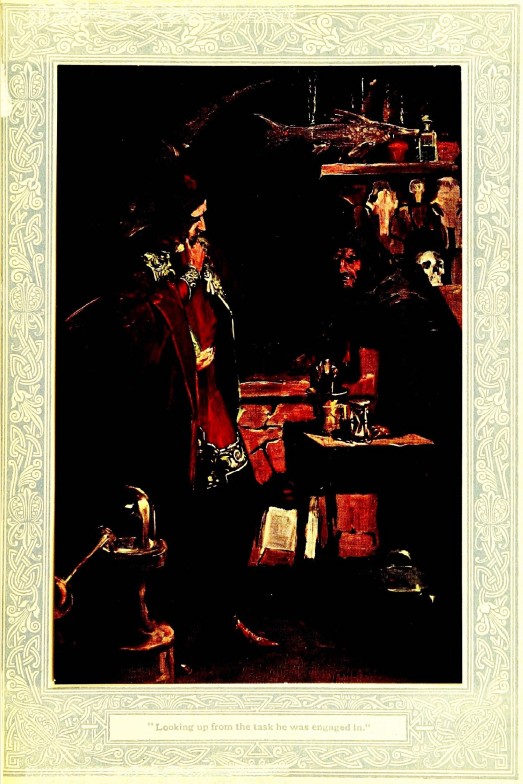
"Looking up from the task he was engaged in."
"To the devil with your river-snails!" exploded Benilo. "The love-philtre and quickly,—else I will have you smoked out of your devil's lair ere the moon be two hours older!"
The alchemist shook his head, as if pained by his patron's ill temper. Yet he could not abstain from tantalizing him by assuming a misapprehension of his meaning.
"The hour," he mumbled slowly, and with studied hesitation, "is not propitious. Evil planets are in the ascendant and the influence of your good genius is counteracted by antagonistic spells."
"Fool!" growled Benilo, at the same time raising his foot as if to spurn the impostor like a dog. "You keep but one sort of wares such as I require,—let me have the strongest."
Neither the gesture nor the insult were lost on Dom Sabbat, yet he preserved a calm and imperturbable demeanour, while, as if soliloquizing, he continued his irritating inquiries.
"A love-philtre? They are priceless indeed;—even a nun,—three drops of that clear tasteless fluid,—and she were yours."
Again Benilo's lips straightened in a hard, drawn line. Stooping over the alchemist, he whispered two words into his ear, which caused Dom Sabbat to glance up with such an expression of horror that Benilo involuntarily burst into a loud laugh, which sent the other spinning to his task.
Ransacking some remote corner in his devil's kitchen he at last produced a tiny phial, which he wrapped in a thin scroll. This he placed with trembling hands into those eagerly stretched out to grasp it and received therefor a hand full of gold coin, the weight of which seemed to indicate that secrecy was to constitute no small portion of the bargain.
After having conducted his visitor to the entrance, where he took leave of him with many bends of the head and manifold protestations of devotion, Dom Sabbat locked his abode and Benilo hastened towards the city.
As he mentally surveyed the events of the evening even to their remotest consequences, he seemed to have neglected no precaution, nor omitted anything which might eventually prevent him from triumphing over his opponents. But even while reviewing with a degree of satisfaction the business of the night, terrible misgivings, like dream shadows, drooped over his mind. After all it was a foolhardy challenge he had thrown to fate. Maddened by the taunts of a woman, he had arrayed forces against himself which he must annihilate, else they would tear him to pieces. The time for temporizing had passed. He stood on the crater of a volcano, and his ears, trained to the sounds of danger, could hear the fateful rumbling in the depths below.
In that fateful hour there ripened in the brain of Benilo the Chamberlain a thought, destined in its final consequences to subvert a dynasty. After all there was no security for him in Rome, while the Germans held sway in the Patrimony of St. Peter. But—indolent and voluptuous as he was—caring for nothing save the enjoyment of the moment, how was he to wield the thunderbolt for their destruction, how was he to accomplish that, in which Crescentius had failed, backed by forces equal to those of the foreigners and entrenched in his impregnable stronghold?
As Benilo weighed the past against the future, the scales of his crimes sank so deeply to earth that, had Mercy thrown her weight in the balance it would not have changed the ultimate decree of Retribution. Only the utter annihilation of the foreign invaders could save him. Eckhardt's life might be at the mercy of John of the Catacombs. The poison phial might accomplish what the bravo's dagger failed to do,—but one thing stood out clearly and boldly in his mind; the German leader must not live! Theodora dared not win the wager,—but even therein lay the greater peril. The moment she scented an obstacle in her path, she would move all the powers of darkness to remove it and it required little perspicuity to point out the source, whence it proceeded.
At the thought of the humiliation he had received at her hands, Benilo gnashed his teeth in impotent rage. His pride, his vanity, his self-love, had been cruelly stabbed. He might retaliate by rousing her fear. But if she had passed beyond the point of caring?
As, wrapt in dark ruminations, Benilo followed the lonely path, which carried him toward the city, there came to him a thought, swift and sudden, which roused the evil nature within him to its highest tension.
Could his own revenge be more complete than by using his enemies, one for the destruction of the other? And as for the means,—Theodora herself would furnish them. Meanwhile—how would Johannes Crescentius bear the propinquity of his hereditary foe, the emperor? Might not the Senator be goaded towards the fateful brink of rebellion? Then,—Romans and Germans once more engaged in a death grapple,—his own time would come, must come, the time of victory and ultimate triumph.
CHAPTER VII
THE VISION OF SAN PANCRAZIO
wo days had elapsed since Eckhardt's arrival in Rome. At the close of each day, he had met Benilo on the Palatine, each time renewing the topic of their former discourse. Benilo had listened attentively and, with all the eloquence at his command, had tried to dissuade the commander from taking a step so fateful in its remotest consequences. On the evening of the third day the Chamberlain had displayed a strange disquietude and replied to Eckhardt's questions with a wandering mind. Then without disclosing the nature of the business which he professed to have on hand, they parted earlier than had been their wont.
The shades of evening began to droop with phantom swiftness. Over the city brooded the great peace of an autumnal twilight. The last rays of the sun streaming from between a heavy cloud-bank, lay across the landscape in broad zones of brilliancy. In the pale green sky, one by one, the evening stars began to appear, but through the distant cloud-bank quivered summer lightning like the waving of fiery whips.
Feeling that sleep would not come to him in his present wrought up state of mind, Eckhardt resolved to revisit the spot which held the dearest he had possessed on earth. Perhaps, that prayer at the grave of Ginevra would bring peace to his soul and rest to his wearied heart. His feet bore him onward unawares through winding lanes and deserted streets until he reached the gate of San Sebastiano. There, he left the road for a turfy hollow, where groups of black cypress trees stretched out their branches like spectral arms, uplifted to warn back intruders. He stood before the churchyard of San Pancrazio.
Pausing for a moment irresolutely before its gloomy portals Eckhardt seemed to waver before entering the burial ground. Hushing his footsteps, as from a sense of awe, he then followed the well-known path. The black foliage drooped heavily over him; it seemed to draw him in and close him out of sight, and although there was scarcely any breeze, the dying leaves above rustled mysteriously, like voices whispering some awful secret, known to them alone. A strange mystery seemed to pervade the silence of their sylvan shadows, a mystery, dread, unfathomable, and guessed by none. With a dreary sense of oppression, yet drawn onward by some mysterious force, Eckhardt followed the path, which here and there was over-grown with grass and weeds. Uneasily he lifted the overhanging branches and peered between the dense and luminous foliage. Up and down he wistfully gazed, now towards the winding path, lined by old gravestones, leading to the cloister; now into the shadowy depths of the shrubbery. At times he paused to listen. Never surely was there such a silence anywhere as here. The murmur of the distant stream was lost. The leaves seemed to nod drowsily, as out of the depths of a dream and the impressive stillness of the place seemed a silent protest against the solitary intruder, a protest from the dead, whose slumber the muffled echo of his footsteps disturbed.
For the first time Eckhardt repented of his nocturnal visit to the abode of the dead. Seized with a strange fear, his presence in the churchyard at this hour seemed to him an intrusion, and after a moment or two of silent musing he turned back, finding it impossible to proceed. Absently he gazed at the decaying flowers, which turned their faces up to him in apparent wonderment; the ferns seemed to nod and every separate leaf and blade of grass seemed to question him silently on the errand of his visit. Surely no one, watching Eckhardt at this place and at this hour, if there was such a one near by chance, would have recognized in him the stern soldier who had twice stormed the walls of Rome.
Onward he walked as in the memory of a dream, a strange dream, which had visited him on the preceding night, and which now suddenly waked in his memory. It was a vague haunting thing, a vision of a great altar, of many candles, of himself in a gown of sack-cloth, striving to light them and failing again and again, yet still seeing their elusive glare in a continual flicker before his eyes. And as he mused upon his dream his heart grew heavy in his breast. He had grown cowardly of pity and renewed grief.
Following a winding path, so overgrown with moss that his footsteps made no sound upon it, which he believed would lead him out of the churchyard, Eckhardt was staggered by the discovery that he had walked in a circle, for almost directly before him rose the grassy knoll tufted with palms, between which shone the granite monument over Ginevra's grave. Believing at this moment more than ever in his life in signs and portents, Eckhardt slowly ascended the sloping ground, now oblivious alike to sight and sound, and lost in the depths of his own thoughts. Bitter thoughts they were and dreamily vague, such as fever and nightmare bring to us. Relentlessly all the long-fought misery swept over him again, burying him beneath waves so vast, that time and space seemed alike to vanish. He knelt at the grave and with a fervour such as is born of a mind completely lost in the depths of mysticism, he prayed that he might once more behold Ginevra, as her image lived in his memory. The vague deep-rooted misery in his heart was concentrated in this greatest desire of his life, the desire to look once more upon her, who had gone from him for ever.
After having exhausted all the pent-up fervour of his soul Eckhardt was about to rise, little strengthened and less convinced of the efficacy of his prayer, when his eyes were fixed upon the tall apparition of a woman, who stood in the shadow of the cypress trees and seemed to regard him with a strange mixture of awe and mournfulness. With parted lips and rigid features, the life's blood frozen in his veins, Eckhardt stared at the apparition, his face covered with a pallor more deadly than that of the phantom, if phantom indeed it was. A long white shroud fell in straight folds from her head to her feet, but the face was exposed, and as he gazed upon it, at once so calm and so passionate, so cold and yet so replete with life,—he knew it was Ginevra who stood before him. Her eyes, strangely undimmed by death, burnt into his very soul, and his heart began to palpitate with a mad longing. Spreading out his arms in voiceless entreaty, the half-choken outcry: "Ginevra! Ginevra!" came from his lips, a cry in which was mingled at once the most supreme anguish and the most supreme love.
But as the sound of his voice died away, the apparition had vanished, and seemed to have melted into air. Only a lizard sped over the stone in the moonlight and in the branches of the cypress trees above resounded the scream of some startled night-bird. Then everything faded in vague unconsciousness, across which flitted lurid lights and a face that suddenly grew dim in the strange and tumultuous upheaval of his senses. The single moment had seemed an hour, so fraught with strange and weird impressions.
Dazed, half-mad, his brow bathed in cold dew, Eckhardt staggered to his feet and glanced round like one waking from a dream. The churchyard of San Pancrazio was deserted. Not another human being was to be seen. Surely his senses, strangely overwrought though they were, had not deceived him. Here,—close beside him,—the apparition had stood but a moment ago; with his own eyes he had seen her, yet no human foot had trampled the fantastic tangle of creepers, that lay in straggling length upon the emerald turf. He lingered no longer to reason. His brain was in a fiery whirl. Like one demented, Eckhardt rushed from the church-yard. There was at this moment in his heart such a pitiful tumult of broken passions, hopelessness and despair, that the acute, unendurable pain came later.
As yet, half of him refused to accept the revelation. The very thought crushed him with a weight of rocks. Amid the deceitful shadows of night he had fallen prey to that fear from which the bravest are not exempt in such surroundings. The distinctness of his perception forbade him to doubt the testimony of his senses. Yet, what he had seen, was altogether contrary to reason. A thousand thoughts and surmises, one wilder than the other, whirled confusedly through his brain. A great benumbing agony gnawed at his heart. That, which he in reason should have regarded as a great boon began to affect him like a mortal injury. By fate or some mysterious agency he had been permitted to see her once more, but the yearning had increased, for not a word had the apparition vouchsafed him, and from his arms, extended in passionate entreaty, it had fled into the night, whence it had arisen.
Accustomed to the windings of the churchyard, Eckhardt experienced little difficulty in finding his way out. He paced through the wastes of Campo Marzio at a reckless speed, like a madman escaped from his guards. His brain was aflame; his cheeks, though deadly pale, burned as from the hidden fires of a fever. The phenomenon had dazzled his eyes like the keen zigzag of a lightning flash. Even now he saw her floating before him, as in a luminous whirlwind, and he felt, that never to his life's end could he banish her image from his heart. His love for the dead had grown to vastness like those plants, which open their blossoms with a thunder clap. He felt no longer master of himself, but like one whose chariot is carried by terrified and uncontrollable steeds towards some steep rock bristling precipice.
Gradually, thanks to the freshness of the night-air, Eckhardt became a little more calm. Feeling now but half convinced of the reality of the vision, he sought by the authentication of minor details to convince himself that he was not the victim of some strange hallucination. But he felt, to his dismay, that every natural explanation tell short of the truth, and his own argumentation was anything but convincing.
In the climax of wonderment Eckhardt had questioned himself, whether he might not actually be walking in a dream; he even seriously asked himself whether madness was not parading its phantoms before his eyes. But he soon felt constrained to admit, that he was neither asleep nor mad. Thus he began gradually to accept the fact of Ginevra's presence, as in a dream we never question the intervention of persons actually long dead, but who nevertheless seem to act like living people.
The moon was sinking through the azure when Eckhardt passed the Church of the Hermits on Mount Aventine. The portals were open; the ulterior dimly lighted. The spirit of repentance burned at fever heat in the souls of the Romans. From day-break till midnight, and from midnight till day-break, there rose under the high vaulted arches an incessant hum of prayer. The penitential cells, the vaults underneath the chapels, were never empty. The crowds which poured into the city from all the world were ever increasing, and the myriad churches, chapels and chantries rang night and day with Kyrie Eleison litanies and sermons, purporting to portray the catastrophe, the hail of brimstone and fire, until the terrified listeners dashed away amid shrieks and yells, shaken to the inmost depths of their hearts with the fear that was upon them.
There were still some belated worshippers within, and as Eckhardt ascended the stone steps, he was seized with an incontrollable desire to have speech with Nilus, the hermit of Gaëta, who, he had been told, was holding forth in the Church of the Hermits. To him he would confess all, that sorely troubled his mind, seeking his counsel and advice. The immense blackness within the Basilica stretched vastly upward into its great arching roof, giving to him who stood pigmy-like within it, an oppression of enormity. Black was the centre of the Nave and unutterably still. A few torches in remote shrines threw their lugubrious light down the aisles. The pale faces of kneeling monks came now and then into full relief, when the scant illumination shifted, stirred by ever so faint a breath of air, heavy with the scent of flowers and incense.
Almost succumbing under the strain of superstitious awe, exhausted in body and mind by the strange malady, which had seized his soul, his senses reeling under the fumes of incense and the funereal chant of the monks, his eyes burning with the fires of unshed tears, Eckhardt sank down before the image of the Mother of God, striving in vain to form a coherent prayer.
How long he had thus remained he knew not. The sound of footsteps in the direction of the North transept roused him after a time to the purpose of his presence. Following the direction indicated to him by one of the sacristans, Eckhardt groped his way through the dismal gloom towards the enclosure where Nilus of Gaëta was supposed to hold his dark sessions. By the dim light of a lamp he perceived in the confessional the shadowy form of a monk, and approaching the wicket, he greeted the occupant with a humble bend of the head. But, what was visible of the monk's countenance was little calculated to relieve the oppression which burdened Eckhardt's soul.
From the mask of the converted cynic peered the eyes of a fanatic. The face was one, which might have suggested to Luca Signorelli the traits of his Anti-Christ in the Capella Nuova at Orvieto. In the deep penetrating eyes was reflected the final remorse of the wisdom, which had renounced its maker. The face was evil. Yet it was a face of infinite grief, as if mourning the eternal fall of man.
Despite the advanced hour of night the monk was still in his seat of confession, and the mighty leader of the German host, wrapt in his long military cloak, knelt before the emaciated anchorite, his face, manner and voice all betraying a great weariness of mind. A look of almost bodily pain appeared in Eckhardt's stern countenance as, at the request of the monk, who had receded within the gloom of the confessional, he recounted the phenomena of the night, after having previously acquainted him with the burden of his grief.
The monk listened attentively to the weird tale and shook his head.
"I am most strangely in my senses," Eckhardt urged, noting the monk's gesture. "I have seen her,—whether in the body, or the spirit, I know not,—but I have seen her."
"I have listened, my son," said the monk after a pause, in his low sepulchral voice.—"Ginevra loved you,—so you say. What could have wrought a change in her, such as you hint? For if she loved you in life, she loves you in death. Why should she—supposing her present—flee from your outstretched arms? If your love could compel her to return from the beyond,—why should it lack the power to make the phantom give response?"
"Could I but fathom that mystery,—could I but fathom it!"
"Did you not speak to her?"
"My lips but uttered her name!"
"I am little versed in matters of this kind," the monk replied in a strange tone. "'Tis but the natural law, which may not be transgressed with impunity. Is your faith so small, that you would rather uproot the holiest ties, than deem yourself the victim of some hallucination, mayhap some jeer of the fiend? Dare you raise yourself on a pedestal, which takes from her her defenceless virtue, cold and silent as her lips are in death?"
Every word of the monk struck Eckhardt's heart with a thousand pangs. A deep groan broke from his lips.
"Madman that I was," he muttered at last, "to think that such a tale was fit for mortal ears."
Then he turned to the monk.
"Have you no solace to give to me, no light upon the dark path, I am about to enter upon,—the life of the cloister, where I shall end my days?"
There was a long pause. Surprise seemed to have struck the monk dumb. Eckhardt's heart beat stormily in anticipation of the anchorite's reply.
"But," a voice sounded from the gloom, "have you the patience, the humility, which it behooves the recluse to possess, and without which all prayers and penances are in vain?"
"Show me how I can humble myself more, than at this hour, when I renounce a life of glory, ambition and command. All I want is peace,—that peace which has forsaken me since her death!"
His last words died in a groan.
"Peace," repeated the monk. "You seek peace in the seclusion of the cloister, in holy devotions. I thought Eckhardt of too stern a mould, to be goaded and turned from his duty by a mere whim, a pale phantom."
A long silence ensued.
"Father," said the Margrave at last, speaking in a low and broken voice, "I have done no act of wrong. I will do no act of wrong, while I have control over myself. But the thought of the dead haunts me night and day. Otto has no further need of me. Rome is pacified. The life at court is irksome to me. The king loves to surround himself with perfumed popinjays, discarding the time-honoured customs of our Northland for the intricate polity of the East.—There is no place for Eckhardt in that sphere of mummery."
For a few moments the monk meditated in silence.
"It grieves me to the heart," he spoke at last, "to hear a soldier confess to being tempted into a life of eternal abnegation. I judge it to be a passing madness, which distance and work alone can cure. You are not fitted in the sight of God and His Mother for the spiritual life, for in Mezentian thraldom you have fettered your soul to a corpse in its grave, a sin as black as if you had been taken in adultery with the dead. Remain in Rome no longer! Return to your post on the boundaries of the realm. There,—in your lonely tent, pray nightly to the Immaculate One for her blessing and pass the day in the saddle among the scattered outposts of your command! The monks of Rome shall not be festered by the presence among them of your fevered soul, and you are sorely needed by God and His Son for martial life."
"Father, you know not all!" Eckhardt replied after a brief pause, during which he lay prostrate, writhing in agony and despair. "From youth up have I lived as a man of war.—To this I was bred by my sire and grandsire of sainted memory. I have always hoped to die on some glorious field. But it is all changed. I, who never feared mortal man, am trembling before a shadow. My love for her, who is no more, has made me a coward. I tremble to think that I may not find her in the darkness, whither soon I may be going. To this end alone I would purchase the peace, which has departed. The thought of her has haunted me night and day, ever since her death! How often in the watches of the night, on the tented field, have I lain awake in silent prayer, once more to behold her face, that I can never more forget!"
There was another long pause, during which the monk cast a piercing glance at the prostrate soldier. Slowly at last the voice came from the shadows.
"Then you still believe yourself thus favoured?"
"So firmly do I believe in the reality of the vision, that I am here to ask your blessing and your good offices with the Prior of St. Cosmas in the matter closest to my heart."
"Nay," the monk replied as if speaking to himself, "if you have indeed been favoured with a vision, then were it indeed presumptuous in one, the mere interpreter of the will divine, to oppose your request! You have chosen a strict brotherhood, though, for when your novitiate is ended, you will not be permitted to ever again leave the walls of the cloister."
"Such is my choice," replied Eckhardt. "And now your blessing and intercession, father. Let the time of my novitiate be brief!"
"I will do what I can," replied the monk, then he added slowly and solemnly:
"Christ accepts your obedience and service! I purge you of your sins in the name of the Trinity and the Mother of God, into whose holy keeping I now commit you! Go in peace!"
"I go!" muttered the Margrave, rising exhausted from his long agony and staggering down the dark aisles of the church.
Eckhardt's footsteps had no sooner died away in the gloom of the high-vaulted arches, than two shadows emerged from behind a pillar and moved noiselessly down towards the refectory.
In the dim circle of light emanating from the tapers round the altar, they faced each other a moment.
"What ails the Teuton?" muttered the Grand Chamberlain, peering into the muffled countenance of the pseudo-confessor.
"He upbraids the fiend for cheating him of the smile of a corpse," the monk Cyprianus replied with strangely jarring voice.
"And yet you fear I will lose my wager?" sneered the Chamberlain.
The monk shrugged his shoulders.
"They have a proverb in Ferrara: 'He who may not eat a peach, may not smell at it.'"
"And you were not revealed to him, you, for whom he has scoured the very slime of the Tiber?" Benilo queried, ignoring the monk's facetiousness.
"'Tis sad to think, what changes time has wrought," replied the latter with downcast eyes. "Truly it behooves us to think of the end,—the end of time!"
And without another word the monk passed down the aisles and his tall form was swallowed in the gloom of the Church of the Hermits.
"The end!" Benilo muttered to himself as he thoughtfully gazed after the monk. "Croak thou thine own doom, Cyprianus! One soul weighs as much as another in the devil's balance!"
With these words Benilo passed through the portals of the church and was soon lost to sight among the ruins of the Aventine.
CHAPTER VIII
CASTEL SAN ANGELO
ight had spread her pinions over the ancient capital of the Cæsars and deepest silence had succeeded the thousand cries and noises of the day. Few belated strollers still lingered in the deserted squares. Under the shadows of the Borgo Vecchio slow moving figures could be seen flitting noiselessly as phantoms through the marble ruins of antiquity, pausing for a moment under the high unlighted arches, talking in undertones and vanishing in the night, while the remote swell of monkish chants, monotonous and droning, died on the evanescent breezes.
Round Castel San Angelo, rising, a giant Mausoleum, vast and sombre out of the solitudes of the Flaminian Way, night wove a more poetic air of mystery and quiet, and but for the tread of the ever wakeful sentinels on its ramparts, the colossal tomb of the emperor Hadrian would have appeared a deserted Memento Mori of Imperial Rome, the possession of which no one cared to dispute with the shades of the Cæsars or the ghosts of the mangled victims, which haunted the intricate labyrinth of its subterranean chambers and vaults.
A pale moon was rising behind the hills of Albano, whose ghostly rays cast an unsteady glow over the undulating expanse of the Roman Campagna, and wove a pale silver mounting round the crest of the imperial tomb, whose towering masses seemed to stretch interminably into the night, as if oppressed with their own memories.
What a monstrous melodrama was contained in yonder circular walls! They wore a comparatively smiling look only in the days when Castel San Angelo received the dead. Then according to the historian Procopius, the immense three-storied rotunda, surmounted by a pyramidal roof had its sides covered with Parian marble, intersected with columns and surmounted with a ring of Grecian statues. The first story was a quadrangular basement, decorated with festoons and tablets of funeral inscriptions, colossal equestrian groups in gilt bronze at the four corners.
Within the memory of living generation, this pile had been the theatre of a tragedy, almost unparalleled in the annals of Rome, the scene of the wildest Saturnalia, that ever stained the history of mediæval state. An incongruous relic of antique profligacy and the monstrosities of the lower empire, drawing its fatal power from feudal institutions, Theodora, a woman illustrious for her beauty and rank, had at the dawn of the century quartered herself in Castel San Angelo. From there she exercised over Rome a complete tyranny, sustained against German influence by an Italian party, which counted amongst its chiefs Adalbert, Count of Tuscany, the father of this second Messalina. Her fateful beauty ruled Church and state. Theodora caused one pontiff after another to be deposed and nominated eight popes successively. She had a daughter as beautiful and as powerful as herself and still more depraved. Marozia, as she was called, reigned supreme in Castel San Angelo and caused the election of Sergius III, Anastasius III and John X, the latter a creature of Theodora, who had him appointed to the bishopric of Ravenna. Intending to deprive Theodora and her lover, the Pope, of the dominion of Rome, Marozia invaded the Lateran with a band of ruffians, put to the sword the brother of the Pope, and incarcerated the pontiff, who died in prison either by poison or otherwise. Tradition relates that his corpse was placed in Theodora's bed, and superstition believes that he was strangled by the devil as a punishment for his sins.
Left as widow by the premature death of the Count of Tusculum and married to Guido, Prince of Tuscany, Marozia, after the demise of her second husband, was united by a third marriage to Hugo of Provence, brother of Guido. Successively she placed on the pontifical throne Leo VI and Stephen VIII, then she gave the tiara to John XI, her younger son. One of her numerous offspring imprisoned in the same dungeon both his mother and his brother, the Pope, and then destroyed them. Rumour hath it, however, that a remote descendant, who had inherited Marozia's fatal beauty, had been mysteriously abducted at an early age and concealed in a convent, to save her from the contamination and licentiousness, which ran riot in the blood of the women of her house. She had been heard of no more and forgotten long ago.
After the changes and vicissitudes of half a century the family of the Crescentii had taken possession of Castel San Angelo, keeping their state in the almost impregnable stronghold, without which the possession of Rome availed but little to any conqueror. It was a period marked by brutal passions and feudal anarchy. The Romans had degenerated to the low estate of the barbarian hordes, which had during the great upheaval extinguished the light of the Western empire. The Crescentii traced their origin even to that Theodora of evil fame, who had perished in the dungeons of the formidable keep, and Johannes Crescentius, the present Senator and Patricius, seemed wrapt in dark ruminations, as from the window of a chamber in the third gallery he looked out into the night, gazing upon the eddying Tiber below, bordered by dreary huts, thinly interspersed with ilex, and the barren wastes, from which rose massive watch-towers. Far away to Southward sloped the Alban hills. From the dark waving greens of Monte Pincio the eye, wandering along the ridge of the Quirinal, reached to the mammoth arches of Constantine's Basilica, to the cypress bluffs of Aventine. Almost black they looked at the base, so deep was their shade, contrasted with the spectral moon-light, which flooded their eminences.
The chamber in which the Senator of Rome paced to and fro, was large and exceedingly gloomy, being lighted only by a single taper which threw all objects it did not touch into deep shadow. This fiery illumination, casting its uncertain glimmer upon the face of Crescentius, revealed thereon an expression of deepest gloom and melancholy and his thoughts seemed to roam far away.
The workings of time, the traces of furious passions, the lines wrought by care and sorrow were evident in the countenance of the Senator of Rome and sometimes gave it in the eyes of the physiognomist an expression of melancholy and devouring gloom. Only now and then there shot athwart his features, like lightning through a distant cloud-bank, a look of more strenuous daring—of almost terrifying keenness, like the edge of a bare and sharpened sword.
The features of Johannes Crescentius were regular, almost severe in their classic outlines. It was the Roman type, softened by centuries of amalgamation with the descendants of the invading tribes of the North. The Lord of Castel San Angelo was in the prime of manhood. The dark hair was slightly touched with gray, his complexion bronzed. The gray eyes with their glow like polished steel had a Brutus-like expression, grave and impenetrable.
The hour marked the close of a momentous interview. Benilo, the Grand Chamberlain, had just left the Senator's presence. He had been the bearer of strange news which, if it proved true, would once more turn the tide of fortune in the Senator's favour. He had urged Crescentius to make the best of the opportunity—the moment might never return again. He had unmasked a plot, the plausibility of which had even staggered the Senator's sagacious mind. At first Crescentius had fiercely resented the Chamberlain's suggestions, but by degrees his resistance had lessened and after his departure the course outlined by Benilo seemed to hold rut a strange fascination.
After glancing at the sand-clock on the table Crescentius ascended the narrow winding stairs leading to the upper galleries of the formidable keep, whose dark, blackened walls were lighted by tapers in measured intervals, and made his way through a dark passage, until he reached the door of an apartment at the opposite end of the corridor. He knocked and receiving no response, entered, closing the door noiselessly behind him.
On the threshold he paused taking in at a glance the picture before him.
The apartment was of moderate size. The lamp in the oratory was turned low. The windows facing the Campagna were open and the soft breeze of night stole into the flower-scented room. There was small semblance of luxury about the chamber, which was flanked on one side by an oratory, on the other, by a sleeping room, whose open door permitted a glimpse of a great, high bed, hung with draperies of sarcenet.
On a couch, her head resting on her bare, white arms reclined Stephania, the consort of the Senator of Rome. Tenderly the night wind caressed the soft dark curls, which stole down her brow. Her right hand supported a head exquisitely beautiful, while the fingers of the left played mechanically with the folds of her robe. Zoë, her favourite maiden, sat in silence on the floor, holding in her lap a red and blue bird, which now and then flapped its wings and gave forth a strange cry. All else was silent within and without.
Stephania's thoughts dwelt in bygone days.
Listless and silent she reclined in her pillows, reviewing the past in pictures that mocked her soul. Till a few hours ago she had believed that she had conquered that madness. But something had inflamed her hatred anew and she felt like a goddess bent upon punishing the presumption of mortal man.
The memory of her husband holding the emperor's stirrup upon the latter's entry into Rome had rekindled in her another thought which she most of all had striven to forget. It alone had, to her mind, sufficed to make reconciliation to existing conditions impossible. Shame and hate seethed anew in her soul. She could have strangled the son of Theophano with her own hands.
But did Crescentius himself wish to break the shackles which were forever to destroy the prestige of a noble house, that had for more than a century ruled the city of Rome? Was he content to be the lackey of that boy, before whom a mighty empire bowed, a youth truly, imbued with the beauty of body and soul which fall but rarely to one mortal's lot—but yet a youth, a barbarian, the descendant of the Nomad tribes of the great upheaval? Was there no one, worthy of the name of a great Roman, who would cement the disintegrated states of Italy, plant his standards upon the Capitol and proclaim himself lord of new Roman world? And he, her husband, from whom at one time she had expected such great things, was he not content with his lot? Was he not at this very moment offering homage to the despised foreigners, kissing the sandals of a heretical pope, whom a bribed Conclave had placed in the chair of St. Peter through the armed manifestation of an emperor's will?
The walls of Castel San Angelo weighed upon her like lead, since Rome was again defiled by these Northern barbarians, whom her countrymen were powerless to repulse, whom they dared not provoke and under whose insolence they smarted. Stephania heaved a deep sigh. Then everything faded from her vision, like a landscape shrouded in mist and she relapsed in twilight dreams of a past that had gone forever.
For a moment Crescentius lingered on the threshold, as if entranced by the vision of her loveliness. The stern and anxious look, which his face had worn during the interview with the Chamberlain, passed off like a summer storm, as he stood before his adored wife. She started, as his shadow darkened the doorway, but the next moment he was at her side, and taking both her white hands in his, he drew her towards him and gazed with love and scrutiny into the velvet depths of her eyes.
For a moment her manner seemed slightly embarrassed and there was something in her tone which did not escape the Senator's trained ear.
"I am glad you came," she said after the usual interchange of greetings such as lovers indulge in when brought together after a brief separation. "My lord's time has been greatly occupied in the emperor's absence."
Crescentius failed not to note the reproach in the tone of his wife, even through her smile. She seemed more radiantly beautiful than ever at this moment.
"And what would my queen have?" he asked. "All I have, or ever shall have, is hers."
"Queen indeed,—queen of a sepulcher, of the Mausoleum of an emperor," she replied scornfully. "But I ask not for jewels or palaces—or women's toys. I am my lord's helpmate. I am to take counsel in affairs of state."
A musing glance broke from the Senator's eyes.
"Affairs of state," he said, with a smile and a sigh. "Alas,—I hoped when I turned my back on Aventine, there would be love awaiting me and oblivion—in Stephania's arms. But I have strange news for you,—has it reached your ear?"
She shook her head. "I know of nothing stranger than the prevailing state."
He ignored the veiled reproach.
"Margrave Eckhardt of Meissen, the German commander-in-chief, is bent upon taking holy orders. I thought it was an idle rumour, some gossip of the taverns, but within the hour it has been confirmed to me by a source whose authenticity is above doubt."
"And your informant?"
"Benilo, the Chamberlain."
"And whence this sudden world weariness?"
"The mastering grief for the death of his wife."
Stephania fell to musing.
"Benilo," she spoke after a time, "has his own ends in view—not yours. Trust him not!"
Crescentius felt a strange misgiving as he remembered his late discourse with the Chamberlain, and the latter's suggestion, the primary cause of his visit to Stephania's apartments.
"I fear you mistrust him needlessly," he said after a pause. "Benilo's friendship for the emperor is but the mantle, under which he conceals the lever that shall raise the Latin world."
Stephania gazed absently into space.
"As I lay dreaming in the evening light, looking out upon the city, which you should rule, by reason of your name, by reason of your descent,—of a truth, I did marvel at your patience."
A laugh of bitter scorn broke from the Senator's lips.
"Can the living derive force and energy from a past, that is forgotten? Rome does not want tragedies! It wants to be danced to, sung to and amused. Anything to make the rabble forget their own abasement. 'Panem et Circenses' has been for ever their cry."
"Yet ours is a glorious race! Of a blood which has flowed untarnished in the veins of our ancestors for centuries. It has been our proud boast, that not a drop of the mongrel blood of foreign invaders ever tainted our own. It is not for the Roman rabble I grieve,—it is for ourselves."
"You have wondered at my patience, Stephania, at my endurance of the foreign yoke, at my seeming indifference to the traditions of our house. Would you, after all, counsel rebellion?"
"I would but have you remember, that you are a Roman," Stephania replied with her deep-toned voice. "Stephania's husband, and too good to hold an emperor's stirrup."
"Then indeed you sorely misjudge me, if you think that under this outward mask of serene submission there slumbers a spirit indifferent to the cause of Rome. If the prediction of Nilus is true, we have not much time to lose. Send the girl away! It is not well that she hear too much."
The last words, spoken in a whisper, caused Stephania to dismiss the Greek maid. Then she said:
"And do you too, my lord, believe in these monkish dreams?"
"The world cannot endure forever."
Crescentius paused, glanced round the apartment, as if to convince himself that there was no other listener. Then he rose, and strode to the curtain, which screened the entrance to an inner chamber. Not until he had convinced himself that they were alone, did he resume his seat by the side of Stephania. Then he spoke in low and cautious accents:
"I have brooded over the present state, until I am well nigh mad. I have brooded ever since the first tidings of Otto's approach reached the city, how to make a last, desperate dash for freedom and our old rights. I have conceived a plan, as yet known to none but to myself. Too many hunters spoil the chase. We cannot count on the people. Long fasts and abstinences have made them cowards. Let them listen to the monks! Let them howl their Misereres! I will not break into their rogue's litany nor deprive them of their chance in purgatory."
He paused for a moment, as if endeavouring to bring order into his thoughts, then he continued, slowly.
"It is but seemly that the Romans in some way requite the affection so royally showered on them by the German King. Therefore it is in my mind to arrange such festivities in honour of Otto's return from the shrines of Monte Gargano, as shall cause him to forget the burden of government."
"And enhance his love for our sunny land," Stephania interposed.
"That malady is incurable," Crescentius replied. "Otto is a fantastic. He dreams of making Rome the capital of the earth,—a madness harmless in itself, were it not for Bruno in the chair of St. Peter. Single handed their efforts might be stemmed. Their combined frenzy will sweep everything before it. These festivities are to dazzle the eyes of the stalwart Teutons whose commander is a very Cerberus of watchfulness. Under the cover of merry-making I shall introduce into Castel San Angelo such forces from the Calabrian themes as will supplant the lack of Roman defenders. And as for the Teutons—their souls will be ours through our women; their bodies through our men."
Crescentius paused. Stephania too was silent, less surprised at the message than its suddenness. She had never wholly despaired of him. Now his speech revealed to her that Crescentius could be as crafty in intrigue as he was bold in warfare. Proud as she was and averse to dissimulation the intrigue unmasked by the Senator yet fascinated her, as the only means to reach the long coveted goal. "Rome for the Romans" had for generations been the watchword of her house and so little pains had she taken to disguise her feelings that when upon some former occasion Otto had craved an audience of her, an unheard of condescension, inspired as much by her social position as by the fame of her unrivalled beauty, the imperial envoy had departed with an ill-disguised rebuff, and Stephania had shut herself up within the walls of a convent till Otto and his hosts had returned beyond the Alps.
"Within one week, Eckhardt is to be consecrated," Crescentius continued with slight hesitation, as if not quite assured of the directness of his arguments with regard to the request he was about to prefer. "Every pressure is being brought to bear upon him, to keep him true to his purpose. Even a guard is—at Benilo's instigation—to be placed at the portals of St. Peter's to prevent any mischance whatsoever during the ceremony."
He paused, to watch the effect of his speech upon Stephania and to ascertain if he dared proceed. But as he gazed into the face of the woman he loved, he resolved that not a shadow of suspicion should ever cloud that white brow, caressed by the dark wealth of her silken hair.
"The German leader removed for ever," Crescentius continued, "immured alive within the inexorable walls of the cloister—small is indeed the chance for another German victory."
"But will King Otto acquiesce to lose his great leader?"
"Benilo is fast supplanting Eckhardt in Otto's favour. Benilo wishes what Otto wishes. Benilo sees what Otto sees. Benilo speaks what Otto thinks. Rome is pacified; Rome is content; Rome is happy; what need of heavy armament? Eckhardt reviles the Romans,—he reviles Benilo, he reviles the new state,—he insists upon keeping his iron hosts in the Neronian field,—within sight of Castel San Angelo. It was to be Benilo or Eckhardt—you know the result."
"But if you were deceived," Stephania replied with a shudder. "Your eagle spirit often ascends where mine fails to follow. Yet,—be not over-bold."
"I am not deceived! I bide my time. 'Tis not by force men slay the rushing bull. Otto would regenerate the Roman world. But he himself is to be the God of his new state, a jealous God who brooks no rival—only subjects or slaves. He has nursed this dream until it is part of himself, of his own flesh and blood. What may you expect of a youth, who, not content to absorb the living, calls the dead to his aid? He shall nevermore recross the Alps alive."
Crescentius' tone grew gloomy as he continued.
"I bear the youth no grudge, nor ill-will.—But Rome cannot share. He has a power of which he is himself unconscious; it is the inheritance from his Hellenic mother. Were he conscious of its use, hardly the grave would be a safe refuge for us. Once Rome triumphed over Hellas. Shall Hellas trample Rome in the dust in the person of this boy, whose unspoken word will sweep our old traditions from the soil?"