Front matter (continued 8)
Reading edition
There was a lull in the uproar of the elements without; but new banks of threatening clouds were hurrying from the West, gathering like armies of vengeful spirits over the Seven-Hilled City, and shutting off every breath of air.
An oppression throbbing with nameless fears was upon them,—a hush, as if life had ceased.
Stephania, urged by a strange dread, had stepped to the high oval window whence a view of Castel San Angelo was to be obtained. And as she gazed out into the night with wildly throbbing heart, she grew faint and wide-eyed for terror. A dull roar, like muffled thunder, ceaselessly recurring, the terrible shouts of Eckhardt's Saxons reached her ear.
Would the walls withstand their assault, ere she returned, or would the defenders yield under the terrible hail of iron and leave the Senator of Rome to his doom? Like knells of destiny boom upon boom resounded through the wail of the rising gale.
She pressed her hands despairingly against her temples, as if to calm their tempestuous throbbing, and her lips muttered a prayer, while broken voices came through the storm,— fragments of a chant from near-by cloisters:
"Ave Maria—Gratia Plena—Summa parens clementiae—Nocte surgentes—"
Otto had tiptoed to the doors of the chamber and after carefully listening had locked them. The order he had given to admit no one would secure for him a few moments of immunity from interruption from without. Supporting himself against a casement he endeavoured to master the awful agony, which upheaved his soul at the sight of the woman who had played with his holiest affections; he tried to speak once, twice, but his tongue clove to the roof of his mouth. He thought he would choke.
The brazen blast of a trumpet from the battlements of Castel San Angelo caused him to approach and to step behind Stephania. In the now almost continuous glare of the lightning troops could be seen moving slowly along the walls and base of the fortress. The air pealed with acclamations. A thousand arrows from Frisian bowmen swept the defenders from the walls. The battlements were left naked; ladders were raised, ropes were slung, axes were brandished; of every crevice and projection of the wall the assailants availed themselves; they climbed on each other's shoulders, they leaped from point to point; torches without number were now showered on every thing that was combustible. At length a stockade near the central defence took fire.
They fought no longer in darkness. The flames rolled sheet on sheet upon their heads, mingling their glare with that of the blazing horizon. But the issue was no longer doubtful. Castel San Angelo was doomed. No longer it vindicated its claim to being impregnable. The defenders, reduced in number, exhausted by the ever and ever renewed and desperate attacks, staring in the face of certain defeat, were becoming visibly disheartened.
Spellbound, both viewed the spectacle, which unfolded itself to their awe-struck gaze. But there was no flush of victory in Otto's face, no gladness in his eyes as, sick at the sight, he turned away. His eyes returned to the woman whose half-averted face shone out in the glow of the conflagration. Never had it seemed to him so mystic, so unearthly, so fair.
The storm was drawing nearer; the thunder bellowed louder through the heavens, the lightning flashes grew ever brighter; the great bell from the Capitol, the lesser bells of Rome, still shrieked forth their insistent clamour on the sultry air.
She silently drew near him, fixing him with her wondrous eyes.
At that moment the lightning rent the clouds and flashed on her pale face. A peal of thunder, now quite overhead, shook earth and sky, rolling through the air in majestic reverberations. Slowly it died away into the great silence, now again rent and broken by the German catapults, by the renewed shouts of the defenders and assailants. Up to this moment Stephania had still hoped that Castel San Angelo would defy the united assaults of the storming Saxons; suddenly, however, a shriek broke from her lips, she turned away from the window and hid her face in her hands. Then she rushed to where Otto was witnessing the progress of the assault and fell on her knees before him.
"Save him!" she moaned, raising her white clasped hands in despairing entreaty. "Save him! Save him!"
He raised her and, looking into her face, he read therein remorse and helpless entreaty. He knew that the moment was irrevocable for both, final and solemn as death. He felt he must break the pregnant silence, yet no word came to his lips. The more he forced his will, to find a solution, the more conscious he became of his own powerlessness and the depth of the abyss which must divide them for ever more.
"Save him, Otto—save him!" she moaned, stretching out her arms towards him,—"You alone can—you alone."
He receded from her.
"I could not save him, even if I would!"
But the woman became frantic in her fear.
The consciousness of the terrible wrong which Crescentius had suffered at her hands, though the most subtle scrutiny of her heart failed to accuse her of a deed, unworthy herself, the unwitting instrument of Fate, added to her despair. She must save the Senator of Rome, even if she should herself pay the penalty of the crime of high treason, of which he stood accused.
"You will not have it said that you crushed your foe under your heels," she cried. "You are too kind, too generous,—Otto! The Senator's resistance is broken. He could not rise a fourth time, if he would—you have conquered. Otto,—for my sake,—by the memory of the past—"
He raised his arms. Now he was himself.
"Stop!" he said. "Why conjure up that memory which you have so cruelly poisoned and defiled? There was nothing,—even to life itself,—that I would not have given to you in exchange for your love—"
"But that it was not mine to give!" she moaned. "Can you not see?"
"You should have remembered that, ere you slowly but surely wove your net of deception round my heart. I loved you! Foe of mine, as I knew you to be, I trusted you! See, how you have requited this trust! See, what you have made of me! You but entered my life to wreck it! Once I loved the hours and the days and the nights and the stars, now my heart is a burnt-out volcano. And you who have taken all my life from me, now come to me crying for mercy for him, who showed such wondrous mercy for me! And you too—you! Did no pity ever enter your heart, when you saw that you were mercilessly chaining my life to despair? And after you revealed yourself his instrument,—Stephania, are you so mad as to think, that I would save the man who insidiously wrecked my life?"
Almost frozen with horror Stephania had listened to the voice she loved so well. The card she had played, the appeal to his generous nature, had lost. She might have foreseen it. But her wondrous beauty still exercised its fatal spell. The moments were flying. She must save Crescentius from Eckhardt's wrath.
"You once told me that you loved me," she spoke with choked, dry throat. "You accuse me of having deceived you—ah! how little versed you are in reading a woman's heart!"
And approaching him as of old, she took his hands into hers.
"What do you mean?" Otto replied, while her touch sent the hot blood hurtling through his veins. "Some new conceit, to gain your end?"
She shook her head, while she gazed despairingly toward the Senator's last defence.
"This is not the time," she gasped. "On every moment hangs a life! Otto, save him! Save him for my sake! Can you not see that I love you? Think you, else I should be here? Can you not see that this is my last atonement? Oh, do not let me be guilty of this too! Save him,—save him, ere it is too late!" she moaned, kneeling without releasing his hands, on which she rested her head. "Save him,—save him, King Otto—or his blood be on your head!"
"On my head? On my head?" exclaimed Otto. "Heaven that has witnessed your unfathomable treachery can never ratify this invocation! Never! Never!"
She glanced up despairingly.
"Otto—he knows all! All! I saw it in his looks—though he never spoke.—He knows—that—I love you!"
"Then you do love me?" Otto replied with large wondering eyes.
"Ask your own heart,—it will answer for mine!"
"Then if you love me,—be mine,—my wife,—my queen!"
"How can I answer you at this moment, how can I? Look yonder,—the stockades are afire,—your Saxons are scaling the walls,—-Otto,—will you have it said that you killed him to possess me?"
He snatched his hands away from her.
"But how can I save him, Stephania?—Collect your woman's wit! How can I?"
"Oh, how they swarm on the parapets!" she moaned. "Mercy, King Otto,—ere it be too late!"
"Let not the King know the mercy in Otto's heart," he replied between irresolution and resentment. "But how can I reach Eckhardt? And think you my messenger would move him? Think you, he would listen to me?"
"You are the sovereign! The King! Have you none that you can send, that you can trust? None, fleet of foot and discreet?"
Otto pondered.
Stephania's gaze was riveted on his face, as the eye of the criminal about to be condemned, hangs on the countenance of his judge, who speaks the sentence. At this moment loud shouts came through the storm. The Germans were hoisting new ladders for the assault. In the glare of the conflagration and the incessant lightning they could be discerned swarming like ants.
Castel San Angelo appeared doomed indeed.
Otto pushed Stephania into a recess, then he made one bound towards the door. In the anteroom sat Benilo, the Chamberlain. His usually placid countenance seemed in the throes of a tremendous strain. Which way would the scales sink in the balance? A straw might turn the tide of Fate. Benilo waited. He held the last card in the great game. He would only play it at the last moment.
As Otto appeared on the threshold, he glanced up, then arose hurriedly.
"Victory is crowning your arms, King Otto!" he fawned, pointing in the region of the assault. "Soon your hereditary foe will be a myth—a—"
Otto waved his hand impatiently.
"Hasten to Castel San Angelo,—take the secret passage!—You may yet arrive in time to place this order in Eckhardt's hands!—Hurry—on every moment hangs a life."
"A life," gasped the Chamberlain. "Whose life?"
"The Senator's!"
"Ah! It is the order for his execution!" Benilo extended his hand, to receive the scroll, while a strange fire gleamed in his eyes. He had waited wisely.
"It is the order for Eckhardt,—to spare him! Hasten! Lose not a moment! Through the secret passage!"
Benilo stared in Otto's face as if he thought he had gone mad.
"Spare Crescentius? Your enemy? Spare the viper, that has thrice stung you with its poison fang?"
"I implore you by our friendship,—go!—I will explain all to you at a fitter hour;—now there is not time."
"Spare Crescentius!" Benilo repeated as if he were still unable to grasp the meaning.
"The Senator's men will lay no impediment in your way,—and to my Germans you are known.—You will,—you must—arrive in time—I pray you hasten—be gone—"
A sudden light of understanding seemed to flash athwart Benilo's pale features. Through the open door he had seen a woman's gown.
Snatching up his skull-cap, he placed the order intrusted to him inside his doublet.
"I hasten," he spoke. "Not a moment shall be lost!"
And rushing out of the chamber, he disappeared.
Stephania had listened in awestruck wonder. What was the friend of the Senator, the man who had counselled the uprising, doing in the imperial ante-chamber at this hour? But,—perchance this was but another mesh in the great web of intrigue, which the Romans had spun round their unsuspecting foes. Perhaps,—she trembled, as she thought out the thought,—he was to seize the King, if Crescentius was victorious. He had never left the youth.—Had the Chamberlain become his sovereign's jailer? The ideas rushed confusedly through her brain, where but the one faint hope still glimmered, that Crescentius would escape his doom.
When Otto entered, she held out both hands to him.
"How can I thank you!"
He warded them off, and stepped to the window, whence the progress of the assault could be watched in the intermittent flashes of lightning. The raging storm had temporarily drowned the signals and cries of the combatants, but though the clouds hung low and heavily freighted over the city, not a drop of rain fell. The lightning became more incessant; soon it seemed as if the entire horizon was ablaze and the thunder bellowed in one continuous roar over the Seven Hills.
Stephania had stepped to Otto's side.
"I must go," she said with indescribable mournfulness in her tones. "My place is by his side! Living—or dead! Farewell, King Otto, and forgive—if you can!"
She stretched out her hands towards him. It seemed to him, as if a dark veil was suddenly drawn before his eyes. Despite the lightning there was nothing but a great darkness around him. His victory would cause a wider, more abysmal gulf between them than his defeat.
If she went from him in this hour, he knew they would never meet on earth again.
At her words he turned and vainly endeavouring to steady his voice, he spoke.
"Stephania,—I cannot let you go! Remain here, until the worst is over! It would mean certain death to you, if my men discovered you,—and perhaps you would hardly escape a similar fate at the hands of your own countrymen."
She shook her head.
"My place is by his side,—no matter what befall! If I am killed,—never was death more welcome! Farewell, Otto—farewell—"
Her voice broke. She covered her face with her hands and sobbed piteously.
He drew them down with gentle force.
"It is not my purpose to detain you here! All I ask of you, is to wait, until my order has had time to reach Eckhardt. After the Senator has yielded,—you may go to him,—I will then myself have you escorted to Castel San Angelo. For the sake of the past,—wait!"
"The past! The past! That can never, never be revived!" she moaned. "Oh, that I were dead, that I were dead!"
He took her in his arms.
"My love,—my own,—I cannot hear you speak thus—take courage! I have long forgiven you!"
Her head rested on his shoulders. For a moment they seemed to have forgotten the world and all around them.
Suddenly the rush of mailed feet resounded in the ante-room. The door of the chamber was unceremoniously thrust open and Haco, captain of the imperial guard, entered the apartment, recoiling almost as quickly as he had done so, at the unexpected sight which met his gaze.
"How dare you?" Otto accosted him with flaming eyes, while Stephania had retreated into the shadows, covering her face, which was pale as death, with her hands.
Eckhardt's envoy prostrated himself before the King.
"I crave the King's pardon—it was my Lord Eckhardt's command to carry straight and unannounced the tidings to the King's ear—your hosts have stormed Castel San Angelo! Your enemy is no more!"
"Rise!" thundered Otto, while Stephania had rushed with a pitiful moan of anguish from her retreat, and was gazing at the messenger, as if life and death sat on his lips. "What do you mean?"
But ere the man could answer, a terrible shriek by his side caused Otto to start. Stephania had rushed to the window. Following the direction of her gaze, his heart sank within him with the weight of his own despair.
A body was seen swinging from the ramparts,—it needed neither soothsayer nor prophet to explain what had befallen.
Eckhardt had kept his oath.
"When the imperial Chamberlain told him that you were here with the King," Haco addressed the woman, who stared with wide-eyed despair from one to the other, "Crescentius charged in person the invading hosts. Struck down twice, he staggered again to his feet, fighting like a madman in the face of certain death and against fearful odds. When he fell the third time, Eckhardt ordered him suspended from the battlements—to save him the trouble of rising again!" the captain concluded in grim humour.
"What of my pardon for the Senator?" gasped Otto.
"I know of no pardon," replied Haco.
"The pardon of which Benilo was the bearer," Otto repeated.
Haco stared at the King, as if he thought him demented.
"It was the order for the Senator's execution, which the Chamberlain placed in Eckhardt's hand," he replied, "to take place immediately upon his capture."
"Ah! This is your work then!" Stephania broke the terrible silence, which hung over them like suspended destinies,—creeping towards Otto and pointing to the ramparts of Castel San Angelo, on which the imperial standard was being hoisted. "This you have done to me!—You have lied to me, detaining me here when I should have been with him,—whose dying hour I have filled with a despair that all eternity cannot alleviate,—let me go—I tell you, let me go! Fiend! traitor,—let me go!"
She fought him in wild despair.
Otto had barred her way. Releasing her, he looked straight into her eyes.
"Your own heart tells you, Stephania, this is the work of a traitor,—not mine!"
She gazed at him one moment. She knew his words to be true. But she would not listen to the voice of reason, when her conscience doubly smote her.
"Let me go!" she shrieked. "Let me go! My place is by the side of him you have foully slain,—murdered—after luring me away from him in his dying hour."
"You know not what you say, Stephania. Your grief has maddened you! Is not the word of the King assurance enough, that he himself is the victim of some as yet unfathomable deceit? By the memory of my mother I swear to you—I never wrote that order! Remain here until I hear from Eckhardt,—your safety—"
"Who tells you that I wish to be saved?" she cried like a lioness at bay. "Remain here with you, whose hands are stained with his blood? Not another moment! You have no claim on Stephania! A crimson gulf has swallowed up the past and his shade divides us in death as it has divided us in life! You shall never boast that you have conquered the wife of the Senator of Rome!"
"Stephania."
He raised his arms entreatingly.
She sprang at him to gain the entrance to the Venus panel, which he covered with his person. For a moment he held her at bay, then she pushed him aside, rushed past him and disappeared in the dark passage, the door of which closed behind her with a sharp clang. She vanished in the subterranean gloom.
Haco had silently witnessed the scene.
Otto seemed to have forgotten his presence, when turning he found himself face to face with the trusty Saxon.
"Did you say—execution?" he addressed the man, his brain whirling.
"Signed by the King!" came the laconic reply.
"You may go! Bid Eckhardt repair hither at the earliest!"
Haco departed. Broken in mind and spirit Otto remained alone. Victory had crowned his cause,—but Death reigned in his heart.
CHAPTER XVI
THE FORFEIT
rescentius was dead. Stephania's fate was left to the surmise of the victors. Since she had parted from Otto in that eventful night, no one had seen the beautiful wife of the luckless Lord of Castel San Angelo. Eckhardt was gloomier than ever. The storm of the ancient mausoleum had been accomplished with a terrible loss to the victors. The Romans, awed for a time into submission, showed ever new symptoms of dissatisfaction, and it was evident that in the event of a new outbreak, the small band constituting the emperor's bodyguard would not be able to hold out against the enmity of the conquered. The monkish processions continued day and night, and as the Millennium drew nearer and nearer the frenzied fervour of the masses rose to fever height. Fear and apprehension increased with the impending hour, the hour that should witness the End of Time and the final judgment of God. Since the storm of Castel San Angelo, Otto had locked himself in his chamber in the palace on the Aventine. No one save Benilo, Eckhardt and Sylvester, the silver-haired pontiff, had access to his person. Benilo had so far succeeded in purging himself from the stain of treason, which clung to him since the summary execution of Crescentius, that he had been entirely restored into Otto's confidence and favour. It was not difficult for one, gifted with his consummate art of dissimulation, to convince Otto, that in the heat of combat, the passions inflamed to fever-heat, his general had mistaken the order; and Eckhardt, when questioned thereon, exhibited such unequivocal disgust, even to the point of flatly refusing to discuss the matter, that Benilo appeared in a manner justified, the more so, as the order itself could not be produced against him, Eckhardt having cast it into the flames. His vengeance had not however been satisfied with the death of Crescentius alone, for on the morning after the capture of the fortress, eleven bodies were to be seen swinging from the gibbets on Monte Malo, the carcasses of those who in a fatal hour had pledged themselves to the Senator's support.
So far the Chamberlain's victory seemed complete.
Crescentius and the barons inimical to his schemes were destroyed. There now remained but Otto and Eckhardt, and a handful of Saxons; for the main body of the army had marched Northward with Count Ludeger of the Palatinate, who had exhausted every effort to induce Otto to follow him. Had Crescentius beaten off Eckhardt's assault, Benilo would in that fatal night have consigned his imperial friend to the dungeons of Castel San Angelo. For this he had assiduously watched in the ante-chamber. At a signal a chosen body of men stationed in the gardens below were to seize the German King and hurry him through the secret passage to Hadrian's tomb.
There now remained but one problem to deal with. With the removal of the last impediment, arrived on the last stepping stone to the realization of his ambition, Benilo could offer Theodora what in the delirium of anticipated possession he had promised, with no intention of fulfilling. He had not then reckoned with the woman's terrible temper, he had not reckoned with the blood of Marozia. She had by stages roused her discarded lover's jealousy to a delirium, which had vented itself in the mad wager, which he must win—or perish.
But one day remained until the full of the moon, but one day within which Theodora might make good her boast. Benilo, who had her carefully watched, knew that Eckhardt had not revisited the groves, he had even reason to believe that Theodora had abandoned every effort to that end. Was she at last convinced of the futility of her endeavour? Or had she some other scheme in mind, which she kept carefully concealed? The Chamberlain felt ill at ease.
As for Eckhardt, he should never leave the groves a living man. Victor or vanquished, he was doomed. Then Otto was at his mercy. He would deal with the youth according to the dictates of the hour.
When Benilo had on that morning parted from Otto in the peristyle of the "Golden House" on the Aventine, he knew that sombre exultation, which follows upon triumph in evil. Hesitancies were now at an end. No longer could he be distracted between two desires. In his eye, at the memory of the woman, for whom he had damned himself, there glowed the fire of a fiendish joy. Not without inner detriment had Benilo accustomed himself for years to wear a double face. Even had his purposes been pure, the habit of assiduous perfidy, of elaborate falsehood, could not leave his countenance untainted. A traitor for his own ends, he found himself moving in no unfamiliar element, and all his energies now centred themselves upon the achievement of his crime, to him a crime no longer from the instant that he had irresistibly willed it.
On fire to his finger-tips, he could yet reason with the coldest clarity of thought. Having betrayed his imperial friend so far, he must needs betray him to the extremity of traitorhood. He must lead Eckhardt on to the fatal brink, then deliver the decisive blow which should destroy both. But a blacker thought than any he had yet nurtured began to stir in his mind, raising its head like a viper. Could he but discover Stephania! Then indeed his triumph would be complete!
On that point alone Otto had maintained a silence as of the grave even towards the Chamberlain, to whom he was wont to lay bare the innermost recesses of his soul. Never in his presence had he even breathed Stephania's name. Yet Benilo had seen the wife of the Senator in the King's chamber in the eventful night of the storm of Castel San Angelo, and his serpent-wisdom was not to be decoyed with pretexts, regarding the true cause of Otto's illness and devouring grief.
But lust-bitten to madness, the thoughts uppermost in Benilo's mind reverted ever to the wager,—to the woman. Theodora must be his, at any, at every cost. But one day now remained till the hour;—he winced at the thought. Vainly he reminded himself that even therein lay the greater chance. How much might happen in the brief eternity of one day; how much, if the opportunities were but turned to proper account. But was it wise to wait the fatal hour? He had not had speech with Theodora since she had laid the whip-lash on his cheek. The blow still smarted and the memory of the deadly insult stung him to immediate action. Once more he would bend his steps to her presence; once more he would try what persuasion might do; then, should fortune smile upon him, should the woman relent, he would have removed from his path the greater peril, and be prepared to deal with every emergency.
How he lived through the day he knew not. Hour after hour crawled by, an eternity of harrowing suspense. And even while wishing for the day's end, he dreaded the coming of the night.
While Benilo was thus weighing the chances of success, Theodora sat in her gilded chamber brooding with wildly beating heart over what the future held in its tightly closed hand. The hour was approaching, when she must win the fatal wager, else—she dared not think out the thought. Would the memory of Eckhardt sleep in the cradle of a darker memory, which she herself must leave behind? As in response to her unspoken query a shout of laughter rose from the groves and Theodora listened whitening to the lips. She knew the hated sound of Roxané's voice; with a gesture of profound irritation and disgust, she rose and fled to the safety of her remotest chamber, where she dropped upon an ottoman in utter weariness. Oh! not to have to listen to these sounds on this evening of all,—on this evening on which hung the fate of her life! Her mind was made up. She could stand the terrible strain no longer. One by one she had seen those vanish, whom in a moment of senseless folly she had called her friends. Only one would not vanish; one who seemed to emerge hale from every trap, which the hunter had laid,—her betrayer,—her tormentor, he who on this very eve would feast his eyes on her vanquished pride, he, who hoped to fold her this very night in his odious embrace. The very thought was worse than death. To what a life had his villainy, his treachery consigned her! Days of anguish and fear, nights of dread and remorse! Her life had been a curse. She had brought misfortune and disaster upon the heads of all, who had loved her; the accursed wanton blood of Marozia, which coursed through her veins, had tainted her even before her birth. There was but one atonement—Death! She had abandoned the wager. But she had despatched her strange counsellor, Hezilo, to seek out Eckhardt and to conduct him this very night to her presence. How he accomplished it, she cared not, little guessing the bait he possessed in a knowledge she did not suspect. She would confess everything to him,—her life would pay the forfeit;—she would be at rest, where she might nevermore behold the devilish face of her tormentor.
With a fixed, almost vacant stare, her eyes were riveted on the door, as if every moment she expected to see the one man enter, whom she most feared in this hour and for whom she most longed.
"This then is the end! This the end!" she sobbed convulsively, setting her teeth deep into the cushions in which she hid her face, while a torrent of scalding tears, the first she had shed in years, rushed from her half-closed eyelids.
From the path she had chosen, there led no way back into the world.
She had played the great game of life and she had lost.
She might have worn its choicest crown in the love of the man whom she had deceived, discarded, betrayed, and now it was too late.
But if Eckhardt should not come?
If the harper should not succeed?
Again she relapsed into her reverie. She almost wished his mission would fail. She almost wished that Eckhardt would refuse to again accompany him to the groves. Again she relived the scene of that night, when he had laid bare her arm in the search for the fatal birth-mark. The terrible expression which had passed into his eyes had haunted her night and day. A deadly fear of him seized her.
She dared not remain. She dared not face him again. The very ground she trod seemed to scorch her feet. She must away.
The morrow should find her far from Rome.
The thought seemed to imbue her with new energy and strength. How she wished this night were ended! Again the shouts and laughter from the gardens beneath her window broke on her ear. She closed the blinds to exclude the sounds. But they would not be excluded. Ever and ever they continued to mock her. The air was hot and sultry even to suffocation: still she must prepare the most necessary things for her journey, all the precious gems and stones which would be considered a welcome offering at any cloister. These she concealed in a mantle in which she would escape unheeded and unnoticed from these halls, over which she had lorded with her dire, evil beauty.
She had scarcely completed her preparations when the sound of footsteps behind the curtain caused her to start with a low outcry of fear. Everything was an object of terror to her now and she had barely regained her self-possession when the parting draperies revealed the hated presence of Benilo.
For a moment they faced each other in silence.
With a withering smile on his thin, compressed lips, the Chamberlain bowed.
"I was informed you were awaiting some one," he said with ill-concealed mockery in his tones. "I am here to witness your conquest, to pay my forfeit,—or to claim it."
Theodora with difficulty retained her composure; yet she endeavoured to appear unconcerned and to conceal her purpose. Her eyelids narrowed as she regarded the man who had destroyed her life. Then she replied:
"There is no wager."
Benilo started.
"What do you mean?"
"There was once a man who betrayed his master for thirty pieces of silver. But when his master was taken, he cast the money on the floor of the temple, went forth and hanged himself."
"I do not understand you."
A look of unutterable loathing passed into her eyes.
"Enough that I might have reconquered the man,—the love I once despised, had I wished to enter again into his life, the vile thing I am—"
Benilo leered upon her with an evil smile.
"How like Ginevra of old," he sneered. "Scruples of conscience, that make the devils laugh."
She did not heed him. One thought alone held uppermost sway in her mind.
"To-morrow," she said, "I leave Rome for ever."
With a stifled curse the Chamberlain started up.
"With him? Never!"
"I did not say with him."
"No!" he retorted venomously. "But for once the truth had trapped the falsehood on your tongue."
She ignored his brutal speech. He watched her narrowly. As she made no reply he continued:
"Deem you that I would let you go back to him, even if he did not spurn you, the thing you are? You think to deceive me by telling me that the hot blood of Marozia has been chilled to that of a nun? A lie! A thousand lies! Your virtue! This for the virtue of such as you," and he snapped his fingers into her white face. "The virtue of a serpent,—of a wanton—"
There was a dangerous glitter in her eyes.
Her voice sounded hardly above a whisper as she turned upon him.
"Monster, you—who have wrecked my life, destroyed its holiest ties and glory in the deed! Monster, who made my days a torture and my nights a curse! I could slay you with my own hands!"
He laughed; a harsh grating laugh.
"What a charming Mary of Magdala!"
Her voice was cold as steel.
"Benilo,—I warn you—stop!"
But his rage, at finding himself baffled at the last moment, caused the Chamberlain to overstep the last limits of prudence and reserve. With the stealthy step of the tiger he drew nearer.
"You tell me in that lying, fawning voice of yours that to-morrow you will leave Rome,—to go to him? To give him the love which is mine,—mine—by the redeemed gauge of the sepulchre? And I tell you, you shall not! Mine you are,—and mine you shall remain! Though," he concluded, breathing hard, "you shall be meek enough, when, learning from my own lips what manner of saint you are, he has cast you forth in the street, among your kind! And I swear by the host, I will go to him and tell him!"
She advanced a step towards him, her eyes glowing with a feverish lustre. Her white hands were upon her bosom as if to calm its tempestuous heaving.
He heeded it not, feasting his eyes on her great beauty with the inflamed lust of the libertine.
"I will save you the trouble," she said calmly, "I will tell him myself."
"And what will you tell him? That he has espoused one of the harlot brood of Marozia, one, who has sold his honour—defiled his bed—"
"And slain the fiend who betrayed her!"
A wild shriek, a tussle,—a choked outcry,—she struck—once, twice, thrice:—for a moment his hands wildly beat the air, then he reeled backward, lurched and fell, his head striking the hard marble floor.
The bloody weapon fell from Theodora's trembling hands.
"Avenged!" she gasped, staring with terrible fascination at the spot where he lay.
Benilo had raised himself upon his arm, filing his wild bloodshot eyes on the woman. He attempted to rise,—another moment, and the death rattle was in his throat. He fell back and expired.
There was no pity in Theodora's eyes, only a great, nameless fear as she looked down upon him where he lay. It had grown dark in the chamber. The blue moon-mist poured in through the narrow casement, and with it came the chimes from remote cloisters, floating as it were on the silence of night, cleaving the darkness, as it is cloven by a falling star. Theodora's heart was beating, as if it must break. Lighting a candle she softly opened the door and made her way through a labyrinth of passages and corridors in which her steps re-echoed from the high vaulted ceilings. Farther and farther she wandered away from the inhabited part of the building, when her ear suddenly caught a metallic sound, sharp, like the striking of a gong.
For a moment she remained rooted to the spot, staring straight before her as one dazed. Then she retraced her steps towards the Pavilion, whence came singing voices and sounds of high revels.
Sometime after she had left her chamber, two Africans entered it, picked up the lifeless body of the Chamberlain, and, after carrying it to a remote part of the building, flung it into the river.
The yellow Tiber hissed in white foam over the spot, where Benilo sank. The mad current dragged his body down to the slime of the river-bed, picked it up again in its swirl, tossed it in mocking sport from one foam-crested wave to another, and finally flung it, to rot, on some lonely bank, where the gulls screamed above it and the gray foxes of the Maremmas gnawed and snapped and snarled over the bleached bones in the moonlight.
CHAPTER XVII
NEMESIS
hile these events, so closely touching his own life, transpired in the Groves of Theodora, while a triple traitor met his long-deferred doom, and a trembling woman cowered fear-struck and tortured by terrible forebodings in her chambers, Eckhardt sat in the shaded loggia of his palace, brooding over the great mystery of his life and its impending solution; meditating upon his course in the final act of the weird drama. But one resolution stood out clearly defined in all the chaos of his thoughts. He would not leave Rome ere he had broken down behind him every bridge leading back into the past.

It had been a day such as the oldest inhabitants of Rome remembered none at this late season. The very heavens seemed to smoke with heat. The grass in the gardens was dry and brittle, as if it had been scorched by passing flames. A singularly profound stillness reigned everywhere, there being not the slightest breeze to stir the faintest rustle among the dry foliage.
How long Eckhardt had thus been lost in vague speculations on the impending crisis of his life he scarcely knew, when the sound of footsteps approaching over the gravel path caused him to shake off the spell which was heavy upon him, and to peer through the interstices of the vines in quest of the new-comer who wore the garb of a monk, the cowl drawn over his face either for protection against the heat, or to evade recognition. Yet no sooner had he set foot in the vineshaded loggia, than Eckhardt arose from his seat, eager, breathless.
"At last!" he gasped, extending his hand, which the other grasped in silence. "At last!"
"At last!" said Hezilo.
The word seemed fraught with destinies.
"Is the time at hand?" queried Eckhardt.
"To-night!"
A groan broke from the Margrave's lips.
"To-night!"
Then he beckoned his visitor to a seat.
"I have come to fulfil my promise," spoke Hezilo.
"Tell me all!"
Hezilo nodded; yet he seemed at a loss how to commence. After a pause he began his tale in a voice strangely void of inflection, like that of an automaton gifted with speech.
Dwelling briefly on the events of his own life from the time of his arrival in Rome with the motherless girl Angiola, on her chance meeting with Benilo and the latter's pretence of interest in his child, Hezilo touched upon the Chamberlain's clandestine visits at the convent, where he had placed her, upon the girl's strange fascination for the courtier, the latter's promises and advances, culminating in Angiola's abduction. After having betrayed his credulous victim, the Chamberlain had revealed himself the fiend he was by causing her to be concealed in an old ruin, and, to secure immunity for himself, he had her deprived of the sight of her eyes. In a voice resonant with the echoes of despair, Hezilo described the long and fruitless hunt for his lost child, of whose whereabouts the disconsolate nuns at the convent disclaimed all knowledge, till chance had guided him to the place of Angiola's concealment, in the person of an old crone, whom he had surprised among the ruins of the ill-famed temple of Isis, whither she carried food to the blind girl at certain hours of the day. At the point of his dagger he had forced a confession and by a sufficiently large bribe purchased her silence regarding his discovery. The rest was known to Eckhardt, who had witnessed Angiola's rescue from her dismal prison, as he had been present in her dying hour.
There was a long silence between them. Then Hezilo continued his account. Step for step he had fastened himself to the heels of the betrayer of his child, whose name the crone had revealed to him. Again and again he might have destroyed the libertine, had he not reserved him for a more summary and terrible execution. He had discovered Benilo's illicit amour with one Theodora, a woman of great beauty but of mysterious origin, who had established her wanton court at Rome. As a wandering minstrel Hezilo had found there a ready welcome, and had in time gained her confidence and ear.
Eckhardt's senses began to reel as he listened to the revelations now poured into his ears. Much, which the confession of the dying wretch in the rock-caves under the Gemonian stairs had left obscure, was now illumined, as a dark landscape by lightnings from a distant cloud-bank. Ginevra's smouldering discontent with Eckhardt's seeming lack of ambition, her inordinate desire for power,—the Chamberlain's covert advances and veiled promises, aided by his chance discovery of her descent from Marozia; their conspiracy, culminating in the woman's simulated illness and death; the substitution of a strange body in the coffin, which had been sealed under pretence of premature decay,—Ginevra's flight to a convent, where she remained concealed till after Eckhardt's departure from Rome:—from stage to stage Hezilo proceeded in his strange unimpassioned tale, a tale which caused his listener's brain to spin and his senses to reel.
The monk conducting the last rites, having chanced upon the fraud, had been promised nothing less than the Triple Tiara of St. Peter as reward for his silence and complicity, as soon as Ginevra should have come into her own. Continuing, Hezilo touched upon Ginevra's reappearance in Rome under the name of Theodora; on the Chamberlain's betrayal of the woman. He dwelt on the events leading up to the wager and the forfeit, the woman's share in luring Eckhardt from the Basilica, and Benilo's attempt to poison him at the fateful meeting in the Grotto. He concluded by pointing out the Chamberlain's utter desperation and the woman's mortal fear,—and Eckhardt listened as one dazed.
Then Hezilo briefly outlined his plans for the night.
Eckhardt's destruction had been decreed by the Chamberlain and nothing short of a miracle could save him. The utmost caution and secrecy were required. Benilo, whose attention would be divided between Theodora and Eckhardt, was to be dealt with by himself. The blood of his child cried for vengeance. Thus Eckhardt would be free to settle last accounts with the woman.
Burying his head in his hands the strong man wept like a disconsolate child, his whole frame shaken by convulsive sobs, and it was some time, ere he regained sufficient composure to face Hezilo.
"It will require all your courage," said the harper, rising to depart. "Steel your heart against hope or mercy! I will await you at sunset at the Church of the Hermits."
And without waiting the Margrave's reply, Hezilo was gone.
Eckhardt felt like one waking from a terrible dream, the oppression of which remains after its phantoms have vanished. The suspense of waiting till dusk seemed almost unendurable. Now that the hour seemed so nigh, the dread hour of final reckoning, there was a tightening agony at Eckhardt's heart, an agony that made him long to cry out, to weep, to fling himself on his knees and pray, pray for deliverance, for oblivion, for absolute annihilation. Walking up and down the vineshaded loggia, he paused now and then to steal a look at the flaming disk of the sun, that seemed to stand still in the heavens, while at other times he stared absently into the gnarled stems, in whose hollow shelter the birds slept and the butterflies drowsed.
Even as the parted spirit of the dead might ruthfully hover over the grave of its perished mortal clay, so Eckhardt reviewed his own forlorn estate, torturing his brain with all manner of vain solutions.
This night, then,—the night which quenched the light of this agonizing day, must for ever quench his doubts and fears. He drew a long breath. A great weariness weighed down his spirit. An irresistible desire for rest came over him. The late rebellion, brief but fierce, the constant watch at the palace on the Aventine, the alarming state of the young King, who was dying of a broken heart, the futility of all counsel to prevail upon him to leave this accursed city, the lack of a friend, to whom he might confide his own misgivings without fear of betrayal,—all these had broken down his physical strength, which no amount of bodily exertion would have been able to accomplish.
After a time he resumed his seat, burying his head in his hands.
The air of the late summer day was heavy and fragrant with the peculiar odour of decaying leaves, and the splashing of the fountain, which sent its crystal stream down towards Santa Maria del Monte, seemed like a lullaby to Eckhardt's overwrought senses. Night after night he had not slept at all; he had not dared to abandon the watch on Aventine for even a moment. Now nature asserted her rights.
Lower and lower drooped his aching lids and slowly he was beginning to slip away into blissful unconsciousness. How long he had remained in this state, he scarcely knew, when he was startled, as by some unknown presence.
Rousing himself with an effort and looking up, he was filled with a strange awe at the phenomenon which met his gaze. Right across the horizon that glistened with pale green hues like newly frozen water, there reposed a cloud-bank, risen from the Tyrrhene Sea, black as the blackest midnight, heavy and motionless like an enormous shadow fringed with tremulous lines of gold.
This cloud-bank seemed absolutely stirless, as if it had been thrown, a ponderous weight, into the azure vault of heaven. Ever and anon silvery veins of lightning shot luridly through its surface, while poised, as it were immediately above it, was the sun, looking like a great scarlet seal, a ball of crimson fire, destitute of rays.
For a time Eckhardt stood lost in the contemplation of this fantastic sky-phenomenon. As he did so, the sun plunged into the engulfing darkness. Lowering purple shadows crept across the heavens, but the huge cloud, palpitating with lightnings, moved not, stirred not, nor changed its shape by so much as a hair's breadth.
It appeared like a vast pall, spread out in readiness for the state burial of the world, the solemn and terrible moment: The End of Time.
Fascinated by an aspect, which in so weird a manner reflected his own feelings, Eckhardt looked upon the threatening cloud-bank as an evil omen. A strange sensation seized him, as with a hesitating fear not unmingled with wonder, he watched the lightnings come and go.
A shudder ran through his frame as he paced up and down the white-pillared Loggia, garlanded with climbing vines, roses and passion flowers, dying or decayed.
"Would the night were passed," he muttered to himself, and the man who had stormed the impregnable stronghold of Crescentius quailed before the impending issue as a child trembles in the dark.
At the hour appointed he traversed the solitary region of the Trastevere. The vast silence, the vast night, were full of solemn weirdness. The moon, at her full, soared higher and higher in the balconies of the East, firing the lofty solitudes of the heavens with her silver-beams. But immobile in the purple cavity of the western horizon there lay that ominous cloud, nerved as it were with living lightnings, which leaped incessantly from its centre, like a thousand swords, drawn from a thousand scabbards.
The deep booming noise of a bell now smote heavily on the silence. Oppressed by the weight of unutterable forebodings, Eckhardt welcomed the sound with a vague sense of relief. At the Church of the Hermits he was joined by the harper and together they rapidly traversed the region leading to the Groves. In the supervening stillness their ears caught the sound of harptones, floating through the silent autumnal night.
The higher rising moon outlined with huge angles of light and shadow the marble palaces, which stood out in strong relief against a transparent background and the Tiber, wherein her reflections were lengthened into a glittering column, was frosted with silvery ripples.
At last they reached the entrance of the groves.
"Be calm!" said Eckhardt's guide. "Let nothing that you may see or hear draw you from the path of caution. Think that, whatever you may suffer, there are others who may suffer more! Silence! No questions now! Remember—here are only foes!"
The harper spoke with a certain harsh impatience, as if he were himself suffering under a great nervous strain, and Eckhardt, observing this, made no effort to engage him in conversation, aside from promising to be guided by his counsel. He felt ill at ease, however, as one entering a labyrinth from whose intricate maze he relies only on the firm guidance of a friend to release him.
They now entered the vast garden, fraught with so many fatal memories. At the end of the avenue there appeared the well-remembered pavilion, and, avoiding the main entrance, the harper guided Eckhardt through a narrow corridor into the great hall.
A faint mist seemed to cloud the circle of seats and the high-pitched voices of the revellers seemed lost in infinite distance. In no mood to note particulars, Eckhardt's gaze penetrated the dizzy glare, in which ever new zones of light seemed to uprear themselves, leaping from wall to wall like sparkling cascades. As in the throes of a terrible nightmare he stood riveted to the spot, for at that very moment his eyes encountered a picture which froze the very life-blood in his veins.
In the background, revealed by the parting draperies there stood, leaning against one of the rose-marble columns, the image of Ginevra. Her robe of crimson fell in two superb folds from the peaks of her bosom to her feet. The marble pallor of her face formed a striking contrast to the consuming fire of her eyes, which seemed to rove anxiously, restlessly over the diminished circle of her guests. The most execrable villain of them all,—Benilo,—had at her hands met his long-deferred doom. Those on whom she had chiefly relied for the realization of her strange ambition now swung from the gibbets on Monte Malo,—their executioner Eckhardt. Strange irony of fate! From those remaining, who polluted the hall with their noisome presence, she had nothing to hope, nothing to fear.
And this then was the end!
It required Hezilo's almost superhuman efforts to restrain Eckhardt from committing a deed disastrous in its remotest consequences to himself and their common purpose. For in the contemplation of the woman who had wrecked his life, a tide of such measureless despair swept through Eckhardt's heart, that every thought, every desire was drowned in the mad longing to visit instant retribution on the woman's guilty head and also to close his own account with life. But the mood did not endure. A strange delirium seized him; the woman's siren-beauty entranced and intoxicated him like the subtle perfume of some rare exotic; mingled love and hate surged up in his heart; he dared not trust himself, for even though he resented, he could not resist the fatal spell of former days. The absence of Benilo, of whose doom he was ignorant, inspired the harper with dire misgivings. After peering with ill-concealed apprehension through the shadowy vistas of remote galleries, he at last whispered to Eckhardt, to follow him, and they were entering a dimly lighted corridor, leading into the fateful Grotto, which Eckhardt had visited on that well-remembered night, when a terrific event arrested their steps, and caused them to remain rooted to the spot.
A blinding, circular sweep of lightning blazed through the windows of the pavilion, illumining it from end to end with a brilliant blue glare, accompanied by a deafening crash and terrific peal of thunder which shook the very earth beneath. A flash of time,—an instant of black, horrid eclipse,—then, with an appalling roar, as of the splitting of huge rocks, the murky gloom was rent, devoured and swept away by the sudden bursting forth of fire. From twenty different parts of the great hall it seemed at once to spring aloft in spiral coils. With a wild cry of terror those of the revellers who had not outright been struck dead by the fiery bolt, rushed towards the doors, clambering in frenzied fear over the dead, trampling on the scorched disfigured faces of the dancing girls, on whose graceful pantomime they had feasted their eyes so short a time ago.
There was no safety in the pavilion, which a moment had transformed into a seething furnace. Volumes of smoke rolled up in thick, suffocating clouds, and the crimson glare of the flames illumined the dark night-sky far over the Aventine.
Half mad with fear from the shrieks and groans of the dying, which resounded everywhere about her, Theodora stood rooted to the spot, still clinging to the great column. Over her face swept a strange expression of loathing and exultation. Her eyes wandered to the red-tongued flames, that leaped in eddying rings round the great marble pillars, creeping every second nearer to the place where she stood, and in that one glance she seemed to recognize the entire hopelessness of rescue and the certainty of death.
For a moment the thought seemed terrifying beyond expression. None had thought of her,—all had sought their own safety! She laughed a laugh of uttermost, bitter scorn.
At last she seemed to regain her presence of mind. Turning, she started to the back of the great pavilion, with the manifest object of reaching some private way of egress, known but to herself. But her intention was foiled. No sooner had she gone back than she returned—this exit too was a roaring furnace. In terrible reverberations the thunder bellowed through the heavens, which seemed one vast ocean of flame; the elements seemed to join hands in the effort at her destruction:—So be it! It would extinguish a life of dishonour, disgrace and despair.
A haughty acceptance of her fate manifested itself in her stonily determined face. It would be atonement—though the end was terrible!
Suddenly she heard a rush close by her side. Looking up, she beheld the one she dreaded most on earth to meet, saw Eckhardt rushing blindly towards her through smoke and flames, crying frantically:
"Save her! Save her!"
Her wistful gaze, like that of a fascinated bird, was fixed on the Margrave's towering stature.
She tarried but a moment.
At the terrible crisis, on one side a roaring furnace,—on the other the man whom of all mortals she had wronged past forgiveness, her courage failed her. Remembering a secret door, leading to a tower, connected with a remote wing of the pavilion, where she might yet find safety, she dashed swift as thought through the panel, which receded at her touch, and vanished in the dark corridor beyond. Without heeding the dangers which might beset his path, Eckhardt flew after her through the gloom, till he found himself before a spiral stairway, at the terminus of the passage. A faint glimmer of light from above penetrated the gloom, and following it, he was startled by a faint outcry of terror, as on the last landing, to which he madly leaped, he found himself once more face to face with the woman, whom even at this moment he loved more in the certainty of having lost her, than ever in the pride and ecstasy of possession.
Seemingly hemmed in by an obstacle, the nature, which he knew not, she stood before him paralyzed with horror. As his hand went out towards her, the gesture seemed to break the spell, and uttering a despairing shriek, she sprang towards a door behind the landing and rushed out.
Eckhardt's breath stopped.
A moment,—he heard an outcry of inexpressible horror,—a struggle, then a hollow dash. Hardly conscious of his own actions he uttered a shrill whistle, when the door of the tower was broken down, and the stairs were suddenly crowded with the soldiers of the imperial guard, whom the conflagration had brought to the scene.
"What woman was that?" exclaimed their leader, pointing to the place whence Theodora had made the fatal leap.
"Whoever she is—she must be dashed to pieces," replied his companion, rushing up the stairs to the trap-door and throwing his lighted torch down the murky depths. But the light was soon lost in the profound gloom.
"A rope! A rope! She must not, she shall not die thus!" cried Eckhardt in mad, heart-rending despair.
"Here is one, but it is not long enough!" exclaimed the captain of the guard, hardly able to conceal his mortification at finding himself face to face with his general.
"Hark! She groans! Help! Help me!" exclaimed Eckhardt, and tearing his cloak into strips, he fastened them together. The work was swiftly completed. These strips fastened to the rope and securely knotted, Eckhardt tied around his waist, and though the leader of the men-at-arms sought to dissuade him from his desperate purpose, he started down, clinging and swinging over a dreadful depth.
The captain of the guard swung the torch down after him as far as possible, but soon the light grew misty, the voices above indistinct, and it seemed to Eckhardt as if he were encompassed by a black mist. Still he continued his descent. His next sensation was that of an intolerable stench and a burning heat in the hand, caused no doubt by friction with the rope. A difficulty in breathing, increased darkness and singing noises in his ears were successive sensations; he began to feel dizzy and a dread assailed him, that he was about to swoon and abandon his hold. Suddenly he felt the last notch of the rope and, not knowing what depth remained, argued that any further effort was in vain. Extending first one arm, then another, he groped wildly about, striving to shout for light; but his voice died in the gloom. Gasping and almost stifled as he was, he made one last desperate effort, when suddenly his groping hand grasped something, which appeared to him either like hair or weeds. At this critical moment the captain of the guard sent down a lamp, which he had procured. It fell hissing in the mire, but it afforded him sufficient light to see that the object of his search lay buried in the slime, and that she was gasping convulsively. Eckhardt's strength was now almost spent, but this sight seemed to restore it all. Noting a projecting ledge of stone lower down, he leaped upon it and was thus obliged to abandon his hold on the rope. Eckhardt seized the woman by the gown, dragged her from the mire and making a desperate leap, regained the ledge, then signalled to those above to draw him up by jerking the rope.
Motionless she lay on his arm and it was only by twisting it in a peculiar manner round the rope, that he was enabled to support the terrible burden. For a time they hung suspended over the abyss, yet they were gradually nearing the top. If he could only endure the agony of his twisted limbs a little longer, both were safe. He could not shout, for he felt that suffocation must ensue; his eyes and ears seemed bursting as from some stunning weight; and a deadly faintness seemed to benumb his limbs. Suddenly, as by some miracle, the burden seemed lightened, though he felt it still reclining in his arms. A wonderful support seemed to raise up his own sinking frame, then all grew bright and numerous faces strained down on him. In a few moments he was on a level with the floor and many arms stretched out, to help him land. Heedless of the roaring sea of fire in the pavilion, they carried the wretched woman to the landing, where they laid her on the floor, attempting, for a time in vain, to restore her. She seemed suffering from some severe internal injury and her lips bubbled with gore. At length she opened her eyes and with a shriek of agony made signs that she was suffocating and desired to be raised. Eckhardt, who stood beside her, raised her, and as he did so, she regarded him with a wild and piteous gaze and murmured his name in a tone which went to the heart of all.
As he bent over her, she made a convulsive effort to rise.
"I have slain the fiend, who came between us—forgive me if you can—" she muttered, then gasping: "Heaven have mercy on my soul!" she fell back into Eckhardt's arms.
At a sign from the Margrave the men-at-arms withdrew, leaving him alone with his gruesome burden.
After they had descended, he bent over the prostrate form, he had loved so well, touching with gentle fingers the soft, dark hair, which lay against his breast. Once,—he recalled the mad delirium of holding her thus close to his heart. Now there was something dreary, weird, and terrible in what would under other conditions have been unspeakable rapture. A chill as of death ran through him as he supported the dying woman in his arms. Her silken robe, her perfumed hair, the cold contact of the gems about her,—all these repelled him strangely; his soul was groaning under the anguish, his brain began to reel with a nameless, dizzy horror.
At last she stirred. Her body quivered in his hold, consciousness returned for a brief moment, and, with a heavy sigh, she whispered as from the depths of a dream:
"Eckhardt!"
A fierce pang convulsed the heart of the unhappy man. He started so abruptly, that he almost let her drop from his supporting arms. But his voice was choked; he could not speak.
A groan,—a convulsive shudder,—a last sigh,—and Theodora's spirit had flown from the lacerated flesh.
In silent anguish Eckhardt knelt beside the body of the woman, heedless of the hurricane which raged without, heedless of the flames, which, creeping closer and closer, began to lick the tower with their crimson tongues. At last, aroused by the warning cries of the men-at-arms below, Eckhardt staggered to his feet with the dead body, and scarcely had he emerged from the tower, when a terrible roar, a deafening crash struck his ear. The roof and walls of the great pavilion had fallen in and millions of sparks hissed up into the flaming ether.
For a moment Eckhardt paused, stupefied by the sheer horror of the scene. The pavilion was now but a hissing, shrieking pyramid of flames; the hot and blinding glare almost too much for human eyes to endure. Yet so fascinated was he with the sublime terror of the spectacle that he could scarcely turn away from it. A host of spectral faces seemed to rise out of the flames and beckon to him, to return,—when a tremendous peal of thunder, rolling in eddying vibrations through the heavens, recalled him to the realization of the moment, and gave the needful spur to his flagging energies. Raising his aching eyes, Eckhardt saw straight before him a gloomy archway, appearing like the solemn portal of some funeral vault, dark and ominous, yet promising relief for the moment. Stumbling over the dead bodies of Roxané and Roffredo and several other corpses strewn among fallen blocks of marble, and every now and then looking back in irresistible fascination on the fiery furnace in his rear, he carried his lifeless burden to the nearest shelter. He dared not think of the beauty of that dead face, of its subtle slumbrous charm, and stung to a new sense of desperation he plunged recklessly into the dark aperture, which seemed to engulf him like the gateway of some magic cavern. He found himself in a circular, roofless court, paved with marble, long discoloured by climate and age. Here he tenderly laid his burden down, and kneeling by Ginevra's side, bid his face in his hands.
A second crash, that seemed to rend the very heavens, caused Eckhardt at last to wake from his apathy of despair. A terrible spectacle met his eyes. The east wall of the tower, in which Ginevra had sought refuge and found death, had fallen out; the victorious fire roared loudly round its summit, enveloping the whole structure in clouds of smoke and jets of flame; whose lurid lights crimsoned the murky air like a wide Aurora Borealis. But on the platform of the tower there stood a solitary human being, cut off from retreat, enveloped by the roaring element, by a sea of flame!
With a groan of anguish, Eckhardt fixed his straining eyes on the dark form of Hezilo the harper, whom no human intervention could save from his terrible doom. Whether his eagerness, to avenge his dead child or her betrayer, had carried him too far, whether in his fruitless search for the Chamberlain he had grown oblivious of the perils besetting his path, whether too late he had thought of retreat,—clearly defined against the lurid, flame-swept horizon his tall dark form stood out on the crest of the tower;—another moment of breathless horrid suspense and the tower collapsed with a deafening crash, carrying its lonely occupant to his perhaps self-elected doom.
All that night Eckhardt knelt by the dead body of his wife. When the bleak, gray dawn of the rising day broke over the crest of the Sabine hills he rose, and went away. Soon after a company of monks appeared and carried Theodora's remains to the mortuary chapel of San Pancrazio, where they were to be laid to their last and eternal rest.
CHAPTER XVIII
VALE ROMA
t was the eve of All Souls Day in the year nine hundred ninety nine,—the day so fitly recalling the fleeting glories of summer, of youth, of life, a day of memories and tributes offered up to the departed.
Afar to westward the sun, red as a buckler fallen from Vulcan, still cast his burning reflections. On the horizon with changing sunset tints glowed the departing orb, brightening the crimson and russet foliage on terrace and garden walls. At last the burning disk disappeared amid a mass of opalescent clouds, which had risen in the west; the fading sunset hues swooned to the gray of twilight and the breath of scanty flowers, the odour of dead leaves touched the air with perfume faint as the remembered pathos of autumn. No breeze stirred the dead leaves still clinging to their branches, no sound broke the silence, save from a cloister the hum of many droning voices. Now and then the air was touched with the fragrance of hayfields, reclaimed here and there upon the Campagna, and mists were slowly descending upon the snow-capped peak of Soracté. In the dim purple haze of the distance the circle of walls, a last vestige of the defence of the ancient world, stood a sun-browned line of watch-towers against the horizon. From their crenelated ramparts at long distances, a sentinel looked wearily upon the undulating stretch of vacant, fading green.
In the portico of the imperial palace on the Aventine sat Eckhardt, staring straight before him. Since the terrible night, which had culminated in the crisis of his life, the then mature man seemed to have aged decades. The lines in his face had grown deeper, the furrows on his brow lowered over the painfully contracted eyebrows. No one had ventured to speak to him, no one to break in upon his solitude. The world around him seemed to have vanished. He heard nothing, he saw nothing. His heart within him seemed to be a thing dead to all the world,—to have died with Ginevra. Only now and then he gazed with longing, wistful glances towards the far-off northern horizon, where the Alps raised their glittering crests,—a boundary line, not to be transgressed with impunity. Would he ever again see the green, waving forests of his Saxon-land, would his foot ever again tread the mysterious dusk of the glades over which pines and oaks wove their waving shadows, those glades once sacred to Odhin and the Gods of the Northland? Those glades undefiled by the poison-stench of Rome? How he longed for that purer sphere, where he might forget—forget? Can we forget the fleeting ray of sunlight, that has brightened our existence, and departing has left sorrow and anguish and gloom?
Eckhardt's heart was heavy to breaking.
As evening wore on, it was evident, that there was some new, great commotion in the city. From every quarter pillars of dun smoke rose up in huge columns which, spreading fan-like, hung sullenly in the yellow of the sunset. Houses were burning. Swords were out. In the distance straggling parties could be seen, hurrying hither and thither.
"There is a devil's carnival brewing, or I am forsworn," muttered the Margrave as he arose and entered the palace. There he ordered every gate to be closed and barricaded. He knew Roman treachery, and he knew the weakness of the garrison.
The roar of the populace grew louder and nearer, minute by minute. Eckhardt had hardly reached the imperial antechamber, ere the crest of the Aventine fairly swarmed with a rebellious mob, whose numbers were steadily increasing. Already they outnumbered the imperial guard a hundred to one.
It soon became evident, that their clamour could not be appeased by peaceful persuasion. Disregarding Eckhardt's protests, Otto had made one last effort to try the spell of his person upon the Romans;—but hootings and revilings had been the only reply vouchsafed by the rabble of Rome to the son of Theophano.
"Where is Benilo? We will speak to Benilo,—the friend of the people!" they shouted, and when he failed to appear, they cried: "They have slain him, as they slew Crescentius," and a shower of stones hailed against the walls of the palace.
Otto escaped unscathed. Once more in his chamber he broke down. His powers were waning; his resistance spent. The death of Crescentius,—the loss of Stephania filled him with unutterable despair. He thought of the mysterious death of Benilo, whose gashed body some fisherman had discovered in the Tiber, and whose real character Eckhardt's account of his crimes and misdeeds had at last revealed to him. He knew now that he had been the dupe of a traitor, who had systematically undermined the lofty structure of his dreams, whose fall was to bury under its ruins the last of the glorious Saxon dynasty,—a traitor, who had deliberately set about to break the heart whose unspoken secret he had read. And this was the end!
"Hark! The Romans are battering at the gates!" Haco, the captain of the guard, addressed Eckhardt, entering breathlessly and unannounced.
"Where they shall batter long enough," Eckhardt growled fiercely. "The gates are triple brass and bolted! Hold the yelping curs in check, till we are ready!"
Haco departed and Eckhardt now prepared Otto for the necessity of flight. All Rome was in arms against them! This time it was not the Senator. The people themselves were bent upon Otto's capture or death. Resistance was madness. Without a word Otto yielded. Sick, body and soul, he cared no longer. A slow fever seemed to consume him, since Stephania had gone from him. The malady was past cure,—for he wished to die. The mute grief of the stricken youth went to Eckhardt's heart. Of his own despair he dared not even think at this hour, when the destinies of a dynasty weighed upon his shoulders, weighed him down:—he must get Otto safely out of Rome—at any, at every cost.
"Hark, below!"
An uproar of voices and heavy blows against the portals rang up to their ears.
Eckhardt seized a torch and, sword in hand, opened the secret panel.
"The back way,—the garden,—'tis for our lives!" he whispered to Otto, who had hastily thrown a dark mantle over his person which might serve to evade detention in case they met some chance straggler. The panel closed behind them and Eckhardt locked every door in the long corridor, through which they passed, to delay pursuit. They descended a flight of stairs, and found themselves in a hall, which through a ruined portico, terminated in a garden. Here Eckhardt extinguished the torch and they paused and listened.
Before them lay a deserted garden with marble statues and weed-grown terraces. The gravel walks were strewn with tiny twigs and leaves of faded summer, and stained in places with a dark green mould. There was the soft splash of water trickling from huge mossy vases, and here and there through a break in the foliage, peered an arrowy shaft of moonlight.
Here they were to await the arrival of Haco and his men. Suddenly the glint of a halberd beyond the wall caught Eckhardt's ever watchful eye; he counted three in succession on the other side of the wall. The Romans seemed bent to deprive them of their only way of flight. Eckhardt glanced about. The wall on the western side seemed unguarded. Here the Aventine fell in a steep declivity towards the Tiber. Eckhardt perceived there was but one course and took it instantly.
At this moment Haco and his men-at-arms emerged with drawn swords from the laurel thickets, in whose concealment they had awaited their leader and King. Motioning to Otto and his companions to imitate his movements, Eckhardt crouched down and stole cautiously along the edge of the wall. Meanwhile the tumult without was increased by the hoarse braying of a horn. Men could be seen rushing about with drawn swords or any other weapons close at hand, staves, clubs and sticks, shouting and yelling in direst confusion.
Amidst this uproar the small band reached the edge of the Tiber and their repeated signals caused a boat rowed by a gigantic fellow to approach. The oarsman, however, insisted on his pay before he would take them across.
After they had safely reached the opposite shore they bound and gagged the owner of the craft, to insure his secrecy. Then the party sped up a narrow lane and paused before a ruinous house which, to judge from its black and crumbling beams, seemed to have been recently destroyed by fire. Here they waited until one of the party secured their steeds.
During all this time Otto had not spoken a word.
Now that he was about to mount the steed, which was to bear him from Rome for ever, he turned with one last heart-breaking look toward the city.
A desire, fierce as that of hunger, wearing as that of sleep, filled him,—the desire of death.
At last he rode away with the others.
The night grew darker. The sky was full of clouds and the wind shrieked through the spectral branches of the pines. The travellers pursued their way along the well beaten tracks of the Flaminian Way, keeping a constant look-out for surprises. They re-crossed the Tiber at a ford above the city, and then only they brought their steeds to a more leisurely gait.
Gradually the ground began to ascend.
A turn in the road brought them to a high plateau. Its rising knolls were crowned with broad and ancient plane-trees, in the midst of which towered a gibbet, from which swung the bodies of two malefactors, recently executed. Otto shuddered at the omen. Death on every turn,—death at every step. The moon at fitful intervals cast from between the rifts in the clouds a feeble radiance upon desolate fields. A company of hungry crows rose at the approach of the horsemen from the stubble, filled the air with their cawing and flapped their way swiftly out of sight. At that moment a horseman galloped past with great rapidity, seeming eagerly to scan the cavalcade. He was closely muffled and had vanished in the night, ere he could be hailed or recognized.
Rome swiftly vanished behind them. After passing the last scattered houses on the outskirts, they finally reached the open Campagna. The darkness increased and the night wore every appearance of proving a dismal one. The wind was high and swept the clouds wildly over the face of the moon.
In silence they proceeded on their way, until they espied a low range of hills, white on the summits with lightning. A dense wood skirted the road on the left for several miles. But as far as the eye could penetrate the murky twilight, no human being, no human habitation appeared.
In the ruins of an old monastery they spent the night, and for the first in three, Otto slept. But his sleep did not refresh him, nor restore his strength. Throughout his fitful slumbers, he saw the pale face of Stephania, the face, which with so mad a longing he had dreamed into his heart, the heart she had broken, but which loved her still.
Gloomily the morning light of the succeeding day broke upon the Roman Campagna. The sun was hidden behind a lowering sky and fitful gusts of wind swept the great, barren expanse. Undaunted, though their hearts were filled with dire misgivings, the small band continued their march, northward, ever northward,—towards the goal of their journey, the Castel of Paterno, perched on the distant slopes of Soracté.
Book the Third
Our Lady of Death
"As I came through the desert, thus it was,
As I came through the desert: From the right
A shape came slowly with a ruddy light,
A woman with a red lamp in her hand,
Bareheaded and barefooted on that strand.
A large black sign was on her breast that bowed,
A broad black band ran down her snow-white shroud.
That lamp she held, was her own burning heart,
Whose blood-drops trickled step by step apart."
—James Thomson.
CHAPTER I
PATERNO
he sun was nigh the horizon, and the whole west glowed with exquisite colour, reflected in the watery moors of the Campagna, as a troop of horsemen approached the high tableland skirting the Cimminian foothills. Not a human being was visible for many miles around; only a few wild fowl fluttered over the pools and reedy islets of the marshes and the lake of Bolsena gleamed crimson in the haze of the sunset.
The boundless, undulant plain spread before them, its farms, villas and aqueducts no less eloquent of death than the tombs they had passed on the silent Via Appia. The still air and the deep hush seemed to speak to man's soul as with the voice of eternity. On the left of the horsemen yawned a deep ravine, from which arose towering cliffs, crowned with monasteries and convents. On their right lay the mountain chains of the Abruzzi, resembling dark and troubled sea-waves, and to southward the view was bounded by the billowy lines of the Sabine hills, rolling infinitely away. Beyond they saw the villages scattered through the gray Campagna and in the farthest distance the mountain shadows began to darken over the roofs of ancient Tusculum and that second Alba which rises in desolate neglect above the vanished palaces of Pompey and Domitian.
It was the day on which is observed the poetic Festa dell' Ottobrata, a festival of pagan significance, with the archaic dance and garlanded processions of harvest and vintage, when the townsfolk go out into the country, to look upon the mellow tints of autumn, to walk in the vineyards, to taste the purple grapes, and to breathe the fragrance, filling the air with odours finer than the flavour of wine. The fields were mellowed to yellow stubble and the creepers touched by the first chill of autumn hung in crimson garlands along the russet hedges. Here and there, among the stately poplars loomed up farmhouses with thatched roofs, which from afar resembled pointed haystacks on the horizon. At intervals among the crimson and russet leafage rose a spectral cypress, like a sombre shadow. In the haze of the distance crooked olive-trees raised their branches in tints of silver-gray. The air was still, but for an occasional hum of insect life. The faint, white outlines of the Apennines shone brilliant and glistening in the evening glow. The travellers passed Camaldoli with its convents reared upon high, almost inaccessible cliffs; the cloisters of Monte Cassino had vanished behind them in silvery haze. They approached Paterno by a road skirted with villas and gardens, with ancient statues and shady alleys. The proximity of the mountains made the air chill; here and there a ray of sunlight filtered through the branches of the plane-trees.
High Paterno towered above, among its rocks and steeps.
Ever since their flight from Rome, Otto had been in the throes of a benumbing lethargy, which had deprived him of interest in everything, even life itself. Vain had been his companions' effort to rouse him from his brooding state, vainly had they pointed out to him the beauties of the landscape. Was it the ghost of Johannes Crescentius, the Senator of Rome, that was haunting the son of Theophano?
After having crossed a swinging bridge, which swayed to and fro under the weight of their iron mail, they arrived at a narrow causeway, above which, like some contemplative spirit above the conflicting problems of life, rose the cloisters, environing the ancient Castel of Paterno. Eckhardt knocked at the barred gate with the hilt of his sword, whereupon a monk appeared at the window of a tower above the portcullis, and after reconnoitring, set some machinery in motion, by which the portcullis was raised. They then found themselves in a long, narrow causeway cut in the rock. The monk who had admitted them disappeared; another ushered them into the great hall of the cloister. The air was full of the lingering haze of License, and traces of devotional paintings on the weather-beaten walls appeared like fragments of prayers in a world-worn mind.
The hall had been made from a natural cavern and was of an exceedingly gloomy aspect, being of great extent, with deep windows only on one side, hewn in the solid granite. It was at intervals crossed by arches, marking the termination of several galleries leading to remoter parts of the monastery. In the centre was a long stone table, hewn from the rock; a pulpit, supported on a pillar was similarly sculptured in the wall. Five or six pine-wood torches, stuck at far intervals in the granite, shed a dismal illumination through the gloom, enhanced rather than diminished by the glow of red embers on a vast hearth at the farthest extremity of the hall.
Eckhardt was about to prefer his request to the monk, who had conducted them hither, when he was interrupted by the entrance of the abbot and a long train of monks from their devotions. The monks advanced in solemn silence, their heads sunk humbly on their breasts; their superior so worn with vigils and fasts, that his gaunt and powerful frame resembled a huge skeleton. He was the only one of the group who uttered a word of welcome to his guests.
After having ordered Haco to attend to the wants of his lord, Eckhardt sought a conference with the abbot on matters which lay close to his heart. For his sovereign was ill—and his illness seemed to defy human skill. The abbot listened to Eckhardt's recital of the past events, but his diagnosis was far from quieting the latter's fears.
"You learn to speak and think very dismally among these great, sprawling pine forests," Eckhardt said moodily, at the conclusion of the conference.
"We learn to die!" replied the monk with melancholy austerity.
Consideration for his sovereign's safety, however, prompted Eckhardt, who had been informed that straggling bands of their pursuers had followed them to the base of the hill, to continue that same night under guidance of a monk, the ascent to the almost impregnable heighths of Castel Paterno. Here Otto and his small band were welcomed by Count Tammus, the commander, who placed himself and his men-at-arms at the disposal of the German King.
CHAPTER II
MEMORIES
tto found himself in a state chamber, whose gloomy vastness was lighted, or rather darkened by one single taper. Through the high oval windows in the deep recess of the wall peered an errant ray of moonlight, which illumined the quaint monastic paintings on the walls, and crossing the yellow candle-light, imbued them with a strange ghostly glare.
When his host had ministered to his comfort and served him with the frugal fare of the cloister, Otto hinted his desire for sleep, and his trusty Saxons entered on their watch before their sovereign's chamber.
At last, left alone, Otto listened with a heavy heart to the monotonous tread of the sentries. It seemed to him as if he could now take a survey of the events of his life, and pass sentence upon it with the impartiality of the future chronicler. Recollection roused up recollection; and as in a panorama, the scenes of his short, but eventful career passed in review before his inner eye. He thought of what he was, contrasting it painfully with all he might have been. The image of the one being, for whom his soul yearned in its desolation, with the blinding hunger of man for woman and woman's love, rose up before his eyes, and for the first time he thought of death,—death,—in its full and ghastly actuality.
What was it, this death? Was it a sleep? Merely the absence, not the privation of those powers and senses, called life? What sort of passage must the thinking particle pass through, whatever it may be,—ere it stood naked of its clay? The breaking of the eyes in darkness,—what then succeeded? Would the thinking atom survive,—would it become the nothing that it was?
The aspect of the chamber was not one to dispel the gloomy visions that haunted him. It was scantily furnished in the crude style of the tenth century, with massive tables and chairs. A curious tapestry of eastern origin, representing some legend of the martyrs, divided it from an adjoining cabinet serving at once as an oratory and sleeping apartment. A low fire, burning in the chimney to dispel the miasmas of the marshes, shed a crimson glow over the chamber and its lonely inmate.
For a long time those who watched before his door heard him walk restlessly up and down. At last weariness came over him and he threw himself exhausted into a chair. Then the haunting memory of Stephania conjured up before his half-dreaming senses an alluring, shimmering Fata Morgana—a castle on one of those far-away Apulian head-lands, with their purpling hills in the background and the scent of strange flowers in the air. On many a summer morning they should walk hand in hand through the Laburnum groves, and find their love anew. But the amber sheen of the landscape faded into the violet of night. The vision faded into nothingness. A peal of thunder reverberated through the heavens,—Otto started with a moan, rose, and staggered to his couch.
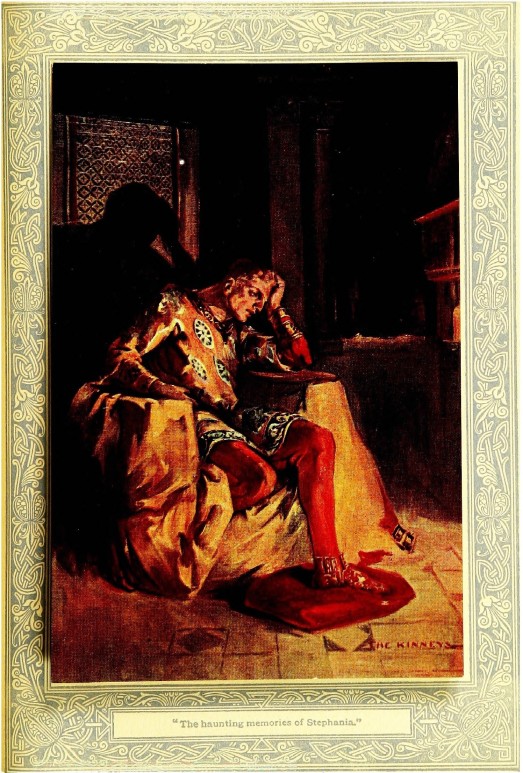
"The haunting memories of Stephania."
He closed his eyes; but sleep would not come.
Where was she now? Where was Stephania? Weeks had passed, since they had last met. It seemed an eternity indeed! He should have remained in Rome, till he was assured of her fate! She had left him with words of hatred, of scorn, bitter and cruel. And yet! How gladly he would have saved the man, his mortal enemy, forsooth, had it lain in his power. Gladly?—No! The man who had thrice forsworn, thrice broken his faith, deserved his doom. Now he was dead. But Rome was lost. What mattered it? There was but one devouring thought in Otto's mind. Where was Stephania? The mad longing for her became more intense with every moment. Now that the worst had come to pass, now that the stunning blow had fallen, he must rouse himself, he must rally. He must combat this fever, which was slowly consuming him; he must find her, see her once more on earth, if but to tell her how he loved her, her and no other woman. Would the pale phantom of Crescentius still stand between them,—still part them as of yore? Not if their loves were equal. His hands were stainless of that blood. On the morrow he would despatch Haco to Rome. Surely some one would have seen her; surely some one knew where the wife of the Senator of Rome was hiding her sorrow,—her grief.
The dim light of the ceremonial lamp, which burned with a dull, veiled flame before an image of the crucified Christ, flickered, as if fanned by a passing breath.
There was deep silence in the king's bed-chamber, and the drawn tapestry shut out every sound from without.
Noiselessly a secret panel in the wall opened behind Otto's couch. Noiselessly it closed in the gray stone. Then an exquisite white hand and arm were thrust through the draperies and the lovely face of Stephania beamed on the sleeping youth. She was pale as death, but the transparency of her skin and the absolute perfection of her form and features made her the image of an Olympian Goddess. Her dark hair, bound by a fillet of gold, enhanced the marble pallor of the exquisite face.
Never had the wonderful eyes of Stephania seemed so full of fire and of life. Stooping over the sleeper, she softly encircled his head with her snowy arms and pressed a long kiss on the dry, fevered lips.
With a moan Otto opened his eyes. For a moment he stared as if he faced an apparition from dream-land.—His breath stopped, then he uttered a choked outcry of delirious joy, while his arms tightly encircled the head which bent over him.
"At last! At last! At last! Oh, how I have longed, how I have pined for you! Stephania—my darling—my love—tell me that you do not hate me—but is it you indeed,—is it you? How did you come here—the guards,—Eckhardt,—"
He paused with a terrible fear in his heart, ever and ever caressing the dark head, the beloved face, whose eyes held his own with their magnetic spell. She suffered his kisses and caresses while stroking his damp brow with soothing hand. Then with a grave look she enjoined silence and caution, crept to the door of the adjoining room and locked it from within.
"They guard you so well, not a ghost could enter," she said with the sweet smile of by-gone days.
He arose and drew the curtains closer. Then he sat down by her side.
"How came you here, Stephania?" he whispered with renewed fear and dread. "If you are discovered,—God have mercy on you,—and me!"
She shook her head.
"I have followed you hither from Rome,—I passed you on the night of your flight. Count Tammus, the commander of Paterno, at one time the friend of the Senator of Rome, has offered me the hospitality of the castelio. No one knows of my presence here, save an old monk, who believes me some itinerant pilgrim, in search of the End of Time," she whispered with her far-away look. "The End of Time."
"They say it is close at hand," Otto replied, holding her hands tightly in his. "Oh, Stephania, how beautiful you are! That which has broken my spirit, seems not to have touched your life!"
"My life is dead," she replied. "What remains,—remains through you. Therefore time has lacked power. But that which has been and is no more, stands immovable before my soul."
He gazed at her with large fear-struck eyes.
"Then—your heart is no longer mine?"
The grasp of the hands in his own tightened.
"Would I be here, silly dreamer? I love you—my heart knows no change. It loved but once—and you!"
All the happiness, slumbering in the deep eyes of the son of Theophano, burst forth as in a glorious aureole of light.
"Then you have never—"
She raised her hand forbiddingly.
"I could not give to him who is gone that which I gave to you! When we first met I was your foe. I hated you with all the hate which a Roman has for the despoiler of his lands. When I gave you my love,—which, alas, was not mine to give, I did so, a powerless instrument of Fate. Side by side have we trod life's narrow path,—neither of us could turn to right or left without standing accounted to the other. It was not ours to say love this one or that other. We were brought together by that same mysterious force, to which it is vain to cry halt. We knew,—I knew,—that it must, sooner or later, carry us to doom and death; but resistlessly the whirlwind had taken us up in its glistening cloud: Thus are we lost;—you and I!"
He listened to her with a great fear in his soul.
"How cold your hands are, my love," he whispered. "Cold as if the flow of blood had ceased. Can you feel how it rushes through my veins,—so hot—so boiling hot?"
"You have the fever! Therefore my hands appear cold to you. But,—you spoke truly,—in my hand is death,—and death is cold! Life I have none,—you have taken it from me!"
"Stephania!"
It sounded like the last outcry of a broken heart.
"Why recall that which could not be averted? Were it mine to change it, oh, that I could!"
"Do you really wish it?"
"I wish but your happiness. Can you doubt?"
"I do not doubt. I love you!"
"Stephania—my darling,—my all!"
And he kissed her eyes, her lips, her hair, and she suffered his caresses as one wrapt in a blissful dream.
"I learned you were stricken with the fever,—the last defence left to us by nature against our foes. I have come, to watch over you, to care for you,—to nurse you back to health,—to life—"
"And you braved the dangers that beset your path on every turn?"
"How should I fear,—with such love in my heart for you!"
"Then you—will remain?" he whispered, his very life in his eyes.
"For a time," she answered, in a halting tone, which passed not unremarked.
"And then?" he queried.
Her head sank.
"I know not!"
"Then I will tell you, my own love! We will return to Rome together, you and I; Stephania, the empress of the West,—would not that reconcile your Romans,—appease their hate?"
Stephania gazed for a moment thoughtfully at Otto, then she shook her head.