THE SLANG DICTIONARY. (continued 8)
Reading edition
Touch-and-go, an expression often applied to men with whom business arrangements should be of the lightest possible character. Thus, “He’s a TOUCH-AND-GO sort of fellow. Be careful of him.”
Toucher, “as near as a TOUCHER,” as near as possible without actually touching.—Coaching term. The old Jarveys, to show their skill, used to drive against things so closely as absolutely to touch, yet without injury. This they called a TOUCHER, or TOUCH-AND-GO, which was hence applied to anything which was within an ace of ruin.
Touchy, peevish, irritable. Johnson terms it a low word.
Tout. In sporting phraseology a TOUT signifies an agent in the training districts, on the look-out for information as to the condition and capabilities of those horses entering for a coming race. Touts often get into trouble through entering private training-grounds. They, however, are very highly paid, some making 40l. or 50l. a week during the season. Now frequently called horse-watchers.
Tout, to look out, or watch.
Touter, a looker out, one who waits at railway stations and steamboat piers, and touts for customers; a hotel runner. Term in general use.
Touzle, to romp with or rumple.—Scotch.
Towel, to beat or whip. In old English phraseology a cudgel was termed an oaken TOWEL—whence, perhaps, the verb.
Towelling, a rubbing down with an oaken TOWEL, a beating.
Town and Gown. The fight which used to come off every 5th of November between the undergrads and the “cads.” The sides used to shout respectively “TOWN!” and “GOWN!” as war-cries.—Oxford University.
Town-lout, a derogatory title at Rugby School for those pupils who reside with their parents in the town, in contradistinction from those who live in the boarding-houses.
Tow-pows, grenadiers. From the bearskins, most likely, unless it was originally TALL-POWS, the grenadiers being the tallest men in the company.
Towzery gang, swindlers who hire sale-rooms, usually in the suburbs, for mock auction sales of cheap and worthless goods, and who advertise their ventures as “Alarming Sacrifices,” “Important Sales of Bankrupts’ Stock,” &c. The American name for a mock auctioneer is a “Peter Funk.”
Tracks, “to make TRACKS,” to run away. See STREAK.
Tradesman, one who thoroughly understands his business, whatever it may be. No better compliment can be passed on an individual, whether his profession be housebreaking, prizefighting, or that of a handicraftsman, than the significant “He’s a regular TRADESMAN.”
Translator, a man who deals in old shoes or clothes, and refits them for cheap wear. These people generally live in or about Dudley Street, Seven Dials.
Translators, second-hand boots mended and polished, and sold at a low price.
Trap, a “fast” term for a carriage of any kind. Traps, goods and chattels of any kind, but especially luggage and personal effects; in Australia, “swag.”
Trapesing, gadding or gossiping about in a slatternly way. Generally applied to girls and women in low neighbourhoods, who wander from public-house to public-house, and whose clothes are carelessly fastened, causing them to trail on the ground.
Traveller, name given by one tramp to another. “A TRAVELLER at her Majesty’s expense,” i.e., a transported felon, a convict.
Tree, “up a TREE,” in temporary difficulties,—out of the way. American expression, derived from racoon or bear-hunting. When Bruin is TREED, or is forced up a TREE by the dogs, it means that then the tug of war begins. See ’COON. Hence when an opponent is fairly run to bay, and can by no evasion get off, he is said to be TREED. These expressions originated with Colonel Crockett, of backwoods celebrity. In Scotland the phrase is “up a close,” i.e., up a passage with no outlet, a cul-de-sac, therefore suggestive of an unpleasant predicament.
Triangles, a slang term for delirium tremens, during a fit of which everything appears out of the square.
Trimmings, the necessary adjuncts to anything cooked, but specially applied to a boiled leg of mutton, as turnips, potatoes, bread, beer, salt, &c. Bets are frequently made for a leg of mutton and TRIMMINGS. Or one person will forfeit the mutton if another will “stand the TRIMMINGS.” It is generally a supper feast, held in a public-house, and the rule is for the landlord to charge as TRIMMINGS everything, except the mutton, placed on the table previous to the removal of the cloth. A boiled leg o’ mutton and TRIMMINGS will be always known as a “swarry” to admirers of Sam Weller.
Tripes, the bowels.
“Next morning Miss Dolly complained of her TRIPES, Drinking cold water had given her gripes.”
Trollies, or TROLLY-CARTS, term given by costermongers to a species of narrow carts, which can either be drawn by a donkey or driven by hand.
Trolling, sauntering or idling, hence TROLL and TROLLOCKS, an idle slut, a “moll,” which see.
Trollop, a slatternly woman, a prostitute.
Trot, to “run up,” to oppose, to bid against at an auction. Private buyers at auctions know from experience how general is the opposition against them from dealers, “knock-outs,” and other habitués of sales, who regard the rooms as their own peculiar domain. “We TROTTED him up nicely, didn’t we?” i.e., we made him (the private buyer) pay dearly for what he bought.
Trot out, to draw out or exploit, to show off the abilities of a companion; sometimes to roast for the amusement and with the assistance of an assembled company.
Trotter, a tailor’s man who goes round for orders.—University.
Trotter cases, shoes.
Trotters, feet. Sheep’s TROTTERS, boiled sheep’s feet, a favourite street delicacy.
Truck, a hat—from the cap on the extremity of a mast.—Sea.
Truck, to exchange or barter.
Trucks, trousers.
Trull, corruption of “troll” or “trollop,” a dirty, slatternly woman, a prostitute of the lowest class.
Trump, a good fellow; “a regular TRUMP,” a jolly or good-natured person—in allusion to a TRUMP card; “TRUMPS may turn up,” i.e., fortune may yet favour me.
Trunks, short trousers worn above hose or tights.—Theatrical.
Try it on, to make attempt, generally applied to an effort at imposition. An extortionate charge or a begging-letter is frequently described as “a regular TRY-ON.”
Tub, the morning bath. To TUB has now become a regular verb, so far as colloquialism is concerned, though no one uses a TUB as the word was originally understood.
Tub-thumping, preaching or speech-making, from the old Puritan fashion of “holding forth” from a tub, or beer barrel, as a mark of their contempt for decorated pulpits.
Tubs, nickname for a butterman.
Tuck, a schoolboy’s term for fruit, pastry, &c. Tuck in, or TUCK OUT, a good meal.
Tuft-hunter, a hanger on to persons of quality or wealth—one who seeks the society of wealthy people. Originally University slang, but now general.
Tufts, at the University, noblemen, who pay high fees and are distinguished by golden TUFTS, or tassels, in their caps.
Tumble, to comprehend or understand. A coster was asked what he thought of Macbeth, and he replied, “The witches and the fighting was all very well, but the other moves I couldn’t TUMBLE to exactly; few on us can TUMBLE to the jaw-breakers; they licks us, they do.”
Tumble to pieces, to be safely delivered, as in childbirth.
Tune the old cow died of, an epithet for any ill-played or discordant piece of music. Originally the name of an old ballad, referred to by dramatists of Shakspeare’s time.
Tuns, a name at Pembroke College, Oxford, for small silver cups, each containing half a pint. Sometimes a TUN had a handle with a whistle, which could not be blown till the cup was empty.
Turf, horse-racing, and betting thereon; “on the TURF,” one who occupies himself with race-horse business; said also of a street-walker, or nymph of the pavé.
Turkey merchants, dealers in plundered or contraband silk. Poulterers are sometimes termed TURKEY MERCHANTS in remembrance of Horne Tooke’s answer to the boys at Eton, who wished in an aristocratic way to know what his father was: “A TURKEY MERCHANT,” replied Tooke—his father was a poulterer. Turkey merchant, also, was formerly slang for a driver of turkeys or geese to market.
Turnip, an old-fashioned watch, so called from its general appearance, if of silver. Also called “a frying-pan.” Old-fashioned gold watches are called “warming-pans.”
Turn it up, to quit, change, abscond, or abandon; “Ned has TURNED IT UP,” i.e., run away; “I intend TURNING IT UP,” i.e., leaving my present abode or employment, or altering my course of life.
Turn-out, personal show or appearance; a man with a showy carriage and horses is said to have a good TURN-OUT.
Turn-over, an apprentice who finishes with a second master the indentures he commenced with another, who has died or become bankrupt.
Turn up, a street fight; a sudden leaving, or making off. An unexpected slice of luck. Among sporting men bookmakers are said to have a TURN UP when an unbacked horse wins.
Turn up, to appear unexpectedly. Also to happen; “Let’s wait, and see what will TURN UP.”
Turn up, to make sick. People are said to be TURNED UP by sea-sickness, or when they are made ill by excessive smoking or drinking.
Turned over, remanded by the magistrate or judge for want of evidence.
Turned up, to be stopped and searched by the police. To be discharged from a police-court or sessions-house; to be acquitted.
Turnpike sailors, beggars who go about dressed as sailors. A sarcastic reference to the scene of their chief voyages.
Tusheroon, a crown piece, five shillings. Otherwise a bull or cartwheel.
Tussle, a row, struggle, fight, or argument.
Tussle, to struggle, or argue.
Twelve godfathers, a jury, because they give a name to the crime the prisoner before them has been guilty of, whether murder or manslaughter, felony or misdemeanor. Consequently it is a vulgar taunt to say, “You will be christened by TWELVE GODFATHERS some day before long.”
Twelver, a shilling.
Twice-laid, a dish made out of cold fish and potatoes.—Sea. Compare BUBBLE AND SQUEAK, and RESURRECTION PIE.
Twig, style. Prime TWIG, in good order and high spirits.
Twig, to comprehend, as, “Do you TWIG?” Also, “Hop the TWIG,” to decamp.
Twist, brandy and gin mixed.
Twist, capacity for eating, appetite; “He’s got a capital TWIST.”
Twitchety, nervous, fidgety.
Twitter, “all in a TWITTER,” in a fright or fidgety state.
Two eighteener, an Americanism for a man or woman of the fastest kind—two minutes eighteen seconds, or close thereabouts, being the fastest time for a mile recorded in connexion with the Transatlantic national sport, trotting. “Two forty on a plank road,” a once favourite expression with a similar meaning, derived from a feat of the famous trotting mare Flora Temple, has died out since trotting has become faster, and courses have been prepared on a different principle.
Two-eyed-steak, a red-herring or bloater. Otherwise “Billingsgate pheasant.”
Two-handed, expert at fisticuffs. Ambidextrous generally.
Two-handed game, a game or proposal in which the chances are fairly even; as, “I’ll punch your head;” “Ah, that’s a TWO-HANDED GAME—you’ll get no good at that.”
Two to one, the pawnbroker’s sign of three balls. So called because it is supposed by calculating humourists to be TWO TO ONE against the redemption of a pledged article.
Two upon ten, or TWO PUN’ TEN, an expression used by assistants to each other, in shops, when a customer of suspected honesty makes his appearance. The phrase refers to “two eyes upon ten fingers,” shortened as a money term to TWO PUN’ TEN. When a supposed thief is present, one shopman asks the other if that TWO PUN’ (pound) TEN matter was ever settled. The man knows at once what is meant, and keeps a careful watch upon the person being served. If it is not convenient to speak, a piece of paper is handed to the same assistant, bearing the, to him, very significant amount of
£2: 10: 0
Compare Sharp, John Orderly.
Twopenny, the head; “tuck in your TWOPENNY,” bend down your head.
Twopenny-halfpenny, paltry, insignificant. A TWOPENNY-HALFPENNY fellow, a not uncommon expression of contempt.
Twopenny-hops, low dancing rooms, the price of admission to which was formerly twopence. The clog hornpipe, the pipe dance, flash jigs, and hornpipes in fetters, à la Jack Sheppard, were the favourite movements, all entered into with great spirit.
Twopenny rope, a lodging-house of the lowest kind, where tramps and cadgers sleep on sacking stretched by means of ropes. Sleeping at these places is called having “twopenn’orth of rope.”
Tyburnia, the Portman and Grosvenor Square district. It is facetiously divided by the Londoners into “Tyburnia Felix,” “Tyburnia Deserta,” and “Tyburnia Snobbica.” The old gallows at Tyburn stood near the N.E. corner of Hyde Park, at the angle formed by the Edgware Road and the top of Oxford Street. In 1778 this was two miles out of London.
Tyburn tippet, in the old hanging days, Jack Ketch’s rope.
Tye, or TIE, a neckerchief. Proper hosiers’ term now, but slang thirty years ago, and as early as 1718.
Tyke, a Yorkshireman. Term used by themselves, as well as by Southerners, in reference to them.
Typo, a printer.
Ugly, wicked, malicious, resentful.—American.
Ullages, the wine of all sorts left in the bottoms of glasses at a public dinner. This is emptied into a measure, and drunk behind the screen or in any convenient place by the waiters, which accounts for their stony glare and fishy appearance late in the evening. Maybe from Lat. ULLUS, any.
Unbleached American, Yankee term, since the war, for coloured natives of the United States.
Uncle, the pawnbroker. See MY UNCLE.
Under a cloud, in difficulties. An evident reference to shady circumstances.
Under the rose. See ROSE.
Understandings, the feet or boots. Men who wear exceptionally large or thick boots, are said to possess good UNDERSTANDINGS.
Understudy, to STUDY a part for the stage, not with the view of playing it at once, but so as to be ready in the event of anything happening to its present representative. Some actors of position, who suffer from delicate health, or mental weakness, have always other and inferior, but more robust, artists UNDERSTUDYING their parts.
Unfortunate, a modern euphuism for a prostitute, derived from Thomas Hood’s beautiful poem of The Bridge of Sighs:—
“One more UNFORTUNATE, Weary of breath, Rashly importunate, Gone to her death.”
It is almost needless to remark that the poet had no intention of using the word in any but its widest and most general sense.
Unicorn, a style of driving with two wheelers abreast and one leader—termed in the United States a “spike team.” “Tandem” is one wheeler and one leader. “Random,” three horses in line. “Manchester” means three horses abreast. See HARUM-SCARUM.
Unlicked, ill-trained, uncouth, rude, and rough; an “UNLICKED cub” is a loutish youth who has never been taught manners; from the tradition that a bear’s cub, when brought into the world, has no shape or symmetry until its dam licks it into form with her tongue. Possibly said of a boy who has been petted, i.e., who has been insufficiently thrashed or licked. Case of spared rod and spoilt child.
Unparliamentary, or UNSCRIPTURAL, language, words unfit for use in ordinary conversation.
Unutterables, or UNWHISPERABLES, trousers. See INEXPRESSIBLES.
Up, “to be UP to a thing or two,” to be knowing, or understanding; “to put a man UP to a move,” to teach him a trick; “it’s all UP with him,” i.e., it is all over with him; when pronounced U.P., naming the two letters separately, means settled, or done UP. “Up a tree,” see TREE. “Up to snuff,” wide awake, acquainted with the last new move; “UP to one’s gossip,” to be a match for one who is trying to take you in; “UP to slum,” proficient in roguery, capable of committing a theft successfully; “what’s UP?” what is the matter? what is the news?
U.P., United Presbyterian Church of Scotland.
Upper Benjamin, or Benjy, a great coat; originally “Joseph,” but, because of the preponderance of tailors named Benjamin, altered in deference to them.
Upper storey, or UPPER LOFT, a person’s head; “his UPPER STOREY is unfurnished,” i.e., he does not know very much. “Wrong in his UPPER STOREY,” crazy. See CHUMP.
Uppish, proud, arrogant.
Used up, broken-hearted, bankrupt, fatigued, vanquished.
Vakeel, a barrister.—Anglo-Indian.
Vamos, VAMOUS, or VAMOOSH, to go, or be off. Spanish, VAMOS, “Let us go!” Probably NAMUS, or NAMOUS, the costermonger’s word, was from this.
Vamp, to spout, to leave in pawn. Also to cobble, as, “a VAMPED play,” and “a VAMPED accompaniment,” both terms reflecting discredit on the work, but not necessarily upon the musician.
Vamps, old, or refooted stockings. From VAMP, to piece.
Vardo, to look; “VARDO the carsey,” look at the house. Vardo formerly was old cant for a waggon. This is by low Cockneys generally pronounced VARDY.
Vardy, verdict, vulgarly used as opinion, thus, “My VARDY on the matter is the same as yourn.”
Varmint. “You young VARMINT, you!” you bad, or naughty boy. Corruption of VERMIN.
Varnisher, an utterer of false sovereigns. Generally “snide-pitcher.”
’Varsity, either UNIVERSITY—more rarely University College, Oxford.
Velvet, the tongue; especially the tongue of a magsman. Also, men who have succeeded in their speculations, especially on the turf, are said to stand on VELVET.
Veneer, the artificiality of society, conventionality. Dickens expressed his dislike for certain forms of VENEER repeatedly, and especially by means of his Veneerings in Our Mutual Friend.
Vet, colloquial term for VETERINARIAN.
Vic, the Victoria Theatre, London. Also the street abbreviation of the Christian name of her Majesty the Queen.
Village, or THE VILLAGE, i.e., London. Birmingham is called “the hardware VILLAGE.” Also a Cambridge term for a disreputable suburb of that town, viz., Barnwell, generally styled “the VILLAGE.”
Ville, or VILE, a town or village—pronounced PHIAL, or VIAL.—French.
Vinnied, mildewed, or sour.—Devonshire.
Voker, to talk; “can you VOKER Romany?” can you speak the canting language?—Latin, VOCARE; Spanish, VOCEAR.
Vowel. “To VOWEL a debt” is to acknowledge with an I O U.
Vulpecide, one who shoots or traps foxes, or destroys them in any way other than that of hunting. A foxhunter regards a VULPECIDE as rather worse than an ordinary murderer.
Wabble, or WOBBLE, to move from side to side, to roll about. Johnson terms it “a low, barbarous word.”
Walk into, to overcome, to demolish; “I’ll WALK INTO his affections,” i.e., I will scold or thrash him. “He WALKED INTO the grub,” i.e., he demolished it. Walk into also means to get into the debt of any one, as “He WALKED INTO the affections of all the tradesmen in the neighbourhood.”
Walk-over, a re-election without opposition.—Parliamentary, but derived from the turf, where a horse which has no rivals WALKS OVER the course. See DEAD HEAT.
Walk your chalks, be off, or run away,—spoken sharply by any one who wishes to get rid of a troublesome person. See CHALKS.
Walker, a letter-carrier or postman. From an old song, called, “Walker, the twopenny postman.”
Walker! or Hookey Walker! an ejaculation of incredulity, used when a person is telling a story which you know to be all gammon, or worse. One explanation of the phrase is this:—“Years ago there was a person named Walker, an aquiline-nosed Jew, who exhibited an orrery, which he called by the erudite name of ‘Eidouranion.’ He was also a popular lecturer on astronomy, and often, telescope in hand, invited his pupils to ‘take a sight’ at the moon and stars. The lecturer’s phrase struck his schoolboy auditory, who frequently ‘took a sight’ with that gesture of outstretched arm and adjustment to nose and eye which was the first garnish of the popular saying. The next step was to assume phrase and gesture as the outward and visible mode of knowingness in general.” This has been denied, however, and a statement made that Hookey Walker was a magistrate of dreaded acuteness and incredulity, whose hooked nose gave the title of “beak” to all his successors; it is also said, moreover, that the gesture of applying the thumb to the nose and agitating the little finger, as an expression of “Don’t you wish you may get it?” is considerably older than the first story would seem to indicate. There are many and various explanations of the term, given according to the development of fancy.—Notes and Queries, iv. 425.
Walking the pegs, a method of cheating at the game of cribbage, by a species of legerdemain, the sharper either moving his own pegs forward, or those of his antagonist backward, according to the state of the game.
Wallflower, a person who goes to a ball and looks on without dancing, either from choice or through not being able to obtain a partner. From the position.
Wallflowers, left-off and “regenerated” clothes exposed for sale on the bunks and shop-boards of Seven Dials. See REACH-ME-DOWNS.
Wallabee-track, Colonial slang for the tramp. When a man in Australia is “on the road” looking for employment, he is said to be on the WALLABEE-TRACK.
Wallop, to beat, or thrash. John Gough Nichols derives this word from an ancestor of the Earl of Portsmouth, one Sir John Wallop, Knight of the Garter, who in King Henry VIII.’s time distinguished himself by WALLOPING the French; but it is more probably connected with wheal, a livid swelling in the skin after a blow. See POT-WALLOPER.
Walloping, a beating or thrashing; sometimes used in an adjective sense, as big, or very large.
Wapping, or WHOPPING, of a large size, great.
Warm, rich, or well off.
Warm, to thrash or beat; “I’ll WARM your jacket.” To WARM the wax of one’s ear is to give a severe blow on the side of the head. To WARM is also to rate or abuse roundly. Also varied, as, “to make it hot” for any one.
Warming-pan, a large old-fashioned gold watch. A person placed in an office to hold it for another. See W.P.
War-paint, evening dress. When people go out in full costume they are often said to have their WAR-PAINT on. Also, military “full-fig.”
Wash, “It wont WASH,” i.e., will not stand investigation, will not “bear the rub,” is not genuine, can’t be believed.
Waster, a useless, clumsy, or ill-made person.
Watch and seals, a sheep’s head and pluck.
Watchmaker, a pickpocket or stealer of watches. Often called “a WATCHMAKER in a crowd.”
Water-bewitched, very weak tea, the third brew (or the first at some houses). Sometimes very weak tea is called “husband’s tea,” in allusion to the wife taking the first brew, and leaving the rest for her husband. Also grog much diluted.
Water-dogs, Norfolk dumplings.
Water gunner, a marine artilleryman.
Water the dragon, or WATER ONE’S NAG, a hint for retiring.
Waterman, a blue silk handkerchief. The friends of the Oxford and Cambridge boats’ crews always wear these—light blue for Cambridge, and a darker shade for Oxford.
Wattles, ears.
Wax, a rage. “Let’s get him in a WAX.” Waxy, cross, ill-tempered.
Wayz-goose, a printers’ annual dinner, the funds for which are collected by stewards regularly appointed by “the chapel.”
Weather eye, the cautious eye. Any one who is supposed to have an extra good knowledge of things in general, or to be hard to impose on or cheat, is said to have his WEATHER EYE well open.
Weather-headed, so written by Sir Walter Scott in his Peveril of the Peak, but it is more probably WETHER-HEADED, as applied to a person having a “sheepish” look.
Weaving, a notorious card-sharping trick, done by keeping certain cards on the knee, or between the knee and the under side of the table, and using them when required by changing them for the cards held in the hand.
Weaving leather aprons. When a knowing blade is asked what he has been doing lately, and does not choose to tell, his reply is, that he has been very busy WEAVING LEATHER APRONS. (From the reports of a celebrated trial for gold robbery on the South-Western Railway.) Other similar replies are, “I have been making a trundle for a goose’s eye,” or a “whim-wham to bridle a goose.” Sometimes a man will describe himself as “a doll’s-eye WEAVER.”
Wedge, silver.—Old Cant.
Wedge-feeder, a silver spoon.
Weed, a cigar; the WEED, tobacco generally.
Weed, a hatband.
Weight-for-age, a sporting phrase which, applied to a race, distinguishes it from a handicap or catch-weight event, and informs all interested that the animals which run carry according to their ages, and not their abilities. Winners of certain great races generally carry penalties in addition to WEIGHT-FOR-AGE, for the purpose of equalizing matters somewhat; but as a rule the results are fairly foreshadowed as soon as in these races the horses are at the post, or as soon as the starters are positively known.
Wejee, a chimney-pot. Often applied to any clever invention, as, “That’s a regular WEJEE.”
Welcher, a person who makes a bet without the remotest chance of being able to pay, and, losing it, absconds, or “makes himself scarce.” In the betting ring a WELCHER is often very severely handled upon his swindling practices being discovered. The Catterick “Clerk of the Course” once provided some stout labourers and a tar-barrel for the special benefit of the WELCHERS who might visit that neighbourhood. The word is modern, but the practice is ancient.
“One Moore, the unworthy incumbent of the ‘Suffolk curacy,’ dedicated a book to ‘Duke Humphrey,’ and was then entirely lost sight of by his old college friends, till one of them espied him slung up in ‘the basket,’ for not paying his bets at a cock-pit.”—Post and Paddock.
One writer says the term “arose from a fellow who took deposits on account of Welsh ponies, which he said he was importing, and never delivered them.” It is not unfrequently suggested by irreverent persons that the word was suggested by the dislike his gracious Majesty George the Fourth had, when a young man, for settling. Others derive it from the nursery rhyme,
“Taffy was a Welshman, Taffy was a thief.”
There can be no doubt that, from the days when the stout Earl of Chester and others were constantly employed in checking and cutting off the expeditions of their neighbours till comparatively recently, the term “Welshman” has been hardly one of kindness. It is not hard, therefore, to imagine its use on the Roodee, and its subsequent corruption into WELCHER. The spelling of the word, WELCHER or WELSHER, is optional.
Well, to pocket, to save money. Any one of fair income and miserly habits is said to “WELL it.”
Welt, to thrash with a strap or stick. Probably meaning to raise wheals.
West central, a water-closet, the initials being the same as those of the London Postal District. It is said that for this reason very delicate people refuse to obey Rowland Hill’s instructions in this particular. An old maid, who lived in this district, was particularly shocked at having W.C. marked on all her letters, and informed the letter-carrier that she could not think of submitting to such an indecent fashion. On being informed that the letters would not be forwarded without the obnoxious initials, she remarked that she would have them left at the Post-Office. “Then, marm,” said the fellow, with a grin, “they will put P.O. on them, which will be more ondacenter than the tother.”
Wet, a drink, a drain.
Wet, to drink. Low people generally ask an acquaintance to WET any recently purchased article, i.e., to stand treat on the occasion. “Wet (originally WHET, to sharpen,) your whistle,” i.e., take a drink; “WET the other eye,” i.e., take another glass. See SHED A TEAR.
Wet Quaker, a man who pretends to be religious, and is a dram-drinker on the sly.
Wet un, a diseased cow, unfit for human food, but nevertheless sold to make into sausages. Compare staggering-Bob.
Whack, a share or lot. “Give me my WHACK,” give me my share.—Scotch, SWEG, or SWACK.
Whack, or WHACKING, a blow, or a thrashing.
Whack, to beat.
Whacker, a lie of unusual dimensions, sometimes called a “round un.”
Whacking, large, fine, or strong.
Whacks, to go WHACKS, to divide equally; to enter into partnership.
Whale, “very like a WHALE,” said of anything that is very improbable. A speech of Polonius’s in Hamlet.
What d’yecall’em, a similar expression to “thingumy.”
Wheeze, a joke, an anecdote, or dialogue, not strictly connected with a piece that is being played, but introduced by an actor, sometimes with the assistance and for the benefit of others. The dialogues which take place between the songs at nigger entertainments are also known as WHEEZES. The word actually means a new notion as applied to dialogue.
Wherret, or WORRIT, to scold, trouble, or annoy.—Old English.
Whid, a word. Sometimes, a fib, a falsehood, a word too much.—Modern Slang, from the ancient cant.
Whiddle, to enter into a parley, or hesitate with many words, &c.; to inform, or discover. See WHEEDLE.
Whim-wham, an alliterative term, synonymous with fiddle-faddle, riff-raff, &c., denoting nonsense, rubbish, &c.
Whip, after the usual allowance of wine is drunk at mess, those who wish for more put a shilling each into a glass handed round to procure a further supply. Whip-round is now a common term for a subscription of a similar kind to that described.
Whip, to “WHIP anything up,” to take it up quickly; from the method of hoisting heavy goods or horses on board ship by a WHIP, or running tackle, from the yard-arm. Generally used to express anything dishonestly taken.
Whip, the member of the House of Commons whose duty it is to collect and keep together his party to vote at divisions. To give him greater influence, the ministerial WHIP holds, or is supposed to hold, the minor patronage of the Treasury.
Whipjack, a sham shipwrecked sailor, called also a turnpike-sailor.
Whip the cat, when an operative works at a private house by the day. Term used amongst tailors and carpenters.
Whipper-snapper, a waspish, diminutive person.
Whisper, a tip given in secret, a rumour which is spread under the pretence of its being a secret. To “give the WHISPER,” is to give a quick tip to any one. An owner’s final instruction to his jockey is called “the WHISPER at the post.”
Whisper, to borrow money—generally small sums—as, “He WHISPERED me for a tanner.”
Whisperer, a constant borrower.
Whistle, “as clean as a WHISTLE,” neatly, or “slickly done,” as an American would say; “To whet (or more vulgarly wet) one’s WHISTLE,” to take a drink. This last is a very old expression. Chaucer says of the Miller of Trumpington’s wife (Canterbury Tales, 4153)—
“So was hir joly WHISTAL well y-wet.”
“To WHISTLE for anything,” to stand small chance of getting it, from the nautical custom of WHISTLING for a wind in a calm, which of course comes none the sooner for it. “To pay for one’s WHISTLE,” to pay extravagantly for any fancy.
Whistling-Billy, or puffing-Billy, a locomotive engine.
Whistling-shop, a place in which spirits are sold without a licence.
Whitechapel or Westminster brougham, a costermonger’s donkey-barrow.
Whitechapel, anything mean or paltry. Potting one’s opponent at billiards is often known as “Whitechapel play.”
Whitechapel, in tossing, when “two out of three wins.” See SUDDEN DEATH.
Whitechapel fortune, a clean gown and a pair of pattens.
White eye, military slang for a very strong and deleterious kind of whisky, so called because its potency is believed to turn the eyes round in the sockets, leaving the whites only visible.
White feather, “to show the WHITE FEATHER,” to evince cowardice. In times when great attention was paid to the breeding of game-cocks, a white feather in the tail was considered a proof of cross-breeding.
White horses, the foam on the crests of waves, seen before or after a storm.
“Now the wild white horses play. Champ and chafe and toss in the spray. Children, dear, let us away, This way, this way.”—Matthew Arnold.
White lie, a harmless lie, one told to reconcile people at variance. “Mistress is not at home, sir,” is a WHITE LIE often told by servants.
White-livered, or LIVER-FACED, cowardly, much afraid, very mean.
White prop, a diamond pin.—East London.
White satin, gin,—term amongst women. See SATIN.
White serjeant, a man’s superior officer in the person of his better half.
White tape, gin,—term used principally by female servants. See RIBBON.
White un, a silver watch.
White wine, the fashionable term for gin.
“Jack Randall then impatient rose, And said, ‘Tom’s speech were just as fine If he would call that first of GOES By that genteeler name—WHITE WINE.’” Randall’s Diary, 1820.
Whitewash, to rehabilitate. A person who took the benefit of the Insolvent Act was said to have been WHITEWASHED. Now said of a person who compromises with his creditors.
Whitewash, a glass of sherry as a finale, after drinking port and claret.
Whittle, to nose or peach.—Old Cant. To cut and hack as with a pocket-knife.—American.
Whop, to beat, or hide. Corruption of WHIP; sometimes spelt WAP.
Whop-straw, cant name for a countryman; Johnny Whop-straw, in allusion to threshing.
Whopper, a big one, a lie. A lie not easily swallowed.
Widdle, to shine. See OLIVER.
Wide-awake, a broad-brimmed felt or stuff hat,—so called because it never had a nap, and never wants one.
Wido, wide awake, no fool.
Wife, a fetter fixed to one leg.—Prison.
Wiffle-woffles, in the dumps, sorrow, stomach-ache.
Wig, move off, go away.—North Country Cant.
Wigging, a rebuke before comrades. If the head of a firm calls a clerk into the parlour, and rebukes him, it is an EARWIGGING; if done before the other clerks, it is a WIGGING.
Wild, a village.—Tramps’ term. See VILE.
Wild, vexed, cross, passionate,—said to be from WILLED (SELF-WILLED), in opposition to “tamed” or “subdued.” In the United States the word “mad” is supplemented with a vulgar meaning similar to our Cockneyism WILD; and to make a man mad on the other side of the Atlantic is to vex him, or “rile” his temper—not to render him a raving maniac, or a fit subject for Bedlam.
Wild Irishman, the train between Euston and Holyhead, in connection with the Kingstown mail-boats.
Wild oats, youthful pranks. A fast young man is said to be “sowing his WILD OATS.”
William, a bill. The derivation is obvious.
Willow, a cricket-bat. From the material of which it is made. The great batsman, W. G. Grace, is often called “champion of the WILLOW.”
Wind, “to raise the WIND,” to procure money; “to slip one’s WIND,” a coarse expression, meaning to die. See RAISE.
Wind, “I’ll WIND your cotton,” i.e., I will give you some trouble. The Byzantine General, Narses, used the same kind of threat to the Greek Empress,—“I will spin a thread that they shall not be able to unravel.”
Windows, the eyes, or “peepers.”
Winey, intoxicated.
Winged, hurt, but not dangerously, by a bullet. Originally to be shot in the arm or shoulder. To slightly wound birds is to WING them.
Winkin, “he went off like WINKIN,” i.e., very quickly. From WINK, to shut the eye quickly.
Winks, periwinkles.
Winn, a penny—Ancient Cant. See introductory chapter.
Wipe, a pocket-handkerchief.—Old Cant.
Wipe, a blow. Frequently sibilated to SWIPE, a cricket-term.
Wipe, to strike; “he fetcht me a WIPE over the knuckles,” he struck me on the knuckles; “to WIPE a person down,” to flatter or pacify; “to wipe off a score,” to pay one’s debts, in allusion to the slate or chalk methods of account-keeping; “to WIPE a person’s eye,” to shoot game which he has missed; hence to obtain an advantage by superior activity. With old topers “WIPING one’s eye,” is equivalent to giving or taking another drink.
Wipe-out, to kill or utterly destroy. This is an Americanism, but is in pretty general use here.
Wire-in, a London street phrase in general use, which means to go in with a will. In its original form of “WIRE-IN, and get your name up,” it was very popular among London professional athletes. The phrase is now general, and any one who has a hard task before him, knows he must WIRE-IN to bring matters to a successful issue.
Wire-pullers, powerful political partisans, who do their work from “behind the scenes.”
With and without, words by themselves, supposed to denote the existence or non-existence of sugar in grog. Generally “warm WITH” and “cold WITHOUT.”
Wobble-shop, a shop where beer is sold without a licence.
Wobbler, a foot soldier, a term of contempt used by cavalrymen.
Wobbly, rickety, unsteady, ill-fitting.
Wolf, to eat greedily.
Wooden spoon, the last junior optime who takes a University degree; denoting one who is only fit to stay at home, and stir porridge.—Cambridge. The expression is also parliamentary slang, and is applied to the member of the ministry whose name appears in the division lists least frequently. At the ministerial dinner annually held at Greenwich, such member sometimes has a wooden spoon presented to him.
Wooden surtout, a coffin, generally spoken of as a WOODEN SURTOUT with nails for buttons.
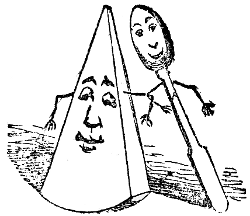
Wooden wedge, the last name in the classical honours’ list at Cambridge. The last in mathematical honours had long been known as the WOODEN SPOON; but when the classical Tripos was instituted in 1824, it was debated among the undergraduates what sobriquet should be given to the last on the examination list. Curiously enough, the name that year which happened to be last was Wedgewood (a distinguished Wrangler). Hence the title.
Wool, courage, pluck; “you are not half-WOOLED,” term of reproach from one thief to another.
Wool, bravery, pluck. Term much in use among pugilists and their admirers. The highest praise that can be bestowed on a man of courage in lower-class circles is that which characterizes him as being “a reg’lar wooled un,” or “a rare WOOL-TOPPED UN.” Derived from the great pluck and perseverance shown by many pugilists of whole or partial colour, from Molyneux down to Bob Travers.
Woolbird, a lamb; “wing of a WOOLBIRD,” a shoulder of lamb.
Wool-gathering, said of any person’s wits when they are wandering, or in a reverie.
Wool-hole, the workhouse.
Woolly, out of temper.
Woolly, a blanket.
Work, to plan, or lay down and execute any course of action, to perform anything; “to WORK the bulls,” i.e., to get rid of false crown pieces; “to work the oracle,” to succeed by manœuvring, to concert a wily plan, to victimize,—a possible reference to the stratagems and bribes used to corrupt the Delphic oracle, and cause it to deliver a favourable response. “To WORK a street or neighbourhood,” to try at each house to sell all one can, or to bawl so that every housewife may know what is to be sold. The general plan is to drive a donkey-barrow a short distance, and then stop and cry. The term implies thoroughness; to “WORK a street well” is a common saying with a coster. “To WORK a benefit” is to canvass among one’s friends and acquaintances.
Worm. See PUMP.
Worm, a policeman.
Worming, removing the beard of an oyster or mussel.
W. P., or WARMING-PAN. A clergyman who holds a living pro tempore, under a bond of resignation, is styled a W. P., or WARMING-PAN rector, because he keeps the place warm for his successor. Warming-pan was a term first popularly applied to a substitute in the reign of James II.
Wrinkle, an idea, or a fancy; an additional piece of knowledge.
Write, as “to WRITE one’s name on a joint,” to leave the impression of one’s handiwork thereon, to have the first cut at anything; to leave visible traces of one’s presence anywhere.
Wylo, be off.—Anglo-Chinese.
X., or LETTER X, a method of arrest used by policemen with desperate ruffians,—by getting a firm grasp on the collar, and drawing the captive’s hand over the holding arm, and pressing the fingers down in a peculiar way—the captured person’s arm in this way can be more easily broken than extricated.
Yack, a watch; to “church a YACK,” to take it out of its case to avoid detection, otherwise to “christen a YACK.”
Yaffle, to eat.—Old English.
Yahoo, a person of coarse or degraded habits. Derived from the use of the word by Swift.
Yam, to eat. This word is used by the lowest class all over the world; by the Wapping sailor, West Indian negro, or Chinese coolie. When the fort, called the Dutch Folly, near Canton, was in course of erection by the Hollanders, under the pretence of being intended for an hospital, the Chinese observed a box containing muskets among the alleged hospital stores. “Hy-aw!” exclaimed John Chinaman, “How can sick man YAM gun?” The Dutch were surprised and massacred the same night.
Yappy, soft, foolish; mostly applied to an over-generous person, from the fact that it originally meant one who paid for everything. Yap is back slang for pay, and often when a man is asked to pay more than he considers correct, he says, “Do you think I’m YAPPY?” do you think I’m paying mad? Thus slang begets slang.
Yard of clay, a long, old-fashioned tobacco pipe; also called a churchwarden.
Yarmouth capon, a bloater, or red herring.
Yarmouth mittens, bruised hands.—Sea.
Yarn, a long story, or tale; “a tough YARN,” a tale hard to be believed; “spin a YARN,” to tell a tale.—Sea.
Yay-nay, “a poor YAY-NAY” fellow, one who has no conversational power, and can only answer YEA or NAY to a question.
Yellow-belly, a native of the fens of Lincolnshire, or the Isle of Ely—in allusion to the frogs and yellow-bellied eels caught there.
Yellow-boy, a sovereign, or any gold coin.
Yellow-gloak, a jealous man.
Yellow-Jack, the yellow fever prevalent in the West Indies.
Yellow-man, a yellow silk handkerchief.
Yellows, a term of reproach applied to Bluecoat and other charity school boys.
Yid, or YIT, a Jew. Yidden, the Jewish people. The Jews use these terms very frequently.
Yokel, a countryman. Probably from yoke, representative of his occupation. Some fancy, however, that the word was originally YOWKEL, in imitation of the broad tones of country labourers.
Yokuff, a chest, or large box.
Yorkshire, “to Yorkshire,” or “come Yorkshire over any person,” to cheat or cozen him. The proverbial over-reaching of the rustics of this county has given rise to the phrase, which is sometimes pronounced Yorshar. To put Yorshar to a man, is to trick or deceive him. This latter is from a work in the Lancashire dialect, 1757.
Yorkshire compliment, a gift of something useless to the giver. Sometimes called a North-country compliment.
Yorkshire estates; “I will do it when I come into my Yorkshire estates,”—meaning if I ever have the money or the means.
Yorkshire reckoning, a reckoning in which every one pays his own share.
Younker, in street language, a lad or a boy. Term in general use amongst costermongers, cabmen, and old-fashioned people. Barnefield’s Affectionate Shepherd, 1594, has the phrase, “a seemelie YOUNKER.” Danish and Friesic, JONKER. In the navy, a naval cadet is usually termed a YOUNKER.
Your nibs, yourself. See NIBS.
Yoxter, a convict returned from transportation before his time.
Ziff, a juvenile thief.
Ziph, LANGUAGE OF, a way of disguising English in use among the students at Winchester College. Compare medical Greek. De Quincey, in his Autobiographic Sketches, says that he acquired this language as a boy, from a Dr. Mapleton, who had three sons at Winchester who had imported it from thence as their sole accomplishment, and that after the lapse of fifty years he could, and did with Lord Westport, converse in it with ease and rapidity. It was communicated at Winchester to new-comers for a fixed fee of half a guinea. The secret is this,—repeat the vowel or diphthong of every syllable, prefixing to the vowel so repeated the letter G, and placing the accent on the intercalated syllable. Thus, for example, “Shall we go away in an hour?” “Shagall wege gogo agawagay igin agan hougour?” “Three hours we have already stayed,” “Threegee hougours wege hagave agalreageadygy stagayed.” De Quincey could hardly have been considered complimentary to his own memory if he supposed that he, or for the matter of that any one possessed of brains, could forget anything so simple; or that, if forgotten until suddenly recalled, it could not be mastered by any sensible person in a minute. The language of ZIPH is far inferior to any of the slangs manufactured by the lower classes. Evidently any consonant will answer the purpose; F or L would be softer, and so far better. This ZIPH system is not confined to Winchester College, as it is recorded and described amongst many other modes of cryptical communication, oral and visual, spoken, written, and symbolic, in an Essay towards a Real Character and a Philosophic Language (founded on or suggested by a treatise published just before, by Geo. Dalgarne), by John Wilkins, Bishop of Chester, published by order of the Royal Society, fol. 1668, and as the bishop does not speak of it as a recent invention, it may probably at that time have been regarded as an antique device for conducting a conversation in secrecy amongst bystanders—which says very little for either the designers or the bystanders.
Zounds! a sudden exclamation—abbreviation of “God’s wounds!”