THE SLANG DICTIONARY. (continued 5)
Reading edition
Lionize, to make much of any visitor with small or moderate claims to distinction; to conduct a stranger round the principal objects of attraction in a place; to act as cicerone.
Lions, notabilities, either persons or sights worthy of inspection; an expression dating from the times when the royal lions at the Tower, before the existence of Zoological Gardens and travelling menageries, were a London wonder, to visit which country cousins and strangers of eminence were constantly taken. Visitors taken round at Cambridge to see the sights are, or were, called LIONS. The origin of the Tower collection was the three leopards sent by the Emperor Frederic to Henry III., as a living illustration of the royal arms of England. In the roll of John de Cravebeadell, constable of the Tower (B. M. Top. Collections, iii. p. 153), is a charge of 3d. per day “in support of the leopard of our lord the king.” Edward III., when Prince of Wales, appears to have taken great interest in the animals; and after he became king, there was not only the old leopard, but “one lion, one lioness, and two cat-lions,” says Stowe, “in the said Tower, committed to the custody of Robert, son of John Bowre.” The menagerie was only abolished in 1834; and the practice was to allow any person to enter gratis who brought with him a little dog to be thrown to the lions!—Dr. Doran’s Princes of Wales.
Lip, talk, bounce, impudence; “come, none o’ yer LIP!”
Lip, to sing; “LIP us a chant,” sing a song.
Liquor, or LIQUOR UP, to drink drams.—Americanism. In LIQUOR, tipsy, or drunk.
Little go, the old term for the examination now called SMALLS.
Little snakes-man, a little thief, who is generally passed through a small aperture to open a door and let in the rest of the gang.
Liverpool Irishman, any man born in Liverpool of Irish parents. See Irish Cockney.
Liverpudlian, a native of Liverpool.
Live-stock, vermin of the insect kind, especially of that more than usually unpleasant kind found on tramps, &c.
Loafer, a lazy vagabond. Generally considered an Americanism. Loper, or LOAFER, however, was in general use as a cant term in the early part of the last century. Landloper was a vagabond who begged in the attire of a sailor; and the sea-phrase, LAND-LUBBER, was doubtless synonymous.
Loaver, money. See LOUR.—Lingua Franca.
Lob, a till, or money-drawer.
Lob-sneaking, stealing money from tills; occasionally stealing tills and all.
Lobb, the head.—Pugilistic.
Loblolly, gruel.—Old: used by Markham as a sea-term for grit gruel, or hasty pudding.
Loblolly boy, a derisive term for a surgeon’s mate in the navy.
“Lob-lolly-boy is a person who on board of a man-of-war attends the surgeon and his mates, and one who knows just as much of the business of a seaman as the author of this poem.”—The Patent, a Poem, 4to, 1776.
Lobs! schoolboys’ signal on the master’s approach. Also, an assistant watcher, an under gamekeeper.
Lobs, words, talk.—Gipsy.
Lobscouse, a dish made of potatoes, meat, and biscuits, boiled together.
Lobster, a soldier. A policeman, from the colour of his coat, is styled an unboiled, or raw LOBSTER.
Lobster-box, a barrack, or military station.
Loggerheads, “to come to LOGGERHEADS,” to come to blows.
Logie, theatrical jewellery, made mostly of tin.
Loll, to lie about lazily. “He would LOLL upon the handle of the door,” said of an incorrigibly lazy fellow.
Lolly, the head. See LOBB.—Pugilistic.
London ordinary, the beach at Brighton, where the “eight-hours-at-the-sea-side” excursionists dine in the open-air.
Long-bow. See DRAW THE LONG BOW.
Long firm, a gang of swindlers who obtain goods by false pretences. They generally advertise or answer advertisements. The word LONG is supposed to be from a playful allusion made by one of the firm to the length of their credit.
Long-ghost, a tall, thin, awkward person. Sometimes called “lamp-post.”
Long-headed, far-seeing, clever, calculating.
Long-hundred, a Billingsgate expression for 120 fresh herrings, or other small fish, the long-hundred being six score.
Long-odds, the odds which denote that the man or animal laid against has, or is supposed to have, little or no chance.
Long-shore butcher, a coast-guardsman.—Sea. All people who get their livings by the side of the Thames below bridge are called LONG-SHORE folk.
Long-tailed beggar, a cat. The tale that hangs thereby runs thus:—A boy, during his first very short voyage to sea, had become so entirely a seaman, that on his return he had forgotten the name of the cat, and was obliged, pointing to puss, to ask his mother “what she called that ’ere LONG-TAILED BEGGAR?” Accordingly, sailors, when they hear a freshwater tar discoursing too largely on nautical matters, are very apt to say, “But how, mate, about that ’ere LONG-TAILED BEGGAR?”
Long-tailed-one, a bank-note or “flimsy” for a large amount.
Long-tails, among shooters, are pheasants; among coursers and dog-fanciers they are greyhounds.
Longs, the latrine at Brasenose, so called because built by Lady Long.—Oxford University.
Longs-and-shorts, cards made for cheating.
Looking-glass, a facetious synonym for a pot de chambre. This is very old. The term arose from the fact that in ancient times this utensil was the object of very frequent examination by the medical fraternity. There is an old story of a lady who called at an inn, and called for a LOOKING-GLASS to arrange her hair, and who was presented with a chamber utensil.
Loony, a silly fellow, a natural. Corruption of LOONEY TICK (lunatic). Sometimes corrupted to LOOBY.
Loose. See ON THE LOOSE.
Loose-box, a brougham or other vehicle kept for the use of a dame de compagnie. A more vulgar appellation is “mot-cart,” the contemptuous sobriquet applied by the envious mob to a one-horse covered carriage.
Loose-box, a stable in which a horse is not tethered, but remains loose.
Loot, swag or plunder; also used as a verb. The word came much into vogue during the latest Chinese campaign.
Lope, this old form of leap is often heard in the streets. To LOPE is also to steal. German, LAUFEN.
Lop-sided, uneven, one side larger than the other. See Jacob Faithful.
Lord, a humpbacked man. See MY LORD.
Lord, “drunk as a LORD,” a common saying, probably referring to the facilities a man of fortune has for such a gratification; perhaps a sly sarcasm at the supposed habits of the aristocracy. This phrase had its origin in the old hard drinking days, when it was almost compulsory on a man of fashion to get drunk regularly after dinner.
Lord-mayor’s-fool, an imaginary personage who likes everything that is good, and plenty of it.
Lothario, a “gay” deceiver; generally a heartless, brainless villain.
Loud, flashy, showy, as applied to dress or manner. See BAGS.
Lour, or LOWR, money; “gammy LOWR,” bad money. From the Wallachian Gipsy word, LOWE, coined money. Possibly connected with the French, LOUER, to hire.—Ancient Cant and Gipsy.
Louse-trap, a small-tooth comb.—Old Cant. See CATCH-’EM-ALIVE.
Love, at billiards, rackets, and many other games, nothing: five points to none would be “five LOVE,”—a LOVE game being when one player does not score at all. The term is also used at whist, “six LOVE,” “four LOVE,” when one side has marked up six, four, or any other number, and the other none. A writer in the Gentleman’s Magazine for July, 1780, derives it either from LUFF, an old Scotch word for the hand, or from the Dutch, LOEF, the LOOF, weather-gauge (Sewell’s Dutch Dictionary, 4to, 1754); but it more probably, from the sense of the following, denotes something done without reciprocity.
Love, “to do a thing for LOVE,” i.e., for nothing. A man is said to marry for LOVE when he gets nothing with his wife; and an Irishman, with the bitterest animosity against his antagonist, will fight him for LOVE, i.e., for the mere satisfaction of beating him, and not for a stake.
Loveage, tap droppings, a mixture of stale spirits, sweetened and sold to habitual dram-drinkers, principally females. Called also “alls.”
Low-water, but little money in pocket, when the finances are at a low ebb.
Lubber, a clown, or fool.—Ancient Cant, LUBBARE. Among seamen an awkward fellow, a landsman.
Lubber’s hole, an aperture in the maintop of a ship, by which a timid climber may avoid the difficulties of the “futtock shrouds;” hence as a sea-term the LUBBER’S HOLE represents any cowardly way of evading duty.
Luck, “down on one’s LUCK,” wanting money, or in difficulty.
Lucky, “to cut one’s LUCKY,” to go away quickly. See STRIKE.
Ludlam’s dog. An indolent, inactive person is often said to be “as lazy as Ludlam’s dog, which leaned its head against the wall to bark.” Sailors say “as lazy as Joe the Marine, who laid down his musket to sneeze.”
Lug, “my togs are in LUG,” i.e., in pawn.
Lug, to pull, or slake thirst.—Old.
Lug chovey, a pawnbroker’s shop.
Luke, nothing.—North Country Cant.
Lully, a shirt.
Lully prigger, a rogue who steals wet clothes hung on lines to dry.
Lumber, to pawn or pledge. Probably from Lombard.
Lumbered, pawned; sometimes imprisoned.
Lummy, jolly, first-rate.
Lump, anything exceptionally large, “as a LUMP of a man,” “a great LUMP of a fellow,” &c.
Lump, the workhouse; also called the Pan.
Lump it, to dislike it; “if you don’t like it, you may LUMP IT;” sometimes varied to, “if you don’t like it, you may do the other thing.” Probably from the fact that, in bulk or in lump, the good has to be taken with the bad. What you don’t like must be reckoned with the LUMP. To LUMP IT is also to take off at a draught, as medicine or a dram. “He LUMPED IT down at once.”
Lump the lighter, to be transported.
Lump work, work contracted for, or taken by the LUMP.
Lumper, a contractor. On the river more especially a person who contracts to deliver a ship laden with timber.
Lumper, a low thief who haunts wharves and docks, and robs vessels, also a person who sells old goods as new.
Lumpy, intoxicated. Also used to signify enceinte.
Lunan, a girl.—Gipsy.
Lurch, a term at the game of cribbage. A is said to LURCH B when the former attains the end, or sixty-first hole, of the board before the latter has pegged his thirty-first hole; or, in more familiar words, before B has turned the corner. A LURCH sometimes, and then only by agreement, counts as a double game or rub.
Lurk, a sham, swindle, or representation of feigned distress. An imposition of any kind is a LURK.
Lurker, an impostor who travels the country with false certificates of fires, shipwrecks, &c. Also, termed a SILVER BEGGAR, which see.
Lush, intoxicating drinks of all kinds, but generally used for beer. It is generally allowed, as has been stated, that LUSH and its derivatives claim Lushington, the brewer, as sponsor.
Lush, to drink, or get drunk.
Lush-crib, a public-house.
Lushington, a drunkard, or one who continually soaks himself with lush. Some years since there was a Lushington Club in Bow Street, Covent Garden.
Lushy, intoxicated. Johnson says, “opposite to pale,” so red with drink. He must, however, have been wrong, as the foregoing derivation shows.
Lylo, come hither.—Anglo-Chinese.
Lynch-law, summary punishment. From an American judge famous for hanging first and trying afterwards.
Mab, a cab, or hackney-coach.
Mace, to sponge, swindle, or beg, in a polite way: “give it him (a shopkeeper) on the MACE,” i.e., obtain goods on credit and never pay for them; also termed “striking the MACE.”
Mace, to welsh, to obtain money without any expectation of being able to pay or intention of paying.
Maceman, or MACER, a welcher, magsman, or general swindler; a “street-mugger.”
Madza, half. Italian, MEZZA. This word enters into combination with various cant phrases, mainly taken from the Lingua Franca, as MADZA CAROON, half-a-crown, two-and-sixpence; MADZA SALTEE, a halfpenny [see SALTEE]; MADZA POONA, half-a-sovereign; MADZA ROUND THE BULL, half a pound of steak, &c. This word is, in street phraseology, invariably pronounced MEDZER.
Mag, a halfpenny.—Ancient Cant, MAKE. Megs were formerly guineas.—B. M. Carew. Make, the old form, is still used by schoolboys in Scotland. “Not a blessed MAG!” would be the phrase of a cadger down on his luck to express his penniless state.
Mag, literary and printers’ slang for magazine.
Mag, to talk; hence MAGPIE. To MAG in thieves’ slang is to talk well and persuasively.
Maggoty, fanciful, fidgety. Whims and fancies were formerly termed MAGGOTS, from the popular belief that a maggot in the brain was the cause of any odd notion or caprice a person might exhibit. Deer are sometimes found to have maggots in their brains, which, perhaps, accounts for the origin of the term.
Magsman, a street swindler, who watches for countrymen and “gullible” persons, and persuades them out of their possessions. Magsmen are wonderful actors. Their work is done in broad daylight, without any stage accessories; and often a wink, a look, or a slip of the tongue would betray their confederacy. Their ability and perseverance are truly worthy of a better cause. Magsmen are very often men of superior education. Those who “work” the tidal trains and boats are often faultlessly dressed and highly accomplished.
Mahcheen, a merchant. Chinese pronunciation of the English word.—Anglo-Chinese.
Mahogany, “to have one’s feet under another man’s MAHOGANY,” to sit at his table, be supported on other than one’s own resources; “amputate your MAHOGANY,” i.e., go away, elaboration of “cut your stick.”
Mahogany flat, a bug.
Mail, to post a letter; “this screeve is mailed by a sure hand.”
Main-toby, the highway, or the main road. See TOBY.
Make, any one is said to be “on the MAKE” who asks too high a price for his goods, or endeavours in any way to overreach.
Make, to steal, a successful theft or swindle. A man on the look-out for swindling opportunities is said to be “on the MAKE.”
Make tracks, an Americanism synonymous with skedaddle; to make oneself scarce.
Make-up, personal appearance.—Theatrical.
Makings, materials. A man is often said to have the MAKINGS of a good politician (or whatever he may aspire to be) in him, if they were but properly applied.
Malapropism, an ignorant, vulgar misapplication of language, so named from Mrs. Malaprop, a character in Sheridan’s famous comedy of the Rivals. Mrs. Partington afterwards succeeded to the mantle of Mrs. Malaprop; but the phrase Partingtonism is as yet uncoined, for the simple reason that Mrs. Malaprop was the original, Mrs. Partington the imitation.
Malley, a gardener.—Anglo-Indian.
Manablins, broken victuals.
Man a-hanging, a man in difficulties. See HANGING.
Mandozy, a term of endearment among East-end Jews; probably from the valiant fighter named Mendoza.
Mang, to talk.—Scotch.
Man-handle, to use a person roughly, as to take him prisoner, turn him out of a room, or give him a beating.
Man in the moon, the gentleman who is supposed to find the “pieces” to pay election expenditure and electors’ expenses, so long as the latter vote his way. See ELECTION INQUIRIES.
Marbles, furniture, movables; “money and MARBLES,” cash and personal effects.
Marchioness, a little, dirty, old-fashioned maid-of-all-work; a title now in regular use, but derived from the remarkable character in the Old Curiosity Shop.
Mare’s nest, a supposed discovery of marvels, which turn out no marvels at all; from a story similar to that about the cock neighing. Three Cockneys, out ruralizing, had determined to find out something about nests. Accordingly, when they ultimately came upon a dungheap, they judged by the signs therein that it must be a MARE’S NEST, especially as they could see the mare close handy. An old preacher in Cornwall up to very lately employed a different simile, as, “It’s like a cow calving up in a tree.”
Marine, or MARINE RECRUIT, an empty bottle. This expression having once been used in the presence of an officer of marines, he was at first inclined to take it as an insult, until some one adroitly appeased his wrath by remarking that no offence could be meant, as all that it could possibly imply was, “one who had done his duty, and was ready to do it again.”
Mark, to make one’s MARK is to achieve a success literary, artistic, or otherwise. Men of eminence are said to leave their MARKS on the earth’s surface. An American poet has described this ambitious, albeit somewhat rare, proceeding as leaving “footprints on the sands of time.”
Marketeer, a betting man who devotes himself, by means of special information, to the study of favourites, and the diseases incident to that condition of equine life. The MARKETEER is the principal agent in all milking and knocking-out arrangements.
Market-horse, a horse simply kept in the betting-lists for the purpose of being betted against.
Marplot, an officious bungler, who spoils everything he interferes with.
Marriage lines, a marriage certificate.—Provincial.
Marrow, a mate, a fellow-workman, a pitman who works in a “shift” with another.—Northumberland and Durham.
Marrow-bones, the knees; “I’ll bring him down upon his MARROW BONES,” i.e., I’ll make him bend his knees as he does to the Virgin Mary. Supposed to be from Mary Bones, an objectionable term used by the first Protestants in reference to the supposed adoration of the Virgin Mary by Catholics.
Marrowskying. See Medical Greek.
Marry, a very old term of asseveration, originally (in Popish times) a mode of swearing by the Virgin Mary; q.d., by Mary.
Martingale, a gambling term, which means the doubling of a stake every time you lose; so that when you win once you win back all that you have lost. So called from the fact that, as in all fair games you must win once, you have a safe hold of fortune. The difficulty is to obtain a bank large enough to do this effectively, or having the bank to find any one who will follow you far enough, in a fair game.
Mary Ann, the title of the dea ex machinâ evolved from trades-unionism at Sheffield, to the utter destruction of recalcitrant grinders. She is supposed to do all the “blow-ups,” steal all the bands, and otherwise terrorize over victims of the union.
Marygold, one million sterling. See PLUM.
Maskee, never mind, no consequence.—Anglo-Chinese.
Massacre of the innocents, when the leader of the House of Commons goes through the doleful operation of devoting to extinction a number of useful measures at the end of the session, for want of time to pass them. Vide Times, 20th July, 1859: Mr. C. Foster, on altering the time of the legislative sessions.—Parliamentary Slang.
Master of the Mint, a gardener.
Master of the Rolls, a baker.
Mate, the term a coster or low person applies to a friend, partner, or companion; “me and my MATE did so and so,” is a common phrase with a low Londoner. Originally a sea term.
Matey, a labourer in one of Her Majesty’s dockyards. Common elaboration of the word MATE.
Maudlin, Magdalen College, Oxford. This is the old English pronunciation of the word.
Mauley, a fist, that with which one strikes as with a mall.—Pugilistic.
Mauley, a signature, from MAULEY, a fist; “put your fist to it,” is sometimes said by a tradesman when desiring a fellow-trader to put his signature to a bill or note.
Maund, to beg; “MAUNDERING on the fly,” begging of people in the streets.—Old Cant. Maung, to beg, is a term in use amongst the gipsies, and may also be found in the Hindoo vocabulary. Maund, however, is pure Anglo-Saxon, from MAND, a basket. Compare BEG, which is derived from BAG—a curious parallel.
Maw, the mouth; “hold your MAW,” cease talking.
Mawworm, a hypocrite of the most unpleasant kind. From Bickerstaff’s play of The Hypocrite. Originally a MAWWORM was a worm in the stomach, the thread worm.
Max, gin; MAX upon tick, gin obtained upon credit.
Mazarine, the platform beneath the stage in large theatres. Probably corruption of Italian, MEZZANINO.
M. B. coat, (i.e., Mark of the Beast,) a name given to the long surtout worn by some of the clergy,—a modern Puritan form of abuse, said to have been accidentally disclosed to a High Church customer by a tailor’s orders to his foreman.
Mealy-mouthed, soft-spoken, plausible, deceitful. A specious liar is said to be MEALY-MOUTHED.
Mean white, a term of contempt among negroes, in the old slavery days, for white men without landed property. A white man in the Southern States had no locus standi unless he possessed property, and the blackest of niggers would have felt insulted at any “poor white trash” claiming to be “a man and brother.”
Measley, mean, miserable-looking, “seedy;” “what a MEASLEY-looking man!” i.e., what a wretched, unhappy fellow.
Medical Greek, the slang used by medical students at the hospitals. At the London University they have a way of disguising English, described by Albert Smith as the Gower Street Dialect, which consists in transposing the initials of words, e.g., “poke a smipe”—smoke a pipe; “flutter-by”—butterfly, &c. This disagreeable nonsense, which has not even the recommendation of a little ability in its composition, is often termed Marrowskying. See Greek, St. Giles’s Greek, or the “Ægidiac” dialect, Language of ZIPH, &c.
Meisensang, a missionary, Chinese pronunciation of the English word.—Anglo-Chinese.
Menagerie, the orchestra of a theatre.—Theatrical.
Menavelings, odd money remaining after the daily accounts are made up at a railway booking-office,—usually divided among the clerks. See OVERS and SHORTS.
Men of Kent, men born in that portion of the “garden of England” which lies east of the Medway, as distinguished from Kentish men born the other side. The MEN OF KENT are entitled to the benefit of the old laws of the county, that of gavelkind particularly.
Merkin, a term usually applied to a woman’s privities. Originally false hair for those parts.
Merry Dun of Dover, a large ship figuring in sailors’ yarns. She was so large that when passing through the Straits of Dover her flying jib-boom knocked down Calais steeple; while, at the same time, the fly of her ensign swept a flock of sheep off Dover cliffs. She was so lofty that a boy who attempted to go to her mast-head found himself a grey old man when he reached the deck again. This yarn is founded on a story in the Scandinavian mythology. There is also a legend among sailors of the gallant Thunderbomb, which had “ninety-nine decks and no bottom.”
Mesopotamia, a name given to Eaton Square and neighbourhood when first built. This part was also called Cubitopolis.—Fashionable slang.
Mess, to interfere unduly. Costermongers refer to police supervision as MESSING. Among sailors, a dead man is said to have lost the number of his MESS.
Metallician, a racing bookmaker. Bookmakers use metallic books and pencils.
Middy, abbreviation of midshipman.—Naval.
Midge net, a lady’s veil.
Mike, an Irish hodman, or general labourer.
Mike, to loiter; or “lazy about.” The term probably originated in St. Giles’s, which is thronged with Irish labourers, who rarely or never labour (Mike being so common a term with them as to become a generic appellation for Irishmen), and who loiter and lean against the public-houses in the “Dials.” It has been said that the term is Old English, MICHE, to skulk, to loiter; Old Norse, MAK, leisure, idleness.
“Shall the blessed sun of heaven prove a MICHER?” Shakspeare’s Hen. IV., ii. 4.
Whatever may have been its origin, there can be now no doubt that the word is supposed to have particular reference to the habits of the Irish Mikes, or labourers, though now and again it is borrowed in the interests of others.
Mild, second-rate, inferior. See DRAW IT MILD. Also feeble, inefficient, as “a MILD attempt.” Weak young men who keep bulldogs, and dress in a “loud” stable style, from a belief that it is very becoming, are sometimes called “MILD bloaters.”
Milk, a term used in connexion with racing; when a horse is entered in a race for which his owner does not intend him to run, or at all events in which he does not intend him to win, and bets against him, the animal is said to “be MILKED.” Milking, is keeping a horse a favourite, at short odds, for a race in which he has no chance whatever, or in which he will not be allowed to try, for the purpose of laying against him.
Milky ones, white linen rags.
Mill, a fight, or set to. Ancient Cant, MYLL, to rob. Probably from the special opportunities afforded to pickpockets when the ring was a “national institution.”
Mill, to fight or beat.
Mill, the old Insolvent Debtors’ Court. “To go through the MILL” was equivalent to being “whitewashed.”
Mill, the tread-MILL.
Miller. To drown the MILLER is to put too much water in anything. The phrase was originally “to drown the MILLER’S thumb,” or go over the specified mark, i.e., the thumb-mark, in adding water to ardent spirits.
Miller. “To give the MILLER” is to engage a person in conversation of an apparently friendly character, when all at once the bystanders surround and pelt him with flour, grease, and filth of various kinds, flour predominating. This mode of punishing spies, informers, and other obnoxious individuals, is used by cabmen, omnibus conductors, et hoc genus omne. Eggs are useful missiles in an engagement of this description. If rotten eggs are not obtainable, ordinary ones will do.
Miller. This word is frequently called out when a person relates a stale joke. See Joe.
Milvader, to beat.
Mish, a shirt, or chemise. From COMMISSION, the ancient cant for a shirt, afterwards shortened to K’MISH or SMISH, and then to MISH. French, CHEMISE; Italian, CAMICIA.
“With his snowy CAMESE and his shaggy capote.”—Byron.
Mitey, a cheesemonger.
Mitten. “To get the MITTEN” is, in Canadian slang, to be jilted.
Mittens, the boxing gloves.
Mizzle, a frequentative form of MIST in both senses; as applied to weather, it is used by John Gadbury in his Ephemeris in 1695—MISTY and MIZZLING—to come down as mist; while the other sense may be expressed as to fade away like a mist.
Mizzle, to run away, or decamp; to disappear as in a mist. From MIZZLE, a drizzling rain; a Scotch mist.
“And then one MIZZLING Michaelmas night, The Count he MIZZLED too.”—Hood.
Mizzler, or RUM-MIZZLER, a person who is clever at effecting an escape, or getting out of a difficulty.
Moab, a name applied to the turban-shaped hat which was some few years back fashionable among ladies, and ladylike swells of the other sex. From the Scripture phrase, “Moab is my washpot” (Ps. lx. 8), which latter article the hat in question was supposed to resemble.—University.
Mob. Swift informs us, in his Art of Polite Conversation, that MOB was, in his time, the slang abbreviation of “mobility,” just as NOB is of “nobility,” at the present day. See SCHOOL.
“It is perhaps this humour of speaking no more words than we needs must which has so miserably curtailed some of our words, that in familiar writings and conversation they often lose all but their first syllables, as in MOB., red., pos., incog., and the like.”—Addison’s Spectator.
Mob, a thief’s immediate companions, as,—“our own MOB;” MOBSMAN, a dressy swindler or pickpocket.
Mob, to hustle, crowd round, and annoy, necessarily the action of a large party against a smaller one, or an individual. Mobbing is generally a concomitant of street robbery.
Mobility, the populace; or, according to Burke, the “great unwashed.” Johnson calls it a cant term, although Swift notices it as a proper expression.
Mockered, holey, marked unpleasantly. A ragged handkerchief and a blotched or pitted face are both said to be MOCKERED.
Modest quencher, a glass of spirits and water. Dick Swiveller was fond of a MODEST QUENCHER.
Moey, the mouth.—Gipsy and Hindoo. Shakspeare has MOE, to make mouths.
Mofussilite, an inhabitant of an up-country district.—Anglo-Indian.
Moisten your chaffer, a slang phrase equivalent to “take something to drink.” Also “moisten your clay,” originally applied to smokers, now general, and supposed to have reference to the human clay.
Moke, a donkey.—Gipsy, but now general to all the lower orders. A “coster” and his “moke” are almost inseparable terms. Probably derived originally from the Arabic al mocreve, a carrier.
Moko, a name given by sportsmen to pheasants killed by mistake during September, before the pheasant-shooting comes in. They pull out their tails, and roundly assert that they are no pheasants at all, but MOKOS.
Moll, a girl; nickname for Mary.—Old Cant.
Molled, followed, or accompanied by a woman. When a costermonger sees a friend walking with a woman he does not know, he says on the first opportunity afterwards, “I see yer the other night when yer was MOLLED up and too proud to speak.”
Mollisher, a low girl or woman; generally a female cohabiting with a man who gets his living by thieving.
Mollsack, a reticule, or market basket.
Moll Thomson’s mark, that is, M. T.—empty; as, “Take away this bottle, it has Moll Thomson’s mark on it.” See M. T.
Moll-tooler, a female pickpocket.
Mollycoddle, an effeminate man; one who “coddles” amongst the women, or does their work.
Mollygrubs, or MULLIGRUBS, stomach ache, or sorrow—which to the costermonger is much the same, as he believes, like the ancients, that the viscera is the seat of all feeling. Costermongers are not alone, even in the present day, in this belief.
Molrowing, “out on the spree,” in company with so-called “gay women.” In allusion to the amatory serenadings of the London cats. Another form of this is, “out on the tiles.”
Mondayish, or Mondayfied, disinclined for work. “St. Monday” is a great institution among artizans and small tradesmen.
Monk, a term of contempt; probably an abbreviation of MONKEY.
Monkey, spirit or ill temper; “to get one’s MONKEY up,” to rouse his passion. A man is said to have his MONKEY up or the MONKEY on his back, when he is “riled,” or out of temper; this is old, and was probably in allusion originally to the evil spirit which was supposed to be always present with a man; also under similar circumstances a man is said to have his back or hump up.
Monkey, the instrument which drives a rocket.—Army.
Monkey, 500l.--Sporting Slang.
Monkey, the vessel in which a mess receives its full allowance of grog.—Sea.
Monkey-board, the place or step attached to an omnibus, on which the conductor stands.
Monkey-boat, a peculiar, long, narrow, canal boat.
Monkey with a long tail, a mortgage.—Legal.
Monkey’s allowance, to get blows instead of alms, more kicks than halfpence.
Monkery, the country, or rural districts. Originally an old word for a quiet or monastic life.—Hall.
Monniker, a person’s name or signature.
Month of Sundays, an indefinite period, a long time.
Mooch, to sponge; to obtrude oneself upon friends just when they are about to sit down to dinner, or other lucky time—of course quite accidentally. Compare HULK. To slink away, and allow your friend to pay for the entertainment. In Wiltshire, TO MOOCH is to shuffle. See the following.
Mooching, or ON THE MOOCH, on the look-out for any articles or circumstances which may be turned to a profitable account; watching in the streets for odd jobs, horses to hold, &c.; also scraps of food, drinks, old clothes, &c.
Moon, a month; generally used to express the length of time a person has been sentenced by the magistrate; thus “one MOON” is one month of four weeks. A calendar month is known as a “callingder” or long MOON. A “lunar MOON,” ridiculous as the phrase may seem, is of constant use among those who affect slang of this description.
Mooney, intoxicated, a name for a silly fellow.
Mooning, loitering, wandering about in a purposeless manner.
Moonlight, or MOONSHINE, smuggled spirits. From the night-work of smugglers.
Moon-raker, a native of Wiltshire; because it is said that some men of that county, seeing the reflection of the moon in a pond, took it to be a cheese, and endeavoured to pull it out with a rake.
Moonshee, a learned man, professor, or teacher.—Anglo-Indian.
Moonshine, palaver, deception, humbug.
Mop, a hiring place (or fair) for servants. Steps are often “about to be taken” to put down these assemblies, which have been proved to be greatly detrimental to the morality of the poor. They are supposed to contribute largely to the bastardy percentages.
Mop, an habitual drunkard. Also a period of intoxication. “To be on the MOP” is to be on the drink from day to day—to be perpetually “stale drunk.”
Mop up, to drink, or empty a glass.—Old Sea term.
Mops and brooms, intoxicated. Supposed by an imaginative person to be the appearance presented by the world to a very drunken man. Possibly the term was first used to express sea-sickness.
Mopusses, money; “MOPUSSES ran taper,” money ran short.
Moral, a forthcoming result which appears certain—originally MORAL certainty. This is racing slang, as, “The race is a MORAL for Cremorne.” These MORALS are often, however, of very uncertain tenure.
More-ish. When there is scarcely enough of an eatable or drinkable, it is said to taste MORE-ISH; as, “This wine is very good, but it has a slight MORE-ISH flavour.”
Morris, to decamp, be off. Probably from the ancient MORESCO, of MORRIS-DANCE. See Shakspeare.
Mortar-board, a square college cap.
Mortgage-deed, a pawnbroker’s duplicate.
Moskeneer, to pawn with a view to obtaining more than the actual value of an article. There are, in various parts of the country, men who make MOSKENEERING a profession—that is, they buy jewellery which, though fairly good, is not so good as it seems, and pawn it as opportunity occurs. It is notorious that some men can obtain a much larger sum on a given article than others can; though the smallest of these professionals generally manage to get good livings, which does not say much for the judgment of those constant inspectors of personal property—pawnbrokers’ assistants.
Mot, a girl of indifferent character. Formerly, Mort. Dutch, MOTT-KAST, a harlotry. Mot-cart, see LOOSE-BOX.
Mouchey, a Jew.
Mouldy, grey-headed. Servants wearing hair-powder are usually termed MOULDY-PATES by street boys.
Mouldy-grubs, travelling showmen, mountebanks who perform in the open air without tent or covering. Doing this is called MOULDY-GRUBBING.
Mount, a saddle-horse. According to quality, “a good MOUNT,” or “a bad MOUNT.”
Mount, in theatrical parlance, to prepare for production on the stage. “The piece was excellently MOUNTED.”
Mounter, a false swearer. Derived from the borrowed clothes men used to MOUNT, or dress in, when going to swear for a consideration.
Mountain-dew, whisky, advertised as from the Highlands.
Mountain-pecker, a sheep’s head. See JEMMY.
Mourning, “a full suit of MOURNING,” two black eyes; HALF-MOURNING, one black eye.
Mouse, a black eye. By a façon de parler, any one with “a MOUSE” is supposed to have been to Blackwall.
Mouth-almighty, a noisy, talkative person.
Mouthpiece, a lawyer, or counsel. Thieves and their associates always speak of a counsel as a MOUTHPIECE.
Move, a “dodge,” or cunning trick; “up to a MOVE or two,” acquainted with tricks. Probably derived from the game of chess.
M.P., member of the police, one of the slang titles of the Force.
Mrs. Grundy, the representative of the censorious world, “What will Mrs. Grundy say?” Originally a character in the comedy of Speed the Plough.
Mrs. Harris and Mrs. Gamp, nicknames of the Morning Herald and Standard newspapers, while united under the proprietorship of Mr. Baldwin. Mrs. Gamp, a monthly nurse, was a character in Charles Dickens’s popular novel of Martin Chuzzlewit, who continually quoted an imaginary Mrs. Harris in attestation of the superiority of her qualifications, and the infallibility of her opinions; and thus afforded a parallel to the two newspapers, which appealed to each other as independent authorities, being all the while the production of the same editorial staff. See introductory article.
Mrs. Jones, the house of office, a water-closet.
M.T., railway slang used by porters and pointsmen for empties, or empty carriages. See Moll Thomson’s mark.
Much of a muchness, alike, very much the same thing.
Muck, to beat, or excel. “It’s no use, his luck’s dead in; he’d MUCK a thousand;” “he MUCKED me clean out,” &c. To RUN A MUCK, or GO A MUCKER, to rush headlong into certain ruin. From a certain religious frenzy, or intoxication caused by bhang, which is common among the Malays, and which now and again causes an enthusiast, kreese in hand, to dash into a crowd and devote every one he meets to death until he is himself killed, or falls from exhaustion.—Malay, AMOK, slaughter.
Muckender, or MUCKENGER, a pocket-handkerchief.—Old. Cf. SNOTTINGER. The original name of the “Neckinger” in Bermondsey was “the Devil’s Neck-handkerchief.” There is still a Neckinger Road and Messrs. Bevington and Sons’ tannery in Bermondsey bears the name of the Neckinger Mills.
Mucker, TO GO A, to go to grief, to ruin one’s prospects.—Oxford Univ.
Muck-out, to clean out; often applied to one utterly ruining an adversary in gambling.
Muck-snipe, one who has been “MUCKED OUT,” or beggared, at gambling. See MUCK.
Mud-crusher, a word of contempt, used by the cavalry in reference to the infantry.
Mudfog, “The British Association for the Advancement of Science.” Term first used by Charles Dickens in Bentley’s Miscellany, about 1836.
Mud-lark, a man or woman who, with clothes tucked above the knee, grovels through the mud on the banks of the Thames, when the tide is low, for silver or pewter spoons, old bottles, pieces of iron, coal, or any articles of the least value, deposited by the retiring tide, either from passing ships or the sewers. Occasionally applied to those men who cleanse the sewers, and who wear great boots and sou’-wester hats. Those who are employed in banks and counting-houses, in collecting and other out-door duties, have also this appellation.
Mud-student, a farming pupil. The name given to the students at the Agricultural College, Cirencester.
Muff, a silly or weak-minded person, a duffer; MUFF has been defined to be “a soft thing that holds a lady’s hand without squeezing it.”
Muffin-cap, a cap similar to that worn by a charity-boy.
Muffin-face, a white, soft, delicate, or whiskerless face.
Muffin-worry, an old lady’s tea party.
Mufti, the civilian dress of a naval or military officer when off duty.—Anglo-Indian. From an Eastern word signifying a clergyman or priest.
Mug, the mouth, or face.—Old.
“‘Goblet and mug.’—Topers should bear in mind that what they quaff from the goblet afterwards appears in the MUG.”
Mug, to strike in the face, or fight. Also, to rob or swindle. Gaelic, MUIG, to suffocate, oppress; Irish, MUGAIM, to kill, destroy.
Mug, “to MUG oneself,” to get tipsy.
Mugging, a thrashing,—synonymous with “slogging,” both terms of the “ring,” and frequently used by fighting men.
Muggy, drunk. Also, as applied to weather, stifling, oppressive.
Mug-up, to paint one’s face, or dress specially with a view to impersonation.—Theatrical. To “cram” for an examination.—Army.
Mull, “to make a MULL of it,” to spoil anything, or make a fool of oneself.
Mulligrubs. Vide MOLLYGRUBS.
Mullingar heifer, a girl with thick ankles.—Irish. The story goes that a traveller, passing through Mullingar, was so struck with this local peculiarity in the women, that he determined to accost the next one he met. “May I ask,” said he, “if you wear hay in your shoes?” “Faith an’ I do,” said the girl; “and what then?” “Because,” says the traveller, “that accounts for the calves of your legs coming down to feed on it.”
Multee kertever, very bad. Italian, MOLTO CATTIVO. Generally used with the affix of bloke when referring to a man. Phrase much used by circus riders.
Mum, “to keep MUM,” to hold one’s peace. Hence “MUM’S the word,”—a phrase which implies to all hearers that the matter to which it refers must remain secret.
Mummer, a performer at a travelling theatre.—Ancient. Rustic performers at Christmas in the West of England.
Mump, to beg. In Lincolnshire, Boxing-day is known as MUMPING DAY.
Mumper, a beggar. A collector of holiday tribute.
Mumps, the miserables. To feel MUMPISH is to be heavy, dull, and stupid.
Mundungus, trashy, coarse tobacco. Sometimes used to represent the half-soddened, half-calcined residuum at the bottom of an all-but-smoked-out pipe, which, when knocked out, is vulgarly called the TOPPER, q.v. Spanish, MONDONGO, black pudding.
Mungarly, bread, food. Mung is an old word for mixed food, but MUNGARLY is doubtless derived from the Lingua Franca, MANGIAR, to eat. See the following.
Mungarly casa, a baker’s shop; evidently a corruption of a Lingua Franca phrase for an eating-house. The well-known “Nix Mangiare” stairs at Malta derive their name from the endless beggars who lie there and shout, “Nix mangiare,” i.e., “Nothing to eat,” to excite the compassion of the English who land there,—an expression which exhibits remarkably the mongrel composition of the Lingua Franca, MANGIARE being Italian, and Nix (German, NICHTS), an evident importation from Trieste, or other Austrian seaport.
Munging, or MOUNGING, whining, begging, muttering.—North.
Muns, the mouth. German, MUND.—Old Cant.
Murerk, the mistress of the house. See BURERK.
Murkarker, a monkey,—vulgar Cockney pronunciation of MACAUCO, a species of monkey. Jacko Macauco, or Maccacco, as he was mostly called, was the name of a famous fighting monkey, who used nearly fifty years ago to display his prowess at the Westminster pit, where, after having killed many dogs, he was at last “chawed up” by a bull terrier.
Murphy, a potato. Probably from the Irish national liking for potatoes, MURPHY being a surname common amongst the Irish. Murphies (edible) are sometimes called DONOVANS.
Murphy, “in the arms of Murphy,” i.e., fast asleep. Corruption of Morpheus.
Mush, an umbrella. Contraction of MUSHROOM.
Mush (or MUSHROOM) faker, an itinerant mender of umbrellas.
Mushroom, a hat, shaped like the fungus from which it takes its name, often worn by demure ladies.
Muslin, a woman or girl; “he picked up a bit of MUSLIN.”
Musta, or MUSTER, a pattern, one of a sort. Anglo-Indian term used in describing the make or pattern of anything. A sample of any kind of merchandize. This word is very generally used in commercial transactions all over the world.
Mutton, a contemptuous term for a woman of bad character; sometimes varied to LACED MUTTON. The expression was used as a cant term for a “wild duck” in the reign of James I. As a slang term it was employed by Ben Jonson in his masque of Neptune’s Triumph, which was written for display at Court on Twelfth Night, 1623; “a fine LACED MUTTON or two,” are the words applied to wantons. Shakspeare has the term. In that class of English society which does not lay any claim to refinement, a fond lover is often spoken of as being “fond of his MUTTON,” which, by the way, in this place does not mean the woman so much as something else.
Mutton chops, a sheep’s-head. A man who has dined off sheep’s-head dignifies his meal by calling it MUTTON CHOPS (chaps).
Mutton-fist, an uncomplimentary title for any one having a large and muscular, bony, or coarse hand.
Mutton-walk, the saloon at Drury Lane Theatre. A vulgar appellation applied to this place early in the last century, still in use in the neighbourhood of Covent Garden, which was formerly the great resort for the gay and giddy of both sexes.
Muzzle, the mouth.
Muzzle, to fight or thrash; to throttle or garrotte.
Muzzler, a blow in the mouth; a dram of spirits.
Muzzy, intoxicated.
My aunt, Aunt Jones, or Mrs. Jones, the closet of decency, or house of office.
My lord, a nickname given to a hunchback.
My tulip, a term of endearment used by the lower orders to persons and animals; “‘Kim up, MY TULIP,’ as the coster said to his donkey when thrashing him with an ash stick.”
My uncle, the pawnbroker,—generally used when any person questions the whereabouts of a domestic article. “Oh! only at MY UNCLE’S” is the reply. “Up the spout” has the same meaning. It is worthy of remark that the French call this useful relative “ma tante,” my aunt.
Nab, to catch, to seize; “NAB the rust,” to take offence.—Ancient, fourteenth century. See NAP.
Nab the rust, to take offence.
Nabob, an Eastern prince, a retired Indian official,—hence a slang term for a capitalist. From Nawaub.
Nabs, self; my NABS, myself; his NABS, himself.—North Country Cant.
Nag, to persistently talk in a scolding manner, after the manner of Mrs. Caudle. Nagging is supposed to be persistent, persevering, passionless scolding.
Nail, to steal, or capture; “paid on the NAIL,” i.e., paid ready money; NAILED, taken up, or caught,—probably in allusion to the practice of NAILING bad money to the counter. We say, “as dead as a door-NAIL;” most possibly because of “apt alliteration.” Shakspeare has the expression in Henry IV.—
“Falstaff. What! is the old king dead?
Pistol. As NAIL in door.”
Dickens, in that marvellous little book, A Christmas Carol, says:—
“Old Marley was as dead as a DOOR-NAIL.
“Mind! I don’t mean to say that I know of my own knowledge what there is particularly dead about a DOOR-NAIL. I might have been inclined myself to regard a COFFIN-NAIL as the deadest piece of ironmongery in the trade. But the wisdom of our ancestors is in the simile: and my unhallowed hands shall not disturb it, or the country’s done for. You will, therefore, permit me to repeat, emphatically, that Marley was as dead as a DOOR-NAIL.”
Nail in one’s coffin, a dram, “a drop o’ summat’ short,” a jocular, but disrespectful phrase, used by the lower orders to each other at the moment of lifting a glass of spirits to their lips. “Well, good luck! here’s another NAIL IN MY COFFIN.” This is probably in ridicule of teetotal or temperance preachers, and the arguments adduced by them. Another phrase with old topers is “shedding a tear,” also “wiping an eye.”
Namby-pamby, particular, over-nice, effeminate. This was possibly of Pope’s invention, and first applied by him to the affected short-lined verses addressed by Ambrose Phillips to Lord Carteret’s infant children. See Johnson’s Life of Pope.
Nammus, or NAMOUS, to be off, to get away; “let’s NAMMUS, somebody’s coming.” See VAMOS.
Nanny-shop, a disreputable house.
Nantee, not any, or “I have none.” Nantee also means “shut up!” or “leave off!” Italian, NIENTE, nothing. See DINARLY.—Lingua Franca.
Nantee palaver, no conversation, i.e., hold your tongue. Very often in this sense also shortened to NANTEE only. Originally Lingua Franca, but now general.
Nap, or NAB, to take, steal, or receive; “you’ll NAP it,” i.e., you will catch a beating.—North; also Old Cant.
Nap, to break, or rap with a hammer. See KNAP.—North.
Nap, or NAPPER, a hat. From “nab,” a hat, cap, or head.—Old Cant.
Nap nix, a person who works at his trade, and occasionally goes on the stage to act minor parts without receiving any pay. The derivation is obvious. See NAP and NIX, i.e., NICHTS.
Nap one’s bib, to cry, shed tears, or carry one’s point.
Nap the regulars, to divide the booty.
Nap the teaze, to be privately whipped in prison.
Nark, a person in the pay of the police; a common informer; one who gets his living by laying traps for publicans, &c. Sometimes called a “nose.”
Nark, to watch, or look after; “NARK the titter,” watch the girl.
Narp, a shirt.—Scotch.
Narrow, mean, sordid.—Scotch. In common slang, dull of comprehension, as distinguished from wide awake.
Nasty, ill-tempered, cross-grained. “He was very NASTY,” i.e., he was ill-humoured.
Nation, or TARNATION, very, or exceedingly. Corruption of damnation.
Natty, pretty, neat, tidy.—Old.
Natural, an idiot, a simpleton. Sometimes HALF-NATURAL.
Navvy, an excavator employed in making railways, canals, &c. Originally slang, but now a recognised term. Short for navigator, a term humorously applied to excavators when their chief work was that of cutting and banking canals, making dykes to rivers, &c.
N. C., “enough said,” being the initials of NUF CED. A certain theatrical manager spells, it is said, in this style.
Near, mean and stingy.
Neardy, a person in authority over another; master, parent, or foreman.—North.
Neat, unmixed with water. “Two half goes of gin, one NEAT, the other cold,” meaning one as drawn, the other diluted with cold water. The Americans use the word “straight” instead of NEAT: “I’ll take mine straight.”
Neck, to swallow. Neck-oil, drink of any kind.
Neck and crop, entirely, completely; “he chuck’d him NECK AND CROP out of window.”
Neck and neck. Horses run NECK AND NECK in a race when they are so perfectly equal that one cannot be said to be before the other.
Neck or nothing, desperate. Originally a steeplechase phrase.
Neck beef, a synonym for coarseness. “As coarse as neck ends of beef.”
Neckinger, a cravat. See MUCKENGER.
Ned, a guinea. Half-ned, half-a-guinea.
Neddy, a considerable quantity, as “a NEDDY of fruit,” “a NEDDY of fish,” &c.—Irish slang.
Neddy, a donkey. On Sunday, when a costermonger, if at all well to do, takes his family out for an airing in his “shallow,” the donkey is called “Eddard.”
Neddy, a life preserver. Possibly contraction of Kennedy, the name of the first man, it is said in St. Giles’s, who had his head broken by a poker.
Ned Stokes, the four of spades.—North Hants. See Gentleman’s Magazine for 1791, p. 141.
Needful, money, cash; the “one thing NEEDFUL” for the accomplishment of most pet designs.
Needle, to annoy. To “cop the NEEDLE” is to become vexed or annoyed.
Needy mizzler, a shabby person; a tramp who runs away without paying for his lodging.
Never trust me, an ordinary phrase with low Londoners, and common in Shakspeare’s time, vide Twelfth Night. It is generally used instead of an oath, calling vengeance on the asseverator, if such-and-such does not come to pass.
Newgate fringe, or FRILL, the collar of beard worn under the chin; so called from its occupying the position of the rope when Jack Ketch operates. Another name for it is a Tyburn collar.
Newgate Knocker, the term given to the lock of hair which costermongers and thieves usually twist back towards the ear. The shape is supposed to resemble the knocker on the prisoners’ door at Newgate—a resemblance that carries a rather unpleasant suggestion to the wearer. Sometimes termed a COBBLER’S KNOT, or COW-LICK.
Newmarket, in tossing, when the game is “two out of three,” that is, when he who gains the first two tosses wins. When the first toss is decisive, the game is termed “sudden death.”
Nibble, to take, or steal. Nibbler, a petty thief.
Nib-cove, a gentleman. Nibsomest cribs, best or gentlemen’s houses.—Beggar’s Cant.
Nib-like, gentlemanly.
Nibs, self. His NIBS, means any one who may be referred to. As, “I told his NIBS,” or “stag his NIBS.” “Your NIBS,” yourself.
Nick, or Old Nick, the devil.—Scandinavian, Knickar, one of the names of Odin, as the destroying or evil principle.
Nick, to hit the mark; “he’s NICKED it,” i.e., won his point. Also to steal. To be “out on the NICK,” is to be out thieving. Sometimes described as being “on the pinch.”
Nick-nack, a trifle.—Originally Cant.
Niggling, trifling, or idling; taking short steps in walking.—North.
Nightcap, a glass of “warm with” taken the last thing at night.
Night-hunter, a poacher.—North. Also a London prostitute. Sometimes in the latter capacity varied to night-hawk.
Nil, half; half profits, &c.
Nilly-willy, i.e., NILL YE, WILL YE, whether you will or no; a familiar version of the Latin, NOLENS VOLENS. Generally written now, WILLY-NILLY.
Nimming, stealing. Old English, NIM, to take. Motherwell, the Scotch poet, thought the old word NIM (to snatch or pick up) was derived from nam, nam, the tiny words or cries of an infant, when eating anything which pleases its little palate. A negro proverb has the word:—
“Buckra man NAM crab, Cram NAM buckra man.”
Or, in the buckra man’s language—
“White man eat [or steal] the crab, And then crab eat the white man.”
Shakspeare evidently had the word NIM in his head when he portrayed Nym.
Nincompoop, a fool, a hen-pecked husband, a “Jerry Sneak.”—Corruption of non compos mentis.
Nine corns, a pipeful of tobacco.
Ninepence, “nice as NINEPENCE,” all right, right to a nicety. A correspondent says:—“This most undoubtedly should be NINE-PINS. For at the game of that name, in fairness to both parties, the nine pins must always be set up with great accuracy. There is no nicety in NINEPENCE!” Evidently this correspondent does not know how nice it is to have ninepence, after being without money. At all events the phrase is “nice as NINEPENCE.”
Nines, “dressed up to the NINES,” in a showy or recherché manner. Up to the NINES, up to the dodges and “wrinkles” of life.
Nine Shillings, cool audacity; most probably derived from the French, NONCHALANCE.
Ning-nang, horse-coupers’ term for a worthless thoroughbred.
Ninnyhammer, a foolish, ignorant person. Generally shortened to NINNY. Ninny is also short for nincompoop.
Nip, to steal, to take up quickly. See NAP and NIB.
Nipcheese, a purser.—Old Sea Slang.
Nipper, a sharp lad. Originally a superior grade among cut-purses.
Nix, nothing. German, NICHTS. See MUNGARLY.
Nix! the signal word of schoolboys and workpeople to each other that the master, or other person in authority, is approaching.
Nix my dolly, once a very popular slang song, beginning—
“In a box of a stone jug I was born, Of a hempen widow all forlorn; And my old dad, as I’ve heard say, Was a famous merchant in capers gay; Nix my dolly, pals, fake away!”
“Capers” of course here refers to the mode of the old gentleman’s decease.
Niz-priz, a writ of nisi-prius.—Legal.
Nizzie, a fool, a coxcomb.—Old Cant, vide Triumph of Wit.
Nob, the head.—Pugilistic; “bob a NOB,” a shilling a head. Ancient Cant, NEB. Nob is an early English word, and is used in the romance of Kynge Alinaunder (thirteenth century) for a head; originally, no doubt, the same as knob.
Nob, a person of high position, a “swell,” a NOBleman,—of which word it may be an abbreviation, or of NOBILIS. See SNOB.
Nob. When the knave of trumps is held at the game of cribbage, the holder counts “one for his NOB.”
Nobba, nine. Italian, NOVE; Spanish, NOVA,—the b and v being interchangeable, as in sabe and savvey. Slang introduced by the “organ-grinders” from Italy.
Nobba saltee, ninepence. Lingua Franca, NOVE SOLDI.
Nobbing cheat, the gallows.—Old Cant.
Nobbing, collecting money; “what NOBBINGS?” i.e., how much have you got or collected from the crowd? This term is much used by “buskers.”
Nobble, to cheat, to overreach; to discover. In the racing world, to “NOBBLE” a horse, is to “get at,” and lame or poison him.
Nobbler, a blow on the NOB, a finishing stroke; “that’s a NOBBLER for him,” i.e., a settler.—Pugilistic.
Nobbler, a confederate of thimble-riggers and card-sharpers, who plays earnestly, as if a stranger to the “rig,” and thus draws unsuspecting persons into a game. The same as a “bonnet” or “bearer-up.” In the North of England, a low, cunning lawyer.
Nobby, or NOBBISH, fine or showy; NOBBILY, showily. See SNOB for derivation.
No flies, an emphatic addition made to an assertion for the purpose of giving it weight. It really means “no error” or “no mistake.” Both of them popular; as, “A jolly fine girl, and NO FLIES!”
No-fly, artful, designing. Term much used among printers, who shorten it to “N.F.”
Noli-me-tangere, the Scotch fiddle, or other contagious disease.
Non-com, a non-commissioned officer in the army.
No odds, no matter, of no consequence.—Latimer’s Sermon before Edward VI.
Nooning, an interval for rest and refreshment, taken at midday by travellers in hot countries.
Norfolk-Howards, bugs; a person named Ephraim Bug some few years back advertised, that for the future he would call himself by the more aristocratic appellation of Norfolk Howard.
North, cunning. The inhabitants of Yorkshire and the Northern counties are supposed, like the canny Scots, to get the better of other people in dealing; hence the phrase, “He’s too far NORTH for me,” i.e., too cunning for me to deal with.
North country compliment, to give or offer anything that is not wanted by either giver or receiver is to pass a NORTH COUNTRY COMPLIMENT.
Norwicher, more than one’s share; said of a person who leaves less than half the contents of a tankard for his companion. In what way the term originated, or why Norwich was selected before any other city is not known. Most likely from the slanders which the inhabitants of one town are always inventing about their neighbours.
Nose, a thief who turns informer; a paid spy; generally called a policeman’s NOSE; “on the NOSE,” on the look-out.
Nose, to give information to the police, to turn approver.
Nose, “to pay through the NOSE,” to pay an extravagant price.
Nose-bag, a visitor at a watering-place, or house of refreshment, who carries his own victuals. Term applied by waiters.
Nose ’em, or FOGUS, tobacco. Nose ’em is but a contraction of the rhyming slang, which see.
Nose-ender, a straight blow delivered full on the nasal promontory.
Nose in the manger, TO PUT ONE’S, to sit down to eat. To “put on the nose-bag” is to eat hurriedly, or to eat while continuing at work.
Nose out of joint, TO PUT ONE’S; to supplant, supersede, or mortify a person by excelling him.
Noser, a hard blow, leading to a bloody or contused nose.—Pugilistic.
Notional, imaginative, full of ideas. Used in America to express a wife’s imaginations with regard to her husband’s doings.
Nouse, comprehension, perception.—Old, apparently from the Greek, νοῦς. Gaelic and Irish, NOS, knowledge, perception.
Nowhere, horses not placed in a race—that are neither first, second, nor third—are said to be NOWHERE, especially when this lack of position happens to favourites.
Number of his mess, when a man dies in the army or navy, he is said to “lose the NUMBER OF HIS MESS.”
Nurse, a curious term applied to competition in omnibuses. Two omnibuses are placed on the road to NURSE, or take care of, each opposition “bus,” one before, the other behind. Of course the central or NURSED bus has very little chance, unless it happens to be a favourite with the public. Recent legislation and tramways have done much to do away with NURSING. Nurse also means to cheat or swindle; trustees are sometimes said to NURSE property, i.e., gradually eat it up themselves.
Nut, the head, in pugilistic slang. Used as an exclamation at a fight, it means to strike on the head. In tossing it is a direction to hide the head; to be “off one’s NUT,” to be crazed or idiotic.
Nut-cut, roguish, mischievous. A good-natured term of reproach.—Anglo-Indian.
Nuts, to be NUTS on anything or person is to be pleased with or fond of it or him; a self-satisfied man is said to be NUTS on himself. Nutted, taken in by a man who professed to be NUTS on you.
Nux, the “plant,” or object in view. “Stoll up to the NUX?” “Do you fully comprehend what is wanted?”—North Country Cant.
Oaf, a lumbering, awkward fellow.
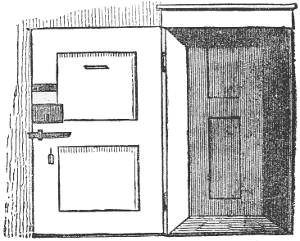
A “Sporting Door,” or “Oak.”
Oak, the outer door of college rooms; to “sport one’s OAK,” to be “not at home” to visitors. See SPORT.—University.
Oar, “to put in an OAR,” to interfere.
“I put my OAR in no man’s boat.”—Thackeray.
Oat, an atom. Probable corruption of iota, or perhaps from the small size of an oat. “I never got an OAT of it,” I never received the smallest portion.
Oat-stealer, an ostler.
Obfuscated, intoxicated.
Obliquitous, oblivious of distinction between right and wrong.—American.
Obstropolous, Cockney corruption of obstreperous.
Ochre, money, generally applied to gold, for a very obvious reason.
O’clock, “like ONE O’CLOCK,” a favourite comparison with the lower orders, implying briskness; otherwise “like winkin’.” “To know what’s O’CLOCK” is to be wide-awake, sharp, and experienced.
Odd man out, a street or public-house game at tossing. The number of players is three or more. Each tosses up a coin, and if two come down head, and one comes tail, or vice versâ, the ODD MAN loses or wins, as may have been agreed upon. Frequently used to victimize a “flat.” If all be alike, then the toss goes for nothing, and the coppers are again “skied.” It is easy for two men to arrange matters beforehand at this game, and so swindle a third.
Odd man, a man who trains in company with a boat’s crew, so that in the event of any one falling ill the seat will be fairly occupied.
Odds, a phrase equivalent to “consequence;” “what’s the ODDS?” i.e., what is the expected result? “It’s no ODDS,” i.e., of no consequence. ODDS, in sporting phraseology, refers to the proportions or differences of a bet. One bookmaker will lay ODDS of “six to one” against such a horse winning; whilst another, more speculative, or in the receipt of a first-rate “tip” (information about the horse in question) will lay “eight,” or even “ten to one.”
Od rot it (Colman’s Broad Grins), DRAT IT, OD’S BLOOD, and all other exclamations commencing with OD, are nothing but softened or suppressed oaths. Od is a corruption of GOD, and DRAT of ROT.
Off and on, vacillating; “an OFF AND ON kind of a chap,” one who is always undecided.
Off at the head, crazy.—Oxfordshire.
Off one’s chump. To be crazy is to be OFF ONE’S CHUMP; this is varied by the word CHUMPY. A mild kind of lunatic is also said to be “off his head,” which means of course exactly the same as the first phrase.
Off one’s feed. To be unable to eat is to be OFF ONE’S FEED. Originally stable slang.
Off the horn, a term used in reference to very hard steak, which is fancifully said to be OFF THE HORN.
Office, “to give the OFFICE,” to give a hint dishonestly to a confederate, thereby enabling him to win a game or bet, the profits being shared. Also in sporting phraseology to give any information worth having.
Offish, distant, not familiar. Corruption of STAND-OFFISH.
Ogle, to look, or reconnoitre.
Ogles, eyes.—Old Cant. French, ŒIL.
Oil of palms, or PALM OIL, money.
Ointment, medical student slang for butter.
O. K., a matter to be O. K. (OLL KORRECT, i.e., all correct), must be on the “square,” and perfectly in order. This is an Americanism, and is derived from the initials O. K., said to have been marked on a document by an official to signify that all was right and proper.
Old boots, a simile as general in its application as it is irrelevant. “Like OLD BOOTS” means like anything. “As cheeky as OLD BOOTS;” “As quick as OLD BOOTS,” seem a little more reasonable, new boots being somewhat unfavourable to speedy locomotion.
Old dog, a knowing blade, an experienced person. Butler uses the phrase, Hudibras, part ii. canto iii. 208, where it was said of Sidrophel, “And was OLD DOG at physiology.” An Irish proverb says, “OLD DOG for hard road,” meaning that it requires an experienced person to execute a difficult undertaking.
Old gentleman, the devil. Also a card almost imperceptibly longer than the rest of the pack, used by sharpers for the purpose of cheating.
Old gooseberry (see GOOSEBERRY), Old Harry (Old Hairy), Old Scratch, all synonyms for the devil.
Old gown, smuggled tea.
Old horse, salt junk, or beef.—Sea.
Old hoss, a term of endearment, originally an Americanism, but now in common use here among friends.
Old Lady in Threadneedle Street, the Bank of England.
Old man, in American merchant ships, the master. The phrase is becoming common in English ships.
Old salt, a thorough sailor.
Old Tom, extra strong gin; sometimes termed CAT’S WATER. Various reasons are given for the use of the words Old Tom. The distillers have the sign of a tom cat on their illuminated placards. The origin of the phrase is, however, in the fact that the managing clerk of a once celebrated “gin-spinning” firm, who was known as Old Tom, used to keep a special bottle of extra good stuff with which to regale customers when they settled their accounts. To get a drink of Old Tom’s was then a great favour. Gradually the title became popular as representing very good strong gin.
Oliver, the moon; “OLIVER don’t widdle,” i.e., the moon does not shine. Nearly obsolete.
Ollapod, a country apothecary. From George Coleman’s comedy of The Poor Gentleman.
Omee, a master or landlord; “the OMEE of the carsey’s a nark on the pitch,” the master of the house will not let us perform. Italian, UOMO, a man; “UOMO DELLA CASA,” the master of the house. Latin, HOMO.—Lingua Franca.
Omnium gatherum, an indiscriminate collection of articles; a numerous and by no means select assemblage.
On, “to be ON,” in public-house or vulgar parlance, is synonymous with getting “tight” or tipsy; “it’s St. Monday with him, I see he’s ON again,” i.e., drunk as usual, or on the road to it. “I’m ON” also expresses a person’s acceptance of an offered bet. To GET ON a horse or a man is to make bets on it or him. “Try it ON,” a defiant challenge to a person.
On the fly, getting one’s living by thieving or other illegitimate means; the phrase is applied to men the same as “on the loose” is to women. On the fly also means on the drink.
On the loose, obtaining a living by prostitution; in reality, on the streets. The term is applied to females only, excepting in the case of “sprees,” when men carousing are sometimes said to be ON THE LOOSE.
On the nose, on the watch or look-out. See NOSE.
On the shelf, transported. With old maids it has another and very different meaning.
On the tiles, out all night “on the spree,” or carousing,—in allusion to the London cats on their amatory excursions. See CATERWAULING.
One-er, that which stands for ONE, a blow that requires no repeating. In The Old Curiosity Shop, the “Marchioness” tells Dick Swiveller that “her missus is a ONE-ER”—there a variation of “stunner.”
One in ten, a parson. In allusion to the tithing system.
Onion, a watch-seal.
O. P. Publishers’ reply to an inquiry for a book or paper that is OUT OF PRINT.
Open the ball, to commence anything.
Oracle, “to work the ORACLE,” to plan, manœuvre, to succeed by a wily stratagem.
Orate, an Americanism, which means, to speak in public, or make an oration.
Organ-grinder, an itinerant who is supposed to “GRIND” music out of a barrel-organ.
Originator, an inventor of plans for the formation of joint-stock companies. The originator submits his schemes to the promoter, who accepts or rejects them.
Otter, eightpence. Italian, OTTO, eight.—Lingua Franca.
Ottomy, a thin man, a skeleton, a dwarf. Vulgar pronunciation of ANATOMY. Shakspeare has ATOMY.
Out, a dram glass. These glasses are two-OUT (half-quartern), three-OUT, and four-OUT. An habitué of a gin-shop, desirous of treating a brace of friends, calls for “a quartern of gin and three OUTS,” by which he means three glasses which will exactly contain the quartern. Really, the word glasses is understood. The man actually means, and one or more three-OUT glasses.
Out, in round games, where several play, and there can be but one loser, the winners in succession STAND OUT, while the others PLAY OFF.
Out and out, prime, excellent, of the first quality; beyond measure. Out-and-outer, one who is of an OUT-AND-OUT description, “up” to anything.
An ancient MS. has this couplet, which shows the antiquity of the phrase:—
“The Kyng was good alle aboute, And she was wycked OUTE AND OUTE.”
Outcry, an auction.—Anglo-Indian.
Outing, a day’s holiday. The Oxford and Cambridge boatrace, the Derby, and other events of a like character, are each said to be simply excuses to the Cockneys for a day’s OUTING.
Out of collar, out of place,—in allusion to servants. When in place, the term is IN COLLAR. Most likely from “head in the COLLAR,” said of horses when hard at work.
Out on the loose, “on the spree,” in search of adventures. See ON THE LOOSE.
Out on the pickaroon. Picarone is Spanish for a thief, but this phrase does not necessarily mean anything dishonest, but is often used to mean readiness for anything in the way of excitement. It also means to be in search of anything profitable, without much care as to honesty or otherwise.
Outsider, a person who does not habitually bet, or is not admitted to the “ring,” a duffer or good-for-nothing fellow. Also, a horse whose name does not appear among the “favourites.”—Sporting.
Over! or OVER THE LEFT, i.e., the left shoulder—a common exclamation of disbelief in what is being narrated,—sometimes implying that the results of a proposed plan will be OVER THE LEFT, i.e., in the wrong direction, loss instead of gain.
Over, generally used in connexion with come, as, “He came it rather strong OVER me,” i.e., tried to intimidate or compel me. The same phrase would also be used to imply that an excess of flattery or praise was being employed for a similar purpose, but that the adulation was being “laid on a little too thick” to be considered genuine. Also used thus sometimes: “You mustn’t come Shakspeare OVER me,” i.e., “you mustn’t assume an air of immeasurable literary superiority OVER me.” “You mustn’t come Rothschild OVER me,” &c.
Over, in cricket, four balls delivered from one end to another. After an OVER has been bowled, the fielders, wicket-keepers, &c., change ends, and the bowling goes on from the recent batting wicket. A MAIDEN-OVER is an OVER from which no runs are obtained. Four balls is the regulation number to an OVER in all important matches; but little clubs and practice elevens suit their own convenience.
Overs, the odd money remaining after the daily accounts are made up at a banking-house,—usually divided amongst the clerks. See MENAVELINGS and SHORTS.
Owned, a slang expression used by the ultra-Evangelicals when a popular preacher makes many converts. The converts themselves are called his “seals.”
P. P., an expression much in use among racing men, which means play or pay, i.e., either go on with the arrangement or forfeit the money. The following is a law of the turf on the subject:—
The following races shall be considered “play or pay”:—The Derby and Oaks at Epsom, the St. Leger at Doncaster, the Two Thousand Guineas, the One Thousand Guineas, the Cesarewitch and Cambridgeshire, at Newmarket, the Ascot, Goodwood, and Doncaster Cups, and all handicaps above 200 sovs. value with two forfeits, the minor of which shall not be less than 5 sovs.; and the Committees of Tattersall’s, and of the Subscription Room at Newmarket, will take no cognisance of any disputes respecting “play or pay” bets on any other races, or of any bets made upon handicap races before the weights are published.
This is the exact law on the subject, but as a rule all bets on horse-racing are considered P. P. unless otherwise arranged. In all matches, though, whether turf, pedestrian, aquatic, or otherwise, a run is given for the money in ordinary betting transactions.
P’s and q’s, particular points, precise behaviour; “mind your P’S and Q’S,” be very careful. Originating, according to some, from the similarity of P’S and Q’S in the hornbook alphabet, and therefore the warning of an old dame to her pupils, or, according to others, of a French dancing-master to his pupils, to mind their pieds (feet) and queues (wigs) when bowing.
Pack, to go away; “now, then, PACK off there,” i.e., be off, don’t stop here any longer.—Old. “Make speede to flee, be PACKING awaie.”—Baret’s Alvearie, 1580. Contraction of “PACK up and be off.” Sometimes the term “sent PACKING” is used to indicate a sudden discharge, as of a servant or mistress.
Packets, hoaxing lies. Sometimes used as an exclamation of incredulity.—North.
Pad, “to stand PAD,” to beg with a small piece of paper pinned on the breast, inscribed, “I am starving.”
Pad, the highway; also a tramp or itinerant musician.
Pad the hoof, to walk; “PADDING THE HOOF, on the high toby,” tramping or walking on the high road.
“Trudge, plod away o’ the HOOF.”—Merry Wives, i. 3.
Padding, the light articles in the monthly magazines, of which the serial stories are the main attraction. Publishers of magazines seem to think that if they get a serial story from a popular novelist they can pack any amount of rubbish into the remaining pages. This is not so in America, as magazines like the Atlantic Monthly and the Overland Monthly show.
Padding-ken, or CRIB, tramps’ and boys’ lodging-house.
Paddle, to go or run away.—American.
Paddy, Pat, or Paddy Whack, an Irishman. A nickname of Patrick.
“I’m Paddy Whack, from Ballyhack, Not long ago turn’d soldier; In storm and sack, in front attack, None other can be boulder.”—Irish Song.
Paddy’s goose, the sign of the White Swan, a noted flash public-house in the east of London, supposed to be Paddy’s idea of a GOOSE.
Paddy’s land, “ould Ireland.”
Padre, a clergyman. From the Portuguese.
Pal, a partner, acquaintance, friend, an accomplice. Gipsy, a brother.
Palampo, a quilt or bed-cover. Probably from Palanpore, a town in India, renowned for its manufacture of chintz counterpanes.—Anglo-Indian.
Palaver, to ask, or talk—deceitfully or otherwise, as occasion requires; “PALAVER to his nibs for a shant of bivvy,” ask the master for a pot of beer. Nantee palaver (pronounced PERLARVER), cease talking. In this sense used by tramps. Derived from the Portuguese.
Pall, to stop; “PALL that,” spoken authoritatively, means, cease what you are doing. From PALL, a small instrument which is used to stop the windlass or capstan at sea. When a man says, “I am PALLED,” he means he cannot or dare not say any more. A sailor, on receiving any extraordinary intelligence, will say, “You PALL me,” i.e., you confound me. Most likely from the order frequently given on board ship, “Ease and PALL.”
Palm, to impose upon. “You can’t PALM that off upon me,” is said when an intending purchaser is suspicious of the quality of the article offered.
Palm oil, or PALM SOAP, money; also, a bribe.
Palmer, a swindler who used to visit shops under the pretence of collecting harp halfpence. To induce shopkeepers to search for them, he offered thirteenpence for one shilling’s-worth, when many persons were silly enough to empty a large quantity of copper on their counters. The PALMER, a proficient with his fingers, generally contrived to conceal some before he left the shop.
Palming, robbing shops by pairs—one thief bargaining with apparent intent to purchase, whilst the other watches his opportunity to steal. The following anecdote will give an idea of their modus operandi. A man once entered a “ready-made” boot and shoe shop, and desired to be shown a pair of boots—his companion staying outside and amusing himself by looking in at the window. The one who required to be fresh shod was apparently of a humble and deferential turn, for he placed his hat on the floor directly he stepped into the shop. Boot after boot was tried on until at last a fit was obtained, when in rushed a man, snatched up the customer’s hat left near the door, and ran down the street as fast as his legs could carry him. Away went the customer after his hat, and Crispin, standing at the door, clapped his hands, and shouted, “Go it, you’ll catch him!”—little thinking that it was a concerted trick, and that neither his boots nor the customer would ever return. Instances of this kind of work frequently occur. PALMING sometimes refers to secreting money or rings in the hand, as well as to bribing. Palming is also the generic term for all that kind of conjuring which depends on manual dexterity, and which is totally distinct from the mechanical-contrivance department.
Pam, the knave of clubs at the game of loo; or, in street phraseology, while the “Judicious Bottleholder” was alive, Lord Palmerston.
Pannikin, a small pan.
Pannum, food, bread.—Lingua Franca, PANNEN; Latin, PANIS; Ancient Cant, YANNAM.
Pannum-bound, said of a pauper or prisoner when his food is stopped. Pannum-struck, very hungry, starving.
Panny, a house—public or otherwise; “flash PANNY,” a public-house used by thieves; PANNY-MEN, housebreakers. Panny, in thieves’ cant, also signifies a burglary.
Pantalettes, the drawers worn in America by little girls.
Pantile, a hat. The term PANTILE is properly applied to the mould into which the sugar is poured which is afterwards known as “loaf sugar.” Thus, PANTILE, from whence comes the phrase, “a sugar-loaf hat,” originally signified a tall, conical hat, in shape similar to that usually represented as the head-gear of a bandit. From PANTILE the more modern slang term TILE has been derived. Halliwell gives PANTILE SHOP, a meeting-house, from the steeple-crowned or PANTILE hats of its frequenters. Pantile also means a flat cake with jam on it, given to boys at boarding-schools instead of pudding.
Pantiler, a Dissenting preacher. Probably from the practice of the Quakers, and many Dissenters, of not removing their hats in a place of worship; or from the sugar-loaf hats originally worn by Puritans. Another derivation is from the earthen tiles, technically PANTILES (tiles hollowed in the middle, as distinguished from “pintiles,” the older sort, which are flat, smaller, and pinned or nailed to the rafters), with which meeting-houses of Dissenters are usually covered; hence the meeting-house came to be called a PANTILE, and its frequenters PANTILERS.
Pants, American term for trousers. Here used to represent the long drawers worn underneath.
Panupetaston, a loose overcoat with wide sleeves, now out of fashion.—Oxford University.
Paper-maker, a rag-gatherer, or gutter-raker—similar to the chiffonnier of Paris. Also, a man who tramps through the country, and collects rags on the pretence that he is an agent to a paper mill.
Paper-Worker, a wandering vendor of street literature; one who sells ballads, dying speeches, and confessions, sometimes termed a “running stationer.”
Parachute, a parasol.
Paradise, French slang for the gallery of a theatre, “up amongst the GODS,” which see.
Parish lantern, the moon.
Parish prig, or PARISH BULL, a parson.—Thieves’ cant.
Parney, rain; “dowry of PARNEY,” a quantity of rain. Anglo-Indian slang from the Hindoo, PANI, water; Gipsy, PANE. Old Indian officers always call brandy-and-water “brandy PAWNEE.”
Parson, a signpost. Common term in the north, where they say that the PARSON points, but does not lead. This is given, as the lawyers say, “without prejudice.”
Parson Trulliber, a rude, vulgar, country clergyman, devoted to agricultural pursuits; the race is most probably now extinct. From the pig-feeding and pig-headed parson in Joseph Andrews.
Parson’s nose, the hind part of a goose—a savoury mouthful. Sometimes called the Pope’s nose.
Part, to pay, restore, or give up; “he’s a right un, he is; I know’d he’d PART,” i.e., he is a liberal (or punctual) person, and pays his debts, or bestows gratuities. The term is in general use in sporting circles, and is very commonly employed when speaking of the settlement of bets after a race. It is probably derived from the very common reference to stingy people, who are described as not liking to PART with their money.
Parter, a free, liberal person. Sometimes called a “good PARTER.” Any one who looks twice at his money, or who doesn’t pay it at all, is called a “bad PARTER.”
Party, a person—term in very general use, similar in application to the German pronoun, MAN, a person, people; “where’s the PARTY as ’ad a’ orter be lookin’ after this ’ere ’oss?” policeman’s inquiry of the wrong cabman; “old PARTY,” an elderly person. The term is said to have arisen in our old justice courts, where, to save “his worship” and the clerk of the court any trouble in exercising their memories with the names of the different plaintiffs, defendants, and witnesses, the word PARTY was generally employed. Dean Alford remarked:—
“The word PARTY for a man is especially offensive. Strange to say, the use is not altogether modern. It occurs in the English version of the Apocryphal book of Tobit, vi. 7. ‘If an evil spirit trouble any, one must make a smoke thereof before the man or the woman, and the PARTY shall be no more vexed.’”
In Shakspeare we find the term:—
“Stephano. How now shall this be compassed? Canst thou bring me to the PARTY?”—Tempest, iii. 2.
This is not the only instance of the word being used by the immortal bard. “I once heard,” said the Dean just quoted, “a venerable dignitary pointed out by a railway porter as an old PARTY in a shovel.” The last word is the vulgar term applied to the peculiar hat worn by clerical dignitaries.
Pash, to strike; now corrupted to BASH, which see.—Shakspeare.
Paste, to beat, to thrash vigorously.
Pasteboard, a visiting card; “to PASTEBOARD a person,” to drop a card at an absent person’s house.
Paste-horn, the nose. Shoemakers nickname any shopmate with a large nose “old PASTE-HORN,” from the shape of the horn in which they keep their paste.
Pasty, a bookbinder.
Patch. This old English term of reproach, long obsolete in polite language, may yet occasionally be heard in sentences like these:—“Why, he’s not a PATCH upon him,” i.e., he is not to be compared with him; “one’s not a PATCH on the other,” &c. Shakspeare uses the word in the sense of a paltry fellow:—
“What a pied ninny’s this? thou scurvy PATCH!”
In old English PATCH meant a fool, a wearer of patched clothes of motley.
Patent coats, the first coat, with the pockets inside the skirt, were so termed.
Patter, a speech or discourse, a pompous street oration, a judge’s summing up, a trial. Ancient word for muttering. Probably from the Latin, PATERNOSTER, or Lord’s Prayer. This was said, before the Reformation, in a “low voice” by the priest, until he came to “and lead us not into temptation,” to which the choir responded, “but deliver us from evil.” In the reformed Prayer Book this was altered, and the Lord’s Prayer directed to be said “with a loud voice.” Dr. Pusey takes this view of the derivation in his Letter to the Bishop of London, p. 78, 1851. Scott uses the word twice, in Ivanhoe and the Bride of Lammermoor.
Patter, to talk. Patter flash, to speak the language of thieves, talk cant.
Patteran, a gipsy trail, made by throwing down a handful of grass occasionally, especially where they have turned off from the main road.
Patter-crib, a flash house.
Patterer, one of a race now nearly defunct, who cried last dying speeches, &c., in the streets. The term is also applied to those who help off their wares by long harangues in the public thoroughfares. These men, to use their own term, “are the aristocracy of the street sellers,” and despise the costermongers for their ignorance, boasting that they live by their intellect, which, as they do not live wonderfully well, is no particularly wise boast.
Pattern, a common vulgar phrase for “patent.”
Paul Pry, an inquisitive person. From the well-known comedy.
Paw, the hand. Paw-cases, gloves. Boots are in some parts of Ireland called “gloves for the feet.”
Pay, to beat a person, or “serve him out.” Originally a nautical term, meaning to stop the seams of a vessel with pitch (French, POIX); “here’s the d‑‑‑‑l to PAY, and no pitch hot,” said when any catastrophe occurs which there is no means of averting; “to PAY over face and eyes, as the cat did the monkey;” “to PAY through the nose,” to give a ridiculous price,—an expressive phrase of which no one seems to know the origin. Shakspeare uses PAY in the sense of to beat or thrash.
Pay, to deliver. “Pay that letter to Mr. So-and-so” is a very common direction to a Chinese servant.—Anglo-Chinese.
Pay-away, “go on with your story, or discourse.” From the nautical phrase PAY-AWAY, meaning to allow a rope to run out of a vessel. When the hearer considers the story quite long enough, he, carrying out the same metaphor, exclaims “hold on.”
Peach, an informer against omnibus conductors and drivers, one especially hired by the proprietors to count passengers and stoppages. The term is in frequent use amongst omnibus-men. This is about the only instance known of the verb being used as a substantive.
Peach, to inform against or betray. Webster states that the word “impeach” is now mostly used, and that PEACH is confined principally to the conversation of thieves and the lower orders. The word was originally “impeach,” though it was never until lately used in the same way as its abridgment.
Peacock horse, amongst undertakers, is one with a showy tail and mane, which holds its head up well. Peacocky refers to an objectionable high action among racehorses.
Peaking, remnants of cloth. Term amongst drapers and cloth warehousemen.
Peaky, sickly, delicate.
Pec, a term used by the Eton boys for money, an abbreviation, of course, of the Latin PECUNIA.
Peck, food; “PECK and boose,” meat and drink.—Lincolnshire. Ancient Cant, PEK, meat.
Peck, to eat voraciously. A hearty eater is generally called “a rare PECKER.” Originally PECK was to eat delicately, “but we have changed all that now.”
Peck-alley, the throat.
Pecker, “keep your PECKER up,” i.e., don’t get down in the mouth,—literally, keep your beak or head well up, “never say die!”
Peckham, a facetious usage of the name of this district, implying a dinner; “all holiday at Peckham,” i.e., nothing to eat.
Peckish, hungry. Old Cant, PECKIDGE, meat.
Peel, to strip, or disrobe.—Sporting.
Peeler, a policeman; so called from Sir Robert Peel (see BOBBY); properly applied to the Irish Constabulary rather than the Metropolitan Police, the former force having been established by Sir Robert Peel.
Peepers, eyes; “painted PEEPERS,” eyes bruised or blackened from a blow.—Pugilistic.
Peery, suspicious, or inquisitive.
Peg, brandy and soda-water. A PEG by which to pull oneself up again. Also, a shilling.—Scotch.
Peg, “to PEG away,” to strike, run, or drive away; “PEG a hack,” to drive a cab; “to take him down a PEG or two,” to check an arrogant or conceited person,—possibly derived from the use of PEG tankards. See PIN.
Peg, to drink frequently; generally used in reference to devotees of “S. and B.”
Peggers, people who constantly stimulate themselves by means of brandy and soda-water.
Pegtops, the loose trousers in fashion some years back, small at the ankle and swelling upwards, in imitation of the Zouave costume.
Penang-lawyer, a long cane, sometimes carried by a footman. Penang-lawyers are also bludgeons which are carried by all classes in Singapore.
Pencil-fever, a supposititious disease among racehorses, the preliminary symptoms of which show that an animal has been pretty considerably “milked.” Pencil-fever sets in when, despite the efforts of the “marketeers,” a horse can no longer be kept at a short price in the lists, through his actual condition being discovered, and when every layer of odds is anxious to write his name down. This disorder is also called “milk-fever,” “market-fever,” and other suggestive names.
Penny-a-liner, a contributor of local news, accidents, fires, and scandals to a newspaper; a man not regularly “on the paper;” one who is popularly believed to be paid for each contribution at the rate of a penny a line, and whose interest is, therefore, that his articles should be stuffed with fine words and long sentences. This wonderful person, to whom so much is daily attributed, is now generally called a LINER.
Penny dreadfuls, an expressive term for those penny publications which depend more upon sensationalism than upon merit, artistic or literary, for success.
Penny gaff, a shop turned into a temporary theatre (admission one penny), at which dancing and singing take place every night. Sometimes rude pictures of the performers are arranged outside to give the front a gaudy and attractive look, and at night-time coloured lamps and transparencies are displayed to draw an audience. Zest is given to these entertainments by the fact that now and again the police make raids upon the houses, and carry off both actors and spectators. These places are also called “dukeys,” for no reason that can be discovered. See GAFF.
Penny starver, a penny roll. See BUSTER.
Pen’orth, value for money; as, “I’ll have my PEN’ORTH,”—given irrespective of the actual amount.
Pensioner, a man of the most degraded condition who lives off the miserable earnings of a prostitute. There is an unmentionable prefix to the word Pensioner. See Ponce.
Pepper, to thrash, or strike.—Pugilistic, but used by Shakspeare.—Eastern Counties.
Pepper-boxes, the buildings of the Royal Academy and National Gallery in Trafalgar Square. The name was first given by a wag, in allusion to the cupolas erected by Wilkins, the architect, upon the roof, which, from their form and awkward appearance, at a distance suggest to the stranger the fact of their being enlarged PEPPER-BOXES. See BOILERS.
Perch, or ROOST, a resting-place; “I’m off to PERCH,” i.e., I am going to bed.
“Nor yet a single perch, for which my lucky stars to thank, Except the perch I’ve taken on this damp rheumatic bank.” Lay of the Unsuccessful Angler.
Perform, to carry out a design, generally a dishonest one. To “PERFORM on a flat” is to cozen a fool.
Perkin, beer. Dandy or affected shortening of the widely-known firm, Barclay and Perkins.
Perpendicular, a lunch taken standing-up at a tavern bar. It is usual to call it lunch, often as the PERPENDICULAR may take the place of dinner.
Persuaders, spurs.
Pesky, an intensitive expression, implying annoyance; as, “A PESKY, troublesome fellow.” Corruption of PESTILENT; or, Irish, PEASGACH, rough, rugged. Pesky has now become more American than English. Pesky Ike is the name of a popular American drama.
Peter, a partridge.—Poacher’s term.
Peter, a bundle, or valise. Also, a cash-box.
Peter, to run short, or give out.—American.
Peter Funk, an American term for a spurious auction or “knock-out.”
Peter Grievous, a miserable, melancholy fellow; a croaker.
Petticoat, a woman.
Pewter, money, like “tin,” used generally to signify silver; also a tankard. “Let me have my beer in the PEWTER,” is a common request to waiters, made by “City” men, and others who affect habits of rude health. The pots for which rowing men contend are often called PEWTERS.
Philadelphia-lawyer, a Transatlantic limb of the law considered to be the very acme of acuteness. Sailors relate many stories of his artful abilities, none, however, short enough to find a place here. The phrase, “Enough to puzzle a Philadelphia-lawyer,” means, enough to puzzle the sharpest man in the world.
Philander, to ramble on incoherently; to write discursively and weakly.
Philip, a policeman. The word is loudly given as a signal that the police are approaching.
Philiper, a thief’s accomplice, one who stands by and looks out for the police while the others commit a robbery, and who calls out “Philip!” when any one approaches.
Philistine, a policeman. The German students call all townspeople not of their body “Philister,” as ours say “cads.” The departing student says, mournfully, in one of the Burschenlieder—
“Muss selber nun Philister sein!”
i.e., “I must now myself Philistine be!” Also, a man who is of a set opposed to one’s own. Society is supposed to regard all outside its bounds as belonging to the Philistine world. Bohemians regard all cleanly, orderly people who conform to conventionality as Philistines.
Physog, or PHIZ, the face. Swift uses the latter word. Corruption of PHYSIOGNOMY.
Picaroon, a pirate or buccaneer originally; now an ordinary thief.
Piccadilly butchers, a satirical name applied by the crowd to the regiment of Horse Guards, known as the “Royal Blues,” from their savage onslaught upon the crowd on the occasion of the arrest of Sir Francis Burdett at his house in Piccadilly, by order of the Speaker of the House of Commons. See Cheesemongers.
Piccadilly weepers, long carefully combed-out whiskers of the Dundreary fashion.
Pick, “to PICK oneself up,” to recover after a beating or illness, sometimes varied to “PICK up one’s crumbs;” “to PICK a man up,” “to do,” or cheat him.
Pickaninny, a young child is thus styled by the West Indian negroes. The word is now completely naturalized among sailors and water-side people in England.
Pickers, the hands.—Shakspeare.
Pickle, a miserable or comical position; “he is in a sad PICKLE,” said of any one who has fallen into the gutter, or got besmeared. “A PICKLE herring,” a comical fellow, a merry-andrew.—Old. Also, a mischievous boy; “what a PICKLE he is, to be sure!” Derived from his always getting into a PICKLE, or mess.
Pickles! gammon; also a jeering and insulting exclamation.
Pick-me-up, a revivifying drink taken after a debauch; a tonic.
Piece, a contemptuous term for a woman; a strumpet.—Shakspeare. Not always objectionable nowadays. A “barber’s clerk” does not object to hear his sweetheart or wife called “a nice PIECE;” and gentlemen of the counter-jumping fraternity describe their “young ladies” as “nice PIECES of goods.”
Pieman. In tossing, the man who cries is called the PIEMAN. In the old days when the itinerant PIEMAN’S duty was to toss or sell, and his call was, “Hot pies, toss or buy, toss or buy,” he was always supposed to be entitled to the cry, the intending eater “skying the copper.” An active and efficient police have, however, improved tossing—so far, at all events, as PIEMEN and poor people are concerned—off the face of the earth, and gaming of all descriptions is now a luxury confined to the rich.
Pig, a mass of metal,—so called from its being poured in a fluid state from a SOW, which see.—Workman’s term.
Pig, a policeman; an informer. The word is now almost exclusively applied by London thieves to a plain-clothes man, or a “nose.”
Pig, a pressman in a printing office. See DONKEY.
Pig, or SOW’S BABY, a sixpence.
Pig, to live in a crowded, filthy manner. The lower orders of Irish are said to PIG together. A suggestive, if not elegant, expression.
Pig and Tinder-box, the vulgar rendering of the well-known tavern sign, “Elephant and Castle.”
Pigeon, a gullible or soft person. The French cant, or Argot, has the word PIGEON, dupe—“PECHON, PESCHON DE RUBY, apprenti gueux, enfant (sans doute dérobé)”. The vagabonds and brigands of Spain also used the word in their Germania, or robbers’ language, PALOMO (PIGEON), ignorant, simple. In the sporting world sharps and flats are often called “rooks and PIGEONS” respectively—sometimes “spiders and flies.”
Pigeon, business, simply the Chinese pronunciation of the English word.—Anglo-Chinese.
Pigeon-English, the English spoken by the natives of Canton and other parts of China.
Pigeon-flying, or BLUEY CRACKING, breaking into empty houses and stealing lead.
Pigeon’s milk, an imaginary fluid for which boys and simpletons are frequently sent on the 1st of April.
Pig-headed, obstinate.
Pig’s eye, the ace of diamonds in cards.
Pig’s whisper, a low or inaudible whisper; also a short space of time, synonymous with “cockstride,” i.e., cock’s tread.
Pike, a turnpike; “to bilk a PIKE,” to cheat the keeper of the toll-gate. Mr. Tony Weller makes many amusing remarks on PIKES and PIKE-keepers. Since the first edition of this work was published, PIKES and PIKE-keepers have departed from amongst us, so far as London and its immediate vicinity are concerned.
Pike, to run, to be off with speed.
Pike it, is said as a hasty and contemptuous, if not angry, dismissal, “if you don’t like it, take a short stick and PIKE it.” This is but a form of the attempts at rhyming smartness common in London.
“Joe quickly his sand had sold, sir, And Bess got a basket of rags; Then up to St. Giles’s they roll’d, sir; To every bunter Bess brags. Then unto the gin-shop they PIKE IT, And Bess was admitted, we hear; For none of the crew dare but like it, As Joey, her kiddy, was there,” The Sand-man’s Wedding, a Cantata.
“’Twas not our fault, dear Jack; we saw the watch going into the house the moment we came there, and we thought it proper to PIKE OFF.”—The Prison Breaker, a Farce.
Pikey, a tramp or gipsy. A PIKEY-cart is in various parts of the country one of those habitable vehicles suggestive of a wandering life. Possibly the term has reference to one who constantly uses the PIKE, or turnpike road.