Chapter II · (continued 5)
Reading edition
"You wonder how much I know! To relieve your mind without parleying further, I will say to you that I know everything."
"Then Aunt Octavia must have told you; and that seems incredible. It was distinctly understood"—
"Your aunt told me nothing. Not by words did any one tell me."
"Not by words?" she asked, eyeing me wonderingly and clearly fearing that I might be playing some trick upon her. "Then can it be that Hezekiah—but no! Hezekiah does n't know!"
"Trust Hezekiah for not telling secrets," I answered evasively. "Give me credit for some imagination. The air of Hopefield is stimulating, and in the few days I have spent in your aunt's house I have learned much that I never dreamed of before. I am not at all the person you greeted with so much courtesy in the library when I arrived there, a chimney-doctor and an ignorant person, a few afternoons ago,—called, as I thought, to prescribe for flues that proved to be in admirable condition, but really summoned by higher powers to assist the fates in the proper and orderly performance of their duties to several members of the house of Hollister,—yourself among them."
"I don't understand it; you are wholly inexplicable."
"I am the simplest and least guileful of beings, I assure you. Yet I have done some things here not in the slightest way related to chimney doctoring; and something else I expect to do for which I believe you will thank me through all the years of your life."
"Ah, if you really know, that is possible!" she sighed wearily. "I am very tired of it all. I was very foolish ever to have agreed to Aunt Octavia's plan. You have seen those men,—any one of them might, you know"— And she shrugged her shoulders impatiently.
"Any one of them might be the seventh man! There, you see I do know! And I mean to help you!"
She was immensely relieved; there was no question of that. Gratitude shone in her eyes; and then, as I marvelled at their beautiful dark depths, fear suddenly possessed them. The change in her was startling. Several motors had swept by in the outer road while we talked; they were faintly visible through the trees; and just now we both heard a horse and caught a fleeting glimpse of Hartley Wiggins, riding slowly with bowed head toward the inn. Cecilia's horse flung up his head, but she clapped her hands upon his nostrils and held them there to prevent his whinnying until that figure of despair had passed out of hearing.
I was smitten with sorrow for Hartley Wiggins. I could put myself in his place and imagine his feelings as he rode like a defeated general back to the inn, there to face the other suitors after the humiliating experience which Cecilia Hollister had just described. In his ignorance of the cause of her eagerness to escape from him, he no doubt believed that he had all unconsciously made himself intolerable to her. It was plain that that glimpse of him had touched Cecilia's pity; if I had doubted the sincerity of her regard for him before, I spurned the thought now. I was anxious to requicken hope in her,—an odd office for me to assume when in my own affairs I had always yielded my sword readily to the blue devils! Yet during my short stay at Hopefield I had already found it possible to restore Miss Octavia's confidence in her own chosen destiny, and in this delicate love-affair between Cecilia Hollister and my best friend I proffered counsel and sympathy with an assurance that astonished me.
"I have told you enough, Miss Hollister, to make it clear that I am in a position to help you. Believe me, I have no other business before me but to complete the service I have undertaken."
"But there is always"—she began, then ceased abruptly, and lifted her head proudly—"there is always Mr. Wiggins's attitude toward my sister. Not for anything in the world would I cause her the slightest unhappiness. You must see that, now that you know her."
I laughed aloud. Cecilia's concern for Hezekiah's happiness was so absurd that I could not restrain my mirth for a moment. Displeasure showed promptly in Cecilia's face.
"I am sorry if you doubt my sincerity, Mr. Ames. I will put the matter directly, to make sure I have not been misunderstood heretofore, and say that if Hezekiah is interested in Hartley Wiggins and cares for him in the least,—you know she is young and susceptible,—I shall take care that he never sees me again."
"Pardon me, but maybe you don't quite understand Hezekiah!"
"Is it possible, then, that you do?" she inquired coldly. "I imagine your opportunities for seeing her have not been numerous."
"Well, it is n't so much a matter of seeing her, when you've read of her all your life and dreamed about her. She's in every fairy story that ever was written; she dances through the mythologies of all races. Hers is the kingdom of the pure in heart. Her mind is like a beautiful bright meadow by the sea, and her thoughts the dipping of swallow-wings on lightly swaying grasses."
Cecilia's manner changed, and she smiled.
"You seem to have an attack of something; it looks serious. You have n't known her long enough to find out so much!"
"Longer than you would believe. She and I sat on the shore together when Ulysses sailed by; we were among those present at the sack of Troy; we heard Roland's ivory trumpet at Roncesvalles."
"Such words from you amaze me. I didn't imagine there was so much romance in chimneys."
"They are full of it! Commend me to an open fire, with a flue that knows its business, and a dream or two! I 've renounced my profession. I shall hereafter offer myself as adviser to persons in need of illusions; we 'd all be poets if we dared!"
I helped her into the saddle, and she looked down at me with amusement in her eyes. My praise of Hezekiah had pleased her, and I felt, as when we journeyed together into town, her kindly, human qualities. The perplexities and embarrassments resulting from her compact with her aunt had doubtless checked the natural flow of her spirits. She talked on buoyantly, though I was eager to be off, to avert the catastrophe that only her flight had prevented and which Wiggins might at any moment precipitate. She gathered up her reins.
"You are not coming home for luncheon? Then I shall see you at four. I hope the hiding-place of the ghost will prove interesting. Aunt Octavia has built her hopes high, and I may add that she has expressed the greatest admiration of you to me. On her ride this morning she declared that great things are in store for you. I hope so, too, Mr. Ames."
She gave me her hand and rode away, and before I had reached the highway she was across the bridge and galloping rapidly homeward.
The inn was a mile distant, and I set off at a brisk pace, turning over in my mind various projects for controlling the characters now upon the stage in such manner that Wiggins should become the seventh man. Cecilia could not always run away from him without violating the terms of her aunt's stipulation; and it was unlikely that she would attempt further to guide or thwart the pointing finger of fate. I relied little upon any arrangement effected among the suitors to stand together. Hume had already found a chance to speak. Lord Arrowood had bitten the dust and turned his face homeward, and Wiggins had been near the brink only that morning. It was unlikely that any of the active candidates remaining would stumble upon the key to the situation, which Hezekiah had given into my keeping.
It was well on toward two o'clock when I approached the inn. Before long the suitors would depart for their afternoon call at the Manor, which was an established event of the day. Just as I was about to enter the gate I was arrested by an imperious voice calling, and John Stewart Dick came running toward me. He had evidently been expecting me, and I paused, thinking him about to renew his attack upon me. To my surprise he greeted me cordially, even offering his hand.
"You thought you would come after all. Well, I'm glad you did. I've decided that there should be peace between us."
In stature he was the shortest of the suitors, but what he lacked in height was compensated for by a tremendous dignity. A dark Napoleonic lock lay across his forehead, and his clear-cut profile otherwise suggested the Corsican, the resemblance being, I wickedly assumed, one that the philosopher encouraged.
"You have several times addressed me, Mr. Ames, in a spirit of contumely which I have hesitated to punish by the chastisement you deserve; but I am willing to let bygones be bygones."
His changed tone put me on guard, but it was impossible for me to take him seriously. In spite of the fact that he was a vigorous muscular young fellow who could have threshed me without trouble, I could not resist the impulse he always roused in me to address him in language any self-respecting man would resent.
"Chant the dies iræ with considerable allegro, Plato, for I am hungry and would fain pay for food at the adjacent inn."
"I will overlook the coarseness of your humor," he rejoined haughtily. "My own time is as valuable as yours. You have sneered at my attainments as a philosopher; but I will pass that for the present. I am disposed to treat you magnanimously. You have an excellent opinion of yourself; you have come here as an intruder upon the rights of those of us who followed Cecilia Hollister across Europe and home to America; but in spite of this I waive my rights in your favor. I had intended to offer myself to Miss Hollister this afternoon, with every hope of success, but I yield to you. My only request is that you inform me at once when you have learned her decision."
He clapped on his cap and folded his arms, clearly satisfied with the expressions of surprise to which my feelings betrayed me. Could it be possible that he had guessed the truth, perhaps by deductive processes of which I was ignorant? Whether he had reasoned from some remark thrown out by Miss Octavia as to the influence of seven in the affairs of life and her application of that fateful principle to the choice of a husband for Cecilia, I could not guess, but assuming that he had caught that clue, he might readily enough have managed the rest. Having crossed on the steamer with the suitor host, a man of his intelligence might readily enough have kept track of the vanquished. In any case he had hit upon me as a likely victim, and on the plea of generously waiting till I had tried my luck he hoped to thrust me forward as the sixth suitor, and immediately thereafter project himself as the inevitable seventh man. The whole situation was rendered perilously complex by the knowledge that, unaided, he had possessed himself of so much dangerous information. I must not, however, allow him to see what I suspected.
"My dear professor, there's an ancient warning against the Greeks bearing gifts. You must give me time to inspect the horse."
"Are you questioning my good faith?"
"Be it far from me! I'm a good deal tickled though by your genial assumption that if I offered myself to this lady I should be declined with thanks. You have fretted yourself into a state of mind that bodes ill for American philosophy."
He was again belligerent. It may have occurred to him that I might know as much as he, but at any rate he grinned; it was a saturnine grin I did not like.
"I'm starving to death at the door of an inn, and you must excuse me. Have you seen Hartley Wiggins lately?"
"I have, indeed! He's taken to lonely horseback rides; he's off somewhere now. He has n't the stamina for a contest like this. One by one the autumn leaves are falling," he added, with special intention, "and I have given you your chance."
"Thanks, light-bringing Socrates from the lands of the Ogalallas! For so much courtesy I shall take pleasure in reading all your posthumous works. Let us cease being absurd."
He laid his hand on my arm and lowered his tone.
"Don't be an ass. If you and I both know what's underneath all this mystery we might come to an understanding."
"I don't follow you. Please make a light, like a man about to have an idea."
"You mean that you don't understand?" He eyed me doubtfully, uncertain whether I knew or not.
"You have implied that I am incapable of understanding; suppose we let it go at that."
With this I left him and entered the low-raftered office—it was really a pleasant lounging-room, unspoiled by the usual hotel-office paraphernalia. Dick had followed close behind, and as I paused, hearing voices raised angrily in the dining-room beyond, I turned to him for an explanation. As the suitors had been the only guests of the inn since their advent, having stipulated that the proprietor should exclude other applicants for meals or lodging, I attributed the commotion to strife in their own ranks. Dick nodded sullenly and bade me keep on.
"You 'd better take a look at those fellows. I 've quit them—quite out of it; remember that."
The dining-room door was slightly ajar, and I flung it open.
Ormsby, Shallenberger, Henderson, Hume, Gorse, and Arbuthnot had been engaged with cards at a round table in an alcove, but some dispute having apparently risen, they stood in their places engaged in acrimonious debate. As near as I could determine, some one of them—I think it was Ormsby—wished to abandon the game, which had been undertaken to determine in what order they should be permitted to pay visits to Hopefield in future, the calls en masse having grown intolerable. They were so absorbed in their argument that they failed to note my appearance, and I stood unobserved within the door. The dialogue between the card-players was swift and hot.
"It's no good, I tell you!" cried Ormsby. "There's no fairness in this unless all take their chances together!"
"You ought to have thought of that before we began. This was your scheme, but because the cards are running against you, you want to quit. I say we'll go on!" This from Henderson, who struck the table sharply as he concluded.
"You knew Wiggins and Dick were n't going in when we started, and you are not likely to get them in now. Your anxiety to cut the rest of us out by any means seems to have unsettled your mind," shouted Gorse. "I say let's drop this and stand to our original agreement that no man speak till the end of the fortnight."
"After that whole scheme has been torn to pieces like paper! There's been nothing fair in this business from the start! We ought to have kept Arrowood here and held together. And we ought to have got rid of that Ames fellow—he did n't belong in this at all; and instead of protecting ourselves against outsiders we have sat here like a lot of fools while he's been making himself agreeable there in the house—right there in the house!"
Ormsby's voice rose to a disagreeable squeak as he closed with this indictment of me. Hume fidgeted uneasily, and met my eye so warily that I wondered whether he suspected that I knew of his breach of faith with the other suitors. Much dallying with Scandinavian literature had not lightened his heart, and there was nothing in Ibsen to which he could refer his present plight. Shallenberger seemed to be the only one of the group who had not lost his senses. He was in the farther corner of the alcove, out of sight from the door, but I heard him distinctly as he addressed the other suitors with rising anger.
"We're acting like cads, and cads of the most contemptible sort! I only agreed to this game to satisfy Ormsby. The idea of our sitting here to draw cards to determine the order in which we shall offer ourselves to the noblest and most beautiful woman in the world would be coarse and vulgar if it were not so ridiculous! The men who had their chance on the steamer or after we came here—and I don't pretend to know who they are—ought in decency to have left the field. We seem to have forgotten that we pretend to be gentlemen; or, far less pardonable, that we pay court to a lady. Damn you all! I refuse to have anything more to do with you, and if you try to interfere with my affairs in any way I'll smash your heads collectively or separately as you prefer!"
My interest in this colloquy had led me further into the room, and hearing my step they all turned and faced me. Dick had continued at my side, but the black looks they sent our way were intended, I thought, rather for me. Shallenberger, having taken himself out of the tangle, leaned against the wall and filled his pipe with unconcern. My appearance roused Ormsby to a fresh outburst.
"You're responsible! If you had n't forced yourself upon the ladies at Hopefield there would n't have been any of this trouble!"
"You're only an impostor anyhow. You went to the house to fix a chimney, and seem to think you 're engaged to spend the rest of your natural life there!" protested Henderson, twisting the ends of his moustache.
Then they dropped me and assailed Dick.
"We'd like to know what you expect to gain by dropping out! You got cold feet mighty sudden!" bellowed Ormsby.
Gorse and Henderson paid similar tributes to the apostate, whose melancholy grin only deepened. Shallenberger was pacing the floor slowly and puffing his pipe. Hume and Arbuthnot growled occasionally, but shared, I thought, Shallenberger's changed feeling.
My silence had been effective up to this time, but I was afraid to risk it longer. Dick, I imagined, had kept close to me for fear of missing any part of the altercation he knew my appearance would provoke. The more vociferous suitors had howled themselves hoarse and glared at me while I considered the situation. Henderson rallied for a final shot.
"A good horsewhipping is what you deserve," he cried, leveling his finger at me.
"Gentlemen," I began, not without inward quaking, "you have spoken loud naughty words to me, and in reply I must say that your vocal efforts suggest only the melodies of the braying jackass, and that your manners, to speak mildly, are susceptible of considerable improvement."
"You leave this neighborhood within an hour!" boomed Ormsby; and in his efforts to free himself from his chair it fell backward with a crash that echoed through the long room.
"Then summon the coroner by telephone, for I shall not be taken alive," I answered quietly, trying to recall my youthful delight in Porthos, Athos, and Aramis. "I should dislike to change the mild color-scheme of this pleasant dining-room, but as sure as you lay hands on me, these walls will become a playground for any corpuscles you carry in your loathsome persons."
"Come along, let us put him out," Henderson was saying in an aside to Ormsby.
"You were playing a game here for a stake not yours for the winning," I continued. "Now I suggest that you shuffle the pack,—you three, who are so full of valor,—shuffle the pack, I say, and draw for the jack of clubs. Whoever is the fortunate man I shall take pleasure in pitching through yonder very charming casement."
"Agreed!" cried Henderson, and the three flung themselves into their chairs.
The alacrity of their consent had unnerved me for a moment. D'Artagnan, I was sure, would have fought them all, but I consoled myself, as the cards rattled on the bare table, with the reflection that, considering the fact that I had never in my life laid violent hands on a fellow-being, I was conducting myself with admirable assurance. My weight has always hung well within one hundred and thirty, and physicians have told me that I was incapable of taking on flesh or muscle. Any one of these men could easily toss me through the window I had indicated as a means of their own exit.
Shallenberger caught my eye and indicated with a slight jerk of the head that I had better run before it was too late. The painstaking care with which Henderson had fallen upon the cards was disquieting, to put it mildly. Dick nudged me in the ribs and offered to hold my coat.
"It will not be necessary," I replied carelessly. "Tender your services to the other gentlemen."
I felt the cold sweat gathering on my brow. The three had begun to draw cards, and I heard them slap the bits of pasteboard smartly upon the table as they lifted them from the deck and, finding the jack of clubs still undrawn, waited the next turn. I had no idea that a pack of cards would dissolve so readily by the drawing process, and my memory ceased trying to recall the adventures of D'Artagnan and hovered with ominous persistence about the mad don of La Mancha. I cannot say now whether I stood my ground out of sheer physical inability to run or from an accession of courage due to the remembrance of my success in detecting the Hopefield ghost. In any case I affected coolness as I waited, even throwing out my arms to "shoot" my cuffs once or twice, and yawning.
"Come, gentlemen, hurry: let us not waste time here," I exclaimed impatiently.
"If Ormsby turns up the card you're a dead man," Dick was muttering gloomily.
"They're all alike to me," I replied loudly. "Mr. Ormsby is very beautiful; I shall hope not to disfigure him permanently;" but as I spoke my tongue was a wobbly dry clapper in my mouth.
I was bending over now, watching the three men pick up the cards, and once, when I misread the jack of spades for the jack of clubs, a shudder passed over me. They were down to the last card, and Ormsby's hand was on it. I recall that a group of steins on a shelf over Henderson's head seemed to be dancing wildly. Then I looked at the floor to steady myself, and hope leaped within me, for there, by Ormsby's foot,—a large and heavy one,—lay an upturned card, the jack of clubs, whose lone symbol magnified itself enormously in my amazed eyes.
At this moment, I became conscious that something had occurred to distract the attention of the other men, who were staring at some one who had entered noiselessly.
"Gentlemen, you seem immensely interested in the turn of those cards. I am glad to have arrived at the critical moment. Mr. Ormsby, will you kindly lift the remaining card from the table?"
Miss Octavia stood beside me. She was dressed in a dark brown riding-habit; the feather in her fedora hat emphasized her usual brisk air. She swung her riding-crop lightly in her hand, and bent over the table with the deepest interest.
Ormsby turned up the card. It was the ten of diamonds.
"Gentlemen," I cried, pointing to the card, "what trick is this? Can it be possible that you have been trifling with me in a fashion for which men have died the world over by sword and pistol!"
"Kindly explain, Arnold, the nature of this difficulty," Miss Octavia commanded.
"Simply this, Miss Hollister, if I must answer; I had offered to fight these three gentlemen in order. It was agreed that the man who drew the jack of clubs from the pack with which they had been playing should be my first victim. They have shuffled their own cards and have drawn the whole pack and there is no jack of clubs in the pack! The only possible explanation is one to which I hesitate to apply the obvious plain Saxon terms."
"It dropped out, that's all! You don't dare pretend that we threw out the jack to avoid drawing it!" protested Ormsby, though I saw from the glances the trio exchanged that they suspected one another. Ormsby and Gorse bent down to look for the missing card, but before they found it I stepped forward and drove my fist upon the table with all the power I could put into the blow.
"Stop!" I cried. "I gave you every opportunity to stand up and take a trouncing, but I need hardly say that after this contemptible knavery I refuse to soil my hands on you!"
"Do you insinuate"—began Henderson, jumping to his feet.
"Gentlemen," said Miss Hollister, lifting the riding-crop, "it is perfectly clear to me that Mr. Ames has gone as far as any gentleman need go in protecting his honor. I do not offer myself as an arbitrator here, but I advise my young friend that nothing further is required of him in this deplorable affair."
With one sweep of her crop she brushed to the floor the three piles of cards that lay on the table as they had been stacked when drawn.
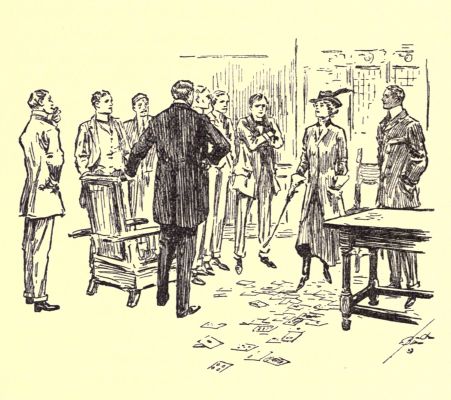
With one sweep of her crop she brushed to the floor the three piles of cards.
"Arnold," she said, with indescribable dignity, "will you kindly attend me to my horse?"
XIX
THE GHOST OF ADONIRAM CALDWELL
A stable-boy held Miss Octavia's horse at the inn-door. Her face, her figure, her voice expressed outraged dignity as she tested the saddle-girth.
"You need never tell me what had happened to provoke your wrath, for that is none of my affair; but I wish to say that your conduct and bearing won my highest approval. They had undoubtedly hidden the jack of clubs to avoid the drubbing you would have administered to the unfortunate man who would have drawn that card if it had been in the pack."
"I was not in the slightest danger at any time, Miss Hollister," I protested. "By one of those tricks of fate to which you and I are becoming so accustomed, the card had fallen to the floor unnoticed. If you had not arrived so opportunely the lost jack would have been discovered, the cards reshuffled, and very likely Mr. Ormsby would have been dusting the inn-floor with me at this very minute."
"I refuse to believe any such thing," declared Miss Octavia, who had mounted and continued speaking from the saddle. "Your perfect confidence was admirable, and I shudder to think of the terrible punishment you would have given them. I do not particularly dislike Mr. Ormsby, though the possibility of Cecilia marrying him has troubled me not a little as I have recalled the unromantic aspect of Utica as seen from the car-windows; but it is much to your credit that you defied them all and brought them to the fighting-point, and then, by a stroke of cleverness it pleased me to witness, placed them irretrievably in the wrong."
If Miss Octavia wished to view my performances in this flattering light it seemed unnecessary and unkind to object. Now that I was in the open again with a whole skin I was not averse to the victor's crown; I would even wear it tilted slightly over one ear. Birds have been killed by shots that missed the real target; bunker sands are rich in gutta percha and good intentions. I was a fraud, but a cheerful one.
"It was only a pleasant incident of the day's work, Miss Hollister. I'm going to engage a squire and take to the open road as soon as all this is over."
"As soon as all what is over!" she demanded, eyeing me keenly.
"Oh, the work I've undertaken to do here. I flatter myself that I have made some progress; but within twenty-four hours I dare say that we shall have seen the end."
"Your words are not wholly luminous, Arnold."
"It is much better that it should be so. You have trusted me so far, and I have no intention of failing you now. If I say that the crisis is near at hand in a certain matter that interests you greatly, you will understand that I am not striking ignorantly in the dark."
"If you know what I suspect you know, Arnold Ames, you are even shrewder than I thought you, and you had already taken a high place in my regard. The curtains of the windows just behind you have shown considerable agitation since we have been speaking, not due, I think, to the wind, as there is no air stirring. Those gentlemen you have just vanquished are timidly watching you. Your daring and prowess have greatly alarmed them. You may be sure they will think twice before provoking your wrath again."
"I devoutly hope they will," I replied, glancing carelessly over my shoulder, and catching a glimpse of Henderson as he drew hastily out of sight. "But will you tell me just how you came to visit the inn at this particular hour?"
"Nothing could be simpler. I had luncheon at the house of a friend on whom I called. Cecilia had left me to continue her ride alone, and on my way home I thought I would ride by the Prescott Arms to see how the guests were faring. You see,"—she paused and gave a twitch to her hat to prolong my suspense,—"you see, I own the Prescott Arms!"
With this she rode away, and not caring to risk a further meeting with the angry suitors from whom Miss Octavia had rescued me by so narrow a margin, I set off across the fields toward Hopefield. From the stile I saw Miss Octavia in the highway half a mile distant, sending her horse along at a spirited canter. I reached the house without further adventures, was served with a cold luncheon in my room, and by the time I had changed my clothes Miss Octavia sent me word that Pepperton had arrived.
Miss Octavia and the architect were conversing earnestly when I reached the library; and from the abruptness with which they ceased on my entrance I imagined that I had been the subject of their talk. Pepperton is not only one of the finest architects America has produced, but one of the jolliest of fellows. He grasped my hand cordially and pointed to the fireplace.
"So you've at last found one of my jobs to overhaul, have you! You must n't let this get out on me, old man; it would shatter my reputation!"
"Please observe that the flue is drawing splendidly now," I answered. "A ghost had been strolling up and down the chimney, but now that I have found his lair he will not trouble Miss Hollister's fireplaces again."
"I have waited for your arrival, Mr. Pepperton, that we might have the benefit of your knowledge of the house in following the trail of this ghost which Arnold has discovered. But we must give Arnold credit for effecting the discovery alone and unaided. I destroyed the plans I obtained from your office so that Arnold might be fully tested as to his capacity for managing the most difficult situations."
When Miss Octavia first referred to me as Arnold, Pepperton raised his brows a trifle; the second time he glanced at me laughingly. He seemed greatly amused by Miss Octavia's seriousness, but her amiable attitude toward me clearly puzzled him.
"It takes a good man to uncover a thing I try to hide. I said nothing to you, Miss Hollister, about the retention within the walls of this house of parts of an old one that formerly occupied the site, for the reason that I thought you might refuse to buy the estate. The gentleman for whom I built Hopefield was superstitious, as many men of advanced years are, as to the building of a new house, and as the site he chose is one of the finest in the county he compelled me to construct this house—which is the most satisfactory I have built—in such manner enough of the old should be kept intact to soothe his superstitious soul with the idea that he had merely altered an old house, not built a new one. As it is the architect's business to yield to such caprices I obeyed him strictly. So there are two rooms of an old farmhouse hidden under the east wing, and it amused me, once I had got into it, to preserve part of the old stairway, and connect the retained chambers with the upper hall of this house. I had to patch the original stair, which was only one flight, with discarded lumber from the old house, but I flatter myself that I managed it neatly. I even saved the old nails to avert the wrath of the evil spirits. When the umbrella and dyspepsia-cure man died,—for he did die, as you know,—I believed the secret had died with him, as he was very sensitive about his superstitions. Most of the laborers on that part of the job were brought from a long distance, and I supposed they never really knew just what we were doing. I might have known, though, that if a fellow as clever as Ames got to pecking at the house the trick would be discovered. But the chimney, old man,—what on earth was the matter with it?"
"It will never happen again, and I promised the ghost never to tell how it was done."
"You were quite right in doing that, Arnold,—a ghost's secrets should be sacred; but let us now proceed to the hidden chambers," said Miss Hollister, rising without further ado.
She summoned Cecilia, to whom we explained matters briefly, and at Pepperton's suggestion the four of us went directly to the fourth floor, so that Miss Octavia might see the whole contrivance in the most effective manner possible.
My awkward pen falters in the attempt to convey any idea of Miss Octavia's delight in Pepperton's revelation; she kept repeating her admiration of his genius, and her praise of my cleverness, which, to protect Hezekiah, I was forced to accept meekly. When in broad daylight Pepperton found and pressed the spring in the upper hall and the hidden door opened, with a slowness that indicated a realization of its own dramatic value, Miss Octavia cried out gleefully, like a child that witnesses the manipulation of a new and wonderful toy.
"To think, Cecilia, that I should never have known of this if that chimney had not smoked!"—a remark that caused Pepperton to glance at me curiously. He knew as well as I did that with ordinary care every flue in that house would have drawn splendidly. "Beyond any question," Miss Octavia kept asserting, "beneath the chambers of the old house down there we shall find the bones of that British soldier who perished here; or it is even possible that a chest of hidden treasure is concealed beneath the floor. What do you yourself suspect, Mr. Pepperton?"
We were lighting candles preparatory to stepping down into the dark stairway, and Pepperton was plainly hard put to keep from laughing.
"I assure you, Miss Hollister, that I have told you all I know about the rooms down there. I 'm not very strong in the ghost-faith; and our friend the umbrella-man never dreamed of such a thing, I assure you, not even after he had satisfied his fierce craving for pie."
Miss Octavia followed Pepperton slowly, pausing frequently to hold her candle close to the stair-walls, whose rough surfaces confirmed all that Pepperton had said of the preservation of the old timbers. I had brought a handful of candles, and when we had reached the dark rooms beneath, I lighted these and set them up in the black corners of the old rooms, in which, Miss Octavia remarked, not even the wall paper had been disturbed. The exit into the coal-cellar, and concealed openings left for ventilation which had escaped me before, were now pointed out by the architect, who kept laughing at the huge joke of it all.
Cecilia murmured her surprise repeatedly as we continued the examination; nothing quite like this had ever happened in the world before, but even as we walked through those hidden rooms my thoughts reverted to the crisis so near at hand in her affairs. I had pledged myself to her service, but I saw no way yet of assuring the proper sequence of proposals. The ultimate seventh must be Wiggins; but how could I manage the penultimate sixth! Cecilia's own apparent freedom from care on this tour of inspection deepened my sense of responsibility to all concerned. Dick might by now have persuaded some one of the others at the inn to offer himself, thus closing the gap, and I had determined that the Westerner should not outwit me. It was some consolation to know that while Cecilia was in these lost rooms in my company, she was safe from Dick's machinations.
My thoughts were, however, given a new direction by Miss Octavia. She had been scrutinizing the floor closely, asking us all to bring our candles to bear upon it, that she might search thoroughly for any signs of a trapdoor beneath which the bones of the British soldier might repose.
"You can't tell me," she averred in her own peculiar vein, "that a house as old as this has been preserved merely to divert calamity from a superstitious gentleman engaged in the manufacture of ribless umbrellas and a dyspepsia cure."
Miss Octavia Hollister was a woman to be humored; we all knew this; but I realized with a pang that she was about to be disappointed. I had expected her to forget the British soldier in the perfectly tangible joy of secret springs and ghostly chambers; and if I had foreseen her persistence in clinging to the tradition of the ill-fated Briton I should have taken the trouble to hide a few bones under the flooring. Miss Octavia had brought a stick from the coal-room, and was thumping the floor with it even while Pepperton tried to discourage her further investigations. We were all ranged about her with our candles, and these, with the others I had thrust into the corners, lighted the room well.
"I'm afraid you've seen the whole of it, Miss Hollister," said Pepperton. "The old house was built after the Revolution, I judge, but your British soldier was probably left hanging to a tree and never buried at all."
"Mr. Pepperton," she replied, holding the candle so close to the architect that he blinked, "it would be far from me to question your knowledge of history, but I should not be at all surprised if the builder of this old house had fought on the seas with John Paul Jones, and had buried beneath these walls the very sea-chest that had been his companion on many eventful voyages."
Pepperton gasped at the absurdity of this, and then suppressed his mirth with difficulty. Cecilia faintly expostulated; but I knew Miss Octavia would not be dissuaded, and I thought it as well to facilitate her search and be done with it. A sailor with rings in his ears and a cutlass dangling at his side might have come home from the wars and established himself on a farm in Westchester County and even buried his sea-chest under the floor of his house, but in all likelihood he never had. It was not my office, however, to advise Miss Octavia Hollister in such matters. Pepperton had changed his tune and seemed anxious to follow my lead. To him she was an eccentric old woman, whose wealth alone gained her indulgence in such preposterous obsessions as this; but my own feelings were those of regret that she must so quickly be disillusioned. To me she had become an incarnation of the play-spirit that never grows old, and there may have risen in me an honest belief that what this unusual woman sought she would somehow find. Once or twice when the uneven worn flooring had boomed hollowly under her stick I had knelt promptly to examine the planks, and had thus disposed of several false alarms. Pepperton feigned interest for a time, but was becoming bored. Cecilia studied the quaint pattern of the wall paper, which she said ought to be reproduced, as nothing in contemporaneous designs equaled it.
Miss Octavia had been over the floors of the two rooms twice, and was about to desist. Her less frequent appeals to the rest of us for confirmation of some suspected change in the responses to her thumping indicated disappointment. She made her last stand in the corner of the smaller room, and as we all stood holding our lights, we were conscious that the dull monotonous thump suddenly changed its tone. We all noticed it at the same instant, and exchanged glances of surprise.
"Do you hear that, gentlemen?"
She subdued her gratification in the rebuking glance she gave us. Calm and unhurried, she rested a moment on her stick, with the candle's soft glow about her, a smile ineffably sweet on her face.
"The timbers may have rotted away underneath. We did n't raise these floors," said Pepperton; but we both dropped to our knees and brought all the candle-light to bear upon the flooring. Dust and mortar, shaken loose in the destruction of the house, filled the cracks. Pepperton, deeply absorbed, continued to sound the corner with his knuckles.
"It really looks as though these boards had been cut for some purpose," he said, whipping out his knife.
I ran to the kindling-room and found a hatchet, and when I returned he had dug the dirt out of the edges of the floor-planks. Silence held us all as I set to prying up the boards.
"I beg of you to exercise the greatest care, gentlemen. If bones are interred here we must do them no sacrilege," warned Miss Octavia.
By this time we all, I think, began to believe that the flooring might really have been cut in this corner of the old room to permit the hiding of something. The room had grown hot, and Cecilia opened the cellar-windows outside to admit air. The old planks clung stubbornly their joists, but after I had loosened one, the others came up quickly and the smell of dry earth filled the room. Pepperton had, at Miss Octavia's direction, brought a chisel and crowbar from the tool-room in the cellar, and he stood ready with these when I tore up the last board, disclosing an oblong space about five feet long and slightly over three feet wide. It was possible that this was the whole story, but Pepperton began driving the bar vigorously into the close-packed soil. As he loosened the earth I scooped it out, and we soon had penetrated about six inches beneath the surface.
We were all excited now. The edge of the bar struck repeatedly against something that resisted sharply. It might have been a root, but when Pepperton shifted the point of attack the same booming sound answered to the prodding. Pepperton now thought it might be only an empty cask or a box of no interest whatever; but Miss Octavia, hovering close with a candle, encouraged us to go on, and was fertile in suggestions as to the most expeditious manner of resurrecting whatever might be buried there. We were pretty well satisfied from the soundings that the hidden object was somewhat shorter and narrower than the hole itself.
"Quite naturally so," observed Miss Octavia, "for a man who buries a treasure has to allow himself room for getting at it."
We worked on silently, Pepperton loosening the soil with the bar while I shoveled it out. In half an hour we had revealed a long flat wooden surface, which to our anxious imaginations was the lid of some sort of box.
"It's sound red cedar," pronounced Pepperton, examining the wood where the tools had splintered it.
"Of course it's cedar," replied Miss Octavia, bending down to it. "I knew it would be cedar. It always is!"
We paused to laugh at her confident tone, and Cecilia suggested that as there was still a good deal to do before we could free the box, we should send for some of the servants to complete the work.
"I would n't take a thousand dollars for my chance at this," Pepperton answered; and we fell to again.
It must have been nearly six o'clock when we dragged out into that candle-lighted chamber a stout, well-fashioned box. The earth clung to its sides jealously, and it was bound with strips of brass that shone brightly where the scraping of our tools had burnished it. We pried off the heavy lock with a good deal of difficulty, and when it was free Miss Octavia asserted her right to the treasure-trove with much calmness.
"I should never forgive myself if I allowed this opportunity to pass; you must permit me to have the first look."
"Certainly, Miss Hollister; if it had n't been for you this chest would have remained hidden to the end of all time," Pepperton replied.
We gathered close about her as she knelt beside the box. My hand shook as I held my candle, and I think Miss Octavia was the only one in the room who showed no nervousness. Cecilia sighed deeply several times, and Pepperton mopped his face with his handkerchief. The lid did not yield as readily as we had expected, and it was necessary to resort to the hatchet and chisel again; but we were careful that it should be Miss Octavia's hand that finally raised the lid.
We all exclaimed in various keys as the light fell upon the open chest. The musty odor of old garments greeted us at once. The box was well filled, and its contents were neatly arranged. Miss Octavia first lifted out the remnants of a military uniform that lay on top.
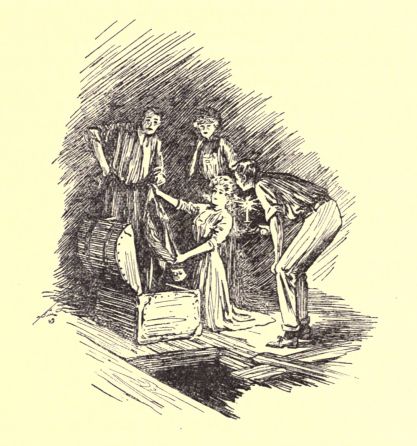
Miss Octavia first lifted out the remnants of a military uniform that lay on top.
"It's his ragged regimentals!" cried Cecilia, as we unfolded an officer's coat of blue and buff, sadly decrepit and faded; "and he was not a British soldier at all, but an American patriot."
Time and service had dealt even more harshly with an American flag on which the thirteen white stars floated dimly on the dull blue field. It had been bound tightly about a packet of papers which Miss Octavia asked Pepperton to examine.
"These are commissions appointing a certain Adoniram Caldwell to various positions in the Continental Army. Adoniram had the right stuff in him; here he's discharged as a private to become an ensign; rose from ensign to colonel, and seems to have been in most of the big doings. 'For gallantry in the recent engagement at Stony Point, on recommendation of General Anthony Wayne'—by Jove, that does rather carry you back!"
Half a dozen of these documents traced Adoniram Caldwell's career to the end of the Revolution and his retirement from the military service with the rank of colonel. A sealed letter attached to these commissions next held our attention. The ends were dovetailed in the old style before the day of envelopes, and evidently care had been taken in folding and sealing it. The superscription, in a round bold hand, without flourishes, read: "To Whom It May Concern."
"I suppose it concerns us as much as anybody," remarked Miss Octavia. "What do you say, gentlemen; shall we open it?"
We all demanded breathlessly that she break the seal, and we were soon bending over her with our lights. The ink had blurred and in spots rust had obliterated the writing:—
"I, Roger Hartley Wiggins, sometime known as Adoniram Caldwell"—
"Hartley Wiggins!" we gasped; and I felt Cecilia's hand clasp my arm.
Miss Octavia continued reading, and as she was obliged to pause often and refer illegible lines to the rest of us, I have copied the following from the letter itself, with only slight changes of punctuation and spelling.
"I, Roger Hartley Wiggins, sometime known as Adoniram Caldwell, having now resumed my proper name, and being about to marry, and having begun the construction of a habitation for myself wherein to end my days, truthfully set forth these matters:
"My father, Hiram Wiggins of Rhode Island, having supported the royalist cause in our late war for Independence, and angered by my friendliness to the patriots, and he, with ... brothers and sister having returned to England after the evacuation of Boston, I joined the Continental troops under General Putnam on Long Island, in July, 1776, serving in various commands thereafter, to the best of my ability, to the end.... My father has now returned to Rhode Island, and has, I learn, been making inquiries touching my whereabouts and condition, so that I have every hope that we may become reconciled. Yet as my services to the Country were against his wishes and caused so much harshness and heartache, and being now come into a part of the country where I am unknown, I am decided to resume my rightful name, that my wife and children may bear it and in the hope that I may myself yet add to it some honor....
"Nor shall my wife or any children that may be born to me, know from me ... (badly blurred.) Yet not caring to destroy my sword, which I bore with some credit, nor these testimonials of respect and confidence I received as Adoniram Caldwell at various times and from various personages of renown, both civilians and in the military service, I place them under my house now building, where I hope in God's care to end my days in peace. I would in like case make like choice again."
Ten lines following this were wholly illegible, but just before the date (June 17, 1789), and the signature, which was written large, was this:—
"God preserve these American states that they endure in unity and concord forever!"
We had all been moved by the reading of this long-lost letter, and Miss Octavia's voice had faltered several times. As I turned to Cecilia once or twice during the recital of the dead patriot's message, I saw tears brimming her eyes.
"Mr. Wiggins once told me that his great-grandfather had lived somewhere in Westchester County, but I fancy he had no idea that Hopefield was the identical spot," remarked Miss Octavia. "It seems incredible, and yet I dare say the hand of fate is in it."
"Oh, it's so wonderful; so beyond belief!" cried Cecilia, reverently folding the letter, which, I observed, she retained in her own hands.
"It's wonderful," added Miss Octavia promptly, taking the sword, which Pepperton had with difficulty drawn from its battered scabbard, "that even a discerning woman like me could have been so mistaken. I recall with humility that last Fourth of July, at Berlin, I reprimanded Mr. Wiggins severely because his family had not been represented in the war for American Independence. By the irony of circumstances it becomes my duty to present to him the very sword that his admirable great-grandfather bore in that momentous struggle. I shall, with his permission, place a bronze tablet on the outer wall of this house to preserve the patriot's memory."
Several copies of New York newspapers, half a dozen French gold coins, the miniature of a woman's face, which we assumed to be that of Roger Wiggins's mother or sister, were briefly examined; then by Miss Octavia's orders we carefully returned everything to the chest. Several packets of letters we did not open.
"Arnold," she said when we had closed the chest, "will you and Mr. Pepperton kindly carry that box to my room? No servant's hand shall touch it; and I shall myself give it to Mr. Wiggins at the earliest opportunity."
We had lost track of time in those hidden rooms, preserved by the whim of one man that the secret of another might be discovered, and found with surprise, after the chest had been carried to Miss Octavia's apartments, that it was after seven o'clock. We had been in the hidden rooms for more than three hours.
"We shall have much to talk about to-night, and I fancy we are all a good deal shaken. It's not often we receive a letter from a dead man, so we shall admit no callers to-night unless, indeed, Mr. Wiggins should chance to come," announced Miss Octavia. "The next time Hartley Wiggins visits this house he shall come as a conquering hero."
"I hope so," replied Cecilia brokenly.
We were still at dinner when the cards of Dick and the other suitors I had last seen at the Prescott Arms were brought in; but Wiggins made no sign, and I wondered.
XX
HEZEKIAH PARTITIONS THE KINGDOM
The man who looked after my needs handed me a note the next morning which added fresh hazards to Cecilia's already perilous plight.
"Left with the gardener before six o'clock by a boy from the village. Said it was most confidential, sir."
I waited till he had left the room before opening it. A square white envelope addressed to Arnold Ames, Esq., Hopefield Manor, told me nothing, and the handwriting was inscrutable. It slanted slightly upward; the small letters were half-printed and quaintly shaded. If a woman's, she had scorned the rail-fence models of the boarding-schools; if a man's—but I knew its gender well enough! The white note sheet within was unadorned, and the same pen had traced compactly, within the widest possible margins, the following:—
GOOSEBERRY BUNGALOW, Before Breakfast.
DEAR CHIMNEYS:—Pep stopped here yesterday to see B.H. He and C. old pals. Watch him. Where's Wig? H.H.
The initials were superfluous, and yet the sight of them pleased me mightily. In her semi-printing she curved the pillars of the H's like parentheses, so that they bore an amusing resemblance to four men striding forward against a storm. The report of a chief of scouts smuggled through the enemy's lines could not have improved on her billet for succinctness, and the information conveyed was startling enough. We had been dealing with a company of suitors outside the barricade; now came warning of the presence of a strange knight within the gates who greatly multiplied the perils of the situation. The compact between the suitors at the inn was a thing of the past, and I now expected them to exercise all the ingenuity of which desperate lovers are capable in pressing their claims. The fact that both Wiggins and Pepperton were old friends of mine did not make my task easier. I not only felt it incumbent on me to prevent Dick, the holder of the clue, from taking advantage of it, but knowing Cecilia's own attitude of mind and heart toward Wiggins I wished to save Pepperton the pain of rejection if it could be done.
But what did Hezekiah mean by the question with which she ended her note? If Wiggins, smarting under Cecilia's treatment of him the day before, had quit the field, here was a pretty how-d 'ye-do f Miss Octavia's refusal to countenance telephones made it necessary for me to leave Hopefield to learn what had become of Wiggins, and I realized that I must act promptly if I saved the day for him. His conduct first and last had been spiritless, and I was out of patience with him. It seemed impossible to formulate any plan amidst these multiplying uncertainties. If Wiggins had decamped, Dick knew it and would lay his plans accordingly. I felt that it was base ingratitude on Wiggins's part to ask me to watch his interests while he went roaming indifferently over the country. One or two consoling reflections remained, however: Dick believed me to be a suitor for Cecilia's hand, and this doubtless caused him considerable uneasiness; and he did not know that Pepperton, whose acquaintance with Cecilia antedated the European flight, had to be reckoned with. I wished Pepperton had kept out of it.
Breakfast that morning was interminably long. Miss Octavia was never more thoroughly amusing, never more drolly inadvertent. She attacked Pepperton for all the evils in American architecture, and in particular took him to task for some house he had built at Newport which she pronounced the most hideous pile of marble on American soil. From her packet of newspaper-cuttings she drew a letter her brother Bassford had written to the "Sun,"—the writing of letters to newspapers was, it seemed, one of his weaknesses,—protesting against the quality of the music ground from the New York hurdy-gurdies. The selections were execrable; the fierce tempo at which the instruments were driven had caused an alarming increase in insanity, in proof of which he adduced statistics. He demanded municipal censorship, and volunteered to sit on the proposed commission of critics without pay.
"That is just like brother Bassford! When I begin speaking to him again I shall point out the error of his ways. I always miss the hurdy-gurdies when I 'm in the country, and I believe I shall buy one and have it play me to sleep at night. The faster the tempo the sweeter the slumber. I should certainly do so," she concluded, with that indefinable smile that always left one wondering, "if it were not that my new laundress is a graduate of the Sandusky-Ottumwa Conservatory of Music, and I fear the toreador's song on wheels might be painful to one of her taste and temperament."
When we left the table at about half-past ten Miss Octavia insisted that we must visit the kennels. A friend had just sent her a fine Airedale, and she wished to make sure the kennel-master was treating the dog properly. Later we were all to ride.
I made haste to excuse myself, saying that personal matters required attention.
"Certainly, Arnold, you shall do as you like. Mr. Pepperton is a difficult bird to catch, so we hope for you at luncheon, and of course we expect you for dinner."
Pepperton looked at me inquiringly. I judged that he had known Miss Octavia a good many years; the tone of their intercourse was intimate; and yet he plainly was at a loss to understand just how I came to be so thoroughly established in her good graces. I confess that as I glance back over these pages it looks odd to me!
As I paced the hall waiting for a horse to be saddled, Pepperton led me out on the terrace above the garden.
"I'm bursting with a great secret, old man. I'm going to be married."
"What!"
"I'm going to be married."
I grasped a chair to support myself. This was almost too much. Could it be possible that Hezekiah had miscalculated the list of rejections in the silver-bound book, or that Cecilia herself had been deceived? Pepperton misread my agitation, and with a hearty laugh clapped me on the shoulder.
"Oh, I'm not intruding on your preserves, old man! Cecilia is the second finest girl in the world, that's all. I'm engaged to Miss Gaylord, of Stockbridge. I 'm telling a few old friends, in advance of the formal announcement to be made next week at a dance the Gaylords are giving."
I crushed his hand in both my own, and seeing that he misconstrued the fervor of my emotion I hastened to set myself right.
"You're a lucky dog as usual, Pep. But you don't understand about Cecilia Hollister. It's not I; I 'm not in the running at all; but Hartley Wiggins is! I'm here trying to help him score."
"What's this? You're here to represent Wiggy?"
"Well, he did n't exactly send me here, but when I came I found that Wiggy was n't playing the game with quite the necessary zipology. There's more required than appears,—a little of the dash and snap of the old adventures,—the ready tongue, the eager, thirsty sword!"
Pepperton pursed his lips and looked me over carefully with a twinkle in his eye.
"You are contributing those elements! You are octaviaized, is that it?" Pepperton laughed until the tears came.
"I prefer hollisterized as the broader term. Brother Bassford has it too, and there's always Hezekiah!"
"Ah! Hezekiah the unpredictable! I knew there was a skirt fluttering somewhere. I saw her yesterday; stopped to see Bassford, who's a good old chap. Hezekiah of the teasing eyes was whitewashing the chicken-coop, and Michael Angelo could n't have done it better."
"Pep," I said, lowering my voice, "if you love me, keep close to Cecilia all day. You're an engaged man and in practice. Give an imitation of devotion. Keep her out of doors; keep male human beings away from her. Don't fail me in this. I 've got to pull off the greatest coup of my life to-day. There's a band of outlaws hanging round here who will propose to Cecilia the first chance they get—and they must NOT. Wig 's got to speak before night or lose out forever. No; not a word of explanation; you've got to take my word for it."
"I'll be the goat; go ahead, but build a fire under Wiggins; I can't stay here forever."
Pepperton's engagement smoothed out one wrinkle, and I felt sure that I could trust him as an ally. The groom was holding my horse in the porte-cochère, and I mounted and rode away to the Prescott Arms.
I found Ormsby, Shallenberger, Arbuthnot, Henderson, Hume, and Gorse glumly sitting in a semicircle before the hall fireplace. Deepest gloom pervaded the inn. I have rarely seen melancholy so darkly stamped upon the human countenance. They turned indifferently and glared as they recognized me. Shallenberger alone rose and greeted me.
"I hope there is no bad news," he said chokingly.
"Bad news?"
"I mean Miss Hollister—Miss Cecilia. We were all deeply grieved last night to hear of her sudden illness; there's always something so terrible in the very name of diphtheria."
My wits had been so sharpened by my late adventures that I readily accounted for these false tidings. Dick was absent; Dick alone would have been equal to this diabolical plot for keeping his rival suitors away from Hopefield. The despair in those faces taxed my gravity severely.
"It is extremely sad, but the first diagnosis was erroneous," I answered. "I think it more likely to prove to be chicken-pox when the truth is known."
"Not diphtheria?"
"No immediate danger of diphtheria, I assure you," I replied; "though of course, with winter coming on and all that, one must be prepared for the worst."
While he repeated this to the others, I sought the clerk, who promptly handed me a note which Wiggins had left late the previous afternoon, to be delivered in case I called. He had gone to spend a day or two with Orton, the playwright, who was at his country house, in the hills beyond Mt. Kisco, rehearsing a new piece, in which a friend of Hartley's was to star. I gained the telephone-booth in one jump, and in five minutes I was bawling wildly into Orton's ear. I had known him well in the Hare and Tortoise, and he answered my demand for Wiggins with the heart-breaking news that Hartley had ridden off with some other guests in the house—Orton did n't know where.
"I threw them out; I've got to rewrite my third act; I don't care whether they ever come back," boomed Orton's voice.
"If you don't send Wiggins back to me at Hopefield as fast as he can get there, my third act is ruined."
"What?"
"Tell Wiggins to come back on the run; tell him the world's coming to an end any minute."
"I'll be glad to get rid of him," snapped Orton, in the harried tone of a man whose third act has wilted in rehearsal.
As I came perspiring out of the telephone-booth I found the suitors engaged in eager but subdued debate by the hearth. They could hardly have heard my bleatings over the telephone, but they were greatly concerned about something. Shallenberger, who was apparently the only one willing to approach me, followed me to the veranda.
"Those fellows in there don't understand this. Dick told us all last night, after we had called at the house and been refused admittance, that Miss Cecilia was ill with diphtheria. I remember that it was Dick who rang the bell and gave our cards to the footman. It was quite singular, you know, our being turned away, unless something had been wrong."
I bowed gravely. They had been turned away for the very simple reason that, after unearthing Adoniram Caldwell's effects in the secret rooms of her house, Miss Octavia had not cared to be troubled with suitors. The haughty Nebraskan had drawn upon his imagination for the rest.
"And I understood you to say a moment ago that Miss Hollister's malady is not diphtheria, but chicken-pox?" Shallenberger persisted with almost laughable trepidation. "These gentlemen, I regret to say, go so far as to doubt your word."
"That, Mr. Shallenberger, is their privilege. But it seems to me that when I merely tried to mitigate the terrible news imparted by Dick, you are rank ingrates for questioning my far less doubtful story. Anything between you gentlemen and Mr. Dick is, of course, none of my affair, for whether considered as a set, group or bunch I am done with the whole lot of you. Farewell!"
I decided as I rode away that nothing was to be gained by going in search of Wiggins. Orton had purposely made his house difficult of access, and the roads in that neighborhood are many and devious. Orton had banished his guests that he might tinker his play in peace, and knowing his temper, I was sure that Wiggins and the rest of them would keep out of his way till the pangs of hunger drove them back.
I had ridden half a mile toward Hopefield, when I espied a woman riding rapidly toward me, and as she drew nearer I identified her as Hezekiah, mounted on a horse I recognized as one of the best in Miss Octavia's stables. Hezekiah rode astride, as a woman should, her bicycle skirt serving well as a habit. She rode as a boy rides who loves freedom and quickened pulses and the rush of wind across his face. She was hatless, for which the sun and I were both grateful. The big bow at the back of her head turned the dial back to sixteen.
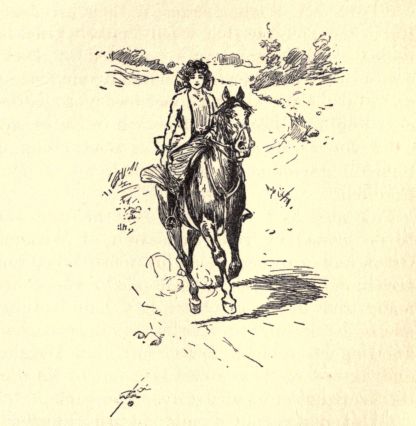
I espied a woman riding rapidly toward me.
She drew rein and fished what seemed to be salted almonds from her sweater pocket. She filliped one of these into the air, and caught it in her mouth with a lazy toss of the head that showed the firm contour of her lovely throat. I had never seen her more self-possessed.
"Do you care much for this horse?" she asked, carelessly.
"It's a good horse; I fancy Miss Octavia thinks so herself. There are places, Hezekiah, where they hang people for horse-stealing."
"Thought I might need one to-day, so I borrowed him,—through the back way to the old red barn. The coachman is an ancient chum, and Aunt Octavia would never mind even if she knew. And she will know all right! Anyhow, my rear tire had been patched once too often, and there is a satisfaction in a horse! Where's our sensitive and impressionable Wiggy? Saw him riding over toward Kisco yesterday P.M. with chin on his chest,—dreadful riding form."
"Wiggins is at Orton's,—the playwright's, you know. I've telephoned him to hustle back, but he's out of our reach somewhere. I could n't speak to him direct; had to leave a message for him."
"Just like Wiggy to die on the last lap. What did you make out of brother Pepperton?"
"Your note scared me,—thanks so much for your note,—but he's all right. Engaged to another girl."
"Ah," she sighed, "it's comforting that Cecilia could n't keep them all going all the time."
We rode along together, our horses in a walk, and I told her everything I knew of the condition of affairs, including a true account of my experiences at the inn the day before and of the finding of the old chest belonging to Wiggins's great-grandfather,—her brown eyes opened wide at this,—concluding with the diphtheria stratagem and Dick's menace to Cecilia's happiness.
"He's really a bright little boy. Coming home on the steamer he gave me a post-graduate course in pragmatism that I've found helpful in keeping house for papa. It's too bad we have to lay a trap for Mr. Dick."
"Is it? Just how are we to manage that, Hezekiah?"
"Oh, that will be easy enough. He's pretty desperate, and since the compact between the suitors has gone to pieces he knows he will have to show his hand pretty soon. He thinks you are wild about Cecilia. He lays great stress on his thinking powers, and he probably argues that you are bound to pop pretty soon. It's just as well he thinks so, but we must finish this up to-day; I'll be a nervous wreck if we don't close the books to-night. There's your friend Dick now."
She indicated a high point in the main road, where it crossed the ridge from which she had shown me—it seemed, oh, very long ago!—the procession of suitors crossing the stile. Dick, mounted, was gazing off across the fields toward Hopefield. Man and horse were so distant as to create the illusion of an equestrian statue on a high pedestal.
"Napoleon before Waterloo," I suggested.
"He does look like Napoleon, doesn't he?" she laughed. "He's a bit fussed to-day. He knows that Wiggy 's not at the inn, and that you are up to something, and to little Mr. Dick the architect probably looks like one of those mysterious knights you read about, who suddenly appears at the tournament all canned in an ice-cream freezer, with a tin pail over his head. Mr. Pepperton's presence no doubt worries him, as I don't think they ever met. Cecilia and Mr. Pepperton are riding—I dodged them just before I struck you, walking their horses in the most loverlike fashion in a lane over yonder; but if Mr. Pepperton is really engaged it's all right, though if I were the other girl I think I'd be anxious."
"Pep's playing the game, that's all. What are you going to do now?"
She glanced at the sun; I fancy that it was with such a scanning of the heavens that her sisters a thousand years before had noted the time.
"This is my pie-day. There's undoubtedly a gooseberry-pie waiting for me at the bungalow, and papa will expect me for luncheon. I 'd ask you to come too, only you 'll have all you can do to keep Mr. Dick from persuading somebody to be the sixth man, so he can slip in as number seven. If we get through to-day all right, you may come for luncheon to-morrow, maybe. Papa told me he liked you; he said you were very decent that night you met him on the roof of Aunt Octavia's house."
"My compliments to your father. I hope to be able to persuade him to extend his paternal arm to include me. Aunt Octavia must be my aunt, too!"
"Really!" cried Hezekiah, with indescribable mockery; and she wheeled her horse and was gone like the wind.
Luncheon at Hopefield passed without incident; and afterward Cecilia retired to help her aunt with her correspondence, while Pepperton and I lounged about the house and smoked. I told him of my ineffectual efforts to reach Wiggins, and he volunteered to find a motor and search for him; but I pointed out the futility of this, and renewed my appeal that he stay on guard at Hopefield.
At about three o'clock Cecilia reappeared. Her color was high and her eyes were unusually brilliant. I knew that she fully realized that the crisis was near, but she asked no questions and her manner reassured me of her confidence. We idled on the stone terrace above the frost-smitten garden, which in its ruin still satisfied the eye with color. I had purposely drawn some chairs to a corner well screened by vines, so that I could note the approach of any visitors who came cross country by way of the stile.
We were hardly seated before Dick entered the garden, followed immediately by the six other suitors I had last seen at the inn. They ranged themselves on a stone bench facing the house at the end of one of the paths. They wore sack coats and hats in a variety of styles, so that they did not present quite the bizarre effect produced by their frock coats and silk tiles. They surveyed the house sadly, bowed their heads upon their sticks, and seemed to have come to stay. The siege, then, had become a practical matter!
"Why don't the gentlemen come in?" asked Cecilia, peering through the vines.
"Hush! There's a rumor that you are terribly ill; they've come merely to pay their tribute of respect by waiting in the garden. You had better go quietly into the house. The shock of seeing you in your usual health might be too much for them."
"But I can't! I must be accessible at all times," she cried, looking helplessly from me to Pepperton, who was all at sea for an explanation. "If that impression is abroad, I shall appear at once."
"Then you and Pepperton must patrol the terrace here; you are lovers for all I know. Ignore them utterly in your absorption with one another. If any one approaches you, Pepperton, ask Miss Hollister to marry you."
"Me!" gasped Pepperton.
"No; it can't be done that way," Cecilia interposed. "Mr. Pepperton has told me of his engagement. I can't be party to a fraud, a trick. I can't countenance it at all. It would ruin everything!"
"Then stay right here; pace back and forth, and I'll manage the rest. I don't for the life of me know how, but I'll do it."
As Cecilia and Pepperton stepped from behind the screen of vines, the men on the benches lifted their heads; then I heard murmurs of amazement and chagrin, and caught a fleeting glimpse of Dick tearing through the hedge with his late companions tumbling after in fierce pursuit.
I ran to the stable and found a horse, feeling that I must be in a position to move rapidly if I saw Wiggins approaching. If Dick eluded his wrathful pursuers he would be on the lookout somewhere, awaiting his own time, and if he saw Wiggins rushing madly for the house, he might yet circumvent us.
I satisfied myself that Cecilia and Pepperton were still plainly visible from the garden, and I knew that for the time she was safe. I gained the high point in the road from which Hezekiah and I had observed Dick on guard at noon, and waited. Remembering the fine figure the philosopher had made against the sky, I dismounted and rested by a stone wall where I could watch with less risk of being seen from a distance.
I at once saw matters that interested me immensely. Dick had thrown off the other suitors, and was rapidly crossing the fields toward Hopefield. When I caught sight of him, he was just leaving the orchard where Hezekiah and I had held our memorable interview. A long stretch of rough pasture lay before him, and he settled down to a quick trot. He took several fences without lessening his gait, crossed the stile like a flash a little later, and was out of sight.
As I turned to my horse I heard the swift patter of hoofs, and saw a man and woman galloping furiously toward me. They were rapidly nearing the ridge, and their horses were springing over the firm white road in prodigious leaps. Wiggins had got my message; Hezekiah had met him in the road and was urging him on! Here indeed was a situation to stir the heart, and the blood sang in my ears as I watched them. I waved my arm as they checked their horses for the long climb. The riders had lost their hats in their mad race, and Wiggins's horse was nearly done for. As they came still nearer, I saw that Wiggins had taken fire at last.
"Orton said some one was killed,—who—what—who"—
"I just picked him up five minutes ago; he doesn't know anything," said Hezekiah; "and you dare n't tell him—remember the rules! What's doing?" she inquired coolly.
She bade Wiggins exchange horses with her, and while he was readjusting the saddle-girths I explained to Hezekiah the situation at Hopefield and told her of Dick's scamper across the fields.
"There's no use fooling with this thing any more. I'll take Wiggy to the house and lock him up until I 've been numbered six,—it's safest."
"Not much it isn't. I don't intend that Cecilia shall have the pleasure of refusing you."
"I'd like to know why not. It's only to fill the gap."
"Oh!" said Hezekiah, "that would be an embarrassment to me all the rest of my life. Listen carefully. Take Wiggy in by the back way, and give him a picture-book to look at. Leave Cecilia alone on the terrace when you're all ready, and see what happens. If Dick's on his way to the house he's going to do something, and he must feel the edge of my displeasure. I owe him a few on general principles."
"What does all this mean? You say there 's nothing wrong at the house?" began Wiggins as we left Hezekiah and started toward Hopefield.
"Nothing whatever the matter; everything perfectly all right; but you've got to keep mum now and do what I tell you. I've worked hard for you, old man, and when it's all over I'm going to send you a bill for professional services. Come!"
I urged my horse to his utmost, and Wiggins rode steadily beside me. The fright Orton had given him had done my friend good, and I felt that I was dealing with a live man at last. Our speed did not permit conversation, but feeling that Wiggins was entitled to some further assurance, I waited until we were climbing our last hill to add a word.
"I'll tell you all about this after we have a good-night cigar to-night. You know I told you I was going to help, and if nothing goes wrong and Hezekiah does n't fail, you will see the world with new eyes before you sleep."
We rode direct to the stable, and I took Wiggins to my room by the back stairs and bade him help himself to my raiment. He was perfectly tractable, and I was glad to see that he trusted implicitly to my guidance.
I met Miss Octavia in the lower hall. She was just in from the kennels. Her new Airedale was a perfect specimen of the breed, she declared, and she announced her intention of exhibiting him at all the reputable bench shows in America.
"I hope, Arnold, that you have not been without entertainment to-day."
"Miss Hollister, the three musketeers were fat monks asleep under the sunny wall of a monastery compared with me!"
"I am glad you are not bored. By the way, if you should by any chance see Hezekiah, you will kindly intimate to her that if she returns that Estabrook mare she borrowed this morning in reasonably good condition, I will overlook her indiscretion in taking it from the stable without permission."
She did not wait for a reply, but continued on to her room, and I went direct to the terrace. Cecilia and Pepperton were just going into the house to look up a book or piece of music which they had been discussing. Cecilia was making herself interesting, as she so well knew how to do, and she seemed in no wise anxious.
"We had forgotten tea," she said. "Aunt Octavia has just ordered it."
"She and Mr. Pepperton may have their tea. I believe the air outside will do you good for a little longer,—so if you don't mind, Pepperton, Miss Hollister will resume her promenade alone."
Pep has told me since that he thought me quite mad that afternoon. I bade Cecilia patrol the long terrace slowly. She turned up the collar of the covert coat and obeyed, laughing a little nervously but asking no questions. The scene could not have been more charmingly set. The great house loomed darkly behind her; beneath lay the garden, over which the dusk was stealing goldenly.
She paused suddenly as I watched from the window, and I stepped out to see what had attracted her attention. There into the garden from its farther entrance filed the six suitors who had previously come to sit beneath the windows of their stricken lady! Having failed to visit their wrath upon the perfidious Dick they had changed their clothes and returned to Hopefield. If Hezekiah had not expressly commanded me not to become the sixth man, I should have offered myself on the spot, and waited only until Cecilia had made the inevitable answer before summoning Wiggins to end the whole affair. Such, however, was not to be the order of events.
The procession, headed by Ormsby, was within a few yards of the terrace. Cecilia, apparently unconscious of their proximity, continued her promenade. In a moment she must recognize them, ask them into the house, give them tea, and otherwise destroy my hope of securing her happiness before the day's end.
A chorus of yelps and barks, as of dogs suddenly released, greeted my ear. The oncoming suitors heard it too, and the line wobbled uncertainly. Then round the house swept mastiffs, hounds, terriers,—a collection of prize-winners such as few kennels ever boasted, loping gayly in unwonted freedom toward unknown and forbidden pastures.
The vanguard of fox-terriers leaped down into the garden, with the rest of the pack at their heels. Happy dogs, to find grown men ready for a gambol! Six coat-tails streamed from the hips of six gentlemen in a hurry. Several battered hats mixed with geraniums were retained later as spoils of war by the gardener. That garden had been built for repose and contemplative amblings, not for panic and flight. The disorder was superior in picturesqueness to that which attended the pumpkin stampede; at least it struck me at the moment as funnier; and I have never since been able to attend a day wedding without appearing idiotic—the procession of ushers suggests possibilities that are too much for me. Four of the suitors found one of the proper exits into the road; two leaped the box-hedge on the other side without shaking a leaf.
I ran round the house, stumbling through the rear-guard of the truant canines, and passing the kennel-master, who had rallied the stable men and was in hot pursuit.
"Somebody turned 'em out—turned 'em out!" he shouted, and swept profanely by. The gate of the kennel-yard stood open. A familiar figure, running low, paused, and then sprinted nimbly along the paddock fence. A white sweater was distinguishable for a moment on a stone wall, then it followed a pair of enchanted heels into oblivion.
Time had been passing swiftly, and the shadows were deepening. I retraced my steps toward the terrace, hearing the cries of pursued and pursuers growing fainter. I had not yet gained a position from which I could see Cecilia, when a man appeared some distance ahead of me, walking guardedly in one of the garden-plots. He came uncertainly, pausing to glance about, yet evidently led toward the terrace by a definite purpose. All may be fair in love and war, but I confess to a feeling of pity for John Stewart Dick as I watched him slowly advancing to his fate. He was going boldly now, and I felt a sudden liking for him; nor can I believe that he was other than a manly fellow with sound brains and a good heart.
I reasoned, as I marked his approach to the terrace, that he had been loitering in the neighborhood, probably watching Cecilia and Pepperton, and when the architect retired, he had assumed that the sixth man had spoken. The appearance of his former comrades of the inn had doubtless disturbed him as it had me; then, thanks to the resourceful Hezekiah, they had been routed and the coast was clear. I think it likely that the sight of Cecilia sombrely pacing the terrace in the darkening shadows was too much for his philosophic poise, or like the rest of us who were actors in that comedy, he may have felt that any end was better than the doubts and uncertainties that beset us.
I watched him draw nearer to Cecilia as I have watched deer go down to a lake to drink. He would speak now; I was confident of it; and I stole round to the side entrance and sent word to Wiggins to go to the drawing-room and wait for me.
Miss Octavia and Pepperton still lingered over their tea-cups. The row made by the fugitives from her kennels had not, it seemed, penetrated to the library, and Miss Octavia bade me join the talk, which had to do, I remember, with some project for a national hall of fame that had incurred her characteristic displeasure. A hall of immortal rascals in pillories she thought far likelier to please the masses.
In fifteen minutes I saw Cecilia crossing the hall. She stopped where I could see her quite plainly, and thrust her hand into the pocket of her coat. Out flashed the silver note-book. She made a swift notation with the pencil that now, I knew, wrote the fate of the sixth man.
I went out and spoke to her, and walked beside her to the drawing-room door, where Hartley Wiggins was waiting.
Miss Octavia had risen when I returned to the library, and it was time to dress for dinner.
"Just a moment, Miss Hollister. Something of great interest is about to occur;" and I made excuses for detaining her for perhaps five minutes,—not more.
"You have never yet deceived me, Arnold Ames, and such is my confidence in you that if you tell me that something interesting will soon occur, I have no reason to doubt you. It is worth remembering, however, that fowl is not improved by prolonged roasting."
I heard Wiggins laugh in the hall, and Miss Octavia raised her head. Then Cecilia came into the room, and walked directly to her aunt.
"Aunt Octavia, here is the little silver notebook you gave me in Paris; I have just written Mr. Wiggins's name in it, and as I have no further use for the book, I return it with my love and thanks."
Without a word, Miss Octavia turned to the wall and pressed the button twice.
"William," she said as the butler appeared, "you may serve Oriana '97, and be careful not to freeze it to death; and the hour for dinner is changed to eight. Arnold, you may yourself drive to Gooseberry Bungalow for my brother and niece. They dine with me to-night."
Hezekiah and I built our bungalow in the orchard where on that October afternoon I found her munching a red apple on the stone wall. She is the most scrupulous of housewives, and only now took me to task for scattering the hearth with fragments of the notes from which this narrative has been written. She has just been reading these last pages, with meditative brown eyes, and not without occasionally reaching for the pen and retouching some sentence in which, she says, soot from my chimney-doctoring days has clogged the ink. Cecilia and Wiggins live at Hopefield across the fields. Miss Octavia insisted on this, for the reason that the sword of Hartley's great-grandfather, found in the chest under the old house, gives him inalienable rights to the premises. Miss Octavia and her brother Bassford are traveling abroad and enjoying those mild adventures to which they are both temperamentally inclined. As Miss Octavia carried with her the Parker House umbrella-check I am confident of her early return.
My name is joined to Pepperton's on his office-door. Pepperton proposed this arrangement, with so many assurances of faith in me that I could not refuse him; but I knew well enough that Miss Octavia had first put it into his head. So while I have called myself a chimney-doctor in these pages, I am again an architect, and the new cathedral now rising at Waxahaxie is, let me modestly note, the work of my hand.
"You ought to say something more about the Asolando," Hezekiah has just murmured at my shoulder. "Everybody will ask whether we ever went back there."
"Of course we go back there, Hezekiah, every time you come to town and can get hold of me. Will that be enough?"
"You'd better explain that Aunt Octavia started the tea-room and still owns it, and makes money out of it, though she rarely goes there, but sends Freda the maid to collect the profits. And it won't do any harm to say that when she met you there that day, she decided at once that you would be a proper husband for me. Any one who reads your book will want to know that."
Hezekiah is always right; so here endeth the chronicle.
The Riverside Press CAMBRIDGE . MASSACHUSETTS U . S . A
THE RIGHT STUFF
By IAN HAY
"Those who love the companionship of people of fine fibre, and to whom a sense of humor has not been denied, will make no mistake in seeking the society open to them in 'The Right Stuff.'"—New York Times.
"Hay resembles Barrie, and, like Barrie, he will grow in many ways."—Cleveland Leader.
"A compelling tribute to the homely genuineness and sterling worth of Scottish character."—St. Louis Post Dispatch.
"Mr. Hay has written a story which is pure story and is a delight from beginning to end."—San Francisco Argonaut.
"It would be hard, indeed, to find a more winning book."—New Orleans Times-Democrat.
With frontispiece by James Montgomery Flagg. 12mo.
$1.20 net. Postage 10 cents.
THE TWISTED FOOT
By HENRY MILNER RIDEOUT
"Henry Milner Rideout has written several good stories of Oriental mystery, but none of them approach in excellence 'The Twisted Foot.'"—Cleveland Plain Dealer.
"The story is fascinating and full of the witchery of the East."—Congregationalist.
"Its persuasiveness of action, its alluring color and high heart courage, make it one of the striking romances of the time."—New York American.
"The whole story glows with the local life and color."—New York Times.
With seven full-page illustrations by G. C. Widney.
12mo. $1.20 net. Postage 11 cents.
THE PROFESSIONAL AUNT
By MARY C. E. WEMYSS
"One of the most delightful stories that has ever crossed the water."—Louisville Courier-Journal.
"The legitimate successor of 'Helen's Babies.'"—Clara Louise Burnham.
"A classic in the literature of childhood."—San Francisco Chronicle.
"Mrs. Wemyss is a formidable rival to E. Nesbit, who hitherto has stood practically alone as a charmingly humorous interpreter of child life."—Chicago Inter-Ocean.
"A charming, witty, tender book."—Kate Douglas Wiggin.
"It is a sunny, warm-hearted humorous story, that leaves the reader with a sense of time well spent in its perusal."—Brooklyn Eagle.
16mo. $1.00 net. Postage 10 cents.
FARMING IT
By HENRY A. SHUTE
"There is nothing funnier in Mark Twain."—Grand Rapids Herald.
"Every man and woman who lives, or ever has lived, in the country will appreciate the situations described.... They are funny enough to disturb the calm of the most serious countenance."—Boston Globe.
"Includes more fun than is concealed in all his other books taken together."—Living Age.
"The book is extraordinarily frank ... spicy and enlivening."—Baltimore News.
"A wholesome and invigorating sort of book.... A real story of real life cheerfully narrated."—New York Times.
Fully illustrated by Reginald B. Birch
12mo. $1.20 net. Postage 12 cents
OLD HARBOR
By WILLIAM JOHN HOPKINS
"A charming picture of an old New England sea-port.... It is a book to close reluctantly with the hope of soon opening another volume by the same author."—New York Times.
"A tale to chuckle over.... It is not often that a reader has an opportunity in the pages of a book to come in touch with such a group of genial and lovable people."—Minneapolis Journal.
"A cheerful, amusing story of old-fashioned people.... The author is a genuine humorist."—Boston Transcript.
"A story conceived in the same spirit as 'The Clammer,' filled with the same philosophy, displaying the same keen insight."—Brooklyn Eagle.
Square crown 8vo. $1.25 net. Postage 14 cents
THE BREAKING IN OF A YACHTSMAN'S WIFE
By MARY HEATON VORSE
"Clever! Sparkling! Full of quaint humor and crisp description! Altogether a book which will not disappoint the reader. It is 'different,' and that is one great merit in a book."—Brooklyn Eagle.
"It will puzzle holiday makers to find a better vacation book than this. Those who go up and down the Sound in yachts will find it especially pleasing; it will appeal to those who are fond of human nature studies; may be recommended even more decidedly to the serious than to the young and frivolous; a tonic to depression and an antidote to gloom."—N. Y. Times.
"Charming, with its salt, sea-slangy flavor, its double love thread, and its pleasant chapters dealing with Long Island Sound, the Mediterranean, Massachusetts Bay and Venetian lagoons."—Chicago Record-Herald.
Illustrated by Reginald Birch. 12mo, $1.50
HOUGHTON MIFFLIN COMPANY BOSTON AND NEW YORK