Chapter II · (continued 3)
Reading edition
"But you don't assume that your daughter is not to be a free agent in the matter? You don't believe that some unworthy and improper man is to be forced upon her?"
"That, sir, is exactly what I fear!"
"You will pardon me, but I cannot for a moment believe that Miss Hollister would risk her niece's happiness even to satisfy her own peculiar humor. Your sister is a shrewd woman, and her heart, I am convinced, is the kindest. Among the suitors now camped at the Prescott Arms there must be some one whom your daughter approves, and I see no reason why he should not ultimately be her choice. Now that you have broached the matter, I make free to say that one of these suitors is an old friend of mine. Hartley Wiggins by name, and that he is a man of the highest character and a gentleman in the strictest sense."
He had been listening to me with the greatest composure, but at the mention of Wiggins's name he started and nervously clutched my arm.
"That man may be all that you say," he cried chokingly, "but he has acted infamously toward both my daughters. He is a rogue, and a most despicable fellow. He has flirted outrageously with Hezekiah while at the same time pretending to be deeply interested in Cecilia. I say to you in all candor that a man who will trifle with the affections of a child like Hezekiah is a villain, nothing less."
"But, my dear sir, is it not possible that you do him a great wrong? May it not be the other way round, that Hezekiah is trifling with Wiggins's affections? He 's a splendid fellow, Hartley Wiggins, but he 's a little slow, that's all. And between two superb young women like your daughters a man may be pardoned for doubts and hesitations; a case of being happy with either if t'other dear charmer were only away. To put it quite concretely, I will say that in my own very slight acquaintance with these young women I feel the spell of both. Your sister, I take it, is anxious not to show partiality for any of these men, and yet I dare say she probably feels kindly disposed toward Wiggins. His worst crime seems to be that he chose Tory ancestors! The thing is bound to straighten itself out."
He tossed his head impatiently.
"Has it occurred to you that Octavia's interest in this Hartley Wiggins may be due to a trifling and immaterial fact?"
"Nothing beyond his indubitable eligibility."
"Then let me tell you what I suspect. Both his names contain seven letters. My sister is slightly cracked as to the number seven. I swear to you my belief that the fact that his names contain seven letters each is at the bottom of all this. Incredible, my dear sir, but wholly possible!"
"Then, such being the case, why does n't she show her hand openly? If she believes that Wiggins with his septenary names is ordained by the seven original pleiades to marry your daughter Cecilia, I should think that by the same token she would have sought a man rejoicing in the noble name of Septimus. You send conjecture far when once you entertain so absurd an idea."
"You think my assumption unlikely?" he asked eagerly.
"I certainly do, Mr. Hollister. But I confess that I had never counted the letters in Wiggins's name before, and your suggestion is interesting. And this whole idea of the potential seven in our affairs has possibilities. If seven at all, why is n't it possible that your sister has Jacob in mind and the seven years he served for Rachel? You may as well assume that, as Wiggins is specially favored in the number of letters in his singularly prosaic and unromantic name, it is Miss Hollister's plan to keep him dallying seven years."
He seized me by the arm and forced me back against the battlements, then stood off and eyed me fiercely.
"You speak of serving and of service! Will you tell me just why you are here and what brings you into this affair! My daughter Hezekiah is the frankest person alive, and she told me of her meetings with you and that you had been to the Asolando,—where she spent a day in the sheerest spirit of mischief. That was the beginning of all our troubles, that damned hole with its insane confectionery and poetry. If Cecilia, in a misguided notion of earning her own living, had not gone there and worn an apron for a week before I dragged her out, she would never have met Wiggins. And now will you kindly tell me just what you are doing in my sister's house, where I have to come like a thief in the night to see one of my own children?"
This fierce deliverance touched me nearly: I doubted my ability to explain to one of these amazing Hollisters just how I came to be sojourning in the house of another of the family without any business that would bear scrutiny. I hastened to declare my profession, and that I had been summoned by Miss Hollister to examine her chimneys. I could not, however, tell him that until my arrival the chimneys had behaved themselves admirably!
"You've admitted your friendship for this Wiggins person; that's enough," he said when I had concluded. "I advise you to leave the house at once. I tell you he 's got to be eliminated from the situation. Understand, that I do not threaten you with violence, but I will not promise to abstain from visiting heavy punishment upon that fellow. And you? A chimney-doctor? I am a man of considerable knowledge of the world, and I say to you very candidly that I don't believe there is any such profession."
"Then let me tell you," I replied, not without heat, "that I am a graduate in architecture, and that if you will do me the honor to consult a list of the alumni of the Institute of Technology, you will find that I was graduated there not without credit. And as for remaining in this house, I beg to inform you, Mr. Hollister, that as I am your sister's guest and as she is perfectly competent to manage her own affairs, I shall stay here as long as it pleases her to ask me to remain. And now, one other matter. How did you gain this roof to-night, when by your own admission you are not on such terms with your sister as would justify you in entering it openly?"
The moonlight did not fail to convey the contempt in his face, but I thought he grinned as he answered quietly:—
"You don't seem to understand, young man, that you are entitled to no explanations from me. If my sister has her sense of a joke, I assure you that I have mine. I came here to see my daughter. As I taught her to fence when she was ten years old and as she is particularly expert, and moreover, as in my present condition of poverty I have been obliged to forego the pleasure of metropolitan life and to give up my membership in the Fencers' Club, you can hardly deny my right to meet my own daughter for a brief bout anywhere I please. You strike me as a singularly fresh young person. It would be a positive grief to me to feel that my conduct had displeased you. And now, as the night grows chill, I shall beg you to precede me into the house by the way you came."
"But first," I persisted, "let me ask a question. It is possible that you yourself have some preference among your daughter's several suitors, Mr. Hollister. Would you object to telling me which one you would choose for Miss Cecilia?"
"Beyond question, the man for Cecilia, if I have any voice in the matter, is Lord Arrowood."
"Arrowood!" I exclaimed. "You surprise me greatly. I saw him at the inn, and he seemed to me the most insignificant and uninteresting one of the lot."
"That proves you a person of poor gifts of discernment, Mr. Ames;" and his tone and manner were quite reminiscent of his sister's ways; and his further explanation proved him even more worthily the brother of his sister.
"As I was obliged," he began, "owing to an unfortunate physical handicap, to abandon my art, that of a marine painter, I have given my attention for a number of years to the study of the Irish situation. Between the various political parties of Great Britain, poor Ireland can never regain her ancient power. But I see no reason why she should not become once more a free and independent nation. I have gone deeply into Irish history, and I may modestly say that I probably know that history from the time of the Anglo-Norman invasion to the death of Gladstone better than any other living man. I met Arrowood by chance in the highway yesterday, and I found that he holds exactly my ideas."
"But Arrowood isn't an Irishman," I interjected; "neither, I should say, are you!"
"That's not to the point. Neither was Napoleon a Frenchman strictly speaking; nor was Lafayette an American. A friend of mine in Wall Street is ready, when the time is ripe, to finance the scheme by selling bonds to the multitudes of Irish office-holders throughout the United States,—most of whom are not unknown to the banks."
"And I suppose you and Arrowood would sit jointly in the seat of the ancient kings in Dublin after you had effected your coup."
"You lose your bet, Mr. Ames. We have agreed that, as the mayors of Boston for many years have been Irishmen, and as they have, by their prowess in holding the natives in subordination, demonstrated the highest political sagacity, we could not do better than take one of these rulers of the old Puritan capital and place him on the Irish throne. The keen humor of that move would so tickle all interested powers, that the investiture and coronation of the new ruler would be accomplished without firing a shot."
This certainly had the true Hollister touch! Miss Octavia herself could not have devised a more delightful scheme.
"And so," Mr. Bassford Hollister concluded, "I naturally incline toward Arrowood, though he is so poor that he was obliged to come over in the steerage to continue his wooing of my daughter."
He let himself down into the dark trunk-room, waited for me courteously, and walked by my side to the stairway, both of us maintaining silence. I was deeply curious to know how he had entered and whether he expected to go down the front way and out the main door. We kept together to the third-floor hall,—I could have sworn to that; then suddenly, just as we reached the stairway, out went the lights, and we were in utter darkness. I smothered an exclamation, clutched my matches and struck a light, and as the stick flamed slowly, I looked about for Bassford Hollister; but he had vanished as suddenly and completely as though a trap had yawned beneath us and swallowed him. I found the third-floor switch and it responded immediately, flooding the stair-well to the lower hall, but I neither saw nor heard anything more of Hollister.
Astounded by this performance, I continued on to the lower floor to have a look around, and there, calmly reading by the library table, sat Miss Octavia!
"Late hours, Mr. Ames!" she cried. "I supposed you had retired long ago."
I was still the least bit ruffled by that last transaction on the stair, and I demanded a little curtly:—
"Pardon my troubling you; but may I inquire, Miss Hollister, how long you have been sitting here?"
The clock on the stair began to strike twelve, and she listened composedly to a few of the deep-toned strokes before replying.
"Just half an hour. I thought some one knocked at my door about an hour ago. The lights were on and I came down, saw a magazine that had escaped my eye before, and here you find me."
"Some one knocked at your door?"
"I thought so. You know, the servants have an idea that the place is haunted, and I thought that if I sat here the ghost might take it upon himself to walk. I confess to a slight disappointment that it is only you who have appeared. I suppose it was n't you who knocked at my door?"
"No," I replied, laughing a little at her manner, "not unless it was you who switched off the lights as I was coming down from the fourth floor. I have been studying this chimney from the roof. I know something of the ways of electric switches, and they don't usually move of their own accord."
"Your coming to this house has been the greatest joy to me, Mr. Ames. I should not have imagined, in a chance look at you, that you were psychical, and yet such is clearly the fact. I assure you that I have not touched any switch since I left my room. It was unnecessary, as I found the lights on. And I acquit you of rapping, rapping at my chamber-door. It gives me the greatest satisfaction to assume that the house is haunted, and at any time you find the ghost, I beg that you will lose no time in presenting me. If the prowler is indeed one of King George's soldiers, hanged during the Revolution on the site of this house, I should like to have words with him. I have just been reading an article on the political corruption in Philadelphia in this magazine. It bears every evidence of truth, but if half of it is fiction I still feel that, as an American citizen, though denied the inalienable right of representation assured me in the Constitution, we owe that ghost an apology; for certainly nothing was gained by throwing off the British yoke, and that poor soldier died in a worthy cause."
She wore a remarkable lavender dressing-gown, and a night-cap such as I had never seen outside a museum. As she concluded her speech, spoken in that curious lilting tone which, from the beginning, had left me in doubt as to the seriousness of all her statements, she rose and, still clasping her magazine, made me a courtesy and was soon mounting the stair.
I heard her door close a minute later, and then, feeling that I had earned the right to repose, I went to my room and to bed.
XI
I PLAY TRUANT
I slept late, and on going down found the table set in the breakfast-room. A pleasant inadvertence marked the choice of eating-places at Hopefield Manor; I was never quite sure where I should find a table spread. No one was about, and I was seized with that mild form of panic familiar to the guest who finds himself late to a meal. As I paused uncertainly in the door, viewing the table, set, I noticed, for only one person, Miss Octavia entered briskly, her slight figure concealed by a prodigious gingham apron.
"Good-morrow, merry gentleman," she began blithely. "The most delightful thing has happened. Without the slightest warning, without the faintest intimation of their dissatisfaction, the house-servants have departed, with the single exception of my personal maid, who, being a Swede and therefore singularly devoid of emotion, was unshaken by the ghost-rumors that have sent the rest of my staff scampering over the hills."
She lighted the coffee-machine lamp in her most tranquil fashion, and begged me to be seated.
"I have already breakfasted," she continued, "and Cecilia is even now preparing you an omelet with her own hand. I beg to reassure you, as my guest, that the émeute of the servants causes me not the slightest annoyance. From reading the comic papers you may have gained an impression that the loss of servants is a tragic business in any household, but nothing so petty can disturb me. Cecilia is an excellent cook; and I myself shall not starve so long as I have strength to crack an egg or lift a stove-lid. And besides, I still retain my early trust in Providence. I do not doubt that before nightfall a corps of excellent servants will again be on duty here. Very likely they are even now bound for this place, coming from the wet coasts of Ireland, from Liverpool, from lonely villages in Scandinavia. The average woman would merely fret herself into a sanatorium if confronted with the problem I face this morning, but I hope you will testify in future to the fact that I faced this day in the cheeriest and most hopeful spirit."
"Not only shall I do so, Miss Hollister," I replied, trying to catch her own note, "but it will, throughout my life, give me the greatest satisfaction to set your cause aright. To that extent let me be Horatio to your Hamlet."
"Thank you, milord," she returned, with the utmost gravity. "And may I say further that the incident gives the stamp of authenticity to my ghost? I was obliged to pay those people double wages to lure them from the felicities of the city, and they must have been a good deal alarmed to have left so precipitately. You must excuse me now, as it is necessary for me to do the pastry-cook's work this morning, that individual having fled with the rest, and it being incumbent on me, to maintain my fee-simple in this property, to make a dozen pies before high noon. But first I must visit the stables, where I believe the coachman still lingers, having been prevented from joining the stampede of the house-servants by the painful twinges of gout."
With this she left me, and I began pecking at a grape-fruit. It had been in my mind as I dressed that morning to play truant and visit the city. It was almost imperative that I take a look at my office, and I had resolved upon a plan which would, I believed, give me the key to the ghost mystery. If Pepperton had built that house he must know whether he had contrived any secret passages that would afford exits and entrances not apparent to the eye. It would be an easy matter to run into the city, explain myself to my assistant, and get hold of Pepperton. My mind was made up, and I had even consulted a time-table and chosen one of the express trains. As I sat at the table absorbed in my plans for the day, my nerves received a sudden shock. I had heard no one enter, yet a voice at my shoulder murmured casually:
"Hast thou seen ghosts? Hast thou at midnight heard"—
It was the voice of Hezekiah, I knew, before I faced her. She wore a blue sailor-waist with a broad red ribbon tied under the collar, and a blue tam o' shanter capped her head. She bore a tray that contained my omelet, a plate of toast, and other sundries incidental to a substantial breakfast, which she distributed deftly upon the table.
"How did you get here?" I blurted, my nerves still out of control.
"The kitchen door, sir. I had ridden into the garden, and seeing Aunt Octavia heading for the stables and Cecilia at the kitchen window, I pedaled boldly in. Cecilia wanted to borrow my bicycle, and being a good little sister, I gave it to her. She also said that you required food, so I told her to go and I would carry you your breakfast. I shall skip myself in a minute. You may draw your own coffee. Mind the machine; it tips if you are n't careful."
She went to the window and peered out toward the stables.
"May I ask, Daughter of Kings, where your sister has gone so suddenly?"
"Certainly. She 's off for town to chase a cook and a few other people to run this hotel. I heard at the post-office that the whole camp had deserted, so I ran over to see what was doing; and just for that I 've got to walk home."
"But your aunt said that Providence would take care of the servant question; she expected a whole corps of ideal servants to come straying in during the day."
Hezekiah laughed. (It is not right for any girl to be as pretty as Hezekiah, or to laugh as musically.) She told me to sit down, and as I did so she passed the toast and helped herself to a slice into which she set her fine white teeth neatly, watching me with the merriest of twinkles in her brown eyes.
"Cecilia has n't Aunt Octavia's confidence in Providence, so she 's taking a shot at the employment agencies. She has left a note on the kitchen table to inform Aunt Octavia that she had forgotten an engagement with the dentist and has gone to catch the ten-eighteen."
"That, Hezekiah, is a lie. It isn't quite square to deceive your aunt that way," I remarked soberly.
Hezekiah laughed again.
"You absurdity! Don't you know Aunt Octavia yet! She will be perfectly overjoyed when she comes back and finds that note from Cecilia. She likes disappearances, mysteries, and all that kind of thing. But it is barely possible that you will have to wash the dishes. I can't, you see, for I 'm not supposed to come on the reservation at all—not until Cecilia has found a husband. Is n't it perfectly delicious?"
"All of that, Daughter of Kings! I think that as soon as I can regain confidence in my own sanity I shall like it myself. But,"—and I watched her narrowly,—"you see, Hezekiah, there is really a ghost, you know."
Once more that divine mirth in her bubbled mellowly. She had walked guardedly to the window and turned swiftly with a mockery of fear in her face.
"Aunt Octavia approaches, and I must be off. But that ghost, Mr. Chimney-Man,—when you find him, please let me know. There are a lot of things I want to ask some reliable ghost about the hereafter."
With this she fled, and I heard the front door close smartly after her. An instant later Miss Octavia appeared and asked solicitously how I liked my omelette.
"The coachman has been telling me a capital ghost-story. He believes them to be beneficent and declares that he will under no circumstances leave my employment."
She sat down and folded her arms upon the table. For the first time I believed that she was serious. There was, in fact, a troubled look on her sweet, whimsical face. It occurred to me that the loss of her servants was not really the slight matter she had previously made of it.
"Mr. Ames, will you pardon me for asking you a question of the most intimate character? It is only after much hesitation that I do so."
I bowed encouragingly, my curiosity fully aroused.
"You may ask me anything in the world, Miss Hollister."
"Then I wish you would tell me whether,—I can't express the dislike I feel in doing this,—but can you tell me whether you have seen in the hands of my niece Cecilia a small—a very small, silver-backed note-book."
"Yes, I have," I answered, greatly surprised.
"And may I ask whether,—and again I must plead my deep concern as an excuse for making such an inquiry,—whether you by any chance saw her making any notation in that book?"
I recalled the silver-bound book perfectly, but had attached no importance to it; but if Cecilia's fortunes were so intimately related to it as Miss Hollister's manner implied, I felt that I must be careful of my answer. I was trying to recall the precise moment at which I had entered the library the preceding evening after Hume's departure, and while I was intent upon this my silence must have been prolonged. I felt obliged to make an answer of some sort, and yet I did not relish the thought of conveying information that might distress and embarrass a noble girl like Cecilia Hollister. Something in my face must have conveyed a hint of this inner conflict to Miss Hollister, for she rose suddenly, holding up her hand as though to silence me. She seemed deeply moved, and cried in agitation:—
"Do not answer me! The question was quite unfair,—quite unfair,—and yet I assure you that at the moment I made the inquiry, I felt justified."
She retreated toward the door as I rose; and then with her composure fully restored she courtesied gracefully.
"Luncheon here will be a buffet affair to-day, as I shall be engaged with matters of pastry. I'm sure, however, that you will find employment until dinner-time, when my house will be fully in order again."
I intended that this should be a busy day, so without making explanations I went to the stable, told the coachman I wished to be driven to the station, and was soon whizzing over the hills toward Katonah. The coachman, an Irishman, introduced the subject of the ghost as soon as we were out of sight of the house.
"The ole lady's dipped; she's dipped, sir," he remarked leadingly.
"It's catching," I answered; "so you'd better forget it."
He thereupon settled glumly to his driving. As we crossed the bridge near where I had first encountered Hezekiah in the apple-orchard, I spied her trudging across a meadow, and she waved her hand gaily. Meadows and streams and stars! Of such were Hezekiah's kingdom.
I wondered how Wiggins and the other gentlemen at the Prescott Arms were faring. My question was partially answered a second later, as we passed the road that forked off to the inn. On a stone by the roadside sat Lord Arrowood, desolately guarding a kit-bag and a suit-case. He was dressed in a shabby Norfolk jacket and knickerbockers, and sucked a pipe.
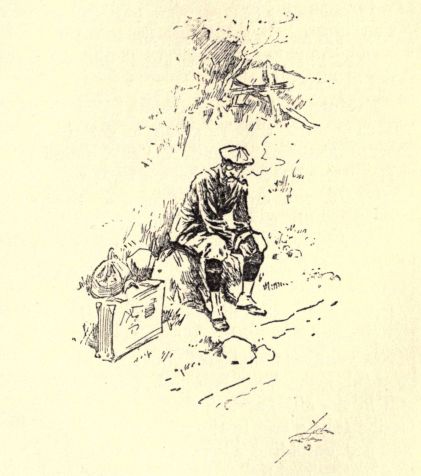
On a stone by the roadside sat Lord Arrowood.
I bade the driver pause, and greeted the nobleman affably.
"Can I give you a lift? You seem to be bound for the station, and I'm taking a train myself."
"No, thanks," he replied sharply. "They're a lot of bounders,—bounders, I say!"
"Ah! Of whom do you speak, Lord Arrowood?" I asked glancing at my watch.
"Those scoundrels at the inn. They have thrown me out. Thrown me out—me!"
"Hard lines, for a fact; but if you are interested in trains"—
"I refuse to leave the county!" he shouted. "If they think they're going to get rid of me they're mistaken. Bounders, I say, bounders!"
He uttered this opprobrious term with great bitterness, and crossed his legs, as though to emphasize his permanence upon the boulder. Patience on a monument is not more eternally planted. He seemed in no mood for conversation, so I sped on, with no time to lose.
I gained the step of the chair-car attached to the ten-eighteen with some loss of dignity, the porter yanking me aboard under the conductor's scornful eye. The Katonah passengers were still in the aisle, and as I surveyed them I saw Cecilia take a seat in the middle of the car. She was just unfolding a newspaper when I moved to a seat behind her and bade her good-morning.
The look she gave me in turning round had in it something of Hezekiah's quizzical humor. This interested me, because I had not previously seen any but the most superficial resemblance between the sisters. Her cheeks were aglow from her sprint on the wheel. The short skirt and the shirt waist are the true vesture of emancipated woman. Cecilia Hollister, whose apparel at home had struck me as rather formal, seemed this morning quite a new being. She drew a folded veil from the pocket of her jacket, removed her hat, and pinned the veil to it. She kept the hat in her lap, however, and went on talking.
"We are both truants. You must have breakfasted in a hurry to have caught this train."
"Not at all. I enjoyed a brief conversation with your sister, and after she had gone, your aunt came back and lingered for a moment."
"She told you, I suppose, that Providence would look after the servant question."
"She did, just that."
"Well, Providence is hardly equal to getting enough servants to run that place, so I'm going to assist Providence a little."
"You become the vicaress of Providence? I admire your spirit."
"It's mere self-preservation. Aunt Octavia would have me chained to the kitchen if I did n't do something about it."
She had permitted me to settle with the conductor, and when I had completed this transaction I found that she had drawn from her purse the little silver booklet about which Miss Octavia had inquired so anxiously. She held this close to her eyes, so that I had a clear view of the silver backs, on one of which "C.H." was engraved in neat script. The subjoined pencil she held poised ready for use, touching the tip of it absent-mindedly to her tongue. She raised her eyes with the far-away look still in them.
"Can you tell me how to spell Arrowood,—is it one or two w's?"
"One, I think the noble lord uses."
She seemed to write the name, and I saw her counting on her fingers, touching them lightly on the open page of the book.
Then she dropped it into her purse, which she thrust back carefully into her pocket. She sighed, and was silent for a moment. We were passing a series of huge signs built like a barricade along the right of way, and on one of these I observed with fresh interest an advertisement whose counterpart I had seen often about New York, but without ever observing it attentively. It drew a laugh from me now. It represented an infant in a perambulator, behind which stood the effigy of a capped and aproned nurse. A legend was inscribed on the board to this effect:—
HUSH! Baby's asleep. It's a HOLLISTER PERAMBULATOR!
"If it's a Hollister," I remarked as a second of these flew by the window, "it's perfect."
"Oh, those things!" she exclaimed.
"I was n't referring to the perambulator necessarily. Anything that's Hollister must be good."
"We're out of the business, except that Aunt Octavia gets a dollar for every one that's made; but the trust keeps the name."
"The trust could hardly change your name. You will have to do that yourself."
"You've been talking to Hezekiah. That's the way people always talk to her."
"It's certainly not the way I've been talking to you; but we've run away from school, and I'm disposed to make the most of it. Our conversation at your aunt's has been so high up in the air, that it's pleasant to come down to earth and tune it to the less strenuous note of a twentieth-century railway journey."
"That, Mr. Ames, may depend upon the point of view."
"But you will make it yours, won't you? You see, I've always dreamed of adventures, but since I met your aunt in the Asolando they've been coming a little too fast. There's that ghost business. Now I 'm going to catch that ghost to-night, if it's the last thing I do!"
"Well, I'm not the ghost, and neither is my father, if that's what's in your mind. Tell me just what you have seen and heard."
I gave her the story in detail, and my recital seemed to amuse her greatly.
"You thought it was Aunt Octavia herself at first, then you thought I was the spook, and now you are not fully persuaded that it is not my father. I will take you into my confidence this far—that I don't know how father got into the house last night. He wrote a note asking me to meet him on the roof and bring the foils. That was not unlike him, as he is the dearest father in the world, and his whims are just as jolly in their way as Aunt Octavia's. I was sure that Aunt Octavia had retired for the night, so I changed my dress and carried the foils up through the trunk-room. I had hardly reached there before my father appeared. The whole situation—my being there and all that—has distressed father a great deal; so I let you see me cry a little. I promise never to do it again."
Mirth brightened the eyes she turned upon me now.
"You think," she asked, "that those lights could n't have winked out twice by themselves while you were on the stairway."
"I am positive of it. And somebody—a being of some sort—passed me on the stairway. It might imaginably have been you!"
"But I tell you positively it was not."
"Then it might have been your father. A man who can enter a house at will might easily play any manner of other tricks. His disappearance after I had gone down into the house with him was just as mysterious as the ghost."
"It was natural for father not to want you to know how he got in; the motive for that would be the fact that he is not supposed to see me or communicate with me in any way. But you 've got to get a ghost-motif."
"I think I have one," I said.
"Then all the rest is easy. To whom does this ghost-motif lead you?"
"I need hardly say; for it must have occurred to you that there is one member of the Hollister family we have n't mentioned in this connection."
"If you mean Hezekiah"—
"None other!"
The surprise in her face was not feigned,—I was confident of this,—and the questions evoked by my answer at once danced in her eyes.
"If Hezekiah should be caught in the house just now we should all pay dearly for her rashness. Believe me, this is true. Some day you may know the whys and wherefores; at present no one may know. There is this, however,—if Hezekiah or my father should be found at Hopefield Manor, anywhere on the premises, while I am there, the consequences would be disastrous,—more so than I dare tell you. But why should Hezekiah wish to prowl about there at night,—to assume for a moment that she is doing it?"
Her manner was wholly earnest. It was plain that she had entered into some sort of a compact with her aunt, and no doubt the arrangement was in the characteristic whimsical vein of which I had enjoyed personal experience. I did not wish to press Cecilia for explanations she might not be free to make, but I ventured a suggestion or two.
"Hezekiah may be entering the house and playing ghost for amusement, merely in a spirit of childish rebellion against the interdiction that forbids her the house. That is quite plausible, Hezekiah being the spirited young person we know her to be. And it may amuse her, too, to plug the chimneys at a time when her sister is enjoying the visits of suitors. Without quite realizing that such was her animus, she may be the least,—the very least bit jealous!"
Cecilia flushed and her eyes flashed indignantly. She bent toward me eagerly.
"Please do not say such a thing! You must not even think it!"
"She may be a little forlorn, alone in your father's house over the hills at times when you are surrounded by admirers, and it is my assumption from what I have learned in one way and another of your flight abroad last summer, that some of these gentlemen now established at the Prescott Arms are known to her."
"Oh, all of them, certainly."
"And Hartley Wiggins among the rest?"
"That, Mr. Ames, is most unkind," she declared earnestly. "She has told me that she was not in the least interested in Mr. Wiggins."
"And she told me the same thing, but I do not feel sure of it! But what if she is! You are not really interested in him yourself!"
In the library at Hopefield Manor I should not have thought of speaking to Cecilia Hollister in any such fashion; but the flying train gave wings to my daring. I was surprised at my own temerity, and more surprised that she did not seem to resent my new manner of speech. She did not, however, vouchsafe any reply to my statement, but changed the subject abruptly.
My description of the ghost had taken considerable time, and we were now running through the tunnels and would soon be at the end of our journey. She put on her hat and veil without making it necessary for us to discontinue our talk. A certain languor that had marked her at her aunt's vanished. There was a clearer light in her eye, and as I helped her into her coat I felt that here was a woman to whose high qualities I had done scant justice.
"I count on finishing my errand and taking the two-seven," she remarked.
"That's a short time to allow yourself. I've heard that it's a dreary business chasing the employment agencies."
"Not if you know where not to go. If you 'll get me a machine of some sort I 'll be off at once."
"I fear I shan't conclude my own business so soon; but if you will honor me at luncheon?"—
This last was at the door of a taxicab I had found for her.
"Sorry, Mr. Ames, but it's out of the question. I hope to see you at dinner to-night. And please"—
"Yes, Miss Hollister"—
"Please remember that you are Aunt Octavia's guest, and don't annoy her by failing to appear at dinner. You know you have n't fixed that chimney yet!"
Her smile left me well in the air; I stood staring after the very commonplace cab as it rolled away with her, my mind a whirling chaos of emotion. The crowd jostled me impatiently; for other people, not breathing celestial ether from an hour of Cecilia Hollister's society, were bent upon the day's business.
I set off at once for Pepperton's office, where I learned that the architect was out of town; but his chief clerk greeted me courteously. I told him frankly that I wanted to look at the plans of Hopefield Manor to enable me to learn the exact lines of the chimneys. He confessed surprise that they were causing trouble, and expressed regret that they were not in the office.
"Miss Hollister sent for them this morning, and I have just given them to a young woman who bore a note from her. Ordinarily I should not have let them go, but the note was peremptory, and Miss Hollister is a friend of Mr. Pepperton's, you know, and a person I'm sure he would not refuse. We're at work now on plans for a cathedral she proposes building for the Bishop of Manila."
I was not surprised that Octavia Hollister should be building cathedrals in the Orient,—I was beyond that,—but I was taken aback to find that she had anticipated me in my rush for the plans of her house. Clearly, I was dealing with a woman who was not only immensely amusing but exceedingly shrewd as well. Could it be possible after all that she was herself playing ghost merely for her own entertainment! She was capable of it; but I had satisfied myself that she could not have performed the tricks of which I had been the victim the night previous unless she possessed some rare vanishing power like that of the East Indian mystics.
"May I ask who came for the plans?"
"I judged the young woman to be a maid, or perhaps she was Miss Hollister's secretary."
I had given little heed during my short stay at Hopefield Manor to Miss Hollister's personal attendant. I had passed her in the halls once or twice, a young woman of twenty-five, I should say, fair-haired and blue-eyed. She might herself be the ghost, now that I thought of it; but this seemed the most unlikely hypothesis possible,—and there was no difficulty in accounting for her flight to town, for there were many horses and vehicles in the Hopefield stable, and trains were frequent.
"If there is anything further, Mr. Ames"—
I roused myself to find the chief clerk regarding me impatiently, and I thanked him and hurried away.
At my own office my assistant pounced upon me wrathfully. He was half wild over the pressure of vexatious business, and had just been engaging in a long-distance conversation with a country gentleman at Lenox which had left him in bad temper. I was explaining to him the seriousness of my errands at Hopefield, rather unconvincingly I fear, and the fact that I must return at once, when the office-boy entered my private room to say that three gentlemen wished to see me immediately. They had submitted cards, but had refused to state the nature of their business. It was with a distinct sensation of surprise that I read the names respectively of Percival B. Shallenberger, Daniel P. Ormsby, and John Stewart Dick.
"Show the gentlemen in," I said promptly, greatly to the disgust of my assistant, who retired to deal with several clients whom I had passed in the reception-room fiercely walking the floor.
I had imagined all the suitors established at the Prescott Arms. As the three appeared clad in light automobiling coats, I could not forbear a smile at their grim appearance. Shallenberger, the novelist, and Ormsby, the knit-goods manufacturer, were big men; Dick was much shorter, though of compact and sturdy build. They growled surlily in response to my greeting, and Ormsby closed the door behind them. Dick seemed to be the designated spokesman, and he advanced to the desk behind which I sat, with a stride and manner that advertised his belligerent frame of mind.
"Mr. Ames," he began, "we have come here to speak for ourselves and certain other gentlemen who are staying for a time at the Prescott Arms."
"Gentlemen of the committee, welcome to our office," I replied, greatly amused by his ferocity.
My tone caused the others to draw in defensively behind him.
"We want you to understand that your conduct in accompanying a lady that I shall not name to the city is an act we cannot pass in silence. Your conduct in going to Hopefield Manor was in itself an affront to us, but your behavior this morning passes all bounds. We have come, sir, to demand an explanation!"
At a glance this was a situation I dare not take seriously. In any circumstances the fact that these men had followed me to my office to rebuke me for accompanying Cecilia Hollister to town was absurd. This young Mr. Dick was absurd in himself. His gray cap had twisted itself oddly to the side of his head, and a bang of black hair lay at a piratical angle across his forehead. Behind him Ormsby, the knit-goods man, tugged at a brown moustache; Shallenberger's blue eyes snapped wrathfully.
"Mr. Dick," I said soberly, "I have heard of you as the original pragmatist of Nebraska, and as I am a mere ignorant chimney-doctor, to whom the later philosophical meaning of that term is only so much punk, I must identify you with that more obvious meaning of the word which is within my grasp. Mr. Dick, and gentlemen of the committee, you are meddlesome persons!"
"Meddlesome!" cried Dick, heatedly, and leaning toward me across my desk, "do I correctly understand, sir, that you mean to insult us?"
"Nothing could be further from my purpose. But I cannot permit you to imagine that I'm going to allow you to beard me in my office and criticise my conduct in regard to Miss Cecilia Hollister or anybody else. As a philosopher from the fertile corn-lands of Nebraska, I salute you with admiration; as a critic of my ways and manners, I show you the door!"
This I did a bit jauntily, and I had a feeling that I was playing my part well. But the young man before me seemed to swell with the rage that surged within him. He broke out furiously, beating the air with his fist.
"You not only insult this committee, but you speak with intentional disrespect of my native state, and of the great philosophical school of which I am a disciple. Am I right?"
"You are eminently right, Mr. Dick. Neither the corn, the philosophical schools, nor the packing-house statistics of your native Omaha interest me a particle. So far as I am personally concerned you may go back to your wigwam on the tawny Missouri as soon as you please."
"Then," he broke forth explosively, "then, sir, by Minerva's pale brow, and by all the gods at once, I brand you"—
"Put the brand on hot, little one! Make it a good strong curse while you're about it!"
He choked with rage for a moment; then he controlled himself with painful effort.
"My personal grievances must wait," continued Dick, brokenly, "but speaking for the committee I wish to say that your attentions to the young lady whom you have dared, sir, to name, are obnoxious to us."
"Nothing less than that!" added Shallenberger.
"We will not stand for it," growled Ormsby's heavy bass.
"Mr. Shallenberger," I replied evenly, "as a member of the great Hoosier school of novelists I have the most profound respect for your talents. My office-boy is dead to the world for weeks after the appearance of a novel from your pen. But your interference in my private affairs is beyond all reason. And as for you, Mr. Ormsby, I dare say your knit-goods are worthy of the fame of the pent-up Utica from which you come. But to you and all of you, I bid defiance. I return to Hopefield Manor by the four-fourteen express."
I rose and bowed coldly in dismissal; but the trio stood their ground stubbornly.
"I tell you, sir, our organization is complete!" declared Dick. "We signed a gentleman's agreement only last night, for the express purpose of excluding you, and you cannot enter as a competitor. You are only an outsider, and we don't intend to have you interfering with our affairs."
"By the pink left ear of Venus!" I blurted, "is it a trust?"
"You put it coarsely, Mr. Ames, but"—
"A suitors' trust? Then if I read the newspapers correctly, your organization is against public policy and in contravention of the anti-trust law. But may I inquire why, if you have perfected a combination of Miss Hollister's suitors, I found Lord Arrowood this morning sitting on a stone by the roadside, evidently in the greatest dejection. Can it be possible that an insurgent has crept into your organization and incurred the displeasure of the regulars?"
"We ruled him out," Shallenberger burst forth, "because he was a foreigner and not entitled to a place among free-born Americans! That is one reason; and for another, the colors of his half-hose were an offense to me, personally."
"And for another reason," interposed Ormsby, "he had no money with which to pay his board at the Prescott Arms. For this just cause the landlord ejected him shortly after breakfast this morning."
"Then there is already a rift in the lute!" I returned. "No trust of suitors is stronger than its weakest link. By the bloody footprints of our forefathers on the snows of Valley Forge, I stand for the right of the American girl to choose where she will. You may perch on the hills about Hopefield Manor, and besiege Cecilia Hollister till the end of time, but my hand is raised against your unrighteous compact, and I am in the fight to stay! Go back to the Prescott Arms, gentlemen, and assure your associates in this hideous compact of my most distinguished consideration and tell them to go to the devil."
I had gone to the St. Parvenu Hotel to call upon a Washington lady who had been making life a burden to my assistant, and on coming out into Fifth Avenue shortly after one, bethought me of the Asolando Tea-Room. My interview with the committee of the suitors had driven from my mind practically every consideration and every interest not centred in Hopefield Manor. My thoughts turned gratefully to the Asolando, where only a few days ago I had been precipitated into the strangest adventures my eventless life had known.
A strange face was visible at the cashier's desk as I entered the tea-room. I passed on, finding the place quite full, but I took it as a good omen that the seventh table from the right was unoccupied, and I hastily appropriated it. A waitress appeared promptly, murmuring,—
"There are no birds in last year's nest,"—
and recommended a Locker-Lampson sandwich, whose contents the girl told me were secret, but it proved to be wholly palatable. As I drank my tea and ate the sandwich I surveyed the decorated menu card with interest, and found pleasurable excitement in discovering an item directing attention to "Pickles à la Hezekiah, 15 cents."
The delightful Hezekiah must, then, have impressed herself upon the deus ex machina of the Asolando on her brief day there, thus to have won this recognition. And further on I noted, among the desserts, Pêche Cécilie, with even greater interest and satisfaction. Miss Hollister's nieces were among ten thousand young women, and it was quite believable that their brief tenure of office in the tea-room had fixed them permanently in the heart of the unknown proprietor.
The girl at the cash-desk was reading, her head bent as demurely as Hezekiah's had been on that memorable afternoon; but I did not care for the stranger's profile. I tried to fancy Cecilia in cap and apron serving these tables, but my imagination was not equal to the task.
Cecilia occupied my mind now. The visit of the furious suitors to my office had stirred in me thoughts and aspirations that had never known harborage in my breast before. The presumption of those fellows had exceeded anything I had known in my contact with human kind, and instead of frightening me away from Hopefield Manor, they had called my own attention to the strategic importance of my present position as a guest in Miss Octavia's house. Here was a siege of suitors indeed; but I was resolved to make the most of my position within the barricade.
As these thoughts ran through my mind, I was finishing my Pêche Cécilie (I spurn all sweets ordinarily), when I became interested in the unusual conduct of a young woman who had entered the front door briskly and walked with a business-like air to the cashier's desk. The girl within the wicket rose promptly, opened the screen, and without parley of any sort, emptied the contents of her till into the visitor's reticule. With a nod and a smile and a moment's careless survey of the room, the girl departed, swinging the reticule in her hand. A long roll she carried under her arm confirmed my identification. It was Miss Octavia Hollister's Swedish maid; and the roll, beyond peradventure, contained the plans she had obtained at Pepperton's office.
The girl was well-featured, neat of figure, and becomingly gowned, and as I watched her leave the shop the lightness of her step, something smooth and flowing in her movements, interested me. I did not know what business she had to be robbing the Asolando money-drawer, but it was altogether possible that she was the Hopefield ghost!
On the whole, when I had finally torn myself away from my assistant,—who made no attempt to conceal his doubts as to my sanity,—and had settled myself in the four-fourteen express with the afternoon papers, I was fully satisfied with the day's adventures.
XII
THE RIDDLE OF THE SIBYL'S LEAVES
I had told the coachman in the morning not to trouble to meet me on my return, and I engaged the village liveryman to drive me to the house for hire. As we approached Hopefield I saw the Napoleonic figure of John Stewart Dick in the roadway. He had evidently been waiting for me. He held up his hand with the superb, impersonal scorn of a Fifth Avenue policeman, and the driver checked his horse.
"I gave you warning," he said impressively. "If you return to the house the consequences will be upon your own head."
"Thank you," I replied courteously. "You lay yourself open to the severest penalties of the law in attempting to intimidate me. I have enlisted for the whole campaign. Sick chimneys require my immediate professional attention. If my bark sink, 't is to another sea. Be good, dear child, let those who will be clever; and kindly omit flowers."
As the driver slapped his reins, Dick sprang out of the way, muttering words that proved the shallowness of his philosophic temper. The liveryman expressed his disapproval of the pragmatist in profane terms as we entered the grounds.
"There's a heap o' talk in the village," he observed. "They do say the old lady 's cracked, if I may so speak of her; and that there's ghosts in the house. And the conduct of the gentlemen at the Prescott is most remarkable. The word 's passed that they're all dippy about the young Miss Hollister that lives with her aunt. I reckon all rich people are a bit cracked. It appears to go with the money. Mr. Bassford Hollister,—he's the old lady's brother,—he's just as bad as any of 'em. I've drove in these parts fifteen year, and I 've worked a heap for the rich, but I never seen nothin' like the Hollisters. They say Mr. Bassford is about broke now. Had his share of the baby-wagon money and blew it in, and now the old lady's marryin' off the girls and he gets no money out of her if he takes a hand in that game. She's doin' it to suit herself. That Bassford is always up to somethin' queer. Yesterday he sat in the village street countin' the number of people he saw chewin' gum. Hung around the school-house watchin' the children to see how many had their jaws goin'. Takin' notes just like the census man and tax assessor. Told our doctor in the village he was figurin' the amount of horse-power the American people put into gum-chewing every year, and expects to find some way of usin' it to run machinery. It's harmless, Doc says. He calls it just the Hollister idiosyncrasy, if that's the word. But I reckon it's idiotsyncrasy all right. I wish you good luck of your place, sir."
He evidently believed me to be some sort of upper servant, and this added to my joy of the day. With my good humor augmented by the interview, I entered the house. A strange footman admitted me, and I went to my room at once without meeting any one else.
The man followed me with a penciled note, signed with Cecilia's initials, requesting my presence below as soon as possible, as she wished to see me before dinner. The thought that she wished to see me at any time filled me with elation; and her few lines scratched on a correspondence card were a pleasing addendum to our conversation of the morning. I only wondered whether I should find her the sober, reserved young woman of our earlier acquaintance, or whether she would choose to renew the good comradeship of our talk on the train. The finding of my assistant's telegraphed resignation on my dressing-table, to take effect in January, had not the slightest effect upon the lofty minarets in which my fancy now found lodgment. It pleased me to believe that fighting blood still pulsed in the last of the house of Ames, and that I had hurled defiance at the organized band of suitors that guarded the Hopefield gates and picketed the surrounding hills.
My question as to which Cecilia I should find in the library was quickly answered. Her frank smile, the candor of her eyes, confessed a new tie between us; we were becoming conspirators within the main conspiracy, whatever its character might be.
"As to Providence and the cook—what luck?" I asked.
"Oh, I managed that very easily. I ran into some friends who were going abroad for the winter. They have a staff of unusual servants, and were anxious to keep them together until their return. I promptly engaged them all, and they are even now installed. I came up on the train with them, and as they are unusually intelligent and biddable, they agreed to stray in in a casual and desultory way through the afternoon. Aunt Octavia really believed, or pretended she did, which is just as good, that Providence had sent them, and was delighted. The laundress—the last to appear—has just arrived, and Aunt Octavia is in fine humor. She did n't even ask me how I came off in my encounter at the dentist's. She had filled the pie-pantry and had a good time while I was gone."
"Well, I have had an adventure of my own," I remarked, after expressing my relief that she had solved the servant difficulty with so much ease. "A committee of gentlemen waited on me in my office on a matter of grave importance."
She lifted her brows, and folded her hands upon her knees—it was a pretty way she had.
"Was it the freedom of the city, or some high recognition of your professional ability, Mr. Ames?"
"Oh, far more exciting! Three gentlemen, representing the suitors' trust now maintaining headquarters at the Prescott Arms, warned me solemnly to keep off the grass. In other words, I am not to interfere with their designs upon the heart of Miss Cecilia Hollister."
She flung open a fan, held it at arm's length, and scrutinized the daffodils that were traced upon it.
"So they dared you?"
"So they dared me. And I took the dare."
"Why?"
Her eyes met mine gravely, but behind her pretty moue a smile lurked delightfully.
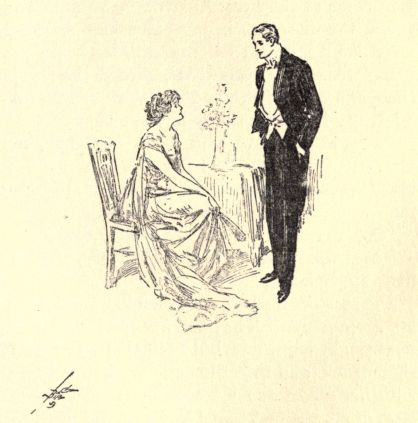
Her eyes met mine gravely.
"If I should tell you now it would be flirting, which is a sin."
"I had imagined, Mr. Ames, that that sort of thing came easy to you. But if it's sinful, of course"—
"But you do not rule me out! You will give me a chance"—
My earnestness caused her manner to change suddenly. Her beautiful gravity came like a swift falling of starlit twilight. I had never been so happy as at this moment. Preposterous as were the circumstances of my presence in the house, the juxtaposition of Cecilia Hollister gave me unalloyed delight. The animosity of the gentlemen at the Prescott Arms—an animosity which the interview in my office had doubtless intensified—quickened my satisfaction in thus being within the walls that guarded the lady of their adoration. She had not answered me, and I felt my heart pounding in the silence.
"I want to serve you, now, hereafter, and always," I added. "These men can have no claim upon you greater than that of any other man who dares!"
"No, none whatever," she replied firmly.
"And the mystery, the whole story, is in the little silver book!"
She started, flushed, and then laughter visited her lips and eyes. The book was not in her hands nor in sight anywhere, but I felt that I was on the right track, and that the little trinket had to do with her plight and her compact with her aunt. Best of all, the fact that I had chanced upon this clue gave her happiness. There was no debating that.
"You had best have a care, Mr. Ames. You have spoken words that would be treasonable if they came from me, and I must not countenance them."
"But you will tolerate from me words that you would not permit another to speak? Do I go too far?"
She bent her head to one side,—with the slightest inclination, as of a rose touched by a vagrant wind.
"If I could only half believe in you," she said, "you might really serve me. So those gentlemen warned you away! Their presumption is certainly astounding."
"They know nothing of the silver book!"
"They know less than you do,—and you have a good deal to learn, you know."
"I am dull enough, but I have no ambition but to read the riddle of the sibyl's leaves. That and the laying of the ghost are my immediate business. As for the gentlemen at the Prescott, including my old friend Hartley Wiggins, I am not in the least afraid of them. My hand is raised against them. If it's a case of the test of Ulysses over again, I 'm as likely as any of them to bend the bow."
I thought this well spoken, but she seemed amused, though without unkindness, by the earnestness of my speech.
"If your wit is equal to your valor, you may go far. But"—and she turned her eyes full upon me—"we must play the game according to the rules."
"And as for Hartley Wiggins"—
She sat up very straight, and the sudden disdain in her face startled me. I had forgotten my eavesdropping in the clump of raspberries on the day of my arrival. Certainly Wiggins had been decidedly in the race then, and my heart thumped in resentment as I recalled her own message, all compact of encouragement, which I had borne to Wiggins at the Prescott Arms.
"I will tell you something, Mr. Ames. This afternoon, as I drove from the station, I came round by the lake, merely to cool my eyes on the water, and I saw Mr. Wiggins and my sister seated on a wall in an old orchard. They were so busily engaged that they did not see me. At least he did not; but I think Hezekiah did."
"Hezekiah," I answered, relieved by the nature of her disclosure, which could not but prejudice Wiggins' case, "Hezekiah is fond of orchards. I dare say this was the same one in which I had a charming talk with her myself. Doubtless she was amusing herself with Wiggins just as she did with me. She finds the genus homo entertaining."
"She is the dearest girl in the world,—the sweetest, the loveliest, the brightest. Mr. Wiggins has treated her outrageously. He has taken advantage of her youth and susceptible nature."
"His punishment is sure," I answered complacently. "Hezekiah laughed when I mentioned his name. And you frown to-day at the thought of him."
"Aunt Octavia is coming," she remarked, feigning at once a careless air; but I was content that she let my remark pass unchallenged.
Miss Octavia's entrances were always effective. She appeared to-night charmingly gowned, but the bright twinkle in her eyes made it clear that no matter of dress could affect her humor or spirit. She greeted me, as she always did, as though our acquaintance were a matter of years rather than of days. I even imagined that she seemed pleased to find me back again. She asked no questions as to my day's occupations, but as we went in to dinner sallied forth cheerfully upon a description of her own activities.
"After I had baked my required quota of pies this morning, I sought recreation at the traps. The stable-boy who has been pulling the string for me having struck-work, it most providentially happened that I espied Lord Arrowood hanging on the edge of the maple tangle beyond the barn. I summoned him at once and put him to work managing the traps for me, finding him most efficient. He seemed extremely despondent, and after I had satisfied myself that two out of three was not an impossible record for one of my years, I brought him to the house and made tea for him. I left the room for a moment—I had taken him into the kitchen where, during the incumbency of the regular cook I hardly dare venture myself, and he made himself comfortable quite near the range. The pies on which I had been engaged all morning lay cooling near him. I had composed twenty-nine pies,—I am an excellent mathematician, and I could not have been mistaken in the count. What was my amazement to find, after his lordship's departure, that one pie was missing! The pan in which it was baked I discerned later, jammed into a barrel of excellent Minnesota flour. My absence from the room was the briefest; his lordship must indeed be a prestidigitateur to have made way with the pie so expeditiously."
"His lordship was doubtless hungry," I suggested. "Even nobility must eat. I passed Lord Arrowood in the highway early this morning, sitting upon a stone, with sundry items of hand-baggage reposing beside him. I have rarely seen any one so depressed."
"He belongs to an ancient house," remarked Miss Octavia. "He is descended from either Hengist or Horsa,—I forget which, but it does not greatly matter. The missing pie, I may add, was an effect in Westchester pippin; and as our American experiment in self-government bores him, I take it as significant that he chanced upon food that is the veritable sacrament of democracy."
"Now that the little matter of the servants has been adjusted, we must have a care lest the newly-arrived phalanx, which Providence so kindly sent to you to-day, is not stampeded by any further manifestations of the troubled spirit of the unfortunate Briton who was hanged on the site of this house."
"Mr. Ames," replied Miss Octavia impressively, "that matter is entirely in your hands."
"But if I could see the plans of this house, I should be better able to grapple with his ghostship."
I had thrown this out in the hope of eliciting some remark from her touching the Swedish maid's visit to Pepperton's office; but Miss Octavia met my gaze unflinchingly.
"You are a clever man, Mr. Ames, and I have every confidence that you will not only solve the mystery of the library chimney but find the ghost that switched off the lights on the stair last night. I prefer that you should accomplish these feats without any help from the plans. I myself have no suggestions. I am gratified that you are meeting the emergencies that have risen here with so much determination, but it is what I should expect of the son of Arnold Ames of Hartford. Opportunity is all that any of us need to find ourselves truly great, and if, in the ordinary course of our lives, the gate does not open freely, we are justified in picking the lock. When I determined to seek adventures in my old age, I resolved that I should miss no chance, and that I should be prepared for any beckoning of the hand of fate. An odd fancy struck me at the beginning of my new life that Boston would some day be the starting-point of some interesting experience. This has not yet developed, but in order that I may be prepared for anything that may occur I keep a blue-silk umbrella constantly checked at the Parker House. The presence of the little brass check in my purse is a constant reminder that Boston may one day call me."
A discussion of the Parker House umbrella followed, Cecilia and I joining, and it proved so fruitful a topic that it carried us to our coffee.
Coffee-making, in a machine she had herself contrived, was always attended with rites that required deliberation, and while she performed them Miss Hollister continued to amuse us.
"You may not know," she remarked, in one of her charming irrelevant outbursts, "that the most important furniture transactions effected in this country are those negotiated daily by the head-waiters of the Fifth Avenue restaurants. Such is, I assure you, the fact. These gentlemen, who have attained front rank among our predatory rich, allow no one to dine at the inns they dominate who does not first purchase a table and chairs at a profit of at least two hundred per cent over the original Grand Rapids cost, the furniture thus purchased reverting in every case to the party of the first part after the purchasers have eaten to their satisfaction. The Fifth Avenue head-waiters are not only the most absolute autocrats of our time, but the most acute students of human nature among us. The sale of the tables by the lords of the dining-rooms is alone worth a fortune every season at our fashionable victualing houses and, in addition, the humbler members of the minor orders of waiters, who merely fetch and carry, are obliged to share their gratuities with their august chiefs."
"The system is iniquitous," I declared. "It's enough to pay two prices for the food without buying the hotel furniture."
"The system, Mr. Ames, is wholly admirable, if you will pardon me for expressing a difference of opinion. We cannot do less than admire the austere genius before which mere plutocrats and men of affairs meekly bow. In making my own investments I would rather have the advice of Alphonse at the Hotel Pallida than that of the president of the strongest trust company on Manhattan Island. The varying size of the sums he receives for the dining-room furniture is the best possible indication of the condition of the market. When a citizen of Pittsburg will pay no more than one hundred dollars for the use of a table to eat from at the Pallida you may be sure that a panic impends. By the way, I proposed to Alphonse last winter the organization of a limited company of leading head-waiters to control the waiting industry of Fifth Avenue. It was my idea that some special forms of torture might be devised for calculating persons—usually readers of New York letters in provincial newspapers—who think a waiter entitled to only ten per cent of the bill, and this could best be managed by an arrangement between the five or six magnates who control the more gilded and imposing refectories. I suggested the placing of a special mark in the hats of the ten-per-cent fiends, so that wherever they dine the symbol of their indiscreet frugalities would be apparent to the initiated eye. It is another of my notions that the head-waiter and his humble slave should present a formal bill for their services, while the hotel or restaurant should merely be tipped. In this way the more important service would receive its due consideration. The sole office of the proprietor is to provide the head-waiter a place in which to follow his profession. Alphonse is impressed with my ideas, and has even offered to make me a director of the company."
"I suppose that you won the regard of Alphonse, the magnificent, only by the most princely tips through many years of acquaintance, Miss Hollister."
"On the other hand, Mr. Ames, I never gave him a cent in my life; but last Christmas, in recognition of his friendliness in warning me against an alligator-pear salad, at a moment when that vegetable was at the turn of the season, I knit him a pair of blue worsted bed-room slippers, which he received with the liveliest expressions of delight."
Three suitors were announced at this moment, and I slipped away without excuses, while Miss Octavia and Cecilia adjourned to the library.
The ghost, I had sworn, should not baffle me another night.
XIII
I DISCOVER TWO GHOSTS
As I crossed the second-floor hall, I passed the Swedish maid, walking toward Miss Octavia's room. I was somewhat annoyed to find, on looking over my shoulder to make sure of her destination, that she, too, had paused, her hand on Miss Octavia's door, and was watching me with interest. She vanished immediately; but to throw her off the track I went to my own room, closed the door noisily, and then came out quickly and ran up to the third floor.
Bassford Hollister's mysterious exit had lingered in my mind as the most curious incident of the eventful Friday night. Having been baffled in my effort to get hold of the architect's plans, my thought now was to await in the upper part of the house a repetition of the various phenomena that had so puzzled me. By the process of exclusion I had eliminated nearly every plausible theory, but if the ghost manifested himself with any sort of periodicity (and the hour of the chimney's queer behavior had been nine) I was now prepared to meet him in the regions he had chosen for his exploits. When it is remembered that I had always been most timorous, not at all anxious to shine in any heroic performances, it will be understood that the atmosphere of Hopefield Manor was exerting a stimulating effect upon my courage. Or, more likely, my inherent cowardice had been brought into subjection by my curiosity.
I had a pretty accurate knowledge by this time of the position and function of all the electric switches between the lower hall and the fourth floor, but I tested them as I ascended, glancing down now and then to make sure I was not observed. From the sound of voices in the library I judged that most of Cecilia's suitors must now have arrived, and so much the better, I argued; for with Miss Octavia and her niece fully occupied, I could the better carry on my ghost-hunt above stairs.
At a quarter before nine I switched off the lights on the third and fourth floors, and established myself at the head of the stairway, and quite near the trunk-room door. This door I had opened, as I fancied that if Bassford Hollister were at the bottom of the business, he would probably wish to find his way to the roof again. So far as I was able to manage it, the stage was in readiness for the entrance of the goblin. And I may record my impression, that as we wait for a visitation of this sort, it is with a degree of credence in things supernatural, to which we would not ordinarily confess. In spite of ourselves we expect something to appear, something unearthly, impalpable, and unresponsive to those tests we apply to the known and understood.
The clock below struck nine upon these meditations, and almost upon the last stroke I heard a sound that set my nerves tingling. I crouched in the dark waiting. Some one was coming toward me, but from where? The bottom of a well at midnight was not blacker than the fourth floor, but the switch lay ready to my hand, and my pockets were stuffed with matches of the sort that light anywhere. The stairways were all carpeted, as I have said, and yet some one was ascending bare treads, lightly, and with delays that suggested a furtive purpose. Meanwhile, as a background for this unreality, murmurs of talk and occasional laughter rose from the library.
This concealed stairway, wherever it was, could not be of interminable length, and I had counted, I think, fifteen steps of that strange ascent when it ceased. I heard a fumbling as of some one seeking a latch, and suddenly a light current of air swept by me, but its clean fresh quality was not in itself disturbing. I stooped and struck a match smartly on the carpet and at the same time clicked the switch. I should say that not more than ten seconds passed from the moment the soft rush of air had first advertised the opening of a passage near me until the hall was flooded with the glow of the electric lamps overhead. My match had also performed its office, but finding the electric current behaving itself normally, I blew it out. What I saw now interested me immensely.
In the solid wall, near the stair, and almost directly opposite the trunk-room, a narrow door had swung outward,—a neat contrivance, so light in its construction that it still swayed on its concealed hinges from the touch of the hand that had released it. How it had opened or what had become of the prowler who had unlatched it remained to be discovered. It seemed impossible that whoever or whatever had climbed the hidden stairway had descended, nor had I been conscious of a ghostly passing as on the previous night. I had only my senses to apply to this problem, and their efficiency was minimized for a moment by fear.
The opening in the wall engaged my attention at once, and I was steadied by the thought that here was a practical matter susceptible of investigation. I stepped within the door and lighted a candle; and just as the wick caught fire, click went a switch somewhere, and out went the hall lamps. But having, so to speak, put my foot to the mysterious stair I would not turn back, and I continued on down the steps.
Great was my astonishment to find that I had apparently stepped from a new into an old house. The stair treads were worn by long use, the plaster walls that inclosed them were battered and cracked, and I seemed to have plunged from the glory of Hopefield into some dim lost passage of a domicile of another era, that lay within or beneath the walls of the Manor. As I slowly descended, holding high my candle, I recalled, not without a qualm, the story of the British soldier whom tradition or superstition linked to the site of Miss Hollister's property. This stairway might certainly have been built in the early days of the republic, and it refuted my disdain of the ghost-myth on the theory that new houses are inhospitable to spirits.
At the foot of the stair I found two rooms, one on either side of a small hall, and these, also, were clearly part of an old house that seemed to be somehow merged into the Hollister mansion. I remembered now that the mansion stood wedged against a rough spur of rock, and that the front and rear entrances were upon different levels, and it was conceivable that the back part of the mansion might inclose these rooms of an earlier house that had occupied the same site; why they should have been retained was beyond me.
Through the carefully-preserved windows, many-paned and quaint, of these hidden rooms, the infolding walls of the new house were blank and black. An odd thing indeed, that Pepperton should have lent himself to the preservation of a commonplace and thoroughly uninteresting relic, for beyond doubt he must have countenanced it; and Miss Hollister's prompt removal of the plans from the architect's office became more enigmatical than ever.
One door only remained in this shell of the old house, and I hastened to fling it open, still lighting my way with a candle. Before me lay the coal cellar, at which I had merely glanced on the morning after my installation at Hopefield. I now began to get my bearings. I remembered two iron lids in the cemented surface of an area on the east side of the house where fuel was deposited, and mounting a few steps that were of recent construction, and had evidently been built to afford communication between the remnant of the old house and the subterranean portion of the new, I found to my relief and satisfaction beneath one of these openings a short ladder, through which the court might be reached. Here, then, the manner of ghostly ingress was illustrated by perfectly plausible means. The lid of the coal-hole was entirely withdrawn, and a bar of moonlight lay brightening upon a pile of anthracite at the foot of the ladder.
The ghost I believed to be still in the upper halls of the house, and now that I was in a position to watch the ladder by which he had entered I felt confident that I had cut off his retreat. I was surveying the cellar, when I heard faint sounds in a new direction. Far away under the house, and remote from the secret steps, some one was moving toward me, and rapidly, too! The ghost that I believed to have disappeared into the fourth-floor hall must then have changed the line of his retreat and descended by one of the regular stairways.
I blew out my candle and stood with my back to the wall of the long corridor on which opened the various store-rooms, the heating plant, laundry and other accessories of the modern house. My ghost was coming in haste,—a haste that did not harmonize with the stately tread of the spooks of popular superstition. A slower pace and I should doubtless have fled before him; but quick light steps echoed in the dark corridor, and I gathered courage from the thought that ghosts create echoes no more than they cast shadows.
As the steps drew nearer I prepared myself to spring upon him. I must unconsciously have taken a step, for he paused suddenly, stood still for a moment, then turned and scampered back the way he had come. After him I went as fast as I could run. The cement-paved corridor was four or five feet wide, and I plunged through the dark at my best speed. At the end of the corridor I was pretty certain of my quarry, and I made ready to grapple with him. Then as I plunged into the wall my hands touched a man's face and for a moment clutched the collar of his coat. He had been waiting for me to strike the wall, and as he slipped out of my grasp he ran back toward the coal cellar. I had struck the wall with a force that knocked the wind out of me, but I got myself together with the loss of only an instant and renewed pursuit. I had no fear but that, if he attempted to reach the open by means of the coal-hole, I should catch him on the ladder, and I sprinted for all I was worth to make sure of him.
My fleeting grasp of the man's collar and the agility with which he had slipped from my clasp had settled the ghost question, and I had now resolved the intruder into a common thief. As we neared the coal cellar I increased my pace, and felt myself gaining on him; though in the dark I saw nothing until I glimpsed the faint light from the coal-hole.
It had evidently occurred to him by this time that if he tried to climb the ladder I could easily pull him down by the legs; and when he reached the cross hall, he turned quickly and dived through the opening into the hidden chambers. I lost no time in following, but the fellow put up a good race, and as I reached the old stairway he was mounting it two steps at a time, as I judged from the sound. I had hoped to catch and dispose of him without alarming the house, but it seemed inevitable now that the chase would end in such fashion as to arouse the company assembled in the library.
I heard him stumble and fall headlong at the door above; then he shot off into the still darkened hall, and when I had gained the top I lost track of him for a moment. I paused and was about to strike a match, when he resumed his flight, and I was forced to grapple with the fact that some one else was pursuing him. I held my match unstruck upon this new disclosure, and stepped back within the concealed door and waited. Up and down the hall, two persons were running, and when they reached the ends of the corridor I heard hands touch the wall and the sound of dodging, and then almost instantly the two runners flashed by me again. The hall was so dark that I saw nothing, but as the runners passed the door I felt the rush of air caused by their flight.
Three or four times this had happened, and then, still without having made a light, I thrust out my foot at the next return of the unseen runners. Some one tripped and fell headlong, and I promptly flung myself upon him.
My prisoner's resistance engaged my best attention a moment, but when I had sat upon his legs and got hold of his struggling hands, some one stole softly by me. My prisoner, too, heard and was attentive. Not only did I experience the same sensation as on the previous night, of a passing near by, but I was conscious of the same faint perfume, as of a flower-scent half-caught in a garden at night, that had added to my mystification before. Then without the slightest warning the lights flashed on, and a door closed somewhere, but it was not the hidden one leading down into the remnant of the old house, for my prisoner's head and shoulders lay across its threshold. He sighed deeply, bringing my dazed wits back to him, and I found myself gazing into the blinking eyes of Lord Arrowood.
"Bounders, I say, bounders!" he gasped.
"In the circumstances, Lord Arrowood, I should not call names. Will you tell me what you mean by running through this house in this fashion? Stand up and give an account of yourself."
I helped him to his feet and bent over the stair-rail leading down to the third floor. Evidently our strange transactions beneath and above had not disturbed the assembled suitors and their hostesses; but in common decency Lord Arrowood must be disposed of promptly; there was no doubt about that.
"I was an ass to try it," muttered his lordship, pulling his tie into shape. "And now I want to get out. I want to go away from here."
He was tugging at the belt of his Norfolk coat, and something between it and his waistcoat evidently gave him concern. It did not seem possible that he was really a thief, with chattels concealed on his person, but he continued to smooth his jacket anxiously, meanwhile eyeing me apprehensively. He puffed hard from his recent game of hide-and-seek, and his face was wet with perspiration. Our conversation was carried on in half-whispers. He was so crestfallen that if it had n't been for the necessity of maintaining silence I should have laughed outright.
"Out with it, my lord. What have you stuck in your coat?"
"They're bounders, all the rest of 'em," he asserted doggedly, "but I believe you to be a gentleman."
"I thank you, Lord Arrowood, for this mark of confidence; but you have led me a hot chase through this house, and it is clear that you have something tucked under your coat that you have seized feloniously. We're standing here in the light, and our voices may at any moment attract Miss Hollister and the others in the library. Open your coat! I declare that even if you have lifted a bit of the Hollister plate I will let you go. My lord, if you please, stand and unfold yourself!"
Reluctantly, shamefacedly, and still breathing hard from his late exertions, Lord Arrowood of Arrowood, Hants, England, obeyed me. There were five buttons to the close-fitting jacket, and the loosening of every succeeding one seemed to give him pain. Then with his head slightly lifted as though in disdain of me, he held out for my observation a pie, in the pan in which it had been baked! The top crust was browned to a nicety; its edges were crimped neatly; and in spite of the fact that I had so lately dined sumptuously at Miss Hollister's hospitable board, at sight of this alluring pastry I experienced the sharp twinges of aroused appetite.
He held out for my observation a pie.
"Now you have it, and I hope you are satisfied," said Lord Arrowood. "Kindly allow me to retire by the way I came."
"First," I replied, sobered by the gravity of his manner, "it would interest me as a student of character to know just what species of pie lured you to this burglarious deed."
"I have reason to think," he answered, with tears in his eyes, "that it is a gooseberry. I was damned hungry, if you must know the truth, and having sampled the old lady's pies this morning, and had nothing to eat since, I saw the coal-hole open and ladder beneath, and the rest of it was easy. If you and the other chap had n't chased me all over the estate, I 'd have been off with my pie and no harm done. The old lady 's insane, you know, and has no manner of use for pies. The house is haunted in the bargain. When you had about winded me down in the cellar and cut me off from the ladder and chased me up here, the ghost took a hand, and if you had n't tripped me and sat on me the spirits would certainly have nailed me. O Lord, what a night!"
"It's your impression then that when you got up here somebody else broke into the game."
"Quite that, only I should say something, not somebody. It was a lighter step than yours. It had its hand on me once; but I could n't touch it. Damn me," he concluded hoarsely, "it was n't there to touch!"
"You are sure you speak the truth when you say that the coal-hole was open and that you found the ladder there when you came?"
"No manner of doubt of it. As I have already said, I believe you to be a gentleman, and between gentlemen certain confidences may pass that would n't be possible between a gentleman and those canaille down there."
He jerked his head scornfully to indicate the suitors below.
I bowed with such dignity as is possible in addressing a nobleman whom you have just caught in the act of lifting a gooseberry-pie from a lady's pantry,—a pie which you hold perforce in your hands.
"The fact is that I was without the price of food; and to repeat, I was beastly hungry."
"Poverty and hunger, my lord, are pardonable sins. And I dare say that Miss Hollister would be highly pleased to know that a gentleman of your high position—she told me herself that you were descended from the Jutish chiefs—had paid so high a compliment to the excellence of her pastry. Your only error, as I view the matter, lies in the fact that you have laid felonious hands upon a gooseberry-pie. All gooseberry pastries are sacred to Hezekiah. My impressions of Hezekiah are the pleasantest, and I cannot allow you to intervene between her and the pie I hold in my hands. If you will accompany me below, I will undertake to gain access to the pie vault, return this pie to its proper place, and hand you, at the foot of the ladder, an apple-pie in place of it. I dare say it never will be missed; but from what I know of Hezekiah, any trifling with her appetite would be a crime indictable at common law."
His lordship seemed reassured, and we were about to descend by the concealed stair when he arrested me.
"Mr. Ames, you are a gentleman, and possess a generous heart. We understand each other perfectly. And as I have every reason to believe that my suit is hopeless, I ask the loan of five dollars until I can confer with my friend the British consul at New York. I shall sail at once for England."
I was moved to pity by his humility. A man who, finding himself reduced to larceny by hunger, and being unable to win the woman of his choice, meekly yields to the inevitable, is not a fair mark for contumely. He stepped down before me into the dark stairway, and I closed the door after me and followed him.
I found my way to the pie pantry without difficulty, returned the gooseberry-pie to its proper shelf, chose an apple-pie and gave it, with a five-dollar note, to Lord Arrowood.
At the bottom of the ladder he pressed my hand feelingly, and expressed his gratitude in terms that would have touched a harder heart than mine.
Then having closed the coal-hole and hidden the ladder under a pile of wood, I resumed my pursuit of the ghost.
XIV
LADY'S SLIPPER
I lighted my way with a candle through the lost chambers of the old house, up the hidden stairway, and out into the fourth-floor hall again. The old stair, I found on closer observation, reached only from the second to the fourth floor, and below this had been pieced with lumber carefully preserved from the earlier house. There was nothing so strange after all about the hidden stairway, though I was convinced that this had been no idea of Pepperton's, but that he had merely obeyed the orders of his eccentric client, the umbrella and dyspepsia-cure millionaire.
I had no sooner let myself through the secret door into the upper hall than I was aware of a disturbance in the library below. I heard exclamations from the men, and as I ran down toward the third floor Miss Octavia's voice rose above the tumult.
"We must have patience, gentlemen. Chimneys are subject to moods just like human beings; and we are fortunate in having in the house a gentleman who is an expert in such matters. I do not doubt that Mr. Ames even now has his hand upon the chimney's pulse, and that he will soon solve this perplexing problem."
"If you wait for that man to mend your chimney you will wait until doomsday."
So spake John Stewart Dick, taking his vengeance of me with my client and hostess. I might have forgiven him; but I could not forgive Hartley Wiggins.
"He does n't know any more about chimneys than the man in the moon," my old friend was saying, between coughs.
And then quite unmistakably I smelt smoke, and bending further over the rail and peering down the stair-well I saw smoke pouring from the library into the hall. It seemed to be in greater volume to-night than at previous manifestations. A gray-blue cloud was filling the lower hall and rising toward me. I ran quickly to the third floor, to the chamber whose fireplace was served by the library chimney. The lights in the third-floor hall winked out as I opened the door,—I heard a step behind me somewhere; but I did not trouble about this. The switch inside the unused guest-chamber responded readily to my touch, and on kneeling by the hearth I found it cold, as I had expected. There was absolutely no way of choking the library flue at this point, for, as I had established earlier, all the fireplaces in this chimney had their independent flues. Pepperton would never have built them otherwise, and no one but a skilled mason could have tapped the library flue here or higher up, and the work could not have been done without much noise and labor.