Chapter II · (continued 4)
Reading edition
The hall outside was still dark, and I did not try the switch. The pursuit was better carried on in darkness, and I had by this time become accustomed to rapid locomotion through unlighted passages. I leaned over the stair-well and heard exclamations of surprise at the sudden cessation of the smoke, which had evidently abated as abruptly as it had begun. The windows and doors had been opened, and the company had returned to the library.
"Quite extraordinary. Really quite remarkable!" they were saying below. I heard Cecilia's light laughter as the odd ways of the chimney were discussed. And as I stood thus peering down and listening, the Swedish maid's blonde head appeared below me, bending over the well-rail on the second floor. She too was taking note of affairs in the library, and as I watched her she lifted her head and her eyes met mine. Then, while we still stared at each other, the second-floor lights went out with familiar abruptness, and as I craned my neck to peer into the blackness above me I experienced once more that ghostly passing as of some light, unearthly thing across my face. I reached for it wildly with my hands, but it seemed to be caught away from me; and then as I fought the air madly, it brushed my cheek again. I have no words to describe the strange effect of that touch. I felt my scalp creep and cold chills ran down my spine. It seemingly came from above, and it was not like a hand, unless a hand of wonderful lightness! Certainly no human arm could reach down the stair-well to where I stood. And in that touch to-night there was something akin to a gentle, lingering caress as it swept slowly across my face and eyes.
I waited for its recurrence a moment, but it came no more. Then on a sudden prompting I stole swiftly to the fourth floor, lighted my candle, and gazed about. I thought it well to let the electric light alone, for my ghost had once too often plunged me into darkness at critical moments, and a candle in my hands was not subject to his trickery.
The hall was perfectly quiet. The door leading down the hidden stair was invisible, and I had not yet learned how it might be opened from the hall, though Mr. Bassford Hollister had undoubtedly left the house by this means after my interview with him on the roof. And reminded of the roof, I opened the trunk-room door and peered in. The candle-light slowly crept into its dark corners, and looking up I marked the presence of the trap-door secure in the opening. As I stood on the threshold of the trunk-piled room, my hand on the knob and the candle thrust well before me, I heard a slight furtive movement to my left and behind the door. I was quite satisfied now that I was about to solve some of the mysteries of the night, and to make sure I was unobserved—for having gone so far alone I wanted no partners in my investigations—I listened to the murmur of talk below for a moment, then cautiously advanced my candle further into the room. I was not yet so valiant, even after all my night-prowlings and explorations of hidden chambers, but that I thrust the light in well ahead of me and bent my wrist so that the candle's rays might dispel the last shadow that lurked behind the door before I suffered my eyes to look upon the goblin. I took one step and then cautiously another, until the whole of the trunk-room was well within range of my vision.
And there, seated on a prodigious trunk frescoed with labels of a dozen foreign inns, I beheld Hezekiah!
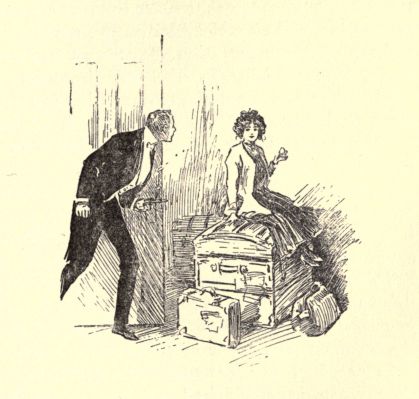
Seated on a prodigious trunk frescoed with labels of a dozen foreign inns, I beheld Hezekiah!
As I recall it she was very much at her ease. She sat on one foot and the other beat the trunk lightly. She was bareheaded, and the candle-light was making acquaintance with the gold in her hair. She wore her white sweater, as on that day in the orchard; and with much gravity, as our eyes met, she thrust a hand into its pocket and drew out a cracker. I was not half so surprised at finding her there as I was at her manner now that she was caught. She seemed neither distressed, astonished nor afraid.
"Well, Miss Hezekiah," I said, "I half suspected you all along."
"Wise Chimney-Man! You were a little slow about it though."
"I was indeed. You gave me a run for my money."
She finished her cracker at the third bite, slapped her hands together to free them of possible crumbs, and was about to speak, when she jumped lightly from the trunk, bent her head toward the door, and then stepped back again and faced me imperturbably.
"And now that you've found me, Mr. Chimney-Man, the joke's on you after all."
She laid her hand on the door and swung it nearly shut. I had heard what she had heard: Miss Octavia was coming upstairs! She had exchanged a few words with the Swedish maid on the second-floor landing, and Hezekiah's quick ear had heard her. But Hezekiah's equanimity was disconcerting: even with her aunt close at hand she showed not the slightest alarm. She resumed her seat on the trunk, and her heel thumped it tranquilly.
"The joke's on you, Mr. Chimney-Man, because now that you 've caught me playing tricks you've got to get me out of trouble."
"What if I don't?"
"Oh, nothing," she answered indifferently, looking me squarely in the eye.
"But your aunt would make no end of a row; and you would cause your sister to lose out with Miss Octavia. As I understand it, you 're pledged to keep off the reservation. It was part of the family agreement."
"But I'm here, Chimney-pot, so what are you going to do about it?"
"Mr. Ames! If you are ghost-hunting in this part of the house"—
It was Miss Octavia's voice. She was seeking me, and would no doubt find me. The sequestration of Hezekiah became now an urgent and delicate matter.
"You caught me," said Hezekiah, calmly, "and now you've got to get me out; and I wish you good luck! And besides, I lost one of my shoes somewhere, and you've got to find that."
In proof of her statement she submitted a shoeless, brown-stockinged foot for my observation.
"The one I lost was like this," and Hezekiah thrust forth a neat tan pump, rather the worse for wear. "I was on the second floor a bit ago," she began, "and lost my slipper."
"In what mischief, pray?"
"Mr. Ames," called Miss Octavia, her voice close at hand.
"I wanted to see something in Cecilia's room; so I opened her door and walked in, that's all," Hezekiah replied.
"Wicked Hezekiah! Coming into the house is bad enough in all the circumstances. Entering your sister's room is a grievous sin."
"If, Mr. Ames, you are still seeking an explanation of that chimney's behavior"—
It was Miss Octavia, now just outside the door.
"Don't leave that trunk, Hezekiah," I whispered. "I'll do the best I can."
Miss Octavia met me smilingly as I faced her in the hall. She had switched on the lights, and my candle burned yellowly in the white electric glow.
Miss Octavia held something in her hand. It required no second glance to tell me that she had found Hezekiah's slipper.
"Mr. Ames," she began, "as you have absented yourself from the library all evening, I assume that you have been busy studying my chimneys and seeking for the ghost of that British soldier who was so wantonly slain upon the site of this house."
"I am glad to say that not only is your surmise correct, Miss Hollister, but that I have made great progress in both directions."
"Do you mean to say that you have really found traces of the ghost?"
"Not only that, Miss Hollister, but I have met the ghost face to face,—even more, I have had speech with him!"
Her face brightened, her eyes flashed. It was plain that she was immensely pleased.
"And are you able to say, from your encounter, that he is in fact a British subject, uneasily haunting this house in America long after the Declaration of Independence and Washington's Farewell Address have passed into literature?"
"You have never spoken a truer word, Miss Hollister. The ghost with whom or which I have had speech is still a loyal subject of the King of England. But by means which I am not at liberty to disclose, I have persuaded him not to visit this house again."
"Then," said Miss Hollister, "I cannot do less than express my gratitude; though I regret that you did not first allow me to meet him. Still, I dare say that we shall find his bones buried somewhere beneath my foundations. Please assure me that such is your expectation."
She was leading me into deep water, but I had skirted the coasts of truth so far; and with Hezekiah on my hands I felt that it was necessary to satisfy Miss Hollister in every particular.
"To-morrow, Miss Hollister, I shall take pleasure in showing you certain hidden chambers in this house which I venture to say will afford you great pleasure. I have to-night discovered a link between the mansion as you know it and an earlier house whose timbers may indeed hide the bones of that British soldier."
"And as for the chimney?"
"And as for the chimney, I give you my word as a professional man that it will never annoy you again, and I therefore beg that you dismiss the subject from your mind."
I saw that she was about to recur to the shoe she held in her hand and at which she glanced frequently with a quizzical expression. This, clearly, was an issue that must be met promptly, and I knew of no better way than by lying. Hezekiah herself had plainly stated, on the morning of that long, eventful day, when she walked into the breakfast-room in her aunt's absence and explained Cecilia's trip to town, that it was perfectly fair to dissimulate in making explanations to Miss Hollister; that, in fact, Miss Octavia enjoyed nothing better than the injection of fiction into the affairs of the matter-of-fact day. Here, then, was my opportunity. Hezekiah had thrown the responsibility of contriving her safe exit upon my hands. No doubt, while I held the door against her aunt, that remarkable young woman was coolly sitting on the trunk within, eating another cracker and awaiting my experiments in the gentle art of lying.
"Miss Hollister," I began boldly, "the slipper you hold in your hand belongs to me, and if you have no immediate use for it I beg that you allow me to relieve you of it."
"It is yours, Mr. Ames?"
A lifting of the brows, a widening of the eyes, denoted Miss Octavia's polite surprise.
"Beyond any question it is my property," I asserted.
"Your words interest me greatly, Mr. Ames. As you know, the grim hard life of the twentieth century palls upon me, and I am deeply interested in everything that pertains to adventure and romance. Tell me more, if you are free to do so, of this slipper which I now return to you."
I received Hezekiah's worn little pump into my hands as though it were an object of high consecration, and with a gravity which I hope matched Miss Octavia's own. I was, I think, by this time completely hollisterized, if I may coin the word.
"As I am nothing if not frank, Miss Hollister, I will confess to you that this shoe came into my possession in a very curious way. One day last spring I was in Boston, having been called there on professional business. In the evening, I left my hotel for a walk, crossed the Common, took a turn through the Public Garden, where many devoted lovers adorned the benches, and then strolled aimlessly along Beacon Street."
"I know that historic thoroughfare well," interrupted Miss Hollister, "as my friend Miss Prudence Biddeford has lived there for half a century, and once, while I was staying in her house, she gave me her recipe for Boston brown bread, thereby placing me greatly in her debt."
"Then, being acquainted with the neighborhood and its sublimated social atmosphere, you will be interested in the experience I am about to describe," I continued, reassured by Miss Octavia's sympathetic attention to my recital. "I was passing a house which I have not since been able to identify exactly, though I have several times revisited Boston in the hope of doing so, when suddenly and without any warning whatever this slipper dropped at my feet. All the houses in the neighborhood seemed deserted, with windows and doors tightly boarded, and my closest scrutiny failed to discover any opening from which that slipper might have been flung. The region is so decorous, and acts of violence are so foreign to its dignity and repose, that I could scarce believe that I held that bit of tan leather in my hand. Nor did its unaccountable precipitation into the street seem the act of a housemaid, nor could I believe that a nursery governess had thus sought diversion from the roof above. I hesitated for a moment not knowing how to meet this emergency; then I boldly attacked the bell of the house from which I believed the slipper to have proceeded. I rang until a policeman, whose speech was fragrant of the Irish coasts, bade me desist, informing me that the family had only the previous day left for the shore. The house he assured me was utterly vacant. That, Miss Hollister, is all there is of the story. But ever since I have carried that slipper with me. It was in my pocket to-night as I traversed the upper halls of your house, seeking the ghost of that British soldier, and I had just discovered my loss when I heard you calling. In returning it you have conferred upon me the greatest imaginable favor. I have faith that sometime, somewhere, I shall find the owner of that slipper. Would you not infer, from its diminutive size, and the fine, suggestive delicacy of its outlines that the owner is a person of aristocratic lineage and of breeding? I will confess that nothing is nearer my heart than the hope that one day I shall meet the young lady—I am sure she must be young—who wore that slipper and dropped it as it seemed from the clouds, at my feet there in sedate Beacon Street, that most solemn of residential sanctuaries."
"Mr. Ames," began Miss Hollister instantly, with an assumed severity that her smile belied, "I cannot recall that my niece Hezekiah ever visited in Beacon Street; yet I dare say that if she had done so and a young man of your pleasing appearance had passed beneath her window, one of her slippers might very easily have become detached from Hezekiah's foot and fallen with a nice calculation directly in front of you. But now, Mr. Ames, will you kindly carry your candle into that trunk-room?"
And I had been pluming myself upon the completeness of my hollisterization! There was nothing for me but to obey, and my heart sank as my imagination pictured Hezekiah's discomfiture when we should find her seated on the huge trunk behind the door. And that stockinged foot already called in appealing accents to the shoe I held in my hand! The foundations of the world shook as I remembered the compact by which Hezekiah was excluded from the house, and realized what the impending discovery would mean to Cecilia, her father, and the wayward Hezekiah, too! But I was in for it. Miss Octavia indicated by an imperious nod that I was to precede her into the trunk-room, and I strode before her with my candle held high.
But the sprites of mystery were still abroad at Hopefield. The room was unoccupied save for the trunks. Hezekiah had vanished. Instead of sitting there to await the coming of her aunt, she had silently departed, without leaving a trace. Miss Hollister glanced up at the trap-door in the ceiling, and so did I. It was closed, but I did not doubt that Hezekiah had crawled through it and taken herself to the roof. Miss Octavia would probably order me at once to the battlements; but worse was to come.
"Mr. Ames," she said, "will you kindly lift the lid of that largest trunk."
I had not thought of this, and I shuddered at the possibilities.
She indicated the trunk upon which Hezekiah had sat and nibbled her cracker not more than ten minutes before. Could it be possible that when I lifted the cover that golden head would be found beneath? My life has known no blacker moment than that in which I flung back the lid of that trunk. I averted my eyes in dread of the impending disclosure and held the candle close.
But the trunk was empty, incredibly empty! My courage rose again, and I glanced at Miss Octavia triumphantly. I even jerked out the trays to allay any lingering suspicion. Why had I ever doubted Hezekiah? Who was she, the golden-haired daughter of kings, to be caught in a trunk? She had slipped up the ladder while I talked to her aunt and was even now hiding on the roof; but it was not for me to make so treasonable a suggestion. Miss Octavia might press the matter further if she liked, but I would not help her to trap Hezekiah.
Miss Hollister did not, to my surprise and relief, suggest an inspection of the roof. She nodded her head gravely and passed out into the hall.
"Mr. Ames, if I implied a moment ago that I doubted your story of the dropping of that tan pump from a Beacon Street roof or window, I now tender you my sincerest apologies."
She put out her hand, smiling charmingly.
"Pray return to the occupations which were engaging you when I interrupted you. You have never stood higher in my regard than at this moment. To-morrow you may tell me all you please of the ghost and the mysteries of this house, and I dare say we shall find the bones of that British soldier somewhere beneath the foundations. As for that trifling bit of leather you hold in your hand, it's rather passé for Beacon Street. The next time you tell that story I suggest that you play your game of drop the slipper from a window in Rittenhouse Square, Philadelphia. Still, as I always keep an umbrella in the check-room of the Parker House, I would not have you imagine that I look upon Boston as an unlikely scene for romance. The last time I was there a Mormon missionary pressed a tract upon me in the subway, and I can't deny that I found it immensely interesting."
XV
LOSS OF THE SILVER NOTE-BOOK
Hezekiah on the roof was safe for a time. Miss Octavia's gentle rejection of my Beacon Street anecdote and her intimation that Hezekiah had been an unbilled participant in the comedy of the ghost had been disquieting, and in my relief at her abandonment of the search I loitered on downstairs with my hostess. I wished to impress her with the idea that I was without urgent business. Hezekiah would, beyond doubt, amuse herself after her own fashion on the roof until I was ready to release her. As I had quietly locked the trunk-room door and carried the key in my pocket I was reasonably sure of this. Humility is best acquired through tribulation, and as Hezekiah sat among the chimney-crocks nursing one stockinged foot and waiting for me to turn up with her lost slipper, it would do her no harm to nibble the bitter fruit of repentance with another biscuit. I should find her much less sure of herself when I saw fit to seek her on the roof. It was a pretty comedy we were playing, but it was best that she should not too complacently take all the curtains. Hezekiah's naughtiness had been diverting up to a point now reached and passed, but the time had arrived for remonstrance, admonition, discipline. And it should be my grateful task to point out the error of her ways and urge her into safer avenues of conduct. Such were my reflections as I attended Miss Octavia in her descent.
The memoranda of my adventures at Hopefield Manor fall under two general headings. On the one hand was the ghost and the library chimney; on the other the extraordinary gathering of Cecilia's suitors. As I followed at Miss Octavia's side, she seemed to have dismissed the ghost and the fractious chimney from her mind; her humor changed completely. As in the morning when, unaccountably abandoning her habitual high-flown speech, she had asked me about Cecilia's silver note-book, she seemed troubled; and when we had reached the second floor she paused and lost herself in unwonted preoccupation.
"Let us sit here a moment," she said, indicating a long davenport in the broad hall. For the first time her manner betrayed weariness. She laid her hand quietly on my arm and looked at me fixedly. "Arnold," she said,—"you will let me call you Arnold, won't you?" she added plaintively, and never in my life had I been so touched by anything so sweet and gentle and kind,—"Arnold, if an old woman like me should do a very foolish thing in following her own whims and then find that she had probably committed herself to a course likely to cause unhappiness, what would you advise her to do about it?"
"Miss Hollister," I answered, "if you trusted Providence this morning to send you a corps of servants when yours had been most unfortunately scattered by ghosts or rumors of ghosts, why will you not continue to have confidence that your affairs will always be directed by agencies equally alert and beneficent?"
She flashed upon me that rare wonderful smile of hers; she looked me in the eyes quizzically with her head bent slightly to one side; but for once her usual readiness seemed to have forsaken her. Could it be possible that she was losing faith in her own play-world, and that the tuneful trumpets of adventure and romance which she had set vibrating on her own key jarred dully in her ears? It passed swiftly through my mind that it was incumbent on me to win her back to complete belief in the potency of the oracles that had called to her old age. She had dipped her paddle into bright waters and had splashed up all manner of gay imaginings, and what disasters awaited her now if she beached her argosy and found no gold at the end of the rainbow! It occurred to me, prosaic man and chimney-doctor that I was, that no one should be disappointed who has heard the dream-gods calling at twilight, or wakened to the chanting of the capstan-song, or heard the timbers creaking in the stout old caravel of romance as it wallows in the seas that wash the happy isles. I had not crawled through so many chimneys but that I still believed that dreams come true, not because they will but because they must! And in the case of Miss Octavia Hollister I felt a great responsibility; for what irremediable loss might not result to a world too little given these days to dreaming, if she, who at sixty had turned her heart trustfully to adventure, should find only sorrow and disappointment? The thing must not be! I was feeling the least bit elated over my success in solving the riddle of the ghost, and I knew that the hidden chambers and stair would delight her when I revealed them on the morrow; so I quite honestly sought to restore her to the joy of life. I felt that she was waiting for me to speak further, and I plunged ahead.
"Our meeting in the Asolando was the most interesting thing that ever happened to me, Miss Hollister. I was rapidly becoming hopelessly cabined, cribbed, confined, bound in to saucy doubts and fears as to the promise of life held out to us in the nursery, where, indeed, all education should begin and end. Your appearance at the Asolando that afternoon was well-timed to save me from death in a world that was rapidly losing for me all its illusion and witchery. But now that you have so readily won me back to the true faith, I beg of you do not yourself revert to the dreary workaday world from which you rescued me."
I had never in my life spoken more sincerely. I had never been so happy as since I knew her, and I was pleading for myself as well as for her—there where, from her own doorstep and in her own garden, one who listened attentively might hear the faint roar of trains bound toward the teeming city along iron highways. It was with relief that I saw my words had struck home. She touched my hand lightly; then she took it in both her own.
"You really believe that; you are not merely trying to please me?"
"I was never half so much in earnest! Please go on in the way you have begun. And have no fear that the charts will mislead you, or that the seas will grind your bark on hidden shoals. Shipwreck, you know, is one of the greatest joys of our adventures,—we have to be wrecked first before we find the island of the treasure-chests."
She sighed softly, but I felt that her spirits were rising.
"But those men down there? How shall I manage that?" she asked eagerly.
I snapped my fingers. We must get back into the air again. And it was remarkable how readily my long-untried wings bore me upward. The earth, after all, does not bind us so fast!
"I don't know the game; but I have found out a lot of things without being told, so tell me nothing! Remember that I have something quite remarkable, startling even, to show you to-morrow. I have even overcome, you know, the obstacle you placed in the way of my discoveries by sending in ahead of me this morning for the plans of the house."
I watched her narrowly, but she was in no wise discomfited.
"Well, I burned them the moment Hilda brought them back," she laughed. "I had faith in you, and I wanted you to manage it all for yourself. I rather guessed that you would go to Pepperton. That was when I still believed."
"But you must go on believing. Make-believing is the main cornerstone and the keystone of the arch of the happy life."
"You are sure you are not mocking a foolish old woman?"
"You are the wisest woman I ever knew!" I asserted, and my heart was in the words.
"I believe you have persuaded me; but Cecilia"—
She was again at the point of loosening her hold upon the cord that linked her shallop to Ariel's isle, but my own youth was resurgent in me.
I rose hastily, the better to break the current of her thought.
"Those men down there! They are in the hands of a higher fate than we control. I don't know the game"—
"But if"—she broke in.
"But if you gave away the secret, explained it to me, you would throw me back into my darkest chimney to hope no more. Leave it to me; trust me; lean upon me! I assure you that all will be well."
She bent her head and yielded herself to reverie for a moment. Then she sprang to her feet in that indescribably light, graceful way that erased at least fifty of her years from the reckoning, and was herself again.
"Arnold Ames," she said, laughing a little but gazing up at me with unmistakable confidence and liking in her eyes, "we will go through with this to the end. And whether that slipper really fell at your feet in Beacon Street or in the even less likely precincts of Rittenhouse Square, or under the windows of the Spanish Embassy in Washington, I believe that you are my good knight, and that you will see me safely through this singular adventure."
And I, Arnold Ames, but lately a student of chimneys, bent and kissed Miss Octavia's hand.
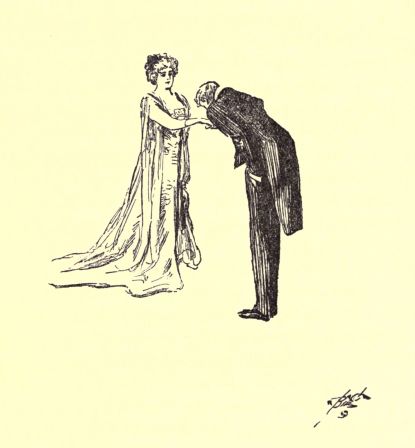
And I bent and kissed Miss Octavia's hand.
She led the way to the library, where I thought it well to appear for a moment, and I was heartily glad that I did so. It was joy enough for any man that he should have earned such glances of hatred and suspicion as the suitors bent upon me. There they were, some standing, some seated, about Cecilia. I bowed low from the door, feeling that to offer my hand to these gentlemen in their present temper would be too severe a strain upon their manners. As Miss Octavia appeared, several of them advanced courteously and engaged her in conversation. She found a seat and called the others to her, on the plea that she wished to ask them their opinion touching some matter,—I believe it was a late rumor that Andree, who had gone ballooning to discover the Hyperboreans, had been heard of somewhere.
Cecilia appeared distrait, and I wondered what new turn her affairs had taken. She rose as I crossed the room, and from her manner I judged that she welcomed this chance of addressing me.
"You have scorned the library to-night. Has there been trouble? Is Aunt Octavia alarmed about anything?"
I was sure that this inquiry covered some ulterior question. Hartley Wiggins, listening with a bored air to Miss Octavia's discussion of Andree's fate, glanced in our direction with manifest displeasure in our propinquity. Cecilia Hollister was a beautiful, charming woman of the world, but I felt her spell less to-night. It may be that the presence of Hezekiah's slipper in my inside coat-pocket, pressing rather insistently against my ribs, acted as a counter-irritant. I certainly could not imagine myself possessed of one of Cecilia's slippers! If I had tried my fictitious Beacon Street episode on Cecilia, she would undoubtedly have expressed her scorn of me. The hollisteritis germ, that had heretofore infected me only intermittently, was now exerting its full tonic power. In trying to hold Miss Octavia to her covenants with the lords of romance, I had strengthened my own confidence in their bold emprise. The gravity with which the suitors gave heed to Miss Octavia's ideas on arctic ballooning touched my humor. Cecilia had but to state her perplexity and I would interest myself promptly in her business. If I had been asked that night to enlist in the most hopeless causes I should have done so without a quibble, and died cheerfully under any barricade.
Our time was short; at any moment the suitors might cease covertly glaring at me, drift away from Miss Octavia, and interpose themselves between me and the girl on whom they had set their collective hearts.
"You are in difficulty, Miss Cecilia," I said; "please tell me in what way I may serve you."
"I don't know why I should appeal to you"—
"No reason is necessary. I have told you before that you need only to command me. We may be interrupted at any moment. Pray go on."
"I have lost an article of the greatest value to me. It has been taken from my room."
For a moment only I read distrust and suspicion in her eyes as it occurred to her that I had access to every part of the house; but my manner seemed to restore her confidence. And she could not have forgotten that her own father had met her secretly on the roof of a house that was denied him, and that I was perfectly cognizant of the fact.
"I am sure you can be of assistance," she said. "There's something behind this ghost-story; some one has been in and about the house; you believe that?"
"Yes. There has really been a sort of ghost, you know."
She shrugged her shoulders. Cecilia had no patience with ghosts, and we were losing time. My conversation with Cecilia was annoying Wiggins, as was plain from his nervousness. Wiggins's courtesy was unfailing, but there are points at which the restraints of civilization snap. Cecilia realized that time passed and that she had not stated her difficulty. She now lowered her voice and spoke with great earnestness.
"I went to my room for a moment, while Aunt Octavia was above, with you I suppose, just after the chimney gave another of its strange demonstrations. I remembered that I had left my little silver-bound book, that I usually carry with me, on my dressing-room table. It contains a memorandum of great importance to me. It positively cannot be duplicated. I am sure it was there when I came down to dinner. But it was not on my dressing-table or anywhere to be found."
"You may be mistaken as to where you left it. You would not be absolutely positive that you left it on the dressing-table?"
"There is not the slightest question about it. I had been looking at it just before dinner. I had sent you a note, you know, immediately after you came back, and hurried down to see you."
"Yes. I recall that. You were in the library when I came down. And I think I remember having seen the little trinket,—slightly smaller than a card-case, silver-backed and only a few leaves. You had it in your hand the other night when I came in after Mr. Hume had left."
She flushed slightly at this, but readily acquiesced in my description. Miss Octavia's inquiry as to whether I had seen the book came back to me; and no less clearly her withdrawal of her question almost the moment she had spoken it.
I felt the sudden impingement of Hezekiah's slipper upon my own conscience, if I may so state the matter. Hezekiah, playing ghost, had confessed to me that she had visited Cecilia's room. Hezekiah, amusing herself with the library chimney and frightening the servants by stealing into the forbidden house through the coal-hole, was a culprit to be scolded and forgiven; but what of Hezekiah mischievously filching an article of real value to her sister! I did not like this turn of affairs. I must get back to the roof, find Hezekiah, and compel her to return the silver book. Only by tactfully managing this could I serve well all the members of the house of Hollister. But first I must leave Cecilia with a tranquil mind.
"I thank you for confiding this matter to me, Miss Hollister. Please do not attach suspicion to any one until I have seen you again."
"But if you should be unable to restore"—
"I assure you that the book is not lost. It has been mislaid, that's all. I shall return it to you at breakfast. I give you my word."
"Do you really mean it?" she faltered. "Please keep this from Aunt Octavia! I can't tell you how important it is that she be kept in ignorance of my loss. The consequences, if she knew, might be very distressing."
I could not for the life of me see what great importance could attach to those few leaves of paper in their silver case, but if Miss Octavia and Hezekiah were interested in it as well as Cecilia, it must have a significance wholly unrelated to its intrinsic value. It is the way of professional detectives to suggest impossible theories merely to conceal their own plans and intentions, and as I had reached a point where my tongue was astonishingly glib in subterfuge and evasion, I suggested that it might perhaps have been one of the new servants, or indeed the Swedish maid.
"We will look into the matter, Miss Hollister. At breakfast I shall have something to report. Meanwhile silence is the word!"
Miss Octavia was carrying the invincible John Stewart Dick away to the billiard-room. He glared at me murderously as he trailed glumly after the lady of the manor. The others were crowding about Cecilia again, and I yielded to them willingly. As I sauntered toward the door Ormsby detained me a moment. His manner was arrogant and he hissed rather than spoke.
"I'm directed to command your presence at the Prescott Arms to-morrow at twelve o'clock. The business is important."
"I regret, my dear brother, that I shall be unable to sit with you at that hour in committee of the whole, and for two reasons. The first is that I am paired with Lord Arrowood. You refused to take him into your base compact, and allowed him to be thrown out of the inn for not paying his bill. The act was deficient in generosity and gallantry."
"Then I suppose you would think it a fine thing for such a pauper to marry a woman like that,—like that, I say?" and he jerked his head toward Cecilia.
"I consider a lord of Arrowood as good as the proprietor of a knitting-mill any day, if you press me for an opinion," I replied amiably.
"And this from a chimney-sweep?" he sneered.
"You flatter me, my dear sir. I've renounced soot and become a gentleman adventurer merely to prevent a type that long illumined popular fiction from becoming extinct. I advise you to fill the void existing in the heavy-villain class; believe me, your talents would carry you far. Study Dumas and forget the wool-market, and you will lead a happier life. My second reason for declining to meet you at the Arms at twelve to-morrow is merely that the hour is inconvenient. I assume that you mean to urge luncheon upon me, and I never eat before one. My doctor has warned me to avoid early luncheons if I would preserve my figure, of which you may well believe me justly proud."
"You're a coward, that's all there is to that. I dare you to come!"
"Well, as I think of it I 'd rather be dared than invited. If I find it quite convenient I shall drop in. But you need n't keep the waffles hot for me. Good evening."
It did not seem possible that I, the timid, uncombative and unathletic, had thus cavalierly addressed a dignified gentleman in a white waistcoat who was perfectly capable of knocking me down with a slap in the face. Valor, I aver, is only another of the offsprings of necessity.
XVI
JACK O' LANTERN
I hurried back to the trunk-room and had soon gained the roof. The moon was harassed by flying clouds that obscured it fitfully, and a keen wind swept the hills. I crept over the several levels of roof thinking that any moment I should come upon Hezekiah; I searched a second time, peering behind chimney-pots, and into dark angles; but to my disappointment and chagrin my young lady of the single slipper was nowhere in sight. I found, however, lying near the library chimney, a trunk-tray that required no explanation. With this Hezekiah had blocked the flue, and I smiled as I pictured her tip-toeing to reach the chimney-crock, and dropping the tray across the top. How gleefully she must have chuckled as she waited for the flue to fill and send the smoke ebbing back into the library, to the discomfiture of her aunt and sister and the suitors gathered about the hearth! The spirit of mischief never whispered into a prettier ear a trick better calculated to cause confusion.
I had thought Hezekiah secure when I locked the trunk-room door, but I had not counted upon the versatility and resourcefulness of that young person. I dropped to the second roof-level and inspected the down-spouts, but it was incredible that she had sought the earth by this means. I swung myself to a third level, and after much groping for my bearings, decided that an athletic girl of Hezekiah's venturesome disposition might, if she set no great store by her neck, clamber off the kitchen-roof by means of a tall maple whose branches now raspingly called attention to their slight contact with the house. It was here that the walls of Hopefield thrust themselves into the shoulder of a rough rocky knoll, and it was perfectly clear now that the chambers of the earlier house around which the mansion had been built were neatly enfolded by the walls on the east side.
As the moon cruised into a patch of clear sky something white fluttered from a maple limb, and I bent and pulled it free. I took counsel of a match behind the kitchen chimney, and found that it was a handkerchief that had been knotted to the tip of the bough. No one but Hezekiah would have thought of marking her trail in this fashion. I held it to my face, and that faint perfume that had been a mystifying accompaniment of the passing of the mansion ghost became nothing more unreal than the orris in Hezekiah's handkerchief-case. The wind whipped the bit of linen spitefully in my hands. I reasoned that if Hezekiah the inexplicable had not meant for me to know the manner of her exit she need not have left this plain hint behind; but the swaying maple bough did not tempt me. I hurried back across the roof to secure the trunk-tray, resolved to dispose of it, seek the open, and find the errant Hezekiah if she still lingered in the neighborhood.
I looked off across the windy landscape before descending, and as my eyes ranged the dark I caught the glimmer of a light, as of a lantern borne in the hand, in the meadow beyond the garden. It paused, and was swung back and forth by its unseen bearer. It shed a curious yellow light and not the white flame of the common lantern; and now it rose a trifle higher and slowly resolved itself into a weird fantastic face.
Three minutes later I was out of the house, using the backstairs to avoid the company in the library, and had crossed the garden and crawled through the hedge. As I rose to my feet a voice greeted me cheerfully,—
"Well done, Chimney-Man! You were a little slow hitting the trail, but you do pretty well, considering. How did you manage with Aunt Octavia about that slipper? I had a narrow escape in the second-floor hall, when I came out of Cecilia's room. I must have lowered a record getting upstairs. And one shoe is n't a bit comfortable. Allow me to relieve you!"
"Here's your slipper. You ought to be ashamed of yourself."
"For losing my slipper? I thought Cinderella had made that respectable."
She placed her hand on my shoulder, lifted her foot, and drew the pump on with a single tug.
"Well, what did Aunt Octavia say?"
"Oh, she had thoughts too dark to express. You probably heard what we said. It was she who found the slipper!"
Hezekiah laughed. The wind caught up that laugh and whisked it away jealously.
"She found it and carried it to you, Chimney-Man, and I skipped just as you began that beautiful story about finding it in Beacon Street. Hurry and tell me how you got me out of it."
"How did you know I would try to explain it? You did a perfectly foolhardy thing in roaming the house that way, scaring Lord Arrowood nearly to death, to say nothing of me. Why should I help you?"
"Oh, you're a man and I was just a little girl who had lost her slipper," she replied. "I was sure you would fix it up."
"Well, I like your nerve, Hezekiah! I had to lie horribly to explain the slipper, and Miss Octavia did n't swallow more than half my yarn."
"Oh, well, if it was a good story, Aunt Octavia would n't mind. She'd have minded, though, if you had n't tried to get me out of it. That's the way with Aunt Octavia. I hope you made a romantic tale of it."
"I can't say that it would place me among the great masters of fiction, Hezekiah, but as lies go I think it had merit. And I 'll improve if I stay here much longer."
"Oh, you'll stay all right. Aunt Octavia has no intention of letting you go. When she left the Asolando that afternoon she met you, she had her plans all made for kidnapping you."
"She did n't tell you so, did she?"
"No; because I have n't seen her and I'm not supposed to see her, you know, until Cecilia is all fixed."
"Married?"
"Um," replied Hezekiah.
She drew from behind a boulder by which we stood a pumpkin of portable size, which I surmised had been carved into the most hideous of jack o' lanterns by the shrewd hand of Hezekiah. I took it from her with the excuse of relieving her, but really to turn the light of the fearsome thing more directly upon her. The wind blew her hair about her face; hers was an elfish face to-night. With a pleasant tingling I met her eyes. The light of a jack o' lantern is not of the earth earthy. Even when you know perfectly well that it's only a candle stuck in a pumpkin, you are not fully satisfied of its mundane character. In its glow one becomes a conspirator, ready for treason, stratagems and spoils. More concretely, in these moments a small archipelago of freckles revealed itself about Hezekiah's nose and caused my heart to palpitate strangely. Her sun-browned cheek was perilously near. I hoped that she would bend forever over the lantern, so that I might not lose the tiny shadows of her lashes, or, again, the laughter of her brown eyes as she glanced up to ask my judgment as to the security of the candle. She viewed her handiwork with feigned solicitude, the tip of her tongue showing between her lips. Then the mirth in her bubbled out, and she drew away and clapped her hands together like a child.
"Come!" she cried. "If you are good and won't begin preaching about my sins, I'll show you the funniest thing you ever saw in your life."
In my joy of seeing her I was neglecting Cecilia's commission. Very likely Hezekiah had forgotten all about her theft; hers, I reasoned, was a nature that delighted in the nearest pleasure. I would follow her jack o' lantern round the world for the chance of seeing the fun brighten in her brown eyes, but I had made a promise to Cecilia and I meant to fulfill it.
She led me now across the meadow, over a stone wall, up a steep slope, and by devious ways through a strip of woodland. I bore the jack o' lantern,—she had bidden me do it, with some notion, I did not question, of making me particeps criminis in whatever mischief was afoot. Dignified conduct in a man of twenty-eight, in his best evening clothes, carrying a jack o' lantern over stone walls, under clumps of briar, and through woods whose boughs clawed the night wildly! The moon lost and found under the flying scud was in keeping with the general irresponsibility of a world ruled by Hezekiah.
She swung along ahead of me with the greatest ease and certainty. Occasionally she flung some word back at me or whistled a few bars of a tune, and when I slipped and nearly fell on a smooth slope she laughed mockingly and bade me not lose the pumpkin. Once, when a boy, I stole a watermelon and bore it a mile to the rendezvous of my pirate band camped at a riverside; but carrying a pumpkin, even a hollow one, is attended with manifold discomforts. It would help, I reflected, to know just what I was lugging it for, but Hezekiah vouchsafed nothing. When I threatened to drop the grinning gargoyle she laughed and told me to trot along and not be silly; and a moment later she stopped and demanded that I repeat fully the story I had told her aunt of the finding of the slipper.
"You are better than I thought you were, Chimney-Man!" she declared, when I had concluded and added her aunt's comment. "You may be sure that tickled Aunt Octavia. You can lie almost as well as an architect. Aunt Octavia says architects are better liars than dress-makers."
"It was my weakness for the truth that caused me to abandon architecture. For heaven's sake, what are you up to?"
I had kept little account of the direction of our flight, and I was surprised that we had now reached the stile over which I had watched the passing of the suitors on the afternoon of my meeting with Hezekiah in the orchard.
"This is the appointed place," she remarked, taking the pumpkin from me and dropping down on the far side of the stile.
"Hezekiah, I've trotted across most of Westchester County after you, and my arm is paralyzed from carrying that pumpkin. I must know what you're up to right here, or I'll go home. Besides, there's a mist falling and you'll be soaked. What do you suppose your father thinks of your absence at this time of night?"
"Oh, he'll never forgive me for not letting him in on this. This is the grandest thing I ever thought of. Sit on this step and gently incline your ear toward the house. It's about time those gentlemen were leaving Cecilia, and they'll be galloping for their inn in a minute, and then"—
Hezekiah whistled the rest of it.
While we waited, she bade me reset the candle and snuff the wick, which I did of necessity with my fingers. Sitting on a stile with a pretty girl is an experience that has been commended by the balladists, but surely this felicity loses nothing where the night is fine. When you get used to sitting in a drizzle in your dress-suit, while your shirt-bosom assumes the consistency of a gum shoe and your collar glues itself odiously to your neck, I dare say the ordeal may be borne cheerfully, but my expressions of discomfort seemed only to amuse Hezekiah. While we waited for I knew not what, I tried once or twice to revert to the silver note-book, but without success. Hezekiah was a mistress of the art of evasion with her tongue as well as her feet!
"Wait till the evening performance is over and I'll talk about that. 'Sh! Quiet! Crawl over there out of the way, and when I say run, beat it for the road."
These last phrases were uttered in a whisper, her face close to my ear. She gave me a little push, and I withdrew a few yards and waited. The ground, I may say, was wet, and the drizzle had become a monotonous autumn rain.
The light of the lantern fell warmly upon Hezekiah's face as she held its illumined countenance toward her, crouching on the stile-steps. I heard now what her keener ear had caught earlier—the tramp of feet along the path. The suitors were returning to the inn, and the voices of one or two of them reached me. One—I thought it was Ormsby—was execrating the weather. They were stepping along briskly, and my remembrance of their retreat over this same stile through the amber evening dusk was so vivid that I knew just how they would appear if a light suddenly fell upon the path.
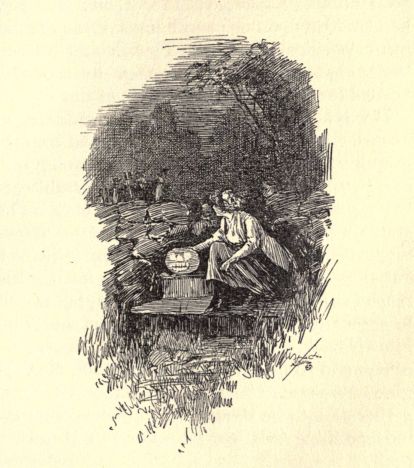
The light of the lantern fell warmly upon Hezekiah's face.
The nature of Hezekiah's undertaking suddenly dawned upon me. No one but Hezekiah could ever have devised anything so preposterous, so utterly lawless; but in spite of myself I waited in breathless eagerness for the outcome. I could not have interfered now, if I had wished to do so, without betraying her and involving myself in a predicament that could not redound to my credit.
Nearer and nearer came the patter of feet, and I heard, for I could not see, the scraping of Hezekiah's slipper,—a wet little shoe by now!—as she crept higher on our side of the stile. The first suitor groped blindly for the steps, slipped on the wet plank, growled, and rose to try again. That growl marked for me the leader of the van. Hartley Wiggins, beyond a doubt, and in no good humor, I guessed! The others, I judged, had trodden upon one another's heels at the moment Wiggins stumbled. Thus let us imagine their approach—six gentlemen in top hats headed for a stile on a chilly night of rain.
It was at this strategic moment that Hezekiah pushed into the middle of the stile-platform, its grinning face turned toward the advancing suitors, the jack o' lantern her hand had fashioned.
I marked its position by its faint glow an instant, but an instant only. The world reeled for a moment before the sharp cry of a man in fear. It cut the dark like a lash, and close upon it the second man yelled, in a different key, but no less in accents of terror. The first arrival had flung himself back, and so close upon him pressed the others and so unexpected was the halt, that the nine men seemed to have flung themselves together and to be struggling to escape from the hideous thing that had interposed itself in their path.
All was over in a moment. In the midst of the panic the lantern winked out, and instantly Hezekiah was beside me.
"Skip!" she commanded in a whisper; and catching my hand she led me off at a brisk run. When we had gone a dozen rods she paused. We heard voices from the stile, where the gentlemen were still engaged in disentangling themselves; and then the planks boomed to their steps as they crossed. They talked loudly among themselves discussing the cause of their discomfiture. The lantern, I may add, had been knocked off the stile by the thoughtful Hezekiah when she blew out the light.
A moment more and all sounds of the suitors had died away. I stood alone with Hezekiah in the midst of a meadow. She was breathing hard. Suddenly she threw up her head, struck her hands together, and stamped her foot upon the wet sod. I had waited for an outburst of laughter now that we were safely out of the way, but I had reasoned without my Hezekiah. Her mood was not the mood of mirth.
"Well, Hezekiah," I said when I had got my wind, "you pulled off your joke, but you don't seem to be enjoying it. What's the matter?"
"Oh, that Hartley Wiggins! I might have known it!"
"Known what?" I asked, pricking up my ears.
"That he would be afraid of a pumpkin with a candle inside of it. Did you hear that yell?"
"Anybody would have yelled," I suggested. "I think I should have dropped dead if you'd tried it on me."
"No, you would n't," she asserted with unexpected flattery.
"Don't be deceived, Hezekiah; I should have been scared to death if that thing had popped up in front of me."
"I don't believe it. I gave you a worse test than that. When I switched off the lights and swung a feather duster down the stair-well by a string and tickled your face you did n't make a noise like a circus calliope scaring horses in Main Street, Podunk. But that Wiggins man!"
"He's a friend of mine and as brave as a lion. Out in Dakota the sheriff used to get him to go in and quiet things when the boys were shooting up the town."
"Maybe; but he shied at a pumpkin and can be no true knight of mine. Cecilia may have him. I always suspected that he was n't the real thing. Why, he's even afraid of Aunt Octavia!"
"Well, I rather think we 'd better be!"
I wanted to laugh, but I did not dare. I was not prepared for the humor in which the panic of the suitors had left her. I did not quite make out—and I am uncertain to this day—whether she had really wished to test the courage of her sister's lovers or whether she had yielded to a mischievous impulse in carrying the jack o' lantern to the stile and thrusting it before those serious-minded gentlemen as they returned from Hopefield. In any event Hartley Wiggins was out of it so far as she, Hezekiah, was concerned. She trudged doggedly across the field until we came presently to the highway.
"My wheel's in the weeds somewhere; please pull it out for me. I'm going home."
"But not alone; I can't let you do that, Hezekiah."
"Oh, cheer up!" she laughed, aroused by my lugubrious tone. "And here's something you asked me for. Don't drop it. It's Cecilia's memorandum-book. Give it back to her, and be sure no one sees it, and you need n't look into it yourself. And we've got to have a talk about it and Cecilia. Let me see. There's an iron bridge across an arm of that little lake over there, and just beyond it a big fallen tree. To-morrow at nine o'clock I'll be there. I've got to tell you something, Chimney-Man, without really telling you. You'll be there, won't you?"
"I'll be there if I'm alive, Hezekiah."
I had found the wheel and lighted the lamp. She scouted my suggestion that I find a horse and drive her home. The lighting of the lamp required time owing to the wind and rain; but when its thin ribbon of light fell clearly upon the road, she seized the handle-bars and was ready to mount without ado.
She gave me her hand,—it was a cold, wet little hand, but there was a good friendly grip in it. This was the first time I had touched Hezekiah's hand, and I mention it because as I write I feel again the pressure of her slim cold fingers.
"Sorry you spoiled your clothes, but it was in a good cause. And you 're a nice boy, Chimney-Man!"
She shot away into the darkness, and the lamp's glow on the road vanished in an instant; but before I lost her quite, her cheery whistle blew back to me reassuringly.
XVII
SEVEN GOLD REEDS
I woke the next morning to the banging of Miss Octavia's fowling-piece. In spite of the crowding incidents of the day and night I had slept soundly, and save for a stiffness of the legs I was none the worse for my wetting. The service of the house was perfect, and in response to my ring a man appeared who declared himself competent to knock my dress clothes into shape again.
I should hardly have believed that so much history had been made in a night, if it had not been for certain indubitable evidence: Cecilia's silver note-book; Hezekiah's handkerchief, which I had forgotten to return to her; and a patch of tallow grease from the jack o' lantern that had attached itself firmly to my coat-cuff.
Cecilia met me at the foot of the stairs, looking rather worn, I thought. We were safe from interruption a moment longer, as her aunt's gun was still booming, and I followed her to the library.
"Please don't tell me you have failed," she cried tearfully. "That little book means so much, so very much to us all!"
"Here it is, Miss Hollister," I said, placing it in her hand without parley. "I beg to assure you that I return it just as you saw it last. Please satisfy yourself that it has not been tampered with in any way. I have not opened it; and it has not left my hand since I recovered it."
She had almost snatched it from me, and she turned slightly away and ran hurriedly over the leaves.
In her relief she laughed happily; and with one of her charming, graceful gestures she gave me her hand.
"I thank you, Mr. Ames; thank you! thank you! You have rendered me the greatest service. And I hope you were able to do so without serious inconvenience to yourself."
"On the other hand it was the smallest matter, and instead of being a trouble I found the greatest pleasure in recovering it."
I stood with my hands thrust carelessly into my trousers pockets, rocking slightly upon my heels to convey a sense of the unimportance of my service. It was a manner I had cultivated to meet the surprise and gratitude of my clients when I had brought a seemingly incurable flue into a state of subjection. I think I may have appeared a little bored, as though I had accomplished a feat that was rather unworthy of my powers. A doctor who prescribes the wrong pill and finds to his amazement that it cures the patient, might improve upon that manner, but not greatly.
"You naturally wonder, Miss Hollister, how I found this trinket so readily. And in order that you may not suspect perfectly innocent persons, I will tell you exactly how I came by it. It was your belief that you had left it on your dressing-table. But as a memorandum-book of any character pertains to a writing-desk rather than to a dressing-table, my interest centred at once upon such writing-table as you doubtless have in your room."
"There is a writing-desk, in the corner by the window, but"—
"Ah, you are about to repeat your belief that you left the book on the dressing-table and that it could not have moved to the desk. May I ask whether you did not, just before you came down to dinner, scribble me a line asking for an interview?"
"Why, yes; I remember that perfectly."
"You wrote in some haste, as indicated by the handwriting in your message. It is possible that you wrote and destroyed one note, or perhaps two, before you had expressed yourself exactly to your liking. We are all of us, with any sort of feeling for style, prone to just such rejections."
"It is possible that I did," she replied, coloring slightly. "I was extremely anxious to see you."
"Very well, then; is it not possible that in throwing the rejected correspondence cards into the waste-paper basket that stands beside your desk,—there is such a basket, is there not?"
"Yes," she replied breathlessly.
"Is it not possible, then, that that little booklet, hardly heavier than paper itself, may have been brushed off without your seeing it?"
"It is possible; I must admit that it is possible; but"—
"It is on that 'but' that any theory implicating another hand must break. What I have indicated is exactly what must have happened. To the nice care that characterizes the house-keeping of this establishment we must now turn. I find that when I go to my own room after dinner it is always in perfect order,—pens restored to the rack on my writing-table, brushes laid straight on the dressing-table, and so on. The well-trained maid who cares for your room, seeing scraps of paper in the basket by your desk, naturally carried it off. When I accepted your commission last night I went directly to the cellar, sought the bin into which waste paper is thrown, and found among old envelopes and other litter this small trinket, which but for my promptness might have been lost forever."
"It does n't seem possible," she faltered.
"Oh," I laughed easily, "possible or impossible, you could not on the witness-stand swear that the book had not dropped into the waste-paper basket precisely as I have described."
"No, I suppose I couldn't," she answered slowly.
My powers of mendacity were improving; but her relief at holding the book again in her hand was so great that she would probably have believed anything.
"You see," she said, clasping the book tight, "this was given me for a particular purpose and it contains a memorandum of greatest importance. And I was in a panic when I found that it was gone, for my recollection of certain items I had recorded here was confused, and there was no possible way of setting myself straight. Now all is clear again. I feel that I make poor acknowledgment of your service; but if, at any time"—
"Pray think no more of it," I replied; and at this moment Miss Hollister appeared and called us to breakfast.
"If it is perfectly agreeable to you, Arnold, I will hear the story of the finding of the ghost at four o'clock, or just before tea. I have sent a telegram to Mr. Pepperton asking him to be present. He 's at his country home in Redding and can very easily motor down. As no motors are allowed on my premises he shall be met at the gate with a trap."
"You have sent for Pepperton!" I exclaimed.
"That is exactly what I have done, and as he knows that I never accept apologies under any circumstances, he will not disappoint me. In addition to reprimanding him for not telling me of the secret passage in this house, I have another matter that concerns you, Arnold, which I wish to lay before him. The new cook that Providence sent to my kitchen yesterday is the best we have had, Cecilia, and I beg that you both indulge yourselves in a second helping of country scrambled eggs."
Miss Octavia made no further allusion to the incidents of the night, but went on turning over her mail. I have neglected to say that her library contained a most remarkable array of books in praise of man's fortitude and daring. I have learned later that these had been assembled for her by a distinguished scholar, and many of them were rare editions. A "Karlamagnus Saga" elbowed Malory and the "Reali di Francia;" and Roland's horn challenged in all languages. She greatly admired and had often visited the Chateau de Luynes, and had a portfolio filled with water-color and pen-and-ink drawings of it. Such books as Viollet-le-Duc's "Dictionnaire du Mobilier Français" I constantly found lying spread open on the library table. She read German and French readily, and declared her purpose to attack old French that she might pursue certain obscure chansons de geste which, an Oxford professor had told her, were not susceptible of adequate translation. Why should one read the news of the day when the news of all time was available! Magazines and reviews she tolerated, but no newspaper was as good as Froissart. She therefore read newspapers only through a clipping bureau, which sent her items bearing upon her own peculiar interests. By some error the story of a heavy embezzlement in a city bank had that day crept in among a number of cuttings relating to a ship that had been found somewhere off the Chilean coast with all sails set and everything in perfect order, but with not a soul on board. She expressed her bitterest contempt for men in responsible positions who betrayed their trusts: highway robbery she thought a much nobler crime, as the robber dignified his act by exposing himself to personal danger.
"In our day, Arnold," she said, placing her knife and fork carefully on her plate, "in our day the ten commandments have lost their moral significance and retain, I fear, only a very slight literary interest."
She reminded Cecilia of an appointment to ride that morning; in the early afternoon she was to install a new kennel-master; and otherwise there was a full day ahead of her. It was a cheerful breakfast table. A letter from my assistant confirming his telegraphed resignation did not disturb me; Miss Octavia showed no further signs of abandoning her quest of the golden coasts of youth, and Cecilia, having recovered her notebook, faced the new day cheerfully.
A little later I met Miss Hollister in the hall dressed for her ride.
"Arnold, you may ride whenever you like. I may have forgotten to mention it. What have you on hand this morning?"
"An appointment with a lady," I replied.
"If you are about to meet the owner of that Beacon Street slipper I wish you good luck."
She was drawing on her gauntlets, and turned away to hide a smile, I thought; then she tapped me lightly with her riding-crop.
"Cecilia's silver note-book was missing last night. She told me of her loss with tears. She has it again this morning. Did you restore it?"
"It was my good fortune to do so."
"Then allow me to add my thanks to hers. You are an unusually practical person, Arnold Ames, as well as the possessor of an imagination that pleases me. You are becoming more and more essential to me. Cecilia approaches, and I cannot say more at this time."
When they had ridden out of the porte-cochère I set off across the fields to keep my tryst with Hezekiah. The air had been washed sweet and clean by the rain of the night, and sky was never bluer. I was surprised at my own increasing detachment from the world. Nothing that had happened before the Asolando mattered greatly; my meeting with Miss Octavia Hollister had marked a climacteric from which all events must now be reckoned. I had embarked with high hope in a profession to which I had been drawn from youth, had failed utterly to find clients, and had therefore taken up the doctoring of flues, a vocation whose honors are few and dubious, and in which I felt it to be damning praise that I was called the best in America. My days at Hopefield were the happiest of my life. Few as they had been, they had changed my gray bleak course into a path bright with promise. The world had been too much with me, and I had escaped from it as completely as though I had stepped upon another planet "where all is possible and all unknown."
I reached the fallen tree that Hezekiah had appointed as our trysting-place a little ahead of time, and indulged in pleasant speculations while I waited. I was looking toward the hills expecting her to come skimming along the highway on her bicycle, when a splash caused me to turn to the lake. Dull of me not to have known that Hezekiah would contrive a new entrance for a scene so charmingly set as this! She had stolen upon me in a light skiff, and laughed to see how her silent approach startled me. She dropped one oar and used the other as a paddle, driving the boat with a sure hand through the reeds into the bank.
"'Tis morning and the days are long!"
Such was Hezekiah's greeting as she jumped ashore. She wore a dark green skirt and coat, and a narrow four-in-hand cravat tied under a flannel collar that clasped her throat snugly. A boy's felt hat, with the brim pinned up in front, covered her head.
"You seem none the worse for your wetting, Hezekiah. You must have been soaked."
"So must you, Chimneys, but you look as fit as I feel, and I never felt better. Did they catch you crawling in last night?"
"I did n't see a soul. You know I'm an old member of the family now. Nobody was ever as nice to me as your Aunt Octavia."
"How about Cecilia?"
"Having found her silver note-book and given it back to her before breakfast, I may say that our relations are altogether cordial."
"Are you in love with her—yet?" asked Hezekiah, carelessly, tossing a pebble into the lake. The "yet" was so timed that it splashed with the pebble.
"No; not—yet," I replied.
"It will come," said Hezekiah a little ruefully, casting a pebble farther upon the crinkled water.
"You mean, Hezekiah, that men always fall in love with your sister."
She nodded.
"Well, she's a good deal of a girl."
"Beautiful and no end cultivated. They all go crazy about her."
"You mean Hartley Wiggins and his fellow-bandits at the Prescott Arms."
"Yes; and lots of others."
"And sometimes, Hezekiah, it has seemed to you that she got all the admiration, and that you did n't get your share. So when her suitors began a siege of the castle whose gates were locked against you, you plugged the chimney with a trunk-tray, and played at being ghost and otherwise sought to terrify your sister's lovers."
"That's not nice, Chimneys. You mean that I'm jealous."
"No. I don't mean that you are jealous now: I throw it into the remote and irrevocable past. You were jealous. You don't care so much now. And I hope you will care less!"
"That is being impertinent. If you talk that way I shall call you Mr. Ames and go home!"
"You can't do that, Hezekiah."
"I should like to know why not? If you say I 'm jealous of Cecilia now, or that I ever was, I shall be very, very angry. For it's not true."
"No. You see things very differently now. You told me only last night that Cecilia might have Hartley Wiggins. Assuming that she wants him! And you and he have been good friends, have n't you? You had good times on the other side. And while Cecilia was in town assisting Providence in finding your aunt a cook, you went walking with him."
"I did, I did!" mocked Hezekiah. "And why do you suppose I did?"
"Because Wiggy's the best of fellows; a solid, substantial citizen, who raises wheat to make bread out of."
"And angel food and ginger cookies," added Hezekiah, feeling absently in the pockets of her coat. "No, Chimneys, you 're a nice boy and you don't yell like a wild man when a feather-duster hits you in the dark; but there are some things you don't know yet."
"I am here to grow wise at the feet of Hezekiah, Daughter of Kings. Open the book of wisdom and teach me the alphabet, but don't be sad if I balk at the grammar."
"I never knew all the alphabet myself," said Hezekiah dolefully; then she laughed abruptly. "I was bounced from two convents and no end of Hudson River and Fifth Avenue education shops."
"The brutality of that, Hezekiah, wrings my heart! Yet you are the best teacher I ever had, and I thought I was educated when I met you. But I had only been to school, which is different. Not until the first time our eyes met, not until that supreme moment"—
"Mr. Ames," Hezekiah interrupted, in the happiest possible imitation of Miss Octavia's manner, "if you think that, because I am a poor lone girl who knows nothing of the great, wide world, I am a fair mark for your cajolery, I assure you that you were never more mistaken in your life!"
"You ought n't to mimic your aunt. It is n't respectful; and besides you have something to tell me. What's all this rumpus about Cecilia's silver memorandum-book? Suppose we discuss that and get through with it."
We were sitting on the fallen tree, which lay partly in the lake, and Hezekiah leaned over and broke off a number of reeds from the thicket at the water's edge. Out of her pocket she drew a small penknife and trimmed them uniformly.
"You see," she began, biting her lip in the earnestness of her labor, "I'm going to tell you something, and yet I 'm not going to tell you. So far as you and I have gone you 've been tolerably satisfactory. If I did n't think you had some wits in your head I should n't have bothered with you at all. That's frank, is n't it?"
"It certainly is. But I'm terribly fussed for fear I may not be equal to this new ordeal."
"If you fail we shall never meet again; that's all there is to that. Now listen real hard. You know something about it already, but not the main point. Aunt Octavia got father to consent to let her marry us off—Cecilia and me. Cecilia, being older, came first. I was to keep out of the way, and father and I were not to come to Aunt Octavia's new house up there or meddle in any way. While we were abroad I was treated as a little girl, and not as a grown-up at all. But you see I 'm really nineteen, and some of Cecilia's suitors were nice to me when we were traveling. They were nice to me on Cecilia's account, you know."
"Of course. You're so hard to look at, it must have been painful to them to be nice to you,—almost like taking poison! Go on, Hezekiah!"
"You need n't interrupt me like that. Well, as part of the understanding, and Cecilia agreed to it,—she thought she had to for papa's sake,—she was to marry a particular man. Do you understand me, a particular man? Aunt Octavia gave her the little note-book—she bought it at a shop in Paris at the time Cecilia consented to the plan—and she was to keep a sort of diary, so that she'd know when the right man turned up. Now we will drop the note-book for a minute; only I'll say that Cecilia was to keep the book all to herself and not show it to any one, not even to Aunt Octavia, you know, until the right man had asked Cecilia to marry him. Now who do you suppose, Mr. Ames, that man is?"
I watched her hands as they deftly cut and fashioned the dry reeds. The air grew warm as the sun climbed to the zenith, and Hezekiah flung aside her coat. The breeze caught the ends of her tie and snapped them behind her. She was wholly absorbed in her task, and no boy could have managed a pocket-knife better. The first reed she made a trifle longer than her hand; the succeeding ones she trimmed to graduated lessening lengths, till seven in all had been cut, and then she notched them.
"Seven," she murmured, laying them neatly in order on her knee. "I remember the right number by a poem I read the other day in an old magazine."
She reached down and plucked several long leaves of tough grass with which she began to bind the reeds together, repeating,—
"Seven gold reeds grew tall and slim, Close by the river's beaded brim.
"Syrnix the naiad flitted past: Pan, the goat-hoofed, followed fast.
"It will be easier," said Hezekiah, "if you hold the pipes while I tie them."
I found this propinquity wholly agreeable. It was pleasant to sit on a log beside Hezekiah. It seemed no far cry to the storied Mediterranean and Pan and dryads and naiads, as Hezekiah bound her reeds to the music of couplets. There was no self-consciousness in her recitation; she seemed to be telling me of something that she had seen herself an hour ago.
"He spread his arms to clasp her there Just as she vanished into air.
"And to his bosom warm and rough Drew the gold reeds close enough.
"I don't remember the rest," she broke off. "But there! That's a pipe fit for any shepherd."
She put it to her lips and blew. I shall not pretend that the result was melodious: she whistled much better without the reeds; but the sight of her, sitting on the fallen tree beside the lake, beating time with her foot, her head thrown back, her eyes half-closed in a mockery of rapture at the shrill, wheezy uncertainties and ineptitudes she evoked, thrilled me with new and wonderful longings. A heart, a spirit like hers would never grow old! She was next of kin to all the elusive, fugitive company of the elf-world. And on such a pipe as she had strung together beside that pond, to this day Sicilian shepherd boys whistle themselves into tune with Theocritus!
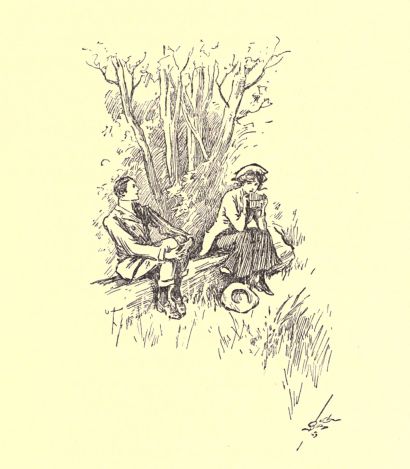
She put it to her lips and blew.
"Take it," she said; "I can't tell you more than I have; and yet it is all there, Chimneys. Read the riddle of the reeds if you can."
I took the pipe and turned it over carefully in my hands; but I fear my thoughts were rather of the hands that had fashioned it, the fingers that had danced nimbly upon the stops.
"There are seven reeds,—seven," she affirmed.
She amused herself by skipping pebbles over the surface of the water while I pondered. And I deliberated long, for one did not like to blunder before Hezekiah! Then I jumped up and called to her.
"One, two, three, four, five, six—seven! Not until the seventh man offers himself shall Cecilia have a husband! Is that the answer?"
For a moment Hezekiah watched the widening ripples made by the casting of her last pebble; then she came back and resumed her seat.
"You have done well, Chimney Man; and now I 'll not make you guess any more, though I found it all out for myself. When Aunt Octavia gave that memorandum-book to Cecilia, I knew it must have something to do with the seventh man. You know I love all Aunt Octavia's nonsense because it's the kind of foolishness I like myself, and the idea of a pretty little note-book to write down proposals in was precisely the sort of thing that would have occurred to my aunt. And it was in the bargain, too, that she herself should not in any way interfere, or try to influence the course of events: it should be the seventh suitor, willy-nilly. And I suspect she's been a little scared too."
"She has indeed! She was almost ready to throw the whole scheme over last night. Your naughtiness had got on her nerves."
"You missed the target that time: Aunt Octavia loves my naughtiness, and I think she has really been afraid Sir Pumpkin Wiggins would catch me. Now I did n't roam my aunt's house just for fun. I was doing my best to keep Cecilia from getting into some scrape about that seventh-suitor plan. I found out by chance how to get into Hopefield, and about the hidden stairway and the old rooms tucked away there. Papa really discovered that. A carpenter in Katonah who worked on the house helped to build papa's bungalow, and he told us how that ruin came to be there. That dyspepsia-cure man, who also immortalized himself by inventing the ribless umbrella, was very superstitious. He believed that if he built an entirely new house he would die. So he had his architect build around and retain those two rooms and that stairway of a house that had been on the ground almost since the Revolution. Mr. Pepperton, the architect, humored him, but hid the remains of the relic as far out of sight as possible."
"Trust Pep for that! And he did it neatly!"
"Yes; but it did n't save the umbrella-man; he died anyhow; or maybe his pies killed him. Papa was so curious about it that he took me with him one night just before Aunt Octavia moved here, and he and I found the rooms and the stair and the secret spring by which, if you know just where to poke the wall in the fourth-floor hall, you can disappear as mysteriously as you please."
"But how on earth did you darken the halls so easily? You nearly gave me heart-disease doing that!"
"Oh, that was a mere matter of a young lady in haste! When I found how easily I could pass you on the stair it became a fascinating game, and it was no end of fun to see just how long it would take you to catch me."
"I wish, Hezekiah, that you would stay caught!"
"Be very, very careful, sir! We're talking business now. There's another ordeal for you before you dare become sentimental."
"Then hasten; let us be after it."
"Things are in a serious predicament, I can tell you. I was frightened when I looked into that note-book,—I did n't like to do that, but I had to assist Providence a little. Five men have already got their quietus."
"Then why don't they clear out, and stop their nonsense?"
"Oh, it's their pride, I suppose; and every man probably thinks that when Cecilia has seen a little more of him in particular, in contrast with the others, he will win her favor. They 're afraid of one another, those men; that's the reason they've been herding together so close since that first day you came. Mr. Wiggins was taking it for granted that he was the whole thing—just like the man!—and those others forced him to join in some sort of arrangement by which they were to hang together. These calls in a bunch came from that, as though any one of them would n't take advantage of the others if he saw a chance! Some of this I got from Wiggy himself, the rest I just guessed."
"But you may not know that they sent a delegation after me into town, to warn me off the grass."
"That was Mr. Dick. He never saw me when Cecilia was around. And he was terribly snippy sometimes, and supercilious; but I'm going to get even with him. I've about underlined him for number six," she concluded, with the manner of a queen who, about to give her chief executioner his orders for the day, glances calmly over the list of victims.
"That's a good idea; Dick is insufferable; I hope you have n't counted wrong."
"As we were saying, about the note-book," she resumed, "the fifth man has already been respectfully declined. The dates of the proposals are written in the note-book; so I learned from the book that Mr. Ormsby, Mr. Arbuthnot, and Mr. Gorse had proposed on the steamer. Professor Hume, as you know, tried his luck at Hopefield; and Lord Arrowood must have stopped Cecilia as she was riding to the station on my bicycle yesterday morning. His goose is cooked."
"His gooseberry pie was cooked, but I took it away from him. No pie sacred to Hezekiah can be confiscated by an indigent lord so long as I keep my present health and spirits. It's the close season for lords in Westchester County; I potted the last one. By the way, he thought you were a real ghost when you were playing tag with him in the dark."
"He stopped to tell papa good-bye and spoke very highly of you; papa and you are the only gentlemen he met in America. But now we come to Mr. Wiggins."
"We do; and why in the name of all that is beautiful and good has n't he tried his luck?"
"Because, knowing Cecilia's admiration for him," replied Hezekiah demurely, "I have kept him so diverted that he has n't been able to bring himself to the scratch."
She examined the palm of her hand critically to allow me time to grasp this.
"You did n't want him to blunder in as the first, fourth, or sixth man?"
Hezekiah gravely nodded her pretty head.
"And while you were engaged in this sisterly labor, Cecilia has been afraid that you were seriously interested in him!"
"That is like Cecilia. She's fine, and would n't cause me trouble for anything;" and there was no doubt of Hezekiah's sincerity.
"But now that I see the light and understand all this, how can we make sure that Wiggy will be on the spot at the right moment? While we sit here, he may be the sixth man! There's my friend, the eminent thinker from Nebraska; he's likely to kneel before Cecilia at any moment, and Henderson and Shallenberger are not asleep."
"That's all true; and you've got to fix it."
"You're leaving the fate of Wiggins and your sister in my hands? That's a heavy responsibility, Hezekiah. I might take care of Wiggy by asking Cecilia to marry me, being careful to have him appear johnny-on-the-spot when I had been duly declined."
"Um, I should n't take any chances if I were you," she replied, feigning to look at an imaginary bird in a tree-top; "for if you had counted wrong and were really the seventh man, she would have to accept you!"
"Hezekiah!"
"Oh, I really did n't mean what you thought I meant. We don't need to discuss it any more. That's the ordeal I've arranged for you," she answered, and set her lips sternly.
"But, my dear Hezekiah, by what means can this be effected? I don't dare tell him the combination he's playing against or sit on him until his hour strikes."
"Certainly not; you must n't tell him or anybody else. You know the plan; but you're not supposed to; and nobody must know I've meddled. Meanwhile, Cecilia must expose herself to proposals at all times. Aunt Octavia's heart would be broken if she thought Providence had been tampered with. She likes Wiggy well enough, except that his ancestors were all Tories and he can't be a son of the Revolution."
"Too bad; it was very careless of him not to do better about his ancestors; but he can't change that now."
"Well, you've behaved with considerable intelligence so far, and now with your friend's fate in your hands you will need to use great judgment and tact in all that follows. I wash my hands of the whole business."
She rose quickly and pointed to her coat.
"Drop it into the boat for me, Chimneys. We meet in funny places, don't we? Papa expects me for luncheon, and I must row back and get my bicycle. You? No, you can't go along; you've got a lot of thinking to do, and you'd better be doing it."
XVIII
TROUBLE AT THE PRESCOTT ARMS
A few minutes later, as I swung along the highway toward the Prescott Arms, I saw Cecilia Hollister riding toward me at a lively gallop. She crossed the bridge without checking her horse, and then, with a hurried glance over her shoulder, she pointed with her crop to a by-way that led deviously into a strip of forest and vanished.
I hurried after her, and found her waiting for me in a quiet lane. She had dismounted and seemed greatly disturbed as I addressed her. Her horse, a superb Estabrook thoroughbred, had evidently been pushed hard. Cecilia had taken off her hat, and was giving a touch to the wayward strands of hair that had been shaken loose in her flight. The color glowed in her dark cheeks, and her eyes were bright with excitement.
"I hadn't expected to meet you; I thought you rode off with your aunt toward Mt. Kisco."
"We did; but on our way home Aunt Octavia stopped to call on a friend, and as I did n't feel in a mood for visits this morning I rode on alone."
She spoke further of her aunt's friend, of whom I had never heard before, to calm herself before touching upon the cause of her wild ride or her wish to speak to me. She pinned on her hat and drew on her riding-gloves while I helped to make conversation, and soon regained her composure. The haste with which she had withdrawn into the wood, and the imperative wave of her crop by which she had bidden me follow her, indicated that something of importance had happened and that she wished to confide in me.
"I was walking my horse in the road beyond Bedford, just after I left Aunt Octavia, when who should ride up beside me but Mr. Wiggins. He had evidently been following me."
She expected me to express surprise; and with the information that Hezekiah had just imparted fresh in my mind I dare say she was not disappointed in the effect of her words. I was thinking rapidly and fearfully. If my friend had sought her in the highway and offered himself in some fresh accession of ardor, he might even now be a rejected and hopeless man; but I was unwilling to believe that this had happened.
"Hartley is fond of riding, and nothing could be more natural than for him to have his horse sent out from town."
"Oh, it's natural enough," she cried; "but I was greatly taken aback when he rode up beside me."
"An old friend joining you in the highway, on a bright October morning! I can't for the life of me see anything surprising or alarming in that, Miss Hollister."
"But only yesterday, you remember I told you I had seen him walking with my sister."
"It's perfectly easy to talk to Hezekiah! It seems to me that that only shows a friendly attitude toward all the family. Let us deal with facts if I am to help you. I understand perfectly that Hartley Wiggins wishes to marry you; and that being the case I see no reason why he should n't be courteous to your sister. I 've always heard that it's the proper thing to be polite to the sisters, cousins, and aunts of one's prospective wife. I know of no more delightful occupation than listening to Hezekiah. Just now, for an hour or so, I have been enjoying her conversation myself. Nothing could be more refreshing or stimulating. She is an unusual young woman, and most amazingly wise."
"You have seen Hezekiah this morning!" she exclaimed.
"I have indeed. I hope I may say that she and I are becoming good friends. I am learning to understand her; though, believe me, I don't speak boastingly. However, this morning we got on famously together. But won't you continue and tell me what happened in the road when Hartley rode up beside you?"
"Oh, nothing happened; really nothing! Nothing could have happened, for the excellent reason that I ran away from him. It was n't what he did or said; it was the fear of what he might say!"
"If it had been Mr. Dick who had joined you in exactly the same way in the highway, you would not have minded in the least, Miss Hollister. Is n't that the truth?"
Her hand that had rested on the pommel of her saddle dropped to her side, and she stood erect, her eyes wide with wonder.
"What do you mean?" she gasped.
"I mean exactly what I have said; that if it had been that strutting young philosopher from the West you would—well, you would have allowed him to say what was in his mind, no matter whether it had been his latest thought on Kantianism, the weather, or his admiration for yourself. Am I not right?"
"I wonder, I wonder"—she faltered, drawing away, the better to observe me.