Chapter II · (continued 2)
Reading edition
"One of these days? Why, I have looked at the time-table, and it is my present intention to take the 12:03 into town. I have appointments at my office for the afternoon. I assure you, Miss Hollister, that I 'm a man of engagements, particularly at this season."
I remembered what Jewett had told me of Fortner, the painter, and his detention at Newport by Miss Octavia Hollister. I had no intention of being immured in any such fashion, and I was about to protest further when Cecilia took a step toward me, and after a glance at the door spoke in a low tone and with great earnestness.
"Mr. Ames, I have every reason to believe that you are a gentleman, and in that confident belief I 'm going to ask a favor of you. You have said that you know Mr. Hartley Wiggins well."
"I know no man better. You might not have inferred it from his manner last night, but he was undoubtedly surprised and embarrassed by my presence, and did not act quite like himself."'
"I think I understand the cause of that. If I should ask you to see him to-day and give him a message for me, could you do so?"
"It will be an honor to serve you; and a very simple matter, as I should see him on my own account if he is still in the neighborhood."
"He is doubtless at the Prescott Arms. My message is a verbal one. Please urge him not to make any effort to see me, and not to call here again. But at the same time, as the chimney smoked just as we were about to be left alone last night, I think—I think"—she hesitated a moment—"You may say that his interests have not been jeopardized by his temerity in calling."
In her pause before concluding this curious commission her eyes searched mine deeply, and I felt that she had not lightly entrusted me with this singular errand. Her dark eyes held mine an instant after she had spoken; then she smiled, and her face showed relief.
"Ask for anything you want. Aunt Octavia despises motors, so there 's no car here, but you will find plenty of horses and traps. Order whatever pleases you. I shall expect to meet you at dinner if not at luncheon—and so"—she smiled again—"will Aunt Octavia."
She nodded to me from the door, and I heard her running lightly upstairs.
Left to my own devices I rang the bell and ordered the library fire extinguished and the hearth cleaned. This required a little time; but the house man obeyed me readily, and soon, clad in my professional overalls and jumper, I was going carefully over the flue whose behavior had been so unaccountable the previous night. Guided by the servant I inspected the three fireplaces in the upper chambers that were served by flues in this chimney and finally dropped my torch and plumb-line from the chimney-pot. Never in all my experience had I seen better flues; but remembering my ghost at Shinnecock, I had the ashes thrown out of the dump in the cellar and found the chute in perfect order. I learned by inquiry that the other flues worked perfectly, but I nevertheless scrutinized them carefully. My freedom of the house afforded an excellent opportunity for a study of its beautiful construction. It was modern in every sense, with no dark, mysterious corners in which goblins might lurk. I prowled about with increasing admiration for Pepperton, and with a deepening sense of my own failure in the art which he adorned.
My professional labors were finished. I was quite ready for Miss Hollister's most searching inquiries. As for the library flue, I had decided that a little care in piling the logs in the hearth would obviate the possibility of any recurrence of the difficulty. And I thereupon hurried to my room, and after a tub (my vocation encouraged frequent tubbing) chose from the stable a neat trap for one horse. Thus equipped I set out to find Wiggins.
The Prescott Arms is an inn that sprang into being with the advent of motoring. The tourist is advised of his approach to it by signs swung at the crossways, and its plaster and timber walls are in plain sight from one of the excellent state roads. Gasoline and other liquids are offered there; one may have tea or an ampler meal on short notice; and a few guests may be lodged in case of necessity. I remembered it well, having several times found it a haven on motor-flights with friends. As I drove into the entrance I saw Wiggins pacing the long veranda. He waved a hand and came out to meet me, and when I had rid myself of the trap he suggested that we take a walk.
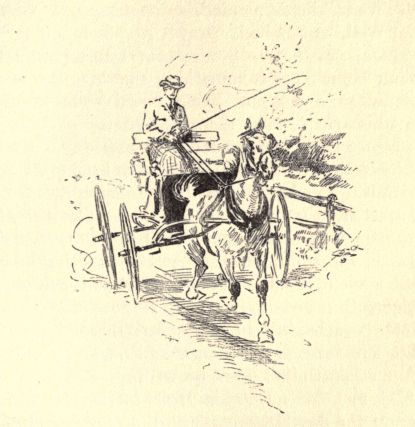
As I drove into the entrance.
His manner was not cordial, and he wore the haggard look of a man on bad terms with his pillow. I attributed his appearance to preoccupation with his love-affair. When we had withdrawn a little way from the inn he turned on me sharply.
"Well?" he demanded.
"Well," I laughed.
"Oh, you needn't take that tone about it! Your being here is something that requires explanation; and your being there"—he flung out his arm toward Hopefield Manor—"your presence there is not a laughing matter."
"My dear Wiggins, I came here in a spirit of friendship, and you treat me like a pickpocket. I must say that if you had not acted like a clam the other night at the club, but had told me what was in the wind, we might not be meeting now like ancient enemies instead of old and intimate friends."
He vouchsafed no reply, but threw himself down under a scarlet maple and began to whittle a stick, while I went on with my story.
"I met Miss Octavia Hollister in the Asolando the day after our last dinner at the club. I had dropped into the tea-room merely to look at the place again. I had never seen her before in all my life. She is a whimsical old lady—but a lady, you must admit that—and we exchanged cards. On learning my occupation she at once declared that I must come up here to look at her chimneys. She made an appointment by mail for yesterday afternoon. It is not my fault that she treated me like a guest, or that she introduced me of necessity to her niece Cecilia. And now I have finished my work, and after I have made my report I shall probably not meet her again. As for Miss Cecilia Hollister, I can only say, my dear Wiggins, that she is a rarely beautiful woman, and that if you wish to marry her you have my very best wishes for your success and happiness."
"It struck me that you were pretty well established there," he blurted. "I confess that I took it for granted you were not there wholly on a professional errand; and I won't deny, Ames, that I was not pleased to see you."
"You honor me in assuming that I might aspire to the hand of so splendid a woman as Cecilia Hollister; but, my dear Wiggins, I tell you I never laid eyes on her until last night."
"But you had been to the Asolando," he persisted, hacking away doggedly at his stick.
"Of course I had. I told you I had. I told you the whole story. But I did not see Cecilia Hollister there. She was n't there! I fancy that after you saw her there last spring and became infatuated with her and followed her to Europe instead of going to Dakota to harvest your blooming wheat—after that bit of history she never returned to the Asolando. Your lack of frankness in all this has pained me. And you left it for a gossiping chap like Jewett to tell me the whole story. And to cap your duplicity you sneaked out of the club the other night while Jewett was talking to me and let the club people think you were bound for your ranch. I call it rather low down, Wiggins, after all the years we have known each other. My slate is clean; how about yours?"
He threw the stick at a sparrow whose chirp irritated him from a stone fence beyond us, and turned toward me a countenance on which dejection, humiliation, and chagrin were written large.
"Damn it all!" he bellowed, "I believe I 'm losing my mind. I don't know what I 'm doing. That old woman up there is responsible for all this. She 's as crazy as a March hare,—crazier! And she 's made a prisoner of that girl. I tell you Cecilia Hollister is the grandest girl in the world."
"Go it, son! Those descendants of Cæsar's legions at work in the road down there are pausing to listen. Try to affect calmness if you don't feel it. I agree to all you say of Miss Cecilia. And please get it into your noddle that I have no intention of becoming your rival for her hand. But I must beg of you also not to speak in such terms of her aunt. She 's the most delightful woman I ever met."
"Mad, I tell you, quite mad!"
"Wise,—with the most beautiful wisdom; you simply don't understand her."
"I know all I want to about her. If she were not insane she would not build a wall of mystery about her niece and keep me camping out here not knowing where I stand. I tell you, Ames, that woman is a malevolent being; she 's perfectly fiendish."
There is no way of answering a man in this humor save by laughter; and I laughed long and loud, to the consternation of the Italian road-laborers who were now swallowing their luncheons a short distance away from us.
Wiggins sulked awhile and then addressed me seriously.
"I didn't tell you I was going abroad, because the situation made explanations difficult. I could hardly tell you that I was about to race over Europe after a waitress I had seen in a tea-room. You 're always so confoundedly suspicious. It would have an odd sound even now if she were—well, if she were a waitress instead of what you know her to be. And my animosity toward Miss Octavia Hollister is due to the fact that after I had been as courteous to her all summer long as I could, and thought myself tolerably established in her mind as a decent person and a gentleman, she suddenly shuts Cecilia up in that house,—bought it on purpose, I fancy,—and Cecilia herself is compelled to take on an air of mystery, warning me to keep away, suggesting the darkest possibilities, but giving me no hint whatever of the reason for her conduct."
"Let us confine ourselves to Miss Octavia for a moment. While you were acting as cavalier to her party abroad she was friendly; then she suddenly changed. Now there must be some explanation of that."
"Well, for one thing, she flew off at a tangent about my ancestors. We were in Berlin on the Fourth of July and got to talking about the American revolution. She asked me what my people had done for the patriotic cause. The painful fact is that most of them were Tories; but my great-grandfather broke with his father and brothers, joined Washington's army, and fought through the whole business. But to save the feelings of the rest of them, who went to England till it was all over, he changed his name. There's no mention of him in the war records anywhere. I've had experts working on it, but they can't find any trace of him. He was greatly embittered by the estrangement from his people, and though he had a farm in this very neighborhood somewhere—I 've thought sometime I 'd look it up and try to get hold of it—he never mentioned his military experiences even to his own children. Usually Miss Hollister changes front if you give her time. I've heard her say that we'd have been better off if we'd never broken with England; but she persists in prodding that weak place in my armor."
"That's very dark, Wiggy. If she keeps it up you'll have to dig up your great-grandfather someway. The spiritualists might call him on long distance. But let us turn to Miss Cecilia. I don't for a moment believe that she is a victim of ancestor worship. The perambulator rampant adorns the Hollister shield to the exclusion of everything else. From what you say Cecilia has not repelled you; on the other hand she has frankly given you to understand that you must not press your suit at this time for reasons she sees fit to withhold. A little more patience, a little calm deliberation and less violent language, and in due course the girl is yours. Now what do you fancy is the cause of Cecilia's abrupt change of attitude?"
He refused to meet my eyes, but turned away as though to conceal an embarrassment whose cause I could not surmise. When he spoke it was in a voice husky with emotion.
"Am I a cad? Am I beneath the contempt of decent people?"
"It's possible, Wiggy, that you are. Go on with it."
"Well, you know," he began diffidently, "Cecilia has a sister."
I grinned, but his scowl brought me to myself again.
"Yes. And her name is Hezekiah. The name pleases me."
"She was with Miss Octavia in her gallop over Europe, so I saw a good deal of her necessarily. She is younger than Cecilia; she's a good deal of a kid,—the sort that never grows up, you know."
"Just like her aunt Octavia!"
"Bah! Don't mention that woman. Hezekiah is a very pretty girl; and I suppose,—well, when you are thrown with a girl that way, seeing her constantly"—
I clapped my hand on his knee as the light began to dawn upon me.
"You old rascal, you don't need to add a single word! I dare say you are guilty. I can see it in your eye. After waiting till you reached years of discretion before beginning an attack upon womankind, you began mowing them down in platoons. So they come running now that you 've got a start. Oh, Wiggy, and I believed you immune! And you 're trying to drive 'em tandem."
The thing was funny, knowing Wiggins as I did, and I gave expression to my mirth; but his fierce demeanor quickly brought me back to the serious contemplation of his difficulty.
"That, you shameless wretch, would be a sufficient reason for Miss Octavia's aloofness,—your double-faced dealing with her nieces? You confirm my impression that she is a wise woman. And Cecilia, I take it, may be deeply embarrassed by her sister's infatuation for you. You certainly have made a tangle of things, you heart-wrecker, you conscienceless deceiver! But where, may I ask, does this Hezekiah keep herself?"
"Oh, she's with her father. They have a bungalow over the hills there, several miles from Hopefield Manor."
"Well, I hope you are no longer toying with her affections. Of course you don't see her any more?"
"Well," he mumbled, "I did see her this morning. But I could n't help it. It was the merest chance. I met her in the road when I was out taking a walk. She 's always turning up,—she's the most unaccountable young person."
"I suppose, Wiggy, that if you stand in the road and Miss Hezekiah Hollister strolls by on her way to market, you fancy that she is pursuing you. As Miss Octavia has well said, this is not a chivalrous age. I 'm deeply disappointed in you. Your conduct and your attitude toward this trusting young girl are disgraceful."
He rose and flung up his arms despairingly. It was much easier to laugh at Wiggins than to be angry at him; but I recalled the message which Cecilia had entrusted to me, and this, I thought, might give him some comfort.
"Miss Cecilia asked me this morning to say to you that you must not try to see her again; you must keep away from the house."
This obviously increased his dejection.
"But," I added, "I was to say that she thought nothing had yet occurred to interfere with your ambitions, as you were not permitted to see her alone last night. The chimney, you may remember, began playing pranks just at the moment when Miss Hollister and I were about to adjourn to the billiard-room, so a tête-à-tête between you and Cecilia was impossible."
"She told you to see me?"
"She certainly did. I confess that my message does n't seem luminous, but I have a feeling that she meant to be kind. It may be that she is giving you time to disentangle yourself from the delectable Hezekiah's meshes. I can't elucidate; I merely convey information. But answer honestly if you can: has Cecilia ever by word or act refused you?"
"No," he replied grimly; "she 's never given me the chance!"
He asked me to luncheon, and on the way back to the inn, after inquiring my plans for returning to town, he proposed that I delay my departure until the following day. What he wanted, and he put it bluntly, was a friend at court, and as I had seemingly satisfied him of my entire good faith and of my devotion to his interests, he begged that I prolong my stay in Miss Hollister's house, giving as my excuse the condition of the chimneys of Hopefield Manor. He brushed aside my plea of other engagements and appealed to our old friendship. He was taking his troubles hard, and I felt that he really needed counsel and support in the involved state of his affairs. I did not see how my continued presence under Miss Hollister's roof could materially assist him, and the thought of remaining there when there was no work to be done was repugnant to my sense of professional honor; but he was so persistent that I finally yielded.
While we ate luncheon I sought by every means to divert his thoughts to other channels. After we were seated in the dining-room four other men followed, exercising considerable care in placing themselves as far from one another as possible. A few moments later a motor hummed into the driveway, and we heard its owner ordering his chauffeur to return to town and hold himself subject to telephone call. This latest arrival appeared shortly in the dining-room, and surveying the rest of us with a disdainful air, sought a table in the remotest corner of the room. Others appeared, until eight in all had entered. The presence of these men at this hour, their air of aloofness, and the care they exercised in isolating themselves, interested me. They appeared to be gentlemen; they were, indeed, suggestive of the ampler metropolitan world; and one of them was unmistakably a foreigner.
While Wiggins appeared to ignore them, I was conscious that he reviewed the successive arrivals with every manifestation of contempt. One of these glum gentlemen seemed familiar; I could not at once recall him, but something in his manner teased my memory for a moment before I placed him. Then it dawned upon me that he was the third man I had met in the field overhanging the garden after my eavesdropping experience the day before. I thought it as well, however, not to mention this fact, or to speak of the man I had seen so grimly posted in the midst of the cornfield. I was an observer, a looker-on, at Hopefield, and my immediate business was the collecting of information.
"Will you kindly tell me, Wiggy, who these strange gentlemen are and just what has brought them here at this hour? They seem greatly preoccupied, and the last one, in particular, surveyed you with a murderous eye. If we could be translated to some such inn as this in the environs of Paris, I should conclude that a duel was imminent and that these gentlemen were assembling to meet after their coffee to-morrow morning for an affair of honor."
"I know them; they are guests of the inn. Most of them were more or less companions in our procession across Europe last summer. The one in the tan suit is Henderson; you must have heard of him. The short dark chap of atrabilous countenance is John Stewart Dick, who pretends to be a philosopher. As for the others"—
He dismissed them with a jerk of the head. My wits struggled with his explanation. It is my way to wish to reduce information to plain terms.
"Are these gentlemen, then, your rivals for the hand of Miss Cecilia Hollister? If so, they are a solemn band of suitors, I must confess."
"You have hit it, Ames. They are suitors, assembled from all parts of the world."
"Nice-looking fellows, except the chap with the monocle, who has just ordered rather more liquor than a gentleman should drink at this hour."
"That is Lord Arrowood. I have feared at times that Miss Octavia favored him."
"Possibly, but not likely. But how long is this thing going to last? If you fellows are going to hang on here until Miss Cecilia Hollister has chosen one of you for her husband, I shudder for your nerves. I imagine that any one of these gentlemen is likely to begin shooting across his plate at any minute. Such a situation would become intolerable very quickly if I were in the game and forced to lodge here."
"I hope," replied Wiggins with heat, "that you don't imagine these fellows can crowd me out! I 've paid for a month's lodging in advance, and if you will stand by me I 'm going to win."
"Spoken like a man, my dear Wiggins! You may count on me to the sweet or bitter end, even if I pull down all the superb chimneys with which Pepperton adorned that house up yonder."
He silently clasped my hand. A little later I telephoned from the inn to my office explaining my absence and instructing my assistant to visit several pressing clients; and I instructed the valet at the Hare and Tortoise to send me a week's supply of linen and an odd suit or two.
At about three o'clock I left Wiggins in first-rate spirits and set out on my return to Hopefield Manor. I felt the eyes of the eight other suitors, who were scattered at intervals along the verandah, glued to my back as I drove out of the inn yard.
VII
NINE SILK HATS CROSS A STILE
A girl in a white sweater sat on a stone wall and munched a red apple; but this is to anticipate.
I had made a wrong turn on leaving the Prescott Arms, and I came out presently near Katonah village. I got my bearings of a shopkeeper and started again for Hopefield Manor; but the mid-afternoon was warm, and the hills were steep, and as Miss Hollister's admirable cob showed signs of weariness, I drove into a fence-corner and loosened the mare's check. On a sunny slope several hundred yards above the highway lay an orchard, advertised to the larcenous eye by the ruddiest of red apples. Not in many years had I robbed an orchard, and I felt irresistibly drawn toward the gnarled trees, which were still, in their old age, abundantly fruitful.
When I reached the orchard I found it quite isolated, with only fallow fields, seamed with stone fences, stretching on either hand. A spring near by sent the slenderest of brooks flashing down the slope. There was no house in sight anywhere, and the neglected orchard flaunted its bright fruit with pathetic bravado. I drew down a bough and plucked my first apple, tasted, and found it good. At my palate's first responsive titillation, something whizzed past my ear, and following the flight of the missile, I saw an apple of goodly size fall and roll away into the grass. I had imagined myself utterly alone, and even now, as I looked guiltily around, no one was in sight. The apple had passed my ear swiftly and at an angle quite un-Newtonian. It had been fairly aimed at my head, and the law of gravitation did not account for it. As I continued my scrutiny of the landscape, I was addressed by a voice whose accents were not objurgatory. Rather, the tone was good-natured and indulgent, if not indeed a trifle patronizing. The words were these:—
"Soup of the evening, beautiful soup!"
It was then that, lifting my eyes, I beheld, sitting lengthwise of the wall, with her feet drawn comfortably under her, a girl in a white sweater, bareheaded, munching an apple. There was no question of identity: it was the girl whose head behind the cashier's grill of the Asolando had interested me on the occasion of my second visit to the tea-room. In soliciting my attention by reciting a line of verse, she had merely followed the rule of the tea-room in like circumstances. The casting of the apple at my head possessed the virtue of novelty, but now that her shot was fired and her line spoken, she addressed herself again to her apple. Her manner implied indifference; but her unconcern was that of a trout not wishing to discourage the fisherman, feigning a languid interest in a familiar fly dropped at its nose. While I tried to think of something to say, I pecked at my own apple, but kept an eye on her. She concluded her repast calmly and flung away the core.
"I mentioned soup," she remarked. "The courses are mixed. We have partaken of fruit. Are you fish, flesh, fowl, or good red herring?"
"Daughter of Eve, I will be anything you like. I 'm obliged for the apple, and I apologize for having entered Eden uninvited."
"It's not my Eden. Nobody invited me. But it's not too much to say that these apples are grand."
"I 'm glad we 're both in the same boat. I 'm a trespasser myself. I don't even know the name of the owner. But if you have had only one apple, two more are coming to you, if you follow Atalanta's precedent."
"I don't follow precedents, and I 've forgotten the name of the boy who threw the apples in the race. It does n't matter, though; nothing matters very much."
Her hands clasped her knees. Her skirt was short, and I was conscious that she wore tan shoes. She continued to regard me with lazy curiosity. She seemed younger than at the Asolando. Not more than eighteen times had apples reddened on the bough in her lifetime! She was even slenderer and more youthful in her sweater than in the snowy vestments of the Asolando. Her hair which, in the glow of the lamp at Asolando cash-desk had been golden, was to-day burnished copper, and was brushed straight back from her forehead and tied with a black ribbon.
"I quite agree with your philosophy. Nothing is of great importance."
"So it's not your orchard?" she asked.
"The thought flatters me. I own no lands nor ships at sea. I 'm a chimney doctor, and if necessary I 'll apologize for it."
"You needn't submit testimonials; I take the swallows out of my own chimneys."
"That requires a deft hand, and I 'm sure you 're considerate of the swallows."
"You may come up here and sit on the wall if you care to. I saw you driving in a trap. I hope your horse is n't afraid of motors; motors speed scandalously on that road."
"I am not in the least worried about my horse. It's borrowed. As you remarked, this is a nice orchard. I like it here."
"If you are going to be silly, you will find me little inclined to nonsense."
"Shall we talk of the Asolando? I haven't been back since I saw you there. And yet,—let me see, is n't this your day there?"
She seemed greatly amused; and her laughter rose with a fountain-like spontaneity, and fell, a splash of musical sound, on the mellow air of the orchard. She had changed her position as I joined her, sitting erect, and kicking her heels lazily against the wall.
"Mr. Chimney Man, something terrible happened just after you left that afternoon. I was bounced, fired; I lost my job."
"Incredible! I 'm sure it was not for any good cause. I can testify that you were a model of attention; you were surpassingly discreet. You repelled me in the most delicate manner when I intimated that I should come often on the days that you made the change."
"The sad part of it was that that was not only my last day but my first! I had never been there before, except for a nibble now and then when I was in town. But I could n't stand it. It was like being in jail; in fact, I think jail would be preferable. But I 'm glad I spent that one day there. It proved what I have long believed, that I am a barbarian. That poetry on the walls of the Asolando made me tired, not that it is n't good poetry, but that the walls of a tea-shop are no place for it. I always suspect that people who like their poetry framed, and who have uplift mottoes stuck in mirrors where they can study them while they brush their hair in the morning, never really get any poetry inside of them. You need a place like this for poetry,—an old orchard, with blue sky and a crumbly wall to sit on. I tried the Asolando as a lark, really, not because I 'm deeply entertained by that sort of thing. They dispensed with my company because I remarked to one of the silly girls who are making the Asolando their life-work that I thought the English Pre-Raphaelites had carried the dish-face rather too far. The girl to whom I uttered this heresy was so shocked she dropped a tea-cup,—you know how brittle everything is in there,—and I came home. You were really the only adventure I got out of my day there. And I did n't find you entirely satisfactory."
"Thank you, Francesca, for these confidences. And having lost your position you are now free to roam the hills and dream on orchard walls. Your scheme of life is to my liking. I can see with half an eye that you were born for the open, and that the walls of no prison-house can ever hold you again."
She nodded a dreamy acquiescence. Then she turned two very brown eyes full upon me and demanded:—
"What is your name, please?"
I mentioned it.
"And you doctor chimneys? That sounds very amusing."
"I 'm glad you like it. Most people think it absurd."
"What are you doing here? There's not a chimney in sight."
"Oh, I have a commission in the neighborhood. Hopefield Manor; you may have heard of Miss Hollister's place."
"Of course; every one knows of her."
"And now that I think of it, it was she about whom you asked in the Asolando that afternoon. You wanted to know what she said about the tea-room."
"I remember perfectly."
She was quiet for a moment, then she threw back her head and laughed that rare laugh of hers.
"You might let me into the joke."
"It would n't mean anything to you. I have a lot of private jokes that are for my own consumption."
"Your way of laughing is adorable. I hope to hear more of it. In the Asolando you repulsed me in a manner that won my admiration, but I venture to say now that, if you roam these pastures, I am the grass beneath your feet; and if yonder tuneful water be sacred to you, I sit beside the brook to learn its song."
"You talk well, sir, but from your tone I fear you can't forget that we met first in the Asolando. That day of my life is past, and I am by no means what you might call an Asolandad. I don't seem to impress you with that fact. I 'm a human being, not to be picked like a red apple, or trampled upon like grass, or listened to as though I were a foolish little brook. I 'm greatly given to the highway, and I prefer macadam. I like asphalt pavements, too, for the matter of that. I should love a motor, but lacking the coin I pedal a bicycle. My wheel lies down there in the bushes. You see, Mr. Chimney Man, I am a plain-spoken person and have no intention of deceiving you. My name was Francesca for one day only. It may interest you to know that my real name is Hezekiah."
"Hezekiah!"
I must have shouted it; she seemed startled by my violence.
"You have pronounced it correctly," she remarked.
"Then you are Cecilia's sister and Miss Hollister's niece."
"Guilty."
"And you live?"—
"Over there somewhere, beyond that ridge," and she waved her hand vaguely toward the village and laughed again.
"Pray tell me what this particular joke is: it must be immensely funny," I urged, struggling with these new facts.
"Oh, it's Aunt Octavia! She will be the death of me yet! You know the girl who waited on Aunt Octavia that afternoon took all that artistic nonsense as seriously as a funeral, and she told me after you left, with the greatest horror, that Aunt Octavia had asked for a cocktail!" That laugh rippled off again to carry joy along the planet-trails above us. "But you know," she resumed, "that Aunt Octavia never drank a cocktail in her life,—and would n't! She does n't know a cocktail from soothing syrup! She pines for adventures. She is just like a boarding-school girl who has read her first romance of the young American engineer in a South American republic, shooting the insurgents full of tortillas and marrying the president's dark-eyed daughter. She reads pirate books and is crazy about buried chests and pieces of eight. And they say I 'm just like her! She is the most perfectly killing person in the world!"
Hezekiah laughed again.
So this was the child whose devotion had rendered Wiggins so miserable, and the sister of whom Cecilia Hollister and her aunt had spoken so strangely. I had not suspected it. She was as unlike Cecilia as possible, and the difference lay in her independent spirit and bubbling humor. Her individuality was more pronounced. You took her, without debate, on her own ground; and though she had expressed a preference for macadam, she seemed related to the days when maidens sat on sunny walls and were not disappointed in their expectation that light-footed youths, or mayhap winged sons of the Olympians, would reward patient waiting. But at the same time she struck the note of modernity. Her flings at the Asolando were reassuring; she was a healthy-minded, vigorous young woman whose nature protested against affectation and pose. She rebelled against closed doors, whether those of town or country. I am myself much of a cockney, and not averse to asphalt and streets ablaze with electric banners. My imagination sprang to meet this Hezekiah. I had, in fact, a feeling that I had waited for her somewhere in some earlier incarnation. She jumped down from the wall, shook three apples from a tree, and sustained them in the air with the deftness and certainty of practised jonglerie. Her absorption was complete, and when she wearied of this sport, she flung the apples away, one after the other, with a boy's free swing of the arm. Herrick would have delighted in her; Dobson would have spun her bright hair into a rondeau; but only Aldrich, with a twinkle in his eye, could have brought her up to date in a dozen chiming couplets. I felt that no matter how much one admired and respected this Hezekiah one would never deal with her in the phrases of drawing-rooms. Her charming inadvertences made this impossible; and it was the part of discretion to await her own initiative.
She had gone on up to the crest of the orchard, and stood clearly limned against the sky, her hands thrust into the pockets of her sweater. She appeared to be intent upon something that lay beyond, and half turned her head and summoned me by whistling. I liked this better than the quotation method of address. It was a clear shrill pipe, that whistle, and she emphasized it further by a peremptory wave of her arm. When I stood beside her I was surprised to find that the site commanded a wide area, including the unmistakable roofs and chimneys of Hopefield Manor half a mile distant.
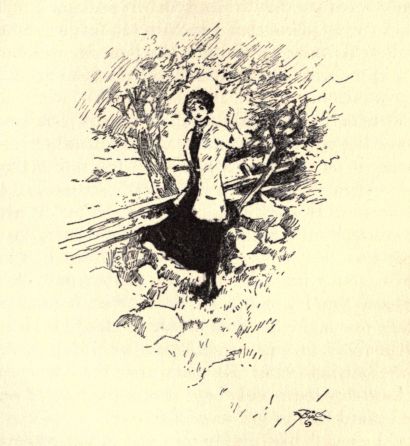
She emphasized it further by a peremptory wave of her arm.
"You will see something funny down there in a minute. They are out of sight now, but there 's a stile—the kind with steps, just beyond those trees. It's in a path that leads from the Prescott Arms to Aunt Octavia's. Look!"
My eyes discovered the stile. It was set in a wall that was, she told me, the boundary dividing Hopefield Manor from another estate nearer our position.
Suddenly a silk hat bobbed in the path beyond the stile; it rose as its owner mounted the steps; it paused an instant when the top of the stile was reached; then quickly descended, and came toward us, a black blot above a black coat. I was about to ask her the meaning of this apparition when a second silk hat bobbed in the path and then rose like its predecessor, descending and keeping on its way until hidden from our sight by shrubbery. A third, fourth, fifth, sixth, seventh, eighth, and ninth followed. Nine gentlemen in silk hats crossing a stile in a lonely pasture between woodlands; so much was plain to the eye from our vantage-ground; but I groped blindly for an explanation of this spectacle. The bobbing hats and dark coats suggested wanderers from some dark Plutonian cave, bent upon mischief to the upper world. Their step was jaunty; they moved as though drilled to the same cadence.
We waited a moment, expecting that another figure might join the strange procession, but nine was the correct count. I looked down to find Hezekiah checking them off on the fingers of her slim brown hand.
"Has there been a funeral and are they the returning pall-bearers?" I inquired.
"Not yet," she replied.
Her face showed amusement; the twitching of her lips encouraged hope that another of those delightful laughs was imminent.
"It was positively weird," I said. "It reminds me of a dream I used to have, when I was a boy, of a long line of Chinamen running along the top of a great wall,—an interminable procession. I must have dreamed that dream a hundred times. I could hear the pigtails of those fellows flapping against their backs as they trotted along, and the soft scraping of their sandals on the smooth surface of the wall. But the pot hats are equally eerie and unaccountable to my dull twentieth-century senses. Pray tell me the answer, Hezekiah."
"Oh, those are Cecilia's suitors. They've been to Aunt Octavia's to tea. They 're staying at the Prescott Arms probably."
"They 're terribly formal. I can't get rid of the impression of sombreness created by those fellows. You 'd hardly expect them to tramp cross country in those duds. Such grandeur should go on wheels."
"Oh, they are afraid of Aunt Octavia! She won't allow a motor on her grounds; and I suppose they 're afraid they might break some other rule if they went on any kind of wheels. She 's rather exacting, you know, my aunt Octavia."
"I was at the Prescott for luncheon to-day, and I must have seen these gentlemen there."
"Oh, you were at the Prescott?"
Almost for the first time her manner betrayed surprise; but mischief danced in the brown eyes. With Wiggins's confession as to the havoc he had played with Hezekiah's confiding heart fresh in my memory, I felt a delicacy about telling her that it was to see Wiggins that I had visited the inn. But to my surprise she introduced the subject of Wiggins immediately, and with laughter struggling for one of those fountain-like splashes that were so beguiling.
"Oh, Wiggy is staying there! Do you know Wiggy?"
"Know Wiggy, Hezekiah? I know no man better."
"Wiggy is no end of fun, isn't he? I've heard him speak of you. You are his friend the Chimney Man. He was the last man over the stile. Did you notice that he lingered a moment longer at the top than the others? From his being the ninth man I imagine that he was the last to leave the house, and he probably felt that this set him apart from the others. Wiggy is nothing if not shy and retiring."
A heart-broken, love-lorn girl did not speak here. She whistled softly to herself as we descended. The air was cooling rapidly, and the west was hung in scarlet and purple and gold. The horse neighed in the road below, and I knew that I must be on my way to the Manor.
"Hezekiah," I said, when I had drawn her bicycle from its hiding-place, "you 'd better leave your wheel here and let me drive you home. It's late and there 's frost in the air. I imagine it's some distance to your house."
"Thank you, Mr. Chimney Man; but it is much farther to Aunt Octavia's, for you have to make a long circuit around the hills. And besides, as we met in the orchard, it would be altogether too commonplace a conclusion of our adventure for you to drive me home behind a mere horse. But tell me this: what do you think of Wiggy's chances?"
"Of winning your sister? I should say from my knowledge of Wiggins that he is a man much given to staying in a game once the cards are shuffled."
She nodded, standing beside her wheel, her hands on the bars. Her manner was contemplative; her eyes for a moment were deep, shadowless pools of reverie.
"Then you think he knows the game?"
There seemed to be something beneath the surface meaning of her words, but I answered:—
"Wiggy's affairs have been few, and while he may not know the game in all its intricacies, he has a shrewd if rather slow mind, and besides, he has asked my help in the matter."
"One of these speak-for-yourself-John situations, then? Well, I should say, Mr. Chimney Man, I should say"—
She made ready for flight, looking ahead to be sure of a clear thoroughfare.
"I should say," she concluded, settling her skirts, "that that indicates considerable intelligence on Wiggy's part."
The tires rolled smoothly away; the gravel crunching, the pebbles popping. The white sweater clasped a straight back snugly; then suddenly, as the wheels gained momentum, she bent low for a spurt, and her rapidly receding figure became a gray blur in the purple dusk.
VIII
CECILIA'S SILVER NOTE-BOOK
Miss Octavia was in the gayest spirits at dinner that night, and struck afield at once with one of her amusing dicta.
"Human beings," she said, "may be divided into two groups,—interesting and uninteresting; but idiots abound in both classes."
Cecilia and I discussed this with more or less gravity, until we had exhausted the possibilities, Miss Octavia following with apparent interest and setting us off at a new tangent when our enthusiasm lagged. She referred in no way whatever to her chimneys, nor did she ask me how I had spent the day. I felt the pleading of Cecilia's eyes that I should accept the situation as it stood, and having already agreed to Wiggins's suggestion that I abide in Miss Hollister's house as a spy,—for this was the ignoble fact,—I felt the threads of conspiracy binding me fast. So far as my hostess was concerned, I was now less a guest than a member of the household.
The variety of subjects that Miss Octavia suggested was amazing. From aeronautics to the negro question, from polar exploration to the political conditions in Bulgaria, she passed with the jauntiest insouciance and apparently with a considerable fund of information to support her positions. She knew many people in all walks of life. I remember that she spoke with the greatest freedom of the Governor of Indiana, whom she had met on a railway journey. She quoted this gentleman's utterances with keenest zest. His anecdotal range she declared to be the widest and raciest she had ever encountered in a considerable acquaintance with public characters. She thought the Hoosier statesman eminently fitted by reason of his acute sense of humor for the office of president.
"That man," said Miss Octavia, "was splendidly equipped for handling the most perplexing affairs of state. It seemed absurd that his public services should be limited to the petty business of a commonwealth whose chief products are pawpaws, persimmons, and politics. The governor told me that before his election he had been sorely beset by reformers. They had teased him persistently to express his views on the most absurd questions. They wanted him to promise all manner of things before they gave him their support. And finally, to appease them, he answered that he would combine their questions in one and reply to all that, the earth being round, he would, if elected, do all in his power to make it square. This he found to be perfectly satisfactory to the reformers. Solomon was a mere tyro in wisdom compared with that man. You would n't expect so much sagacity in one who, by his own frank confession, had been raised on fried meat, and who declared that if grand opera were attempted in his state he would suspend the writ of habeas corpus and call out the militia to suppress it."
I was not at all sure whether the governor whom she quoted with so great delight was an actual person or a myth upon whom Miss Octavia hung her own whimsicalities; but as if to rebuke my skepticism, she dwelt on this personage at considerable length, inviting my own and Cecilia's questions as to her knowledge of him.
"I didn't suppose," remarked Cecilia provocatively, "that Indiana was really a place that you could go to on trains, but a kind of imaginary kingdom like Eppenwelzen-Sarkeld or Grunewald or Zenda, or an extinct place in Asia where lions crouch upon the ruins in the moonlight."
"Indiana," said Miss Octavia sternly, "is a commonwealth for which I have always had the greatest veneration, and which, in due course, I hope to visit. In the early seventies my father, the late Hezekiah Hollister, invested a considerable part of his fortune in Indiana farm-mortgages. On these investments the interest was paid with only the greatest reluctance and in the most fitful fashion. This, I think, argues for a keen sense of humor in the Hoosier people. Interest is something that I should never think of paying in any circumstances, as I have always considered it immoral. My father, keenly enjoying the playfulness of the Hoosiers in this particular, saved himself from loss merely by raising the price of baby-cabs throughout the world, and gave the mortgages as a free gift to the Society for the Amelioration of the Condition of Good Indians. All the good Indians being dead, the society had no expenses except officers' salaries, and as the Hoosiers gave up politics for a season and raised enough corn to pay their debts, the society became enormously rich."
As we rose from the table Miss Octavia declared that she must show me the pie-pantry. I was now so accustomed to her ways that I should not have been in the least surprised if she had proposed opening a steel vault filled with a mummified Egyptian dynasty.
"The gentleman who built this house," she explained, "had already grown rich in the manufacture of the famous ribless umbrella before he acquired a second fortune from a nostrum warranted to cure dyspepsia. He was inordinately fond of pies, and in order that this form of pastry might never be absent from his home, he had a special pantry built to which he might adjourn at his pleasure without any fear of finding the cupboard bare."
She led the way through the butler's pantry and into a small cupboarded room adjoining the table-linen closet. At her command the butler threw open the doors, and disclosed lines of shelves so arranged as to accommodate, in the most compact and orderly form imaginable, several dozens of pies. These pastries, in the pans as they had come from the oven, peeped out invitingly. Miss Octavia explained their presence in her usual impressive manner.
"It was one of the conditions of the sale of this house to me by the original owner's executors that the pie-vault should be kept filled at all times, whether I am in residence here or not. He felt greatly indebted to pie for the success of the dyspepsia cure. It had widened and steadily increased the market for the cure, and pie was to him a consecrated and sacred food. It was his habit to eat a pie every night before retiring, and on the nightmares thus inspired he had planned the strategy of all his campaigns against dyspepsia. The man had elements of greatness, and these shelves are a monument to his genius. In order to keep perfect my title to this property it is necessary for me to maintain a pastry-cook, and as I do not myself care greatly for pie—though contrary to common experience I have found it a splendid antephialtic—the total output is distributed among the people of the neighborhood every second day. The station agent at Bedford is a heavy consumer, and a retired physician at Mt. Kisco has a standing order for a dozen a week. My niece Hezekiah, of whom you have heard me speak, is partial to a particular type of pie and one only. It is the gooseberry that delights Hezekiah's palate, and under G in File 3, in the corner behind you, there is even now a gooseberry pie that I shall send to Hezekiah, who, for reasons I need not explain, does not now visit here."
"But the dyspepsia man—you speak of him as though he were dead."
"Your assumption is correct, Mr. Ames. The builder of Hopefield died only a few weeks after he had established himself in this house. Having entered upon the enjoyment of his well-earned leisure, and made it unnecessary that he should ever go pieless to bed, he gave himself up for a fortnight to a mad indulgence in meringues, and died after great suffering, steadily refusing his own medicine to the end."
We still lingered in the pie-crypt after this diverting recital, while Miss Octavia entertained me with her views on pies.
"The soul-color of pies varies greatly, Mr. Ames. It has always seemed to me that apple-pie stands for the homelier virtues of our civilization; it is substantial, nutritious and filling. The custard and lemon varieties are feminine, and do not, perhaps for that reason, appeal to me. Cherry-pie at its best is the last and final expression of the pie genus, and where cooks have been careful in eliminating the seeds, and the juice hasn't made sodden dough of the crust, a cherry-pie meets the soul's highest demands. Grape and raisin-pie are on my cook's index expurgatorius; I consider them neither palatable nor respectable. But rhubarb is the most odious pie of all, in my judgment. It suggests the pharmacopoeia—only that and no thing more. You will pardon me for mentioning the matter, but one of my gardeners, a Swiss, crawled in here two nights ago and stole a rhubarb-pie, which, I rejoice to say, made him hideously ill. The R's, you will notice, are placed near the floor and within easy reach of any larcenous hand. The ease of his approach was his undoing. The pumpkin variety reaches almost the same lofty heights as the cherry. When not over-dosed with spices, a pumpkin-pie conveys a sense of the October landscape that is the despair of the best painters. In the gooseberry I find a certain raciness, or if I may use the expression, zip, that is highly stimulating. Both qualities you will observe in Hezekiah if you come to know her well. The thought of blackberry or raspberry-pie depresses me, but huckleberry buoys the spirit again. The huckleberry seems to me to voice a protest, and unless managed with the greatest neatness and circumspection it is bound to stimulate the laundry business. As any one who would eat a cooked strawberry would steal a sick baby's rattle, I need hardly say that the strawberry-pies, even in their season, shall have no place on these shelves."
"So it is the gooseberry that Miss Hezekiah prefers," I remarked with feigned carelessness, as we walked toward the library.
"It is, Mr. Ames; and I trust that your inquiry implies no reflection on Hezekiah's judgment."
"Quite the reverse, Miss Hollister. It is not going too far to say that I have formed a high opinion of Miss Hezekiah, and that I should deal harshly with any one who ventured to criticise her in any particular."
"Will you kindly inform me just when you made the acquaintance of my younger niece? I should greatly dislike to believe you guilty of dissimulation, but when Hezekiah was mentioned in the gun-room last night your silence led me to assume that she was wholly unknown to you."
"She was, I assure you, at the dinner-hour last night; but I met her quite by chance this afternoon, in an orchard at no great distance from this house."
I did not think it necessary to mention the Asolando, as Hezekiah herself had taken pains to avoid her aunt in the tea room. It was clear that my words had interested Miss Octavia. She paused in the hall, and bent her head in thought for a moment.
"May I inquire whether she referred in any way to Mr. Wiggins in this interview?"
"She did, Miss Hollister," I replied; and I could not help smiling as I remembered Hezekiah's laughter at the mention of my friend. My smile did not escape Miss Octavia.
"Just how, may I ask, did she refer to Mr. Wiggins?"
"As though she thought him the funniest of human beings. She laughed deliciously at the bare mention of his name."
"It was not your impression, then, that she was deeply enamored of him; that she was eating her heart out for him?"
"Decidedly not, Miss Hollister. She gave me quite a different idea."
"You relieve me greatly. Mr. Wiggins's sense of humor is the slightest, and I should not in the least fancy him for Hezekiah. And besides, I am not yet ready to arrange a marriage for her."
She laid the slightest stress on the final pronoun. It was a fair inference, then, that Miss Cecilia's affairs were being "arranged;" when they had been determined, a husband would be found for Hezekiah. But had there ever existed before, anywhere in the Copernican system, a wealthy aunt so delightfully irresponsible, so vertiginous in her mental processes, so happily combining the maddest quixotism with the bold spirit of the Elizabethan mariners! My faith in the real sweetness and kindliness of her nature was unshaken by her capriciousness. I did not doubt that her intentions toward her nieces were the friendliest, no matter what strange devices she might employ to bend those young women to her purposes.
She disappeared in the hall without excuse, and I entered the library to find Cecilia sitting alone by the fire. She put aside a book she had been reading, and seeing that her aunt had not followed me, asked at once as to my visit to the inn.
"I conveyed your message," I answered; "but you have seen Mr. Wiggins since, unless I am greatly mistaken."
"Yes; he called this afternoon. We had several callers at the tea-hour. I had rather expected you back."
"The fact is," I replied, "that after I had taken luncheon at the Prescott Arms, I got lost among the hills, and while in the act of robbing an apple-orchard I came most unexpectedly upon your sister."
"Hezekiah!"
"The same; and oddly enough, I had met her before, though I did n't realize it was she until the meeting in the orchard. It was in the Asolando that I saw her; she was at the cashier's wicket the afternoon I met your aunt there."
She seemed puzzled for a moment; then her eyes brightened, and she laughed; but her laugh was not like Hezekiah's. Cecilia's mirth had its own expression. It was touched with a sweet gravity, and her laughter was such as one would expect from the Milo if that divine marble were to yield to mirth. Cecilia grew upon me: there was magic in her loveliness; she was a finished product. It seemed inconceivable that she and the fair-haired girl with whom I had exchanged banter in the upland orchard were daughters of one mother.
"You have given me information, Mr. Ames. I did not know that Hezekiah had ever been connected with the Asolando."
"Oh, it was only that one historic day. She says the place was unbearable. She jarred the holiest chords of the divine lyre by harsh comments on the Pre-Raphaelite profile. One of the devotees was so shocked that she dropped a plate or something, and, to put it coarsely, Hezekiah got the bounce."
My description of Hezekiah's brief tenure of office at the Asolando seemed to amuse Cecilia greatly.
"There is no one like my sister," she said; "there never was and there never will be any one half so charming. Hezekiah is an original, who breaks all the rules and yet always sends the ball over the net. And it is because she is so inexpressibly dear and precious that I am anxious that nothing shall ever hurt her,—nothing mar the sweet, beautiful child-spirit in her."
It was my turn to laugh now. Cecilia's manifestation of maternal solicitude for Hezekiah seemed absurd. For Hezekiah, in her way, was older; Hezekiah had raced with Diana and plucked arrows from her girdle; she had heard Homer at the roadside singing of Achilles' shield.
"Hezekiah is reasonably safe, I should say, because she is so amazingly swift of foot and eye, and so nimble of speech. She is not to be caught in a net or tripped with a word."
"I suppose that is so," remarked Cecilia soberly. "You thought her happy when you met her to-day? She did not strike you as being a girl with a wound in her heart? She was n't particularly triste?"
"Not more so than sunlight on rippled water or the song of the lark ascending."
"Of course you made no reference to Mr. Wiggins? If I had imagined you would meet her I should have"—
She ended with an embarrassment that I now understood, and I broke in cheerfully.
"We did mention him. She asked me if I had seen him, and it was the thought of him that evoked her merriest laughter."
She shook her head and sighed; then her manner changed abruptly.
"You delivered my message to Mr. Wiggins?"
"I did. He is badly out of sorts and sees nothing clearly. He is very bitter toward your aunt. He thinks she has treated him outrageously."
"Aunt Octavia has done nothing of the kind," she replied with spirit. "Mr. Wiggins has no right to speak of Aunt Octavia save in terms of kindness. If her wits are sharper than his, it is not her fault, that I can see! But there are matters here that I do not understand, Mr. Ames. I trust you, as my aunt evidently does, or I should not be talking to you as I am; and I am moved to ask a favor of you,—a favor of considerable weight in view of the fact that you are a professional man with doubtless many pressing calls upon your time."
I bowed humbly before this compliment. My time had been lightly appraised by Miss Octavia and again by Wiggins. A long telegram from my assistant that reached me while I dressed for dinner had urged my immediate attendance upon my office. Some of my best clients, now reopening their houses for the winter, were in desperate straits. From the number of appeals for help reported by my assistant I judged that all the chimneys in the republic had grown obstreperous. But Father Time learned early in his career that to women his scythe's edge has no terrors. In this instance I must admit that if Cecilia Hollister wished to cut a few days out of my reasonable expectation of life it was not for me to plead sick chimneys as an excuse for declining to serve her.
In fact, I had never found myself so close upon the heels of the adventure that we all crave as since making the acquaintance of the Hollisters. Octavia Hollisters do not occur in the life of every young man, and both Cecilia and Hezekiah had taken strong hold upon my imagination. Wiggins's place among the dramatis personæ would in itself have compelled my sympathetic attention; and the nine silk hats that I had seen bobbing over the stile still danced before my eyes.
"Miss Hollister," I said, "my time is yours to command. My office is well organized, and I am sure that my assistant is equal to any demands that may be made upon him. Pray state in what manner I may serve you."
"I am going far, I know, Mr. Ames, but I beg that you will not be in haste to leave my aunt's house. She must have been strongly prejudiced in your favor, or she would not have asked you here on so short acquaintance. I am confident that she has no thought of your leaving. She expressed her great liking for you at luncheon, and I am sure that she will see to it that you do not lack for entertainment. I assume that you must have gathered from what Mr. Wiggins told you of my acquaintance with him the peculiar plight in which I am placed."
I bowed. If she groped in the dark and needed my help in finding the light, I was not the man to desert her. I had dropped my plumb-line into too many dark chimneys not to feel the fascination of mystery. As I expressed again my entire willingness to abide at Hopefield Manor as long as she wished, the footman announced Mr. Hartley Wiggins.
We had hardly exchanged greetings before another man was announced, and then another. I should say that it was at intervals of about three minutes that the sedate servant appeared in the curtained doorway and announced a caller, until nine had been admitted. My spirits soared high as the gentlemen from the Prescott Arms appeared one after the other. The earlier arrivals rose to greet the later ones,—and as they were all in evening clothes I experienced, as when I had seen the same gentlemen in their afternoon raiment crossing the stile, a sense of something fantastic and eerie in them. There was nothing unusual about them, taken as individuals; collectively they were like life-size studies in black and white that had stepped from their frames for an evening's recreation. Cecilia introduced me in the order of their arrival; and in the interest of brevity, and to avoid confusion, I tabulate them here, with a notation as to their residence and occupation, taking such data from the notebook in which, at subsequent dates, I set down the facts which are the basis of this chronicle.
HARTLEY WIGGINS, Lawyer and Farmer; Hare and Tortoise Club, New York.
LINNÆUS B. HENDERSON, Planter; Roanoke, Virginia.
CECIL HUGH, LORD ARROWOOD, no occupation; Arrowood, Hants, England.
DANIEL P. ORMSBY, Manufacturer of Knit Goods; Utica, New York.
S. FORREST HUME, Lecturer on Scandinavian Literature, Occidental University; Long Trail, Oklahoma.
JOHN STEWART DICK, Pragmatist; Omaha, Nebraska.
PENDENNIS J. ARBUTHNOT, Banker and Horseman; Lexington, Kentucky.
PERCIVAL B. SHALLENBERGER, Novelist and Small Fruits; Sycamore, Indiana.
GEORGE W. GORSE, Capitalist; Redlands, California.
We rose and stood in our several places when, a moment later, Miss Octavia entered. She greeted the suitors graciously, and then, in her most charming manner, called one after the other to sit beside her on a long davenport, the time apportioned being weighed with nicety, so that none might feel himself slighted or preferred. These interviews consumed more than half an hour, and the movement thus occasioned gave considerable animation to the scene.
It may seem ridiculous that nine gentlemen thus paying court to a young woman should call upon her at the same hour, but I must say that the gravity of the suitors and the entire sobriety of Cecilia did not affect me humorously. Nor did I feel at all out of place in this strange company. I found myself agreeably engaged for several minutes in discussing Ibsen with the Oklahoma professor, who proved to be a delightful fellow. His experience of life was apparently wide, and he told me with an engaging frankness of his meeting with the Hollisters in France and of his pursuit of them over many weary parasangs the previous summer. As no one had elected his courses in the university at the beginning of the fall term, he had been granted a leave of absence, and this accounted for his freedom to press his suit at Hopefield Manor at this season. He was a big fellow, with clean-cut features, and bore himself with a manly determination that I found attractive.
He alone, I may say, of the nine men who had thus appeared in Miss Octavia's library, met me in a cordial spirit. Even Wiggins seemed not wholly pleased to find me there again, though he had asked me to remain. The manner of the others expressed either disdain, suspicion, or fierce hostility, and Lord Arrowood, who was older than the others and a man well advanced toward middle age, glared at me so savagely with his pale blue eyes, that I should have laughed in his face in any other circumstances.
When the last man rose from the davenport, Miss Octavia called me to her side. She seemed contrite at having neglected me during the day, but assured me that later she hoped to place an entire day at my disposal. As we talked, the nine suitors sat in a semicircle about Cecilia, while the group listened to an anecdotal exchange between Professor Hume and Henderson, the Virginia planter. My opinion of Cecilia Hollister as a girl of high spirit, able to carry off any situation no matter how difficult, rose to new altitudes as I watched her. If this strange wooing en bloc was not to her liking, she certainly made the best of it. She capped Henderson's best story with a better one, in negro dialect, and no professional entertainer could have improved upon her recital. As she finished we all joined in the general laugh, Lord Arrowood's guffaw booming out a trifle boisterously, when Miss Octavia quietly rose and excused herself. About five minutes later, when the company had plunged into another series of anecdotes, I suddenly became conscious that the fireplace, near which I sat, had all at once begun to act strangely. Much in the manner of its performance the previous night, it abruptly gasped and choked; the smoke ballooned in a great swirl and then poured out into the room.
After my examination of the flues in the morning, I had dismissed them from my mind, and this extraordinary behavior of the library fireplace astounded me. It is not in reason that a perfectly normal fireplace, built in the most approved fashion, and with chimneys that rise into as clear an ether as October can bestow, could act so monstrously without the intervention of some malign agency. We had discussed all the possibilities the previous night, and I was not anxious to hear further lay opinions. The chimney's conduct was annoying, the more so that to my professional sense it was inexplicable.
Lord Arrowood had retreated discreetly toward the door, and the others had risen and stood close behind Cecilia, whose gaze was bent rather accusingly upon me.
A dark thought had crossed my mind. As our eyes met, I felt that she had read my suspicions and did not wholly reject them. Henderson was valiantly poking the logs, while one or two of the other men gave him the benefit of their advice. I crossed the hall to the drawing-room, but no one was there. I went back to the billiard-room, but saw nothing of Miss Octavia. Cecilia had rung for the footman, and I passed him in the hall on his way to answer her summons. I stopped him with an inquiry on my lips; but I could not ask the question; even in my perplexity as to the cause of the chimney's remarkable performances I did not so far forget myself as to communicate my suspicion to a servant.
"Nothing, Thomas," I said; and the man passed on.
It was possible, of course, that Miss Octavia knew more than she cared to tell about the erratic ways of the library chimney, or she might indeed be the cause of its vagaries. Sufficient time had elapsed after her retirement from the library to allow her to gain the roof and clap a stopper on the chimney-pot. This did not however account for the fact that on the previous evening she had been present in the library when the same chimney had manifested a similar sulkiness. I was still pondering these things when I heard loud laughter from the library, and on returning found the logs again blazing in the fireplace, from which the smoke rose demurely in the flue.
"This fireplace is like a geyser, Mr. Ames," said Cecilia, "and spurts smoke at regular intervals. As I remember, the clock on the stair was striking nine last night when the smoke poured out, and there—it is striking nine now!"
She tossed her head slightly; and this was, I thought, in disdain of the suspicion that must still have shown itself a little stubbornly in my face.
I withdrew again in a few minutes, and followed the great chimney's course upward. Miss Octavia's apartments were at the front of the house, her sitting-room windows looking out upon the Italian garden. Her doors were closed, but I knew from my examination in the morning that the flue of her fireplace tapped the chimney that rose from the drawing-room, and had nothing whatever to do with the library chimney.
From the fourth floor I gained the roof, by the route followed on my inspection of the house in the morning. The smoke from the library chimney was rising in the crisp, still air blithely. I leaned upon the crenelations and looked off across the hills, enjoying the loveliness of the sky, in which the planets throbbed superbly. There was nothing to be learned here, and I crept back to the trap-door through which I had come, made it fast, and continued on down to the library.
There, somewhat to my surprise, I found that in my absence all but Hume had taken their departure. As I paused unseen in the doorway, I caught words that were clearly not intended for my ear.
Cecilia sat by the long table near the fireplace; Hume stood before her, his arms folded.
"You are kind; you do me great honor, Professor Hume, but under no circumstances can I become your wife."
I retreated hastily to the billiard-room, where I took a cue from the rack and amused myself for perhaps fifteen minutes, when, hearing the outer door close and knowing that Hume had departed with his congee, I returned to the library.
Cecilia sat where I had left her, and at first glance I thought she was reading; but she turned quickly as I crossed the room. She held in her hand an oblong silver trinket not larger than a card-case. A short pencil similar to those affixed to dance-cards was attached to it by a slight cord, and she had, I inferred, been making a notation of some kind on a leaf of the silver-bound booklet. Even after she had looked up and smiled at me, her eyes sought the page before her; then she closed the covers and clasped the pretty toy in her hand. As though to divert my attention she recurred at once to the chimney, in a vein of light irony.
"You see," she said, "there is ample reason for your remaining here. You would hardly find anywhere else so interesting a test of your professional powers as Hopefield Manor offers. The house is haunted beyond question, and I can see that you are not a man to leave two defenseless women to the mercy of a ghost who drops down chimneys at will."
I suffered her chaff for several minutes, then I asked point-blank:—
"Pardon me, but have you the slightest idea that Miss Octavia is behind this? It is not possible that she was responsible last night; but she was not on this floor a while ago when the smoke poured in here. I should be glad to hear your opinion."
"I saw that you suspected her before you left the room, Mr. Ames, and I must say that the idea is in no way creditable to you. If you entertain such a suspicion you must supply a motive, and just what motive would you attribute to my Aunt Octavia in this instance?"
Her tone and manner piqued me, or I should not have answered as I did.
"It is possible," I said, "that some of these gentlemen who came here to-night were not to her liking, and it may have occurred to her to get rid of them by the obviously successful method of smoking them out."
She rose, still clasping the little silver-backed note-book, and looked me over with amusement in her face and eyes.
"You are almost too ingenious, Mr. Ames. I hope that by breakfast-time you will have some more plausible solution of the problem. Good-night."
And so, tightly clasping the little book, she left the room. I followed her to the door, and at the turn of the stair she glanced down and nodded. Her face, as it hung above me for an instant, seemed transfigured with happiness.
But, as will appear, my adventures for the day were not concluded.
IX
I MEET A PLAYFUL GHOST
It was not yet ten o'clock, and I was dismayed at the thought of being left to my own devices in this big country-house, at an hour when the talk at the Hare and Tortoise usually became worth while. I sat down and began to turn over the periodicals on the library table, but I was in no mood for reading.
The butler appeared and offered me drink, but the thought of drinking alone did not appeal to me. I repelled the suggestion coldly; but after I had dropped my eyes to the English review I had taken up, I was conscious that he stood his ground.
"Beg pardon, sir."
"Well?"
"Hit's a bit hod about the chimney, sir."
The professional man in me was at once alert. The chimney's conduct was inexplicable enough, but I was in no humor to brook the theories of a stupid servant. Still, he might know something, so I nodded for him to go on.
He glanced over his shoulder and came a step nearer.
"They say in the village, sir, that the 'ouse is 'aunted."
"What?"
"'Aunted, sir."
"Who say it, James?"
"The liveryman told the coachman, and the 'ousemaid got hit from a seamstress. Hit's werry queer, sir."
"Rubbish, James. I 'm amazed that a person of your station should listen to a liveryman's gossip. There 's the chimney, it's working perfectly. Some shift of air-currents causes it to puff a little smoke into this room occasionally, but those things are not related to the supernatural. We 'll find some way of correcting it in a day or two."
"Werry good, sir. But begging pardon, the chimney hain't hall. Hit walks, if I may so hexpress hit."
"Walks?" I exclaimed, sitting up and throwing down my review. "What walks?"
"You 'ear hit, sir, hin the walls. Hit goes right through the solid brick, most hunaccountable."
"You hear a mouse in the walls and think it's a ghost? But you forget, James, that this is a new house,—only a year or so old,—and spooks don't frequent such places. If it were an old place, it might be possible that the creaking of floors and the settling of walls would cause uneasiness in nervous people. The ghost tradition usually rests on some ugly fact. But here nothing of the kind is present."
"Hit was one of 'is majesty's horfficers, sir," he answered hoarsely.
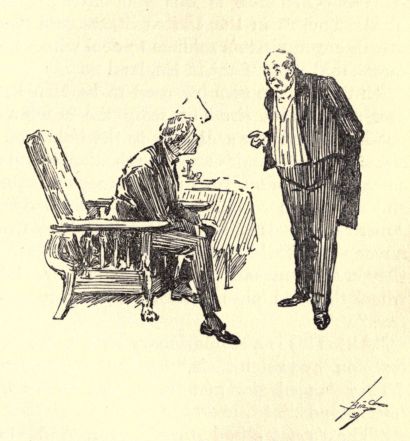
"Hit was one of 'is majesty's horfficers, sir," he answered hoarsely.
It flashed over me that this big stolid fellow was out of his head; but sane or mad he was clearly greatly disturbed. It was best, I thought, on either hypothesis, to speak to him peremptorily, and I rose, the better to deal with the situation.
"What nonsense is this you have in your head? You 're in the United States, and there are n't any majesty's soldiers to deal with. You forget that you 're not in England now."
"But this 'ere country used to be Henglish, you may recall, sir. The story the coachman got hin the village goes back to the hold times, sir, when the colonies was hin rebellion, if I may so call hit, sir, and 'is majesty's troops was puttin' down the rebellion hin these parts. Some American rebels chased a British soldier from hover near White Plains to these 'ere woods as they was then, and they 'anged 'im, sir, right where this 'ere 'ouse stands, if I may make so free."
"Ah! This is a revolutionary relic, then?"
"You 'ave got hit, sir," he sputtered eagerly. "They 'anged the man right 'ere where the 'ouse stands."
"That's not a bad story, James. And what does your mistress say about it?"
"Well, sir; hit's the talk hin the village that that's why she bought the place, sir. She rather fancies ghosts and the like, as you may know, sir."
"Be careful what you say, James. Miss Hollister is a noble and wise lady, and you do well to give her your best service."
"We're all fond of 'er, sir, though she's a bit troubled hin the 'ead, if I may make so bold. She says a good ghost is a hasset."
I did not at once catch 'asset' with an aspirate, but when he repeated it, I laughed in spite of myself.
"You 'd better go to bed, James. And don't encourage talk among the other servants about this ghost. I know something about the building of houses, and I 'll give these walls a good looking over. Good-night."
It was apparent that my interview had not cheered him greatly. He turned at the door, to ask if I would put out the lights, and fear was so clearly written upon his big red face that I dismissed him sharply.
I made myself comfortable for an hour, smoking a cigar over an article on English politics, and while I read, a big log placidly burned itself to ashes. I found the switch and snapped out the library lights. When I had gained the second floor I turned off the lights in the hall below, and as I looked down the well to make sure I had turned the right key, the third floor lights suddenly died and I was left in darkness. This was the least bit disconcerting. I was quite sure that the upper lights had remained burning brightly after the darkening of the lower hall, so that it was hardly possible that the one switch had cut off both lights.
Standing by the rail that guarded the well, I peered upward, thinking that some one above me was manipulating another switch; but the silence was as complete as the blackness. I was about to turn from the rail to the wall to find the switch, but at this moment, as my face was still lifted in the intentness with which I was listening, something brushed my cheek,—something soft of touch and swift of movement. As I gripped the rail I felt this touch once, twice, thrice. Then my hand sought the wall madly, and with so bad an aim that it was quite a minute before I found the switch-plate and snapped all the keys. The stair, and the halls above and below me sprang into being again, and I stood blinking stupidly upward.
Though I was in a modern house thoroughly lighted by electricity, I cannot deny that this incident, following so quickly upon the butler's story, occasioned a moment's acute horripilation, accompanied by an uncomfortable tremor of the legs. As already hinted, I lay no claim to great valor. As for ghosts, I am half persuaded of their existence, and after witnessing a presentation of Hamlet, always feel that Shakespeare is as safe a guide in such matters as the destructive scientific critics.
There were various plausible explanations of the failure of the lights. Some switch that I did not know of, perhaps in the third-floor hall, might have been turned; or the power house in the village might have been shifting dynamos. Either solution of the riddle was credible. But the ghostly touch on my face could not be accounted for so readily. Leaving the lights on, I continued to the third floor, and examined the switch, and sought in other ways to explain these phenomena. My composure returned more slowly than I care to confess, and I think it was probably in my mind that the ghost of King George's dead soldier might be lying in wait for me; but I saw and heard nothing. The doors of the unused chambers on the third floor were closed, and I did not feel justified in trying them. The servants were housed on this floor, at the rear of the house, and a door that cut off their quarters proved on examination to be tightly locked.
The fourth floor was only a half-story, used for storage purposes. The roof was gained, I recalled, by an iron ladder and a hatchway in a trunk-room. I ran down to my room and found a candle, to be armed against any further fickleness of the lights, and set out for the fourth floor. I had changed my coat, and with a couple of candles and a box of matches started for the roof. My courage had risen now, and I was ready for any further adventure that the night might hold for me. Miss Hollister and Cecilia were both in their rooms, presumably asleep; the servants doubtless had their doors barred against ghostly visitors, and the house was mine to explore as I pleased.
I think I was humming slightly as I mounted the stair, which, in keeping with the general luxuriousness that characterized the furnishing of the house, was thickly carpeted even to the fourth floor. I was slipping my hand along the rail, and mounting, I dare say, a little jauntily as I screwed my courage to an unfamiliar notch, when suddenly, midway of the first half, and just before I reached the turn where the stair broke, the lights failed again, with startling abruptness. This was carrying the joke pretty far, and instantly I clapped my hand to my pocket for the box of safety-matches, dug it out, and then in my haste dropped the lid essential to ignition, and stooped to find it.
The stair had narrowed on this flight, and as I sought with futile eagerness to regain the box-lid, I could have sworn that some one passed me. Still half-stooping, I stretched out my arms and clasped empty air, and so suddenly had I thrown myself forward, that I lost my balance and rolled downward the space of half a dozen treads before I recovered myself. I was badly scared and hardly less angry at having missed through my own clumsiness the joy of grappling with the ghost of one of King George's soldiers; but the matches having been lost in the pitch-darkness of the stair, I could get my bearings again only by clinging to the stair-rail until I found the second-floor switch. I should say that two full minutes had passed between the loss of the matches and my flashing on of the lamps. From top to bottom the lights shone brightly; but no one was visible and I heard no sound in any part of the house.
As I began to analyze my sensations during the temporary eclipse of the lights, I was conscious of two things. The being, human or other, that had passed me had been light of step and fleet of motion. There had been something uncanny in the ease and speed of that passing. I was without conviction as to its direction, whether up or down, though I inclined to the former notion for the reason that the employment of a concealed switch above seemed the more reasonable argument. And a faint, an almost imperceptible scent, as of a flower, had seemed to be a part of the passing. Mine is a sensitive nostril, and I was confident that it did not betray me in this. The sensation stirred by that faintest of odors had been agreeable; there was nothing suggestive of grave-mold or cerecloth about it. There was in fact something rather delightfully human and contemporaneous in this fellow that pleased and reassured me. That scamp of a revolutionary British soldier, resenting as was his right the application of hemp to his precious neck, had still a grace in him, and a ghost who prowls undaunted about an electric-lighted house in this twentieth century, having his whim with the switches, cannot be an utterly bad fellow. My respect for all who are doomed to walk the night rose as, leaving the lights on clear to the lower hall, I gathered up my matches and started again for the roof. The trunk-room door opened readily, as on my morning inspection of the chimney-pots, but as I glanced up, I saw that the hatch was open. Through the aperture shone the heavens, a square of stars, and bright with the moon's radiance. Pocketing my matches, I ran nimbly up the ladder.
X
MY BEFUDDLEMENT INCREASES
I had been surprised to find the hatch open, but it is not too much to say that I was greatly astonished by what I saw on the moon-flooded roof. There, midway of a flat area that lay between the two larger chimney-pots, two persons were intently engaged, not in ghostly promenading or posturing, or even in audible conversation, but in a spirited bout with foils! The clicking and scraping of the steel testified unmistakably to the reality of their presence. And I was grateful for those sounds! It needed only silence to tumble me back down the trap with chattering teeth, but these were beyond question corporeal beings, albeit rendered weird and fantastical by the oddity of their playground and the soft effulgence of the moon. The vigor of the onset and the skill of the antagonists held me spellbound. I stood with head and shoulders thrust through the opening, staring at this unusual spectacle, and not sure but that after all my eyes were tricking me.
"Touché!"
It was a woman's voice, faint from breathlessness. She threw off her mask and dropped her foil, and with a most human and feminine gesture put up her hands to adjust her hair. It was Cecilia Hollister, in a short skirt and fencing coat!
Her opponent was a man, and as he too flung off his mask I saw that he was a gentleman of years. If Miss Cecilia Hollister chose to meet strange men on the roof of her aunt's house and practice the fencer's art with them, it was no affair of mine, and I was about to withdraw when the stranger swung round and saw me. His sudden exclamation caused the girl to turn, and as a reasonable frankness has always seemed to me essential to a nice discretion, I crawled out on the roof.
"I beg your pardon, Miss Hollister, but if I had known you were here I should not have intruded. The vagaries of the library chimney have been on my mind, and I was about to have another peep into yonder pot."
She stood at her ease, with one hand resting lightly against the inexplicable chimney in question, and still somewhat spent from her exercise.
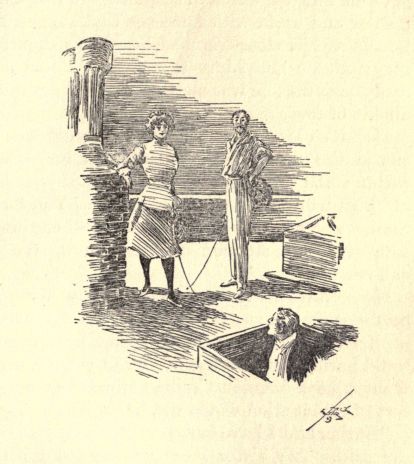
She stood at her ease, with one hand resting lightly against the inexplicable chimney.
"Father," she said, turning to the stranger who stood near, "this is Mr. Ames, who is Aunt Octavia's guest."
The light of the gibbous moon enabled me to discern pretty clearly the form and features of Mr. Bassford Hollister. And I find, in looking over my notes, that I accepted as a matter of course the singular meeting with my hostess's brother. I had grown so used to the ways of the Hollisters I already knew, that the meeting with another member of the family at eleven o'clock at night on the roof of this remarkable house gave me no great shock of surprise. He was tall, slender and dark, with fine eyes that suggested Cecilia's. His close-trimmed beard was slightly gray: but he bore himself erect, and I had already seen that he was alert of arm and eye and nimble of foot.
He put on his coat, which had been lying across one of the crenelations, and covered his head with a small soft hat.
"This will do for to-night, Cecilia. You had the best of me. We 'll try again another time. I 'm glad you stopped us, Mr. Ames. We 'd had enough."
He seemed in no wise disturbed by my appearance, nor in any haste to leave. This meeting between the father and daughter, I reasoned, could hardly have been a matter of chance, and it must have been in Cecilia's mind that some sort of explanation would not be amiss.
"Father and I have fenced together for years," she said. "My sister Hezekiah does not care for the sport. As you have already seen that my aunt Octavia is an unusual woman, given to many whims, I will not deny to you that at present my father is persona non grata in this house. I beg to assure you that nothing to his discredit or mine has contributed to that situation, nor can our meeting here to-night be construed as detrimental to him or to me. In meeting my father in this way I have in a sense broken faith with my aunt Octavia, but I assure you, Mr. Ames, that it is only the natural affection for a daughter that led my father to seek me here in this clandestine fashion."
Cecilia had spoken steadily, but her voice broke as she concluded, and she walked quickly toward the hatchway. Her father stepped before me to give her his hand through the opening.
I withdrew to the edge of the roof while a few words passed between them that seemed to be on his part an expostulation and on hers an earnest denial and plea. He passed her the foils and masks and she vanished; whereupon he addressed himself to me.
"I had learned from both my daughters of your presence in my sister's house, and I had expected to meet you, sooner or later. This is a strange business, a strange business."
He had drawn out a pipe, which he filled and lighted dexterously. The flame of his match gave me better acquaintance with his face. He leaned against the serrated roof-guard with the greatest composure, his hat tilted to one side, and drew his pipe to a glow. I had not forgotten my encounter with the ghost on the stair, and as I waited for him to speak, I was trying to identify him with the mysterious agency that had tampered with the lights, and passed so ghostly a hand across my face in the stair-well. I could hardly say that there had not been time for either Bassford Hollister or his daughter to have reached the roof after my experiences on the stair; and yet they had been engaged so earnestly at the moment of my appearance at the hatchway that it was improbable that either could have played ghost and flown to the roof before I reached it. And eliminating the ghost altogether, I had yet to learn how Bassford Hollister had gained entrance to the house. It seemed best to drop speculations and wait for him to declare himself.
"You must understand, Mr. Ames, that my daughters, both of them, are very dear to me. It is the great grief of my life that owing to matters beyond my control I have been unable to care for them as I should like to do. This being the case, I have been obliged to allow them to accept many favors from my only sister Octavia. This in ordinary circumstances would not be repugnant to my pride; but my sister is a very unusual person. She must do for my children in her own way, and while I was prepared, in agreeing that they should accept her bounty, for some whimsical manifestation of her eccentric character, I did not imagine that she would go so far as to shut me out from all knowledge of her plans for them. That, Mr. Ames, is what has happened."
His voice rose and fell mournfully. He puffed his pipe for a moment and continued:—
"Cecilia, being the older, was to be launched first. Hezekiah was to be cared for in due season. Last summer Octavia took them both abroad. As you are aware, they are young women of unusual distinction of appearance and manner, and they attracted a great deal of attention. From what I hear, a troop of suitors followed them about. That sort of thing would appeal to Octavia; to me it is most repellent, but I had already committed myself, agreeing that Octavia should manage in her own fashion. There is now something forward here which I do not understand. I have an idea that Octavia has contrived some preposterous scheme for choosing a husband for Cecilia that is in keeping with her odd fashion of transacting all her business. I do not know its nature, and by the terms of her agreement Cecilia is not to disclose the method to be employed to me,—not even to me, her own father. You must agree, Ames, that that is rather rubbing it in."