THE SIEGE OF NORWICH CASTLE (continued 5)
Reading edition
But the awakening did not silence the cries. They were no dreams, those screams of terror, those head-rending shrieks for help, they were dreadful realities; and, rushing to the window, she gazed out with a beating heart at the western sky, which flickered and flared with strange and ghostly gleams.
She ran back to the sleeping countess, and by the lurid light saw that she was smiling in her sleep.
'Wake! wake! Oh, Emma! dear countess! this is no night for sleep. Methinks the dawn is like to bring the last dread day! Alas! she sleeps like a young infant that knows not danger or woe. Wake, Emma! Thy life may hang on it!'
Then the countess, opening her eyes dreamily, murmured, 'Thou hast brought good succour, Ralph!' The next moment she started up. 'Mary Mother! what is it, child?'
'There is murder in the air, Emma! See, the very sky is full of tokens. Listen! listen! Oh, saints in heaven! how they scream!'
They did indeed! The countess sprang from the bed and rushed to the window also.
'They have fired the town!' she cried; 'they have fired the town!—the Saxon quarter! Sir Hoël said they would!'
'The Saxon quarter! Oh, my home, my home!' cried Eadgyth, and, pressing her hands to her ears in a vain effort to shut out the shrieks of the sufferers, she cowered, with closed eyes, upon the floor.
'Let us go to the great portal of the keep, whence we can see it,' said the countess.
'See it!' cried Eadgyth. 'Ah, Emma, no! I could not look! It would kill me.'
But Emma went forth boldly, intent to know if anything could be done to rescue the victims.
Norwich in those days was an open town. The walls and towers, of which portions still remain to gladden the eyes of archaeologists, were not built till some fifty years later, so that it was not possible to defend the town itself. Moreover, although the earl had found supporters amongst the Saxon and Anglo-Danish inhabitants of the older quarters, numbering more than one relative of Harold Godwinsson, the majority of the Norman denizens of the New Burg around the Chapel-in-the-Field remained loyal to William, and were ready to give all help to the besiegers. For this reason was it that the western sky had but flickered with the reflections of flames. It was the Saxon quarter by the river, the wooden tenements in King Street, which provided fuel for the bonfire.
Looking east from the portal of the great tower, a grand and terrible spectacle confronted the beholders.
Crackling flames shot up against the dark midnight sky, dancing like living demons of fiery destruction, and sinking only to lick the doomed houses with their scorching tongues and spring up higher than ever. Every now and again some beam or stone would burst with a sharp report, throwing blazing fragments into the air; and the volumes of smoke rolled far into the night, lurid with the red glare of the flames. Moats and marshes and river gleamed and sparkled weirdly with the light of destruction, so that the ground was broken by inverted images of fiery tongues; and it seemed, indeed, as if the nether world—so ardently believed in by those who were watching as a material hell of fire and brimstone—had broken bounds, and was let loose to destroy the world.
But most awful was it to see the small black figures that every now and again raised wild arms against the flare of the fire; most awful was it to here the screams that every now and again rose above the dull roar and crackle and hiss of the destroying element.
When such figures were seen, and such sounds heard, curses and execrations burst from the white lips of the soldiers who were crowding the eastern walls of Blauncheflour, and the knights who had assembled before the portal of the keep.
As the countess came down amongst them, she could not repress an exclamation of horror, for never in her life had she beheld anything so awful.
Sir Hoël de St. Brice came instantly to her side.
'Alas, dear lady! this is no scene for thee. Return to thy bower. There is no danger for the castle.'
'My place is here, Sir Hoël,' said Emma firmly. 'I am Castellan of this castle. The battle is not always to the strong. See, yonder flames hissing through the air are more terrible than a hundred mailed warriors! The flame of wit is given to woman as well as to man!'
'William's men are doing thee homage, noble countess,' said De Gourin, with a sneer. 'These are finer bonfires than the good people of Norwich lighted on the night of thy arrival in their town!'
Emma turned from him with a shudder of disgust.
'How hath this been accomplished, Sir Hoël?' she asked of the older knight. 'By what means hath the fire been enkindled?'
'The king's men are provided with mighty engines,' answered Sir Hoël. 'Never have I seen mangonel or balista that carried so far. They are throwing red-hot stones and balls of lead from them, and the old houses yonder have been so well dried by the sun of late, that they burn like tinder. See,' he added, pointing out some glowing stars in the south-east, which Emma had not before distinguished from the burning fragments tossed aloft by the action of the flame, 'their fiery hail continues even now. They have got possession of the Cyning Ford, and are flinging their missiles from across the river.'
'And are we to stand here and gape at them, and do nought to stop them?' demanded the countess eagerly. 'Good St. Nicholas! how the cattle bellow in the castle meadow! Are the poor beasts in danger?'
'The fire frightens them, and no wonder!' answered Sir Hoël. 'But they are in safety, unless, perhaps, some fragment, here and there, may be carried from the fire, and somewhat scorch their hides. As for thy former question, I see not that anything can be done. Having possession of the ford, I know not how we can dislodge them.'
'It would be but throwing away good lives to attempt it,' said De Gourin, who cared little whether a few Saxons more or less were burned on their own hearthstones.
'Eadgyth!' exclaimed the countess impetuously to her bower-maiden, who had followed her, notwithstanding her terror, 'hast thou not told me there was a way through the marshes, that Harold used against the Vikings?'
Eadgyth, with wild eyes and teeth chattering in the extremity of her horror, gazed at the countess as if her fear had taken away her reason.
The countess repeated her question, and Eadgyth, with an effort, forced herself to attend.
'Ay, that is so. My kinsman Leofric would be familiar with it. He has fought every inch of this ground against the Danes under your lord!' she said.
'Where is this Leofric? Let him be summoned,' commanded the countess.
'He is yonder helping his countrymen to save their skins from the fire,' said Sir Alain contemptuously.
Again the countess commanded, 'Let him be summoned!'
And when, not long after, Leofric Ealdredsson stood before her, still breathing hard after his exertions, his face begrimed with dust and smoke, and the wild firelight gleaming on his torc and mail corselet and bracelets, she asked him if he knew of any way by which he could steal unperceived through the marshes, and take the artillerymen of the foe by surprise.
'By Asgaard! yes!' exclaimed Leofric, turning to De Gourin. 'And so I told this fair sir an hour ago, and offered to show him how he might take them in flank, and stuff their accursed red-hot balls down their own throats; or I would have taken a band under my own order, twenty of my house-carles, if he would add twenty stout men from the garrison. But he would hear none of it.'
'We shall be the safer that the buildings yonder are burned,' said De Gourin. 'Why throw away good lives to stop it?'
'Why was I not told of this suggestion?' asked Sir Hoël, frowning. 'Thou takest over much upon thyself, Sir Alain!'
'Grant me the men now, countess!' said Leofric eagerly.
'My lord owed his life to thee, Leofric Ealdredsson!' answered the countess. 'I know I may trust thee! Take thy stout carles, and twenty men beside.'
'Ahoi! By Freya! thou art a pearl among women!' cried the wild Leofric, who was much of a Viking himself.
'Ah, kinsman Leofric, leave those heathen names alone!' said Eadgyth. 'Thou hast a better symbol in the hilt of thy sword!'
But he had not stopped to listen to her. He had gone off to call his carles together, and to choose his twenty men from the garrison.
And some forty of them, for the most part Anglo-Danes or Saxons, left the castle a few minutes later, leaving by the western horn of the barbican, and making their way by the streets north of the castle, by Tombland, to the river; slipping along through the fire-lighted night with a panther-like trot on their silent shoes of untanned leather, their trusty seaxes in their right hands, and their round red shields on their left arms.
Arrived at the river, they possessed themselves of boats without particularly asking the leave of the owners, and crossed-over to the marshes on the eastern bank, leaving a man in each boat to guard it. They crept through the rushes, as only men who had grown up amid the fens could have done, and fell upon the unsuspecting Normans like thunderbolts; knocked their balistas to fragments, served a good many of their men likewise, and returned as they came to the west bank of the river.
Then they added their strength to that of the townsfolk to fight the flames, and, by means of clearing large spaces to windward of the burning houses, stopped the fire from spreading its ravages indefinitely. But five less returned through the castle gate than had left it.
So went the first day and the first night of the siege.
When day broke, the attack on the barbican began again, and so it was for five days afterward; but at the end of the sixth the barricades were almost battered down, and strong bridges were established across the ditch, so that the defenders thought it wise to abandon it to the enemy, as scarcely worth the lives it would cost to maintain possession of it. But this meant no very great advantage to the besiegers.
They stood before the great gate of the castle, the actual entrance to which looked like a mere mouse-hole between the sheer strong walls of its two flanking towers. They well knew the make of such gateways: their folding-doors of solid oak, strengthened with bars and bolts of iron, and studded with huge nails to prevent the cutting out of a panel or staving in of the same; the strong portcullis behind them, a harrow-shaped iron grating, to be let up and down in a moment by means of pulleys from the inside; above the doors a row of chimney-like apertures, called machicolations, through which the defenders could pour scalding water, molten lead, or any other deadly matter, upon the devoted heads of the assaulting column, who were exposed also to a cross fire of quarrels, stones, and other missiles from the flanking towers.
Truly, to assault such a portal was no child's play, even with such aid as could be given by the rude artillery of the times: petronels and agerons for throwing stones and leaden pellets, catapultas for shooting arrows, and the trebuchettum, or warrewolf, specially designed for the smashing in of gates and walls; all these, and more of their kind, the king's men were well provided with.
Stout Earl Warrenne, and the astute Bishop of Coutances, and the accomplished lance, Robert Malet, held many a consultation as they rode round the invested fortress, and scanned it eagerly to see if haply they might discover some weak point which should give them advantage in the attack.
But they decided that they must become masters of the great gate, and so of the ditch, before they could make any assault on the castle itself.
A month had passed away before they were so masters; but being so, they had their opponents in a veritable trap. The besieged knew well that a harder struggle than ever lay before them in their awful isolation, cut off from communion with their fellow-creatures by a wall of human fury as effectually as if they had been wrecked on some desert island in that vast ocean of the west, the opposite shores of which were all unknown to them, though its great eastern rollers dashed in spray upon the Breton and Norman coasts.
Through all this weary time of fear and suspense, with its harassing duties and oppressive sorrows, the Countess Emma found comfort in two dumb friends: Oliver, the earl's Spanish destrier, who had been left in the fortress when De Guader embarked for Denmark; and the brave tassel-gentle, that had been Ralph's gift to her upon the day on which she had promised to share his fortunes, good or ill.
Oliver had been restored to his master, after he had been struck down by Odo's mace, by one of those strange accidents which seem to have the finger of fate in them. Some of the old thegn Ealdred's men had visited the battlefield several days after the fight, to see how the land lay and what the king's men were doing. They were attacked by a band of Norman soldiers, headed by a knight who was mounted on a splendid destrier. The animal was full of strength and courage, but the rider being, as they afterwards found, one Stephen Main-de-fer, a parvenu who had made his fortune out of the woes of England, like so many of his countrymen, and who had won his spurs without having learned to ride, instead of profiting by the noble booty that had fallen to his share, was brought to his ruin thereby; for the fiery barb, unused to such handling as he gave it, and doubtless wondering, like Johnny Gilpin's steed, 'what thing upon his back had got,' became unmanageable in the excitement of the fray, and threw his clumsy new master heavily to the earth. There he lay sprawling, as little versed in carrying his armour as in managing his horse, and Ealdred's men did not lose their opportunity of despatching him. After a short struggle, his followers beat their retreat, and the destrier fell into the hands of the Anglo-Danes, who took him back with them to their refuge in the Fens, where he was immediately recognised with much jubilation by Grillonne, and restored to his master.
So it came to pass that Ralph de Guader had been able to ride back into Blauncheflour on his trusty Oliver.
Since the earl had quitted the castle, Emma had visited the barb morning and night, and had taken him many a dainty wastel cake or sugary comfit such as horses love; and, stroking his satin neck with many an endearment, longed for the time when she should see his master on his back again. A time which would never come!
At such moments she would often have the tassel-gentle on her wrist, and the bird seemed almost human, so intelligent and tame was he.
She needed some comfort, for she had one great sorrow. The gentle and loving Dame Amicia de Reviers, who had watched over her from her cradle, was stricken down by paralysis, and a few days later died. It was really but the natural end of a long and happy life; but Emma, in the mood for self-torture, blamed herself for having dragged the aged dame into tumult and terror, and shed tears that were beyond the usual bitterness of grief. She was buried in the holy precincts of St. Martin at Bayle, which stood before the castle gate, the besiegers granting a truce for the occasion, with that chivalrous courtesy that was so oddly mixed with the ferocity of the times.
So the king's men and the earl's met in friendly sympathy one day, and prepared for bitter contest on the morrow, when the besiegers planned to make assault upon the walls themselves.
Within the castle all was bustle and business. Harness was mended and bullets were moulded, bows restrung and arrows feathered, axes and swords whirred on the grindstone, huge cauldrons were prepared wherein to heat water to pour upon besiegers' heads; and even the countess and her ladies helped to carry stones with their own fair hands, and pile them ready for the use of the slingers.
Meanwhile the swallows wheeled and twittered overhead as they wheel and twitter now; and down in the woods the merles and mavises sang on undisturbed by the tumult, while swans were marshalling green-grey cygnets across the pools in the marshes of the Cowholme.
CHAPTER XXII.
A SUBTERRANEAN CONFLICT.
The besiegers on their part had not been idle. They had established quite a menagery of mechanical contrivances, rejoicing in the zoological names of tortoises, sows, and cats, to protect their approaches to the white walls of Blauncheflour, and under cover of these they had cut a channel to the castle ditch and drained the water from it, so that it was as dry as at present, though, instead of growing fair greenery of bushes and flowers, it showed a bottom of parched, fœtid mud under the hot summer sun.
They had thrown up large mounds of earth at intervals around the ballium, and upon these had built up towers of wood overtopping the walls. These were furnished with drawbridges which could be let down at pleasure upon the merlons of the battlements, so to give ingress to their men-at-arms; their upper storeys serving to shelter archers and slingers, while from the lower, battering-rams were sturdily plied, and the warrewolves flung their stones and balls of lead.
These towers had cost them many good lives, for not one had been established without a fierce struggle. Sally after sally had been made from the castle, but, in the end, numbers prevailed, and at last their impertinent wooden crests were reared above the Caen stone of Blauncheflour.
Those within were, however, more troubled by the mines which their assailants had run from the bottom of the moat beneath the foundations of the castle; for although these had been met by countermines, and many a furious combat had taken place in these uncanny lists, each mine meant a point to be guarded with jealous care, and was a source of weakness and anxiety; demanding exhausting sentry duty from the already over-burdened garrison.
The countess found her office of Castellan no sinecure. The motley garrison were anything but homogeneous. All manner of petty jealousies, personal and national, raged among them. The Normans were jealous of the Bretons, and the Bretons blustered about independence, boasting that they were 'no man's men;' while the Saxons hated them both, and regarded their refinements as dandyisms and their courtesies as cant; and the Normans and the Bretons both looked down upon the Saxons as savages, and gibed at their priest-bestowed knighthood; so that, on the whole, they were as much inclined to fight against each other as against the king's forces outside the walls, and sometimes actually came to blows.
However, the countess set her woman's wit to weigh these quarrelsome gentlemen against each other, and managed to do it, owing to the three-sidedness of the situation.
After all, their want of unity had its advantages, as they never 'went solid' in any direction, except under the self-evident necessity of defending their lives and the castle.
Still, at times, Emma grew very weary, and almost failed under the burden she had taken upon her slender shoulders, feeling terribly feeble and lonely and out of her depth.
Sir Hoël de St. Brice was her chiefest comfort and principal counsellor. The old knight had come to regard her with absolute veneration and the deepest affection, and in him she felt that she had a true and sincere friend.
His zeal for the earl's cause nearly equalled her own. To say that he would have given his life for it would express little, for all in the garrison were formally pledged to do that; but he had no other object in life.
Emma had sought the earliest opportunity to tell him the circumstances under which she had discovered the imprisonment of Sir Aimand de Sourdeval, and to repeat his account of the foul treatment he had met with from De Gourin.
'Unknightly!' he had said,—'from first to last unknightly. But what would you have? Can a man who sells his lance to the first bidder, without inquiry into the justice of his cause, be a true knight?' Altogether he gave evidence of shrewd indignation, but no keen surprise.
'I love not the mercenary,' he answered, 'and wish that he had not so high a command in the garrison. I know well that he had no great liking for the young Norman prudhomme, whose boyish enthusiasms were stronger than his prudence, and led him to throw taunts at Sir Alain's thick head, all the more galling that they were barbed with truth.'
But he agreed that, under the circumstances, it was best to let matters stand; De Gourin was evidently of the same opinion, and, save for a few veiled gibes at the magnanimity of the countess, made no reference to the freeing of the young knight.
Sir Aimand, for his part, had a dismal time of it, and almost wished himself back in his dungeon, securely chained by the leg.
As soon as his health began to mend, which was speedily enough, under the combined influences of good food, good air, and the sight of his lady's face, Eadgyth withdrew that last and sweetest influence.
For she was determined by no word or look of hers to tempt him to be untrue to his high standard of honour, and she felt on her own part more Saxon than ever, and judged the gulf between them impassable, save by the wreckage of the ideals of both; and therefore she deemed that to bestow her company upon him would be but cruel kindness.
So the poor knight mooned about in solitary meditation, and his returning strength made inaction a veritable purgatory to him. To hear blows going, and have no hand in giving or taking them, was truly about the cruellest torture that could have been invented for one of his order and temper in those days when Christians still thirsted for the Valhalla of the old Norsemen, wherein the immortal heroes were healed of their wounds at night that they might slay each other over again in the morning.
Again and again he was on the point of throwing his scruples to the wind, and buckling on sword and helm in defence of the generous dame who had given him his freedom so unconditionally. Again and again he restrained himself, and did penance by fasting and prayer, wishing the while that she had left him in durance, so he had escaped such doubting and searching of heart.
Nor did he find much peace in Hall. Norman, Breton, and Saxon were all against him. Gibes and jeers were his portion. They called him the 'ladies' tame tiercel,' the 'gamecock without spurs,' the 'dancing bear,' and a hundred other names suggestive of carpet-knight-errantry. Then his fists would ball and his clear-cut, high-bred face grow white with anger, though he never made reply, as he felt it an evident point of honour that, being a prisoner on parole, he might neither risk his own person, which carried value for ransom, nor seek to injure any of the garrison.
But on the eve of the assault, when the countess was holding council with Sir Hoël de St. Brice, attended only by Eadgyth, the young Norman prayed audience of her, and on its being granted strode into the chamber with curiously flashing eyes.
'I beseech thee, noble Emma, to furnish me with an helm and an hauberk, and the sharpest sword thou canst spare out of thine armoury, and I will put them to a good use in thy service,' he said, with speech that was rather too hasty to be clear.
'Hast found thy senses at last, brave sir?' demanded Sir Hoël, smiling indulgently, for he had always liked the young knight.
But Eadgyth noticed his flushed cheek and excited mien with a chill dread at her heart. Was he about to be false to the noble ideals for which he had endured so much, or—saints in Heaven forfend!—did his exaggerated love to his suzerain lead him to contemplate a baser falseness still, and so confuse his mind that he should fancy it would be virtue to betray the castle? Her cousin Leofric had said more than once, that only a woman playing Castellan would be so imprudent as to allow one holding so invidious a position as did De Sourdeval, to be free of the castle and aware of all its secrets; and though at the time she had cried shame on his mean suspicions, the words had rested in her mind with the burr-like persistency characteristic of such suggestions of evil.
The countess, however, looked at him with her frank glad eyes, and rejoiced, for she had always hoped that the time would come when he would repay her generosity with complete allegiance, and she was about to reply unconditionally, 'Ay, that will I.'
But before she could speak, Sir Aimand continued, 'I ask thee more. I want not only arms for myself, but twenty men to back me.'
Sir Hoël looked grave, and lifted his bushy white eyebrows high in astonishment.
'Pick men of whose fidelity you are assured,' Sir Aimand cried. 'Let Leofric Ealdredsson go with me. Thou knowest he has no liking for me, and is in no way in collusion with me, sith there is race hatred between us and rivalry in love.'
'Rivalry in love!' exclaimed Emma, turning quickly to Eadgyth, and the cheeks of the Saxon maiden burned scarlet under her gaze, but not more redly than those of the knight, who had exposed his jealousy unawares.
'I should not have said rivalry,' he amended hastily, 'sith I have no claim.'
Eadgyth was in a difficult position. If she made the protest her heart urged, that Leofric was her cousin and nothing more, and never could be more, she would give Sir Aimand an encouragement which was cruel. If she did not make it, she let that be believed which she imagined had no foundation in fact.
Emma saved her from need of reply.
'Upon the honour of Leofric Ealdredsson I can rely,' she said, 'whether he have cause to like or mislike thy person, fair knight. What more hast thou to ask?'
'That he, with twenty of his stout Anglo-Danes, may be put under my guidance, with instructions to hew me in sunder if I in any way show token of treachery. I can serve thee best if none know of this matter, nor the end in view, save Leofric alone. But this I will say in explanation, there is a traitor in thy camp, and I would fain foil him. I cannot fight under thy banner, noble countess, but it accords with my vow of chivalry to save thee from foul betrayal.'
'Let Leofric Ealdredsson be summoned, Sir Hoël,' said the countess.
And in the end De Sourdeval obtained his boon.
Knowing what had been granted to the Norman, and that Leofric and his stout carles would not have accepted service under him unless with some prospect of stiff work to follow, Sir Hoël was somewhat surprised to see the Anglo-Danes linger later than usual over the wassail bowl in Hall that even, seeing too that on the morrow it was certain that shrewd blows would be going, and all heads wanted clear.
Sir Alain de Gourin thought fit to rebuke them. 'For as thick skulls as your battle-axes there may boast, Childe Leofric,' he said, 'they had best have wakeful wits under them by dawn.' And he set a worthy example by leaving the revel.
His most important followers slipped after, first one and then another, but still the Vikings drank on, and Sir Hoël began to have queer doubts of the wisdom of granting the whimsical De Sourdeval control over such a crew, and determined to watch them out.
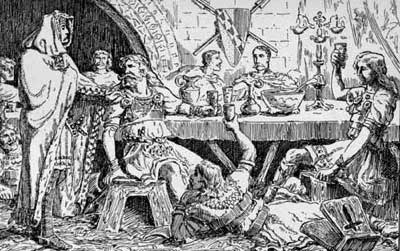
"The big rat has gone into his hole!"
Presently in came Sir Aimand, wrapped in a long cloak, with a hood over his head, and whispered to Leofric,—
'The big rat has gone into his hole.'
And Leofric wagged his yellow beard approvingly, and rose up, tall and strong, with a rattle of mail and bracelets, and took his great two-handed axe and strode with De Sourdeval out of the hall; and Sir Hoël saw that under De Sourdeval's cloak was a mail hauberk and steel headpiece.
Then one after another the Anglo-Danes picked themselves out of the rushes, whither they had subsided to save the trouble of falling, and went out also, with strange steadiness for tipsy men.
And De Sourdeval led Leofric to a mine that had been run to meet one dug by the enemy on the north-west side of the castle, near the chiefest of the wall towers, and two dozen good men and true were at their back.
They went down into the darkness, dimly lighted with rude lanterns, and they found the watch were one and all Breton mercenaries. These one after another they stealthily seized, gagged before they could make outcry, bound, and carried up into the outer air, setting their own men in their stead. Then they crouched down and waited at the extremity of the mine, where it met the Norman parallels.
And after a while they heard sounds approaching. The clink and chink of weapons and mail and the muffled beat of creeping footsteps.
'Remember—Sir Alain to me,' hissed De Sourdeval in a hoarse whisper,—'Sir Alain and his traitors. I strike no blow against the king's true men.'
'By Odin! all's fish that comes to my net. Breton or Norman, what have they to do in Harold's Norwich?' returned Leofric savagely. 'But I'll not poach on thy manors. Sir Alain to thee.'
Two minutes later, the Breton mercenary, leading the foe with whom he had traitorously compounded to save his own skin, was startled to meet the fierce white face of Sir Aimand instead of the friendly countenance of one of his own ruffians.
'Ha! caught in thine own burrow, despicable rat!' shouted the Norman, and the next moment they were hewing at each other with the fury of a long hatred.
De Gourin had the disadvantage of surprise, and he lost his head and struck wildly. De Sourdeval got within his guard, and the next moment the Breton rolled heavily to earth.
Over his dead body waged a fierce battle, but it was not maintained for long. The besiegers, expecting to be led straight into the heart of the castle, were not prepared for the determined resistance they met with thus at the outset, and credited the Bretons with decoying them into a trap. The latter were therefore the chief combatants, for their case was desperate. They were between two foes, and scarce one of them escaped alive; nor did Sir Aimand find any great difficulty in keeping his vow to deal with them alone.
So Sir Aimand slew his enemy in the bowels of the earth; the man through whose treachery he had been forced to live for so many long days as deeply buried from the free air and cheerful light of day. Yet the personal quarrel was merged in a greater cause, and in revenging his own wrong he was saving the brave Countess Emma and the lady of his love, with all the womanhood in the castle, from the horrors of a sudden sack.
When the garrison heard of this feat which 'the ladies' tame tiercel' and 'the Danish wolf' had carried through between them, the enthusiasm knew no bounds, and the curses and maledictions that were poured on the senseless head of the treacherous Breton knew no bounds either, till Sir Aimand said,—
'The greater his sins, the greater need we pray for him,' and ordered masses for the dead man's soul at his own expense, so putting bitter tongues to shame.
The countess came down into the great hall and met the heroes of the hour with shining eyes and heartfelt thanks; but, to say truth, they were both more anxious for kind glances and sweet praise from her Saxon bower-maiden, and their eyes went round the hall in search of her. But she was not there; she had slipped away to ask the chaplain to set her penances for having entertained suspicions of an innocent person.
Perhaps none felt deeper indignation against the foiled traitor than those of the Breton mercenaries whom he had not included in his band of deserters. If his plot had been successful, they would probably have suffered most of all in the garrison, for mercenaries are rolling stones who make enemies wherever they go, and whose services being paid for in cash and plunder, win no gratitude even from those they defend. They knew well that if the besiegers got the upper hand, it would go hard with them.
Therefore they stood aghast when they heard of the treachery of their leader and of those of their comrades who had been with him, feeling that treachery to be in a manner twofold towards themselves. They gathered round De Sourdeval asking eager questions.
'How had he discovered the plot? Had he known it long? What proofs had he to support his assertion?'
To which he made reply that he had not known it long, only an hour or two before his counterplot was framed and executed, and it had come to his knowledge in this wise. A certain soldier in De Gourin's band had been Sir Aimand's warder during his imprisonment in the dungeons of the castle, and it seemed that the man had conceived a great affection for him. Being one of the sentries whose duty it was to guard the mine, he had received instructions from De Gourin to admit the king's troops, and was perforce made privy to the nefarious designs of the leader.
Believing De Sourdeval to be hostile to the garrison, and wishing to do him a good turn, he had told him of the scheme on hand, and had undertaken to procure a disguise for him, so that he might pass out amid De Gourin's band. The man would tell them the story himself; he now lay bound in the courtyard of the castle with the rest of the Breton sentries.
The next day Sir Aimand returned to the countess the arms with which she had provided him from the castle armoury, holding fast to his resolution not to bear them against the king's forces.
CHAPTER XXIII.
HOW OLIVER DIED.
But there was little time for asking questions and making inquiries, or for celebrating the exploits of heroes, Norman or Anglo-Dane.
The morning light was creeping up the east, and the chirp and twitter of wakening sparrows was the signal for the battering-rams and pickers to commence their ominous clatter.
The attack was made at several points simultaneously; and all the strength of the garrison, weakened as it was by the losses of a month of strife, was needed on the walls.
From every loophole the archers and slingers aimed whizzing arrows and hurtling stones upon the columns of the assailants, and from between the merlons great sacks of wool and horsehair were suspended to protect the walls from the battering-rams, while huge logs of timber were hurled upon the pickers. Molten lead and boiling water was poured down upon the heads of the besiegers like a veritable hell-rain.
But for all their efforts the assault made progress. In two distinct places the walls were so battered that horsemen could have ridden through the breach.
The garrison did their best to throw up earthworks inside the broken walls, and fought valiantly to defend them, sallying forth at intervals with the impetus of men who felt their case desperate.
But the besiegers fought with fury also. They were weary of dallying week after week before the walls of a castle which was under the command of a woman, and were determined to get the mastery, if energy and valour could accomplish it.
The countess, mounting the battlements of the keep one day, that she might see for herself the working of the mighty engines which were plied against her stronghold, had seen Earl William de Warrenne and Robert Malet standing together in one of the wooden towers already described. As she bent forward to look below, a stone from a petronel struck the wall not far beneath her, and the fragments and dust flew into her face and upon the wall on which her hand had rested.
Her noble adversaries, who were watching her, could not repress an exclamation of dismay at this; but Emma, without blenching, took her kerchief from her gipsire and nonchalantly dusted the walls with it.
'You do well to fight a housewife with dust, fair sirs!' she cried, sending a mocking peal of silvery laughter to follow her words.
Such taunts were not unheeded or forgiven. They helped to nerve the leaders who led the attack; and they were men who were accustomed to lead their men to victory. On this day the chequered shield of Earl Warrenne pressed forward as if it were possessed of magic powers, which made it proof against every blow, and wherever it went it had eager followers; while young Robert Malet showed himself the worthy son of his great father. As for the Bishop of Coutances, he contented himself with blessing the column before it started, and reminding the soldiers that the brother of the Countess Emma was an excommunicated man.
Earl Warrenne strained every nerve to make the assault a success. He led his men in person to the breach; and his strong voice dominated the tumult with trumpet tones, as he cried, 'Dex aie! For William the Norman!'
'A Warrenne! a Warrenne!' responded his men, as they struggled forward over the counter-scarp, under a pelting hail of arrows and javelins from the battlements.
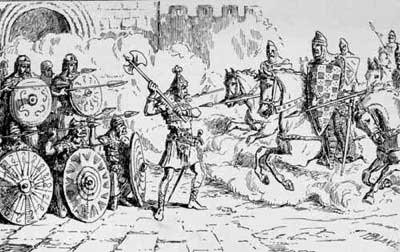
A Warrenne! A Warrenne! For William the Norman!
Within the breach stood Leofric Ealdredsson, holding his great double-edged axe in his hand, with his men arranged in a Saxon wedge, the front row kneeling, with shield touching shield, and a forest of spears bristling out above them, like the spines of a porcupine. They answered the Norman battle-cry with a wild shout that made the walls ring again, and echoed up the sides of the keep behind them, 'Ahoi! ahoi! A Guader! a Guader!' otherwise they were motionless as statues.
Earl Warrenne had won experience of that formation at Hastings, and he well knew how invulnerable it was, and how the terrible seaxes could crash through helm and hauberk. He knew how stratagem alone had prevailed over it; how pretended flight had cheated the Saxons into pursuit, and how they had so foregone their advantage; and he determined to employ the same device again.
So he leapt his horse in over the shattered wall, and his men-at-arms followed him, but spent their force in vain on the living rampart before them; more than one reeled with cleft helmet from the saddle, and Warrenne himself wavered and turned.
Seeing their leader give way, the band broke and pressed tumultuously back over the temporary drawbridge thrown across the waterless moat for their use; and Leofric and his men sprang forward to pursue them.
Then Warrenne turned again with a fierce rallying cry, and his knights, used to strict discipline, and instantly understanding his aim, turned with him, and, as at Hastings, the advantage was won. It was a hazardous experiment, but it had succeeded.
Man to man the battleaxes and spearmen were no match for the mailed and mounted Normans. The struggle was bitter. Horses and knights, Normans and English, fell cursing and kicking from the bridge into the moat. But Earl Warrenne, with a bevy of knights at his heels, made their way through the breach, penetrating into the courtyard of the castle; while Leofric lay senseless on the bridge, with his yellow curls dangling over the edge, streaked with crimson, and dripping red drops into the gulf below.
So the king's men had made their way within the walls of Blauncheflour, after two months of strong endeavour; and the sight of Warrenne's chequered banner inside the defences they had held so manfully brought terror into the hearts of the besieged. Their unnerved arms struck feeble blows; and the king's knights rode them down, driving them to the very stairway of the great entrance to the donjon keep.
All at once, from above their heads came a clear voice like a clarion,—
'St. Nicholas for Guader! A Guader! a Guader! Shall your lord come back, and find his castle lost?'
There, on the platform before the grand entrance, stood a white-robed figure, with uplifted arms and a wildly shining face, which set the half-pagan Anglo-Danes thinking of Valkyries and Norns, and the Bretons and Normans of angels and saints; but when they recognised the face of Emma the countess, they shouted a mighty shout, and the blood came back into their hearts with a great glow of determination, and they rushed once more fiercely against their assailants.
'I am here to see how bravely you maintain his cause in his absence!' cried Emma from the portal.
Then the knights mixed in the wild mêlée at her feet; while the king's archers shot their whizzing shafts from the wooden towers, and the king's slingers hurled their leaden balls and stones, fighting the men who upheld the East Anglian banners on the walls. Whether or no every arrow had its billet, as it is said every bullet has in modern days, many an arrow flew far beyond the men at whom it was aimed, and whistled down into the courtyard.
As the besieged knights looked for inspiration to their beloved Châtelaine, brimming over with the strong desire to distinguish themselves before her eyes, they saw a cloth-yard shaft fly straight to her white figure, and strike the tender form they were burning to protect, marring it with a crimson streak. A great howl of rage rose up against the sky, and the passion of vengeance nerved their arms with furious force.
They sprang at the foe, who had also seen the arrow strike its mark, and had paused a moment in chivalrous horror, and so were unprepared to meet the onslaught. Thus the tide of battle turned once more, and Earl Warrenne and his followers were driven out through the breach by which they had entered.
Then, when the knights of the garrison rode back in grievous haste to satisfy their anxiety for their lord's bride, the countess still stood before the portal, laughing, though the arrow stuck in her arm.
'See!' she said, 'it is nothing! Only a flesh-wound. I have leeched a hundred worse.'
The Normans and the Bretons and the Saxons all joined in tumultuous cheers, and vowed to save their countess and their castle if they died to the last man.
'Merci! brave hearts!' cried the countess. 'That was well spoken! Holy Mary grant my lord may relieve us ere many days are past!'
Then they entreated her to have her wound looked to; and she swept away to the spital, and there had the arrow cut out of her white arm, so all her wounded warriors might see; and the legend of her unflinching courage spread like wildfire through the garrison, and even into the camp of the besiegers without.
'By St. Michael!' cried Robert Malet, 'these rebels seem to have the knack of coining heroines. Thou and my father, Earl Warrenne, had shrewd experience of Hereward's witch of a wife in the Fenlands by Ely,—how she wound up the wild galliards her husband got to follow him with her sorceries and incantations till they were at the point of madness! Sooth, methinks we have to deal with such another.'
Then Leofric Ealdredsson, who had been carried into the camp, and lay within earshot, raised himself up and swore mightily.
'No witch was Torfrida,' he cried in anger, 'but as true and noble a woman as ever God made! So truly is De Guader's countess, Norman though she be!'
At which the king's captains laughed, and turned to Leofric.
'Ay! thou wast one of that pestilent Hereward's most saucy upholders, I well remember; and now thou art leader in this hornet's nest also, I trow!' said Earl William. 'Dost thou know the mark we are bid to set on all our prisoners in this affair, to the end that we may recognise them again when we meet them?'
'Do your worst, usurping cowards!' answered the furious Anglo-Dane. 'When Sweyn Ulfsson follows De Guader home, and claims his own, and drives the tanner's grandson from the throne he has stolen, he will put his mark on you in return, I warrant me!'
Malet's face grew dark; for William himself and William's followers resented no insult so deeply as any allusion to the honest fell-monger of Falaise.
But Earl Warrenne was too wise to quarrel with a wounded man, and said good-humouredly,—
''Twould be a pity to lop a limb from so fine a warrior as thyself, noble Leofric. Perhaps some exception can be made in this case. We are told that Sir Aimand de Sourdeval is detained in Blauncheflour against his will, and that he is faithful to the king. If that be so, an exchange might be effected.'
Leofric, who did not relish the prospect of having his right foot hewed off, courageous as he was, gasped for joy at this proposition. It meant even more to him than escape from cripplehood for life; it meant that he would regain entrance into Blauncheflour, and be near the fair cousin who had become dear to his heart, and that his rival would be parted from her.
'That is true,' he said eagerly. 'The knight is there, and has refused to strike a blow against the king's troops.'
Meanwhile the sun was sinking in the sky, and with night came partial cessation of hostilities. The besieged were holding council as to what step should next be taken, but the counsellors had dwindled in number. Sir Alain de Gourin was no longer there with his purple face and blatant ways, but he could be better spared than Leofric, and than several others who had fallen during the month.
'We cannot hold the walls another day,' said Sir Hoël sadly; 'there is nothing for it but to retire into the keep. It will take them some time to dislodge us from thence; the masonry is solid as the earth.'
'And time is all we need!' exclaimed the countess eagerly. She was very pale, and had her arm in bandages, but her eyes were bright with fever and determination, and she insisted on taking her part in the discussion. 'My lord must soon be here.'
'We may hold the keep for months,' said a knight.
'Yes, if manna would fall from heaven,' suggested another jestingly; 'else I fear we must needs eat each other ere many moons had waned.'
'Gentlemen,' said Sir Hoël gravely, 'there is a means by which we may increase our supplies a shade less desperate than that.'
The countess turned to him with anxious curiosity. Sir Hoël continued,—
'We cannot stable all our horses in the keep, some must be sacrificed; better we kill them with our own good swords, and salt their flesh, than let the king's men have them. Horse-flesh may not be palatable, but at least it would be better fare than picking each other's bones. Relief may come before we need fall back on such provender. Still, it will be there.'
A sick shudder of horror passed through Emma's heart. Was famine indeed so near?
The faces of the knights grew serious. No man stood forward to proffer his own steed for the sacrifice. More than one gave evidence, by trembling lip and quickened breathing, of the hardness of the trial. For those mailed warriors were a centaur race. Their steeds were almost a part of themselves. Their lives were constantly hanging on the qualities of their mounts. A hard mouth or a nervous temper might bring them their death any day, and docility and nimble limbs be their safeguard. The horse became a trusted friend, and a champion's destrier was often as celebrated as himself.
The countess's lip trembled also, and her cheeks grew even paler than before, while her heart throbbed in cruel doubt.
For was not Oliver, the earl's noble Spanish warhorse, in the castle? Had she not visited him morning and night, and seen with her own eyes that he had his due ration of corn, and that his satin skin was sleek as grooming could make it? Had she not patted his splendid neck morn and night, and plaited his thick mane, and had his velvet nose thrust into her soft palms for an apple or a wastel cake? She knew how the earl loved the creature, and had misliked leaving him behind, and she herself loved him both for his master's sake and for his own. He seemed to her half human as she thought of his intelligent eyes, and the clear, soft neigh, musical as the whistle of a blackbird, with which he was wont to greet her, and a sob caught her breath as she thought of condemning him to death. She knew also that he was worth his weight in gold.
Yet to sacrifice him seemed to her a clear duty, as she looked round the circle of reluctant men about her. They would never ask it, she knew. Some few horses would be kept, and the earl's destrier amongst them, as a matter of course; but she remembered how she had heard it told of William the Conqueror, that when, on his march on Chester, his men, weary with labour and cold, begged him to let them go back, he dismounted and went afoot to encourage them, and shared all their hardships. Was her lord a less generous knight than William? A thousand times no! If he were in Blauncheflour, he would be the first to lead the sacrifice. As he was absent, she must do it for him. These thoughts flashed through her mind in a moment, though they are long to write.
'Thou art right, Sir Hoël,' she said in a steady voice. ''Tis like killing a child for a knight to kill his steed, I well understand. Yet it is but wisdom as we are circumstanced, and I make no doubt if my lord were here, he would be the first to make the sacrifice. Therefore I beg thee, dear Sir Hoël,'—she laid her left hand on his arm, and would have put the other with it, had it not been stiffened with bandages, and looked into his face with her clear, brave eyes, very pathetic now, with heavy rings of blue round them, and thin, wan cheeks beneath,—'I beg thee, dear Sir Hoël, despatch my lord's destrier with thine own blade, and see that he suffer no needless pain.'
A chorus of protests burst from the knights; not a man but offered his steed to save Oliver; but the countess said hastily, 'Attend to my behest, I pray thee, Sir Hoël!' and hurried from the room.
She went to her bower, where Eadgyth was awaiting her. She had not trusted any of her ladies to attend her in her council-chamber, lest their courage should give way, and so weaken her influence over the knights. Now, when she met Eadgyth's look of tender inquiry, and felt her caressing arms round her, she was overcome herself. She dropped her poor weary head on Eadgyth's shoulder and wept—wept as she had never done in her life before—no, not even in the chapel through that long sad night when she believed herself a widow; for her fresh young strength was in its prime then, and now she was weakened physically by the strain of continued anxiety and the acute pain of her wounded arm.
The storm of sobs was so long and violent, that Eadgyth, who had scarcely ever seen her cry, was sore afraid. She dreaded that some fell disaster had befallen.
But she was a good comforter; she did not tease with questions, she only pressed her friend fondly to her, and kissed and caressed her till she grew calmer.
'Oh, Eadgyth,' said the countess at length, 'they are going to kill the horses, and Ralph's destrier must die. The dear Oliver!'
To Eadgyth this reason for such excessive grief seemed almost absurd, and her blue eyes opened widely.
'Oh, I am a poor weak fool!' said Emma, drawing away, 'to break down so utterly. But my arm aches shrewdly, Eadgyth, and I am not used to pain.'
She threw herself upon the embroidered bed, tears rolling silently down her cheeks.
'Poor sweet!' said Eadgyth. 'I do not marvel that even thy wonderful spirit should yield to nature. This day has been fearful indeed.'
'Why does not Ralph come? Why does he not come?' exclaimed Emma, covering her face with her slender hands, which had grown so thin that she could scarce keep on her wedding ring. 'My heart is full of fears, Eadgyth. I dreamt of him last night, ill and sorrowful, tossing on a bed of fever. He was ill when he went away, his wounds half-healed. It is all doubt and dread—and horror!'
'Ah, Christ have mercy upon us!' said Eadgyth, who was kneeling beside the bed.
'I dare not ask for mercy,' said Emma piteously. 'I am fighting in a wrong cause! Thy Sir Aimand said it. I have brought all this woe and suffering on the man who loved me, and on those who love him and follow him, like leal knights and true!'
'Oh, do not torment yourself with such thoughts, sweet heart! Surely it was no wrong cause to strive with the oppressor of this wretched land,—he whose minions were killing the heart out of his victims with every species of wrong and outrage!'
The tears were running swiftly enough down Eadgyth's cheeks now.
'Alas!' said Emma, 'I fear we thought less of that than of our own revenge and ambition.'
'But how couldst thou have helped it?'
'I might have helped it. I might have refused to marry against the king's command, and gone into a convent, and then the bride-ale would never have been, nor its direful following.'
'Perchance it had been better,' said Eadgyth thoughtfully.
'No, it would not have been better!' cried Emma, starting up, impatient at Eadgyth's acquiescence; she had given her scruples voice that they might be combated, not confirmed. 'I would go through it all again and more to be Ralph's wife, and I am a contemptible coward, a noding, to be puling here because my roses are not thornless, when I might be helping to keep my hero's castle for him!'
She sprang from the bed, and insisted on going to the spital to leech the day's wounded, though Eadgyth told her that she needed leeching far more sorely herself.
Yet in all her self-abandonment she had spared Eadgyth, and had not told her that they were to be imprisoned in the keep from that day forth, nor that her cousin Leofric Ealdredsson was dead or in the hands of the enemy.
CHAPTER XXIV.
FAMINE.
When the besiegers attacked the walls of Blauncheflour on the morning following, they found them undefended, and took possession with shouts and jubilation.
The besieged, sheltered behind the strong ramparts of the keep, felt much as shipwrecked mariners, who, from the present safety of some rocky islet, watch the rising of the tide, knowing that their lives depend upon the height to which the shining water will attain,—unless indeed some friendly vessel come to the rescue and carry them off.
The hope of the imprisoned garrison was in the coming of the earl, and as Earl Warrenne and Robert Malet rode round the keep, and saw how strong and flawless was the masonry, they had a shrewd fear that De Guader would yet bring the Danes and Bretons upon them before they had time to complete their victory, and that, after all their hard fighting and expenditure of lives and time and money, the quarry would escape them.
So they determined to call a parley, and endeavour to cajole the countess into resigning the fortress.
Needless to say, their summons was eagerly responded to by the garrison.
Emma trembled with hope that was almost pain, as she inquired what terms the envoy was empowered to grant.
'Safe-conduct to herself, her ladies, and a reasonable escort, if she would give her parole to leave the country within a month—no more.'
She realised then that her hope had been despair; that she had not had courage to hope at all.
'Safe-conduct for myself, my ladies, and every soul in the garrison,' replied the countess proudly. 'I will yield for no less.'
The envoy was not empowered to grant it.
'Dear lady, it were better to accept the terms. We cannot insure the safety even of thyself and thy ladies in the end,' advised Sir Hoël privately. 'Nought lies before us but quick starvation; the provisions are very short.'
'Desert you and all who have fought so nobly for us, and braved every peril for us, to insure our own safety? Never! Remember Stephen le Hareau! They would deal with you likewise,' cried Emma. 'I have given my answer. Convey it to thy lords!' she told the envoy.
Then the messenger said there was a further matter. It was understood that a loyal knight, Sir Aimand de Sourdeval, was in the castle, a prisoner, and, the gallant Childe Leofric Ealdredsson having fallen into their hands on the previous day, they proposed an exchange.
This was, of course, accepted, and Sir Aimand was sent for.
Eadgyth had begged to attend the countess to the council-chamber, and Emma turned to her. 'I am glad, Eadgyth. I feared a worse fate for thy kinsman.' The poor girl turned to her with a white face, well knowing that the words were spoken to cover her agitation. She tried to smile.
'It is a happy thing for him,' she said.
'Thy presence here is no longer needed,' said the countess. 'Let Sir Aimand wait upon me in my bower before he goes.'
'Poor child, thou shalt have a comfortable leave-taking at least!' she said, as Eadgyth followed to her private chamber. 'It is good for him to go, donzelle; he is eating his heart out in misery here.'
'Good for him to go that he may be free to slay my people!' cried Eadgyth bitterly. 'Ah, wretched me! that I should love my country's foe!'
Emma had no time to answer, for De Sourdeval's mailed step was clanking up the passage. A moment later he entered the bower. His eyes were shining and his cheeks flushed. He threw himself on his knee before the countess.
'Ah, noble lady,' he exclaimed, 'would that thy cause were one with that of my liege-lord William, so I might fight for thee, and show my gratitude for all thy kindness and generosity! I will seek service far from here; my sword shall not be against thee!'
'The generosity has not been all on my side, Sir Knight!' replied the countess, with moistening eyes. 'I would indeed that my cause were one with that of William of Normandy; that all this turmoil was at an end, and that no more brave lives were to be sacrificed for me and mine.' A deep, quivering sigh followed her speech.
'Lady Eadgyth,' said Sir Aimand, with a voice not quite so steady as before, as he turned to the Saxon maiden, 'I am glad thy kinsman profits by my freedom. It will comfort me that if I cannot myself labour in thy defence, my poor life has served to restore one who can to the garrison—far more valiantly and worthily than I.'
He forced out the words. He himself tried to believe that he was glad, but, in truth, the bitterest sting of parting lay for him in the thought that the man whom he regarded as his rival should be in the castle, favoured by daily and hourly intercourse under circumstances that must needs draw the hardest-hearted together. He remembered with renewed anguish all the tortures of Tantalus he had endured during his enforced inactivity; burning to distinguish himself before his lady's eyes, and forced to remain a drone in the hive, while Leofric had been free to show himself the hero he was, and would now have still fairer opportunity.
His eyes sought hers, therefore, full of a sadness which belied his words.
Eadgyth longed to tear a favour from her dress, and bid him wear it in his helm against all comers, for that no other knight, stranger or kin, should ever carry it. But she thought, 'Who knows that we shall ever meet again? Why should I bind him?' So she answered, bowing her head to hide the springing tears, 'Mary Mother have thee in her keeping!'
She gave him her hand, which he kissed reverently, and so departed, and half-an-hour later Leofric Ealdredsson was borne into the keep on a litter.
When Eadgyth saw her kinsman, her heart smote her that his fate had moved her so little; for his brow was damp with pain, and his brawny arms dropped feebly by his side, and all his strength was fled from him. She pansed and bound his wounds with tender care, and washed the clotted blood from his long yellow curls, wondering if indeed it were true that he was Sir Aimand's rival, or if it were only a figment of love's self-torturing jealousy.
From time to time Leofric moaned as she ministered to him, but scarcely opened his eyes. Did he know who it was, she wondered, or, if he knew, did he care?
When the last bandage was fastened, and she stood for a moment to see if aught more could be done for her patient, Leofric raised his weary head and looked in her face.
He did not speak, he had scarce strength for that; his eyes were full of gratitude, and spoke his thanks, but they told her something more.
Then Eadgyth knew that Sir Aimand had said sooth, and her heart smote her, and her breath caught with an inward sob.
Leofric lifted his hand feebly and held it for hers. Had she given it, he would have pressed it to his lips; she could not,—but an hour before Aimand de Sourdeval had kissed it!
Leofric let his great nerveless hand fall listlessly beside him again.
'Thou art the best leech in the world, cousin,' he murmured, and closed his eyes again.
Eadgyth hurried away to the bower.
The days that followed were like an evil dream for all in the castle. The deadly monotony let them note clearly how, hour by hour, death was creeping nearer.
The mangonels and warrewolves were busy at their work, and the din of their projectiles was ever in the ears of the besieged. But these were not what they feared. These could but splinter a fragment off a stone here and there, but could make no dangerous breach in walls thirteen feet thick; besides, wooden galleries had been projected from the battlements, through which the defenders poured scalding rain of boiling water and molten lead upon the engineers, and so prevented any lengthened attack upon a given spot.
No; the enemy they feared was Famine! She stared them in the face. Day by day more nearly her awful ghoulish eyes came nearer, and the grip of her bony hands was at their throats.
And still the warders scanned the horizon vainly, in hope to see the glimmer of friendly armour, still vainly watched the river for the flash of friendly oars.
Day after day dragged its slow length along, and yet the position remained unchanged, save that the assailants had almost given up effort, and quietly surrounded them, biding their time, knowing well that it must come if only no relief appeared.
The garrison had long been reduced to the barest rations on which it was possible to sustain life, and the few poor horses which had been taken into the keep, in the hope of some happy chance making their services available, had shared the fate of their brethren.
Gaunt faces and spectre forms dragged wearily from post to post, and strange thoughts flitted across hungry brains when slain men had to be buried in the donjon vaults. If one were to eat a body now, what would happen at the last day? Would it be more difficult for the soul that needed it again than for those whose flesh had been food for worms in the usual way? Would the men who had partaken of the flesh, and incorporated it into their own bodies, have to give it up again when the time of resurrection had arrived, and go scant themselves? Then they shuddered and crossed themselves, and muttered an ave or a paternoster, shunning the hungry eyes of their neighbour, lest he should guess their thoughts, or be thinking like horribleness himself, while they buckled their belts tighter to stay their pangs.
The countess, worn to a shadow, with her arm still bandaged,—for the worry and care she had undergone had hurt her health and kept her wound from healing,—was ever among them, consoling, entreating, commanding, inventing all manner of comforts for their souls and their bodies. She it was who prompted the cooks to make dainty dishes out of most unlikely materials; who sang the song of Rollo as she passed on her way, and kept up their hearts with gay jests.
One day an archer had the good fortune to shoot a heron that was flapping with evenly beating wings across the sky, so that it fell fluttering upon the roof of the keep, and was soon killed and presented by the lucky marksman to the countess, as a fit tribute to her private table, the fare on which, as all knew, had been poor enough for some time past.
She thanked the stout bowman heartily, but bade him follow her, and led the way to the great kitchen. Then she bade the scullions pluck the noble bird; and, after that was done, put it with her own white hands into the great cauldron which was cooking for the men.
'Share and share alike,' she said; and the soldiers cheered her, so that the king's men heard it outside the walls, and wondered what good luck could have come to their prisoners.
One morning Eadgyth met her kinsman, Leofric Ealdredsson, who had so far recovered from his wounds as to be able to keep watch and ward, and to see that the sentinels did their duty. His face bore traces of violent agitation.
'Well met, coosine,' cried he; 'I wanted to see thee. Keep thy lady off the battlements to-day, and go not thither thyself.'
Eadgyth looked in his face, and trembled. 'Thou hast bad news. I will heed thy warning. But wherefore? Is aught more terrible than we daily witness to be seen?'
'By Odin and Thor, yes! It bears not the telling.'
'Oh, Leofric, invoke not those dreadful pagan names in such an hour! Pray rather to the holy saints.'
'If thou wouldst take me in hand, a good man might perchance be made of me, coosine,' said the wild Leofric, with a laugh half tender and half bitter.
Eadgyth shook her head.
'But thou hast sorely alarmed me, Leofric. I would rather know the worst.'
'Well, the countess must know some time; perhaps it were better told through thee. This, then, is the sight to be seen from the battlements, and it is ugly as sin.' The veins on his forehead swelled, and his strong throat gathered into knots, while his fingers clenched on the hilt of his dagger. 'A tall gallows, right close under our noses, and three men hanged thereon; with an inscription over them, "The traitor Breton's traitor messengers."'
Eadgyth clasped her hands. 'The earl has sent, and they have caught his men!'
'That's it;' and Leofric murmured a few wishes regarding the king's men that at the least were uncharitable. 'Further, one of the men is the poor fool Grillonne—a quick-witted rascal as ever was called wise—he who saved his master so cleverly after the battle.'
'Grillonne! What! Grillonne so entreated?' exclaimed Eadgyth, with a shudder. 'But that will be a sore blow to the earl when he comes to know it. Art thou sure?'
'Ay; the knave's face was one not easily mistaken,' said Leofric.
Eadgyth hurried to the bower, and told the countess what she had heard.
'But it is good news, it is great news!' cried Emma, with sparkling eyes. 'Ralph is alive, and trying to help us! Alacke! I grieve for the poor envoys and Grillonne. Ah, 'tis sad such a fate has befallen him, the poor honest fool! his quick wits have not saved him after all.'
Emma was right, it proved to be good news, for Earl Warrenne and his colleagues, before hanging the messengers, had extracted from them the intelligence that Ralph de Guader had collected a great force in Bretagne and amongst the Danes, and that he was coming to the relief of his beleaguered castle. A day or two later they called a parley, and offered safe-conduct to the whole garrison, without exception, on condition that they left England within forty days, counting from the day on which they surrendered the castle.
Emma would fain have held out still, hoping that the earl was on his way to relieve them; but she had no certain knowledge of his movements, and the famine was so direful that even the fire-eating Leofric was obliged to counsel her to accept the terms.
'It is a victory!' exclaimed Sir Hoël, moved almost to tears; 'and we owe it to thy haught spirit and determined courage, noble countess. Thy name shall be famous in days to come.'
So the garrison were called together into the great hall, and told how that their lives were saved, and that they were to march out of Castle Blauncheflour with banners flying, and all the honours of war, instead of having their feet cut off like poor Stephen le Hareau and the other prisoners the king's men had taken; and the men, who had looked forward to certain ill-fortune for themselves, whatever might betide their superiors, thought it a victory also.
How the hall rang with cheers, and congratulations, and praise of the countess! Norman and Breton, Saxon and Dane, raised what voices hunger had left them, and verily they shouted lustily, notwithstanding a light breakfast.
The countess stood amongst them, sobbing like a child.
'No praise is due to me; it is all to you, my gallant defenders.'
So the answer went back to Earl William de Warrenne that the keys of Castle Blauncheflour should be surrendered on the morrow.
Then all the garrison attended a 'Te Deum' in the chapel of St. Nicholas.
Afterwards, when the knights had again assembled in the great hall, the countess said,—
'Leofric Ealdredsson, these gentlemen, thy comrades in arms, shame themselves that they should wear the belt and spurs while one who has fought so knightly should not claim them. We well know thou hast them not solely because thou wert too careless to claim them, but I would not have thee leave Blauncheflour undubbed.'
Leofric's pale hunger-eaten cheeks turned red with pleasure.
'If the men who have fought with me here esteem me peer, I will not reject the honour,' he answered; at which the hall rang with cheers.
Then said the countess, smiling, 'Wilt thou have thine accolade in our Norman fashion, from the hands of a knight, and take Sir Hoël de St. Brice for thy sponsor, or, in the way of thine own people, at the hands of Father Pierre?'
'Nay,' quoth the turbulent hero, 'there is a better way than either. Many a good man has taken his knighthood from the hands of a maiden. Let my fair kinswoman, thy bower-maiden, stand sponsor to me;' and he turned appealingly to Eadgyth.
'A truce to thy jests, Leofric Ealdredsson, this is no time for them!' answered Eadgyth sharply, fingering the bracelet she always wore upon her arm.
'By the Rood, I mean no jest, coosine! Jourdain took his knighthood from the hands of his lady; why not I from thee?'
'Keep to the old Saxon custom, Leofric; take it from the hands of Father Pierre.'
And so he did; and his last night within the walls of Blauncheflour was spent in vigil and prayer before the altar of the chapel, whereon lay his armour.
On the morrow, the brave defenders of Norwich Castle marched forth from its sheltering walls, with all the honours of war; carrying their arms, and fully equipped, with flags flying and banners waving.
The leaders of the royal forces sent palfreys for the countess and her ladies, and came in state to meet the woman who had held them all at bay so long, armed cap-à-pie, their horses prancing and curveting, and plumes dancing in the breeze. Many a courtly compliment they paid to their fair foe, and Earl Warrenne took the keys himself from her white hands.
Then Bishop Geoffrey, and Earl Warrenne, and Robert Malet took possession of Castle Blauncheflour formally, and threw into it a garrison of three hundred men-at-arms, and a body of balistarii and other engineers.
And Archbishop Lanfranc wrote to King William, in terms more forcible than polite, 'Glory be to God on high! your kingdom is at last purged from the filth of these Bretons.'
CHAPTER XXV.
BRETAGNE.
The days that followed seemed like an evil dream to the countess and her ladies.
Several of the Breton knights who were amongst the garrison had manors in the neighbourhood; these were, of course, under confiscation; still, for the forty days allowed them to get away from England, they retained the lordship of their estates, and were able to offer hospitality to Emma.
On their way to a temporary retreat thus provided for them, the newly-dubbed knight, Sir Leofric Ealdredsson, reined in the somewhat sorry jade he had managed to procure, to the side of his kinswoman Eadgyth, as on a happier occasion Sir Aimand de Sourdeval had reined in a nobler steed.
'Alack, coosine! the Norman fell-monger is safe in his seat now. Our last, chance is over and done. We have nought left but to submit with the best grace we can muster,' he said sadly.
Eadgyth turned to him with an unfathomable regret in her limpid eyes. 'Yes, it is too true; the Normans have conquered.'
'But not us, coosine! We shall never be conquered in spirit, you and I! We are Angles to the backbone, and always shall be. In the fat Fenland we may yet live a life of our own, doing homage to no man, and defying fate. Share my island home amongst the meres, Eadgyth. I have strength to protect thee.'
Then Eadgyth shook her head sadly, her voice was scarcely audible as she answered,—
'I am not so staunch as you think me, kinsman. I fear I am conquered, body and soul. Day by day it hath been borne in upon me more strongly that the Normans have won because they deserved to win.'
Leofric opened his blue eyes at this announcement, and rounded his mouth for an oath, but recollected himself and checked it, and tugged his yellow beard instead.
'I say it advisedly, Leofric Ealdredsson: we English have lost because we were selfish and lazy; sunk in enjoyment; turbulent, and unwilling to submit to discipline. Hast thou not thyself told me how the Normans spent the night before Senlac in prayer and vigil, while the English feasted and drank it away?'
'Ah, Eadgyth, well for thee thou art a woman!' answered Leofric, grinding his teeth, his cheeks flushed with anger. Then he burst out laughing in his light-hearted, merry way, though there was a taint of bitterness in his mirth.
'By Asgaard and Odin! I believe thou art bewitched by that pale, shaven-faced Norman prudhomme, as they call it—Aimand de Sourdeval. My unclerkly tongue and downright ways doubtless bear ill the contrast with such a "parfait knight"!' He brought down his strong hand on his thigh with a force that made all his bracelets jingle. 'Say frankly now, kinswoman, thou thinkest him the better man of us twain?'
He dreaded the answer, though he braved it. But Eadgyth, looking steadily in his face, replied,—
'I should not speak sooth, Leofric Ealdredsson, if I denied it. I do think him the better man. Thou thyself hast said he was thine equal in the mêlée; and, certes, he is more gentle in hall.'
Leofric turned away and hung his head, only for a moment. Then he faced Eadgyth with a bright smile, the indomitable spirit of the man meeting the heart-wound as it would have met one of the flesh.
'But I am here, and he is absent,' he said; 'a live dog, they say, is better than a dead lion. And he is of the conquerors, and I of the conquered, so all thy generosity should be thrown into my side of the balance. Beside,' he added seriously, 'the blood of thy countrymen is on his blade, whilst I am of thy people.'
Eadgyth shuddered, and clutched the pommel of her saddle; the quick tears started from her eyes, and rolled one after another down her cheeks.
Leofric leaned over and laid his broad palm upon her little trembling hand.
'Go not away from thy country in the train of the foreign woman, Eadgyth,—though God forbid that I should say aught against her, for she is brave and beautiful,—but come thou over into the Fenlands, and share my risks, and comfort my poor old father, and tame me. Rough as I am, I would always be gentle to thee, Eadgyth.'
'Wouldst thou wed me with another man's image in my heart, Leofric?' asked Eadgyth, with a trembling voice.
'I would drive out that image by my own,' avowed Leofric.
'That thou wilt never do, coosine!' said Eadgyth firmly. 'No, do not dream it. I can never be his, neither can I wed any other. Nor can I leave my lady now in her sore distress and sorrow. No, Leofric, I cannot go with thee; ask me no more, it is but pain to both.'
Then Leofric saw she was in earnest, and desisted. Affecting to see some dangerous object that required investigation, he struck spurs into his hacquenée, and dashed off into the brushwood that bordered the road; and when he joined the cavalcade again, he took care not to choose the neighbourhood of his cousin's palfrey.
About a fortnight later, the countess and her ladies, amongst whom was the faithful Eadgyth, went on board a long-bodied, high-prowed galley at Lovelly's Staithe. It was propelled by twenty-five oars on each side, and flaunted gaudy embroidered sails to the wind, the mainmast being surrounded by a gallery round which a sentinel could walk. The garrison of Blauncheflour embarked on board a small flotilla of similar vessels.
We may imagine how they suffered as they made tedious progress down the rough east coast, passing Dunwich and Ipswich, and the low-lying estuaries of Maldon and the Thames; and farther south, Sandwich and the high white cliffs of Dover, famous then, although no Shakespeare had sung them. How they raised their weary heads and strained their sad eyes to look at the castles which William the Norman had built at Hastings and Lewes and Arundel; and how Eadgyth wept to see them, because they reminded her of slain Harold Godwinsson, and were proof of the downfall of her nation. Emma was sorrowful too, because they witnessed to the valour and success of the greatest captain of the age, whom her father, stout William Fitzosbern, had loved and honoured, and against whom she was in rebellion.
They slipped as quickly as might be past the rough Norman coast, keeping as far out to sea as possible, lest Norman vessels should come down on them and harry them, and bear off the precious charge they guarded, to be kept in durance vile till ransom was extorted, which was far from improbable, notwithstanding the forty days' safe-conduct given them by William's officers.
Standing out so far to sea, they got a rough tossing on Atlantic rollers, and many a baptism of Atlantic spray. With what joy they hailed the first glimpse of the Breton rocks! How glad they were when they made the Ille, and floated under the staithes of Dinan!
Then all was question and curiosity, one side as eager to hear as the other. The countess and her meinie asking news of Ralph de Guader and Montfort; the Brittany folks as anxious to learn how she had fared, and how escaped.
The countess learned with joy that Ralph was at Montfort, scarce forty miles away, preparing with might and main an expedition for the relief of Blauncheflour. 'Had she not seen the warships in the harbour?' they asked.
We may guess how quickly messengers were sent off to Montfort, and how Ralph mounted in hot haste as soon as they told him that his countess had come, with all her gallant garrison, and how he galloped to meet them as fast as his steed could gallop. No doubt he sighed that he had not Oliver under him then.
Emma and her following got what horses they could, and started for Montfort.
The August sun shone hotly from the blue continental sky, and the apples were turning yellow and red in the orchards along the road. As noon came on, the travellers, having ridden some fifteen miles on very sorry beasts, were fain to rest them at a wayside hostel.
The countess and her ladies ascended the ladder that served for a staircase to the upper chamber, and, while food was preparing below, lay down upon the rushes to rest their weary limbs.
The countess occupied a low pallet bed that stood in a corner of the room, and so utterly weary and broken down was she, that she could not even rejoice at thought of seeing her husband speedily. She soon fell into a heavy slumber, broken by dreams of the dreadful past more terrible even than the reality.
She heard again the din of the warrewolves and mangonels, and the crash of the stones flung by them as they struck the walls, the clash of swords and clangor of armour; and the terror and woe of it overcame her. She awoke with a scream. Throwing out her arms wildly, her hands came in contact with a man's mailed gauntlets, and she sprang up, crying, 'Blauncheflour is taken! To the rescue! to the rescue!'
'Dost thou not know me, my wife, mine own?' answered Ralph's voice, broken with sobs. 'Would to God I had never left thee!'
Emma burst into hysterical laughter, and threw herself upon her husband's breast, sobbing for joy. 'I was dreaming, Ralph! Would all bad dreams might end as happily.'
Then they sat down side by side upon the bed, and looked in each other's faces. They were alone, for Emma's ladies had delicately withdrawn when the earl entered, knowing that they would rather be in private.
'How pale thou art and thin, my sweet,' said Ralph, reproaching himself more and more bitterly that he had left her to struggle alone.
'I fear my poor face has lost its fairness, Ralph,' with an anxiety of tone that was all of love and naught of vanity.
'Thou art ten times fairer to me than ever before, my heroine!' answered De Guader fondly. 'But let me make excuse e'er I question thee. This is how I came not to thine aid. I went, as thou knowest, to Denmark, and sought Sweyn Ulfsson, and begged him bear out his promises and assist me with men, telling him that he might yet hoist William from the English throne. And Sweyn swore by the head of Sleipnir, Odin's horse, which thou knowest is a mighty oath amongst these Danish heathens, that he would support me. But then my wounds, being half healed, broke out afresh; and my head being still sore through Odo's blow, I fell into a fever, and lost my mind for six weeks. Meanwhile Sweyn had made no move, and when I came to myself I was still weak and powerless. As soon as I got strength enough, I came over here to collect my vassals, and call to me whoever would put his hands between mine and be my man; and I sent off messengers to comfort thee'—
'Whom William's men caught, and hanged on a gallows as high as the donjon keep,' interposed Emma.
Ralph gnashed his teeth.
'Ah! was it so? My faithful Grillonne, was this the reward of thy long service? I have brought evil on all who loved me! I had all in readiness, and should have started in a day, but, the blessed saints be praised! thou art here in safety, and there is no need. None can tell how I have suffered thinking of thee.'
'Thy cheeks are hollow enough, in truth; thou canst not crow over me,' said Emma, with a flash of her old gaiety. And then she told him the long story of the siege of Blauncheflour.
Ralph listened as one spellbound, and when she had ended her tale he slipped on his knee at her feet.
'Let me do thee homage,' he said, with a proud, fond glance in her eyes. 'What am I that thou shouldst have so suffered for my sake? It humbles me unspeakably.'
Ever after it seemed to Emma that the poor garret of that wayside inn was the noblest, fairest, and most beautiful apartment into which she had ever set foot. [8]
CHAPTER XXVI
CONCLUSION.
Whoever will, may find no small part of the ensuing chapter in the pages of grave historians; but in no sober leaf of history will they find recorded how it fared with Eadgyth of Norwich and Sir Aimand de Sourdeval.
Ralph and Emma, like an orthodox hero and heroine, lived happily together to the end of their days; though they had to fight a good many more battles. De Guader had made himself a mighty enemy in William the Conqueror, King of England and Duke of Normandy; one who, in his latter capacity, had no mind to have Ralph rampant on the borders of his dukedom. So he invaded Brittany, and strove to run De Guader to earth in his own country; he invested Dol, but had to raise the siege somewhat ignominiously, owing to the help rendered to the besieged by Alan Fergant, son of the reigning Count Howel of Brittany, and Philip of France, who was always delighted to supply aid against William.
Sweyn Ulfsson, King of Denmark, carried out his promises to Ralph, and sent his son Cnut with Hakon Jarl to invade England; and they appeared on the east coast with a fleet of two hundred ships, and actually put into the Humber, though rather too late to serve the purposes of the ambitious earl.
William, whether really frightened, or moved by the lust of power which was rapidly gaining upon him, and which clouded his later years with hate and misery, made the descent of the Danes a pretext for the worst crime of his reign—the judicial murder of Waltheof;—for it must be noted that, with this exception, his conduct to the English princes was generous and mild.
When the son of Siward had carried to William the news of the plot in which he had taken part, the Conqueror had received him graciously, and had pardoned him freely for his own share of the mischief. But he kept him at his side, although he did not call him a prisoner; and, soon after landing in England, arrested him on a charge of complicity with the Danes, who had been his old comrades. William had that excuse for thinking him dangerous.
Then came Judith's opportunity. She hated the husband she had been forced to marry for State purposes, and stood forth as his accuser, pouring her poison into the ears of her royal uncle. Unfortunately William listened, and cast the son of Siward into prison at Winchester, where he languished for months, while a mock trial was going on, which many hungry Normans, who wanted his estates, were determined should end to their liking. Ivo Taillebois, who had been one of Hereward's most venomous foes, and whose lands adjoined those of Waltheof, was amongst the most clamorous for his destruction; and the Primate Lanfranc his best advocate and almost sole friend, recognising perhaps that it was by his persuasion that Waltheof had been induced to place himself in the power of the Conqueror.
Early one morning, while the good folks of Winchester were asleep in their beds, the Normans led the Saxon chief without the walls of the town. Waltheof walked to the place of execution clothed in his earl's apparel, which he distributed among some priests, or gave to some poor people who had followed him, and whom the Normans permitted to approach on account of their small numbers and entirely peaceful appearance. Having reached a hill at a short distance from the walls, the soldiers halted, and the Saxon, prostrating himself, prayed aloud for a few moments; but the Normans, fearing that too long a delay would cause a rumour of the intended execution to be spread in the town, and that the citizens would rise to save their fellow-countryman, exclaimed with impatience to Waltheof, 'Arise, that we may fulfil our orders.' He asked, as a last favour, that they would wait only until he had once more repeated, for them and for himself, the Lord's Prayer. They allowed him to do so; and Waltheof, rising from the ground, but remaining on his knees, began aloud, 'Our Father who art in Heaven;' but at the verse, 'and lead us not into temptation,' the executioner, seeing perhaps that daylight was beginning to appear, would wait no longer, but, suddenly drawing his large sword, struck off the Saxon's head at one blow. The body was thrown into a hole, dug between two roads, and hastily covered with earth. [9] But the monks of Crowland, to whom he had made rich gifts in his lifetime, and who had been staunch throughout to the English cause, got the body up again a fortnight later, and averred that it was still unchanged and the blood fresh (sixteen years later they pronounced that it was still as fresh, and that the head had grown on to the body again!); and they bore it away to 'Holland,' to St. Guthlac's in the Fens, and erected a tomb in the abbey, with William's permission, whereat great miracles took place. When his traitress wife Judith, the 'foreign woman,' as the chroniclers style her, went to cover this monument to her husband with a rich pall of silk, which she had prepared for it, the martyred hero refused her hypocritical gift, and the offering was snatched away and thrown to a distance by an invisible hand.
So the Saxon monks made a holy martyr of the wavering Waltheof, whose fate, and the fate of England with it, might have been very different if he had possessed as much moral as physical courage.
The Norman ecclesiastics accused the Saxons as idolaters, and found the occasion good for deposing and dishonouring Abbot Wulfketel, and putting Norman Toustain in his stead; which only made the English more keen to honour their dead hero, and they rushed in crowds to his tomb.
Judith thought herself very lucky to have all the money and lands that had belonged to Waltheof, and to be free of him, and made up her mind to have a second husband according to her own taste. But she wished him alive again when William made a present of her, possessions and all, to one Simon de Senlis, a brave, but lame and deformed knight.
She refused to carry out the bargain, so William consoled De Senlis with her daughter instead, together with all the lands and money; and the Saxon chroniclers gloat over Judith's subsequent poverty and sorrows. But we, looking back, now the years have rolled away, may pity her, and see that the crime lay with those who treated a woman as a chattel, and 'gave' her away to this man and that, without consulting her welfare or her happiness, rather than with the woman so treated.
And Emma's brother, the son of William's staunchest vassal, how fared he?
When the Conqueror passed the Straits after his attempt to reduce De Guader at Dol, he called a great council of Norman barons to pass judgment on the authors of the recent conspiracy. Ralph de Guader they dispossessed of all his English property as absent and contumacious; and Roger of Hereford, being a prisoner, was brought before them, and condemned to lose all his lands, and to pass the rest of his days in prison.
But William seems still to have had a soft place in his heart for the son of his old friend, and sent him one Easter, according to the custom of the Norman court, a complete suit of precious stuffs, a silk tunic and mantle, and a close coat trimmed with foreign furs.
But Roger was full of pride and bitterness, and he took the rich present and threw it on the fire.
When William heard how his gift had been received, he flew into a mighty rage.
'The man is too proud who does such scorn to me,' he cried. 'He shall never come out of my prison in my days, par le splendeur Dex!'
Nor did he; neither in the days of William Rufus. He died in prison. But, in the reign of Henry I., his two sons won back a portion of their father's possessions.
The lesser accomplices of the three great earls fared even worse.
At the council before mentioned, 'Man foredoomed all the Bretons that were at the bride-ale at Norowic, some were blinded, some were driven from the land, and some were put to shame. So were the king's traitors brought low,' say the chronicles.
Truly a disastrous bridal!
Yet the bride and bridegroom, who risked so much for each other and involved so many in ruin, were the most fortunate of those who attended it.
Though Ralph lost his English estates, he had broad lands in his mother's country, and lived with his hard-won consort in his castles of Guader and Montfort. A son and a daughter were born to them. The son succeeded to his father's Breton possessions, and the daughter, whom one chronicler names Amicia, another Itta, married Earl Robert of Leicester, and became a great English lady.