THE SIEGE OF NORWICH CASTLE (continued 4)
Reading edition
Meanwhile the stalwart fellows who had borne the stricken noble so far upon their strong shoulders,—no light burden, sheathed as he was in all his mail!—with Grillonne and others, were regaled with the savoury messes whose odours had assailed them with such enticing welcome through the kitchen door as they entered, and, in sooth, they had a ménu fit for a king.
Stewed and fried eel, pike and lampreys in pasties, roast gossander, curlew, and snipe!—fare fit for an epicure, and by no means cavilled at by the hungry men before whom it was served—add thereto good cider and ale.
For this island in the meres was the home of innumerable wildfowl, and fish as many crowded the waters around it. 'Wild swannes, gossanders, water-crows, hernes, hernshaws, cranes, curlewes, mallard, teele, bytters, knotts, styntes, godwytts, widgeons, smeaths, puffins, and many sorts of gulls; eels, pike, pickerel, perch, roach, barbel, lampreys, and sometimes a royal-fish' (turbot or sturgeon?); so that, as the chronicler relates of Hereward's refuge in the neighbouring Isle of Ely, foemen might sit blockading the place for seven years without 'making one hunter cease to set his nets or one fowler to deceive the birds with springe and snare.'
In this asylum we will leave the earl, and see how it fares with Blauncheflour.
CHAPTER XVI.
WIFE OR WIDOW?
The Castellan of Blauncheflour swept hastily from the chamber where she had held council with the two knights, doubting lest her power of self-control should fail her, and that the desperate grief which was gnawing at her heart should gain the upper hand, and mar the stately boldness of mien which she saw affected them not a little, by bringing the weak tears which are accounted a woman's privilege.
She remembered bitterly that almost the last day which she had spent with her dear lord had been clouded for him by her weeping, and she felt as if by maintaining firmness now she was carrying out his wishes.
'I vexed him with my tears,' she said to herself. 'Ah! now I will be the very hero's daughter he bade me to be. I will be bolder than his mailed retainers. While I can get one soldier to fight for me, one warder to pace the walls, I will hold his castle ready to receive him!'
By such brave words she tried to stifle the awful terror that assailed her secret heart that the tidings of Stephen le Hareau were indeed true.
Leaving the room hastily, she nearly fell over the fair figure of Eadgyth, who was kneeling on the threshold.
'Eadgyth! what dost thou here? Is this obeying my behests? I bade thee tend the wounded, from whom other duties called me.'
'Pardon, dear Emma! I feared lest thou shouldst need my service. I have not forgotten the day when I found thee senseless in thy chamber; and these news be so dire.'
'Faint heart!' cried Emma contemptuously, taking refuge in indignation. 'Dost thou then credit the wild stories of these runaways? How but by telling of slain leader and ruined cause could they excuse their own cowardice? The cousin of Harold Godwinsson should despise them for nodings!'
Her eyes blazed with the light of fierce determination, as she hissed out the word which in the ears of Saxon or Dane was the most degrading that could be applied to a warrior.
The mild-natured Eadgyth, whose courage was of the moral order, and with whom fortitude and fidelity were greater than high spirit, gazed wonderingly at her friend. She had seen Emma cry over a fawn the dogs had lacerated, or over the dead body of a pet bird, when her own eyes had been tearless, and this strange strength of Emma's made her shiver, for she fully believed that the earl was slain.
Emma looked in her startled face and laughed. 'Tend them, bonnibell, and ease the pain of their wounds; but credit them not. Let my lord deal with them when he comes back at the head of a victorious army.'
Eadgyth, like the knights, thought that the countess was going mad. Perhaps she was; but her madness saved the garrison.
Yet, to say truth, her high spirit quailed when she re-entered the spital. The draggled, blood-stained, dejected warriors who lay, and leaned, and stood around, with every variety of wound to be dressed, were no cheering sight. Nor, when she saw their pale, stern faces, grave with defeat and haggard from fatigue, did she stigmatise them in her heart, as she had stigmatised them in words, as cowards—nodings. Her woman's heart went out in sympathy to the suffering humanity around her. She did not pause to settle the question whether they had fled prematurely or stood by their leader—in whom was all her joy—to the last bitter gasp, as brave men should. She dared not investigate too closely, lest they should convince her that she had wronged them, and so daunt the hope that was her only comfort.
With tireless industry she busied herself in the manual labour of the leech, in such crude forms as the medical science of the day allowed. How rudimentary they were may be guessed from the story told us by old Robert of Gloucester, of the Duke of Austria in Cœur de Lion's time, some fifty years later, a patient who doubtless had at his command whatever skill the times afforded. The duke fell from his palfrey and hurt his foot, which mortified, and the doctors advised him that his only hope lay in having it taken off. Nobody, however, could be found bold enough to undertake the operation, and the poor duke at last held a keen axe with his own hands upon his ankle, and bade his chamberlain smite upon it with all his strength, the foot being severed at the third blow.
Such being the best surgical aid that a royal duke could obtain, it may be imagined that little could be done to ease the pangs of humbler men.
A stream of fugitives came straggling in before the day was done, and, alas! all told the same tale. They were mostly Bretons or Normans, for the Saxons and Anglo-Danes who had followed the earl sought refuge, not in the Norman stronghold, but in the forest retreats where their countrymen had already found shelter, and in the fastnesses of wold and fen, which were familiar to their steps.
The bride of a month before tended them with feverish assiduity, refusing rest and food, dreading that time for thought should force her to yield belief to the tidings they all brought—that she was a widow.
When evening came, Sir Alain de Gourin demanded another audience, at which he appeared alone, averring that Sir Hoël could not leave the direction of the defence at the same time as himself.
He faced the countess doggedly, with a defiant gleam in his bulging blue eyes which she did not find it pleasant to meet. His cheeks were more purple than ever, and it seemed to Emma that his red moustache almost quivered with flame, while his brawny figure was adorned with an unusual display of finery, the flashing jewels on his baldric attracting her eyes even in that moment of distress.
He urged that what had seemed a doubtful rumour in the morning had become certain news by night, since fugitive after fugitive had confirmed the tidings first brought by Stephen le Hareau, and begged her once more to think of her own safety, and allow himself and his trusty Bretons to escort her to Bretagne.
'Is it but to repeat to mine ears the idle plaints of these runaways that thou hast summoned me to solemn conclave, good knight? My answer of the morning stands.'
She broke into a laugh that was low and silvery enough, but which caused even the thick-skinned mercenary to shiver, and she would have swept from the room, but, recovering himself, De Gourin stepped forward, and, laying his mailed hand on her arm, detained her.
'By the Rood!' he exclaimed, 'thou shalt not go! Thou alone in all this castle dost refuse to believe the inevitable. I tell thee, knights of my following, whose word is sacred as my own, saw Ralph de Guader struck down by the mace of Odo of Bayeux; none could live after such a blow, were his harness sevenfold thick! Besides, the press of battle was upon the spot where he fell, and the feet of the horses must have achieved what Odo began, if his mace completed it not.'
Eadgyth, who attended the countess, uttered a scream of horror, and endeavoured to stop his speech. 'Wouldst thou kill her?' she cried.
Emma shook herself free from his grasp, and faced him with flashing eyes of scorn.
'By the mass, noble lady, pardon me! I would have spared thee these rude details, but perforce I must have thee comprehend.'
'If the earl indeed be perished,' said Emma bitterly, 'life will not be so sweet to me that I should take such care to save it. Save thyself and thy Bretons if thou wilt. If ye go, there will be less to man the walls, but fewer mouths to feed.'
The last words were uttered with a careless contempt that was absolutely sublime, and the blustering mercenary no longer ventured to detain her.
'Certes, the donzelle is mad!' he asserted, with a round oath, when she had left the chamber, for her absolute refusal to leave Blauncheflour had thrown to the winds his plan for becoming her second husband, and becoming lord of her fair manors.
Outside the chamber door Emma turned to her loving bower-maiden like a creature of the woods at bay. Eadgyth's sympathy was more dreadful to her than the Breton's brutal frankness. 'I would be alone, Eadgyth. I am going to the oratory,' she forced her white lips to murmur, and almost fled from her side down the circling stairway.
Eadgyth followed at a distance, and, when Emma had disappeared within the sacred portal, threw herself prostrate at the threshold, like a faithful hound, as she had thrown herself at the door of the council-chamber in the morning.
Emma, alone at last, knelt before the shrine of the Virgin. She chose that rather than the one dedicated to St. Nicholas, for it seemed to her in her anguish that her husband's patron saint had forsaken his votaries in their distress.
The grief she had so long held at bay shook her from head to foot with a long quivering sob that held her speechless, and almost stopped her breath. She stretched out her arms in mute supplication to Heaven. Scalding tears formed slowly in her eyes, and rolled one by one down her bloodless cheeks.
Then a fresh gust of agony shook her like a leaf. 'Ah, Dieu merci!' she moaned; 'the horses! the horses! They achieved if Odo failed, he said! Oh, Christ! it cannot be! That dear head that has pillowed on my bosom!'
Quivering and shuddering, she sank upon the cold flags of the floor. The grey light of morning creeping through the narrow oriel found her still there.
'Oh, countess! sweet countess! one waits without who will not deliver his message to any but thee, and he bears the earl's signet!'
Eadgyth was in the oratory, bending over the stiffened form of the unhappy Châtelaine of Blauncheflour.
Emma passed her hands across her brow in blank bewilderment, and Eadgyth cried to her again.
'Oh, Heaven be praised!' cried Emma, a great light of joy springing into her eyes; and, rising from her knees, 'Where is he? where is he?' she asked. 'Take me to him without delay. What manner of man is this whose advent doth so raise my hopes? The earl's signet, sayest thou?'
'He wears a Danish helm, and looks as if he had travelled over land and through water,' said Eadgyth. 'Our Lady and good St. Nicholas grant that our hopes be well founded!'
'Fetch me my golden torc, which was my wedding gift from the false Waltheof,' said Emma; 'I will meet this Dane as one who knows somewhat of his race.'
She went to her chamber to wash away the signs of her night's vigil from her cheeks, and, when her hasty toilette was made, Eadgyth saw with surprise the change in her: hope had brought back the bloom to her cheek and the elasticity to her step, and she looked well fit to be the bride of one who aspired to the third of a kingdom for his earldom.
She swept from the lodge to the great tower, and entered the council-chamber, where Sir Hoël and Sir Alain awaited her, curious enough to know the contents of the missive guarded by the fair-haired, long-limbed Dane with such jealous care, Sir Alain eyeing him as he stood before them with no very gracious countenance.
When Emma came into the room, the Dane saluted her profoundly, his tow-coloured locks almost touching his knee, and his formidable double-edged axe rattling on the floor as he bent; then he put into the hands of the countess a packet tied with a slender silken cord.
Emma started with joy, for her quick eyes noted the many joins in that silken cord, and recognised it as composed of the fringe with which Ralph's surcoat had been decked.
The Dane then drew from his finger a ring, and handed it to her, and, truly enough, it was De Guader's signet.
Emma's fingers trembled so violently that she could scarce read the superscripture, endorsed with a clerkly scroll,—
'To the fair hands of Emma de Guader, Castellan of our Castell of Blauncheflour in Norowic.'
She drew the little miséricorde at her girdle and severed the silk.
'Bid the chaplain hither,' she said, for in truth she had little learning, and her literary attainments did not extend far beyond the reading of her own name; notwithstanding which, her eyes questioned eagerly the fairly illumined page before her, which was the work of the monk who has been mentioned as sitting by the hearth of Ealdred Godwinsson in his Fenland refuge, for the earl's clerkly skill was little greater than that of his wife.
Impatiently she awaited the coming of the chaplain, and, when he came, thrust the cherished parchment into his hand, and followed his reading, word by word, with hungry avidity.
'Fair and dear Lady and Countess,' said the missive, 'ill news has thy unfortunate knight wherewith to vex thine heart. The battle went against me. By little less than a miracle was my life, dear for thy sweet sake, preserved to me. A long story which some day I yet hope to relate to thee. I am sore wounded, but not dangerously'—
'The holy saints be praised!' ejaculated Sir Hoël fervently.
'Ay!—the holy saints be praised!, echoed Sir Alain, with somewhat halting zeal, for this resuscitated earl put an end to all his schemes.
'Therefore,' resumed the chaplain, continuing his reading, 'vex not thyself with fears. But for my wounds only, I had been with thee by now, but could not mount steed or hacquenée. The messenger will tell thee my retreat, and the plan by which I yet hope to prevail, and to win fame for thee. Defend my Castell of Blauncheflour, sweet my Castellan, and, by the aid of good St. Nicholas, I will come back to thee at the head of such an host as will put all our foes to rout. I count the daies till I see thee again. The Blessed Virgin have thee in her keeping.
'These from thy leal and loving husband,
'Ralph de Guader and Montfort, 'Earl of Norfolk and Suffolk.'
The missive was signed by the earl's own hand, and sealed with his wedding ring, on which was graven the cognisance of Hereford.
'Ah, fair sirs,' cried Emma exultingly, looking, however, at Sir Alain, and with contemptuous defiance in her flashing eyes, 'ye see the instinct of the true wife was more trustworthy than the eye-witness of belted knights! Let us charitably suppose that their poor heads were somewhat flustered with the hurly-burly of battle. Methinks they were over quick to believe their leader slain.'
Then, turning to the messenger, she questioned him regarding the battle and the retreat, and the manner of the earl's escape; and heard the story we already know of Grillonne's ready wit, and the refuge in the fens.
The Dane was one of those who had helped to carry the wounded earl, and had been chosen as a messenger because he was trustworthy, renowned as a swift runner, and could carry messages of importance to such Danish seamen as might be with their vessels at Norwich for trading purposes, besides his message to the countess. Dependence had not been placed on him alone; other messengers had been despatched from the Fenland camp, in case he fell into the hands of the enemy, but he had outstripped his competitors.
He said that the earl had desired to return to Norwich, but had been overpersuaded by those about him that it would be a wiser course to take ship at Wells by the sea, which he could do privily by aid of Ealdred Godwinsson, and those over whom the thegn had influence. So it was agreed that the earl should make sail for Denmark, where, without doubt, he would be nobly welcomed by King Sweyn, who had already promised him men and vessels. From thence he would go with all speed to Bretagne, and arm his retainers, and gather all help he might among the Breton nobles; and with the host thus gathered would haste to the relief of Blauncheflour, which would thus be rendered sure and certain.
The countess listened with kindling eyes and glowing cheeks.
'A device worthy of a hero!' she exclaimed. 'Let the garrison be summoned to the courtyard of the castle, and I will tell them these brave news. I would they should receive them from mine own lips. See also that this worthy messenger enjoys all hospitality the castle may afford.'
She unfastened a golden collar from her neck, and added it to the many bracelets which already glittered upon the Dane's muscular arms.
The warrior thanked her earnestly, with the frank reverence which characterised the wild sea-kings in their behaviour to women.
Half-an-hour later, the countess, arrayed in her richest robes, with steel-cap on her head, and her gorget glistening in the morning sun as it rose and fell with the swift heaving of her bosom, stood at the great east portal, with the Danish messenger at her side, and looked down upon the eager faces of the hastily assembled garrison.
A rumour had gone forth that the earl had escaped, and would yet return in triumph, and a glow of excitement lighted every eye. As Emma saw the stalwart forms and the strong determined countenances before her, a thrill of pride swelled her heart at the thought that her warrior husband should have given her command over them. The spirit of William Fitzosbern lived again in the breast of his daughter. 'I will be worthy of the honour that Ralph's choice bestowed on me,' she thought. 'If aught a woman can say or do may inspire men to gallant deeds, these men shall not fail their lord.'
Emotion brought high words to her lips and fire to her eyes. Her heart verily shouted with delight for the joyful message which she had to deliver. 'Brave knights and soldiers!' she cried, and her voice rang through the fresh morning air like the clang of a silver trumpet, 'glad news have I for loyal ears. Earl Ralph yet lives! See, this missive is signed by his own noble hand! His signet blazes on my finger!'
She held the scroll aloft in her hands, and the sunshine flashed on the ring.
'A Guader! a Guader!' shouted the assembled host; and arms were raised and weapons clashed, while some three hundred stout throats echoed the shout, 'St. Nicholas for Guader!'
'Yesterday your countess and her counsellors were sore distressed,' Emma went on; 'for, as ye know, the unfortunate squire, Stephen le Hareau, and those who followed him, believed that the earl was slain; but we would not vex ye with our grief till doubt was changed into certainty. Doubt is changed into certainty;—but a certainty of life, not death!'
A roar of cheers rent the air again.
'Yes, your lord lives!' cried Emma. 'His first field is lost, but it will not be his last! He is wounded, sorely, but not dangerously. See! so the letter says! His way is open to Denmark. This gallant Dane has borne his message across field and over flood, faithfully, as he helped to carry the earl himself from the battlefield.'
She turned to the messenger beside her, who clashed his great axe upon his round wooden shield, with its strange embossing of iron nails, and shouted 'Waes hael!'
Then Emma told again the story of the earl's rescue, though she did not reveal his hiding-place, lest there should be traitors in the camp, and how he intended to take ship for Denmark to ask aid of King Sweyn, 'who,' she said,'has already promised it. Then the earl will seek his own fair lands in Bretagne, and he will call his vassals to his standard, and come across the sea at the head of a great host to relieve his faithful garrison in Blauncheflour. Is any man so mean of heart that he will not vow to good St. Nicholas to do his best to keep the castle to that hour? If so, let him declare himself a noding, and quit the company of gallant men!'
'Not one! Not one!' rang round the castle yard, and echoed back from the high stone tower of the keep, reverberating in tumultuous thunder from base to summit.
Then old Sir Hoël de St. Brice took off his plumed barret, and waved it in the air, where he stood behind his lady, his eyes humid and his lips quivering, as he echoed, 'Not one!'
Sir Alain de Gourin, listening with a strange expression of satirical disdain on his florid countenance, rattled his sword from its sheath and waved it in the air, where he stood behind his lady, and shouted with a lusty voice, 'Not one!'
'I thank ye, friends!' cried the countess. 'To your strong arms and your loyal hearts I commit my fate and that of my lord. St. Nicholas give ye fortitude!'
Turning to a page who stood beside her with a silver tray, she took a velvet purse from it, and scattered broad pieces amongst the soldiery.
'A largesse! a largesse!' they cried; and all was joy and hilarity.
'Ye shall taste a vintage better than ever grew even in the vineyards of Hereford or Kent,' cried the countess; and she gave orders to the steward to broach a cask of French wine which had been amongst her brother's gifts at the bride-ale; an order which called forth a fresh burst of applause.
'Drink it,' cried Emma, 'to the safe return of your lord!'
CHAPTER XVII.
HOW RALPH CAME HOME.
'Sweet nuncle, methinks some of thy wits adhered to my cap, and that, when I put the same upon thy noble skull, they found an entrance into it by that crack the worshipful bishop's mace rove therein, else thou hadst never assayed this mad journey! Why, thou hast scarce taken a step without giving a groan.'
'Have I been so weak, Grillonne?' Earl Ralph asked, a faint smile brightening his pale, worn face.
He was on horseback, but rode at a foot's pace, and bent over the neck of his hacquenée like an aged and decrepit man. He was dressed in a loose flowing Saxon blouse, and had not a link of mail on his person from top to toe. On his left rode Grillonne, who strove to cheer him with loving banter; on his right the young Anglo-Dane, Leofric Ealdredsson, the son of his late host in the Fenland refuge; a little behind came a small band of men-at-arms, a squire leading Ralph's Spanish destrier, and a mule bearing the earl's harness, making some score in all.
'In good sooth,' continued the earl, 'it hath not seemed to me that my path was strewn with rose-leaves, but only with the thorns stripped bare of flowers. Yet would I go through it seven times over to see my lady's face again.'
'Well-a-day, nuncle! and a pretty galliard thou art, forsooth, to figure before a gracious dame, with thy hollow cheeks and thy hawk's eyes glaring out of caverns deep eno' for pixies to bide in,' replied the privileged jester. 'Cogs bones! thou hadst done better to go to Denmark first as thou didst intend, there to have picked up a few stout followers and a little flesh to cover thy worn framework withal. The women ever love the signs of power.'
A jealous pang flushed the earl's gaunt face with a faint hue of red. What if the fool spoke truth, and Emma should turn from him in his defeat, and embitter his humiliation by fresh reproaches? She had sent him forth with a doubting heart, scarce wishing him success, in that he fought against her kinsman and suzerain, William of Normandy. All his feudal pomp and glory, at the head of the eager army he then led to battle, had failed to move the bosom of the daughter of William Fitzosbern, who, young as she was, had seen many a fair host go forth with streaming pennons and noisy clarions. How, then, would she greet the weary, wounded wight who crept back to his castle like a thief in the night, with a poor remnant of faithful followers in little better plight than himself?
Truth is seldom palatable to men in high places, and the jester's light words had struck home too surely.
'Thou presumest, Sir Fool!' quoth the earl sharply. 'Thine office doth not establish thee a critic of mine actions!'
'Mercy, sweet nuncle! I cry you mercy! A fool's words count for nothing!' cried Grillonne, looking into his lord's face with so much love in his clear, keen eyes, that De Guader instantly forgave him.
'Thou art the best friend I have, Grillonne!' he said impulsively.
'Nay, there thou dost wrong to a thousand stout hearts, good my lord!' answered the jester, 'noble Leofric there amongst the number. But see, thy toils are well-nigh ended. Yonder rise the white walls of Norwich Castle.'
'St. Nicholas be praised!' exclaimed the earl fervently. 'Right glad shall I be to shelter my aching head within the towers. The next bosquet shall serve me for tiring-room. I will show myself in harness as befits a knight.'
Some two hours later, the warders at the great gate of Castle Blauncheflour saw a small troop of horsemen approaching the portal at a foot-pace, amongst them a knight in mail, but without cognisance, or surcoat, or shield, his countenance covered by his large round helmet, and, riding beside him, a motley-coated jester, whose well-known visage caused a thrill of excitement amongst the guards, greater than the general appearance of the group; for many a similar one had demanded and received admittance within the castle during the preceding days, since Stephen le Hareau had pioneered the fugitives.
This party had little difficulty in gaining entrance, for the faces of the men-at-arms composing it were all more or less familiar to the warders; and, after a short parley, the portcullis was raised and the drawbridge lowered to admit of their passage into the courtyard of the castle.
The news that the earl's jester had returned spread like wildfire through the garrison, with the mysterious celerity that sometimes makes it seem as if intelligence was circulated by magic.
Before the new-comers had dismounted from their horses, the countess, who was passing from the chapel to the spital, heard the rumour, and came forth into the courtyard to ascertain if it indeed were true.
Sir Alain de Gourin, who had been overlooking some target practice amongst the archers in the tilt-yard, came also to receive and examine the fugitives.
Seeing the countess and the ladies who had followed her, glad that duty gave them the opportunity to satisfy their own curiosity, he louted low, and took his place beside them.
Archers and soldiers of various arms from the guardroom, servants and others, had swarmed from all quarters, and the courtyard was well-nigh full of animated faces.
One new-comer after another was recognised, and, so to speak, 'passed' by De Gourin, and it came to the turn of the helmeted knight to declare himself—most of the others wore round steel-caps with a nasal, which left the features visible.
He doffed his steel headpiece silently, and looked around upon the throng. The gaunt, pale face woke no instant response from the many onlookers, but the countess sprang forward with outstretched arms to his saddle-bow.
'My lord!' she cried. 'Soldiers! do you not know your earl?'
'A Guader! a Guader!'
The cry resounded in the court with vigour even surpassing that of a few days before, when their Castellan's eloquence had moved them so deeply.
Ralph de Guader caught his wife's outstretched arms in his own, and looked down into the fair face he had feared never to see again; and then—not the gentle lady, but the mailed warrior swooned.
Worn out with the terrible fatigues he had undergone, while yet unhealed of his wounds, the earl reeled in his saddle, and would have fallen, if the tender arms of his wife had not caught him in their clasp.
His head sank on Emma's shoulder. The fiery Oliver turned his intelligent head and caressed her arm softly with his velvet nose, but stood without moving a limb, gazing at her with his full, bright eyes. He seemed to understand. Had he moved, the countess would have fared ill.
Emma was quickly eased of her beloved burden by the retainers around, and the insensible earl was borne within the sheltering walls of the keep, and laid upon his own broidered, carved oak bed, in his own spacious and luxurious room.
Ah! how Emma wept and prayed and joyed over him, and laughed lowly for delight that in very truth she had her warrior once more.
How she burnt sweet essences, and bathed his lips with perfumed waters, and shuddered at the print of Odo's mace that still marked his brow with a black and sullen scar.
Ralph, opening his steel-grey eyes upon that eager face, lost all fear lest his gauntness and humiliation and defeat should lessen wifely love.
'Sweetheart!' he sighed. 'Sweetheart! God be praised that I see thee again!' The memory of his desolation on the battlefield came over him with resistless force. His breast heaved with a mighty sob as he took his wife's hands again in his own and pressed them to his lips.
'They brought me news of thy death, Ralph. But I knew better,' whispered Emma, as she bent over him, her quick tears falling on his face. 'I knew better! Thou couldst not have died but I had known it. My heart had been rent in twain.'
Then Ralph told her the history of his struggle, and of the long dreadful hours when he lay 'twixt life and death upon the field; and how Grillonne had schemed and saved him; and of the refuge in the Fens. A murmured story, told in a voice faint and weak with suffering, and received with many an ejaculation of sympathy and love.
'I had planned to steal away privily by Wells on the sea, and there take ship for Denmark,' De Guader said. 'But, sweetheart, the thought of thee was to me as the thought of water to the pilgrim in the desert. Thee I must see, or perish for longing. And I see thee.' He drew her to him and feasted his eyes on her face.
'And for that thou didst confront danger and difficulty and the pain of thy sore wounds?' said Emma proudly.
'In sooth the wounds were sore, but of danger there was little,' answered the earl. Then he sprang up from the couch into a sitting posture with a suddenness that startled his gentle leech. 'They deem me crushed,' he said. 'So flushed are they by their victory that they are careless to pursue it further. I found no trace of their troops as I dragged wearily to Norwich. They have gone west, I deem it, to deal with thy brother.'
'Alas, my poor Roger! I would we had news of him,' said the countess, her face drawn with pain. De Guader caught the change in her face with jealous quickness. The old haunting fear came back lest she should scorn the broken man.
'Emma, my defeat is dire! Dost thou credit how I have come back to thee,—hiding behind bush and briar, beaten, poverty-stricken, all but alone? I, who left thee at the head of a noble army, now scattered like chaff before the winds! Dost thou not spurn me?'
The daughter of William Fitzosbern looked in the face of the man she had chosen for richer, for poorer, for better, for worse.
'My knight,' she said, 'hadst thou come maimed of a hand and foot, with thy visage marred for ever and a day by the cruel daggers of thy foes, as hath happened to thy favourite squire, Stephen le Hareau, I had but loved thee the better.'
'By the Holy Rood! has Stephen le Hareau been so foully entreated?'
'Alack, yes! Moreover, he bore a message from the king's men, that every prisoner, of whatever rank and whatever nation, they might take in this struggle, should lose his right foot.'
The earl raised himself from the couch and smote his knee with his balled fist.
'By the bones of St. Nicholas, I will avenge them! I will yet prevail.' He turned to Emma, fiercely seizing her hands again in his, this time with no very tender grip. 'Hast thou courage? Wilt thou help me now in my sore need, or is thine heart half with William? Say me sooth!'
'It is with thee!—all with thee!'
'God bless thee for that answer!' He passed his hand across his eyes, and then held his brow as if in pain. 'That accursed shaveling's mace! Sith he cracked my poor head with it, whenever I try to think I get a pang instead of a notion.'
'Strive not to think, mine own. Rest awhile. Where shouldst thou rest if not here in thine home, or when, if not after dire fatigue?'
'No, Emma! no rest for me till I have retrieved mine honour! Stephen le Hareau, thou saidest? He fought like a Paladin beside me. The smartest squire in my following, and the best born. I so loved the lad that I would have had him squire to mine own body, but that Sir Guy de Landerneau was as a father to him, and had formed him in all fitting a man-at-arms. Sir Guy dead too! Yet death is But the soldier's portion, it irks me not. 'Tis that the fiends should mutilate one of Le Hareau's gentle blood. It beggars credence! Their own leader is of such proud lineage. Ha, ha!'
Emma had moved softly to his side, and had enlaced her slender fingers round his mailed arm, striving to soothe him with mute sympathy.
'Seest thou not the menace in the insult, Emma? They spare not rank. Had I been taken, my fate had been even as Le Hareau's.'
Emma shuddered, recalling Le Hareau's awful face as she had seen it on the day of his return. 'It bears not to think of,' she said.
'Sweet, I must go forth! I must seek Sweyn Ulfsson of Denmark in mine own person; he dallies with my messengers. I must go to him and demand fulfilment of his pledges. I must go to Wader and Montfort and assemble my vassalage. Hast thou courage to hold Blauncheflour till my return?'
'I have courage for aught that profits thee.'
Ralph gazed in her face, his eyes aflame with joyous pride. He took her fair cheeks between his palms, and bent down and kissed her brow and lips.
'Methinks there is but little risk, my Falcon!' he said. 'They cannot turn from west to east, as the sun does, in a night. That gives me time. They will scarce attempt Blauncheflour and I not in it. If they do, it is impregnable. Ere six weeks I shall relieve thee with a fair force at my back.'
Emma looked wistfully in his eyes. Her heart ached at the thought of losing him again.
'Courage, m'amie!' he said, mistaking the cause of her hesitation.
'My courage fails not, Ralph,' she answered. 'I had held thy castle while a man would obey my orders and stand to the walls, even hadst thou been dead, as they tried to make me believe. How then should I quail to hold it for thee living? I do but mourn that we must part again.'
And again Ralph took her face between his palms and kissed it.
Meanwhile Lanfranc, the Primate, sat writing in his closet; a satisfied smile hovered round the corners of his mobile lips and lighted up the depths of his gleaming Southern eyes. A monk stood waiting to receive the letter.
It ran thus:—
'To his lord, William, King of the English, his faithful Lanfranc sends his faithful service and faithful prayers. Gladly would we see you, as an angel of God, but we are unwilling that you should take the trouble of crossing the sea at this particular juncture. For if you were to come to put down these traitors and robbers, you would do us dishonour. Rodulph the Count, or rather the traitor, and his whole army have been routed, and ours, with a great body of Normans and Saxons, are in pursuit. Our leaders inform me that in a few days they will drive these perjured wretches into the sea, or capture them dead or alive. The details I send you by this monk, who may be trusted, as he has done fealty to me. May God Almighty bless you.' [6]
The details which Lanfranc's messenger had to give of the defeat of the Earl of East Anglia, or, as the prelate styled him, Rodulph the Count, we already know.
Turning to the monk, the archbishop said, 'Regarding the base uprising favoured and headed by our lord-king's cousin, Roger, Earl of Hereford, the tidings are of like good savour. Inform our liege that the English prelates, Bishop Wulfstan and Abbot Æthelwig, in union with Urse, Sheriff of Worcestershire, have hindered the traitor from passing the Severn, and have taken the earl himself prisoner, whereon we pray our liege heartily to make known his wishes how we may best dispose of this haught prisoner.
'Forget not to repeat likewise the stratagem by which the Count Rodulph's men deceived us, so that we made not his body secure, and know not certainly if he be dead or alive.'
'I will forget no detail, good my lord Archbishop,' replied the messenger; and Lanfranc folded his letter, and fastened it with a silken cord, and sealed it with his official seal.
'Naught could be more satisfactory,' he murmured to himself, as he was performing these small offices, 'than the manner in which the Saxons have ranged themselves, in this matter, upon our liege's side. It was a bold stroke on the part of the Lady Judith to warn us of her husband's schemes, and to risk his rage and his danger. Sooth, it had been a dire struggle if the doughty son of Siward had taken his part, as the plotters did well intend. A turmoil raised for the sake of one woman, and foiled by another! Thanks to thee, Judith, the day is ours!'
But not to be ended quite so speedily as the sanguine Primate supposed. A woman was to hold his best troops at bay for a space of three long months, and then to make terms quite other than a choice between imprisonment or the bottom of the sea.
The race is not always to the swift, nor the battle to the strong!
CHAPTER XVIII.
BESIEGED.
'Methinks, Emma, my foes will say that Ralph de Guader was a recreant knight, who fled from his devoir and left his lady to fight for him! Beshrew me, but it mislikes me to leave thee!'
So quoth the earl, when, after a few days of rest and rehabilitation at Blauncheflour, he was making ready to go on board a Danish galley, which lay moored at Lovelly's Staithe, her brightly coloured sails flapping idly in the summer wind; the heads of the oarsmen, with their long light hair and long light moustaches, showing in even ranks along her bulwarks, and her high dragon-carved prow gleaming in the sun.
Emma, upright and determined, with the keys of the castle at her girdle, and wearing her steel-cap and mail gorget, forced back the tears that sprang to her eyes, and turned proudly to the warrior beside her, who, dressed in complete mail, with his long cross-handled sword suspended from a jewelled baldric, looked the perfect figure of a hero.
'Nay, my Ralph! whatever hard things they may say of thee, they will never be so mad as to accuse thee of aught that savours of cowardice. Thy valour has been too well proven on many a well-fought field! Did not William see thee fight at Hastings, and give thee thine earldom for thy prowess? Didst thou not defend his conquest from the Danish invaders, and win fresh honours and lands? Who could withstand thee in the tourney? Oh, it is preposterous! Rebel they may call thee, recreant never!'
Ralph de Guader, however, gauged the justice of the makers of history better than his warm-hearted countess. [7]
He looked at the waiting galley with a sigh, wondering if he should ever again be lord in his English earldom.
He had not been idle during his short stay in his capital. Without waiting for his wounds to heal, he had been up and doing as soon as a few days of rest had made it possible. He had summoned his local supporters, who—if we may judge from the number of estates entered in Domesday as 'Wasta' later on—were numerous, to more than one council, and had done much to restore their confidence in his arms and their belief in his ultimate success.
His own heart had grown lighter as he went the round of his magnificent new castle, which William had munitioned with every improvement then known, and truly it seemed well-nigh impregnable, with its high towers and battlemented walls, and deep, sullen moats.
Preparations for the siege had been going merrily forward. Fat beeves were driven up from the meadows; the bleating of sheep mingled strangely with the clangor of arms, and the large herds of swine so dear to Saxon housekeeping contributed their quota of victims, while not a little fun was caused among the laughter-loving soldiery by the exciting difficulties of persuading the squeaking porkers to cross the drawbridge, and many were the tussles and, in some cases, dire the misfortunes incurred in the sport.
Barrels of salt meat and flour and ale were rolled up the ballium by the stalwart arms of the bows and bills; arms destined, alas! to be but bare skin and bone when they should issue again from the walls of the fortress.
All was bustle and plenty. Sinews of war of every kind were there in superfluity.
De Guader saw clearly that to shut himself up in the castle was to make himself helpless; but that to leave its defence to his vassals, and go forth to collect reinforcements in Denmark and Bretagne, and take the besiegers in rear, was a plan that promised all success; and every man among his counsellors agreed with him.
Yet it was hard to leave the fair bride for whom he had risked so much, and whose noble sympathy in his misfortunes had endeared her to him a thousandfold.
No wonder that his heart failed him at the last, when the moment for parting had arrived, and the time and tide that wait for no man were ripe for departure.
'It mislikes me to leave thee!' he said.
'Sweet my lord, "he that putteth his hand to the plough must not look back,"' said Emma, meeting his wistful eyes firmly. 'An thou standest quavering for my poor sake, while yon oarsmen are broiling on their benches, I myself shall accuse thee for a recreant! Dost doubt the courage of thy Castellan?'
'No, by St. Nicholas! Thou art the true daughter of a noble sire!' said the earl. A group of knights, Saxon, Breton, and Norman, stood around him, some half-dozen in readiness to accompany him, while the rest were gathered from the neighbourhood, or formed part of the garrison; amongst these last, Sir Alain and Sir Hoël and Leofric Ealdredsson were conspicuous.
The earl turned to them: 'Obey your lady loyally, guard her zealously; and may the saints have mercy on the man who is untrue to his trust!' he cried, 'for I will have none.'
'Thy threat touches no man here, good my lord,' blustered De Gourin. 'I will warrant every soul in the garrison ready to die for that trust.'
'Ay, ay!' cried the rest; but a strange quiver of doubt ran through the bosom of the valorous Castellan, as to whether one man there was honest and leal, and the man she doubted was the Breton protester.
Then the earl mounted and rode down to the waiting galley; and soon the long oars were sweeping rhythmically through the blue water and shedding simultaneous showers of pearly drops from their glittering blades; the gay sails swelled fairly in the breeze, so that the dragon-prow moved swiftly down the shining reaches of the Yare.
But Emma did not watch it; she had slipped away to the oratory, and knelt before the altar in speechless but passionate prayer, while the tears she had repressed so long chased each other down her cheeks.
A terrible fear was gnawing at her heart, that her husband had but left her to die in that wild Denmark, amongst the rough Norsemen, for she knew how sore and desperate were his unhealed wounds, and by what effort his high spirit forced his body into action.
She had steeled herself to serve him as he wished to be served, but it had been liefer to her woman's heart to tend and leech him into perfect health, than to command and urge his vassals to hurt others as sorely.
Meanwhile the king's forces were not so far away as Ralph supposed.
On the eve of the third day after the earl's embarkation, the warders on the battlements of Blauncheflour heard afar off the thunderous tramp of steeds and the jingle and clang of harness and arms, and, as the sun sank in a splendour of golden clouds, his last rays gilded the hastily pitched pavilions of Bishop Geoffrey of Coutances, Earl William of Warrenne, and Robert Malet, who led the investing army to the attack.
The Bishop of Bayeux, though not dead, as the fugitives supposed who had seen the combat between Odo and Earl Ralph, with its catastrophe of mutual unhorsing, was hors-de-combat for the time being, and unable to seek retrieval of his knightly prowess in person.
The Countess Emma, with Eadgyth and her ladies, ascended to the battlements of the keep to view the encampment of the foe, and in sooth the sight would have been gay enough if it had not borne so dire a meaning.
Groups of glittering horsemen, their long lances decked with many-coloured pennons gleaming in the golden light, their horses curveting and prancing, were riding hither and thither, directing and superintending. Long lines of bowmen and slingers were advancing in order at a quick march, wheeling and breaking into companies as they reached the camping ground. Trains of sumpter mules and squires with led horses mingled with the infantry; and shouts and laughter, the braying of trumpets and neighing of horses, mixed fitfully in the soft south wind. Sometimes even the words were audible as some man-at-arms shouted to his followers, and the blows of the mallets with which the poles of the pavilions were being driven into the ground came sharply through the air. The tents themselves were decked with richly-hued silks, and soon displayed the banners of their noble owners. As the twilight deepened, some hundreds of watchfires threw out bright flames into the dusk, and made the air fragrant with their sweet wood smoke, seeming to blaze the brighter as the curfew boomed forth from the church towers in Norwich, to bid all the inhabitants of humble rank rake out their cheerful hearths.
All 'the pomp and circumstance of glorious war,' as it was known in those days, was spread out before Blauncheflour, and, as Emma watched the doings of her foe, there rose in her spirit that wild and mysterious 'rapture of battle,' which modern Darwinians explain by tracing back our lineage to tiger forefathers,—that strange yearning to dare all and spend life itself in one great effort, which some have said is but the endeavour to satisfy our instinct to grapple with abstract evil by personifying it in the form of a human foe; but which others define, perhaps more truly, as the final efflorescence of egotism run riot, which satisfies its lust of power even at the cost of destruction to itself.
Good or bad, the feeling flooded Emma's heart. At sight of real danger, menacing and close, she who had fainted at the thought of it grew bold as any of the belted knights in the hostile host below. The blood of her hero father coursed swiftly through her veins, and the wild battle-song of Rollo, which had served her ancestors so often as a national hymn, haunted her brain.
She had ascended one of the small flights of steps at the angle of the battlements, which served to raise the sentinel above the merlons.
Eadgyth stood beside her, and the ladies and knights in attendance were all busily watching the encamping foe through the embrasures, and were out of earshot.
Emma stretched out her right hand with its small fingers tightly clenched, and shook it at the beleaguering host.
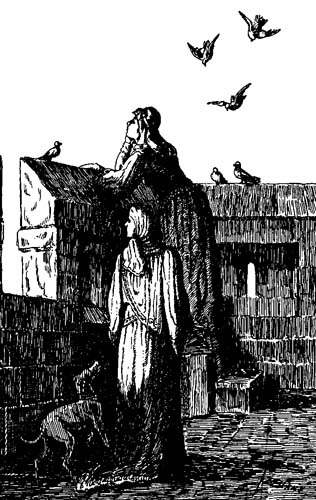
Emma's first sight of the Foe.
'Methinks, Eadgyth, these haught chevaliers with their baldrics and their golden spurs, and above all my Lord Bishop of Coutances, cut a sorry figure assembling their forces thus to crush a woman,' she cried, with an excited laugh. 'How wrathful will they be, when the brave ger-falcon they deem to be mewed up within these towers swoops down upon them as from the skies, with a gallant army of bold Bretons, backed by some of Sweyn Ulfsson's best warriors. Do your worst, ye tools of my tyrant kinsman! I fear ye not. My lord is safe—my lord ye would fain have hindered from being mine. And I am safe also, whatever betide—my miséricorde assures that.'
'Holy Mary preserve thee from such a desperate safety!' exclaimed Eadgyth, whose sad, still face contrasted strongly with the flushed excitement of the impulsive Norman.
'Thou art down-hearted, Eadgyth!' said Emma, after a piercing glance into her bower-maiden's eyes. 'I know thee too well to believe that thy depression comes from vulgar fear. Tell me thy grief. We are as private here as in my bower. None can hear our speech.'
'Seest thou yon star shining between two bars of cloud, noble Emma? It reminds me of one who bore a painted star between two clouds for his cognisance. A dire doubt haunts me lest he be in the ranks of the foe; for I well remember his heart was always with the Duke of Normandy.'
'Sir Aimand de Sourdeval? Nay, surely he would not lift his hand against his lord. Besides, the earl told me that he had sent him on a long journey.'
Through Eadgyth's heart passed a quiver of pain.
'Not surely the longest journey of all,' her anxious affection whispered, but she was silent.
'Poor child, I feel for thee!' said the countess, laying her hand caressingly on the flaxen head of the Saxon, which her elevated position on the stone steps enabled her to do comfortably. She had assumed a very matronly manner since the gold ring had been slipped upon her finger by her heart's chosen, and, in truth, she felt as if years of experience had gone over her head since the day when her brother had come to her and told her 'that her broken troth should soon be mended.'
Sir Alain de Gourin approached with an obsequious air, and the countess said to him gaily, 'I hope, fair sir, the gentlemen yonder are well satisfied with the quarters they have chosen, for methinks it will be somewhat long e'er they change them for the hospitable shelter of Blauncheflour.'
At which De Gourin laughed applaudingly, and swore that if the garrison had half the spirit of their Castellan, they would send them to bide still farther from their doors.
Then the countess led her ladies down to the chapel, where the chaplain performed a special mass, praying the protection of the heavenly powers for the beleaguered garrison and for all who fought on their side, at home or abroad, and offering prayers for the safety and success of the earl.
The tears rolled down Emma's cheeks as she repeated these last, and many of the ladies sobbed audibly, partly for the woes of their countess and partly through fears or sorrows of their own.
When the service was over, Emma dismissed her attendants, even Eadgyth, and followed Father Pierre into his sacristy.
'I would have a mass performed, father,' she said, 'for the soul's welfare of a knight whom I regard for the sake of one who loves him well, and also in that he did always seem to me an honest wight, but of whom I know not whether he be fighting for my dear lord, or if he be in the opposing host without. There is no reason why I should make mystery of his name—Sir Aimand de Sourdeval.'
'Sir Aimand de Sourdeval!' repeated Father Pierre, gazing at the lady with startled eyes. 'Knowest thou not, noble countess, that he is a prisoner in the dungeons of this keep?'
CHAPTER XIX.
'STONE WALLS DO NOT A PRISON MAKE.'
'Sir Aimand de Sourdeval a prisoner in this castle?' repeated the countess in a tone of the most complete surprise, and her cheeks grew white with a sudden horror, for, to explain this thing, either, it seemed to her, the young knight, whose honest face and noble bearing had won her respect and the heart of her best-loved bower-maiden, must be unworthy; or—and the thought gave her a keener pang than even she had suffered from the rumour of his death—the master of the castle had made evil use of his power.
'Wherefore is this? Knowest thou his offence, father?' demanded the countess.
The young priest bowed his head. 'Daughter, if thou wilt know the truth, the offence of a too great fidelity to his suzerain, William of Normandy,' he answered in a low voice.
A spasm of pain crossed Emma's face at this objective presentment of her worst fear, and the terrible heart-searchings with which she had entered into the struggle against the Conqueror returned with renewed force.
'I would hear this prisoner's defence from his own lips, and judge for myself of his guilt,' she said, turning to Father Pierre with quick decision, and a pale, set face. 'Lead me to him.'
'Noble Emma, the dungeon in which he is chained is no seemly place for gold-embroidered slippers and ermined robes.'
'Less seemly still, then, for an innocent man, if innocent he be,' cried Emma, each syllable sounding like a challenge thrown at a foe. 'Show me the way. I will see myself to the lodgment of all under my roof.'
Then a satisfied light gleamed from Father Pierre's unworldly dark eyes, and his thin, ascetic features relaxed into a smile. 'The Holy Mother reward and sustain thee, my daughter!' he said softly. 'Come then at once!'
Emma followed him; outwardly calm, but in reality deeply moved, and not without terror at thought of entering those terrible dungeons, which, although she had passed her life in castles, had hitherto been known to her only by name.
He led her through winding passages secured by more than one heavy, clangorous portal—the vaulted walls echoing to the creak of their hinges—into the silence and the darkness of the basement.
The chaplain was free to penetrate at will into these halls of suffering and despair in the prosecution of his sacred office, but the warders who guarded the various portals half forgot to make their reverence to the priest, as they stared with open-eyed surprise at the lady, till, on recognising her, they saluted with clumsy haste, and strove to atone for momentary negligence by quick opening of the door which formed their ward.
Emma shuddered as the torch with which Father Pierre had provided himself gleamed on the damp, massive walls. It seemed to her that imprisonment between them would of itself bring death to her, and she marvelled how any human creature should sustain life under such conditions.
'In sooth, noble Emma,' said Father Pierre, as the countess gave expression to this feeling, 'the holy saints have sent thee hither this night, because time grew pressing. A little while, and the man who is the object of thine errand of mercy would be released by a sterner liberator—death. If thou shouldst deem him worthy of his dungeon, he will not need guarding long!'
'Ah!' sighed Emma, with a sharp pang of horror, and instinctively quickening her steps, as if a moment might be fatal.
They had reached a narrow, ponderous door, studded with huge nails. Father Pierre produced a key which he had taken from a warder who stood at the end of the passage. He turned it in the lock, and, drawing back their solid bolts, pushed open the door and entered the cell into which it gave access, the countess following with shrinking steps.
The cell was small, for it was hollowed in the wall of the keep, some thirteen feet in thickness at the outside; it was, perhaps, eight feet square. The walls were running with moisture, and the air was dank and fœtid. On a stone ledge raised a little higher than the ground, the prostrate figure of a man was revealed by the fitful gleam of the torch, and Father Pierre went forward and bent over him.
'Awake, my son!' he said gently, holding the torch so that the light fell upon the slumberer's face.
Emma's hands clung together in anguish as she saw the gaunt, cadaverous features, the paled skin, and the wild matted hair and beard of the prisoner, and marked the fleshlessness of the limbs that were extended in uneasy length upon the inhospitable couch. His appearance might have moved the hardest-hearted to pity, and seemed all the more terrible in contrast with the image that was in Emma's mind, of the young knight as she had last seen him, in all the bravery of the harness of the jousting-field, neat-shaven and close-cropped as any modern English gentleman, according to the fashion of the Normans.
The unhappy knight opened his eyes with a nervous start, and sprang into a sitting posture; the rattle of chains that accompanied his movement revealing to the ruthful eyes of the countess that his ankles were loaded with heavy rings of iron, attached by chains to a stanchion in the floor.
'Fear nothing, Sir Aimand,' said the priest reassuringly. 'It is I—Father Pierre; and I have brought thee hope, and at least the surety that thy case will be inquired into and sifted to the ground. See, the noble Countess Emma has herself deigned to visit thy prison. St. Michael has answered thy prayers!'
The captive stared round him with haggard eyes, which seemed almost supernaturally large and bright, and Emma quailed as they rested at length upon her, with an expression of wonder and inquiry.
'The Countess Emma?' he repeated in a faint voice,—'the bride?'
Time for him had been standing still since the day of that fatal bride-ale, which brought evil in some form to all who partook of it!
'Art thou indeed Sir Aimand de Sourdeval?' said Emma, crossing the cell and standing before the prisoner, her beautiful face full of pity, yet not all softness. 'Unhappy knight,' she added almost sternly, her clear, decisive utterance ringing round the cell, 'what crime hast thou committed against my lord, that thou art subject to such durance?'
De Sourdeval threw back his head with a gesture of indignation; then his expression changed to one of sadness, and he threw himself on his knee before the countess.
'Noble Emma,' he said, 'the only crime I have committed against thy lord and mine own liege, was that of being faithful to his suzerain and mine, nor can I believe the kind and generous De Guader knows my fate.'
'Thank God!' cried Emma, with a sudden sob.
'Thou hast been good to me always!' exclaimed De Sourdeval, with intense excitement, his breast heaving and his eyes shining as he spoke. 'Oh, gracious countess, bear my petition to thy lord, and tell him that Aimand de Sourdeval was never unfaithful to him in word or deed, and pray him to sift this matter to the bottom, for if he knoweth aught, 'tis most like that his ears have been abused by the untrue malignities of my enemies.'
'Knowest thou not that the earl is sped to Denmark, there to collect fresh forces wherewith to relieve us from the beleaguering host that now sits before the castle walls?' asked Emma, with less firmness, feeling for the first time the full weight of the responsibilities she had undertaken. 'In my hands is the ruling of the castle; tell me, therefore, the burden of thy petition.'
Then Sir Aimand related to her the story of his adventures on the night of her bridal, and how Sir Alain de Gourin had foully entreated him, a narrative broken by terrible fits of coughing, showing how deeply the chills of his prison had wrought upon his frame, and by exclamations of surprise from the countess, who was much startled to discover the conduct of the Breton knight, and in great perplexity, for she felt keenly that Sir Aimand had but acted the part of an honourable man, and that to offer him a pardon under such circumstances would be but an insult. Moreover, he seemed to ignore the earl's present position of active rebellion, and she could not gather how far he was aware of the position of affairs.
'Doubtless, Sir Knight,' she said, 'thine impulse to be faithful to thy suzerain was that of a true and loyal soul, and none can blame thee; but William of Normandy has made the land groan under his tyranny, and so haught and overbearing was he, that, for the mere delight of showing his power, he crushed his most loving peers under his heel. Thou knowest that he strove to part my lord from me, and forbade our marriage; and so wroth was he at the breach of his capricious mandate, that, in self-defence, my lord was driven to take arms. Let the past be forgotten. Thou shalt be reinstated in all knightly honour, and shall prove thy faith to the earl thy lord, by defending his lady in his absence.'
She held out her white jewelled hand to the gaunt, unkempt prisoner, looking in his face with a persuasive witchery that might have tempted a man to leave a palace for a dungeon. But De Sourdeval kept back his meagre, unwashed hand.
'Noble countess,' he exclaimed, with a long sobbing sigh, that showed how great the effort was to speak words that might close for ever his half-opened prison door, 'against whom am I to defend thee? Am I to fight men who are faithful to their knightly vows, by the side of traitors who have broken troth?'
'My son! my son!' interposed Father Pierre anxiously. The knight's bold words brought home the unvarnished truth of the situation with a startling clearness, which his own dreamy nature had enabled him to shirk facing hitherto.
Emma proved cowardly; she evaded a direct answer, and sheltered herself behind the privileges of her sex.
'Surely thy vow of chivalry binds thee to succour ladies in danger? We are in danger, myself and my ladies. Eadgyth of Norwich,'—she paused and looked in his face. De Sourdeval made a gesture of distress,—'Dame Amicia, whose age and infirmity should nerve the arm of a brave young knight and all our band, need the help of every stalwart friend who can be found. Still further, Sir Aimand, famine is our most dread foe,' she added, half smiling at the inhospitable thought. 'We can ill support idle mouths in Blancheflour.'
'Let me then starve, dear lady,' replied De Sourdeval in a low voice of desperate earnest, and avoiding her too persuasive eyes. 'I cannot lift my hand against my heart's witness to the right.'
'Fight not then, noble Sir Aimand!' exclaimed the countess, deeply moved. 'Only pass thy knightly pledge not to betray us to the foe, or to struggle to escape, and thou shalt be free! Nay, if we make a prisoner we will honourably exchange thee!'
'Not even that can I do, noble countess,' said Sir Aimand with unwavering firmness. 'I cannot pledge myself not to help the right.'
'Nay then, thou art obstinate!' cried Emma, stamping on the stones with one of the gold-embroidered slippers which Father Pierre had observed to be ill suited to dungeon floors, and turning away.
Sir Aimand bowed his head in silence, and made no effort to recall her, as she swept towards the door, though his trembling lips and clenched fingers showed the fierceness of the struggle he was making.
But Emma paused before she reached the door. 'Thou art too proud, Sir Knight,' she said coldly. 'But few can rival the Fitzosberns in that quality, and I also have my pride. I scorn to make conditions with a man circumstanced as thou art. Abuse my generosity if thou list. Thou art free!'
'Mary Mother in heaven bless thee for thy goodness, noble countess!' cried De Sourdeval, raising his head with a start of joy. 'Yet methinks I am scarce free yet!' He lifted his shackled limbs, and made the heavy irons clang upon the floor.
'Ah, good St. Nicholas, no!' cried Emma, with a fresh shock, as she realised what sufferings the prisoner must have undergone. 'But thou shalt be free before the sun is in the sky.'
'Noble countess,' interrupted a harsh voice behind her, 'what means thy presence in this cell at such an hour? By the Rood! thou dost great honour to the would-be murderer of thy husband.'
'Liar!' hissed the prisoner between his set teeth.
Emma turned with a start to face Sir Alain de Gourin, his cheeks purple with passion, and his quivering hand on the hilt of his miséricorde. The countess thought it politic to ignore his speech, although every word had reached her ears.
'Sir Alain!' she exclaimed, simulating pleasure at his appearance. 'Thy coming is most opportune. I was about to send a messenger to thee. Give orders forthwith that the irons be struck from the limbs of this worthy knight without delay. He hath been shrewdly misunderstood, and my will is that he be set free!'
She looked the mercenary hardily in the face as she gave him her command, and the villain quailed. He saw that he had come too late to prevent her from hearing Sir Aimand's statement of the case.
He accepted the oblivion in which she had buried his first insulting speech, and took an entirely different tone. 'Thy will is law, noble countess,' he said obsequiously, and with a low bow.
Emma did not retire to rest until she knew that the knight was comfortably lodged in the state apartments of the castle.
The Breton had been completely taken by surprise. He had imposed upon the earl with a story which the latter, in the excitement attendant upon his ambitious enterprise, had neglected to verify, and it had never entered his head that the countess would trouble herself about the matter. He supposed that the earl himself had at least spoken to her of Sir Aimand as a culprit, and that she was entirely ignorant of his presence as a prisoner in the castle; as she had been, until the strange impulse which came to her to have a mass said for him, caused her to name him to the chaplain.
Even in case of her finding the matter out and wishing to probe it, he had an ingenious story ready, wherewith to put her off the scent.
But the suddenness with which she had taken matters into her own hands, and had visited the prisoner and heard his version of the facts, quite overcame the somewhat clumsy wit of the Breton.
His first impulse, as usual, had been to bluster, but the firmness with which the countess confronted him had fairly cowed him for the moment, as he knew that he would have to justify himself, and to eat a good many of his words before Sir Hoël and the Norman knights of the garrison, to whom he had accounted for De Sourdeval's absence by representing that he had been sent on an embassy by the earl.
Many were the curses that he inwardly showered on the devoted head of Father Pierre, to whom he attributed the discovery of his schemes, and he also reviled himself for having forgotten him as a possible channel of communication between the prisoner and the countess.
His wits had not been the brighter for the hour at which Emma had happened on her inopportune discovery, for he had been indulging freely in his favourite spiced hippocras during the evening, and therefore it seemed best to his clumsy cunning to offer no further open opposition to the countess, and to carry out her orders himself, thus gaining time to concoct plausible excuses before Sir Hoël should know of the affair.
Emma also kept her own counsel, and did not say a word even to Eadgyth, when the Saxon maiden, who slept in her chamber, came to help her to unrobe.
When Eadgyth ventured a question as to what had detained her to such a late hour, the countess smiled and kissed her.
'Thou shalt know all in good time, dear donzelle,' she answered. 'Ask me not to-night.'
CHAPTER XX.
À OUTRANCE.
The morning came, and with it cares more important than the fate of the poor Knight of Sourdeval.
Before the dew was off the meadows, the shrill trumpets of the besiegers were heard at the barbican, demanding a parley, and calling for admittance in the name of the king.
The countess, holding counsel with Sir Hoël de St. Brice and Sir Alain de Gourin, and other of the knights of the garrison, replied that she would accede to the parley, and receive the messenger in person; and, accordingly, the messenger was blindfolded, admitted within the castle, and conducted to the council-chamber in the great tower.
The knight who bore the message of the king's lieutenants was sheathed in complete armour, and exceedingly stately in his mien and figure, being tall and of great personal strength. He was no other than Robert Malet, whose father, the loved and honoured William Malet, had been in bodily prowess second to none but the Conqueror himself of those who fought on the Norman side at Hastings.
As he entered the room, the rebel knights instinctively straightened themselves, and assumed such dignity of bearing as they were capable of showing; but none bore comparison with him save Leofric Ealdredsson, the stalwart Anglo-Dane, who had never bent the knee to the Norman Conqueror, and who now stood at the right hand of the countess, with the lightnings of a noble defiance gleaming in his blue eyes.
Yet Malet himself was to become a rebel before his death. When the silken kerchief with which his eyes had been covered was removed, he gazed proudly round the assembly, and bowed his tall head to the countess alone.
'In the name of William the Conqueror, King of England and Duke of Normandy,' he said in a commanding voice, 'I call upon Ralph de Guader and Montfort, heretofore Earl of East Anglia, but deprived of his earldom for that he has wrongfully taken arms against his suzerain and liege lord; and I demand that he instantly surrenders this castle, which he holds only as the Constable of the king. I demand that entrance into the said castle be at once given to the troops of his Grace the king, and that he thereby refrain from adding still further to his guilt, by contumaciously retaining it.'
'The Earl of East Anglia hath taken ship from this country, and hath devolved the duties of Castellan upon me, his countess,' replied Emma calmly.
'In that case, noble lady,—I cannot style thee countess, for thou hast no longer right to the title,—I call upon thee, as Castellan of this castle of Blauncheflour, to surrender it to the lieutenants of thy liege and kinsman, William of Normandy,' answered the young knight, fixing his keen blue eyes upon Emma's fair face, whose features, worn by the anxiety she had undergone, were pathetic in their pallor, and moved his heart to pity. 'I may well suppose,' he continued boldly, 'that in so doing thou wilt with pleasure disburden thy slender shoulders of so heavy and unwomanly a burden.'
Emma drew herself up with a slight gesture of disdain for such misbestowed sympathy. The knight responded by adding hastily, 'Moreover, I would appeal to thy gentleness and natural instincts of mercy to prevent the useless shedding of blood which the holding of this castle must cause, by prolonging a struggle which can only end one way.'
Emma's delicate nostrils quivered, and the fine firm lips set fiercely.
'The Countess of East Anglia desires to know the terms on which she is asked to yield up her faithful garrison to the tender mercies of the men who mutilated Stephen le Hareau,' she said, still calmly, but with flashing eyes, and due emphasis on her title. 'The race is not always to the swift, nor the battle to the strong, and methinks her gentleness and love of mercy are more nearly concerned in preventing her faithful defenders from encountering such a fate as his.'
'To the Castellan of Blauncheflour I reply, that the surrender must be without conditions,' answered the knight.
'In that case,' answered Emma, 'the Countess of East Anglia replies, that her garrison will win their own terms by their swords.'
Leofric Ealdredsson burst out with a loud 'Ahoi!' in the exuberance of his approbation, and clashed his heavy axe upon the floor, his many bracelets jingling like small bells. 'Well said!' exclaimed the venerable Sir Hoël de St. Brice, looking at the young countess with an expression of reverent affection, and from one and all the representatives of the garrison who stood around her chair broke various expressions of approval.
The countess turned to her knights with sparkling eyes. 'I have ye with me, then, in this reply, fair sirs?' she asked, and the tumult of assent with which they answered hindered Robert Malet, for some moments, from further speech.
In truth the enthusiasm was contagious, and the royal envoy's own eyes flashed. The chivalrous spirit of Fitzosbern's daughter jumped well with his humour. He had been a sorry Norman else; no true heritor of the wild sea-kings. It cost him some effort to resist his impulse to join in the applause, but he controlled himself, and said gravely, 'I pray thee, noble lady, to consider well before coming to so direful a decision; involving, as it doth, no less an issue than the adding of high treason on thine own part to the heavy guilt of the man thou hast wedded against the express mandate of thy suzerain. The daughter of William Fitzosbern should be slow to draw the sword against William of Normandy.'
'The decision is final, Sir Knight,' replied Emma curtly; thinking to herself that William of Normandy had not scrupled to insult the son and daughter of William Fitzosbern. She added to those in attendance, 'Let this brave gentleman be reconducted to the gate without delay.'
The envoy bowed in silence, and, allowing the silken kerchief to be again bound over his eyes, he marched with stately grace from the apartment.
So Emma de Guader cast down her gauntlet beside that of her husband, and dared the power of her great cousin.
Before the sun was midway in the heavens, a fierce struggle had begun between the besiegers and the besieged for possession of the barbican. This was not a strong construction of masonry as in the Norman castles of the twelfth century, but a deep and wide fosse or moat, with a high vallum strengthened with stout palisading on its inner side, of a semicircular or horseshoe form, the horns nearly touching the present ditch. The causeway that passed between the horns and the present ditch, by which access was given to the castle, was amply protected by the towers of the gate-house and the walls of the castle itself, from whence arrows and quarrels would easily reach assailants. The similar fosse and palisaded vallum surrounding the castle meadow afforded additional protection to the eastern extremity of the causeway; the portion of the semicircle to the south-west being most open to attack.
Spearmen and javelin-throwers lined the palisades, and from their cover repelled the onslaught of the assaulting men-at-arms, who had further to withstand a whizzing shower of arrows from bowmen hiding in the wooden stalls of the market.
The king's men were endeavouring to throw a wooden bridge across the ditch. One end was furnished with wheels, the other with huge grappling-irons, which they strove to make fast in the vallum.
Watching them stood Leofric Ealdredsson, who, on the night before, when Sir Alain de Gourin had been sneering at the primitive Saxon earthworks, had said, with a laugh and a fierce gleam in his eyes, 'Let me defend them; I am used to the rude English fashions.' A band of his terrible house-carles, armed with their great battle-axes, and long of hair and large of limb, waited his orders with the air of bloodhounds in a leash straining at their collars.
From a loophole on the southern side of the keep, lighting the gallery which runs within the walls on a level with the great entrance, the countess and her bower-maiden Eadgyth watched the strife.
Eadgyth had been present in the council-chamber during the audience of Robert Malet. 'Thou wast grand, Emma,' she was saying to her lady and friend. 'Thou wast so strong and courageous, while, to say sooth, my own heart was beating like an armourer's hammer.'
'Thou art a strange child, my Eadgyth,' said Emma affectionately, well pleased with the admission of the English maiden.
A wilder shout from the besiegers than any preceding broke their converse, and for some moments each watched the progress of the fight in breathless silence.
For the assailants had established their bridge against the vallum, and over it the attacking knights charged in a body, led by Robert Malet in person, his high crest topping them all, and by sheer weight of horse and harness they drave down the barricades and pressed in, hewing in sunder all before them.
Eadgyth gave a shrill scream and threw her arms wildly round the countess, who stood motionless, with eyes dilated and heaving breast.
Then rang out the wild Norse war-cry, 'Ahoi! ahoi!' And Leofric and his fierce carles sprang forward like tigers; and the flash and crash of their great axes smote eye and ear, while more than one knightly saddle was emptied, more than one riderless destrier ran neighing around the enclosure; more than one mailed warrior, impervious to arrows and quarrels, was cloven through his helm and lay lifeless on the ground.
The Anglo-Danes laughed in their yellow beards, and vigorously improved their advantage, so that in a few moments the knights were forced back beyond the line of the barricades, some getting back across the bridge, some falling into the water.
'See, foolish child! thy cousin has driven them back!' cried Emma. For Leofric was akin to Harold on the mother's side, and so akin to Eadgyth. She stroked the cheek of the frightened girl as a mother who comforts an infant. 'And had he not, there are stout walls and strong arms betwixt them and thee.'
'I know it! I know it! But it is all so terrible! I have not thy nerves of steel! Oh, Emma, in pity watch no longer! I cannot bear it!'
'Faint heart!' cried Emma lovingly. 'The clash of arms doth but spur my courage. I have always loved it from my cradle. Methinks I had made a doughty knight! It is not danger that quells me.'
Her face grew sad, for the bitter pang of an uneasy conscience gnawed her soul. Danger did not quell her, but her doubting heart tormented her.
'Let me then starve, dear lady; I cannot lift my hand against my heart's witness to the right.'
The sentence sprang into her mind and seemed to glow before her eyes as if it had been seared upon her brain with red-hot irons.
She drew her breath with a long shuddering sigh. In the rapid crowding of events that morning, the man who had spoken it in such despairing earnest had been forgotten, though she had thought of nothing else through the long watches of the night.
She turned to Eadgyth, and bade her go to the chapel, and offer prayers for the earl, and the garrison, and the souls of the fallen. 'Thou wilt feel safe within the holy precincts,' she said; 'and Dame Amicia shall attend me. She is short of sight, and the shouts of yonder madmen will scarce penetrate her ears; she will prove more courageous than art thou.'
When the aged lady-in-waiting came to her, in obedience to the message Eadgyth had conveyed, the countess left the loophole through which so stirring a drama was visible, and advanced to meet her. 'I need the support of thy reverend presence, dear dame,' she said, and told her how she had found one of her lord's knights imprisoned, as she believed, on a misunderstanding, and that she wished to question him again, having taken it upon her to free him.
The old lady could hear each syllable of Emma's clear, soft voice, though she was untroubled by the shouts of the combatants below, and she nodded her stately head with its crown of snow-white hair, tastefully draped with a broidered veil of Cyprian crape.
'A good lad, a good lad, and ever courteous,' answered Dame Amicia. 'Thou dost well to probe the matter. I thought he had gone to Bretagne.'
'It seems he was in durance in this castle,' said Emma. 'But we knew it not; or, if my lord knew it, he had no time to sift the charges against him. Methinks, if he have somewhat erred, he has been punished enough, and I may grant him pardon.'
'Ay; if we forgive not the trespasses of others, how can we pray with a clean heart that our own may be forgiven?' replied the old lady, nodding again. 'We must practise forgiveness, or our paternosters are but a mockery.'
No further words were spoken till they reached the apartment to which, according to the orders of the countess, Sir Aimand had been conveyed.
De Gourin had taken the precaution to place a stout warder at the door, who announced the visit of the countess to the knight.
When Emma entered the chamber, Sir Aimand threw himself on his knee before her, with an expression of deep homage, and bowed to her and to her venerable attendant.
'Noble countess,' he exclaimed, 'I scarce know how to form my gratitude in words!'
Emma was freshly shocked when she saw his face and form. Shaven and close-clipped as became a Norman knight, and clad in tunic and hose, the ravages of two months of misery were but the more conspicuous, as they owed no adventitious aid to wild elf-locks and shaggy beard. His cheeks were sunken, and his eyes unnaturally bright with fever, and the bones of his thin hands and limbs were pitiful to see. His voice also was hoarse and hollow. Emma felt that the revelations of the morning moved her more, not less, than the doleful horrors of the preceding night.
'I fear me thou hast greatly suffered,' she said involuntarily. 'Rise, Sir Aimand, and be seated; thou art not fit to stand.'
And Sir Aimand was forced to obey her, for, as he rose to his feet, he tottered and clutched at a stool for support, and Emma recalled some fears that had crossed her mind during the night, with pathetic amusement, for she had been haunted with the idea that she had perhaps let loose a very dangerous champion in the castle. The poor knight looked little able to fight either for her cause or against it.
'I had come hither to question thee more closely as to the circumstances of thy imprisonment,' the countess said, 'and to see if thy proud spirit be at all softened by my bounty, but methinks the best thing I can do is to send thee a good leech.'
'Noble countess, thy generosity hath not left me unmoved,' said Sir Aimand eagerly. 'I give thee my parole, neither to attempt escape, nor in any way to communicate with, aid, or abet the besiegers, if indeed thou wilt be gracious enough to accept it so ungraciously and tardily given.'
'I will accept it,' replied the countess, with a gratified smile; and Dame Amicia smiled also, seeing that her lady was well pleased, although her deafness prevented her from knowing very clearly her reasons for satisfaction.
The countess had felt that the old dame's infirmity might be convenient, for the chief object of her visit was to question the knight more closely regarding the circumstances of his imprisonment, and she cared not to trust his indictment of Sir Alain to any of her gossip-loving ladies.
'I would that Sir Alain bore not so important a position in the garrison,' she said, after listening again to De Sourdeval's story. 'The Bretons make the most part of our strength, and, save one or two, who are vassals to my lord, he hath them all under his command.'
'Lady,' answered De Sourdeval, 'strive not to see me righted to the detriment of thy welfare. It may well be that De Gourin will serve thee faithfully, though he satisfied a private vengeance against me. Let him not know that I accuse him; say only that thou dost grant me pardon. But be on thy guard against him.'
'It must be so,' answered the countess, 'for the present.'
So saying, she took her leave, the knight following her with grateful eyes.
When Emma regained her bower, she summoned Eadgyth to her.
'I have news to comfort thy courage,' she said. 'A doughty champion is in the castle. Does not thy heart tell thee his name?'
Eadgyth opened her blue eyes in vague surprise, then cried, with a start of joy,—
'Ah, Emma, dear Emma! hath the earl so soon returned?'
'Fie, maiden! wouldst make me jealous? Doth thy heart suggest the name of my lord?'
'What meanest thou, Emma? Jest not, I pray thee. These days are too terrible for jesting,' said Eadgyth, with distressed mien and paling cheeks.
Emma took both her slender wrists in hers and looked lovingly in her face. 'Nay, we must jest to keep our blood from curdling, Eadgyth. But I will not tease thee. Sweet, 'tis Sir Aimand de Sourdeval of whom I speak.'
Eadgyth said nothing, but met Emma's gaze with eyes in which joy and surprise, and doubt of herself that was almost terror, were struggling for mastery.
Emma drew her gently upon the seat beside her. 'Surely thou art glad to know that he is safe, if thou joyest not that he is near?'
'Ah yes! I am glad—glad indeed of his safety!' replied Eadgyth in a low, thrilling voice, and her hand sought the bracelet which she wore as ever.
'And not of his nearness?'
'I know not! I know not! It means but fresh struggle and misery!' The tears rolled down her cheeks.
'Why struggle, Eadgyth? Fate has united you when all pointed to separation. Eadgyth, he needs thee. I told thee sooth when I said he was in safety. But he has suffered much. He is ill. Be thou his leech. Dame Amicia will attend thee—her motherly heart warms towards the youth.'
'Ill?' Eadgyth looked in the countess's eyes with almost fierce questioning.
'Ill,' repeated Emma, smiling. 'Not dying; not in danger; I said "safe." It is a long story, Eadgyth, but I must tell it thee.'
Then she told the history we already know; and how, after Eadgyth's remark about him on the battlements, it had entered her heart to have a mass said for him; how it had led to his discovery, and how she had visited him in his dungeon.
When she came to that point, and narrated her visit, describing his sorrowful aspect with unconscious pathos, Eadgyth sprang up and clasped her hands above her head. 'Oh, the terrible injustice of it!' she groaned, and afterwards she paced backwards and forwards, unable to control her emotion.
'But thy hero was shrewdly saucy, Eadgyth. Woebegone and desperate as he was,—I almost wish I had let thee see the figure he cut, with his unkempt beard and tangled locks, as long as those of thy Saxon champions,—natheless he would make no terms. I might free him, or leave him chained by the leg like a hobbled steed, as I found him. One might have thought he had passed a pleasant time down there in the dark. He would not even give me his parole not to help our besiegers if I gave him the chance.'
Eadgyth's eyes lighted up with a proud joy. 'That was noble,' she said under her breath.
Emma laughed. 'He had come to a better mind this morning,' she said; 'I found means whereby to tame his proud spirit.'
Eadgyth turned to her with a start, and wild visions of racks and thumbscrews, and other fashionable instruments of the time, passed through her mind. Her spirit was so torn with the terror of the day, and the excitement she had undergone, that she did not pause to consider probabilities. 'Emma! thou hadst not heart to crush one so unhappy?'
'I had!' said Emma.
Eadgyth's eyes looked dumb reproach more eloquent than words.
'Yes,' said Emma; 'I hold not the office of Castellan of Blauncheflour by halves! I made use of my power.'
'What didst thou do?' asked Eadgyth in a scarcely audible voice.
'I gave him his liberty without conditions, and had him lodged in one of the best apartments of the castle. That touched my knight's pride; he would not have me outdo him in generosity, so he capitulated this morning, and offered me his parole without further asking!' and the countess broke into a silvery peal of laughter.
'Oh, Emma, that was like thy dear self!' cried Eadgyth, running to the countess, throwing herself on her knees before her, and hiding her head in Emma's robes like a repentant child.
Emma kissed her. 'Now, maiden, thy part must be done. The knight has promised neither to help the enemy nor to attempt escape. Be it for thee to persuade him to buckle on his harness and fight for us. He can scarce see thy sweet face, and know thou art in danger, and not lift his hand to help thee!'
'I persuade him!—to break his knightly vows and fight against his lawful liege? Never!' cried Eadgyth, raising her head and throwing it back proudly. 'Strange,' she continued, more to herself than to the countess, indeed, scarce knowing that she spoke aloud, 'how thy haught courage and noble generosity are allied with so little sense of moral right!'
A flash of pain and some indignation crossed the countess's brow. 'I deny thy right to judge me,' she said coldly. 'There are some who strain after such high ideals, they fail to see the duties that lie near; gratitude, for instance, and the welfare of their friends!'
Eadgyth was silent, for she felt that Emma was unjust; she would have given her life to serve her, though she would not go a step against her conscience.
'Sir Aimand has suffered much,' said the countess gently, after a pause. 'He is out of health and out of hope. A little happiness would serve him in better stead than an armful of herbs and simples. Go to him, Eadgyth! Encourage his contumacy if thou wilt, but go to him.'
And Eadgyth went.
CHAPTER XXI.
THE ORDEAL BY FIRE.
At the close of the day the barbican still remained in the keeping of the besieged.
It had not been retained without the loss of many a stout soldier, and the spital was crowded with patients, who occupied all the healing talents of the countess and her ladies.
When Emma at last retired to her chamber, with her Saxon bower-maiden in attendance, she was so weary and worn with the excitement and strain of the day, that she threw herself upon the bed, without even taking off her jewels, and fell asleep almost immediately; while Eadgyth, after softly laying a warm coverlet over her, lay down beside her.
But not to sleep. Her brain was full of dire and disturbing images, and even the face of Sourdeval, which it had been so great a joy to her to behold once more, came to her as she had seen it, wan and melancholy, when he turned to her as she entered his apartment, before it flashed with brightness on recognising who had come to him. The change in him had shocked her, and in her nervous and depressed mood she thought of him as one whom death had marked for his own, and his image was but as a pale spectre, round which the manifold forms of wounded and dying and tortured men, whom she had beheld during the day, grouped as a central point.
Her ears were full of the wild shouts of the besiegers and the shrieks of the injured, the awful clash of seax on helm, and hurtle and whiz of arrows. Again and again she woke from a fitful doze, thinking to hear the thunder of charging knights and the fierce 'Aoi!' of Leofric Ealdredsson and his carles, as they leaped forth from the cover of the palisades upon the foe.
At last from such an awakening she sprang from the bed; better, she thought, to wake all night than suffer such awful dreams.