THE SIEGE OF NORWICH CASTLE (continued 3)
Reading edition
It was a sunny little room on the east side of the palace, looking over the marshes of the low holme which then bordered the Wensum with a wilderness of sedges and white water-lilies, and upon which, some eleven years later, Herbert de Losinga erected the cathedral which is our present pride and joy.
Emma loved to watch the high-prowed galleys passing to and fro upon the river, with sails spread, and oars flashing, and stout rowers bending to their work; and to see them lading and unlading at Lovelly's Staithe, a wharf situated about a third of the distance between the present ferry and Foundry Bridge.
Here Eadgyth would entertain her with stories of her girlhood, and tell how she had seen her cousin, Harold Godwinsson, land at that wharf, when he came to Norwich after his imprisonment in Normandy; and how Leofric, Earl of Mercia, to whom the sainted King Eadward had given the East Anglian earldom in Harold's absence, met him with all honour; and of the magnanimous strife between the two, when Leofric would give back the earldom, and Harold would fain have had him keep it; and how Harold took it for a time, but returned it on ascending the throne.
And when the white swans came sailing amongst the reeds, bending their long necks from side to side, the Saxon maiden would tell her friend of Harold's beloved, her namesake Eadgyth Swannehals, the most beautiful woman in Norfolk, or, for the matter of that, in all England, and would burst into tears when she thought of the sad ending of that fair romance.
And Emma would smile at her enthusiasm, but yet grew in sympathy with this English people, the smoke of whose dwellings was rising around her, and almost found it in her heart to wish that her hero William had been a little less successful, and to question whether it had not been more virtuous of him to stay at home in his native Normandy. Somehow she had never admired him so freely since he had endeavoured to part her from her betrothed.
In such a mood as this was Emma when her husband sought her, with the intention of telling her the secret of his bold enterprise, but he little guessed how much her sympathies had turned against William, for, as is often the case when convictions are changing, she had made up for her coldness of feeling by warmth of speech, and had sought so to atone for her act of rebellion in marrying Ralph against the king's mandate.
Therefore the earl knew not how to begin his explanation, and sat before her embroidery frame almost as deeply embarrassed as Waltheof had been before the archbishop. 'Tis true he had told her ere their wedding that the quarrel must needs be fought out, yet it seemed not the easier to say,'My standard is lifted.'
His face was ashy pale, for it was to him cruel as death to leave his young bride before a month had passed, although he had known that the parting must come.
Emma, looking at him, dropped her silks in horror, and, throwing her arms round his neck, asked coaxingly what ailed him.
And Ralph turned his head away without speaking.
'Can it be that I have offended thee in aught?' asked the young countess anxiously.
'Nay, Emma, I am the offender, if offender there be. Methinks the worst of all ailments is mine, for I must leave thee, and perchance anger thee also.'
'Leave me?' Her breath caught in a sob of terror.
Ralph faced her desperately. 'My love, thou knowest our wedding was against the express mandate of the king. Lanfranc, the king's man, whom he made Primate of all England,—in place of the holy Stigand, whom he unjustly deprived, and who yet languishes in prison,—hath turned bitterly against thy brother of Hereford, whom whilom he was wont to treat as a son, and has set a ban of excommunication upon him.'
A low cry of horror escaped from Emma.
Ralph's eyes flashed fire. He caught his wife's white hands as they were sliding down from his neck, half withdrawn at the fear that her love had led her into deadly sin, since the brother who had countenanced her marriage, and urged her to its fulfilment, was cast out by the Church.
He understood the loosening of her clasp, and caught her hands as a protest.
'Emma,' he cried,'thou hast taken me for better or worse. I hoped to have made thee the second lady in the land. But alas! I must fight to hold mine own, nay, for dear life,—life which is precious for thy sake.'
'I do not regret my choice,' said Emma, meeting his gaze with her frank eyes, her proud Fitzosbern spirit rising to the test. 'Only I fear lest I have sinned in taking thee against the will of my king-lord and the voice of the Holy Church.'
'Say rather the voice of William's creature,—a Lombard upstart, without a drop of noble blood in his veins. Dost thou forget the holy men who blessed our union and gave it the sanction of the Church? They blessed thy brother for taking up the cause of an oppressed people. Shall the curses of the wily Italian have more weight than their benedictions? Dost thou throw over thy brother so easily to his untender mercies?'
'Alas! I am bewildered amid so many conflicting counsels,' Emma sighed.
'This poor land and all who are in it are so bewildered, my sweet lady,' Ralph answered, kissing the hands he still held. 'None can see the right clearly. William—the Conqueror, as he proudly styles himself—hath gone mad with his success, and the luckless people groan under his tyranny. Would I had never helped him to leave his duchy of Normandy! But it is useless to groan over the past, nor can I stop to chop logic over the present. The point is this: The king's men are marching to attack me. My only course is to fight for it, and, if possible, make a junction with thy brother Roger, when it may be that the oppressed Saxons will strike a blow to regain their freedom, and, with my trusty Bretons, I may still gain the day.'
Emma clasped her hands in sore distress.
'Is it in good sooth come to this, that thou must go forth against the king? Alas! my foolish face tempted thee to wrong. 'Tis I that am to blame.'
Ralph caught her to him and kissed her. 'Nay, by the heart of Our Lady. 'Tis William's mad pride that is to blame, and that alone. Speak no slander against my wife, or it will go ill with thee, for I will not brook to hear it.'
Emma drooped her head against his shoulder, smiling through her tears. 'Oh, Ralph,' she said, 'if thou wert but going in a good cause, the parting would not be so bitter.'
Ralph, having no good argument to proffer in reply, lost his temper. He sprang up and paced the room, making his golden spurs jingle at each impatient stride.
'I thought when I wedded a Fitzosbern I should escape the lot of most men, to be wept and wailed over at every crinkle in the rose-leaves of fate. But it seems thou art but of the same stuff as other women, after all.'
Emma flushed over neck and brow. She drew herself proudly erect, and hastily wiped away the tears that were rolling down her cheeks.
'Naught but dread of guilt and a too fond love could have drawn tears from a Fitzosbern,' she answered haughtily. 'Thou shalt not need to complain again, my lord.'
'Nay, my sweet lady, pardon me,' pleaded the earl, turning to her with entreating eyes. 'In good sooth, I am well-nigh distracted, and the sight of thy tears makes me too bitterly conscious of my own lack of worth. But what wouldst thou have me do? If it were but a question of my own poor life, I would submit, and let William do his worst, if such a course would pleasure thee; but I cannot desert thy brother, nor my own poor Bretons, and the Saxons who have thrown in their lot with mine. Thou knowest William is not gentle with such as cross his will. It would mean loss of lands and lifelong imprisonment to thy brother and myself, and the lopping off a hand and a foot for each of my Bretons, at the least, while hanging would be too mild a measure in his eyes for the Saxons.'
Emma's hands were tightly clenched together. The momentary flush had faded from her face, and it was pale as death, but she neither sobbed nor flinched.
'I have made my choice, and I will abide by it,' she said in a low, firm voice. 'Nor will I quail before the consequences of our deed. We have chosen each other against the whole world. Perhaps if thou hadst trusted me more fully, thou hadst not been vexed with tears. Thy announcement was somewhat sudden.'
'Let that ill-grained speech rest in its grave, dear love. Thou hast spoken like a Fitzosbern now,' said the earl, taking her hands again in his and drawing her back to his shoulder. 'I want thee to be of good courage, for I have treated thee as a hero's daughter, and appointed thee Castellan of Blauncheflour in my absence. I have vested in thee the supreme and sole command. Thine it shall be, in case of siege while I am away,—which God forfend,—to surrender or defend the castle on whatsoever terms may seem good to thee. Sir Alain de Gourin and Sir Hoël de St. Brice will act under thine orders and be thine advisers. Wilt thou take the office?'
'Yes, I will take it,' answered Emma, without a moment's hesitation, although her whole soul trembled within her at the prospect of being left in her young feebleness to command the turbulent De Gourin, for whom she had a strong aversion, and the veteran Sir Hoël, who was a total stranger to her, albeit he had been so long in her husband's train.
'Thou art indeed a fit bride for a warrior,' cried Ralph, gazing with admiration at her determined face.
Emma longed to throw her arms around his neck and sob, but conquered the impulse, answering only with a smile.
'Thou saidest I was sudden, sweet,' resumed Ralph. 'Methinks an agony that must be sharp had best be short. To that end I would not poison for thee the brief time we had together with the shadow of parting. That is why I told thee naught till now, upon the eve of my going forth.'
Emma could not repress a slight start.
'Dost go so soon? To-morrow?' she said.
'To-morrow thou wilt enter on thy new office,' answered the earl gaily, kissing her forehead. And then he slipped from the apartment, congratulating himself that the mischief was out, and full of admiration for his bride, in that she had borne the tidings so bravely.
Emma listened to his footfall as he strode down the long corridor till its echo was lost in the distance. Then the emotion she had violently repressed had its way.
She stretched out her arms after him as if to call him back, and threw herself on her knees near the door.
'Oh, Ralph!' she sobbed,—'oh, Ralph, my husband! Saints and angels protect thee! Guard him, St. Nicholas, thou under whose patronage he has placed himself. I vow seven candlesticks of pure gold to thine altar in Blauncheflour.'
Her voice died away, a strange sensation of numb oppression succeeded her violent anguish, and she sank in a dead faint by the door her husband had just passed through.
CHAPTER XII.
THE STANDARD OF REVOLT.
The day which was to part Emma de Guader from her bridegroom dawned clear and bright, and the summer sunshine sparkled upon the broad reaches of the Yare, and gleamed amidst the pale green rushes and brown osier beds of the Cowholme, shining with impartial equality, not only upon the just and the unjust, but upon the joyous and the sad.
In nooks and corners amongst the reeds and water weeds, the coots and water-hens were tending their nestlings.
On the site of the busy railway station, the tall heron poised gracefully on one leg, as his descendants do to this day, some ten or fifteen miles nearer the sea.
The yellow water-lilies were pushing their golden buds to the surface, and the reeds were growing dusky at the top, while the hot sunshine brought out the fragrance of the sweet-gale, or bog-myrtle, which covered many an acre, now built over, with its dark green bushes.
Westward the broad woodlands were in the young beauty of their summer dress, wearing still somewhat of the rich variety of spring. Mountainous white clouds cast purple shadows over the sea of their close-packed crowns, in the shelter of which sang merles and mavises, and the fitful nightingale; while above marsh and woodland many a hawk and bustard hung poised on motionless wings, for in those days the gamekeepers had no quarrel with them.
The sentinels on the keep of Blauncheflour had a fair panorama to look upon as they marched to and fro upon the walls; but they did not pay much heed to the beauties of nature, they were far too much engrossed in the doings in the courtyard of the castle below, and their eyes only left the knights who were gathered there, for an occasional glance at the armed host assembled within the circle of the barbican.
Truly the cluster of gallant warriors before the grand portal of the castle, glittering from head to foot with shining steel, lavishly ornamented with gold and silver, were a goodly sight to see; though perhaps Roger Bigod may have gathered a still gayer company round him a century later, when gaudy plumes and surcoats embroidered with the coats of arms of the wearers were the fashion of the day. In William the Conqueror's time, military finery had trenched little on the strictly useful, and the richness of these cavaliers consisted more in fine inlay of precious metals than in feathers and embroidery, or fantastic helms or armour. Their heads were covered with small conical steel-caps, having a nasal to protect them from a transverse cut across the face, or were encased in huge cylinders of steel, having narrow apertures for the necessities of sight and breathing; their long hauberks were of linked mail, or leather sewn all over with little rings of steel; their straight cross-hilted swords measured three and a half to four feet in length, and were encased in richly-chased and jewelled scabbards, and suspended from baldrics ablaze with gold and gems. Each wore in his belt the miséricorde, and at the saddle-bows of some hung the battle-axe or mace. Their oval or heart-shaped shields were from four to five feet long, richly embossed, and often bearing a raised spike in the centre. Their long lances were adorned with square or swallow-tailed pennons, according to their rank, for, when a knight obtained the rank of banneret, or leader of a troop, the points were shorn off his pennon. Their saddles and horse furniture were studded with steel bosses, and often the reins were steel chains plentifully enriched with gold, and the heavy steeds they bestrode had need of all their sturdy strength to carry their burdens of man and metal at a gallop, even at the prompting of golden spurs.
Before the portal stood De Guader's magnificent barb Oliver, champing his bit, and with difficulty restrained by the squire who held his bridle-rein, the white foam flying from his heavy curb upon his gilded trappings, and his fox-coloured mane tossing in the breeze.
A few words of the great portal itself, before which this brave company was assembled. The vestibule on the eastern side of the keep, now known as Bigod's Tower, was not built, but the very beautiful early Norman archway was certainly a part of the original structure, and opened upon a raised platform of stone, from which sprang a drawbridge connecting it with a flight of twenty-eight steps, ended by a gate to the south.
Beneath this drawbridge was the sally-port, a narrow postern strongly fortified, which in case of siege could, by raising the drawbridge of the main doorway, be made the only entrance to the keep. [3]
At a signal from a sentinel who stood upon this platform, the trumpeters executed a lively fanfare on their instruments. A moment later the portal was thrown open, and the earl came forth, clad in complete armour, and leading the young countess, who was very gallantly apparelled in crimson cloth, broidered over with jewels and silver; she wore a small gorget of blue Milan steel, and had on her head a little cap of the same, damascened with gold; round her waist a jewelled belt, from which were suspended a little miséricorde and a short steel chain.
Behind the earl and countess followed Sir Hoël de St. Brice and Sir Alain de Gourin, both in full harness, attended by several squires and pages. As they came upon the platform, the greater part of the garrison—all that were not actually on duty as sentries, warders, and like offices—filed into the courtyard, and took up their places behind the group of knights.
'A Guader! a Guader!' shouted knights and soldiers. 'Long live the earl and countess!'
The noble couple bowed courteously, and the earl, who held in his hands the keys of the castle, turned to his consort, and then cast a proud glance along the ranks of his retainers.
'Knights and soldiers,' he said, in clear trumpet tones which could be heard even by the sentinels on the battlements, 'before I go forth to battle, it is meet that I should appoint a Castellan to have charge of my castle of Blauncheflour, and this I do now before ye all assembled, in the person of my dear lady and countess, Emma, daughter of the valiant William Fitzosbern. I appoint her to the sole and supreme command, and to have as deputies under her, and as military advisers,—but under her pleasure, and to be dismissed if she think fit,—Sir Hoël de St. Brice and Sir Alain de Gourin. Knights and gentlemen, you who are about to go forth to battle with me, and to share my dangers, and, I hope, my successes, I make you witnesses of the fact of this appointment, so that if I fall in the chances of the field, you may hurry to my lady's standard and reinforce it with your strength. Knights and soldiers of the garrison, I charge ye to serve your Castellan and liege lady with faithfulness and fervour; to render her humble obedience, and to defend her as ye would defend your own lady-loves, wives, and children. I commit her and my castle, and with them my joy and my honour, to your care. Justify my trust!'
As he spoke he handed the keys of the castle to Emma, who took them with trembling fingers and attached them to her girdle, looking at the ranks of steel-clad men around her with a brave though blanched face.
A great roar of cheering rolled round the spacious courtyard, such as Emma had never heard in her life before, though she was to hear its like in the coming months. Asseverations and vows and battle-cries mingled in wild confusion, shouted from stentorian lungs in more than one language. 'Dex aie!' cried the Normans; and the Bretons cried 'Guader et Montfort!' 'Aoie!' 'Heysaa!' and 'The Holy Rood!' from English of varying types; while the knights shook their lances, and cried to God to shield their lady in their absence. Arms clashed, and horses stamped, and it seemed as if all the dogs in Norwich were barking.
When the tumult had somewhat subsided, and the startled pigeons were circling back to their favourite perches on the battlements, Emma, with a beating heart, made her little speech in answer. Turning first to the garrison, she said,—
'I thank ye all for your devotion, good sirs and soldiers!' and her clear, flute-like voice was to the full as distinct as that of the earl. 'Nor do I doubt that ye will do your duty to God, to your earl, and to me, his deputy, in whatsoever sore straits may befall. To you, noble knights,' she continued, turning to the group who were about to depart with the earl, 'I return thanks for your courtesy, and beg you to bear in mind that my lord's fortunes and fair fame, nay, even his life, do in some measure depend upon the sharpness of your swords, and your promptness to use them in his behalf, and therefore every blow ye strike will be struck in my defence, for, in sooth, I should die if ill or dishonour came to him!'
The cheers of the garrison and the vows of the knights to do their devoir by their lord burst forth more tumultuously than before; but the countess, turning to her husband, said in a low voice,—
'I can bear no more, Ralph. Farewell! May Our Lady and St. Nicholas guard thee and bring thee shortly home!'
She held out her hands to him appealingly, and he, pressing them, bent forward hastily and kissed her on the forehead.
'À Dieu, dear lady!' he said, with a voice less steady than her own. 'Forget not to name me in thine orisons!'
He stepped forward and mounted his impatient destrier, which, excited almost to madness by the cheering of men and the clash of arms, pranced and curveted proudly as he felt his master's hand. The trumpets blared, the portcullis creaked upon its hinges, and the drawbridge clanked upon its chains.
The gay cavalcade set forth on their adventures, none knowing how, or when, or if ever, they should return. The armed heels of the steeds clattered upon the pavement and thundered over the drawbridge, and lusty cheers rent the air before and behind them, from the waiting host upon the plain, and from the garrison in the courtyard of the castle.
Emma, with a heavy heart, ascended the circular staircase in the north-eastern angle of the keep, her ladies following, and went round to the southern side of the battlements, whence they commanded a view of the country for many miles around, and could see the earl's army in glittering array upon the space within the barbican, and also the road by which they would march away, that same broad Ikenield way by which the young countess had entered the town such a short time before, happy in her bridegroom's society.
The troops assembled in order of march. A cloud of archers and slingers in the van, chiefly Bretons; after them the bills and battle-axes, and the Anglo-Saxon contingent with their round red shields and great two-edged seaxes—the weapon from which they got their name of Saxons, though it was modified from the ancient scythe-shaped blade to a straight, double-edged sword; next in order, the javelins and pikemen, and men of various arms, many only wielding stout clubs of oak and ash, or carrying long staves. Then, glittering and shining, the body of knights headed by the earl. Near him rode Sir Guy de Landerneau, the richest and most powerful of De Guader's Breton vassals, to whom was accorded the honour of bearing the gold and black standard of the earl—the standard of revolt.
Next after Sir Guy rode his body-squire, young Stephen le Hareau, the handsomest and most promising of all the aspirants for knighthood who rode in Ralph de Guader's train, the darling of the ladies' bower, after whom more than one fair face looked wistfully as he went away, full of high hopes and visions of glory, bent on 'winning his spurs,' and wearing till he had done so, as the custom was, a golden chain around his right arm. Laughing and fearless as he rode away, with the blue summer sky reflected in his blue Norseman's eyes, little did they who watched him dream in what plight they would see him return. After them followed pages leading hacquenées which their masters might ride when the weight of their armour had fatigued them and their fiery war-steeds. Next the baggage on sumpter mules, and a second body of archers and slingers to protect the rear.
So they rode away on the bright summer morning, and Emma and her ladies watched their slow progress from the battlements till the last glimmer of the glittering armour was lost in the distance, her eyes following them by wood and mere, now hidden by thickets, now crossing the open moorland covered with golden gorse, now startling a solitary heron from his post amongst the marshes, now a skein of wild fowl from some shining pool.
Eadgyth watched beside the countess with eager eyes, and a great hope in her bosom that her countrymen might yet come by their own again. A delusive hope, and one she would scarcely have held if she had known more of the facts of the case. The English hated their conqueror, and found his yoke oppressive. If Eadgar Ætheling had been man enough to stand against William, and lead them in revolt, they might have struggled to overturn the Norman;—even Waltheof they might have welcomed as a national chieftain;—but they saw too clearly that Ralph de Guader and Roger of Hereford were bent only on their own advancement, to rally in numbers to their banners. Small gain would it be to them to pull William from the throne only to place one of his turbulent barons in his stead.
But the patriotic talk which the Earl of East Anglia had affected, with the hope of gaining Saxon aid, had been as honey to the listening ears of Eadgyth, and had helped her to bear the trial of seeing strangers in the palace which had been Harold's aforetime. She had almost forgiven Ralph his part at Senlac, and was building the most noble castles in the air as she watched the rebel army marching away.
But the young countess, torn with doubts, in bitter anguish for both husband and brother, watched with clasped hands and a set, pale face, and spoke not a word; but at last, when even her anxious gaze could no longer discern a vestige of the moving force, she turned to Eadgyth.
'Let us to our bower amid stone walls, sweet,' she said. 'I had hoped to have done with such when I left the stormy borders of Wales, and came hither to peaceful Norfolk. At least, I had thought that their shelter would be needed only for protection against the wild Danish Vikings, not to guard me from my own folks.'
She sighed deeply, and Eadgyth scarce could think of consolation. Like most other people in all days and all places, it seemed to them that their times were sadly out of joint.
So they descended from their post of observation, and, crossing the courtyard, entered the Constable's Lodge, which was to be their home till the war-engines of the royal forces compelled them to shelter behind the solid walls of the keep.
The bower De Guader had prepared for his bride was as magnificent and comfortable as the resources of the times permitted; and here Dame Amicia de Reviers sat awaiting them, her infirmities having prevented her from climbing the steep newel staircase of the great tower.
The pretty bower-maidens clustered round the venerable old lady, and chattered to her gaily of all that had taken place, vying with each other in recalling all the details of the stirring sight they had just witnessed, and in conveying them to her dull ears.
But Dame Amicia felt keenly that what was but a pleasant excitement to most of them must have been acute anguish to her darling.
'Where is your lady, children?' asked she; but only Eadgyth had noticed that before they left the great tower, the countess had slipped quietly away from them.
She had gone to the oratory, that little oratory which is still shown to those who visit the remains of Norwich Castle.
The archway by which she had entered was supported by two columns with ornamental capitals. At the angle were carved pelicans, in their piety vulning their breasts.
'Ah!' thought Emma as she passed them, 'if I could strip my own breast, and so make soft the beds of those I love! Brother and husband! Ah me, what sufferings may await them! The warrior's lonely death on the cold, pitiless earth, or worse, that of the prisoner on the colder flags of the dungeon of their foe! William is without mercy. St. Nicholas, make my Ralph prevail!'
She shook from head to foot with a shudder of dread, as she threw herself upon her knees before the altar; but the tears she had so long repressed would not now come to her relief. Dry-eyed, with a dull, persistent pain at her heart that made each breath a sigh, she stretched up her arms in mute supplication to the Help of the helpless for aid.
CHAPTER XIII.
ST. NICHOLAS FOR GUADER!
The original plan of campaign drawn out by the Earls of East Anglia and Hereford had been sadly marred by the defection of Waltheof, whose counties of Huntingdon and Northampton lay between them, so that, instead of being a bond of union, they had now become adverse territory.
With Waltheof assisting them, only Worcestershire and Warwickshire would have divided them, but since he had left them in the lurch, they must needs fight half across England to effect a junction. They had this comfort, however, that Waltheof had left the country in order to make his peace with the king, and would not personally encounter them, while their positions at the extremes of east and west exposed any force attacking either of them to be itself attacked in the rear by the other. Further, the unsettled state of the Welsh border, and the readiness of the Celts to seize any excuse for invasion, rendered Hereford's movement doubly formidable for the king's lieutenants.
De Guader hoped that, for this reason, the main force of the opponents might be turned towards Hereford, and that he might be upon them before they were aware that he had taken the field. The hope proved delusive.
When he reached his manors at Swaffham, of which place he was lord, he found that the royal army was almost upon him, and that he must give battle there and then.
Ralph had need to put forth his best powers of generalship, for the force against him was led by four of William's most brilliant officers:—
Earl William de Warrenne and Surrey, the husband of the king's stepdaughter Gundred, to whom had been given twenty-eight manors in Yorkshire, and one hundred and thirty-nine lordships in Norfolk, and who was building a fine castle at Acre near Swaffham, so that he was Ralph's neighbour, and probably no very cordial one. The Norman earl had won experience of Fenland fighting in the campaign against Hereward a few seasons previously, and had never forgiven the English for killing his brother, who was leading the king's men through the terrible quagmires of the Isle of Ely; so he ground his teeth and swore strange oaths, as was the way of the Normans, that now the time for retribution had come.
Next there was Robert Malet, son of the brave old Sir William, who had helped to bear the corse of Harold Godwinsson to its first burial, and who took with him to his own grave the love and respect of Normans and English alike, leaving his son an inheritance of lands in Norfolk and Suffolk.
Besides were two warlike bishops: Odo of Bayeux, the king's half-brother, and Geoffrey of Coutances, warriors whose prestige was itself equal to a large body of troops.
After the death of Robert the Devil, Arlète of Falaise, the mother of William the Conqueror, married a knight named Herluin de Conteville, and bore him two sons, Robert, Count of Mortain, and Odo, Bishop of Bayeux.
Odo had a large share of the military genius of his great half-brother; nevertheless the chronicles say: 'He was no instigator to war, nor could he be drawn thereto, and therefore much feared by the soldiers. But upon great necessity, his counsels in military affairs were of special avail, so far as might consist with the safety of religion. To the king, whose brother he was by the mother, his affections were so great that he could not be severed from him, no, not in the camp.' He equipped one hundred ships of war as his contribution to the invasion of England, and fought in person at Hastings, for which he was rewarded by the earldom of Kent, one hundred and eighty-four lordships in that county, and two hundred and fifty in other parts of England, including Rising, in Norfolk, where he built a fine castle.
Affluence did not improve his character. He grew rapacious and greedy, and degraded his sacred office by flagrant immoralities.
The followers of these four redoubtable leaders far out-numbered De Guader's, and were better drilled and equipped; moreover, the defection of Waltheof had caused many of the Saxon and Anglo-Danish nobles to join the Norman camp, seeing a good opportunity to curry favour with the Conqueror.
Ralph's naturally dauntless spirit was, however, strung by the impossibility of turning back, and he formed his troops in the strongest position he could, taking advantage of the great Saxon fosse and rampart known as the Devil's Dyke, which runs from Eastmore to Narborough, lining the steep vallum with his archers and slingers and javelin men, and massing his cavalry on the firm open ground of Beachamwell Heath, with the hope of forcing his foe into the morasses that lay around Foulden; for in those days the Bedford level was undrained, and there were no old and new Bedford rivers to gather the waters, no Denver sluice to carry them off; the sweltering fens stretched far and wide, and miles and miles of land that is now fertile pasturage was haunted only by wildfowl and fishes.
Before commencing the attack, the leaders on the king's side sent forward a knight with a herald carrying the royal standard, and accompanied by trumpets to sound a parley. This being acceded to by De Guader, and a knight bearing his standard sent forth to meet them, the royal envoy, who was no less a person than the Bishop of Bayeux himself, rode forward, and delivered his charge in so loud and clear a voice, that it was audible to the cluster of knights who gathered round De Guader, before the herald officially repeated it.
Ralph was not ill-pleased to see the Bishop of Bayeux come forward, for the cruelties he had perpetrated while sharing the vice-regency of England with William Fitzosbern had won him the hatred of the Saxons, and the Normans regarded him with jealousy and distrust; so that of all William's leaders he was least likely to win Ralph's followers to his side by personal influence.
Yet the warlike bishop was well fitted to grace the saddle of a knight. Tall, robust, and handsome, in the prime of youthful manhood, he looked indeed a noble cavalier, and any who saw him might well deem that the feats by which he had made himself famous at Hastings might be eclipsed by his prowess on the field before him.
His eyes sparkled with the excitement of the coming struggle, and his upright and muscular form was armed cap-à-pie in all the trappings of knightly harness. Only in one particular did his equipment differ from that of the warriors around him. He bore neither lance nor sword, but only, hanging from his saddle-bow, a huge mace with iron spikes, a weapon more deadly than either, be it said, though less like to spill blood; by this subterfuge professing to obey the law of the Church which forbade his order to shed blood.
He now came as a messenger of peace—on conditions. But what conditions!
'Noble barons and knights,' he shouted, 'here present in contumacious assembly! In the name of our king-lord, William of Normandy, supreme sovereign of these realms, by the will of the sainted Eadward the Confessor, and the election of the Witanagemót'—('No!' thundered some of the Anglo-Saxons who followed Ralph de Guader)—'By the will of the sainted Eadward the Confessor, and the election of the Witanagemót!' repeated the bishop in still louder tones, 'we, his representatives, do here demand of you that ye deliver up the body of the vile and audacious traitor, Ralph de Guader, sometime Earl of Norfolk and Suffolk, but now under attainder for high treason; and the persons of his Breton followers, here arranged in blank rebellion against their liege lord and sovereign, William the Norman, upon which deliverance and your immediate return to allegiance, your past misdeeds will receive free pardon, be ye Norman or Saxon.'
Ralph de Guader's dark visage was convulsed with passion when he heard himself and his countrymen thus singled out and excepted from all hope of pardon; and he vowed within his throat that if his Norman and Saxon vassals and allies accepted the terms, himself and his bold Bretons would forthwith turn upon them, and so entreat them that few should live to profit by their delinquency.
But the doubt was short-lived. Ralph was a brave leader and a generous master, and, moreover, well skilled in raising the ambitions of such as had embarked in his boat. A shout of derision hailed the bishop's harangue before the herald had time to repeat it formally, rising first from a dozen or so of lusty throats in Ralph's near neighbourhood, and spreading afterwards through the whole host. Ralph himself flung back the answer.
'Tell your base-born usurper,' he shouted, 'that the Normans have tired of his ingratitude, and deem his offers of pardon as little like to be fulfilled, as the fair promises of lands and honours he made them before Hastings. Tell him that the Saxons have yet to avenge Harold Godwinsson, and win back their broad acres, and that the Bretons are not yet within the power of the murderer of Count Alain and Count Conan.'
'It is well!' replied the bishop, who, notwithstanding the elasticity of his ecclesiastical conscience, preferred honest fighting to the chopping off the hands, ears, and noses of prisoners which must needs have followed the acceptance of his terms. 'After such a message, we need have no compunction in striking the first blow.'
The day was overcast, and heavy masses of grey cloud were scudding up from the south-west, shedding blinding gushes of rain at intervals, and a gusty, whistling wind swept the open heath. As Bishop Odo withdrew to the ranks of the king's men, a wilder whistle shrilled through the air, and sharp cries of pain startled the larks and the whin-chats from their nests among the gorse.
The battle had commenced with an almost simultaneous flight of arrows on each side. For a long time De Guader acted stubbornly on the defensive. His only chance was to keep the king's forces at bay along the Devil's Dyke. But the line to be guarded was very long, and the number of the foe enabled them to attack many points at once.
He stood with his standard and his cavalry on the high ground towards Beachamwell, where alone they had any chance to manœuvre; but down in the fens towards Fouldon the fierce clashing of axe on spear, the clang of swords on buckler and mail, the whiz of arrows and the sharp twanging of bows mingled strangely with the shrill screaming of frightened waterfowl; and the wild shouts of the combatants frightened many a skein of mallards and plovers in their reedy haunts, from which they rose on whirring wings, with clamorous shrieks of fear.
Alike on the heath and in the fen, Normans were striving with Normans, and Saxons with Saxons, while the Bretons fought with the courage of desperation, well knowing that not only ruin, but the most terrible tortures and mutilation awaited their defeat.
Time after time the assailants strove to throw bridges across the dyke, and more than once succeeded in fixing their grappling-irons upon the rampart.
Time after time they were beaten back, leaving so many dead and dying behind them that the bodies of their friends might almost have served for a bridge.
But numbers prevailed at length. There came an hour when De Guader's archers and slingers, thinned by the continuous iron hail of arrows and quarrels to which they had been unceasingly exposed, no longer sufficed to guard the extended line of the rampart. While they were defending one hotly-contested point, the enemy forced another, and before they were well aware of their misfortune, a large body of knights had gained the eastern side of the dyke.
De Guader instantly formed his cavalry and led them to the charge, with the cry of 'St. Nicholas for Guader!' and the ground shook beneath the thundering feet of the destriers.
'Dex Aie et Notre Dame!' shouted the warlike bishop, who led the foe, and the mailed hosts closed with a crash that was heard by the warders on the walls of the new castle that William de Warrenne was building at Castle Acre.
But when De Guader and his followers had hewn their way through the thick squadron that met them, a fresh body stood ready for them, and further hosts were pouring across the dyke.
The odds were so overwhelming, that the East Anglian earl was forced to fall back; an awful retreat, for his troops were harassed in the rear by the remnant of the band they had just charged.
The royalist knights pressed after them, driving them back and back off the firm heath towards the morasses near Fouldon; many a gallant horseman floundering into the quagmires and stifling in the black ooze. Carnage grew fierce round the East Anglian banner, and anxious eyes followed the waving gold and black plumes upon De Guader's helm, for many felt that to lose their leader would be to lose the day. In those times individual prowess often turned the fortune of a field. It was the era of single combats, and a thrill passed through all the host, when, after long seeking, Ralph and Odo met at length. It was as if the whole field paused to watch.
They had fought side by side at Hastings, these two splendid warriors, to Ralph's shame be it spoken! They had sat side by side at many a festive board, and had tried their strength and dexterity in the friendly struggle of the tourney. Now they met as mortal foes, hurling insult at each other.
'Pitiful renegade, twice told a traitor!' cried Odo, 'how darest thou draw good steel to defend thine unknightly carcase?'
'Nay! My sword has better cause than ever hath thy mace, unsanctified shaveling!' retorted Ralph 'the cause of a fell-monger's grandson!'
The taunt struck home, since it included Odo with William.
Striking the rowels into their horses, they flew at each other like tigers.
The head of Ralph's lance had been chopped off a few moments before by a blow from a Saxon seax, so he had but his sword to oppose to the bishop's awful mace.
A gleam of steel, and a dull, horrible crash! A wild yell of execration and triumph from a hundred throats! For both the champions were down. Each party closed up to protect its leader, and a fearful conflict began around the fallen heroes.
But though Odo was down, Geoffrey of Coutances, William de Warrenne, and Robert Malet were ready to take his place, and shrewd blows were given and taken in the neighbourhood of each of these redoubtable champions, while, although the East Anglian earl had many brave knights in his following, the insurgents were virtually without a leader.
Ralph's fall decided the fate of the day, if it had ever been doubtful. The flight of his army was only delayed by the frantic valour of the Bretons, who were bent on selling their lives as dearly as possible.
The tide of battle rolled eastwards, gradually degenerating into a pursuit and butchery, and the original site of the struggle was left to the dead and the dying.
The wind had risen, shaking the white tassels of the cotton-grass which covered acres of the marshes, and bending the aspens till the white undersides of their leaves alone were visible, as if it were preparing white shrouds for the dead. As the clouds parted, the red sun shone forth between their scudding masses, flushing them to vivid crimson, and shedding a lurid light upon the ensanguined field of fight, glittering redly on the harness of the fallen, and painting the pale faces of the dying with a hue as bright as the life-blood that welled from their wounds. But no wind could shake yonder tuft of reeds as it is shaken! Behold a motley figure comes cautiously forth and advances along the field, peering curiously into the faces of the fallen as it comes.
It is Grillonne, the Earl of East Anglia's jester. Grim jests he must make if he would suit his wit to his surroundings!
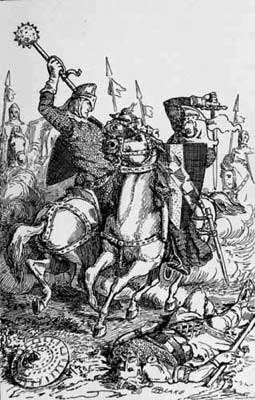
Bishop Odo meets De Guader.
And grim jests he does make; for often, when, after considerable toil, he has gained sight of the face of a dead or wounded man, half buried under fallen friends and foes, he expresses his disgust and abhorrence at recognising one of William of Normandy's supporters, by pulling his nose or moustachios;—not very violently, it is true, and usually following up the indignity by placing the victim's head in as comfortable a position as the circumstances allowed.
But at last he found a face which he treated otherwise.
'Ah, my dear lord!' he cried, placing his hands tenderly under the senseless head; he could do no more, for a heap of slain and the hoof of a dead charger were piled above the earl.
'Oh, sweet nuncle, open thine eyes, thy dear eyes, and glad the heart of thy poor faithful fool. God forbid! Thou canst not be dead! For thy lady's sake thou canst not be dead!' He took from his breast a small flask containing a strong cordial, and poured a portion of its contents down the earl's throat, tenderly wiping away the blood which oozed from a contused wound in his forehead; and after a time Ralph's eyes opened languidly,—opened and closed again almost instantly.
'Good lad! Good lad!' exclaimed the old jester cheerfully. 'There is life in thee yet, I well see, and we will have thee all safe and sound yet, Holy Mary be praised! But I cannot do the job single-handed, valiant hero as I am, and I like not to leave thee, lest thine enemies return. Hist! I have a notion!'
He took off his little parti-coloured cape, and got it upon the earl's shoulders; and he drew from his pocket his jester's cap, which he had thrust therein to still the noise of the bells, and decorated therewith the earl's stately head; and he took the earl's battered helm, which had rolled off, and lay near by, with its gold and black plumes mightily draggled, and fastened it upon the head of a dead Breton knight, Sir Guy de Landerneau, who had fallen at a little distance from his leader, and not long afterwards. Next, he armed himself with the mail jerkin and steel-cap of one of the slain archers, added thereto a short sword, then fled precipitately to find help to extricate the earl.
And he was but just in time.
Scarcely had he disappeared, when a searching party of the king's men came to that quarter of the field, and carried off triumphantly the dead knight upon whom Grillonne had fixed the earl's helmet.[4]
CHAPTER XIV.
HOW THE CONQUEROR DEALS WITH REBELS.
The days passed drearily for the Countess of East Anglia, mewed up within the protecting walls of Norwich Castle, and the anxiety she felt on behalf of her husband and brother made the hours seem unutterably long.
Her office of Castellan was no unusual one for women in those days. The annals of chivalry teem with stories of noble ladies who held castles for their male relatives or feudal superiors, but as no enemy was, at present, near the castle, it did not afford her much occupation.
An occasional hawking or fishing party was organised for her entertainment, but the disturbed state of the country, the fear of treachery, and the uncertainty of the whereabouts of the king's forces, rendered so large an escort necessary, and entailed so much trouble and preparation, that the sport was robbed of all zest. If orders were given in the evening, it most frequently happened that the morning would be wet and uninviting; if left till a suitable morning had dawned, all freshness had vanished before the advancing sun ere so large a party could be put in motion.
Moreover, Emma had little heart for such entertainment, which chiefly served to bring back memories of happier days, when Earl Roger and Ralph de Guader had been beside her; and all the prowess of her Danish hawk did but remind her of her husband and his dangers. Soar, and stoop, and chancelier as he might, he failed to move her enthusiasm, and did but render her more sad, while the encomiums of Sir Alain De Gourin, who made a point of attending her on these expeditions, irked rather than pleased her. His criticisms, admiring as they were, seemed to her impertinent when passed on a bird which Ralph de Guader had pronounced as one of the most perfect he had ever seen.
So she strove to cheat the hours by embroidering a magnificent mantle for her absent lord, using all the most elaborate Saxon stitches, which she had learned from Eadgyth, who sat ever at her elbow to help her, if she forgot her lesson. Such gorgeous mantles were much in fashion among the Norman exquisites.
Eadgyth herself was busy, by Emma's desire, making an altar-cloth for the chapel of the castle, in which the De Guader and East Anglian arms were mingled somewhat incongruously with pictorial illustrations of the life of St. Nicholas. The chaplain of the aforesaid chapel had drawn the designs, being a very clever limner and illuminator, and he took great interest in the progress of the pious work, losing no opportunity to visit the fair embroideress when she was engaged upon it.
He was a young Breton of good family, but had sunk his patronymic for the priestly 'Father Pierre,' the venerable title being rather incongruous to his boyish face and shy, shrinking ways. He was an ascetic enthusiast, believing sternly in the mortification of the flesh, and his young cheeks were sunken, his large dark eyes hollow and glittering, and his tall figure painfully emaciated. But his sternness was all for himself; to his flock he was the kindest of pastors, and in his humility he did not venture to enter upon political matters, accepting the judgment of his feudal superior as paramount, and not to be questioned.
Emma did not feel drawn to him. Her practical nature could not comprehend or draw comfort from his mystic and dreamy ecstasies, and she needed a strong, clear-headed guide, to advise her on the tangible and imminent perplexities that encircled her.
'Oh for an hour of Father Theodred!' she sighed one day, when Father Pierre had left the apartment, after making a vague reply to a question she had addressed to him, touching some small urgent duty of the hour. 'Our good chaplain hath more anxiety regarding the ordering of thy needlework warriors for the adornment of his chapel, than for the bodies of the living men who are defending it, methinks! In good sooth, Eadgyth, I feel tired of this stitchery. I would the wind blew not so keenly on the battlements. I could be ever watching the horizon like some sea-rover's deserted mate, looking out for the glint of sun on a steel headpiece, as such an one would watch for a sail. The stone walls well-nigh stifle me! I feel entombed sitting here, where I cannot see if any approach to bring tidings of my dear lord! Fetch me mantle and headrail, sweet damsel. Methinks, if I sit here longer, chewing the cud of bitter reflection, I shall go stark staring mad. Let us go to the battlements and fight the wind!'
Eadgyth, whose more phlegmatic temperament did not seek relief from mental pain in physical exercise, smiled at the restlessness of her friend, but instantly laid aside her needlework, and sought her lady's tire-woman, who brought the wished-for garments.
In a few moments Emma and Eadgyth had left the lodge, ascended the spiral staircase in the great tower, and were pacing upon the battlements. It was one of those grey chilly days, frequent in the Eastern counties, when the north-west wind brings haze from the Fenlands, and the Wash, and the North Sea; covering the sky with a leaden pall, and bringing winter into summer's heart. Columns of dust rose along the roadways, but the wind swept away all mist and fog, and the country showed bleak and naked to the horizon.
The sentinels saluted their countess and her lady-in-waiting with a deep reverence, but they were accustomed to see their fair Castellan scanning the distance, as if distrusting that any eyes could be so keen and faithful as her own.
They paced the circuit of the battlements some five or six times, and played with the pigeons that crowded upon the merlons, and greeted them with soft cooing and much fluttering of soft-coloured pinions, for they knew well that Emma's gipsire was generally stored with peas for them.
Suddenly Emma caught her bower-maiden by the wrist.
'See!' she cried. 'My sail is in sight! Dost thou not catch the glint of a morion over yonder?'
They were on the southern side of the keep, and she indicated a far speck upon the course of the Ikenield way.
'Nay,' replied Eadgyth, 'mine eyes reach not so far, the more especially as this stinging wind brings unbidden tears into them.'
'I am right, Eadgyth—it is a horseman approaching! Ho, sentinel! thy vigil is no very keen one!'
'In sooth, lady, I can see naught,' answered the sentinel, with a respectful salutation.
It had been a favourite amusement with Emma, when a girl at Clifford Castle, to challenge her maidens and squires, and any noble visitor who might chance to be present, to a trial of sight, from the walls of that goodly fortress, and seldom had she found any who could rival her for length of vision. She proved to be right on this occasion. A horseman was approaching, and at a gallop, and the sentinels soon acknowledged his coming and gave the fitting signal.
A while later, and the traveller had reached the barbican, and, after a short parley, the portcullis was raised, the drawbridge lowered, and he rode forward into the courtyard of the castle.
Emma descended full of tremulous excitement. Sir Alain de Gourin met her, on his way to the courtyard, to question the new-comer.
'I will send word at once, if he prove to be one of the earl's men, or brings any message or news,' said Sir Alain.
'Nay,' replied Emma, 'I will myself go down. Each moment of waiting will prove a year.'
So, with Eadgyth beside her, and her train of ladies following, she went down to the great portal on the east side of the keep, whence a short time before she had bidden 'God Speed' to her noble spouse and his army.
The horseman was surrounded by a curious crowd of soldiers and domestics. Archers and men-at-arms of all sorts and conditions from the guard-room, pages, squires, cooks, and scullions, had all come forth to see. Certain of the garrison who had been trying their strength for pastime in a wrestling bout, had left their sport, and stood with brawny arms akimbo, and mouths agape. Even the pale face of the chaplain was amongst the group, his dark eyes gazing with pity and awe upon the man who formed its centre.
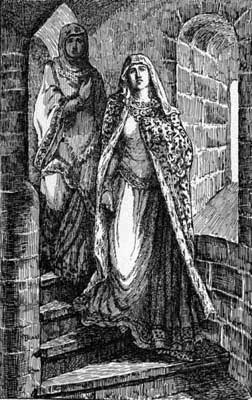
The Tower Stairs.
He was in sorry plight! His horse, flecked with foam and bloody with spurring, head down, nostrils red, and limbs trembling with fatigue, looked as though another mile had been utterly beyond his spent powers. The casque of the rider was battered, and his countenance so gashed with wounds as to be beyond recognition, nor did his surcoat or harness in any way help to show his identity, so stained and torn were they. Shield he had none, and his right arm hung straightly at his side.
He took no heed of the crowd buzzing round him, nor of the countess standing at the portal of the keep, with Sir Alain de Gourin at her right, and Sir Hoël de St. Brice on her left, and her train of ladies and squires behind her, but sat on his panting steed, with his chin sunk on his breast.
Suddenly one from the circle around him cried, 'Mort de ma vie! He has lost a foot as well as a hand!'
A murmur of surprise burst round him.
'Those are no gashes gained in fair fighting! His nose is slit! Saints and angels! He has been in the hands of the Bastard's men! We all know how William serves his prisoners!'
'Speak, Sir Fugitive, or Sir Messenger, or whatever your name is,' thundered De Gourin, 'and speedily! Is it so? Who art thou? For thy beauty is so spoiled we are at a loss by what title to greet thee! By the rood! his own mother would not know him!'
The countess hastily bade her leech be called, and shuddered, not only with pity, but with a dread presentiment of evil, as the ghastly witness of men's merciless cruelty turned his maimed face towards them, his bloodshot eyes staring vacantly, half dazed with terror and pain.
'It is all over!' he muttered hoarsely, forcing his swollen lips to utter the words with difficulty. 'The earl is slain, and my master; and the army is scattered like a flock of sheep! Flee, flee! They are coming after me to storm the castle!'
He raised his right arm, from which the hand had been riven, the stump black with the searing of red-hot irons with which the flow of blood had been staunched, in a gesture of entreaty.
A fearful witness truly as to what might be expected to follow on defeat.
A howl of fierce anger ran around the courtyard, and many a strong breast heaved with an indignant sob of impotent rage; curses loud and deep were showered on the heads of William of Normandy and his vicegerents.
'Heed him not, noble Emma!' cried Sir Hoël de St. Brice hastily. 'By the Holy Virgin! 'tis but a recreant who has let himself be made prisoner, and now repeats the story they have stuffed him with! Out of his wits with their rough treatment, and small wonder! May the Foul Fiend seize them for their barbarity!'
'Christ be my witness, I speak sooth!' cried the unfortunate fugitive. 'I am Stephen le Hareau, squire of the body to Sir Guy de Landerneau, and I swear by the Holy Cross, I saw the earl fall with mine own eyes!'
'Thou Stephen le Hareau? Thou?' shouted Sir Alain de Gourin, startled out of his equanimity as he looked at the pitiful object before his eyes, and remembered the handsome gallant he had seen ride from the castle gates a few weeks before.
A fresh hiss of execration burst from the bystanders, as the cruelty of the young man's fate came home to them.
Stephen le Hareau! The handsomest and most popular squire in the earl's following! They knew him, too, for a brave and dauntless soldier.
Sir Hoël looked towards the countess, wondering how she would bear the blow, for the difficulty with which she had maintained her self-control when she had parted with her noble bridegroom had been manifest to all, and now the worst fears she could then have entertained were declared to have come to pass.
But Emma, who had shrunk from the approach of evil, stood firm to meet its actual contact. Her face was white as marble, and her lips quivered, but she said in a firm voice,—
'The cruelty this poor gentleman has undergone may well nerve our hearts to resistance. St. Nicholas grant thou art in the right, Sir Hoël. He may well deem things blacker than they are! I prithee, keep him no longer answering our vain queries. Let him be lifted from his horse and carried to the spital. I will tend him with my own hands. His poor steed also, let it be cared for.'
Eadgyth and several of the ladies were sobbing hysterically behind her. She turned to them.
'Courage, dames and damsels!' she said, with a simple dignity that shamed them into self-control. 'I have heard as evil tales as this, and found them vanish like dreams at the breaking of the morn.'
She gathered her robes around her and swept back into the keep, and, calling her tirewoman, ordered her to bring sundry essences and simples, which, like every noble lady of the time, she kept by her, the science of medicine being chiefly in feminine hands in those days. Then, bidding Eadgyth to attend her, she proceeded at once to the spital, to leech the unfortunate squire.
She stopped a few moments in the chapel, to direct the chaplain to offer masses for the souls of those who had fallen in the battle. A sob caught her breath as she remembered the earnest repetition with which Stephen le Hareau had declared that the earl was amongst them.
But she dare not think, and went on hurriedly to direct that others should be offered for the safety of those who had escaped, and for the success of their undertaking.
Her ministrations to the wounded man kept at bay the fierce troop of agonising thoughts that were thronging down upon her like a pack of hungry wolves. Rolling bandages, and preparing salves and unguents, she had scarce time to speculate upon the probability of the truth of her patient's direful news. True, no doubt, it was as far as his knowledge went, but there was hope, as Sir Hoël had suggested, that his report of the battle had been supplied by their opponents, and himself sent off by them, as a messenger of evil tidings, with the express intent of demoralising the garrison of Blauncheflour.
The physical sufferings of the poor squire were so terrible to witness, that Emma almost forgot the awful shadow of death and impending peril that hung over her own head, and the hours flew past without her noticing their flight. All that she and her leech and her ladies could do to lessen his pain was done, but it was not much.
Even in these days little could be done for such a case, with all the skill of advanced science.
Presently a page came to the countess with a message from the two knights, St. Brice and De Gourin, begging her to give them audience in the council-chamber.
'Watch over my sufferer, Eadgyth,' said Emma.
When she entered the apartment in which the two knights were awaiting her, she quivered with apprehension as she saw their grave faces. Sir Hoël's kindly visage was white as his silver hair, and even Sir Alain's inflamed countenance was a shade less purple-red than usual, while his expression was distinctly anxious.
They both hesitated to speak, but the countess broke the pause.
'Tell me the worst, gentle sirs, I pray you. Suspense is ever hardest to bear, and I see you have ill news.'
Sir Hoël advanced and took her hand in both his own, a little forgetting the ceremony due to her rank, in his huge pity for her youth and the forlorn fate that he feared too surely had befallen her.
'Alas, dear lady, the news is ill indeed! Sir Walter Deresfort, and the Saxon thegn, Alfnoth of Walsham, with some dozen men-at-arms, have ridden in from Cambridgeshire, and confirm'—a sob broke his voice—'in every item the dire tidings brought by poor Stephen le Hareau.'
'Do they say, then, that I am a widow?' asked Emma in a strange, hard voice, with so awful a calm in it, that the thick-skinned Sir Alain, who was little wont to heed the tears or shrieks of women, or to spare them in any respect if they stood in his way, shuddered as he heard it. He thought the countess was going mad.
'I fear,' answered Sir Hoël, 'there is no doubt the earl is slain, St. Nicholas rest his soul!'
'Then, gentlemen,' asked Emma in the same strange tone, 'what is to be done?'
'God knows!' exclaimed Sir Hoël, the great tears running down his furrowed face, and dripping upon his hauberk.
'Noble lady,' said Sir Alain eagerly, speaking for the first time, 'it is well known that the wrath of the Primate, and of his master, William the Norman, is principally enkindled against the countrymen of the late earl. Thy safety, most noble countess, is, of course, what every man in the garrison would give his life to insure, therefore my humble counsel, for what it may be worth, is that thou shouldest at once take ship with the trusty Bretons under my command, and make for Bretagne, and thy late husband's estates of Guader and Montfort.'
'What is thy counsel, Sir Hoël?' demanded Emma, still with the same unnatural calm.
'Dear lady, I would advise thee as doth Sir Alain.'
'But would not the garrison, thus bereft of half their numbers, fall an instant prey to the enemy?' asked Emma.
'It is not William's policy to provoke the Saxons, and to his own countrymen he is ever complacent,' urged De Gourin, with the same eagerness. 'Therefore my meaning is, that the castle be surrendered at once, in which case the garrison would probably be softly dealt with, we Bretons being out of the way; whereas further resistance will be useless, and will but further provoke their vengeance, the style of which we have seen.'
'Art thou of this advice also, Sir Hoël?' demanded Emma.
Sir Hoël bowed his head. 'Dear lady,' he said, 'there is no doubt that the Primate hath animosity against us Bretons, and may prove kinder to Normans and Saxons; yet methinks I will stand by them, and advise them not to try his mercy sooner than is needful. I counsel, therefore, that thou shouldest so far follow Sir Alain's advice, as to take ship with himself and his band for Bretagne. For my part, I will fight for it with the garrison remaining to me. Blauncheflour has been built to stand a siege, and we may well victual it before supplies can be cut off. We may yet make good terms.'
'There spoke the spirit of a true knight!' cried Emma, turning on De Gourin with so fierce a flash in her eyes, that he started, so great a change was it from the stony indifference of her former manner.
'Go, fair sir, if it suits thee! Take all thy fainthearted mercenaries with thee to their native Bretagne! I will stay with Sir Hoël and defend this castle, which the earl gave into my charge. The late earl, thou said'st? Methinks thou art wondrous quick to make so certain of his death! Methinks all these gallant gentlemen who have galloped back to the safe walls of Blauncheflour in such hot haste, scarce waited to see if he was wounded or slain! For me he will never be the late earl. On earth or in heaven he is my husband still, and I will hold his castle, hoping, perhaps selfishly, that he will come to claim it. I will hold it if only to have vengeance on his foes!'
Sir Hoël watched her in delighted surprise. Sir Alain flushed hotly under her attack, but could not but admire the high-spirited beauty as she hurled her indignant taunts at his head.
'Now, by all the saints! thou art unjust to me and my poor following, noble lady!' he exclaimed. 'My object was but to secure thy safety.'
'If the earl be indeed slain,' said Emma, with a tremor in her voice, 'my safety boots me but little; if he be not, it is important that Blauncheflour hold out to the last gasp. Besides, ye know not how it fares with my brother of Hereford; his arms have perchance prevailed, and he may be able to relieve us.'
'A slender hope,' said Sir Alain impatiently. 'But our lives are at thy disposal, noble Emma.'
He accompanied this speech with a smile of homage, which he meant to be irresistibly touching and pathetic; for a new idea had come into the adventurer's bullet-head, which somewhat gilded the pill of hard fighting without hope of plunder, which the countess's decision forced him to swallow. He remembered that if, as he fully believed, De Guader was slain, the beautiful Emma had become a widow with a goodly dower! for even if, as was probable, her late husband's possessions in England were forfeit through his treason, and all English and Norman property of her own, the estates of Guader and Montfort were beyond William's jurisdiction, and she would doubtless draw rich rents from them. This rich prize was here under his hand, and, to a great extent, in his power. If he played his cards well, he might secure her for himself, albeit she was William of Normandy's kinswoman.
But the good old Sir Hoël looked at her fair, flushed face with very different thoughts. 'God bless thee, dear young lady,' he said, with a husky voice. 'He would be a coward indeed who grudged to give his life for thee! Though, for that matter, we must needs fight for our own sakes, so we need not try to make out that all our valour is on thy behalf!'
Emma met his kind eyes, and scarce bore their sympathy.
She turned away hastily. 'There must be more wounded in the spital,' she said; 'I must tend them. Make what preparation needs for holding out under a long siege.'
And so saying she quitted the apartment.
'Alas!' Sir Hoël murmured, more to himself than to De Gourin, when she was gone, 'I doubt she is buoying herself with a false hope, and that our noble De Guader will glad her eyes no more.'
'By the rood!' answered Sir Alain, 'I doubt so too. But methinks so fair a widow, and so well-dowered and youthful withal, may find consolation on this side the grave. Holy Mary! A dame of spirit! If our motley garrison, Saxons, Danes, Flemings, and other, were of metal that would ring to the same tune, our case would not look so desperate.'
'Methinks the mercenaries under thy hand are the most doubtful metal within the walls, good sir,' answered Sir Hoël gravely, eyeing his companion somewhat keenly. 'If thou canst get the right ring out of them, I think I can answer for the rest!'
CHAPTER XV.
'O HIGH AMBITION LOWLY LAID!'
The choughs and ravens which had flapped lazily away, with noisy wings and harsh croaking, when the Royalists had come to search amongst the dead and wounded for Ralph de Guader, had settled down to their banquet again as soon as their disturbers had departed, mistakenly laden with the body of the Breton knight whom Grillonne had decorated with the earl's helmet. Their foul beaks were busy with the flesh of the dead and the eyes of the living.
The harsh clamour of these noisy revellers pierced at length to the fainting ears of the fallen earl, who was in some measure revived by the cordial which Grillonne had poured down his throat. Consciousness came back to him, a poor exchange, under such circumstances, for kind oblivion. For he could move neither hand nor foot, and the weight upon his chest was as the oppression of a fearful nightmare—a nightmare from which there was no awaking. He lay helpless—the living under the dead!
Above him stretched the twilight sky, still flushed with fleeting, blood-red clouds, beyond which, from pale green pools of infinite depth, glimmered, here and there, a silvery star. To the right stretched the sombre heath, its rising hills crested with fantastic figures of contorted slain, men and horses stiffened into uncouth and terrible forms; while groaning wounded were heaped between them, their panting anguish not less awful than the silence of the dead.
To his left also were witnesses of battle, but not so many, for on that side the hungry morasses had swallowed them up. To the south and west the measureless fen stretched to the horizon, crimson to its farthest verge with the ensanguined glow of the sun, the tall reeds reddened like warrior's lances that had been dipped in the life-blood of the foe.
The air was full of the awful scent of wounds and blood, and the weird, dank odours of the decaying sedges, while the wailing wind piped and moaned over the wold, swaying the rushes, though scarcely making a ripple on the protected surfaces of the bottomless lagoons.
Mallard and teal and plover came circling back to their haunts in the lonely swamps, now that the din of battle, which had frightened them, was over and done; and, as the twilight deepened, bats and owls came forth with silent wings to hunt their night-roaming prey.
Ralph's open eyes looked only into the sky, and at the wild, wind-driven clouds fleeting across the calm, immutable heavens beyond, as the struggling hosts of mortals fleet over the face of eternity.
His soul was filled with an overwhelming sense of desolation and guilt. He had brought his fate upon himself, and he must face the Shadow of the Valley of Death, all forsworn and blood-stained as he was; alone, helpless. No wife to comfort him, no priest to absolve him,
'Cut off even in the blossoms of his sin, Unhousel'd, disappointed, unanel'd.'
Against the clear spaces of the sky, he saw, high up, almost above the clouds, an ordered flight of wild swans passing swiftly westward into the sunset glow.
Oh, that he were free as they, winged as the wind! His spirit writhed in fierce rebellion. He put forth all his force in a wild struggle to drag his limbs from the prisoning mass that detained them, but he could not lift the ghastly burden that weighted him to earth an inch.
'Mary in heaven, help me!' he groaned. 'I am scarce wounded, and so strong! It will take me hours to die, and these foul birds will perish mine eyes!'
The cold sweat burst from his brow, and, as he writhed again, he somewhat shook his head, and the bells on the jester's cap tinkled.
He quivered with astonishment, and contrived so far to lift his head as to catch a glimpse of the points of the cape which covered his shoulders. At first the idea seized him that he was no longer on earth at all, but in purgatory, and dressed in a jester's garb, in that his sin had been through the folly of pride and mad ambition. Then, with a flash, came the joyous thought of Grillonne, the faithful, the ready of wit, the fertile of resource.
A wild gladness came to him, but as the sky grew dark, and the stars were obscured by clouds, hope left him again.
'If it were he indeed, he has forgotten me, or has met his death in trying to save me.'
Then all the joys of earth passed before him in a fair pageant, and he thought of his young bride with her clear, loving eyes that he might never see again, and to whom he had been united with such magnificence scarcely a month before, and who was but a few short miles from the scene of his present suffering; and at the thought, burning tears welled from beneath his closed lids and rolled down his bronzed cheeks, moistening the parti-coloured edges of Grillonne's cape.
'Ah, it is bitter!' he groaned.
'Not more bitter for thee than for the scores and tens of scores thou hast led into like misery,' said awakened conscience grimly.
'Mea culpa! mea culpa!' murmured the unfortunate warrior in his anguish. 'My days have been evil in the land. I have sought not the will of Heaven, but mine own vain-glory. But oh, Mary Mother, let not my sins be visited on the head of my sweet lady! as thou wert a woman, protect her from all harm! Sure William will be merciful to his kinswoman.'
Dismal indeed were the thoughts that chased each other across his restless brain, which seemed to make up by its activity for the enforced stillness of his body. Visions crowded upon him of his castle of Blauncheflour in flames, and his lady in the power of insulting or—and it was little less terrible to his ambitious, jealous spirit—too-courteous conquerors, some one of whom might, perchance, find favour in her eyes and drive his memory from her heart.
At length, however, as the stillness of the night fell over the plain, broken only by the moaning wind or the agonised groan of some fellow-sufferer, he grew calmer, and a deep resignation flooded his breast.
'Mea culpa!' he murmured again. Death seemed inevitable, and he bowed his spirit humbly to accept it.
Hark!—
The mingled anguish and joy of hope awaked once more. For the silence was broken by a sound so faint that his listening ears could scarce detect its repetition, distracted as they were by the tumultuous pulses which throbbed at the possibility of escape. Yet why hope rather than fear? Why should the sound of approaching steps mean friends rather than foes?
The fact grew certain. Steps were approaching, and were accompanied by a clash of arms that betokened soldiery.
How he strained to catch every faint sound that might indicate the direction in which these, his fellow-men, alive and strong and capable of help, were moving!
'St. Nicholas befriend me! If the miracle is wrought that I be rescued from this living tomb, I vow to make pilgrimage to the Holy Sepulchre before my days are done!'
Then he shuddered in sick misery lest the band should pass him by! Better a blow from the miséricorde of an enemy, than the languishing torture of his present position.
Others thought so too, for he heard more than one piteous cry for help.
Then he, the proud earl, lifted up a feeble voice and craved deliverance, even by death!—
And it came.
'Here! here! This way, my lads, this way!' cried the familiar voice of the faithful jester. 'Look you, galliards, there is my famous cap and cape! Saints be praised! He wears them still. The Lord grant there is a living skull in the cap. I shrewdly thought I heard him squeak!'
'Ay, Grillonne, thou didst, sure enough!' cried the earl; and the revulsion of feeling from despair to hope was so great that he fainted again.
When he revived, his head was in Grillonne's arms, and the intolerable weight of the slain who had fallen above him was removed from his limbs, which, however, were so numbed that he could not move them. Half-a-dozen stout fellows, archers, slingers, and spearmen, were bustling about him, dimly visible by the light of a horn lantern which one of them carried.
Grillonne, seeing his eyes open, instantly held a flask to his lips, and when the draught had helped his revival, nodded sagely.
''Tis well to be taken for a fool sometimes, nuncle.' he remarked, twitching his tinkling cap from the earl's head. 'Thy fine helmet has been carried off in triumph to the enemy's camp on the corse of poor Sir Guy de Landerneau, whom I bedecked with it; seeing that, as they had already killed him as dead as a Norwich red herring, they could do him no further hurt. 'Twill have given us time even if they discover the cheat, as most like they will, for so many of them are full well acquainted with thy noble hawk nose.'
'Ah, Grillonne ready-wit,' said the earl, 'St. Nicholas reward thee! That prince of hypocrisy, Lanfranc, may say that jesters have no hope, and are doomed without fail to the worm that dieth not and the fire that knows no quenching! [5] But I tell thee, Grillonne, he in hell shall pray to thee in heaven as Dives to Lazarus!' and the groaning noble kissed the hand that lay upon his breast, albeit the member belonged to one of that despised class, for death is a greater leveller than any democrat or republican of them all, and Ralph de Guader had held long converse with him.
Grillonne raised the hand which had been so honoured to his own lips and added some hearty smacks to the aristocratic salute it had received.
'Nay, my dear lord,' he said in a rather husky voice, 'I would fain lay that hand up in lavender and take it to heaven with me when I die, since thou thinkest I have hope to get there. But alack! we have rough work before us to prevent thee from getting thither before thy palace is prepared for thee. Thou art not saved yet by a very long chalk. If St. Nicholas is half so generous as thou deemest, he will give me my reward at once, like a free-handed gentleman, in the shape of success to the safe ending of my undertaking; nor must we spend further time in palaver.'
He beckoned to the men who were with him, and four of them came forward with a litter roughly woven of osiers, of which a plentiful supply was near at hand. Grillonne and another lifted the earl into it, and they set off at a rapid pace, the jester guiding them along the smoothest path; and watching over his charge with tender care.
To De Guader it seemed as if he were couched on pillows of softest down, notwithstanding his wounds and the pain the motion caused him, for the joy of being rescued from his horrible entombment, and of having yet a chance of life and love, was so intense that he seemed to be in a dream of bliss.
His eyes filled with grateful tears each time that a gleam from the lantern gave him a fitful glimpse of Grillonne's face. Never had he thought to be so glad to look on that wizened, whimsical countenance, with its oblique eyes twinkling with mingled malice and affection, and which seemed almost quainter under the conical steel-cap with the nasal, in which he had ensconced it on giving up his cap to the earl, than in that strange headgear itself.
The way was no flowery one either. Slain men and horses encumbered the bearers at every step, and more than one pitiful voice from some wounded wretch, in such plight as the earl had just been rescued from, besought them in mercy to stop and give aid, for the sake of Mary Mother and the saints in heaven. Most pitiful of all was the cry for 'Water, for the love of Christ!' from men whose limbs were actually immersed in the rippling edges of the meres or engulfed in the slimy ooze, and who were so faint from wounds, or so set fast by the slain above them, that they could reach no drop wherewith to moisten their parched lips and slake the burning death-thirst which tormented them. But they cried to deaf ears; nay, when entreating arms were thrown around the limbs of the litter-bearers, a sharp cut across the knuckles with dagger or anlace speedily unclasped the detaining fingers, whether they belonged to friend or foe.
It was rough treatment, but the men were risking their lives in their endeavour to save that of the earl, and delay would have been fatal both to him and to themselves. The fact that the body of Sir Guy de Landerneau had been removed by the enemy proved that they desired to make certain of De Guader's fate, and on finding their mistake they might at any time return to rectify it.
The moon had risen by this, and shone between the swift fleeting clouds that sped across the sky. By her light and the uncertain glimmer of the lantern, Ralph saw that two of his rescuers wore the winged helms and long moustaches and golden torcs distinguishing the costume of the Danes. His heart leapt with hope that the messengers he had despatched to the court of King Sweyn had moved the warlike monarch to seize the opportunity of striking a blow at his ancient enemy, William of Normandy, and had sent him timely reinforcements. But their progress was too rapid for speech, and whatever might be his curiosity, he had to lie passive in his litter and allow himself to be borne whithersoever his rescuers pleased.
And by what a weird and desolate pathway did they bear him!
Heading, apparently, for the very heart of the fen that stretched westward as far as eye could reach, its level surface unbroken by tree or hill, and only varied by beds of tall reeds and snake-like pools of still, dark water, the surfaces of which were scarcely rippled by the gusty breeze, they advanced steadily for the better part of an hour.
The fitful light of the half shrouded moon cast ghastly gleams upon the waving plumes of the flowering sedges and white tufts of the meadow-sweet, whose strong and somewhat sickly perfume mingled, strangely luscious, with the dank odours of peat and decaying rushes and grasses. Now and again some frightened bird flew screaming from its roosting-place, or dusky water-rat glided hastily into thicker cover, or plunged with a flop into the water, while the pipe of the curlew, or boom of the bittern, sounded from afar off in the melancholy marshes. The loneliness was intense, and seemed but accentuated by the presence of bird and beast.
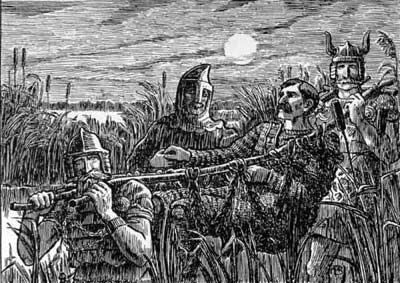
The Rescue of the Earl.
In the dimness of the cloudy night, with the uncertain bursts of moonlight, that seemed to make the chaos of scarce divided earth and water but more difficult to distinguish, the men who bore the earl threaded their way through the bewildering maze, with an unerring celerity and absence of hesitation that proved them to be no strangers to its mysterious solitude.
At length they halted, beside a channel less overgrown with weeds and rushes than the many they had passed, and which was, in fact, the Great Ouse River.
One of the party put a horn to his lips and sounded a couple of mots. His summons was answered from the water, and in a few seconds a boat impelled by eight sturdy oarsmen shot forth from a bend in the river and drew to the bank. The earl was speedily put on board, with the faithful Grillonne at his head, and his bearers embarked, some with him, some in a second boat which had come in the wake of the first.
De Guader confided himself utterly to the safe keeping of his jester, and the rhythmic sound of the oars, which he believed were every moment bringing him nearer to liberty, soothed him inexpressibly. He fell into a drowsy sleep of exhaustion, never really losing consciousness, but devoid of all impatience, and almost of all curiosity as to whither he was being taken.
But the splash of the oars ceased at length, and the keel of the boat grated on the shore of a small island, raising a modest crown a little above the level of the surrounding fen. It was protected by an earthwork somewhat similar in construction to the great dykes with which Cambridge is seamed, the Devil's Dyke, Fleamdyke, and others, and, had the light served, the low turrets of a long, rambling, two-storied house might have been seen behind its shelter.
A summons was given by a few mots on the horn, and in answer a deep voice threw a challenge across the sullen surface of the waters,—
'Who goes there?'
'St. Nicholas for Guader!'
A rattle of chains and hoarse creaking of bolts and hinges followed, and a heavy gate was slowly lifted, which admitted the boats into an inner moat. They glided in and moored their vessels at a small landing stage on the opposite side, the gate closing instantly behind them.
As they did so, the sentry asked anxiously, in a low voice and in the Saxon tongue, 'What cheer?'
'All's well!' was the answer.
'St. Eadmund be praised!' ejaculated the sentry fervently; and the earl's heart leapt with a thrill of joy and gratitude to the poor unknown soldier who cared about his safety, so infinitely precious had the humblest human sympathy become to him since those dreadful hours when he had thought himself doomed to quit the cheerful earth and the faces of his fellow-men for evermore!
Inside the enclosure a party of wild-looking ceorls surrounded them, with shaggy locks and rude jerkins of sheepskin, armed with pikes and staves for the most part, but some few better clad, and bearing the terrible seax; their brawny necks half hidden by their unshorn beards, which hung in tow-coloured elf-locks round their weather-beaten and scarred faces. Amongst them were one or two tall fellows, dressed, like those in the party of rescuers who had attracted De Guader's attention, in Danish mode.
This much he gathered by the fitful moonlight and the feeble light of lanterns carried by the men. Question and answer followed quick between his bearers and their rough colleagues, but he could comprehend little of what they said, for they spoke in all manner of tongues and dialects.
'Thou hast had a harsh ride, I fear me, good nuncle,' said Grillonne, bending over his beloved master with tender solicitude. 'Gramercy! 'Tis a God-forsaken hole we have brought thee to; but beggars must not be choosers, and let us hope that the archbishop's people will keep their pious noses from sniffing thee out in it! Troth! if they venture them here, I parry, some of these stout carles will slit them for them parlous quick!'
'Methinks any corner of the earth is better than being quite out of it, Grillonne,' returned the earl, with a gentle smile. 'I am not like to be critical; but in good sooth I would fain know the title of my host?'
'I scarce know it myself, good my lord,' replied the jester. ''Tis a Saxon, or more properly Anglo-Danish thegn, whose son went shares in thy escapade, and has got a maimed foot for his share of the booty, they tell me. The father and son have had a price on their heads since Hereward Leofricsson's downfall, and have a natural fellow-feeling for thy discomfiture, sweet nuncle.'
Meanwhile they had reached the entrance of the house, and the earl was borne into a long barnlike hall, very sparsely furnitured, with a table running almost from one end of it to the other, and rude settles and stools placed against it, as in preparation for a meal. At one end was an archway leading into another apartment, which seemed, to judge by the heat and the savoury odours, the noises of pots and kettles and other indications which came from it, to be a kitchen; while at the other end was a cheerful fire of peat, beside which sat an aged warrior wearing the Anglo-Danish tunic and cross-gartered hose, his white hair flowing back over his shoulders and his grizzled beard growing close up his cheeks, so that it seemed almost to meet the bushy white eyebrows that shaded his bright blue eyes. His baldric was richly worked with gold, and he wore massive gold bracelets on his arms.
Beside him stood a broad-shouldered, athletic young man in similar garb; his thick fair hair surrounding his head like a lion's mane, and his long moustaches and golden beard showing lighter than the bronzed skin of his cheeks and chest; his eyes as bright and blue as those of his father, and his neck and sinewy arms covered with tattoo marks. But the linen tunic he wore was drabbled with mud and gore, and one of his feet was swathed in bandages, through which the crimson stains would force their way, and his muscular hand grasped the arm of his father's carved oak chair to ease his weight somewhat from the wounded foot.
On the opposite side of the large open fireplace sat a monk in the habit of the Black Friars, and near by a stately lady, wearing the headrail and flowing robes which had been the fashion in the time of the Confessor; while a bevy of damsels waited behind her, looking towards the wounded earl with curious eyes.
The old thegn rose as the bearers brought their noble burden forward, advanced to the litter, and, bowing with great dignity, said in his own tongue,—
'By the Holy Cross! my heart is glad to see thee safe beneath my roof, oh, valorous earl! Would that Ealdred Godwinsson had means to offer fitting hospitality to the son of Ralph the Staller, in whose hand his own has been placed and under whose standard he has fought in many a hard field! Alas! the glory of his house has faded! Barely can he save his last days from the fury of his foes by hiding in this wilderness of the meres! But to such as he possesses, thrice welcome, noble earl! Had not age and infirmity clogged his steps as securely as chains of iron, he had sallied forth to thy rescue himself. Had not a spear-thrust in the instep, got this morn while fighting in thy ranks, crippled Leofric his son, that son had gone forth to seek thee.' Here the younger man bowed deeply in token of assent and reverence. 'It boots not! His followers have been true, and thou art here.'
'Brave thegn,' returned De Guader, raising himself as far as possible in his litter, 'I thank thee for thy fidelity to a ruined and defeated man! The saints forefend that my presence bring evil to thy retreat!'
'Nay,' answered Ealdred, 'had those who would harm us the wit to track us, we had perished long since. But thou art sore wounded! Berwine, the widow of mine eldest-born, shall leech thy hurts.'
A couch was prepared in a recess near the fireplace, and the earl was placed thereon. Cordials and delicate soups, with omelettes of plovers' eggs, were brought to tempt his appetite, and the young thegn's widow examined his wounds, pansed and dressed them with soothing unguents, and finally bound them up in linen of her own weaving, and with the greatest tenderness and skill.