THE SIEGE OF NORWICH CASTLE (continued 2)
Reading edition
CHAPTER VI.
THE BRIDE-ALE.
The festivities of the days preceding the wedding had no special incidents to mark them as more worthy of note than a hundred such which have been described in history and romance, but the wedding-day itself left its mark on time, and has been recorded as of woeful bearing on the destinies of the many who partook of its good cheer, by chroniclers contemporary and modern.
The ceremonies observed at the marriage were after the Anglo-Saxon fashions, and Ralph de Guader himself wore the Saxon garb: a tunic of saffron silk reaching to the knee, with a border round the neck and hem of embroidery in gold thread, edged with ermine, and fastened at the waist with a wide belt of highly-wrought goldsmith's work set with jewels; suspended from this a short sword, hilted with gold-inlaid ivory, and a fierce-looking hunting-knife no less richly embellished. On his shoulders a short scarlet cloak lined with ermine, and fastened by a band across the chest of similar work and design to the baldric, having at each extremity a round clasp of Danish filigree, much raised in the centre, where a splendid ruby repeated the red of the cloak. Stockings of scarlet cloth, cross-gartered with golden braid, and short brown leather boots, the heels armed with the golden spurs of knighthood, completed his apparel.
His earl's coronet was embedded in the crisp dark curls of his close-cropped hair, which, to have been in keeping with his dress, should have been long enough to lie upon his shoulders, and the colour of tow; and, to say truth, his swart countenance was still less in character. Yet from an æsthetic point of view the costume was sufficiently becoming, and the personal appearance of the bridegroom drew forth a full share of praise from the noble dames and damsels who graced the day with their presence, for he looked strikingly handsome, flushed as he was with excitement, his face animated, and his keen eyes flashing.
The policy of adopting it was another question. Many of the English nobles and knights, whom it was intended to flatter, rather resented his assumption of their national garb as a mockery and insult, after the part he had borne in helping to crush their cause and help the Conqueror to the throne, while the Normans and Bretons were offended by it.
The guest in whose honour he had chiefly assumed it, Waltheof, Earl of Northumberland, Northampton, and Huntingdon, wore a similar garb with all the ease of custom and grace of habit, and looked in very truth an English prince. Tall, broad-chested, brawny-armed, his long light hair hanging in shining curls upon his shoulders, his strong wrists circled with many bracelets, hands, arms, and neck covered with blue tattoo-marks, he stood by the East Anglian earl with a pleasant smile on his ruddy face and in his sleepy blue eyes. 'This earle Walteof or Waldene,' says Holinshed, 'was sonne (as ye haue heard) to Siward the noble earle of Northumberland, of whose valure in the time of K. Edward the confessor ye haue heard. His son, the aforesaid Walteof, in strength of bodie and hardinesse did not degenerate from his father, for he was tall of personage, in sinews and musculs verie strong and mighty. In the slaughter of the Normans at Yorke, he showed proofe of his prowesse in striking off the heads of manie of them with his owne hands, as they came forth of the gates singlie one by one.'
But this doughty hero, this son of Siward and Æthelflæd, whom the Northern scalds celebrated in their sagas, and who claimed relationship to the kings of Denmark and descent from the Fairy Bear,—the great white bear, the hound of Hrymir, who was credited with twelve men's strength and eleven men's wit by the Norsemen,—was not so strong of mind as of body; the 'eleven men's wit' of his ursine ancestor had not come down to him. He had not the indomitable spirit of Harold Godwinsson or Hereward Leofricsson, and he succumbed to the finer brain of the Norman general. He had done homage to William, and had accepted the hand of William's niece Judith, daughter of the Conqueror's own sister Adelaide, and grand-daughter of Robert the Devil and Arlète of Falaise, and, in return, the earldom which had been wrested from him was restored—the Northumbrian portion of it, at least, a barren waste by fire and sword.
It was whispered that he hated his foreign wife, that she henpecked him cruelly, and was but a spy set to watch all his actions. Some thought the marriage, instead of binding him to William's interest, would prove his strongest incentive to revolt.
However that might be, Judith appeared at Exning with an almost royal following, and was to fill the honourable position of 'bride-woman,' as the matron who in those days gave the bride away was then styled, and whose place is now held by the nearest male relative. Another change has taken place in marriage ceremonial. Then it was the duty of the bridemaids to lead the bridegroom to the altar instead of following the bride, and Ralph de Guader was preceded by a bevy of fair damsels, of whom Eadgyth of Norwich was the chief, while the bride was conducted by a party of handsome young bride-knights, almost as bravely attired as the groom himself.
Emma Fitzosbern still clung to the Norman fashions, and wore a tight-fitting kirtle of pale green samite, embroidered all over with silver thread and pearls; a silver girdle passing diagonally round the hips, richly gemmed with emeralds, from which hung a gipsire of like material. A long underskirt of salmon silk fell to her feet and trailed upon the ground behind her. Her little pointed boots were of green samite, wrought with silver, and a splendid embroidered mantle, in which the colours of the kirtle and skirt were subtly blended, hung from her shoulders, and was held up by two little page boys. Her auburn hair flowed over the mantle, and was bound by a silver fillet, fastened in front with one large emerald. Over face and figure fell a veil of delicate Cyprian crape, flowered with silver thread.
Green signified youth, and salmon or flesh colour typified earthly joy. Her beautiful costume had been designed for her by no less a person than her uncle, the Bishop of Exeter, who was pleased to emulate St. Dunstan by designing a lady's dress.
Judith, her bride-woman, on whose arm she leant, wore a robe of rich red samite heavy with gold, and ostentatiously Norman in style. Her tall, stately figure was as straight as an arrow, and made a splendid foil to the shrinking form of the bride.
Her clear-cut, cold features and sparkling steel-blue eyes wore a sarcastic and critical expression, but she acted her part with a grace and courtesy which the many who longed to pass adverse criticisms on her could not but admit to be perfect.
Emma felt a strong repugnance to her kinswoman, the more so perhaps that Judith's features and eyes reminded her of the king she was defying, and every time she met their glance, a thrill of dread and foreboding passed through her heart.
The wedding procession was preceded to the church by a dozen Saxon scops or bards, who sung each to the sound of his cruit, a harp having five strings, yet affording a very sweet music, and by esquires and pages strewing flowers; and the guests were led by Earls Waltheof and Hereford, the latter with his young countess on his arm.
The little church at Exning would not have contained so great a company, but the fashion in those days was for the bride and bridegroom to stand on the threshold till the ceremony was almost concluded. After the wedding ring had been bestowed with due ceremony,—being placed first on the thumb and successively upon the second and fourth finger, where it was allowed to remain, that finger being supposed by the most scientific authorities of the time to be joined to the heart by a small artery,—the couple entered the sacred portal, and advanced to the altar, before which the nuptial benediction was given by the bridegroom, under cover of a square veil, held aloft by four tall knights, and termed a 'care-cloth.'
Wine, blessed by the officiating priest, was then poured into a splendid golden bride-cup, in which was placed a sprig of gilded rosemary, supposed to have the gift of strengthening memory and increasing tenderness, and many other good qualities. In this the bride and bridegroom pledged each other, and it was then handed round to all the guests. A wheaten cake, in token of plenty and fruitfulness, was then broken between them, from whence we derive our bride-cake.
On leaving the church, the newly-made husband and wife were crowned with garlands of flowers, and the Earl of Hereford presented his sister with her dower.
The word bridal comes from the Saxon bryd-eala, from a custom among that people of the bride selling to each guest a tankard of foaming ale drawn from the tun by her own fair hands, the price being at first paid in kind, and consisting of a contribution to the banquet, by which means the expense of entertaining a great company was lessened for the young couple. For this simple exchange, more costly presents were substituted after a while, a part of the custom which still survives, though the bride no longer offers an equivalent.
This ceremony was magnificently observed at the East Anglian earl's wedding, and Emma de Guader dispensed the favourite Saxon drink in a glorious golden beaker, which was of depth sufficient to try the wind and capacity of the gallants, as they strove to empty it without drawing breath, particularly of the Normans, who were not adepts at the art of copious drinking. Many and rich were the presents offered in payment, with fitting good wishes and compliments, Waltheof bestowing the most superb of all, a pair of Danish torcs of that beautiful gold filigree, the working of which was the special glory of the Danish goldsmiths of that day, and a white bear's skin of rare beauty and value.
A bountiful feast followed, pages and esquires, clad in the colours of the nobles and knights they served, presenting the dishes on the knee, one golden plate being set between each lady and gentleman; it being the duty of the latter to carve choice morsels for his fair charge with his dagger. Peacocks in their feathers, crane, heron, and swan, porpoise, seal, venison, and boar's head, were amongst the delicacies offered, and the united science of Saxon and Norman cooks achieved some triumphs of culinary skill, we may be sure. A receipt for forcemeat which has come down to us from those days, will show they were no novices in the matter. It is to be compounded of pork, figs, and cheese, moistened with ale, seasoned with pepper and salt, and baked in a crust, garnished with powderings of sugar and comfits. All these good things were washed down with rare wines, Gascon and Rhenish, with hippocras and pigment spiced to suit the Saxon palate, with moral and mead, cider, perry, and ale.
In all, Saxon profusion was united to the dainty Norman cookery, and, under the influence of this heavy hospitality, the male portion of the guests grew somewhat boisterous.
When the attendants brought in large Saxon drinking-horns, filled with hydromel and beer, and marked with knobs of brass to indicate to what depth the guests might quaff without fear of intoxication, with cups of spiced wine for those who preferred it, the bride arose from her seat, her Norman delicacy already offended by the copiousness of the potations.
Nevertheless, before she left, she touched her lips to one of the hugest drinking-horns and pledged the guests. Then she withdrew with the ladies of the company, the Countess Judith casting a strange glance of contemptuous malice as she went.
The bride's challenge was, as may be imagined, received with ready enthusiasm, and called forth such lusty cheering, that she had reached her bower ere it died away. Before it had well ceased, the Earl of Hereford rose to his feet, his proud young face full of wayward triumph. 'Noble earls, barons, and knights,' he said, 'who honour this board with your presence, ye have this day pledged the health of the bridegroom, my noble brother-in-law, the Earl of East Anglia, and ye have but now with a noble enthusiasm pledged the bride, my fair sister. I ask of you yet another pledge. Drink to the marriage itself, in token that you, one and all, justify my noble brother and myself in our defiance of the mandate of the tyrant, William the Bastard, who strove to hinder their union!'
Many a jewelled hunting-knife and miséricorde flashed in the air to show that their owners accepted the bold pledge; for in those wild days, when every man's hand was against every man, it was the fashion that when two drank together, each should hold up his dagger while the other was in the defenceless position necessitated by the act of drinking.
'By the bones of King Offa, the founder of St. Albans, whose holy Abbot Frithric sits amongst us to-day, ye do well to support me!' said Hereford. 'But I would have your hearts even more closely with me! To that end I ask ye to answer me a question or two, ere ye drain the cup to pledge me. Shall I ask them?'
'Ask them!' shouted every lusty throat around the board.
'I ask ye, then, my countrymen, you Norman barons and knights, and you noble Bretons, who have fought with us shoulder to shoulder, ay, and you valiant Saxons, who were foemen worthy of his steel, was not my father, William Fitzosbern, a good man and true?'
'Oui!' shouted the men of Langued'oui, nor did the Bretons or Saxons gainsay them.
'Did he shed his blood like water in William's cause? Did he fight beside him in the thickest of the fray at Hastings?'
'Oui!' shouted Normans and Bretons, and the Saxons assented with muttered curses.
'Could William have conquered his kingdom without my father's aid?'
'Non!' cried the Normans.
'Then, I ask, is it fitting and just that William the Bastard should refuse his sanction, when William Fitzosbern's son pleads for it, to the marriage of William Fitzosbern's daughter with a noble English earl?' Here he bowed to Ralph de Guader, who had risen and stood beside him. 'Is it not a threefold affront to the memory of my father, to me his son, and to my noble brother-in-law, the Earl of East Anglia?'
Normans, Bretons, and Saxons joined in a howl of reprobation of William of Normandy's conduct, the Saxons delighting to find fault with the conqueror of their woeful land on any pretext, and boiling with wrath at wrongs of their own. If any dissented, their feeble voices were drowned in the outcry of indignation that stormed round the board. The cups were drained to the last drop.
'William is no rightful Duke of Normandy, still less doth it befit him to style himself a king,' cried a Norman noble. 'He was born in adultery, and God favours not the children of sinful parents.'
'And born of mean blood!' shouted another. 'Who was Arlète of Falaise, the tanner's daughter, that her son should be anointed king, even if he had been born in wedlock?'
'If a natural son might succeed to his father's honours,' said the Earl of Hereford, his face flushed with the success of his appeal, 'Nicholas, Abbé of St. Ouen, had been Duke of Normandy, for he was the son of Duke Robert's elder brother. As Nicholas was set aside on account of his birth, so should William be. Guy of Burgundy is the rightful heir!'
'Nobles and knights of Bretagne!' cried the bridegroom, less fiery than his Norman brother-in-law, but speaking with a calm impressive voice, and flinging out each syllable as if it were a challenge in itself, 'ye who have so faithfully supported me in this land, which is the land of my birth, but not of yours! Men of Guader and Montfort! ye too have shed your blood like water for the sake of this ill-born Norman, who had God's own laws against him, and what reward hath he given you? Lands wasted by the ravages of war, which when you have tilled he hath taken away again to bestow on those who were higher in his favour! Some of your number he hath put to death! Nay more! Bretagne still mourns her glorious Count Conan, whom he slew with the coward's weapon—poison!—as he poisoned Conan's father Alain before him!'
A low growl of wrath, terrible to hear, answered this appeal. Many of the Bretons sprang from their seats and bent over the table, shouting accusations against William of Normandy; for Ralph's cool determination was inherited from his English father; the men of Lower Britain were characterised generally by the hot-headedness of their Welsh ancestors, which they inherited with their red hair and fiery blue eyes, and Ralph had roused them.
'Ay! he used that coward's weapon too on Walter and his wife Biota in Falaise!' cried a voice above the tumult.
'Remember how he banished William of Mortmain for a single word, and gave his lands to Arlète's son Robert!' cried another. 'He is hateful to all men! His death would give joy to many!'
Roger of Hereford whispered in the ear of the Abbot of St. Albans. The venerable abbot was dearly loved by the English on account of his vigorous opposition to the Norman churchmen, and, in particular, to Lanfranc, the Italian to whom William had given the primacy, and whose untiring adversary he had been. They loved him also for his share in the heroic attempt made by Hereward Leofricsson to beat back the invader.
The turbulent soldiers hushed their outcry as the abbot rose to his feet, and stood waiting to address them, his face seamed and furrowed by age and sorrow, and his sunken eyes gleaming with a lustre that seemed almost supernatural from beneath his snow-white brows. Truly a dignified figure, in his splendid vestments, and a pathetic one also, so worn was he by suffering, so trembling was the thin right hand in which he held out the cross.
'Earls, barons, and knights!' cried the old man in his eloquent preacher's voice, 'the Earl of Hereford, whose health ye have just pledged, has told me grievous news. Know, all present, that he is an excommunicated man!'
Many a cheek that had hitherto been flushed with excitement blanched at that awful word; and a silence that might have been felt succeeded the passionate uproar. Men cast questioning glances at their neighbours, wondering each if the other would have strength of mind either to retract or fulfil his pledges to a man under the anathema of the Church, and which alternative he would choose.
'Yes!' cried Frithric, his voice rising clear as a bell into the silence. 'The Norman Church has cursed him by the mouth of that tool of William the Bastard, that despoiler of saints and robber of sanctuaries, Lanfranc, by the grace of that same William the Bastard, Archbishop of Canterbury! But the English Church blesses him!—the Church of St. Dunstan, St. Eadmund, and St. Cuthberht,—of the blessed martyrs Æthelric and Æthelwine,—whose holy members, Archbishop Stigand, Bishop Æthelmær, and Abbot Wulfric, now languish in the dungeons of the tyrant! In the name of the English Church, I here pronounce that curse invalid, and give my benediction to the man who has pity on the sufferings of a luckless race, who will help to make its oppressor bite the dust!'
Here he extended his thin hands over Roger's bent head, and repeated the benediction.
The other bishops and abbots present ratified his action, and the tension of the crisis gave way before a fresh burst of cheering, louder than any previous. Then Ralph de Guader turned to Waltheof, who had sat very quietly through all the tumult, but had shown during Abbot Frithric's speech evidence of rising emotion.
'Valiant hero!' he said, 'hast thou no wrongs to complain of at the hands of the man who has conquered thy country, and robbed its princes and nobles of their birthrights? who has murdered or driven into exile the lawful heirs of its broad acres? Hast thou no revenge to take on him who harried thy patrimony, and made it a barren waste, where even the wild beasts starve? Art thou appeased because he gave thee back thy father's lands in such sorry plight?'
Waltheof rose to his feet like a giant newly awakened, magnificent in his slowly aroused wrath, his sinewy chest expanded, the muscles in his splendid neck knotted like whipcord, and his blue eyes sparkling with anger, so that he looked as if he were verily that Thor, God of Battles, whom his Danish forefathers worshipped, come down to earth. He tossed his mantle back from his brawny arms, and his hands worked involuntarily, till the left sought the hilt of the jewelled hunting-knife in his baldric, and the right was extended towards the sky. His long golden moustache bristled till it stood almost straightly from either cheek, and he shook his yellow mane like a lion.
'By St. John of Beverley, no!' he cried. 'The blood of starved women and children cries for justice! The spirits of men whose flesh was eaten by their fellows, after every horse and dog and cat had been devoured, call for vengeance on the harrier of Northumberland! Slaves rattle their chains who through him sold their freedom for food! The sated crows and ravens alone croak his praises from full maws, for they grew fat on the unburied corses of those whose dwellings he had burned and whose homesteads he had laid waste! It would be a sin to hold myself under bond to the tyrant!'
The Saxon thegns received this speech with wild acclaim.
'Ay,' cried one from Hampshire, 'and as in the north so in the south! Other kings have hunted wild beasts that their subjects might not be torn with them. This scourge of God maims and slaughters his subjects that the wild beasts may live for his hunting! May his New Forest prove a bane to him and his children!'
'Noble Waltheof,' cried Ralph, 'the time is come to avenge our wrongs. William is beyond the sea with the flower of his chivalry, and hard beset by rebellions and feuds in the bosom of his family, for such a tyrant is he that his own kinsfolk hate him! It is little likely that he will come back, but if he does, it will be at a disadvantage. Join us, thou whose stalwart arm struck one Norman head after another from its shoulders at the gates of York!—thou who firedst the wood wherein one hundred Normans sheltered, and slew them as they ventured forth like rats from a burning house! Join thy twelve men's strength to ours! We three earls might be again as Siward, Leofric, and Godwin. As if the Norman had not conquered, Godwin's son would have held the throne, so shall Siward's son be king when we in turn have laid the Norman low!'
'Waltheof Cyning! Waes hael! Waes hael!' cried the thegns.
'Call not the Bastard a Norman!' shouted the Earl of Hereford. 'The Normans disown him!'
Then said Frithfic, fixing his shining, mournful eyes upon the Earl of Northumberland,—
'Waltheof, son of Siward, let thy words be upheld by deeds! Thy hand was on the plough, and thou didst turn in the furrow and make terms with the spoiler of thy land. See to it, thou failest not thy countrymen again!'
Turning to the Earl of East Anglia, he continued: 'Thou also, son of Ralph the Staller, forget the evil teaching of thy young days, when thy heart was weaned from thy father's land. Give thy manhood in amend for thy youth, and Jesu pardon thee! Join hands, ye two, and tender each a hand to this brave Norman, whose soul revolts at the cruelties of the man whom his father served, alas! for evil as well as good! Swear a solemn oath, ye three noble earls, to be true to each other, and to right this much-wronged land!'
A huge cheer of assent burst from the followers of the three earls, and they joined hands and swore a great oath that they would unite to oust the tyrant from the throne, and seat thereon in his stead Waltheof Siwardsson.
And they settled it that Waltheof should bring his men from the north, and seek assistance from his old friend Sweyn, King of Denmark, to strengthen his hands; that Hereford should arm the west, and East Anglia the east, and so enclose the forces of William in a deadly triangle of hostile steel.
So ended the fatal bride-ale. [1]
CHAPTER VII.
DELILAH SHEARS SAMSON.
On the morning following the bride-ale, Waltheof should have been early astir, to the end that he might be present at the bride-chamber to witness the presentation of the 'morning gift' from the bridegroom to the bride, according to the fashion of the times.
But alas! the recreant hero lay stretched upon his cushions in the oblivion of slumber, his gigantic limbs outspread in the most complete repose, and his heavy breathing witnessing to the depth of the potations of the night before.
By his couch watched Judith, niece to the man against whom the English hero had raged so potently, when the generous wine had stolen away the caution that was wont to ward his speech.
Her magnificent attire of the previous day was laid aside, and she was dressed in a simple travelling gown of grey cloth.
Her face wore a strange expression of triumphant malice, as she stooped over the sleeping giant, and whenever he stirred or showed any signs of waking, she passed her cool and slender fingers over his heated forehead, and stroked back the thick golden curls that clustered on his brow, mesmerising him to sleep again with her gentle touches.
The day wore on, and the sun was high in the heavens, and Judith's sharp, cold face grew more and more triumphant.
A time came at last, however, when even her deft fingers could no longer bind the wings of sleep, and the earl opened his blue eyes with a mighty yawn, springing into consciousness with an uneasy sense of having undertaken heavy responsibilities. For Waltheof, like most giants, was lazy, and though terrible when roused, had a strong preference for quietness and peace.
Therefore he gave a great sigh when he remembered the vows of the night before, and wished he were well out of his hazardous undertaking. Ambition had small hold of his nature, and he had far rather be an earl in peace, than a monarch who had to fight for his throne. Moreover, his religious sentiments were strong, and inclined to an ascetic renunciation. Judith swept back the curtain from the lattice, and let a flood of noonday light into the hitherto carefully darkened chamber.
Waltheof started.
'It is noon!' he said. 'Why didst thou not wake me? By St. John of Beverley! it was meet that I should have attended the presentation of the morning gift.'
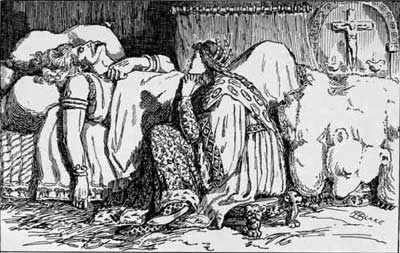
Judith watches her sleeping Spouse.
Judith knew that her lord was deeply moved, by his invocation of the Northumbrian saint, whose name was connected with all the wrongs that he preferred to forget when he was in an amiable mood. Yet she answered calmly, and with scorn in her voice, 'Who can wake a drunken man?'
And the champion who had struck off the heads of the Norman warriors, one after another, with a single blow of his terrible seax, at the gates of York, was so ignominiously under the rule of his Norman wife, that he swallowed his wrath and made no reply.
Judith made haste to improve her advantage, and to carry the war into the enemy's camp.
'How I hate these Saxon excesses!' she continued; 'only befitting barbarians, lowering men below the level of the brutes, who eat when they are hungry, and drink when they are thirsty, and abstain when want is satisfied. Thou madest not a fair picture, Waltheof, lying sprawled out and insensible in thy tipsy sleep, a prey to any evil creature who had chanced to come thy way. Cyning of the Saxons, indeed! Learn first to be king of thine own appetites!'
Waltheof started, and his brows knitted over his still heavy eyes.
'How knewest thou that, witch of Endor?' he demanded.
'Nay, thou hast experience that the spirits of the air are at my beck, and that my power serves me to gain knowledge of all that concerns my dearly-beloved spouse,' returned Judith, with a sneer.
'Sorceress! I believe, in sooth, thou art leagued with the devil!' quoth Waltheof furiously, and his expression was no metaphor. He was superstitious by nature, and his sharp-witted wife had done her utmost to impress him with the notion that her intellectual gifts were replenished from supernatural sources. Hence her power over him. 'But I tell thee, thou hadst better never have been born than meddle in this concern of thy husband's. For this concern, is the concern not of my poor unworthy self, but of my country, of my people! And I tell thee, foreign harridan, I had liefer strangle thee with mine own hands than be frustrated!'
''Tis pity,' quoth Judith calmly, 'since the matter is marred already.'
'What meanest thou, viper?' shouted Waltheof, fully aroused and springing to his feet, and advancing towards Judith with a threatening gesture, his mighty fist, which could have struck the life from her frail body at a blow, clenched into an iron ball, and the knots in his massive throat working with nervous excitement.
But Judith faced him unmoved, her proud face flashing with scorn. For the blood of Robert the Devil and Arlète of Falaise was hot in her veins, and perhaps she opined, also, that even in his wrath her heroic lord was too generous to hurt her. She did not quail before him but stood looking at him with her defiant, steadfast eyes.
'Slay me if thou wilt,' she said, without a falter in her tone. 'That which is done cannot be undone. My death will not hinder the stout messenger that sped through the night, ere thou hadst reeled from the banquet to thy chamber, from bearing the news of thy treason to Lanfranc. In vain wilt thou seek to overtake him, for he hath nigh a twelve hours' start, and he is mounted on thine own Spanish destrier, the swiftest steed in England—William's gift!'
The oath with which Waltheof answered was too terrible for repetition. He sprang at his wife, and clutched her slender throat with his strong fingers, as if he were in very truth about to execute his threat and strangle her.
She stood like a statue, though the weight of his hands upon her shoulders almost bore her to the ground.
'My people are as dear to me as thine to thee,' she said, expecting the death-grip to follow her bold speech. 'Thou hast sworn fealty to William, nay, thou hast done him homage, and put thy hands between his and vowed to be his man; thou hast married me, his niece! The struggle and the bloodshed are over, the Normans and Saxons should be one, and thou wouldst renew the strife and divide them again!'
With a moan like that of a wounded bull, the son of Siward cast the grand-daughter of Robert the Devil from him, and, covering his face with his hands, threw himself back on his couch in an agony of thwarted and impotent rage.
'Hadst thou been a man!' he muttered,—'hadst thou been a man, that I could do battle with thee hand to hand!'
'Had I been a man, Waltheof,' said Judith softly kneeling on one knee beside her prostrate warrior,—'had I been a man, Waltheof, I had not been here to save thee, and thy country, and thy people from the consequences of thy drunken folly. Holy Mary be praised that made me a woman! Waltheof, what is thy love for thy people, if thou wouldst plunge them again in blood and fire for the vain hope of satisfying an impossible ambition? Was not the harrying of Northumberland enough, that thou wouldst have the whole country ravaged from north to south?'
No man of many words was the hero of York, and his only reply to this eloquent appeal was to mutter an occasional curse in his beard, nor did he raise his face from the pillows among which he had plunged it.
'I tell thee,' Judith went on, 'William would harry the land from York to Hastings, as he harried it from Durham to York, rather than lose it from his grip. And thinkest thou that he whom Harold Godwinsson could not baulk nor drive from the land ere one Norman castle or stronghold was built in it, though he had the full force of the Saxon chivalry at his back, could be so easily ousted from the saddle into which he has climbed, now the most part of the nation are dead, or ruined and torn by dissensions and rivalry? Thinkest thou I would not gladly be a queen if there were any hope of such an ending to thine exploit? But seeing it not, I have chosen rather to endeavour to save thy life.'
'Save my life? Thou hast rather lost it! Say'st thou not that thou hast betrayed me to Lanfranc?' He raised his head at last, and looked her in the face.
'Nay, Waltheof!' answered Judith, softly laying her slender hand upon his huge shoulder. 'The foreign harridan loves her husband! I would save thee, not destroy thee. The letter was couched in thy name and sealed with thy seal, and so writ as though thou hadst but seemed to join the plot the better to discomfit the king's enemies.'
'Thou fiend infernal!' cried Waltheof, starting up again in an agony. 'Hast thou so dared to sully my good name?—to paint me so black a traitor?'
'Softly, my husband! The vow that is first made counts most binding. I would save thy name from the foul stain of treachery to thy generous liege-lord, William of Normandy, to whom thou didst homage in person on the banks of the Tees, coming of thine own free will to tender it, and accepting his forgiveness, his friendship, and the hand of his kinswoman. Yes—the hand of thy poor wife Judith, who would fain lead thee back to thy nobler self.'
The logic of this speech bore heavily on Waltheof, who threw himself down again upon the couch with a curse and a moan.
'Would that the sun had never risen on the day I first saw light!' he muttered.
Judith stretched out her hand and raised the golden crucifix which was suspended by a chain from her husband's neck, so that it was on a level with his eyes.
'Though we be of two nations, Waltheof,' she said gently, 'we are servants of one Lord. The abbot who bade thee plunge thy country afresh in blood and fire is no true priest of God. And for my countryman, Roger of Hereford, thinkest thou Lanfranc excommunicated him for nought?—Lanfranc, who loved him as a son. Wouldst thou associate with one accursed? What motive can he have in this save the slaking of his over-weening pride? As for the Breton, or the Englishman, or whatsoever he be called, Ralph of Guader, he who fought against his people at Hastings can have little spur save his own ambition. Wilt thou be the tool of such as these? I tell thee, Waltheof, if thou by timely return to thy sober senses dost frustrate the plottings of these men, thy memory will be green in the pages of the chroniclers, but if thou dost strengthen them in their folly, the ages will curse thee. Without thee they are powerless. It is thy name they conjure with, son of Siward. What Saxon would fight for Roger of Hereford, the son of their mightiest foe, or for the renegade, half-bred Ralph de Guader? Go now to Lanfranc, throw thyself at his feet, and all bloodshed will be stopped.'
And Waltheof groaned, and kissed the crucifix as she held it to his lips, for he was deeply religious after the wild manner of his times; humble in his faith, and little dreaming that the Saxon Church he loved so well would one day account him a martyr, and accord the power of miracle-working to the tomb in which his headless corse would repose, the trysting-place of countless pilgrims.
'I would not willingly bring further suffering on my unhappy country,' he said thoughtfully.
A gleam of triumph passed over the face of Judith, for the fury was gone from his voice, and she knew that she had conquered.
CHAPTER VIII.
KNIGHT-ERRANT AND MERCENARY.
Sir Aimand de Sourdeval, after he had been forbidden by Eadgyth of Norwich to wear her colours openly in his helm at the tourney, had cast about in his mind for some means of so bearing them that she should be aware that he did so, and she alone.
Accordingly, he had a new device blazoned on his shield,—a star shining from a band of blue sky between two barriers of sable cloud, with the motto, 'L'espérance vit dans le bleu,' blue being the colour most affected by Eadgyth, and to be worn by her, he knew, at the bride-ale.
This shield he bore with brilliant fortune in the joust, and plied his lance so well that the highest prize was awarded to him, a lady's bracelet gleaming with many gems, which Emma Fitzosbern handed to him with a bright smile; while Eadgyth, who stood behind her, thrilled with pleasure and pride that the knight who had placed his valour at her disposal had so worthily acquitted himself, though it was but a painful pleasure, since she deemed that an impassable gulf divided them, and she grieved to see how, without wearing any token openly, Sir Aimand still contrived to carry her colours. The ingenuity of the homage touched Eadgyth to the quick, for she was no coquette, and had no wish that a gallant youth should waste his breath in vain sighs for her favour.
So, when Emma with a gracious compliment crowned Sir Aimand with laurel, and handed him the prize he had won away from the many dexterous lances and strong arms which had contended for it, Eadgyth's eyes were full of ruth, and Sir Aimand, seeing them, grew suddenly glad at heart.
'Nay, noble Emma,' he said, declining to take the bracelet from her hand. 'Though my lady's eyes are as bright as the jewels that stud this golden circlet, they look not upon me with favour, neither may I wear her token in mine helm, nor place my trophies at her feet. Bestow the prize, therefore, upon one of thy fair damsels whose small wrist, peradventure, it may be of size to suit.'
So saying, he descended into the lists again, mounted his steed, and rode away amid the cheers of the spectators.
Emma turned to the maiden beside her, and bade her hold out her wrist.
'I believe shrewdly the bracelet will fit thee,' she said; and Eadgyth, blushing, was obliged to obey, and saw the jewelled circlet blazing round her arm with strangely mingled feelings of triumph and sorrow.
On the day of the bride-ale, it fell to the lot of Sir Aimand, as the youngest knight in Ralph de Guader's following, to keep ward over the sentries of the camp, and necessarily, therefore, to be absent from the banquet. So, while his chief was pledging his guests with pledges of dire import, and men were feasting and revelling and vowing mad vows to help each other's treason, and follow the three great earls in their wild enterprise, the unconscious Knight of Sourdeval was riding through the starlit night from outpost to outpost, passing the watchword himself had chosen for the night.
'Corage é bonne conscience,' he said, as he proved each post.
'Fait tout homme fort é fier,' answered each sentry.
For Sir Aimand, it must be admitted, was of a romantic cast of mind, and threw himself heart and soul into the fantastic images of chivalry which were then being evolved by the brightest spirits of the age, and never lost an opportunity of enforcing a good maxim, if it were only in so small a matter as a watchword.
His young head was as full of schemes for the reformation and improvement of the world as that of any modern Socialist; and, having lately met a palmer who had returned from a visit to the Holy Sepulchre, he had fallen a-dreaming on his chances of ever being able to travel thither himself, a project which had haunted him for a long time with more or less persistence, and which had started into prominence again in his mind since Eadgyth had given so discouraging an answer to his suit.
Being profoundly religious, he had been inclined to believe that her answer was guided by Heaven to lead him back to the less worldly scheme which had so filled his heart before he met her, and which he must have laid aside for an indefinite period, if not for ever, if she had consented to wed him; and he found comfort for his wounded love in the thought that he was, perhaps, to attain a higher spiritual life through the denial of earthly joy.
So, as he rode under the sparkling sky, his breast was full of a tender resignation, and the thought that he was guarding the lady of his love caused him a quiet satisfaction. He liked to feel that he was serving her, and vowed to serve her no less zealously that she had forbidden him ever to expect guerdon, and made all manner of silent vows to prove himself worthy of the love he had asked, and to live knight-like and piously, and do his devoir to God and man.
So noble a frame of mind might well bring forth fruit of song, and as he rode he hummed snatches of a lai which had taken his fancy a few weeks before, when he heard it from the lips of the author, a gallant minstrel, who, like Taillefer the famous, was also a knight of goodly prowess, and was devoted to the nobler branches of the joyeuse science.
Sir Aimand sang but snatches to the jingle of scabbard and harness, but this was the poem at length:—
THE WHYTE LADYE. I. Sir Bors went riding past a shrine, And there a mayd her griefe did tyne. O sweet Marye! A lilye maid with cheekes all pale, And garments whyte, and snowy veil, Shee bitterly did weepe and wail. O dear Marye! II. Sir Bors beheld, and straight hys brest For pitye 'gainst his hauberke prest. O sweet Marye! 'Ladye,' quod hee, 'I love thee soe, That I toe Deth wold gladlye goe, If I might ease thy cruel woe!' O dear Marye! III. Shee answered, 'In a robber's hold Lies chained a comlye knight and bold.' O sweet Marye! 'Mine herte is fulle of dysmal dred Lest hee be foully done to dedde, For I have promised him to wedde!' O dear Marye! IV. Then grew Sir Bors as white as shee, And never answer answered hee. O sweet Marye! A cruel stound didde pierce his brest, Yet soothly laid hee lance in rest, And parted instant on his quest. O dear Marye! V. And whilom found the robber's hold, And freed the comlye knight and bold. O sweet Marye! And sette him on his own good steed (Though inwardly his wounds did bleed), And stript his hauberke for his need, That he might be in knight-like weed. O dear Marye! VI. And ran before him in the mire, That hee might fitlye have a squire. O sweet Marye! Then when they reacht the lilye maid, 'Behold thy comlye knight!' he said, And saw her chaunge from white to redde, Then, smiling, at her feet fell dedde. O dear Marye!
As Sir Aimand hummed his song, a secret joy came to his heart, for he felt that although his plight was sad, being distasteful to his lady for his country's sake, at least no 'comlye knight and bold' of any other nation, Saxon or Breton, had forestalled him in her regard; of that he felt doubly assured, for, in the first place, if it had been so, he felt convinced that Eadgyth would have frankly avowed it, when he begged her permission to show himself at the tourney as her knight; and secondly, the expression he had surprised on her face when he had refused to take the prize bracelet.
Suddenly these dreams were interrupted.
The soldier banished the lover.
Sir Aimand checked his horse, and stiffened into rigidity, like a pointer scenting game.
Trot! trot! trot! The beat of a horse's tread leaving the camp at a rapid pace sounded through the darkness.
Sir Aimand struck spurs into his own gallant destrier, and dashed forward in the direction he judged the horseman was taking, endeavouring to intercept him by cutting off an angle.
The trot changed into a gallop, and though the Norman knight even caught sight of a dark figure hurrying through the gloom, he soon found that his steed was no match for the one he was pursuing; but Judith's messenger had a narrow escape.
Returning to the camp, De Sourdeval questioned the sentries; but, finding that the horseman had issued from the quarter occupied by the Northumbrians in the retinue of Earl Waltheof, over which he had no jurisdiction, he was forced unwillingly to let the matter rest.
Meanwhile the camp had grown quiet. The sounds of revelry and the mighty chorus which from time to time had burst from the palace—Sir Aimand little guessed their dire import—had ceased, and the silence was only broken by the occasional neigh of a horse, or whinny from some of the mules belonging to the ecclesiastical guests, or the clash of a sentinel's spear against his shield and jingle of his harness as he paced his post, or perhaps some wandering owl hooting at the disturbers of his accustomed hunting-grounds.
The east grew red with dawn, and Sir Aimand was relieved from his watch by the knight next on duty, and went towards his own pavilion to rest. As he passed the quarters of the Breton knights in the East Anglian earl's following, he was hailed by a group who were still lingering at the entrance of one of the pavilions, and talking together rather noisily of the events of the evening. Some few of the Bretons were vassals to Ralph de Guader, holding lands under him on his estates of Guader and Montfort, but the greater number were adventurers whom the earl had gathered round him, when he had determined to defy the mandate of William against his marriage. These men were under the leadership of one Alain de Gourin, a bold and reckless soldier of fortune, whose guiding principle was the lining of his own purse and the obtaining a full share of the fat of whatsoever land he might be living in. Between this swashbuckler and De Sourdeval but little love was lost, the Norman deeming the Breton a ruffian, and the Breton despising the Norman as a prig, so a smothered enmity was always between them.
Therefore it was with no great alacrity that Sir Aimand answered De Gourin's hail, especially as he guessed very shrewdly that the Bretons had not returned very steady-headed from the banquet.
'Gramercy, Sir Aimand! Thou hast been out of the world these six hours,' cried De Gourin, who had inherited the physical traits of his Welsh forefathers, having blue, bulging eyes, and light eyelashes, and truly Celtic flaming red hair, and was of a tall, wiry figure, and capable of immense endurance, his age being about fifty. 'Come hither, lad! We have such news for thee as will make thy heart beat faster, if thou hast the love of a true knight for the clash of steel and the hope of glory! Beshrew me! the man who knows how to wield his weapon will have a chance to carve his way to fortune e'er many months are past and gone!'
Here a knight whispered to him rather anxiously.
'Tush! Sir Aimand had been at the banquet save for the need of keeping ward on the camp,' answered Sir Alain. 'I would have the pleasure of seeing his delight!' he added, with a coarse laugh, and half forced the Norman to enter the tent with him, when, pouring out a goblet of Gascon, he challenged Sir Aimand to pledge the enterprise.
'Nay! First I must know what it is,' said the Norman.
'To unseat that upstart and usurper, William the Bastard, from his ill-gotten seat on the throne of England, and to put a better man in his place,' answered Sir Alain in a hectoring tone; 'and to win for ourselves such good shares of the lands as is due to our valorous lances.'
Sir Aimand started back, looking fixedly at the Breton, and his hand instinctively sought his sword-hilt; but in a moment he regained his composure.
'Methinks the earl's somewhat ponderous Saxon hospitality has turned thy hot brains a bit, Sir Alain,' he said contemptuously. 'Neither thou nor I are likely to drink that pledge!'
Sir Alain smiled at him with an evil smile, but he kept his temper. 'St. Nicholas! But every man here has drunk it this evening, and every man who sat at Ralph de Guader's marriage board; and, sooth to say, if thou hadst been present to hear the list of that same William's crimes that were brought up against him, methinks so virtuous a knight as thyself had drunk it too, with a rider to vow that such vermin were best exterminated from the earth.'
'It is true, De Sourdeval! All drank the pledge,—Normans, Bretons, and Saxons,' chorused the knights around. 'We are under oath to pull William from the throne and set up Waltheof in his stead.'
'It cannot be!' cried Sir Aimand, overwhelmed. 'It is treachery! The earl cannot be guilty of such baseness!'
'And who art thou to stigmatise as baseness what so many men as good as thee hold fit and good?' chorused the Bretons.
'By the rood! ye are scarcely fair to the lad,' said one somewhat more sober than his companions. 'The communication is sudden, to say the least. Neither did he hear the eloquent catalogue of William's faults which wrought our blood to the boiling point.'
'Nor would I have listened to a word of it!' cried Sir Aimand fiercely. 'I would have thrown down my gauntlet had it been the earl himself who traduced his liege lord and king! And what were ye for leal knights, fair sirs, that ye gave ear to such treason?'
'Look ye, my galliard,' said Alain de Gourin contemptuously, 'I should advise you to drop that hero of romaunt strain, for it is a little out of fashion here and now. By my halidom, thou wilt scarce find a foot-page in the whole camp that will support thee! The fell-monger's grandson has carried his tyrannies a little too far even for the patient stomachs of his servile Normans at last; and as for us Bretons, we have long bided our time to pay him out for those dishes of Italian soup to which he treated Counts Alain and Conan.'
'I will never drop the strain whilst I have breath in my body!' said Sir Aimand stoutly. 'Perhaps, when the morning comes, it will be you who will pipe to a different tune, fair sirs. Let me pass, gentlemen; I would go to my pavilion.'
'Not so fast!' answered Sir Alain, interposing his bulky person betwixt De Sourdeval and the door of the tent. 'Not until thou hast drunk the pledge! It would be scarce politic to let loose so puissant a knight while he declares himself hostile to our enterprise.'
Sir Alain and the most part of the Bretons were in their banqueting robes, armed only with swords and daggers, but a half-dozen, at least, had prepared for duty, and were in full harness, and these closed round their leader, and barred Sir Aimand's retreat.
'Sirs,' said De Sourdeval, 'ye are six to one, without counting unarmed men. If you stand not at treason to your king-lord, ye will scarce be particular in giving fair play to one who is true to him. But I tell you that ye shall not force me into complicity with your traitorous plans if ye hack every limb from my body. And I will sell my life dearly, since every blow I strike will be for my liege as well as for myself.'
'Thou young fool!' returned De Gourin, 'we have no wish to hurt a hair of thy head. Thou needest not drink the pledge if it irks thee, but for our own sakes we must shut thy mouth in one way or other. Resistance to such odds is madness. Yield thyself a prisoner, and the worst that will befall thee is a limited sphere of action till such time as we can honourably exchange thee against any of our members who may get into William's clutches.'
'Honourably!' repeated Sir Aimand furiously. 'When the combat is begun by throwing honour and devoir and all knightly fairness to the winds!'
'By the devil's own horns! thou carriest the matter too far for my patience!' cried De Gourin. 'Fight for it, then, if thou wilt!' Drawing his sword, he made a tremendous blow at Sir Aimand, who parried without returning it.
'I fight not with unarmed men!' said Sir Aimand, and obtained a cheer from the onlookers, who dropped the points of their own swords, as if rather ashamed of the business.
'Nay, if thou likest it better, and none of these men will suit thee, I will go and put on my harness,' said De Gourin.
'It is not I who hesitate!' flung back Sir Aimand, for his blood was up, and he threw prudence to the winds.
'Well crowed, Sir Victor of the Tourney!' cried Sir Alain mockingly. 'Thou hast already unhorsed singly more than one of us, why shouldst thou be awed by our combination? Sir Mordred here cut a shrewdly laughable figure when thy thrust caught his jowl two days agone! Methinks his teeth must chatter yet! No wonder he pauses before attacking so doughty a champion!'
Sir Mordred, stung by the taunt, advanced on De Sourdeval and attacked him fiercely; but the Norman held his own, surpassing him both in strength and skill; and in a few moments Sir Mordred fell to the ground, cured for ever of the toothache or any other ache that flesh is heir to.
His comrades, with a savage howl, closed on Sir Aimand, and, overwhelmed by numbers, he was borne down, and lay senseless and bleeding beside his slain foe.
Meanwhile Judith's messenger was speeding on his way to the Primate, while the unfortunate knight who had striven so hard to stop him was thus foully entreated, lest he should himself be the bearer of some such message.
CHAPTER IX.
NORWICH.
After the bride-ale the splendid company parted, mainly in three great divisions: Earl Waltheof and his following to the north; Earl Roger to the west; Earl Ralph with his bride, his Norman knights, and Breton vassals and mercenaries, his Anglo-Saxon vassals and sympathisers, to the east; a few minor parties of independent barons, knights, and thegns going their several ways.
The Earl of Norfolk and Suffolk and his train rode forth along the old Roman Ikenield Street, which ran then an uninterrupted course from within a few miles of Exning to Norwich.
De Guader rode beside his young countess on a gentle hacquenée, which paced quietly beside her palfrey, and did not break in upon their converse by any pranks of his own, his squire leading the fiery Oliver, and an attendant following with a mule carrying his armour, lance, and spear.
It may well be supposed that the noble bridegroom spared no pains to make the time pass pleasantly for his young countess, which, under the circumstances, was no difficult task, for the mid-May weather was delightful, and whether they rode over heaths or through the forests, which then spread over the greater part of the country, they were surrounded with flowers and the song of birds. The yellow gorse was gorgeous in the open, filling the air with its almond scent, and the whin-chats fluttered from bush to bush, trying to lure them away from the spot that hid their nests. Overhead the larks carolled and the sparrow-hawks poised motionless, while round and about them darted the busy swallows.
Where they passed a homestead, fruit-trees were gay with blossom, apple and cherry and pear, and the sweet-breathed kine were standing in the meadows, knee-deep in the flower-jewelled grasses, for was it not Tri-milki, the month when cows are milked thrice in the day, according to the quaint old Anglo-Saxon calendar? Now and again they met a shepherd with a flock of ewes and lambs, or, more often, the inevitable Saxon swineherd with his grunting pigs.
But alas! they passed more often the blackened ruins where a homestead had once been, for the curse of war had desolated the land. Over the thatchless rafters hung the white branches of the flowering May, the more like snow, because no girlish fingers had stripped them to deck Maypoles.
They journeyed also through many a mile of forest land, where the great trees interlaced their boughs into the beautiful arches which the Gothic architect imitated so well in stone, and the wild birds thronged in undisturbed security, countless in kind and number, and the antlered stags trotted nimbly down the glades.
The greenwood in those days, however, had its dangers as well as its delights. Wolves and boars and wild cattle shared its shelter with the feathered songsters; and more formidable still were the indomitable Saxons, who had sought refuge in the wilderness, and made war without mercy on such of the conquering race as trespassed on their domain. Many a Saxon thegn, who had lost house and land in the great struggle against the Norman invader, had retired into the woods, and there lived the life of a freebooter, some taking with them not only their families, but their vassals and retainers. To be an outlaw was accounted an honour by these men, who would not acknowledge the right of the law-makers to command. They swarmed even under the walls of the Norman castles, and harassed the conquerors continually. Retaliation was sanguinary, and the unarmed peasants were punished under pretext that they harboured the outlaws. In return, the kings of the forest attacked the English households who favoured the Normans, and every house was fortified to resist a siege, and stores of arms and food were laid in; at night the head of the family read aloud the form of prayer then used at sea in a storm, praying 'The Lord bless and help us,' to which all present answered 'Amen.'
But the strong and well-armed retinue that accompanied the Earl of East Anglia's party assured safety, and the most timid amongst the ladies could fear no harm while surrounded by so many gallant knights in all the pride and panoply of glorious war! They made a goodly sight as they moved along, the sunshine flashing on their mail hauberks and high-peaked steel saddles, and the wind fluttering the gonfalons on their lances, their well-appointed horses snorting and curvetting, a strong body of men-at-arms, bowmen, and slingers following afoot.
Doubtless many a Saxon serf and bordar cursed them as they passed, not knowing that the powerful earl who led them had avowed himself champion of the Saxon cause, and meant once more to raise the standard of revolt.
Doubtless many a stout forester peered at them from behind the shelter of green leaves, and raged with impotent anger at their strength.
Perhaps others greeted them with courtesy and proffers of friendship and offerings of game, for the outlaws contrived to be wonderfully well informed of the march of events, and De Guader was keenly alive to the desirability of making all possible allies amongst the scattered English, and did not neglect the brave spirits who had taken to the wilds rather than submit, and who wielded so strong a weapon in possessing the love of the common people.
However that might have been, they journeyed safely through wood and wold, going slowly to suit the comfort of the ladies, and the capacity of the sumpter mules, and revelling in the bright spring weather.
Amongst the knights who pressed round them Eadgyth looked in vain for the figure of Sir Aimand de Sourdeval. Emma, happy with her bridegroom, took no notice of his absence, till, on the second day of their journey, the earl having left her side to give some necessary orders to his train, she saw that Eadgyth was sad and silent, and remembered that the hero of the tourney had not appeared in the ranks of their escort. She surmised that it was likely he had purposely avoided companionship which could only lead to pain, and had contrived to fulfil some other duty; so, when the earl rode up to her side again, she put some light question to him regarding the knight, and was surprised to see his face grow dark as thunder. He answered briefly, however, that Sir Aimand was detained on business of weight, and Emma, rather perplexed, did not venture to question him further. At the moment the jester Grillonne ambled up, mounted on a piebald nag with a chuckle-head and goose-rump, and cut capers which made both earl and countess laugh, so that the poor Knight of Sourdeval was banished from Emma's thoughts.
On the evening of the fourth day they came in sight of the churches and trees of Norwich, with the newly-built Castle Blauncheflour rising in stately strength above them (for no cathedral spire dwarfed it then), the brilliant beams of the setting sun gilding its snowy towers, and lighting the square mass of the lofty keep, which still, after eight hundred years of war and weather, stands firm and solid on its throne above the city. [2]
Emma exclaimed in delight when she first came in sight of this goodly castle, which brought home to her pleasantly the power and wealth of her noble husband.
'A garrison of five hundred might hold it for ever!' cried Ralph enthusiastically, 'if only manna would fall from the skies to feed them, or that they might be fed by a San Graal. That reminds me, sweet, thou wilt like to hear my minstrel tell the story of Blauncheflour, who was the betrothed of Percivale, the searcher for the Graal. The fair white walls, faced with goodly Caen stone, seemed to me in their invincible dignity to resemble a pure maiden, so I named them after her.'
Norwich in those days was surrounded by broad and deep streams, at least five times as wide as its present modest rivers, and the chroniclers of Edward the Confessor's day record that the fisher-folk suffered terribly through the receding of the waters. A sandbank some distance out at sea was just emerging where Yarmouth now stands, and sea-going vessels could make their way past the walls of Blauncheflour.
The level of the water was many feet above its present mark, and the castle was surrounded, and rendered very strong, by deep ditches of early British construction, on a similar scheme to those traced at Rising, Castleacre, and many other places, where Norman architects had availed themselves of the earthworks constructed by earlier peoples. The castle was surrounded by the circular moat which still exists, while a large horseshoe fosse extended to the south, covering the great gate of the castle, which was at the foot of the existing bridge, which is of Saxon construction, and measures forty feet in the span, being the largest remaining arch raised by that people.
The great gate was a strong and imposing structure, and had four towers, two at the base and two at the top of the bridge, and was the only entrance to the upper ballium, which was guarded by eleven strong towers, and contained various halls and lodgings, beside the great keep, which is all that remains to us.
The fortress might well look imposing, with its moats and earthworks, strengthened by strong palisadings of wood, its formidable walls and gate-houses dominated by the great square tower, with many a pennon waving from the topmost points, and warders marching to and fro on the battlements, their glittering mail shining in the sun.
Norwich was not a city then, the see of the Bishop of East Anglia being at Elmham, but there was a monastic church called Christ's Church where the present cathedral stands, and the bishop had a palace on the site of the well-known Maid's Head Inn of the present, the walls of which were lapped by the river.
Herfast, who held the see from 1070 to 1076, had been chaplain to William the Conqueror when he was Duke of Normandy. It may be that he somewhat favoured Ralph de Guader, or chose to be blind to the doings of the turbulent earl, for, though Norman of the Normans, he bitterly hated Lanfranc, who had once exposed his ignorance to pitiless scorn, and who unsparingly denounced his vices, bidding him 'to give over dice-playing, not to speak of graver misconduct, in which you are said to waste the whole day;' and bade him 'study theology and the decrees of the Roman Pontiffs, and to give especial attention to the sacred canons.' Also to 'dismiss certain monks of evil reputation.' At all events, he does not appear to have been an active opponent to the East Anglian earl, and it may be that he was not sorry that the archbishop he so much disliked should have a little trouble during his time of temporal power.
In the Domesday survey, made eleven years later, 1086, fifty-four churches are recorded, and 1565 burgesses and 480 bordars were among the inhabitants. The town was probably larger in 1075, as it suffered much during the subsequent siege, and many an entry of 'Wasta,' 'wasta,' 'wasta,' bears testimony to the sorrow Ralph de Guader brought upon the place.
Where the busy market-place is now, spread broad meadows for the castle use, called the Magna Crofta or castle fee, and through them ran a stream, having its rise on All Saints' Green, and flowing across the present site of Davey Place to the river. The quiet Quaker burial ground occupies the Jousting Acre, or Gilden Croft, where many a noble knight gave or received a broken head in sheer good fellowship and amiable love of fighting; and many a fair lady encouraged the giver with smiles, or wept for the receiver. So the lovers of peace sleep calmly under the sod that once was trampled by the eager steeds of the men-at-arms.
Such was the Norwich to which Ralph de Guader brought home his bride; and, as they entered it, the knights in their retinue pricked their jaded steeds and stirred their mettle, that they might prance sufficiently gaily. The trumpeters flourished their trumpets, to give notice to the good people that their earl and his bride were approaching, and, though travel-stained and weary, the cavalcade made a brave appearance.
Rich and poor, Normans, Saxons, Danes, Flemings, and Jews, all of which nations were represented in the town,—the last-named having made their first appearance therein at the heels of the Norman invaders, and being hated accordingly,—crowded into the streets to welcome and admire the bride and bridegroom, or, at the least, to render that homage which circumstances rendered politic.
For it must be remembered that the dignity of the powerful Earl of East Anglia was almost royal. The feudal king was 'first among peers,' and the earls came next to him; even so late as the reign of Queen Elizabeth the parliamentary formula of royal speeches was, 'My right loving Lords, and you, my right faithful and obedient subjects.'
The 'Ykenilde weie' entered Norwich where afterwards stood the Brazen Doors, passing by All Saints' Green to the Castle Hill; the cavalcade so entering what was called the New Burg, consisting of Norman dwellings erected since the Conquest, which, then as now, took its name from the Chapel in the Field, and included the parishes of St. Giles and St. Stephen's. Here the enthusiasm was effusive, and a well-dressed populace waved caps of rich fur in the air, while silken hangings and gay banners waved from the windows.
It was with mingled feelings that Eadgyth of Norwich re-entered her birthplace in the train of the Norman lady. All her loving recollections were embittered by the sight of changes that reminded her of the sufferings of her people and the ruin of their cause, and the tears came into her eyes when she compared the welcoming crowd of foreigners that shouted around her with the scenes stamped on her childish memory, when she had seen the stalwart Danes and Saxons gather to greet Harold Godwinsson, and heard their loud 'Waes hael!'
Storms of anger and jealous misery moved her as she passed through the New Burg, for the smart dwellings on each side of the street had all been built since the Conquest, and showed the wealth of the invader. As they approached the castle, her heart sank more and more. It seemed to her as if its heavy foundations had been laid upon her breast, so cruelly did it bring home to her the strength of the yoke which was riveted upon the necks of her people. For in architecture more than in any art did the Normans excel the people they conquered, and though the moats had been there when Harold was earl, the fortress within them was but a rude structure.
When they reached the castle gate, a lively scene was enacted. The garrison marched down to salute the earl and his bride, led by the castellan on a prancing charger, and forming in glittering lines on either side the Bale. There were companies of archers clad in mail coats reaching halfway to the knee, over which they wore jerkins of stout leather, their ell-long shafts stuck through their belts, and their bows of yew, ash, witch-hazel, or elm, held in their right hands, and capable of despatching the arrows to a distance of from 200 to 300 yards, with little steel-caps on their heads shaped much like the prim head-coverings worn by the Puritan maidens of later times; and men-at-arms, shining from head to foot in chain mail, or with little steel rings sewn thickly upon leather, armed with straight swords about a yard in length, and wearing helms like upset saucers; others less heavily armed, bearing oval shields and long lances, their shoulders and chests protected by glittering capes of scale armour; and others again, still more slightly armed, with lighter lances, and small round shields not larger than dinner-plates, with which to baulk a lance thrust; slingers, with light tunics reaching to the knee, and little or no armour, their weapon a long pole provided with a loop, from which the practised hand could sling stones with great force and precision. A good two-thirds of the archers and slingers were Bretons; for the men of Bretagne were famed bowmen, and furnished the chief contingent of the archers who did so much execution at Senlac.
Besides these there were the engineers, who worked the mangonels and catapults, and a large troop of smiths and armourers, whose duty it was to repair with hammer and anvil the damage done by wear and war to the accoutrements of these various gentry,—in all some two to three hundred men.
They rent the air with a great cheer, as they formed in line before the earl and countess and their retinue; and the castellan, Sir Hoël de St. Brice, a knight who had grown grey in the service of the Lords of Guader and Montfort, and who had fought under the father of Ralph's Breton mother, gave the cue, with a compliment to the bride.
'Long live the daughter of William Fitzosbern!' he cried, whereat the soldiers cheered again.
Emma smiled and bowed, and tried to pay them equal compliments in return.
'With such a castle, and such gallant defenders,' she said, 'fear would be impossible, even if the blood of the veriest coward ran in her veins instead of that of a hero.'
Whereat they gave still louder cheers, and vowed that they would spend every drop of their blood to defend her if need were.
Then the earl treated them to a little harangue.
'He knew they meant what they said,' he told them, 'for he had seen them fight, not only from behind stone walls, but hand to hand on the field of Hastings;' and added, 'that he was glad he knew their metal, for perhaps it would be rung sooner than they looked for.' An announcement received with vociferous delight by the wild men of war, who scarce thought life worth living in time of peace, and looked to the giving and taking of shrewd blows both for amusement and fortune, caring little in what cause they were bestowed.
While this took place, Eadgyth had turned her eyes to the south-east, the old portion of the town looking over to the Thorpe marshes, where the bright Mary buds 'had oped their golden eyes,' and the willows were white with catkins, and the Thorpe woods were in their fresh verdure. An overwhelming sense of desolation came upon her as she marked the old familiar objects among which her childhood had been passed—and more forcibly as she noted the absence of others. She drew her veil across her face, lest it should be seen that she was weeping.
The cavalcade moved on again, Sir Hoël riding by the earl's side. They passed into the northern end of King Street, and so to the ancient palace of the East Anglian earls, which stood where the St. Ethelbert Gate is now, and had a chapel dedicated to that saint, who had been a king of the East Angles. He was murdered by Offa, King of Mercia, at the instigation of his wife Quendrida. The head of the victimised prince rolled down as his body was being carried away; a blind man stumbled over it, and, accidentally touching his eyeballs with the blood, received his sight again. A well sprang up where the head fell. So runs the legend.
At the palace they were received by a gaily-clad host of servants and retainers. Brave squires and smart pages, portly bursar and anxious steward, cellarers, cooks, and scullions; stately dames and pretty bower-maidens, tirewomen, dairy and grinding-maids (for in those days windmills had not been invented, so 'woman's sphere' included the grinding of flour in a hand-mill),—these, and many more, stood waiting in order of their rank, and dressed in their bravest apparel.
Behind the earl's household was a still larger company of socmen and slaves from the nine manors which William of Normandy had bestowed on Ralph de Guader when he gave him the East Anglian earldom, making altogether a goodly crowd of retainers; and we may guess how they all strained forward to catch the first glimpse of the noble young bride their lord was bringing home, and how Emma, though well used to homage, was glad to bow her fair head under excuse of courtesy, and so hide her glowing face from so many curious eyes.
On the plain before the palace, opposite St. Michael's Chapel (Tombland), six fine beeves were roasting whole for the entertainment of the populace, and a tun of wine and several fat barrels of ale were broached, wherewith throats that had grown hoarse with shouting welcome should be refreshed.
So came Emma, Countess of Norfolk and Suffolk, to her new home in Norwich, where she was to spend but a few short months full of terror, suffering, and sorrow, and by her bearing under misfortune to prove herself the worthy daughter of her noble sire, and to be known in the pages of history as the heroine of the most romantic incident in the annals of Norwich Castle.
CHAPTER X.
LANFRANC, PRIMATE OF ALL ENGLAND.
Waltheof, instead of continuing his journey northward, left his retinue privily, and, with as small a following as the state of the country rendered imperative, made his way to Canterbury and craved audience of the Primate, appealing to him in the double capacity of a spiritual father, and, for the time, while King William should be absent, as a temporal superior also, the archbishop having been appointed justiciary of the kingdom in conjunction with Robert, Earl of Morton, and Geoffry, Bishop of Coutances.
After certain ceremonious delays, he was received. Lanfranc, Archbishop of Canterbury and Primate of all England, was a man of high character and subtle intellect, uniting the business capacities and breadth of view of the man of the world, to the piety and earnestness of a sincere churchman.
A Lombard by birth, he had attained eminence in his youth as a law student at Pavia. His birth was not noble, but his parents were said to have been of senatorial rank, which indicated a good social position. His eloquence as a lawyer was so great, that he triumphed over veteran opponents, and soon became famous. Italy, however, was at that time torn by dissensions, and he was early involved in political quarrels, so that he deemed it wise to quit the arena of his forensic triumphs, and to seek the less genial but safer climate of Normandy. Here he soon attained high eminence, and opened a school at Avranches, to which scholars came in crowds; but suddenly the illustrious advocate disappeared, and no one knew whither.
He was discovered, some three years later, living the life of a penitent in the secluded monastery of Bec, a small establishment founded by his countryman Herluin, but which afterwards became famous through having supplied Canterbury with three archbishops. After a time, Lanfranc became the prior of Bec, and was as much sought as a religious teacher as he had hitherto been as a lawyer.
In his newly-awakened zeal, Lanfranc took it upon him to denounce the intended marriage of the Duke of Normandy with Matilda of Flanders; the Pope having threatened excommunication, as the couple were within the prohibited degrees of relationship.
One fine day, the quiet monks of Bec, working in their garden amongst their cabbages and onions, were surprised by the advent of a gay company of knights in holiday attire, surrounding an ecclesiastic who rode pompously upon a fine white mule. The excitement increased to boiling point when the visitor was found to be the duke's chaplain Herfast, whom we have already introduced to the reader as holding the Bishopric of Elmham in 1075, and that his retinue was composed of nobles high in favour at the court; and the much-impressed monks hastened to tell their prior of the honour shown him. But the prior was giving audience to a beggar, and made the duke's emissaries wait till his conference was leisurely concluded. He understood perfectly well that William wished to bribe him, by this display of favour, into giving his assent to the wedding, and he had a mind to assert his independence.
Herfast was as ignorant as he was pompous, and the accomplished prior took every opportunity of exposing his guest's ignorance, even placing in his hands an abcdarium, or spelling-book, to the great amusement of the spectators and the huge wrath of Herfast, who rode back to his royal master with a fine tale of the insolence of the Lombard upstart.
William was so incensed, that he fell into a paroxysm of rage, ordered Lanfranc out of the country, and sent a band of soldiers to burn one of the granges of the monastery to the ground, as a practical witness to his anger at the way in which his courtiers had been treated.
Imagine the consternation amongst the monks of Bec. Lanfranc, however, was equal to the occasion. William had ordered him to quit the country. But the brethren of Bec were poor, and there were no parliamentary trains in those dark ages to carry passengers from one end of a country to the other for a penny a mile. They must travel in the saddle or on foot. Churchmen, for the most part, patronised mules of considerable size and high breeding, and journeyed in no small state. But the only animal the stables of Bec could boast was a sorry steed, angular of joint and far from sound. None the less the prior mounted it, and set off for Rouen, where he had been bidden to appear before the duke ere he quitted the country.
William came forth to meet the haughty churchman, who had dared to thwart and condemn him, and to make fun of his chaplain, accompanied by a gallant train of knights and squires. He expected to meet a cavalcade almost as numerous and magnificent as his own.
His face was dark with anger, and he wrapped himself in thoughtful taciturnity, meditating a rebuke befitting the insolence with which his condescension and favour had been met.
He grew impatient when along the straight level road nothing could be seen but a single horseman on a lame jade, whose nose almost touched the ground at every step, and whose pace was easily kept up with by a follower on foot.
As this sorry trio approached, however, he saw that the men were habited as monks, and Herfast, who rode beside his royal master on his sleek white mule, flushed deeply red.
''Tis Lanfranc himself!' he exclaimed.
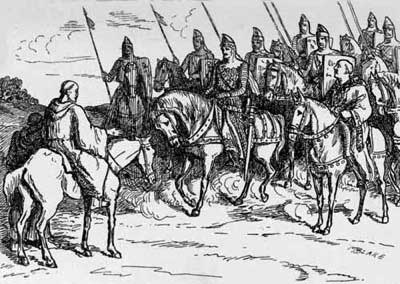
Lanfranc jests with the Conqueror.
'What new mummery is this?' demanded William, his keen eyes straying over the comical figure of the prior and his wretched mount, and a smile gleaming over his stern face, brief but irrepressible, for William was a lover of horseflesh, and spared no pains or expense in the importation of fine horses from Spain for his own use. The creature he bestrode was a splendid animal, and the strongest of contrasts to the prior's pitiful nag.
Slight as the smile was, and hastily repressed, Lanfranc saw it, and took instant advantage.
'By your commands,' said the audacious prior airily, 'I am leaving your dominions, but it is only at a foot's pace that I can proceed on such a wretched beast as this; give me a better horse, and I shall be better able to obey your commands.'
William had a keen sense of humour, and perhaps felt that the clever Lombard would be a formidable foe.
He laughed a royal laugh of magnificent amusement. 'Who ever heard before,' he asked, 'of an offender venturing to ask a donation from the very judge he has offended?'
Herfast grew redder than ever with chagrin and mortification, for he saw very plainly that the subtle prior had mollified the duke by his intrepid joke. And so it was, and from this strange meeting resulted no less a matter than the establishment of a friendship which lasted till William's death.
Not long afterwards, Lanfranc went to Rome to plead with the Pope, and urge him to give his sanction to that marriage which the prior had hitherto opposed so bitterly. And this he did without inconsistency, for his opposition had been based upon William's defiance of the Holy See; when, therefore, he persuaded the haughty duke to humble himself, and plead meekly for a dispensation, with promises that he and his bride would bind themselves to many duties in return, amongst others, to endow each an abbey and two hospitals, the seeming submission of Lanfranc was really a triumph.
After a while, though much against his will, Lanfranc was induced to leave Normandy, and assume the onerous post of Primate of William's newly-conquered kingdom of England. He even appealed to Pope Alexander II. to extricate him from the difficulties of such high office, and to permit him to return to the monastic life, which above all things delighted him. But the Pope refused to interfere, and Lanfranc accepted the inevitable, and set to work with courageous zeal to make the best of his manifold duties. And he acquitted himself like a brave and good man, steering a wise course amongst the jealous Normans and aggrieved Saxons, selecting virtuous men to fill the posts which became vacant; and though, no doubt, partaking the prejudices of the conquerors, yet securing good men amongst the Saxon clergy as friends. The Church of England owes much to him, for he was distinctly an imperialist, and stoutly resisted papal aggression, laying the seeds of that nationality which has saved us from so many evils.
It may be imagined that the simple-minded and gentle Waltheof, much more adept at wielding a seax than at chopping logic, and who was as wax in the hands of his clever wife, was as water under the treatment of this subtle Lombard, who could mould to his wishes even the self-willed and astute William.
The archbishop received the Earl of Northumberland with much pomp and circumstance, giving him the ceremonious honour due to his high rank and his position as husband of the king's niece, so that Waltheof had to beg for a private interview.
This being granted, the unhappy hero knew not how to begin his forced confession, and the keen black eyes with which Lanfranc searched his face did not lessen his confusion.
But the archbishop had no intent to deal harshly with his illustrious penitent.
His features softened with a winning smile. 'What hast thou to say to me, my son?' he asked in a gentle voice. 'Why hesitate? Dost thou not know me for a true friend?'
'Alas, father! I have a sad tale of sin and weakness to reveal to thine ears,' said the son of Siward at length. 'But I pray thee advise me. I have taken an oath, and since then, heated with wine, and somewhat overawed by numbers, I have taken a second contrary thereto. By which am I bound? Am I forsworn in that, notwithstanding this second oath, I sent the messenger to thee, who, if nought mischanced, reached Canterbury some four days agone?'
'Thou hast sinned, my son, answered the archbishop gravely; 'but not so heavily but that, after due penance, the offence may be pardoned. An unwilling oath, taken under the compulsion of an excited crowd, can scarce bind as that which was the fruit of calm reflection and sober judgment. Rather must it be accounted evil in thee, that thou didst consort with a man who was anathema of the Holy Church.' His mobile face grew stern, but it was a sternness not unmixed with sorrow.
'Nay,' answered Waltheof eagerly, 'I knew not of that till the banquet was well-nigh ended, when it was impossible to turn back.'
He was relieved at the tone of the archbishop, yet could not keep reflecting bitterly in his heart, that this light treatment of a forced oath when taken by the son of Siward against William, was very different to the view taken of that made by the son of Godwin for William. Harold had been branded a perjurer for abjuring a forced oath.
'Nevertheless,' said the archbishop, not yet relaxing his face, 'thou hadst knowledge that the men whose bread was broken for thee were acting in direct opposition to the mandate of thy king-lord and kinsman, whose clemency had pardoned thy former misdeeds against him, whose hand had been reached to thee in fellowship, and whose niece had been given to thee to be bone of thy bone, flesh of thy flesh.'
'In good sooth, father,' replied Waltheof reluctantly, and with the air of a schoolboy repeating a lesson by rote, 'I thought mine uncle and king-lord was playing a somewhat tyrannical part in dividing two true lovers. I see now that he had reasons which I little suspected.'
This defence had been suggested by Judith.
Lanfranc's fine sensitive face grew sad. Speaking in a low, sorrowful voice, as though the subject caused him inexpressible pain, he said, 'My son, it was not for light or frivolous reasons that William our king-lord interfered to thwart the wishes of his earls. Nor was it without cause, or, in truth, without grievous necessity, that I declared the anathema of the Holy Church against the son of the man who did more than any other to crown our Norman duke an English king. Had it been but a question of a marriage,' the archbishop continued in the same strain, but in a still softer tone, and rather as if speaking to himself than to the earl, 'God forbid that I should have parted whom He had elected in His all-seeing wisdom to unite!' He sighed deeply, for in his youth he had been the husband of a much-loved wife, whose death had taken all flavour from earthly joy for him, and had been the cause of his precipitate retreat from a position of wealth and fame, to seek consolation in the cloister. 'I have loved Roger Fitzosbern as a son! I have striven with him in affection! But, alas! in vain. One folly was added to another, until at last foolishness swelled into crime. He denied justice to the injured. He invaded the property of his king-lord, and of his peers; and now he has crowned all by this attempted treason, brought to the light at the unholy banquet at which thou wert thyself tempted to evil, Waltheof! Ah! I have wept tears of blood over this lost sheep. Would that my efforts had recalled him to the fold! But the time is past.'
He stretched out his thin, transparent hands before him, his dark eyes fixed upon space, as if contemplating a vision of the bloodshed to come.
He was silent, and Waltheof, being a man of few words, was silent also.
Suddenly the Lombard turned his gleaming eyes upon the Northumbrian earl. Waltheof started, for in his heart was no repentance for having attended the banquet, nor for any of his treasonable designs, but only a fierce wrath against the Norman wife who had defeated his plans, and brought him more tightly under the yoke he hated, and it seemed to him as if those dark eyes could read his most secret thoughts. He shifted his huge frame uneasily, so that the bracelets which ringed his tattooed arms almost to the elbow, clanged together, and his large fingers sought the jewelled haft of the hunting-knife which hung at his baldric, not threateningly, but from habit.
Yet if his thoughts were read, they were ignored.
'But thou at least art here!' Lanfranc exclaimed, his mobile features lighted by a brilliant smile. 'Thy better angel has prevailed, and, by the mercy of Our Lady, has brought thee back to the fold at the eleventh hour.'
Waltheof looked relieved, and he lifted his head and tossed back the yellow mane which had fallen over his face.
'I pray thee, father,' he said earnestly, encouraged by the Primate's smile; 'stand by me in my trouble, and plead my cause with William of Normandy. Thou hast the power to influence him. Advise me how I may best act to win his pardon for my transgression; how best assure him of the sincerity of my return to allegiance.'
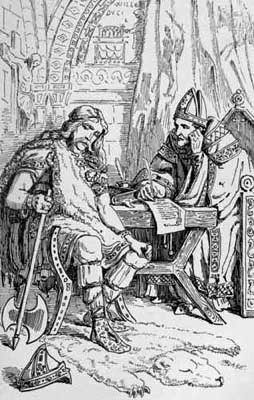
Waltheof's Humiliation.
'I will stand by thee, my son,' replied the archbishop, clasping Waltheof's great hand in his slender fingers. And he fulfilled his promise with unswerving fidelity, even to the last, when the unfortunate son of Siward lay doomed to death in prison; nor, if Lanfranc could have prevented it, would William have consummated that greatest blot upon his reign, the execution of the Northumbrian earl. 'Thou art impulsive, my son, and simple-minded, and therefore easily snared. But I believe not that thy heart is evil, or that thou wouldst be other than a pious son of our Holy Mother Church.'
'No, indeed!' said Waltheof, much affected by the appeal, which roused all the natural piety and humility of his nature. He crossed himself with much fervour. 'Tell me what to do, father. Whatever thou wilt command I will perform.'
'My son, I would bid thee cross the sea to Normandy and seek William in person, confessing all frankly, and throwing thyself on his mercy. Nor would it be detrimental to thy suit if thy hands bore somewhat of the produce of the lands and honours he has bestowed upon thee with so lavish a generosity.'
Waltheof shuddered. It was no pleasant prospect to the powerful earl, whose head had of late been so filled with schemes of ambition, thus to humble himself a second time to the conqueror of his people.
But Waltheof's courage was more of the physical order than the moral. He was, besides, of gentle disposition, and sincerely desired to avert bloodshed, and he thought that his defection from the ranks of the conspirators would prevent any attempt to meet William in the field.
Therefore he bowed his head. 'Thine advice is meet, father,' he said; 'I will cross the seas and seek William, bearing rich presents to testify my regret for the past, and present goodwill.'
CHAPTER XI.
THE CASTELLAN OF BLAUNCHEFLOUR.
Ralph de Guader had said little to his bride of the proceedings at the marriage festivities, but a time came when it was necessary for him to break in upon their brief honeymoon with rumours of war, for it was not possible to hide the fact that he must take the field in defence of life and liberty.
The defection of Waltheof had been a great blow to the conspirators; his untimely betrayal of their plans was more serious still, as their chance of success lay chiefly in the hope of taking the king's forces by surprise.
Waltheof himself had supposed that his course would altogether put a stop to the undertaking, seeing that his two brother earls had represented that to place him on the throne was its chief object.
But De Guader and Fitzosbern were too proud to give up their hopes of aggrandisement so easily, and, moreover, their case was desperate. If they submitted at once and unconditionally, they could only look forward to disgrace and imprisonment, whereas the chances of battle might still be in their favour. It was not wonderful, therefore, that they elected to fight it out, notwithstanding the odds against them.
The Earl of Norfolk and Suffolk had assembled his forces, and held all in readiness for departure on the morrow. The dreaded moment had come, and he sought his wife's bower, feeling that he would much liefer meet William's men-at-arms.