Chapter VII · THE INDIAN BASKET TRICK.
Professor Hoffmann translation
The Indian Basket Trick was exhibited in London in the year 1865, by Colonel Stodare, at his Theatre of Mystery, Egyptian Hall, Piccadilly.
It was asserted that the illusion in question had been brought over from India by the conjuror-colonel; but in such case, as the reader will judge from the following description, the original mise en scène of the Indian Basket Trick must have been very considerably modified in arranging it for exhibition before the British public.
Upon the rising of the curtain, the spectators beheld a wicker basket, of oblong shape, placed upon a light, undraped table.
The colonel came forward, followed by a handsome boy, wearing with native grace the traditional costume of an Indian prince. His tunic was of white cashmere embroidered with gold, and his head-dress adorned with a peacock’s feather looped up with an aigrette of diamonds.
“What do I behold!” exclaimed the colonel; “a descendant of that hated race which has shed so much English blood!”
“Nay, I am only a child,” gently replied the prince.
“That will not prevent me from putting you to death.”
“Spare me! spare me!” shrieked the child.
“I cannot spare you; you must die!”
The boy sought to escape, but in vain. The colonel seized him, and, holding him at arm’s length, thrust him into the basket, the lid of which he closed and fastened. He then drew his sword, and after proving its sharpness by thrusting its point deep into the flooring of the stage, he made repeated lunges at the basket, thrusting it completely through and through from side to side.[32]
At every thrust, the child uttered a scream of agony. The sword was withdrawn each time, dripping with the blood of the victim. Then gradually the shrieks grew weaker and weaker, and after a few moments all was silent.
The spectators were under the influence of an indescribable horror; ladies hid their faces with their fans, and begged for mercy. The male spectators cried, “Enough! enough!” The audience were worked up to a pitch of the most intense excitement; so painfully real was the bloody drama. Colonel Stodare was within an ace of experiencing very rough treatment; but all at once changing his tone, and smiling pleasantly, he addressed the audience as follows:—
“Need I remind you, ladies and gentlemen, that all I exhibit here is illusion? Calm yourselves, I beg, and rest perfectly at ease as to the fate of my young Indian friend, who is at this moment safe and sound; indeed, he has already made his escape from his narrow prison.”
Then, opening the basket, the magician showed it empty. The boy, in truth, was no longer there.
While the company were still lost in amazement, the colonel with a wave of the hand called attention to a private box, in which the young prince, cool and comfortable, appeared, joyously taking his ease, and kissing his hands not only to the company, but to his mock executioner.
Explanation.—Colonel Stodare’s basket was placed on a table similar in all respects to that which we shall later on have occasion to describe in relation to the “Decapitated Speaking.”
Once fairly shut up in the basket, the child lifted a trap in its under side, corresponding with the opening in the top of the table; then, under cover of the two silvered glasses which extend from leg to leg, he slipped down behind the screen thereby formed, and thence uttered the screams of agony demanded by the mise en scène. Finally, having played his part here, he passed under the stage and to the “box” which had been reserved for his use.
A sponge saturated with a crimson fluid, and properly arranged within the basket, gave the appearance of blood, and ensanguined the sword which was thrust through it.
The reader will readily comprehend that, in the performance of this trick, the colonel had to take care not to pass across the front of the table. Without this precaution, his legs would have been reflected in the mirrors, and the mysterious secret of the Indian Basket would have been a secret no longer.
According to Colonel Stodare’s own account, he brought this trick from India, and performed it in exactly the same manner in which he had seen it performed by the native conjurors. This statement is only partly correct; the basket, indeed, is the same; but the mise en scène differs considerably.
The Indians who, for ages past, have performed this trick on the public highway, have certainly never made use of the famous mirror-table, whose very existence, indeed, must be unknown to them, inasmuch as it is of quite recent invention.
The consideration which in all probability induced the colonel to alter the form of the trick, was that, in order to exactly follow the method of his magical brethren, he must have assumed for the nonce the traditional robe of the Hindoo magicians, which would scarcely have assorted with his American costume, and the tokens of his military rank.[33]
The genuine Indian Basket Trick is much less elaborate in form than that which we have above described, as the reader will perceive from the description following, which we can guarantee as being strictly correct.
The “basket” was exactly similar to that used by Colonel Stodare, and we need not therefore describe it a second time. We shall only deal with the disappearance of the boy, and with his subsequent re-appearance among the spectators.
When the child is once fairly shut up in the basket, which is placed on the bare ground, the Indian fastens the lid down with leather straps, and to facilitate the operation, rests his knee against the basket. The bottom of the basket being thus turned towards the performer, the boy slips out through a cunningly contrived “trap” in the basket, and quickly conceals himself under the flowing robe of the magician, whose attitude renders his so doing a comparatively easy matter. Then, while the principal performer stabs the basket with his sword, and the general attention is thereby directed to that special quarter, the little Indian, escaping from the opposite side of the garment, sneaks away to some little distance from the company, and quickly returns and makes his way in among the spectators, uttering joyful cries. The magician then shows that the basket is empty.
According to the testimony of the person to whom I am indebted for these particulars, the trick, thus executed, is completely bewildering in effect.[34]
Second Method.—There is another method of performing the Indian Basket Trick, without making use of the “Sphinx Table.” Two simple trestles in this latter case suffice to support the basket, which, however, has a mechanical arrangement within to conceal and so cause the disappearance of the child who has been placed in it.
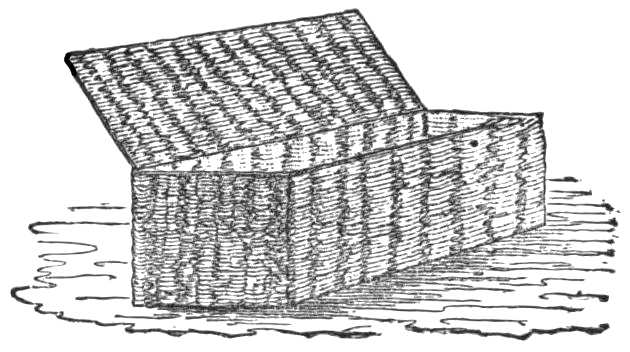
Fig. 13.
The accompanying diagrams will render the arrangement of the trick extremely easy to comprehend.
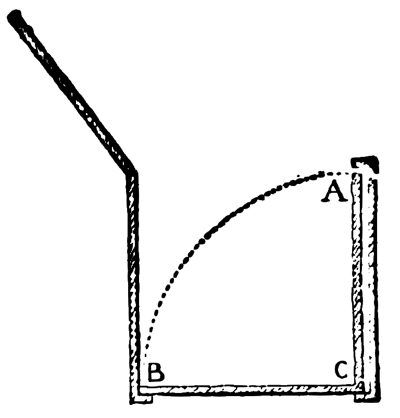
Fig. 14.
Fig. 13 represents the basket open ready to admit the child. Fig. 14 is a sectional view of the same.[35]
The reader will perceive, indicated by the letters A B, a double bottom working on a pivot at C. This movable bottom is more completely shown in Fig. 15, but it has there changed its position, as we shall proceed to explain.
In order to cause the disappearance of the child, you turn over the basket with its top towards the spectators. But the bottom A and the portion B, which is fixed thereto, take no part in such movement. The weight of the child, pressing on the bottom A, compels it to remain at rest, and thereby the part B is made to fill the space which would otherwise be left in the basket, following the dotted line in Fig. 14.[36]
In order to be able to thrust the sword through the basket without any risk of injury to the boy, the magician proceeds according to a particular routine and with certain appropriate precautions; there are marks made on the basket to show where the sword is to be thrust, and to still further guard against mistake it is agreed that the sword shall be thrust in, in the first instance, only a very little way, and that when it has once penetrated, the boy shall himself direct it in such manner as to avoid being hurt by it. The basket is made large enough to allow of the child withdrawing himself towards the one or the other end at pleasure.
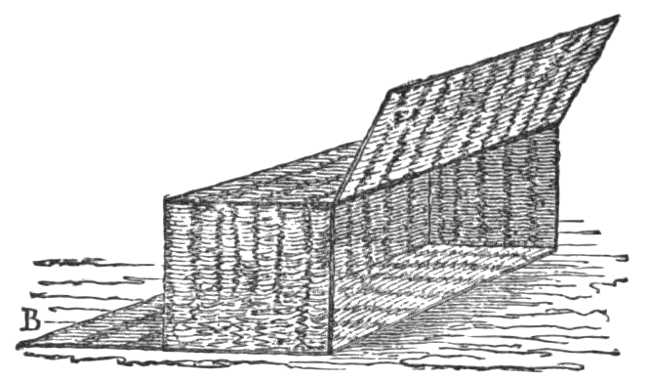
Fig. 15.
We have yet to explain how it happens that the performer is enabled to exhibit the child in a private box, although he still remains safely ensconced in the basket. To do this, the assistance of two children is required, who must be alike in stature, dress, and arrangement of the hair. One of these children is brought forward by the magician, who on some pretext or another (this depends upon the particular mise en scène adopted by the performer) states that he is about to shut him up in the basket, but in order that he may be the less nervous in his narrow prison, he ties a broad bandage across his eyes. The child, alarmed notwithstanding at the preparations made, runs away from the conjuror, but is caught again by his executioner just as he is darting through a side door on the stage, and is forced remorselessly into the basket.
The object of this little comedy is to effect a substitution of the one child for the other. The “twin” child, with eyes bandaged in the same manner as the other, stands close to the door in the side-scene, and takes the place of the original victim, while the latter makes his way to the private box, in which he is afterwards to appear. The new comer, who is naturally taken to be the same child who a moment before ran away, is shut up in the basket, and goes through the performance we have above described; and afterwards, when he has been made to disappear behind the false bottom of the basket, his comrade, whose face, having been seen uncovered, is at once recognized, appears in the box and waves his childish greetings to the company.