Chapter II · A CONJUROR’S STAGE ARRANGEMENTS.
Professor Hoffmann translation
The furniture of a conjuror’s stage is not merely designed to please the eye of the spectator, but serves, in addition, to facilitate the execution of many of his marvels. The tables, in particular, have important duties to discharge, for by their aid is generally effected the appearance or disappearance of articles too bulky to be concealed in the hands or the pockets of the performer.
The conjurors of the old school[10] derived great assistance in this particular even from the ornamentation of their tables. These were covered with richly-embroidered cloths, extending downwards to the floor, as shown in the accompanying figure (Fig. 2).
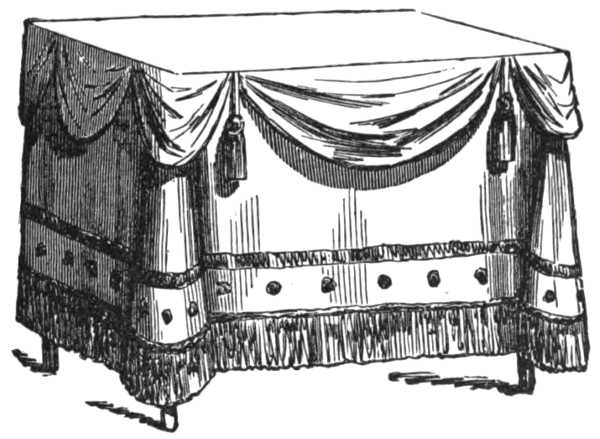
Fig. 2.
It was not uncommon to see four or five of these tables on the stage, and sometimes even more. In order to mislead the spectator as to their real purpose, they were loaded with candlesticks and other articles, ostensibly intended to be used for the purposes of the performance.
In the background, the principal object, extending quite from side to side, was a kind of sideboard composed of several stages, one above the other, also loaded with pieces of apparatus made of polished brass, which, however, generally speaking, had no connection whatever with conjuring.
This miscellaneous but showy collection was rendered still more dazzling by a considerable number of lamps and wax candles.[11] This gorgeous exhibition, which the conjuror of that day denominated pallas,[12] was simply intended, to use a homely phrase, to throw dust in the eyes of the spectators.
When, in the year 1844, I undertook the erection of my own theatre, I made very considerable alterations in my stage arrangements, as compared with those of my predecessors. The most important was the suppression of the long table-covers, under which the public always suspected, and not without reason, the presence of an assistant to facilitate the execution of the tricks performed. For these bulky “confederate-boxes,” I substituted gilt tables and consoles in the Louis XV. style, of which I subjoin a specimen (Fig. 3).
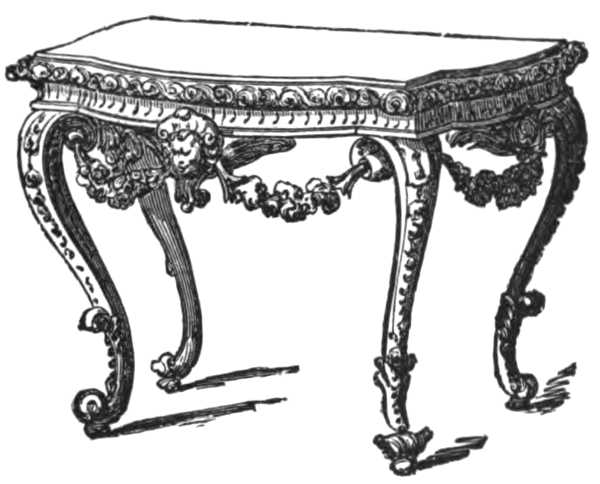
Fig. 3.
The number of these latter was very limited: a centre table (that represented by the figure), two side consoles, and two small light guéridons. At the back a broad shelf in the same style, on which were arranged the pieces of apparatus intended to be used in my performance.[13] Those enormous metal covers, polished or japanned, under which articles to be vanished had hitherto been put, were no longer to be seen. I had replaced them with covers of glass, opaque or transparent, as the case might be. Boxes with false bottoms, and all apparatus of polished brass or tin, were completely banished from my stage.
The decoration of my miniature drawing-room was of white and gold. The visible lighting arrangements consisted simply of four girandoles, and two small candelabra of crystal, placed on my centre table. But in order that my audience might have a perfect view of the smallest details of my experiments, I had fitted my stage with special appliances, which gave a sufficiency of light without hurting the eyes of the spectators. For this purpose, I had fixed just behind the proscenium-border[14] a gas string-light,[15] with a reflector, which brightly illuminated my centre table and my two consoles, the only spots at which my feats of magic were executed.
The reforms which I had introduced in the form and ornamentation of the “tables” did not by any means render them less valuable than their predecessors for conjuring purposes, as the reader may judge by the following details:—
As I have already stated, there were on my stage but three tables—one in the centre and two at the sides; these last, which were in the form of consoles, were fixed to the panelling of the side-scene. I had also two little guéridons,[16] of the lightest possible description, which I brought forward, as occasion demanded, to the front of the stage, for any experiment which required close proximity to the spectators.
The majority of my tricks were performed at my centre table. The only specialities of this table were a servante, with its gibecière, and a set of “pistons.” I have already described in a preceding work, and illustrated by a diagram[17] the arrangement and utility of the servante. It is a shelf (behind the table on the side farthest away from the spectators) on which are placed the articles destined to be produced in the course of the performance. In the middle is placed a small square box (the gibecière) made of cloth padded with wadding, and quilted so as to give it a certain degree of stiffness. Its use is to receive noiselessly any article dropped therein.[18]
The set of pistons, which is fitted to the under surface of the table, serves to work the automata and mechanical pieces exhibited to the spectators. These automata being supposed to obey the word of command, it is necessary that their mechanical intelligence should be guided by an assistant, and this result is obtained by the use of pistons.
A piston is a group of three steel rods; two of them are fixed, and form what in mechanical parlance is termed a cage, the third is movable, and may be made, by pulling the string attached to it, to rise above the other two. A spring placed beneath, serves to bring the rod down again as soon as the string is released.
When several of these pistons are placed side by side in a straight line, they form what is known as a set of pistons. Supposing that, as in the case of my own table, the set is composed of ten pistons; the ten cords will travel right and left (over pulleys) down the legs of the table, and passing under the floor of the stage, will terminate at a “key-board,” to which they are attached in the same order which they occupy in the table.
When the piston-rods rise above the surface of the table, they come in contact with corresponding pedals in the base of the mechanical piece; which pedals move, as the case may be, the arm, the head, or any other part of the automaton, or whatever the apparatus may be.
The side tables, or consoles, fixed to the panels of the side-scene are furnished with various traps, specially adapted for different tricks. An opening made in the side-scene, immediately behind the console, enables the assistant to introduce his arm for the performance of whatever duty may devolve upon him. The under surface of the consoles forms a closed case, so that articles passed through the traps cannot fall on the floor. This case, which is about seven inches deep, is concealed by the ornamental work of the table, and the gold fringe which surrounds its edges.
Besides these tables, which are intended for the general requirements of the performance, there are others specially designed for some one special trick, and which are placed on the stage as they happen to be needed. We may instance that which serves to vanish a human being, and which we shall describe later on, when we come to deal with the trick in question.[19]
The conjuror’s servant fills on the stage a like office to that which is discharged by the assistant of a lecturer on chemistry or natural science; it is his duty to provide the operator with all that is needed for the performance of his experiments, and not unfrequently he gives his personal assistance, unknown to the spectators, in aid of some particular trick. The costume of the servant is a matter of taste, but he should be of smaller stature than the conjuror, so as not to draw too much attention to himself; a young lad answers the purpose very well. I used to be assisted on the stage by one of my sons, who wore the dress which the fashion of the day rendered appropriate to his age, who at that time (in 1844) was thirteen.
There is a second servant, of whose existence the spectators know nothing. This is the alter ego of the conjuror, the invisible hand which really effects sundry appearances, disappearances, and substitutions, of which magic has the credit. This servant remains behind the scenes, eye and ear constantly on the alert; and at certain moments, duly arranged beforehand, he lends a hand in ready aid of the skill and the “patter” of the principal performer. The due discharge of this office demands great dexterity, constant watchfulness, and, above all, instant readiness in execution. Women perform this duty to perfection.