Chapter XIII · THE FEATS OF THE DAVENPORT BROTHERS.
Professor Hoffmann translation
In the month of September, 1865, two Americans, Ira and William Davenport, landed in France for the purpose of giving a series of marvellous performances, under the title of Spiritualistic Manifestations. They came direct from England, where for a period of two years they had enjoyed an extraordinary run of popularity. The press of the United Kingdom had taken a lively interest in their mysterious evolutions, and the fame of the discussions they had excited had even spread to France.
The arrival of these wonder-workers assumed the importance of a political event. The Moniteur du Soir, the official paper, announced their appearance in its issues of the 6th and 8th September, and all the organs of the press vied with each other which should be first to repeat the interesting intelligence.
Before they reached Paris, the brothers Davenport had made a short stay at the Château de Gennevilliers, whose owner, a fervent believer in spiritualism, regarded the visit of the illustrious travellers as a special privilege. It was under this hospitable roof that, by way of experiment, the first exhibition of the Spiritualistic Manifestations took place. A select party of journalists and other literary men were invited, and were fully agreed as to the marvellous and inexplicable character of the phenomena they had witnessed.
The American mediums could not speak a word of French, and were therefore obliged to avail themselves of the services of an interpreter, who was at the same time their impresario, or, so to speak, their “Barnum.” They had been recommended to apply to M. Derosne, a literary man residing at Passy, and to whom we are indebted for excellent translations of sundry English works. This gentleman accepted the proffered position, and by way of introducing his protégés, he arranged that they should give, in his own drawing-room, specimen séances before certain chosen spectators, whose good opinion might be expected to have a powerful influence on the future success of the performances which they intended to give in the capital. Immense posters, in the American style, were placarded about Paris, announcing in enormous characters that the first séance of the Brothers Davenport would take place on the 12th September, at the Salle Herz. The performance, which was divided into two parts, consisted of (1) the “Cabinet” performances, and (2) the “Dark Séance.” The price of admission was fixed at 25 francs for the entire exhibition, or 10 francs for those who witnessed the first part only.
At such prices, what a rich harvest in prospect! Unfortunately, the bright anticipations of the two brothers as to their future success in the capital were doomed to disappointment; the friendly reception which they had met with at their preliminary séances was the only substantial satisfaction which they were destined to receive from the nation which is at once the most intelligent and the most sceptical of the civilized globe. A cloud, quite unexpected by themselves, was gathering over spiritualism in general, and over their own performances in particular; and this cloud became more and more threatening as the day of the first public performance drew near. The friendly criticisms of some of the papers had been succeeded by a host of energetic protests against an exhibition which was regarded, not without reason, as dangerous to the mental health of the public, and particularly to those weaker intellects which are always ready enough to accept as gospel the tricks and artifices of the adepts of sham witchcraft.
The following passage, extracted from an article in the paper called the Opinion Nationale (of the 10th of September, 1865,) will give some idea of the state of excitement of the Parisian press on the subject of the American mediums. This article appeared just two days before the first public performance of the Brothers Davenport.
“These estimable Americans reach our shores preceded by a reputation of a kind to crush all opposition. Their gospel has appeared before them. It consists of a volume of three hundred pages, in which Mr. Nichols, the author of the work in question, assures us that the Brothers Davenport have from their earliest youth possessed the faculty of becoming lighter than air; and that on various occasions they have been wafted to the ceiling, and floated over the heads of those present. If I venture to cast a doubt on the testimony of Mr. Nichols to this effect, it is not merely because the assertion is absurd in itself, but because it is distinctly insulting to the Brothers Davenport. What, gentlemen, do you allow it to be put forth that you have flown without wings in a drawing-room, while it is at the same time stated that you can do so no longer? You had then once a power which is now exhausted, a virtue which is gone out of you? Must we conclude that you were undeserving of your ghostly familiars, that you have no longer over your aërial bearers the same authority as of yore, that at the age of twenty-five or twenty-three you are already played out; that you proceed from the greater marvel to the less, and that in the land of Nicolet?[44] Do you come and show us mere stock marvels, after having in America worked miracles which a God might envy? Do you take Paris for one of those twopenny-half-penny country villages whither used-up, unappreciated, and out-of-date performers come and try to scrape up some scanty remnant of success?
“Is it not passing strange that in the year 1865,—when the whole of the human race is pressing with rapid strides in the direction of progress, when the spirit of positivism is abroad on all sides, and when every branch of science, freed from the burden of the old nonsensical beliefs, is stepping resolutely forward to the goal of truth,—an attempt should be made to revive these supernatural tomfooleries?
“And if the time is inaptly chosen, the selection of the instruments is scarcely less absurd. What! here are two favoured mortals who have subdued the powers of the unseen world; spirits minister to their behests; they have at their command an army of beings unknown, indeed, but, in any case, of higher power than man; and by the aid of these supernatural powers, they actually—do what? Play the fiddle in a cupboard! Verily, demigods have become singularly unassuming in these days.
“These gentlemen appear to have travelled from America to France in order to show us phenomena. This is the word they themselves use, and they take care to add that ‘these phenomena have been attested by the most celebrated men of science in England and America.’ Their gospel is entitled, ‘The phenomena of the Davenport Brothers.’ Phenomena be it, then; the word is familiar in the language of science, and equally so in that of the country fair. The fair of Saverne does not begin till Sunday next, but the market-place is crammed with ‘phenomena’ already. There are even living phenomena, every one ‘attested’ by the Emperor of China and the Sultan of Morocco, and none the prouder even for that!
“But to return to your ‘phenomena,’ since you really possess phenomena, and appear desirous of finding a market for them. Are you not aware that ‘phenomena’ are nothing of themselves? It is necessary to refer them to some law, known or unknown, new or old; they have no interest for persons of sense, save in so far as they prove something. What do you profess to prove? What conclusion do you draw from your trumpery racket in the dark? What new contribution do you bring to science? Come, deal openly with us; new ideas have no terrors for us. Indeed, they alarm us so little that it is quite needless now-a-days to enforce them by miracles. A good sound truth makes its own way in the world, without any accompaniment of luminous guitars or phosphorescent fiddles.
(Signed)
“Edmond About.”
So judicious a criticism, and the stern and uncompromising logic of so celebrated a writer, of necessity dealt a heavy blow to the credit of the American mediums, and shook the faith even of the firmest believers in the occult sciences. The mediumistic powers of the two brothers, their spiritualistic “evocations” and “manifestations” stood thenceforth condemned. To any rational man, the Brothers Davenport were mere performers of juggling tricks. Nevertheless, public curiosity had for some time past been so keenly excited, that every one wished to see the men who had been so much talked about; and the miracles, true or false, which had been the subject of such lively controversy. The day of the first performance was looked for with impatience, and the public rushed in crowds to be present at it.
In consequence of my great distance from the metropolis, I could not manage to be present at this memorable performance; and I am therefore obliged to borrow my account of it from M. Henri de Pène, reserving to myself the privilege of afterwards giving an exact description of the remarkable performances in question, as I myself saw them exhibited before an orderly and favourably-disposed audience.
The following are the terms in which the witty chronicler of the Gazette des Etrangers relates, under the title of the “Attack on the Davenport Brothers at the Salle Herz,” the tragi-comical incidents of the evening of the 14th of September:—
“The first performance of the two Brothers before a paying public took place, as had been previously announced, on Tuesday evening. The hall was lighted up, and every seat was filled. But the performance was lost in a tumult worthy of a meeting of infuriated shareholders. There was a great deal of noise and a good deal of spite displayed. The dark séance, the more interesting of the two, and poetically entitled, ‘an hour of darkness,’ and which was only to be witnessed by a small number of spectators at a high price, never took place at all.
“The first portion, alone, of the so-called ‘public’ séance, to be seen at comparatively low prices, raised such a tumult, that after about three-quarters of an hour’s row, the spectators had to be cleared out of the hall with the police at their backs. It should be mentioned, by the way, that the money was honestly returned at the doors; indeed, we are informed that more money was paid out of the treasury than had actually been paid into it.
“The poor Davenports! I saw them face to face; I spoke to them; I examined their cabinet, their famous ropes, the tambourine, the bells, the guitars, in a word, all the elements of that miraculous symphony which is said to be their strong point. I was called by the universal suffrage of the audience to the perilous honour of going upon the platform to inspect the operations,—to tie, to untie, and do all that might concern my office of inspector.
“Can I venture to say that there was a cabal against the Brothers even before the commencement of the performance? It may have been so, but I should hesitate to assert it as a fact. The worst enemies of the Davenports, at the performance in question, were themselves. Do not let me be misunderstood: I regard them as very clever fellows, inasmuch as, in the presence of other credible witnesses and myself, they, more than once, by the aid of some agency, whether of this world or the other, did some really marvellous things. Their reputation and their personal merits as conjurors, mediums, or wizards, whichever you may please to call them, remain still unaffected in my eyes. But they have not the most elementary notion of the temper of a Parisian audience; and to judge from the style in which the mise en scène of their miracles (!) was arranged, one would think that they had never come out of their cupboard.
“It was at once obvious that they had to deal with a mistrustful and keenly watchful audience, who should have been attacked with energy, with a light steady hand, as when a skilful rider ‘lifts’ a horse which hesitates at a leap. If the rider hesitates as well as the horse, he is lost. The performance was opened by a speech from an interpreter, whose intention was excellent, and whose wish to conciliate was evident, but who was also excessively nervous. What he said was, in effect, as follows: ‘Gentlemen, the Brothers Davenport, who have for ten years past enjoyed an extraordinary reputation in America and in England, have not the advantage of being able to speak your language. I am commissioned, therefore, on their behalf to assure you that they do not desire, in any way, to induce the public to believe that they have dealings with spirits. They introduce themselves to you neither as wizards nor as conjurors; they propose simply to enable you to witness phenomena, of the causes of which they themselves are ignorant, leaving you alone to judge of the effects which will be produced.’
“Such a platform seemed fair enough, and was well received. Unfortunately, the interpreter, presuming too far on the friendly encouragement which was vouchsafed to him, continued to speak, and drifted into long and tedious explanations, which at last exhausted the patience of the audience. The Davenports were loudly called for. They came forward, and the tumult ceased.
“At last, then, the performance is about to commence. Not so fast! The performers are actually on the stage, the three doors of the cabinet stand wide open to receive them, but their ignorance of the French language, their desire—real or assumed—for substantial tests, the eagerness with which they unresistingly accept the most minute examination, the obstinacy with which they compel the representative of the general incredulity (alas! I was that unhappy person) to poke his nose everywhere,—all these produce delays, and more delays. It would be almost better to be cheated, if only one was cheated a little quicker. The spectators begin to groan, to sing, to hiss, to laugh aloud, to yell, and finally to lose their temper.
“During this critical period we discharge the duties with which we have been entrusted. We verify, we measure, we handle everything; and finally, after examining the ropes which are provided for our use, we tie, as best we may, the two Brothers to the seats of their cabinet. The audience, in answer to an inquiry from the interpreter, reply by acclamation that they are satisfied with our exertions. But a gentleman with fair hair, whom I have since heard to be an engineer, rises, and says, ‘The gentlemen are honestly tied up, but the method of tying is weak; I will tie them myself in such a manner that they cannot possibly get loose.’ He ties them accordingly, and returns to his seat with a triumphant air. The doors of the cabinet close upon the two Brothers, who, after a few minutes’ interval, appear, released from their bonds. The audience applaud. The Davenports had therefore succeeded in what I will call, provisionally, their ‘rope trick,’ when the fair-haired gentleman, burning to avenge his defeat, leaps impetuously on the platform, and shouts, ‘They are making fools of us; it is a shameful hoax: the planks on which these gentlemen are seated are hinged, and so enable them to get loose.’ So saying he deals a vigorous blow on the plank in question, which breaks with a loud noise, and, as happens when anyone pulls away the chair on which one is seated, one of the Brothers Davenport naturally comes to the ground. Everyone is on his feet in a moment, the storm spreads throughout the assembly; everyone leaves his seat and goes to examine for himself. Everybody is on the platform at once. People talk to total strangers, just as happens in a political disturbance. M. Herz begins to tremble for the safety of his hall.
“At this point the constables make a sharp and energetic entry, and the performance comes to an end by the peremptory order of the commissary of police.
“Even at the late hour at which I write these lines (Tuesday, midnight) the Boulevards are still in a high state of excitement, and nothing is spoken of but the Davenports. They will be quoted as ‘gone down’ on the Stock Exchange to-morrow. The opinion which appears to me to be most general is that they have been condemned with a sort of coarse ferocity and without a fair trial. In truth, the very worst of all hateful things, to my own mind, is violence. It disgraces the fairest cause, and would prejudice us even against law and order themselves, were we to find it enrolled under the same flag. I am ready to suppose that the Davenports are clumsy impostors; but it is none the less true that, in their Waterloo at Salle Herz, the public has treated them with brutality, and therefore, in my eyes, the public has placed itself in the wrong, even though it may be right in the opinion it has formed.”
If they formed their opinion on the reception they had just met with, the Brothers Davenport must have had a queer impression of French hospitality. Many persons, in their place, would have been completely disheartened at such a reception, and would have then and there abandoned their enterprise. But they were determined to have a return match with their impulsive antagonist, whom they regarded, with some reason, as the principal cause of their unfortunate misadventure. The very next day, they invited several of the leaders of the press to come and examine their cabinet, which was then in course of repair. They showed readily enough that the mechanical arrangements referred to by their antagonist only existed in his own imagination, and that the hinges and movable portions of the piece of furniture in question had no other object save that of folding-up for convenience of packing.
The triumph of the fiery engineer was therefore of short duration. He might have read in several papers (the Epoque, the Temps, and the Patrie) of the very same day, a special article as follows:—
“M. D——, who was persuaded that he had discovered the trick, and who had induced us, up to last evening, to share his conviction, was clearly mistaken.
“The movable wooden cross-piece is not, in any sense, the deus ex machinâ of the apparatus. In fact, this cross-piece is now attached to the upright portion of the cabinet by very substantial screws. The whole affair is made of very slight boards, in whose thickness it would be absolutely impossible to insert any mechanism, even of the smallest dimensions. Neither above, below, or on either side, have we discovered anything in the slightest degree suspicious. In vain have we examined everything, sounded walls, taken up carpets, turned chairs upside down; we are constrained to admit that if there is any mechanism employed, it is utterly and absolutely invisible.”
Emboldened by this declaration, the Davenports inserted in all the newspapers a letter in which, after protesting against the violence to which they had been subjected, they announced their intention to continue their performances. The following is an extract therefrom:—
“M. D——, the engineer who, after having taken the platform by assault, cried out, ‘We are the dupes of a shameful hoax,’—in order to justify his exclamation, forcibly tore away an innocent stretcher, which supported the seat on which one of us was seated in bonds. The stretcher in question is of solid oak, contains no spring or other mechanical device; and was only moved from its place by being broken to pieces. We challenge M. D—— to come forward and himself verify the truth of our statement, and like an honourable man, to admit that he was mistaken.
“Our cabinet may be examined by any one who pleases; it contains no appliance of any kind which can facilitate the phenomena which take place in it. Further, if any one chooses to supply us with a cabinet of the same form and dimensions as our own, constructed wholly without our intervention, he can prove for himself that the séance of September 12 was but a series of premeditatedly hostile demonstrations. We should at once have bowed to a judgment delivered in a calm and equitable spirit; but we protest, with all our strength and with just indignation, against the abuse and the brutality of which, for some time past, we have been the victims; and we appeal in all honesty from the judgment of an excited and partial mob to the deliberate and fair examination of disinterested persons; nay, even persons who start with a prejudice against us. With this view, we shall continue to give our séances in the Salle Herz, not entertaining for a moment any doubt as to the ultimate result of our appearance in public.”
The Davenport Brothers gave, in fact, a series of séances, which they had the good sense to exhibit in a room of smaller dimensions than the concert hall, and consequently better adapted for an exhibition of this kind. These performances passed off with comparative quietness. Every now and then there was a slight skirmish, or a passage of words, but they never degenerated into downright disorder. More frequently they assumed a comic character, leaving the laughers sometimes on the one side, sometimes on the other.
I myself was present on more than one occasion at these performances, and I derived therefrom the same amusement as I should have done in witnessing well-executed conjuring tricks; for I knew exactly how much to believe as to the nature of the “spiritualistic” manifestations of the two Brothers, and I often enjoyed a laugh at the calm assurance with which they played the part of passive instruments of the spirits of another world. To put it plainly, the Davenports were simply clever conjurors, who, in order to give greater prestige to their performances, thought fit to ascribe the effects of mere sleight-of-hand to the supernatural intervention of spirits. From a purely business point of view they were unquestionably wise, inasmuch as, up to the time of their misadventure at the Salle Herz, their receipts had been enormous. It was not, in truth, either rope tricks or dancing guitars that the public went to see: they attended “spiritualistic manifestations” in order to witness supernatural and inexplicable phenomena, and this alone induced them to pay so high an amount as twenty-five francs for admission. All said and done, the performances of the American Brothers were extremely interesting; and the mise en scène was calculated to make a great impression. In order to give the reader some idea of the performance, I will describe it in detail; noting, at the same time, the impression which, to my own knowledge, it produced on the spectators. After having duly described these very surprising effects, I propose, in the next place, to give full explanations of the manner in which they were produced.
THE PERFORMANCE OF THE BROTHERS DAVENPORT.
Part I.—The Cabinet.—We are in one of the smaller rooms belonging to the Salle Herz, in the Rue de la Victoire, a room which may accommodate some sixty persons. The apartment is divided by a railing of a little more than a yard high into two equal portions. On the one side of this division are the seats allotted to the spectators, and on the other the cabinet which is intended to be used for the performance. This piece of furniture, which is of the slightest possible construction, rests on trestles, and is of such a size as just to contain three persons, seated or standing. To the sides of the cabinet, on the inside, are hung divers musical instruments, such as violin, guitar, trumpet, tambourine, and bell. Three doors, to be closed as occasion may require, serve to screen the mediums from the public view.
Before the commencement of the performance, several of the spectators are invited to come within the railed-off portion of the room, and to place themselves in a circle round the cabinet, so as to bar all communication from without.
The first point is the binding of the two Americans. All present agree in selecting, for the performance of this delicate task, a veteran naval officer, who is expert in knots of every description, and in whose skill every one appears to have the utmost possible confidence.
The ropes which are intended to be used are first tendered for examination. We search the two young men as if we were representatives of the police force; and having taken every possible precaution against any trick or artifice, we turn our attention to the actual tying.
The Americans step into the cabinet, and place themselves on the seats to which they are to be tied. Our naval representative takes a cord, marks it to make sure that there is no substitution; he takes note of its precise length; and then, by means of regular “sailor’s knots,” hitherto reputed invincible, he ties up, first one brother, then the other. He pinions their arms to their sides, ties their legs firmly together; in fact, he so ties and lashes them to their seats and to the cross rails, that every one regards the defeat of the Americans as a foregone conclusion; they must, beyond a doubt, be driven to cry for quarter.
We have stated that the cabinet has three doors. In the middle is cut, at about the height of a man’s head, a lozenge-shaped aperture. The side-doors are first closed, simultaneously, and lastly the centre door, but, mirabile dictu, scarcely has this last been closed, than we see appear, at the opening above mentioned, the arms of the right-hand prisoner, still rosy with the friction of the famous “sailor’s knot.” The surprise, the astonishment, nay, the stupefaction of the spectators are beyond description: they hesitate to believe the testimony of their own eyes; they furtively glance around, each seeking to confirm his own impressions by those of his neighbour, but all are in the same condition of bewilderment, and equally unable to afford the slightest guidance. Finally, they give up the riddle as hopeless, and render to the performers a well-earned tribute of applause.
A little later, and the three doors are opened. We see the two brothers, with smiling countenances, step down from the cabinet freed from their bonds, which they now carry in their hands. More than ten minutes had been occupied in tying them up; a single minute had sufficed for their release.
This first feat concluded, the young men again step into the cabinet, and take their seats. The cords are laid in a heap at their feet, and the doors are closed. Two minutes later, the doors are opened, and we find the mediums again in bondage. They have tied themselves up in the darkness, and their hands are found firmly secured behind their backs. The tying is examined, and is declared to be as secure as on the first occasion. It should here be repeated that, during the whole of the séance, sundry spectators keep constant watch on all sides of the cabinet; that this latter is raised on trestles; and that the hall is kept sufficiently light to enable any one to see without difficulty.
Now, however, still more astonishing phenomena are about to take place. The doors are put to with the utmost possible quickness, but scarcely is the last one closed than a concerto of the most eccentric character becomes audible; the violin strikes up under the touch of a vigorously handled bow, the guitar is thrummed, the tambourine marks time, the bell rings, the horn is vigorously blown, the whole forming a discord of the most awful description. Occasionally a variety of other noises, knocks, and heavy blows is added to the infernal concert. Suddenly, there is a dead silence, and an arm, bare to the shoulder, is seen to pass through the hole in the door, ringing the bell with frantic energy.
At the very moment when the noise is most deafening, if the doors of the cabinet are suddenly opened, the musical instruments are seen in the place they originally occupied, and the two Brothers are motionless on their seats, and tied up as before. As soon as the doors are closed, the hullabaloo begins again; but each time that the doors are opened, the mediums are found, calm, motionless, and still firmly tied. I have forgotten to mention that at each of the “spiritualistic manifestations” the horn and the bell are flung through the opening in the door, and fall at the feet of the spectators.
By way of check upon these tricksy sprites, it is requested that some one of the company, to be selected by the audience, will take a seat in the cabinet between the two Brothers. A representative is selected accordingly; he places himself on the seat in the centre, and in order to ensure his giving no assistance to the mediums, one of his hands is tied to the shoulder of one of the Brothers, and his other hand upon the knee of the other brother. This arrangement further ensures that there can be no movement on the part of the mediums without the knowledge of the person thus chosen. As soon as the doors are closed, however, the witches’ sabbath is again heard in the cabinet, the various musical instruments appearing to vie with each other, which shall make the most noise. An instant, and the hubbub ceases; the doors are opened, and the unlucky visitor is seen with his head wrapped in his own pocket-handkerchief, with the tambourine by way of head-dress, while his cravat is neatly tied round the neck of his right-hand neighbour, and his spectacles are on the nose of his left-hand neighbour, and his watch, even, is found to have travelled from one pocket to another. The representative of the public is freed from his encumbrances, and is instantly surrounded and cross-questioned. He declares that all he felt was a slight tickling of the nose, when, at the self-same moment, he was covered with his pocket-handkerchief and robbed of his spectacles, and can give no other explanation. Meanwhile, the wrists of the mediums are still found firmly tied behind their backs. Flour is produced, and a little is put, with a spoon, into each hand of the mediums. No sooner is the door closed than the coat of one of the prisoners is passed through the aperture. The doors are instantly opened, the knots are examined, the doors again closed, and scarcely two minutes elapse before the two Brothers step out of the cabinet entirely freed from their bonds; they come forward to the spectators, and show that their hands are still full of the flour which had been placed therein. It should be stated that the young men are dressed in black, and that not the slightest trace of flour is to be seen on their garments.
Part II.—The Dark Séance.—The scenic arrangements of this exhibition are of the simplest possible character. The cabinet and its trestles are removed and put on one side, and are replaced by a small table, on which are placed two guitars and a tambourine, which we have already seen employed in the first part of the performance.
These preparations, which are very deliberately made, have given the two Brothers time to take a little rest in an adjoining room. They speedily return, and seat themselves on two slightly made chairs, one on each side of the table. Each places at his feet a coil of rope.
At their request, made through their interpreter, some fourteen or fifteen members of the audience come and take seats near the Americans, and, joining hands, form an impenetrable circle round them. Two gas-jets, one on each side of the enclosed portion of the hall, are alone lighted. A person is posted beside each of these burners, to turn the light up or down as may be required.
At a signal given by one of the two Brothers, the room is placed in complete darkness for a space of about two minutes. A solemn silence prevails throughout the assembly; so much are all present impressed by the weird singularity of the scene. The privileged spectators who form the protective circle are so close to the mediums, that the least movement on the part of the latter, the slightest rustle of their garments, would be distinctly audible. Each lends an attentive ear, and seeks to catch the slightest sound of a suspicious character; but, in the very midst of this strained attention, the light is suddenly turned up, and the two Americans are seen securely tied; their legs, arms, and bodies are alike covered with a network of cords binding them to the chairs on which they are seated; their wrists are pinioned behind their backs, and lashed to the “stretchers” of the chairs. The chairs are likewise firmly tied to the table. Spectators gather round, they examine the various knots, and are constrained to admit that they are honestly tied.
Again we are placed in darkness, and instantly the musical instruments placed on the table are heard in mysterious harmony. Suddenly, the gas is turned up, and, simultaneously with the appearance of the light, the concert ceases. The instruments show no sign of having moved from their places, and the mediums are tied up as before.
The spectators begin to experience an indescribable sensation of “all-over-ishness.” There is very little applause: a performance of this kind is not calculated to produce a feeling of exaltation. On the contrary, it rather tends to make one feel a kind of nervous depression. True believers regard the phenomena in question as the genuine work of spirits; and even the incredulous and the sceptical are forced to admit that these pretended supernatural manifestations are, to say the least, remarkably well executed. As yet, moreover, we have by no means arrived at the most remarkable phenomena of this mysterious performance.
In order to afford the company absolute certainty that the ligatures are not unfastened, one of the spectators who happens to be nearest is asked to apply some melted sealing-wax to the knots which bind the wrists, and to impress a seal thereon. Meanwhile, the guitars and the tambourine are smeared with a phosphorescent liquid which renders them distinguishable in the dark.
The moment that the room is again placed in darkness, the guitars and the tambourine begin to move, and leave the places they occupy, at the same time producing the most lugubrious sounds. They are seen to rise in the air, and to move about in luminous curves; then, to take an erratic course, and wander about the hall, flitting just over the heads of the spectators. One guitar just ruffles this gentleman’s hair, another brushes against that gentleman’s coat; and yet, though frequently moving in an abrupt and jerky manner, neither of the instruments comes in actual contact with either the spectators or the ceiling; at most, as they pass close to your face, you feel a sudden draught, a puff of wind which causes you instinctively to draw your head back, for fear of receiving a blow. The situation is rather painful than pleasant. One experiences a sort of indefinable feeling of dread, which for the time being paralyses the reflective faculties.
In the middle of these eccentric evolutions the lights are turned up, and the instruments are found resting on the laps of the spectators. The seals on the knots are examined, and are found to be unbroken.
A further precaution is now taken to guarantee the spectators against any trickery, if they still entertain a doubt on the subject. A sheet of paper is placed under the feet of each of the mediums, and the outline of his boots is traced with a pencil thereon. If by some mysterious means they manage to get free from their bonds, and to leave their seats, this sheet of paper will betray them. If it has shifted but a quarter of an inch, trickery stands confessed. The public appear to put complete faith in this test. In addition, a spectator is requested to take off his coat or overcoat, and to lay it across his knees.
These arrangements being completed, the gas is extinguished, and during some few minutes of darkness, the guitars again strike up their unearthly music, and recommence their eccentric movements. But, even while these musical will-o’-the-wisps are still hovering in space, one spectator finds himself suddenly deprived of his hat, which is wafted several yards away; another has his hair dishevelled by mysterious fingers; a third feels his hand shaken by an invisible hand; the coat, above referred to, is whisked away from its owner, while another spectator finds on his lap some indistinguishable garment-like object. When the gas is re-lighted, the two Brothers are seen perfectly composed, still bound, and apparently quite innocent of any concern with what has just taken place. A rush is made to examine the seals, they are found intact; the sheet of paper is inspected, the sole has not shifted by a hair’s-breadth from the outline traced around it. But the fact which puts a climax to the general astonishment is, that one of the Brothers, though still tied up and the knots sealed, is wearing the spectator’s missing coat, while the other has a hat on his head and a pair of spectacles on his nose. These three articles belong to three different spectators. The medium’s own coat is found in the hall on the lap of one of the spectators.
At this stage of the proceedings, the astonishment, indeed, one might say the stupefaction, the bewilderment of the audience reaches its utmost limit; spiritualistic manifestation or imposture, supernatural phenomenon or mere conjuring tricks, the performance is perfect of its kind. Putting aside for the moment reflection or investigation, we simply make up our minds to pay the performers a well-earned tribute of applause.
Explanation of the Artifices whereby the pretended Spiritualistic Manifestations and the “Inexplicable” Phenomena of the Brothers Davenport are produced.
Ordinary conjurors, as a rule, use special apparatus to facilitate the execution of their marvels. The Davenports have, strictly speaking, nothing but their “ropes.” The cabinet lends no assistance whatever in the actual execution of the tricks. An ordinary screen and a couple of chairs might, on emergency, be used in its stead. It serves, in truth, simply to cover the manipulations of the mediums. The musical instruments may be considered as mere accessories.
The ropes used are of a cotton fibre; their make is the same as that of the cords which are used to draw curtains backwards and forwards, and they present therefore smooth surfaces, adapted to slip easily one upon another. In length they are about ten feet each.
When, at the outset of the performance, a certain number of spectators are invited to step upon the platform, and to surround the cabinet, they are requested to join hands, under the pretext of establishing a magnetic circle round the mediums. In reality, the object is to preclude the possibility of individual attempts to solve the mystery. For the same reason, the spectators in the front row are required to join hands in like manner.
The two Brothers place themselves on the seats of the cabinet, and each hands three ropes to the person selected to secure him to his seat. At first sight it may be imagined that this is a very easy matter, but in truth it is quite the reverse. To begin with, upon what system will you proceed, and where will you commence? You have in all probability never before had occasion to bind a prisoner. Sometimes the person appointed is of an easy-going disposition; he thinks less of creating difficulties for his victim than of getting his task well over: he ties his man up “anyhow,” so to speak. In such case everything is in favour of the success of the trick. But very often, on the other hand, the medium has to do with a keen and vigorous antagonist, who takes a serious view of the duty he has undertaken, and considers his own reputation for smartness at stake. His first proceeding is to place the hands of the patient behind his back and to fasten them there securely. He next brings the cord to the front, thence back again; passes it under the arms, and finishes off with a knot which he regards as invincible. With the two remaining cords he surrounds the feet, the thighs, and arms of the medium, and lashes these parts also firmly to the seats of the cabinet. Vain precaution! Every knot, every form of ligature is necessarily capable of being again untied.
While he is being tied up, the medium places himself in any position which may be required of him; but with his keen Yankee eye, he sees at once the kind of person with whom he has to do. The easy-going representative he does not trouble himself about; he lets such a person do just as he pleases. But with the other kind of delegate he is keenly on the watch, and strives silently to neutralize his hostile intentions. If he finds himself being too tightly tied, he utters a faint cry of pain, which, however, he makes believe at once to repress. This little piece of acting nearly always succeeds; the rest of the ligatures are almost invariably tied with a certain amount of forbearance. Or again, the medium, without appearing to do so, expands various portions of his frame, either by slightly raising his shoulders, holding the arms away from the body, or lastly, by opposing a secret resistance in the direction in which the pressure is the strongest.
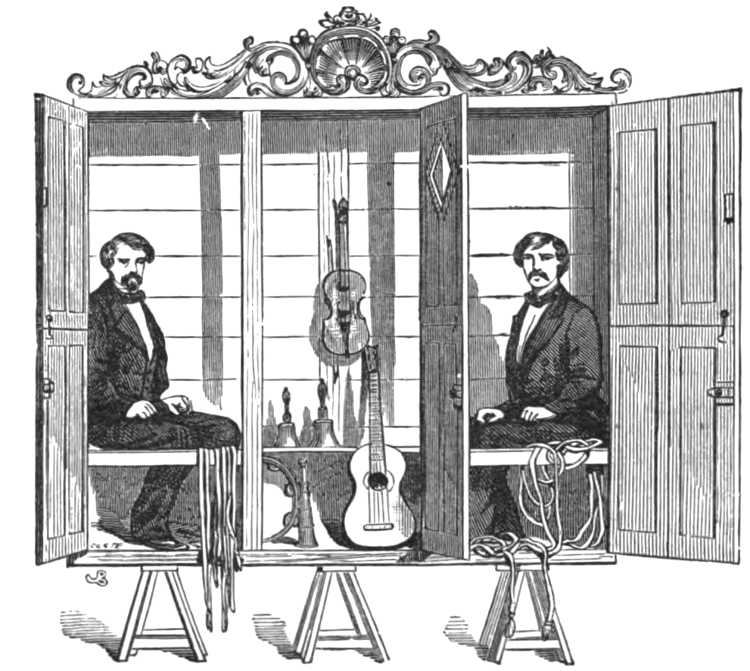
Fig. 24.
When the tying-up is complete, the first endeavour of the medium is, by dint of a particular movement which it is impossible to describe, to work up towards the shoulders the cords which are round the forearms, so as to give these last a little freedom. Next comes a process of pulling and straining; the wrists drawn vigorously apart operate as levers straining against the loops through which they pass, and by persistent pulling, they stretch such parts of the cord as may be susceptible of such extension. A quarter of an inch, or little more, of play, will suffice for the deliverance of one or the other hand. It should be stated, that by dint of special practice on the part of our mediums, the thumb is made to lie flat in the hand, when the whole assumes a cylindrical form of scarcely greater diameter than the wrist.
The first to get free of the four hands is passed through the opening, and shows itself to the spectators, while the three others still labour for the common deliverance. The hands once free, the remaining cords and the knots are then untied; the teeth rendering valuable service in this particular.
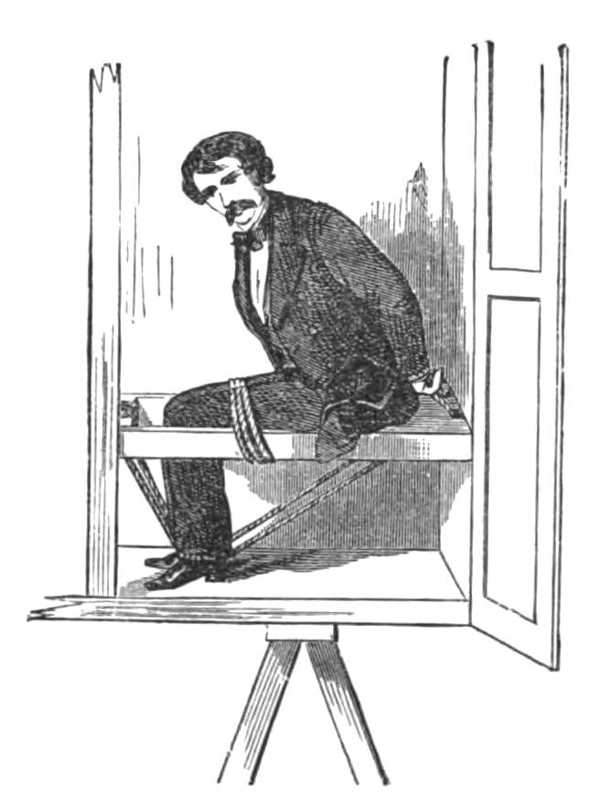
Fig. 25.
Ira Davenport (who in Fig. 24 is represented as being to the right hand of the spectator) is cleverer and more active than his brother, and is almost invariably the first to release himself. When this is so, he helps William. In any case, the first to get free assists the other.[45]
When the mediums bind themselves in their cabinet, the mode of tying which they employ enables them to free themselves and again secure themselves in an extremely small space of time. Fig. 25 will give some idea of the arrangement of the cords.
To produce such arrangement they proceed as follows: They take one of the cords by the middle, and form at that point a bow or double loop, as represented in Fig. 26.[46]
The reader will perceive that this is in fact a double slip-knot, the loops of which may be diminished or increased in size, according as the ends A and B are drawn tight or released.
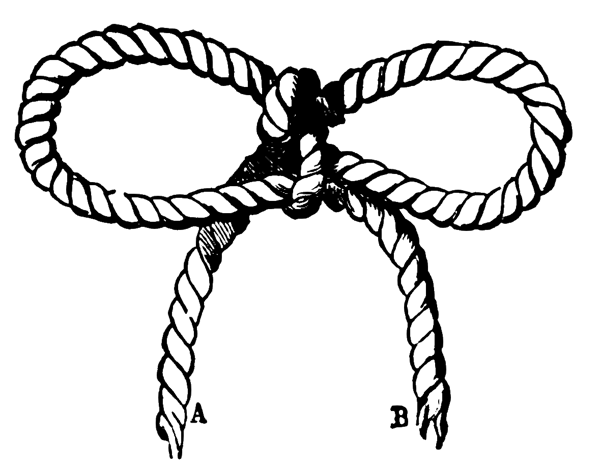
Fig. 26.
Leaving the two loops open as above, the performers pass through two holes, bored purposely in the seat, the two ends of the cord, which is long enough to be tied round their feet, and attached to the cross-bar in front. With the two other cords, they bind their thighs to the side rails, and sometimes also the arms close to the body. This done, they pass their hands through the loops, which they then draw tight by extending their legs slightly forward. Upon this “dodge” rests the whole pretended intervention of the spirits and the racket in which they indulge. In point of fact, no sooner are the doors of the cabinet closed than the two Brothers draw back their legs a little and slacken the knot, thus enabling themselves to draw out their hands and to become free. The violin, the guitars, the tambourine, and the bell are almost instantaneously set in motion, making a row of the most hideous description, which is still further enhanced by occasional kicks and thumps on the sides of the cabinet itself. After a short interval the instruments are restored to their original positions, the wrists are replaced in their ligatures, the doors are flung open, and all appear in due order as at first.
A representative selected by the audience is requested, as already described, to step upon the platform; he takes his place in the cabinet upon the seat in the middle. One of his hands is tied to Ira’s shoulder, and the other to William’s knee. But is it not obvious that this precaution, which is ostensibly taken against the two Brothers, is really in their favour? They have no need, in truth, to stir either knee or shoulder in order to carry out their mischievous pranks; and the stranger, having his hands tied, has no control whatever over their proceedings. He becomes a mere dummy; and under such circumstances, there is not the least difficulty in removing his spectacles (if he wears any), his necktie, or his pocket-handkerchief, and in crowning him with the tambourine.
Placing flour in the hands of the two Brothers does not at all interfere with their drawing them out of the slip-knot. The hands once free, they pour the flour into a pocket made on purpose in their coats, wipe their hands on the inside of the pocket, then pass them one after another through the opening in the door, to show that they are free, and finally indulge, as before, in their noisy concerto; after which, one of the Brothers takes from a side-pocket a little paper bag filled with flour, pours some into the hands of his companion and into one of his own, replaces the empty bag in its hiding-place, and then gives his other hand its due proportion of flour. The doors are opened, and the two Brothers, freed from their cords, come forward to show the public that their hands are still full of flour.
This little “flour test” terminated on one occasion in a manner which was rather embarrassing to the mediums, though highly diverting to the spectators. The person deputed to place the flour in the mediums’ hands hit on the cute idea of using snuff instead. The mediums saw nothing of the change, for at the moment in question their hands are held behind their backs. The two Brothers reappeared with flour in their hands. The trick which had been played them was then explained, and there was a hearty laugh all round, except, indeed, on the part of the discomfited tricksters.[47]
The explanation of the second portion, or Dark Séance, will be readily understood, inasmuch as the tricks still mainly rest on the famous “slip-knot” of which we have already spoken. The two Brothers are seated on either side of a table, on which are laid the guitars and tambourines; they have at their feet a heap of cords; around them is formed the magnetic circle of spectators, each holding the hand of his neighbour. The lights are turned down, and forthwith the two Brothers lash themselves to their chairs after the manner above described, and in the position depicted in Fig. 25. The only difference lies in the form of the seats used. Just as in the case of the cabinet, they can at pleasure fasten or unfasten themselves, and play the instruments which are on the table.
But, it may be asked, how do they manage when the knot which attaches them is sealed? The reader will note on inspection of Fig. 26, that it is quite possible to put wax on the middle of the knot, and even to seal the two portions of the cord at this point firmly together, without the movement of the ends A or B, or that of the loops themselves being at all interfered with. When the wrists are placed in the loops, this portion of the knot is always uppermost. And, further, the interpreter takes good care to indicate the precise point at which the seal is to be applied, adding a request that the investigator will be careful not to allow the melted wax to touch the wrists. This remark is sure to induce an amount of reserve which is very favourable to the success of the trick. Finally, it should be remarked, that the cord being as thick as the little finger, the impression of the seal cannot possibly extend beyond the point of junction of the two fixed portions.
We have, however, still sundry marvels to explain, viz., the fantastic evolutions of the guitars, the sheet of paper under the feet, the coat taken off and replaced, &c.
The guitars and the tambourine are smeared with a phosphorescent liquid whose faint glimmer does not shine brightly enough to reveal the outline of surrounding objects. The company are therefore in total darkness. Ira frees himself from his bonds, and, by the aid of a faculty which he has acquired of seeing in the dark,[48] he seizes one of the luminous guitars by the neck, steps forward with it as close as possible to the circle of spectators, and waves it over their heads, at the same time twanging the strings with the third and fourth fingers. The absence of any other object wherewith to compare prevents the spectator forming any decided judgment as to the distance of this vaguely luminous body; indeed, I have myself known a guitar which was almost touching my head appear to be several yards away. Meanwhile, the other medium, having also sufficiently freed himself from his bonds, holds up the other phosphorescent guitar and tambourine as high as he can, and with these two instruments makes as much noise and as much movement as possible.
The trick of the outline of the feet marked on the sheet of paper is very ingenious. Ira, after the above measure of precaution has been duly taken, quits his position on the sheet of paper in order to approach the spectators, but when he returns to his seat, takes care to turn over the sheet of paper before placing his feet upon it; and then, by means of a pencil, which he takes from one of his pockets, he traces another outline, which is taken to be the same which had been made by the public.
The “coat” trick is worked as follows:—Ira, freed from his bonds, takes off his coat, throws it into the middle of the hall, and catching up one which he has had placed on the lap of a spectator in the front row, puts it on instead, then replaces himself in his ligatures, and the trick is done.[49]