Note 49 — Chapter XIII · THE FEATS OF THE DAVENPORT BROTHERS.
Professor Hoffmann translation
Readers who chance to have had the opportunity of witnessing the Davenports’ performances will be impressed by the fairness and accuracy of Robert-Houdin’s description of the effects produced, not less than by the extreme simplicity of the mystery when explained. We may add that there is no possibility of question as to the correctness of the explanation given, which fully accords with the conclusions formed by all skilled observers of the Davenport “phenomena.” It must be conceded, in favour of the Brothers, that their performance of their difficult task was perfect of its kind, and far ahead of the majority of their imitators. One of their most successful rivals on their own ground, i.e., working wholly without mechanical aids, is Dexter, “the Man of Many Mysteries.” This gentleman equals the Brothers themselves in the quickness of his manipulations, while in one particular he may even claim to have surpassed them, viz., that his manifestations, including the startling “coat” feat, are produced without apparent disturbance of the original knots tied by the audience. The Davenports, it will be remembered, only produced their most startling effects after they had freed themselves from the original ligatures, and tied themselves in their own fashion, thereby gaining the benefit of the slip-knot described at page 205. Working in a somewhat different direction, the ingenuity of Messrs. Maskelyne and Cooke and others, by the introduction of mechanical aids, has developed the rope-tying and other spiritualistic “business” to an extent never dreamt of by their original promoters. Handcuffs, sacks, and locked and corded boxes have been added to the original appliances of bondage, and yet the captive is free to “manifest” in a variety of eccentric ways. We are indebted to Mr. Bland, of Oxford Street, for the opportunity of examining one of the latest appliances in this direction: a substantial brass collar, by means of which, after the closest and most careful scrutiny, the performer is secured to an equally substantial staple. It would seem that nothing short of a skilled locksmith could effect his release; but no sooner are the lights lowered than the captive is free, again instantly securing himself after completing his “manifestation” for the time being. The mechanism of this collar, which we must own completely baffled our most careful scrutiny, is a marvel of ingenious simplicity. In examining this cleverly constructed piece of apparatus, we could not avoid the reflection that large numbers of very honest people, (even including fellows of learned societies, and others who ought by profession and practice to know better) constantly accept, as conclusive, so-called “tests” offering infinitely less assurance than this deceptive collar; and we are led to suggest, as an almost obvious moral, that, human intelligence being fallible, wherever there is a sufficient motive for deception, means will always be found to deceive.
It would scarcely be possible, within the limits of a footnote, even to enumerate the thousand-and-one dodges of the professed medium. We will, however, give one or two examples, selecting our illustrations from such of the so-called “phenomena” as appear more particularly to stagger unbelievers.
A party of inquirers engage a medium to come to the house of one of their number. He comes, we will suppose, alone (this, by the way, no medium will ever do if he can possibly help it).
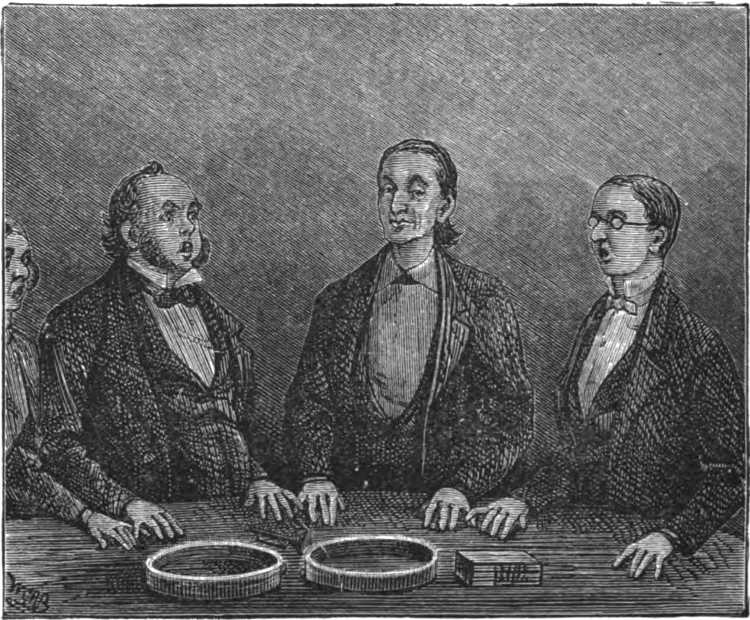
Fig. 27.
The other members of the party are all known to each other, and above suspicion. All sit round the table, joining hands in the usual manner (i.e., the hands laid flat on the table, the little fingers of each person crossing those of his neighbours on either side). The medium is placed, say, between Mr. A. and Mr. B. (see Fig. 27), both thorough sceptics, and both fully determined that he shall not stir a finger without their knowledge. And yet, the gas being extinguished, sundry mysterious things happen, which, the members of the party being ex hypothesi innocent of complicity in the matter, can only be the work either of the medium or some unknown agency. Mr. A. and Mr. B. are both absolutely certain that the medium’s little fingers have rested beneath their own during the whole performance; and therefore the “supernatural agency” solution is only too frequently accepted.
Now for the true explanation. After the party have sat long enough in darkness (possibly singing “Hand in hand with angels,” or some similarly inspiring strain) to begin to feel chilly and uncomfortable, the medium is seized with convulsive starts and twitchings, which are understood to be the premonitory symptoms of the approaching “influence.” Little by little, in the course of these convulsive spasms, he brings his hands gradually nearer and nearer, till they are at last quite close together, those of Mr. A and Mr. B. conscientiously accompanying them. At last, in the course of a more than ordinarily violent spasm, the right hand is drawn away with a jerk. The hand of Mr. A. (the guardian on the right) makes an instant effort to regain its position over the emancipated little finger, and apparently succeeds, really coming down on the outstretched left thumb of the medium, which is only a couple of inches distant. The condition of things is now altered as shown in Fig. 28. Mr. A. and Mr. B. are both carefully mounting guard over the left hand of the medium, while the right is free to pull hair, tweak noses, ring bells, rattle tambourines, or otherwise “manifest” as maybe desired. Still the convulsive twitching on the part of the medium continues. Presently the left hand also is jerked away. Mr. A. and Mr. B. each make a “grab” to regain it, and each meeting the other’s hand, settle down, in the calm assurance that they still command the movements of the medium, though in reality they are each carefully guarding the fingers of the other, while the medium is free to fetch chimney ornaments from the mantle-piece and place them on the table, personate “John King” or “Peter,” ring bells, strum guitars, or execute any other piece of tomfoolery which he may deem most adapted to the gullibility of his audience (see Fig. 29). If it is desired to jingle tambourines against the ceiling, or to execute any other manifestation requiring special length of reach, the performer calls to his aid a light, handy instrument made after the manner of the “telescope” toastingfork. This may be drawn out for use to a length of several feet, but when closed may be concealed in the pocket without difficulty. With this apparatus the enchanted tambourine or musical-box may be made without difficulty to describe a circle of fifteen or sixteen feet in diameter above the heads of the audience. When the medium has “manifested” sufficiently, he has only to resume his seat, and give a violent upward lurch to the table. This necessarily breaks the chain, and enables him to make a plunge to his original position, the hands on either side immediately closing on his own, in blissful unconsciousness that they have ever lost control of them.
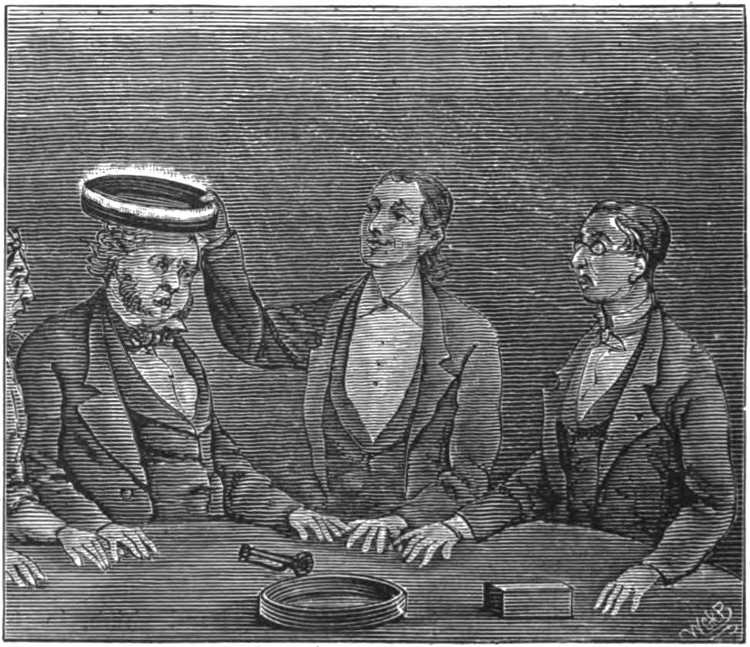
Fig. 28.
A favourite “manifestation” is that of the “icy hand,” a hand which wanders in an erratic manner among the audience, giving to one a clammy touch, to another a sudden grip, the icy coldness of its touch being amply sufficient (in the dark) to prove its supernatural origin, and to compel a shudder of horror from the least nervous of temperaments. This pleasing “phenomenon” is produced by nothing more uncanny than—a damp kid glove! A kid glove is clipped into cold water, and any superabundant moisture squeezed out of it. Thus prepared, it lies perdu in the tail pocket of the medium till wanted—when it is quietly slipped on in the darkness, and the hand, thus attired, begins to frolic playfully about the ears of the company, its clammy coldness having (to the imaginative) a charmingly corpse-like character, and provoking screams of delicious horror from the members of the “circle.”
But what are we to say to the mysterious hand which, in the “dim” but not particularly “religious” light of the all but extinguished gas, creeps from beneath the table-cover, and shows itself above the edge of the table (testibus the late Serjeant Cox and other credible persons)? We do not undertake to give of this or any other “manifestation” an explanation which shall apply to all recorded cases, each medium having his own peculiar modus operandi; but it will probably be in the recollection of the reader that this was one of the special “manifestations” of Dr. Monck, originally a Unitarian Minister, subsequently a professional medium, and ultimately adjudged, with unquestionable propriety, a rogue and vagabond, a year or two since. Dr. Monck was confessedly a medium of the first rank; indeed, notwithstanding the exposure at Huddersfield, we believe some of the more thorough-going spiritualists retain their faith in him still. By favour of Mr. Lodge, the gentleman to whose courage and acuteness the public are indebted for the exposure of a peculiarly mischievous impostor, we are enabled to give Dr. Monck’s special method of working this and a few other leading “manifestations.”
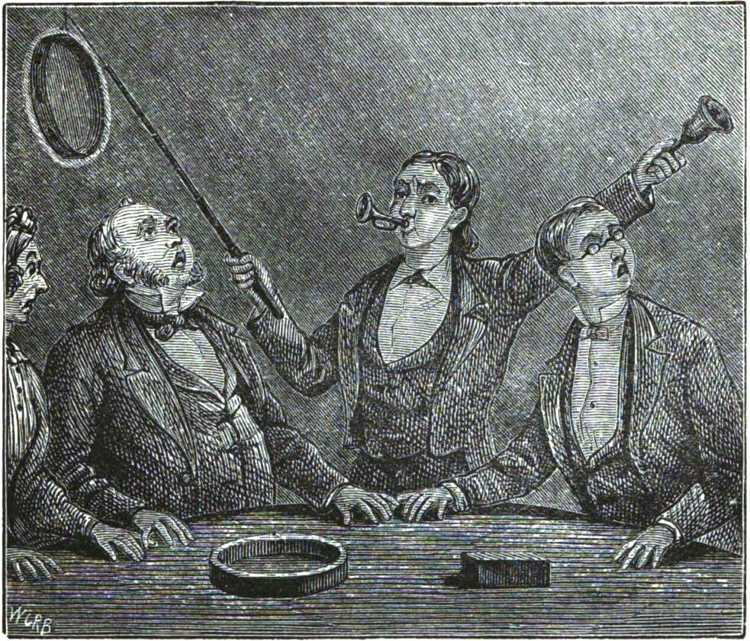
Fig. 29.
A dummy hand of small size, with the fingers slightly bent, is attached to a piece of broad elastic about three feet in length. This in turn is fastened to a belt round the performer’s waist, and thence passes down (say) his left trouser leg, the hand reposing, when not wanted, within the garment, a few inches above the ancle. To the wrist of the hand is appended a kind of elastic sleeve of five or six inches in length. (In Monck’s case, if we remember right, it consisted of the upper portion of an ordinary sock.) The medium, thus prepared, takes his seat at one side of a square table, with an overhanging table-cover, allowing no one else to be seated at the same side of the table. (Those who had the privilege of seeing Dr. Monck produce this particular “manifestation” will remember that the above conditions were always strictly insisted on.) Some one present is requested to lower the gas. “A little lower, please. A little lower yet!” till, as a natural consequence, it goes out altogether. “Dear me!” says the medium, “I am extremely sorry! I did not intend you to turn it out. Pray light it again.” This is done, and it is again lowered, but this time only to a dim twilight. Meanwhile, under cover of the momentary darkness, the medium has quietly crossed his left foot over his right knee, pulled down the dummy hand, slipped the “sleeve” portion over the toe of his left boot, and, with the foot masked by the table-cover, calmly bides his time. Presently, on the right hand of the medium, something is seen to be moving under the table-cover, making apparent efforts to come out. The medium, at the same time, prepares the minds of the spectators by declaring that he sees a hand floating about,—that it has touched him, and so on. Presently he gradually draws his foot, still crossed over the right knee, from under the table-cover, and allows the hand to show itself just above the surface, the effect to the spectators being as in Fig. 30, the ridiculous reality as in Fig. 31. Dr. Monck went so far as to offer a set of “fairy bells” to the touch of the spirit hand, and partly by scraping the hand against the wires (or rather the wires against the hand), and partly by a judicious use of his own fingers, produced sounds which, though not particularly harmonious, passed muster fairly enough as the production of a hand without a body. The manifestation over, the performer has only to place the left foot on the ground, and with the other foot dislodge the dummy hand, which is forthwith spontaneously drawn back by the elastic band beneath the sheltering trouser. The gas being turned up, sceptical gentlemen may search beneath the table, but in vain.
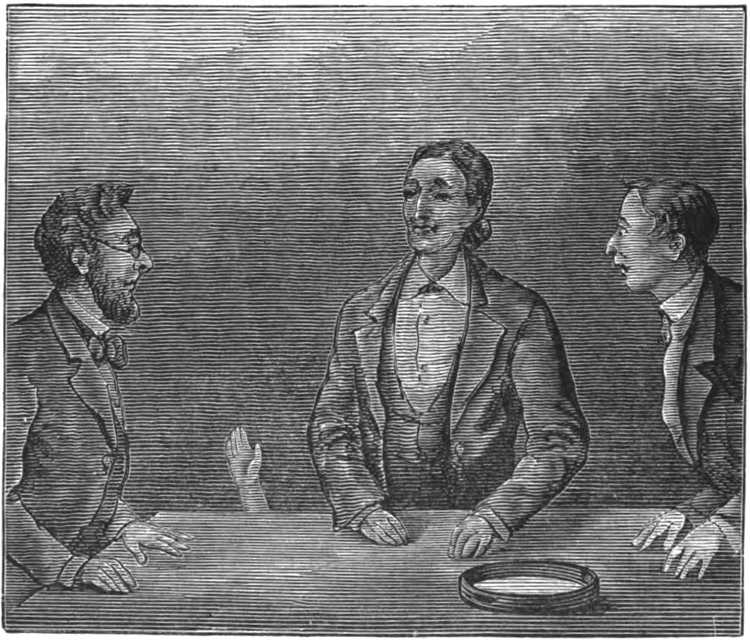
Fig. 30.
The working of the above feat demands of course some amount of lissomness in the lower limbs, but nothing beyond what any ordinarily active man, particularly if of spare build, could readily accomplish after a week or so of practice. The use of the lower limbs in a quadrumanous fashion is a stock artifice among the mediums. There is little doubt that a good many of the manifestations of the notorious “Dr. Slade,” of Bow Street celebrity, were produced in this manner, his unusual length of limb being a great advantage to him. The medium in this case wears light Oxford shoes or Albert slippers, which can be readily slipped off or on. The tip of each sock is cut off, leaving the toes completely bare. Thus equipped, the medium has but to slip his shoe off under the table, and with the great and second toe he is enabled to pull ladies’ dresses, pinch gentlemen’s legs, ring a bell placed under the table, &c., &c.
A second speciality of Dr. Monck was a mysterious power of attraction, by virtue of which, tambourines, photographic albums, &c., moved in the twilight across the table towards the medium. If some daring sceptic asked the Doctor whether he could not induce them to move to one side, or in the opposite direction, he was wont discreetly to reply that he found it better “not to attempt to dictate to the spirits in such particulars.” The reader will appreciate the wisdom of this reply on hearing the explanation of the modus operandi. Like most great inventions, it is simplicity itself when explained. The trick literally hangs on a thread—a black silk thread of about 2 feet 6 inches long, with a bent pin at each end. One of these is hooked into the elastic side of the performer’s right boot, the other into the cloth of his trousers, at the point which tailors describe as the “fork.” To work the trick, the medium (the lights being first duly lowered), lifts the right foot on to the left knee, thereby slackening the thread, unhooks the upper bent pin, and attaches it to the edge of the tambourine, or hooks it into the surface of a sheet of paper, newspaper, or the like, on which some article has been placed. His hands may now lie motionless on the table, or even be securely grasped by inquirers on either side, for they have no more to do with the matter. A gradual extension of the right leg tightens the thread, and causes the article attached to it to move towards the performer. The arrangement above described does not admit of a movement in any other direction. Doubtless, Dr. Monck found his cool evasion of this little difficulty so readily accepted by the faithful, that it was hardly worth while to seek to conquer it, though an expert conjuror would find but little difficulty in doing so.
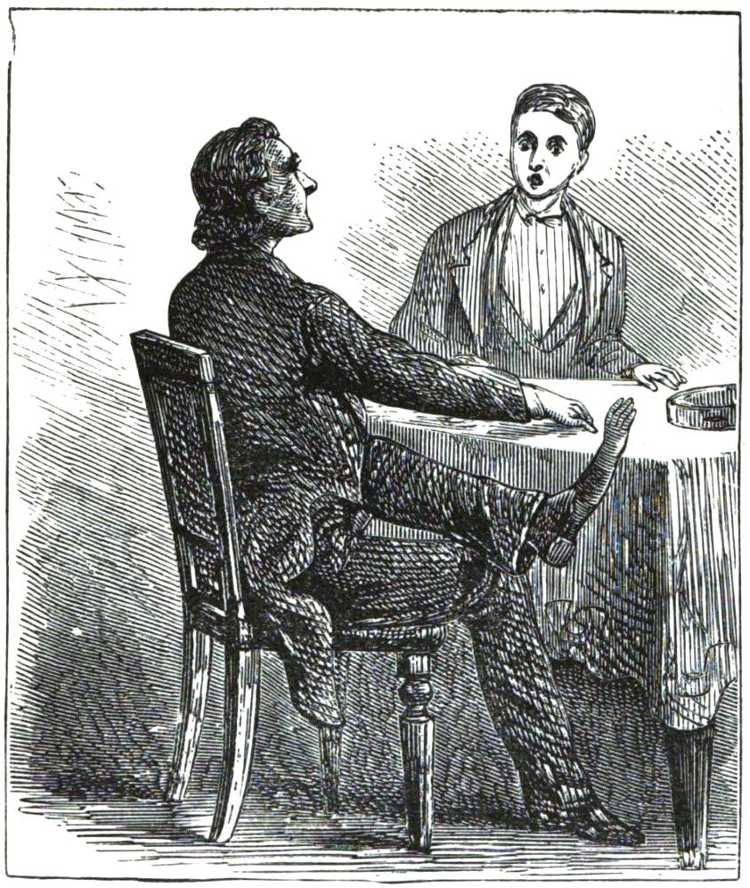
Fig. 31.
Another manifestation was the performance of the “spirit musical-box”: an ordinary musical-box, which, being placed on the table, and shielded from interference by, say, an empty cigar-box placed over it, played or ceased to play at the command of the medium.
This effect was produced by the aid of a second musical-box, playing the same airs as the first, and attached by an elastic band to the leg of the medium, just above the bend of the knee, of course within the trouser. When not in use the box rested beneath the knee, but when required for action it was brought round to the front of the leg, resting above the knee. The box was so arranged that pressure upon a stud at top caused it to play, the music immediately ceasing when such pressure was removed. The working of the trick will now be clear. The box on the table remains silent throughout, but when it is commanded to play, the medium with his knee presses the concealed box against the under surface of the table, again relaxing the pressure when it is desired that the music shall cease. The illusion, so far as sound is concerned, is perfect.
The above explanations, be it remarked, are not merely speculative. Dr. Monck beat such a hurried retreat from the scene of his disaster, that he left all the above appliances, with others too numerous to mention, behind him. They were taken possession of by the chief constable of Huddersfield, and told their own tale to any skilled observer.
We could multiply instances almost ad infinitum. There is hardly a professional medium now before the public, who has not been, at some time or other, detected in barefaced imposture; and there is hardly a stock trick of the mediums (slate trick, writing on the ceiling, et hoc genus omne), that is not perfectly well known to legitimate conjurors, although, as a matter of professional policy, they find it more profitable to keep, than to expose, the secret. To those who have any lurking doubt as to the real nature of spiritualism, we cannot do better than commend a perusal of Mr. Maskelyne’s clever little book, “Modern Spiritualism,” wherein he has described, in a light and amusing form, the rise and progress of this most discreditable craze, and chronicled the exposures which the leading professors of the craft from time to time have met with. We are glad to note that he promises, at some future time, to supplement this work with another, explaining the whole secrets of the mediumistic art, a task which no man is better qualified to perform. Meanwhile, the seeker after truth combined with amusement cannot do better than pay a visit to the great anti-spiritualist himself at the Egyptian Hall, where he will witness “manifestations,” though introduced in comic guise, to the full as “genuine,” and infinitely more surprising, than the stock achievements of the spiritualists. Here he will see Mr. Cooke—though bound and sealed and enveloped in network from head to foot—ring bells, rattle tambourines, exhibit spirit-hands, &c., &c., finally carrying the cabinet with him in an aërial flight about the hall. Here he will find walking-sticks justify their name by walking spontaneously across the stage, tables defying not only the vis inertiæ but the power of gravitation, tambourines that “rap” visibly in answer to questions, and, finally, see Mr. Maskelyne himself, not under the convenient shade of darkness, but illumined by a very respectable amount of gaslight, float gently upwards towards the roof of the hall. The reader who has carefully followed Robert-Houdin’s description of the “floating table” in an earlier section, may probably make a shrewd conjecture at the nature of the means (of course mechanical), by which this particular effect is produced.
Here we pause to anticipate an objection which will inevitably be raised by “true believers,” if any such chance to peruse these humble pages. “Mechanical means!” it will be said. “Of course! Mr. Maskelyne performs upon a stage, and has full command of stage appliances. But how do you account for the well-authenticated instances of the medium having been floated about the room in a house which he then visited for the first time, and where the use of any mechanical means for such a purpose was clearly out of the question?”
We do not pretend to account for it, gentle reader, for we utterly deny that any such impertinent interference with the laws of nature ever took place. The “well-authenticated instances” referred to have invariably happened in darkness, and the utmost the most positive person can say is, that during such darkness, something or other happened which gave him the impression that the medium’s manly form had quitted terra firma, and was floating about the room. Now such an impression can be produced by the simplest possible means. Note the conditions. A circle of persons is seated in a room in total darkness; they are warned to expect something supernatural. They wait in this unpleasant expectation until they perforce become more or less nervous. They are kept in an attitude of fixed attention, which, long maintained, tends to merge, as the physiological student is well aware, into the “hypnotic” or morbidly impressionable state. Every creak of a chair, every sound, however minute, may be the outward and visible sign of a message from another world. Under such circumstances, when the musical-box spontaneously strikes up “Home, sweet Home!” when the medium remarks “I am leaving the floor; don’t notice me; talk of something else;” and then a shadowy something, with an unmistakable perfume of leather, passes over the heads of the assembled group, the heel of a boot perhaps resting lightly on a head or a shoulder in its passage,—who so sceptical as to doubt that the medium has really been “levitated” in the manner suggested? Who so sceptical, indeed? unless in truth he was aware, or was shrewd enough to suspect, that the medium, under cover of the darkness, had quietly taken off his boots, slipped them upon his hands, and gently moved them backwards and forwards over the heads of the awe-stricken investigators (Fig. 32).
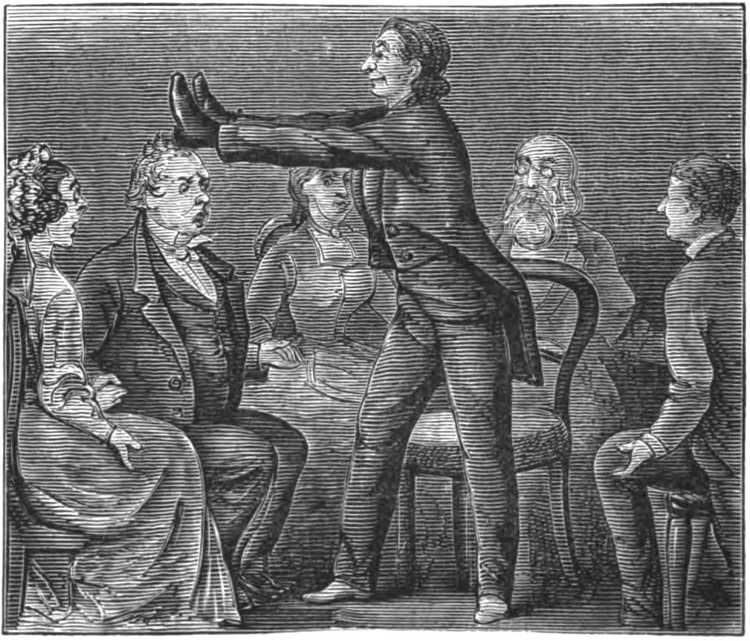
Fig. 32.
The process of reasoning is obvious. “Here are the medium’s boots, floating in the air on a level with our faces. Where a man’s boots are, there his feet must be; and if a man’s feet are floating in the air, his whole body must be floating also. Ergo, we are henceforth prepared to make affidavit that the medium did at such and such a time actually float about such and such a room in our presence.”
Lest the simplicity of the explanations we have here given should tend to discredit their genuineness, we may remind the reader that the art of conjuring consists not half so much in doing wonderful things (for what is actually done is often very simple), as in persuading the spectator that wonderful things are done. It is a matter of common knowledge among conjurors, that not one spectator in a hundred, unless he be himself a conjuror, can give even a fairly correct account of what has been visibly done in the performance of a trick. And if such be the case in broad gaslight and with every opportunity of observation, how much more is it likely to be so in darkness or semi-darkness, with scarce half of the physical senses permitted to be used, and the mental vision obscured by the belief or semi-belief of supernatural intervention.—Ed.]